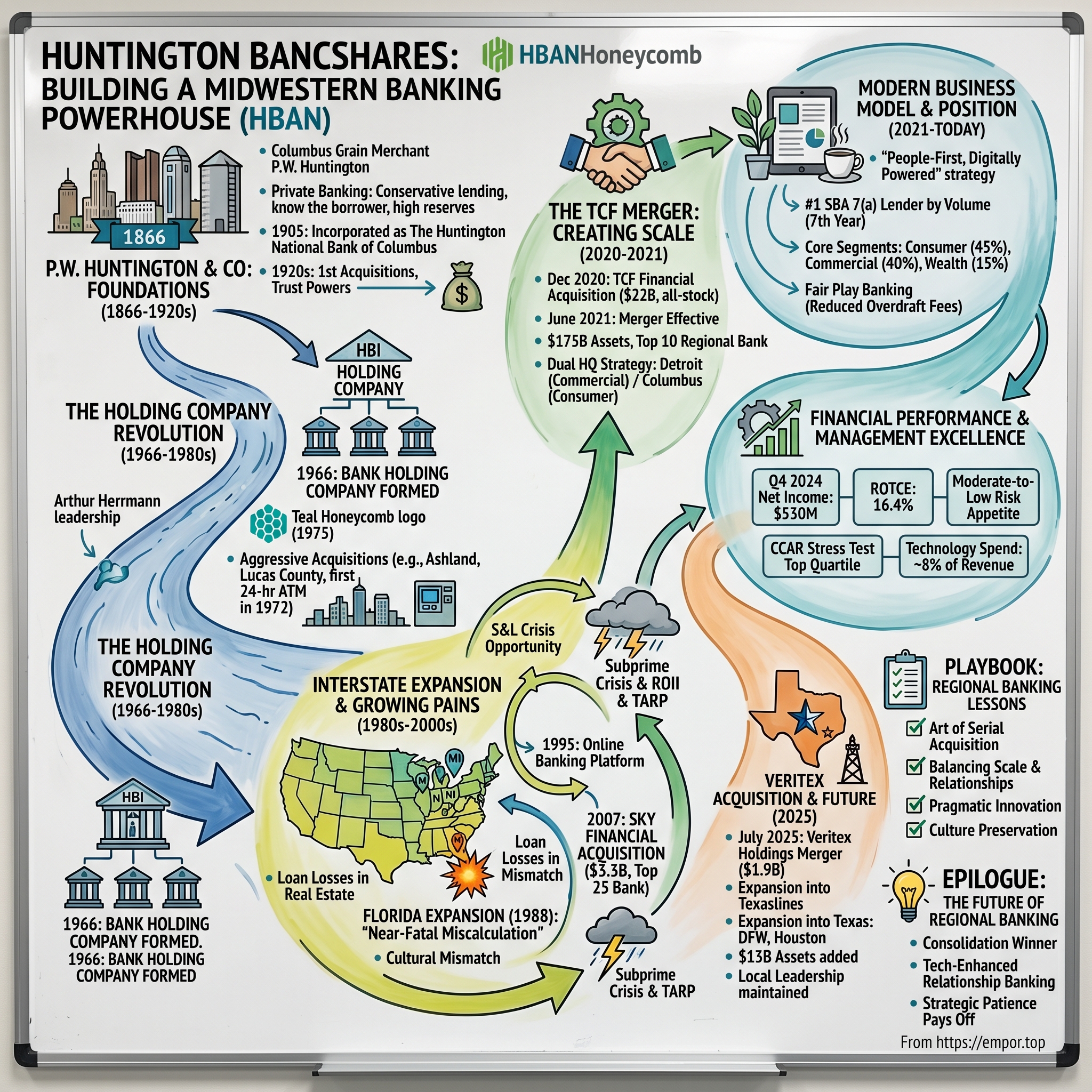
Huntington Bancshares: The Rust Belt Fortress and the Texas Frontier
I. Introduction & The Regional Banking Crucible
On the morning of January 22, 2009, Huntington Bancshares shareholders woke up to find their quarterly dividend reduced to a token penny per share—down from 13.25 cents, which itself was already half of what the bank had paid just a year earlier.12 In the same earnings announcement, the Columbus-based lender disclosed a fourth-quarter loss of $417.3 million, a tangible common equity ratio that had dropped below 4%, and a $722.6 million credit-loss provision largely tied to a New Jersey subprime mortgage servicer unfamiliar to most of Huntington's retail depositors.1 Two months earlier, the 142-year-old institution had accepted $1.4 billion of preferred equity from the U.S. Treasury.1[^3] Eight days before slashing the payout, the board had brought in an outsider from Boston to take over executive leadership.3
By the summer of 2026, Huntington presented a fundamentally different balance sheet. At the close of June, the bank reported $284 billion in total assets, $223.4 billion in average deposits, quarterly net income of $727 million, and credit quality that held steady with an annualized net charge-off ratio of just 0.25%.45 Management had also just completed core systems conversions for Cadence Bank, a $53 billion lender operating across Houston and Tupelo, Mississippi, eight months after closing the purchase of Dallas-based Veritex.647 A retail footprint that once halted at the Ohio River now encompassed nearly 1,400 branches spanning 21 states, stretching from Minneapolis to Mississippi.8
The distance between those two moments frames a central structural challenge in American finance: regional banking's squeezed middle. At the top stand money-center titans like JPMorgan Chase and Bank of America, commanding technology budgets that dwarf the entire annual revenue of most regional peers. At the bottom operate thousands of community banks whose primary moat is intimate, relationship-driven underwriting. Between them sit the super-regionals—institutions too large to rely purely on local goodwill, yet too small to match the scale economies of national leaders. For seventeen years, Huntington has attempted to prove that this middle tier can operate as a defensible fortress rather than a structural trap.
The company trades on the NASDAQ Global Select Market under the ticker HBAN. Earlier iterations of this corporate narrative captured a regional institution with roughly $208 billion in assets, an exclusively Midwestern footprint, and an unclosed Texas expansion. That snapshot quickly became outdated. Between October 2025 and February 2026, Huntington completed two acquisitions, absorbed roughly $65 billion in assets, and in September 2026 appointed a new president widely viewed as the successor to the chief executive post.9610 The southward expansion is no longer a tentative strategic trial; the capital is committed, the platforms are unified, and the balance sheet is exposed.
The path to this juncture spans six distinct chapters: a conservative 140-year prologue that ended with a costly Florida real-estate misadventure; a late-cycle acquisition that brought the bank to the brink of failure; a post-crisis recovery anchored in consumer overdraft reform and small-business lending; two major in-market consolidations that built scale; the sector-wide liquidity shocks of March 2023; and the Sunbelt expansion now underway. Throughout that trajectory runs an essential question for long-term bank investors: has Huntington established a franchise with a durable structural moat, or is it an efficiently operated commodity lender buoyed by the interest-rate cycle?
The answer begins, as bank histories often do, with an elderly founder counting cash in a modest Ohio office.
 Subscribe on LinkedIn
II. The 140-Year Prologue: From High Street Private Bank to Interstate Acquirer (1866–2006)
A Messenger Boy Builds a Bank
Pelatiah Webster Huntington entered banking at 17 as a messenger boy in Columbus, Ohio. In 1866, with the Civil War freshly concluded and the state's manufacturing and rail corridors entering an industrial boom, he established his own private banking house.11 P.W. Huntington embodied the fiscal conservatism of postbellum commerce: frugal, deeply skeptical of speculative ventures, and inclined toward permanent institutions. In 1878, he erected a five-story headquarters that Columbus residents dubbed the city's first skyscraper.11 He eventually integrated four of his five sons into the partnership, and in 1905, the private firm formally incorporated as The Huntington National Bank of Columbus.11
Under the leadership of his son Francis R. Huntington, the bank initiated its first external consolidations, acquiring State Savings Bank and Trust alongside Hayden Clinton National Bank in 1923.11 Concurrently, management cultivated a large fiduciary practice. Corporate archives indicate that by 1930, Huntington's trust assets exceeded all of its commercial banking assets combined.11 That concentration established an enduring institutional tone. Trust administration is a business of fiduciary longevity and quiet reputation, where clients place multi-generational wealth with the expectation of wealth preservation rather than speculative yield. For the majority of its first century, Huntington's prevailing corporate identity was that of a regional wealth steward.
The Holding Company and the Handy Bank
For decades, Ohio's restrictive branch-banking statutes capped geographical reach at county borders. To circumvent these limits, regional institutions adopted the multibank holding company structure, establishing a parent entity that could purchase and operate individually chartered banks across state lines. Huntington formed Huntington Bancshares in 1966, marking its centennial anniversary.11 A swift series of acquisitions expanded the balance sheet from approximately $400 million in 1966 to nearly $2.5 billion by 1979, encompassing 15 affiliated banks and 97 branch locations.11
The institution also demonstrated an early appetite for retail automation. In 1972, Huntington deployed what it billed as the first 24-hour, fully automated banking facility in the United States—a freestanding, kiosk-style installation known as the "Handy Bank."11 Decades later, executive messaging frequently invoked a "digitally powered" strategy, an identity rooted in that early experiment. Yet being first to introduce an automated terminal in 1972 did not secure permanent technical differentiation; automated teller machines became an undifferentiated industry commodity within a decade. That early cycle of proprietary innovation swiftly replicated by larger competitors became a recurring motif in Huntington's history, prefiguring the contemporary question of whether any regional player can construct a lasting technological edge against national money-center rivals.
Deregulation, Debt, and the Florida Detour
The 1980s ushered in a leadership transition under Frank Wobst, an executive who assumed the presidency in 1981 and the chief executive role in 1984, working alongside Zuheir Sofia, who advanced from the bank's international division.11 The defining strategic move of that era came in 1982 with the buyout of Cleveland-based Union Commerce Corporation. The transaction doubled Huntington's balance sheet overnight, but it also saddled the holding company with severe debt that required six years of methodical de-leveraging to work off.11 The episode introduced an enduring dynamic of interstate banking: wholesale acquisitions deliver instantaneous scale, but routinely demand years of operational friction and balance-sheet repair.
As federal deregulation cleared the way for interstate banking compacts, Huntington established holding companies across Indiana, Kentucky, and Michigan, while extending credit and retail operations into Florida, Delaware, New Jersey, and Pennsylvania.11 By 1994, the bank oversaw $18 billion in total assets across more than 450 offices in 17 states, making it the 40th largest commercial lender in the nation.11
Florida represented the most attractive target in that outward campaign. Lured by an influx of Midwestern retirees migrating south with their life savings, Huntington followed their deposits. The bank constructed a substantial franchise across central Florida, with retail clusters in Tampa, St. Petersburg, Orlando, Sarasota, and Bradenton, coordinated through an operations center in Lakeland.12 The strategic premise was straightforward: shadow Midwestern retail liquidity wherever it migrated.
The execution, however, proved unsustainable. In July 2001, Huntington announced a sweeping restructuring program that entailed a complete divestiture of its Florida operations.12 On February 15, 2002, the bank completed the sale to SunTrust Banks, offloading 143 offices, roughly $4.8 billion in deposits and liabilities, and approximately $2.9 billion in loans and associated assets for a 15% deposit premium totaling $718.5 million.12 While conventional accounts frequently cite 126 branches, Huntington's official regulatory filings registered 143 locations.
Huntington never published a comprehensive post-mortem detailing the Florida failure. The regulatory record simply charts an institution that expanded into 17 states through rapid dealmaking and then, under Chief Executive Thomas Hoaglin, retrenched to its core Midwestern perimeter.3 Industry analysts generally concluded that operating a thin retail network in a contested Sunbelt market, without the deep commercial lending ties that anchor primary corporate operating accounts, yielded high overhead and negligible pricing power. The premium paid by SunTrust affirmed that the branch network held real franchise value for a buyer with dense local market share; it simply lacked strategic value inside Huntington's distributed network.
For investors evaluating the bank's modern strategy, the Florida divestiture stands as a cautionary precedent for out-of-footprint expansions—a precedent made immediately relevant by Huntington's decision to re-enter Orlando and Tampa by 2026.6 Before staging that southern return, however, the bank first had to survive the most perilous acquisition in its history.
III. The Near-Death Experience: Sky Financial & The Subprime Abyss (2007–2008)
The Handshake at the Top
On December 20, 2006, Huntington announced an agreement to acquire Sky Financial Group of Bowling Green, Ohio, for approximately $3.6 billion, structured as 90% stock and 10% cash.13 Under the transaction terms, Sky shareholders were slated to receive 1.098 Huntington shares plus $3.023 in cash per share, valuing Sky at $30.22 at the time—a 25% premium to Sky's prior close.13 The combined bank would command 756 offices and approximately $38 billion in deposits.13 Huntington projected roughly $115 million in annual cost savings and guided that the transaction would be immediately accretive to 2007 earnings.13
The deal also carried an explicit succession plan. Sky's chairman, Marty Adams, was appointed Huntington's president and chief operating officer, with a plan for him to become chief executive by the end of 2009.13 The merger closed on July 1, 2007.14 The timing proved precarious: by the middle of 2007, the first cracks across the subprime mortgage market were already widening into open distress.
By the time the transaction closed, Huntington's falling share price had trimmed the deal's recorded value to $3.3 billion rather than the $3.6 billion originally announced.14 Paying predominantly in equity cushioned the initial cash outlay, but it did nothing to insulate the balance sheet from the underlying credit risks Huntington had absorbed.
The Franklin Landmine
Inside Sky's loan portfolio sat a massive credit exposure to Franklin Credit Management Corporation, a New Jersey specialty lender that bought and serviced subprime and second-lien mortgages. Huntington served as the lead agent and largest participant in the bank syndicate funding Franklin.15 In practice, Huntington was financing an intermediary whose entire asset base consisted of high-risk residential loans, just as nationwide borrower defaults began to accelerate.
On January 3, 2008, Huntington announced a restructuring of the Franklin relationship. Two weeks later, Huntington reported a fourth-quarter 2007 net loss of $239.3 million, driven by a $405.8 million credit provision tied to Franklin.2 Chief Executive Thomas Hoaglin's public assessment was blunt: "Clearly the biggest setback was the significant negative impact associated with the previously announced restructuring of the Franklin relationship acquired in the Sky Financial merger."2 The same earnings release recorded $13.4 million in retirement benefits for Marty Adams, the executive designated to run the combined bank.2 The merger's carefully arranged succession plan had lasted roughly six months.
In August 2008, Hoaglin said Franklin's updated reserves were "more in line" with Huntington's internal assumptions and that exposure stood at $1.13 billion, net of charge-offs.15 That reassurance proved short-lived. In the fourth quarter of 2008, Franklin-related charges totaled another $454.3 million pre-tax.1
The Bottom
The lag between emerging credit losses and capital preservation was stark. In January 2008, with the first Franklin loss already booked, the board still declared a 26.5-cent quarterly dividend and guided to full-year 2008 earnings of $1.57 to $1.62 per share.2 Instead, 2008 ended with a steep full-year net loss.1 The quarterly dividend was reduced from 26.5 cents to 13.25 cents and ultimately to a single penny.21 On November 15, 2008, Huntington shored up its balance sheet with $1.4 billion in preferred capital from the U.S. Treasury's Capital Purchase Program.1[^3] Tangible common equity fell to 3.98% of tangible assets by year-end, leaving the bank with negligible cushion to absorb further credit impairment.1
Public equity markets reflected the damage. Huntington shares had closed at $24.77 the day before the Sky announcement.13 Seven years after the crisis, in January 2016, they still closed at just $8.80.16 The transaction had been accretive on paper, but ruinous in practice.
The Post-Mortem
The Sky acquisition was not an isolated misstep, but a sequence of compounding errors. Huntington paid a substantial premium at the peak of a credit cycle; it funded the transaction with its own equity, heavily diluting existing owners; and it inherited concentrated wholesale exposure to subprime mortgage servicing, a business model alien to traditional commercial banking. The breakdown was fundamentally one of due diligence and risk appetite rather than post-merger operations; system conversions and branch integrations did not cause the collapse.
For bank investors, the enduring lesson is straightforward: existential risk in bank acquisitions rarely stems from branch overlap or technology integration, but from hidden credit concentrations that the buyer fails to fully understand. Every transaction Huntington pursued thereafter was shaped by that institutional trauma, establishing the backdrop for the outsider brought in to overhaul the bank.
IV. The Steinour Resurrection: Recapitalization, "Fair Play," & The Low-Risk Mandate (2009–2015)
The Outsider From Providence
Stephen D. Steinour was elected chairman, president, and chief executive of Huntington on January 14, 2009.3 His career arc read like an itinerary through modern American banking distress. From 1980 to 1983, he worked at the Federal Deposit Insurance Corporation in the Division of Receiverships and Resolution, the unit tasked with unwinding failed institutions.3 He then spent eight years at Bank of New England, from 1983 to 1991, followed by a tenure at Fleet.3 Between 1992 and 2008, he helped build Citizens Financial Group in Providence, advancing to president in 2005 and chief executive in 2007; Huntington's lead director credited him with expanding Citizens from a $3 billion regional lender into an institution surpassing $160 billion in assets.3 Following his departure from Citizens in 2008, he served briefly as a managing partner at Boston-based CrossHarbor Capital Partners.3
That background proved decisive. Steinour had observed firsthand the consequences of an unmoored credit culture, experiencing both bank resolutions at the FDIC and Bank of New England's collapse. He was also an experienced operator who had navigated rapid, acquisition-led balance-sheet growth during Citizens' expansion under Royal Bank of Scotland. Huntington did not recruit a financial visionary; it hired an executive trained to spot institutional vulnerabilities and manage balance-sheet risk. Thomas Hoaglin, who had led the company since 2001 and presided over both the Florida divestiture and the Sky Financial transaction, retired.3
Paying Back the Treasury
The immediate priority was recapitalization. Huntington raised new common equity, diluting existing shareholders to rebuild its depleted capital base. On December 22, 2010, the company repurchased the entire $1.4 billion of preferred stock held by the U.S. Treasury under the Capital Purchase Program, funding the redemption with proceeds from common equity and debt offerings completed the preceding week.17 "The repayment was possible because of the significant progress we have made in strengthening our balance sheet," Steinour said.17
For long-term investors, that recovery carried an enduring cost. Retiring the government's preferred equity protected the institution, but funding the redemption through substantial secondary share sales locked in permanent dilution for pre-crisis owners. Stabilizing the bank's solvency did not restore the equity value erased in 2007 and 2008.
Fair Play: Giving Money Back on Purpose
The initiative that came to define Steinour's early tenure ran counter to prevailing industry practice. In 2010, regional and money-center institutions leaned heavily on consumer overdraft fees. Depositors who overran a checking account by even modest amounts routinely faced charges near $35, often levied several times within a single day. For retail banking divisions across the sector, overdraft penalties formed a highly lucrative income stream.
Huntington moved in the opposite direction. In September 2010, the bank unveiled "24-Hour Grace": retail account holders who overran their balances were granted until the close of the next business day to deposit sufficient funds to waive the fee.18 Huntington's retail director framed the consumer proposition simply: "Give me a little time I'll make the deposit."18 American Banker reported that Huntington anticipated an immediate $24 million annual revenue reduction from the grace period and associated fee adjustments, coming alongside a separate $52 million decline driven by new federal caps on overdraft practices and debit interchange fees.18 The broader consumer repositioning was branded "Fair Play Banking." A decade later, in September 2020, Huntington broadened the framework by extending 24-Hour Grace to commercial accounts and establishing a $50 "Safety Zone," beneath which minor overdrafts incurred no penalties.19
In the strategic terms popularized by author Hamilton Helmer, this represented classic counter-positioning: an operational gambit that dominant competitors could not replicate without inflicting direct damage on their existing profit pools. For national institutions booking hundreds of millions of dollars in penalty revenue, adopting Huntington's stance meant voluntarily surrendering non-interest income. Huntington, smaller and emerging from a recapitalization, had comparatively little fee income left to protect and far more to gain in retail trust.
The long-term efficacy of that strategy requires critical examination. Management credited Fair Play with accelerating core retail checking acquisition and anchoring low-cost deposits—an assertion supported by the deposit stability detailed in Section VII. Yet Huntington never published an audited, isolated metric tracking the exact volume of balances directly attributable to the program. Furthermore, counter-positioning advantages inevitably compress over time. By the early 2020s, intensifying regulatory scrutiny and digital competition prompted lenders across the banking system to lower or abandon overdraft penalties, eroding Huntington's operational distinction. Fair Play successfully rebuilt retail deposit inflows during a critical rebuilding window, but its utility as a unique structural moat has largely passed.
The SBA Machine
Steinour's second strategic pillar targeted small-business banking. The U.S. Small Business Administration's primary 7(a) program provides a federal guaranty on a substantial portion of eligible commercial loans, reducing underwriting exposure and permitting banks to sell the guaranteed tranches into the secondary market for non-interest fee income.20 Huntington established a focused origination and distribution infrastructure around the platform.
By October 2024, Huntington reported that it had ranked as the nation's largest SBA 7(a) lender by volume for seven consecutive fiscal years.21 Over fiscal 2024, the bank originated 7,577 SBA 7(a) loans representing roughly $1.53 billion in total commitments, securing the top origination ranking across nine states, including core markets like Ohio and Michigan alongside expansion targets like Texas.21
The key distinction lies in the phrase "by volume." Huntington's top ranking measured the raw number of loans approved rather than the total dollar amount disbursed. Dividing the aggregate dollar volume by total originations yields an average transaction size of approximately $200,000. Huntington's SBA strategy focused on financing localized enterprises—such as machine shops, auto repair centers, and small retailers—at scale, rather than syndicating high-dollar credits. The economic value of that volume was fundamentally relational: a business securing an SBA loan frequently anchored its primary corporate operating accounts, payroll processing, and subsequent commercial credit lines with the bank. In practice, the SBA desk operated as an efficient customer acquisition funnel rather than an isolated high-margin profit center. Because no subsequent disclosure confirming an eighth consecutive annual title was published in the disclosures reviewed for this period, Huntington's leadership streak into fiscal 2025 remained unconfirmed.
Institutionalizing "Aggregate Moderate-to-Low Risk"
The third pillar focused on credit underwriting culture. Huntington codified an internal credit framework designated as an "aggregate moderate-to-low risk" appetite, establishing hard exposure ceilings for commercial real estate portfolios and individual borrower concentrations. The emphasis on "aggregate" carried specific portfolio implications: management tolerated higher-margin, moderately riskier commercial exposures only to the extent that overall portfolio volatility remained contained by lower-risk assets. The ultimate measure of any credit policy is not its internal documentation, but realized charge-off rates across a complete credit cycle. Nonetheless, the institution that had absorbed a catastrophic $400 million loss on a single subprime mortgage servicer in 2007 had established an operational framework structured to prevent concentrated borrower failures. The pivotal question was whether an institution committed to low-risk underwriting could generate competitive asset and earnings growth.
V. Building Regional Scale: The FirstMerit Inflection (2016–2019)
Akron, January 2016
FirstMerit was a quintessential Northeast Ohio institution: headquartered in Akron, deeply tied to the regional tire and rubber manufacturing economy, and supported by a stable deposit base with operations extending across Michigan, Wisconsin, Illinois, and Pennsylvania. On January 26, 2016, Huntington announced an agreement to acquire FirstMerit for 1.72 Huntington common shares plus $5.00 in cash per share, valuing the target at approximately $20.14 per share or $3.4 billion in total.16 When the transaction closed on August 16, 2016, Huntington's rising share price had lifted the transaction value to roughly $3.7 billion, creating a regional lender with 1,091 branches across an eight-state Midwestern footprint.22
The Deal Math, Honestly
The strategic contrast with the Sky Financial transaction was pronounced. Rather than acquiring out-of-footprint risk at the crest of a credit cycle, Huntington targeted an overlapping in-market competitor. Valuation multiples reflected that discipline: Huntington paid approximately 1.6 times FirstMerit's tangible book value and 14.3 times estimated 2016 earnings, a multiple that fell to 7.9 times earnings once fully phased cost synergies were factored in.16 Management identified annual pretax cost reductions of roughly $255 million, representing about 40% of FirstMerit's non-interest expense base, with 75% targeted for realization in 2017 and 100% thereafter.16 Huntington projected approximately 10% earnings-per-share accretion in 2018, a lift of more than 300 basis points in return on tangible common equity, and an internal rate of return exceeding 20%.16
The underlying operational rationale rested on dense branch proximity. Roughly 65% of the two lenders' retail branches were located within two miles of each other.16 In retail banking, geographic overlap provides a straightforward consolidation playbook: an acquirer can eliminate duplicative branch real estate and consolidate back-office overhead while retaining the acquired deposit relationships.
Yet that operating efficiency required upfront capital sacrifice. Huntington disclosed that the transaction would dilute tangible book value per share by approximately 12%, projecting an earn-back period of roughly five and a half years.16 For bank investors, five and a half years represented a lengthy horizon to recover per-share tangible equity. The acquisition was fundamentally a wager that operating synergies would overcome near-term capital dilution, demanding further patience from an investor base that had already absorbed significant dilution during the post-crisis recapitalization.
Did It Deliver?
Huntington's subsequent reported financial results were consistent with capturing those projected expense reductions, and FirstMerit produced no credit surprises comparable to the Franklin exposure that had derailed the bank eight years earlier. Secondary accounts of the merger have often asserted that the bank surpassed the $255 million synergy target within 18 months, executed the core technology migration over a single weekend, and fully re-underwrote FirstMerit's entire commercial loan portfolio prior to closing. Because primary public filings do not independently corroborate those specific claims, they remain unverified. The verifiable conclusion is more measured: FirstMerit represented a disciplined in-market consolidation with achievable financial targets that avoided operational disruption. The merger demonstrated that the reconstituted Huntington could absorb a major regional peer without compromising its balance sheet, even if it did not conclusively prove unique integration prowess.
The Supermarket Detour
The mid-2010s also encompassed an alternative retail distribution strategy: operating in-store branches within regional supermarket chains like Giant Eagle and Meijer. These locations featured compact physical footprints and extended operating hours, designed to capture consumer deposits during routine weekly shopping trips. However, as mobile banking applications increasingly absorbed everyday check deposits, transfers, and cash management, the strategic relevance of grocery-store branches receded. While the format expanded consumer reach at low upfront capital cost, it offered no lasting operational moat against digital disruption. The FirstMerit consolidation served as the primary rehearsal for large-scale integration; the true test of Huntington's modern operational capacity arrived with the pandemic.
VI. The Mega-Merger: TCF Financial & The Midwest Super-Regional (2020–2022)
A Deal Announced in the Dark
December 2020 was an unconventional moment to pursue bank consolidation. With COVID-19 vaccines only beginning to circulate, credit-loss reserves elevated across the sector, and the survival of thousands of small businesses still uncertain, balance-sheet visibility remained poor. On December 13, 2020, Huntington and Detroit-based TCF Financial announced an all-stock merger with a combined market value of about $22 billion.23 Under the transaction terms, TCF shareholders were slated to receive 3.0028 Huntington shares for each share held.23 At announcement, the combined institution was projected to hold approximately $168 billion in total assets.23
The strategic rationale relied on familiar levers. Huntington targeted approximately $490 million in annual cost reductions—representing roughly 37% of TCF's non-interest expense base—and projected 18% earnings-per-share accretion in 2022 once those operational synergies were fully phased in.23 The governance structure, however, featured an unconventional compromise: a dual-headquarters arrangement. Huntington's parent holding company and retail banking division would remain in Columbus, while the commercial bank, encompassing more than 800 employees, would be headquartered in Detroit.23 In parallel, TCF Executive Chairman Gary Torgow was named chairman of Huntington's board of directors.23
The dual-headquarters structure addressed both political sensitivities and operational practicalities. TCF maintained deep commercial relationships and employee concentrations across Michigan and Minnesota, with Torgow framing the transaction around "more jobs in Detroit" and "an increased commitment in Minneapolis."23 Centralizing all executive authority in Columbus risked prompting defections of key commercial lenders and commercial operating accounts to regional rivals such as Fifth Third, PNC, and Comerica. In functional terms, the distributed corporate footprint operated as a talent-retention safeguard as much as a public expression of civic alignment.
Closing, and What Had to Go
The merger closed on June 9, 2021.24 At completion, the unified balance sheet encompassed roughly $175 billion in assets, $142 billion in deposits, and $116 billion in loans spanning a 12-state perimeter, establishing substantial new market presence in Minnesota and Colorado.24 Regulatory clearance required selective branch sales: TCF divested 14 Michigan branches—representing approximately $975 million in deposits and $275 million in loans—to Horizon Bank to satisfy antitrust remedies mandated by the Department of Justice and the Federal Reserve.25 In addition, Huntington consolidated 189 overlapping branches across the combined network.24 That physical consolidation formed the principal engine for delivering management's projected overhead reductions.
The Specialty Lending Prize
Beyond expanded Midwestern geography, TCF contributed two national specialty lending platforms independent of branch density: inventory finance and equipment finance.23 Inventory finance—commonly known as floorplan lending—finances dealer inventory across recreational marine, recreational vehicles, powersports, and lawn and garden equipment. The lender maintains a secured claim on each serialized unit, conducts regular physical audits of dealer lots, and is repaid as individual inventory units are sold. Equipment finance operates on a comparable asset-backed model, financing capital equipment such as commercial trucks, industrial machine tools, and healthcare devices.
These verticals commanded strategic interest because specialized asset-backed lending is more resistant to pricing commoditization than standard commercial lines of credit. Underwriting a dealership network requires specialized residual-value forecasting—understanding collateral valuation through downturns and monitoring inventory turnover velocity. That institutional domain knowledge establishes a tangible, if modest, competitive barrier to entry. Yet it also introduces distinct cyclical vulnerabilities: floorplan lending on consumer leisure goods is directly correlated with discretionary consumer spending, exposing the portfolio to rapid demand contraction during economic downturns.
Falsification Check: Did TCF Deliver?
Management had promised approximately $490 million in annual cost synergies.23 Primary regulatory filings reviewed for this analysis do not provide audited confirmation that the full run-rate savings were achieved on schedule by the end of 2022, nor do public disclosures independently verify the industry narrative that Huntington shed roughly $2 billion of non-conforming TCF loans to align with its internal risk framework. What public disclosures do verify, however, is credit performance. Huntington posted a full-year 2024 net charge-off ratio of 0.30%, followed by a fourth-quarter 2025 ratio of 0.24%.2627 For an institution with an expanded commercial and specialty loan mix, those annualized loss rates remained well within conservative historical boundaries, offering no indication that TCF introduced latent credit impairment into the combined balance sheet.
The measured assessment is that the TCF transaction fulfilled its primary strategic mandate: manufacturing regional super-regional scale across the Midwest while avoiding credit pitfalls. Even if the precise dollar volume of net cost synergies remains clearer in executive investor decks than in post-merger accounting disclosures, the combination reinforced the franchise's asset base. That fortified institution would confront its first systemic stress test less than two years later—not from deteriorating loan quality, but from a balance-sheet crisis on the other side of the ledger.
VII. The Crucible: Navigating the March 2023 Regional Banking Panic
Seventy-Two Hours in March
In the second week of March 2023, depositors at Silicon Valley Bank attempted to withdraw tens of billions of dollars within hours, triggering a liquidity run that outpaced the lender's ability to settle payments. Within days, federal regulators seized the institution, and New York-based Signature Bank was shuttered shortly thereafter. For the ensuing weeks, regional lenders across the United States faced intense scrutiny from depositors, rating agencies, and short sellers. First Republic Bank, despite appearing well-capitalized on conventional metrics, collapsed two months later.
The mechanics of the panic followed a straightforward logic. Both Silicon Valley Bank and Signature held extraordinary concentrations of uninsured deposits—balances far exceeding the standard $250,000 FDIC insurance limit, concentrated among startups, venture capital funds, and digital-asset firms. These client bases were tightly networked and capable of moving liquidity instantly via mobile platforms. Concurrently, both lenders had invested heavily in long-duration fixed-rate securities during the preceding era of near-zero interest rates. As the Federal Reserve rapidly raised benchmark borrowing costs, those bond portfolios incurred deep paper losses; when deposit withdrawals accelerated, those paper losses forced actual asset liquidations.
Why Huntington Held
Huntington's deposit franchise presented a fundamentally different risk profile. In the first quarter of 2023, about $100 billion, or 69% of total deposits, were insured.28 Available cash alongside borrowing capacity it could tap reached $61 billion at the end of March, equal to 136% of its uninsured deposits.28 In functional terms, even if every uninsured depositor had attempted to withdraw their funds simultaneously, Huntington possessed sufficient standby liquidity to pay them out without having to sell a single bond at a loss.
The outflows never materialized. Average total deposits rose $472 million from the prior quarter, and average core deposits rose $381 million.28 That was a modest increase rather than a dramatic influx. While secondary market narratives often suggested that Huntington gathered billions in flight-to-safety deposits during the panic, the bank's reported averages reflected something quieter: stability. In a quarter where several regional competitors surrendered a fifth of their funding base, maintaining deposit levels was itself a notable operational achievement. Steinour framed it in terms of the "long-standing approach to conservative and disciplined risk management."28
A recurring misconception in subsequent commentary held that more than 70% of deposits were insured or collateralized; the company's reported figure was 69% insured. The decisive factor, however, was portfolio granularity rather than the exact percentage: a deposit base distributed across millions of Midwestern households and small businesses proved far less vulnerable to coordinated runs than a funding base concentrated among venture-backed firms.
The Hidden Cost of Staying
Surviving a bank run is not the same as winning it. Retaining deposits through 2023 required paying for them. Average non-interest-bearing deposits, the zero-cost funding that underpins commercial banking margins, fell 22% from $39.9 billion in the fourth quarter of 2022 to $31.2 billion a year later.29 Corporate treasurers methodically shifted idle balances into interest-bearing accounts and money market funds as benchmark rates rose above 5%.
The margin compression tells the story. Huntington's net interest margin, the spread between what it earns on earning assets and what it pays for funding, peaked at 3.52% in the fourth quarter of 2022.29 It compressed to 3.40% in the first quarter of 2023, 3.11% in the second, and 3.07% by the fourth.29 It bottomed at 2.98% during 2024 before recovering to 3.03% in the fourth quarter.26 In practical terms, the bank's core lending spread narrowed by roughly half a percentage point—a substantial contraction on an asset base exceeding $180 billion.
Unrealized losses on the securities portfolio also weighed on reported capital metrics. The Common Equity Tier 1 ratio, which excluded accumulated other comprehensive income under prevailing regulatory rules, stood at 10.25% at year-end 2023, but including those unrealized marks reduced the adjusted ratio to 8.58%.29 Huntington also absorbed a $214 million FDIC special assessment, representing its pro-rata share of the bill for rescuing SVB and Signature depositors.29
Rebuilding the Cushion
Management's response across the quarters following the panic was to accumulate liquidity reserves before repositioning the balance sheet. By the end of 2023, cash and available borrowing capacity had grown to $93 billion, equal to 206% of uninsured deposits, up from 136% at the end of March.2928 In the fourth quarter of 2024, Huntington sold about $1.0 billion of corporate debt securities at a $21 million pre-tax loss and reinvested the proceeds in securities that carry no risk weighting for capital purposes, projecting an earn-back of less than two years.26 These portfolio moves were measured rather than sweeping, reflecting a treasury function oriented toward balance-sheet defense rather than yield extraction.
By the close of 2024, executive commentary pivoted toward offense. Average deposits for the year grew 7% to $159.4 billion, with Steinour describing "peer-leading organic growth, across both loans and deposits."26 Fourth-quarter 2024 return on tangible common equity reached 16.4%.26 Whether that growth was truly peer-leading remained management's claim rather than an audited industry ranking, but the operational trajectory was clear: the bank had navigated the liquidity panic with sufficient confidence to resume outward expansion.
The broader verdict from March 2023 is split. The claim that Huntington's deposit franchise is resilient survived its hardest test, providing meaningful empirical evidence of balance-sheet durability. The claim that the franchise gives Huntington pricing power over depositors proved far weaker; when market interest rates rose, depositors demanded and received higher yields, just as they did at rival institutions. The moat, in other words, protected against runs, but not against interest-rate competition. That distinction would shape the economics of the southern expansion that followed.
VIII. Modern Business Model, Segments, & Competitive Moats
How Huntington Makes Money
At its operational core, Huntington’s business model resembles commercial plumbing. Customer deposits flow in from retail households, small businesses, and commercial enterprises. The bank channels that liquidity back out into the economy as auto loans, residential mortgages, corporate credit lines, and commercial real estate debt. The spread between the yield generated on those loans and securities and the funding cost paid on deposits represents net interest income, which forms the vast majority of total revenue. Layered atop that spread are fee-based services: treasury management and payment processing, wealth advisory, and capital markets capabilities such as interest-rate hedging and syndicated loan underwriting.
In the second quarter of 2026, Huntington generated a net interest margin of 3.21%, down 3 basis points from the first quarter but 10 basis points above the prior year.5 Non-interest income reached $785 million, led by $204 million from payments and treasury management, $140 million from capital markets and advisory fees, and $134 million from wealth and asset management.5 The bank's efficiency ratio—the percentage of revenue consumed by operating overhead—stood at 61.5% for the quarter, elevated by merger-related integration expenses and higher than the 59.0% recorded a year earlier.5
At the close of the TCF merger, Steinour described Huntington's ambition as establishing "the leading People-First, Digitally Powered bank in the nation."24 That mandate offers clear empirical benchmarks: a "people-first" culture should register in low customer attrition and subdued regulatory complaints, while a "digitally powered" platform should translate into declining servicing costs per account and an expanding share of transactions handled through digital channels. While Huntington highlights selected digital engagement metrics in its investor presentations, primary filings provide no audited, peer-comparable data, leaving the slogan as a statement of managerial intent rather than a verified competitive edge.
The Segments
Huntington organizes its operations into two primary reporting segments—Consumer and Business Banking, and Commercial Banking—supplemented by a Treasury and Other unit that oversees the investment securities portfolio, wholesale borrowings, and capital management.30 While comprehensive segment profitability is detailed in annual regulatory filings, the operational split illustrates how the institution distributes capital across customer groups.
The consumer division encompasses retail branch distribution, consumer checking and savings, residential mortgages, small-business lending through the SBA program, and indirect auto finance—one of Huntington's longest-running specialty businesses. In indirect auto lending, automobile dealerships arrange retail installment sales contracts and pass them to Huntington, which has underwritten prime consumer auto loans across several economic cycles. The strategic attraction lies in predictable credit performance and relatively short contractual maturities; the vulnerability is aggressive industry pricing, with automotive captive finance arms, credit unions, and rival regional lenders continually bidding down spreads for prime dealer paper.
The commercial division spans middle-market lending, corporate banking, treasury and payments solutions, capital markets underwriting, commercial real estate, and the specialty inventory and equipment finance businesses acquired from TCF. Management has bolstered these fee-generating verticals through targeted acquisitions, including middle-market advisory firm Capstone Partners and, in January 2026, three corporate advisory units from Janney Montgomery Scott—most notably middle-market investment bank TM Capital, which added nearly 140 professionals.31 Huntington reported that Capstone’s advisory headcount expanded by more than 30% following the transaction, framing the combined practice as a top-10 middle-market investment bank.31
The Competitive Map
Huntington’s direct competitors have spent the mid-2020s pursuing an identical strategic imperative: buying regional asset scale to withstand operating cost pressures.
Fifth Third, Huntington's primary Cincinnati-based competitor, completed its acquisition of Dallas-based Comerica in early February 2026, creating the nation's ninth-largest commercial bank with roughly $294 billion in assets and a plan to operate approximately 1,750 branches by 2030, with more than half concentrated across the Southeast, Texas, Arizona, and California.32 That transaction represents the pivotal competitive factor in Huntington's operating environment. Huntington and Fifth Third now oversee almost identical asset bases, share Midwestern headquarters, and are racing to capture the same middle-market commercial operating accounts across Dallas and Houston.
PNC, the Pittsburgh-based super-regional that commands the largest market share in Huntington’s Midwestern backyard, finalized its purchase of Colorado and Arizona lender FirstBank on January 5, 2026.33 That deal established a dense PNC presence across metropolitan Denver, directly challenging the Colorado footprint Huntington acquired through TCF.
KeyCorp of Cleveland pursued the opposite path in 2024. Pressured by unrealized losses on low-yielding bond portfolios, the regional lender sold a 14.9% minority equity stake to Scotiabank for approximately $2.8 billion.34 KeyCorp’s move demonstrated the strategic fork facing regional lenders caught in the middle: import outside minority capital to absorb balance-sheet pressure, or engineer rapid consolidation to build scale.
Looming above the regional tier are JPMorgan Chase and Bank of America, both of which have systematically opened physical branches across Midwestern markets where Huntington historically maintained dominant market share. The money-center lenders command not only national brand recognition but multi-billion-dollar technology development budgets that regional players cannot match individually—a structural dynamic explored in the subsequent bull and bear analysis.
The 7 Powers Test
Hamilton Helmer’s 7 Powers framework provides a disciplined diagnostic for evaluating business defensibility: a sustainable competitive moat requires both a distinct economic benefit and a durable barrier that stops rivals from replicating it. Applied to Huntington, the analysis yields a sober assessment:
Switching costs: real, but concentrated in commercial banking. A mid-sized commercial client whose daily payroll, vendor receivables, lockbox services, and syndicated credit lines are integrated into Huntington faces substantial operational friction in changing banks. That administrative stickiness provides the franchise’s most durable defensive barrier, as demonstrated by the stability of commercial deposit balances during the regional liquidity panic of 2023. Yet that same episode illustrated the commercial moat's boundary: sticky depositors still demanded prevailing market interest rates on their balances. Switching barriers preserve customer accounts, but they do not insulate lending spreads from competitive yield pressure.
Scale economies: meaningful, but strictly relative. Fixed operational burdens—such as regulatory compliance, cybersecurity infrastructure, and mobile software engineering—are materially more efficient across $284 billion in assets than across $50 billion. Spreading those fixed investments over a broader balance sheet lowers the operating cost per dollar of deposits. Yet regional scale is relative: while Huntington holds clear efficiency advantages over sub-scale community banks, Fifth Third now matches its exact asset scale, and national money-center rivals operate balance sheets ten times larger.
Counter-positioning: historical. Huntington's Fair Play consumer overdraft framework delivered genuine counter-positioning in 2010, when dominant competitors could not replicate grace periods without sacrificing lucrative penalty fee income. Over the ensuing decade, regulatory scrutiny and digital consumer competition forced lenders across the banking system to curtail overdraft penalties, closing the competitive divide. Today, Fair Play functions as a brand asset rather than an active operational moat.
Cornered resource: narrow. Huntington's national SBA lending platform and specialty equipment finance teams possess specialized underwriting know-how, but institutional talent remains vulnerable to recruitment. Huntington's own commercial expansion—built partly on hiring lift-outs and acquiring specialized advisory teams—demonstrates that banking domain expertise is ultimately portable.
Network effects, brand, and process power: weak to unproven. Like most regional commercial banks, Huntington exhibits negligible consumer network effects, commands limited pricing power from brand prestige alone, and relies on standard core banking platforms that competitors can license or emulate. Huntington’s franchise defensibility does not rest on a single dominant structural moat, but on an aggregate collection of disciplined, moderately defensible operational competencies. That measured reality placed decisive strategic weight on the bank's next major maneuver: an aggressive geographic push into the fast-growing economies of the American Sunbelt.
IX. The Texas Frontier: Veritex Acquisition & The Sunbelt Pivot (2025)
A Monday in July
On July 14, 2025, Huntington announced an agreement to acquire Dallas-based Veritex Holdings, a commercial bank operating more than 30 branches across the Dallas–Fort Worth and Houston metropolitan areas, with approximately $13 billion in assets, $9 billion in loans, and $11 billion in deposits.9 Under the transaction terms, Veritex shareholders were slated to receive 1.95 Huntington common shares for each share held, valuing the target at $33.91 per share based on Huntington's prior close, or roughly $1.9 billion in aggregate.9 Management guided that the acquisition would be modestly accretive to earnings, neutral to regulatory capital, and only slightly dilutive to tangible book value per share, with an estimated earn-back period of roughly one year.9
Veritex founder and chief executive C. Malcolm Holland III assumed the role of non-executive "Chairman of Texas" for Huntington.9 The transaction closed on October 20, 2025, lifting Huntington's balance sheet to approximately $223 billion in assets across more than 1,000 branches in 14 states.7 Huntington completed the core systems conversion three months later, on January 19, 2026.27
The entry was not Huntington's first exposure to the state. The bank had maintained commercial lending operations in Texas since 2009, employing roughly 200 personnel and securing the top statewide SBA lending ranking by loan volume in 2024.9 Veritex, however, provided an established physical retail and commercial deposit foundation across the state's two primary economic corridors—a platform Huntington quickly leveraged for a much larger combination.
Then Came Cadence
Fifteen weeks after announcing Veritex, on October 27, 2025, Huntington unveiled a significantly larger transaction: an agreement to acquire Cadence Bank, a $53 billion regional lender dual-headquartered in Houston, Texas, and Tupelo, Mississippi, with more than 390 branches spanning nine Southern states—Alabama, Arkansas, Florida, Georgia, Louisiana, Mississippi, Missouri, Tennessee, and Texas.6 Cadence shareholders were slated to receive 2.475 Huntington shares for each share held, valuing the transaction at $39.77 per share based on Huntington's $16.07 close on October 24, for an aggregate equity value of approximately $7.4 billion.6 Management projected 10% earnings-per-share accretion alongside 7% dilution to tangible book value per share, with an estimated three-year earn-back period.6
The transaction closed on February 1, 2026.8 Following completion, Huntington reported that it ranked as the eighth-largest bank in Texas and the largest bank in Mississippi by deposits, while holding fifth place in both metropolitan Dallas and Houston.86 Cadence Chief Executive Dan Rollins joined Huntington as vice chairman and a member of the board of directors.8 Huntington completed the Cadence core systems conversion in mid-June 2026, an operational milestone Steinour characterized as "the last major milestone in the integration."4
The rapid two-step sequence redefined the bank's geographical identity. Veritex served as the tactical beachhead, while Cadence delivered immediate regional scale across the American South. Within seven months, Huntington transformed from an exclusively Midwestern institution with a modest Texas outpost into a super-regional lender where Texas and the Southeast represent a substantial portion of the consolidated balance sheet.
Reading the Price Tag
The two Southern acquisitions carried contrasting financial structures, illustrating what Huntington was willing to pay to secure geographic scale. Veritex was sufficiently compact to leave regulatory capital ratios untouched and produce negligible tangible book dilution.9 Cadence demanded a much heavier capital commitment. At $7.4 billion, requiring 7% tangible book value dilution and a three-year earn-back, the transaction asked Huntington shareholders to surrender near-term per-share net worth in exchange for future earnings power—a financial trade-off reminiscent of the FirstMerit consolidation a decade earlier.616 In exchange, management guided to 10% annual earnings accretion once cost synergies took hold.6
The immediate impact of that acquired scale surfaced in reported second-quarter 2026 results: average total loans expanded 42% year-over-year, while commercial loans surged 59%, increases driven almost entirely by the absorbed portfolios.4 For analysts and investors, these elevated top-line growth rates will mechanically distort year-over-year comparisons through early 2027. The decisive test of the strategy will emerge only after the acquired balances are fully integrated into the baseline, revealing whether the combined franchise can generate organic loan and deposit growth above legacy Midwestern rates.
The compressed timeline between the two announcements also warrants scrutiny. Announcing a $53 billion acquisition just fifteen weeks after unveiling a $13 billion deal left virtually no window to test and digest the Veritex integration before committing capital to Cadence. Whether driven by regulatory opportunism, a cooperative seller, or defensive positioning against Fifth Third’s simultaneous expansion into Texas, the rapid succession concentrated operational integration risk, even as core technology migrations were delivered on schedule.4
The Ghost of Florida
Cadence’s footprint includes metropolitan Orlando and Tampa—the exact markets Huntington had abandoned in 2002 when it sold its Florida retail franchise to SunTrust.612
The return to Florida inevitably revives the historical comparison. The operational differences are substantive. In the 1990s, Huntington followed migrating Midwestern retiree deposits into Florida with a consumer branch network, lacking the local commercial relationships required to anchor primary corporate operating accounts. In Texas and the Southeast in 2025 and 2026, the bank acquired entrenched commercial and middle-market lending franchises with established local underwriting teams, subsequently introducing Huntington's centralized treasury management, capital markets, equipment finance, and SBA product suites. On the second-quarter 2026 earnings call, management noted that Huntington had advanced from outside the top 400 lenders in Texas to the top eight, supported by 955 revenue-producing professionals in the state, while identifying nearly $1 billion in new client commitments across the Cadence footprint.35
Yet the strategic parallels remain relevant. Both expansions entered fast-growing Southern regions where Huntington possessed no natural incumbent advantage and where dominant money-center and entrenched regional competitors had spent decades defending market share. Furthermore, while Veritex was concentrated in corporate hubs like Dallas and Houston, Cadence brought an extensive retail branch network scattered across small-town and rural Mississippi, Alabama, and Arkansas. The enduring lesson of the 2002 Florida divestiture was not that geographic expansion is inherently flawed, but that operating distributed branches without local deposit density yields elevated overhead without pricing power. Cadence provides meaningful deposit density across Mississippi and northern Texas, but leaves Huntington with a thin, contested presence across Florida and Georgia.
What Would Prove or Disprove the Bet
Management's investment thesis rests on the premise that the acquired Sunbelt franchise will generate higher organic growth than the legacy Rust Belt core, creating revenue synergies on top of operational overhead reductions. On the July 2026 earnings call, executives guided to $435 million in combined annual cost synergies from the two transactions, with full run-rate savings expected to be realized in the fourth quarter of 2026.35 Realizing cross-sell revenue synergies, however, remains an ongoing operational aspiration supported by loan pipelines rather than audited fee income.
For institutional investors, the conditions that would validate the Sunbelt pivot are clear: loan and deposit growth in Texas and the Southeast consistently outpacing the legacy Midwestern footprint over the next two years, stable commercial banker retention once initial merger retention packages expire, and credit losses in the acquired portfolios that remain aligned with Huntington’s conservative historical averages.
Conversely, the signals of strategic friction are equally concrete: deposit runoff in acquired markets, a deterioration in underwriting quality across acquired commercial credits, or a slowdown in commercial banker recruitment. One early metric already bears monitoring: Huntington’s non-performing asset ratio climbed from 0.63% in the second quarter of 2025 to 0.85% in the second quarter of 2026.5 While that increase partly reflects the accounting intake of acquired loan books, it represents a tangible credit shift that requires scrutiny rather than casual dismissal. The leadership that will ultimately navigate those operational outcomes, however, is already in the midst of a transition.
X. Management Credibility, Governance, & Capital Allocation Record
The Long Tenure
Steve Steinour has led Huntington since January 2009, spanning more than seventeen years at the helm. At 68, he has stated that he plans to remain chief executive for approximately two more years.36 On September 8, 2026, Huntington appointed Brant Standridge, 50, as president, granting him operational oversight across all revenue-generating business lines.1036 Standridge joined Huntington in April 2022 from Truist, where he had served as chief retail community banking officer, after spending eight years as a regional president for BB&T across Baltimore, Atlanta, and Dallas.1036 Crucially, he led the post-merger integration of both Veritex and Cadence.10
An orderly, well-signposted succession is a clear governance asset. Yet it also introduces a structural dilemma: Huntington’s defining strategic gamble—the Sunbelt expansion—will have been executed by one chief executive but ultimately judged under another. For incoming leadership, the question is whether Standridge inherits a fully integrated, revenue-generating engine or an unfinished set of merger commitments.
Evaluating Steinour’s tenure requires weighing tangible delivery against initial targets. On operational execution, the scorecard is substantial: the bank repaid its TARP obligations in under two years, integrated FirstMerit and TCF without credit disruption, and completed the Cadence core systems conversion on the exact timetable announced at signing.1764
The more complicated entries center on financial forecasting and balance-sheet dilution. In July 2026, management revised its full-year net interest income guidance toward the bottom of its target range or slightly below, pointing to elevated deposit costs and an interest-rate path that had diverged from earlier expectations of cuts.35 While hardly a crisis, the revision underscored that Huntington remains exposed to the same persistent deposit competition that squeezed industry margins in 2023. Management attributed the compression to dynamic deposit pricing across 56 separate rate regions, noting that its legacy Midwestern backyard remained its most price-competitive funding arena—a level of transparency that provided institutional investors with granular clarity.35
Reported Versus Adjusted
A critical investor examining Huntington’s operating results would focus on a persistent gap: the recurring spread between reported and adjusted earnings. In the first quarter of 2026, Huntington reported net income of $0.25 per share, but presented adjusted earnings of $0.37 after stripping out $271 million in pre-tax notable items, mostly acquisition and integration costs.37 In the second quarter, reported earnings stood at $0.33 per share against $0.39 on an adjusted basis, reflecting another $152 million in acquisition-related expenses.4 That friction carried over directly to profitability: reported return on tangible common equity was 15.1%, compared to 17.5% excluding those notable items.4
Integration expenses are genuine cash outlays, yet because they eventually run their course, adjusted figures provide useful insight into baseline earning power. For a serial acquirer that books notable items year after year, however, transaction and restructuring fees become a quasi-permanent operational drag rather than isolated one-off events. The true test of management's profitability targets will arrive in 2027: whether reported returns on tangible common equity—not merely adjusted figures—can sustainably reach the projected 18% to 19% range once merger noise subsides.
The disparity also carries a subtle historical resonance. In January 2008, prior management guided to full-year earnings of $1.57 to $1.62 per share just as the Franklin losses began to emerge, only for the year to conclude in a severe net loss.21 Today's Huntington features different leadership, stronger capital reserves, and a transformed risk culture. Still, that history serves as an enduring reminder that earnings guidance issued in the midst of major integrations represents an aspirational projection rather than guaranteed performance.
Compensation and Alignment
Huntington's executive compensation framework reflects an emphasis on capital discipline. According to the bank's 2025 proxy statement, performance share units—which represented 55% of the chief executive's long-term incentive grant in 2024 and 60% beginning in 2025—were linked directly to relative and absolute return on tangible common equity.38 Annual cash incentives were tied to earnings per share, pre-provision net revenue growth, and operating leverage.38 The chief executive was required to hold company stock valued at ten times base salary, and Huntington enforced formal clawback policies covering restatements or inappropriate risk-taking.38
Structuring long-term compensation around return on tangible common equity rather than asset expansion provides an essential check against unconstrained dealmaking. Even so, the framework contains subtle trade-offs: metrics like earnings-per-share growth and operating leverage can be flattered by acquired revenues and initial cost synergies, while upfront tangible book value dilution is omitted as a direct incentive hurdle. (Secondary claims that the chief executive maintains more than $80 million in company stock or engages in regular open-market purchases could not be verified in official disclosures and are excluded from this analysis.)
Capital Allocation: The Ledger
Evaluating Huntington's capital allocation requires analyzing the multi-year pattern of balance-sheet expansion. The 2007 Sky Financial merger under prior leadership inflicted severe value destruction. Under Steinour, subsequent transactions followed a recurring structural formula: the 2016 FirstMerit acquisition diluted tangible book value per share by approximately 12%, with a projected five-and-a-half-year earn-back period.16 A decade later, the Cadence combination incurred 7% tangible book dilution with an estimated three-year earn-back.6 Both transactions promised double-digit earnings accretion, but both required existing shareholders to absorb an immediate haircut to per-share equity to fund geographic scale.
Tangible book value per share stood at $9.65 at the end of June 2026, rising 6% year-over-year but retreating from $9.89 at the close of 2025 as merger dilution took effect.427 By comparison, tangible book value stood at $7.79 at the close of 2023.29 Progress has been real, but the trajectory demonstrates how periodic acquisitions pause the organic build of per-share book value.
On capital returns, Huntington maintains a quarterly dividend of 15.5 cents per share.5 The board authorized a $3 billion share repurchase program in April 2026, under which Huntington bought back $309 million of common stock during the first half of the year.374 On the July earnings call, management guided to expected share repurchases of between $1.1 billion and $1.2 billion during 2027.35
That capital deployment, combined with acquired balance-sheet volume, has narrowed Huntington's regulatory cushions. The Common Equity Tier 1 ratio registered at 10.0% at the end of June 2026, down from 10.4% at year-end 2025, and 9.0% when incorporating unrealized securities losses.427 The tangible common equity ratio settled at 7.1%.4 While these metrics satisfy regulatory minimums with comfortable headroom, they provide less balance-sheet flexibility for opportunistic acquisitions or aggressive buybacks than Huntington enjoyed prior to its southern expansion.
Stress Tests
Regulatory stress testing provides external validation of Huntington's underwriting profile. Under the Federal Reserve's 2025 capital framework, Huntington was assigned the minimum statutory stress capital buffer of 2.5%, matching its 2024 level.30 Because the buffer reflects the capital depletion a bank would experience under the central bank's severely adverse economic scenario, receiving the regulatory floor indicates that supervisory modeling projected comparatively mild credit losses. Under prevailing regulatory rules for lenders of its size, Huntington was not subject to the Fed's full supervisory stress test in 2025.3039 (Unverified secondary claims asserting top-quartile performance across nine consecutive cycles find no corroboration in official disclosures and are omitted here.)
Taken together, the empirical record supports a more nuanced conclusion than unvarnished excellence in capital allocation. Over seventeen years, Steinour's leadership successfully insulated the balance sheet from catastrophic credit shocks and executed complex regional integrations with operational discipline. Concurrently, that expansion has repeatedly required shareholders to absorb upfront tangible dilution in exchange for future earnings synergies that took years to materialize. The institutional track record reflects competent, low-risk execution paired with persistent capital compromise—a dynamic that defines the investment thesis as Huntington enters its next strategic chapter.
XI. The Playbook: Key Business & Investing Lessons
1. Counter-position early, but know when the advantage expires
Fair Play Banking cost Huntington immediate revenue in 2010—roughly $24 million by one contemporary estimate—while establishing goodwill among retail depositors during an era when large lenders faced widespread public skepticism.18 The strategic lesson for investors is two-sided. Counter-positioning functions effectively when dominant incumbents are constrained by their own legacy profit pools. That advantage inevitably fades once regulatory scrutiny and digital competition force the broader industry to conform. Any investment thesis that continues to cite Fair Play as a durable moat applies a 2010 playbook to a 2026 franchise.
2. In-market deals and out-of-market deals are different animals
FirstMerit and TCF were in-market consolidations whose economic returns depended primarily on closing overlapping branches and eliminating duplicative corporate overhead.1623 Out-of-market transactions operate under fundamentally different economic mechanics. With negligible physical overlap in Texas and the Southeast, the returns from Veritex and Cadence cannot rely on real estate rationalization; they depend entirely on organic balance-sheet expansion, cross-selling fee products, and spreading fixed compliance and technology expenses over a broader asset base. Bank investors should resist evaluating Sunbelt expansions through the lens of Midwestern cost synergies. The decisive benchmarks for Huntington's southern campaign are revenue generation per commercial banker and deposit growth per branch, rather than branch closures.
3. Government-guaranteed niches are customer funnels
A federally guaranteed lending platform delivers strategic value less from individual loan margins than from the broader commercial relationships it initiates. Approving a $200,000 SBA loan for a localized machine shop or service provider serves as an entry point to capture primary corporate checking accounts, payroll processing, and subsequent commercial credit facilities. This customer acquisition engine is among the most adaptable elements of Huntington’s operating model, yet competitors have been slow to replicate it at scale—largely because originating high volumes of smaller, labor-intensive credits demands specialized processing infrastructure and underwriting patience.
4. Specialized lending protects margins, until the cycle turns
Specialized inventory and equipment finance command superior loan yields because underwriting dealership lots and commercial machinery requires niche collateral valuation and monitoring expertise. That specialized domain knowledge builds a meaningful barrier against standard commercial loan commoditization. Yet that same focus concentrates credit exposure within cyclical consumer and industrial sectors. A downturn that curtails discretionary purchases of recreational boats, RVs, and powersports equipment would subject the portfolios inherited from TCF to cyclical stress they have not encountered under Huntington's consolidated ownership.
5. Crossing regulatory thresholds changes the economics
Under the Federal Reserve's regulatory tailoring framework, banking organizations surpassing $250 billion in consolidated assets transition into Category III supervisory standards, confronting more demanding capital rules, liquidity coverage mandates, and supervisory scrutiny than lenders in the $100 billion to $250 billion tier. At $284 billion in total assets, Huntington has crossed that structural divide.4 While the exact financial drag remains subject to ongoing supervisory rule adjustments, the broader institutional lesson is unequivocal: balance-sheet expansion is not frictionless. Crossing statutory size thresholds imposes direct compliance overhead, mandating sufficient incremental earning power to prevent return on equity dilution. Whether Huntington’s newly acquired scale generates enough profit to clear that higher hurdle forms the central question for the analysis that follows.
XII. Bull vs. Bear Case & Critical KPIs
The Bull Case
Growth markets at scale. Huntington holds top-ten deposit rankings across several of the fastest-growing metropolitan markets in the country, including fifth place in both Dallas and Houston.6 If Texas and the Southeast continue to outpace the economic growth of Ohio and Michigan over the coming decade, an institution commanding meaningful deposit share in both regions should generate higher organic loan and deposit expansion than a competitor confined strictly to the Midwest.
A resilient deposit base. The March 2023 regional banking panic tested the granularity of Huntington's deposit franchise and confirmed its stability under systemic pressure.28 That retail and small-business stickiness provides a proven defense against coordinated liquidity runs during future sector stress.
Diversified fee streams. Treasury payments, capital markets, and wealth advisory services together generated $478 million in revenue during the second quarter of 2026, providing an operational buffer against cyclical swings in net interest margin.5 The acquisitions of Capstone Partners and the advisory units from Janney Montgomery Scott add middle-market investment banking and advisory capabilities that most regional lenders lack.31
A visible earnings trajectory. Executive leadership reaffirmed a 2027 target for return on tangible common equity of 18% to 19% alongside an earnings goal of $1.90 to $1.93 per share, underpinned by acquired cost synergies and planned share repurchases.35 Delivering on those projections would position Huntington among the top-performing super-regional lenders in profitability.
The Bear Case
Sticky deposit costs. The July 2026 downward revision in net interest income guidance stemmed directly from the vulnerability highlighted in 2023: depositors who remain with the bank, but demand higher yields to stay. Huntington's interest-bearing deposit costs climbed 8 basis points in the second quarter of 2026 to 2.29%, while non-interest-bearing balances represented roughly 18% of total deposits.5 If benchmark interest rates remain elevated and rivals such as Fifth Third compete aggressively for funding in overlapping markets, net interest margin expansion could face renewed pressure.
Southern integration and credit uncertainty. Cadence is an expansive institution distributed across nine states with varying local economic dynamics. Huntington's non-performing asset ratio climbed to 0.85% in the second quarter of 2026.5 While part of that increase reflects fair-value acquisition accounting rules, any emerging credit deterioration across the acquired Southern loan portfolios would directly challenge the merger's financial logic.
Cyclicality in specialty lending. The dealer floorplan portfolios acquired through TCF—financing discretionary consumer goods like recreational marine, RVs, and powersports equipment—are directly exposed to household spending cycles. A macroeconomic downturn or pullback in discretionary consumer outlays would likely surface as credit pressure in those books first.
The structural technology divide. Money-center giants like JPMorgan Chase and Bank of America allocate annual technology budgets that surpass the total net revenue of most super-regionals. Over time, that compounding capital investment risks eroding relationship advantages in digital commercial banking and treasury management, where national leaders can deploy proprietary software capabilities that a $284 billion institution cannot easily match.
Dilution fatigue. Across four major acquisitions—FirstMerit, TCF, Veritex, and Cadence—management has repeatedly asked shareholders to absorb upfront dilution to tangible book value per share. Institutional investors may increasingly question whether incremental capital should be directed toward further acquisitions or channeled into common share repurchases, demanding concrete proof that the Sunbelt transactions generate returns above their cost of capital.
Porter's Five Forces, Briefly
A classic Five Forces assessment highlights the structural pressures shaping regional banking:
Buyer power represents the sector's sharpest ongoing headwind on the funding side: corporate treasurers and yield-sensitive depositors can reallocate cash into money market instruments or digital channels with minimal effort, as demonstrated during the 2023 liquidity flight.
Competitive rivalry remains elevated and is intensifying as Fifth Third, PNC, and money-center titans aggressively expand into the same high-growth Sunbelt metropolitan areas.
Substitutes are steadily eroding traditional lending moats, with private credit funds competing aggressively for the middle-market corporate credits that historically formed the backbone of regional bank balance sheets.
Barriers to entry remain robust, as newly chartered commercial banks are rare and building an extensive low-cost deposit franchise requires decades of capital investment—providing the primary structural shield for established incumbents.
Supplier power is moderate, primarily reflecting competition for experienced commercial underwriting talent and pricing power among specialized enterprise core-banking software providers.
The aggregate dynamic reveals an industry where regulatory moats and deposit granularity insulate incumbents from external entrants, but offer little protection from intense competition among themselves.
Myth Versus Reality
Myth: Huntington gathered billions in new deposits during the 2023 panic.
Reality: Huntington's reported average total deposits were essentially flat, rising just $472 million during the first quarter of 2023.28 Balance-sheet stability, rather than an influx of flight-to-safety deposits, was the actual achievement.
Myth: Fair Play Banking remains a durable structural moat.
Reality: While grace periods represented authentic counter-positioning in 2010, the 2020 expansion of overdraft relief arrived as regulatory pressure and digital challengers forced the broader banking sector to eliminate or curtail overdraft fees.19 The program preserves customer goodwill, but no longer confers an exclusive competitive moat.
Myth: Huntington is the nation's largest SBA lender by credit volume.
Reality: The bank secured the top national SBA 7(a) ranking based on the total number of loans approved rather than aggregate dollars lent, maintaining an average transaction size of approximately $200,000 to drive commercial client acquisition.21
Myth: The Sunbelt push represents an entirely novel frontier without precedent.
Reality: Huntington has operated commercial lending offices in Texas since 2009, while its Southern acquisition network absorbs the same central Florida metropolitan areas the bank divested in 2002.9126
Weighing It
Huntington's institutional history does not invalidate the bull case, but it sharply defines its boundaries. The deposit franchise has proven its stability against systemic panic, yet it does not confer pricing power over funding costs. The M&A engine has demonstrated disciplined integration execution, but it has repeatedly extracted upfront dilution from existing shareholders. The Sunbelt expansion represents a logical demographic pivot, but its strategic premise echoes the Florida retail campaign that ended in retrenchment two decades ago.
The investment thesis holds if the acquired Southern markets deliver faster organic balance-sheet and fee growth than the legacy Rust Belt core, without uncovering latent credit impairment. The thesis breaks if persistent deposit competition and ongoing merger overhead hold returns on tangible equity below management's 2027 targets.
The Three KPIs That Matter Most
1. Net interest margin and the cost of interest-bearing deposits. This spread tracks whether Huntington can defend its core lending profitability and contain funding expenses as monetary policy shifts and regional competitors bid for deposits.
2. Net charge-off ratio and non-performing asset ratio. Management's guidance anticipates annualized net charge-offs in the lower half of a 25 to 35 basis point range.35 The non-performing asset ratio provides the crucial early warning metric for latent credit stress across the acquired Veritex and Cadence loan books.
3. Return on tangible common equity. The 2027 target of 18% to 19% represents the single most decisive benchmark for evaluating whether the balance-sheet dilution incurred across the 2025 and 2026 acquisitions created genuine economic value for shareholders.35
XIII. Epilogue: The Regional Banking Endgame
Over the first weekend of February 2026, two Ohio-based lenders closed transactions that fundamentally altered their operational reach. Fifth Third completed its acquisition of Comerica, while Huntington finalized its purchase of Cadence.328 Both institutions emerged with balance sheets between $280 billion and $295 billion in assets, and both established Texas as a strategic center of gravity. Weeks earlier, PNC had finalized its acquisition of FirstBank in Colorado.33 The consolidation wave long anticipated across the regional banking sector materialized in rapid succession.
The structural logic driving that consolidation is straightforward. The United States still supports thousands of commercial banks and savings institutions, as tracked by the FDIC's quarterly banking profile.40 Fixed overhead in core technology, cybersecurity defense, and regulatory compliance weighs disproportionately on smaller balance sheets. Regulatory approval timelines have also accelerated: Huntington's purchase of Cadence advanced from initial announcement to closing in roughly three months.68 Super-regional scale has become the operating price of admission, and lenders with sufficient balance-sheet capacity are moving to secure it.
Where does that leave Huntington? At $284 billion in assets, the bank operates firmly as a consolidator rather than an acquisition target. Yet that newly attained size also means further large-scale transactions would encounter more demanding supervisory oversight and heightened integration friction. In the near term, the operational imperative is balance-sheet digestion: retaining acquired commercial depositors, capturing projected cost synergies, and returning capital through common share buybacks. Speculation that a larger domestic or international lender might pursue Huntington remains unsupported by public disclosures. What the market record does demonstrate—exemplified by Scotiabank's minority investment in KeyCorp—is that foreign institutions view U.S. regionals as viable strategic investments, even as the valuation and balance-sheet divide between super-regionals like Huntington and national money-center titans remains wide.34
Huntington's expansion from a one-cent quarterly dividend in January 2009 to a $284 billion institution in 2026 represents a substantial structural turnaround. That rebuilding was anchored in disciplined underwriting standards, relationship-driven core deposits, and a sequence of in-market acquisitions executed without systemic credit distress. Yet the next chapter will unfold across competitive Southern markets where the bank possesses no historical incumbency, guided by an executive succession already underway, and supported by narrower regulatory capital cushions than the company maintained prior to its expansion. The Rust Belt fortress took seventeen years to construct; the Texas frontier will determine whether its builders have fully absorbed the lessons taught by the Florida retrenchment a quarter-century ago.
References
-
Huntington Bancshares Reports 2008 Fourth Quarter Net Loss of $417.3 Million, or $1.20 Per Common Share — Huntington Bancshares, 2009-01-22 ↩↩↩↩↩↩↩↩↩
-
Huntington Bancshares Reports 2007 Fourth Quarter Results — Huntington Bancshares, 2008-01-17 ↩↩↩↩↩↩↩
-
Huntington Bancshares Announces the Election of Stephen D. Steinour as Chairman, President, and Chief Executive Officer — Huntington Bancshares, 2009-01-14 ↩↩↩↩↩↩↩↩
-
Huntington Bancshares Incorporated Reports 2026 Second-Quarter Earnings — Huntington Bancshares, 2026-07-23 ↩↩↩↩↩↩↩↩↩↩↩↩↩
-
Huntington Bancshares Form 8-K Exhibit 99.1, 2026 Second-Quarter Earnings Release — U.S. Securities and Exchange Commission, 2026-07-23 ↩↩↩↩↩↩↩↩↩
-
Huntington Bancshares Incorporated to Acquire Cadence Bank — Huntington Bancshares, 2025-10-27 ↩↩↩↩↩↩↩↩↩↩↩↩↩↩↩
-
Huntington Bank Completes Merger with Veritex, Deepening Commitment to Texas — Huntington Bancshares, 2025-10-20 ↩↩
-
Huntington Bank Completes Merger with Cadence Bank, Expanding Presence Across Texas and the South — Huntington Bancshares, 2026-02-02 ↩↩↩↩↩↩
-
Huntington Bancshares Incorporated Announces Acquisition of Veritex and Provides Preliminary 2025 Second Quarter Results — Huntington Bancshares, 2025-07-14 ↩↩↩↩↩↩↩↩
-
Huntington Names Brant Standridge President — Stock Titan (company announcement), 2026-09-08 ↩↩↩↩
-
History of Huntington Bancshares Inc. — FundingUniverse ↩↩↩↩↩↩↩↩↩↩↩↩
-
Huntington Bancshares Form 8-K on Completion of Sale of Florida Operations to SunTrust — U.S. Securities and Exchange Commission, 2002 ↩↩↩↩↩
-
Sky Financial Group and Huntington Bancshares Announce Definitive Merger Agreement (Form 8-K Exhibit 99.1) — U.S. Securities and Exchange Commission, 2006-12-20 ↩↩↩↩↩↩
-
Huntington Bancshares and Sky Financial Group, Inc. Complete Merger — Huntington Bancshares, 2007-07-02 ↩↩
-
Huntington Bancshares Comments on Franklin Credit Management Corporation Announcement — Huntington Bancshares, 2008-08-15 ↩↩
-
Huntington and FirstMerit Merger Investor Presentation (Form 8-K Exhibit 99.2) — Huntington Bancshares, 2016-01-26 ↩↩↩↩↩↩↩↩↩↩
-
Huntington Bancshares Completes Repurchase of TARP Capital (Form 8-K Exhibit) — U.S. Securities and Exchange Commission, 2010-12-22 ↩↩↩
-
Huntington Offers 'Grace' on Overdraft — American Banker, 2010-09-16 ↩↩↩↩
-
Huntington Introduces 24-Hour Grace for Business and a No Overdraft Fee $50 Safety Zone for Consumers and Businesses — Huntington Bancshares, 2020-09-14 ↩↩
-
Huntington Bank is Nation's Top SBA 7(a) Lender by Volume for Seventh Consecutive Year — Huntington Bancshares, 2024-10-09 ↩↩↩
-
Huntington Bancshares Form 10-K for Fiscal Year 2016 — U.S. Securities and Exchange Commission, 2017 ↩
-
Huntington Bancshares and TCF Financial Corporation Announce Merger to Create Top 10 U.S. Regional Bank — Huntington Bancshares, 2020-12-13 ↩↩↩↩↩↩↩↩↩↩
-
Huntington Bancshares and TCF Financial Complete Merger (Form 8-K Exhibit 99.1) — Huntington Bancshares, 2021-06-09 ↩↩↩↩
-
TCF National Bank Agreement to Sell 14 Michigan Branches to Horizon Bank (Form 8-K) — U.S. Securities and Exchange Commission, 2021-05-25 ↩
-
Huntington Bancshares Form 8-K Exhibit 99.1, 2024 Fourth-Quarter Earnings Release — U.S. Securities and Exchange Commission, 2025-01-17 ↩↩↩↩↩
-
Huntington Bancshares Incorporated Reports 2025 Fourth-Quarter Earnings — Huntington Bancshares, 2026-01-22 ↩↩↩↩
-
Huntington Bancshares Incorporated Reports 2023 First-Quarter Earnings — Huntington Bancshares, 2023-04-20 ↩↩↩↩↩↩↩
-
Huntington Bancshares 2023 Fourth-Quarter Earnings Release (Form 8-K Exhibit 99.1) — Huntington Bancshares, 2024-01-19 ↩↩↩↩↩↩↩
-
Huntington Bancshares Form 10-K for the Fiscal Year Ended December 31, 2025 — U.S. Securities and Exchange Commission, 2026 ↩↩↩
-
Huntington Securities, Capstone Partners Complete Acquisition of Three Strategic Business Units from Janney Montgomery Scott — Huntington Bancshares, 2026-01-06 ↩↩↩
-
Fifth Third Completes Merger with Comerica to Become 9th Largest U.S. Bank — Fifth Third Bancorp, 2026-02-02 ↩↩
-
PNC Completes Acquisition of FirstBank — The PNC Financial Services Group, 2026-01-05 ↩↩
-
Scotiabank Announces Agreement to Acquire 14.9% Equity Interest in KeyCorp — Scotiabank, 2024-08-12 ↩↩
-
Huntington Bancshares Incorporated Q2 2026 Earnings Call Summary — Yahoo Finance, 2026-07 ↩↩↩↩↩↩↩↩
-
Huntington's New President Looks Like Its CEO-in-Waiting — American Banker, 2026-09 ↩↩↩
-
Huntington Bancshares Incorporated Reports 2026 First-Quarter Earnings — Huntington Bancshares, 2026-04 ↩↩
-
Huntington Bancshares Notice of 2025 Annual Meeting and Proxy Statement (Form DEF 14A) — U.S. Securities and Exchange Commission, 2025 ↩↩↩
-
Comprehensive Capital Analysis and Review and Dodd-Frank Act Stress Testing — Board of Governors of the Federal Reserve System ↩
-
FDIC Quarterly Banking Profile — Federal Deposit Insurance Corporation ↩
 LinkedIn
 WhatsApp
 Reddit
 Hacker News
 Email
Email Kindle
 RSS Feed
 Spotify
 Apple Podcasts
 Amazon Music
 Audible
 YouTube