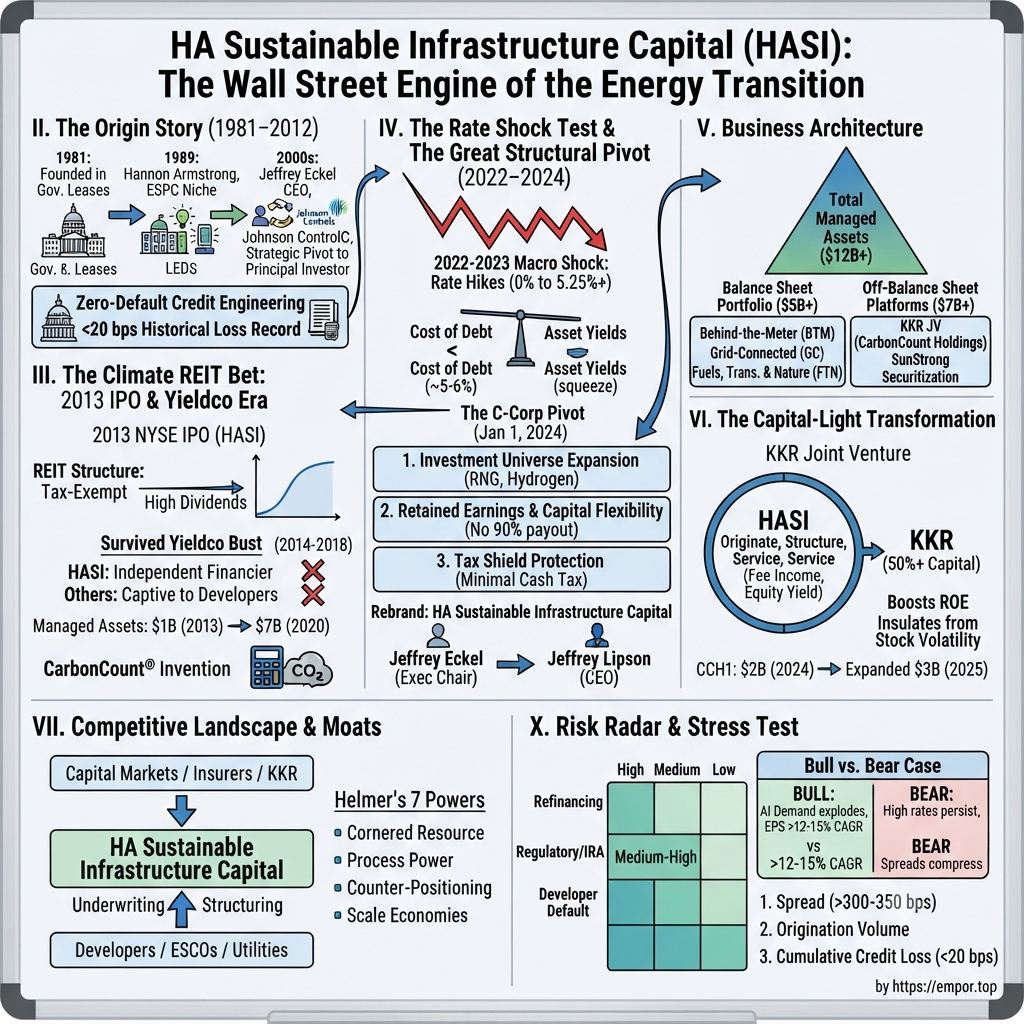
HA Sustainable Infrastructure Capital: The Wall Street Engine of the Energy Transition
I. Introduction & Episode Roadmap (10 min)
On the evening of August 6, 2026, a company that most retail investors still struggle to categorize did something unusual for a business operating amid shifting federal energy policies: it raised its long-term earnings guidance. HA Sustainable Infrastructure Capital reported that adjusted earnings per share grew 24% year-over-year through the first half of 2026, managed assets reached $17.6 billion, and expected adjusted EPS for 2028 was revised upward to a range of $3.55 to $3.65 — compared to the $3.50 to $3.60 target issued six months earlier.1 The announcement arrived in the same year federal policy began scaling back clean-energy tax credits long considered vital to the sector's growth.
The stock closed at $40.68 on August 7, 2026, giving the company a market capitalization of roughly $5.2 billion — up sharply from its 52-week low of $25.35, yet still a fraction of its $17.6 billion in managed assets.2 That divergence between equity valuation and managed asset scale highlights HASI's fundamental structure: it operates as a leveraged spread lender, where profitability hinges on the spread between asset yields and borrowing costs.
The company presents an identity puzzle for investors. It is not a utility, as it operates no power plants. It is not a developer, as it builds no projects. Nor is it a conventional bank, though it underwrites credit; a real estate investment trust, though it operated as one until 2024; or a pure private-credit fund, though it increasingly earns management fees on third-party capital. At its core, HASI is a specialty project-finance underwriter that has spent four decades pricing risks that generalist lenders struggle to evaluate — and has more recently begun monetizing that underwriting expertise for outside investors.
The defining strategic choice in the company's modern history was voluntarily relinquishing its tax exemption. On December 21, 2023, the board unanimously approved revoking the company's real estate investment trust election, effective January 1, 2024, converting HASI into a taxable C corporation.3 Such conversions are rare. While REIT status eliminates corporate-level taxation, it imposes strict operational constraints: companies must distribute the vast majority of taxable income to shareholders and maintain assets that meet rigid IRS definitions. HASI concluded that these restrictions hampered its growth more than the tax exemption helped. Evaluating whether that trade-off has paid off forms a central theme of this analysis.
A central debate surrounding HASI involves its financial reporting. In the first quarter of 2026, the company posted adjusted EPS of $0.77 alongside a GAAP net loss of $(0.57) per share.4 In the second quarter, adjusted EPS stood at $0.75 while GAAP EPS swung to $0.92.1 The two metrics did not merely diverge in magnitude; over consecutive quarters, they moved in opposite directions. Management attributes the disconnect to non-cash accounting adjustments inherent in its financing structures. Yet when GAAP figures remain volatile, investors face an enduring question first raised by short sellers in 2022: which metric provides the truer picture of underlying earnings?
The scale question, stated honestly. Understanding HASI requires calibrating its true scale, as labels like "energy transition powerhouse" obscure its actual capital structure. While HASI oversees $17.6 billion in total managed assets, its direct balance-sheet portfolio totals $8.2 billion, and its market capitalization equals roughly a fifth of its managed asset base.12 Total debt stands at $5.9 billion.1 These financial ratios reflect a specialty finance firm rather than a traditional utility or pure-play asset manager. Over the past three years, HASI's strategic goal has been shifting toward fee-based asset management — expanding third-party capital while originating and servicing the assets. Assessing how much of this transition is already reflected in financial results versus forward-looking messaging remains a key metric for investors.
The recurring-versus-transactional tension. Earnings quality centers on the balance between stable income and deal-contingent gains. Adjusted recurring net investment income — the portfolio spread income earned continuously from held assets — reached $107 million in the second quarter of 2026, a 26% year-over-year increase.1 Gains on asset sales generated $16 million during the same period, double the prior year's figure.1 While recurring net investment income remains roughly seven times larger than transactional gains, transactional revenue is expanding at a faster pace and relies more heavily on valuation estimates for retained asset interests. Tracking this ratio provides critical insight into earnings sustainability, much like comparing net interest income to trading revenue in bank analysis.
What this episode covers. This narrative traces HASI's evolution in six parts. First, its 1981 origins as a small leasing shop in Alexandria, Virginia, that carved out a niche financing municipal and federal energy retrofits. Second, its 2013 initial public offering as the first listed "climate REIT," and its survival through the yieldco boom and bust that collapsed competing firms. Third, the 2022–2024 transition marked by a short-seller campaign, a steep interest-rate hiking cycle, leadership succession, and the exit from REIT status. Fourth, the current portfolio architecture across behind-the-meter, grid-connected, and fuels-transport-nature assets. Fifth, the capital-light expansion anchored by a joint venture with KKR that altered its return model. Sixth, the competitive landscape and the durability of its underwriting moat. The analysis concludes with strategic execution, core risks, bull and bear cases, and the key financial metrics that determine HASI's long-term trajectory.
The story begins in a Virginia office park, financing municipal police radios.
 Subscribe on LinkedIn
II. The Origin Story: Municipal Efficiency & The Annapolis Playbook (1981–2012) (15 min)
The firm’s initial transaction, closed in September 1981, was a $300,000 Motorola communications system for the police department of Petersburg, Virginia.5 Operating out of Alexandria as Eden Hannon Goodwin & Company, the firm built its business around a narrow structural inefficiency: state and local agencies faced steep statutory hurdles to issuing debt for equipment, but could readily sign municipal leases. Crucially, because the lessee was a public entity, the interest component of those lease payments was tax-exempt to the lender. Properly structured, the arrangement allowed a police department to acquire equipment outside its capital budget while delivering tax-advantaged, government-backed cash flows to investors.
That unglamorous origin established an operational template that still defines HASI's business model. It taught the firm’s founders a credit discipline distinct from energy market speculation: how to construct legally defensible claims on payment streams from low-default counterparties, anchored by assets whose physical performance could be independently verified.
R. Jon Armstrong joined the firm in 1983, bringing federal contracting expertise that helped close its first federal transaction — telecommunications equipment for the FBI.5 In 1985, banker Jeff Eckel joined as a senior vice president to launch an energy project finance group.5 Two years later, in 1987, the firm participated in refinancing Solar Energy Generating Systems III, a pioneering solar thermal facility in the California desert.5 At the time, renewable energy was a niche sector driven by policy responses to the 1970s oil shocks. Financing solar projects was less an environmental statement than a specialized structured-credit exercise that mainstream financial institutions avoided.
Following co-founder Greg Eden's departure in 1989, the firm adopted the name Hannon Armstrong. That same year, Eckel testified before a U.S. Senate energy subcommittee on energy performance contracting, reflecting how deeply the firm's growth would depend on federal policy frameworks.5
How an ESPC actually works, in plain English. When a federal agency — such as the Navy or the Department of Veterans Affairs — manages inefficient facilities but lacks capital budget for retrofits, it turns to an Energy Services Company, or ESCO. The ESCO upgrades lighting, boilers, and building controls at its own initial cost, guaranteeing a specific reduction in utility expenses. The agency pays nothing up front; instead, it pays the ESCO over time out of the money saved on utility bills. Those payments are backed by federal appropriations, while the technical risk of achieved savings rests entirely on the contractor.
Financing these long-term retrofits created a distinct lending niche. Hannon Armstrong financed its first energy savings performance contract in 1996 — a $1 million lighting upgrade at a U.S. Postal Service building.5 The credit structure offered notable security: the ultimate obligor was the U.S. government, while performance risk sat with the ESCO rather than the lender.
That combination of government-backed credit, contractor-absorbed performance risk, and complex legal structuring formed the core of Hannon Armstrong's underwriting strategy. Rather than lending against real estate equity or corporate balance sheets, the firm underwrote contractually engineered cash flows, building a competitive moat around specialized transaction structures.
After departing to lead power development projects at Wärtsilä and EnergySource, Eckel returned as chief executive officer in 2000. He relocated headquarters to Annapolis, Maryland, and launched HannieMae Trust, the firm’s initial securitization vehicle for energy performance receivables.5 Modeled conceptually on mortgage-securitization platforms, HannieMae originated standardized contracts, pooled them, and sold the senior cash flows to institutional investors to recycle capital for new originations. By 2006, HannieMae had completed more than $1 billion in performance financings across 191 transactions, averaging roughly $5 million per deal.5 The portfolio relied on granular, well-documented obligations rather than concentrated single-asset exposures.
Ownership shifted significantly over the next two years. Following Jon Armstrong's death in 2005, management partnered with MissionPoint Capital in 2007 to execute a buyout that increased employee ownership.5 During the 2008–2009 financial crisis, as syndicated loan markets contracted, Hannon Armstrong deployed over $700 million in clean energy financing and took development risk on the 49.9-megawatt Hudson Ranch geothermal project in California.5
The financial crisis reinforced a core structural lesson: during periods of capital scarcity, liquidity providers command leverage over pricing, seniority, covenants, and governance terms. Modern features of HASI's underwriting — including its prioritization of senior and preferred investment positions and strict hurdle-rate discipline — stem from operating as a sole liquidity provider during market dislocations. However, that competitive advantage remains inherently cyclical: capital pricing power peaks when liquidity dries up, but narrows when capital becomes abundant.
Management concluded that the primary constraint on growth was not deal flow, but balance-sheet capacity during market downturns. As a private partnership, Hannon Armstrong originated far more asset volume than its balance sheet could retain. Expanding the business required access to scalable, permanent capital.
That requirement eventually pointed toward public capital markets — and an unconventional application of a tax-exempt corporate structure.
III. The Climate REIT Bet: 2013 IPO & The Yieldco Boom/Bust (2013–2021) (15 min)
The pitch in early 2013 was unusual. A 32-year-old private firm from Annapolis, holding a portfolio of government energy-efficiency receivables, sought to list on the New York Stock Exchange as a real estate investment trust focused on climate infrastructure. At the time, no comparable public entity existed in equity markets.
The strategy relied on legal structure rather than operational change. Tax rules governing real estate investment trusts require that the majority of assets and income derive from real property or mortgages secured by real property. Clean energy projects met these criteria because solar arrays and wind turbines sit on physical land, allowing the underlying project debt and land leases to qualify under IRS rules. Commercial Property Assessed Clean Energy financing similarly qualified because building efficiency upgrades are repaid through assessments attached to local property tax bills, creating a statutory lien on real estate. By structuring its investments around these provisions, Hannon Armstrong qualified for REIT status and prepared for its public debut.
Shares began trading on the NYSE under the ticker HASI on April 18, 2013.5 The offering priced 13,333,333 shares at $12.50 apiece, and the company closed the transaction on April 23 with net proceeds of approximately $155.4 million after underwriting discounts.6 By the standards of 2013 technology initial public offerings, the raise was modest. For a firm that had operated for three decades as a private partnership, however, the public listing provided permanent equity, a public equity currency for future acquisitions, and established capital market visibility.
The REIT structure served two primary functions. It eliminated corporate-level income tax, allowing the spread between asset yields and borrowing costs to pass through to shareholders largely intact. It also mandated distributing most taxable income as dividends, attracting income-focused investors during a prolonged period of near-zero interest rates. In effect, HASI operated as a yield instrument with an environmental focus at a time when both features were in high demand.
The yieldco mania, and why HASI was structurally different. Broader capital markets soon embraced a similar thesis: contracted renewable energy projects generate stable, long-term cash flows that can support high-yielding public equities. This trend gave rise to the yieldco — a listed entity designed to acquire operating projects from a developer parent and distribute cash flow to shareholders. SunEdison listed TerraForm Power in July 2014 and TerraForm Global a year later.7 Competitors such as Abengoa and NRG Energy launched similar vehicles.
The yieldco model contained a structural vulnerability. Developer-sponsored yieldcos operated as captive buyers, purchasing assets at prices set by their parent companies while public shareholders absorbed operational and valuation risks. To sustain dividend growth, yieldcos relied on issuing new equity at premium valuations to fund continuous acquisitions. When share prices fell, the capital loop collapsed. SunEdison filed for Chapter 11 protection on April 21, 2016, with $16.1 billion of liabilities, and although TerraForm Power itself did not file, the parent's collapse triggered defaults across most of its non-recourse financing agreements.7
Although HASI experienced sector-wide valuation pressure, its business model provided structural insulation. Unaffiliated with a single developer parent, the firm acquired assets through competitive transactions across multiple counterparties. Furthermore, HASI rarely held common equity in operating projects. Instead, it provided senior loans, held preferred equity, or acquired ground leases beneath wind and solar installations. In underperforming projects, common equity absorbs initial losses before preferred equity or debt positions are impaired. Land leases offered additional protection: landowners hold priority claims on cash flows, physical infrastructure cannot be easily moved, and project operators face prohibitive costs if forced to dismantle facilities.
This senior position protected capital during market stress, though it also capped return potential, as seniority requires accepting lower yields.
The yieldco crisis demonstrated that while contracted clean-energy assets generate bond-like cash flows, relying on continuous equity issuance to fund dividend commitments creates severe refinancing risks when market conditions tighten. HASI remained subject to capital market access requirements as a listed REIT, but its diversified origination network and senior position in the capital stack differentiated it from developer-controlled yieldcos.
Building the machine, 2015–2021. In 2015 the company launched CarbonCount with the Alliance to Save Energy, a scoring tool that expressed metric tons of annual carbon avoided per $1,000 invested, and completed its first publicly rated A-rated asset-backed securitization.5 CarbonCount provided institutional investors with standardized impact reporting while supporting HASI's issuance of green bonds and securitized debt products.
In November 2018, HASI and SunPower formed SunStrong Capital, with HASI initially investing $10 million for a 49% interest in a vehicle holding a large portfolio of residential solar leases; SunStrong went on to complete a $400 million asset-backed securitization backed by more than 37,500 residential leases.8 The transaction established HASI's footprint in residential solar — an asset class with consumer credit risks distinct from municipal and federal contracts.
Jeffrey Lipson joined as chief financial officer in 2019, the same year the company received its first corporate credit ratings, at BB+, from S&P Global and Fitch.5 While obtaining ratings marked a key step toward accessing public debt markets, the sub-investment-grade rating restricted access to lower-cost investment-grade bond indices.
Capital deployment accelerated over the following two years. In 2020 HASI announced a $553 million wind and solar investment with ENGIE and a $663 million portfolio investment with Clearway Energy; in 2021 it deployed $1.7 billion into climate solutions.5 In 2022 it took a position in a 1.3 GW AES renewable portfolio and made its first renewable natural gas investment.5
During a decade of low interest rates, HASI expanded origination volume, established institutional partnerships, and extended debt maturities. The sharp increase in benchmark interest rates beginning in 2022 would subsequently test how resilient that balance sheet was when the cost of capital rose dramatically.
IV. The Rate Shock Test & The Great Structural Pivot (2022–2024) (20 min)
The stress test arrived from two directions at once, and the initial wave did not come from the Federal Reserve.
On July 12, 2022, Muddy Waters Capital published a short thesis targeting Hannon Armstrong. The central allegation was not that the firm was insolvent, but that its financial statements were uninterpretable. Specifically, Muddy Waters asserted that HASI booked non-cash income from third-party tax credits that would later reverse, inflated securitization gains by applying unrealistically low discount rates to retained residual assets, and recognized interest income from paid-in-kind (PIK) IOUs issued by stressed borrowers. The report concluded that the company's "accounting is so complex and misleading that its financial statements are effectively meaningless."9
HASI responded the following day, stating that it had provided audited, accurate, and timely financial statements for more than four decades, that its accounting fully complied with GAAP and SEC regulations, and that its quarterly analysis confirmed PIK interest was fully collectable.10 Wall Street analysts largely backed the company, arguing that the short seller had conflated fundamental credit risk with timing differences between GAAP revenue recognition and cash receipts under tax equity partnership rules.10
Four years later, a balanced assessment reveals a nuanced reality. No financial restatement occurred, no regulatory action followed, and the credit defaults implied by the short thesis never materialized. On those terms, the bear case failed. Yet the broader critique — that HASI's GAAP financial statements are difficult to parse without management's adjustments — remains valid. That complexity does not imply wrongdoing; rather, it reflects accounting conventions for tax equity partnerships, equity-method joint ventures, and securitization residuals. Investors who do not evaluate hypothetical liquidation at book value accounting, which is detailed in subsequent analysis, are essentially relying on management's adjusted metrics.
The impact of rising benchmark rates. Between March 2022 and mid-2023, the Federal Reserve raised its policy rate from near zero to over 5%. For a specialty lender, this rapid monetary tightening compressed profit margins on existing capital. HASI faced a mechanical hurdle: it had funded long-duration assets at lower historic yields, while new debt issuances incurred significantly higher borrowing costs. As funding costs climbed, the spread supporting the firm's earnings came under immediate pressure.
Management responded by raising target yields on new originations rather than relying on financial engineering. The company systematically increased required returns on incoming deals. In 2024 and 2025, HASI reported that yields on new portfolio investments exceeded 10.5% for two consecutive years.11 By the second quarter of 2026, underwritten yields on new investments passed 11%.1 Consequently, the blended portfolio yield across the entire asset base rose steadily as older loans matured and were replaced by higher-yielding assets: moving from 8.3% at year-end 2024 to 8.8% at year-end 2025, and reaching 9.2% by mid-2026.111
This upward trajectory demonstrates HASI's asset-side pricing power. While rising risk-free rates elevate borrowing yields across all financial markets, HASI maintained its net interest spread during a period of asset expansion. The company's weighted-average interest cost increased from 5.6% in 2024 to 5.8% in 2025, reaching 6.2% by the second quarter of 2026.111 Because asset yields expanded faster than debt costs, the core lending model performed as designed.
Leadership succession. On February 16, 2023, the company announced that Chief Financial Officer and Chief Operating Officer Jeffrey Lipson would succeed Jeffrey Eckel as president and chief executive officer, with Eckel transitioning to executive chair.12 Eckel had served as CEO since 2000 and held the combined role of chairman, president, and CEO from 2013 to February 2023; he served as executive chair until March 2025 before continuing as board chair.13
The leadership change reflected an evolving operational focus. Eckel had spent three decades establishing clean energy infrastructure as a viable asset class and pioneering energy performance contracting. Lipson, with a background at Bank of America and Capital One, brought specialized expertise in balance-sheet management, liquidity, credit ratings, and corporate leverage. Promoting a financial officer to the chief executive role signaled that HASI's primary strategic constraint had shifted from originating assets to optimizing its capital structure.
The C-corporation conversion. On December 21, 2023, the board of directors voted unanimously to revoke the company's REIT election, effective January 1, 2024.3 Explaining the decision, Lipson stated: "We've concluded that our optimal tax structure moving forward is to cease electing REIT status in 2024," noting that the conversion left the core investment strategy intact while offering enhanced flexibility to pursue growth opportunities.3
The strategic rationale rested on three primary arguments.
First, the conversion expanded asset scope. IRS rules impose strict property qualifications on REIT portfolios. Infrastructure investments such as renewable natural gas digesters, hydrogen facilities, fleet electrification, and specific equity co-investments do not qualify as real property. Operating as a REIT capped the volume of non-qualifying assets HASI could hold without risking its tax status. In subsequent regulatory filings, the company noted that the revocation directly addressed "expanding opportunities in non-qualifying assets."14 Portfolio expansion since 2024 has validated this operational flexibility.
Second, the structural shift enabled greater capital retention. REIT regulations require companies to distribute the vast majority of taxable income to shareholders, forcing growth to be financed through continuous equity offerings. That model relies on shares trading at a sustained valuation premium. As a C corporation, HASI can retain a larger share of earnings to fund deployment internally. Management set targets to reduce the payout ratio below 50% of adjusted EPS by 2028 and below 40% by 2030.11 On a fourth-quarter 2025 earnings call, Lipson explained that management viewed the business as "more valuable and can grow faster if we recycle more capital."15
Third, management projected minimal immediate tax expense. HASI planned to utilize accumulated net operating loss (NOL) carryforwards and tax credits to maintain tax efficiency.3 The company held over $465 million in cumulative NOL carryforwards at the end of 2022. However, these tax shields remain subject to statutory limitations under Section 382 if a qualifying ownership change occurs. To safeguard these assets, HASI implemented a tax benefit preservation plan that limits substantial stock accumulations.16 While defensible as a tax-preservation measure, the mechanism also functions as a governance constraint. Furthermore, NOL carryforwards represent a finite tax offset; once exhausted, HASI will incur corporate income tax that REIT status previously eliminated. The C-corporation strategy represents a calculated bet that the compounding value of retained earnings and broader investment scope will exceed the ultimate corporate tax liability.
During this period, the company adopted "HASI" as its primary brand in 2023 and formally renamed itself HA Sustainable Infrastructure Capital, Inc., completing a transition from the Hannon Armstrong name used since 1989.5 Meanwhile, HASI strengthened its credit profile: after Moody's assigned a Baa3 rating in June 2022, Fitch granted a BBB- rating on May 20, 2024. This second investment-grade rating allowed HASI's debt securities to enter investment-grade bond indices, which management noted served to "increase our access to low-cost, long-duration debt capital."17 On June 11, 2025, S&P Global upgraded HASI from BB+ to BBB- with a stable outlook — a third investment-grade rating that Chief Financial Officer Chuck Melko identified as a milestone confirming the company's balance-sheet strength.18
For a specialty finance institution, an investment-grade rating provides a structural advantage by lowering long-term borrowing costs. The corporate conversion and balance-sheet repositioning achieved their primary objective: securing scalable, lower-cost capital to support continued asset expansion.
V. Business Architecture & Segment-Level Capital Allocation (20 min)
Strip away corporate labels, and HASI's portfolio consists of roughly 700 separate transactions averaging about $10 million each.[^19] That structural detail reveals far more about the business than any segment chart. This is not a firm taking a handful of concentrated bets; it is a business built on hundreds of small, contractually distinct claims. Consequently, a single underperforming project has historically had little impact on overall earnings, explaining why HASI reports an average annual realized loss rate of less than 0.10%.15
As of June 30, 2026, the $8.2 billion GAAP balance-sheet portfolio was distributed across three primary segments: behind-the-meter assets accounted for roughly $4.1 billion, or about half the total; grid-connected assets represented roughly $2.6 billion, or approximately one-third; and fuels, transportation, and nature assets made up the remaining $1.5 billion.1 Ninety-eight percent of the portfolio held the company's category one credit rating, with 2% in category two and zero exposure in category three — the bucket indicating substantial doubt regarding principal collection.1
Behind-the-meter: the original business, grown up. "Behind the meter" refers to installations located on the customer's side of the utility meter — such as rooftop solar on a commercial warehouse, LED lighting retrofits in a federal facility, energy storage batteries in a building basement, or EV chargers at a fleet depot. Economically, these assets do not sell power into wholesale electricity markets; instead, they displace energy the customer would otherwise purchase from a utility. That distinction eliminates merchant power price exposure, shifting credit evaluation to two primary questions: whether the customer remains solvent, and whether the installed equipment performs as specified.
This segment includes the modern descendants of the firm's 1996 Postal Service lighting project, residential solar financings managed through SunStrong, and Commercial Property Assessed Clean Energy (C-PACE) loans. C-PACE warrants attention due to its legal seniority: C-PACE assessments are repaid through special line items on local property tax bills, giving them statutory priority over commercial mortgages in most jurisdictions. Holding a claim that ranks senior to a primary mortgage bank represents a particularly strong credit position.
The residential solar portfolio remains the segment's most scrutinized component given recent industry consolidation. Management directly addressed performance on the first-quarter 2026 earnings call, stating that "literally, 100% of the loans in residential are performing," with delinquency rates tracking within original underwriting expectations.19 While current disclosures support that assertion, consumer credit trends require ongoing quarterly validation.
Grid-connected: the scale engine. Grid-connected investments comprise utility-scale infrastructure — including large solar installations, onshore wind farms, and grid-scale battery storage. In this segment, HASI deploys capital through senior debt, structured and preferred equity, and land ownership beneath project sites. Power offtake is typically contracted with investment-grade utilities or corporate buyers — a market expanded significantly by power demand from data center hyperscalers.
The defining transaction of this segment, and the largest in HASI's recent history, closed in the third quarter of 2025: a $1.2 billion structured equity commitment to Pattern Energy's SunZia project, a 3,650-megawatt wind development in New Mexico paired with a 550-mile high-voltage direct-current transmission line delivering power into Arizona.20 Management structured the transaction as preferred equity rather than common equity, sharing the financial exposure with a co-investment vehicle rather than holding the entire position on HASI's balance sheet.21
SunZia illustrates both the scale of available market opportunities and an evolving risk profile. A $1.2 billion commitment against a portfolio that totaled $7.6 billion at year-end 2025 represents a departure from the smaller, highly granular transactions that established HASI's sub-10-basis-point loss record. Although structured as a senior position in North America's largest onshore wind development, it represents a far more concentrated project exposure. Management's use of co-investment capital mitigates balance-sheet concentration, but the structural shift is clear: HASI's historical track record was built on hundreds of $10 million municipal and federal efficiency loans, whereas marginal capital deployment increasingly targets larger, more complex infrastructure assets.
Fuels, transportation and nature: the C-corp dividend. The fuels, transportation, and nature segment represents asset classes that were largely prohibited under REIT qualification rules — including renewable natural gas, biofuels, fleet electrification, and ecological restoration. It remains HASI's smallest segment, but management identifies it as its highest-yielding asset class.
The segment's anchor transaction occurred on May 4, 2026, when Ameresco and HASI announced the formation of Neogenyx Fuels, spinning Ameresco's biofuels business into a joint venture owned 70% by Ameresco and 30% by HASI. HASI committed $400 million: $300 million invested directly into the venture to fund development and $100 million paid to Ameresco for its equity stake, valuing the entity at a post-money enterprise value of $1.8 billion.22 On HASI's first-quarter 2026 earnings call, Lipson noted that Neogenyx Fuels is "primarily focused initially on organic growth" rather than near-term public listings or roll-up acquisitions.19
The transaction reflects long-standing commercial relationships: Ameresco is an energy service company whose performance contracts HASI has financed since the 1990s. Converting a four-decade underwriting relationship into a joint-venture equity stake demonstrates the strategic value of HASI's origination network. However, a 30% equity interest in a growth-stage biofuels business introduces a higher risk profile than land leases or federal receivables, exposing capital to construction, feedstock price, and regulatory variables that senior debt does not carry.
A note on the credit scale, because it is the most-watched disclosure and the least-explained one. HASI sorts its portfolio into three internal categories. Category one indicates performance is consistent with or better than underwriting expectations. Category two flags assets where performance has deteriorated but full collection is still expected. Category three signals substantial doubt about recovering principal. The company has reported no category three assets and 98% category one for an extended stretch.1 The value of the disclosure is that it serves as a leading indicator: an asset must pass through category two before becoming a loss, so migration between buckets reveals stress well before the income statement reflects it. The limitation is that the categorization relies on management's own judgment, reviewed by auditors but not standardized across the industry, meaning it is only as useful as the underlying discipline. The first-quarter 2026 migration of two receivables into category two, disclosed voluntarily with a specific operational explanation, is at least consistent with a team that uses the scale honestly.19
Where the yield actually comes from. It is worth being precise about why portfolio yield keeps rising, because there are two very different explanations and only one of them is favorable. The benign explanation is portfolio mix: older assets originated at 7% to 8% during the zero-rate decade are running off and being replaced by new assets underwritten above 10.5%, driving the blended yield upward mechanically. The less benign explanation would be that the company is reaching for yield by accepting lower credit quality. Empirical evidence supports the portfolio mix thesis. Yields rose while the category one share held at 98% and realized losses stayed below ten basis points, with the largest new positions structured as senior or preferred equity rather than common equity.115 That combination — higher yields paired with stable credit metrics — reflects asset repricing rather than credit deterioration, though the dynamic will reverse if new-origination yields decline.
Across all three segments, HASI's business model avoids direct commodity price risk, earning returns instead through transaction structuring, capital seniority, and underwriting complexity. Yet this structure raises a central question: if asset returns are compelling, what has limited faster balance-sheet growth? Historically, expansion required issuing new common equity — a structural bottleneck addressed by the strategic shifts detailed in the next section.
VI. The Capital-Light Transformation: The $3B+ KKR Partnership (20 min)
Every spread lender eventually encounters a structural growth constraint: deal origination capacity can outpace balance-sheet expansion. While pipeline growth depends on underwriting expertise and partner relationships, balance-sheet capacity is bounded by available equity, leverage limits, and capital-market appetite. When deal flow exceeds capital capacity, a lender must either turn away profitable originations or source third-party equity.
HASI addressed this constraint by partnering with alternative asset manager KKR. In May 2024, the two firms established CarbonCount Holdings 1 LLC (CCH1), a co-investment vehicle capitalized with $1 billion in equity commitments from each partner.23 In December 2025, each side committed an additional $500 million, bringing total equity commitments to $3 billion and extending the deployment window to the earlier of year-end 2027 or full capital deployment; incorporating target leverage, the partners projected total investment capacity approaching $5 billion.24 Through November 2025, accounting for the reinvestment of returned capital, the partnership had closed nearly $3 billion in investment commitments spanning six asset classes.24 By the first quarter of 2026, approximately $2.3 billion had been deployed against that roughly $5 billion in capacity.19
The structural mechanics alter HASI's financial model. HASI originates, underwrites, structures, and services the assets, while KKR supplies half of the equity capital. Consequently, HASI earns returns on its own invested equity alongside management fees and asset-level economics on KKR's capital. The vehicle also accesses independent debt markets: in May 2026, CCH1 issued $508 million of 20-year fixed-rate senior unsecured notes priced at 195 basis points over the 10-year Treasury yield — a spread management cited as evidence of underlying asset quality.2519
The number that explains the whole strategy. On the fourth-quarter 2025 earnings call, management illustrated the shift through a single operational metric: $100 of proceeds from newly issued common shares supported $1,350 of new investments under the co-investment model, compared to roughly $300 before CCH1 was established.15 That fourfold expansion in deployment leverage demonstrates HASI's transition from a pure balance-sheet lender into a hybrid specialty underwriter and asset manager.
The efficiency gains show up directly in profitability metrics. Adjusted return on equity expanded from 12.7% in 2024 to 13.4% in 2025, with incremental adjusted ROE — the return on capital deployed during the year — exceeding 19%.11 By the first quarter of 2026, adjusted ROE reached a quarterly record of 15.7%, and averaged 15.3% through the first half of 2026 toward a 2028 target above 17%.41
A key operational outcome of this capital-light model is reduced equity dilution. HASI issued no common shares through its at-the-market equity program in either the first or second quarter of 2026.41 Chief Financial Officer Chuck Melko informed investors that the firm remained on track for minimal at-the-market issuance for the full year, while Chief Executive Officer Jeffrey Lipson noted on the first-quarter call that if originations track internal forecasts, full-year equity issuance could be zero.119 For an institution that spent its first decade as a public REIT dependent on secondary stock offerings to fund asset growth, achieving self-funded expansion marks a significant structural evolution.
Off-balance-sheet asset expansion expanded fee income accordingly. Partner-held assets within co-investment structures reached $1.5 billion by June 30, 2026, up from $550 million a year earlier, while HASI's direct equity interest in CCH1 grew from $559 million to $970 million over the same period.1 Revenue from management fees and retained interests rose 44% year-over-year in the second quarter of 2026 to $13 million, following $34 million generated in full-year 2025.111
The third channel, easy to miss. Total managed assets extend beyond HASI's direct balance sheet and CCH1. They encompass the company's proprietary portfolio, partner equity in co-investment vehicles, and assets securitized and sold to institutional buyers where HASI retains servicing rights and residual interest positions.11 Securitization represents the oldest of these three capital channels — dating to the HannieMae Trust in 2000 — and serves a distinct balance-sheet function: it monetizes pools of seasoned receivables into upfront cash, freeing balance-sheet capacity to reallocate capital into higher-yielding originations. That mechanism makes gain-on-sale revenue a structural component of the operating model rather than a transactional windfall, heightening the analytical importance of valuation assumptions applied to retained residual interests.
Now the counter-argument, which is not trivial. Three analytical concerns surround this strategic pivot.
First, disclosure transparency remains limited. Although fee revenue is expanding, reporting aggregates management fees and retained interest without itemizing origination fees, ongoing asset-management fees, performance promotes, or net revenue sharing. For a strategy premised on commanding a higher valuation multiple for fee income over spread income, disclosures provide less detail than those of traditional asset managers.
Second, balance-sheet risk has shifted rather than disappeared. HASI accounts for its equity stake in CCH1 under the equity method, omitting the vehicle's underlying assets and non-recourse debt from consolidated balance-sheet lines. While consistent with standard accounting practices, reported balance-sheet leverage — 1.7x debt-to-equity as of June 30, 2026, within management's 1.5x to 2.0x target range — does not fully reflect total leverage across all HASI-underwritten assets.1 Evaluating overall financial risk requires looking through to the co-investment structure.
Third, capital availability depends on external partners. CCH1's capital commitments are finite, with its deployment period ending by late 2027. On the fourth-quarter 2025 call, Melko acknowledged that remaining capacity would fund deployment through 2026, but noted that sustaining asset growth beyond that timeline requires extending CCH1 or establishing new institutional co-investment vehicles.15 Achieving 2028 financial targets therefore relies on institutional partners continuing to commit capital on comparable terms — a financing dependency that remains central to HASI's long-term outlook.
VII. Competitive Landscape, Industry Structure, & Economic Engine (20 min)
Consider the capital stack of a mid-sized solar-plus-storage portfolio. At the bottom sits sponsor common equity. Above it lies tax equity or a tax credit transfer. Above that is structured or preferred capital. At the top sits senior secured debt. Each layer has a natural capital provider, and HASI's strategic positioning depends on which layers it targets and against whom it competes.
Commercial banks dominate the top of the stack with low-cost debt. What banks generally avoid is the middle layer: bespoke, hybrid instruments tied to granular portfolios of smaller assets with complex security packages. Underwriting those positions requires evaluating both credit and engineering risks, while Basel capital rules penalize structural complexity. Private credit funds will deploy into the middle tier, but they price for fund-level target returns and typically expect capital returned within three to seven years, whereas infrastructure assets operate for twenty-five years.
That structural mismatch creates HASI's commercial opening: long-duration, customized financing for transactions too complex for commercial banks and too long-dated for drawdown funds. The pricing data — sustained yields above 10.5%, rising past 11%, alongside a 98% category-one credit profile — indicates HASI is not simply winning on price.1
The named comparisons.
Brookfield Renewable presents a clear strategic contrast to HASI. Brookfield acquires, owns, and operates global power platforms, absorbing direct operational and merchant price risk. When power prices rise, Brookfield captures the upside, while HASI's coupon remains fixed. Conversely, when equipment fails or power prices fall, Brookfield absorbs the loss, whereas HASI's preferred position maintains priority payment rights. Rather than direct competitors, the two firms offer distinct approaches to allocating operational risk, with Brookfield accepting higher variance in exchange for equity upside.
XPLR Infrastructure, formerly NextEra Energy Partners, illustrates the structural vulnerabilities of captive yieldcos. Renamed in January 2025, the company announced on January 28, 2025, that it would suspend distributions indefinitely to redirect cash toward buying out convertible equity portfolio financing obligations, causing its units to fall roughly 30% on the news.2627 The captive yieldco model — relying on continuous equity issuance to acquire sponsor assets funded temporarily through convertible obligations — fractured under tighter capital conditions. HASI operates without a developer parent, eliminating sponsor-driven asset transfers and enabling origination without relying on equity market valuation premiums.
Private credit and infrastructure debt arms at major alternative asset managers represent HASI's primary competitive threat. These platforms deploy substantial capital pools, backed by institutional insurance balance sheets seeking long-duration assets. HASI relies on its origination network and duration tolerance rather than scale to compete. On a fourth-quarter 2025 earnings call, Chief Executive Officer Jeffrey Lipson noted that HASI gained market share as certain capital providers pulled back, though he declined to quantify the shift.15 That dynamic reflects a cyclical advantage rather than a permanent moat; as private credit appetite for energy transition assets expands, yield spreads will encounter competitive pressure.
Commercial mortgage REITs extending into infrastructure financing lack specialized engineering and regulatory underwriting capabilities, making them a minor factor in limiting portfolio returns relative to alternative asset managers.
Seven Powers, honestly applied. Evaluating HASI against Hamilton Helmer's framework reveals two strong strategic advantages, a partial third, and limited applicability across the remainder.
The strongest advantage is what Helmer terms a cornered resource, expressed here as an established origination network. Four decades of partner relationships with energy service companies, project developers, and equipment manufacturers yield proprietary, negotiated deal flow rather than competitive auction bidding. The Neogenyx joint venture with Ameresco illustrates this dynamic: acquiring a 30% equity stake in a partner's spun-out business stems from bilateral negotiation rather than open bidding. However, because this advantage relies on institutional relationships, executive turnover presents a more material risk than at scale-driven institutions.
The second advantage is process power — an underwriting architecture built to evaluate technology performance, counterparty credit, tax structures, and regulatory risk concurrently. An average annual realized loss rate below 0.10% serves as the primary output metric.15 Notably, that track record was established predominantly on federal energy performance contracts and diversified small-ticket assets during a lower-rate environment; it remains untested by a severe credit downturn across larger, more complex portfolio positions.
The partial advantage lies in counter-positioning. HASI's ability to route originations either onto its balance sheet or into the CarbonCount Holdings 1 co-investment vehicle based on its cost of equity provides operational flexibility unavailable to traditional yieldcos and unnecessary for commercial banks. Whether established competitors cannot or choose not to replicate the model tests its durability, with evidence suggesting incumbents currently choose not to compete in this specific structure.
Scale economies remain constrained: at roughly $5 billion in market capitalization, HASI is small relative to private credit competitors, and its investment-grade debt ratings reside on the lowest tier. Network effects, switching costs, and brand equity offer minimal competitive protection.
Porter, briefly. Threat of new entrants remains low, constrained by the decades required to build a specialized underwriting track record. Developer bargaining power is moderate: while developers seek low-cost capital, they prioritize execution speed, closing certainty, and structural flexibility, fostering repeat business through HASI's programmatic partnerships. Capital provider power represents a critical and rising factor: HASI's borrowing costs depend on bond market pricing, while deployment capacity relies partly on partner equity commitments from KKR. Substitutes — including tax equity, green bonds, and bank debt — provide alternative financing options but remain incomplete replacements. Competitive rivalry remains moderate today while intensifying structurally.
A key industry metric illustrates how market mechanics are changing. On HASI's first-quarter 2026 earnings call, Chief Operating Officer Susan Nickey reported that the tax credit transfer market expanded 50% to $42 billion, with corporate buyers representing nearly 25% of Fortune 1000 companies.19 Transferability provisions under the 2022 Inflation Reduction Act replaced complex tax equity partnership structures with a more standardized market. While enhancing broader industry liquidity, this standardization reduces transaction friction, gradually eroding the competitive advantage specialized underwriters held in navigating structural complexity.
The executives responsible for navigating that structural shift form the next subject.
VIII. Management, Governance, & Capital Allocation Record (15 min)
The most reliable way to judge a management team is not to read its strategy deck but to compare what it promised three years ago with what it delivered, and to watch how it responds when unexpected events occur.
Jeffrey A. Lipson has run the company since March 2023. His background — Bank of America, Capital One, four years as HASI's chief financial officer starting in 2019, and subsequently chief operating officer — reflects that of a balance-sheet technician rather than a dealmaker.512 Operating results over the past three years align with that profile: completing an investment-grade ratings ladder, building a co-investment platform, restructuring the corporate tax entity, extending debt maturities, and driving equity issuance to zero. What remains absent from his record is acquisition adventurism. For a firm whose peers spent the era purchasing operational platforms, that restraint represents a deliberate capital allocation choice.
On guidance discipline, Lipson made a falsifiable claim on the fourth-quarter 2025 earnings call: "we have hit every guidance that we have put out."15 The public record supports that statement for the period in question. During that call, management altered the format of its guidance, shifting from a compound annual growth rate to fixed 2028 targets of $3.50 to $3.60 in adjusted EPS and an adjusted ROE above 17%, with Lipson noting that the change "allows us in subsequent quarters to perhaps be a little more precise."15 Six months later, management raised the adjusted EPS target range to $3.55 to $3.65.1 Establishing a concrete target and raising it within two quarters demonstrates execution discipline, though it also suggests the initial target may have been calibrated conservatively.
A second test of narrative consistency involves comparing management's stated operational strategy with its subsequent execution. In early 2024, after revoking its REIT election, management argued that C-corporation status would unlock non-qualifying asset classes and that higher capital retention would reduce reliance on secondary equity offerings. By 2026, the company's largest commitments fell directly into non-qualifying categories — a biofuels joint venture and structured equity in a transmission-linked wind project — while at-the-market equity issuance remained at zero for two consecutive quarters.1 The forward strategy outlined to investors matches the capital deployed afterward.
Chuck Melko became executive vice president, chief financial officer, and treasurer on March 1, 2025, having joined the firm in 2016 with a background in financial reporting and capital markets execution.28 His public focus has remained consistent: capital efficiency, equity dilution discipline, and the operational path from a 13% adjusted ROE toward targets above 17%.
Management turnover is the governance area requiring ongoing tracking. Marc Pangburn joined the firm in 2013, served as co-chief investment officer, and spent two years as chief financial officer — a period encompassing the CCH1 launch and the investment-grade credit upgrades — before transitioning to chief revenue and strategy officer in February 2025.28 On the first-quarter 2026 earnings call, the company disclosed that Pangburn was transitioning to GoodFinch, while continuing to assist with the SunStrong business, alongside the appointment of a new chief legal officer and the internal elevation of executives into co-chief investment officer and co-chief risk officer roles.19
A senior financial executive shifting roles and departing within roughly a year, at an institution where underwriting relies heavily on partner relationships, marks a notable transition. This shift may reflect natural executive progression, an external opportunity, or a planned expansion of leadership roles. Management has not detailed the background behind the transition, leaving investors to weigh origination network continuity against platform management depth.
Eckel's continuing role. Founder-era chief executive Jeffrey Eckel serves as board chair, having stepped down from the executive chair role in March 2025.13 Maintaining a long-tenured former CEO on the board balances institutional memory and partner continuity against independent oversight. The board has added independent perspectives, including two director appointments announced in April 2025.13
Incentives. HASI's compensation framework links executive pay to adjusted earnings and adjusted return on equity, featuring multi-year performance-based long-term incentive awards, while reporting a CEO-to-median-employee pay ratio of 36x for 2025.29 Indexing executive compensation to return metrics rather than total asset volume discourages expanding origination volume at narrower spreads. However, tying incentives to adjusted metrics when GAAP and adjusted results diverge significantly places added weight on the governance of non-GAAP definitions, which are established with board approval rather than standardized accounting rules.
The dividend as a capital allocation statement. The quarterly dividend has remained flat at $0.425 per share through 2026 across declarations for July and October.41 For most of its history as a public REIT, HASI regularly raised its dividend to comply with tax distribution requirements. Maintaining a flat dividend while adjusted EPS grows at a low-twenties rate lowers the payout ratio toward the sub-50% target without reducing total cash payouts.11 Every dollar retained preserves internal equity that would otherwise require external equity raising. Income-oriented investors who purchased shares under the REIT structure are effectively accepting a static dividend yield in exchange for compounding book value.
On explaining reporting adjustments. A recent test of management transparency occurred in the first quarter of 2026, when the company reported a GAAP net loss alongside record adjusted EPS. Melko attributed the divergence to hypothetical liquidation at book value accounting tied to the timing of tax credit sale distributions, stating that the HLBV accounting impact would fully reverse in the subsequent quarter.19 In the second quarter of 2026, GAAP EPS swung to $0.92 against adjusted EPS of $0.75.1 The accounting reversal occurred as projected, confirming that quarterly GAAP results for HASI can fluctuate significantly based on tax equity accounting timing.
A second disclosure from the same call provides insight into credit monitoring: two receivables migrated from category one to category two credit quality, which management attributed to equipment technical issues requiring additional capital rather than broader counterparty stress.19 Disclosing a two-asset credit reclassification provides visibility into internal risk metrics, though the long-term credit performance of those positions requires verification over subsequent quarters.
The overall trajectory of the past three years reflects a balance-sheet focus on optimizing debt structures, extending maturities, limiting share dilution, and expanding adjusted earnings. What that record has not yet been tested by is a sustained credit downturn.
IX. Playbook: Key Business & Investing Lessons (15 min)
A single pattern repeats across four decades of HASI's history, changing only in its specific transaction details. A counterparty requires capital for an asset that generates a long, contracted, unglamorous stream of cash flows. A commercial bank reviews the deal and declines — not because the underlying credit is weak, but because the contract structure does not fit standard lending products. Underwriters at Hannon Armstrong — now HASI — evaluate the contract, price the structural risk that generalist banks pass up, and take a senior investment position. In 1996, the collateral was fluorescent lighting in a postal facility; in 2026, it was a biofuels platform and a high-voltage transmission line. The strategic lessons that generalize stem from that repeatable discipline.
1. Finance the transition; do not operate it. HASI's defining structural choice is maintaining senior or preferred positioning in nearly every asset it finances. The company avoids merchant power price volatility on wind farms, turbine gearbox operational risks, and solar module supply-chain disruptions. Instead, it holds senior payment claims secured by long-term contracts and physical land. That choice caps upside potential, yielding mid-teens returns on equity rather than 30% venture-style returns, but it protects capital, as reflected in an average annual realized loss rate below 0.10%. For investors, the broader lesson is that in a capital-intensive infrastructure buildout, optimal risk-adjusted returns often accrue not to project developers, but to institutions holding senior claims on those developers' cash flows.
2. Structure is a tool, not an identity. HASI spent a decade operating as the first listed climate REIT, a tax structure central to its public narrative and investor base. Management revoked that status when IRS asset tests began constraining portfolio expansion into non-qualifying sectors like biofuels and RNG. Abandoning a core corporate identity when it becomes a growth bottleneck is rare among public management teams. The generalizable lesson is that corporate tax structures are optimizations tailored to a specific opportunity set; when the market evolves, preserving the legacy structure effectively narrows the business.
3. When equity capital is expensive, sell the service instead of the balance sheet. Any specialty lender can grow by raising external equity; the critical question is what that capital costs. The CCH1 co-investment architecture solved this balance-sheet constraint by decoupling origination capability from asset ownership. HASI monetizes its core asset — proprietary deal flow and specialized underwriting — across a capital pool far larger than its own balance sheet. When low share prices make equity issuance expensive, more originations route through the joint venture; when valuation premiums return, more assets remain on the balance sheet. The broader principle applies to any specialized financial institution: underwriting capability is the durable asset, while the balance sheet represents only one channel to monetize it. The corresponding caveat is equally clear: fee income reliant on a single co-investment partner represents a concentrated institutional relationship rather than true fee diversification.
4. Credit quality is manufactured at origination, not recovered in workout. An annual realized loss record under 0.10% is not the product of aggressive debt collection. It is engineered before capital is deployed through structural seniority, cash sweep provisions, government or investment-grade counterparties, and real property liens. Each structural protection reduces origination yield while preserving capital over time. The corollary for HASI is immediate: as average transaction sizes expand and deployment shifts toward structured equity in large-scale projects, the underwriting assumptions that produced historical loss rates face continuous testing. A track record reflects the portfolio that created it, not necessarily the larger, more concentrated assets being underwritten today.
5. In spread businesses, the liability side is the strategy. While investors naturally focus on asset selection, funding costs and liability duration are often more predictive of long-term returns. HASI's transition from an unrated private partnership to a triple-investment-grade issuer, paired with debt maturities extended into the 2030s, contributed more to compounding shareholder value than any single asset deal. Across an $8 billion portfolio, a 50-basis-point reduction in funding costs generates millions in recurring annual savings. Evaluating any leveraged financial institution requires analyzing the debt maturity profile and credit rating trajectory just as rigorously as portfolio yield.
6. Complexity is a moat and a liability simultaneously. HASI underwrites new investments at yields exceeding 11% because its bespoke transaction structures require specialized engineering and credit expertise. That same complexity causes quarterly GAAP earnings to diverge sharply from adjusted financial metrics. These are not separate phenomena, but two sides of the same operational model. A business that derives earnings from structural complexity often trades at a valuation discount relative to peers with simple, transparent cash flows, as a portion of the market avoids assets it cannot easily evaluate. Expanded disclosures can narrow that valuation gap, but management cannot eliminate it without altering the underlying business model.
X. Risk Radar & The Skeptical Investor Stress Test (15 min)
Refinancing and cost of capital. The risk capable of undermining HASI’s model fastest is funding cost, and it remains the vulnerability management actively addresses. Total debt has grown to $5.9 billion, pushing the weighted-average interest cost to 6.2%.1 Structural defenses are in place: approximately 95% of outstanding debt is fixed-rate or hedged. In the first quarter of 2026, HASI pushed out its corporate maturity wall by issuing $1 billion of notes — $400 million in senior notes at 6% and $600 million in junior subordinated notes at 7.125% — to retire $450 million of 8% notes due 2027, extending weighted-average corporate debt maturity from 7.9 years to 12.8 years. In June 2026, HASI issued another $1 billion of senior notes at approximately 5.6%, and expanded its revolving credit facility by $425 million to $2.25 billion in July.11911
This sequence retired 8% debt with a blended issuance of roughly 6.7%, followed by a 5.6% debt issuance five months later. Marginal funding costs are moderating even as reported weighted-average costs rise, because legacy hybrid securities still weigh on the blended average. The primary vulnerability is not current coupons, but a prolonged environment where benchmark interest rates stay elevated, credit spreads widen, and developers resist borrowing above 11%. In that scenario, deal volume contracts or net interest margins compress — a structural reality no financial engineering can fully offset.
Policy and regulation. The One Big Beautiful Bill Act of 2025 reshaped clean-energy tax credits, accelerating the phase-out for wind and solar projects starting construction after July 5, 2026, which generally must enter service by year-end 2027 to qualify. Meanwhile, technology-neutral Section 48E and 45Y credits maintain a longer runway for storage, geothermal, and hydropower, where phase-downs do not begin until 2034.30 Additionally, Foreign Entity of Concern restrictions have introduced administrative complexity. Chief Operating Officer Susan Nickey acknowledged these rules caused temporary guidance delays for credits in 2026 and beyond, but noted that safe-harbored pipelines extending through 2030 cushion the near-term impact.19
Policy risk presents a gradual transition rather than an immediate cliff. Safe-harbor provisions protected near-term project pipelines before statutory shifts took effect. Consequently, regulatory uncertainty centers on 2028 and beyond — matching HASI’s long-term guidance window. Storage's extended tax-credit timeline and behind-the-meter projects anchored by retail power pricing offer key structural mitigants against federal subsidy changes.
Counterparty and asset concentration. While higher interest rates and equipment cost inflation have pressured mid-tier project developers, HASI relies on structural seniority and portfolio diversification across roughly 700 transactions for credit protection. However, recent capital allocation marks a shift toward ticket sizes that alter this historical concentration profile — highlighted by the $1.2 billion SunZia commitment and the $400 million Neogenyx transaction.
Execution risk in joint venture architecture. Partnering with an institution of KKR's scale introduces shared governance, dependent deployment pacing, and external fundraising dynamics outside HASI's unilateral control. Achieving 2028 financial targets requires expanding CarbonCount Holdings 1 or securing a successor vehicle. While HASI has expanded the partnership twice, replicating those terms in future co-investment structures remains an ongoing execution test.
The activist challenge. A skeptical investor case centers on four core arguments:
First, financial reporting volatility. Adjusted EPS excludes several non-cash items, while GAAP results experience wide quarterly swings — from a $(0.57) loss per share in one quarter to a $0.92 gain in the next — offering limited standalone visibility into steady-state earnings.41 Muddy Waters highlighted this accounting complexity in 2022.9 HASI maintains that its audited GAAP disclosures strictly comply with accounting standards and reflect timing shifts inherent in tax equity partnership accounting, noting that the second-quarter reversal of first-quarter non-cash charges validated management's explanation.1019
Second, gain-on-sale earnings quality. Gains on asset sales reached $16 million in the second quarter of 2026, doubling year-over-year.1 While asset syndication and securitization generate actual cash proceeds, gain-on-sale income remains variable and relies on discount rate assumptions for retained residual interests — a central point in short-seller critiques.9 Evaluating earnings stability requires comparing recurring investment income with transactional revenue. Second-quarter recurring net investment income of $107 million significantly exceeded the $16 million gain on sale, though sustaining that healthy balance requires ongoing verification.1
Third, look-through leverage. The reported debt-to-equity ratio of 1.7x excludes off-balance-sheet leverage within equity-method co-investment vehicles.1 Consolidated metrics understate total debt across HASI-underwritten assets.
Fourth, organizational complexity and executive transitions. An origination model dependent on partner relationships navigating senior executive turnover, combined with multiple co-investment entities including CCH1, SunStrong, and Neogenyx, introduces operational complexity that can obscure underlying asset performance.
Evaluating core bear theses. Two prominent skeptical arguments warrant empirical evaluation against disclosed results.
The claim that HASI operates as a disguised yieldco masking interest-rate exposure through non-GAAP metrics is refuted by debt hedging disclosures and portfolio trends. While traditional yieldcos reduced dividends during monetary tightening, HASI expanded asset yields faster than borrowing costs and systematically reduced its dividend payout ratio from operating cash flow rather than balance-sheet stress.111
The second claim — that origination pipelines collapse without federal subsidies — is challenged by historical execution and current pipeline figures. HASI constructed a $1 billion federal efficiency financing platform between 1996 and 2006 before modern tax credit structures existed, while maintaining a pipeline above $6.5 billion through mid-2026.51 Nevertheless, policy incentives materially enhance project returns; a prolonged sector-wide reduction in renewable development would ultimately constrain origination volume regardless of HASI's seniority in the capital stack.
XI. Strategic Position, Bull vs. Bear Case, & The 3 Key KPIs (15 min)
Here is the war-game version. Put two analysts in a room. One is looking at a company whose managed assets grew 20% year-over-year, whose adjusted return on equity has climbed roughly three percentage points in eighteen months, and which funded all of it in the first half of 2026 without issuing a single share.1 The other is looking at a leveraged lender with $5.9 billion of debt against roughly $5.2 billion of market value, whose reported GAAP earnings swung from a loss to a large gain in consecutive quarters, and whose growth plan depends on a private equity partner renewing a capital commitment that expires in 2027.12 Both are evaluating the same company from the same disclosures. The disagreement is not about the facts, but about which facts are load-bearing.
The KPIs that matter. Everything above compresses into three core numbers, and an investor tracking only these would capture the fundamental trajectory.
The spread between portfolio yield and weighted-average cost of debt. This spread forms the economic engine. Portfolio yield reached 9.2% as of June 30, 2026, against a weighted-average interest cost of 6.2%.1 New originations are being underwritten above 11% against marginal debt funding in the mid-to-high 5% range.1 The relationship between the marginal spread and the blended portfolio spread reveals whether profitability is improving or decaying. If new-origination yields decline toward the portfolio average while borrowing costs hold firm, the spread-expansion thesis ends regardless of total deal volume.
Equity efficiency — investment volume per dollar of new equity issued. Management's framing of $1,350 of total investments supported by $100 of share proceeds represents the clearest metric for the capital-light model, and its execution can be verified directly through share count disclosures.15 Zero at-the-market equity issuance during the first half of 2026 alongside 20% growth in managed assets serves as the strongest empirical evidence for the bull case.1 If share count growth resumes at a significant pace while return on equity plateaus, the capital-light thesis breaks down.
Credit migration, not just realized losses. Realized losses act as a lagging indicator; the distribution across credit categories one, two, and three provides the leading signal. The proportion of portfolio assets in category one has remained stable at 98%.1 Investors should monitor migration trends, particularly across larger structured-equity commitments and the residential solar portfolio. A shift of several percentage points into category two would signal portfolio stress long before it appears in net interest income.
The bear case. Benchmark interest rates stay elevated while credit spreads widen, compressing net interest margins from both sides. The post-2025 tax credit phase-downs begin taking effect in 2028 and 2029 just as safe-harbored project pipelines are fully deployed, slowing origination velocity. Large alternative asset managers, utilizing institutional insurance balance sheets seeking long-duration paper, designate energy transition credit a primary asset class and bid down origination yields below 11%. The next co-investment vehicle raises capital on less favorable terms or encounters execution delays, stalling the return-on-equity glidepath toward 17%. Meanwhile, the strategic shift toward larger, more concentrated project exposures means a single underperforming asset produces realized losses that exceed historical sub-10-basis-point averages. In that environment, the divergence between GAAP net income and adjusted earnings ceases to be a technical accounting detail and becomes the focal point of market evaluation.
The bull case. U.S. electricity demand is expanding for the first time in a generation, driven by data center expansion, industrial electrification, and manufacturing reshoring, leaving capital structuring as the primary bottleneck for new generation projects rather than policy or technology constraints. HASI's origination network — anchored by four decades of partner relationships with developers, energy service companies, and equipment manufacturers — supports an origination pipeline exceeding $6.5 billion that the company can fund with minimal equity dilution.1 The C-corporation structure allows management to target higher-yielding non-qualifying asset classes, compounding retained earnings internally rather than distributing capital under REIT payout requirements. Three investment-grade credit ratings continue to reduce long-term funding costs while asset-level yields remain above 11%. If 2028 guidance targets are achieved, HASI will have nearly doubled adjusted EPS relative to the $2.45 reported in 2024 while lowering its dividend payout ratio below 50%, completing a structural transition from a high-yield vehicle into a compounding specialty finance and asset management platform.111
The data center question, which both cases invoke and neither has settled. Artificial intelligence power demand represents the most frequent bullish narrative across energy markets in 2026, yet it requires careful calibration in HASI's case. Management has maintained a cautious posture. When asked on the fourth-quarter 2025 earnings call regarding direct data center exposure, executives stated that the company participates indirectly by financing power assets that supply load growth, but noted it had "nothing to report just yet" regarding direct data center debt or equity commitments while continuing to evaluate opportunities.15
This restraint carries two implications. It confirms that management has declined to promote speculative market narratives to expand valuation multiples, supporting managerial credibility. It also indicates that investors should not treat direct hyperscaler lending as an active earnings driver. The actual economic transmission mechanism is indirect: expanding system-wide electricity demand tightens wholesale power markets, increases the economic value of behind-the-meter generation and storage for commercial customers, and expands the volume of grid-connected infrastructure requiring structured financing. This dynamic provides a broad tailwind for origination volume, but it differs fundamentally from direct data center credit underwriting.
The myth worth checking. A common consensus shorthand characterizes HASI as a direct proxy for the broader energy transition, assuming its earnings fluctuate in tandem with political and macroeconomic tailwinds behind clean energy. Company disclosures point to a more specialized dynamic. HASI's earnings depend primarily on the spread between structured asset yields and debt funding costs, multiplied by total deployment capacity. Overall renewable buildout volume influences deployment capacity, but it does not dictate net interest spreads. During the 2022–2025 tightening cycle, HASI's net interest spread expanded even as broader sector sentiment declined: underwritten yields on new originations rose above 11% while new debt pricing moderated toward the mid-5% range despite federal policy adjustments.1 Slower overall industry deployment can reduce total deal volume while simultaneously lessening competition for complex, high-yielding transactions. This creates a nuanced credit exposure rather than a binary policy bet, explaining why tax-credit news headlines frequently induce stock price volatility without impacting reported net investment income.
Where the evidence points. The most defensible synthesis of available financial data indicates that HASI possesses a durable competitive advantage in transaction structuring and partner origination across deal sizes that remain too complex for commercial banks and too long-dated for private drawdown funds. This structural edge is currently amplified by two temporary market conditions: selective capital retrenchment among regional banks and a co-investment partner providing half of equity capital requirements. The permanent corporate asset remains the partner origination network; the co-investment structures represent rentable capital deployment vehicles.
Falsifying the bull case requires observing specific operational shifts: new-origination yields converging downward toward the blended portfolio average, equity issuance resuming to fund baseline growth while return on equity plateaus, or credit quality bucket migrations. Conversely, validating the bull case requires a successor vehicle to CCH1 secured on comparable or superior terms, continued self-funded deployment, and portfolio yields continuing to rise into 2027 while category-one assets remain at or near 98% of the total book.
XII. Epilogue & Outro (5 min)
Forty-five years separate a $300,000 police radio lease in Petersburg, Virginia, from a $1.2 billion structured equity commitment in a New Mexico wind farm. The underlying technology changed completely; the core credit question did not. In 1981, the objective was constructing a legally durable claim on cash flows from a low-default counterparty, secured by an asset whose technical performance a third party guaranteed. In 2026, HASI is asking the exact same question.
That structural continuity is easy to lose behind green-energy branding. Fundamentally, HASI's trajectory is less about decarbonization than about identifying a structural gap in capital markets — the void between rigid commercial bank lending criteria and long-duration asset needs — and spending four decades refining how to price that risk. The energy transition did not create the firm's model; it expanded its addressable market.
The remaining open questions are those facing any specialty lender scaling its operations. Does an underwriting record built on small, granular deals hold up as average ticket sizes expand into large project commitments? Does the origination network survive executive succession? And does the fee-based asset management platform, currently anchored by a single primary co-investment partner in KKR, evolve into a broader franchise or remain a specialized relationship? These uncertainties will not be resolved in a single quarter; they will unfold over several years as HASI attempts to meet the long-term targets it has put in writing.
One broader market takeaway cuts across the clean-energy sector. The energy transition has driven substantial capital destruction at the equity level — through equipment manufacturer bankruptcies, residential installer failures, yieldcos suspending distributions, and early-stage hydrogen ventures that stalled. Yet throughout those defaults, senior and structured debt positions on the same projects largely continued to collect contractual cash flows. That asymmetry reflects how capital stacks function by design, illustrating that the most resilient exposure to a technological buildout is frequently neither the technology nor the developer, but the senior credit instrument positioned above them both.
HASI has demonstrated a consistent willingness to reshape its corporate architecture when legacy frameworks restricted growth — relinquishing REIT tax-exempt status, retiring its founder-era name, and sharing deal economics with an institutional partner to fund deployment without diluting shareholders. Whether that structural adaptability provides a lasting competitive advantage or merely marks a favorable phase in a changing capital cycle remains the core question long-term investors are underwriting.
References
-
HASI Announces Second Quarter 2026 Results and Raises Guidance on 24% Y/Y Adjusted EPS Growth YTD and Adjusted ROE Above 15% — HASI Investor Relations, 2026-08-06 ↩↩↩↩↩↩↩↩↩↩↩↩↩↩↩↩↩↩↩↩↩↩↩↩↩↩↩↩↩↩↩↩↩↩↩↩↩↩↩↩↩
-
HASI Stock Price, Financials & Key Metrics — The Wall Street Journal ↩↩↩
-
HASI Announces Conversion to C-Corporation — HASI Investor Relations / Business Wire, 2023-12-21 ↩↩↩↩
-
HASI Announces First Quarter 2026 Results With 20% Y/Y Growth in Adjusted EPS and Record Adjusted ROE of 15.7% — HASI Investor Relations, 2026-05-07 ↩↩↩↩↩
-
Hannon Armstrong Sustainable Infrastructure Capital, Inc. Form 10-Q for the quarter ended March 31, 2013 — U.S. Securities and Exchange Commission ↩
-
SunEdison Files For Bankruptcy Testing Billionaire David Tepper's TerraForm Power Trade — Forbes, 2016-04-21 ↩↩
-
SunStrong Capital Holdings, LLC Successfully Completes $400 Million Asset Backed Securitization — HASI Investor Relations ↩
-
MW is Short Hannon Armstrong Sustainable Infrastructure Capital, Inc. (HASI US) — Muddy Waters Research, 2022-07-12 ↩↩↩
-
Hannon Armstrong Sets the Record Straight on Muddy Waters' Deceptive Report — HASI Investor Relations / Business Wire, 2022-07-13 ↩↩↩
-
HASI Announces Fourth Quarter and Full Year 2025 Results with New Investments up 87% Y/Y to a Record $4.3b, Adjusted ROE up 70 bps to 13.4% and Adjusted EPS up 10% to $2.70 — HASI Investor Relations, 2026-02-12 ↩↩↩↩↩↩↩↩↩↩↩
-
Hannon Armstrong Announces Leadership Transition — Business Wire, 2023-02-16 ↩↩
-
HA Sustainable Infrastructure Capital, Inc. Form 10-K for fiscal year 2025 — U.S. Securities and Exchange Commission, 2026-02-13 ↩
-
HASI Q4 2025 Earnings Call Transcript — The Motley Fool, 2026-02-12 ↩↩↩↩↩↩↩↩↩↩↩
-
HASI Adopts Tax Benefit Preservation Plan for Net Operating Losses — HASI Investor Relations ↩
-
HASI Secures Second Investment Grade Credit Rating — HASI Investor Relations, 2024-05-20 ↩
-
HASI Receives Ratings Upgrade from S&P Global Ratings — HASI Investor Relations / Business Wire, 2025-06-12 ↩
-
HASI Q1 2026 Earnings Call Transcript — The Motley Fool, 2026-05-08 ↩↩↩↩↩↩↩↩↩↩↩↩↩
-
Pattern Energy Marks Full Operations of SunZia with HASI as a $1.2 Billion Structured Equity Partner — HASI ↩
-
HASI Announces Third Quarter 2025 Results with Record Adjusted EPS of $0.80 and a New $1.2b Investment — HASI Investor Relations, 2025-11-06 ↩
-
Ameresco and HASI Announce Formation of Neogenyx Fuels, a Joint Venture to Accelerate Growth of Advanced Biofuels — HASI Investor Relations / Business Wire, 2026-05-04 ↩
-
HASI and KKR Announce Strategic Partnership to Invest in Sustainable Infrastructure — Business Wire, 2024-05-07 ↩
-
HASI and KKR Commit Additional $1 Billion to CarbonCount Holdings 1 — HASI Investor Relations / Business Wire, 2025-12-15 ↩↩
-
CarbonCount Holdings 1 LLC to Issue $508 Million of 20-Year Fixed Rate Senior Unsecured Notes — HASI Investor Relations, 2026-05-07 ↩
-
NextEra Energy Partners, LP to be renamed XPLR Infrastructure, LP — XPLR Infrastructure, 2025-01-23 ↩
-
XPLR Infrastructure, LP news release — XPLR Infrastructure, 2025-01-28 ↩
-
HASI Announces Leadership Team Appointments — HASI Investor Relations / Business Wire, 2025-02-13 ↩↩
-
HA Sustainable Infrastructure Capital, Inc. Definitive Proxy Statement (Form DEF 14A) — U.S. Securities and Exchange Commission, 2026-04-13 ↩
-
"One Big Beautiful Bill Act" Brings Big Changes to Green Energy Tax Credits — Kirkland & Ellis LLP, 2025-08 ↩
 LinkedIn
 WhatsApp
 Reddit
 Hacker News
 Email
Email Kindle
 RSS Feed
 Spotify
 Apple Podcasts
 Amazon Music
 Audible
 YouTube