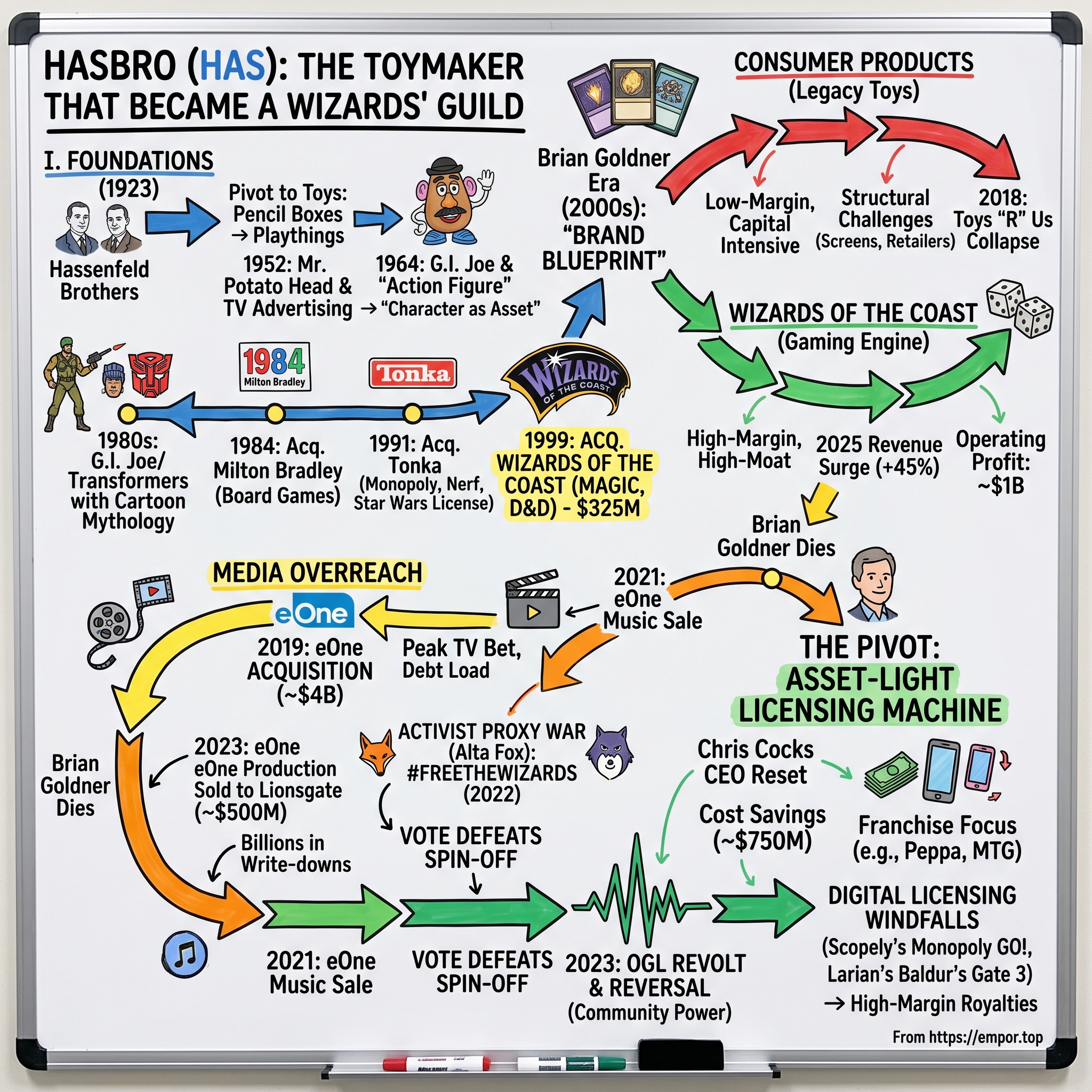
Hasbro: The Toymaker that Became a Wizards' Guild
I. Introduction & Episode Roadmap
Walk into a Hasbro shareholder meeting a decade ago and you would have found a toy company. There were Nerf blasters on the table, a Mr. Potato Head somewhere for the photographers, and an earnest slide deck about holiday sell-through at Walmart and Target. Walk into the version of Hasbro that reported its 2025 results in February 2026, and you would find something that barely resembles a toy company at all: a business whose single most profitable division prints cardboard rectangles, licenses a fantasy tabletop game invented in a Seattle apartment, and collects royalty checks from a mobile app it did not build and a video game it did not fund.
Here is the puzzle that animates this story. In fiscal 2025, Hasbro's Wizards of the Coast and Digital Gaming segment generated roughly $2.19 billion in revenue and just over $1.0 billion in operating profit.1 The legacy toy business — the Nerf, the Play-Doh, the Transformers action figures, the entire physical-goods empire that took a century to build — produced about $2.44 billion in revenue but a reported operating loss of $942.6 million, dragged into the red by a billion-dollar goodwill write-down.12 Put plainly: an 80-year-old Rhode Island company that started life selling textile remnants and pencil boxes now makes more money from a card game and a handful of gaming royalties than it does from the toys on which its name was built.
Zoom out to the whole company and the split personality is just as stark. For full-year 2025, total Hasbro revenue rose about 14%, powered almost entirely by the 45% surge at Wizards, while adjusted operating profit climbed 36% to roughly $1.14 billion and the adjusted operating margin expanded nearly four points to 24.2% — a level that would flatter many a software company, let alone a toymaker.1 And yet, on a reported basis, Hasbro posted a net loss of $2.30 per share, even as adjusted earnings came in at $5.54 per diluted share.1 That chasm between the "adjusted" profit story and the "reported" loss — the gap into which a billion-dollar toy-goodwill write-down disappeared — is not an accounting footnote. It is the whole argument in miniature: a thriving gaming business and a wounded toy business, reported as one number that satisfies no one.
That is the narrative tension of the modern Hasbro, and it is a tale of two companies wearing one ticker. On one side sits Consumer Products — the toys — a low-margin, capital-intensive, structurally challenged business fighting a war of attrition against screens, retailers, and its own tooling costs. On the other side sits a high-margin, high-moat gaming engine that has quietly subsidized the whole enterprise for years. Understanding Hasbro means understanding how one of those businesses came to carry the other.
It is also a story of a spectacular, expensive mistake. At the peak of the streaming-era conglomerate mania, Hasbro spent roughly $4.0 billion to buy the film-and-television studio Entertainment One (eOne), convinced it needed to own Hollywood's cameras.5 Within four years it had reversed course, dismantled the studio, and sold the production business to Lionsgate for a fraction of what it paid.6[^7] The write-downs ran into the billions. It remains one of the more instructive capital-destruction episodes in recent consumer-company history.
Out of that wreckage came a new strategy and a new CEO. Chris Cocks — the executive who had built Wizards of the Coast into a billion-dollar franchise — took the top job in early 2022 and set about turning Hasbro into an asset-light licensing machine.[^12] Rather than owning studios, it would license its intellectual property to the best developers on earth and keep the high-margin royalty. The evidence for the thesis arrived in the form of two extraordinary windfalls: Monopoly GO!, a mobile game built by Scopely that became one of the fastest titles ever to cross billions in gross revenue, and Baldur's Gate 3, a Dungeons & Dragons role-playing game built by Larian Studios that swept the Game of the Year awards.[^11]3
This article traces that arc from the beginning: the Hassenfeld brothers and the pencil boxes; the rise of Brian Goldner's "Brand Blueprint" and its overreach into peak-TV Hollywood; the eOne disaster; Wizards of the Coast as the silent golden goose; the activist proxy war that tried to break the company apart; the pivot to digital licensing and the self-inflicted wound of the Open Game License revolt; a strategic-power teardown using Hamilton Helmer's 7 Powers and Porter's Five Forces; the playbook lessons; and finally a clear-eyed bull-versus-bear stress test. Throughout, the posture here is neutral. Management says it is winning. The job of this piece is to ask what the evidence actually supports — and what could still break the case.
 Subscribe on LinkedIn
II. From Pencil Cases to Monopoly: The Hassenfeld Origins
The origin of one of America's great toy dynasties has almost nothing to do with toys. In 1923, two brothers — Henry and Helal Hassenfeld, Jewish immigrants from Poland — set up a small business selling textile remnants: the leftover scraps and off-cuts that fabric mills discarded. They called it Hassenfeld Brothers, a name later shortened into the corporate portmanteau the world knows today. The operation began in the New York area and soon planted roots in Pawtucket, Rhode Island, the mill town that would remain Hasbro's home for a century.
The pivot to toys came, as the best pivots often do, from watching customers. The brothers had moved from cloth into pencil boxes and school supplies — the zippered cases and cloth-covered boxes that students carried. Then they noticed something. The boxes were selling better than what went inside them. Customers wanted the container, the object, the thing — not just the pencils. During the Great Depression, when discretionary spending collapsed and survival meant finding whatever people would still pay for, the Hassenfelds leaned into manufacturing playthings of their own: doctor and nurse kits, modeling clay, simple toys that a cash-strapped family might still buy for a child. It was an early, accidental lesson in a truth that would define the company for the next hundred years — that the emotional pull of an object often matters more than its utilitarian contents.
The company's first true megahit rewired the entire industry. In 1952, Hasbro launched Mr. Potato Head, and in 1952 it did something no toymaker had done before: it advertised a toy directly to children on television. Until then, toys were marketed to parents, in catalogs and store displays. Hasbro went over the parents' heads and spoke straight to the kids — and the kids did the rest. Mr. Potato Head became a phenomenon, and the lesson Hasbro absorbed was profound and slightly Machiavellian: whoever controls the demand-generating medium controls the toy aisle. Television was the first "platform" Hasbro learned to ride, decades before anyone used that word.
The second defining product was an act of marketing genius disguised as a product decision. In 1964, Hasbro introduced G.I. Joe — a poseable military figure for boys. The problem was cultural: dolls were for girls, and no self-respecting mid-century American boy would be caught playing with a doll. So Hasbro simply refused to call it one. They coined a new category — the "action figure" — and in doing so created a franchise that has generated demand across generations and, crucially, established the template of the character as a durable, ownable asset rather than a one-season fad.
G.I. Joe also delivered, almost by accident, the prototype of the strategy that would one day define the whole company. When Hasbro relaunched the line in the early 1980s at a smaller scale, it paired the toys with a Marvel comic book and, soon after, a syndicated animated series — a coordinated fiction that gave every plastic figure a name, a backstory, and a place in an ongoing narrative. The same playbook produced Transformers in 1984, a line of shape-shifting robots licensed from Japan's タカラ Takara and wrapped in an American cartoon and comic mythology of Autobots and Decepticons. Children were no longer just buying toys; they were collecting characters from stories they watched every afternoon. Two decades before anyone drew up a "Brand Blueprint" on a slide, Hasbro had already discovered that entertainment sells plastic — it simply had not yet realized how much of the entertainment value it could keep for itself.
The modern shape of Hasbro was forged in a wave of consolidation in the 1980s and early 1990s, largely under Stephen Hassenfeld, the founders' grandson, whose ambition turned a regional toymaker into a national champion. In 1984, Hasbro acquired Milton Bradley, absorbing an entire canon of board games — The Game of Life, Candy Land — and the Playskool preschool brand. In 1991, it acquired Tonka, which itself owned Kenner and Parker Brothers, and with that single deal Hasbro swallowed Monopoly, Nerf, and — perhaps most consequentially — Kenner's lucrative Star Wars toy license, the franchise that had proven in the late 1970s that a film could sell mountains of plastic.
There was a human cost and a succession drama beneath the numbers. Stephen Hassenfeld, the driving force of the acquisition era and a somewhat private figure who had turned the family firm into a public-company juggernaut, died in 1989 at just 47. Leadership passed to his younger brother Alan Hassenfeld, who steadied the company through the 1990s and the transition to professional management. By the time the family stepped back from day-to-day control, the pencil-box startup had become a Fortune 500 institution — but one still culturally anchored in Pawtucket and still, at its core, a toy manufacturer.
By the mid-1990s, Hasbro had become a master of a specific and formidable game: physical distribution, retail logistics, and television-advertising-driven demand generation, operating as one half of a global toy duopoly alongside Mattel — the maker of Barbie and Hot Wheels, and the perennial rival with which Hasbro would flirt, more than once, over a merger that never happened. That was the legacy blueprint — own the brands, feed the retail channel, buy the TV airtime, repeat every holiday season. It worked beautifully for decades. But it was also a machine exquisitely optimized for a world that was about to disappear: a world of physical retail, broadcast television, and children whose attention had not yet migrated to a glowing rectangle. The man who would try to reinvent that machine for the media age had just joined the company.
III. The Brian Goldner Era: The "IP Blueprint" & Peak TV Overreach
Brian Goldner did not come up through the toy business. He came up through advertising and entertainment marketing — including a stint running the toy licensor Bandai America — and when he joined Hasbro in 2000 he brought an outsider's suspicion of the company's core assumption: the belief that Hasbro was, fundamentally, in the business of manufacturing and selling plastic. Goldner looked at the toy aisle and saw a commodity trap: injection-molded goods sold through price-obsessed retailers, endlessly knocked off by cheaper competitors, with margins that thinned every year. Selling plastic was a race to the bottom. He rose quickly, becoming chief operating officer and then, in 2008, chief executive; his central idea would reorganize the company around a single word — brands.
Goldner's personal style matched his thesis. He was a storyteller and a dealmaker, comfortable in Hollywood rooms in a way that few toy executives had ever been, and he cultivated relationships with studios, directors, and franchise owners as if entertainment were the main event and toys the merchandise — which, increasingly, was how he wanted Wall Street to see Hasbro too. That instinct would produce both the company's greatest strategic leap and its most expensive mistake, sometimes for the same underlying reason: a conviction that Hasbro belonged in the entertainment business, not merely adjacent to it.
He called it the "Brand Blueprint." The premise inverted decades of industry logic. For most of Hollywood history, toy companies had been supplicants: they paid studios for the right to make figures based on someone else's movie, taking whatever licensing terms the studio dictated. Goldner's insight was that Hasbro already owned characters and worlds — G.I. Joe, Transformers, My Little Pony — that were every bit as rich as the franchises it was paying to license. So why not make the movies to sell the toys, rather than the other way around, and capture the entertainment value for itself?
The proof of concept arrived in 2007 with Transformers, a partnership with Paramount and director Michael Bay that turned a line of shape-shifting robot toys into a multi-billion-dollar global box-office phenomenon across a string of sequels. For Goldner, the lesson was intoxicating and, as it turned out, dangerous: controlling the entertainment narrative was the ultimate margin booster. A hit film did not just sell tickets; it re-energized an entire toy line, justified premium pricing, and refreshed a brand for a new generation of children — a self-reinforcing loop between screen and shelf. The strategy was genuinely visionary, and for a while it looked unstoppable.
It is worth pausing on the asymmetry hidden inside this success, because it foreshadows everything that follows. In the Transformers model, Hasbro owned the underlying intellectual property and licensed it out to a studio that fronted the capital and risk of moviemaking — a fundamentally asset-light arrangement. But Hasbro also plays the opposite role in some of its biggest lines: it pays Disney enormous licensing fees for the right to make Star Wars and Marvel toys, franchises it does not own. Those licensed lines drive huge volumes but comparatively thin margins, precisely because the IP owner — Disney — captures the lion's share of the economic rent. Goldner understood this asymmetry perfectly. The tragedy is that he drew from it the ambition to own more content infrastructure, rather than the discipline to own only the IP and rent everything else.
But visions have a way of curdling into empire-building. Goldner did not want Hasbro to merely partner with Hollywood; he wanted Hasbro to become a piece of Hollywood — a Disney-lite that owned its media distribution rather than renting it. The company moved beyond licensing into direct media investment: a television joint venture that became the Discovery Family channel (originally the Hub Network), and eventually the ambition to own full-scale studio production. The logic was seductive. If entertainment drove toy demand, and Hasbro owned the entertainment, then Hasbro would capture the entire value chain. What the logic underweighted was that studio economics are brutally different from toy economics — content is a hit-driven, capital-intensive, high-variance business, and owning the infrastructure means owning the losses in the lean years, not just the wins in the fat ones.
This media ambition was not merely rhetorical. Hasbro poured resources into building out an entertainment apparatus: a dedicated Hasbro Studios to produce animated series for its brands, and the cable channel that became Discovery Family, launched as a venue to air My Little Pony, Transformers, and other Hasbro-branded programming directly to children. The theory was elegant — own the airwaves that create the demand — but the execution ran headlong into the collapse of the very model it depended on. Linear children's television was hollowing out as kids migrated to YouTube and streaming, and a cable channel aimed at pushing toy demand was a diminishing asset almost from the moment it launched. Hasbro would eventually retreat from the channel, an early and comparatively cheap preview of the far more expensive media lesson still to come.
Meanwhile, the ground beneath the legacy business was shifting in a way no amount of Hollywood strategy could fix. The traditional toy market was maturing and, in developed markets, structurally declining as children's leisure time migrated to screens. Then came the earthquake: the bankruptcy and 2018 liquidation of Toys "R" Us. For the entire industry, Toys "R" Us had been the anchor tenant — the specialty retailer that carried deep assortments, took risks on new lines, and provided a physical showroom for the category. Its collapse ripped out a pillar of the industry's primary distribution channel, concentrating even more power in the hands of Walmart, Target, and Amazon, and accelerating Hasbro's search for higher-margin, more direct, more media-driven ways to reach consumers. It was against this backdrop of a crumbling physical channel and a seductive Hollywood dream that Hasbro made the single largest — and most destructive — bet in its history.
IV. The $4 Billion Blunder: The eOne Fiasco
In August 2019, Hasbro announced it would buy Entertainment One, and on December 30, 2019, the deal closed. The price was roughly $4.0 billion (about £3.3 billion) in cash — an enormous sum for a company Hasbro's size, and by some distance the largest acquisition it had ever attempted.5 The strategic rationale was the full flowering of Goldner's Brand Blueprint: eOne came with a world-class television and film production engine, a deep content library, a global distribution apparatus, and — the crown jewels — a stable of beloved preschool intellectual properties, above all Peppa Pig and PJ Masks, franchises that generate enormous consumer-products and licensing revenue with the kind of durable, evergreen appeal that toymakers dream about.
The timing, in retrospect, could hardly have been worse. Hasbro paid a full price at the apex of the streaming-content boom, precisely when the "Streaming Wars" were driving content-creation costs to unsustainable highs and every media company on earth was bidding against the others for production capacity and talent. Hasbro was buying an independent film-and-TV studio at the top of the market, financing the purchase with a substantial pile of new debt. That leverage would become acutely painful when global interest rates began to climb sharply in 2022, turning a manageable debt load into a genuine balance-sheet constraint just as the underlying content business began to sour.
The cultural friction was as real as the financial strain. A century-old toy manufacturer from Pawtucket, wired for holiday retail cycles and the disciplines of physical goods, does not easily digest a Hollywood studio wired for greenlight meetings, talent deals, and the high-variance economics of scripted and unscripted television. The two organizations spoke different languages, ran on different clocks, and measured success in different currencies. Integration proved harder than the deal deck imagined.
There is a subtle but important distinction buried in the eOne rationale that explains why the deal was not entirely foolish — and why its unwinding was so surgical. eOne was really two businesses bolted together. One was a genuine IP owner: the studio behind Peppa Pig and PJ Masks, evergreen preschool brands that generate the same kind of durable, high-margin licensing income Hasbro prizes, and that fit the Brand Blueprint logic exactly. The other was a general-purpose film-and-television production and distribution engine — a services business that makes and sells content for third parties, carrying heavy working-capital needs, lumpy hit-driven revenue, and structurally lower returns. Hasbro paid a single premium price for both, at the top of the market, and financed it with debt that would grow far more expensive once central banks began raising rates in 2022. The mistake was not wanting Peppa Pig; it was paying studio-empire prices to get her.
Then the strategy began to unwind, piece by piece. The first crack came in 2021, when Hasbro sold the eOne Music business to Blackstone for $385 million, a move framed as portfolio-focusing but which also served to shore up cash.[^8] That same autumn, tragedy reshaped the company: Brian Goldner, the architect of the entire media blueprint and the man whose conviction had driven the eOne purchase, died in October 2021 after a long illness. The strategist was gone, and with him much of the internal will to defend the studio dream.
Under new leadership, Hasbro admitted defeat on owning Hollywood's cameras. In August 2023, it agreed to sell the eOne film and television production business to Lionsgate, and the deal closed at the end of December 2023.6[^7] The headline price was roughly $500 million — about $375 million in cash plus the assumption of production financing debt — for a business that had been the centerpiece of a $4.0 billion acquisition less than four years earlier.6 The gap between purchase price and sale price, layered on top of billions in goodwill and intangible write-downs, made the arithmetic unambiguous: this was one of the more expensive strategic lessons a consumer company had paid in years.
Yet the epilogue carries the real insight. Hasbro did not sell everything. It kept Peppa Pig and PJ Masks — the actual intellectual property, the evergreen preschool franchises that throw off high-margin licensing income. What it discarded was the studio itself: the cameras, the production infrastructure, the unscripted-TV operations, the capital-hungry machine for making content. The lesson, learned at a cost of billions, was that a toy-and-IP company should license its worlds to Hollywood and collect the royalty, not own the volatile, low-margin, hit-or-miss business of physically producing film and television. Buy the water rights, in other words, not the pipes. And here is the deeper irony that the next chapter reveals: while Goldner was chasing Hollywood and the market was watching the eOne drama, the most valuable business Hasbro had ever bought was sitting quietly in Renton, Washington, compounding.
V. Wizards of the Coast: The Silent Golden Goose
In 1999, Hasbro paid $325 million for a company most of its shareholders had never heard of and few understood: Wizards of the Coast, the Seattle-area firm that had created Magic: The Gathering and, through an earlier acquisition, owned Dungeons & Dragons. At the time it read as a quirky, almost niche purchase — a bet on hobbyist gamers, on people who spent their weekends in the back rooms of comic shops shuffling decks of fantasy cards. Nobody at the 1999 investor presentations would have guessed they were watching what may be the single best acquisition in the history of the toy industry.
The two franchises inside Wizards had improbable origin stories of their own. Dungeons & Dragons was invented in 1974 by Gary Gygax and Dave Arneson and published by a small Wisconsin outfit called TSR — the game that essentially created the tabletop role-playing genre and taught a generation to imagine collaboratively around a table with dice and rulebooks. Magic: The Gathering arrived in 1993, the brainchild of a mathematician named Richard Garfield, and it invented an entirely new category: the collectible card game, in which players buy randomized packs, build their own decks, and duel. Wizards of the Coast, founded by Peter Adkison, struck gold with Magic and used the proceeds to rescue a floundering TSR, buying Dungeons & Dragons in 1997. So when Hasbro bought Wizards two years later, it acquired the two foundational franchises of modern hobby gaming in a single stroke. There is even a delicious footnote to the moment: Wizards of the Coast was also the company that first published the Pokémon trading card game in North America, printing the cards that ignited a national craze — until Nintendo pulled the license in-house in the early 2000s. Hasbro thus briefly touched, and then lost, what became the best-selling trading card game on earth, a reminder that owning distribution is not the same as owning the IP.
To understand why, you have to understand the economics of a trading card game, because they are almost the inverse of the toy business Hasbro had spent 75 years perfecting. A physical toy is a lump of plastic: it costs real money to mold, package, ship, and warehouse, and it sells once. A Magic: The Gathering card is a printed piece of cardboard whose marginal cost of production is effectively nothing — pennies of ink and paper — but which sells at premium prices because its value lives not in the material but in the game, the scarcity, and the collectibility. The intellectual property does the heavy lifting; the physical object is almost incidental. This is why the two halves of Hasbro post such radically different margins. The legacy toy division typically operates at low-to-mid single-digit adjusted operating margins — often in the 4-to-5-percent range. Wizards of the Coast routinely posts operating margins in the 40-to-45-percent range. They are barely the same kind of business.
For years, this divergence hid in plain sight, buried inside consolidated financials. Then it became impossible to ignore. In fiscal 2025, the Wizards of the Coast and Digital Gaming segment grew revenue 44.7% to roughly $2.19 billion — very nearly matching the $2.44 billion of the entire Consumer Products division, a business it took a century to build.1 More striking still was the profit picture. Wizards generated about $1.01 billion in segment operating profit in 2025, up from $632 million the year before, at a segment operating margin of 46.0%.1 That single division produced essentially the entirety of Hasbro's underlying operating income. By contrast, the Consumer Products segment — even setting aside the non-cash goodwill impairment — delivered only about $113 million in adjusted operating profit, down 26% on the year, squeezed by lower volumes and roughly $45 million of new tariff costs running through the cost of sales.12 On a reported GAAP basis, Consumer Products swung to a $942.6 million operating loss, courtesy of a $1,021.9 million non-cash goodwill write-down triggered in the second quarter of 2025 when tariff pressure forced a reassessment of the legacy toy business's carrying value.12 In other words, the toy business had to formally admit on the balance sheet that it was worth a billion dollars less than the books had claimed.
The engine driving Wizards' surge was Magic: The Gathering, which had its strongest financial year ever in 2025.1 Tabletop gaming revenue jumped more than 60%, powered by a single, controversial, wildly successful strategic idea: Universes Beyond. For most of its 30-year history, Magic lived inside its own original fantasy multiverse. Universes Beyond blew the doors open, licensing massive external intellectual properties into the game — The Lord of the Rings, Marvel, Final Fantasy, Avatar: The Last Airbender — so that players could build decks around Gandalf, Spider-Man, or a Final Fantasy summon.1 The Final Fantasy set in particular became a phenomenon. What this reveals strategically is that Magic has quietly transformed from a game into an IP platform — a distribution layer onto which other people's beloved characters can be grafted, each collaboration bringing a new fandom into the ecosystem while the core rules engine, and Hasbro's margins, stay intact.
Wizards has also been building a second engine alongside the cardboard one: digital. Magic: The Gathering Arena brought the card game online as a free-to-play client, letting players buy and battle without ever touching a physical card — pure software economics with even lower marginal cost than paper. On the role-playing side, Hasbro acquired D&D Beyond, the digital toolset where players manage character sheets, rulebooks, and campaigns by subscription, turning a one-time rulebook purchase into recurring revenue and a data-rich relationship with the player. These platforms matter for two reasons. They deepen switching costs — a player's collection and campaign history live inside them — and they point toward a future in which Wizards captures more of the value chain digitally rather than through printing and shipping cardboard. They are also, as the coming Open Game License episode would show, the exact pressure points where a mismanaged relationship with the community can inflict immediate, measurable damage.
That is the bull case for Wizards in a sentence: a business with software-like margins, a 30-year moat, digital platforms that thicken switching costs, and a newfound ability to plug the world's biggest franchises into its own economics. But a golden goose that is squeezed too hard stops laying, and the same Universes Beyond strategy and accelerated release cadence that produced 2025's record numbers carry a real risk of collector fatigue — a theme we will return to. First, though, the record surge of Wizards is exactly what a hedge fund noticed in 2022, when it decided the goose deserved a cage of its own.
VI. The Proxy Fight & The Chris Cocks Reset
In early 2022, a relatively small Texas hedge fund named Alta Fox Capital Management did something that made a lot of Hasbro shareholders sit up: it publicly argued that the company was sitting on a hidden jewel and mismanaging it. Alta Fox held about a 2.5% stake, and it launched a campaign with a name engineered to go viral in the gaming community — #FreeTheWizards.7 The thesis was blunt and, to many observers, uncomfortably persuasive. Wizards of the Coast, Alta Fox argued, was a world-class software-and-gaming business trapped inside a mediocre, capital-destroying toy manufacturer. Locked inside Hasbro, its extraordinary economics were being masked by the drag of the legacy business and squandered on misadventures. And what was Exhibit A for legacy corporate incompetence? The still-fresh, multi-billion-dollar eOne debacle. Alta Fox demanded that Hasbro spin off Wizards of the Coast as a standalone company to unlock what it claimed was enormous suppressed value.7
Hasbro's board mounted the standard defense of the conglomerate: synergy. In its proxy materials it argued that Wizards' intellectual property was deeply woven into the broader Hasbro machine — the toy manufacturing, the licensing relationships, the merchandising, the entertainment pipeline — and that ripping it out would sever those connections, sacrifice cross-brand value, and create tax inefficiencies that would destroy more value than a spin-off could unlock.9 It is worth naming the skeptic's counterpoint honestly, because it never fully went away: the "synergies" between a card-game studio and a plastic-toy factory are, on inspection, fairly thin, and much of the defense amounted to an argument for keeping the profitable division's cash flow available to fund the struggling one.
The proxy fight played out against a leadership transition that was almost poetically on the nose. In February 2022, Hasbro named its new CEO: Chris Cocks — the man who had run Wizards of the Coast, who had grown Magic: The Gathering into a billion-dollar brand and pushed hard into digital with MTG Arena and the D&D Beyond platform.[^12] The board was, in effect, handing the entire company to the person who best understood the very asset the activists wanted to liberate.
Cocks's résumé was, tellingly, a technology résumé more than a toy one. Before joining Wizards as president in 2016, he had spent years at Microsoft, including in its Xbox games business — steeped in live-service software, digital storefronts, and the economics of games as ongoing platforms rather than one-time products. That background shaped his instincts profoundly: he thought in terms of engagement, recurring revenue, and digital distribution, not seasonal toy shipments. His elevation signaled, more clearly than any press release could, where the company believed its future lay. It also carried an implicit acknowledgment of the activist's core point — that the most valuable thing about Hasbro was the gaming business Cocks had built.
In June 2022, shareholders voted. They backed Hasbro's incumbent slate and rejected Alta Fox's nominees, defeating the spin-off campaign.7 But defeating a message is not the same as ignoring it, and the message had plainly been received. Under Cocks, Hasbro launched a strategic reset it branded "Blueprint 2.0" — later sharpened into the "Playing to Win" strategy unveiled at its October 2022 Investor Day — that adopted, in substance, much of the activist critique even as it rejected the activist remedy.[^12][^14]
The reset had three hard edges. First, operational discipline: a cost-savings program that was ultimately scaled up to a target of roughly $750 million in gross annualized savings by the end of 2025, aimed squarely at stripping out layers of middle management and legacy toy overhead. Second, the human cost of that discipline: Hasbro cut roughly a fifth of its global workforce, including about 1,100 employees announced in late 2023 — a wrenching reduction that underscored just how much cost the legacy structure had accumulated. Third, focus: rather than spreading resources across a sprawling portfolio, management concentrated some 80% of its investment behind a short list of franchise brands — Peppa Pig, Dungeons & Dragons, Magic: The Gathering, Transformers, Play-Doh, Nerf, Monopoly, and Clue — while walking away from low-margin licensed partner brands that consumed shelf space and management attention without earning their keep. The strategy, in a phrase, was to stop being everything to everyone and start being ruthlessly profitable at a few things.
Even the plumbing of Hasbro's financial reporting was rebuilt to reflect the new worldview. The company reorganized its reportable segments so that "Wizards of the Coast and Digital Gaming" stood on its own, distinct from Consumer Products and from the Entertainment operations. This is more than accounting housekeeping: how a company slices its segments tells investors where management believes the story lives. By carving out gaming as a standalone segment, Hasbro was, in effect, doing voluntarily and transparently a version of what Alta Fox had demanded — letting the market see the gaming engine's revenue and margins in the open, even if the assets themselves stayed inside the corporate walls. It was a concession dressed as disclosure, and it made the divergence between the two Hasbros impossible to ignore quarter after quarter. The question that remained was how to grow those franchises without pouring capital into studios and factories. The answer was to let someone else build.
VII. The Asset-Light Playbook: Licensing, Digital, & The Community Power
The clearest way to see the new Hasbro is to look at what it stopped doing. It stopped trying to build video-game studios and movie sets. Instead, it began renting out its intellectual property to the best developers in the world and keeping the high-margin royalty — the "license the water, don't build the pipes" lesson from eOne, applied deliberately and at scale.
The two showcase examples are almost too perfect. The first is Monopoly GO!, a mobile game built and operated by Scopely, not Hasbro. Hasbro supplied the century-old Monopoly brand; Scopely supplied the free-to-play design, the live-operations machine, and the marketing budget. The result was one of the fastest-growing mobile games in history, blowing past $3 billion and then $6 billion in cumulative gross player spending in remarkably short order.[^11] For Hasbro, the beauty of the arrangement is that it bore essentially none of the development cost or commercial risk and simply collected a royalty off the top — and that royalty is nearly pure profit. In 2025, Hasbro's cut from this single game reached $168.0 million, up from $112.2 million in 2024.13 That is a high-margin, bottom-line contribution from a product Hasbro did not build, does not operate, and barely has to manage.
The second example validates the same model in a different genre. Baldur's Gate 3, a lavish role-playing epic built by Belgium's Larian Studios and set in the Dungeons & Dragons universe, swept the 2023 Game of the Year awards and became a critical and commercial sensation. Because it was built on Hasbro's D&D license, it generated well over $90 million in high-margin royalties for Hasbro — again, with zero capital development risk borne by Hasbro itself.34 Two products, built by two outside studios, throwing off more than a quarter of a billion dollars in mostly-profit royalties: this is the asset-light thesis made concrete, and it is genuinely powerful.
The contrast with the other D&D entertainment product of 2023 sharpens the point. That same year, a Dungeons & Dragons feature film, Honor Among Thieves, arrived in theaters to warm reviews but disappointing box office — a reminder that when Hasbro's IP rides on someone else's expensive, capital-intensive production, the outcome is far less certain than a royalty check off a hit game. The pattern management has clearly internalized is to favor licensing structures where Hasbro carries none of the downside. Even the partners themselves are a study in the shifting economics of games: Scopely, the maker of Monopoly GO!, was itself acquired by Savvy Games Group, an arm of Saudi Arabia's sovereign wealth fund, underscoring how much capital and risk now sit on the developer side of the ledger — exactly the side Hasbro has chosen to avoid.
But — and this is the crucial counterweight — the same year that showcased the promise of Hasbro's IP also delivered a brutal lesson in the fragility of it, and it came from the company's own hand. In January 2023, Wizards of the Coast attempted to overhaul the two-decade-old Open Game License (OGL 1.0a), the permissive license that had, since 2000, allowed thousands of third-party creators to build and sell their own Dungeons & Dragons-compatible adventures, supplements, and businesses. Leaked drafts of the proposed new terms revealed management's intent to "de-authorize" the old license and replace it with one that could extract royalties — reportedly up to 25% — from the largest third-party creators, and, in some versions, grant Wizards broad rights over content those creators made.8
To grasp why this was incendiary, you have to understand what the OGL had built. For two decades, the license had functioned as a kind of constitution for the D&D economy: a promise that anyone could publish compatible material, sell it, and build a business on it without fear that Wizards would one day change the rules. On the strength of that promise, an entire cottage industry had grown up — small publishers, Kickstarter creators, virtual-tabletop platforms, and third-party adventure designers, many of whom made their living inside the ecosystem. The proposed changes did not just raise fees; they threatened to retroactively revoke the foundational trust on which those livelihoods rested. That is why the community read "de-authorization" not as a business-terms update but as a betrayal.
The reaction was not a grumble; it was a revolt. The D&D community — the very ecosystem of Dungeon Masters, small publishers, streamers, and superfans that gives the game its life — erupted. Competitors and independent publishers, led by Paizo (maker of the rival Pathfinder system), rallied around a new, genuinely open alternative called the Open RPG Creative License (ORC). Fans organized mass cancellations of their D&D Beyond digital subscriptions, and the cancellations were large enough and public enough to become a business threat in their own right.8 Within weeks, Wizards executed one of the more complete corporate reversals in recent memory. It backed down entirely, issued a public mea culpa, abandoned the de-authorization plan, and — to try to rebuild trust — placed the core Dungeons & Dragons rules content (the System Reference Document, SRD 5.1) under an irrevocable Creative Commons license, permanently surrendering the very control it had just tried to tighten.8
The episode is worth dwelling on because it teaches something the Monopoly GO! success obscures. In community-driven gaming, the company does not own the moat outright — the community co-owns it. The network effect that makes D&D valuable lives in the players and creators, not just in the trademark. Push monetization too aggressively, act in bad faith, and you can vaporize goodwill — and with it the network effect — faster than any competitor could. Hasbro captured hundreds of millions in easy royalties and nearly detonated its most beloved brand in the same twelve months. Both facts are true, and holding them together is the key to valuing this business honestly. That tension — powerful IP, fragile trust — is exactly what a rigorous strategic-power analysis has to reckon with.
VIII. Strategic Power Analysis
Step back from the news flow and the question for a long-term investor becomes structural: how durable, really, are Hasbro's advantages? The most useful lenses are Hamilton Helmer's 7 Powers — applied to the gaming crown jewel — and Michael Porter's Five Forces — applied to the legacy toy business, where the pressures are very different.
Wizards of the Coast through Helmer's 7 Powers. Start with network effects, which for Magic: The Gathering are genuinely high. Magic is only fun if you have people to play against, cards to trade, and a scene to compete in. Every additional player thickens the ecosystem — deepening the secondary card market, filling local game-store tournaments, sustaining the professional and streaming scene — which in turn makes the game more valuable to every existing player. Dungeons & Dragons enjoys a related but distinct platform network effect: the more people who learn to run games as Dungeon Masters, the more tables exist for new players to join, and the larger the pool of creators making the adventures and tools that draw yet more players in. This is the very asset the OGL fiasco endangered — which is precisely why endangering it was so dangerous.
Next, switching costs, also high. A committed Magic player may have spent thousands of dollars and hundreds of hours assembling a physical collection, or built an extensive digital library on D&D Beyond and MTG Arena. Walking away to a competitor like Disney's Lorcana or Paizo's Pathfinder means abandoning that sunk investment of money, time, and social capital. That stickiness is real, though it is worth noting it is not absolute — a sufficiently alienated player base can and did organize collective action, as the subscription cancellations proved.
Then the cornered resource: Hasbro owns the copyrights, trademarks, characters, and lore of both D&D and Magic. No competitor can legally publish a "Magic: The Gathering" set or sell official Forgotten Realms content. This is a durable legal moat around the brand itself — even as the OGL episode reminded everyone that the rules mechanics underneath are far harder to fence off than the names and art on top.
Finally, scale economies intersecting with what looks like a cost leadership power in production: once the art, design, and rules of a card or a digital release are paid for, the marginal cost of printing another card or serving another digital download is close to zero. Enormous operating leverage flows from that — it is the mechanical reason a 46% segment operating margin is even possible.1 The flip side, and the honest caveat, is that this leverage cuts both ways: it rewards ever-higher release volume, which is exactly the pressure that risks the collector fatigue discussed below.
It is worth war-gaming the competitive field directly, because Wizards does not operate unopposed. In trading card games, the single largest force is Pokémon — the best-selling TCG in the world, owned by Japan's The Pokémon Company and Nintendo, and enjoying its own collecting boom — a rival Magic has coexisted with for decades but never displaced. More recent is Lorcana, Disney's collectible card game published by Germany's Ravensburger, launched in 2023 to plug directly into the same hobby shelves and the same players' wallets; it is the most credible new entrant Magic has faced in years, and it comes armed with Disney's own bottomless IP library. In tabletop RPGs, Paizo's Pathfinder has long been the disciplined alternative to D&D, and it was Paizo that channeled the OGL backlash into the rival ORC license. The instructive point is that Wizards' moat is real but not a monopoly: its cornered resources protect the specific worlds of Magic and D&D, not the categories themselves, and well-capitalized rivals with their own beloved IP are actively probing for share. Meanwhile, the eOne lesson finds an unlikely validation across the aisle: rival Mattel's 2023 Barbie film — a global blockbuster that Mattel licensed out to Warner Bros. rather than producing itself — demonstrated the asset-light IP model working at spectacular scale, a pointed contrast to Hasbro's own studio misadventure.
Consumer Products through Porter's Five Forces tells a far grimmer story, and it explains why the same corporate parent hosts a 46%-margin business and a near-breakeven one. The threat of new entrants into global toys is relatively low — the capital costs of worldwide distribution, retail relationships, and injection-mold tooling are real barriers — which is cold comfort given the other forces. The bargaining power of buyers is extremely high: with Toys "R" Us gone, physical toy distribution is dominated by Walmart, Target, and Amazon, giants that dictate pricing, inventory terms, and shelf space and relentlessly squeeze supplier margins. And the threat of substitutes is arguably the most severe force of all: digital entertainment, Roblox, tablet games, YouTube, and screen time generally are eating directly into the hours children once spent with physical toys. A plastic action figure competes not just with Mattel's plastic action figure but with an infinite, free, algorithmically optimized feed of digital play. That is a structural headwind no cost-savings program can fully cure — it can only be managed. Which is the honest, uncomfortable synthesis of the strategic-power view: Hasbro owns one business with excellent powers and one business fighting a losing battle against the physics of its industry, and the corporate task is to keep harvesting the first while stabilizing the second.
IX. Playbook: Business & Capital Allocation Lessons
Strip away the specifics and Hasbro's recent history offers a set of transferable lessons that are useful well beyond the toy aisle. Three stand out.
Lesson one: beware the core-competence trap, and don't buy the pipes when you can license the water. The eOne saga is a near-textbook case of a company mistaking an adjacency for a competency. Hasbro reasoned that because entertainment drove its toy demand, it should own the entertainment production apparatus. But content distribution and studio production are their own distinct disciplines — volatile, capital-hungry, hit-driven, and structurally lower-margin than owning the intellectual property and licensing it out. Roughly $4 billion went in; a business worth a fraction of that came out, along with billions in write-downs.56 The generalizable insight is that vertical integration is only value-creating when you can actually run the acquired activity better than the market can, and "we are adjacent to it" is not evidence that you can. The asset-light licensing model Hasbro now champions is, in effect, the negation of the mistake it made — and the fact that the same company both made the error and corrected it is a mark, at least, of institutional learning.
Lesson two: community moats are co-created, and they can be breached from the inside. Traditional consumer products treat the customer as a passive recipient — you make a Nerf blaster, the child buys it, transaction complete. Trading card games and tabletop RPGs are different in kind: the value is co-produced by a decentralized ecosystem of players, Dungeon Masters, third-party publishers, and creators who invest their own labor and love into the platform. That is what makes the moat deep — and also what makes it uniquely vulnerable to the platform owner's own behavior. Over-monetize, act in bad faith, and you don't just lose a sale; you can shatter the trust that makes the network valuable in the first place, as the OGL revolt demonstrated in real time.8 The lesson is that when your customers are also your co-creators, governance and goodwill are not soft values — they are core assets on the balance sheet, even if no accountant records them there.
Lesson three: watch for brand dilution disguised as growth — the "Magic fatigue" risk. Under pressure to feed corporate profit growth, Wizards has dramatically accelerated the release cadence of Magic: The Gathering — more sets, more Universes Beyond crossovers, more premium "Secret Lair" drops, and a steady stream of collector variants. In the near term this is pure fuel: it drove the record 2025 numbers. But there is a well-understood failure mode in collectibles, familiar to anyone who lived through the comic-book and sports-card bubbles of the 1990s: flood the market with product and special editions, and you risk overwhelming the core collector, creating an inventory glut, and eroding the perceived scarcity that gives old cards their value. The tension is structural and ongoing — management is being asked to hit quarterly targets with a product whose long-term value depends on restraint. That is a genuinely hard balance, and it is one investors should watch management navigate rather than assume it will get right.
Underlying all three lessons is a single question of temperament: has Hasbro genuinely changed its capital-allocation character, or merely its circumstances? The eOne era was defined by a willingness to make a giant, debt-funded, empire-building bet. The current era preaches discipline — deleveraging, harvesting IP, refusing to fund other people's production risk, and returning to shareholders only what the balance sheet can safely spare. The encouraging evidence is behavioral: management set specific cost and margin targets and, on the 2025 results, appears to have met or beaten them, which is the kind of promise-and-deliver track record that builds credibility over time. The cautionary note is that discipline is easiest to maintain when the core engine is booming, as Wizards was in 2025. The real test of a capital-allocation philosophy comes in the lean year — when royalties fade, when a Magic set underwhelms, when the temptation returns to do something big and transformative to reignite the narrative. Investors have not yet seen this management team under that particular kind of pressure. These lessons flow directly into how one should judge the stock and the people running it.
X. Investor Stress Test: Bull vs. Bear
Assessing management. Any honest appraisal of Hasbro today has to start with Chris Cocks, because the entire thesis runs through his execution. On credibility, the record is, so far, reasonably strong. Cocks inherited a mess — a leveraged balance sheet, a failing Hollywood strategy, an activist at the gate, and a legacy business in structural decline — and he did the unglamorous things competently. He unwound the eOne disaster and got the studio off the books; he drove a large, painful cost-reduction program toward its roughly $750 million target; and he presided over Wizards' historic 45% revenue surge in 2025.1[^7] His incentives are aligned with what the situation demands: operational efficiency, debt paydown, and margin expansion. At its 2022 Investor Day, management set a target of a 20%-plus adjusted operating profit margin; the 2025 adjusted operating margin of 24.2% suggests they cleared that bar early.1[^14]
The skeptic, though, has legitimate challenges to press. Much of the 2025 profit surge rests heavily on Wizards, and within Wizards heavily on a Universes Beyond strategy and a release cadence that may be borrowing brand equity from the future. The reported net loss for 2025 — driven by that billion-dollar goodwill impairment — is a reminder that the legacy business is still capable of delivering ugly surprises, and that "adjusted" numbers exclude some very real economic decay. And the near-breakeven toy margin means the turnaround of Consumer Products, as opposed to the harvesting of Wizards, remains largely unproven.
There is also an activist-style critique still latent in the structure, and it is essentially the one Alta Fox raised — never resolved so much as outvoted. A sharp long/short investor would press several points. First, disclosure and mix: the more Hasbro's value concentrates in Wizards, the more shareholders are effectively buying a great gaming company yoked to a declining toy company, and the conglomerate structure lets management fund the weak half with the strong half's cash flow — the very cross-subsidy the board defended as "synergy." Second, leverage: the eOne debt is being paid down, but the balance sheet still carries the scars of that acquisition, and a company reliant on hit-driven royalties and a single blockbuster card franchise wants less financial fragility, not more. Third, accounting judgment: a billion-dollar goodwill impairment in the toy segment, triggered in part by tariffs, is a formal admission that prior carrying values were too optimistic — and it invites the question of whether the remaining intangibles are conservatively marked. None of these is fatal, but each is a live line of attack, and the fact that the spin-off debate was closed by a shareholder vote rather than settled by the numbers means it can always reopen if Wizards' outperformance grows more glaring.
A brief myth-versus-reality note is warranted here, because the popular narrative oversimplifies. The myth is that "Hasbro doesn't make toys anymore" or that it has "become a software company." The reality is more nuanced: toys still generate roughly half of total revenue and remain the company's largest segment by sales; Hasbro has not exited the toy business, it has stopped depending on it for profit. The transformation is one of where the earnings come from, not where the revenue comes from — and that distinction matters, because it means the low-margin, cyclical, retailer-dominated toy operation is still very much part of the investment, dragging on returns even as the gaming engine powers ahead.
One risk on the current radar deserves explicit naming because it directly shaped the 2025 numbers: tariffs and the supply chain. Hasbro manufactures a large share of its physical toys in Asia, and the imposition of new import tariffs in 2025 did double damage — it added roughly $45 million of direct cost to the Consumer Products segment through cost of sales, and it was the trigger that forced the billion-dollar goodwill reassessment of the toy business.12 This is the mechanism by which trade policy converts into a real earnings and balance-sheet event for Hasbro: a company whose profits increasingly come from weightless digital IP still has one foot planted in a globe-spanning physical supply chain that geopolitics can tax at will. The gaming engine is largely insulated from this; the toy business is squarely exposed. It is one more reason the two halves of Hasbro deserve to be valued as the very different animals they are.
The KPIs that actually matter. Rather than drown in metrics, a long-term investor can track this company with three:
- Wizards of the Coast segment operating margin (recently 46%). This is the profit engine; the question is whether it can sustain margins in the 40s as the mix shifts toward more internally developed digital games, which may carry different economics than near-zero-marginal-cost card printing.1
- Consumer Products adjusted operating margin (recently around 5%, with management aspiring toward double digits). This is the referendum on whether the cost program and franchise focus can structurally repair the toy business, or whether they are merely slowing its decline.1
- Licensed and digital gaming royalty durability. Monopoly GO! royalties nearly doubled year-on-year, but the essential unknown is whether these windfalls are durable recurring streams or the peak of a mobile-gaming fad that will decay as player spending rotates to the next hit.13
The bull case. Hasbro completes its metamorphosis into an asset-light IP-licensing powerhouse. Wizards and digital licensing drive the overwhelming majority of the company's value; the toy business is stabilized into a modestly profitable, cash-generative operation that funds debt paydown rather than draining it; and — crucially — the market eventually re-rates the whole enterprise on a premium gaming-and-software multiple rather than the depressed multiple it assigns to toymakers. In this world, the century of toy heritage becomes a brand-and-IP library feeding a high-margin licensing flywheel, and the stock's valuation follows the profits toward the software end of the spectrum.
The bear case. The legacy toy division keeps declining, demanding further write-downs and consuming management attention and cash. Magic: The Gathering hits the collector-fatigue wall — the overproduction that juiced 2025 curdles into glut, discounting, and disillusioned core players — and the segment's growth stalls or reverses. The mobile royalty windfalls decay on schedule as gaming trends move on, leaving Hasbro with a still-meaningful debt load, an impaired legacy engine, and a gaming crown jewel that turns out to have been managed for near-term yield at the expense of long-term brand health. In this world, the "asset-light transformation" narrative was really a story about one great business carrying a declining one, and the market was right to be skeptical all along.
The truth, as usual, will likely land somewhere between the two — and precisely where it lands is what the three KPIs above are designed to reveal over the next several years.
XI. Epilogue & Outro
There is a tidy symmetry to Hasbro's hundred-year arc. It began when two immigrant brothers noticed that customers cared more about the pencil box than the pencils — that the container, the object, the thing with meaning attached was where the value lived. A century later, their successors have discovered a version of the same truth at a higher level of abstraction: that the value lives not in the plastic but in the intellectual property, not in the pipes but in the water, not in the manufacturing but in the worlds and characters that people love enough to build their own play around.
Hasbro's journey is, in that sense, a microcosm of the broader economy's migration — from making physical goods to managing high-margin, digital-first networks of intellectual property. The company that once mastered injection molding and Saturday-morning television advertising is now trying to master licensing royalties, live-service mobile economics, and the delicate governance of player communities that co-create its most valuable assets. It shed the Hollywood studio dream at a cost of billions and, in the wreckage, rediscovered the quiet business in Renton that had been compounding under everyone's nose.
For the long-term investor, the honest verdict is that Hasbro today is neither the doomed toymaker of the bears' imagination nor the pure gaming-and-software compounder of the bulls' pitch deck. It is a hybrid mid-transformation — a genuinely excellent gaming franchise stapled to a structurally challenged consumer-products business, run by a management team that has, so far, done the hard and unglamorous work of cleaning up its predecessor's mistakes. The bet a shareholder makes is essentially a bet on two things holding simultaneously: that Wizards can keep growing without cannibalizing the trust and scarcity that make it valuable, and that the toy business can be stabilized rather than perpetually rescued. Neither is guaranteed. Both are knowable over time, through the handful of metrics that actually matter — which is why the discipline of watching, rather than assuming, is the whole game here.
The final reflection is also the central caution. By embracing its inner "Wizards' Guild," Hasbro has charted a genuinely higher-margin future — but that future rests on a foundation more fragile than a factory. Card games and RPGs are trust economies. They reward patience, restraint, and treating players as partners; they punish overreach, as the OGL revolt showed, faster and more decisively than any market downturn. The company has proven it can generate enormous profit from its IP. Whether it can do so without strip-mining the very communities that give that IP its worth is the open question — and it is the one on which the next chapter of this century-old story will turn.
References
-
Hasbro Reports Fourth Quarter and Full Year 2025 Financial Results — Hasbro, Inc., 2026-02 ↩↩↩↩↩↩↩↩↩↩↩↩↩↩↩↩↩↩
-
Hasbro, Inc. Form 10-K for fiscal year ended December 28, 2025 — SEC EDGAR ↩↩↩↩
-
Hasbro 2024 report: Monopoly GO brings in $112M and BG3 doubles royalty expectations — Game World Observer, 2025-02-21 ↩↩↩↩
-
MONOPOLY GO! and Baldur's Gate 3 Dominate the Digital Scene — Hasbro, Inc. ↩
-
Hasbro Completes Acquisition of Entertainment One — Hasbro, Inc., 2019-12-30 ↩↩↩
-
Lionsgate to Buy Hasbro's eOne TV and Film Business for $500 mln — Reuters, 2023-08-03 ↩↩↩↩
-
Activist Alta Fox Nominates Directors at Hasbro, Seeks Spinoff of Wizards of the Coast — Bloomberg, 2022-02-17 ↩↩↩
-
Dungeons & Dragons Maker Wizards of the Coast Backs Down on Royalty Plan After Fan Uproar — Wall Street Journal, 2023-01-27 ↩↩↩↩
-
Hasbro Proxy Statement DEF 14A Filing — U.S. Securities and Exchange Commission, 2022-04-25 ↩
 LinkedIn
 WhatsApp
 Reddit
 Hacker News
 Email
Email Kindle
 RSS Feed
 Spotify
 Apple Podcasts
 Amazon Music
 Audible
 YouTube