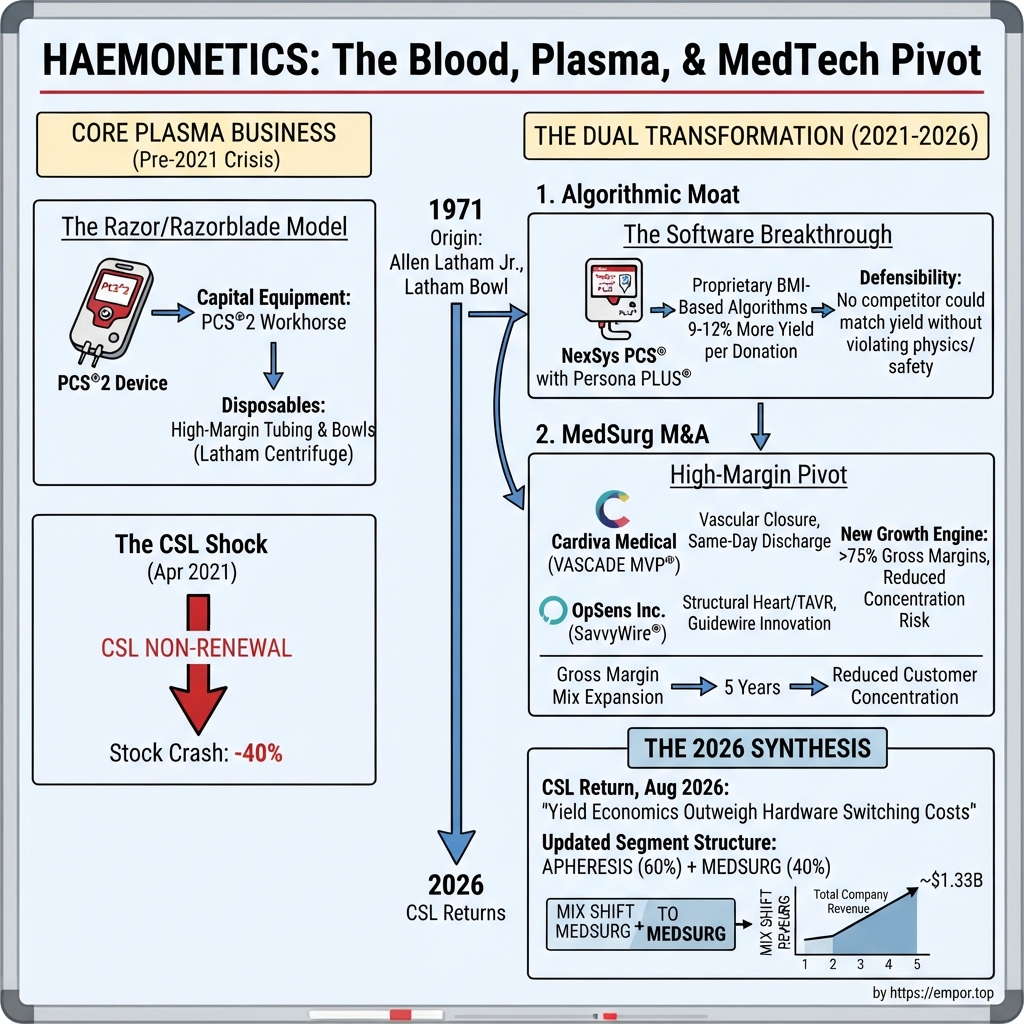
Haemonetics Corporation: The Blood, Plasma, and MedTech Pivot
I. Introduction & Episode Roadmap
At 7:30 in the morning on Monday, April 19, 2021, Haemonetics Corporation put out a press release with the blandest possible headline: "Haemonetics Provides Update On U.S. Plasma Business." Anyone who read past the first sentence understood immediately that it was not an update. It was an obituary for the single most important commercial relationship the company had.
CSL Plasma — the collection arm of the Australian fractionator CSL Limited, and the largest operator of commercial plasma donation centers in the United States — had notified Haemonetics that it did not intend to renew its U.S. supply agreement when the contract expired in June 2022. The systems in question were PCS2 plasma collection devices and the disposable plasmapheresis kits that ran on them. In fiscal 2020, that one agreement had generated $117 million of revenue, or roughly 11.8% of everything Haemonetics sold worldwide.1 The company also disclosed it would take an approximately $25 million impairment on disposables manufacturing equipment plus another $7 million of expenses in the quarter then ending.1
The market did the arithmetic in about four minutes. Haemonetics shares fell 32% that day, closing at $79.65.2 It was not merely the revenue that vanished. Plasma disposables were among the most operationally leveraged dollars in the business — high-volume, repeat-purchase, manufactured on dedicated lines that did not shrink just because one customer walked away. Losing the volume meant losing the absorption, and losing the absorption meant losing a disproportionate slice of segment profit. In a single trading session, the market re-rated Haemonetics from a medical-technology compounder into a hardware supplier with dangerous customer concentration and no obvious answer.
Now fast-forward five years and four months. On August 14, 2026, Haemonetics entered into a new supply agreement with CSL Plasma Inc., under which CSL may deploy the company's NexSys PCS devices with Persona PLUS technology and purchase the related disposables in the United States. The company disclosed the agreement in an 8-K filed August 18, 2026.3 The stock rose 15.93% that day to close at $104.65.4
The temptation is to call this vindication and move on. Resist it. Read the actual terms. The agreement is explicitly non-exclusive. It contains no minimum purchase commitments. Haemonetics said it "anticipates" CSL will transition "a portion" of its U.S. centers, and that the scope and timing "have not yet been determined." Management pointedly declined to update fiscal 2027 guidance, deferring any quantification to the second-quarter earnings call in November 2026.3 Eight days before signing, on the first-quarter call, CEO Christopher Simon had told analysts that the company would not put Persona PLUS economics into guidance because "we don't have a signed contract and a committed timeline."5 That is a company being careful, not a company doing a victory lap.
So the honest framing of this story is narrower and more interesting than "customer comes crawling back." It is this: when a mid-cap medical device company loses the customer that defines its category, what does it actually take to survive — and what does the eventual partial return prove, and not prove, about the durability of its advantage?
The answer runs through two parallel campaigns that Haemonetics ran simultaneously between 2016 and 2026. The first was engineering a source of value in plasma collection that was not a machine at all, but a software nomogram — an algorithm deciding how much plasma each individual donor can safely give. The second was buying its way into interventional cardiology and electrophysiology, at prices that ranged from defensible to eye-watering, to build a second engine before the first one stalled.
Here is where we are going:
- The physics of automated blood processing, and how a scientist at Arthur D. Little invented the disposable spinning bowl that made it economic.
- How commercial plasma became an industrial volume business, and how consolidation among fractionators handed enormous bargaining power to four buyers.
- The 2012 Pall acquisition — a $551 million bet on a declining market — and the 2016 arrival of a McKinsey senior partner who spent a decade unwinding it.
- Persona: how a company facing hardware commoditization moved the value into an FDA-cleared algorithm, and why competitors have replicated the concept faster than the bull case assumes.
- The CSL shock, and the MedSurg acquisitions — Cardiva Medical, OpSens, Vivasure — that were meant to answer it.
- The June 2026 segment recast into Apheresis and MedSurg, and what the reorganized numbers reveal.
- Competitive structure through Porter and Helmer, the activist stress test, and the specific evidence that would confirm or break the bull case.
The company that emerges from this story is not a triumphant one. It is a company that got several big things right, one very expensive thing wrong, and is currently being priced by the market on the assumption that the next three years look like the last twelve months rather than the last five years. Whether that is correct is the whole question.
 Subscribe on LinkedIn
II. Founding Context & The Latham Centrifuge
Blood is not one substance. It is a suspension — red cells, white cells, platelets, and a straw-colored protein-rich liquid called plasma, all mixed together and all with different densities. For most of medical history, separating them meant collecting a full unit of whole blood into a bag, letting gravity and a bench-top centrifuge do the work over hours, and accepting that whatever the patient needed, the other components were largely wasted. The donor, meanwhile, went home a full pint lighter regardless of which component the hospital actually wanted.
Allan "Jack" Latham Jr. thought this was a solvable engineering problem, and he had the unusual background to solve it. Latham was a scientist at Arthur D. Little, the Cambridge consulting and contract-research firm that in the mid-twentieth century functioned as a kind of industrial invention shop for hire. Working with Harvard researchers on the problem of freezing and storing blood, he confronted a mechanical bottleneck: the centrifuges available were fixed steel bowls that had to be cleaned and sterilized between uses, which made high-throughput processing impractical and cross-contamination a permanent worry.6
His answer was to make the bowl disposable. The Latham bowl was a molded plastic chamber, cheap enough to throw away after a single donor, that could be spun at high speed while blood flowed continuously through it. Denser red cells migrated to the outer wall, plasma stayed toward the center, and the layers could be drawn off separately in real time. Because the process was continuous, whatever the operator did not want could be returned to the donor's vein — a technique called apheresis. A donor could give plasma or platelets specifically, keep their red cells, and come back sooner and more often than whole-blood donation rules allowed.
The commercial history is worth pausing on because it establishes a pattern. Latham developed the underlying machine — the Model 10 — while at Arthur D. Little, and Abbott Laboratories marketed it briefly before deciding it was not a business worth pursuing. When Abbott dropped it, Latham raised roughly $1 million from private investors and founded Haemonetics in 1971, with the company opening for business in 1972.6 Even at the founding, the value was not really in the hardware. The Model 10 was sold to blood banks and hospitals as capital equipment; the recurring money came from the disposable bowls and tubing sets that had to be replaced with every single procedure.
That is the razor-and-blade structure, and it has defined Haemonetics' economics for fifty-plus years. It also creates something subtler than a pricing model. Once a collection center installs a fleet of devices, trains its staff on one manufacturer's workflow, writes its standard operating procedures around that workflow, and validates its regulatory documentation against it, changing vendors is not a purchasing decision. It is an operational project involving retraining, revalidation, and a period of reduced throughput. Switching costs in this business are measured in staff-hours and regulatory paperwork, not in the price of the box.
The company's corporate life was considerably less linear than its technology. Haemonetics went public for the first time in 1979, after introducing apheresis platelet collection in the mid-1970s. In August 1983, American Hospital Supply bought it for $70 million. When Baxter International acquired American Hospital Supply in 1985, antitrust concerns forced a divestiture, and in December 1985 the company was bought by a group of private investors — largely current and former employees, alongside Du Pont.6 Through the second half of the 1980s the business found its real growth market: an automated plasma collection system that cut donation time from roughly ninety minutes to forty. Sales roughly tripled between 1984 and 1988 to about $90 million, with net income reaching $10 million.6 Cell Saver, the intraoperative autotransfusion system that recovers a surgical patient's own shed blood and returns it, arrived in the early 1980s and found a powerful tailwind in the HIV and hepatitis era, when the safest blood for a patient was increasingly understood to be their own.
Haemonetics returned to the public markets in May 1991, listing on the New York Stock Exchange under the ticker HAE, with Du Pont selling down its 47% stake in the offering.6 By fiscal 1997, revenue had reached $309.8 million.6
For an investor in 2026, the useful takeaway from the origin story is not nostalgia. It is that Haemonetics' durable advantage has never been the centrifuge. Spinning bowls are a mature technology that competent engineering organizations can replicate. What compounds is the accumulated integration into a customer's daily operations — the training, the SOPs, the software, the service relationships — and the ability to keep giving that customer a reason to stay that is worth more than the cost of leaving. Hold that thought, because the next thirty years would test it in a market Latham never imagined: not hospitals, but industrial-scale paid plasma collection.
III. Scaling the Core: The Commercial Plasma Boom
There are two blood businesses in the world, and they operate on almost opposite logic.
The first is the blood center business. Non-profit organizations — the American Red Cross and its international equivalents — recruit volunteer donors to give whole blood and platelets for transfusion. Donors are unpaid. The organizations are perpetually budget-constrained. Demand is essentially flat to declining, because surgical technique has improved and patient blood management programs have made hospitals systematically stingier about transfusing. It is a stable, cash-generative, structurally low-growth market.
The second is source plasma. Here, plasma is not a transfusion product at all; it is a pharmaceutical raw material. Fractionators run it through industrial-scale purification to extract therapeutic proteins: immunoglobulin (IgG) for primary and secondary immune deficiencies and a widening list of autoimmune conditions, albumin, and clotting factors for hemophilia. Because a single course of IgG therapy can require plasma from dozens of donations, and because the number of treated patients keeps rising, the industry needs an enormous and growing volume of liters. In the United States, donors are compensated. Collection is a paid, high-frequency, industrially managed activity conducted in purpose-built storefront centers.
That second market is where Haemonetics made its money. The economics of a plasma center are brutally simple and worth stating in plain terms, because everything about Haemonetics' competitive position follows from them. A center's profitability is a function of how many liters it can move through the door per unit of cost. The costs are donor compensation, staff, rent, and the disposable kit for each collection. The revenue is liters delivered to the fractionator. So the operator has exactly three levers: get more donors through the door, process each one faster, or collect more plasma from each donor visit.
The first lever is marketing and demography, and it is expensive. The second lever is machine cycle time, and it hits physical limits — you can only pull blood out of a human vein so quickly before the donor's comfort and safety become the binding constraint. The third lever, volume per donation, is the one that scales without adding a single donor or a single minute, and it is the one Haemonetics would eventually attack with software. But that comes later.
Through the 1990s and 2000s, Haemonetics' PCS2 became the workhorse of the industry — installed across thousands of centers in North America and Europe, embedded in staff training and center SOPs, generating a disposable kit sale on every collection. Plasma became the growth engine of the company, and the razor-blade model did what razor-blade models do: it converted a lumpy capital sale into a decade-long annuity.
The problem was on the other side of the table. Over the same period, the fractionator industry consolidated into a handful of global players — CSL Behring, Grifols, Octapharma, and 武田薬品工業株式会社 Takeda Pharmaceutical Company, which inherited the Baxalta and Shire plasma franchises. Four buyers, all of them large, all of them sophisticated, all of them buying the same category of consumable in enormous volumes, and all of them intensely focused on a single internal metric: cost per liter.
This is oligopsony, and it is a genuinely difficult structure for a supplier. It does not necessarily produce brutal annual price cuts. What it produces is volume-tiered pricing — the more you buy, the less you pay per unit — and an ongoing expectation that the supplier will fund the customer's productivity agenda. That dynamic still shows up in the reported numbers. On the fourth-quarter fiscal 2026 call, CFO James D'Arecca explained a 650 basis point year-over-year decline in Plasma segment operating margin partly by noting that "as we got into the fourth quarter, we hit some of the higher tiers on our volume-based pricing, and that also pushed it down a bit."7 Success against a concentrated buyer is partially self-taxing.
It also produces a specific kind of tail risk: because each buyer is so large, the loss of any one of them is a step-change, not a trend. By fiscal 2026, after a decade of deliberate diversification, Haemonetics still disclosed in its 10-K that one plasma customer accounted for approximately 13% of total net revenues and that its ten largest customers together represented 44%.8 That single-customer figure is now larger than CSL's was at the time of the 2021 shock. Management frames the concentration differently — on the first-quarter fiscal 2026 call, Simon said that "no one customer represents more than 9% or 10% of our total volume for the corporation," with the top three plasma customers under 25%.9 Both statements can be true, because volume and revenue are not the same thing. But an investor should notice that the metric management chooses to emphasize is the flattering one, and that the concentration risk this story is nominally about has not been eliminated. It has been rotated.
That is the setup. A supplier with real workflow entrenchment, selling into a market with excellent secular demand, facing four buyers with structural leverage and long memories. The question that would define the next fifteen years was whether Haemonetics could find something to sell that those buyers could not simply put out to competitive bid.
Before it found that answer, though, it spent half a billion dollars going in precisely the wrong direction.
IV. The M&A Trap & The 2016 Management Succession
In April 2012, Haemonetics announced it would acquire the blood collection, filtration and processing product lines of Pall Corporation for $551 million — $536 million at closing plus $15 million payable in 2016 upon delivery of certain filter media.10 The deal closed on August 1, 2012. It brought over roughly 1,300 employees and manufacturing plants in Covina, California; Tijuana, Mexico; Ascoli, Italy; and part of a facility in Fajardo, Puerto Rico.10
The strategic logic was consolidation: Haemonetics already sold apheresis systems to blood centers, and Pall's leukoreduction filters and whole-blood collection sets would make it a full-line supplier to the same customers. One salesforce, one relationship, more of the wallet.
The problem was the wallet itself. Whole blood collection in developed markets was a shrinking category with commodity economics, sold to non-profit customers under relentless budget pressure, and it came with a heavy fixed manufacturing footprint spread across four countries. Haemonetics had paid a substantial price to buy scale in the one part of its addressable market with the worst structural characteristics — at exactly the moment when the commercial plasma business was about to demand serious next-generation investment.
You can trace the consequences through the following decade. In 2014, equipment manufacturing moved out of Braintree, Massachusetts to a contract facility in Mexico. In November 2017, the company announced a Complexity Reduction Initiative that would eliminate roughly 350 positions — about 11% of the global workforce — targeting $80 million of annualized savings by the end of fiscal 2020, alongside cuts in direct materials, indirect spend, facilities and freight.11 A great deal of that work was the slow unwinding of a footprint the company had bought.
The definitive verdict came in the numbers. On December 3, 2024, Haemonetics agreed to sell its whole blood assets to the Italian filtration group GVS S.p.A., a transaction that closed on January 14, 2025 for total consideration of up to $67.8 million — $45.3 million upfront plus up to $22.5 million in earn-outs over four years. GVS took the whole blood collection, processing and filtration portfolio, the Covina manufacturing plant, and related assets in Tijuana.12 Those are, recognizably, the same assets.
An investor does not need a precise carve-out P&L to draw the conclusion. Capital deployed into a structurally declining, commoditized end market destroys value even when the acquired products work exactly as advertised, because the terminal value of the business is the problem, not the execution. It is the single most useful piece of evidence in the entire Haemonetics story for judging the acquisitions that came later — and the reason a skeptic should insist on testing the Cardiva and OpSens deals against outcomes rather than against strategic narrative.
The board reached its own verdict on management. Brian Concannon departed as CEO in September 2015. Director Ron Gelbman served as interim chief. And in October 2015 the board commissioned an outside strategy review, led by a McKinsey & Company senior partner named Christopher Simon who ran the firm's Global Medical Products Practice. In May 2016, the board hired the consultant.13
This is a genuinely unusual succession, and it cuts both ways. Simon had never run an operating company. What he had was an exceptionally detailed, recently formed, outside-in view of exactly what was wrong with this one — because he had just been paid to produce it. Companies that hire the author of their own diagnosis get speed and conviction; they also get a leader whose personal credibility is bound to a plan formed before he had operational responsibility for it. The initial guidance reflected the cost of the medicine: adjusted EPS of $1.40 to $1.50 on sales of $850 million to $875 million, a 4–7% revenue decline from fiscal 2016, with restructuring taking roughly 37 cents off earnings.13
What Simon brought, in style, was a consultant's discipline about metrics and language. Ten years of transcripts show a CEO who runs to a small, unchanging scorecard — revenue growth, margin expansion, free cash flow — and who repeats it with almost liturgical consistency. On the first-quarter fiscal 2027 call, a decade in, he was still saying it in those words: "the three metrics we run to, haven't changed, revenue growth, margin expansion and free cash flow."5 That consistency is an asset when assessing credibility, because it makes deviation visible.
The operational program that followed was multi-year and cumulative: manufacturing footprint rationalization, a shift of production to lower-cost regions, procurement discipline, and SG&A control. The successor program, the 2020 Operational Excellence Program, was sized at $95–105 million of aggregate charges through fiscal 2025 to deliver $115–125 million of annualized gross savings.14 Adjusted operating margin, which had run in the mid-to-high teens, would eventually reach 25.4% in fiscal 2026.15
That is the machine Simon built. In 2021 it would be tested by an event no cost program could offset — and by then, the company's answer to commoditization was already in FDA review.
V. NexSys PCS & The Persona Software Breakthrough
To understand what Haemonetics did next, you have to understand a piece of regulatory plumbing almost nobody outside the plasma industry has heard of: the nomogram.
A nomogram is simply the rule that determines how much plasma a given donor is permitted to give in one sitting. For decades, U.S. practice used a coarse weight-banded table. Donors were sorted into a small number of weight brackets, and each bracket had a fixed collection volume. If you weighed 160 pounds, you gave the same volume as everyone else in your bracket, regardless of your height, your body composition, or how concentrated your blood happened to be that morning.
The logic behind the brackets was safety, and the safety concern was real: plasma is mostly water and protein, and taking too much from too small a person too often causes problems. But the brackets were built for an era of paper records and manual calculation. They are, in engineering terms, a very low-resolution approximation of a continuous biological variable. A tall, lean 160-pound donor and a short, heavy 160-pound donor have meaningfully different plasma volumes, and the bracket cannot tell them apart. Every donor whose true safe capacity sits above their bracket's ceiling is leaving plasma in their arm.
Here is why that mattered commercially by the mid-2010s. Collection hardware had converged. Competing systems could all separate plasma reliably, and cycle times were bumping against donor physiology rather than engineering. When products converge, buyers with concentrated purchasing power do the obvious thing: they run competitive processes and compress price. テルモ株式会社 Terumo Corporation, through its Terumo Blood and Cell Technologies unit, was developing a new plasma platform. Fresenius Kabi competed with the Aurora system. The direction of travel for a hardware-and-plastics supplier facing four industrial buyers was not ambiguous.
Haemonetics' response was to stop competing on the machine and start competing on the rule.
Persona is an FDA-cleared, proprietary nomogram that replaces the weight bracket with a donor-specific calculation using body mass index and hematocrit — the latter being the percentage of blood volume made up of red cells, measured at each visit. In plain terms: instead of asking "which weight box does this person fall into," the software asks "given this person's body composition and how concentrated their blood is today, what is the correct volume for them?" It is the difference between shoe sizes in half-inch increments and a shoe molded to the foot.
The clearance came on October 2, 2020, supported by the IMPACT trial — a multicenter, randomized, double-blinded study of 3,443 donors across 23,137 plasma donations. The measured result was an average 8.2% increase in plasma volume collected per donation versus the company's prior YES technology, with repeat donation rates unchanged and collections up to 1,000 mL well tolerated in eligible donors.16
Two things about that number deserve care, because the range of figures floating around this story is wider than the trial.
First, the 8.2% was measured against Haemonetics' own previous-generation software, not against the legacy industry nomogram. Management's more frequently quoted figures — "9% to 12%" on the fiscal 2021 fourth-quarter call, and "on average 10% benefit" in fiscal 2026 — describe the uplift versus the standard weight-based approach, which is a different and larger comparison.177 Both framings are defensible; they are not interchangeable, and the larger one is the one that gets repeated.
Second, the unchanged repeat-donation rate is the most important finding in the study and the one least discussed. A yield technology that quietly makes donors feel worse would show up as attrition, and donor attrition is far more expensive to a center than incremental yield is valuable. The trial's evidence that frequency held is what made the product adoptable at industrial scale.
Now the unit economics, which is where this stops being a science story and becomes an investment story. Take a large collector running a national network. Its plasma obligation for the year is denominated in liters. If every donation yields ten percent more, the network needs roughly ten percent fewer donations to hit the same target. Each donation avoided saves a donor compensation payment, a staff-hour of chair time, and a disposable kit. For a network measured in the hundreds of centers and millions of donations, the annual saving runs into the tens of millions of dollars.
That creates the pricing structure Haemonetics has been harvesting ever since. The company does not have to win a bid on kit price; it can price against a documented reduction in the customer's cost per liter. Simon described the mechanism almost mechanically on the fourth-quarter fiscal 2026 call: "while we don't talk about price explicitly, the value of dropping that additional 5% yield to our customers creates a lot of room for mutual benefit."7 The company internally refers to this as innovation-based pricing, and it is the closest thing in the portfolio to genuine pricing power over an oligopsony.
The next iteration arrived on February 23, 2026, when the FDA cleared NexSys PCS with Persona PLUS. The supporting trial was substantially larger than IMPACT — more than 30,000 donations from approximately 3,000 donors — and demonstrated a mid-single-digit percentage increase in plasma per donation on top of Persona.18
The commercially decisive feature of Persona PLUS is not the yield. It is the delivery mechanism. It is a firmware upgrade to an installed NexSys device. There is no new machine, no new validation of hardware, no capital cycle, no logistics. Simon told analysts the company was "changing 30 or 40 centers a week without any kind of reluctance," and that conceptually it "could convert the entire U.S. market this year."5 A yield improvement that deploys as a software push, into a fleet the customer already owns, is about as frictionless as value delivery gets in regulated medical devices.
Myth vs. reality: the "unmatchable algorithm"
The bullish version of this story holds that Persona is a physics-and-clinical-data moat no competitor can cross. The evidence does not support the strong form of that claim, and an investor should know why.
On May 9, 2024, the FDA cleared Terumo's iNomi — an individualized nomogram for the Rika Plasma Donation System that sets collection volume using the donor's height, weight, and same-day hematocrit. Terumo's clinical work showed an average 10% increase in plasma volume per donation while keeping collection times under 35 minutes.19 That is a different variable set and a different device, but it is unmistakably the same idea, cleared roughly three and a half years after Persona, with a headline number in the same neighborhood.
So the durable advantage is not that individualized nomograms are impossible to copy. They plainly are not. The realistic case is narrower and rests on three things. One: Haemonetics is ahead on the iteration cycle, and Persona PLUS resets the gap. Two: the company holds patents it says it is actively enforcing — on the first-quarter fiscal 2026 call, Simon noted the company was "aggressively defending our YES and Persona patents to make sure we expand that exclusivity."9 Three, and most practically: incremental yield delivered by firmware to an existing installed base costs the customer nothing to adopt, while matching yield on a rival platform requires physically replacing devices. The advantage is less "no one can build this" and more "for anyone already on NexSys, the next increment is nearly free, and for anyone not on NexSys, it isn't."
That is a real advantage. It is a narrower one than the marketing implies, and it depends on Haemonetics continuing to ship the next increment. Which is exactly what a company in this position would need to do — and, in April 2021, exactly what it had to prove while its largest customer was walking out the door.
VI. The April 2021 CSL Crisis & The High-Stakes MedSurg Pivot
The thing that made the CSL announcement so disorienting was the reason given — or rather, the absence of one that made commercial sense.
Haemonetics stated plainly that CSL's decision was not based on service or product quality.1 On the fiscal 2021 fourth-quarter call three weeks later, Simon went further, telling analysts the company had been informed that CSL's decision "was not based on the level of service or quality of our products, but rather reflects a change in internal strategy that was made some time ago, presumably before they had experience with NexSys and Persona."17
Read that carefully, because it is a CEO making a specific and slightly awkward argument in public: that the customer had decided before it had seen the good version of the product. It is not blame-shifting — he did not fault the pandemic, the market, or the customer. But it is a claim that the loss was a timing accident rather than a competitive verdict, and it was, at that moment, unfalsifiable.
The mechanics were harsh. The contract ran to June 2022, with CSL holding an option to extend to June 30, 2023 if it gave notice by the end of 2021.1 So Haemonetics had roughly a year of known-doomed revenue and a hard cliff after it. And the timing could hardly have been worse: fiscal 2021 had already been a disaster. U.S. plasma collections had collapsed during the pandemic, as stimulus payments reduced the economic incentive to donate. Plasma revenue fell 26% for the year and 28% in the fourth quarter, with North American disposables down 31%. Company-wide organic revenue declined 13%, and adjusted EPS fell 29% to $2.35.17
The analyst Q&A on that call is worth reading for how the pressure was applied. Larry Keusch of Raymond James put the real question directly: investors feared management "got blindsided," and worried other customers might follow. Simon's answer avoided specifics on contracts — "it's confidential and proprietary," and in "a tightly contested market like this it's just not helpful" — but made one concrete, checkable commitment: every major plasma customer other than CSL had agreed to adopt NexSys, in the U.S. or globally, and the company expected the installed base converted by mid-fiscal 2023.17
That commitment is the right yardstick for judging management's credibility on this episode, because it was specific and verifiable. It was met. By fiscal 2025, the company had transitioned all of its U.S. customers to NexSys with Persona and Express Plus.9 By fiscal 2026, plasma revenue grew 20% organically excluding CSL, above the company's own revised 17–19% guidance range, with Simon attributing roughly half of the growth to share gains.7 A company that loses its largest customer and then takes share from competitors across the rest of the market has, at minimum, demonstrated that the product was not the problem.
But the response was not only defensive. It was also the moment Haemonetics went shopping.
Cardiva Medical: paying up for growth
On January 20, 2021 — three months before the CSL notification, a sequencing detail that matters — Haemonetics announced it would acquire Cardiva Medical, a Santa Clara-based maker of vascular closure systems, for $475 million in cash upfront plus up to $35 million in contingent consideration tied to sales growth over two years. The deal closed on March 1, 2021.20
Vascular closure is a deceptively simple category. To perform a catheter procedure — an ablation for atrial fibrillation, a coronary stent, a structural heart repair — the physician punctures a large vessel, usually in the groin, and threads instruments through it. At the end, that hole has to be closed. Do it with manual pressure and the patient lies flat for hours and often stays overnight. Do it with a device that seals reliably and the patient can get up quickly and go home the same day.
Cardiva's VASCADE devices work by deploying a collapsible disc inside the vessel to hold position while a bioabsorbable collagen patch seals the puncture from outside the vessel wall, after which everything resorbs. VASCADE MVP was designed specifically for multi-access venous procedures — which is to say, electrophysiology, where a single AFib ablation may involve several separate punctures.
The price was aggressive. Guidance issued three months later put fiscal 2022 Cardiva revenue at $65–75 million, implying roughly seven times forward revenue at the upfront price, and management acknowledged the deal was dilutive to both operating income and EPS in year one.17 The justification was category position: same-day discharge is a hospital economics argument, not just a clinical one, because a bed-night avoided is capacity created.
OpSens: a cheaper entry into structural heart
On December 12, 2023, Haemonetics completed the acquisition of Canada's OpSens Inc. for C$2.90 per share, roughly C$345 million or about US$255 million in cash, funded with cash on hand plus a $110 million draw on the revolver.21
OpSens made fiber-optic pressure sensors small enough to sit inside a guidewire. Two products mattered. OptoWire measures pressure across a coronary narrowing to calculate fractional flow reserve — effectively answering whether a visible blockage is actually restricting flow enough to warrant a stent. SavvyWire was designed for transcatheter aortic valve replacement, combining valve delivery support, continuous pressure measurement, and pacing capability in one wire, so the operator does not have to exchange devices mid-procedure.
Relative to Cardiva, this was a considerably more conservative price for an asset with a real, if narrower, clinical hook, and it plugged into the same interventional cardiology call point.
Vivasure: the third bet
On January 9, 2026, Haemonetics acquired Vivasure Medical of Galway, Ireland for approximately $116.4 million (€100 million) upfront plus up to $98.9 million (€85 million) in contingent consideration tied to sales growth.22 Vivasure's PerQseal Elite closes large-bore punctures up to 26 French — the size used in structural heart and endovascular work — with a fully bioabsorbable patch applied from inside the vessel, with no sutures and no pre-close technique. Its ELITE arterial study reported no major complications at thirty days.22
Notably, management put the launch costs in the fiscal 2027 guide and none of the revenue, on the grounds that FDA timing was outside its control. D'Arecca quantified the drag at roughly $0.20 per share for the year.7 That is a conservative convention, consistently applied, and it is one of the more genuinely reassuring habits in this management team's disclosure.
The capital allocation verdict, stated honestly
Three acquisitions in five years, roughly $850 million of upfront cash plus contingent payments, funded substantially with debt, into a segment that in fiscal 2026 accounted for 44.1% of revenue.8 Net leverage stood at 2.73x EBITDA at the end of fiscal 2026, against total debt of $1.2 billion — $700 million of convertible notes due 2029, a $239 million term loan, and $300 million drawn on the revolver.7
Did it work? The honest answer as of August 2026 is: partially, and later than promised. Interventional Technologies — the franchise built from Cardiva, OpSens and now Vivasure — declined 9% in fiscal 2026 and fell 10% in the fourth quarter.7 The diversification asset that was supposed to offset plasma risk spent a full year going backwards while plasma carried the company. That is precisely the inverse of the thesis.
What the M&A did deliver, unambiguously, is mix. Total company adjusted gross margin expanded 280 basis points in fiscal 2026 to 60.3%, and adjusted operating margin rose 140 basis points to 25.4%, with management explicitly citing portfolio transformation as the driver.7 Buying higher-margin hospital revenue and selling lower-margin blood center revenue changed what kind of company this is. Whether it also bought durable growth is a question the next four quarters will answer, not the last four.
VII. Segment Breakdown & Core Business Economics
On June 5, 2026, Haemonetics announced that it was collapsing three reportable segments into two, effective with the first quarter of fiscal 2027, which began on March 29, 2026. The old Plasma and Blood Center segments were merged into a single segment called Apheresis, with supplemental disclosure for Plasma and Other. The old Hospital segment was renamed MedSurg. The company said the new names "more accurately reflect the underlying businesses, technologies, and markets served," and posted recast historical revenue for fiscal 2024 through 2026 alongside recast fiscal 2027 guidance.23
Segment recasts deserve a moment of suspicion as a matter of routine. Combining a growing business with a shrinking one is a well-worn way to make the shrinking one disappear from view. In this case, the logic holds up better than the reflex suggests, and Simon explained why on the first-quarter call in a passage that is more informative than the press release: what was formerly "Blood Center" had bifurcated. A substantial part of it was plasma collection running on NexSys devices — sometimes for a source plasma customer, sometimes for a blood center that had become affiliated with a fractionator. Roughly 80% of the combined Apheresis segment is now plasma-driven, leaving about 20% as non-plasma apheresis.5 Under the old structure, the same machine doing the same job for the same end customer landed in two different segments depending on who signed the purchase order. The recast is defensible.
It also comes with a real cost to investors: the CSL-era Plasma segment numbers are no longer directly comparable to the go-forward Apheresis numbers, and the change lands in the same year the CSL overhang rolls off. Anyone modelling this company needs the recast files, and anyone using pre-2026 segment history without adjustment will get it wrong.
Apheresis: the cash engine
In the first quarter of fiscal 2027, Apheresis generated $191 million of revenue, up 5% reported and 6% organic — roughly 56% of the company's $339 million total.5
The plasma component grew 8% organically, and the composition of that growth is the important part. North American disposables were up in the mid-20% range and European sales grew double digits, against a difficult comparison created by a large upfront software license recognized a year earlier.5 Simon has taken to calling the driver set a "trifecta": share gains from prior competitive center conversions, genuinely strong collection volumes, and innovation-based price from the Persona PLUS rollout.
The most revealing disclosure was about geography. Simon told analysts that for the first time in at least a decade, collections outside the United States — principally Europe — represent about 20% of total collection volume, against a historical split closer to 90-10, because the cost of collection has come down and the fractionators have globalized their operations.5 That is a genuine expansion of the addressable market, and one that a U.S.-centric model of this business would miss entirely.
The non-plasma remainder — automated red cell and platelet collection sold to blood centers — declined 3% organically in the quarter, which management characterized as portfolio optimization and order timing, and which came in better than the mid-single-digit decline embedded in guidance.5 This is a business being managed for cash and margin, not growth, and the company has been willing to shrink it deliberately: the whole blood divestiture removed roughly $153 million of non-recurring revenue from the base in combination with the CSL transition.7
The single most important thing to understand about how management guides this segment is what they refuse to forecast. Haemonetics assumes 0% to 2% growth in plasma collection volumes, and has done so for two consecutive fiscal years, even while observing actual U.S. collections growing high-single to low-double digits.5 Pressed by Andrew Cooper of Raymond James on why they would not guide to the trend they were actually seeing, Simon was blunt: "we want to get out of the business of trying to predict things that we don't control. So if you are so inclined, use your own number on collection volumes."5
This is a deliberate design choice with a real payoff and a real cost. The payoff is that guidance depends almost entirely on controllable levers — contracted share conversions and contracted Persona PLUS upgrades — which structurally biases the company toward beating and raising. The cost is that reported "beats" carry less information than they appear to, because the bar was set to exclude the largest swing factor. Investors should treat Haemonetics' guidance philosophy as an accounting convention to be adjusted for, not as evidence of unusual operating momentum.
MedSurg: the growth thesis on probation
MedSurg produced $148 million in the first quarter of fiscal 2027, up 6% reported and organic, about 44% of revenue.5 It contains two franchises with very different track records.
Blood Management Technologies — Hemostasis Management (TEG), Cell Salvage (Cell Saver), and Transfusion Management software — grew 8% organically, and has quietly become the most reliable thing in the company. Hemostasis grew mid-teens on disposables. TEG deserves a plain-English explanation because it is genuinely useful technology: it is a viscoelastic test that watches a small sample of a patient's blood actually form a clot in real time and reports the mechanical properties of that clot — how fast it forms, how strong it gets, how quickly it breaks down. A conventional coagulation lab test tells a clinician that something is abnormal. TEG tells them which component is failing, which means a bleeding surgical patient can be given the specific blood product they need rather than a broad transfusion. The health-economic consequence, as Simon described it, is that hospitals adopting TEG tend to reduce total blood product consumption — a rare device that saves the customer money on something other than itself.9
The newer growth driver here is the heparinase neutralization cartridge, which strips out the interfering effect of heparin and therefore makes the test usable in cardiac surgery, liver transplant, and other high-acuity settings where patients are anticoagulated. Management says TEG has compounded at roughly 15% annually over five years, that the revenue split is about 85% disposables to 15% capital, and that a TEG 6s device generates roughly twice the recurring revenue of the older TEG 5000 it replaces.5
One caution on management's market framing here. On the first-quarter fiscal 2026 call, Simon sized the opportunity as "roughly an $800 million addressable market" with about 70% share; a year later he described "a $400 million TAM, plus or minus globally," about 60% penetrated, with 80% share.95 Those may be different definitions — one broad viscoelastic testing, one narrower — but the company did not say so, and unexplained movement in a headline TAM and share figure is the kind of thing worth asking about rather than assuming away.
Interventional Technologies is where the investment case is genuinely contested. After declining 9% in fiscal 2026, it returned to growth in the first quarter of fiscal 2027, up 3% organically, with Vascular Closure up low double digits and up low single digits sequentially.5
The dominant variable in this franchise is a technology shift the company does not control: pulsed field ablation. PFA is a newer method of ablating heart tissue to treat AFib, and it has swept the electrophysiology market. For Haemonetics, PFA cuts both ways. It has expanded AFib procedure volumes, which is good. But PFA systems tend to use fewer vascular access points per procedure than older approaches, and Haemonetics gets paid per access site closed. For two years, the second effect swamped the first. Management now estimates PFA is 80–85% penetrated, that access-site growth has stabilized at roughly 6–7%, and that it should eventually converge on the underlying AFib procedure growth rate in the mid-teens.5
There was collateral damage too. The esophageal protection product, ensoETM — a cooling device used to protect the esophagus during thermal ablation — is structurally impaired by PFA, which does not generate the same thermal risk. Management has been direct about it, calling the product "on the wrong side of the PFA adoption curve" and noting it has shrunk to roughly $2 million per quarter, "a level where it can't hurt us."7
The evidence supporting the recovery is more than assertion. In late March 2026, the FDA expanded the VASCADE MVP XL label to sheaths up to 17 French outer diameter, opening up large-bore procedures. A real-world study at Emory University in more than 1,600 patients reported rapid hemostasis, greater than 92% same-day discharge, and what the company characterized as an excellent safety profile in large-bore procedures including PFA and left atrial appendage closure.5 Same-day discharge rates are the metric hospital administrators actually negotiate on, so this is the right kind of evidence.
The honest read: one quarter of 3% organic growth, off a depressed base, in a franchise that shrank 9% the prior year, is a data point, not a trend. Simon himself said as much — "it's one quarter, and it's our first quarter."5 The bull case requires this to compound; nothing yet proves it will.
Where the money actually comes from
Two structural facts about the economics deserve emphasis over any single quarter's numbers.
First, this is a recurring-revenue business dressed as a device company. Disposables and software dominate; capital equipment is largely the delivery mechanism for the annuity. That is why free cash flow conversion reached 89% of adjusted net income in fiscal 2026 and 106% on a trailing twelve-month basis by the first quarter of fiscal 2027.75 It is also why device placements — the capital cycle that seeds future disposables — show up as a cash headwind in good years and a tailwind in slow ones.
Second, the margin structure differs sharply by segment. Hospital-facing products run near 70% gross margin; the Apheresis business is lower-margin but far more operationally leveraged and, by management's own description, the primary source of return on invested capital.7 That means total company gross margin is substantially a mix outcome. Investors watching the 60%-plus consolidated gross margin should understand they are watching a portfolio-weighting result as much as an operating improvement — and mix can move backwards as easily as forwards.
VIII. Competitive Landscape & Industry Structure
There is a specific date that should make any Haemonetics bull slow down. In September 2025, CSL Plasma and Terumo Blood and Cell Technologies jointly announced the completion of a nationwide rollout of the Rika Plasma Donation System — more than 300 CSL centers converted over roughly eighteen months, covering all of CSL's U.S. centers.24
Eleven months later, CSL signed a non-exclusive agreement to also buy NexSys PCS with Persona PLUS.3
That sequence is the single most information-dense fact in the competitive analysis, and it cuts in two directions at once. On one hand: a customer that has just finished spending eighteen months and considerable capital standardizing an entire national network on a competitor's platform does not sign up for a second platform out of sentiment. Something in the yield-and-cost math made a partial reversal worth the operational disruption. That is a genuine, expensive endorsement of the Persona PLUS economics, from the most credibly hostile possible witness.
On the other hand: this is not a competitive displacement. It is a second supplier being added to a network that already has one. Non-exclusive, no minimums, scope undetermined.3 A rational reading is that CSL intends to run a dual-source strategy — which, from CSL's perspective, is excellent procurement policy. It gets the yield technology where it wants it, retains leverage over both vendors, and never again finds itself dependent on a single supplier. The fact that Haemonetics is the beneficiary of dual-sourcing today does not change that dual-sourcing is structurally worse for suppliers than sole-sourcing.
The plasma battlefield
テルモ株式会社 Terumo Corporation is now the credible peer, not the challenger. The Rika platform received FDA clearance in March 2022, collected from its first donor in August 2022, and reached full CSL deployment by September 2025.2524 Terumo's positioning emphasizes donor experience and safety — the system keeps no more than 200 milliliters of blood outside the donor's body at any moment — and, critically, it now has its own individualized nomogram in iNomi.19 Terumo has demonstrated it can win the largest account in the industry and execute a national rollout. Any thesis that treats it as a price-only competitor is out of date.
Fresenius Kabi, through the Fenwal heritage and the Aurora platform, competes primarily on price and bundled disposable contracts. It is the reason the floor exists on kit pricing, and the reason a pure hardware strategy was never going to work.
Haemonetics' position is strongest where the customer is already on NexSys — an installed base management describes as north of 50% share of combined U.S. and European collection volume.7 Within that base, the next yield increment arrives as firmware, at effectively zero switching cost, and the competitive question becomes "is a mid-single-digit yield uplift worth the negotiated price?" rather than "should we change platforms?" That is a much easier sale, and it is the real mechanism behind the company's pricing power.
Outside that base, Haemonetics has to win on total cost of ownership against an incumbent competitor's fleet — a fight it lost decisively at CSL in 2021 and has now partially reopened in 2026.
Interventional MedSurg
In vascular closure, the competitive set is heavyweight. Abbott Laboratories fields Perclose ProGlide and StarClose and has the advantage of selling into cath labs across an enormous portfolio. Teleflex and Merit Medical compete in adjacent closure and access categories. Management sizes the global vascular closure market at $2.5–2.7 billion, of which roughly $1 billion is electrophysiology.9
Haemonetics' differentiator is the venous, multi-access, same-day-discharge use case in electrophysiology, backed by label and clinical evidence — most recently the MVP XL expansion to 17 French and the Emory real-world dataset.5 But the fiscal 2026 experience is a caution against over-reading label advantages. The company lost accounts in the first quarter of fiscal 2026 and spent the year rebuilding. Simon's own diagnosis at the time was unusually candid for a CEO under pressure: the softness was "executional, not structural," MVP and MVP XL grew 6% against a market growing about 8.5%, and "that tells you that we need to up our game competitively as we've woken competition and now need to respond quite decisively to it."9 The remedies were mundane and specific — new franchise leadership hired from larger EP and interventional players, splitting the salesforce into dedicated vascular closure and structural heart teams, rebuilt quotas and comp plans, a strategic accounts function, and more pricing latitude for reps.9
Whether the recovery is durable is the open question. Asked directly on the first-quarter fiscal 2027 call how much of the rebound came from price flexibility, Simon acknowledged "giving them some latitude has helped" while arguing manufacturing cost reductions made the price lever affordable.5 Growth bought with discounting is worth less than growth bought with differentiation, and the disclosure does not yet let an outsider separate them.
In sensor-guided technologies, SavvyWire competes against guidewire offerings from Boston Scientific, Medtronic and Edwards Lifesciences in TAVR. Its argument is procedural simplification — pressure measurement and pacing in one wire, eliminating device exchanges. The franchise has a structural complication management has been open about: a meaningful OEM component whose volumes are outside its control. Roughly 80% of the fiscal 2026 IVT decline traced to two causes, and one of them was OEM destocking in sensor-guided technologies following Johnson & Johnson's acquisition of Abiomed, which rebalanced its sourcing.7 That drag reappeared in the first quarter of fiscal 2027, when Simon noted "a bit of a backsliding on the OEM business."5 An OEM revenue stream that can be turned off by a customer's corporate development activity is worth a lower multiple than direct revenue, and it belongs in any honest sum-of-the-parts.
IX. Management Credibility, Incentives, & Capital Allocation
The fairest way to evaluate this management team is not to ask whether the story sounds good. It is to line up what they said they would do against what happened, including the parts that did not work.
Christopher Simon has now run Haemonetics for ten years, having arrived in May 2016 from McKinsey, where he led the Global Medical Products Practice and had authored the strategy review that preceded his hiring.13 His communication style across four dozen quarterly calls is consistent to the point of being predictable: a fixed three-metric scorecard, heavy use of controllable-versus-uncontrollable framing, and a habit of quantifying bad news precisely rather than qualifying it vaguely. When Interventional Technologies fell apart in fiscal 2026, he did not talk about market conditions — he said "there's no apologies here," attributed 80% of the decline to two named causes, and stated that one had been lapped and the other reduced to immateriality.7 Whether or not that framing proves right, it is falsifiable, which is more than most CEOs offer.
James D'Arecca became EVP and CFO effective April 11, 2022, arriving from the CFO seat at TherapeuticsMD and, before that, nearly seven years as Chief Accounting Officer at Allergan through its merger with AbbVie. He holds a Rutgers accounting degree and a Columbia MBA.26 His fingerprints on the disclosure are visible in the emphasis on trailing-twelve-month cash conversion over quarterly noise, and in the repeated practice of pre-announcing known headwinds — tariffs built into standard costs at 15% versus 10% actually being paid, ERP program costs, Vivasure dilution quantified at roughly $0.20 per share — before they show up in results.7
The scorecard
Fiscal 2026 marked the end of a four-year long-range plan, and the company published the results against the original targets. Organic revenue compounded at 10% (13% excluding CSL) against a high-single-digit target. Adjusted EPS compounded at 18% against a mid-teens target. Cumulative free cash flow was $636 million against a $600–700 million goal. Adjusted operating margin expanded 660 basis points to 25.4%.157
And one target was missed. The plan called for operating margin in the "high twenties." Finishing at 25.4% leaves roughly 250 basis points on the table.15 That is not a rounding error, and the company did not lead with it. It is, however, a defensible miss in context — the plan was written before a global tariff regime, and management chose to fund commercial investment in a struggling franchise rather than protect a margin number. An investor can disagree with that trade-off; it is at least a coherent one.
The more uncomfortable observation is about the guidance architecture itself. A company that systematically excludes its largest uncontrollable growth driver from guidance will systematically beat guidance. Haemonetics raised fiscal 2027 revenue guidance to 5–8% reported and 4–7% organic after one quarter, while explicitly leaving the rest-of-year assumptions "largely unchanged" and keeping the collection volume assumption at 0–2% despite observing high-single to low-double-digit actual growth.5 That is prudence, and it is also a mechanism that manufactures a favorable narrative. Both readings are correct simultaneously.
Incentives
The compensation design is more thoughtful than average for a mid-cap medtech. Annual incentives run on adjusted revenue, adjusted EPS, and adjusted free cash flow. Long-term performance share units are weighted 50% to three-year average return on invested capital and 50% to three-year average cumulative cash conversion, with the combined result modified up or down by relative total shareholder return against a defined peer group, on a rolling three-year structure.27
The ROIC weighting is the part that matters for this specific company. A management team that has spent roughly $850 million of upfront cash on acquisitions, and whose predecessor destroyed capital on a $551 million deal, should have its long-term pay explicitly geared to the denominator. It does. The relative TSR modifier is the weaker element — it rewards outperforming a peer group in a down market — but it is a modifier, not a primary metric, which is the right hierarchy.
Capital allocation, and a shift worth noting
The behavior over the last two years has moved through three distinct phases, and the shifts have been explained rather than silent.
Through fiscal 2025, the priority was buybacks: $225 million repurchased, with the board authorizing a new $500 million program over three years, at a moment when Simon said plainly that the company believed "our stock is significantly historically undervalued."9 In fiscal 2026, the company deployed $175 million to repurchase over 3 million shares while also investing $61 million in Vivasure, ending the year with $245 million of cash.7 Then, in the first quarter of fiscal 2027, the emphasis moved to debt: $50 million of revolver repaid in the quarter and another $50 million immediately after, bringing the revolver to $200 million and net leverage to 2.69x, with $223 million of cash on hand.5
D'Arecca gave a specific and credible reason for the rotation — that the company had already executed 3 million shares of repurchase, that money market yields had normalized while borrowing costs stayed elevated, and that the arithmetic therefore favored paying down floating-rate debt.5 That is a rate-arithmetic explanation, not a story, and it is the kind of reasoning an investor should want to hear.
The most consequential capital allocation statement of the year, though, was a negative one. Asked about M&A appetite on the first-quarter fiscal 2027 call, Simon said: "I'm not saying never, but M&A is off the table for now. Our focus is solid execution against the existing demand we have in our core products today."5 For a company whose strategic response to crisis was to buy three businesses in five years, and whose acquired growth franchise just spent a year shrinking, a public commitment to stop acquiring and start integrating is the correct signal. It is also, conveniently, the only credible position available while Interventional Technologies is still proving itself — which is why it should be treated as a commitment to be monitored rather than a virtue to be credited in advance.
X. Playbook: Business & Investing Lessons
Strip away the specifics of blood chemistry and what remains is a set of transferable lessons about supplying a concentrated industrial customer base — the kind of situation that recurs across semiconductors, aerospace components, packaging, and specialty chemicals.
1. When the hardware converges, move the value to where the customer's money actually leaks.
The instinct of most device companies facing commoditization is to build a better machine — faster, quieter, more elegant. Haemonetics' most consequential product decision was to stop doing that. The centrifuge was already good enough; the constraint was a regulatory rule written for a pre-computational era. By attacking the nomogram rather than the pump, the company found the one lever that scaled the customer's economics without requiring the customer to buy anything new, hire anyone, or change a workflow.
The generalizable version: in any razor-and-blade business under price attack, ask what fraction of the customer's total cost your product actually touches. Haemonetics' disposable kit is a small line item in a plasma center's P&L. Donor compensation and chair time are large ones. A product that reduces the large line items can be priced against those savings; a product that only competes on its own line item can only be discounted. That is the difference between innovation-based pricing and a bidding war.
The caveat, which the Terumo iNomi clearance makes concrete, is that software advantages decay unless they are renewed. A firmware moat is only as deep as the next release.
2. Customer concentration is not a risk you eliminate. It is a risk you re-price.
The lesson usually drawn from the CSL episode is that Haemonetics was too dependent on one buyer and fixed it. That is not quite what happened. A decade of diversification — three acquisitions, a divestiture, a segment overhaul — left the company with a different single customer at 13% of revenue and its top ten at 44%.8 In an industry with four buyers, concentration is a structural feature, not a management failure.
What management can actually control is the shape of the exposure: how long the contracts run, how much of the customer's operation is entangled with yours, whether the value you deliver is measurable in the customer's own accounting, and whether you have a second business large enough to absorb a shock. That last one is the real function of the MedSurg build-out. It did not remove concentration; it changed what a concentration event does to the equity.
The investor-facing version of the lesson: for any supplier with a top customer above roughly 10% of revenue, model the loss, not the probability. A 32% single-day drawdown is what it looks like when the market prices that scenario in one session because it had not been pricing it at all.
3. A customer's return is information about economics, not about relationships.
The romantic reading of August 2026 is that CSL came back because the technology was undeniable. The transactional reading is that CSL, having completed a full conversion to a rival platform, found a yield increment attractive enough to justify running two systems — and structured the agreement so it owes Haemonetics nothing.3
Both readings share the same underlying mechanism: large industrial buyers act on measurable cost per unit, on a lag, and without sentiment. They will leave over strategy, return over arithmetic, and never surrender optionality in the process. Suppliers who interpret a customer's return as loyalty tend to under-invest in the next increment. Suppliers who interpret it as a recurring audit of their value proposition tend to keep the business.
The practical test for an investor is simple and will be available in November 2026: does the agreement convert into disclosed, quantified revenue, or does it remain an option that CSL never fully exercises?
4. Buying growth is easy. Owning it is the hard part.
Haemonetics did the acquisitive part competently — it identified real clinical differentiation, moved before the categories were fully priced in the case of OpSens and Vivasure, and paid up in the case of Cardiva for a category-defining asset. The integration lesson arrived later and less pleasantly. In fiscal 2026, the acquired growth franchise shrank while the legacy business it was supposed to de-risk carried the company.7
The proximate causes were partly external — a technology shift in electrophysiology and an OEM customer's corporate restructuring — but management's own diagnosis was that the shortfall was executional: the salesforce was not organized, incentivized, or equipped to defend accounts against awakened competitors.9 Acquiring a differentiated product does not confer commercial capability. Building the strategic accounts function, the clinical selling motion, and the compensation structure to defend a premium product against Abbott took Haemonetics roughly four years after the Cardiva close, and cost visible SG&A along the way.
The generalizable warning: when a company justifies an acquisition with "channel synergy," ask whether the channel actually exists at the required level of sophistication, or whether it is a salesforce that currently sells something easier. The gap between those two is where acquisition returns go to die.
5. Guidance philosophy is a disclosure choice, and it should be adjusted for.
The final lesson is about reading this particular company. Haemonetics has adopted a guidance convention of forecasting only what it controls — contracted conversions and contracted upgrades — and explicitly excluding end-market volume growth it can observe but not command.5 Applied consistently, this produces a company that beats and raises in good conditions and holds guidance in bad ones. It is intellectually honest and operationally sensible. It also means that the headline "raise" carries less signal than it does at a company guiding to its actual expectations, and investors should calibrate accordingly rather than treating each beat as evidence of accelerating momentum.
Those lessons set up the analytical question that matters: given all of this, what does the competitive structure actually support, and where does the case break?
XI. Analysis, 7 Powers, & Bull vs. Bear Case
Hamilton Helmer's 7 Powers, tested rather than asserted
Process Power — real, but narrower than advertised, and decaying without reinvestment. The strongest claim in the Haemonetics story is that the Persona family constitutes a durable process advantage: proprietary algorithms, validated through large randomized trials, cleared by the FDA, and protected by patents the company says it defends actively.918 The mechanism is genuine — the clinical evidence base is expensive and slow to replicate, and regulators do not clear yield-increasing nomograms casually.
But the falsification test has already partly run. A competitor cleared its own individualized nomogram in 2024 with a comparable headline yield claim.19 So the advantage is not categorical. What survives scrutiny is a sequencing advantage: Haemonetics is one generation ahead, and each generation lands on an installed base as a costless firmware update. Process Power here is best understood as a rolling lead that must be re-earned every product cycle, not a permanent structural asset.
Switching Costs — the most durable power in the portfolio, and the least discussed. The stickiness is not the device. It is the layered entanglement: the NexLynk donor management software that management says holds roughly 80% share in plasma DMS, the Donor360 donor-facing application, the center-level SOPs, and the operator training.9 The evidence that this is real is behavioral: when CSL left, it took a full eighteen months and more than 300 center conversions to replace Haemonetics at scale.24 Switching is possible — CSL proved it — but it is a multi-year capital and operational project, which is exactly what a switching-cost moat should look like.
Cornered Resource — modest and eroding at the edges. The clinical and label position of VASCADE MVP and MVP XL in multi-access electrophysiology, extended in March 2026 to 17 French sheaths and supported by real-world same-day-discharge evidence, is a genuine asset.5 But fiscal 2026 demonstrated its limits: a labeled advantage did not prevent account losses to competitors, and the recovery has required price flexibility alongside clinical differentiation.95 Treat this as a strong product position in a contested market, not as a cornered resource.
Scale Economies — moderate, and mostly a cost-position story. High-volume automated manufacturing of sterile fluid sets confers real unit-cost advantages against subscale entrants, and management has cited manufacturing cost reductions as what made competitive pricing in vascular closure affordable.5 Against Abbott, Terumo, or Fresenius, however, Haemonetics is the smaller party. Scale is a defense against new entrants, not against incumbents.
Branding, Counter-Positioning, Network Economies — not present in any meaningful form. Hospital and fractionator procurement does not pay brand premiums, no competitor is structurally prevented from copying the strategy, and there is no demand-side network effect. Claiming these would be wishful.
Porter's Five Forces
Threat of new entrants: low. Regulatory clearance, clinical trial cost, sterile manufacturing capability, and the need to place capital equipment fleets across hundreds of centers make de novo entry impractical. The realistic threat is a large adjacent medtech deciding to enter, not a startup.
Bargaining power of buyers: high, and structurally permanent. Four global fractionators, sophisticated procurement, volume-tiered pricing that mechanically compresses supplier margin as volume grows.7 Persona economics blunt this — they give the supplier something to price against — but they do not reverse it. On the hospital side, group purchasing organizations and integrated delivery networks exert parallel pressure.
Bargaining power of suppliers: low. Medical-grade plastics, electronics, and sensors are competitively supplied. The live exposure is not supplier power but trade policy: tariffs hit hard enough in the fourth quarter of fiscal 2026 to be cited as a specific margin driver, and management built fiscal 2027 standard costs assuming a 15% tariff level against the 10% then being paid.7 That is a sensible conservatism, and a reminder that the cost base has a political variable in it.
Threat of substitutes: moderate, and the single most debated item in the bear case. FcRn inhibitors such as Vyvgart treat some of the same autoimmune conditions as immunoglobulin therapy. If they displace IgG, plasma collection volumes eventually follow. Management's counterargument, delivered at length on the fourth-quarter fiscal 2026 call, is that more than half the IgG market is primary and secondary immune deficiency — where there is no substitute and where incidence is rising partly as a consequence of cancer therapy — and that in autoimmune indications IgG remains first-line, with FcRn agents used mainly in non-responders or as add-on therapy rather than replacing established patients.7 That argument is coherent and consistent with observed collection volumes, which grew high-single to low-double digits in the most recent quarter.5 It is not proof. New-patient-start data by indication is the evidence that would settle it, and Haemonetics does not have it; its customers do.
Competitive rivalry: high and intensifying in both segments. Terumo has proven it can win and execute at the largest account in plasma. Abbott and Teleflex are formidable in closure.
The activist stress test
A skeptical investor building the short case would press on five things.
First, the quality of the reported growth. Fiscal 2026 organic growth excluding CSL was 10% for the company and 20% in plasma — but roughly half of the plasma figure came from share gains that are, by definition, one-time conversions, and a meaningful part of the first quarter of fiscal 2026 came from a renegotiated software agreement recognized upfront.79 Strip out conversions and one-time software, and the underlying recurring growth rate is lower than the headline. The company has been transparent about these components, which is to its credit; an investor still has to do the subtraction.
Second, the acquired portfolio's return on capital. Roughly $850 million of upfront cash across three deals has produced a franchise that declined 9% in the most recent full fiscal year and grew 3% in the most recent quarter.75 Against a predecessor management team that destroyed capital on Pall, the burden of proof on this management's M&A record has not yet been discharged — it has been deferred. The most useful signal available is that management has publicly taken further M&A off the table.5
Third, the balance sheet and its refinancing shape. Net leverage of 2.69x is manageable, and the company has been paying down its revolver.5 But $700 million of convertible notes matures in 2029, and converts are a form of financing whose ultimate cost depends on where the equity trades. After a move that took the stock from a 2025 low near $53 to above $104, the conversion arithmetic looks different than it did a year ago.284 This is not a distress question; it is a dilution question that belongs in a share-count model.
Fourth, disclosure consistency. The TEG market-size and share figures moved materially between the first-quarter fiscal 2026 and first-quarter fiscal 2027 calls without explanation.95 Management's preferred concentration metric — share of volume — differs from the 10-K's revenue-based disclosure in a way that flatters the story.8 Neither is an accounting problem. Both are the kind of thing an activist would put on a slide.
Fifth, the gap between the CSL headline and the CSL contract. A non-exclusive agreement with no minimum commitments, announced with no guidance change, drove a 16% single-day re-rating.34 If the November 2026 quantification is modest, the market will have to unwind an expectation it set for itself.
The bull case
The affirmative argument does not rest on the CSL headline. It rests on three mechanisms with evidence behind them.
The first is that plasma has become a structurally better business than it was in 2021 — more customers, more geographies, and a pricing lever tied to documented customer savings rather than to kit cost. European and Middle Eastern collections reaching roughly 20% of volume is a genuine expansion of the market, not a mix shift.5 If Persona PLUS converts broadly, the company earns price on a base it already owns, at close to full incremental margin, with no capital required.
The second is that Blood Management Technologies has quietly become the most attractive asset in the portfolio and is under-discussed relative to the noisier interventional story. Roughly 15% compound growth over five years, 85% disposables revenue, a device generating twice the recurring revenue of its predecessor, and a new cartridge opening up cardiac surgery and transplant settings is a very good franchise by any standard.5
The third is cash conversion. Trailing free cash flow conversion at 106% of adjusted net income, with the major device investment cycle and productivity programs largely complete, gives management genuine optionality between deleveraging and repurchases without needing external capital.5 A business that converts earnings to cash at these rates does not have to be right about everything.
What would falsify the bull case
The clean tests, in order of how quickly they resolve: Persona PLUS conversions stalling or converting without price; the CSL agreement remaining an unexercised option after the November quantification; Interventional Technologies failing to sustain growth at or above its end market, or sustaining it only through discounting visible in segment margin; and, on a longer horizon, evidence that new IgG patient starts in autoimmune indications are shifting to FcRn agents.
Any one of those would not break the company — the cash generation is too solid for that. Together, they would return Haemonetics to what it was priced as in 2021: a competent supplier to a concentrated customer base, with an advantage that has to be re-earned every cycle.
XII. Strategic Position, KPIs, & What to Watch
Stand back from five years of drama and the shape of the business is clearer than the narrative suggests. Haemonetics enters fiscal 2027 as a roughly $1.3 billion revenue company, split about 56/44 between an Apheresis franchise that funds everything and a MedSurg franchise that is supposed to grow.5 It has converted itself from a device manufacturer with a large capital cycle into a recurring-revenue business with high cash conversion and a mix that carries gross margins around 60%. It has also, over the same period, taken on a leveraged balance sheet, made three acquisitions whose collective return is unproven, and retained the customer concentration that nearly broke it.
The strategic position is genuinely improved. It is not, on the evidence, transformed.
The three metrics that matter
1. Persona PLUS conversion — and whether it converts with price. The rollout is the cleanest read on whether Haemonetics still has an economic edge in plasma. The two things worth tracking are how much of the U.S. and European NexSys base is running Persona PLUS, and whether plasma revenue growth exceeds the underlying disposable volume growth — because the gap between those two is the price the company is capturing for yield. A rollout that happens quickly but produces no revenue premium would mean the customers took the yield and kept the savings, which is the quiet failure mode of innovation-based pricing against powerful buyers. Management has said it will only include contracted, scheduled conversions in guidance, so the disclosed pipeline of committed centers is the leading indicator.5
2. Interventional Technologies organic growth versus its end market. The single number that decides whether the acquisition program worked. The relevant comparison is not growth in absolute terms but growth relative to electrophysiology access-site growth, which management currently estimates at 6–7% and expects to converge toward the mid-teens AFib procedure growth rate as pulsed field ablation matures.5 Growing in line with that market means the acquisitions bought a decent business at a full price. Growing meaningfully above it — while MedSurg segment margin also expands, which is the discipline that separates share gain from discounting — would mean they bought a franchise. Growing below it, for a third consecutive year, would make the capital allocation case difficult to defend.
3. Adjusted operating margin expansion and free cash flow conversion, together. These are the two metrics management has guided to for a decade, which makes them the fair basis for accountability. The fiscal 2027 commitment is 50–100 basis points of adjusted operating margin expansion and roughly 80% free cash flow conversion.7 Watching them as a pair matters: margin expansion achieved by starving the commercial investment that Interventional Technologies still needs would be a false positive, and cash conversion is where inventory decisions, tariff timing and device placement all eventually surface.
The calendar
Three dates structure the next year of this story.
The second-quarter fiscal 2027 earnings call in November 2026 is the most consequential scheduled event. Management explicitly deferred quantification of the CSL agreement's financial impact to that call.3 What investors should listen for is not the revenue number but its shape: how many centers, over what period, with what device economics, and whether the arrangement carries any commitment beyond CSL's discretion. A specific, bounded answer is far more valuable than a large but vague one.
The remainder of fiscal 2027 for PerQseal Elite, which is under FDA review with launch costs already in the guide and no revenue assumed.7 Approval would be upside to a conservatively constructed plan; a delay would leave the spending stranded for a year. Management has also flagged an expected Japanese label expansion for VASCADE MVP XL in the same window, again excluded from guidance.5
And the fourth-quarter fiscal 2027 call in spring 2027, which will bring the next long-range plan. The prior one ran four years and missed only its margin target, at 25.4% against a high-twenties ambition.15 The credibility question for the next plan is whether management sets a margin target it can hit while funding a growth franchise that still requires investment, or repeats the pattern of an aspirational number quietly abandoned.
One governance item belongs on the watch list too: Dr. Martin Madaus joined the board in 2026, and Simon framed the recruitment as a search for prior CEO and CFO experience with a record of value creation.5 Boards that add operators with that profile are sometimes preparing for portfolio decisions. It is a weak signal, not a strong one, but it is the kind of thing worth noting before it becomes obvious.
The story that began with a scientist's disposable plastic bowl has arrived somewhere Latham could not have anticipated: a company whose most valuable intellectual property is a mathematical rule about how much of a person's plasma it is safe to take, sold as a firmware update to machines its customers already own. Whether that is a durable business or a temporarily privileged one is not a question the last five years answered. It is the question the next three will.
References
-
Haemonetics Provides Update On U.S. Plasma Business — PR Newswire, 2021-04-19 ↩↩↩↩
-
Haemonetics Slumps as CSL Plasma Declines to Renew a Supply Pact — TheStreet, 2021-04-19 ↩
-
Haemonetics Corp Form 8-K: Supply Agreement with CSL Plasma Inc. — SEC.gov, 2026-08-18 ↩↩↩↩↩↩↩
-
Haemonetics Stock Jumped 16% on a CSL Plasma Deal — TIKR, 2026-08-19 ↩↩↩
-
Haemonetics First Quarter Fiscal 2027 Earnings Conference Call and Webcast — Haemonetics Investor Relations, 2026-08-06 ↩↩↩↩↩↩↩↩↩↩↩↩↩↩↩↩↩↩↩↩↩↩↩↩↩↩↩↩↩↩↩↩↩↩↩↩↩↩↩↩↩↩
-
History of Haemonetics Corporation — FundingUniverse / International Directory of Company Histories ↩↩↩↩↩↩
-
Haemonetics (HAE) Q4 Fiscal 2026 Earnings Call Transcript — The Motley Fool, 2026-05-08 ↩↩↩↩↩↩↩↩↩↩↩↩↩↩↩↩↩↩↩↩↩↩↩↩↩↩
-
Haemonetics Corp Form 10-K for Fiscal Year 2026 — SEC.gov, 2026-05-20 ↩↩↩↩
-
Haemonetics First Quarter Fiscal 2026 Earnings Conference Call and Webcast — Haemonetics Investor Relations, 2025-08-07 ↩↩↩↩↩↩↩↩↩↩↩↩↩↩↩
-
Haemonetics Signs Definitive Agreement to Acquire Pall Corporation's Blood Collection, Filtration and Processing Product Lines for $551 Million — PR Newswire, 2012-04 ↩↩
-
Haemonetics to cut 11% of workforce — Medical Design and Outsourcing, 2017-11 ↩
-
Haemonetics Announces Sale of Whole Blood Assets to GVS, S.p.A — PR Newswire, 2024-12-03 ↩
-
Layoffs ahead as Haemonetics restructures, names new CEO — MassDevice, 2016-05 ↩↩↩
-
Haemonetics Corp Form 10-Q for the quarter ended January 1, 2022 (Operational Excellence Program) — SEC.gov ↩
-
Haemonetics Q4 FY2026 slides: earnings beat caps transformation plan — Investing.com, 2026-05-07 ↩↩↩↩
-
Haemonetics Receives FDA Clearance For NexSys PCS with Persona Technology — PR Newswire, 2020-10-02 ↩
-
Haemonetics Fourth Quarter Fiscal 2021 Earnings Conference Call and Webcast — Haemonetics Investor Relations, 2021-05-13 ↩↩↩↩↩
-
Haemonetics Receives FDA Clearance for NexSys PCS Plasma Collection System with Persona PLUS Technology — PR Newswire, 2026-02-23 ↩↩
-
FDA Clears the Individualized Nomogram for Rika Plasma Donation System — PR Newswire, 2024-05-09 ↩↩↩
-
Haemonetics To Acquire Cardiva Medical, Inc. To Expand Hospital Portfolio — Nasdaq, 2021-01-20 ↩
-
Haemonetics Corporation Completes Acquisition of OpSens Inc. — Haemonetics Corporation, 2023-12-12 ↩
-
Haemonetics acquires Irish vessel closure company Vivasure for $116.4M — MassDevice, 2026-01-09 ↩↩
-
Haemonetics Updates Financial Reporting Segments — BioSpace, 2026-06-05 ↩
-
CSL Plasma and Terumo Blood and Cell Technologies Announce Completion of Nationwide Rollout of Rika Plasma Donation System — Terumo BCT, 2025-09 ↩↩↩
-
U.S. FDA Clears Terumo Blood and Cell Technologies' New Plasma Collection Technology — PR Newswire, 2022-03-10 ↩
-
Haemonetics Appoints James D'Arecca Chief Financial Officer — PR Newswire, 2022-03-21 ↩
-
Executive pay and equity plans in Haemonetics (NYSE: HAE) proxy filing — StockTitan, 2026 ↩
-
Haemonetics stock rating downgraded by Raymond James on vascular closure slowdown — Investing.com, 2025-08 ↩
 LinkedIn
 WhatsApp
 Reddit
 Hacker News
 Email
Email Kindle
 RSS Feed
 Spotify
 Apple Podcasts
 Amazon Music
 Audible
 YouTube