Hyatt Hotels Corporation: The Asset-Light Lifestyle Fee Machine
I. Introduction & The $5.6B Asset-Light Pivot
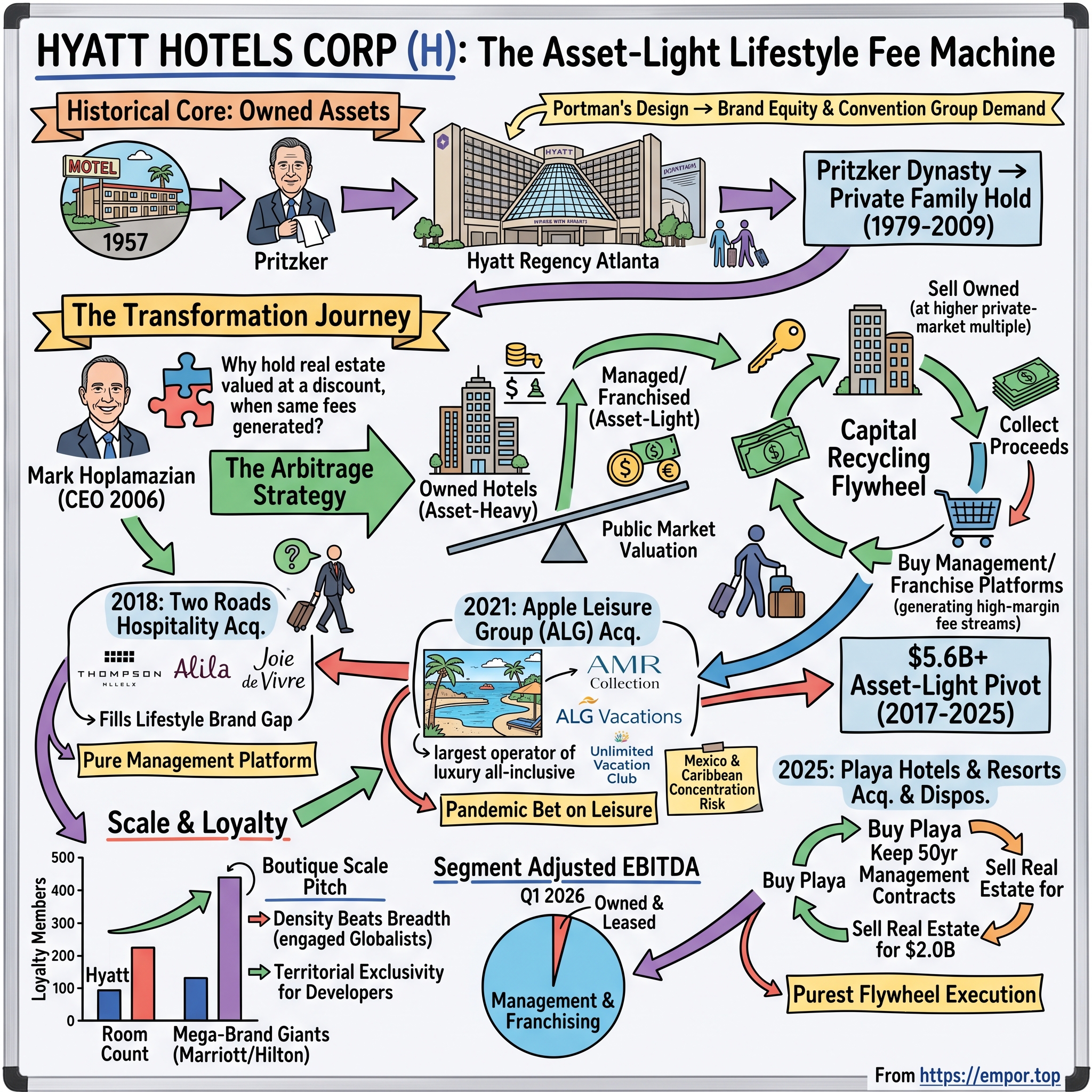
On the morning of April 30, 2026, Hyatt Hotels Corporation released a set of numbers that would have been unrecognizable to anyone who studied the company a decade earlier. Total Adjusted EBITDA for the first quarter came in at $266 million. Of that, the Management and Franchising segment — the part of Hyatt that owns almost nothing and collects fees for putting its name and its people on other people's buildings — generated roughly $264 million on its own.1 The Owned and Leased segment, the division that once was Hyatt, the division that held the marble lobbies and the convention-center towers and the balance-sheet risk that came with them, contributed about $10 million.1
That is not a rounding error. That is the end of a business model.
To be precise about what those figures mean — because segment reporting flatters the story if you read it carelessly — Hyatt's segment EBITDA lines are reported before corporate overhead, and a third segment, Distribution, added roughly $29 million while unallocated corporate costs subtracted from the total.1 The three segments do not tidily sum to $266 million. But the directional truth survives the accounting: the real estate that defined Hyatt for sixty years now contributes less to quarterly earnings than a single mid-sized management contract portfolio. Hyatt did not shrink its way there. It sold its way there, deliberately, over nine years, at a cumulative pace and price that few corporate transformations have matched.
Here is the puzzle worth solving. Hyatt operates a system of roughly 300,000 rooms across more than 1,500 hotels and all-inclusive properties in 83 countries.2 Marriott International runs a system north of 1.76 million rooms.3 Hilton opened 97,000 rooms in 2025 alone — roughly a third of Hyatt's entire global footprint in twelve months of new supply.4 Marriott's Bonvoy loyalty program counts around 271 million members.5 By any conventional measure of scale in the lodging industry — rooms, keys, brands, loyalty accounts, distribution reach — Hyatt is a boutique.
And yet Hyatt has consistently grown its room base faster than both of them. In 2025, Hyatt delivered 7.3% net rooms growth against Hilton's 6.7%.24 Its comparable system-wide RevPAR — revenue per available room, the industry's core same-store metric — rose 2.9% for the year while Hilton's rose 0.4%.24 Developers with capital to deploy in luxury and lifestyle markets keep choosing the smaller brand. Frequent travelers with the option of any hotel on earth keep chasing Hyatt's Globalist status. Something is working that the room count does not capture.
The engine of the transformation was capital recycling. Beginning formally in late 2017, Hyatt committed to selling owned real estate and redeploying the proceeds into fee-generating platforms. By the end of 2025, the company reported approximately $5.7 billion in cumulative disposition proceeds net of purchases since the program's inception, at an aggregate multiple of roughly 15 times EBITDA.6 Read that multiple carefully, because it is the entire strategic argument in one number: Hyatt was selling hotel real estate to private buyers at a valuation that public markets almost never award to hotel real estate, and buying management contracts that public markets do reward. The arbitrage was not clever financial engineering. It was a recognition that the same cash flow is worth different amounts depending on who owns the underlying brick.
This story runs through several acts. It begins in 1957 with a lawyer named Jay Pritzker buying a single motel near the Los Angeles airport. It turns in 1967 in downtown Atlanta, where a rejected architectural design that every major hotel operator had passed on became the defining aesthetic of American hospitality. It runs through a family fortune that fractured into litigation and a public listing born in the wreckage of the financial crisis. It accelerates through a decade of methodical asset sales under a CEO who came out of the family's merchant bank rather than the hotel industry. It bets $2.7 billion on all-inclusive resorts during a pandemic. And it arrives, in February 2026, at a governance rupture nobody's strategy deck anticipated.
What follows is the case for how a company one-sixth the size of its largest competitor built a durable position — and an equally serious accounting of where that case could break.
 Subscribe on LinkedIn
II. The Pritzker Dynasty & The Birth of Airport Luxury (1957–1978)
The founding story Hyatt tells about itself involves a napkin. Jay Pritzker, the story goes, was sitting in a coffee shop attached to a motel near Los Angeles International Airport in 1957, noticed the place was packed, scrawled an offer on a paper napkin, and bought the building on the spot. It is a wonderful story. It is also, in the strict sense, unverified — the napkin and the coffee shop appear in Hyatt's own anniversary materials and in secondary retellings, not in contemporaneous independent reporting. What is documented is the transaction itself: on September 27, 1957, Pritzker acquired the Hyatt House motel adjacent to LAX for $2.2 million from Hyatt Robert von Dehn, the man whose first name the company still carries.7
Strip away the napkin and the insight underneath is sharper than the legend. Jay Pritzker was not a hotelier. He was a Northwestern-trained lawyer, born in Chicago in 1922, who had spent the 1950s doing something more interesting than practicing law: buying troubled or overlooked companies cheaply and fixing them.8 With his brother Robert he had acquired the Colson Corporation in 1953, the seed of what became the Marmon Group, an industrial conglomerate assembled from castoffs.9 Pritzker's instinct was not "hotels are a good business." It was "this specific asset is mispriced because of a structural change nobody has capitalized on yet."
The structural change was the jet. Commercial aviation was reorganizing American business travel in the late 1950s, and the executives now flying between cities landed at airports ringed by nothing but low-grade motor courts. Pritzker saw a category — decent, professional lodging positioned at transportation nodes — that essentially did not exist. The LAX motel was full because demand had outrun supply in a niche the industry had not yet named.
Jay handed operations to his younger brother Donald, and the partnership that resulted defined Hyatt's first fifteen years. Jay was the financial architect: structures, leverage, deal terms, the patient assembly of a portfolio. Donald was the operator, the one who actually built a hotel company out of a motel — expanding across West Coast transportation hubs through the early 1960s and setting the service culture.7 The division of labor was clean and it worked, and it ended abruptly. Donald Pritzker died of a heart attack in May 1972 at age 39, while at a Hyatt property in Honolulu.10 He was, by then, the company's president. The loss removed the operating half of the founding partnership at precisely the moment Hyatt was scaling internationally.
But by 1972 Hyatt had already made the decision that mattered most — and it happened in Atlanta.
The Building Nobody Wanted
In the mid-1960s, an Atlanta architect named John Portman was trying to sell an idea that the hotel industry considered close to insane. Conventional hotel economics said that interior volume was waste: every cubic foot of open air was a cubic foot not generating room revenue. Portman proposed the opposite. He designed a hotel built around a vast hollow core — a 22-story interior atrium, open from lobby to roof, with guest-room corridors running as balconies around the void and glass elevators climbing through the middle of it.11
Portman could not find an operator. Conrad Hilton was pitched the building and turned it down; the widely repeated verdict was that it wasted an extraordinary amount of rentable space.12 The project — roughly 800 rooms, built at a cost of about $18 million — sat in search of a partner until the Pritzkers took it.13
The Regency Hyatt House opened in Atlanta in 1967 and did something the spreadsheets had not modeled. It ran at roughly 90% occupancy within three months.13 Guests did not merely stay there; they detoured to see it. The building was a destination in its own right, and that changed the pricing math entirely. Portman had not wasted rentable space — he had converted it into brand equity, which turned out to price better than a floor of guest rooms.
The economic mechanism here is worth naming carefully because it recurs throughout Hyatt's history. A hotel room in a commodity building competes on location and price. A hotel room in a building people talk about competes on desire, and desire supports a rate premium and, critically, wins convention and group business — the high-volume, contracted, forward-booked demand that fills a large hotel's shoulder nights. The atrium did not just look impressive. It made Hyatt the natural choice for meeting planners who needed a property that would make their event feel like an event. Hyatt built more of them; by the late 1980s the company operated more than two dozen open-atrium hotels.7 Portman's design went from unfinanceable to the default template for the American convention hotel, and for a period Hyatt owned the association.
That is the origin of Hyatt's real, durable asset — not the buildings, but the position in the customer's mind that Hyatt is where the interesting building is. It is why, sixty years later, the company's acquisition strategy has been almost entirely about buying design-led brands rather than room count.
Public, Then Private
Hyatt Corporation went public in 1962, split at the time between Hyatt House Hotels and Hyatt Chalet Motels, and the Pritzker family took it private again in 1979, folding ownership into the family's trust structures.14 The reasoning was consistent with everything else the family did: Hyatt was one holding among many in a private empire that eventually included Marmon and TransUnion, and it was managed on a horizon measured in decades rather than quarters. Public reporting was, from that vantage, an unnecessary constraint.
For thirty years afterward, Hyatt operated as an opaque web of family partnerships — hotels held in separate entities, cross-ownership between trusts, management arrangements that made a consolidated picture nearly impossible for an outsider to assemble. It was an efficient structure for a family that trusted itself. It became a liability the moment the family stopped.
III. Preparing for Public Markets & The Hoplamazian Era (1979–2009)
The Pritzker fortune held together for two generations on a specific and unwritten premise: that the money belonged to the family collectively, that individual members drew from it but did not own identifiable pieces of it, and that the head of the family decided. Jay Pritzker was that head. When he died of a heart attack in Chicago in January 1999 at age 76, the premise had no one left to enforce it.8
What followed was one of the more instructive dynastic unwindings in American business. In 2001, the third generation of Pritzkers reached an agreement to dismantle the joint holdings over roughly a decade, splitting the empire into eleven shares of approximately $1.4 billion each.15 Then it got worse. In late 2002, Liesel Pritzker — a cousin who had been written out of certain trusts as a child — filed suit alleging the family's trusts had been improperly stripped, seeking billions; her brother Matthew joined months later.16 The dispute settled in early 2005.15
For Hyatt, the family's decision to break up its holdings was not a scandal so much as a forcing function. If the collective ownership was going to be divided into individual stakes, the assets had to be made sellable — which meant they had to be made legible. A sprawling web of partnerships with no consolidated financials cannot be handed to eleven heirs, and it certainly cannot be handed to public markets. Hyatt needed to be turned into a company.
The Banker Who Became a Hotelier
The person handed that job was an unlikely choice for the hospitality industry: Mark Hoplamazian, who had never run a hotel in his life.
Born in November 1963, Hoplamazian took an undergraduate degree at Harvard and an MBA at the University of Chicago's Booth School, then spent his early career at The First Boston Corporation in New York doing mergers and acquisitions work.17 In the late 1980s he joined The Pritzker Organization, the family's private merchant bank, and spent close to two decades there — eventually running it.17 His formative professional experience, in other words, was not operating hotels. It was valuing businesses, structuring transactions, and thinking about where capital should sit. He had also served on Hyatt's board and knew the assets from the ownership side.
In December 2006, Hoplamazian was named President and Chief Executive Officer of Hyatt.18 The industry reaction was skeptical in the predictable way: a finance guy running a service business. That skepticism misread the assignment. Hyatt at that moment did not primarily need a better hotelier. It needed someone who could look at a tangle of family partnerships and see a capital structure, someone who could answer the question "what is each of these things actually worth, and to whom?" The mandate was to professionalize management, consolidate the ownership spaghetti, and get the company ready for a public listing.
It is worth pausing on what this background predicted, because Hoplamazian's entire tenure is legible through it. A career operator would likely have tried to grow Hyatt by building more Hyatts. A career dealmaker looked at the balance sheet and asked a different question: why are we holding several billion dollars of real estate that the public market values at a discount, when the same hotels generate identical fees whether we own them or manage them for somebody else? That question took another decade to be acted upon at scale. But the person asking it was in the chair from 2006.
November 2009: Going Public Into the Wreckage
The timing of Hyatt's IPO was, on its face, terrible. Lodging fundamentals had collapsed with the financial crisis; hotel real estate was radioactive; occupancy and rate were in freefall across the industry. Hyatt priced anyway.
On November 4, 2009, Hyatt priced 38 million shares of Class A common stock at $25.00 each, with the stock beginning trading on the New York Stock Exchange under the ticker H the following day.19 Goldman Sachs led the offering.
There is an important detail here that gets lost in most retellings. The IPO was overwhelmingly a secondary offering. The 38 million shares came from selling stockholders — Pritzker family interests — meaning the roughly $950 million of proceeds attributable to that block went to the family, not into Hyatt's treasury.20 This was not a capital raise for the business. It was a liquidity event for the owners and, more importantly, the creation of a public market price for a family asset that needed to be divided.
Understanding that reframes the listing. Hyatt did not go public because it needed money. It went public because eleven heirs needed a way to value and eventually monetize their share of a hotel company. Every subsequent governance feature follows from that origin.
The Two-Class Fortress
Hyatt's registration statement established the structure that still governs the company: Class A shares carrying one vote each, sold to the public; Class B shares carrying ten votes each, retained by family interests, with otherwise identical economic rights.21 Class B converts to Class A on transfer outside the family, meaning family control decays only as the family sells.
The concentration remains extraordinary. According to Hyatt's definitive proxy statement filed in April 2026, Pritzker family business interests beneficially owned approximately 50.9 million Class B shares plus about 767,000 Class A shares — roughly 54.8% of total shares outstanding, but approximately 89.0% of total voting power.22 A separate legacy holder controlled another 2.3 million Class B shares carrying about 4.0% of the vote.22
The honest assessment of this structure cuts both ways, and investors should hold both halves simultaneously.
The favorable reading: the asset-light transformation described in the sections that follow required selling billions of dollars of real estate over nearly a decade, absorbing dilution to reported earnings and asset value along the way, while promising that the fee streams purchased with the proceeds would eventually be worth more. That is precisely the kind of multi-year, optically-painful transition that activist investors interrupt. Hyatt's controlling structure made interruption impossible. Management could take the long path because no one could force the short one.
The unfavorable reading is equally concrete: a shareholder base holding roughly 45% of the economics wields roughly 11% of the votes. There is no realistic mechanism by which public holders can replace directors, force a strategic review, or compel a sale. If capital allocation deteriorates — if a future management team overpays for platforms, or if the family's interests diverge from minority holders' — the public shareholder's only meaningful remedy is the exit. Dual-class structures are not virtuous because they happened to produce a good outcome in one case; they are a bet on the controller, and the bet is unhedgeable.
That bet was about to be tested by the largest strategic reversal in the company's history.
IV. The Asset-Light Epiphany & Capital Recycling Flywheel (2010–2018)
Imagine two hotel companies. Both put their brand on 100,000 rooms. Both collect roughly the same percentage of room revenue and hotel profit as fees. The first one owns the buildings. The second one signed contracts to manage buildings owned by pension funds, sovereign wealth funds, and private equity.
In a good year, the first company earns far more — it keeps the operating profit, not just the fee. In a bad year, it earns far less, because hotel operating leverage is brutal: fixed costs stay while revenue falls. And in every year, the public market pays the first company a materially lower multiple of earnings, because those earnings are cyclical, capital-hungry, and attached to depreciating physical assets that periodically require hundreds of millions of dollars in renovation capital just to stand still.
That was Hyatt's problem entering the 2010s. It was, structurally, the first company. Marriott and Hilton had already become the second.
The Multiple Gap Was the Whole Argument
By the mid-2010s, Marriott and Hilton had substantially completed their own transitions to franchise-and-manage models. Their earnings were fee-based: high margin, low capital intensity, and — crucially — growable without balance sheet. A franchise company adds rooms by signing a contract. An owner adds rooms by writing a check for a building.
The consequence showed up in valuation. Fee streams command higher multiples than hotel real estate for reasons that are not fashion: they require almost no reinvestment, they scale with system size rather than with capital deployed, and their contracts are long-dated. Hyatt, holding real estate, was being valued partly as a REIT that happened to have a brand attached. Every dollar of owned-hotel EBITDA was worth less in Hyatt's share price than a dollar of fee EBITDA would have been — for the identical underlying hotel.
The strategic implication was almost mechanical. If private buyers of hotel real estate — sovereign funds, insurance capital, opportunistic private equity — would pay a high price for a stabilized luxury hotel, and the public market was assigning Hyatt a lower implied value for the same asset inside the corporation, then Hyatt should sell the asset to the private buyer, keep the long-term management contract on the building, and use the proceeds to buy more contracts. The hotel keeps operating. Hyatt keeps collecting fees. Somebody else absorbs the roof replacement.
November 2017: The Commitment Goes Public
Hoplamazian made it formal on November 2, 2017, alongside third-quarter earnings: Hyatt announced a plan to sell approximately $1.5 billion of real estate over the following three years.23
This deserves credit as a piece of management discipline, and it deserves scrutiny as a piece of management communication. Announcing a specific dollar target with a specific deadline is a commitment device — it converts a vague aspiration into something analysts can score you against. Companies that dislike accountability announce "an ongoing review of the portfolio." Hyatt announced a number and a clock. That choice is the single most useful early evidence on Hoplamazian's credibility, and the record since is what makes it meaningful: the target was not merely met, it was serially expanded, which is the desirable direction for a commitment to move.
The harder question is whether the sales were good sales. Selling real estate is easy; selling it well is not. The relevant test is the multiple achieved and the terms retained — specifically, whether Hyatt kept long-duration management contracts on the properties it sold, or simply exited. Hyatt's disclosed aggregate multiple across the full program, roughly 15 times EBITDA, is a strong result for hotel real estate and materially above where lodging C-corps trade.6 The company has consistently structured sales to retain long-term management agreements, which is the difference between recycling capital and liquidating a business.
Two Roads: The First Real Test
The other half of the flywheel — deploying the proceeds — needed proof. It arrived on October 8, 2018, when Hyatt announced the acquisition of Two Roads Hospitality for a base price of $480 million, with up to $120 million in additional contingent consideration.24 The deal closed on November 30, 2018, at a revised base price of $405 million and additional consideration reduced to $96 million.25
That downward revision is a small detail worth noticing. Purchase prices in platform deals are typically tied to the contracts actually delivered at closing; a reduction usually means fewer contracts survived diligence or transition than the headline assumed. It cuts both ways as evidence: it suggests the target's portfolio was somewhat softer than announced, and it suggests Hyatt structured the deal so that it did not pay for what it did not receive.
What Hyatt bought was a pure management platform — no real estate — controlling roughly 74 operating hotels and a set of brands that mattered more than the count: Thompson Hotels, Alila, Joie de Vivre, Destination, and tommie.2425 The transaction took Hyatt to 19 brands.25
The logic was specific. Hyatt's brand portfolio in 2018 was strong at the top (Park Hyatt, Grand Hyatt) and strong in the middle (Hyatt Regency, Hyatt Place), but thin in the fastest-growing category in the industry: lifestyle. Lifestyle hotels — independent-feeling, design-forward, food-and-beverage-driven properties that do not announce their chain affiliation in the lobby — were where affluent younger travelers were migrating and where developers could charge premium rates in urban markets. Building credible lifestyle brands organically takes a decade and usually fails, because the whole proposition depends on not feeling corporate. Buying them was faster and, arguably, the only route that preserved authenticity.
The financial appeal was that the cash flow arrived essentially unencumbered. A management platform's costs are people and systems; incremental fee revenue drops through at very high margins. Return on invested capital in these deals is high not because the fees are enormous but because the invested capital is small.
By the end of 2018, then, both halves of the machine had run at least once: sell buildings at a private-market multiple, buy contracts that trade at a public-market multiple. What remained untested was whether Hyatt could do it at a scale that would change the company. The answer came from an unlikely direction — during a pandemic, in the resort business.
V. The $2.7B Apple Leisure Group Transformative Bet (2021)
In the summer of 2021, the global lodging industry presented a genuinely strange picture. Business travel had not recovered. Convention calendars remained hollowed out. Urban hotels in New York, London, and Chicago were running occupancy levels that would have been unthinkable two years earlier.
And beach resorts in Cancún were full.
The pandemic had bifurcated travel demand along a line the industry had not previously had to think about. Discretionary leisure travel — particularly drive-to and short-haul destination resorts, particularly all-inclusive properties where a family could pay one price and stay inside a controlled environment — recovered violently and early. Corporate travel, which depends on employers' decisions rather than consumers', lagged by years. For a company like Hyatt, whose portfolio was weighted toward exactly the urban and group-oriented properties that were suffering most, this was either a catastrophe or an opportunity, depending on the balance sheet and the nerve behind it.
On August 16, 2021, Hyatt announced it would acquire Apple Leisure Group for $2.7 billion in cash from KKR and KSL Capital Partners.26 The transaction closed on November 1 of that year — the largest acquisition in Hyatt's history.27
What Was Actually Being Bought
ALG was three businesses stapled together, and Hyatt's rationale for each was different.
The first and largest was AMR Collection, a portfolio of all-inclusive resort brands — Secrets, Dreams, Breathless, Zoëtry, Alua, Sunscape, and Now — comprising roughly 100 hotels and more than 33,000 rooms across ten countries, with a pipeline of 24 additional deals.26 These were management contracts, not owned real estate. The deal roughly doubled Hyatt's global resort footprint at a stroke and made the company the largest operator of luxury all-inclusive resorts in the world.
The second was ALG Vacations, a leisure tour operator and distribution platform including Apple Vacations, Funjet, Travel Impressions, and CheapCaribbean.com.26 This is the piece most investors found hardest to categorize, and it is worth explaining plainly. A tour operator in the all-inclusive business does not just sell hotel rooms; it packages air seats with resort stays. It contracts blocks of airline capacity into destination markets and then fills them. Whoever controls that seat supply substantially controls which resorts get filled — because a traveler in Ohio choosing a week in the Dominican Republic is buying a package, not a hotel. On Hyatt's first-quarter 2026 earnings call, management framed ALG Vacations' value in exactly these terms, citing visibility into roughly $1.5 billion of annual airline seat inventory as a strategic asset rather than a financial one.1
The third was Unlimited Vacation Club, a paid membership program with more than 110,000 members at the time of acquisition, which had been compounding at roughly 18% annually over the prior five years.26 Members pay upfront for the right to discounted stays. The economics resemble a subscription: cash collected in advance, high incremental margin, and a member base that has a structural reason to keep returning to the same resort family.
Was the Price Right?
Hyatt characterized the acquisition as accretive relative to what it was simultaneously selling. In its investor materials for the transaction, the company noted that the assets it was disposing of were being sold at more than 17 times EBITDA — a higher multiple than it was paying for ALG.28 The financing plan was equally explicit: Hyatt raised its cumulative asset-sale commitment to $3.0 billion total since 2017, and pledged an additional $2.0 billion of dispositions by the end of 2024.28
That is the flywheel operating at full scale and in public. Hyatt was not funding a $2.7 billion acquisition primarily with permanent leverage. It was funding it by pre-committing to sell more buildings — using the balance sheet as a bridge between real estate it no longer wanted and contracts it did.
An honest assessment has to sit with the risk that was being taken. In August 2021, buying $2.7 billion of leisure-resort exposure was a directional bet that the pandemic-era surge in beach travel was a durable shift rather than a temporary substitution for the trips people could not otherwise take. If leisure had normalized downward while business travel recovered, Hyatt would have paid a full price at a cyclical peak for the most cyclical category in lodging, with the borrowing to match.
The subsequent operating record has supported the bet more than it has undermined it. In 2025, Hyatt's all-inclusive Net Package RevPAR — the resort equivalent of same-store revenue — grew 8.6% for the full year and 8.3% in the fourth quarter, meaningfully outpacing the 2.9% growth in comparable system-wide hotel RevPAR.2 Four years on, the acquired category has been the faster-growing half of the company, not the drag.
But two caveats belong permanently attached to that conclusion. First, four years of strong performance in a post-pandemic travel boom does not establish through-cycle durability for a discretionary consumer category; the real test is a recession, and it has not yet come. Second, the concentration is geographic as much as categorical. Hyatt's all-inclusive base is heavily weighted to Mexico and the Caribbean, and events in 2026 demonstrated exactly what that means: on the first-quarter call, management attributed a roughly 5% revenue decline in March to security concerns in Mexico that emerged in February, and quantified the impact of Hurricane Melissa's Jamaica closures at roughly $25 million of Distribution segment EBITDA for the full year.1 Those are not fatal numbers. They are a reminder that a resort portfolio concentrated in two weather-exposed, headline-exposed regions has a risk profile that a diversified urban portfolio does not.
There is also an open strategic question around ALG Vacations that management has not resolved. In September 2025, Hoplamazian publicly acknowledged that Hyatt might sell a stake in the distribution business.29 On the April 2026 call, management instead emphasized its strategic value and announced no divestiture.1 That is not a contradiction — a company can evaluate a partial sale and decline to do one — but it is an unresolved thread. Distribution is the lowest-margin, most capital-consumptive, and most operationally volatile part of Hyatt's portfolio, and it sits uneasily inside a company whose entire narrative is asset-light fee generation. Investors are entitled to a clearer answer on whether it is core or not.
VI. The Boutique Scale Imperative: World of Hyatt vs. The Giants
Put the scale comparison plainly, because it is the central strategic fact about this company.
Marriott Bonvoy holds roughly 271 million members against a system of about 1.76 million rooms.53 Hilton Honors is the second-largest program in lodging, attached to a system that added 97,000 rooms in 2025 and carries a record development pipeline of 520,500 rooms.4 World of Hyatt reported approximately 66 million members as of the first quarter of 2026, up about 18% year over year, attached to a system of roughly 300,000 rooms.12
Hyatt's loyalty program is roughly a quarter the size of Marriott's. Its room base is roughly one-sixth. In an industry where the conventional wisdom holds that scale is destiny — more rooms means more members means more direct bookings means more developers means more rooms — Hyatt should be losing. It is not. The question is why, and whether the reason is durable.
Density Beats Breadth (Conditionally)
The most useful way to think about a loyalty program is not as a membership count but as a share of a customer's wallet. A program with 271 million members where the median member stays twice a year is a very different asset from a program with 66 million members where the engaged core stays fifteen times a year.
On the first-quarter 2026 call, management disclosed the metric that actually matters here: World of Hyatt members accounted for roughly half of occupied rooms globally and spent approximately twice as much as non-members.1 That is a meaningful penetration figure for a program of Hyatt's size, and it points at the real mechanism — not breadth of membership, but depth of engagement among high-value travelers.
The behavioral logic behind that depth is worth spelling out for readers who do not spend their lives in hotel loyalty programs. Elite status in lodging is fundamentally a promise: stay a certain number of nights and receive upgrades, free breakfast, late checkout, and recognition. The problem with a very large program is that the promise degrades under its own success — when tens of millions of members hold elite status, there are not enough suites to upgrade them into, and the benefit becomes theoretical. Hyatt's top tier, Globalist, has historically been harder to reach and delivered more reliably, and Hyatt's point currency has generally been redeemable at high value at its top properties. Frequent travelers respond to this rationally by consolidating their stays: if the benefit only pays at high volume, you concentrate volume with one brand.
That concentration is the switching cost. It is not contractual and not technological. It is the accumulated position — status, points, expectations — that a traveler would forfeit by splitting stays. It is real, and it explains the disproportionate devotion Hyatt commands among high-frequency business and luxury travelers.
But it is also the most fragile asset in this entire story, and investors should treat it that way. The value of Globalist depends on the ratio of elite members to premium inventory. Hyatt has grown its membership base at double-digit rates and its room base at 5-7% annually. If member growth persistently outruns luxury room growth, the upgrade math deteriorates and the differentiation erodes — quietly, gradually, and without any announcement. Every large loyalty program in history has followed this path. The specific thing to watch is not membership growth, which management will always report favorably, but whether Hyatt's premium inventory grows fast enough to keep the promise fundable.
The Developer Pitch: Scarcity as a Product
The second mechanism is the one that explains Hyatt's net rooms growth outrunning far larger competitors, and it is counterintuitive: Hyatt's smallness is the sales pitch.
Consider a developer building a luxury hotel in a major city. Affiliating with a mega-brand delivers enormous distribution — but it also means that within a few miles there may be a dozen sister properties under related flags, competing for the same guest and the same loyalty redemption. This is encroachment, and it is a structural cost of scale that the largest operators cannot fully solve, because their growth requires them to keep signing.
Hyatt can offer what the giants cannot: territorial exclusivity that is actually meaningful, because Hyatt does not have twelve other hotels in the neighborhood. A developer signing a Park Hyatt or a Thompson in a given market is, in many cases, getting the only one — with access to a loyalty base that skews toward exactly the high-rate customer a luxury property needs.
This is a genuine competitive advantage and it has shown up in results. It is also, by construction, self-limiting. Scarcity value cannot be scaled indefinitely; the more Hyatt grows in a market, the less exclusive its next signing can be. The strategy contains its own ceiling, and the interesting question for the next decade is at what system size the pitch stops working.
Buying Scale Without Buying Buildings: The China Approach
The scarcity strategy works beautifully in luxury. It does not solve the problem of participating in enormous mid-market opportunities in countries where Hyatt has no distribution and no brand permission to operate at scale.
Hyatt's answer in China was a joint venture rather than a balance-sheet commitment. In February 2019, Hyatt formed a joint venture company with 首旅如家酒店集团 BTG Homeinns, one of China's largest domestic hotel groups, and in June 2019 the partners unveiled the resulting brand, 逸扉酒店 UrCove, aimed at the underserved upper-midscale segment of the Chinese market with initial properties planned for Shanghai and Beijing.30
The structural logic is sound: BTG Homeinns supplies domestic development relationships, local operating capability, and distribution to Chinese travelers; Hyatt supplies international brand credibility and its loyalty system. Neither party writes a large check for real estate. Hyatt gets exposure to Chinese domestic travel demand without taking Chinese property risk, and gains a feeder into World of Hyatt from a market it could not otherwise reach at that price point.
The honest caveat is that Hyatt has not disclosed the ownership split of the venture or broken out its financial contribution, and joint ventures in China have a long history of delivering less than the announcement implies. The concept is right; the execution is not independently verifiable from public disclosure.
The larger point stands: Hyatt has consistently chosen to rent scale rather than buy it. That is the same instinct that drove the asset sales, applied to geography instead of real estate — and it is the instinct that produced the numbers management reported in early 2026.
VII. Management Credibility & The Generational Governance Shift (2024–Today)
Nine years after committing to sell $1.5 billion of real estate, the machine Hoplamazian described in 2017 was running at something close to full efficiency.
For the full year 2025, reported on February 12, 2026, Hyatt generated $1,198 million in gross fees, up 9.0% year over year, and $1,159 million in Adjusted EBITDA, up 5.8%.2 Net rooms growth reached 7.3% — 6.7% excluding acquisitions — and the development pipeline expanded roughly 7% to approximately 148,000 rooms.2 Hyatt returned capital steadily, repurchasing $114 million of stock in the fourth quarter and $293 million across the year.2
There is a number in that release that does not fit the triumphant narrative, and it should be stated: Hyatt reported a net loss attributable to the company of $52 million for 2025, including a $20 million loss in the fourth quarter.2 Adjusted EBITDA grew; GAAP earnings were negative. The gap reflects the accounting reality of a transformation executed through large asset sales, acquisitions, and impairments — transaction costs, asset write-downs, and gains and losses on dispositions flow through net income and are excluded from the adjusted figure. This is defensible as a description of underlying earnings power, and it is exactly the kind of adjustment an activist would probe. Investors should be aware that Hyatt's headline profitability metric has, for several years, been a management-defined number that excludes the costs of the very strategy being celebrated.
The 2025 Detour: Buying a Company to Sell Its Buildings
The single most revealing capital allocation move of the period was not on the outline of anyone's asset-light playbook, and it deserves a close reading.
In 2025, Hyatt acquired Playa Hotels & Resorts — an owner-operator of all-inclusive properties — for $13.50 per share in cash, representing an enterprise value of roughly $2.6 billion including approximately $900 million of net debt. The tender offer conditions were satisfied on June 10, 2025.31
On its face this looked like a reversal. Hyatt, the company that had spent eight years divesting real estate, bought a company whose principal assets were resorts it owned.
What followed explained the logic. On June 30, 2025, Hyatt announced an agreement to sell Playa's owned real estate portfolio — fifteen all-inclusive resorts across Mexico, the Dominican Republic, and Jamaica — for approximately $2.0 billion to Tortuga Resorts, a joint venture between an affiliate of KSL Capital Partners and Rodina, with up to $143 million of additional earnout consideration.32 That sale closed on December 30, 2025, with Hyatt retaining 50-year management agreements on thirteen of the fifteen properties.33
Read as a single transaction rather than two, this was the flywheel executed in its purest form: buy a company at an enterprise value of roughly $2.6 billion, immediately sell the buildings for roughly $2.0 billion, and keep half-century management contracts on the great majority of them. Hyatt effectively acquired a large block of long-duration fee streams in its highest-growth category for a net cash outlay far below the headline price, using a third party's capital to hold the real estate. S&P Global Ratings, revising its outlook on Hyatt to stable, noted that the Playa asset sale and associated debt repayment were expected to bring lease-adjusted leverage to roughly 3.5 times by the end of 2025 and below 3.0 times in 2026, and that the new Playa management contracts would add an estimated $60-65 million of gross fees in 2026.34
This is the strongest single piece of evidence on Hoplamazian's capital allocation, precisely because it looked wrong at the announcement and was structurally right at the completion. It also demonstrates something about how Hyatt sources deals: the company is willing to temporarily hold assets it does not want in order to acquire contracts it does. That requires balance sheet capacity and a credible buyer network, and it is not a trick most operators can execute.
The consistency of the broader record supports the same conclusion. Two Roads, ALG, Dream Hotel Group — announced November 29, 2022 at a base price of $125 million plus up to $175 million contingent over six years, closing February 2, 2023 with twelve lifestyle hotels and 24 pipeline deals3536 — and Standard International, which closed on October 1, 2024 for roughly $150 million upfront plus up to approximately $185 million contingent, bringing 22 open hotels of about 2,000 rooms under The Standard and Bunkhouse brands plus more than 30 future projects37 — were all asset-light platform purchases in luxury and lifestyle. None was an attempt to buy scale for its own sake. There is no midscale acquisition, no distressed portfolio grab, no diversification into adjacent industries. Nine years of transactions point in the same direction, which is the most reliable form of evidence about management intent.
Two disciplines within that record deserve specific note. Hyatt has repeatedly structured platform acquisitions with large contingent-consideration components — up to $120 million on Two Roads, up to $175 million on Dream, up to $185 million on Standard — meaning a substantial portion of the price is paid only if the acquired pipeline actually converts into operating hotels.243537 That is a deliberate transfer of execution risk to the seller and a meaningful discipline in an industry where announced pipelines routinely evaporate. And when the Two Roads pipeline did not fully materialize, the price came down at closing rather than being paid anyway.
February 16, 2026: The Chairman Leaves
The governance transition, when it came, did not arrive the way succession plans usually do.
On February 16, 2026, Hyatt announced that Thomas J. Pritzker was retiring as Executive Chairman effective immediately and would not stand for re-election at the May 2026 annual meeting.38 Pritzker had served on the board since August 2004 and in senior roles associated with the company since 1980. Mark Hoplamazian was appointed Chairman, combining the roles of Chairman, President and Chief Executive Officer.38 Hyatt's 2026 proxy statement confirms the appointment.22
Hyatt's own release framed the departure as a personal decision to retire. Major media outlets reported it differently. CNBC and other national outlets tied the timing to newly released Department of Justice files documenting Pritzker's association with Jeffrey Epstein; Pritzker stated that he deeply regretted the association.39
An investor platform has an obligation to state this plainly rather than smooth it into a succession narrative. The end of active Pritzker family leadership at Hyatt was not a planned generational handoff executed on management's timetable. It was an abrupt departure under adverse publicity, with the company's public framing and the contemporaneous press reporting pointing in different directions. That gap between the corporate account and the reported circumstances is itself a governance data point.
What it does and does not change is worth being precise about. It does not change control: the Class B voting structure is unaffected, and family interests continue to hold approximately 89% of the vote.22 The family remains the controlling shareholder; only its representative in the chairman's seat has departed.
What it does change is the concentration of authority. Hyatt now has a combined Chairman-CEO with no independent chair and no family executive at the board's head, operating under a controlled-company structure. On the favorable reading, this is the controlling shareholders expressing confidence in a chief executive who has delivered on nine years of stated commitments. On the skeptical reading, it consolidates board leadership and executive leadership in one person at a company where public shareholders have essentially no voting recourse — a combination that governance-focused investors would ordinarily challenge, and which, in this structure, they cannot. Both readings are true simultaneously.
The transition also raises a question that the strategy itself does not answer: what happens after Hoplamazian. He has run Hyatt since 2006 and is now approaching two decades in the role. The asset-light transformation is closely identified with him personally, the capital-recycling capability is a relationship business, and there is no publicly designated successor. For a company whose investment case rests substantially on capital allocation quality, key-person concentration is a material and under-discussed risk.
VIII. Playbook: Business & Investing Lessons
Step back from the specifics and three transferable lessons emerge from Hyatt's sixty-nine years — each of which is more conditional than the triumphant version suggests.
Niche Density Can Beat Scale, Within Limits
The dominant assumption in branded lodging is that scale compounds: more rooms attract more members, more members attract more developers, more developers deliver more rooms. Under that logic Hyatt should have been slowly strangled by companies six times its size.
Instead, Hyatt has grown rooms faster than Hilton and generated stronger same-store revenue growth, while operating a fraction of the inventory.24 The reason is that lodging is not one market. It is a set of loosely connected markets with different customers, different economics, and different competitive structures. A traveler booking a $180 select-service room near an interstate and a traveler booking a $900 suite in Tokyo are not the same customer, and the assets that win them are not the same assets. Hyatt chose to be dense in the high-value segments rather than present in all of them, and density in a segment produced better economics than breadth across all of them.
The condition attached to this lesson is the one most often omitted: it works only where the niche has genuine economic separation and the operator does not outgrow it. A luxury and lifestyle strategy is a strategy about being chosen, and being chosen depends partly on not being everywhere. Hyatt's advantage is real today. It is not automatically renewable at three times the current size.
Capital Recycling Is a Real Value-Creation Mechanism, Not an Accounting Trick
The deeper lesson from Hyatt's decade is that the same cash flow can be worth materially different amounts depending on the wrapper it sits in and the buyer evaluating it. Hotel real estate held inside a public branded operator was valued by equity markets at a discount to what private capital would pay for the identical building. That gap was not a market error — private buyers have different cost of capital, different tax treatment, different holding periods, and different reasons to want a stabilized luxury asset — but it was persistently exploitable.
The mechanics that made it work, and which any company attempting a similar transition would need to replicate, were three: sell into strength rather than distress, retain the operating relationship so the sale is a recycling rather than an exit, and redeploy proceeds into assets with structurally higher returns on invested capital rather than into buybacks or debt paydown alone. Hyatt did all three, and the Playa transaction showed the method could even be run in reverse — acquiring an owner in order to disassemble it into a fee stream.
The limit is arithmetic. A recycling program ends when the real estate ends. Hyatt is approaching that point, and when it arrives, growth must come entirely from organic signings, contract renewals, and platform M&A. The transformation has been a source of both earnings quality improvement and one-time value creation, and it is important to separate the two: the quality improvement is permanent, the value creation is finite.
Concentrated Control Is a Bet, Not a Virtue
Hyatt is regularly cited as the case that vindicates dual-class structures. The transformation required tolerating years of optically weak GAAP results and shrinking asset values in service of an eventual re-rating. Activists interrupt exactly this kind of program. Hyatt's structure made interruption impossible, and the strategy completed.
But the correct lesson is narrower than "dual-class works." Concentrated control removes the market's ability to correct management — which is enormously valuable when management is right, and unhedgeable when it is not. The evidence at Hyatt is that the controller's patience was well-directed. That evidence is about the Pritzkers and Hoplamazian specifically, and it does not transfer to the next controller or the next CEO. And the February 2026 departure is a reminder that concentrated control carries its own idiosyncratic risks — reputational, personal, and succession-related — that diffuse ownership does not.
IX. Analysis: Bull vs. Bear Case & Risk Radar
The Bear Case: What a Skeptical Investor Would Attack
Portfolio complexity and integration debt. Hyatt has absorbed five platforms in eight years, each with its own culture, systems, and brand promise. Lifestyle brands are particularly resistant to integration, because their value depends on feeling independent. The bear argument is that the operating complexity is real and cumulative — more brands than any competitor relative to system size, more reporting segments, more adjustments to GAAP earnings — and that at some point it shows up as brand dilution, developer churn, or costs that never quite come out. Hyatt's persistent GAAP net losses through 2025 despite growing adjusted earnings give this argument something concrete to point at.2
Asymmetric cyclicality. This is the most serious structural criticism. By concentrating in luxury, lifestyle, and all-inclusive leisure, Hyatt has assembled a portfolio with more upside in good times and materially more downside in bad ones. Marriott and Hilton carry enormous midscale and select-service bases — the Courtyards and Hampton Inns — that function as recession ballast, because business travel at $150 a night compresses far less than a $700 resort week. Hyatt has no equivalent cushion. This has not been tested since the ALG acquisition, because there has been no consumer recession since. It is unresolved, not disproven.
Geographic and event concentration. The 2026 experience quantified this. Security concerns in Mexico, Middle East conflict costing roughly $10 million in fees and about 50 basis points of RevPAR, and hurricane damage in Jamaica together dented a quarter's results.1 Any one of these is manageable. The concern is that a portfolio weighted to a handful of leisure destinations has a materially higher frequency of idiosyncratic shocks than a globally diversified urban footprint.
The growth ceiling. Sustaining 6-7% net rooms growth on a base of 300,000 rooms requires signing and opening a rising absolute number of hotels every year, and the pipeline of roughly 151,000 rooms as of the first quarter of 2026 must not only convert but be continuously replenished.1 Trailing-twelve-month net rooms growth in that quarter was 5.0% — below the 2025 full-year figure and below the low end of the 6-7% full-year guidance range.1 Management has attributed the pattern to timing, and the full-year guidance implies a substantial second-half weighting. This is the single cleanest place where stated targets can be tested against delivery over the next two reporting periods.
Governance. A combined Chairman-CEO, a controlling shareholder with roughly 89% of the vote against roughly 55% of the economics, no independent board chair, and a chairman departure under circumstances the company and the press describe differently. In a widely-held company, each of these would be a live proxy issue. Here, they are simply facts that public shareholders hold without recourse.
The Bull Case: What Has to Be True
Earnings quality is structurally higher than it was. The mix shift is not a forecast; it has happened. Fee-based earnings now dominate, and fees require essentially no reinvestment — Hyatt guided to roughly $135 million of capital expenditure for 2026 against Adjusted EBITDA guidance of $1,155-1,205 million and adjusted free cash flow of $580-630 million.1 A business converting the large majority of its earnings into free cash is a different asset than the one that existed in 2016, regardless of what multiple the market assigns it.
The 2026 guidance is a testable commitment. Management guided to system-wide RevPAR growth of 2-4%, gross fees of $1,305-1,335 million (up 9-11%), and Adjusted EBITDA growth of 13-18% adjusted for asset sales.1 Guidance of that specificity, from a management team with a nine-year record of meeting and expanding stated targets, is the bull case's most falsifiable claim. It will be scored within two quarters.
Loyalty and developer positioning are compounding, for now. Member penetration at roughly half of occupied rooms with roughly double the spend of non-members is a genuinely strong engagement profile.1 Combined with the scarcity pitch to developers, it explains why a company this small keeps winning signings against much larger balance sheets.
Balance sheet capacity is being restored. Total debt stood at $4.3 billion at both year-end 2025 and the end of the first quarter of 2026, with liquidity of roughly $2.2-2.3 billion, and Hyatt holds investment-grade ratings at the lower end of the scale — Moody's at Baa3 with a stable outlook.2140 With leverage trending toward 3.0 times, the company retains capacity for further platform acquisitions without stressing the rating.
Industry Structure: The Five Forces
Rivalry is intense in aggregate but segmented in practice. Hyatt does not compete meaningfully with Hampton Inn. It competes with Marriott's Luxury Collection, Hilton's Waldorf and Conrad, Accor's lifestyle stable, and a long tail of independents. In that narrower arena the field is more even than the headline scale gap suggests.
Buyer power is bifurcated. Corporate travel managers and group buyers negotiate hard and Hyatt's smaller footprint weakens it in enterprise negotiations where breadth of coverage matters. Individual luxury guests have low price sensitivity and high brand attachment, which is where Hyatt's economics are made.
Supplier power in this model is unusual, because Hyatt's most important supplier is the hotel owner — the party providing the physical asset. Owners can switch flags at contract renewal. This is the quiet risk in every asset-light lodging model: the fee stream is only as durable as the contracts. Hyatt's structural response has been long duration, and the 50-year terms on the Playa properties are an aggressive example.33 Online travel agencies are the other supplier-side power, taking commission on bookings Hyatt does not capture directly; a high direct-booking share through loyalty is the counterweight.
Threat of substitutes runs through short-term rentals and, increasingly, through AI-mediated booking. The rental threat is most acute in exactly two places Hyatt is exposed: leisure destinations and multi-night family stays. The AI threat is more subtle and worth explaining. If travelers increasingly book through AI assistants that compare options on price and attributes, the value of brand familiarity as a shortcut declines — brands have historically been paid partly for reducing search costs, and an agent that searches perfectly does not need the shortcut. Hyatt's defense is that loyalty status is not a search-cost benefit; it is an account balance and an entitlement, and an AI assistant optimizing for its user's actual interest would preserve it. That defense is plausible and untested.
Barriers to entry in branded luxury lodging remain high — brand equity takes decades, and loyalty networks are hard to bootstrap — but the barrier that has actually eroded is capital. Entering as an asset-light brand no longer requires owning hotels, which is why the lifestyle segment has proliferated with independent brands. Hyatt's own strategy of buying such brands is evidence that the entry barrier is lower than it once was.
Seven Powers: An Honest Scorecard
Hyatt has branding in the Helmer sense — customers pay more for the same functional room because of what the flag signifies — and this is its strongest power, earned over sixty years and reinforced by design leadership dating to Portman.
It has switching costs, concentrated in the loyalty base and, separately, in owner contracts with long terms and termination provisions.
It has partial scale economies in loyalty and distribution — but this is where Hyatt is genuinely weaker than its competitors, and no amount of narrative changes the arithmetic of a one-sixth room base.
It has something adjacent to cornered resource in the exclusivity it can offer developers in markets where it is not yet present, though this is depleting rather than renewable.
It does not have counter-positioning in any meaningful sense — Marriott and Hilton could compete in luxury and lifestyle if they chose, and they do. It does not have process power or network economies at a level that meaningfully differentiates it.
That is a real but narrow set of powers. It supports the conclusion that Hyatt occupies a defensible position, not that it occupies an unassailable one.
The Three KPIs That Matter
Net rooms growth. This is the leading indicator of everything, because a management contract signed today generates fees for decades. Management has guided to 6-7% for 2026 against a trailing figure of 5.0% in the first quarter.1 Whether the gap closes is the most informative single question about the business over the next year.
Comparable system-wide RevPAR growth, with all-inclusive Net Package RevPAR read alongside it. This is organic health — pricing power and demand, stripped of unit growth. The two together also reveal the cyclical divergence between the urban and leisure halves of the portfolio, which is where the bear case would first appear.
The fee-earnings mix. The proportion of Adjusted EBITDA generated by Management and Franchising is the direct scorecard on the transformation and on how much residual real estate risk remains. It is also the number that determines whether the earnings stream deserves to be valued as fees or as hotels.
X. Epilogue
There is a symmetry worth noticing in Hyatt's story.
It began with a lawyer who was not a hotelier buying a building because he had spotted a mispricing — a motel full of business travelers at an airport nobody had thought to build a decent hotel beside. It has arrived at a banker who was not a hotelier selling buildings because he spotted a different mispricing — hotel real estate worth more to private capital than public markets would credit inside a branded operator.
Between those two moments sits a company that made its name on a building everyone else rejected, spent thirty years private inside a family's trust structure, went public so that eleven heirs could divide their inheritance, and then, over nine years, systematically dismantled the asset base that had defined it — roughly $5.7 billion of real estate sold at an aggregate multiple well above where the market valued it inside the corporation, converted into contracts on other people's buildings.6
What Hyatt is today is a fee business with a luxury brand, a disproportionately engaged loyalty base, a scarcity-driven pitch to developers, and a heavy concentration in the most cyclical corner of a cyclical industry. It is one-sixth the size of its largest competitor and has been growing faster. Whether that continues depends on whether the loyalty promise stays fundable as membership outpaces premium inventory, whether the leisure bet survives a consumer recession that has not yet arrived, and whether a company built on scarcity can keep selling scarcity as it grows.
Mark Hoplamazian now holds both the chief executive and chairman titles at a company where public shareholders own roughly 45% of the economics and control roughly 11% of the votes. The strategic record that earned him that position is unusually consistent and unusually well documented. The structure that grants it is unusually unaccountable. Long-term investors in Hyatt are, in the most literal sense, underwriting a person and a family rather than a governance system — which is precisely the arrangement Jay Pritzker would have recognized when he wrote his first offer for a motel near a Los Angeles runway.
References
-
Hyatt Reports First Quarter 2026 Results — BusinessWire, 2026-04-30 ↩↩↩↩↩↩↩↩↩↩↩↩↩↩↩↩
-
Hyatt Reports Fourth Quarter and Full Year 2025 Results — Hyatt Hotels Corporation, 2026-02-12 ↩↩↩↩↩↩↩↩↩↩↩↩
-
Marriott International Reports Fourth Quarter and Full Year 2025 Results — Marriott International, 2026-02-10 ↩↩
-
Hilton Reports Fourth Quarter and Full Year Results — BusinessWire, 2026-02-11 ↩↩↩↩↩
-
Marriott adds more than 40 million loyalty members — Hotel Dive, 2026 ↩↩
-
Hyatt Fourth Quarter 2025 Investor Presentation — Hyatt Hotels Corporation, 2026-02-12 ↩↩↩
-
Hyatt Corp. — Encyclopedia.com, International Directory of Company Histories ↩↩↩
-
Atlanta in 50 Objects: Hyatt Regency — Atlanta History Center ↩
-
Hyatt Hotels Corporation Prices Initial Public Offering — Hyatt Newsroom, 2009-11-04 ↩
-
Hyatt Sells All 38 Million Shares in IPO — Family Business Magazine, 2009 ↩
-
Hyatt Hotels Corporation Definitive Proxy Statement (DEF 14A) — SEC EDGAR, 2026-04-02 ↩↩↩↩
-
Hyatt Announces Plan to Sell Approximately $1.5 Billion of Real Estate — Hyatt Newsroom, 2017-11-02 ↩
-
Hyatt to Expand Brand Footprint and Pipeline with Acquisition of Two Roads Hospitality — Hyatt Investor Relations, 2018-10-08 ↩↩↩
-
Hyatt Completes Acquisition of Two Roads Hospitality — Hyatt Newsroom, 2018-11-30 ↩↩↩
-
Hyatt to Acquire Apple Leisure Group — Hyatt Newsroom, 2021-08-16 ↩↩↩↩
-
Hyatt Completes Acquisition of Apple Leisure Group — Hyatt Newsroom, 2021-11-02 ↩
-
Apple Leisure Group Acquisition Investor Presentation (Form 8-K, Exhibit 99.2) — SEC EDGAR, 2021-08-16 ↩↩
-
Hyatt Sees All-Inclusives Surge, May Sell a Stake in ALG Vacations — Skift, 2025-09-04 ↩
-
Hyatt and BTG Homeinns Unveil UrCove Brand — Hyatt Newsroom, 2019-06-19 ↩
-
Hyatt completes Playa Hotels & Resorts acquisition — Hotel Dive, 2025-06 ↩
-
Hyatt Announces Agreement to Sell Playa's Owned Real Estate Portfolio to Tortuga for $2.0 Billion — Hyatt Investor Relations, 2025-06-30 ↩
-
Hyatt Completes $2.0 Billion Sale of Playa's Owned Real Estate Portfolio — Hyatt Newsroom, 2025-12-30 ↩↩
-
Hyatt Hotels Corp Outlook Revised to Stable by S&P Global Ratings — Investing.com ↩
-
Hyatt to Acquire Dream Hotel Group — Hyatt Newsroom, 2022-11-29 ↩↩
-
Hyatt Completes Acquisition of Dream Hotel Group — Hyatt Newsroom, 2023-02-02 ↩
-
Hyatt Completes Acquisition of Standard International — Hyatt Newsroom, 2024-10-01 ↩↩
-
Hyatt Announces Thomas J. Pritzker Retires as Executive Chairman — BusinessWire, 2026-02-16 ↩↩
-
Hyatt chairman Pritzker leaves board over Epstein ties — CNBC, 2026-02-16 ↩
 LinkedIn
 WhatsApp
 Reddit
 Hacker News
 Email
Email Kindle
 RSS Feed
 Spotify
 Apple Podcasts
 Amazon Music
 Audible
 YouTube