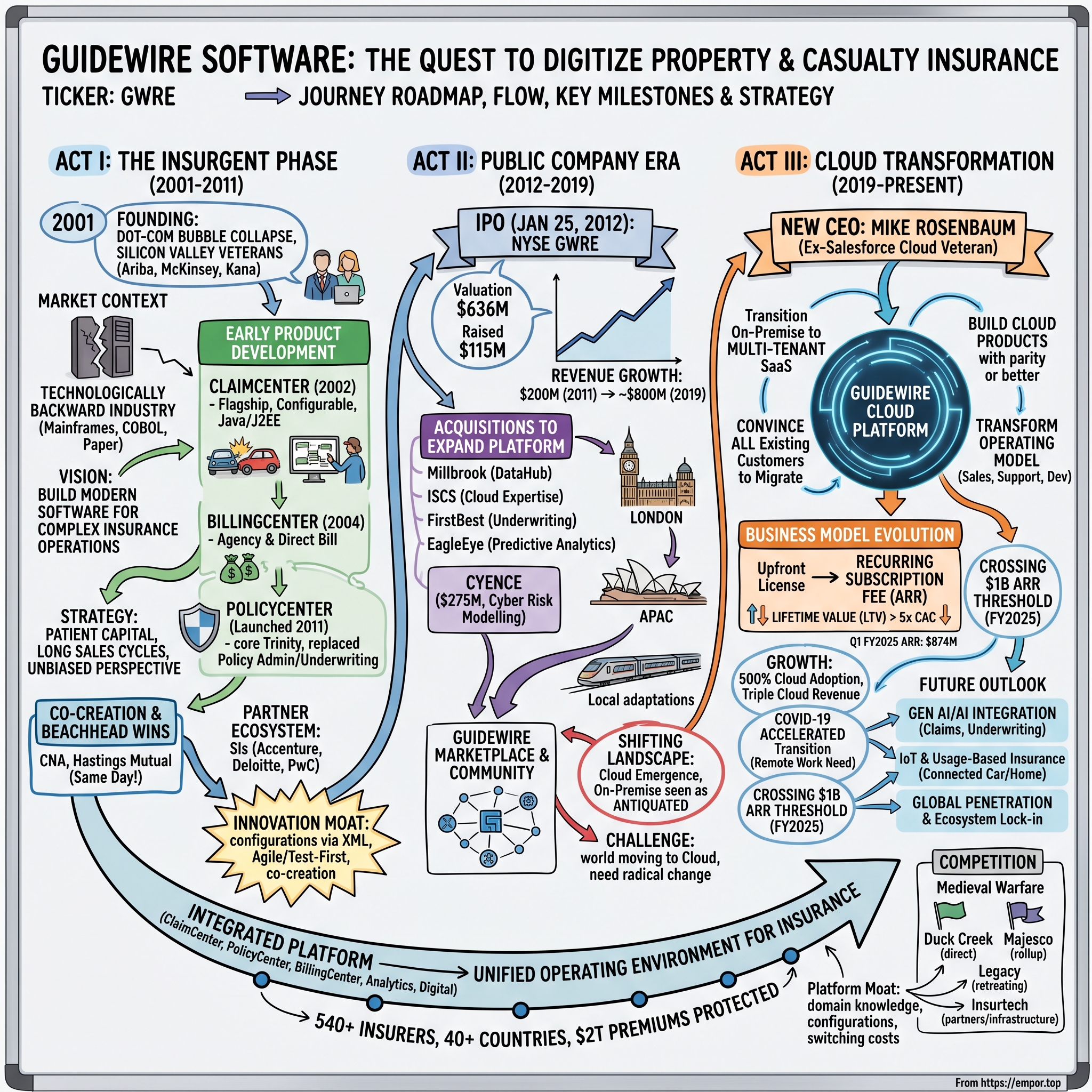
Guidewire Software: The Operating System for Global Risk
I. Introduction & The Core System Conundrum
Picture a claims floor at a large American auto insurer on the morning after a severe hailstorm. Thousands of first notices of loss arrive before midday. Each one must be matched to an active policy, evaluated against coverage terms that differ by state, routed to an adjuster, backed by balance-sheet reserves, and ultimately disbursed. Beneath the adjuster's interface, a system of record governs each determination: deciding whether damage is covered, how much capital the carrier must set aside, and what data will eventually reach state regulators. For decades, that foundation consisted of custom, in-house software—frequently legacy mainframe code that only a shrinking cadre of veteran engineers understood. An error in that software carried severe consequences: an insurer risked overpaying claims by millions of dollars, submitting faulty statutory filings, or running afoul of state insurance commissioners who mandate prior approval for every pricing adjustment.
This is an unglamorous corner of enterprise technology, but it is where Guidewire Software built an entrenched industry franchise. While customer relationship management and enterprise resource planning platforms dominate tech headlines, far fewer investors study the software determining whether a homeowner's storm claim is paid. Guidewire supplies that core infrastructure for the property and casualty (P&C) insurance industry, providing the mission-critical policy administration, billing, and claims management engines that anchor carrier operations.
The company's history reflects a two-stage operational overhaul. Beginning in 2001, Guidewire persuaded one of the financial sector's most risk-averse industries to abandon bespoke legacy code in favor of packaged software. Later, after establishing a profitable on-premises deployment model, management shifted strategy again, transitioning customers to a vendor-managed cloud platform. That second transformation severely depressed operating margins during the migration phase, but it established the modern recurring-revenue business.
The Machine Today
Guidewire concluded fiscal 2026 on July 31 with constant-currency annual recurring revenue (ARR) of $1.242 billion, a 19% increase year over year, while fully ramped ARR—the contracted run rate once pre-negotiated customer price tiers take effect—rose 22% to $1.578 billion.1 Total revenue expanded 23% to $1.475 billion, led by subscription and support revenue, which grew 33% to $970.9 million.1 Cash generation improved alongside top-line growth: operating cash flow reached $389.7 million, or a 26% margin, with GAAP operating income climbing to $149.9 million.1 Company disclosures indicate that Guidewire serves more than 570 insurers across 44 countries and has completed more than 1,700 software implementations.1
While these results suggest a software provider emerging from the capital-intensive phase of a cloud migration, equity markets have responded with caution. On September 4, 2026, following the release of fourth-quarter results, Guidewire shares declined roughly 20% to approximately $162; although the fourth quarter exceeded forecasts, revenue guidance for the first quarter of fiscal 2027 fell short of consensus estimates.2 By mid-September, the stock traded near $150, down approximately 43% over the prior twelve months, amid widespread market debate over how generative artificial intelligence and automated coding tools will affect traditional enterprise seat- and volume-based software pricing.3
That divergence between operational execution and market valuation frames the company's outlook. Guidewire's financial metrics indicate that its transition to the cloud succeeded operationally. The unresolved question for investors is whether a core system-of-record provider can sustain a premium valuation multiple if autonomous software tools lower the barrier to building custom enterprise applications and claims automation.
The Roadmap
This analysis examines Guidewire across seven core areas. First, industry context: why property and casualty carriers relied on legacy mainframes long after banking and retail modernized. Second, the company's 2001 founding and the decision by dot-com software engineers to focus on enterprise insurance. Third, the claims management system that served as Guidewire's initial wedge. Fourth, the expansion into InsuranceSuite and subsequent patent litigation with Accenture. Fifth, the initial public offering and the company's mixed track record of software acquisitions. Sixth, the margin contraction during the cloud transition—the corporate "valley of death"—and the management handover from co-founder Marcus Ryu to former Salesforce executive Mike Rosenbaum. Finally, an assessment of the business model, competitive dynamics, structural switching costs, and the competing bull and bear investment arguments evaluated against the company's operating record.
The baseline for evaluating Guidewire begins with the legacy architecture it was designed to displace—systems that remain active across significant segments of the insurance sector.
 Subscribe on LinkedIn
II. Pre-Founding & Industry Structure: The Trillion-Dollar Mainframe Prison
Consider an actuary at a regional property and casualty insurer during the 1990s. She spent three months developing a new pricing model for homeowners' coverage in a spreadsheet, incorporating revised territory factors, an updated roof-age curve, and discounts for home security systems. She handed the model to internal IT, where it joined a queue behind dozens of competing requests because every rate table and underwriting rule had to be manually hardcoded into an IBM mainframe program written in COBOL. The change reached production eighteen months later—if it deployed at all. By then, a competitor with more agile systems had already captured the most profitable policies in the territory.
That bottleneck, repeated across hundreds of carriers, illustrates the operational inertia that created the market opening for Guidewire.
Why P&C Is a Different Animal
Life insurance is actuarially complex but operationally deliberative; a whole life policy can sit largely untouched on a carrier's books for decades. Property and casualty insurance operates on the opposite rhythm. Covering automobiles, homes, commercial facilities, workers' compensation, and general liability, P&C carriers contend with claims that are frequent (traffic accidents), severe (major hurricanes), and occasionally both at once (catastrophic wildfire seasons). Each product line requires distinct rating variables, proprietary policy forms, and, in the United States, compliance with unique state-level regulatory regimes. Carriers file rates and forms with insurance commissioners in every jurisdiction where they operate, meaning a pricing revision approved in Ohio cannot simply be extended to Pennsylvania or California.
Operationally, a property and casualty carrier relies on three core engines. The policy administration engine serves as the underwriting and pricing hub: it ingests customer applications, evaluates and prices risk across hundreds of variables, and binds the policy contract. The billing engine manages premium collections, installment schedules, broker commissions, and payment delinquency. The claims engine oversees losses from the initial notice of loss through final settlement, governing two primary cost drivers that directly affect underwriting profitability: loss adjustment expenses (the internal and external costs of investigating and settling claims) and claims leakage (unwarranted payouts caused by calculation errors, missed subrogation opportunities, or fraud).
For enterprise software investors, the insurance core system functions like a bank's general ledger. While rarely visible to end consumers, it represents an indispensable system of record that processes every transaction, allocates regulatory capital, and ensures statutory compliance.
The Mainframe Era
Throughout the 1970s, 1980s, and 1990s, most large insurers built and maintained bespoke core systems in-house. Running on IBM mainframes and midrange hardware, these systems relied on millions of lines of COBOL and assembly code that underwent continuous, ad hoc patching across decades. Every corporate merger introduced duplicate platforms, and every new insurance endorsement added another layer of brittle code. By the late 1990s, carriers were managing sprawling legacy architectures that functioned adequately for daily transactions, but proved extraordinarily risky and costly to modify.
Commercial alternatives offered little relief. Large systems integrators profited from billing hourly rates for custom development and ongoing maintenance, giving them little incentive to deliver standardized software. Early packaged-software vendors offered rigid client-server applications that could not handle the scale and regulatory permutations of national carriers. Meanwhile, horizontal enterprise software vendors treated insurance as a specialized branch of corporate accounting, rather than an operational discipline defined by dynamic policy terms and multi-year claim lifecycles.
The Founding Coalition
In 2001, an outsider team with software engineering backgrounds rather than insurance careers entered this market. Marcus Ryu, a Princeton graduate and Marshall Scholar who completed a philosophy degree at Oxford, had worked as a consultant at McKinsey & Company and as an executive at procurement software pioneer Ariba.4 Ryu's introduction to insurance claims emerged through an informal channel: an office mate at McKinsey had worked as an actuary, leading Ryu to view carrier claims departments as inefficient operations overwhelmed by paper files and inconsistent settlement decisions.5 Guidewire was established in 2001 by six co-founders, with Ryu initially overseeing strategy before later managing professional services and customer delivery.6
The timing proved defining. Launching in the aftermath of the dot-com crash, the founding team deliberately avoided the speculative consumer-internet model. Ryu later recounted that the founders sought to build "something sober, something grounded, something substantive," based on the contrarian conviction that complex, mission-critical operational challenges required dedicated, vertical software rather than a generalized horizontal platform.5 At a time when venture capital overwhelmingly favored horizontal cloud and enterprise platforms, targeting property and casualty back-offices was distinctly unfashionable.
Management also established strict operational boundaries early in the company's development. Guidewire declined to pursue life and annuity carriers, recognizing their distinct data models and longer settlement cycles. When the company took on several self-insured corporate accounts around 2005, it concluded that their workflow requirements diverged too far from primary carriers and, as Ryu noted, "ended up returning every dollar and stepping back to refocus."7 Early recruiting efforts reflected a similar pragmatism, pitching candidates with the warning: "you won't get rich, your mom won't understand what you're doing, and it's going to be hard work."7
That focus addressed an essential economic distinction: an insurer's inventory consists of a legally binding promise, and its cost of goods sold is a claim that may take years to resolve. Horizontal enterprise software designed for supply chains and physical inventory could not accommodate those dynamics. A purpose-built architecture could—provided the startup identified the right operational entry point into the carrier's core workflow.
III. The Wedge Strategy: ClaimCenter & Surviving the Outsider Stigma (2001–2005)
Guidewire's initial customer engagement nearly derailed the enterprise before it gained traction. After raising a Series A round partly on the strength of an early contract, the carrier cancelled six months into the deployment.5 For a fledgling startup with a single product and no established revenue base, such an early cancellation often proves fatal. Yet Ryu later characterized the loss as a fortunate escape: the project had consumed the entire engineering staff, and the customer had wanted Guidewire configured as a front-end overlay bolted onto legacy systems rather than deployed as an authentic core replacement—an architecture Ryu believed would have introduced unresolvable technical flaws.5
That episode crystallized the central tension of Guidewire's formative years. The company needed customers urgently, but accepting engagements on the wrong operational terms risked turning it into a custom-software consultancy masquerading as a scalable product vendor.
Why Claims First
The founders selected claims management as their entry point, an operational wedge well matched to insurance economics. Policy administration houses an insurer's proprietary underwriting logic and pricing models; entrusting that core to an unproven startup was an unacceptable risk for most carrier executives. Claims, by contrast, represented an operational pressure point directly visible on the income statement. Ryu's pitch to carriers was straightforward: Guidewire would help them curb claims leakage "and thereby make a massive difference to your operating income," by lifting the decisions of junior adjusters closer to those of senior staff.5
The founders bypassed textbooks in favor of direct observation. They arranged site visits to shadow desk adjusters, field adjusters, and clerical workers, discovering that carriers shared their operational routines freely when approached with respect and curiosity.5 That habit of learning from the claims floor rather than executive boardrooms became embedded in the product's design.
The Clean-Sheet Product
ClaimCenter, first released in 2003, was built from scratch as a modern Java application rather than an adapted legacy codebase.8 Its core architectural principle—which Guidewire would later extend across its entire suite—was configurability. A carrier's specific business rules, input screens, and operational workflows could be configured on top of a standardized platform rather than hard-coded into it. In practical terms, Guidewire provided a building with movable interior walls: each insurer could rearrange its rooms, while the underlying foundation, plumbing, and electrical wiring remained shared and maintained by Guidewire.
That architecture proved to be a double-edged sword. Deep configurability enabled carriers to tailor workflows to their exact needs, which drove early sales. Yet it also allowed them to customize implementations so extensively that future software upgrades became prolonged, expensive engineering projects—a friction that would resurface forcefully during the subsequent cloud migration.
The First Wins
Trade coverage identifies CNA and Hastings Mutual as the first insurers to select ClaimCenter, in 2003.9 That customer pairing provided an effective proving ground: CNA, a major commercial carrier, conferred institutional credibility with national insurers, while Hastings Mutual, a regional mutual, offered an accessible environment to validate the software at scale. By the time of its initial public offering a decade later, Guidewire had expanded that initial foothold to 113 customers.8
Myth vs. Reality: Did Guidewire Have Pricing Power From Day One?
Popular retellings of Guidewire's ascent often assume that once ClaimCenter proved viable, the company commanded immediate pricing power and software-grade margins. The company's financial disclosures contradict that narrative. In fiscal 2010 and 2011, professional services still accounted for roughly 45% of total revenue and generated gross margins of only 18% to 22%, compared with near-100% margins on software licenses.8 Guidewire also remained unprofitable deep into its first decade, reporting an $11.0 million net loss on $84.7 million of revenue as late as fiscal 2009.8 Customer concentration was similarly pronounced: the top ten accounts generated 48% of total revenue in fiscal 2010.8
These figures illustrate a software business that spent its first decade operating much like a specialized systems integrator, absorbing extensive implementation labor at modest margins to ensure successful customer rollouts. Guidewire's early moat did not stem from immediate pricing leverage; it arose from a willingness to shoulder complex operational friction and deliver a dependable architecture that kept carriers from walking away. True pricing power emerged only later, earned incrementally as core switching costs took hold across each customer deployment.
With ClaimCenter established as a trusted claims system of record, the natural strategic move was to build and sell the remaining two engines.
IV. Building InsuranceSuite & The Existential Patent War (2005–2012)
In December 2007, as Guidewire emerged as a formidable challenger in core-system tenders, it was sued for patent infringement by Accenture, one of the world's largest consulting firms and an established force in insurance technology.8 For a private software vendor with a concentrated customer base, the lawsuit posed a critical commercial threat. Insurance chief information officers represent some of the most risk-averse buyers in enterprise software; a live patent dispute over their prospective core platform threatened to paralyze sales cycles that already stretched across twelve to eighteen months.
Completing the Trinity
Even as the legal confrontation unfolded, Guidewire continued to expand its architectural footprint. According to its 2012 prospectus, PolicyCenter followed ClaimCenter in 2004, and BillingCenter arrived in 2006.8 (Trade coverage dates the commercial deployments slightly later, with CNA again among the initial PolicyCenter customers.9) Unified on a shared codebase, the three products became InsuranceSuite.
Expanding beyond claims was a deliberate architectural escalation. While claims management served as the initial wedge into carrier workflows, policy administration represented the core asset. Replacing an insurer's policy engine required overhauling its proprietary product definitions and rating rules—the intellectual property carriers viewed as their competitive identity. Winning those foundational contracts required the operational credibility Guidewire had built through successful claims implementations. BillingCenter then connected policy and claims workflows on a common data model, increasing customer retention and eliminating the integration friction of operating disparate vendor systems.
The Accenture Fight
The patent dispute eventually produced a significant legal precedent. The federal district court in Delaware invalidated Accenture's U.S. Patent No. 7,013,284, which covered a computer-implemented system for handling insurance claims, finding that it claimed patent-ineligible subject matter. On September 5, 2013, the U.S. Court of Appeals for the Federal Circuit affirmed the decision, ruling that the system claims were directed to an unpatentable abstract idea, over a dissent from Chief Judge Randall Rader.10 Handed down shortly before the U.S. Supreme Court's 2014 Alice ruling reshaped software patent eligibility nationwide, the decision stood as an early bellwether in the curtailment of broad business-method patents.
The commercial resolution, however, was determined by balance-sheet pragmatism rather than a clean courtroom finish. Guidewire's 2012 prospectus disclosed that the litigation was settled in October 2011: Guidewire paid $10 million upfront, alongside an obligation to pay an additional $20 million contingent on the outcome of Accenture's appeal of the invalidated patent, or alternatively $15 million to discharge the liability early.8 Facing an impending initial public offering, Guidewire absorbed a material cash expense to purchase legal certainty before entering public markets, after which the appellate ruling discharged the dispute.
From Adversaries to Channel
The more enduring outcome of that period was Guidewire's relationship with third-party systems integrators. A core-system overhaul at a large carrier is a multi-year transformation involving legacy data migration, custom integration with dozens of peripheral applications, rigorous statutory testing, and sweeping change management. A software vendor of Guidewire's scale could not deliver those massive implementations without ballooning professional services headcount and diluting software gross margins. The strategic solution was to convert global consulting firms into a primary distribution and delivery channel, encouraging integrators to build profitable Guidewire practices rather than develop bespoke systems.
The underlying economic alignment was straightforward: every Guidewire core rollout generated substantially more implementation revenue for the integrator than software license revenue for Guidewire, giving consulting firms an incentive to train staff and recommend the platform. While the company did not disclose the precise multiple of integrator billings relative to software revenue, the partner ecosystem became an indispensable sales engine. Yet the relationship with Accenture remained complex. When rival vendor Duck Creek went public in 2020, Accenture held an equity stake of approximately 22.5%.11 A single consulting organization operated simultaneously as a crucial Guidewire implementation partner and as a major equity owner in its primary competitor.
This dynamic underscored a structural reality that persisted across Guidewire's evolution: systems integrators served as powerful allies when their billable incentives aligned with product deployments, but they remained an ongoing source of channel friction when their corporate interests diverged. With InsuranceSuite fully developed and the patent overhang resolved, Guidewire prepared to test the public markets.
V. The IPO, The On-Premises Peak, & Capital Allocation (2012–2018)
On January 24, 2012, Guidewire priced its initial public offering at $13 per share, above its indicated range of $10 to $12, raising $115 million after upsizing the offering to 8.85 million shares from 7.5 million.12 J.P. Morgan, Deutsche Bank Securities, and Citi led the underwriting syndicate.12 Unlike many enterprise software peers entering public markets, Guidewire was already profitable. For fiscal 2011, revenue totaled $172.5 million and net income reached $35.6 million, though that bottom line was bolstered by a $27.2 million tax benefit, meaning underlying operating profitability was considerably more modest than the headline implied.8
The Philosopher CEO
The executive ringing the opening bell was Marcus Ryu, who had assumed the chief executive role in September 2010.6 Ryu was an unconventional figure among enterprise software leaders. He articulated corporate values around "integrity, rationality and collegiality," and his public commentary often adopted a philosophical tone. Looking back on nearly two decades at the company, he characterized corporate growth as a sequence of false summits: securing the initial customer, reaching the first profitable quarter, and completing the IPO each merely revealed the next operational ascent, proving that the work "never got easier."5 Under Ryu's leadership between fiscal 2011 and fiscal 2019, Guidewire's customer base expanded from 101 to 380 carriers, while annual revenue rose from $172 million to $719 million.6
The On-Premises Plateau
The economic engine of this era was a classic term-license and maintenance model. Insurers bought multi-year term software licenses, paid annual maintenance fees for updates, and engaged Guidewire or third-party systems integrators for deployments. In fiscal 2017, total revenue expanded 21% to $514.3 million, divided across $271.5 million in license revenue, $68.6 million in maintenance, and $174.2 million in professional services.13 Operating cash flow was $137.2 million.13
The business's underlying profitability, however, depended heavily on the accounting lens applied. Non-GAAP operating income reached $110.5 million, or an operating margin of roughly 21%, but GAAP operating income stood at just $26.6 million, approximately 5% of revenue.13 That divergence—driven primarily by stock-based compensation and acquisition-related amortization—became an enduring characteristic of Guidewire's financial profile, highlighting a meaningful structural gap between adjusted earnings metrics and the ultimate economic costs borne by equity holders.
The Acquisition Ledger
During this period of on-premises maturity, Guidewire began deploying capital to expand its functional perimeter. Three corporate transactions provide an instructive audit of management's capital allocation track record.
ISCS (December 2016). Guidewire agreed to acquire ISCS, a San Jose-based provider of cloud-delivered core systems for smaller carriers, for $160 million in cash.14 ISCS brought approximately 40 insurer clients—two-thirds generating under $100 million in direct written premium—projected 2016 revenue of about $41.2 million, and roughly 220 employees.14 Ryu described its platform as "hands down" the premier offering for smaller carriers, while Guidewire's chief financial officer emphasized that there was "very little overlap" with the company's enterprise client base.14 Rebranded as InsuranceNow, the strategic rationale was sensible: smaller regional insurers lacked the internal IT budgets to support multi-year core implementations and were far readier to adopt standardized cloud delivery. Yet the transaction introduced the long-term overhead of maintaining a separate codebase. InsuranceNow remains positioned as an integrated cloud application for policy, billing, and claims, operating exclusively in the United States and serving mid-market carriers and managing general agents.15 Because Guidewire does not report standalone revenue or ARR figures for InsuranceNow, the return realized on that $160 million cash investment cannot be determined from public disclosures.
Cyence (2017). The most ambitious transaction of the Ryu era arrived in October 2017 with the acquisition of Cyence, a data-science startup dedicated to modeling emerging risk exposures such as cyber peril.[^16] The deal closed for $275 million in cash and stock, with Cyence chief executive Arvind Parthasarathi joining as senior vice president of Cyence Risk Analytics.16 Management argued that internet-scale data collection and behavioral analytics would enable carriers to underwrite risks—such as cyber attacks, reputational harm, and modern business interruption—that had historically been underinsured or deemed uninsurable.16 Across annual earnings releases from fiscal 2017 through fiscal 2026, however, Guidewire never reported Cyence revenue separately, and the business line never emerged as an independent growth pillar alongside InsuranceSuite. While disclosures indicate no formal goodwill impairment, the acquired technology was effectively absorbed as an analytical feature set within the core underwriting workflow rather than serving as the standalone revenue engine envisioned at its purchase.
HazardHub (August 2021). A later, smaller transaction reflected a more disciplined integration profile. HazardHub delivered property-risk intelligence via an application programming interface, generating geospatial risk scores across perils including wind, hail, flood, earthquake, and wildfire for any property parcel in the United States.17 While Guidewire did not disclose the purchase price in its transaction announcement,[^19] the data plugged directly into carrier rating and quoting workflows—the exact operational juncture where Guidewire's core policyholders already worked.
Taken together, the corporate development record cautions against viewing Guidewire's historical capital allocation as uniformly disciplined. Targeted tuck-ins that directly enhanced underwriting workflows proved additive, whereas the two largest bets either introduced architectural bifurcation or failed to yield quantifiable standalone financial returns. That history carries renewed significance as Guidewire directs capital toward artificial intelligence and pricing optimization—and it underscored a deeper strategic challenge by 2018: the lucrative on-premises licensing machine was approaching its structural ceiling.
VI. The Cloud Chasm & The CEO Pivot (2018–2022)
On August 5, 2019, Guidewire announced that the co-founder who had taken it public was handing operational leadership to an outsider. Mike Rosenbaum, previously executive vice president of product at Salesforce, became chief executive officer and joined the board, while Marcus Ryu transitioned to chairman.18 Ryu's statement pointed directly at the strategic rationale: Rosenbaum's experience leading product development and go-to-market strategy at "the world's leading cloud enterprise software company" made him the ideal leader "to accelerate our progress."18
In subsequent commentary, Ryu was even more direct, observing that the company required "more pure product focus and cloud experience at large scale," and that it was "best served by someone with a different set of skills."6 Such public candor is rare among enterprise software founders. It reflected a pragmatic admission: the engineering competencies that built an on-premises market leader were distinct from those required to re-architect that platform into a modern cloud service.
The Problem With Success
The configurability that won Guidewire its early customer base had become an operational trap. Because carriers had customized their on-premises deployments so extensively, upgrading to newer versions evolved into major, multi-year engineering projects. Each customer effectively ran an idiosyncratic fork of Guidewire's software, meaning newly engineered platform improvements reached production environments slowly, if at all. Systems that had represented modern architecture when first installed began aging the moment they went live.
A vendor-hosted cloud model promised to resolve that stagnation: Guidewire would operate the infrastructure, keep every customer on a unified release, and deploy improvements continuously. Competitive dynamics also intensified the pressure to transition. Duck Creek, a rival core-system vendor, positioned itself around a cloud-delivered product and went public in August 2020 at $27 a share, valuing the company at about $3.46 billion.11 Its stock jumped as much as 55% on its first day.11 The public markets were rewarding cloud-native insurance software, leaving Guidewire's on-premises licensing model looking dated by comparison.
The Salesforce Operator
Rosenbaum arrived with a relevant enterprise pedigree. Having spent a decade at Salesforce, he had overseen the rollout of Salesforce Lightning, a major redesign of that platform.19 At Guidewire, he framed his mandate as converting "packaged software that carriers can buy and implement" into "a service they can access," describing the transformation as a "90 degree pivot" for sales, support, and upgrades.19 He also emphasized corporate culture, arguing that an organization could achieve high performance without people "all trying to kill each other."19
His most immediate operational overhaul targeted release cadence. Shortly after taking over, Rosenbaum committed Guidewire to delivering a new cloud release every six months.20 The first, named Aspen, arrived in June 2020, followed by releases named alphabetically after ski destinations, including Banff, Cortina, Dobson, Elysian, and Flaine.20 While resort branding appeared cosmetic, the operational commitment behind it was substantial. A predictable biannual calendar established an operating heartbeat for the cloud company, forcing engineering, quality testing, and customer communication into a disciplined rhythm the on-premises business had never required. At the October 2022 Connections conference, Rosenbaum stated the strategic reality plainly: "it is increasingly untenable for us to continue to innovate and invest in the on-prem instances of Guidewire."20
Architecturally, the central imperative was decoupling customer-specific configurations from Guidewire's core platform. In the on-premises environment, a carrier's custom workflows and business rules were woven directly into the base product, much like renovations that knocked out load-bearing walls. In the cloud architecture, carrier configurations resided in standardized layers connecting through published interfaces, allowing Guidewire to upgrade the underlying structure without disrupting individual customer operations. Engineering that separation required years of development and substantial capital investment.
The Valley of Death, by the Numbers
The financial cost of navigating this transition was severe. Top-line expansion stalled: in fiscal 2021, total revenue reached $743.3 million, up less than 1%, as license revenue fell 8% while subscription and support revenue rose 24%.21 That plateau stemmed from revenue-recognition mechanics rather than collapsing commercial demand. Under term licensing, a carrier's multi-year contract value was recognized largely upfront upon delivery, whereas cloud subscription revenue was recognized ratably over the contract term. Selling subscriptions instead of term licenses shifted recognized revenue into future periods, causing reported income to weaken precisely when the company was securing multi-year customer commitments.
Yet the financial strain was far more than an accounting timing difference. GAAP operating losses widened from $23.9 million in fiscal 2020 to $105.6 million in fiscal 2021.21 The trough deepened in fiscal 2022: although revenue reached $812.6 million, GAAP operating losses expanded to $199.4 million—nearly a quarter of total revenue—and operating cash flow turned negative at minus $37.9 million.22 Subscription and support gross margin languished at roughly 38%, while professional services operated at a gross loss of about 13%.22 Guidewire was not only incurring the infrastructure overhead of running an early-stage cloud network, but it was also actively absorbing implementation costs to keep carrier migrations on schedule.
Myth vs. Reality: "Customers Had No Choice"
An early bull narrative maintained that Guidewire held such commanding pricing leverage that it could dictate cloud migration terms at will. The financial record contradicts that assumption. For roughly three fiscal years, Guidewire shouldered heavy economic friction to move its base: running low-margin cloud infrastructure, absorbing professional services losses, and weathering a stalled income statement. A vendor possessing absolute pricing power would not have needed to subsidize migrations so aggressively. The historical record refines the switching-cost thesis: Guidewire's customers were sticky enough that they did not defect during a disruptive transition, but they retained enough bargaining leverage to prevent the company from shifting the financial burden of that overhaul onto carrier budgets.
Tangible evidence of operational recovery emerged through core deal momentum. Guidewire closed a record 17 core cloud transactions in the fourth quarter of fiscal 2021, 16 of them for InsuranceSuite.21 ARR reached $582 million that year and $664 million the next.2122 In fiscal 2023, the company reported another 17 cloud deals in its fourth quarter—11 with Tier-1 insurers—propelling ARR to $763 million.23 Subscription and support gross margin improved to roughly 51% in fiscal 2023, still below mature software-as-a-service benchmarks, but demonstrating meaningful progress toward platform operating leverage.23
Guidewire's cloud transition proved financially viable only after enduring years of compressed margins and operational losses, with validation materializing in stages rather than a single inflection point. That hard-won turnaround positioned the company to convert its core systems footprint into a durable recurring-revenue platform.
VII. Current Operations & Segment Mechanics: Inside the Guidewire Engine
During Guidewire's fourth-quarter fiscal 2026 earnings call on September 3, 2026, the central development was an anchor customer rather than a headline financial metric. Chief Executive Mike Rosenbaum highlighted a long-term cloud migration agreement with Nationwide, a carrier he credited with validating the scalability of Guidewire's software for Tier-1 insurers more than a decade earlier.24 Under the agreement, Nationwide committed to moving its entire InsuranceSuite estate to Guidewire Cloud Platform while also selecting PricingCenter for personal lines, making it the first U.S. Tier-1 carrier to adopt the pricing product.24 For enterprise software investors, an early flagship customer migrating its core workloads onto the vendor's next-generation platform provided tangible validation of customer retention.
The Three Revenue Lines
Guidewire reports revenue across three streams, each tracing a distinct stage of its cloud overhaul.
Subscription and support represents the operational core of the modernized company. In fiscal 2026, the segment generated $970.9 million, accounting for roughly two-thirds of total revenue and expanding 33% year over year.1 Within that total, pure subscription revenue rose 37% to $916 million.24 The gross margin trajectory on this line offers the clearest evidence of the cloud platform's emerging operating leverage: on a GAAP basis, gross margin expanded from roughly 38% in fiscal 2022 to approximately 63% in fiscal 2024 and reached 72.7% in fiscal 2026.22251 On a non-GAAP basis, gross margin reached 74.5% in fiscal 2026, with management guiding to 75% to 76% for fiscal 2027 toward an ultimate long-term target of 80%.24 Management noted that fiscal 2026 performance had already approached the upper end of its initial fiscal 2028 targets.24
License revenue reflects the legacy term-licensing business in deliberate, managed decline. The revenue line contracted 7% to $234.6 million in fiscal 2026.1 Management projected that license revenue would fall by another $46 million to approximately $189 million in fiscal 2027, as term licenses diminish by nearly $50 million when customers shift workloads to the cloud, partially offset by true-up fees from remaining on-premises clients whose premium volumes continue to expand.24 This contraction represents an intentional strategic unwind: falling license revenue reflects execution of the cloud migration rather than deteriorating underlying customer demand.
Services revenue expanded 23% to $269.9 million in fiscal 2026.1 Professional services remains an intentionally low-margin operation, generating a non-GAAP gross margin of 12.5% in fiscal 2026; management guided to approximately 12% in fiscal 2027, anticipating a near-breakeven first quarter due to the milestone timing of several large fixed-fee engagements.24 In Guidewire's operating model, internal professional services exist to ensure customer migrations succeed rather than to maximize standalone profit pools. The recovery from a 13% gross loss in fiscal 2022 to modest positive margins illustrates how much of the initial cloud margin compression was driven by transition-related implementation subsidies.22
How Guidewire Gets Paid
The company's commercial model centers on insurance transaction volume rather than user seats. Guidewire calculates its subscription fees primarily as a percentage of the direct written premium (DWP)—the gross underwriting volume—managed on its platform.15 Initial contracts typically span five years before converting to annual renewals.15
This pricing structure functions like an infrastructure toll road priced on the value of cargo rather than vehicle count. When carriers raise premiums to offset inflation in vehicle repairs, construction materials, or catastrophic storm losses, the aggregate volume of premium managed on Guidewire's software rises, lifting the vendor's contracted revenue base. This mechanism provides a natural contractual hedge against general economic inflation. Conversely, the model carries cyclical exposure: during softer insurance pricing cycles or carrier retrenchments, premium stagnation dampens the expansion tailwind. Management observed that premium growth across on-premises carriers similarly generated license true-ups that cushioned the decline in upfront term licensing, demonstrating that the premium-linked mechanism operates across both deployment models.24
Reading ARR Correctly
Evaluating Guidewire's financial progress requires distinguishing between two closely monitored operational metrics. Annual recurring revenue (ARR) measures the annualized contracted run rate active at period-end, whereas fully ramped ARR measures the contracted value of existing agreements once all pre-negotiated step-ups and line-of-business deployments take full effect. Because major enterprise cloud transitions phase in over multiple years, carrier contracts frequently begin at modest introductory billing tiers before stepping up as additional policy lines migrate onto the platform. The spread between ARR and fully ramped ARR represents a contracted backlog of future revenue growth.
Fiscal 2026 marked the fourth consecutive year in which fully ramped ARR expanded faster than active ARR, and the second straight year it grew by more than 20%.24 Customers generating more than $5 million in fully ramped ARR increased from 86 to 105.24 Total cloud ARR advanced 35%, accounting for 84% of total ARR.24 Demonstrating the visibility of this pipeline, Chief Financial Officer Jeff Cooper stated that more than half of the net new ARR projected in fiscal 2027 guidance was already contracted under defined ramp schedules.24
Customer retention reinforces that revenue trajectory. Guidewire reported that gross annual ARR attrition remained below 1.5% across all product lines and below 1% among core systems clients in fiscal 2026, marking the lowest churn levels since the company began tracking the metric.24 While management does not disclose a net revenue retention rate—rendering third-party estimates speculative—Cooper acknowledged that the record-low churn added roughly one percentage point to fiscal 2026 ARR growth, cautioning that fiscal 2027 projections conservatively assume attrition returns to historical averages.24
New Products, New Proof Burden
Alongside core platform migrations, Guidewire has begun cross-selling adjacent operational tools into its carrier base. In April 2025, the company completed its acquisition of Quantee, a Poland-based pricing startup, re-engineering the application as PricingCenter.1524 In October 2025, it agreed to acquire ProNavigator, an artificial intelligence knowledge platform serving 34 insurance carriers, 12 of which were existing Guidewire customers, for an undisclosed purchase price.26 During fiscal 2026, Guidewire recorded 28 customer wins for ProNavigator and 12 contracts for PricingCenter.24
These product lines remain in their early commercial stages. Rosenbaum acknowledged that ProNavigator's initial adoption was "primarily cross-sell" within the existing customer base, and when asked by an equity analyst to quantify the ARR contribution from AI products, he declined, characterizing the disclosure as "not appropriate" at that stage of rollout.24 Cooper similarly noted that adoption curves for standalone tools would follow "much shallower" revenue ramps than core suite deployments.24 Given the precedent of Cyence—where a heavily promoted risk-analytics acquisition was eventually absorbed into core workflows without establishing a discrete revenue pillar—transaction counts alone do not yet validate a durable new growth vector. For long-term investors, the definitive test will be whether these ancillary tools ultimately contribute material disclosed ARR or provide measurable differentiation that defends core platform pricing.
That dynamic leads directly into Guidewire's competitive landscape, where the primary contest is waged not against rival vendors, but against entrenched customer inertia.
VIII. Competitive Dynamics & Industry Structure
Consider the view from a chief information officer's desk at a mid-sized insurer weighing a core-system replacement. On one side sits a proposal for a multi-year overhaul costing tens of millions of dollars, touching every policy, claim, and invoice, with executive careers tied to its execution. On the other side sits the legacy mainframe: slow, rigid, and expensive to patch, but functioning. In enterprise insurance technology, the most formidable rival is rarely another vendor. It is the organizational temptation to wait another year.
The Field
Guidewire's annual report identifies Duck Creek, EIS Group, Insurity, Majesco, Origami Risk, and Sapiens as direct core-system competitors, alongside horizontal enterprise software providers such as SAP, Salesforce, and ServiceNow.15 The defining characteristic across this competitive landscape is how much of it has transitioned into private equity ownership.
Duck Creek was Guidewire's primary challenger during the cloud transition. Following an August 2020 initial public offering, Vista Equity Partners took the company private on March 30, 2023, for $19 per share, valuing the business at approximately $2.6 billion.27 That buyout price sat well below its $27 IPO debut. Under private ownership, Duck Creek no longer reports public financial statements, meaning industry assumptions regarding its win rates, R&D spending, or cost structure under Vista cannot be verified from regulatory filings.
Majesco was acquired by Thoma Bravo in a transaction that closed on September 21, 2020, at $16 per share in cash.28 The vendor competes across property and casualty lines as well as life and annuity markets, maintaining its strongest presence among smaller and mid-sized carriers.
Sapiens, an Israel-based insurance software vendor with an established position in Europe and among mid-market insurers, agreed in August 2025 to be acquired by Advent International for approximately $2.5 billion, or $43.50 per share.29
This pattern points to a notable structural shift: three of Guidewire's most prominent named competitors were taken private at valuations far below Guidewire's public enterprise value. While private equity sponsors can provide patient capital away from quarterly earnings pressure, their operating models typically emphasize cash generation and margin discipline. That posture can restrict the heavy research and development investments required to challenge an incumbent for complex Tier-1 carrier transformations. At the same time, private ownership introduces a diligence gap for public equity investors, as a competitor quietly improving its software or discounting contracts away from public view cannot be tracked through standard regulatory disclosures.
War-Gaming the Competitive Position
The available evidence outlines a clear market hierarchy, though with distinct operational limits. Guidewire's revenue base remains balanced: its top ten accounts represented 20% of both revenue and ARR in fiscal 2025, demonstrating diversified enterprise adoption rather than reliance on a handful of mega-accounts.15 Its reference list includes major carriers such as Nationwide, which chose to deepen its commitment by moving core workloads to the cloud rather than defecting to a rival platform.24 Because Guidewire does not report verified market-share figures, third-party assertions regarding its precise share of the Tier-1 carrier segment should be evaluated as estimates.
Conversely, the company's operating record demonstrates that its market leadership is not immune to competitive pressure. During the late 2010s and early cloud migration, a rival vendor positioned itself as cloud-native, and public equity markets rewarded that narrative with a premium valuation. Guidewire responded not through effortless pricing power, but through years of heavy capital reinvestment and compressed operating margins. Guidewire's competitive moat remains strongest among Tier-1 and Tier-2 carriers with complex multi-state operations, where depth of business logic, regulatory compliance content, and broad systems-integrator ecosystems prove decisive. Downmarket, among smaller regional carriers and managing general agents (MGAs), that advantage is more contestable, as lighter platforms can compete effectively on upfront price and faster deployment timelines. Guidewire appears to recognize that vulnerability: on the fourth-quarter fiscal 2026 earnings call, John Mullen noted that managing general agents and smaller carriers contributed meaningfully to fiscal 2026 results, while Rosenbaum maintained that Guidewire's standardized, pre-built cloud architecture provides particular value to carriers operating without extensive internal IT departments.24
Porter's Five Forces
Buyer power is moderate overall, but highly asymmetrical over time. Large carriers are sophisticated buyers that conduct multi-month competitive tenders, demand custom contractual terms, and negotiate price protections. Once a core platform goes live in production, however, switching costs rise steeply. In practice, carrier bargaining leverage concentrates heavily at initial vendor selection and contract renewal, before diminishing sharply during normal operations.
Supplier power is low to moderate. Guidewire Cloud Platform runs on Amazon Web Services (AWS) regions worldwide, creating an operational dependency on a single primary infrastructure provider.15 However, hyperscale cloud vendors compete aggressively for large enterprise workloads; Guidewire disclosed that it anticipated approximately $4 million in infrastructure credits from its provider in the first quarter of fiscal 2027 alone, indicating measurable bargaining leverage in hosting arrangements.24
The threat of substitutes represents the most dynamic strategic variable. Historically, the primary alternative to Guidewire was bespoke, internally developed mainframe code. In the current environment, the emerging question is whether horizontal enterprise software or AI-assisted development tools will make custom in-house software or lightweight systems commercially viable again—a debate evaluated in the bull and bear investment theses.
The threat of new entrants remains low for comprehensive core suites. Replicating more than two decades of insurance-specific business logic, state-level statutory filing templates, and implementation partner networks requires vast capital and multi-year engineering cycles. For Tier-1 carriers, where regulatory non-compliance or system outages carry catastrophic operational risk, executive committees rarely approve core replacements with unproven vendors.
Rivalry is moderate. Competitive intensity is highest in mid-market and regional carrier tenders, where implementation timetables and subscription costs dominate procurement decisions. Competition is more muted in complex Tier-1 transformations, where very few vendors possess referenceable, large-scale deployments. While private equity ownership among several rivals may temper price competition in certain segments, the absence of public financial reporting prevents independent verification.
If the competitive map explains who Guidewire fights, the next question is why it keeps winning where it does.
IX. The Playbook & Hamilton Helmer's 7 Powers Analysis
During Guidewire's fourth-quarter fiscal 2026 earnings call, Chief Executive Mike Rosenbaum offered an unvarnished assessment of the company's competitive limits. When asked what proprietary advantages Guidewire's artificial intelligence platform possessed that third parties could not replicate, he acknowledged that the company's out-of-the-box approach was "less valuable to that Tier 1 insurance company than it is to a smaller insurance company," because large carriers may choose to invest more heavily with frontier AI model partners.24 That candid observation provides a pragmatic lens for evaluating Guidewire through the framework of Hamilton Helmer's 7 Powers: every competitive moat operates within defined structural boundaries.
1. Switching Costs: The Foundation
Switching costs represent Guidewire's most entrenched and thoroughly documented strategic power. A core insurance platform functions as the definitive system of record, housing every active policy, historical claim, and billing ledger. Replacing that engine requires migrating decades of transactional data, retraining thousands of adjusters and underwriters, rebuilding dozens of peripheral integrations, and risking regulatory penalties or claims disruption if calculations falter. The empirical evidence of that friction is clear: gross ARR attrition remained below 1.5% across all product lines and under 1% among core systems clients in fiscal 2026.24
Yet high switching costs protect only the installed base; they do not win new accounts. Furthermore, the friction cuts in both directions. The identical operational risk that prevents existing clients from leaving Guidewire deters prospective customers from abandoning their legacy mainframes. In practice, Guidewire's most formidable rival remains carrier inertia and the institutional bias toward the status quo.
2. Ecosystem and Network Effects
Guidewire's partner network, particularly the global systems integrators that conduct deployments, creates a reinforcing, two-sided dynamic. Carriers select Guidewire partly because certified implementation talent is readily available in the market. Consulting firms invest in training personnel on Guidewire because that is where enterprise carrier budgets are concentrated. This dynamic functions more as a partner ecosystem advantage than a pure network effect, because one carrier's adoption does not directly enhance software utility for another. In addition, Guidewire's annual report does not quantify the number of certified consultants or marketplace partners, meaning frequently cited industry estimates cannot be independently verified from regulatory filings.15
The ecosystem also carries documented commercial friction. As demonstrated by Accenture's earlier patent litigation and its subsequent equity stake in Duck Creek, integrator incentives do not always align with vendor strategy. Systems integrators historically generated lucrative billings from custom on-premises code, which subsequently complicated and delayed carrier cloud migrations. On the fourth-quarter fiscal 2026 earnings call, President and Chief Operating Officer John Mullen introduced a new competitive variable, noting that he anticipates "new entrants and disruptors into the SI world" who will apply automated AI tooling aggressively to implementations.24 If automated software development substantially compresses deployment timetables, Guidewire's platform could become easier and cheaper to adopt, but the consulting partners that have served as its primary distribution channel may see their billable hours and economic incentives altered in unpredictable ways.
3. Scale Economies
Guidewire's operational scale provides a meaningful cost defense against both niche competitors and in-house development. At the end of fiscal 2025, the company employed 3,772 people, including 1,879 in product development.15 That engineering capacity is distributed across approximately 500 customers representing about 570 insurance brands.15 Complex regulatory updates, state-specific policy forms, and cloud infrastructure enhancements are engineered once and delivered to hundreds of carriers, whereas an in-house IT team at a single insurer must absorb the entire development and maintenance expense for its own bespoke systems. That cost advantage expands as customer workloads consolidate onto a single cloud release, relieving Guidewire of the overhead required to maintain disparate on-premises software forks.
4. Counter-Positioning
During its formative decade, Guidewire successfully counter-positioned against systems integrators building custom, proprietary software. Consulting firms billing extensive hourly rates to maintain bespoke mainframe applications had little commercial incentive to promote standardized packaged software that reduced ongoing development hours. Over time, that counter-positioning advantage dissipated as major consulting firms adapted and established dedicated Guidewire integration practices.
The more pressing strategic question is whether Guidewire now faces counter-positioning from below. An agile, AI-native software provider unburdened by legacy codebases could theoretically offer faster deployments and lower upfront fees, exerting pressure on an enterprise model built around multi-year transformation contracts. Guidewire has sought to defend that flank by adopting similar tools: Mullen stated that the company is deploying AI-assisted implementation tooling across all active projects and partner practices over the subsequent six months to reduce project duration and operational complexity.24 Whether that initiative lowers procurement barriers without eroding high-margin software pricing or partner engagement remains an ongoing test.
5. Branding and the "Safe Choice"
In an industry defined by risk aversion, Guidewire's institutional track record serves as a distinct commercial asset. Completing more than 1,700 software implementations provides a referenceable foundation in an enterprise procurement environment where failed multi-million-dollar core replacements routinely jeopardize executive careers.1 That reputational advantage, however, carries clear limitations: institutional trust remains vulnerable to high-profile deployment delays, and an established reputation for core transaction processing does not automatically confer authority in newer functional domains, such as generative AI or pricing optimization, where Guidewire is still establishing customer proof points.
What the Powers Add Up To
Auditing Guidewire against Helmer's framework reveals an asymmetrical competitive profile. Switching costs and scale economies represent durable, highly evidenced defenses that safeguard the company's core franchise. The partner ecosystem provides significant operational reach, though it introduces channel dependencies that generative coding tools could reshape. Meanwhile, early counter-positioning has largely run its course, and corporate branding remains effective only so long as core implementations deliver on schedule. In aggregate, the powers that anchor Guidewire operate primarily as protective moats around its installed base; their ability to drive rapid expansion into adjacent product markets remains to be proven. That operational reality places the spotlight directly on the executive leadership tasked with navigating those strategic boundaries.
X. Management, Governance, & Incentives
On September 8, 2026, days after the stock's post-earnings decline, Mike Rosenbaum sold 1,200 shares at an average price of about $160.52, generating approximately $193,000.3 The sale was executed under a Rule 10b5-1 trading plan adopted on October 14, 2025, and represented less than 1% of his directly held equity.3 As with most pre-scheduled executive plans, the transaction carries limited informational signal regarding operating performance. What it clarifies is the scope of his direct ownership: following the sale, Rosenbaum held roughly 185,000 shares, valued at approximately $27.8 million at the time.3 That represents meaningful balance-sheet alignment, even if more modest than casual characterizations of his equity position suggest.
The Operator
Rosenbaum's tenure has now reached a length where performance can be measured across a full operational cycle. When he arrived in 2019, Guidewire was operating as a profitable on-premises vendor on the verge of a multi-year margin contraction. Seven years later, the business has returned to GAAP operating profitability and generates substantial cash flow.1 His defining operational decisions were establishing the disciplined six-month release cadence, standardizing the carrier base onto a unified cloud product, and, more recently, initiating a programmatic expansion into adjacent operational tools through targeted acquisitions.
On quarterly earnings calls, his communication style leans toward conceptual explanations, a consistent emphasis on structural durability, and broad expressions of operational confidence. During the fourth-quarter fiscal 2026 call, he asserted that there is "more upside potential than there is downside anxiety" for fiscal 2027, while also acknowledging that "our deals are very lumpy and things can happen."24 For investors, weighing both sides of that assessment is essential.
The Supporting Cast
John Mullen, now president, joined in February 2022 as president and chief revenue officer.30 He came from Capgemini, where he had led its $4 billion-plus North American business unit and, before that, its global insurance business unit.30 While some external accounts describe him as an Accenture alumnus, Guidewire's appointment announcement specifically identified Capgemini. His recruitment deepened Guidewire's structural ties to the global consulting ecosystem, and he now leads the company's commercial organization.
Jeff Cooper, the chief financial officer, has overseen the platform's margin recovery and guidance framework. His explanations on earnings calls are consistently mechanical and granular, detailing backlog ratios, churn assumptions, and the precise division between contracted step-ups and uncontracted net new growth.24 The company also disclosed that Chief Accounting Officer David Peterson intends to retire in early November 2026.24 While an orderly succession, leadership changes within the finance function warrant attention at an enterprise software vendor whose revenue recognition is as complex as Guidewire's.
Marcus Ryu no longer leads the board. Guidewire's 2025 proxy statement identified Michael C. Keller as independent chairman, formally separating the chief executive and board leadership roles.31 In September 2025, Ryu became a general partner at Battery Ventures, focusing on investments in vertical software, artificial intelligence, and financial and insurance technology.4
Incentives
The executive compensation framework broadly aligns with standard institutional investor preferences. For fiscal 2025 performance-based restricted stock units, vesting depended on ARR (60% weighting) and adjusted non-GAAP operating income (40%), measured annually and averaged over three years, with vesting capped at 150% of target.31 The annual bonus pool paid out at a 130% company performance factor for fiscal 2025, yielding a cash bonus of $975,000 for Rosenbaum.31 At the 2024 annual meeting, more than 98% of votes cast supported the executive compensation program.31
A critical examination of the company's capital allocation and compensation structure points to three considerations. First, executive incentives reward ARR growth and non-GAAP operating profit, but neither metric directly measures per-share compounding or GAAP profitability. Stock-based compensation was $182 million in fiscal 2026 and is projected to reach approximately $202 million in fiscal 2027, which explains the vast majority of the gap between non-GAAP operating income of $339.9 million and GAAP operating income of $149.9 million.241 Second, Guidewire spent $606.3 million repurchasing about 4.1 million shares at an average price of $148.41 in fiscal 2026, leaving only $31.9 million under its existing authorization.1 With the stock trading near $150 in mid-September 2026, those repurchases were roughly breakeven on price, but much of that capital outlay effectively absorbed dilution from ongoing equity grants rather than retiring net share count. Third, cash and investments fell from $1.48 billion at the end of fiscal 2025 to $1.22 billion a year later.321 While buybacks represent a conventional deployment of surplus liquidity, evaluating whether they constitute a true return of capital requires tracking net share reduction after accounting for executive dilution.
The governance profile, on balance, is conventional and shareholder-aligned, supported by an independent chair and overwhelming say-on-pay approval. The more substantive analytical question is not governance risk, but whether the current incentive architecture sufficiently rewards per-share capital discipline—a question that frames the central investment debate.
XI. The Investment Case: Bull vs. Bear & The Historical Falsification Ledger
In June 2026, Guidewire reported third-quarter results that surpassed Wall Street expectations on both revenue and earnings, yet the stock dropped sharply.33 Rosenbaum told analysts that the company had "anticipated a couple of more deals to close in the quarter," but that with "a relatively small number of discrete deals each quarter," contract timing does not always align with quarterly reporting boundaries.34 Over the subsequent six trading sessions, the shares tumbled 27%, wiping out roughly $4 billion in market value, and by June 10 the stock was down approximately 38% year-to-date.33 Three months later, the pattern repeated: a fourth-quarter operational beat, followed by softer-than-expected near-term revenue guidance, and an immediate 20% single-day decline.2
Twice in a single year, the business delivered ahead of forecasts while the stock sold off. That divergence between operational execution and market sentiment provides an instructive lens for evaluating the competing bull and bear investment theses.
The Falsification Ledger
Thesis 1: The core system moat is unassailable. The strongest supporting evidence is contemporary: gross annual ARR attrition remained below 1% among core systems clients in fiscal 2026, reinforced by Nationwide's commitment to migrate its entire InsuranceSuite estate onto the cloud platform.24 The strongest counter-evidence is historical: during the early cloud migration, Guidewire had to heavily subsidize carrier transitions, while equity markets rewarded a rival that positioned itself as cloud-native.2211 That operating history narrows the thesis: the switching moat is exceptionally deep for complex Tier-1 carriers already running Guidewire, but considerably more contestable among regional insurers and new prospects. The primary metric to monitor is gross ARR attrition; a sustained rise above the normalized historical run rates assumed in guidance would provide the earliest signal of moat erosion.
Thesis 2: The cloud transition has produced a high-margin software-as-a-service model. The platform's margin trajectory supports this claim: GAAP subscription and support gross margin expanded from roughly 38% in fiscal 2022 to 72.7% in fiscal 2026.221 Yet any suggestion that this transition occurred smoothly is contradicted by the operating record: the shift required roughly three years of widening GAAP operating losses, culminating in negative operating cash flow in fiscal 2022.2122 Cloud leverage was ultimately achieved, but through prolonged margin compression and substantial capital outlays. The forward test is whether subscription gross margins can reach management's long-term 80% target without re-triggering professional services losses as more complex Tier-1 migrations ramp up.24
Thesis 3: Analytics and artificial intelligence products establish a discrete growth engine. Here, historical precedent urges caution. Cyence was acquired for $275 million to unlock emerging risk markets, yet the company never reported it as a distinct standalone growth driver.16 Newer offerings, such as ProNavigator and PricingCenter, are accumulating transaction wins, but management has declined to quantify their specific ARR contributions, and early adoption has stemmed primarily from cross-selling into the existing customer base.24 The thesis remains plausible but unproven. It would be validated by disclosures demonstrating material, standalone ARR contributions or clear data showing these tools measurably improve core platform win rates. It would be weakened if management continues reporting deal counts without providing underlying financial scale.
Thesis 4: The integrator ecosystem operates as a frictionless growth channel. The historical record demonstrates that this relationship has alternated between vital collaboration and commercial conflict: Accenture previously engaged in patent litigation with Guidewire and subsequently held a substantial equity stake in Duck Creek, while integrator-led custom coding heavily complicated early cloud migrations.811 The thesis is therefore conditional: systems integrators serve as an effective distribution channel only when billable incentives align with Guidewire's standardized cloud delivery, and emerging AI tooling that compresses implementation hours could alter those economic incentives once again.24
The Bull Case
The bull case centers on exceptional revenue visibility. Fully ramped ARR of $1.578 billion is already contracted under multi-year agreements, more than half of the net new ARR projected for fiscal 2027 is already committed under defined ramp schedules, and gross customer attrition remains at historical lows.124 Management's fiscal 2027 guidance projects ARR reaching between $1.45 billion and $1.46 billion, total revenue expanding to between $1.707 billion and $1.727 billion, and operating cash flow climbing to between $445 million and $465 million.1 While legacy license revenue will continue its deliberate contraction, subscription revenue is guided to grow approximately 31%.24 From this perspective, investors see an enterprise franchise with high contracted visibility, expanding operating cash flow, and a deeply entrenched customer base, available at a sharply discounted multiple: the roughly 43% twelve-month share price decline means public markets value Guidewire far more conservatively than when its market capitalization approached $20 billion in September 2025.34
Furthermore, bulls frame generative artificial intelligence as a structural catalyst rather than an existential threat. Their argument—reiterated by management—maintains that autonomous software agents operating in claims and underwriting require structured, authoritative data and transactional workflows, which reside exclusively within the core system of record. As John Mullen noted, autonomous agents "need to be able to contribute to and consume from your enterprise context," which "resides primarily in your core systems."24 Under this premise, AI does not displace the underlying core; it amplifies the utility of a modernized cloud platform and accelerates the carrier imperative to decommission legacy mainframes.
The Bear Case
The bear case does not rest on an imminent collapse of Guidewire's core franchise. Instead, it contends that top-line growth is moderating just as structural technological uncertainty peaks. Guidance for fiscal 2027 implies ARR growth decelerating to approximately 18% from 19%, with management acknowledging that roughly one percentage point of fiscal 2026 growth reflected unsustainably low customer attrition that guidance conservatively assumes will revert to historical norms.24 Jeff Cooper also noted that a smaller proportion of fully ramped backlog will convert into recognized ARR in fiscal 2027, with the balance shifting into years two through five.24 While that dynamic supports multi-year revenue visibility, it makes near-term growth more dependent on closing new enterprise transactions—deals that have historically proven lumpy and unpredictable from quarter to quarter.34
A more fundamental challenge involves the impact of generative artificial intelligence on enterprise software economics. If AI-assisted software engineering makes it substantially cheaper and safer for insurers to maintain legacy mainframes or assemble custom applications, the operational pressure to undertake multi-million-dollar core replacements could abate. Similarly, if automated coding dramatically compresses implementation timelines, professional services revenue and consulting partner billings could face structural pressure. Rosenbaum described the rapid emergence of AI as "maybe unprecedented in the history of enterprise software," while acknowledging that Tier-1 carriers may choose to build their own proprietary AI interfaces alongside frontier model providers rather than adopt Guidewire's packaged tools.24 Management counters that Guidewire operates an open platform—equipped with published APIs, Model Context Protocol (MCP) servers, and the architecture to run "headless"—ensuring it remains the authoritative transactional engine regardless of which external AI layer interacts with it.24 While that architecture defends the core system of record, it implicitly concedes that significant economic value and pricing upside in insurance AI may accrue to external foundation models and specialized application layers rather than to Guidewire.
Finally, skeptics point to capital allocation and underlying earnings quality. Guidewire allocated more than $600 million to share repurchases in fiscal 2026, an outlay that largely absorbed dilution from ongoing equity grants rather than substantially reducing net share count, while simultaneously re-engaging in corporate acquisitions despite an uneven historical M&A track record.1 While fiscal 2026 free cash flow of $358.7 million reflects genuine cash conversion, GAAP operating income of $149.9 million illustrates how heavily the company's non-GAAP profitability narrative relies on excluding substantial stock-based compensation.1
Weighing It
Guidewire's operating history leaves the core investment thesis focused and disciplined. The installed-base moat is verified by record customer retention and flagship carriers committing their full core estates to the cloud. Conversely, assertions that the cloud overhaul was seamless, that ancillary data and AI acquisitions reliably generate standalone growth pillars, or that systems integrators represent a frictionless channel are either refuted by the historical record or remain commercially unproven. The investment debate is no longer about whether Guidewire can survive the operational journey to the cloud; that transition is largely accomplished. The critical questions for long-term investors now center on the durable rate of ARR compounding, the degree to which enterprise AI either reinforces or circumvents core transactional pricing, and how much reported operating cash flow translates into per-share value after accounting for ongoing dilution. Those questions ultimately turn on a concise dashboard of operational metrics.
XII. Forward Watchlist & 1–3 Primary KPIs
The next scheduled checkpoint is Guidewire's Analyst Day on October 27, 2026, held alongside its Connections customer conference in Las Vegas, where management has indicated it will showcase new agentic AI capabilities.24 The event represents a key test for the company's valuation framework: management is expected to provide updated medium-term financial targets, and investors will look for whether leadership offers quantitative detail on artificial intelligence revenue, having declined to size the contribution during its September earnings call.24
The Three KPIs That Matter
1. Fully ramped ARR growth. This metric functions as a key leading indicator of Guidewire's future revenue trajectory because it captures signed contractual commitments before pre-negotiated pricing tiers take full effect. In fiscal 2026, fully ramped ARR expanded 22%.1 Guidewire does not provide forward guidance for the metric, reporting it only on an annual basis.24 If fully ramped ARR growth slows toward or falls below active ARR growth, it would indicate that the contracted backlog supporting future revenue expansion is beginning to compress.
2. Subscription and support gross margin. This line item offers the clearest measure of platform operating leverage as customer workloads scale. Management guided to a non-GAAP gross margin between 75% and 76% for fiscal 2027, maintaining a long-term target of 80%.24 Progress toward that benchmark—particularly as large, operationally complex Tier-1 carriers complete their migrations—will demonstrate whether Guidewire can expand cloud profitability without requiring ongoing professional services subsidies.
3. Gross ARR attrition. Customer retention provides a direct test of the platform's switching moat. Gross annual ARR attrition stood below 1.5% across all product lines and under 1% among core systems clients in fiscal 2026, though management conservatively assumed in its fiscal 2027 guidance that churn will revert toward historical run rates.24 A persistent increase above those historical levels would provide the earliest tangible evidence that customer switching costs are eroding, especially if automated coding tools begin making competitive alternatives more viable.
What to Listen For
On upcoming earnings calls, three qualitative signals warrant scrutiny. First, deal execution: whether management's explanations regarding "lumpy" quarterly transaction timing remain an occasional occurrence or evolve into an ongoing rationale for top-line volatility. Second, product monetization: whether ancillary tools including ProNavigator, PricingCenter, and the agentic platform transition from reported contract counts to disclosed recurring revenue. Third, implementation economics: whether AI-assisted deployment tools successfully compress project timetables and implementation costs without eroding internal professional services margins or straining commercial relationships with global systems integrators.
Guidewire's trajectory began with a founding conviction that mission-critical operational challenges require purpose-built vertical software. A quarter-century later, the enterprise has established that platform across the insurance industry's most heavily regulated core systems, absorbed a multi-year cloud overhaul that severely compressed operating margins, and emerged with a sizable recurring-revenue foundation supported by high customer retention. Whether its subsequent phase compounds shareholder value will depend on whether that entrenched system-of-record advantage can defend pricing power against emerging artificial intelligence architectures—or whether the company must rely on unproven ancillary applications to justify its market valuation.
References
-
Guidewire Announces Fourth Quarter and Fiscal Year 2026 Financial Results (Exhibit 99.1 to Form 8-K) — SEC EDGAR, 2026-09-03 ↩↩↩↩↩↩↩↩↩↩↩↩↩↩↩↩↩↩↩
-
Here's Why Guidewire Stock Sank 20% Yesterday — TIKR, 2026-09-05 ↩↩
-
Down 43% Over the Last Year, CEO Trims Holdings, Sells 1,200 Shares of Software Stock — The Motley Fool, 2026-09-18 ↩↩↩↩↩
-
Marcus Ryu, Co-Founder and Former CEO of Guidewire Software, Named General Partner at Battery Ventures — Yahoo Finance / Business Wire, 2025-09-29 ↩↩↩
-
The Vertical Advantage: How Specialisation Drove Success in Insurance, with Marcus Ryu — Cytora ↩↩↩↩↩↩↩
-
A Conversation with Guidewire Chairman Marcus Ryu — Insurance Innovation Reporter ↩↩↩↩
-
Guidewire Co-founder Marcus Ryu – CEO Voices Interview — Sollers ↩↩
-
Guidewire Software, Inc. Prospectus (Form 424B4) — SEC EDGAR, 2012-04-18 ↩↩↩↩↩↩↩↩↩↩
-
Accenture Global Services GmbH v. Guidewire Software, Inc., 728 F.3d 1336 (Fed. Cir. 2013) — Justia US Federal Circuit Law, 2013-09-05 ↩
-
Duck Creek Shares Jump; Coronavirus Drives Insurance Technology Demand — Insurance Journal, 2020-08-16 ↩↩↩↩↩
-
Guidewire Software prices upsized IPO at $13, above the range — Renaissance Capital, 2012-01-24 ↩↩
-
Guidewire Software Announces Fourth Quarter and Fiscal Year 2017 Financial Results (Exhibit 99.1 to Form 8-K) — SEC EDGAR, 2017-09-06 ↩↩↩
-
Guidewire to Acquire Insurance Cloud Software Firm ISCS for $160 Million — Insurance Journal, 2016-12-19 ↩↩↩
-
Guidewire Software, Inc. Form 10-K for the Fiscal Year Ended July 31, 2025 — SEC EDGAR, 2025 ↩↩↩↩↩↩↩↩↩↩
-
Guidewire Completes Cyence Acquisition; Names Sherry, Maier to Top Posts as Roza Departs — Insurance Journal, 2017-11-01 ↩↩↩
-
Guidewire Acquires Property Risk Data Firm HazardHub — Insurance Journal, 2021-08-25 ↩
-
Guidewire Appoints Mike Rosenbaum as CEO; Marcus Ryu Transitions to Chairman Role — Guidewire, 2019-08-05 ↩↩
-
Guidewire's Journey to Cloud-Based Service: CEO Mike Rosenbaum's Mission — Insurance Innovation Reporter ↩↩↩
-
Guidewire Announces Flaine Cloud Release at Connections Conference — Insurance Innovation Reporter, 2022-10 ↩↩↩
-
Guidewire Software Announces Fourth Quarter and Fiscal Year 2021 Financial Results — Guidewire, 2021-09-02 ↩↩↩↩↩
-
Guidewire Announces Fourth Quarter and Fiscal Year 2022 Financial Results (Exhibit 99.1 to Form 8-K) — SEC EDGAR, 2022-09-06 ↩↩↩↩↩↩↩↩
-
Guidewire Announces Fourth Quarter and Fiscal Year 2023 Financial Results (Exhibit 99.1 to Form 8-K) — SEC EDGAR, 2023-09-07 ↩↩
-
Guidewire (GWRE) Q4 2026 Earnings Call Transcript — The Motley Fool, 2026-09-03 ↩↩↩↩↩↩↩↩↩↩↩↩↩↩↩↩↩↩↩↩↩↩↩↩↩↩↩↩↩↩↩↩↩↩↩↩↩↩↩↩↩↩↩↩↩
-
Guidewire Announces Fourth Quarter and Fiscal Year 2024 Financial Results (Exhibit 99.1 to Form 8-K) — SEC EDGAR, 2024-09-05 ↩
-
Guidewire Signs Definitive Agreement to Acquire ProNavigator — Guidewire, 2025-10-28 ↩
-
Vista Equity Partners Completes $2.6B Buy of Duck Creek Technologies — Insurance Journal, 2023-03-30 ↩
-
Thoma Bravo Completes Acquisition of Majesco — Thoma Bravo Newsroom, 2020-09-21 ↩
-
Sapiens to be Acquired by Advent for $2.5 Billion — Sapiens, 2025-08-13 ↩
-
Guidewire to Appoint John Mullen President and Chief Revenue Officer — Guidewire, 2022-01-06 ↩↩
-
Guidewire Software, Inc. Definitive Proxy Statement (DEF 14A) — SEC EDGAR, 2025-10-30 ↩↩↩↩
-
Guidewire Announces Fourth Quarter and Fiscal Year 2025 Financial Results (Exhibit 99.1 to Form 8-K) — SEC EDGAR, 2025-09-04 ↩
-
Guidewire Software Stock 6-Day Losing Spree: Stock Falls -27% — Trefis, 2026-06-10 ↩↩
-
Guidewire (GWRE) Q3 2026 Earnings Transcript — The Motley Fool, 2026-06-04 ↩↩
 LinkedIn
 WhatsApp
 Reddit
 Hacker News
 Email
Email Kindle
 RSS Feed
 Spotify
 Apple Podcasts
 Amazon Music
 Audible
 YouTube