Getty Realty: The Rent Check From the Roadside
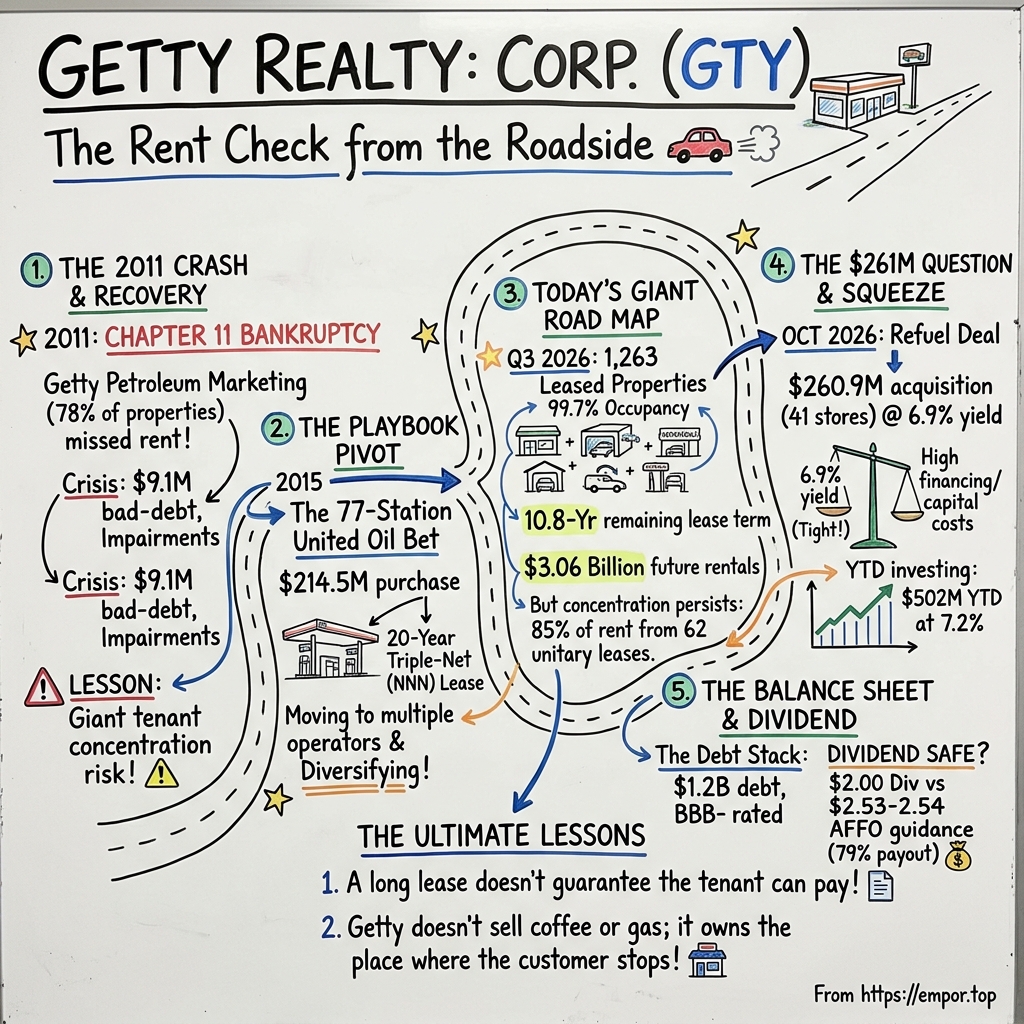
I. Forty-One Stores, One $261 Million Question
Picture a convenience store on the edge of Myrtle Beach at six in the morning. It is not the cramped gas-station kiosk of a 1980s road trip. It sits on about two and a half acres, its building runs to nearly 5,000 square feet, and the smell coming out of the door is hot food made on site.1
Contractors fill their trucks, a nurse coming off a night shift buys coffee, and a delivery van idles by the air pump. Every dollar in that scene goes to the operator, a southeastern chain called Refuel. None of it goes to the company that, as of this autumn, owns the ground under the store.
That company is Getty Realty. In the third quarter of 2026 it agreed to pay about $261 million for 41 of these stores, spread across markets from Raleigh-Durham and Charleston to Austin, San Antonio and greater Jackson, Mississippi, and to lease them straight back to Refuel.1
Refuel runs roughly 250 locations under the Refuel and Double Quick names, and it was no stranger: it had been a Getty tenant since 2021, and the two companies had been talking since 2019.1
The deal never went to auction. Chief executive Christopher Constant described it as an off-market transaction negotiated directly with Refuel, and he added a detail that tells a lot about how Getty hunts: Getty was Refuel's only institutional landlord.1
It was the largest single deal in years for a company that has spent the last decade growing one roadside parcel at a time. It also arrived at a price that made analysts lean forward. The third quarter's investments came in at a blended initial cash yield of 6.9%, and Refuel, at about $261 million of the quarter's $297 million, set that number almost by itself.12 The handful of smaller deals Getty did around it were priced near 8%.1
Management's defense of the price rested partly on time: the properties acquired in the quarter came with leases averaging about 19.5 years, which locks in rent and escalators for nearly two decades, and the quarter's 53 acquisitions were overwhelmingly convenience stores, 42 of them, with nine auto service centers and two drive-through restaurants alongside.12
A lower yield on a longer, better lease is a reasonable trade in principle. Whether it is the right trade at this price is the question the rest of this story keeps returning to.
For the year to date, counting what closed after the quarter ended, Getty had invested about $502 million at an average initial yield of 7.2%.2 Refuel was its biggest bet of 2026 and also its most expensive per dollar of rent.
It helps to be precise about what Getty actually bought. It did not buy Refuel. It did not buy the coffee machines, the fuel contracts, the hot-food recipes or the staff. It bought land and buildings, and in return Refuel signed long leases promising to pay rent, maintain the property and cover the taxes and insurance.
That is the whole business model, repeated across roughly 1,270 properties in 46 states and Washington, D.C.2 Getty is a landlord. Its customers are operators, and its product is a lease.
That framing matters because the most important number in this story is not the size of the Refuel deal. It is the gap between what the new rent earns and what the money to buy it costs. Getty does not have $261 million sitting in a drawer; at the end of September it held $8.8 million of cash.3 It pays for acquisitions with unsecured bonds, bank borrowings and new shares, including shares sold forward for future delivery.
At quarter end it still had about 1.5 million shares under forward sale agreements, expected to bring in about $51.8 million when settled.2 Every acquisition is therefore a small financial machine: rent goes in at the top, interest and dilution come out at the bottom, and the shareholder keeps the difference.
On that scorecard, 2026 has looked good but less spectacular than the headline growth. Base rental income rose 13.8% in the third quarter, driven by newly acquired properties and contractual rent increases.2 Adjusted funds from operations per share, the measure net-lease investors use as a proxy for distributable cash per share, rose 5% for the first nine months.2
Rent rose almost three times as fast as the per-share number, because the share count rose too, from about 59.8 million at the end of 2025 to about 67.1 million at the end of September.2 That gap is the central tension of the story. The portfolio is growing quickly. Each shareholder's slice of it is growing more slowly.
So three questions run through what follows. The first is about survival: how a company once almost entirely dependent on a single failing tenant rebuilt itself into a diversified landlord. The second is about the engine: whether Getty's acquisition machine reliably earns more than its cost of capital, or whether the big deals now arrive at thinner spreads.
The third is about protection: how much a long lease really shields an owner when tenants stumble and funding markets turn. Getty has already lived through the worst version of the first question. It is the right place to begin.
 Subscribe on LinkedIn
II. When the Biggest Tenant Stopped Paying
In November 2011, a rent payment did not arrive. The tenant that failed to pay was Getty Petroleum Marketing, and it was not merely Getty Realty's largest tenant. It was nearly the whole company. A year earlier, Getty had leased about 78% of its 1,052 owned and leased properties to Marketing under a long-term triple-net arrangement, and those leases produced about two-thirds of its revenue.4 In 2010, Marketing paid Getty roughly $60 million of rent, while every other tenant combined paid less than half that.4
For a landlord, that is not a customer relationship. It is a dependency. When the November rent went unpaid, Getty served a notice terminating the Master Lease and claimed the right to retake the premises. On December 5, 2011, Marketing filed for Chapter 11 in the U.S. Bankruptcy Court in Manhattan.5
The relationship had deep roots, and its history explains why so much rode on one counterparty. The business began in 1955 with a single gasoline station in New York City, went public in 1971 as Power Test, and in 1985 bought Getty Oil's petroleum marketing assets in the Northeast from Texaco, along with the Getty name and trademark.6
In 1997 the company spun off its petroleum marketing business as Getty Petroleum Marketing, leaving Getty Realty as the owner of the stations and terminals.6 In December 2000, a U.S. subsidiary of the Russian oil company Lukoil acquired Marketing, and Getty Realty, which became a REIT in 2001, sat behind a single unitary Master Lease with it.6
That lease looked like safety for a decade. A unitary lease bundles many properties into one contract, so a tenant cannot keep the profitable stations and hand back the weak ones; it takes all or nothing. When a well-funded tenant is in good health, that structure protects the landlord. When the tenant fails, the same structure means hundreds of properties come back at once.
The ground shifted in February 2011, when Lukoil transferred its ownership of Marketing to a company called Cambridge Petroleum Holding.4 By the end of the year Marketing was in bankruptcy, and the estate's later lawsuit alleged that a November 2009 sale of assets from Marketing to Lukoil had been a fraudulent conveyance.7
David Driscoll, then Getty's president and chief executive, kept his public reaction measured. Getty planned to repossess its properties and, over time, reposition the portfolio "in order to maximize the value of the portfolio," he said, pointing out that two acquisitions completed in 2011 had already "significantly reduced our dependence on Marketing."5
One of those was a sale-leaseback of 59 Mobil-branded stations with a Chestnut Petroleum affiliate for about $111.6 million, a deal that made that tenant 12% of rental revenue in 2011 and 18% in 2012.7
The release also warned of what was coming: more reserves against unpaid rent, impairment charges, environmental accruals and significant costs to fight the case and re-let the properties.5
All of those warnings came true. Getty booked about $8.8 million of net bad-debt reserves against Marketing's unpaid rent and taxes in the fourth quarter of 2011 and about $14 million more in 2012.7 It recorded impairment charges of $15.9 million in 2011 and $6.3 million in 2012 as it marked down properties whose value had depended on the old tenant.7
Those numbers were painful but not fatal. The real work was operational. On April 30, 2012, Marketing rejected the Master Lease with the court's approval, and possession of 788 properties came back to Getty in one stroke.7
A landlord with 788 empty gas stations has a problem a lease cannot solve: it needs operators. Through 2012, Getty signed ten new long-term unitary leases re-letting 443 of those properties to regional distributors, including affiliates of Global Partners, Capital Petroleum Group, Lehigh Gas Partners and BP North America, typically with 15-year initial terms.7 About 155 more stations ran under month-to-month licenses with Global Partners as interim fuel supplier while longer solutions were found.7
The weakest properties were sold: 54 in 2012 for about $15.4 million, and 42 more in early 2013 for about $17.5 million, with most of the remaining stations whose tanks had been pulled and eight fuel terminals also headed for sale.7 The average price of those sold sites tells its own story. These were not prime corners. They were the leftovers a failed operator had kept alive.
There was a coda in court. Getty agreed in October 2012 to fund up to $6.4 million of the Marketing estate's lawsuit against Lukoil.7 In July 2013 the bankruptcy court approved a settlement under which Lukoil and its affiliates paid the estate $93 million, from which Getty received about $25.1 million under its funding agreement plus $6.6 million for its priority claims.8
Final distributions of $18.2 million followed in 2015 and flattered that year's earnings with other income that did not recur.8 By then the bankruptcy had been closed for good.
The episode taught a lesson that still applies. Getty had always been diversified by geography; its stations were spread across the Northeast and beyond. It had never been diversified by counterparty. A thousand properties behind one signature carry the credit risk of the signature, not the properties.
Even years later, the old relationship echoed through the portfolio: at the end of 2016, 391 properties Getty owned or leased had previously been leased to Marketing, and leases covering them had substantially all begun in 2012.6
That history is not a verdict on today's Getty. The tenant mix, the property types and the management team have changed, and the company's current largest tenant represents about a tenth of revenue, not two-thirds. But the mechanism that hurt Getty in 2011 has not disappeared. Getty still writes unitary leases, because they protect it while tenants are healthy.
So the question the bankruptcy left behind was practical: could a landlord built around one legacy operator turn itself into an owner with many tenants, and grow without signing its next all-or-nothing bet? The first big answer came from the West Coast, three years after the stations came home.
III. The 77-Station Bet That Changed the Portfolio
On June 3, 2015, Getty did something it had never done at that scale. It bought 77 convenience-store and gasoline-station properties from affiliates of Pacific Convenience and Fuels and, on the same day, leased every one of them to Apro, LLC, which did business as United Oil.8
The stations were in California, Colorado, Nevada, Oregon and Washington, flying brands such as 7-Eleven, 76, Circle K and Conoco.8 For a company whose map had been dominated by New York, New Jersey and the Northeast, it was a leap across the continent.
The price was $214.5 million, funded with borrowings under Getty's bank credit agreement and notes placed with Prudential.8 To put the size in context, Getty's total revenue that year was about $118 million.6 It was spending nearly two years' revenue on one transaction, at a time when the scars of the bankruptcy were still fresh and the last of the Marketing estate's money had not yet arrived.
The structure is the heart of what Getty became, so it is worth slowing down. In a sale-leaseback, an operator that owns its real estate sells the land and buildings to a landlord and keeps running the business as a tenant. The operator gets cash it can use to pay down debt, remodel stores or expand. The landlord gets a long stream of rent.
Here, the leases ran for 20 years initially, with options for up to three further five-year renewals, and they were triple-net, meaning the tenant pays the property taxes, insurance and maintenance.8 Getty did not acquire United Oil's operating business, its fuel supply or its employees. It acquired the right to collect rent from them.
The leases were also, again, unitary: 77 properties were grouped under three separate leases, and those three were cross-defaulted, so a default on one counted as a default on all.8 The structure echoed 2011: 77 properties sat behind one tenant.
The difference was scale relative to the whole. United Oil's leases produced 9% of Getty's revenue in 2015 and 15% in 2016, the first full year.6 That was a large tenant, not a company-defining one. Getty had grown from one dominant tenant toward a handful of big ones.
Was the price right? The public record cannot settle that. Getty's filings give the purchase price, the lease term and the structure, but they do not give the deal's initial yield in a way that can be matched against comparable West Coast station sales of 2015. An investor can say the deal was large, long and structurally protective.
An investor cannot say from the filings whether Getty paid up to win it. What the record does show is the deal's strategic meaning. Getty had proven that it could find an operator who wanted capital, buy the real estate at scale, and write a lease that protected the landlord for two decades.
The deal also changed the company's story to the credit markets. Less than three years later, on May 3, 2018, Fitch assigned Getty's issuer rating and unsecured debt their first investment-grade rating, BBB-, with a stable outlook.9 Danion Fielding, then chief financial officer, credited "the repositioning of our portfolio over the past few years" and said the company had diversified "from both a tenant and geographic perspective."9
By the end of 2017, Getty owned 828 properties and leased 79 more, across 28 states and Washington, D.C.9 The emergency landlord of 2012 had become a growing net-lease REIT with access to cheaper debt.
The property counts from those years hide a counterintuitive point. Getty got smaller before it got better. It ended 2011 with about 1,149 properties and ended 2015, even after adding the 77 West Coast stations, with about 851.8 Hundreds of former Marketing sites had been sold, many of them weak locations with tanks pulled out of the ground, while the new money went into fewer, larger and better-leased properties.
A shrinking property count would look like decline to anyone who measured a landlord by its pins on a map. It was actually the cleanup that made the next decade's growth possible, because it turned a portfolio defined by one failed tenant into one that lenders could underwrite lease by lease.
The United Oil purchase was the bridge between those two identities. Before it, Getty's growth mostly meant re-leasing and selling what the old tenant left behind. After it, growth meant going out and buying rent. The question it raised is the one that hangs over every later deal, including Refuel: can a larger version of this model diversify Getty, or does each big sale-leaseback rebuild a smaller copy of the concentration that nearly broke the company? To answer that, it helps to look at what Getty's portfolio actually is today, and what its leases do and do not promise.
IV. The Rent Rolls Come With a Tenant Attached
Imagine the day a lease is signed. An operator of car washes, or oil-change shops, or drive-through burger restaurants, sits across from Getty's investment team. The operator wants capital to build or expand. Getty offers to buy the real estate, or fund its construction, and lease it back for 15 or 20 years.
The lease will carry rent increases every year or every few years and renewal options at the end. From that day on, the operator chooses the brand, sets the prices, hires the staff, pays for the plumbing and decides whether to stay open late. Getty mails no invoices to drivers. It collects rent.
Multiply that scene by more than a thousand and the result is Getty's portfolio as of September 30, 2026: 1,263 leased properties, a weighted average remaining lease term of 10.8 years excluding renewal options, and about $3.06 billion of future rent due under the operating leases already signed.3 Occupancy outside redevelopment sites was 99.7%.1
That last figure is easy to skim past. In much of commercial real estate, a landlord counts empty units and chases new tenants every year. Getty's leases are so long that vacancy is close to a rounding error, at least while the tenants keep paying.
The portfolio no longer looks like the Northeast gas-station chain of 2011. Over the past several years Getty has spread across four types of roadside property: convenience stores, many with fuel; auto service centers such as collision repair and oil change shops; car washes; and drive-through quick-service restaurants.1 The timing of that spread is telling. Getty added express tunnel car washes in 2019, auto service centers in 2021 and drive-through restaurants in 2023, and over those six years its annual base rent grew from about $117 million on 945 sites to about $221 million on 1,174.10
Even so, convenience stores still produced roughly 64% of rent at the end of 2025.10 Getty has diversified away from gasoline. It has not left it. These are not separate businesses. They are flavors of one business, a freestanding building on a busy road, leased long-term to an operator whose customers arrive by car.
The geographic mix has moved too. About 58% of annual base rent comes from the 50 largest metropolitan areas, and about 74% from the top 100.1 The old map of Long Island and New Jersey stations has become a national map of suburban corners.
The most important safety metric in the portfolio is rent coverage: how many dollars of store-level profit an operator earns for each dollar of rent it pays. Getty reported trailing-twelve-month coverage of 2.5 times, and it said about 77% of annual base rent comes from leases requiring the tenant to report site-level financials, with visibility on another 17.5% through tenants that publish their own accounts.1
A tenant earning two and a half dollars for every dollar of rent has room to absorb a bad year. That cushion is the real foundation under the 99.7% occupancy number.
The weak spots are visible if one looks for them. On the July call, an analyst noticed that the share of rent coming from sites covering their rent less than once had risen by about 0.7 percentage points. Dickman's answer was that there was "certainly no softening": the bucket was the same group of new-to-industry car washes still ramping up after opening.11
That is a plausible explanation, because a brand-new wash takes time to build its membership base, and Getty often funds such projects from the ground up. It also shows where development funding carries risk that a mature sale-leaseback does not: Getty is paying rent-producing prices for sites whose customers have not yet fully arrived. Management said there had been no realized credit losses to date, while its model assumed a loss rate of about 25 basis points; by October, an analyst's question about a 10-basis-point credit-loss figure drew the answer that collections were running at about 99.9%.111 Those are excellent numbers. They describe a benign period, not a full credit cycle.
The tenant roster has broadened, too. By early 2026, management said Getty had added 49 new tenants since it began its diversification strategy.12 Each new tenant is a hedge against the next Marketing. Each is also a new credit to underwrite, often a regional operator smaller than ARKO or Global Partners, with less public information and thinner access to capital. Breadth reduces the damage any single failure can do. It does not reduce the number of things that can go wrong.
But a cushion is an average, and averages hide the individual tenant. ARKO, one of the country's largest convenience-store operators, accounted for 11% of Getty's revenue through 148 properties at the end of September, and Global Partners, the fuel distributor that helped Getty re-let its stations in 2012, accounted for 9% from 125 properties.3 Getty's own investor materials go further. At the end of 2025, its ten largest tenants paid about 61% of annual base rent and its twenty largest about 80%, with ARKO at about 11%, Global Partners about 10%, a convenience operator called United Pacific about 8% and GO Car Wash about 7%.10
Six years earlier, the top ten had paid about 82%.10 That is real progress, and it is also a reminder of scale: three-fifths of the rent still comes from ten companies.
Getty does publish the number that matters most for the lesson of 2011: at the end of 2025, about 85% of annual base rent came from 62 unitary leases covering 962 properties.13 In other words, most of Getty's rent arrives through a few dozen all-or-nothing contracts. The map shows more than a thousand pins. The rent roll shows a few dozen signatures.
That is not a flaw so much as a deliberate trade. Unitary leases stop tenants from cherry-picking, handing back weak sites while keeping strong ones, which protects the landlord in normal times. They concentrate risk when a tenant fails. After the Refuel deal, which added another unitary relationship of roughly $18 million of annual rent if the 6.9% yield is applied to the price, Constant was candid about the trade-off on the third-quarter call: Getty likes its four sectors, but "size and scale right now may trump some of our overall diversification goals."1
That is a refreshing admission and a meaningful one. It means the company is choosing bigger relationships over a more granular rent roll, at least for now.
How does Getty compare with the rest of its industry? It names six peers in its performance graph: Agree Realty, EPR Properties, Essential Properties Realty Trust, Four Corners Property Trust, NETSTREIT and One Liberty Properties.14 Most are generalist or retail-focused net-lease landlords; Getty is the specialist in convenience and automotive retail. With about 1,263 leased properties, it is a focused niche landlord rather than a dominant owner of American roadside real estate, and its filings offer no national denominator that would allow a credible market-share estimate. There are hundreds of thousands of gas stations, car washes and quick-service restaurants in the country. Getty owns a small, curated fraction.
The competitive forces on this business are easier to describe than to measure. Tenants have real bargaining power, because a well-run operator with strong coverage can shop its sale-leaseback to many landlords, and at renewal it can threaten to walk. Rival buyers are plentiful, from the listed peers above to private capital, 1031-exchange investors and, as Getty's own team noted, buyers chasing bonus depreciation.1
What tips the balance back toward the landlord is location. A busy corner with fuel permits and zoning for a drive-through is hard to replicate, and an operator who leaves a profitable site leaves its customers behind. The landlord is replaceable. The site often is not.
That points to the real nature of Getty's edge. It is not a cornered resource; nothing in the filings shows Getty controlling access to sites or tenants that others cannot reach. It looks more like accumulated process: underwriting habits honed on this specific property type, data on site-level economics, and relationships that produce off-market deals like Refuel. The company says it underwrote a record $6.8 billion of potential investments in 2025.12
That is evidence of reach and selectivity. Getty also says more than 90% of its transactions are negotiated directly with tenants rather than bought from other landlords with leases already in place.10 The best test of the underwriting is what happened when conditions turned, and here the record is good: annual rent collections ran between about 98% and 100% from 2019 through 2025, including about 99% in the pandemic year of 2020.10 That is a genuine stress, passed.
But it is a narrower test than it looks. The pandemic hurt restaurants and offices far more than fuel stations and car washes, which stayed open as essential businesses, so 2020 did not test the specific weakness of Getty's tenants, a long squeeze on fuel and store margins. The coverage figure deserves the same scrutiny. About 74% of rent comes from leases requiring site-level reporting, but nearly 18% of rent sat on sites too new to have a year of data, so the 2.5 times coverage is calculated on just over half the rent roll; and Getty notes that it does not independently verify the financial information tenants send it.10 The edge is plausible and supported by operating metrics. It is not proven across a full credit cycle.
Then there is the question every investor asks about a landlord to gas stations: what happens when cars stop burning gasoline? The answer runs through tenants, not through Getty's revenue model. Getty's rent does not change with gallons sold. But if fuel volumes fall over time, the operators who pay that rent will need to replace the profit with in-store food, car washes, service bays or charging, and the sites that cannot adapt will become harder to re-lease.
Fuel margins were described on the call as healthy, nationally in the low 40 cents a gallon range, not at a record.1 Getty's drift toward auto service, car washes and drive-through restaurants, and toward modern stores with big food programs like Refuel's, reads partly as a hedge against that slow erosion. It is a hedge the company is paying for with every new acquisition, which is why the price of those acquisitions is the question that matters most.
V. The Acquisition Engine Meets Its Cost of Capital
The third-quarter call on October 22, 2026, opened with a celebration and quickly turned into a negotiation over a single number. The first analyst, Mitch Germain of Citizens JMP, went straight at it: Refuel's yield had come in below Getty's regular-way deals, so how did management weigh economics against quality?1 Constant talked about the depth of the relationship and the way the transaction was structured.
RJ Ryan, Getty's chief investment officer, called the properties "the epitome of kind of the modern C-store."1 Neither answer disputed the premise. Getty had paid more per dollar of rent for Refuel than it usually does.
To see why that matters, it helps to understand how a net-lease REIT creates value at all. Imagine Getty buys a property for $100 that pays $7 a year in rent. That 7% is the initial cash yield. If Getty funds the purchase half with debt costing 5% and half with new shares, the debt costs $2.50 a year.
The equity half has its own cost: the new shares are entitled to their share of Getty's cash flow, which is roughly the AFFO yield the market puts on the stock.
If the rent left after interest exceeds what the new shares claim, per-share cash flow rises. If not, the portfolio gets bigger while each existing shareholder gets slightly poorer. Rent escalators help over time, because the rent rises while the cost of fixed-rate debt does not. Overhead takes its own bite.
Measured that way, Getty's 2025 record was strong. It invested about $268.8 million in 2025 at an average initial cash yield of 7.9%, with acquired leases averaging 15.8 years.12 The largest single deal was a $100 million, 12-property sale-leaseback in Houston, and the company also committed up to $82.5 million of development funding for 11 collision centers.12
For context, the Boulder Group's survey of retail net-lease asking cap rates put the national market average at about 6.57% in the second quarter of 2025.15
Getty's 7.9% was well above that. The comparison is loose, because asking rates are what sellers hope to get and the survey mixes property types, but the direction was clear. Getty was buying rent cheaper than the broad market was offering it.
The early 2026 record extended that pattern. In the second quarter, Getty invested about $128.3 million at 7.4%, and through late July it had deployed more than $172 million at 7.6%.11 On that July 23 call, Constant said he still saw cap rates in its sectors at around 7.5%, with some deals touching 8%, while chief financial officer Brian Dickman said spreads "have largely remained constant, if not increased a little bit in some instances," because Getty's own cost of capital had fallen.11
That was a confident message. It was also notably quiet on Refuel, which went unmentioned on the call even though Dickman later said the deal was priced around the end of May.111
Refuel then pulled the year's average yield from the mid-7s to 7.2%.2 Against the Boulder Group's third-quarter 2026 retail market average of about 6.69%, Refuel's roughly 6.9% looked close to market rather than a bargain.15 Again, that benchmark is an asking-rate survey, not a set of matched comparable sales, and modern large-format stores in fast-growing southern metros may well deserve a lower yield than an average retail building.
The comparison cannot prove that Getty overpaid. It does show that, on this deal, Getty gave up the yield advantage that defined its 2025 buying.
Dickman's own description of the economics is the most useful piece of evidence in the story, precisely because it was unpolished. Asked by Bank of America's Jana Galan how the deal was funded, he said that when the deal was priced, "it was accretive at the time, but maybe not at the levels that we look to achieve on a regular basis."1 Dispositions, he said, "added quite a bit to that investment spread."1
In plain terms, Refuel was a thinner-margin deal that management expected to fatten by selling older properties and recycling the proceeds. Constant had already said that a substantial portion of the transaction was funded with capital raised earlier in the year at lower costs.1 The deal looked better against the share price of the spring than against the share price of the autumn.
That spring capital is visible in the July call. At the end of the second quarter, Getty had more than $190 million of equity sold forward but not yet settled, about 5.8 million shares, and total liquidity above $570 million; asked how much forward equity it liked to carry, Dickman said "the best word is balance."11
In hindsight, that war chest was waiting for Refuel. Pre-raising equity when the stock was stronger was a sensible piece of financial engineering, because it fixed the cost of the shares before the deal was announced.
But it also means the true test of Refuel is not against the spring price alone. Shareholders who supplied that capital could, in principle, have seen it deployed in more 8% deals instead of one large 6.9% deal. The opportunity cost does not appear in any accretion calculation.
That point deserves a rough worked example. At the November 6, 2026 share price of $28.56, and against the midpoint of 2026 AFFO guidance of $2.535, the stock carried an AFFO yield of about 8.9%.2 On that crude measure, new equity issued today would "cost" more than the 6.9% Refuel yield and more than the 7.2% year-to-date average. Debt is cheaper: the new term loan carries an effective 5.03% rate.2
A half-debt, half-equity purchase at 6.9% roughly breaks even on that arithmetic before escalators and dispositions. That is a simplification, not a valuation model, and it ignores that the funds Getty actually used were raised earlier at better prices. But it explains why Dickman was blunt when Huntington's Rob Stevenson asked about issuing equity at today's levels: at "$27 and below," he said, "Not enthused would be an appropriate characterization."1
Long-term debt tells a similar story from the other side. In July, Dickman put the cost of a new ten-year unsecured note at "about six and a quarter" percent.11 Getty's existing notes carry about 4.5%, a legacy of cheaper years.2 So the company's average borrowing cost looks comfortable, but its marginal cost of long-dated debt sits only modestly below the yields it is paying for new rent. A 7% acquisition funded with 6.25% ten-year money leaves a thin margin for overhead, and the margin on a 6.9% deal is thinner still.
This is why the shorter, cheaper term loan made sense in October, and why it is also a bet: it is due in 2028, alongside the company's other maturities and the revolver's renewal, and will have to be refinanced at whatever rates prevail then.1
There is a reason investors focus on AFFO rather than reported earnings. Under accounting rules, Getty must depreciate its buildings every year as if they were wearing out, even though well-located land often holds or gains value. In 2025, net earnings were about $79.2 million, but operating cash flow was about $139 million, the difference mostly being roughly $62 million of real-estate depreciation and amortization.14 Accounting also smooths rent increases over the life of a lease, so reported rent can run ahead of cash actually collected.
AFFO strips those effects out to approximate the recurring cash a REIT can pay out or reinvest. It is a company-defined measure, not an audited one, but it is the language the whole sector uses, and it is the right lens for judging whether an acquisition pays.
The scorecard that captures all of this is AFFO per share. In 2025 it rose 3.8%, to $2.43.12 Through the first nine months of 2026 it rose 5%, to $1.89, even as base rent grew more than 13%.2 In the third quarter alone, AFFO per share rose about 3.2%, and FFO per share actually fell from $0.66 to $0.61, partly because of non-recurring costs tied to executive departures.2
The gap between rent growth and per-share growth is the cost of financing growth with new shares. Getty's share count rose about 12% in nine months.2 More rent shared among more owners produces modest per-share growth, which is exactly what the record shows.
The longer record shows what the engine produces in a normal year. AFFO per share rose from about $1.80 in 2019 to $2.43 in 2025, roughly 5% a year compounded, while the dividend rose in near lockstep, from about $1.42 to about $1.90, keeping the payout close to four-fifths of AFFO throughout.10 Built into the leases is a slower, surer source of growth: about 99% of rent is subject to escalation, at a weighted average rate of about 1.8% a year.10
So roughly two points of that 5% annual growth arrive automatically, and the rest has had to come from acquisitions, net of the shares issued to pay for them. Without new deals, Getty is a business growing a little under 2% a year. The acquisition engine is not an embellishment. It is most of the story.
That record also puts Refuel's yield in perspective. Getty's average initial cash yield moved between roughly 6.7% and 8.3% across 2019 to 2025.10 In the low-rate years, it bought rent at yields below Refuel's without anyone worrying, because the money was cheap. A 6.9% yield is therefore not an outlier by Getty's own standards.
What is different in 2026 is the price of the money. The question was never whether 6.9% is a low number. It is whether 6.9% is low relative to what the capital costs today.
Getty's guidance path adds another layer. It started 2026 guiding to $2.48 to $2.50 of AFFO per share, raised that to $2.52 to $2.54 in July, and tightened it to $2.53 to $2.54 in October.12112 Because guidance includes only completed transactions, each raise largely reflected deals already closed rather than a better operating outlook.
In October, Dickman attributed the narrower change to higher short-term rate assumptions, a small drag from funding Refuel with equity, and conservative assumptions for costs on deals that die.1
That is a straightforward explanation, and the guidance moved up rather than down. But it also shows how sensitive per-share growth is to funding costs and deal timing.
Then there is recycling. Getty sold 14 properties for about $23.5 million in the first nine months of 2026, while investing more than $500 million.2 Dickman said dispositions are "something that we absolutely will be looking at," and that the company is building a more programmatic platform, while Ryan said bonus-depreciation buyers have become a bigger part of the buyer universe.1 Constant pointed to non-core redeveloped assets and Northeast properties with alternative-use value as candidates.1
The scale is still small; disposals were about a twentieth of investment. If Getty can sell older Northeast stations at low yields to buyers who value the dirt and reinvest at higher yields, the Refuel math improves. If those sales prove slower or cheaper than planned, Refuel stays a thin-spread deal.
The rest of the call showed a company trying to restore its spread. Ryan said that rates had moved fast in the previous 60 to 90 days and that counterparties were "far more willing to engage" on repricing; if no deal could be struck, the two sides would "collectively punt or delay the transaction or part ways."1
He expected cap rates to "keep walking up" in current conditions.1 Dickman warned there "may be some deals that we do walk from."1 The committed pipeline had shrunk to about $75 million, around half development funding, at yields "in the 8% area."1 Constant called the pipeline "maybe slightly smaller than it's been."1
Read across three calls, the tone shifted in an instructive way. In February, the message was volume: record underwriting and a pipeline already beyond a quarter of the prior year's activity.12 In July, it was stable or widening spreads.11 In October, it was repricing, walking away and selling assets to support a lower-yield deal.1
That is not a contradiction, because the cost of capital moved under the company's feet. It is evidence that the engine works well when the stock is strong and becomes harder to run when it is not.
The acquisition record supports a real capability. Refuel narrows the claim: Getty can source big deals, but its biggest deal of the year depended on cheaper capital raised earlier and on future disposals to meet its usual return bar. Whether that pattern repeats is the question the balance sheet now has to answer.
VI. The Dividend Is a Promise the Balance Sheet Must Fund
A few days before the October call, Getty signed an amendment to its credit agreement that, on paper, looked like housekeeping. It added a new $200 million senior unsecured term loan, maturing on October 16, 2028, with three optional twelve-month extensions, at an effective interest rate of 5.03% based on the company's BBB- rating at closing.2 Every dollar went to repay borrowings on the revolving credit line.2
The amendment also scrapped a small extra interest charge on revolver borrowings and moved Getty to a pricing grid tied to its credit ratings.2 Nothing about it made headlines. It was exactly the sort of move a landlord makes after a big purchase, turning a short-term bridge into longer, fixed-purpose funding so the revolver is empty again for the next deal.
That is the rhythm of a growing net-lease REIT: draw on the revolver to close, then refinance the revolver with bonds, term loans or equity. It works as long as lenders and shareholders keep showing up. At the end of September, Getty's indebtedness was about $1.2 billion, made up of $1 billion of senior unsecured notes at a weighted average rate of about 4.5% with roughly five and a half years to maturity, plus $200 million drawn on its $450 million revolver.2 Nothing matured before 2028.1 Management described total liquidity of more than $500 million, counting unsettled forward equity and revolver capacity.1
The debt ladder tells a more reassuring story than the headline leverage number. Most of Getty's borrowing is fixed-rate, long-dated and unsecured, so a sudden rise in rates does not reprice the whole balance sheet at once. The company terminated its interest-rate swaps in December 2025 for a $1.7 million cash settlement and had no derivatives outstanding at the end of September.3
That simplifies the picture: the floating-rate exposure now lives mostly in the term loan and whatever sits on the revolver. In January 2026, Getty closed $250 million of new notes and used them to repay the revolver, pushing more of its debt into the fixed, long-dated bucket.12
The leverage figure is where the tension lives. Net debt was about 5.2 times annualized adjusted EBITDA at the end of September, or about 5.0 times counting the cash still due from forward share sales.1 Getty's stated target range is 4.5 to 5.5 times.1
At the end of 2025 the ratio was 5.1 times, total indebtedness was about 36% of total asset value, and fixed-charge coverage, the number of times operating earnings cover interest and similar fixed obligations, was 3.8 times.13
By the third quarter, management put fixed-charge coverage at 4.1 times.1 In plain terms, Getty is in the middle of its own comfort zone, not at its edge. But it has also used most of the room the summer's equity raises created. In July, pro forma leverage counting unsettled forwards was about 4.3 times.11 By October it was 5.0 times. Refuel consumed most of that cushion.
The equity side of the stack has its own pattern. Getty has issued shares in nearly every recent year to fund growth. In 2024 it sold 4.0 million shares for about $121.2 million and entered forward sales for another 1.4 million, alongside $125 million of new unsecured notes due in 2029 and 2032.16
In the third quarter of 2026 alone it settled about 5.1 million forward shares for about $164.6 million of net proceeds, and it entered new forwards on about 0.8 million shares.2
A forward sale lets Getty lock in a price when the stock is strong and deliver shares later when it needs the cash, which reduces the risk of having to issue at a bad moment. It does not avoid dilution. It only schedules it.
Then there is the dividend, which for most Getty shareholders is the point of owning the stock. In October, Getty raised its quarterly dividend 3.1% to $0.50, which management called the 13th straight year of increases.1 At $2.00 a year against the midpoint of 2026 AFFO guidance, the dividend absorbs about 79% of AFFO. That leaves a cushion, but a modest one. Dickman put post-dividend free cash flow at roughly $40 million to $50 million a year.1
Set that against more than $500 million of investment in 2026 and the arithmetic is stark: retained cash can fund less than a tenth of the current acquisition pace. The rest has to come from lenders and new shareholders. The dividend is covered. The growth is not self-funding.
What does the BBB- rating actually say? Fitch first assigned it in 2018, after the portfolio's repositioning, and the new term loan's pricing indicates Getty still held it at BBB- when that loan closed in October 2026.92 Investment grade gives Getty access to the unsecured bond market, which is cheaper and more flexible than mortgage debt.
But BBB- is the lowest rung of investment grade. The company does not include a fresh Fitch rationale in its materials, so investors cannot read the agency's current view of Getty's strengths and constraints from the company's own disclosure.
What is clear is that the rating rests on long leases, strong coverage, moderate leverage and the ability to raise equity. A run of thin-spread acquisitions funded mainly with debt would pressure all four.
There is one risk on this balance sheet that belongs uniquely to Getty's history: the ground itself. A landlord to gas stations inherits environmental exposure from the tanks buried beneath them. At the end of 2025, Getty accrued $15.9 million for prospective environmental remediation, down from $20.9 million a year earlier, and about $7.7 million of that 2025 reserve was for future liabilities from contamination that already exists but has not yet been found.14
Tenants generally bear responsibility for contamination under their leases. But Getty remains contingently liable if a tenant fails to meet those obligations, and the old Marketing properties carry their own special look-back obligations.14 It is a small number relative to a $1.2 billion debt load. It is also the kind of liability that tends to surface exactly when a tenant is in trouble, which is when a landlord can least afford surprises.
The accounting carries a related judgment. Because rent increases are recognized evenly over a lease's life, Getty books a straight-line rent receivable that grows ahead of the cash it has collected. The company says it reviews receivables for collectability and, if a tenant's balance becomes doubtful, writes it off and stops recognizing straight-line income unless cash arrives.14 It does not publish an ageing schedule of tenant balances, so investors cannot watch late payments build quarter by quarter.
Its history shows why that matters: in 2016, Getty carried a $2.4 million allowance for doubtful accounts and then recovered earlier reserves when past-due rent was finally paid.6 That episode ended well. It is still a reminder that a single struggling tenant shows up first as a receivable, then as a reserve, and only later in the headline rent.
Other risks deserve less space than they might in a generic risk section. Getty's properties are all in the United States, and its filings identify no material foreign-currency exposure.3 Artificial intelligence does not change how a tenant pays rent on a car wash. The external tests that matter are narrower and more concrete: tenant economics, interest rates, acquisition spreads and environmental obligations.
Each of those depends, in the end, on the judgment of a small group of people deciding which deals to sign and which to walk away from.
VII. The People Who Have to Say “No” to a Deal
Christopher Constant joined Getty in November 2010 as director of planning and corporate development, about a year before the November 2011 rent check failed to arrive.17 He was there for the whole crisis. He became treasurer in May 2012, the month after the Master Lease was rejected and 788 stations came home, then vice president in 2013 and chief financial officer in December 2013.17 On January 1, 2016, he became president and chief executive.17
Before Getty he had been a vice president in corporate finance at Morgan Joseph & Co., and he started his career at ING Barings; he studied at Princeton.17 His formative years at the company were spent not building an empire but cleaning up after one tenant's collapse, and then helping finance the United Oil deal that pointed the way out.
His finance chief brings a different education. Brian Dickman joined in December 2020 as executive vice president, chief financial officer and treasurer, after serving as chief financial officer of Seritage Growth Properties and, before that, chief financial officer of Agree Realty, one of the net-lease peers Getty measures itself against.17 He spent years as a REIT investment banker at Lehman Brothers and began his career at Intel.17
On the calls, Dickman is the one who quantifies: the free cash flow after the dividend, the leverage-neutral buying power, the plain admission that Refuel was accretive but below the usual bar.1 He sounds like someone who has watched REITs grow too fast before.
The investment seat changed hands in 2026. Mark Olear, who had led investments since 2014 and also served as chief operating officer from 2015, retired effective February 27, 2026, after a career that included senior real estate roles at Home Depot and TD Bank.17 Olear moved to a consulting arrangement through September 2027 at $25,000 a month, stepping down to $10,000 a month from October 2026, which the audit committee approved as a related-party transaction.17
RJ Ryan, previously senior vice president of acquisitions, became chief investment officer on March 1, 2026, and the COO role was not refilled.17 Through the first nine months of 2026, retirement and separation costs, mostly tied to the former COO and the departure of the former chief accounting officer, totaled about $4.0 million.3 Refuel was, in effect, the new CIO's first big signature.
How are these people paid to behave? Constant's total compensation was about $3.16 million in 2025, up from about $2.62 million in 2024; the rise came mostly from larger stock awards and a $565,000 discretionary cash bonus.17 That was roughly a 21% pay increase in a year when AFFO per share grew 3.8%.17
The proxy says the compensation committee has no formal policy for dividing pay among its components and considers bonuses "subjectively," with no single factor given a specific weight.17
Restricted stock units vest over five years, and since February 2025 the chief executive has been required to hold shares worth at least five times base salary, other named executives three times; as of the end of 2025, all directors and named executives were in compliance or within the transition period.17
Those features cut both ways. Long vesting and meaningful required ownership tie executives' wealth to the share price for years, which is exactly the alignment a landlord needs when it is tempted to grow for growth's sake. But subjective bonuses are hard for shareholders to hold anyone accountable to.
A formula tied to AFFO per share, or to the spread between acquisition yields and the cost of capital, would tell investors what the board actually rewards. Getty's proxy instead lists achievements, including the 3.8% AFFO per share growth, without saying how much each one was worth.17
Shareholders mostly approved. At the April 21, 2026 annual meeting, about 46.1 million votes were cast for the say-on-pay proposal and about 1.8 million against, roughly 96% support among votes cast for or against.18 Constant was re-elected with only about 0.4 million votes withheld.18
Three directors drew noticeably more dissent: Evelyn León Infurna had about 5.7 million votes withheld against 42.4 million for, roughly 12% of votes cast on her election; Philip Coviello about 10%; and Milton Cooper about 9%.18
Those numbers do not threaten anyone's seat, and the meeting filing does not explain them. They are a reminder that strong support for pay does not mean shareholders have no reservations about the board.
The shape of the shareholder base helps explain the calm. As of late February 2026, BlackRock held about 16% of the shares, Vanguard about 14% and State Street about 7%, giving the three largest index-fund managers well over a third of the company between them.17 Their stakes were roughly unchanged from a year earlier, and no controlling holder sits above the company.17
Getty is internally managed, so there is no external manager collecting fees on assets, a common source of misaligned incentives in REITs; the main related-party item in the proxy is Olear's consulting arrangement.17
A holder base dominated by passive funds rarely agitates, which places more of the burden of discipline on the board and management themselves. No activist stake has forced the question of whether growth is creating value per share. The numbers will have to do that.
The fairest test of management is promises against outcomes. Getty raised its 2026 guidance twice and delivered 5% AFFO per share growth through nine months.2 It has raised its dividend for 13 straight years.1 Occupancy has stayed near full, and on the October call management said there had been no realized credit losses.1
Those are concrete results. Against them sit the facts that per-share growth has trailed rent growth by a wide margin, that the largest deal of the year came at a below-normal spread, and that the company has repeatedly needed new equity to keep growing.
Management's description of its own approach as disciplined has some support in the record, especially in its willingness to say Refuel fell short of the usual spread and its talk of walking from deals that cannot be repriced. But talking about walking away is not the same as doing it. The proof will be visible in the next few quarters' volume and yields.
The 2011 bankruptcy belongs in this assessment only in its proper weight. It happened under a different chief executive, with a tenant structure that today's team spent years dismantling. It does not condemn the current leadership. It does define the risk they must manage: that a landlord which is good at signing big relationships may end up, once again, with too much of its rent behind too few names. Which brings the story to the real question for an investor today: what has to go right, and what could go wrong?
VIII. The Case for Getty—and the Case Against It
Put two numbers on a napkin. On the left, 6.9%: what Refuel's stores yield on their purchase price. On the right, 7.2%: what Getty's whole 2026 program yielded. Now add a third: at the November 6, 2026 share price of $28.56, the stock traded at about 11.3 times the midpoint of 2026 AFFO guidance, which is the same thing as an AFFO yield of roughly 8.9%, and it paid a dividend of $2.00, a yield of about 7%.21
The market is pricing Getty's existing cash flows at a higher yield than Getty is paying for new ones. That single comparison explains most of the debate about the stock.
The bull case starts with what the leases already guarantee. Getty has about $3.06 billion of contracted future rent, a weighted average term of more than a decade, rent escalators built into most leases, occupancy near 99.7% and tenants that, on average, earn about two and a half times their rent at the store level.31
It adds a sourcing machine that underwrote billions of dollars of opportunities in 2025, keeps adding new tenants, and wins off-market deals with operators who trust it.121
It notes that the dividend is covered by AFFO with room to spare, that leverage sits inside the target range, and that the debt ladder has no maturity until 2028.1 On this view, Refuel is an exception, a high-quality portfolio bought with cheap capital raised in the spring, and the pipeline's 8% yields show the normal spread returning.1
The long record gives the bull case something firmer than a single year. Getty's total revenue grew from about $118 million in 2015, the year of the United Oil deal, to about $222 million in 2025, roughly 6.5% a year compounded.614 Over the most recent stretch, from 2023 to 2025, revenue rose from about $186 million to about $222 million and net earnings from about $60 million to about $79 million.14
Those are not explosive numbers, but they describe a decade of steady compounding by a company that, in 2012, was busy pulling tanks out of stations nobody wanted. The recent pace of base-rent growth, above 13%, is running well ahead of that ten-year average, and it is being driven by acquisitions.2
The bear case starts with the same leases and asks who stands behind them. About 85% of base rent flows through 62 unitary leases, so a few tenant failures could matter far more than the property count suggests.13 Refuel adds another large relationship at the lowest yield of the year.
The 2026 pace depends on forward equity and debt, and management has said it is not keen to issue shares at current prices, which means growth may slow just as the company has built a larger G&A base and a bigger dividend to cover.1
Fuel-related tenant economics may weaken over time, and the old stations carry environmental tails. On this view, Getty's growth has mostly transferred value from new shareholders to the portfolio's sellers, leaving existing holders with low-single-digit per-share growth and a riskier rent roll.
The competitive analysis helps decide which story is closer to the truth. Getty's suppliers are, in effect, its sources of capital: bondholders, banks and equity buyers. Their bargaining power has risen with rates, as the October call made clear. Its buyers, the tenants, have meaningful power when they are large and creditworthy; a company like ARKO or Refuel can shop a sale-leaseback widely, which helps explain why the best tenants command the lowest yields.
Rivalry among net-lease landlords is intense, from the six listed peers to private funds and individual exchange buyers. The threat of new entrants is high, because buying a leased building requires capital, not a license. Substitutes are subtler: an operator can always choose to own its real estate or use mortgage debt instead of a sale-leaseback, and in the long run electric vehicles and changing habits could make some sites less valuable.
Hamilton Helmer's seven powers offer a stricter test, and Getty passes only parts of it. There is no meaningful network effect; one tenant does not make Getty more valuable to another. Scale economies are modest: a larger portfolio spreads overhead, and Getty's G&A ratio has drifted toward about 8 to 9% of revenue, but it is too small to have a structural cost advantage over far bigger net-lease peers.1
Switching costs exist only at the property level, because a tenant cannot easily move a profitable site, and they protect the location rather than the landlord.
Branding matters little to the motorist. Counter-positioning is not obvious. The most credible powers are a weak form of process power, accumulated underwriting expertise in convenience and automotive retail, and something close to a cornered resource at the level of individual sites, though not of the company as a whole. The evidence supports a capable niche platform. It does not support an unassailable moat.
Valuation, as a snapshot, reflects that ambiguity. An 11-times AFFO multiple and a 7% dividend yield imply that investors expect modest growth and want to be paid for the risks of tenant concentration and capital-market dependence. It is a rough calculation from the share price and the company's guidance, not a historical or peer study, and it says nothing about whether the shares are cheap or dear.
What it does say is that Getty's cost of new equity is now above the yield on its best-known recent deal. If that persists, the growth engine has to run on debt, recycling and patience.
For investors trying to keep score, three measures matter more than anything else. The first is AFFO per share after forward-share settlements, which rose 5% through nine months of 2026; that is the only growth figure that belongs to the shareholder.2 The second is the spread between acquisition cash yields and the cost of debt and equity; the year-to-date yield was 7.2%, down from 7.9% in 2025, while the newest borrowing cost about 5.03%.212
The third is tenant concentration and rent coverage: ARKO at 11% of revenue, 85% of rent behind unitary leases, and coverage steady at about 2.5 times.3131 If the first rises, the second holds above funding costs and the third stays steady, the bull case is working. If any of them moves the wrong way, the bear case gains.
The proving events are near. Year-end 2026 results will show leverage and AFFO per share after Refuel and the forward settlements. The first year of Refuel's rent, and whether its stores keep strong coverage, will show whether the quality premium was worth paying. And the disposition program will show whether Getty can sell old assets at prices that genuinely improve the spread.
Those are the facts that will turn this debate from argument into evidence. Before looking ahead, the story so far already offers a few lessons that reach beyond one roadside landlord.
IX. Business & Investing Lessons
Go back to two scenes fifteen years apart. In late 2011, a tenant that leased about 78% of Getty's properties stopped paying rent, and Getty spent the next several years taking back stations, finding new operators and selling the sites nobody wanted.47 In 2026, the same company sat down with a tenant it had known since 2019 and wrote a $261 million check for 41 of its best stores.1 The distance between those scenes is the story of a landlord's recovery. The similarity between them is the story's warning.
The first lesson is that a long lease secures a schedule of rent; it does not secure the tenant's ability to pay it. Getty Petroleum Marketing's Master Lease ran for years and covered hundreds of properties, and it was worth exactly as much as Marketing's capacity to pay. When that capacity failed, the contract became a claim in bankruptcy court and a stack of stations to re-let.
Today's 10.8-year average lease term and $3 billion of contracted rent are real assets. They are also promises made by operators whose fortunes depend on fuel margins, food sales and the local economy. For investors in any net-lease business, the right question is not how long the lease is, but how long the tenant will be able to honor it.
The second lesson is that a diversified map can still hide a concentrated rent roll. Getty's 2011 portfolio was spread across many towns, and its risk was concentrated in one signature. Today's portfolio covers 46 states and Washington, D.C., yet most of its rent flows through a few dozen unitary leases, and ten tenants still pay about three-fifths of it.21310 That is not a contradiction; it is how this business is built.
But it means the right way to measure Getty's diversification is to count the tenants and the leases, not the pins on the map. A founder or investor looking at any business with a long customer list should ask the same question: how many of those customers can actually walk away together?
The third lesson is that an acquisition is only accretive when the rent survives the funding cost, and the shares issued to buy it. Getty's rent rose about 13% in 2026 while AFFO per share rose about 5%, because more shares came along with the new rent.2 Refuel, priced when the stock was stronger and funded partly with cheaper equity raised earlier, cleared the bar but not by the usual margin.1
The general rule is that growth funded by new capital is only as good as the gap between what the asset earns and what the capital costs. A company can double its revenue and leave its owners no richer.
The fourth lesson comes from the years nobody celebrates. Between 2011 and 2015, Getty's property count fell by roughly three hundred while it sold off the weakest of the stations its old tenant had left behind.8 Those were not glamorous years, and a shrinking landlord rarely gets credit for anything. But that cleanup is what made the United Oil deal, the investment-grade rating and the decade of acquisitions possible.
Sometimes the fastest way for a landlord to grow is to get smaller first. Founders who inherit a broken asset base often try to grow their way out of it; Getty pruned its way out, and only then started to plant.
The fifth lesson is the subtlest. For a landlord, the most valuable asset may be the relationship that gets the next lease signed, and the return still has to prove that the relationship was worth the price. Getty's off-market deal with Refuel, a tenant for whom it was the only institutional landlord, is exactly the kind of advantage relationship-driven businesses prize.1
But relationships can be expensive: a trusted partner can ask for a better price, and a landlord eager to deepen the tie can give it. Familiarity is an edge only if it shows up in the yield, the lease terms or the tenant's credit. Otherwise it is just comfort.
X. Epilogue
Tonight, Getty sits at a hinge. The Refuel stores are on its books, the term loan has replaced the revolver borrowings, about 1.5 million forward shares are waiting to be settled, and management says a pipeline of roughly $75 million is being renegotiated at higher yields.21 Management has said the next report, covering the fourth quarter and full year, will come in February.1
That report will be the first full accounting of a year in which Getty has invested more than half a billion dollars, nearly double the previous year, and the first to show the whole Refuel transaction inside the numbers.212
Several moments will decide how that year is judged. The first is the final AFFO per share for 2026 against guidance of $2.53 to $2.54. A result at or above the top would show the year's deals paying their way despite the higher share count; a miss would suggest the funding drag was larger than expected.
The second is leverage after the forward shares settle. If net debt to EBITDA stays near 5 times, the balance sheet will have absorbed Refuel without strain.
If it drifts toward the top of the 4.5 to 5.5 times range while equity remains unattractive to issue, growth will have to slow or rely more heavily on asset sales. The third is the next set of acquisition yields. The pipeline's 8% area is a promise; the closed deals will be the evidence. The fourth is the next view from Fitch on whether a BBB- issuer growing this quickly still fits its rating.
One thing will not decide the year, and it is worth saying so. Only about 1% of Getty's rent was scheduled to expire in 2026, and nearly half runs beyond 2035.10 The danger for this landlord is not a wave of leases ending. It is a tenant that stops paying while its lease still has fifteen years to run, which is exactly the shape of the danger Getty met in 2011.
There are quieter tests too. Refuel's first year of rent, and whether its coverage holds near the portfolio average, will show whether the quality premium was justified. The disposition program will reveal whether Northeast stations and finished redevelopments really sell to buyers who value them more highly than Getty does. And the tenant list will show whether "size and scale" are crowding out diversification, as Constant suggested they might for now.1
If AFFO per share rises while leverage stays controlled and new yields hold comfortably above funding costs, Getty's model earns credibility. It would show that a niche landlord can grow by buying long-dated rent from operators who know it, and that it can lean on asset sales and patience when equity is expensive.
If, instead, volume keeps rising while per-share growth stalls, or leverage climbs while the stock stays weak, the acquisition thesis narrows to something smaller: a well-run portfolio that pays a reliable dividend but no longer compounds much for its owners.
The unresolved issue is concrete. Can Getty keep finding enough high-quality roadside real estate at yields that justify the capital it must raise to buy it? The portfolio can keep growing either way. The question is whether each shareholder's share of the rent check grows with it.
XI. Outro
Back on that road outside Myrtle Beach, the morning rush is fading. A landscaper's truck pulls out with a cooler of ice, and the next car pulls in before the space is cold. The coffee urns are being refilled, the pumps are quiet for a moment, and somewhere in a Refuel back office a monthly rent payment is being scheduled. Forty-one stores, and a landlord willing to pay up for a familiar tenant.1
Fifteen years ago, Getty learned what happens when the rent stops coming from the tenant it trusted most. Today it is betting, again, on operators it knows, on locations that are hard to replace, and on capital markets that stay open long enough to fund the next lease. It owns the place where the next customer stops.
References
-
Getty Realty Q3 2026 Earnings Call Transcript — StockAnalysis, 2026-10-22 ↩↩↩↩↩↩↩↩↩↩↩↩↩↩↩↩↩↩↩↩↩↩↩↩↩↩↩↩↩↩↩↩↩↩↩↩↩↩↩↩↩↩↩↩↩↩↩↩↩↩↩↩↩↩↩↩↩
-
Getty Realty Corp. Announces Third Quarter 2026 Results — Getty Realty Corp., 2026-10-21 ↩↩↩↩↩↩↩↩↩↩↩↩↩↩↩↩↩↩↩↩↩↩↩↩↩↩↩↩↩↩↩↩
-
Quarterly Report on Form 10-Q for the Quarter Ended September 30, 2026 — Getty Realty Corp., 2026-10-22 ↩↩↩↩↩↩↩↩
-
Annual Report on Form 10-K for 2010 — Getty Realty Corp., 2011-03-16 ↩↩↩↩
-
Getty Realty Corp. Announces That Getty Petroleum Marketing Has Filed for Chapter 11 Bankruptcy — Getty Realty Corp., 2011-12-05 ↩↩↩
-
Annual Report on Form 10-K for 2016 — Getty Realty Corp., 2017-02-24 ↩↩↩↩↩↩↩↩
-
Annual Report on Form 10-K for 2012 — Getty Realty Corp., 2013-03-18 ↩↩↩↩↩↩↩↩↩↩
-
Annual Report on Form 10-K for 2015 — Getty Realty Corp., 2016-03-10 ↩↩↩↩↩↩↩↩↩
-
Getty Realty Corp. Receives Investment Grade Long-Term Issuer Default Rating of BBB- with Stable Outlook from Fitch Ratings — Getty Realty Corp., 2018-05-03 ↩↩↩↩
-
Q4 2025 Corporate Profile and Supplemental Information — Getty Realty Corp., 2026-02 ↩↩↩↩↩↩↩↩↩↩↩↩
-
Getty Realty Q2 2026 Earnings Call Transcript — StockAnalysis, 2026-07-23 ↩↩↩↩↩↩↩↩↩↩
-
Getty Realty Q4 2025 Earnings Call Transcript — Equibles, 2026-02-12 ↩↩↩↩↩↩↩↩↩↩↩
-
Prospectus Supplement on Form 424B5 — Getty Realty Corp., 2026-02-18 ↩↩↩↩↩
-
Annual Report on Form 10-K for 2025 — Getty Realty Corp., 2026-02-12 ↩↩↩↩↩↩↩
-
2026 Proxy Statement — Getty Realty Corp., 2026-03-12 ↩↩↩↩↩↩↩↩↩↩↩↩↩↩↩↩↩
-
Form 8-K, 2026 Annual Meeting Voting Results — Getty Realty Corp., 2026-04-27 ↩↩↩
 LinkedIn
 WhatsApp
 Reddit
 Hacker News
 Email
 Kindle
 RSS Feed
 Spotify
 Apple Podcasts
 Amazon Music
 Audible
 YouTube