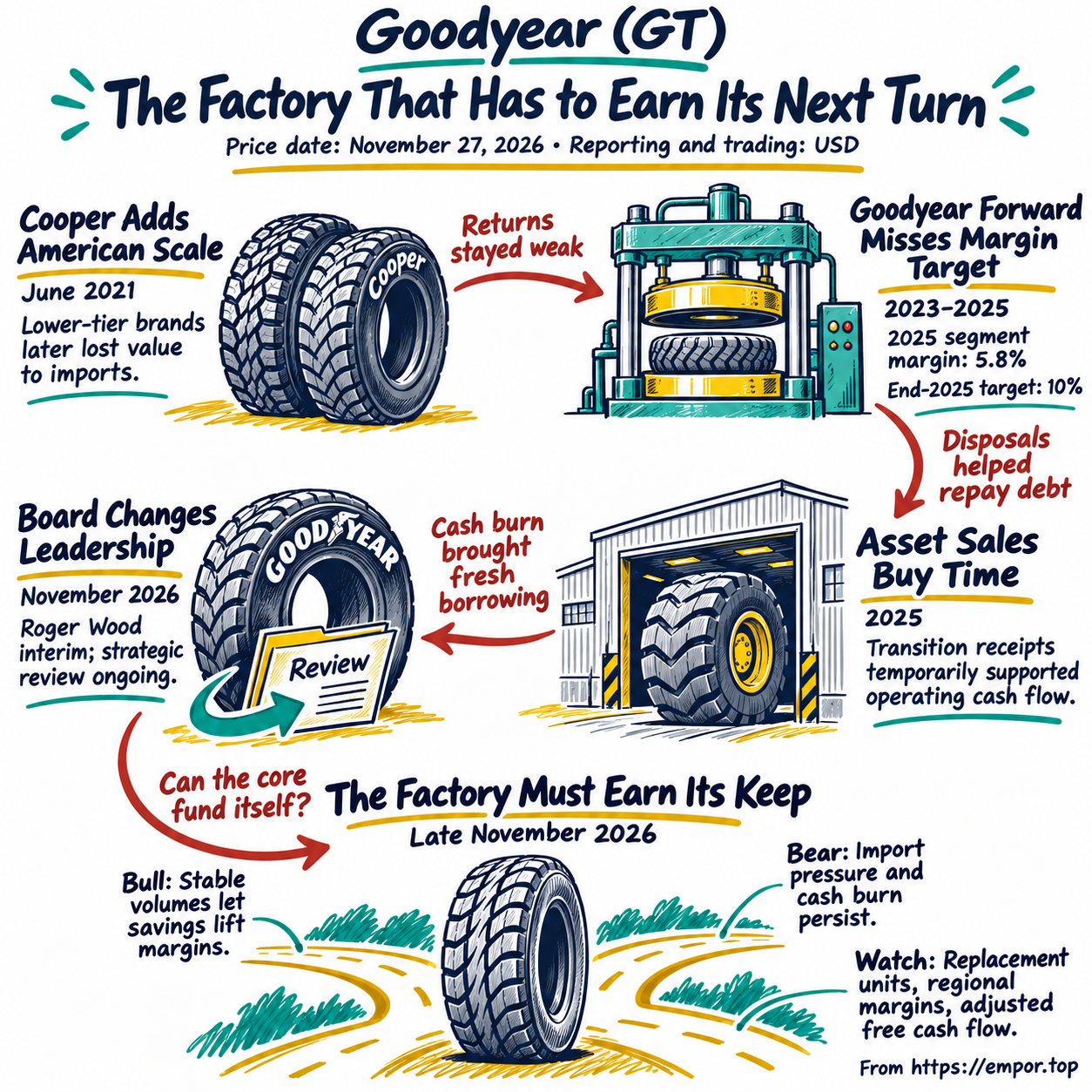
The Goodyear Tire & Rubber Company: The Factory That Has to Earn Its Next Turn
I. The CEO Change Before the Recovery
On the morning of Thursday, November 5, 2026, Goodyear's chief executive Mark Stewart dialed into the third-quarter earnings call alongside interim chief financial officer Scott Deakin, with analysts from Deutsche Bank, BNP Paribas, TD Cowen and JPMorgan waiting in the queue.1 The numbers they had to defend were not good, but they could be read as the bottom of a trough. Third-quarter sales came in at $4.54 billion, down 2.3% from a year earlier.2 Segment operating income, the figure tire analysts watch most closely because it strips out corporate overhead, financing and one-off charges, was $174 million, which was $113 million less than in the same quarter of 2025.2 The bottom line showed a net loss of $238 million.2
There was a hopeful way to frame all that, and it was the frame the quarter allowed. Only three months earlier, Goodyear's segments had together earned just $36 million in the second quarter, with both the Americas and the Europe, Middle East and Africa businesses losing money at the operating level.3 Going from $36 million to $174 million is sequential improvement by any arithmetic. The call was a story about execution continuing, cost savings arriving and the hard part of the year being behind the company.
Four days later, the story changed hands. On Sunday, November 8, the board made director Roger Wood interim chief executive, and Stewart was out.4 The filing that disclosed the change landed on Monday, November 9. It said the board would search for a permanent successor, and it confirmed that a strategic review of Goodyear's operations and options, overseen by a special committee of directors, was continuing.4 Stewart had joined from Stellantis, where he ran North American operations, and had been in the job since early 2024.5 He lasted less than three years.
The terms of Wood's appointment say something about how the board views the assignment. He receives a salary of $310,000 a month, plus restricted stock grants valued at $1 million a month, for up to five months.4 If he serves the full period, that adds up to roughly $6.5 million for less than half a year of work, most of it paid in Goodyear shares. That is not a pay package for a caretaker who will simply keep the lights on. It is a package for someone expected to make consequential decisions quickly, and it ties a large part of his reward to where the share price goes in the meantime.
Wood is not a stranger to the industry's hard economics. He spent his career in the auto-supply business, including a spell running Dana, the drivetrain supplier, and he had sat on Goodyear's board since 2023, the year an activist forced the company to rethink almost everything about itself.5 He is, in other words, one of the directors who approved the plan he now has to judge.
The timing is the first puzzle of this story. A board does not usually remove a chief executive four days after a quarter that showed sequential progress unless it has concluded that progress is not enough, or not fast enough, or not coming from the right places. The filing does not explain the board's reasoning, and Goodyear has not published what its strategic review will produce.4 So a reader in late November 2026 is left with a company in mid-sentence: a turnaround plan whose deadline has passed, a review whose output is unknown, a chief financial officer, Jerome Rouquet, who will not start until December 1, and an interim chief executive with a five-month horizon.4
Here is why that matters to an investor. Goodyear's shares closed at about $3.47 on November 27, which gave the whole company a stock-market value of roughly $1 billion.6 At the end of September, Goodyear owed about $7.1 billion in debt, not counting leases.2 The equity is a thin slice on top of a heavy capital structure, which means small changes in operating performance produce large changes in what the shares are worth, in either direction. The board's review is happening in a company where there is little room for a slow answer.
Four questions run through everything that follows. The first is whether volumes and factory utilization can recover, because a tire factory that runs half empty is a machine for losing money. The second is whether Goodyear's brands and distribution earn real pricing power, or whether customers will simply trade down to cheaper imports. The third is whether the asset sales and cost programs of the past three years made the remaining company stronger, or just smaller. The fourth is whether new leadership can turn the strategic review into a credible plan that is funded and has milestones an outsider can check.
A boundary note before the story begins. This is the story of the listed tire maker and its consolidated subsidiaries, the entity that reports to the Securities and Exchange Commission as The Goodyear Tire & Rubber Company.7 The companies that bought Goodyear's businesses, the joint ventures it shares with others and the wider tire industry all appear here as context, not as part of Goodyear's results. And to understand why a company with one of the most famous names in American industry is worth about a billion dollars, the story has to start with the product itself: a round piece of rubber that every car wears out, on a schedule that is far less predictable than it looks.
 Subscribe on LinkedIn
II. Every Car Wears Out Its Tires. That Does Not Make Demand Smooth.
Follow a single tire off the end of a Goodyear production line. It has been built from layers of rubber compounds, steel belts and fabric, pressed in a heated mold and cured until the tread pattern sets. At the loading dock it can go one of two ways. It can ride a truck to a carmaker's assembly plant, where it will be bolted onto a new vehicle as original equipment. Or it can go to a distributor, a retailer or a fleet operator, where it will replace a worn tire on a car already on the road. The tire is the same. The economics are not.
The replacement route is the heart of the business. About 19% of Goodyear's 2025 revenue came from original-equipment manufacturers; the rest came overwhelmingly from replacement and related channels.7 On paper, replacement demand looks like an annuity. There are well over a billion vehicles on the world's roads, every one of them grinding rubber into the asphalt, and every one of them will eventually need new tires. That is the bull case in one sentence, and it is true as far as it goes.
What it leaves out is timing. A tire does not wear out on a fixed date. It wears out when its owner has driven enough miles, in enough heat or cold, on enough rough roads, and then only when that owner decides to act. A household under financial pressure can stretch a set of tires another winter. A fleet can delay replacement for a quarter. Distributors who stocked up in anticipation of price increases can stop ordering while they work through their inventory. None of this changes the long-run need for tires, but all of it changes when the orders arrive at Goodyear's factories, and Goodyear's factories cost roughly the same to run whether those orders arrive or not.
The original-equipment route has its own logic. Carmakers buy tires to specification, often after long qualification processes, and they buy in volume tied to how many vehicles they build. The margins on original equipment are generally thinner than on replacement, because a carmaker is a large, sophisticated buyer that can qualify more than one supplier for a given model. The prize is what comes later. A driver whose new SUV arrived on a particular Goodyear tire has a reason to replace it with the same one, especially if the tire is a large, specialized size that few competitors make. Original equipment, at its best, is a seed for future replacement sales.
The tire that got bigger
That is why Goodyear has leaned so hard into larger tires. In the third quarter of 2026, tires for rims of 18 inches and above made up 44% of Goodyear's volumes, up from 39% a year earlier.8 Bigger tires go on SUVs, pickups, premium cars and electric vehicles, which are heavy and need tires that can handle the weight and the instant torque. They are harder to make, so fewer factories can make them well, and they sell for more. Management also reported gains in its share of original-equipment business, including what the company called the tenth consecutive quarter of consumer original-equipment share gains in Europe by mid-2026.3
That is a real shift in mix, and mix matters, because it lets a company earn more revenue per tire even when the number of tires falls. But it is a strategy to test, not a moat already proven. The open question is whether those original-equipment wins convert into profitable replacement sales a few years from now, and whether higher-value tires lift segment margins enough to offset everything else that is going wrong. So far, the evidence is incomplete. Goodyear's total segment operating margin in 2025 was 5.8%.7 That is thin for a company that describes itself as a premium tire maker.
The fixed-cost trap
Here is the mechanism that makes this business so unforgiving. A tire plant is a huge fixed investment: buildings, mixers, curing presses, energy systems and the skilled people who run them. When a plant runs near capacity, those costs are spread across millions of tires, and each tire carries a small share. When volume falls, the same costs are spread across fewer tires, and each one becomes more expensive to make. Industry people call the result unabsorbed fixed costs, and it is the single biggest reason tire makers' profits swing so hard with demand.
Goodyear felt that trap acutely in 2026. In the third quarter, lower production and inflation raised conversion costs, the cost of turning raw materials into finished tires, by $138 million compared with a year earlier.8 Fitch Ratings put a number on the broader effect: unabsorbed fixed costs reduced Goodyear's operating income by $291 million in the first half of 2026, after $285 million in 2025.9 Think of it like a restaurant that has to pay its chefs and rent whether it serves 300 diners a night or 200. The food may be just as good, but the restaurant earns less on every plate.
The volume declines were severe. Goodyear's tire units fell 12% year over year in the first quarter of 2026 and another 4% in the second.3 Over the first nine months, replacement tire volumes fell 10.7%.2 Some of that decline was deliberate. In the second quarter, Goodyear attributed a 13% drop in Americas replacement units partly to a "planned rationalization of lower-tier product offerings," along with lower sell-in to North American dealers and competition.3 Walking away from unprofitable low-end tires can be smart, but it shrinks the volume that pays for the factories, which is exactly the trap described above.
Goodyear's geography explains where the pressure lands. In 2025, the Americas business generated $10.8 billion of Goodyear's $18.3 billion in sales and $735 million of its roughly $1.06 billion in segment operating income.7 In plain terms, the Americas accounted for nearly six of every ten dollars of revenue and seven of every ten dollars of segment profit. Europe, the Middle East and Africa produced $5.6 billion of sales but only $114 million of segment operating income, which is a margin of about 2%.7 Asia Pacific was the small, profitable outlier, earning $208 million on about $2.0 billion of sales, a margin above 10%.7
That pattern says something important. Goodyear's European business is large enough to matter and earns almost nothing, its Asian business earns a healthy return on a small base, and its American business carries the company. When American replacement volumes fell in 2026, there was no other region big enough to compensate. In the second quarter of 2026, the Americas posted a segment operating loss of $10 million on $2.4 billion of sales.3
Goodyear does not compete in an empty market. In the European Rubber Journal's global ranking of tire makers, Michelin and Bridgestone each reported roughly $25 billion to $27 billion of tire sales in 2024, against about $17 billion for Goodyear.10 Behind them come Continental, Pirelli, Sumitomo Rubber and a growing field of lower-cost Asian manufacturers, including Chinese producers that have built enormous capacity and export it around the world. The two leaders are not only bigger; they have the scale to spread research, marketing and factory investment across more tires.
The case for a Goodyear moat rests on a handful of real assets. The brand is one of the most recognized in American industry. Goodyear's engineering lets it make tires across almost every category, from passenger cars to commercial trucks to aircraft and racing. Its relationships with carmakers give it a place on new vehicles. Its retail and distribution reach puts its tires in front of buyers when they need them. Each of these is a potential advantage.
The test of a moat is whether it holds when someone attacks it, and the 2025 record is the place to look. Goodyear lost lower-tier volume to imports, and it took impairments on brands in exactly the price tier where imports competed.7 That evidence narrows the claim. Goodyear's brand and engineering appear to protect it in premium and specialized tires, where performance and fitment matter and where fewer competitors can match it. They do not protect it at the low end, where a buyer comparing two unfamiliar tire names on a retailer's screen will often choose the cheaper one. The moat, in other words, is real but smaller than the company's footprint. Whether Goodyear can hold price and mix while Chinese and other lower-cost imports keep expanding is the open question, and the metric that will settle it is replacement volume in the premium tiers, quarter by quarter.
The industry's structure reinforces that reading. Replacement buyers can compare brands and prices easily. Carmakers can and do qualify multiple suppliers. Rivalry among the big tire makers is intense, and all of them face the same swings in natural rubber, synthetic rubber, carbon black and steel, much of which tracks oil prices; Fitch estimates that about 70% of Goodyear's raw-material basket is linked to crude.9 Building a global tire business from scratch is extremely hard, but a regional, lower-cost entrant does not need to build a global business to take share in the lower tiers. It just needs to ship tires.
One last question hovers over every company in 2026: does artificial intelligence threaten it? Not directly. No software replaces the rubber between a vehicle and the road. The more relevant technology question is whether data-enabled services for fleets, such as tire monitoring and maintenance planning, can improve customer retention or earn fees. Goodyear's own disclosures do not establish that as a material profit pool today.7 The near-term story is physical: tires, factories and the volume that keeps them busy.
That physical story explains why Goodyear, five years before this autumn, decided the answer to its competitive problems was to get bigger in America.
III. Cooper Was the Bet on More American Scale
On February 22, 2021, two Ohio tire companies with more than two centuries of combined history announced they would become one. Goodyear, organized in Akron in 1898, agreed to buy Cooper Tire & Rubber, founded in 1914 and headquartered in Findlay.117 Cooper was the fifth-largest tire maker in North America by revenue, with about 10,000 employees in 15 countries, ten manufacturing facilities and a stable of brands that included Cooper, Mastercraft, Roadmaster and Mickey Thompson.11
The pitch was about American scale. Goodyear said the deal would create a stronger U.S.-based leader in the global tire industry, combining Goodyear's strength in premium tires and original equipment with Cooper's strength in replacement tires for light trucks and SUVs, and with Cooper's network of independent tire dealers.11 Cooper's customers tended to be value-conscious drivers of pickups and sport utility vehicles, the exact vehicles that dominated American roads. Goodyear's customers skewed toward carmakers and premium buyers. On paper, the two companies filled each other's gaps.
The price was not extravagant on the headline terms. Goodyear offered $41.75 in cash plus 0.907 Goodyear shares for each Cooper share, worth $54.36 per share at the time of the announcement.11 That was a 24% premium to Cooper's last closing price and a 36% premium to its 30-day average.11 The deal valued Cooper's equity at about $2.8 billion and its enterprise value, which adds debt and subtracts cash, at about $2.5 billion.11 Against Cooper's 2019 sales of roughly $2.75 billion, the enterprise value was about one times revenue, not an obviously rich price for a manufacturer with an established brand portfolio.11
Goodyear funded the cash portion with debt, backed by a committed bridge loan from JPMorgan, and paid the rest in stock, issuing about 46 million new shares at closing.1112 When the dust settled, Goodyear's legacy shareholders owned about 84% of the combined company and Cooper's former shareholders about 16%.11 The deal closed in June 2021.12
A fair test of whether Goodyear overpaid would compare the transaction multiple with other tire deals of similar size and quality. There is no clean comparison to make. The industry's largest players, Michelin, Bridgestone and Goodyear itself, were far bigger businesses, and tire-company acquisitions of Cooper's size were rare enough that no like-for-like multiple exists to prove the price was too high. The honest verdict on the price alone is that it was defensible at the time.
The promises
Goodyear promised two things. The first was about $165 million in annual run-rate cost synergies within two years of closing, excluding savings from manufacturing.11 The second was that the deal would be immediately accretive to earnings per share.11 The company also highlighted Cooper's tax attributes, which it said had a net present value of $450 million or more.11
Synergies are the most common promise in corporate acquisitions and the hardest for outsiders to verify, because the savings disappear into the combined company's cost base. Goodyear reported progress on integration in the years that followed, and the 2021 annual report described the combination as complete and the integration as underway.12 But what investors ultimately need to know is not whether the promised savings were achieved in isolation. It is whether the combined company earned better returns than the two companies would have earned apart, after paying for the deal, issuing shares and absorbing whatever went wrong.
The thing that went wrong
Then came the evidence that cut against the thesis. In 2024, Goodyear recorded a $125 million impairment, primarily against lower-tier brand intangible assets acquired with Cooper, citing competition from lower-tier imports.13 An impairment is an accounting admission that an asset on the balance sheet is worth less than the company paid for it. This one was specific: the brands that sold value tires to price-sensitive buyers had lost value because cheaper imported tires were taking those buyers away.
It is worth being precise about what that impairment does and does not mean. It does not prove the entire Cooper acquisition failed. Cooper brought factories, dealer relationships, a strong position in light-truck tires and brands such as Cooper and Mickey Thompson that sit above the lowest tier. A $125 million write-down against a $2.5 billion enterprise value is a meaningful but partial loss. What the impairment does show is that one piece of the original thesis, that Cooper's breadth across price tiers would give Goodyear a stronger defensive position in the American replacement market, proved vulnerable in exactly the way a skeptic would have worried about.
The broader goodwill impairment that followed in 2025 makes the picture harder. That year Goodyear recorded a $674 million goodwill impairment in its Americas segment, the segment into which Cooper had been integrated.7 Goodwill is the premium a company pays above the identifiable value of what it buys, and an impairment of goodwill is a statement that the business is expected to generate less cash than once assumed. Goodyear's auditor treated the valuation behind that impairment as a critical audit matter, which means it involved especially difficult judgments.7 Goodwill in the Americas does not all come from Cooper, so the impairment cannot be attributed entirely to the deal. But the combination of a write-down on Cooper's lower-tier brands in 2024 and a much larger write-down on the segment that houses Cooper in 2025 is not the record of an acquisition that obviously compounded value.
There is a subtler echo in the tax line. When Goodyear announced the deal, it pointed to Cooper's tax attributes, worth $450 million or more in present value, as part of the prize.11 Tax attributes are only valuable if the owner earns enough taxable profit to use them. In 2025, Goodyear concluded that it could no longer count on enough American profit to use its U.S. deferred-tax assets and wrote them down with a valuation allowance of about $1.4 billion.7 The allowance covered Goodyear's American tax position as a whole, not Cooper's attributes alone, so it is not a precise verdict on that piece of the deal. But it captures the problem neatly: a tax asset bought on the assumption of American profits loses its value when the American profits do not come.
Put those pieces together and the verdict narrows. The strategic logic of buying Cooper was clear, and the price was not obviously excessive on the disclosed terms. The deal did add scale and light-truck strength in Goodyear's most important market. But the parts of Cooper most exposed to imports lost value, the segment that absorbed it was later written down, and by late 2026 Goodyear's entire stock-market value was well below the $2.5 billion enterprise value it had paid for Cooper alone.611 That last comparison is not a fair measure of the deal by itself, because so much else happened in between. It is a vivid measure of how far the combined company's fortunes fell.
The question that Cooper left behind was simple. If more scale did not fix Goodyear's returns, what would? Two years after the deal closed, an activist investor arrived with an answer.
IV. The Activist Plan Became Goodyear Forward
In early 2023, Elliott Investment Management, one of the world's most aggressive activist hedge funds, turned its attention to Akron. Elliott had built a stake in Goodyear and argued publicly that the company had underperformed for years and needed change, recommending new directors for the board and pushing for a fresh look at Goodyear's portfolio and operations.14 The argument was not subtle. Goodyear had spent years generating weak returns on a large manufacturing base while carrying substantial debt, and Elliott believed the board had not done enough about it.
Goodyear's response came in stages. The board added new directors, and in 2023 it formed a five-member Strategic and Operational Review Committee that spent sixteen weeks working with the investment banks Evercore, Lazard and Goldman Sachs.15 Roger Wood, the director who would later become interim chief executive, joined the board that same year.5 On November 15, 2023, Goodyear announced the result: a transformation plan called Goodyear Forward, with Elliott's public support.15
The plan was ambitious and specific, which is to its credit, because specific targets can be checked. It promised a $1 billion annual run-rate benefit from cost reductions by the end of 2025, plus another $300 million from top-line actions in North America, for a headline total of $1.3 billion.15 It promised to roughly double Goodyear's segment operating margin, from about 5% in 2023 to 10% by the end of 2025.15 It promised to bring net leverage, the ratio of net debt to earnings before interest, taxes, depreciation and amortization, down to between 2.0 and 2.5 times by the end of 2025.15 And it promised gross proceeds of more than $2 billion from selling three businesses: the chemical operation, the Dunlop brand rights and the off-the-road tire business.15
At the time, the plan was presented by chief executive Richard Kramer, who had led Goodyear since 2010 and who retired soon after; Mark Stewart took over in early 2024 to execute it.155 That handoff matters for judging accountability. The executive who designed the targets was not the one who had to hit them.
What the plan delivered
The cost savings were real. In 2025, Goodyear attributed a $564 million benefit in its Americas segment income alone to Goodyear Forward.7 Fitch later credited the program with nearly $1.6 billion in cumulative cost savings and North American mix gains through the end of 2026.9 Those are not trivial numbers. A company does not find more than half a billion dollars of savings in one region in one year without closing facilities, cutting headcount and renegotiating how it buys and makes things.
And yet the destination was not reached. Goodyear's 2025 segment operating margin was 5.8%, not 10%.7 Total segment operating income fell 18.8% to about $1.06 billion.7 Net leverage ended 2025 above the 2.0 to 2.5 times target; Fitch put Goodyear's debt at about 4.1 times EBITDA that year.9 Of the three headline targets, the margin target was missed by more than four percentage points and the leverage target by a wide margin. Only the asset sales came in roughly on plan.
How can a company save hundreds of millions of dollars and still watch its profit fall? The Americas segment answers the question. In 2025, Americas segment income fell by $198 million even though the year's results included the $564 million Goodyear Forward benefit.7 Strip the savings out and the underlying business deteriorated by roughly three-quarters of a billion dollars in a single year, through lower volumes, higher conversion costs, raw materials and other expenses. The savings did not fail. They were simply outrun.
That is the crucial lesson of Goodyear Forward. It was a cost program, and the 10% figure depended on stable volumes, something the plan did not control.
A skeptic should also ask what the savings were made of. Some savings come from genuine efficiency: better procurement, fewer layers of management, smarter logistics. Others come from spending less on the future. Goodyear's research and development spending fell from $461 million in 2023 to $380 million in 2025, from about 2.3% of sales to about 2.1%.7 Capital spending fell from $1.19 billion in 2024 to $826 million in 2025.7 Headcount fell from about 68,000 at the end of 2024 to roughly 60,000 by November 2026.74
Some of that decline reflects the businesses Goodyear sold, which took their own employees, research and capital spending with them. Some reflects plant closures that were deliberate and arguably overdue. But lower investment intensity raises a separate question that cost savings cannot answer: whether Goodyear is spending enough to keep its factories modern and its products competitive against Michelin and Bridgestone, which have much larger revenue bases over which to spread research. A company can raise its margins for a few years by investing less. It cannot do so forever.
The plan that followed the plan
By mid-2026, Goodyear had moved on to a second round of restructuring. In July it announced the closure of its plant in Fayetteville, North Carolina, as part of further manufacturing-footprint actions.3 The company said those actions would improve Americas segment operating income by about $90 million in 2027 and about $270 million annually from 2028, at a pre-tax cost of $535 million to $565 million, including $190 million to $210 million in cash, with the work substantially complete by the end of 2027.3
That is a reasonable-looking trade on paper: spend roughly $200 million in cash to save $270 million a year. But it raises the questions an investor should always ask of footprint actions. What capacity is being removed, and what is left? If demand recovers, can the remaining factories meet it, or will Goodyear have to buy capacity back? And what return must the retained factories earn to justify the capital still tied up in them? Goodyear has not published the capacity it expects to have after these actions, or the utilization rate it needs to make them pay.
The 2026 numbers show the same pattern repeating. In the second quarter, Goodyear's own bridge of segment operating income, excluding divested businesses, showed Goodyear Forward contributing $95 million and price and mix running $123 million ahead of raw-material costs.3 Against that, lower volume cost $132 million, tariffs and other costs took $100 million and inflation another $53 million, leaving segment income down $79 million on a like-for-like basis.3 Every lever management controlled pulled in the right direction, and the levers it did not control pulled harder. That is the most precise description of Goodyear's problem in a single quarter: the company is doing the things a cost plan can do, and it is not enough while the factories are under-filled.
There is also a credibility point. Goodyear Forward had a deadline of the end of 2025, and when that deadline arrived, the company did not stop and declare victory or defeat. It announced a new round of savings with a new deadline of 2028. That is not necessarily wrong; businesses must respond to conditions. But it means investors are now being asked to judge a second set of promises before the first set has been fully reconciled. The test is not whether Goodyear can announce another savings target. It is whether lower costs produce higher margins at realistic volume assumptions, which is why segment operating margin, and operating income per tire, are better guides than any savings tally.
The savings were half of Goodyear Forward. The other half was selling businesses, and those sales bought something the cost cuts could not: time.
V. The Asset Sales Bought Time. What Did They Leave Behind?
Picture three handoffs, each one a piece of Goodyear walking out the door. The first was the off-the-road tire business, the giant tires that go on mining haul trucks, earthmovers and port equipment, some of them taller than a grown adult. Goodyear sold it to the Japanese tire maker 横浜ゴム (Yokohama Rubber) for $905 million.7 The second was the Dunlop brand, one of the oldest names in tires, whose rights Goodyear sold to 住友ゴム工業 (Sumitomo Rubber Industries); at closing, Goodyear received $735 million in gross cash.7 The third was its chemical business, which made synthetic rubber and other materials, much of it for Goodyear's own tires. Together with smaller disposals, these sales brought in about $1.8 billion in 2025.7
It is worth being clear about the direction of these deals. These were Goodyear's own businesses, sold by the listed company to outside buyers, and the proceeds belong in Goodyear's capital story. Nothing here was shuffled between affiliates. The cash came into Goodyear, and Goodyear decided what to do with it.
What it did was pay down debt. Goodyear said the 2025 divestiture proceeds helped repay borrowings.7 There was no dividend in 2025 and no regular share repurchase competing for the money.7 For a company whose activist-backed plan had promised lower leverage, that was the right priority. But debt repayment from asset sales is a one-time event. It reduces what a company owes, and it also reduces what the company earns, because the businesses sold had their own revenue and profit.
Set the asset sales next to the Cooper purchase and an uncomfortable symmetry appears. Goodyear spent about $2.5 billion in enterprise value to buy Cooper in 2021, and between early 2025 and the Dunlop closing it raised roughly $1.64 billion in gross proceeds from off-the-road tires and Dunlop alone, before counting the chemical business.117 The assets were different, so this is not a simple calculation of buying high and selling low. The off-the-road business and Dunlop were not Cooper. But the sequence tells the shape of the decade: Goodyear bought more American scale with borrowed money, then sold specialized businesses and a historic brand to pay the borrowing down.
Cash that came with a timer
The part of this story most likely to mislead a casual reader is the cash flow. In 2025, Goodyear reported a net loss of about $1.7 billion, yet its operating cash flow was a positive $796 million.7 How does a company lose that much money and still generate cash?
Most of the loss was not cash. About $1.4 billion of it came from a valuation allowance on American deferred-tax assets, an accounting judgment that Goodyear might not earn enough U.S. profit in the coming years to use tax credits it had accumulated.7 The goodwill impairment was also non-cash, and depreciation added back about $1.05 billion.7 So the gap between loss and cash is partly an accounting story, and the valuation allowance itself is a sobering signal: management and its auditors concluded that future American profits were too uncertain to count on.
But there was a second, temporary support. The 2025 operating cash flow included $486 million of deferred revenue and income tied to the divestitures: supply agreements under which Goodyear kept making products for the buyers, trademark licensing arrangements and transition services.7 That is real cash, but it is cash that exists because Goodyear sold businesses, and it will fade as those agreements expire. Take it out and Goodyear's 2025 operating cash flow was roughly $310 million, set against $826 million of capital spending. On that rough reading, the remaining business did not fund its own investment in 2025.
2026 removed any doubt that the cash picture was fragile. In the first nine months of the year, operating cash flow was negative $764 million, and working capital consumed $871 million.2 Tire makers normally use cash early in the year and generate it in the fourth quarter as inventories are sold down, so some of that will reverse. But a negative nine-month figure of that size, in a year with lower volumes, shows how quickly the business can burn cash when the factories are running below capacity and inventory builds.
The tax line adds a quieter cost of the 2025 valuation allowance. Because Goodyear no longer books a tax benefit on most of its American losses, it recorded $140 million of tax expense in the first nine months of 2026 on a pre-tax loss of $552 million.2 In a normal year a loss produces a tax credit that softens the blow. For Goodyear in 2026 it produced a tax bill, mostly from profitable foreign operations, and that is part of why the net loss looked so much worse than the operating picture. Until American profits return, losses there will hit the bottom line without a cushion.
Two financing arrangements make the cash flow harder to read. At the end of 2025, Goodyear had sold $892 million of trade receivables through off-balance-sheet programs, which means it collected cash from banks before its customers paid.7 And $551 million of its obligations to suppliers had been confirmed to financial institutions under supplier-financing programs, which lets suppliers get paid early by a bank while Goodyear pays later.7 Both are common and neither is evidence that customers are paying badly. But both move cash between periods, and a change in how much Goodyear uses them can flatter or depress reported operating cash flow in a way that has nothing to do with selling tires.
The joint venture on the side
One affiliate deserves a brief mention because its numbers are moving in the wrong direction. Goodyear owns half of TireHub, a tire distribution joint venture in the United States.7 Goodyear's share of TireHub's 2025 loss was $41 million, and the loan Goodyear had made to the venture fell from $103 million at the end of 2025 to $84 million by September 2026, while Goodyear's net investment shrank from $44 million to $17 million.72 These amounts are small next to an $18 billion revenue base, and TireHub is not the main earnings driver. But a distribution partner that keeps losing money is one more sign of how hard the American replacement channel became.
The capital question coming out of the asset sales is whether the disposals reduced leverage while leaving a competitive core. They clearly reduced debt in 2025. Whether the core was strong enough to stand on its own is something 2026 has called into question, and the answer will become visible only after the divested operations and their transition receipts have fully rolled off. Selling businesses is one way to protect a brand's balance sheet. Protecting the brand itself is a different problem entirely.
VI. The Tire Brand Has to Survive the Tire Itself
In 2013 and 2014, Goodyear ran a campaign in Europe to exchange certain commercial truck tires. Years later, that campaign became the center of a French judicial investigation. In March 2024, Le Monde, working with other international media partners, published an investigation into alleged tire failures and into how Goodyear had handled incidents involving those truck tires, including serious road accidents.16 French investigators searched Goodyear sites in 2024.16
The details matter, and so does the distinction between allegation and finding. The reporting described serious claims about tire failures and about whether information was shared quickly and fully with customers and authorities. It did not describe a court verdict, and none has been published. An ongoing investigation is not a determination of liability. What the episode does is put a hard question to the idea that Goodyear's brand is an automatic moat: a brand is valuable only as long as customers trust the product it is stamped on.
A tire is a safety-critical product. When it works, nobody thinks about it. When it fails at highway speed under a fully loaded truck, the consequences can be fatal. That is why reputation in this industry is built slowly and can be damaged quickly. Fleet buyers, who make careful, data-driven decisions about tires, care about warranty support, failure rates and how a supplier responds when something goes wrong, not only about the name on the sidewall.
Set that specific episode against what Goodyear records on its balance sheet. At the end of September 2026, the company carried $435 million of liabilities for product-liability and other tort claims, including asbestos, and about $84 million of environmental liabilities.2 It had roughly 28,500 asbestos claims pending, a legacy of decades-old products and workplaces.2 Goodyear said reasonably possible losses above its recorded product-liability amounts were not expected to have a material effect on its financial position, cash flow or results, while cautioning that actual outcomes could differ.2
The asbestos docket is old, large and persistent rather than acute; it has been part of Goodyear's accounts for years and its scale shrinks slowly. The French investigation is newer and less quantified, and Goodyear's filings do not set aside a specific amount for it. The honest reading is that the company's own accounting does not point to a balance-sheet threat from product claims today, while the French case remains an unresolved reputational and legal risk whose outcome is unknown.
What the episode should not do is lead anyone to assume that today's Goodyear tires share the problems alleged about a specific set of truck tires more than a decade ago. That would be an unfair leap. The more useful exercise is to identify what would show whether trust in the brand is actually weakening: product recalls, the trend in claims, warranty costs and, above all, whether customers keep choosing Goodyear when cheaper options sit beside it. Brand recognition by itself tells you little. Customer behavior tells you a lot. The brand's protection, in other words, has to be earned again with every tire. The balance sheet, meanwhile, sets the clock on how long Goodyear has to earn it.
VII. The Balance Sheet Is the Clock on the Turnaround
Goodyear entered 2026 with something it had not had in years: a debt load that was moving down. The asset sales had paid off borrowings, and at the end of 2025 the company had about $4.4 billion of unused credit arrangements available.7 Then replacement demand weakened, factories ran slower, and the cash started flowing the other way.
By the end of September 2026, Goodyear's debt, excluding leases, stood at about $7.1 billion.2 Of that, about $5.5 billion was fixed-rate long-term debt, about $1.25 billion was variable-rate long-term debt, and about $350 million was notes payable and overdrafts.2 The average interest rate across its borrowings in the first nine months of the year was 5.9%.2 Cash on hand was $812 million.2 Leases add more: at the end of 2025, Goodyear had about $260 million of finance-lease liabilities and about $1.06 billion of operating-lease liabilities.7
The trend is the story. In 2025, asset sales funded debt repayment. In the first nine months of 2026, Goodyear took on $1.21 billion of net new borrowing, including a $1.05 billion issue of senior notes in the middle of the year.217 A company that had just spent a year shrinking its debt was borrowing again within months, and doing so not to invest in growth but because its operations were consuming cash.
Two covenant triggers deserve attention, because they are where a cash problem can turn into a financing problem. Goodyear's first-lien credit facility, its main revolving line, has a springing covenant that activates if available cash plus availability under the facility falls below $275 million.2 The European receivables facility has an early-amortization trigger tied to a net-debt-to-EBITDA ratio of 3.0 times.2 There is also a quieter constraint: at the end of September, the first-lien facility's borrowing base, which depends on the value of the inventory and receivables backing it, was $270 million below the facility's stated $2.75 billion size.2 In plain language, Goodyear can borrow only as much as its collateral supports, and when volumes fall and inventories shift, that capacity can shrink.
The rating agencies noticed. S&P had Goodyear at B+ with a negative outlook by late August 2026.18 In early November, Fitch cut Goodyear to B+ from BB-, with a stable outlook, citing what it called persistent volume contraction.199 Fitch's numbers frame the bind precisely: debt at about 4.1 times EBITDA in 2025, projected to rise above 5.5 times by the end of 2026 and to stay at or above 4.0 times through 2028, with free cash flow expected to remain negative through 2027.9 Those are Fitch's projections, not Goodyear's, and they should be read alongside the company's own liquidity disclosures. But they describe a company whose leverage target from 2023 now looks further away, not closer.
This is the cash-flow trap that makes timing so important. To fix its cost structure, Goodyear has to spend money: on closing plants such as Fayetteville, on restructuring, on severance and on keeping the remaining factories modern. That spending comes at precisely the moment weak volumes are reducing the cash its operations generate. A company in that position can fund the gap by borrowing, but each new dollar of debt raises interest costs and moves it closer to the triggers that would restrict its flexibility. The longer the recovery takes, the more expensive it becomes.
Currency adds another layer of exposure for a company that makes and sells tires on several continents. Goodyear hedges trade flows, intercompany loans and royalty payments with foreign-exchange contracts, which carried about $1.84 billion of notional value at the end of September 2026.2 By the company's own modeling, a 10% adverse move in exchange rates would reduce the fair value of those contracts by about $185 million, though the underlying exposures would largely move the other way.2 Hedges smooth transactions; they do not change the dollar value of profits earned in euros or yuan once those profits are translated into Goodyear's accounts. For a company whose European segment already earns a thin margin, a stronger dollar is one more force pushing on reported earnings at an inconvenient moment.
None of this means Goodyear is short of options. It still had financing sources, it has fixed-rate debt that does not reprice immediately, and the fourth quarter is normally its strongest for cash. But the balance sheet has turned the turnaround's timing from an earnings question into a solvency-adjacent one. What resolves it are a few specific numbers: net debt at the end of 2026, free cash flow excluding divestiture-related receipts, the refinancing schedule and the headroom under those covenants. The man now responsible for all of them took the job only weeks ago.
VIII. A New Interim CEO Inherits an Unfinished Plan
Picture the two events side by side. On November 5, Stewart and Deakin, the interim finance chief, led the third-quarter call, walking analysts through a quarter of sequential improvement.1 Four days later, Wood was named interim chief executive; the board said it would search for a permanent successor.4 Between the two, nothing in Goodyear's published operating results changed. What changed was the board's judgment about who should lead the next phase.
Wood takes over with some unusual arrangements. He will remain on the board, but he has stepped off its compensation and governance committees while serving as interim chief executive, which avoids the awkwardness of a director helping to set his own pay or choose his own successor.4 On December 1, Jerome Rouquet is scheduled to start as chief financial officer, succeeding Deakin.4 So within a single month Goodyear will have a new chief executive and a new chief financial officer, both in the middle of a strategic review whose conclusions have not been announced. That is a lot of fresh hands on the wheel during a turn.
The management record that matters most is the gap between promise and outcome. Stewart's reported compensation for 2025 was $14.6 million, down from $25.8 million in 2024, his first full year in the job.5 It came in a year when Goodyear missed key Goodyear Forward targets.7 Shareholders nonetheless backed the pay plan: at the April 2026 annual meeting, 95.2% of votes cast for or against executive pay supported it.20 The highest opposition to any director, 7.5%, went to board chair Laurette Koellner.20 That is modest dissent for a company in Goodyear's position. Shareholders, at least in the spring, were not in revolt.
The board's formal structure looks sound: 83% of director nominees in the 2026 proxy were independent.5 Independence, however, describes who sits at the table, not what they decide. The real test of governance is whether the board explains why it removed a chief executive four days after an earnings call, and how its review changes the operating plan. Goodyear has not yet given that explanation.4
The incentive signal deserves careful reading. Wood's stock grants are monthly restricted shares. They tie his reward to the share price over the next few months, but they are not attached to a disclosed multi-year scorecard of operating targets such as margins, cash flow or leverage.4 That design suits a short assignment. It also means that the more important alignment question, how the permanent chief executive will be paid and what performance will earn the award, remains to be answered in future compensation disclosures.
Ownership is spread out. The 2026 proxy listed BlackRock at 11.5%, Vanguard at 10.2% and Wellington Management at 8.8% as of February.5 By November, Wellington reported holding about 10.5 million shares, or 3.6%, as of September 30.21 That looks like a sharp decline, but the two filings use different dates and different reporting bases, so they do not establish exactly when or how Wellington sold. No shareholder controls the company.
Elliott, which set the transformation in motion, is part of the backdrop rather than a current campaign. Its 2023 push opened the debate about the portfolio and operating performance and helped produce Goodyear Forward.14 The question its arrival raised has not gone away: would a board under outside pressure produce measurable returns, cash flow and leverage milestones? Goodyear Forward fell short of its targets.
A useful way to judge the next phase is to listen to how management's story changes over time. Goodyear's second-quarter release in August explained the collapse in Americas replacement volume partly as a deliberate exit from lower-tier products, and it set out the Fayetteville closure and its savings timetable.3 It did not include a full-year outlook or announce the strategic review.3 By November, the strategic review was continuing and the chief executive was gone.4 When the permanent leader arrives, investors should compare the new plan's volume assumptions, utilization targets and price-mix expectations with the 2023 Goodyear Forward targets. The size of the gap between those two documents will say a great deal about how much of the old plan survives.
IX. Analysis & Bull vs. Bear Case
Look at Goodyear as two businesses living under one roof. One is the Americas, which in 2025 produced about 59% of sales and about 70% of segment income, earning a margin of about 6.8%.7 The other is Asia Pacific, much smaller, earning a margin of about 10.6%.7 In between sits Europe, the Middle East and Africa, with plenty of revenue and a margin of about 2.1%.7 The company's fate depends on the first business, its best returns come from the second, and the third is a large question mark. Any honest analysis has to hold all three at once.
The long view sets the stakes. Goodyear's sales were about $15.2 billion in 2016 and about $18.3 billion in 2025, which is modest nominal growth over nearly a decade, much of it from the Cooper acquisition.227 Profit has not compounded at all. Goodyear earned $1.26 billion in 2016, a figure flattered by non-recurring items, earned just $35 million in 2024, and lost about $1.7 billion in 2025.227 This is not a company with a stable base of earnings that is temporarily depressed. It is a company that has struggled for years to turn a large revenue base into consistent profit.
The case for recovery
The bull case rests on a richer mix, reported gains in original-equipment share, real savings and debt reduction. The company says its footprint actions will add roughly $270 million a year by 2028.3 And the underlying demand never goes away: every tire on the road is wearing out, and replacement eventually comes. If volumes merely stabilize, the factories become more fully used, fixed costs per tire fall, and the savings that have been offset by unabsorbed costs start to show up in profit. On that view, the third quarter's sequential improvement from the second quarter is the first sign.
The bear case starts with falling replacement volumes and pressure from lower-tier imports, already visible in the Cooper brand impairment and Americas goodwill write-down.137 Falling volume has overwhelmed cost savings, and the second quarter showed how thin the cushion is when two of the three regions lost money.73 Cash generation has been weak, while reduced research and capital spending may protect near-term margins at the expense of long-term competitiveness.72
Where the moat really sits
The frameworks that strategists use help sort these facts. Start with the five forces that shape an industry's profitability. Buyer power is high on both routes to market: carmakers qualify multiple suppliers and negotiate hard, and replacement buyers can compare prices on a screen and trade down. Supplier power is moderate but volatile, because the raw-material basket swings with oil and natural rubber prices that no tire maker controls. The threat of new entrants is low at global scale but meaningful at the low end, where Asian producers ship tires into Goodyear's markets without building a global brand first. Substitutes are not a serious threat, since nothing replaces the tire itself. Rivalry is intense, with Michelin and Bridgestone larger and better capitalized. That combination produces an industry where average returns are modest and where the best returns go to companies with real differentiation.
Now apply Hamilton Helmer's framework of seven sources of lasting advantage. Goodyear's strongest claim is branding: a name customers know and, in premium segments, pay more for. Its next claim is scale economies, which are real when its plants are full and become a burden when they are not; Goodyear's 2026 conversion-cost pressure is the clearest proof that scale cuts both ways. Switching costs are weak, because carmakers can qualify other suppliers and replacement buyers face no penalty for changing brands. Goodyear has no network effects in the core business, no cornered resource such as a unique raw material, and no counter-positioning advantage against its rivals. Its process know-how in specialized tires is genuine, but Michelin and Bridgestone have the same capability at larger scale.
The verdict remains that Goodyear's moat is narrower than its size suggests, centered on premium and specialized tires. The evidence that would confirm it is rising replacement volume and margins in the larger-rim categories. The evidence that would falsify it is continued share loss to lower-cost rivals moving up the price ladder.
So the investment spine is this. Goodyear wins from here if premium mix, disciplined capacity and lower costs lift margins and cash flow without needing a sharp rebound in volume. It loses if lower-cost rivals take share faster than restructuring can reduce fixed costs, or if the balance sheet forces the company to sell more of what remains before the recovery arrives.
Three numbers will tell which story is coming true. The first is quarterly replacement tire units, the clearest measure of whether customers are still choosing Goodyear; volumes fell sharply over the first nine months of 2026.2 The second is segment operating margin by region, which shows whether savings are reaching profit; the company's margin was 5.8% in 2025 and about 3.8% in the third quarter of 2026.72 The third is operating cash flow less capital spending, adjusted for divestiture-related receipts, which shows whether the remaining business can fund itself; it was negative in 2025 and through September 2026.72
Valuation is mostly a reflection of that risk. At its November 27 price, Goodyear's equity was worth around $1 billion, against roughly $6.3 billion of debt net of cash, before leases.62 The market is valuing the whole enterprise at around seven to eight times the value of its shares, which means debt holders, not shareholders, own most of the company's economic value. Trailing earnings are negative, so a price-to-earnings ratio is meaningless. Enterprise-value-to-EBITDA multiples vary widely by provider and by which earnings figure is used, and any comparison with Goodyear's own history needs to adjust for the businesses it sold and the impairments it took.6 What the price appears to assume is that recovery is uncertain and that much of any improvement will go first to repairing the balance sheet.
An activist or a skeptical long-term investor would push the board on three questions. Which businesses should Goodyear keep, and is the European operation, with its thin margin, worth the capital it consumes? What cash return should the remaining company target, and over what volume assumptions? And what milestones would justify the cost of further footprint changes, given that the last round of savings was outrun by falling volume? Those questions are the agenda for whoever becomes the permanent chief executive.
X. Business & Investing Lessons
Picture the factory floor in a weak quarter. The mixers turn, the curing presses close and open, and the tires roll off the line into a warehouse that is filling faster than the trucks can empty it. Everything about the machine works. The problem is outside the building, where buyers are delaying purchases or choosing a cheaper tire. Goodyear's story is full of lessons, but five belong to it more than to any other company.
The first: a replacement purchase can recur; a profit margin does not. The recurring need belongs to the industry. The margin has to be won, tire by tire, from customers who owe Goodyear nothing.
The second: a factory is an asset only when the next tire absorbs its share of the cost. The factories had not become worse; they had become emptier. For founders and investors in any capital-intensive business, the lesson is that capacity is a bet on volume, and that bet is paid for every quarter whether volume shows up or not.
The third: a strategic acquisition is a promise until the brands hold their value. Cooper showed how lower-tier brands can lose ground to imports. Buyers of brands should ask not just what the brand earns today, but who could undercut it tomorrow.
The fourth: selling assets can repair a balance sheet and shrink the earnings base at the same time. A divestiture is a trade of future earnings for present safety. Whether it was a good trade depends on what the remaining company earns once the last transition payment arrives.
The fifth: a savings plan earns credibility one quarter at a time. Goodyear Forward's missed margin target showed that falling volume can outrun savings. Investors will believe the successor plan when margins, not savings tallies, rise.
XI. Epilogue
Tonight, at the end of November 2026, Goodyear is a company in waiting. Wood sits in the chief executive's office on a five-month horizon. Rouquet arrives on December 1 to take over the finance function. The special committee's review is continuing, its conclusions unpublished. The board is interviewing candidates for a permanent leader. And in the factories, the fourth quarter, normally the season when inventory turns into cash, is under way.
The next decisive moments are easy to name. The first is the appointment of a permanent chief executive, whose background will itself say something: an operator who has run factories through a downturn would signal a focus on fixing the core, while a dealmaker would signal more portfolio change. The second is the publication of a strategic plan that is funded and comes with measurable targets for margins, cash flow and leverage. The third is Goodyear's full-year 2026 results, which will show where net debt ended the year, how much cash the fourth quarter returned and how close the company came to its covenant thresholds.
Each outcome points somewhere different. If the full-year numbers show working capital reversing and net debt stabilizing, Goodyear will have bought itself time to let the footprint savings arrive in 2027 and 2028. If they show continued cash burn, the new chief executive's first decisions may be about financing and further disposals rather than strategy. If the plan sets realistic volume assumptions and still reaches higher margins, it will be the first serious evidence that the company can earn its cost of capital without waiting for the market to rescue it.
Two threads will run through all of it: whether Goodyear can turn its richer mix into stronger margins, and whether the remaining business can fund its investment as divestiture-related receipts roll off.
What remains open is what Goodyear has not yet published: the permanent leader's plan, the capacity it intends to keep, and the margin and cash-flow thresholds at which the restructuring will count as a success. Until those arrive, the company's story stays suspended between a famous past and an unproven next chapter.
XII. Outro
Go back to the factory floor one last time. A tire comes off the line, warm from the mold, its tread pattern crisp and new. It is one of the most ordinary objects in modern life, something billions of people rely on and almost nobody thinks about. It is also, in Goodyear's case, a test of whether one of the largest industrial systems in American history can still earn its keep.
That is what makes Goodyear unlike any other company in this story: a century-old brand selling a product the world continues to need, now led by an interim chief executive while it tries to make fewer factories and fewer products earn more. Goodyear does not need the world to stop driving. It needs each tire, each factory and each dollar of capital to work harder.
References
-
Goodyear Q3 2026 Earnings Call Transcript — Fortune, 2026-11-05 ↩↩
-
Form 10-Q for the quarter ended September 30, 2026 — The Goodyear Tire & Rubber Company, 2026-11-05 ↩↩↩↩↩↩↩↩↩↩↩↩↩↩↩↩↩↩↩↩↩↩↩↩↩↩
-
Goodyear Announces Second Quarter 2026 Results — Goodyear Corporate, 2026-08-05 ↩↩↩↩↩↩↩↩↩↩↩↩↩
-
Form 8-K: Leadership Changes — The Goodyear Tire & Rubber Company, 2026-11-09 ↩↩↩↩↩↩↩↩↩↩↩↩
-
2026 Proxy Statement — The Goodyear Tire & Rubber Company, 2026-03-06 ↩↩↩↩↩↩↩
-
2025 Form 10-K — The Goodyear Tire & Rubber Company, 2026-02-10 ↩↩↩↩↩↩↩↩↩↩↩↩↩↩↩↩↩↩↩↩↩↩↩↩↩↩↩↩↩↩↩↩↩↩↩↩↩↩↩↩↩↩↩↩↩↩
-
Q3 2026 Earnings Presentation — Goodyear Corporate, 2026-11-05 ↩↩
-
Fitch Downgrades Goodyear to B+ as Tire Volume Declines Outpace Cost Cuts — Investing.com, 2026-11-03 ↩↩↩↩↩↩
-
Goodyear to Acquire Cooper, Creating Stronger U.S.-Based Leader in Global Tire Industry — Goodyear Corporate, 2021-02-22 ↩↩↩↩↩↩↩↩↩↩↩↩↩↩↩
-
2021 Annual Report — The Goodyear Tire & Rubber Company, 2022 ↩↩↩
-
2024 Form 10-K — The Goodyear Tire & Rubber Company, 2025-02-14 ↩↩
-
Activist Investor Elliott Recommends Five Directors to Goodyear Board — Reuters via Investing.com, 2023 ↩↩
-
Goodyear Announces Transformation Plan: Goodyear Forward — Goodyear Corporate, 2023-11-15 ↩↩↩↩↩↩↩
-
Investigation: Tire Manufacturer Goodyear Faces Global Blowout Scandal — Le Monde, 2024-03-26 ↩↩
-
Prospectus Supplement for Senior Notes — The Goodyear Tire & Rubber Company, 2026 ↩
-
2026 Annual Meeting Voting Results, Form 8-K — The Goodyear Tire & Rubber Company, 2026-04-15 ↩↩
-
2016 Annual Report — The Goodyear Tire & Rubber Company, 2017 ↩↩
 LinkedIn
 WhatsApp
 Reddit
 Hacker News
 Email
 Kindle
 RSS Feed
 Spotify
 Apple Podcasts
 Amazon Music
 Audible
 YouTube