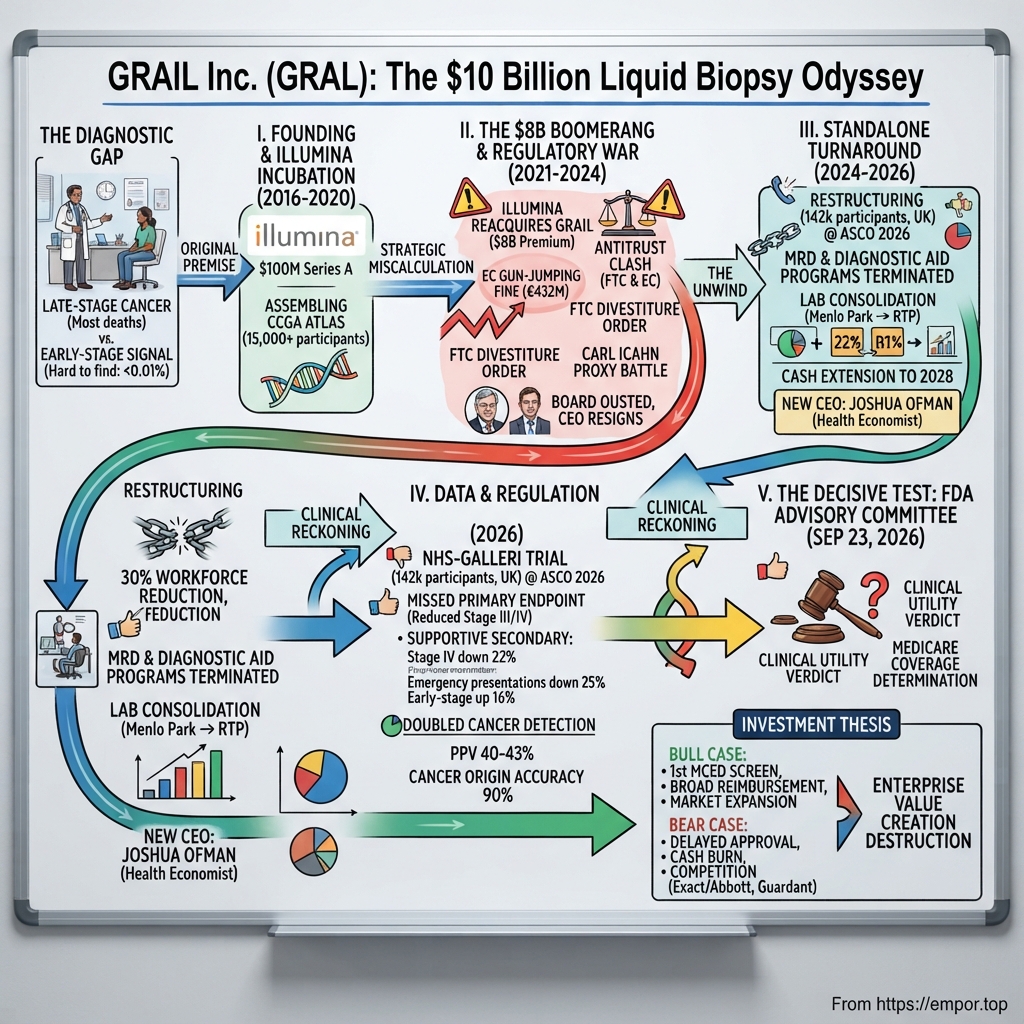
GRAIL Inc. (NASDAQ: GRAL): The $10 Billion Liquid Biopsy Odyssey
I. Introduction & Episode Roadmap
There is a particular kind of silence in an oncology clinic when a patient learns that a tumor has already metastasized. It is not shock so much as a sudden narrowing of options. By the time most cancers announce themselves through symptoms, biology has usually dictated the outcome. A palpable lump, a chronic cough, jaundice—these are late-stage alarms. The central challenge of modern oncology is that the overwhelming majority of cancer deaths stem from tumors for which no routine screening exists. Pancreatic, ovarian, esophageal, liver, gallbladder, stomach: medicine has no mammogram for the pancreas. Roughly seven in ten cancer deaths arise from malignancies lacking a guideline-recommended screening test.
That diagnostic gap is the reason GRAIL was formed. The company was founded on an ambitious premise: a single vial of blood, drawn during a routine annual physical, could screen for dozens of cancers simultaneously—identifying the lethal malignancies clinical practice routinely misses until it is too late.
The underlying biophysics are demanding. As cancer cells die, they shed fragments of DNA into the bloodstream. In a patient with advanced metastatic disease, circulating tumor DNA can make up a substantial fraction of the free-floating DNA in blood plasma. In a patient with an early Stage I tumor the size of a pea, that fraction can fall below one part in ten thousand. Detecting it requires isolating a microscopic biological signal against an overwhelming background of healthy cellular debris.
Beyond the diagnostic challenge, the company also became the focal point of one of the most contentious corporate sagas in modern biotechnology.
GRAIL was spun out of DNA sequencing giant Illumina in early 2016 with a $100 million Series A funding round backed by prominent venture and technology investors, including ARCH Venture Partners, Bezos Expeditions, and Bill Gates. It subsequently raised nearly $2 billion privately and filed for an initial public offering in 2020. Days after that filing, Illumina announced a deal to reacquire the company for $8.0 billion.1
What followed was not commercial integration, but a protracted legal and regulatory battle. The U.S. Federal Trade Commission sued to block the transaction on antitrust grounds, while the European Commission asserted jurisdiction over a target that had generated no European revenue. Illumina closed the transaction anyway without regulatory clearance. That decision triggered a €432 million European gun-jumping fine, an FTC divestiture order, and a proxy fight led by activist investor Carl Icahn that ousted Illumina's board chair and led, two weeks later, to the resignation of its chief executive.[^10]2[^14] In a subsequent legal twist, the European Court of Justice ruled that the European Commission never possessed the authority to review the merger in the first place—a vindication that arrived only after the transaction had been dismantled.3
On June 24, 2024, GRAIL was spun out a second time: 85.5% of its shares were distributed to Illumina shareholders, supported by a $932.3 million cash balance and a dedicated public listing under the ticker GRAL.4 Confronting a steep burn rate, the newly independent management team moved quickly to restructure, cutting approximately 30% of the workforce.5
That brings the company to its present crossroads. As of September 2026, GRAIL remains a single-product business generating approximately $147 million in annual revenue against a quarter-billion-dollar annual cash burn. It now faces a decisive regulatory test: on September 23, 2026—four days from now—an FDA advisory committee will convene to evaluate the premarket approval application for Galleri.[^7][^5]
The core investment thesis remains acutely divided. Proponents view Galleri as a category-defining multi-cancer screening platform, shielded by an extensive methylation database that would take competitors hundreds of millions of dollars and years to replicate. Skeptics view it as an operationally intensive endeavor heading toward the fundamental barrier of the diagnostic industry: public and private payers that demand proof not merely that a test detects cancer, but that early detection extends life at an acceptable cost.
This report examines each dimension of that contest. It starts with the underlying biology and sequencing physics, explaining why GRAIL shifted from mutational analysis to targeted methylation. It then reconstructs the Illumina incubation, the multi-billion-dollar private capital raises, and the strategic miscalculations behind the $8.0 billion reacquisition. From there, it traces the antitrust clash, the Icahn proxy battle, and GRAIL's operational restructuring as an independent entity managing laboratory consolidation. Finally, it analyzes the clinical evidence—including a May 2026 trial readout that missed management expectations—alongside competitive pressures, strategic frameworks, a falsification audit of core management claims, and the key financial metrics that will determine whether the business creates or destroys value from here.
 Subscribe on LinkedIn
II. The Science of the Signal: Liquid Biopsy & Epigenetics
To understand the biophysical challenge outlined in GRAIL's founding premise, consider the biological churn taking place continuously in the human bloodstream. Every day, billions of cells die on schedule. As they break down, they release their DNA into the circulation in short fragments—roughly 160 base pairs, the precise length of DNA wrapped around a single spool-shaped histone protein. Human plasma serves, in effect, as a running shredder bin of the body's own genome: a background pool known as cell-free DNA, or cfDNA.
When a malignant tumor develops, it undergoes the same cycle of cellular turnover and shedding. Those fragments—circulating tumor DNA, or ctDNA—constitute the clinical signal. Everything else in plasma is background noise.
The operational barrier is the dilution. In advanced metastatic disease, a large, necrotic tumor sheds aggressively. But in early-stage disease—the clinical window where screening must succeed—tumor fragments frequently account for well under one-hundredth of one percent of the total cfDNA pool. Isolating that trace is the molecular equivalent of searching a library of ten thousand identical books to locate a single volume containing one misprinted word, with no index to guide the search.
Why the obvious approach failed
The initial instinct in liquid biopsy was to search for somatic mutations: single-letter point mutations, insertions, and deletions known to drive oncogenesis. That technique proved effective for therapy selection and minimal residual disease monitoring in patients already diagnosed with advanced cancer.
For population screening among asymptomatic individuals, however, mutational analysis collided with a widespread biological phenomenon: clonal hematopoiesis of indeterminate potential, commonly known as CHIP. As humans age, blood stem cells acquire somatic mutations, and certain mutated clones expand. By age sixty, a substantial proportion of healthy adults harbor circulating white blood cell clones carrying mutations in genes traditionally classified as cancer drivers. When those benign white blood cells die, they shed their mutated DNA into the bloodstream alongside everything else.
A mutation-seeking screening assay deployed across an asymptomatic older population therefore registers cancer-associated mutations routinely, even when no solid tumor exists. The mutations represent aged blood cells, not an incipient solid malignancy. In an asymptomatic screening cohort where baseline cancer prevalence sits well below one percent, that background noise destroys positive predictive value. An assay that sends nine healthy individuals for follow-up imaging and invasive biopsies for every true cancer confirmed cannot secure clinical adoption or broad payer reimbursement, regardless of how sensitive it is in the laboratory.
The methylation pivot
GRAIL's pivotal technical decision was to stop asking what mutations are present and instead ask what tissue shed the fragment.
The biological mechanism is epigenetics. DNA carries not only its four-letter nucleotide sequence but a regulatory layer of chemical modifications—most notably methyl groups bonded to cytosine bases, forming 5-methylcytosine. These epigenetic marks function like volume controls, tuning gene expression up or down across cellular development. Crucially, methylation patterns are tissue-specific and stable: a liver cell and a lung cell share identical genomic sequences but display distinct methylation profiles. They serve, in effect, as biological barcodes identifying a cell's organ of origin.
Malignancy alters those patterns in characteristic configurations: hypermethylating promoter regions that normally repress tumor suppressors, and hypomethylating regions across the broader genome. A targeted methylation readout delivers two essential capabilities that mutational profiling cannot provide. First, it sidesteps the CHIP dilemma, because aging hematopoietic cells retain the methylation profile characteristic of blood. Second, it yields an anatomical return address.
To capture that signal, GRAIL adopted enzymatic methyl sequencing rather than traditional bisulfite chemical conversion. Bisulfite treatment degrades fragile, low-abundance cfDNA fragments during preparation—a major vulnerability when attempting to isolate faint traces of early-stage ctDNA. GRAIL's assay selectively sequences roughly 100,000 targeted methylation regions at high read depth rather than sequencing the entire genome at shallow coverage. This targeted strategy represents an explicit operational trade-off: it maximizes informative signal density per sequencing dollar in high-value genomic regions, but carries a higher reagent and probe cost per test than low-pass whole-genome approaches.
A proprietary machine-learning classifier then processes the sequencing output to resolve two distinct questions. First, it delivers a binary determination: whether a cancer signal is detected. Second, upon a positive call, it predicts the Cancer Signal Origin—the primary anatomical site of the malignancy. That second prediction is clinically critical. A positive cancer screening result without an anatomical location forces an extensive, unfocused diagnostic workup. A positive result that identifies an upper gastrointestinal origin with high confidence allows a clinician to order a targeted endoscopy immediately.
The atlas was the actual product
None of this computational machinery functions without clinical training data, and the scale of GRAIL's data collection explains why the company required billions of dollars in early capital. The Circulating Cell-free Genome Atlas, or CCGA, enrolled more than 15,000 participants to train and validate the underlying machine-learning models. STRIVE recruited nearly 100,000 women during routine mammography screening. SUMMIT enrolled approximately 25,000 participants, heavily weighted toward long-term smokers at elevated risk for lung cancer. PATHFINDER contributed prospective real-world clinical data from active screening environments.
These expansive clinical trials transformed an analytical algorithm into a commercial diagnostic. They generated a reference database of tens of thousands of clinically annotated methylomes paired with confirmed longitudinal patient outcomes from cohorts with and without cancer. While competitors can license enzymatic methylation chemistry or high-throughput sequencers, they cannot license proprietary longitudinal ground truth, nor can they easily compress the years required to enroll cohorts and verify cancer outcomes. That library forms the foundation of GRAIL's competitive moat argument—a premise this report evaluates in subsequent sections.
Yet the unresolved commercial question has never been whether the methylation biology is viable, but whether an elegant molecular assay supported by a proprietary database constitutes a sustainable, high-margin business. Understanding why that question remains so contentious requires tracing the corporate history of the company that created GRAIL—and then fought a multi-billion-dollar regulatory war to take it back.
III. Founding, Funding, & The $8 Billion Boomerang (2016–2021)
Jay Flatley led Illumina for sixteen years, transforming it from an early-stage microarray venture into the dominant supplier of DNA sequencing hardware. By the mid-2010s, however, Illumina confronted the natural ceiling of a platform monopoly: its sequencing systems were established, the cost of sequencing a human genome had plummeted, and the next order of magnitude in economic value lay downstream. Rather than simply selling sequencers to researchers, the larger long-term prize resided in the clinic, where diagnostic tests could be billed to insurers year after year.
The concept of utilizing cell-free DNA for multi-cancer population screening was already circulating within Illumina's research division. Yet, by any financial standard, developing such a diagnostic represented an intensive research program that would consume hundreds of millions of dollars annually for nearly a decade before generating commercial revenue. A publicly traded corporation with a premium valuation multiple and quarterly earnings targets could not easily absorb that operational drag without facing persistent investor resistance.
In January 2016, Illumina executed a strategic carve-out. It spun the initiative out as an independent company named GRAIL, retaining a significant equity stake while moving the development burn off its own income statement and allowing external venture capital to fund the required clinical trials. GRAIL's initial Series A round raised approximately $100 million, led by Illumina alongside ARCH Venture Partners and Sutter Hill Ventures, with participation from Bezos Expeditions and Bill Gates.
Subsequent financing rounds reflected the abundant liquidity of the era. A Series B round and follow-on investments secured more than $900 million, attracting institutional backers including Tencent, the SoftBank Vision Fund, and Johnson & Johnson. By 2020, total private capital raised had surpassed $1.9 billion. Crucially, that capital did not fund manufacturing facilities, commercial sales forces, or corporate acquisitions. Instead, it underwrote clinical blood draws, sequencing reagents, and longitudinal patient follow-up. GRAIL spent nearly two billion dollars of private capital assembling an unprecedented clinical dataset.
In September 2020, with biotechnology public markets receptive to early-stage platform companies, GRAIL filed a Form S-1 registration statement to list on NASDAQ. The operational trajectory appeared clear: establish an independent public listing, access liquid equity markets, and mark Illumina's retained stake to market.
The boomerang
Days after the filing, Illumina announced an agreement to reacquire GRAIL.
Under Flatley's successor, Francis deSouza, the commercial rationale had a clear logic. The market for core sequencing instruments was maturing: high-throughput systems such as the NovaSeq represent one-off capital equipment sales paired with recurring consumables, and the global pool of institutional customers requiring high-volume sequencers is ultimately finite. Clinical diagnostics, by contrast, offered access to a large, recurring, and reimbursable revenue stream. If multi-cancer early detection screening became standard clinical practice, analysts and management routinely modeled an addressable market measured in tens of billions of dollars. Illumina sought to capture that diagnostic margin directly rather than remain a pure-play supplier of sequencing chemistry to third-party assay developers.
The acquisition terms were aggressive: Illumina agreed to pay $8.0 billion for the roughly 85.5% of GRAIL it did not already own, structured as approximately $3.5 billion in cash, $4.5 billion in Illumina common stock, plus a contingent value right entitling GRAIL shareholders to a percentage of future Galleri-related revenues.1
Did Illumina overpay? An honest autopsy
By every prevailing valuation benchmark in clinical diagnostics, Illumina paid a steep premium.
At the time of the transaction in September 2020, Galleri had generated no commercial revenue. The assay had not yet launched even as a laboratory-developed test, which occurred only in mid-2021. It possessed no FDA premarket approval, no dedicated Medicare coverage, and no published prospective trial evidence demonstrating an improvement in patient outcomes. In effect, Illumina paid $8 billion for an early-stage clinical research program backed by an extensive dataset and a compelling theoretical premise.
Historical diagnostic transactions provide clear perspective. When Exact Sciences acquired Genomic Health, it paid roughly $2.8 billion—approximately six times revenue—for a profitable oncology diagnostic business with established clinical guideline inclusion and broad insurance reimbursement. Similarly, Hologic acquired Gen-Probe, with its commercial Panther diagnostic instrument base and recurring assay revenue, for approximately $3.7 billion at a mid-single-digit revenue multiple. Those transactions priced operating businesses with validated reimbursement pathways. By contrast, GRAIL's $8 billion valuation was anchored entirely to projected future revenue; against the roughly $100 million in revenue Galleri would generate three years later in 2023, the purchase price implied a multiple exceeding eighty times revenue.
The multiple, however, was merely symptomatic of the aggressive operational assumptions required to justify the capital outlay. For the transaction to deliver an acceptable return on an $8.0 billion investment, Galleri needed to achieve several billion dollars in annual revenue within approximately a decade. In the United States healthcare system, that scale cannot be reached through cash-paying consumers, executive physicals, or self-insured employer arrangements, which represent modest niche markets. It requires broad, universal Medicare coverage for asymptomatic screening across the population aged 50 and older.
Securing broad Medicare coverage for a novel screening modality is not a standard commercial rollout. It is an evidentiary and statutory process that historically spans decades, almost invariably demanding prospective, randomized clinical trial evidence demonstrating an overall reduction in disease-specific mortality. Illumina underwrote an $8.0 billion corporate acquisition on a reimbursement timeline that its management could neither dictate nor materially compress through capital investment.
The commercial and reimbursement risks were widely recognized across the diagnostics sector in 2020. Yet the variable that proved most destabilizing was neither scientific nor commercial. It was antitrust enforcement—and regulatory resistance emerged within months of the transaction's announcement.
IV. The Antitrust Standoff, The Carl Icahn Proxy War, & The Unwind (2021–2024)
In March 2021, the Federal Trade Commission filed an administrative complaint to block Illumina's acquisition of GRAIL. The regulatory theory centered on vertical foreclosure: Illumina manufactured the high-throughput sequencers upon which virtually every liquid biopsy developer depended. By owning the leading multi-cancer early detection assay, Illumina would possess both the financial incentive and the operational leverage to disadvantage GRAIL's direct competitors—whether through discriminatory pricing, prioritized access to next-generation sequencing instruments, or delayed technical support. From an antitrust perspective, regulators did not require evidence of overt misconduct; the market structure itself created an inherent conflict of interest.
Across the Atlantic, the European Commission took an even more aggressive procedural step. Because GRAIL generated no revenue in Europe, the transaction fell comfortably below every standard European Union merger notification threshold. However, antitrust officials led by Margrethe Vestager invoked Article 22 of the EU Merger Regulation—a referral mechanism traditionally used when member states lack their own national competition regimes—to assert jurisdiction over the deal. The underlying policy objective was to address the perceived risk of "killer acquisitions," in which dominant incumbents acquire pre-revenue innovators before traditional turnover thresholds are met. The legal foundation for that jurisdictional stretch, however, was immediately contested.
Closing anyway
In August 2021, Illumina took an extraordinarily rare corporate gamble. With active FTC litigation underway in the United States and the European review still unresolved, management closed the transaction. To comply with procedural demands during the pending appeals, Illumina placed GRAIL into a ring-fenced, "hold-separate" operational structure.
Management defended the decision by citing contractual merger deadlines, asserting that the FTC's vertical theory was legally vulnerable, and maintaining that the European Commission lacked statutory authority. Yet closing before regulatory clearance transformed a standard antitrust review into an open confrontation, and authorities responded with punitive force.
In July 2023, the European Commission imposed a record €432 million fine for gun-jumping—the practice of completing a notified concentration prior to clearance—a penalty explicitly calibrated to deter similar corporate maneuvers.2 In April 2023, the FTC issued a formal administrative order requiring Illumina to divest GRAIL outright.[^10]
Operationally, the hold-separate mandate produced acute corporate strain. Illumina was forced to consolidate GRAIL's operating losses—which absorbed more than $600 million in cash annually—while remaining legally prohibited from integrating operations, sharing clinical data, or realizing the commercial synergies used to justify the purchase price. Illumina shouldered the financial liabilities while being barred from controlling the underlying asset.
Icahn at the gate
Carl Icahn has spent decades targeting public corporations where the divergence between executive narrative and shareholder returns creates an opening for intervention. By early 2023, Illumina presented a textbook vulnerability.
In March 2023, Icahn launched a proxy campaign against Illumina's board, issuing sharply critical public letters. His critique focused on capital stewardship: management had overseen the destruction of tens of billions of dollars in market capitalization, paid a multi-billion-dollar premium for a pre-revenue business, closed the acquisition in defiance of dual antitrust authorities, incurred unprecedented regulatory penalties and legal fees, and subsidized an annual cash burn exceeding $600 million using cash generated by the core sequencing business—all while board compensation remained largely insulated from the fallout.[^14]
The activist campaign succeeded because the governance failures were readily apparent to institutional investors. At the May 2023 annual shareholder meeting, investors ousted board chair John Thompson and elected Icahn nominee Andrew Teno to the board. Two weeks later, chief executive Francis deSouza resigned.
The governance collapse at Illumina was not triggered by the scientific rationale behind multi-cancer screening, an area where legitimate technical debate persisted. Rather, the board unraveled because directors repeatedly endorsed executive management's conviction that antitrust regulators could be outmaneuvered or ignored. The shareholder vote served, in practice, as a market reassessment of that strategic miscalculation.
The unwind, and the vindication that arrived too late
Following deSouza's departure, Jacob Thaysen was appointed Illumina's chief executive in late 2023 and committed to divesting GRAIL. The chosen divestiture structure—a public spin-off rather than an outright corporate sale—underscored the lack of strategic or private equity buyers willing to absorb a business burning $600 million annually without established reimbursement.
On June 24, 2024, the separation was finalized. Illumina distributed 85.5% of GRAIL's outstanding shares to Illumina stockholders at a ratio of one GRAIL share for every six Illumina shares held, while Illumina retained a 14.5% minority stake.4 To support the independent entity, Illumina capitalized GRAIL with $932.3 million in disposal funding—providing its initial operating runway—and executed a supply and commercialization agreement that suspended high single-digit royalties on Galleri net revenues through December 24, 2026.1
That contractual provision carries direct implications for GRAIL's forward financial model: its primary sequencing supplier remains a significant minority shareholder, and a material royalty obligation to that supplier is scheduled to reinstate at the end of 2026.
In an ironic legal postscript, the Court of Justice of the European Union ruled in September 2024 that the European Commission lacked statutory authority under Article 22 to review the transaction.3 Illumina was ultimately vindicated on the jurisdictional question of European law. By the time the ruling was issued, however, the corporate damage was irreversible: Illumina had already spun off the asset, absorbed massive regulatory fines and advisor fees, replaced its leadership, and recorded billions in impairment charges. Prevailing on statutory interpretation offered little solace against the economic realities of the unwind.
GRAIL emerged from the separation on June 25, 2024, as an independent public company possessing an extensive clinical methylation atlas, an operating runway with a defined expiration date, and an inherited cost structure designed for a well-funded corporate subsidiary rather than a standalone diagnostic business.
V. The Standalone Turnaround: Restructuring, Leadership, & Operations (2024–2026)
There is a specific moment in the life of every spun-off company when the new management team sits down with the actual cash flow statement — not the parent's allocation memo, the real thing — and does the division. Cash on hand, divided by monthly burn.
GRAIL's team did that arithmetic in the summer of 2024 and got an answer they could not live with. Roughly $932 million of funding against an annual operating burn that had been running north of $600 million inside Illumina implied a runway measured in about eighteen months. Not eighteen months to profitability. Eighteen months to zero, with FDA approval and any plausible reimbursement decision still on the far side of that horizon.
In August 2024 — inside sixty days of independent trading — management announced a restructuring that was less a cost program than an act of strategic amputation.5
Roughly 350 positions went, about 30% of headcount. More consequentially, entire scientific programs were terminated. GRAIL halted its minimal residual disease pipeline — the business of monitoring treated cancer patients for recurrence — and shut down its diagnostic-aid programs, which applied the same technology to patients already presenting with symptoms. And it consolidated its clinical sequencing laboratory operations out of Menlo Park, California, into Research Triangle Park, North Carolina, trading Bay Area cost structure for Southeastern labor and facility economics.
The stated outcome was a runway extended from early 2026 into 2028.
How should an investor read this? Two ways, simultaneously, and they do not cancel out.
The favorable reading is that this was fast, decisive, and correct. Management identified the existential constraint within weeks and acted before the market forced it to, which is rarer than it should be.
The unfavorable reading is that killing MRD and diagnostic aid did not merely reduce cost. It eliminated GRAIL's entire portfolio of adjacent options. Before August 2024, the bull case could describe a platform company with several shots on goal. After it, GRAIL was a one-product company whose fate rested entirely on a single regulatory and reimbursement pathway. That is not diversified optionality with a leaner cost base; it is concentration risk purchased with a cash extension. Both statements are true, and the second one is the one that determines what happens if the FDA says no.
The people running it now
Joshua Ofman, MD, MSHS, became chief executive effective June 1, 2026.[^8] The appointment is the single clearest signal management has sent about what it believes the remaining fight is.
Ofman is not a sequencing technologist. He is a trained gastroenterologist and a health economist who spent years as senior vice president of global value, access, and policy at Amgen — which is to say, his career was built on the unglamorous work of convincing payers and health technology assessment bodies to pay for expensive things. He joined GRAIL in 2019 and served as its president through the Illumina years, the antitrust siege, and the spin-off.
Elevating him over an R&D or commercial leader is an admission, and a reasonable one: Galleri's remaining obstacles are not in the laboratory. The assay works as well as it works. What stands between GRAIL and a real business is an FDA panel's view of clinical utility, a Medicare coverage determination, a possible act of Congress, and the health-economic modeling that determines whether any of it gets paid for. Ofman's compensation reflects that framing — heavily weighted toward performance stock units tied specifically to PMA approval, Medicare national coverage, and reductions in operating cash outflow.
That is a well-constructed incentive package. It is also worth noting what it does not reward: revenue growth in the cash-pay channel. Management is being paid to win the reimbursement war, which tells you where it believes the value is, and implicitly concedes that the current commercial business is not the destination.
Aaron Freidin, the chief financial officer, came from Illumina's finance organization and was the architect of the cost-reduction and capital-conservation program. Bob Ragusa, GRAIL's chief executive through the separation, is a former Illumina senior vice president of operations who executed both the spin-off mechanics and the lab consolidation, and remains as a senior advisor through March 2027. Gregory Summe, the independent board chair, brings the outside-operator perspective — former chief executive of PerkinElmer and a former vice chair at Carlyle.
Notice the pattern: this is largely an Illumina-trained team, now running the asset their former employer could not hold. Institutional continuity is useful for operating the lab. It is a fair question whether it produces enough distance from the assumptions that got the asset overvalued in the first place.
What the numbers actually say
For full year 2025, GRAIL reported revenue of $147.2 million, up about 17% year over year.[^5] The composition matters more than the total. Galleri screening revenue in the United States was $136.8 million, up roughly 26%, representing about 93% of the business. Biopharma services and other revenue was $10.4 million, and shrinking as a share — the legacy of a services business that is no longer strategic.
So the growth is real and it is all coming from the core product. But the absolute scale is the point: after five years of commercial availability, a test with a list price near $949 generates under $140 million a year, entirely from cash-pay individuals, concierge and executive-health programs, and self-insured employers. That is not a mass-market screening business. It is a premium wellness product sold to people and employers who can write the check themselves.
Operating cash outflow for 2025 was approximately $299 million.[^5] Against the $550 million-plus burn of the Illumina era, that is a genuine halving, and it validates the restructuring. Against $147 million of revenue, it means GRAIL spends roughly two dollars of cash for every dollar it collects.
Liquidity stood at $904.4 million in cash, equivalents and short-term investments at the end of 2025, and $861.6 million as of June 30, 2026.[^5] The first-half consumption of roughly $43 million net is considerably better than the run-rate implies, which reflects both continued cost discipline and the timing of working capital and investment maturities — a distinction worth watching rather than extrapolating.
The market's verdict as of mid-September 2026: around $80.77 per share, a market capitalization of roughly $3.61 billion. Strip out the cash and public markets are assigning something on the order of $2.7 billion to a business with $147 million of revenue and no approved product. That is not a distressed valuation. It is a valuation that already embeds a meaningful probability of regulatory and reimbursement success — which means the September panel is not a free option. It is a priced event.
And what that panel will actually argue about is the clinical evidence, where 2026 delivered the most important and most awkward data in GRAIL's history.
VI. Clinical Data Autopsy: NHS-Galleri, PATHFINDER 2, & The ASCO 2026 Reckoning
The ballroom at the American Society of Clinical Oncology annual meeting in late May 2026 was standing-room only, as the oncology community gathered for the presentation of four years of clinical data. The NHS-Galleri trial was the largest randomized controlled study of a multi-cancer early detection test ever conducted: 142,250 asymptomatic adults aged 50 to 77, recruited across England in partnership with the National Health Service and randomized between annual Galleri testing and usual care.6
No diagnostics developer had ever submitted an asymptomatic screening assay to that degree of clinical scrutiny. It is also why the headline finding proved so challenging.
The standard the trial was built to meet
Evaluating the outcome requires understanding the evidentiary hierarchy governing population screening—a standard far more demanding than laboratory diagnostic validation.
Clinical diagnostics are evaluated across three distinct tiers. Analytical validity asks whether an assay reliably measures the biological target. Clinical validity asks whether that measurement correlates with the presence of disease. Clinical utility addresses the definitive question required by health systems and institutional payers: does using the test improve patient outcomes at an acceptable cost, without causing net harm?
That third tier is where cancer screening modalities historically falter, primarily due to overdiagnosis. A sensitive screening test inevitably identifies indolent malignancies that would never have caused symptoms or shortened life. Once detected, those patients often undergo surgery, radiation, or chemotherapy, absorbing clinical morbidity for zero survival benefit—yet they appear in epidemiological records as screening successes. Diagnostic history contains numerous tests that substantially expanded cancer detection without producing any reduction in cancer mortality. For that reason, regulators and health technology assessors prioritize stage shift or mortality endpoints over absolute detection counts.
The NHS-Galleri study designed its primary endpoint around that requirement: a statistically significant reduction in the combined incidence of Stage III and Stage IV cancers. The clinical hypothesis was direct: if an assay identifies aggressive malignancies earlier in their natural history, the volume of late-stage diagnoses should contract as cases shift into Stage I or Stage II.
The result
The trial missed that primary endpoint. It failed to demonstrate a statistically significant reduction in the combined incidence of Stage III and IV cancers.6
That outcome represents the central clinical complication in GRAIL's commercial thesis. The largest and most rigorous randomized evaluation of the company's platform did not validate its core premise on the primary metric prespecified in the trial protocol.
The secondary endpoints, however, presented a more encouraging clinical pattern. Diagnoses of Stage IV disease—the category with the poorest clinical prognosis—fell by 22% in the second study year and 26% in the third. Early-stage detection across Stage I and Stage II combined rose by 16%. In addition, emergency-presentation diagnoses, where an undiagnosed patient first arrives at a hospital with acute, advanced malignancy, dropped by 25%.6
For institutional investors, reconciling a missed primary endpoint with supportive secondary data requires strict statistical discipline. Prespecified primary endpoints are the foundation of clinical trials because secondary and subgroup analyses frequently generate favorable-looking variations by chance. In standard regulatory and epidemiological frameworks, a trial that misses its primary endpoint is classified as a negative trial, with secondary findings treated as hypothesis-generating observations.
Yet the secondary findings in NHS-Galleri reflect a plausible biological mechanism that warrants close examination. The Stage III and Stage IV composite combines two clinically distinct disease states. Stage III disease is typically locally advanced and often detected through existing symptomatic pathways; Stage IV represents distant metastasis. If Galleri predominantly intercepts cancers destined for Stage IV and shifts them into earlier detection, while leaving Stage III incidence relatively stable—or even elevating it as would-be Stage IV cases are detected earlier—the combined late-stage total can remain unchanged despite meaningful clinical intervention. Furthermore, a 25% reduction in emergency-department cancer presentations is difficult to discount as statistical variance; emergency presentation is an objective clinical event directly linked to high healthcare costs and poor survival.
A balanced assessment indicates that NHS-Galleri demonstrated Galleri's ability to shift the severe tail of the diagnostic distribution without proving the broader, population-level late-stage reduction the trial was powered to establish. Crucially, the study yielded no data on overall cancer mortality, an endpoint that requires years of additional longitudinal follow-up.
The commercial consequence in Britain
The institutional response from the National Health Service highlighted the immediate commercial implications. The NHS deferred broad national rollout across England—an adoption program that would have screened millions of citizens and represented the largest multi-cancer early detection contract globally—pending formal health-economic modeling and extended survival follow-up.6
That institutional pause serves as a preview of GRAIL's broader reimbursement negotiations. The NHS is a single-payer system with a sophisticated health-economics apparatus and an institutional mandate to expand early cancer detection. It co-designed and executed the trial, established the clinical infrastructure, and still withheld population-scale deployment. If the health system most aligned with Galleri's clinical mission declined to commit on this evidentiary foundation, commercial and public payers in the United States face an equally demanding hurdle.
PATHFINDER 2
The second major clinical dataset of 2026 arrived from PATHFINDER 2, an interventional study enrolling approximately 35,000 U.S. participants aged 50 and older with no suspected cancer, structured to evaluate Galleri within routine clinical workflows alongside standard-of-care screening.7
In that clinical setting, Galleri roughly doubled the total number of cancers detected compared to standard screening alone. Positive predictive value landed between 40% and 43%, while Cancer Signal Origin accuracy reached 88% to 91%.7
The positive predictive value illustrates the fundamental trade-off of multi-cancer early detection. Compared to early somatic-mutation liquid biopsies, where clonal hematopoiesis generated pervasive false positives, achieving a positive predictive value above 40% in an asymptomatic cohort confirms the technical validity of the methylation approach. In routine medical practice, however, that ratio means that for every ten individuals receiving a positive cancer signal, roughly six will undergo diagnostic imaging, endoscopy, or invasive tissue biopsies only to find no malignancy. Those patients absorb clinical risks, economic expenses, and significant psychological distress from an unconfirmed signal.
Whether that ratio represents acceptable clinical practice is an economic and regulatory judgment rather than a purely biological question, and it forms the core debate facing the FDA advisory panel. By comparison, screening mammography routinely operates at a positive predictive value well below 40% and has maintained clinical acceptance for decades. Yet mammography is an established, single-organ imaging modality supported by prospective randomized mortality trials; Galleri is a multi-organ molecular test lacking mortality data and priced at nearly $1,000 per draw.
Conversely, the 88% to 91% accuracy in predicting the Cancer Signal Origin represents GRAIL's most defensible operational asset. Directing a clinician to a specific anatomical site transforms a diffuse, expensive diagnostic hunt into a targeted medical evaluation. That localization capability is the primary feature encouraging primary care physicians to order the test, and it marks GRAIL's clearest competitive advantage over rival liquid biopsy developers.
Four days from now
GRAIL submitted the final module of its premarket approval application to the FDA in January 2026.[^6] On August 7, 2026, the company disclosed that the FDA's Molecular and Clinical Genetics Panel of the Medical Devices Advisory Committee would convene on September 23, 2026, to review the filing.[^7]
The advisory panel faces a decisive regulatory dilemma: will the committee view a 22% to 26% reduction in Stage IV diagnoses, a 25% drop in emergency presentations, a doubling of detected malignancies, and roughly 90% tissue-of-origin accuracy as sufficient evidence of clinical utility—despite a missed primary endpoint? Or will it conclude that screening an asymptomatic population requires definitive evidence of reduced cancer mortality, delaying regulatory clearance and Medicare coverage by another five to ten years?
While advisory committee votes are formally non-binding, the FDA rarely deviates from panel consensus on first-in-class screening devices, and the committee's deliberations will immediately dictate commercial payer sentiment. Every component of GRAIL's valuation and forward operating model routes directly through that hearing.
VII. Competitive Landscape & Industry Dynamics
For much of its existence, GRAIL operated with an unusual competitive buffer: few peers were willing to spend two billion dollars developing a screening test for asymptomatic individuals. That exclusivity has ended. Competitors entering the space now arrive with the operational assets GRAIL lacks—most notably established distribution channels, institutional relationships with ordering physicians, and contracted payer coverage.
Analyzing this competitive environment requires distinguishing the three distinct commercial sectors within liquid biopsy. Multi-cancer early detection, the market GRAIL pursues, screens asymptomatic populations across dozens of organ sites simultaneously. Single-cancer screening targets individual malignancies—predominantly colorectal cancer—where clinical guidelines and broad reimbursement already exist. Minimal residual disease testing monitors previously treated oncology patients for recurrence, a sector with direct clinical utility and established coverage. Having discontinued its minimal residual disease development in 2024 and bypassed single-cancer tests entirely, GRAIL's commercial prospects depend entirely on multi-cancer screening.
Exact Sciences and Abbott
Exact Sciences established the commercial blueprint for population cancer screening with Cologuard, building a multi-billion-dollar colorectal screening franchise. The enduring asset of that franchise was not simply the stool-based assay, but the commercial distribution network built around it: a dedicated primary care sales force of roughly a thousand representatives, formal contracted coverage with nearly every major commercial payer, clinical guideline endorsement, and widespread consumer brand recognition.
Exact's blood-based multi-cancer early detection program, Cancerguard, combines targeted methylation profiling with somatic mutation detection and protein biomarkers. In analytical comparisons, Galleri's deep targeted methylation and tissue-of-origin resolution retain a technical edge. In clinical diagnostics, however, technological precision frequently yields to commercial distribution.
Abbott's acquisition of Exact Sciences structurally reshapes that dynamic.8 As one of the world's largest diagnostic manufacturers, Abbott brings established hospital laboratory networks, an expansive global instrument footprint, cross-border regulatory infrastructure, and a balance sheet capable of funding decade-long screening trials from operating cash flow. Combining those corporate resources with Exact's primary care channel creates a competitor capable of trailing GRAIL on molecular sensitivity while outperforming it on commercial scale.
This operational asymmetry represents a primary risk for GRAIL equity holders. GRAIL must construct a primary care commercial apparatus from an initial baseline, funded by an $861.6 million cash reserve budgeted through 2028. By contrast, an integrated Abbott and Exact entity can iteratively refine its multi-cancer assay while leveraging an established, cash-generative commercial channel. Refining assay performance is generally more predictable than constructing commercial distribution from scratch.
Guardant Health
Guardant Health pursued an inverted commercial trajectory. Rather than targeting asymptomatic multi-cancer screening at the outset, it prioritized colorectal screening. That strategy culminated in 2024, when Guardant secured FDA premarket approval for Shield in average-risk colorectal cancer screening alongside dedicated Medicare reimbursement set at approximately $895 per test.[^16]
That sequencing confers two distinct advantages. First, Guardant demonstrated the institutional capability to guide a blood-based screening diagnostic through the complete regulatory and reimbursement cycle—navigating a premarket approval application, an FDA advisory panel, and a national Medicare coverage determination. That execution materially de-risks Guardant's eventual regulatory submissions in multi-cancer screening.
Second, every reimbursed Shield test processed by Guardant yields a clinical blood sample from a screening-age adult accompanied by longitudinal medical outcomes. As a result, Guardant is assembling a proprietary multi-cancer training atlas as a natural byproduct of a revenue-generating commercial business. While GRAIL raised nearly two billion dollars in dilutive private equity to construct its clinical database, Guardant is being compensated by commercial and public payers while constructing a comparable asset.
Freenome and Delfi
Freenome is advancing a multi-omics platform that integrates methylation marks, fragmentomics, and circulating protein biomarkers. Supported by commercialization backing from Abbott, Freenome has advanced an approved colorectal screening diagnostic alongside expanding clinical studies in multi-cancer detection.8 The company's corporate roadmap mirrors Guardant's: secure a reimbursed commercial beachhead in a single validated cancer indication before expanding into broader asymptomatic screening.
Delfi Diagnostics introduces a different strategic challenge centered on unit economics. Rather than analyzing chemical modifications on individual DNA bases, Delfi evaluates cell-free DNA fragmentation patterns—the physical size distribution and genomic cleavage locations of circulating fragments. Because fragment geometry can be profiled using low-pass whole-genome sequencing without chemical or enzymatic conversion, Delfi has outlined an operating path toward laboratory costs well under $150 per test. That stands in sharp contrast to Galleri's estimated cost of goods, which runs between $400 and $500 per test.
If multi-cancer early detection eventually transitions into an institutionalized, high-volume commodity screening service, cost per test will become the governing commercial metric. A diagnostic platform with a cost basis roughly one-third that of Galleri could enforce price compression that undermines high-cost targeted methylation assays. The technical caveat is that fragmentomics has not yet demonstrated tissue-of-origin localization accuracy comparable to targeted methylation—the diagnostic capability essential for guiding focused downstream clinical evaluations.
So where does that leave GRAIL?
GRAIL's competitive advantages remain substantive, though narrow. The company possesses the sector's most extensive clinical dataset, comprising more than 400,000 enrolled study participants, the most thoroughly validated tissue-of-origin localization engine, and an installed commercial base of over 10,000 ordering accounts centered primarily in self-insured employer arrangements and concierge medical practices.
Its structural vulnerabilities, however, are significant. Galleri's cost of goods remains elevated due to the sequencing depth required by targeted methylation. The company relies on Illumina as its primary sequencing consumables supplier—a supplier that remains a significant minority shareholder and whose high single-digit royalty on Galleri revenues is scheduled to resume at the close of 2026. Furthermore, GRAIL lacks the scaled primary care sales organization possessed by established diagnostic conglomerates.
First-mover status in clinical diagnostics creates durable enterprise value only if an assay converts that lead into professional guideline inclusion and statutory reimbursement before better-capitalized competitors introduce clinically acceptable alternatives. That commercial window of opportunity is measured in quarters, not decades.
VIII. Strategic Frameworks: 7 Powers & Porter's Five Forces
Evaluating GRAIL through Hamilton Helmer's 7 Powers framework clarifies the fundamental strategic question facing the company: does it possess an enduring advantage that both creates substantial economic value and resists competitive erosion?
Cornered resource is the company's central strategic claim, but it carries a defined expiration date. The 100,000-region targeted methylation panel and the machine-learning classifiers trained on hundreds of thousands of clinically annotated patient samples cannot simply be purchased off the shelf. Replicating that atlas requires years of prospective trial enrollment paired with longitudinal patient follow-up, at a capital expenditure plausibly exceeding $1 billion. That represents a formidable initial barrier to entry. Yet that advantage is depreciating rather than compounding. As established competitors like Guardant Health and Abbott-backed Exact Sciences expand reimbursed commercial testing, they accumulate comparable clinical data as a direct byproduct of operational volume. A data moat that competitors can replicate over a multi-year horizon using commercial revenue represents an early lead rather than an insurmountable barrier.
Scale economies remain modest and largely prospective. Centralizing high-throughput sequencing and laboratory automation across larger test volumes lowers fixed unit overhead—an operational benefit management pursued through the consolidation into Research Triangle Park. However, sequencing reagents scale roughly linearly with volume, and those consumables are purchased directly from Illumina. A diagnostic developer whose largest direct cost input is dictated by a dominant sequencing supplier—one that also holds a significant equity stake—retains limited control over its long-term gross margin.
Switching costs are bifurcated. In the cash-pay employer and consumer segments that currently generate nearly all commercial revenue, switching costs are negligible: self-insured employers can drop Galleri from annual wellness benefits at renewal with minimal friction, and individual consumers make discretionary year-to-year purchasing decisions. Meaningful switching costs emerge only where health systems integrate Galleri ordering and result reporting directly into electronic health records and construct formal clinical care pathways to triage positive results. While that institutional integration creates genuine operational stickiness, it currently encompasses only a small fraction of the broader addressable market.
Counter-positioning offers GRAIL clear differentiation against legacy screening modalities, but none against its direct peers. Against single-organ screening methods—such as colonoscopy, low-dose CT, and screening mammography—Galleri is structurally counter-positioned: established screening tools are capital-intensive, organ-specific, and invasive, and their clinical and economic sponsors cannot easily embrace a universal blood draw that routes around their specialized infrastructure. Against direct liquid biopsy rivals, however, counter-positioning disappears entirely. Conglomerates such as Abbott and Exact Sciences, alongside specialists like Guardant, Freenome, and Delfi, can adopt multi-cancer methylation or multi-omic screening without cannibalizing their existing commercial revenue streams.
Brand equity remains confined to a narrow commercial niche. Galleri possesses measurable recognition within executive physical clinics and corporate wellness programs, but negligible mindshare among general primary care physicians. Furthermore, in broader public markets and medical circles, the corporate brand retains residual association with multi-year antitrust litigation and proxy conflict rather than uncontested clinical authority.
Network effects are largely absent. An individual patient's Galleri screening result derives no direct clinical value from other patients taking the test. While aggregate testing volume yields marginal data-network benefits by providing additional training samples for algorithmic refinement, that analytical feedback loop is diffuse and slow—lacking the self-reinforcing, winner-take-all mechanics that define true network effects.
Process power represents GRAIL's most defensible operational asset. Transitioning bisulfite-free enzymatic methyl sequencing from academic research to high-throughput clinical laboratory scale, paired with proprietary bioinformatic denoising to separate faint tumor signals from clonal hematopoiesis, reflects years of accumulated operational know-how. This tacit manufacturing and analytical discipline is difficult to reverse-engineer or document in patent filings, conferring an operational reliability that competitors cannot readily match overnight.
Evaluating the business through Michael Porter's Five Forces framework clarifies why equity analysts remain divided, shifting the debate from technological capability to commercial market structure.
Threat of new entrants is low. The capital and temporal barriers to entering asymptomatic multi-cancer screening—requiring half a billion dollars and at least five years of prospective clinical trials—rank among the most forbidding in healthcare diagnostics. That evidentiary threshold shields GRAIL from early-stage startups, even as it explains why the company consumed billions of dollars in development capital.
Buyer power is extreme, and it serves as the governing dynamic of the sector. GRAIL's ultimate economic buyers are not individual patients, but the Centers for Medicare & Medicaid Services (CMS) and private commercial insurers. These institutional payers dictate reimbursement pricing, establish coverage determinations, and possess the unilateral ability to deny reimbursement entirely. Without FDA premarket approval, a favorable national coverage determination from CMS, and an endorsement from the U.S. Preventive Services Task Force to mandate private commercial coverage, a broad population-scale screening market cannot exist at any commercial price. A diagnostic platform whose primary buyer class possesses complete veto power over its commercial addressable market operates with virtually zero pricing power.
Supplier power is high and structurally complex. Illumina functions not only as the dominant supplier of the sequencing hardware and consumables essential to Galleri's processing, but also as a major minority shareholder scheduled to see high single-digit revenue royalties reinstate at the close of 2026.
Threat of substitutes is high. Established, guideline-recommended single-cancer screening modalities—such as colonoscopy, mammography, and cervical cytology—remain deeply entrenched in clinical practice, fully reimbursed, and accessible to patients with zero out-of-pocket cost under federal preventive care mandates. Simultaneously, emerging low-cost liquid biopsy modalities, particularly whole-genome fragmentomics platforms targeting processing costs well below $150 per test, present a long-term economic threat from below if multi-cancer screening eventually commoditizes.
Rivalry is intensifying, with better-capitalized diagnostic conglomerates and nimble liquid biopsy developers converging on the same clinical targets, regulatory clearance pathways, and payer reimbursement pools, often backed by established sales forces that GRAIL has yet to build.
The strategic synthesis presents an asymmetric challenge for the long-term investment case. GRAIL operates in an industry characterized by exceptionally high barriers to entry—a structural protection that preserves its market position. Yet it occupies an operating posture where institutional buyers wield near-total pricing authority, its primary sequencing supplier exercises immense commercial leverage, and its chief competitive moat is a temporal head start rather than an irreproducible structural lock. That framework describes an enterprise that can achieve notable scientific breakthroughs while struggling to earn returns above its cost of capital.
IX. The Historical Falsification Layer: Testing Core Thesis Claims
Strategic frameworks are useful hypotheses, but evaluating them requires testing management's core claims against the company's operating record to determine what survives scrutiny.
Claim 1: "Galleri possesses an unassailable clinical utility moat that makes broad population screening inevitable."
This premise has been GRAIL's load-bearing thesis since 2016, justifying nearly $2 billion in private capital, an $8.0 billion corporate acquisition, and its current public valuation.
The mechanism that falsifies it is straightforward: an inability to demonstrate a statistically significant stage shift or mortality reduction in prospective randomized trials. The critical vulnerability for a screening test is not failing to detect cancer, but failing to prove that early detection alters clinical outcomes.
The disconfirming record is unambiguous, and it comes directly from GRAIL's flagship trial. NHS-Galleri, the largest prospective randomized MCED study ever conducted, missed its prespecified primary endpoint of reduced combined Stage III/IV incidence.6 Following that readout, the National Health Service in England—the single-payer system that co-designed the trial and possessed the clinical infrastructure to deploy it nationwide—declined to proceed with a population-scale rollout on that evidence.
In clinical diagnostics, this represents a definitive evidentiary challenge: the same assay, evaluated under prespecified randomized conditions across more than 140,000 participants, failed to achieve its primary benchmark, resulting in an immediate commercial deferral.
Verdict: Materially narrowed. What survives is scientifically defensible and clinically meaningful: Galleri reduced Stage IV diagnoses and emergency-department presentations by margins unlikely to reflect statistical noise, detecting lethal malignancies that lack routine screening options. What fails to survive is the premise of inevitability, along with the assumption that clinical utility across an entire asymptomatic population has been established. The critical evidentiary milestones ahead are immediate: the FDA advisory committee's assessment of clinical utility on September 23, 2026, followed by whether longer-term NHS-Galleri follow-up eventually yields a statistically significant mortality benefit or a durable stage shift.
Claim 2: "GRAIL's platform can organically dominate multiple diagnostic verticals — screening, diagnostic aid, and MRD."
This claim underpinned the multi-billion-dollar platform valuation during the private financing rounds and Illumina's purchase price: one underlying methylation atlas addressing three distinct commercial markets.
The mechanism that breaks it is operational friction: cash burn exceeding the company's ability to fund parallel developmental programs, combined with specialized competitors out-executing a multi-market generalist in each vertical.
The disconfirming record is written in management's own capital allocation. In August 2024, GRAIL terminated both the MRD and diagnostic-aid programs outright, took an impairment charge of approximately $28 million, and cut 30% of staff.59 These initiatives were not out-licensed or partnered; they were eliminated.
Verdict: Rejected. The platform thesis was dismantled by management's own restructuring within two months of independent trading. GRAIL is a single-product enterprise. Any valuation framework that assigns residual option value to adjacent diagnostic applications is pricing programs the company has demonstrated it cannot afford to fund. If that optionality returns, it must be underwritten by Galleri cash flow that does not yet exist. Until then, its economic value is zero.
The corporate transition also clarifies the Illumina era: inside a well-capitalized parent, GRAIL could operate as a multi-vertical development platform. Outside, burdened with its own income statement, the same technology supported exactly one product. The constraint was never the biology; it was the balance sheet.
Claim 3: "Cash runway extends comfortably into 2028."
The mechanism that breaks it: ongoing operating cash burn outpacing a modest cash-pay revenue base before broad statutory reimbursement is secured.
The operational record presents two contrasting realities. On the execution side, management pledged in August 2024 to extend its operating runway into 2028 and subsequently delivered a burn reduction from north of $550 million to $299 million in 2025, with first-half 2026 liquidity consumption tracking better still.[^5]5 That represents measurable fiscal discipline, establishing managerial credibility in direct contrast to the spending trajectory of the Illumina years.
On the financial side, the arithmetic leaves minimal margin for error. Approximately $862 million in liquid reserves against an annual burn of $250 million to $300 million provides under three years of operations. That runway must absorb the reinstatement of Illumina's high single-digit royalty at the close of 2026, the capital required to build a commercial-scale sales organization, and the cost of any confirmatory evidence demanded by regulators. A regulatory outcome in which the advisory panel recommends requiring longitudinal mortality data would not merely postpone commercial revenue; it would expand the company's clinical trial expenses.
Verdict: Intact, but fragile and conditional. The runway projection holds under management's current spending plan, but remains entirely contingent upon timely regulatory and reimbursement clearance. It does not represent an independent financial buffer; it is a derivative of the regulatory schedule. The key metric to monitor is quarterly net operating cash outflow: sustained quarterly outflows above $75 million would compress the operating runway toward 2027, making a dilutive equity financing unavoidable.
The activist stress test
A rigorous institutional stress test reveals three structural vulnerabilities that move beyond the clinical data.
First is disclosure transparency in the cash-pay commercial channel. Commercial revenue is currently reported in aggregate. Annual retention and repeat-order rates across self-insured employers and concierge clinics—the most revealing metrics for assessing commercial durability—remain undisclosed. If annual retest rates are low, and consumers treat a $949 blood draw as a one-time discretionary purchase, the existing cash-pay business functions more as an initial revenue plateau than a recurring growth engine. That distinction is recorded in internal cohort data that the company has not made public.
Second is governance and counterparty exposure regarding Illumina's 14.5% equity stake. Illumina is simultaneously a major shareholder, the monopoly provider of proprietary sequencing instruments and reagents, and the counterparty to a commercial agreement whose revenue royalties reinstate at the close of 2026. These commercial roles carry inherent conflicts of interest that require continuous board oversight.
Third is executive compensation alignment. Structuring leadership incentives around premarket approval and national coverage determinations reflects the core valuation drivers of the business. However, it also incentivizes management to pursue regulatory filing on an accelerated timeline rather than waiting for mature, longitudinal mortality data. Securing regulatory clearance is a necessary step, but it is not synonymous with establishing a profitable, self-sustaining enterprise.
X. The Investment Spine: Bull vs. Bear Case & What to Watch
The investment debate surrounding GRAIL ultimately compresses into a single strategic question with a wide distribution of potential outcomes.
The bull case
The favorable scenario begins on September 23, 2026. The FDA advisory committee determines that the reduction in Stage IV diagnoses, the decline in emergency presentations, the doubling of detected cancers in PATHFINDER 2, and roughly 90% tissue-of-origin accuracy collectively establish clinical utility for an unserved medical need, and votes to recommend approval.67 Galleri becomes the first FDA-approved multi-cancer early detection test—establishing a first-in-class regulatory precedent with significant commercial advantages.
The legislative milestone follows. The Medicare Multi-Cancer Early Detection Screening Coverage Act, currently pending in both chambers of Congress, grants CMS explicit statutory authority to establish coverage for FDA-approved multi-cancer screening diagnostics—resolving the historical barrier that Medicare's preventive screening benefit categories were established long before blood-based multi-cancer assays existed.10 Legislative enactment transforms regulatory clearance into an active, reimbursable clinical benefit.
The operating economics then shift rapidly. At a target reimbursement level near $900 per test against $400 to $500 in cost of goods sold, and with a Medicare-eligible screening population exceeding 60 million adults, achieving even low single-digit market penetration generates revenue that fundamentally transforms the business. Because management already completed substantial operational restructuring, incremental gross profit flows directly toward operating income. Under this trajectory, the company achieves cash-flow breakeven before its liquid reserves are depleted, avoiding dilutive follow-on equity offerings.
The bull thesis does not rest on scientific perfection. It asserts that the clinical evidence is sufficient to navigate regulatory and legislative gates across 2026 and 2027, and that the restructured cost profile provides enough runway for the company to capture the resulting market.
The bear case
The advisory committee adopts a traditional regulatory stance toward population screening: confronted with a missed primary endpoint in a 142,250-participant randomized trial, the panel concludes that asymptomatic screening requires prospective proof of an overall survival benefit. Regulatory approval is postponed by years, and the demand for additional prospective trials introduces substantial clinical development costs to an enterprise already consuming cash.
Simultaneously, the commercial ceiling in the self-pay market becomes apparent. Discretionary cash-pay demand from individuals and self-insured employers plateaus between $175 million and $200 million annually—a natural saturation point as the cohort of affluent consumers willing to pay $949 annually is exhausted, and first-time screening participants exhibit low repeat-testing rates.
The balance sheet then becomes an active operational constraint. Burning more than $250 million annually against $861.6 million in cash reserves, GRAIL approaches the end of its financial runway in late 2027. Management is compelled to raise equity capital into a public market evaluating multi-year regulatory delays. Severe dilution at a discounted valuation ceases to be an outlier risk; it becomes the baseline scenario.
While that timeline unfolds, diagnostic conglomerates including Abbott, Exact Sciences, and Guardant Health advance blood-based multi-cancer tests through established primary care distribution networks and existing commercial payer contracts. The multi-cancer screening category GRAIL pioneered is captured by better-capitalized competitors that did not incur the original research-and-development burden.
What actually decides it
Three specific operational and regulatory variables will determine which scenario materializes:
The FDA advisory committee vote on September 23, 2026. Beyond the binary recommendation, the critical signal lies in the voting breakdown across safety, effectiveness, and clinical utility, along with the specific panel commentary. A split vote accompanied by stringent recommendations for post-market randomized survival trials represents a fundamentally different commercial outlook than an unreserved endorsement, directly informing how CMS structures subsequent coverage determinations.
Legislative progress on statutory Medicare coverage. The operational trajectory of the Medicare Multi-Cancer Early Detection Screening Coverage Act—monitored through congressional co-sponsorship, committee markups, and whether the language attaches to an omnibus healthcare package.10 Regulatory approval without statutory reimbursement authority provides clinical validation without creating a scalable business.
Quarterly net operating cash outflow. Disclosed in the company's regular financial reports.[^1] This metric dictates whether GRAIL maintains sufficient capital to reach regulatory and legislative resolution. Maintaining quarterly operating cash outflows below $60 million preserves the runway into 2028 and protects managerial flexibility; an upward drift in burn accelerates liquidity depletion and removes the company's control over financing timing.
Commercial revenue growth remains absent from this primary decision matrix for a structural reason: under the current commercial framework, revenue expansion in the cash-pay channel measures discretionary consumer uptake rather than business model viability. The enterprise becomes financially self-sustaining only when institutional third-party payers establish broad coverage at scale.
XI. Epilogue & Playbook Lessons
Three durable lessons emerge from this decade-long corporate odyssey, and each applies well beyond a single cancer diagnostic.
The first is that in clinical diagnostics, scientific ingenuity is merely table stakes; institutional reimbursement is the actual business. GRAIL resolved an engineering challenge that oncology long considered intractable—identifying tissue of origin from microscopic traces of circulating tumor DNA—and that breakthrough produced an enterprise generating under $150 million in annual cash-pay revenue against a persistent cash burn. Health economics, clinical guideline inclusion, and statutory coverage determinations are not administrative afterthoughts in diagnostics. They dictate enterprise survival. Any investment thesis evaluating an early-stage diagnostic platform must resolve who pays, under what evidentiary standard, and over what statutory timeline before evaluating the elegance of the underlying assay.
The second lesson centers on corporate governance and transaction risk. Illumina's reacquisition of GRAIL proved exorbitant on valuation and disastrous in execution. The purchase price capitalized an accelerated reimbursement timeline that management had no statutory authority to enforce. The transaction process rested on the calculation that antitrust authorities could be outmaneuvered—a miscalculation that precipitated a record European gun-jumping penalty, an FTC divestiture decree, a successful proxy challenge, the forced resignations of the board chair and chief executive, and the eventual distribution of the business back to shareholders. The European Court of Justice ultimately confirmed that Illumina was correct on European jurisdictional limits.3 Yet prevailing on statutory interpretation while absorbing billions of dollars in enterprise value destruction demonstrates that being legally validated after being strategically reckless offers little solace to equity holders.
The third lesson concerns operational discipline. The August 2024 restructuring halved GRAIL's operating burn, secured critical operating runway, and demonstrated managerial decisiveness rare among newly independent corporate spin-offs. Yet that focus was a forced maneuver rather than an unconstrained strategic choice. Management reduced headcount by 30% and terminated its minimal residual disease and diagnostic-aid pipelines because the enterprise possessed eighteen months of operating cash and no viable financing alternative. The execution was disciplined; the strategic flexibility was nonexistent.
That leaves GRAIL, four days away from its decisive regulatory evaluation, as one of the clearest binary propositions in the public markets: an enterprise that demonstrated it can detect lethal malignancies clinical practice routinely misses, but has yet to establish that institutional payers will fund it at scale.
References
-
GRAIL, Inc. Form 10-12B/A (Spin-off Registration Statement from Illumina) — U.S. Securities and Exchange Commission, 2024-06-03 ↩↩↩
-
European Commission Fines Illumina and GRAIL for Implementing Their Merger Prior to Approval — European Commission Press Release, 2023-07-12 ↩↩
-
European Court of Justice Judgment in Joined Cases C-611/22 P and C-625/22 P Illumina and GRAIL v Commission — InfoCuria, 2024-09-03 ↩↩↩
-
Illumina Completes Separation of GRAIL — Illumina Investor Relations, 2024-06-24 ↩↩
-
GRAIL Announces Restructuring Plan to Focus on Galleri and Extend Cash Runway into 2028 — MedTech Dive, 2024-08-14 ↩↩↩↩
-
ASCO 2026: Results of the NHS-Galleri Randomized Controlled Trial in 140,000+ Asymptomatic Individuals — American Society of Clinical Oncology Annual Meeting, 2026-05-31 ↩↩↩↩↩↩
-
Clinical and Economic Impact of Multi-Cancer Early Detection: Evidence from the PATHFINDER and PATHFINDER 2 Studies — JAMA Oncology ↩↩↩
-
Abbott to Acquire Exact Sciences in Milestone Oncology Diagnostics Transaction — Exact Sciences Investor Relations ↩↩
-
GRAIL, Inc. Form 10-K for the Fiscal Year Ended December 31, 2025 — U.S. Securities and Exchange Commission, 2026-02-19 ↩
-
Medicare Multi-Cancer Early Detection Screening Coverage Act (H.R. 2407 / S. 2085) Bill Tracking — Congress.gov ↩↩
 LinkedIn
 WhatsApp
 Reddit
 Hacker News
 Email
Email Kindle
 RSS Feed
 Spotify
 Apple Podcasts
 Amazon Music
 Audible
 YouTube