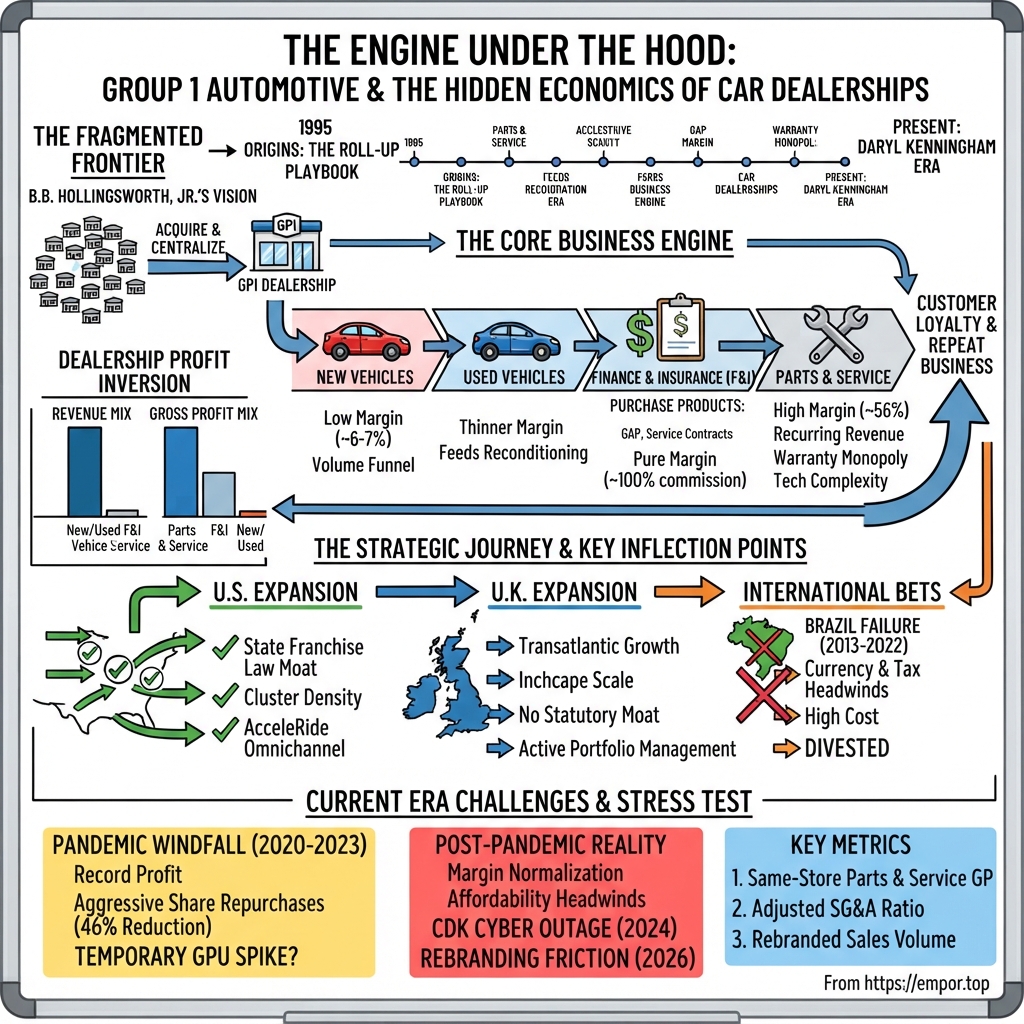
The Engine Under the Hood: Group 1 Automotive and the Hidden Economics of Car Dealerships
I. Prologue & Episode Roadmap
Walk into a Group 1 Automotive dealership on a Tuesday morning in Houston, and the first thing a visitor notices is that almost nobody is buying a car. The showroom floor is quiet. Two salespeople hover near the coffee machine. A couple circles a mid-trim crossover, opening and closing the tailgate as though the hinge might reveal something about the purchase.
Then walk around to the back.
The service drive operates in an entirely different gear. Vehicles are stacked three deep waiting for an intake lane. Service advisors with tablets write repair orders as quickly as they can type. Inside the shop, roughly two dozen technicians work under hydraulic lifts on brake replacements, transmission diagnostics, advanced driver assistance system (ADAS) recalibrations, and a manufacturer recall campaign reimbursed at a negotiated fleet labor rate. Nobody in that building is haggling over pricing. Nobody is asking for a discount on a cabin air filter.
That operational contrast captures the underlying reality of auto retail, running counter to how the general public and many generalist investors misunderstand the business model.
The illusion of selling metal
The consensus mental model of auto retail depicts dealerships as cyclical, low-margin middlemen. In this view, operators are hostages to automakers in Detroit, Tokyo, and Stuttgart, forced to buy inventory they cannot dictate, finance it with expensive floorplan debt, and grind out a few hundred dollars per vehicle by wearing down consumers over a Saturday afternoon. When interest rates rise or consumer spending weakens, the narrative assumes the model breaks.
While individual elements of that depiction are grounded in reality, the overarching conclusion is flawed.
Group 1 Automotive (NYSE: GPI) closed 2024 with roughly $19.9 billion in revenue and about $3.1 billion in gross profit.1[^2] New and used vehicle sales collectively generated more than 80% of that top-line revenue, but those same sales accounted for only about a third of total gross profit. The remaining two-thirds flowed from two segments that barely register on the top line: Parts & Service — internally branded as Customer Care — and Finance & Insurance (F&I).1
Put plainly: the vehicle sale serves as the customer acquisition cost, while the service bay and the finance office generate the enduring profit.
This is not a corporate narrative devised to deflect attention from narrow vehicle margins. It is documented directly in the segment disclosures of every publicly traded dealership group's 10-K, as it has been for decades. The dynamic is obscured primarily by statutory revenue accounting: a retailer must book the entire $52,000 invoice price of a pickup truck as gross revenue, but books only the $2,000 financing commission from that same transaction. While the truck sale might carry a 6% gross margin, the financing commission carries a 100% gross margin because it incurs no cost of goods sold.
The scale of GPI today
By mid-2026, Group 1 operated slightly more than 260 dealership franchises across the United States and the United Kingdom, with its domestic footprint concentrated in Texas and the Sunbelt, and its British footprint centered across England's southern and midland corridors.1 The company has become an established transatlantic operator: in the second quarter of 2026, the U.K. accounted for 27.7% of all new vehicle units sold.2
Full-year 2025 marked the company's highest total throughput on record, generating $22.6 billion in revenue, an increase of 13.2%, and $3.6 billion in gross profit.3 The operating environment in 2026, however, proved more challenging. First-half revenue of $10.8 billion contracted 3.7% year over year, and second-quarter adjusted diluted earnings per share fell 16.6% to $9.61, missing consensus expectations.2 Management attributed the shortfall to compressed consumer affordability, tight used-vehicle sourcing conditions, and operational friction stemming from an internal dealership rebranding campaign.4
That performance reflects the structural reality of the business: Group 1 is not a frictionless compounder, but a high-operating-leverage retailer navigating an earnings normalization cycle while managing multiple capital allocation initiatives across distinct regional markets.
Why this story matters now
Four industry currents converged on automotive retail by 2026, placing Group 1 directly at their center.
The first is the conclusion of the pandemic-era pricing surge. Gross profit per unit (GPU) on new vehicles, which rose above $5,000 during the acute semiconductor shortages, has declined steadily for three years. Group 1's new-vehicle GPU dropped to $3,370 across full-year 2025 and fell further to $3,254 in the second quarter of 2026, down another 8.5% year over year.32 The broader margin profile is continuing its post-pandemic normalization.
The second is affordability. Elevated vehicle transaction prices, higher auto loan rates, and a growing cohort of buyers carrying negative equity into trade-ins have shrunk the pool of qualified buyers. On its second-quarter 2026 earnings call, management characterized strained household budgets as an ongoing headwind for both new and used vehicle volumes, observing that acquiring used inventory had become significantly more difficult because prospective trade-ins were frequently underwater.4
The third is operational technology vulnerability. The sector confronted this systemic dependency in June 2024, when a cyberattack on CDK Global — the primary dealer management software provider across the industry — paralyzed core back-office, contracting, and scheduling workflows at roughly 15,000 North American dealerships for several weeks.56
The fourth is the long-term viability of geographic expansion. Group 1 has tested international consolidation twice with divergent outcomes. The company spent nine years and substantial capital pursuing an expansion into Brazil before ultimately withdrawing. In August 2024, however, it expanded aggressively in another direction, completing the £346 million (approximately $439 million) acquisition of Inchcape plc's U.K. retail business, roughly doubling its British presence at a time when many peers were moderating their M&A exposure.[^3]7
The roadmap
Four central questions frame this analysis: How did an executive trained in funeral-home consolidation assemble a Fortune 300 automotive retailer? How do dealership unit economics actually function across metal sales, high-margin customer care, and financing commissions? What does the company's uneven M&A record — from Brazil to major acquisitions like Prime, Inchcape, and Hennessy — demonstrate about capital allocation discipline? And what operational metrics will determine whether the current corporate strategy succeeds or falters?
The narrative begins where all consolidation plays start: with a highly fragmented industry and an operator adapting a proven roll-up playbook.
 Subscribe on LinkedIn
II. Origins: The Roll-Up Playbook Meets the American Car Lot (1995–2005)
In 1995, acquiring an American car dealership typically began with lunch at a local country club with an owner in his sixties whose father had founded the business. He owned the real estate, held the franchise rights, and commanded the community goodwill built over decades of sponsoring youth sports teams. But he also faced a succession dilemma: his children either had no interest in running the store or lacked the capital to buy him out at a valuation that could fund his retirement.
Across roughly twenty thousand franchised dealerships nationwide, that scenario defined the retail automotive landscape of the mid-1990s: a profitable, highly fragmented industry confronting an industry-wide succession cliff.
The fragmented frontier
Three structural pressures accelerated industry consolidation.
The first was rising capital intensity. Automakers were beginning to mandate expensive, brand-standard facility overhauls—requiring specific architecture, uniform signage, and specialized service-bay configurations that could cost a single dealership several million dollars. Working-capital demands also expanded as vehicle trim lines proliferated, while dealership management software transitioned from physical file cabinets to proprietary mainframe systems.
The second was a widening financing gap. An independent dealer borrowed against personal guarantees at regional bank rates. By contrast, a publicly traded consolidator with an investment-grade-adjacent credit profile could secure floorplan credit facilities at institutional borrowing rates. In a business requiring roughly $50 million of vehicle inventory on the lot at any given time, a 150-basis-point interest-rate advantage was not a minor accounting variance—it represented a structural earnings advantage every month.
The third was cash-flow stability. Dealerships generated remarkably durable cash flows, anchored by high-margin parts and service operations. That combination of recurring cash generation, fragmented ownership, succession-driven sellers, and financing arbitrage provided the classic foundation for a corporate roll-up strategy.
The unlikely architect
B.B. Hollingsworth Jr. had already executed this roll-up playbook in another fragmented sector.
Hollingsworth had served as president of Service Corporation International, the Houston-based company that rolled up thousands of independent funeral homes into a national enterprise. The structural thesis was identical: family-owned businesses, succession hurdles, localized customer loyalty, steady demand, and private operators lacking reliable valuation benchmarks because no public comparables existed. Service Corporation International acquired family-owned funeral homes at low-to-mid single-digit multiples of earnings before interest, taxes, depreciation, and amortization (EBITDA), removed redundant back-office overhead, clustered facilities regionally to share fleet vehicles and mortuary equipment, and centralized debt financing and procurement.
Applying that framework to retail automotive, Hollingsworth founded Group 1 in Houston in 1995 and took it public on the New York Stock Exchange in October 1997.[^13] The funeral home playbook translated directly: acquire cash-generative dealerships at private-market valuations between 4x and 6x EBITDA, eliminate duplicative accounting and administrative overhead, pool regional marketing budgets, and refinance floorplan debt onto the parent company's lower-cost credit facilities. The valuation spread between what an independent store was worth to a retiring dealer and how a diversified consolidator was valued in public equity markets served as the primary engine of early returns.
The first public wave
Group 1 was not alone. The late 1990s produced an entire class of public consolidators: Wayne Huizenga's Republic Industries, which became AutoNation and briefly attempted to reshape used-vehicle retail with a national format; Sonic Automotive in Charlotte; Lithia Motors in Oregon; Penske Automotive Group; and later Asbury Automotive Group. Six public consolidators pursued the same fragmented market.
The competing groups diverged almost immediately on branding strategy: whether to change the sign out front.
AutoNation's initial strategy prioritized building a national consumer brand around a single banner and standardized megastores. Group 1 took the opposite approach. When it acquired Houston-based Sterling McCall, it kept the Sterling McCall name on the building. As it purchased regional operators, it preserved their legacy signage, general managers, and local reputations, while standardizing back-office operations that retail buyers never saw: the general ledger, dealer management software, floorplan borrowing lines, and captive insurance programs.
Group 1's thesis held that dealership goodwill was hyper-local and non-transferable. A car buyer in Houston cared little about the corporate holding company; they cared that their family had bought trucks from the same sales team for decades. Removing the legacy name risked destroying the community goodwill the company had just acquired.
Decades later, Group 1's leadership reversed that philosophy to pursue a unified corporate brand—a decision that would eventually re-emerge as a driver of operational friction during the 2026 normalization cycle.
Early structural limits
Automakers viewed this consolidation wave with caution. From an original equipment manufacturer's (OEM) perspective, a publicly traded retailer controlling dozens of dealerships gained sufficient bargaining leverage to push back against vehicle allocations, mandatory facility overhauls, and warranty labor reimbursement rates. In response, manufacturers such as Ford and Toyota established framework agreements that capped the number of franchises a single public group could own nationally and within individual metropolitan markets. These ownership caps created a tangible ceiling on domestic expansion, helping explain why Group 1 eventually pursued international acquisitions.
By 2005, the founding chapter had drawn to a close. Hollingsworth stepped down as chief executive, and the board selected a successor from the manufacturer side of the auto industry to guide the next phase of the company's expansion.
III. The Hesterberg Era & The International Ambitions (2005–2022)
Earl Hesterberg arrived at Group 1 in 2005 carrying an unusual résumé for an automotive retailer: he had spent his career as the executive dealers complained to.
Before joining Group 1, Hesterberg served as Ford Motor Company's Group Vice President of North American Marketing, Sales and Service—the corporate officer who allocated wholesale vehicle shipments, structured dealer incentive programs, and adjudicated franchise disputes. Earlier in his career, he had led Nissan's European operations. He understood OEM operational dynamics from the inside: how regional managers handled vehicle allocations, how volume-driven stair-step bonus programs functioned, and which facility overhaul demands were open to negotiation.
For a consolidator whose primary operational dependency was maintaining favorable standing with major automakers, appointing a former manufacturer sales chief functioned as a deliberate supplier-relations strategy.
Surviving 2008
Hesterberg confronted his first systemic test three years into his tenure. The U.S. seasonally adjusted annual rate (SAAR) of light vehicle sales collapsed from roughly 16 million units to 10.4 million during the Great Recession. General Motors and Chrysler entered bankruptcy restructuring. Automakers terminated thousands of franchised dealerships through bankruptcy court proceedings, pruning retail distribution networks that state franchise laws had previously protected.
Franchised dealerships survived the downturn through the countercyclical strength of their aftersales operations. When new vehicle transactions halted, vehicle owners continued servicing existing cars. Customer-pay repairs, scheduled maintenance, and manufacturer-paid recall campaigns continued uninterrupted. Group 1 reduced selling, general, and administrative (SG&A) expenses, expanded throughput across its service drives, and maintained institutional floorplan credit lines while independent dealers faced credit withdrawals from regional banks.
The downturn established an operational blueprint for the consolidator: vehicle sales remain cyclical, parts and service revenues prove defensive, and operators that control fixed overhead through demand troughs can acquire distressed dealerships from competitors that cannot.
The international thesis
By the late 2000s, Group 1 encountered internal and regulatory limits on domestic expansion. Platform acquisitions grew increasingly competitive as the six public dealership groups targeted the same regional sellers, while OEM framework agreements restricted the market share an individual consolidator could hold within single metropolitan markets. If a dealership group could no longer add stores in Dallas and refused to overpay for assets in Atlanta, capital allocation required alternative geographic outlets.
Management initially targeted the United Kingdom. Group 1 entered the British market in 2007 by acquiring luxury franchises, including BMW, MINI, Audi, and Jaguar Land Rover. The structural thesis aligned closely with its domestic operations: the British dealer network was highly fragmented, premium-brand sales carried favorable margins, and financial statements shared the same four-segment architecture—new vehicles, used vehicles, parts and service, and financing commissions. Crucially, the U.K. lacked state-level franchise protection laws, allowing for more flexible network management, though offering fewer legal protections against OEM policy shifts.
Management pursued a second international expansion in Latin America. That initiative yielded an entirely different outcome.
The historical falsification layer: the Brazilian catastrophe
The investment thesis for entering Brazil in 2013 was widely embraced across the sector. The country exhibited an expanding consumer class, low per capita vehicle ownership, and an automotive retail network that appeared undersized relative to projected long-term demand. Management anticipated that emerging-market expansion would generate higher returns on invested capital than incremental market-share acquisitions in mature domestic regions like Texas.
In 2013, Group 1 acquired UAB Motors Participações Ltda. for approximately $136 million in cash and stock plus assumed debt, subsequently expanding the platform to roughly 17 dealerships representing Toyota, Honda, BMW, and Jaguar Land Rover badges.[^5]
The operational and macro assumptions underpinning the acquisition quickly deteriorated.
Currency depreciation surfaced first. The Brazilian real steadily weakened against the U.S. dollar over the holding period. As a result, stable local-currency operating results converted into shrinking dollar-denominated earnings alongside recurring foreign-exchange translation losses. For a U.S.-listed corporation, hedging long-term emerging-market currency depreciation over a multi-year horizon was cost-prohibitive.
The inventory financing model deteriorated next. The roll-up model's economics rely heavily on low-cost inventory floorplan financing. In Brazil, benchmark central bank interest rates spent extended periods in double digits. Floorplan interest cannot be eliminated through conventional corporate cost reductions; it is a mathematical function of inventory carrying days multiplied by prevailing interest rates. Elevated borrowing costs eroded gross vehicle retail margins.
The cost structure presented further complications. Brazil's complex indirect tax regime—incorporating state ICMS levies alongside federal PIS and COFINS assessments—combined with an active labor litigation environment to require dedicated local compliance infrastructure. The back-office operational synergies that typically justify retail consolidation failed to materialize because the administrative overhead was legally mandated by local regulatory frameworks.
Finally, statutory franchise protections were absent. While U.S. state statutes establish rigorous legal thresholds preventing automakers from arbitrarily terminating dealer agreements, Latin American distribution contracts afforded no comparable operational safeguards.
The venture produced nine years of financial drag, characterized by repeated goodwill impairment charges, operational losses, and depressed consolidated returns on invested capital. In July 2022, Group 1 completed the divestiture of UAB Motors to Original Holdings S.A., an affiliate of Simpar S.A., for 510 million Brazilian reais—approximately $96 million in cash—recording a loss on the transaction.[^5] Management acknowledged that the Brazilian platform could not achieve sustainable operational scale or critical mass within the market.[^5]
The broader lesson extends beyond the general observation that cross-border retail expansion involves execution risk. Rather, it demonstrated that the structural advantages that make American dealership consolidation work are legal and financial artifacts of the American market, not properties of the dealership business itself. Low-cost floorplan debt, state franchise statutory protections, and currency stability represent the operational foundation of the domestic roll-up model. Without them, the business model reduces to a capital-intensive retailer of imported manufactured goods carrying expensive floating-rate inventory debt.
This distinction is essential for assessing Group 1's subsequent consolidation in the United Kingdom. While the British market offers credit stability and currency liquidity comparable to the United States, it lacks statutory franchise protections, leaving dealer networks more directly exposed to OEM distribution shifts.
The 2021 megadeal: Prime Automotive
Group 1's other primary transaction during this era took an alternate path: acquiring high-performing domestic retail assets out of operational distress.
In September 2021, Group 1 agreed to acquire Prime Automotive Group—a portfolio of roughly 30 dealerships across New England and the Mid-Atlantic generating approximately $1.8 billion in annualized revenue—for $880 million.[^6] At less than 0.5 times annual revenue, the transaction represented an attractive headline valuation multiple for an established regional dealership footprint.
The platform was available at that valuation because Prime's parent company, GPB Capital Holdings, was subject to regulatory enforcement actions and federal court-appointed receivership following allegations of investor fraud and financial mismanagement. Completing the acquisition required navigating complex legal diligence and regulatory approvals that deterred other strategic bidders.
The integration required post-closing adjustments. Group 1 addressed subsequent litigation, including the 2023 Prime Subaru Manchester settlement, and pruned several non-core locations from the acquired portfolio. Strategically, however, the transaction established an immediate, high-volume operational cluster in the Northeast, expanding Group 1's retail footprint beyond its historical concentration in the Sunbelt.
The M&A record under Hesterberg was ultimately defined by two contrasting outcomes: a protracted, value-dilutive international expansion in Brazil that management held for nearly a decade before divesting, paired with an opportunistic, complex domestic turnaround acquisition that established regional scale. That mixed operational record established the baseline for the larger capital deployment initiatives pursued by subsequent leadership.
Before Hesterberg concluded his tenure, however, the automotive retail sector encountered an unprecedented market shift: an eighteen-month period during the global pandemic in which the underlying economics of vehicle retailing completely inverted.
IV. The Pandemic Profit Explosion & The Great Capital Cannibalization (2020–2023)
In March 2020, dealership general managers across Texas were calculating how many weeks of payroll they could cover while showrooms remained shut. Dealership personnel were furloughed, discretionary capital expenditures were halted, and every publicly traded dealer group drew down revolving credit facilities as a liquidity buffer. The initial consensus anticipated a severe demand contraction in the economy's most discretionary big-ticket category.
Instead, the automotive retail sector entered the most profitable period in its history.
The economics of scarcity
The disruption originated on the supply side rather than with demand. Expecting an extended downturn, automakers cancelled semiconductor orders in the spring of 2020. Semiconductor foundries promptly reallocated that production capacity to booming consumer electronics. When retail vehicle demand rebounded rapidly—buoyed by fiscal stimulus, suburban migration, and consumer avoidance of mass transit—automotive assembly plants were unable to restore full production volumes.
Dealership inventories fell from historical levels of 60 to 75 days of supply to fewer than 20 days, with several high-demand brands dropping below 10 days. Dealership lots that historically held 400 vehicles were frequently reduced to 40.
The fundamental unit economics of vehicle retailing transformed overnight. Consumer discounting disappeared, replaced by widespread dealer markups above manufacturer suggested retail prices (MSRP). Floorplan interest expense declined sharply because vehicles sold almost immediately upon delivery, leaving minimal inventory to finance. Dealerships reduced advertising budgets because available inventory required little marketing support, and sales commissions fell as transactions required minimal price negotiation.
New-vehicle gross profit per unit, which had historically hovered between $1,800 and $2,200 across the industry, surged past $5,500 at the peak of the supply shortage.
What it did to the financials
The operational windfall showed up immediately in Group 1's reported earnings. Consolidated revenue surpassed $16 billion in 2022 and reached $17.9 billion in 2023. Operating margins roughly doubled from their pre-pandemic baseline of 3.5% to 4.0% to more than 7.5%, generating unprecedented levels of free cash flow.
How management deployed that cash windfall provides an instructive case study in modern corporate capital allocation.
The capital allocation masterclass — with an asterisk
The cash influx coincided with an equity market anomaly: skeptical that pandemic-era profitability could endure, public equity markets declined to capitalize peak earnings. Through 2021 and into 2024, Group 1 traded at mid-single-digit price-to-earnings multiples on trailing results, reflecting investor assumptions that industry earnings would rapidly mean-revert.
Management took the counter-position, deploying operating cash flows into aggressive share repurchases. Between 2014 and early 2025, Group 1 reduced its diluted share count from approximately 24.5 million shares to roughly 13.2 million—a cumulative reduction of approximately 46%.1 For long-term shareholders who maintained their positions throughout that period, the repurchases nearly doubled their proportional ownership of the company's underlying dealership portfolio, real estate, and service capacity without requiring incremental capital.
That repurchase program continued even as vehicle margins began their post-pandemic descent. Across full-year 2025, Group 1 retired 1.34 million shares—representing roughly 10.1% of total shares outstanding—for $554.8 million at an average repurchase price of $413.05.3
Retiring a tenth of a company's equity base in twelve months represents substantial capital deployment, though its long-term merit depends on normalized earnings capacity. Repurchasing equity at single-digit multiples of cyclical peak earnings creates shareholder value only if normalized through-cycle cash flow supports the purchase price. Group 1 executed those 2025 repurchases at an average price of $413 per share during a fiscal year in which new-vehicle margins were contracting and adjusted diluted earnings per share grew by 3.8%.3 The ultimate return on that capital will be determined by normalized earnings power across the balance of the decade rather than the immediate reduction in share count.
Subsequent corporate actions also establish clear boundaries around the repurchase strategy. During the first half of 2026, share repurchases slowed to $72.4 million—retiring approximately 1.7% of outstanding shares—and the company executed no repurchases during the second quarter.2 On its second-quarter 2026 earnings call, management confirmed that buybacks would remain paused until leverage metrics normalized following the closing of its pending dealership acquisition in Atlanta.4
The broader capital allocation record indicates that while Group 1 has demonstrated an enduring commitment to share repurchases over a ten-year horizon, that program remains subordinate to major M&A transactions when platform acquisitions compete for balance-sheet liquidity.
The historical falsification layer: the "permanently higher GPU" myth
During 2021 and 2022, an optimistic thesis gained traction among equity analysts and dealership investor presentations: that automotive retail had undergone a permanent structural transformation. Proponents argued that automakers had adopted lasting production discipline, that lean inventory management would persist indefinitely, and that new-vehicle gross profit per unit would establish a permanent structural floor between $3,500 and $4,000 rather than reverting to pre-pandemic baselines.
The thesis overlooked the structural incentives governing original equipment manufacturers. Automakers operate with high fixed operating leverage tied to assembly facilities, specialized tooling, long-term supplier commitments, and union labor contracts. When an auto assembly plant operates at subdued capacity utilization, fixed overhead quickly erodes corporate profitability. Once automotive supply chains and semiconductor deliveries stabilized, the competitive imperative for individual manufacturers shifted back toward maximizing plant utilization and protecting retail market share.
Vehicle production accelerated through 2023 and 2024, leading to inventory accumulation across the retail channel, particularly in full-size domestic pickups and battery-electric models that exceeded near-term consumer absorption.
Group 1's financial disclosures trace this margin reversion. New-vehicle gross profit per unit declined from peak levels, falling through roughly $3,200 by late 2023, dropping below $3,000 during portions of 2024, settling at $3,370 across full-year 2025, and falling to $3,254 in the second quarter of 2026—a year-over-year contraction of 8.5%.32 Used-vehicle retail gross profit per unit underwent a similar trajectory, averaging $1,478 for 2025 and recording $1,532 in the second quarter of 2026.32
Management adjusted its strategic messaging across quarterly conference calls, pivoting away from arguments regarding permanent vehicle pricing power toward areas under internal operational control: overhead cost discipline, dealership consolidation, and aftersales service lane retention. The thesis that vehicle shortages had permanently reset metal retailing margins was disproved by disclosed market results.
That realization redirects strategic focus to the dealership operations that historically insulated the business from vehicle margin volatility: aftersales servicing and financing.
V. The Real Business: The Hidden Margin Engine of Dealership Economics
Here is a thought experiment that clarifies the entire sector.
Imagine two dealerships. The first sells 2,000 new cars a year and has eight service bays. The second sells 1,000 new cars a year and has forty service bays running at full technician capacity. The first store has twice the revenue. The second store is worth considerably more money.
Understanding why requires taking the dealership apart into its four distinct businesses, which happen to share a parking lot and a sign but otherwise have almost nothing in common.
The revenue illusion, quantified
On roughly $19.9 billion of 2024 revenue, new vehicles contributed about half, used vehicles roughly 31%, parts and service about 12%, and F&I around 4%, with wholesale making up the remainder.1
On roughly $3.1 billion of gross profit, the ordering inverts almost completely: parts and service contributed around 41%, F&I around 26%, new vehicles around 21%, and used vehicles around 12%.1
Two lines of business worth 16% of revenue produce 67% of gross profit. Any valuation framework that anchors on revenue multiples or on unit volumes is measuring the wrong thing.
Engine 1: Parts & Service — the golden goose
The service department is a high-margin, non-discretionary, recurring-revenue business hiding inside a retailer.
The scale is easy to state and hard to overstate. In full-year 2025, parts and service generated $2.84 billion of revenue — up 14.2% — and $1.6 billion of gross profit, up 15.9%, at a gross margin of 55.7%.3 In the second quarter of 2026, with vehicle sales falling across the board, parts and service still delivered $389.0 million of gross profit at a 56.2% margin.2
Fifty-six percent gross margins. On a business the customer cannot easily avoid.
Three mechanisms protect those margins, and they are worth explaining carefully because they are the substance of the investment case.
Technical complexity. A 2015 sedan could be diagnosed by a competent independent mechanic with a generic OBD-II scanner. A 2026 vehicle cannot. Modern cars are distributed computer networks on wheels: dozens of electronic control units communicating over proprietary buses, with advanced driver-assistance systems whose cameras and radar require physical recalibration after something as mundane as a windshield replacement. Doing that work correctly requires the manufacturer's diagnostic software, the manufacturer's calibration targets, a technician certified on that specific brand, and often a live connection to the manufacturer's servers. The independent corner garage is being priced out of the late-model vehicle not by competition but by engineering.
The warranty monopoly. Factory warranty repairs and safety recall campaigns can only be performed and reimbursed at franchised dealerships. This is not a competitive advantage the company earned; it is a legal structure. When a manufacturer issues a recall on 800,000 vehicles, every one of those repair orders must flow through a franchised service lane, with the manufacturer paying the bill. It is the closest thing in retail to guaranteed demand from a creditworthy counterparty.
Technician capacity as the binding constraint. This is the point most outside observers miss. The limiting factor on service revenue is almost never customer demand. It is how many certified technicians you can hire, train, and keep. A master technician on a German luxury brand takes years to develop and is aggressively recruited. Every unfilled bay is permanently lost gross profit, because a repair order not written on Tuesday does not get written twice on Wednesday. This is why Group 1 talks constantly about technician headcount and retention, and why the Atlanta acquisition it announced in 2026 was described partly in terms of its 500 service bays and roughly 280 technicians rather than its sales volume.8
There is a counterweight worth naming in the same breath. On the second-quarter 2026 call, management explicitly tempered expectations for parts and service growth, citing changing customer behavior and increased aftermarket competition, even while reporting roughly 4% customer-pay revenue growth.4 Second-quarter parts and service gross profit was actually down 3.4% year over year.2 The golden goose is real; it is not immune to the cycle, and management's own guidance language has become more cautious than it was a year earlier. That shift in tone is itself a data point.
Engine 2: Finance & Insurance — pure operating leverage
If parts and service is the annuity, F&I is the alchemy.
When a customer agrees to buy a vehicle, they move into a small office to sign paperwork. What happens there is that the dealership acts as a broker in two separate transactions. First, it arranges financing — submitting the credit application to a panel of lenders, receiving a "buy rate," and writing the contract at a marked-up "sell rate," keeping a regulated portion of the spread. Second, it sells products: extended vehicle service contracts, guaranteed asset protection insurance covering the gap between loan balance and insured value in a total loss, tire and wheel coverage, paint protection.
Because the dealership is an intermediary rather than a principal on most of these, there is essentially no cost of goods sold. F&I revenue is gross profit. In full-year 2025, F&I generated $934.6 million of revenue at a per-unit average of $2,036 — up 1.6% in a year when vehicle margins fell.3
That resilience is informative. F&I per-unit economics are a function of attachment rate and product mix, not vehicle scarcity. They held up through the entire normalization of metal margins, and in the second quarter of 2026 F&I PRU was $2,030, down just 1.0% even as new GPU fell 8.5%.2
Two caveats belong here rather than in a distant risk section. F&I is the most regulated and most reputationally exposed part of the business, subject to recurring federal and state scrutiny of markup practices and add-on product sales; a rule change affecting dealer participation in finance spreads would hit a nearly-pure-margin profit pool. And F&I income is mechanically tied to units sold — it is high-margin, but it is not counter-cyclical. When volumes fall, as they did 4.4% in new and 11.2% in used retail in the second quarter of 2026, F&I gross profit falls with them.2
Group 1 has also expanded a virtual F&I platform to more than 40% of its stores, centralizing the finance office remotely rather than staffing it at every location.2 That is a cost-structure play as much as a revenue one, and it is worth watching as an indicator of whether F&I productivity can be industrialized.
Engines 3 and 4: new and used vehicles — the acquisition funnel
New vehicle retail is the largest revenue line and the weakest economic one: roughly 6.7% gross margins in the second quarter of 2026, with outcomes dependent on manufacturer allocation decisions, stair-step volume incentives that can flip a month's profitability at quarter-end, and floorplan interest costs that rise precisely when inventory is hardest to move.2
Used vehicles are thinner still, but strategically different. Every trade-in is three things at once: a discount mechanism on the new sale, a unit of inventory the dealer sourced without bidding against anyone at auction, and a reconditioning work order that flows straight into the service department at internal transfer pricing. A well-run used operation is a feedstock supply for the high-margin businesses.
Which is why the 2026 used-vehicle sourcing problem matters more than the headline suggests. Management described on the second-quarter call a market in which customers arrive with more negative equity — owing more than the trade is worth — which suppresses trade-in volume, and acknowledged that appraisal practices needed to improve.4 Notably, leadership said it would rather protect margin than replenish inventory by buying at auction.4 That is a defensible discipline. It is also, mechanically, a decision to accept lower volume, and therefore lower F&I and lower reconditioning throughput, for some period.
The digital layer: AcceleRide
Group 1 built AcceleRide as its online retail platform — complete digital purchase, trade valuation, financing application, and home delivery — largely as a response to Carvana's emergence.
It deserves proportionate framing, which means resisting the temptation to call it a technology asset. AcceleRide is not a separable, asset-light software business and has never been presented as one. It is an omnichannel funnel: it captures online shoppers, converts leads, and routes them into physical stores where the service relationship — the actual profit pool — begins. Its contribution should be judged through inventory turn velocity and lead conversion, not as standalone technology value.
The four engines together explain why the company survives downturns that kill single-point dealers. They do not, by themselves, explain why this company should outperform the five other public groups running the identical model. That question has become more urgent under current management, which has made three large and genuinely debatable bets.
VI. The Current Era: Daryl Kenningham, The Inchcape Mega-Deal, and Tech Shocks (2023–Present)
On January 1, 2023, Daryl Kenningham assumed leadership of Group 1 at the cyclical peak of its profitability. Taking the helm at that juncture represented an unenviable handoff: every subsequent operating period would inevitably be evaluated against financial comparisons inflated by a pandemic-driven supply shortage that no retailer had created and none could duplicate.
The operator
Kenningham was not an outside financial engineer brought in to overhaul the balance sheet. He joined Group 1 in 2011, directed U.S. operations, and served as Chief Operating Officer from 2017 through 2022 before his appointment as chief executive. His earlier automotive career included leadership roles at Nissan and Gulf States Toyota—the latter a major private vehicle distributor, offering a vantage point positioned directly between factory leadership and retail dealers.
As outlined in proxy filings, Kenningham's compensation package has been heavily weighted toward performance-contingent equity awards and operational milestone bonuses, with direct insider equity holdings representing a modest share of total equity.9 That structure aligns with prevailing industry practices, reflecting standard corporate governance rather than an outlier alignment model.
Alongside Kenningham, Chief Financial Officer Daniel McHenry—appointed in 2020 after previously serving as finance director for Group 1's British division—offered a clear operational signal regarding future capital deployment.9 Elevating the head of U.K. finance to group CFO four years before doubling down on the British market signaled long-term geographic intent.
Strategic continuity from the Hesterberg era remained evident: disciplined return hurdles on acquisitions, avoidance of speculative greenfield facility developments, dense regional clustering, and persistent benchmarking of transaction multiples against the baseline return of share repurchases. Under Kenningham, however, the absolute scale of balance-sheet commitments expanded, accompanied by a willingness to challenge established operational norms—most notably by reconsidering the legacy dealership names displayed on storefronts.
The transformative U.K. megadeal
On April 15, 2024, Group 1 agreed to acquire the retail automotive division of Inchcape plc for £346 million (approximately $439 million) in cash.[^3] The transaction closed on August 1, 2024.7
The operational rationale rested on three strategic pillars.
Scale. The acquisition incorporated 54 dealership locations generating roughly £2.1 billion (approximately $2.7 billion) in annual turnover, expanding Group 1's British retail network beyond 100 locations.[^3] The U.K. operation evolved from an international outpost into a primary reporting segment: across full-year 2025, British revenue totaled $5.94 billion, up 42.8%, generating $811.9 million in gross profit, an increase of 45.0%, on 61,905 new vehicle retail units.3
Asset backing. The purchase agreement encompassed approximately £220 million (approximately $279 million) of appraised dealership real estate.[^3] Excluding the physical property, the effective purchase price for the operating business—which generated £2.1 billion in revenue and £49 million in 2023 adjusted operating profit—equated to roughly £126 million. That implied an entry multiple of roughly 7.1 times operating profit and approximately 0.16 times revenue, substantially below prevailing acquisition multiples for comparable domestic dealership platforms.
Competitive timing. The expansion mirrored Lithia Motors' purchase of Pendragon, formalizing a consolidation race between American operators seeking critical mass across the British automotive retail landscape.
The transaction invites an operational comparison with past initiatives: did this expansion address the structural pitfalls that derailed the Brazilian venture?
Three critical deficiencies from the Brazilian expansion are resolved in the United Kingdom: a liquid, hedgeable currency; institutional access to low-cost inventory floorplan financing; and a mature commercial legal system in which Group 1 had operated continuously since 2007. Management was not entering an unfamiliar jurisdiction without local infrastructure; the company possessed seventeen years of domestic operational familiarity and had already integrated its former regional finance chief into the corporate executive suite.
The remaining divergence, however, carries structural implications. The United Kingdom possesses no statutory equivalent to American state franchise protection laws. An automotive manufacturer operating in Britain can legally modify its distribution architecture, transition toward direct-to-consumer agency sales models, or terminate franchise agreements under contractual conditions that would violate franchise statutes in Texas. The statutory moat that anchors dealership profitability in the United States does not apply across the nearly 28% of Group 1's new vehicle volume generated in Britain.
Operating results through mid-2026 present a nuanced picture. The U.K. division achieved record revenues and record gross profit across used-vehicle sales and parts and service during the first quarter of 2026, accompanied by widening margins.10 However, portfolio integration required substantial cash outlays: Group 1 recognized $28.4 million in restructuring expenses throughout 2025, and during the second quarter of 2026 it divested four British Jaguar Land Rover franchises that represented approximately $330 million in annual turnover.32 Concurrently, the company initiated retail partnerships with Chinese automakers, opening its initial U.K. Geely showroom in June 2026, with two additional sites under development.2
These moves reflect active portfolio rationalization rather than seamless corporate integration. At this stage, the U.K. consolidation thesis remains not falsified, and not yet proven. The primary operational test over the medium term will be whether British operating margins can converge toward domestic U.S. levels, rather than remaining pinned near the lower baseline that initially made the assets available at discounted multiples.
The rebranding bet — and a self-inflicted wound
Alongside cross-border expansion, leadership initiated a project that broke with thirty years of company practice.
Group 1 began phasing out the regional dealership banners it had accumulated over decades—revered local names such as Sterling McCall, Hub City, and Rivertown—to unify storefronts under the Group 1 corporate brand. By mid-2026, the rebranding program had surpassed 60% completion, encompassing more than 60 domestic locations and over half of U.S. retail sales volume, with major Texas metropolitan clusters fully converted.21112
The corporate rationale is conventional: a single unified brand concentrates regional advertising spend rather than diluting marketing dollars across separate banners, streamlines technician and sales recruitment, and maintains customer continuity when vehicle owners relocate between regional markets.
The strategic risk is that local goodwill represents capitalized economic value, and organic search engine positioning depends heavily on historical local domain authority and regional citations.
Second-quarter 2026 results highlighted the operational hazards of that pivot. Management disclosed that about two-thirds of the decline in same-store new vehicle sales came from the branding transition and related search issues.4 Leadership told investors that the operational friction was temporary and would dissipate during the second half of 2026.4
That guidance provides a measurable performance benchmark. If same-store retail vehicle volumes across rebranded markets recover over late 2026 and early 2027, management's thesis will be supported by marketing efficiencies. If sales trajectories lag peer benchmarks, however, the enterprise will have traded localized customer equity already capitalized on its balance sheet for an expensive corporate branding campaign. While final evaluation requires subsequent operating data, the transitional disruption proved materially steeper than initial executive forecasts.
The historical falsification layer: the CDK Global cyber outage
A core narrative often advanced by public dealership consolidators is that corporate scale provides enterprise-grade IT infrastructure, sophisticated cybersecurity, and greater operational resilience than independent family-owned stores can maintain.
That premise faced an empirical test in mid-June 2024, when the BlackSuit ransomware syndicate shut down CDK Global, the dominant dealer management software provider handling core accounting, inventory management, customer financing submissions, and service-lane scheduling for roughly 15,000 North American dealerships—including Group 1.5
For nearly three weeks through the end of the second quarter, dealership operations reverted to manual, paper-driven workflows. Showroom staff wrote vehicle buyer orders by hand. Finance managers were unable to pull digital credit reports or transmit financing contracts to lending institutions. Service lanes recorded repair orders on legal pads, titling pipelines stalled, and customer vehicle deliveries halted because dealerships could not print the statutory paperwork required to release inventory.56
The analytical takeaway is clear: enterprise scale did not provide operational resilience; it concentrated operational vulnerability. While a single-point independent operator on CDK was sidelined, a multi-billion-dollar corporate consolidator running the identical software suffered simultaneous disruption across hundreds of rooftops, without an independent technical architecture to maintain operations. The presumed enterprise technology advantage of public dealer groups largely reflects volume purchasing agreements with shared commercial vendors rather than differentiated proprietary software.
The thesis of enterprise-level technological insulation is therefore substantially falsified in its strong form. The outage demonstrated an operational rather than technical capability: Group 1's dealership personnel adapted to manual workarounds and processed transaction backlogs within the subsequent quarter. For investors, the forward takeaway is that dealer management system concentration represents an ongoing, industry-wide operational exposure where corporate disclosure surrounding disaster recovery and system redundancy remains limited.
VII. The Moat Test: Porter's Five Forces & Hamilton Helmer's 7 Powers
Strip away the narrative and consider the fundamental strategic question that governs long-term capital returns: what prevents competitors from replicating this model and eroding returns over time?
For most conventional retailers, the answer is very little. Automotive retail differs from standard merchandising, but not always for the reasons market commentary suggests. Crucially, those structural advantages are unevenly distributed across the company's operating footprint.
Hamilton Helmer's 7 Powers, applied
Cornered Resource: U.S. state franchise protection law. This serves as the foundational power, and it is unusual because dealership groups did not create it. Across Group 1's core domestic markets—concentrated in Texas and across the Sunbelt—state statutes prohibit manufacturers from selling new vehicles directly to retail buyers, opening factory-owned stores within an established dealer's relevant market area, or terminating franchise agreements without protracted administrative proceedings that carry demanding evidentiary thresholds.
As a result, a franchised dealership in an expanding metropolitan area functions as a quasi-perpetual, legally protected right to distribute and service a manufacturer's vehicles across that territory. That regulatory shield explains why dealership "blue sky"—intangible value beyond physical assets—commands substantial valuation multiples. It represents a legally defended franchise entitlement rather than simple consumer goodwill.
The strategic boundary: this cornered resource does not exist in the United Kingdom, which accounts for more than a quarter of Group 1's new vehicle retail volume. Furthermore, the domestic moat has already been bypassed by non-franchised entrants: Tesla, Rivian, and Lucid built direct-to-consumer distribution models from inception, challenged state franchise restrictions in court, and captured market share in the premium vehicle segments where franchised dealers generate their highest margins. State franchise law shields dealers from unilateral policy shifts by their existing brand partners, but it offers no protection against direct-to-consumer manufacturers that never entered the franchise system.
Scale Economies: financing, reinsurance, and overhead. Group 1 accesses floorplan credit facilities at institutional borrowing spreads unavailable to standalone family-owned dealerships. Its captive reinsurance programs allow the company to retain underwriting profit on extended warranty and vehicle protection products that independent stores typically surrender to third-party underwriters—a durable, underappreciated profit center that scales directly with transaction volume. Corporate administrative costs, digital marketing spend, and the centralized corporate brand are spread across a broad retail base.
The competitive limit is that Group 1's five publicly traded peers possess identical scale advantages. This scale economy functions as a moat against independent private dealers, driving ongoing industry consolidation. It does not, however, confer a competitive advantage over AutoNation, Lithia, Penske, Sonic, or Asbury.
Switching Costs: the service relationship. Owners of late-model vehicles under factory warranty encounter meaningful friction when attempting to defect from franchised service drives. Warranty claim reimbursement requires dealer processing, advanced driver-assistance systems demand certified diagnostic tooling, and documented dealer service histories preserve vehicle resale value. This customer lock-in diminishes as vehicles age beyond factory warranty coverage—the exact phase where independent aftermarket repair shops compete aggressively on pricing, a dynamic management explicitly highlighted during the second-quarter 2026 earnings call.4
Absent powers. The business generates no structural network effects; a vehicle buyer in Houston derives no utility from Group 1 operating dealerships in Massachusetts or the United Kingdom. Corporate brand power has historically been negligible, as consumer loyalty attaches to the vehicle marque and the local dealership staff rather than the corporate holding company. The current rebranding campaign represents an effort to construct an enterprise brand asset the company historically lacked, though second-quarter 2026 results demonstrated that the transition creates measurable near-term sales friction.4
Porter's Five Forces
Supplier power: HIGH, and the defining operational constraint. Automakers dictate wholesale production volumes, model allocations, trim configurations, stair-step incentive thresholds, and franchise transfer approvals. Manufacturers enforce brand-standard facility image overhauls costing millions of dollars per rooftop and determine warranty labor reimbursement rates. A dealership's primary inventory input and underlying product demand are governed by a supplier whose corporate objectives only partially align with retail profitability. State franchise statutes mitigate contractual overreach, but they do not eliminate the structural leverage held by the factory.
Buyer power: HIGH on metal, LOW on service. Comprehensive digital pricing transparency across online marketplaces has established a ceiling on vehicle gross margins, driving the post-pandemic compression in gross profit per unit. Conversely, a vehicle owner facing a check-engine warning, complex sensor recalibration, or a mandatory safety recall has minimal bargaining power. The margin divergence between these two customer experiences forms the economic core of the dealership model.
Threat of substitutes: LOW across the core Sunbelt footprint. Across Texas, Oklahoma, and the wider Sunbelt, private vehicle ownership remains essential. Mass transit networks and ride-hailing services do not offer scalable alternatives across low-density, sprawling metropolitan corridors. The primary substitution threat is vehicle maintenance deferral—drivers retaining older vehicles longer during economic contractions—which ultimately channels incremental maintenance work back into the service lane.
Threat of new entrants: VERY LOW in franchised channels. Capital requirements ranging from $30 million to more than $100 million per location for real estate, facility construction, and floorplan inventory, combined with mandatory manufacturer vetting, make unvetted entry into franchised retail virtually impossible. The relevant entry risk emerges through alternative channels: direct-to-consumer electric vehicle manufacturers circumventing dealer networks entirely, and used-vehicle digital retailers targeting vehicle sales and financing commissions without the overhead obligations of physical service bays.
Competitive rivalry: HIGH for vehicle transactions, localized oligopoly for aftersales service. Six public dealership groups alongside major private dealership chains compete aggressively for vehicle inventory and retail customers. The mitigating factor is local physical density: within a defined trade area, the number of franchised service locations for any individual brand is legally constrained and economically bounded.
The synthesis
Group 1's competitive moat is real, structurally uneven, and narrower than broad retail consolidation narratives suggest. It is most defensible in the domestic service drive, where statutory protection, vehicle software complexity, and certified technician capacity converge. It is weakest in new-vehicle retailing, where digital price transparency and manufacturer supply adjustments have eroded retail pricing power. Finally, that protective moat is structurally thinner across the expanding United Kingdom division, where domestic statutory safeguards do not apply.
That split economic profile frames the operational stress test facing the enterprise.
VIII. Bear vs. Bull: The Investor Stress Test & Forward Falsification Radar
A skeptical investor evaluating Group 1 in September 2026 would look first at its second-quarter operating results, which gathered nearly every operational challenge into a single three-month window. Reported revenue contracted 5.6%, gross profit declined 8.0%, adjusted diluted earnings per share fell 16.6%, and consolidated selling, general, and administrative (SG&A) expenses as a percentage of gross profit deteriorated 341 basis points to 72.4%. Concurrently, management halted share repurchases while announcing a $1.3 billion domestic platform acquisition on the same morning.28
Those figures describe a retailer absorbing cyclical margin compression while committing balance-sheet liquidity to its largest domestic acquisition in a decade.
Bear Claim 1: EVs erode the aftermarket engine
The mechanism. A battery-electric vehicle (BEV) possesses far fewer mechanical wear parts than an internal-combustion equivalent: no motor oil, spark plugs, transmission fluid, timing belts, exhaust hardware, or fuel injectors. Regenerative braking systems also extend brake pad longevity. If battery-electric powertrains displace internal combustion across the national vehicle fleet, auto retail's highest-margin profit pool confronts structural, permanent volume erosion.
What the evidence actually supports. Three factors moderate that operational threat. First, electric vehicle adoption across Group 1's core Sunbelt footprint remains well below coastal adoption rates, extending the transition timeline over years rather than quarters. Second, battery-electric vehicles wear out tires and suspension components at higher rates due to heavy battery curb weights and instantaneous torque, while high-voltage battery thermal management systems require complex, capital-intensive diagnostics and repair. Third, hybrid powertrains—which combine an internal-combustion engine with an electric drivetrain—generate higher average repair order values than pure internal-combustion vehicles, and domestic hybrid sales growth has outpaced battery-electric vehicle adoption.
The calibrated conclusion. The bear claim is not rejected; it is deferred and narrowed. It is deferred because fleet turnover occurs gradually: with the average age of the U.S. light vehicle fleet standing at roughly 12.6 years, aggressive electric vehicle sales penetration requires more than a decade to materially alter service bay throughput.[^11] It is narrowed because mechanical erosion centers on routine internal-combustion maintenance, whereas structural collision repair, tire replacement, suspension work, software calibration, and high-voltage electrical diagnostics remain intact or expand.
However, deferral does not equal refutation, and the immediate operational risk differs from long-term fleet electrification. In the second quarter of 2026, Group 1's parts and service gross profit contracted 3.4% year over year, with executive leadership pointing to aftermarket competition and changing customer behavior rather than powertrain electrification.24 The primary near-term threat to aftersales margins stems from financially constrained consumers deferring discretionary maintenance or defecting to independent repair shops. Electrification mix represents a structural consideration for the 2030s; consumer trade-down represents the immediate margin test.
Bear Claim 2: the European agency model
The mechanism. Under an agency retail structure, the vehicle manufacturer retains inventory ownership and dictates retail pricing. The dealer transitions into an delivery and handling agent earning a fixed commission—typically in the mid-single digits as a percentage of vehicle transaction price—while forfeiting retail pricing discretion and direct oversight of finance and insurance sales. Scaled across a retail network, this arrangement converts a franchised dealership into a logistics contractor.
The counter-evidence. The operational rollout of agency models across Europe has encountered significant friction. Several automakers faced software integration failures, inventory allocation bottlenecks, and market share losses, prompting manufacturers to postpone, scale back, or renegotiate their agency transitions.13 Concurrently, state franchise statutes across Group 1's domestic markets make unilateral transitions to agency agreements legally impractical.
The calibrated conclusion. This risk is materially contained in the United States but remains an active exposure in the United Kingdom, where statutory franchise protections do not exist. Through the Inchcape acquisition, Group 1 expanded its British exposure to more than a quarter of consolidated retail unit volume. Skeptical investors may observe that the acquisition's entry multiple of 7.1 times operating profit reflected this regulatory exposure rather than an unalloyed pricing discount. Conversely, the premium marques most inclined toward agency sales align with franchises Group 1 has selectively pruned, including the divestiture of four British Jaguar Land Rover locations during the second quarter of 2026.2
Bear Claim 3: the U.K. squeeze and integration risk
British retail conditions have remained subdued, complicated by rising employer national insurance liabilities and restrictive benchmark interest rates. That backdrop coincided with $28.4 million in integration restructuring costs throughout 2025, an asset impairment charge of $68.2 million recognized in the fourth quarter of 2025, and ongoing rooftop divestitures through mid-2026.32
Impairment charges represent an accounting acknowledgement that acquired assets have underperformed their purchase valuations. Group 1's corporate history warrants scrutiny here: the Brazilian venture generated repeated impairments over several years prior to its eventual divestiture. The critical governance question is whether the 2025 charges reflect the decisive pruning of non-core acquired stores or the start of a broader valuation write-down. A single year of post-acquisition financial disclosures cannot settle that distinction.
The activist lens
From an activist or concentrated shareholder perspective, three capital allocation decisions warrant scrutiny:
First, the acquisition-versus-buyback trade-off. Management spent a decade assuring public markets that every external transaction was measured against the hurdle rate of repurchasing its own shares. In 2026, the company suspended equity repurchases to finance a $1.3 billion acquisition in Atlanta, funding the purchase roughly equally between store divestiture proceeds and incremental debt issuance.48 While the strategic rationale is defensible—establishing Atlanta as Group 1's second-largest market by revenue through a dense cluster that includes high-margin Lexus and Porsche franchises—the transaction marked a distinct shift in revealed capital preference, placing the burden of proof on management to generate returns above share repurchases.814
Second, SG&A expense discipline. Consolidated adjusted SG&A at 70.8% of gross profit in the second quarter of 2026 exceeded the company's historical operating target of 66% to 70%.2 Management completed an annualized overhead reduction program of $50 million, eliminating roughly 700 domestic positions—equivalent to approximately 5% of its U.S. headcount—alongside vendor contract consolidations, reporting that it exceeded initial cost and headcount milestones.41015 Domestic adjusted SG&A improved by more than 400 basis points sequentially to 66.4%.2 While that sequential improvement demonstrated operational execution against stated expense targets, the underlying question is whether overhead discipline can hold as retail volumes normalize, or whether staffing cuts contributed to lower store throughput.
Third, transitional disruption. Trimming 5% of the domestic workforce while rebranding over half of U.S. retail sales volume in the same twelve-month period introduced compounding operational friction during a strained consumer demand environment. Management's disclosure that the branding transition drove two-thirds of the same-store new vehicle volume decline provided transparency, but it also confirmed that the enterprise had chosen the timing of that operational disruption.4
The bull spine: why this wins from here
Pillar 1 — cash generation against a low multiple. Group 1 has consistently traded at modest price-to-earnings multiples. A business generating durable free cash flow at a discounted multiple does not rely on secular volume expansion to compound per-share value; it requires management to allocate operating cash flow effectively. The cumulative 46% share count reduction achieved over the decade ending in early 2025 demonstrates that capability.1 The 2026 buyback suspension demonstrates that management will pause capital return when large-scale acquisitions demand balance-sheet liquidity.
Pillar 2 — aftersales counter-cyclicality. With the average age of U.S. light vehicles reaching 12.6 years and consumer affordability constraints encouraging drivers to maintain existing vehicles, the pool of service-eligible automobiles expands during periods of subdued new-vehicle sales.[^11] Full-year 2025 results demonstrated that resilience: parts and service gross profit reached $1.6 billion, up 15.9% year over year, even as new-vehicle gross margins contracted.3
Pillar 3 — cluster density. Group 1's acquisition framework prioritizes local geographic concentration rather than isolated rooftop expansion. Market density allows regional operations to share certified technicians across rooftops, pool parts inventories, consolidate metropolitan advertising spend, and centralize back-office administration. The 2026 Atlanta transaction exemplifies this approach: acquiring ten dealerships representing premium marques with 500 service bays in a metropolitan market where Group 1 already maintains infrastructure.8 Whether that regional density yields returns above the corporate cost of capital represents a primary operational test over the medium term.
The honest synthesis
The disciplined bull case does not claim Group 1 possesses an unassailable enterprise moat. Exposure to the British regulatory environment, direct-to-consumer competition from electric vehicle makers, and shared technical dependencies highlighted by the CDK Global outage each constrain that narrative. Rather, the investment thesis rests on the premise that the domestic franchised service lane remains an economically protected profit pool, that management possesses an established record of converting operating cash flow into per-share value, and that equity markets periodically undervalue both assets.
The corresponding bear case does not depend on immediate powertrain electrification eroding service drives. Instead, it observes that the enterprise is simultaneously absorbing post-pandemic vehicle margin normalization, integrating an overseas retail platform in a market lacking domestic statutory protections, executing a domestic rebranding campaign that created measurable sales disruption, reducing 5% of its domestic workforce, and taking on leverage for a $1.3 billion acquisition—all while pausing share buybacks.
Both perspectives describe genuine operating conditions. The trajectory of the business over the medium term will be determined by three primary operating metrics.
The KPIs that matter
1. Same-store parts and service gross profit growth. This metric serves as the company's operational foundation. The long-term investment case requires aftersales gross profit to compound steadily through softer macroeconomic periods. Second-quarter 2026 results showed a 3.4% year-over-year contraction in consolidated parts and service gross profit, despite roughly 4% growth in customer-pay revenue, alongside moderated management guidance for the division.24 If aftersales gross profit fails to expand while the national fleet ages and vehicle electronics grow more complex, the core economic thesis of auto retail weakens.
2. Adjusted SG&A as a percentage of gross profit. This ratio provides the primary barometer of whether Group 1 can adjust operating overhead to match normalizing vehicle gross profit per unit. The historical target band spans 66% to 70%; readings persistently above 72% indicate that cost structures are lagging margin compression. In the second quarter of 2026, domestic adjusted SG&A of 66.4% contrasted with consolidated adjusted SG&A of 70.8%, identifying international operations as the primary source of expense pressure.2
3. Same-store new vehicle unit volume in rebranded U.S. markets. This metric provides a definitive test of brand equity. Management attributed two-thirds of the second-quarter same-store new vehicle sales decline to marketing and search friction from the corporate rebranding campaign, guiding toward a recovery later in 2026.4 A volume rebound across converted rooftops over subsequent quarters would validate management's attribution. Continued retail sales underperformance would indicate that replacing established regional dealership names impaired local customer goodwill.
IX. Playbook: Business & Investing Lessons
Every long-form business story leaves behind transferable strategic insights. Group 1's operating history offers unusually clear lessons, primarily because the company has executed both the successful and the failed versions of its core strategic playbooks.
Lesson 1: the transaction product is not the profit engine
The most critical analytical discipline in automotive retail is separating where top-line revenue is booked from where economic profit is generated. In auto retail, the vehicle acts as the customer acquisition tool, while the service bay functions as the enduring annuity. A new vehicle may carry a $50,000 transaction price and appear on the income statement as gross revenue, but parts and service delivers a gross margin exceeding 56% to a customer base with few practical repair alternatives during the initial years of ownership.2
The broader takeaway: whenever an enterprise features one operating segment that dominates top-line volume and another that accounts for the bulk of gross profit, valuation frameworks anchored to revenue multiples represent a fundamental category error. In such models, the unit economics of the smaller, higher-margin segment represent the entire investment thesis. Screening for this structural inversion highlights businesses that public equity markets frequently misprice.
Lesson 2: the cannibal playbook — and its limits
When public markets value a cash-generative enterprise at depressed valuation multiples due to cyclicality concerns, leadership faces two alternative paths. One option is to fight the multiple through promotional narratives, diversifying acquisitions, or speculative technology stories. The alternative is to accept the market's discount and aggressively buy back the equity.
Group 1 pursued the second approach with notable discipline: the company retired approximately 46% of its diluted shares over a decade, funding the repurchases through operational cash flow rather than incremental leverage.1 In the corporate finance playbook, that execution represents a textbook capital cannibalization strategy.
The constraint, however, lies in what happens when the operating cycle turns. Across full-year 2025, Group 1 retired 10.1% of its outstanding shares at an average price of $413 per share—a capital deployment whose ultimate return hinges entirely on where normalized cycle earnings ultimately settle.3 By the second quarter of 2026, management halted repurchases entirely to preserve balance-sheet liquidity for an external platform acquisition.24 Share cannibalization describes an established decade of corporate behavior, not an unvarying operational guarantee. Capital return programs must be judged against the prices paid and competing balance-sheet priorities, rather than cumulative share-count reductions alone.
Lesson 3: geographic moats are regulatory, not universal
Group 1's domestic competitive advantage is anchored in legal protections rather than inherent operational superiority. Over seven decades, American state legislatures established a rigid statutory framework that bars manufacturers from disintermediating franchised dealers, opening factory stores, or terminating franchise agreements without meeting exacting evidentiary thresholds. That statutory shield accounts for billions of dollars in capitalized dealership blue-sky value.
The company's nine-year venture in Brazil demonstrated what remains when an operator strips away that statutory protection alongside currency stability and low-cost inventory floorplan financing: a capital-intensive, low-margin importer carrying expensive debt, which management held for nearly a decade before acknowledging it could not attain sustainable scale.[^5] The current consolidation of the British market represents an ongoing test of the same dynamic—retaining liquid currency, low-cost debt, and operational familiarity, but lacking statutory franchise protections—with final returns still being established.
The transferable insight: before assuming a domestic business model can be replicated internationally, investors must decompose returns into operational competencies and jurisdictional privileges. Only operational competencies travel across borders.
Lesson 4: centralization creates the failure mode it was supposed to eliminate
The June 2024 CDK Global ransomware disruption provided an empirical demonstration that enterprise scale does not inherently confer operational resilience.56 The consolidator thesis posited that public dealer groups possessed enterprise-grade technical infrastructure and superior security architectures. In reality, Group 1 utilized the identical commercial dealer management software as independent dealers, deployed across hundreds of rooftops without an independent, redundant technical architecture.
The systemic implication extends well beyond automotive dealerships. In any sector where a single software vendor achieves more than 50% penetration across a mission-critical workflow, operational risk across all market participants becomes highly correlated. In that environment, the largest enterprises are not insulated; they represent larger operational footprints with hundreds of simultaneous failure points. When assessing technology as a competitive moat, investors must distinguish between proprietary technological capability and volume procurement from an industry-wide monopolist. In a systemic crisis, those two models behave very differently.
Lesson 5: change one big thing at a time
The final operational lesson addresses organizational bandwidth. Across roughly twelve months, Group 1 absorbed a major transatlantic acquisition, cut approximately 5% of its domestic workforce, converted over half of its U.S. retail sales volume to a unified corporate brand, paused share repurchases, and committed $1.3 billion to its largest domestic acquisition in years—all within a macro environment characterized by consumer affordability constraints.24815
While several of those initiatives responded directly to margin normalization, others were self-directed strategic choices. Crucially, management's own disclosures attributed two-thirds of the second-quarter domestic same-store new-vehicle volume decline to one of those deliberate choices: the operational and marketing disruption of the corporate rebranding transition.4
Whether this simultaneous execution of multiple strategic pivots represents decisive long-term repositioning or compounding operational friction remains an open question. The answer will emerge across forthcoming operating periods through three disclosed metrics: same-store parts and service gross profit growth, the adjusted SG&A expense ratio, and retail volume trajectories across rebranded domestic stores. Those three quarterly indicators will provide the definitive test of the corporate strategy.
References
-
Group 1 Automotive Form 10-K Annual Report for Fiscal Year Ended December 31, 2024 — U.S. Securities and Exchange Commission, 2025-02-12 ↩↩↩↩↩↩↩↩
-
Group 1 Automotive Reports Second Quarter 2026 Financial Results — Group 1 Automotive, Inc., 2026-07-30 ↩↩↩↩↩↩↩↩↩↩↩↩↩↩↩↩↩↩↩↩↩↩↩↩↩↩
-
Group 1 Automotive Reports Fourth Quarter and Full Year 2025 Financial Results — Group 1 Automotive, Inc., 2026-01-29 ↩↩↩↩↩↩↩↩↩↩↩↩↩
-
Earnings call transcript: Group 1 Automotive posts Q2 2026 miss, shares sink — Investing.com, 2026-07-30 ↩↩↩↩↩↩↩↩↩↩↩↩↩↩↩↩↩↩↩
-
Car Dealerships Paralyzed Across North America by Massive Cyberattack on CDK Global — Bloomberg, 2024-06-20 ↩↩↩↩
-
Auto Retailers Tally Costs and Delays After Weeks of Cyber Outage Chaos — Reuters, 2024-07-10 ↩↩↩
-
Completion of the Sale of Inchcape's UK Retail Business to Group 1 Automotive — Inchcape plc, 2024-08-01 ↩↩
-
Group 1 Agrees to Acquire Hennessy Automobile Dealerships in the Atlanta Market to Advance Proven Cluster Strategy — Group 1 Automotive, Inc., 2026-07-30 ↩↩↩↩↩↩
-
Group 1 Automotive Definitive Proxy Statement (DEF 14A) on Executive Compensation & Share Ownership — U.S. Securities and Exchange Commission, 2024-04-11 ↩↩
-
Group 1 Automotive Reports First Quarter 2026 Financial Results — Group 1 Automotive, Inc., 2026-04-30 ↩↩
-
Group 1 Automotive overhauls its branding strategy — WardsAuto, 2026 ↩
-
Group 1 Automotive Completes Rebranding of Its Lubbock Dealerships — PR Newswire, 2026-08-04 ↩
-
The Dealership Dilemma: Why Carmakers Are Rethinking the European Agency Model — Financial Times, 2024-02-14 ↩
-
Atlanta dealership giant Hennessy strikes deal to sell to Group 1 Automotive — The Atlanta Journal-Constitution, 2026-07-30 ↩
-
Group 1 Automotive trims 700 jobs in Q1 amid uncertain market — WardsAuto, 2026 ↩↩
 LinkedIn
 WhatsApp
 Reddit
 Hacker News
 Email
Email Kindle
 RSS Feed
 Spotify
 Apple Podcasts
 Amazon Music
 Audible
 YouTube