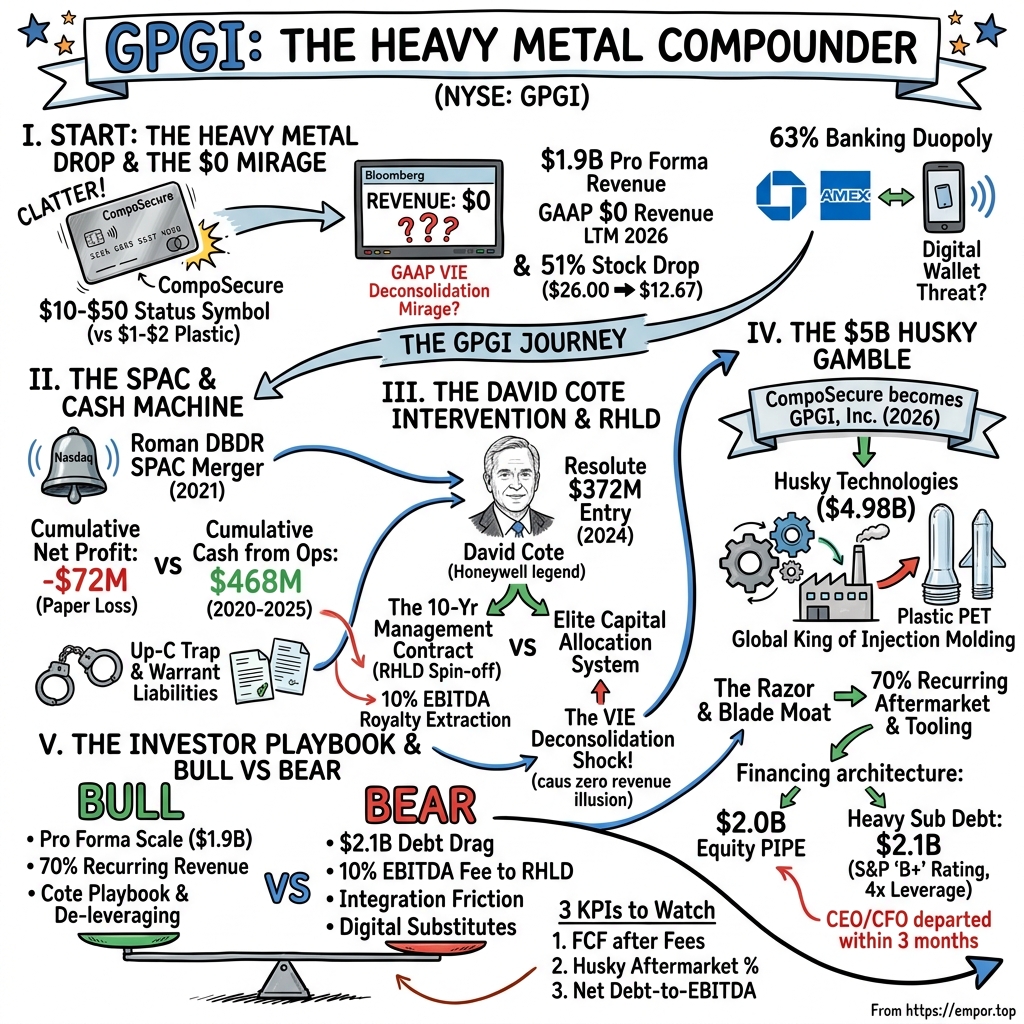
GPGI: The Heavy Metal Compounder
I. The Heavy Metal Drop and the $0 Revenue Mirage
The check arrives at a corner table in a Manhattan restaurant, and someone reaches for it. The card goes down on the wood with a dull, metallic clack, not the light tick of plastic. Everyone at the table hears it, and that is the point. The card weighs a few times what an ordinary credit card does, it is cut from stainless steel or something denser, and it tells the waiter, the date and the colleague across the table that its owner pays several hundred dollars a year for the privilege of carrying it.
Very few of the people who carry such a card know who made it. Most of the heavy cards in American wallets come out of a precision factory in Somerset, New Jersey, run by a company called CompoSecure.1 A bank pays somewhere between $10 and $50 or more for each one, against $1 or $2 for an ordinary PVC card.2 That gap, twenty times the price for what is still a payment credential, is one of the stranger little profit pools in American manufacturing.
Now cut to a different screen. An investor pulls up the June 2026 quarterly report of GPGI, Inc., the company that used to be called CompoSecure and still owns that factory, and looks at the top line of the income statement. Revenue: zero.3 Not low. Zero, for the quarter and for the trailing twelve months, while the operating platform beneath the listed company now has combined annual revenue of roughly $1.9 billion once its January 2026 acquisition of the Canadian packaging-machinery maker Husky Technologies is counted.4
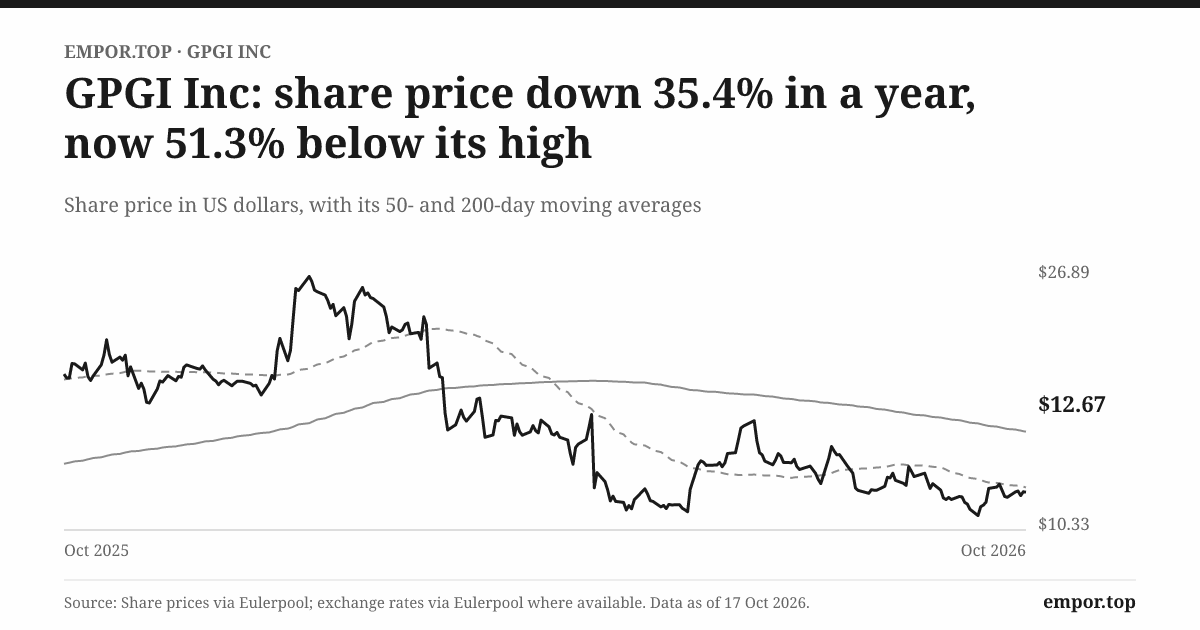
The share price tells the rest of the opening scene. GPGI traded at $26.00 at its 52-week high and closed at $12.67 on October 17, 2026, a fall of about 51%.5 Trailing earnings per share were negative $1.97.3 Any screen that ranks stocks by growth, profitability or momentum would flag this as a company in free fall.
The record says something different, and much more interesting. Between 2020 and 2025 the business generated about $468 million of cash from operations while reporting cumulative net losses of around $72 million.26 The zero is not a collapse of demand. It is the product of a chain of corporate decisions: a 2021 SPAC listing, a 2024 takeover by the former Honeywell chief executive David Cote, a 2025 spin-off of Cote's management company, and an accounting rule that forced the listed parent to stop consolidating its own factories.3 Somewhere inside that chain, real money also changed hands: a management fee worth roughly a tenth of operating profit every year, and about $2.1 billion of new debt at the operating level.34
So this story is an investigation with four questions at its centre. The first is whether value is being created for GPGI's public shareholders or quietly routed to Cote's external manager, Resolute Holdings Management, which trades on its own under the ticker RHLD and collects a fee on the operating company's earnings.3 The second is whether the halving of the stock reflects genuine strain from that debt load or mass confusion over an accounting presentation almost nobody reads closely. The third is whether a metal-card business that sells most of its output to two banks can stay relevant as phones replace wallets. And the fourth is whether paying about $5 billion for Husky built a real industrial compounder or an awkward conglomerate heading into a capital-goods downcycle.4
Before any of that, it helps to know who is who, because the names have changed more than once. GPGI, Inc. is the listed company on the New York Stock Exchange.7 Beneath it sits GPGI Holdings, L.L.C., formerly CompoSecure Holdings, which owns the two operating businesses and carries the debt.3 Those businesses are CompoSecure, the metal-card maker in New Jersey, and Husky Technologies, the injection-molding specialist in Bolton, Ontario.2 Above and beside all of it sits Resolute Holdings Management, which runs the platform under a long-term contract.3 Keep those four boxes in mind. Nearly every puzzle in GPGI's numbers comes from money and control moving between them.
To see why anyone would build such a structure on top of a card factory, the story has to go back to the factory itself, and to the odd discovery that rich customers will gladly carry a heavier card.
 Subscribe on LinkedIn
II. Heavy Metal: Inventing the Physical Status Symbol
In the summer of 2016, Chase launched the Sapphire Reserve, a travel card with a large sign-up bonus, a steep annual fee and a body made of metal. Demand overwhelmed the plan. The bank ran short of the metal card bodies and, for a time, sent some new customers ordinary plastic cards while they waited, which for a product sold on prestige was close to an insult.8 The episode became a piece of payments folklore, and it carried a lesson that CompoSecure had been betting on for years: for the right customer, the object itself was part of the product.
CompoSecure was founded in 2000 by Michele Logan and began life far from luxury, making secure credentials and laminated identification products before moving into durable composite and metal payment cards.8 It stayed a private, founder-led manufacturer for most of its first two decades, later bringing in the Philadelphia private equity firm LLR Partners as an investor.9 What it learned along the way was a materials problem that sounds simple and is not.
A modern payment card is a small piece of radio equipment. It carries an EMV chip, which the terminal reads when the card is inserted, and an antenna coiled inside the body so the card can be tapped. Metal is wonderful for weight and terrible for radio, because a sheet of steel blocks and reflects the signal the antenna needs to send. Making a metal card that taps reliably means engineering layers of steel, titanium or tungsten around a carefully placed antenna, bonding them without warping, and doing it to the tolerances the card networks demand.2 Think of it as building a window into a steel door so the radio can see out. CompoSecure's patents and processes for that bonding are the technical core of the business.2
The commercial insight was even more valuable than the engineering. A wealthy cardholder does not care what a card costs to make. The bank issuing it cares enormously, though not about the unit cost. It cares about winning that customer, keeping that customer, and being the card that comes out of the wallet first, because affluent spenders generate interchange fees and annual fees far larger than any manufacturing bill. A $30 card protecting a customer worth thousands of dollars a year is cheap insurance. That is the logic that let CompoSecure charge twenty times plastic's price.2
The mid-2010s premium-card arms race did the rest. Sapphire Reserve, American Express's metal Platinum card and, later, the titanium Apple Card made heavy cards a mainstream marketing weapon aimed at affluent younger spenders.8 CompoSecure sold into that race on multi-year master service agreements with issuers, and its revenue rose from about $155 million in 2018 to about $420 million in 2024, a compound growth rate of roughly 18% a year.2
Growth was only half the story. The other half was the margin. Across 2020 to 2023 the business earned operating margins of about 30% to 32%, a level more often associated with software than with a factory that cuts and laminates metal.28 Gross margins ran above half of sales.2
The cash dynamics were cleaner still. CompoSecure's customers are among the strongest credit names in the world, so it booked no allowance for credit losses at all, and customers typically paid in a little over a month, around 36 to 41 days in recent years.2 The factory needed little new investment: capital spending ran under 3% of sales and fell to about 1.8% in 2024.2 Put those together and nearly every dollar of operating profit arrived as cash, roughly $80 million to $120 million of free cash flow a year between 2020 and 2024.28
The verdict on the founding era is straightforward. CompoSecure found a niche where a commodity, the payment credential, could be turned into a status object, and it protected that niche with hard engineering. The question that follows is who held the power in that relationship, and the answer turns out to be uncomfortable, because almost all the money came from two customers.
III. The 63% Banking Duopoly and the Digital Wallet Threat
Picture the annual pricing conversation. On one side of a New York conference table sit CompoSecure's sales team; on the other, procurement officers from a money-center bank whose card program buys millions of metal bodies. A concession of a few cents, or a dollar, per card can move the supplier's annual profit by tens of millions. The bank knows it. So does the supplier.
That scene matters because of a single disclosure. In 2024, JPMorgan Chase and American Express together accounted for about 63% of CompoSecure's net sales, down from about 71% the year before.2 Two customers, nearly two-thirds of the business. The decline is real but modest, and it mostly reflects other issuers growing rather than the big two shrinking.
Concentration cuts in two directions. On credit risk it is a gift: these customers do not default, which is why the company has never needed a bad-debt reserve.2 On bargaining power it is a weakness. When two buyers take most of the output, they set the tempo of every renewal, and each one could in principle bring in a second supplier, redesign its premium card, or trim the budget for card upgrades.
What keeps CompoSecure in the room is switching cost. A bank cannot simply swap card makers between quarters. A new supplier must pass the networks' security certifications, qualify its chips and antennas, meet secure-facility requirements for handling card data, and prove it can deliver at volume with essentially no defects, because a failed premium card is a failed premium customer.2 Qualification takes many months, and the multi-year contracts lock in the relationship once it is done.2 Cards also expire or wear out every three to five years, so a large share of shipments are replacements for cards already in wallets, a recurring base that does not depend on new account openings.2
Has that combination produced pricing power? The record narrows the claim. Revenue grew about 42% in 2022, then just over 3% in 2023 and about 8% in 2024.2 The 2022 spike reflected a post-pandemic surge in premium card issuance; once it passed, growth settled into the mid-single digits. Operating margin also slipped, from about 30% in 2023 to about 26% in 2024, though part of that came from corporate and transaction costs rather than the factory floor.2 A supplier with strong pricing power over a growing market does not usually look like that. A supplier with sticky, defensible but negotiated pricing in a maturing market does. That is the better description.
CompoSecure's own answer to concentration was Arculus, a metal card that acts as cold-storage hardware for cryptocurrency keys and a form of digital identity authentication.2 It was the diversification story management told for years, with partnerships, press releases and trade-show launches. The filings tell a quieter story: the company does not break Arculus out as a material revenue line, and its sales remain small next to the payment-card business.2 That is the falsification test the bull case has to face. CompoSecure had world-class security engineering and a credible product, and it still did not turn that into a meaningful second business. Technical capability is not commercial adoption, and any future claim that the platform can spin new products out of its card know-how should be weighed against that record.
Then there is the threat overhead. Every tap of a phone at a checkout is a transaction where the physical card stays in the pocket. Apple Pay, Google Wallet and tokenized payments keep taking share of everyday spending, and the long-run fear is simple: if nobody pulls the card out, why would a bank pay $30 to make it heavy?2 The counterargument is that the premium card was never really a payment tool. It is a membership badge, a brand-retention device, and the thing that gets loaded into the phone wallet in the first place. So far the counterargument has held: shipments have not fallen. But the evidence also shows that the easy growth of the metal-card adoption wave is over.
The conclusion here is that CompoSecure's moat is real but narrower than its margins suggest. It rests on certification, engineering and switching costs, not on irreplaceability, and its two largest customers keep most of the bargaining power. That is the business the public markets got when CompoSecure listed, and the way it listed nearly buried the fact that it was a cash machine.
IV. The SPAC Mirage: How Accounting Obscured a Cash Machine
On December 27, 2021, at the tail end of the great SPAC boom, Roman DBDR Tech Acquisition Corp. completed its merger with CompoSecure, and the combined company began trading on Nasdaq as CompoSecure, Inc.9 The deal valued the business at roughly $1.2 billion and gave LLR and the founders a path to liquidity without a traditional IPO.9
What came with the listing was a structure that made the company hard to read. CompoSecure became an "Up-C": the public company owned units in an operating partnership, CompoSecure Holdings, L.L.C., while legacy holders kept their economic interest through partnership units paired with high-vote Class B shares.9 A tax receivable agreement promised those legacy holders a share of the tax savings the structure generated.9 And like nearly every SPAC deal of its vintage, it carried warrants and earnout shares that GAAP required to be treated as liabilities and marked to market every quarter.8
That last detail produced the strangest numbers in the story. A warrant is a right to buy stock at a fixed price, so when the stock goes up, the warrant becomes more valuable, and if the company counts the warrant as a liability, its liability grows. Under the accounting rules the increase runs through the income statement as a loss. The better the share price did, the worse the reported earnings looked.
In 2024 the effect peaked. CompoSecure's shares rallied, and the company booked a net non-cash charge of about $172 million from revaluing those instruments.2 Operating profit that year was about $108 million, close to a record, yet reported net profit was a loss of about $53 million.2 A factory that had just had one of its best years appeared, to anyone reading only the bottom line, to be losing money.
The cash statement told the truth. Cash from operations was about $129 million in 2024 and free cash flow about $121 million.2 Under chief executive Jon Wilk, the company used that cash to pay down debt, cutting borrowings from about $393 million at the end of 2021 to about $206 million by the end of 2024.29 It even began paying a small dividend, about $8 million in 2024.2
Stretch the lens across six years and the gap becomes the story. From 2020 through 2025 the business produced about $468 million of operating cash against cumulative net losses of roughly $72 million, a difference of more than half a billion dollars made up of warrant revaluations, stock compensation, and later the paper effects of the 2025 restructuring.26 Measured on the cash, the company converted operating profit into cash at a rate that most manufacturers would envy.
Why did the market not see it? Partly because many investors never looked. Screens flagged negative earnings and erratic per-share numbers. The Up-C structure, with its two share classes and tax agreement, kept some institutions away. And SPACs as a class had earned their reputation: most of the 2021 vintage lost money for public holders, so a SPAC that reported losses looked like one more casualty rather than an exception.
The lesson of this era is that CompoSecure's operating business and its listed equity told different stories, and the cash was the honest one. The cheapness that resulted did not escape everyone. In 2024 one of the most famous industrial operators in America noticed it.
V. David Cote's $372 Million Entrance
David Cote did not come to CompoSecure as a dealmaker in search of a trade. He came with a reputation. From 2002 to 2017 he ran Honeywell, taking over a sprawling, demoralised industrial conglomerate after a failed merger and a string of disappointments, and leaving it as one of the best-performing large industrial companies of his era.10 He wrote and spoke constantly about the same themes: short-term results and long-term investment are not a trade-off, bureaucracy is the enemy, and relentless process discipline in factories and back offices compounds over time.10 He was known for blunt operating reviews and for asking plant managers about the details others assumed belonged to someone else.
In August 2024 Resolute Holdings, the vehicle Cote built with his partner Tom Knott, agreed to invest about $372 million to buy a controlling stake of roughly 60% in CompoSecure, buying shares from LLR and the founder group, and the deal closed in September.211 Cote became Executive Chairman.2 As part of the transaction, legacy holders exchanged their Class B units for Class A common stock, which collapsed the Up-C structure and the dual-class arrangement that had made the company so hard to analyse.2
Why buy a niche card maker? Cote's public answer was never that metal cards were the destination. The plan, made explicit in the months that followed, was to use CompoSecure as a chassis: a clean, cash-rich, listed company that could become a permanent-capital vehicle for acquiring and running industrial businesses, in the tradition of Danaher and of the portfolio Cote had built at Honeywell.111 A sleepy single-product supplier was about to become a platform prepared to use leverage.
The management on the ground stayed largely the same. Jon Wilk remained chief executive of CompoSecure, with total compensation of about $6.5 million in 2024, most of it in stock awards, roughly flat on the year before.2 Under his tenure the card business had delivered steady shipments and cut its debt, a credible record for a supplier of this size, though not one that tested him on large acquisitions.
Here is the tension worth naming early. Cote's record at Honeywell was earned as a chief executive whose wealth rose and fell with shareholders. The structure he built for CompoSecure was different. Resolute would hold equity, but Cote's group would also own a separate company that charged a fee to run the platform. That is the kind of arrangement that, in other corners of the market, has created persistent governance discounts: think of externally managed real estate trusts and business development companies, where the manager earns fees on the size of the assets whether or not shareholders do well. The very governance problem that had dogged CompoSecure after the SPAC was being removed with one hand and potentially reintroduced with the other. The evidence on whether it was a good trade would arrive within months, in a spin-off that made the company's revenue vanish.
VI. The RHLD Spin-Off and the Deconsolidation Shock
On February 28, 2025, CompoSecure distributed shares of a new company, Resolute Holdings Management, Inc., to its shareholders.11 On the same day, the operating company signed a management agreement with the newly independent Resolute.3 To a casual shareholder it looked like a dividend of shares in a small new business. In fact it reorganised who ran CompoSecure and who got paid for doing so.
The fee is the place to start. Every quarter, in arrears, the operating company pays Resolute 2.5% of its trailing twelve months of Adjusted EBITDA.3 Four quarters of 2.5% of a trailing annual figure works out to roughly 10% of a year's Adjusted EBITDA. On a platform that, after the Husky acquisition, earns several hundred million dollars of Adjusted EBITDA a year, that is a fee in the tens of millions annually, paid in cash.36
It matters where the fee sits in the line. It comes off the top of operating earnings, before interest on the debt, before any reinvestment, and before any dividend reaches common shareholders.3 Resolute is paid on EBITDA, not on share price performance or free cash flow, so it earns its fee whether the stock rises or falls, and it earns more as EBITDA grows, including EBITDA bought with borrowed money. There is a floor: if Adjusted EBITDA turns negative, the fee is zero.3 But in any year the business is profitable, the manager is paid first.
The contract's durability is the other half. Its initial term is ten years, and it renews automatically for further ten-year terms.3 Ending it is hard: the company must either have two-thirds of its independent directors conclude the fee is unfair and go through mediation, or point to narrow "kick-out" events such as fraud or serious criminal conduct, and terminating generally triggers a substantial termination fee payable in cash or stock.3 Shareholders who dislike the arrangement have few practical exits besides selling.
The defence of this structure is that it aligns Resolute with growth and lets a small, elite team run many businesses at once; Cote's group still owns equity, and it built the platform. The counter is that a 10% claim on EBITDA in perpetuity is an expensive price for management, far larger than what most industrial companies pay their entire executive suite. Whether the fee is earned can only be answered by results: if the Resolute operating system lifts margins by more than the fee costs, shareholders come out ahead. Until that is shown, the fee is a certain cost against an uncertain benefit.
The day the revenue disappeared
The management agreement also set off an accounting earthquake. Under U.S. GAAP's rules for variable interest entities, the company that consolidates a business is the one with the power to direct its most important activities. Once Resolute, through the management agreement, held that power over the operating company, the listed parent was no longer treated as controlling it, and on February 28, 2025, it deconsolidated GPGI Holdings and began accounting for it as an equity-method investment.3
That is why the numbers look the way they do. Revenue for 2025 shows only January and February, about $59 million, and nothing afterwards.63 Every subsequent quarter shows zero. Parent borrowings dropped to zero and parent property, plant and equipment to zero, because the debt and factories now sat in an entity the parent no longer consolidated.6 Meanwhile a balance sheet line called "investments" jumped from about $4 million to about $125 million, which is simply the carrying value of the parent's stake in the operating company.63 The parent's earnings now arrive as a single line of equity-method income, swinging with every paper adjustment beneath it.3
None of this changed how many cards the factory shipped. But automated systems read the reported data literally. Screens showed revenue growth of minus 100% and returns on capital deep in the red.5 The stock's one-year volatility reached about 62%, and over five years its largest fall was more than 57%.5 Some of that fall was earned by real decisions still to come. Some was the market reading a footnote as a collapse.
So the spin-off did two things at once. It created a permanent priority claim on operating earnings for Cote's management company, and it dressed the listed company in financial statements that hide the business. Both would matter far more once the platform had something much bigger to manage, and less than a year later it did.
VII. The $5 Billion Husky Gamble: Becoming a Permanent Capital Beast
On January 12, 2026, CompoSecure, Inc. became GPGI, Inc. and moved its listing to the New York Stock Exchange, and on the same day it closed the purchase of Husky Technologies from the private equity firm Platinum Equity in a deal valued at about $5 billion.712 The acquirer had, a year earlier, been a $420 million revenue card company. Husky alone had revenue of about $1.5 billion a year.4 A minnow had swallowed something four times its size.
Husky is a name almost no consumer knows and almost every bottled drink depends on. Based in Bolton, Ontario, it makes the high-tonnage injection-molding systems, molds and hot runners used to produce PET preforms, the small, thick test-tube shapes that are later blown into plastic bottles.13 A single Husky system can turn out preforms by the tens of thousands per hour, and the company is widely regarded as the leader at the high end of that market.134 Its customers are beverage companies and the packaging converters who supply them, names like Amcor, Alpla and Plastipak, and no single customer accounts for more than a tenth of its revenue.4
The industrial logic Cote laid out rests on a familiar model. A new injection-molding system is a large, cyclical capital purchase, and margins on the machine are not where the profit lives. The profit lives in what follows: replacement molds when a bottle design changes, hot-runner parts, refurbishment, service and monitoring.4 Management and S&P both describe roughly 70% of combined revenue as recurring or recurring in nature.46 It is the same razor-and-blade shape that made CompoSecure's replacement cycle valuable, but spread across hundreds of customers instead of two.
Regulation adds a tailwind. European rules require more recycled PET in bottles and caps that stay tethered to the bottle, and similar pressures are spreading elsewhere.4 Every such change forces bottlers and converters to redesign and retool, which is exactly the work Husky's molds and services perform.4 Management's case is that the replacement and retooling stream is less sensitive to the capital cycle than machine sales. That claim is plausible, but it is a management claim until the segment results show it holding through a downturn.
How the deal was paid for
The financing turned a card company into a leveraged industrial platform. GPGI sold about 106 million new shares at $18.50 each in a private placement worth about $2.0 billion.411 Platinum Equity rolled about $1.0 billion of its proceeds into GPGI stock, which made it the largest outside shareholder with roughly 18% of the company and the right to nominate two directors while it holds at least 10%.4 Total Class A shares outstanding rose to about 290 million by March 2026.3
The rest came from debt at the operating level. GPGI Holdings took out a $1.2 billion senior secured term loan due 2033, which amortises at 1% a year, about $12 million, with the balance due at maturity, and issued $900 million of senior secured notes, also due 2033, alongside a $400 million revolving credit facility.3 That is about $2.1 billion of funded debt, none of it visible on the listed parent's balance sheet because the borrower is the deconsolidated subsidiary.36
S&P Global, rating the borrower ahead of the closing, gave it a 'B+' issuer rating with a stable outlook, which is solidly in speculative-grade territory.4 The agency credited the two businesses' leadership in high-margin niches, Adjusted EBITDA margins in the mid-20s and the recurring revenue base, and estimated pro forma leverage of about 4 times debt to EBITDA.4 It also named the constraints: niche concentration, exposure to packaging capital spending, and governance complexity from the external management agreement and an unproven financial policy for the new platform.4 When a rating agency lists the management contract as a credit weakness, minority shareholders should take note.
The acquisition brought other changes. Husky operates across Canada, Europe and China, so a business that once invoiced almost everything in dollars now carries exposure to the Canadian dollar, the euro and the Chinese yuan.42 And just before the closing, on January 9, 2026, the audit committee dismissed Grant Thornton, CompoSecure's long-time auditor, and appointed Ernst & Young, which already audited Husky.3 Grant Thornton had issued clean opinions, so the switch reads as a practical consolidation choice rather than a warning sign, but it means the first audit of the combined business will come from a new firm.3
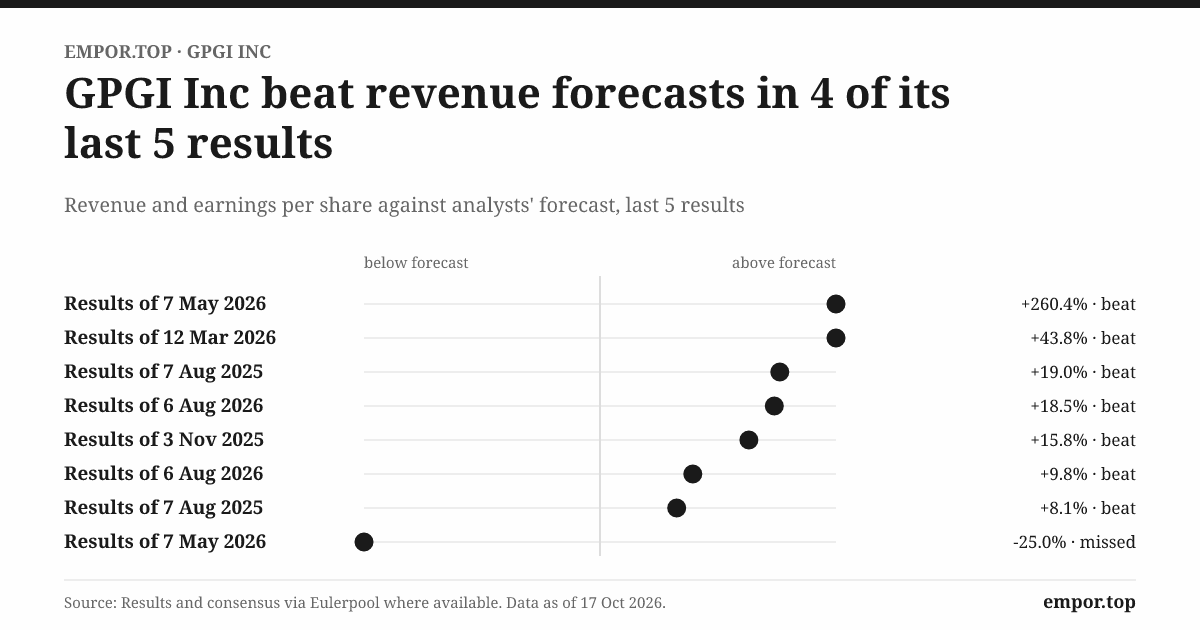
Then came the first real test. Within about three months of closing, Husky's chief executive, Bradley Selleck, and its chief financial officer, John Linker, stepped down, in March and April 2026.3 GPGI began a search for permanent leaders.3 Leadership turnover after a private-equity exit is not unusual, and Cote's model at Honeywell often meant replacing managers. But losing both of the acquired company's top two executives in a quarter, at the moment the platform is carrying record debt, is the kind of disruption the bull case cannot simply wave away. On the first-quarter call, management framed the changes as part of installing the Resolute operating system.14 That is an explanation, not yet evidence.
The verdict on the Husky deal is that it gave GPGI genuine scale, diversification away from two banks and a second recurring-revenue franchise, at the price of much higher leverage, currency risk and an early leadership gap. Whether it was a masterstroke or an overreach depends on lessons that are already visible in the story so far.
VIII. Playbook: Business & Investing Lessons
Imagine an operating review in Bolton. Cote, by his own long public account of how he runs businesses, would be the one asking about working-capital days on a single product line, about why a mold takes as long as it does to move across the shop floor, about whether the plant manager knows the number without looking.10 It is the same set of questions he asked at Honeywell, applied now to two businesses that, on the surface, have nothing in common: a factory that makes cards for bankers and a factory that makes machines for bottlers. What they share is the shape of their economics, and the lessons GPGI teaches come from that shape and from what was built on top of it.
The first lesson comes from that 2016 shortage of metal Sapphire Reserve cards. CompoSecure did not win by making a cheaper card. It won by making the card matter to the bank's most valuable customers, at which point the price of the card stopped mattering to the bank. A component that protects a customer worth thousands of dollars a year can sell for $30 when it costs a fraction of that to make, and still look cheap to the buyer. The line to remember: when your customer is terrified of losing its best customers, your price is a rounding error in its fear.
The second lesson is the 2024 paradox, when a record operating year produced a reported loss because the share price rose. CompoSecure generated close to half a billion dollars of operating cash over six years while reporting losses. Investors who read only earnings missed the business; investors who read only cash risked missing the claims on that cash, the warrants, the tax agreement and later the fee. The line: follow the cash, then follow everyone with a claim on it.
The third lesson is the management agreement signed the day Resolute was spun off. The architect of the turnaround owns a separate company that takes 2.5% of trailing EBITDA every quarter, for ten years at a time, ahead of any dividend.3 That is not inherently wrong; if the manager adds more than the fee, everyone wins. But it changes the question every shareholder must ask about every decision. A larger acquisition funded with debt increases EBITDA, and so increases the fee, even if it lowers returns per share. The line: when the operator is paid on the size of the earnings, not their return, watch what it chooses to buy.
The fourth lesson is the zero on the income statement. An operating company with about $1.9 billion of revenue reported nothing at the top line because an accounting rule moved control to the manager, and automated money treated the zero as real. Deconsolidation creates mispricing in both directions: it can hide a healthy business, and it can hide $2.1 billion of debt. The line: when GAAP says zero, the footnotes are the financial statements.
The fifth lesson is Husky itself. The company sells big machines to converters, but the durable money comes from the molds, parts and services that every new bottle rule forces them to buy. That model has survived capital cycles before, but it is not immune: new equipment orders fall when converters freeze spending, and the aftermarket share only protects profits if it holds near the 70% management describes.4 The line: a razor-and-blade business is only as strong as its blades in a bad year.
Those lessons point toward a price question. GPGI trades at about $12.67, near its 52-week low, which raises the obvious debate: is the market seeing a broken roll-up, or failing to see a compounder?
IX. Analysis & Bear vs. Bull Case
On GPGI's second-quarter 2026 call, analysts pressed on the same subjects again and again: the departures at Husky, the leverage, and how much cash reaches the listed company once the fee and the interest are paid.43 The debate sounds like two descriptions of the same company. In one, GPGI is a small Danaher with a famous operator and two niche franchises. In the other, it is a SPAC descendant with a manager that takes its cut first. The evidence supports parts of both.
Start with the price. At $12.67 the listed company is worth about $1.4 billion.5 It trades at about 1.1 times its book value of roughly $28.70 a share.5 The historical price-to-earnings figure of about 5.6 times, against a five-year median of 4.2 times, is a relic of the pre-deconsolidation earnings and says little about today.5 The meaningful comparison is with the operating company's debt: about $2.1 billion sits beneath the parent at roughly 4 times EBITDA.43 In effect, the market is valuing a $1.9 billion revenue platform with mid-20% EBITDA margins at a modest equity value layered on top of substantial debt. That price implies doubts about leverage, the fee and the integration, or simple neglect of a company whose statements show zero sales.
Where the moat holds, and where it bends
Now the competitive analysis, argued once and in full. In Hamilton Helmer's language, CompoSecure's strongest power is a combination of process power and switching costs. Its metal-bonding and antenna know-how, built over two decades, is not easy to copy, and the certification burden on any new supplier makes changing vendors slow and risky for a bank.2 Its listed competitor in cards, CPI Card Group, also makes metal cards, which shows that the technology is not a cornered resource. CompoSecure's edge is scale and quality in the premium tier rather than a monopoly. Husky's equivalent power is switching costs too: a converter's lines, molds and hot runners are built around Husky's systems, and retooling with a rival is costly.4 Against that, Husky competes with large equipment makers such as 海天国际 Haitian International at the lower-cost end, and with Milacron, now part of Hillenbrand, in other segments.6
Porter's forces sharpen the picture. Buyer power is the main weakness in cards: two banks take about 63% of sales and can dictate price at renewal.2 Husky is the opposite, with a diverse customer base and no buyer above 10%, which is the strongest argument that the acquisition improved the platform's quality, not just its size.4 Supplier power is moderate, centred on qualified chip suppliers such as Infineon and NXP and specialty metal mills.4 The threat of substitutes is the long-term risk in cards, digital wallets, and a slower risk at Husky, if alternative packaging materials gain share from PET. New entrants face high certification and engineering barriers in both businesses. The verdict is that the moats are real but niche, durable against copycats and less so against powerful customers.
The bear case starts with leverage. About $2.1 billion of debt at roughly 4 times EBITDA is manageable for a business with steady cash flow, but Husky's equipment sales are cyclical, and a freeze in packaging capital spending could push leverage up quickly while the fixed interest bill stays put.4 The fee then compounds the pressure: roughly a tenth of EBITDA goes to Resolute before interest, so a downturn hurts equity holders more than the headline margin suggests.3 The leadership gap at Husky, both top executives gone within months, raises the risk that cost-cutting or culture clash damages a business that depends on engineering talent and customer relationships.3 And the card business is mature, its growth around high single digits at best, with two customers holding the pen.2 An activist looking at this company would ask why the fee is tied to EBITDA rather than per-share free cash flow, and why the contract renews for a decade at a time.
The bull case starts with the scale. The combined platform has revenue around $1.9 billion, mid-20% EBITDA margins and about 70% recurring revenue, which S&P itself treated as the core credit strength.4 Once the first fully audited combined results are published, the optical zero will matter less, and investors who never looked past the screen will see the business. Cote's operating playbook has delivered margin expansion in industrial businesses before, and Husky, with its global footprint, offers more room to apply it than CompoSecure did.10 And the card business has a proven record of deleveraging: it cut debt by nearly half between 2021 and 2024.2 If the combined platform repeats that pattern, management's ambition of bringing leverage toward 3 times within a couple of years would be achievable; the scheduled amortisation alone, about $12 million a year, would not get there, so it depends on free cash flow being applied to debt.3
Weighing it, the history supports the claim that these are high-quality cash-generating businesses, narrows the claim that the card moat confers pricing power, and leaves the claim that the Resolute system will justify its fee intact but entirely unproven. Three numbers will decide which story wins. The first is free cash flow of the combined platform after the Resolute fee and interest, the cash actually available to shareholders, which GPGI has not yet reported as a full audited year. The second is Husky's aftermarket share of revenue, described today as about 70%, which shows whether the recurring base holds in a slowdown.4 The third is net debt to Adjusted EBITDA, about 4 times at closing, whose direction will show whether the platform is deleveraging like CompoSecure did or drifting toward the 5 times ceiling S&P set.4 Those readings will start to arrive in the next annual report.
X. Epilogue
Early in 2027, Ernst & Young is due to sign GPGI's first audit opinion, on the Form 10-K for fiscal 2026. It will be the first full year in which CompoSecure and Husky sit under one roof, and the first annual report in which an investor can look for both halves of the extraction question side by side: how much cash Resolute collected in fees, and how much cash moved up from GPGI Holdings to the listed parent and its shareholders.3 Tonight, those two numbers are not on any single page. In a few months they should be.
That filing settles the first of the story's central questions. If the fees are a modest fraction of a growing stream of distributable cash, and the platform is paying down debt at the same time, then the structure looks like an expensive but productive partnership. If the fees are large and steady while distributions to the parent are thin, the arrangement looks like what its critics fear: a royalty on someone else's factories.
The second test is leadership. GPGI has been searching for permanent leaders at Husky since the spring.3 An appointment of a proven industrial operator, followed by stable order books, would answer much of the bear case on integration. A long vacancy, or further departures, would suggest the Resolute model is struggling to translate from Honeywell's scale to a newly acquired, engineering-led company.
The third test is debt. The term loan's quarterly amortisation began in the third quarter of 2026 at about $3 million a quarter.3 That is a token amount. The meaningful signal will be voluntary prepayments funded by free cash flow, the same pattern that took CompoSecure's borrowings from nearly $400 million to about $200 million in three years.2 If the combined platform repeats it, leverage falls and the equity's share of the enterprise grows. If it does not, and especially if the platform instead reaches for another acquisition, the fee grows while the balance sheet stays heavy.
And beneath all three sits the question about the card business itself: whether two banks, renewing contracts while phones absorb more of every checkout, keep paying twenty times plastic for a heavier card. The answer will come slowly, one renewal at a time, but it is the foundation everything else stands on. The tension that remains is simple to state and hard to resolve: GPGI owns two businesses that make money reliably, and has handed a priority claim on that money to the people who run it.
XI. Outro
Back at the restaurant, the card hits the check tray with that solid sound, a few grams of machined steel from Somerset, New Jersey. A few hundred miles north, in Bolton, Ontario, a Husky system cycles again and again, turning out the preforms that will become tomorrow's water bottles.13 Neither the diner nor the person who buys the bottle will ever think about who made the object in their hand. Two unglamorous manufacturing franchises keep minting cash in the background of ordinary life.
The listed company that owns them trades at $12.67, half its high, because the accounting rules say its revenue is zero.5 That gap between economic reality and reported reality is the whole opportunity and the whole risk. GPGI is either David Cote's next great multi-billion-dollar industrial compounder or an elaborate vehicle engineered to pay its manager a 10% royalty on someone else's factories, and over the next twelve months, the cash flows will tell investors which one it is.
References
-
CompoSecure, Inc. Annual Report on Form 10-K for FY2024 — U.S. Securities and Exchange Commission, 2025-03-05 ↩↩↩↩↩↩↩↩↩↩↩↩↩↩↩↩↩↩↩↩↩↩↩↩↩↩↩↩↩↩↩↩↩↩↩↩↩↩
-
GPGI, Inc. Quarterly Report on Form 10-Q for the Period Ended June 30, 2026 — U.S. Securities and Exchange Commission, 2026-08-06 ↩↩↩↩↩↩↩↩↩↩↩↩↩↩↩↩↩↩↩↩↩↩↩↩↩↩↩↩↩↩↩↩↩↩
-
CompoSecure, Inc. Definitive Merger Proxy Statement on Schedule 14A (DEFM14A) — U.S. Securities and Exchange Commission, 2025-11-24 ↩↩↩↩↩↩↩↩↩↩↩↩↩↩↩↩↩↩↩↩↩↩↩↩↩↩
-
SEC EDGAR Company Filing History for GPGI, Inc. (CIK 0001823144) — U.S. Securities and Exchange Commission, 2026-10-17 ↩↩↩↩↩↩↩
-
Research Update: CompoSecure Holdings LLC Assigned 'B+' Rating on Acquisition of Husky Technologies — S&P Global Ratings, 2025-11-04 ↩↩↩↩↩↩↩↩↩
-
GPGI, Inc. Current Report on Form 8-K Announcing Name Change and Closing of Husky Combination — U.S. Securities and Exchange Commission, 2026-01-12 ↩↩
-
CompoSecure, Inc. Annual Report on Form 10-K for FY2023 — U.S. Securities and Exchange Commission, 2024-03-12 ↩↩↩↩↩↩
-
CompoSecure, Inc. Current Report on Form 8-K Closing Business Combination — U.S. Securities and Exchange Commission, 2021-12-27 ↩↩↩↩↩↩
-
David Cote on Industrial Operations and Long-Term Value Creation — Harvard Business Review, 2020-06-15 ↩↩↩↩
-
About GPGI and Platform Overview — GPGI, Inc., 2026-08-20 ↩↩↩↩
-
Platinum Equity Sells Husky Technologies to GPGI in $5.0 Billion Transaction — Platinum Equity Press Releases, 2026-01-12 ↩
-
Husky Technologies Corporate Homepage and Packaging Systems — Husky Technologies, 2026-09-15 ↩↩↩
-
GPGI, Inc. Q1 2026 Earnings Conference Call Transcript and Management Commentary — GPGI Investor Relations, 2026-05-08 ↩
 LinkedIn
 WhatsApp
 Reddit
 Hacker News
 Email
 Kindle
 RSS Feed
 Spotify
 Apple Podcasts
 Amazon Music
 Audible
 YouTube