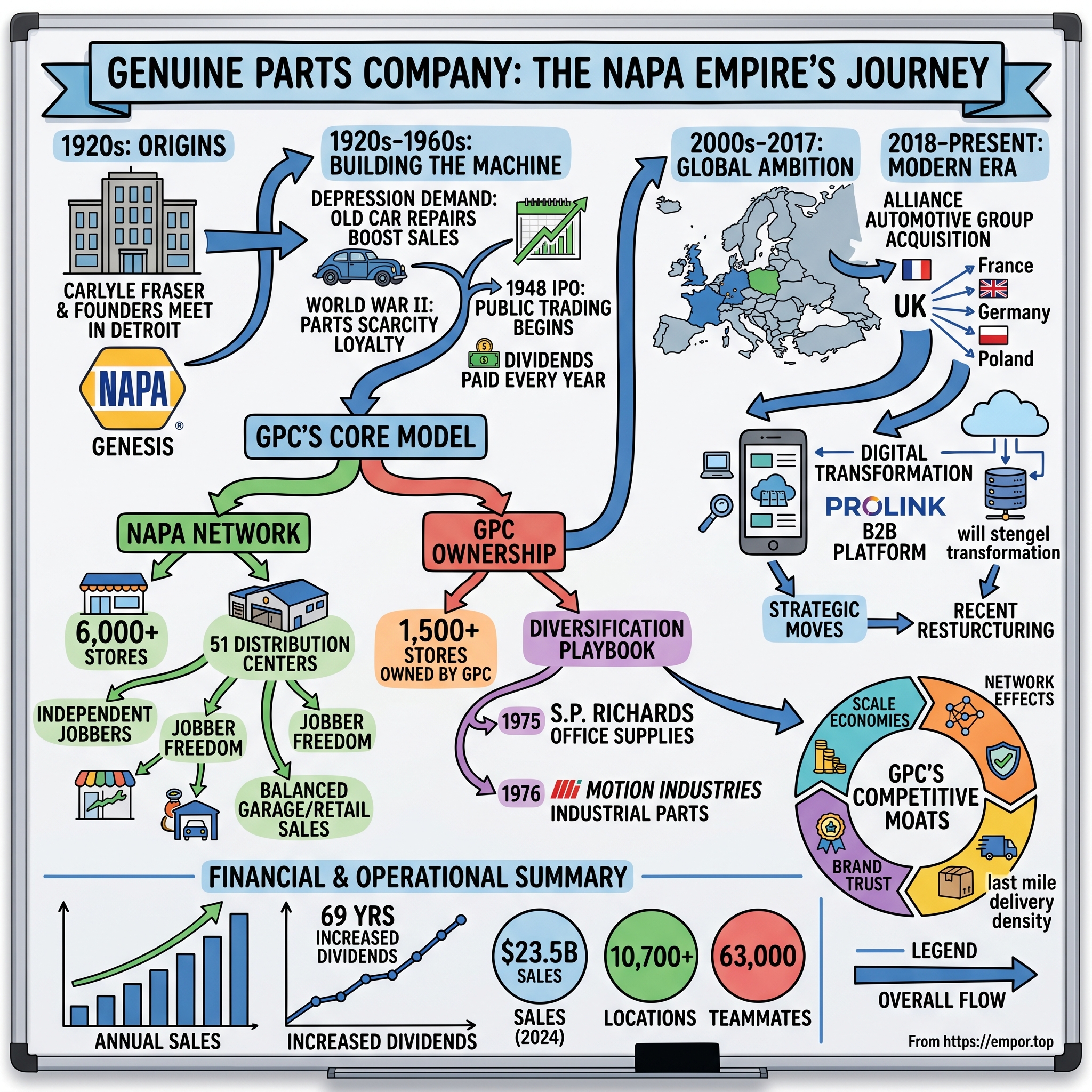
Genuine Parts Company: The Century-Old NAPA Machine, the Industrial Cash Engine, and the Great De-Conglomeration
I. Cold Open & Episode Thesis
Picture a parts counter in Atlanta in 1928: a narrow storefront, metal bins of gaskets and spark plugs, a handful of clerks, and a ledger recording $75,000 in sales for the entire year. Carlyle Fraser had just paid $40,000 for Motor Parts Depot, renamed it Genuine Parts Company, and staked its future on six employees and the conviction that America's expanding automobile fleet would break down often enough to sustain a business.1 His calculation proved correct. What he could hardly have foreseen was that nearly a century later, the company he founded would prepare to split itself in two.
By 2025, Genuine Parts Company, trading under the ticker GPC on the New York Stock Exchange, generated $24.3 billion in annual revenue.2 It employed more than 65,000 people across North America, Europe, and Australasia.3 Most American consumers recognize it by a single blue-and-yellow logo: NAPA Auto Parts. Far fewer realize that nearly half of the parent company's segment profit came from an operation most motorists never encounter: Motion, an industrial distributor supplying bearings, hydraulic hoses, drive belts, and automation components to assembly plants, mines, and paper mills.
That divide forms the central tension of the business. Genuine Parts has functioned as two distinct enterprises housed under a single corporate umbrella. In 2025, its automotive units generated $15.4 billion in sales and roughly $1.2 billion in segment EBITDA, an EBITDA margin of about 7.9%. Motion generated $8.9 billion in sales and $1.15 billion in EBITDA, converting at a 12.9% margin.2 The automotive arm provided scale on thin profitability; the industrial arm operated with smaller revenue, higher margins, and increasingly served as the primary rationale for institutional ownership.
For decades, equity markets valued the combined entity as a steady, reliable dividend investment. That stability broke down in 2024. In July of that year, management lowered its full-year adjusted earnings guidance from an initial range of $9.80 to $9.95 per share to between $9.30 and $9.50.4 Just three months later, the company cut guidance again, reducing the forecast to between $8.00 and $8.20 per share.5 The stock fell roughly 20% in a single trading session.6 By 2025, Elliott Investment Management had built an activist stake valued at more than $1 billion.7 Then, on February 17, 2026, the board announced a plan to separate the automotive and industrial segments into two standalone public companies through a tax-free spinoff targeted for the first quarter of 2027.8
Meanwhile, the operational comparison hanging over the automotive business remains difficult to dismiss. In 2025, O'Reilly Automotive converted 19.5% of its sales into operating income.9 AutoZone posted an operating margin of roughly 19% in its fiscal 2025.10 Over the same period, Genuine Parts' North American automotive segment—the domestic NAPA distribution network underpinning the brand—generated an EBITDA margin of just 7.1%.2 Because EBITDA excludes depreciation and amortization, the segment's actual operating margin trailed peer results by an even wider margin. Both operations distribute replacement components for the same vehicles to the same commercial garages, yet they run on fundamentally divergent cost and profit structures.
Capital allocation creates another point of vulnerability. Genuine Parts raised its annual dividend in 2026 for the 70th consecutive year, maintaining one of the longest payout-growth records in corporate history.2 Yet underlying cash generation had already fallen behind that commitment: in 2025, the company distributed $564 million in dividends while producing $421 million in free cash flow, leaving no capital for share repurchases.2 A continuous multi-decade streak that long signaled financial durability now prompts an unexamined question: whether the institutional requirement to expand the payout each year curtailed management's strategic flexibility.
The pending breakup sharpens the timeline for investors. With the spinoff scheduled for early 2027 and inaugural standalone investor meetings set for December 2026, the specific debt burdens and capital structures allocated to each successor entity have not yet been disclosed.1112 Market participants are being asked to underwrite two independent operators using consolidated financial statements from an era in which management repeatedly misjudged its earnings power.
This analysis examines how that structure was assembled and why it is coming apart. It traces the enterprise from a regional Depression-era warehouse into the dominant partner within a national supply cooperative. It covers Wilton Looney's four-part conglomerate model and its eventual streamlining, followed by an aggressive push into Australasia, Europe, and industrial supplies. It contrasts NAPA's hybrid, independent-jobber network with O'Reilly's centralized, corporate-owned footprint, dissects the guidance reductions of 2024, and evaluates the corporate separation now underway. Across each phase, the evaluation focuses on a single issue: which operational advantages are structural, and which have been compromised by shifting competitive realities?
 Subscribe on LinkedIn
II. Origins & The NAPA Cooperative Architecture
In the mid-1920s, servicing an automobile in the United States was plagued by fragmented supply lines. The Ford Model T had put millions of motorists on the road, but procuring a replacement component for a local garage could take days, and standardized part numbers did not exist. In 1925, a consortium of independent parts distributors moved to organize the wholesale market. They founded the National Automotive Parts Association—NAPA—not as a unified corporation, but as a trade cooperative designed to pool purchasing volume, standardize parts catalogs, and establish dependable delivery schedules for repair shops. Carlyle Fraser was among its co-founders.13
Three years later, Fraser established his operating base by acquiring Motor Parts Depot in Atlanta. The newly rechristened Genuine Parts Company lost roughly $2,500 during its first operating year on those initial $75,000 in sales.13 That precarious start preceded the 1929 stock market crash by barely a year.
The Depression Turns Into a Tailwind
The economic collapse that followed revealed the counter-cyclical dynamics that continue to define the aftermarket auto parts industry. When consumers and fleet operators could not finance new vehicles, they had to maintain their existing ones. Over the course of the 1930s, Genuine Parts' annual sales climbed from $339,000 to $3.18 million.13 Expanding revenue nearly tenfold during the deepest downturn in modern American history validated the company's core economic premise.
That operational resilience established a pattern that repeated across subsequent recessions. New vehicle sales fluctuate with consumer confidence and credit availability, but mechanical maintenance on an aging vehicle fleet remains non-discretionary. A driver can postpone purchasing a new automobile, but replacing a failed starter or alternator cannot be deferred if the car is required for daily work. That inelastic demand formed the traditional bedrock of the NAPA investment thesis. Yet steady aftermarket demand does not ensure that any specific distributor captures the resulting economics—a distinction that would take decades to fully surface.
From Member to Owner
Fraser's primary strategic insight lay in his positioning within the supply chain. Rather than operating retail storefronts, Genuine Parts positioned itself as a wholesale warehouse distributor—the intermediary tier holding deep inventory reserves to supply independent "jobbers," the local store owners who directly served neighborhood mechanics and fleet accounts. Under this division of responsibility, local jobbers managed customer relationships and shouldered retail real estate risk, while Genuine Parts controlled wholesale inventory depth and regional logistics.
In 1948, marking its 20th anniversary, the company conducted an initial public offering, selling 150,000 shares at $11 each on annual sales of roughly $20 million.13 It has distributed a cash dividend every year since that public debut.1
Over the following decades, Genuine Parts systematically consolidated the wholesale tier by acquiring fellow NAPA member distributors. By the late 1960s, it owned 33 of NAPA's 55 regional distribution centers.13 By the 1980s, the company operated 55 of the association's 72 distribution hubs and generated roughly 85% of total NAPA system sales.13 Through those acquisitions, the cooperative Fraser helped establish had effectively evolved into Genuine Parts' proprietary distribution network. The retail layer, however, remained largely decentralized: during that same era, Genuine Parts directly owned only about 350 of the roughly 5,200 NAPA jobbing stores nationwide.13
That two-tier structure offered an efficient expansion model for its era: local owners contributed capital, regional market knowledge, and entrepreneurial initiative, while Genuine Parts provided logistics scale. When Will Stengel addressed investors in October 2024, he noted that NAPA would celebrate its centennial the following year, in 2025.14 Few commercial brands in the United States have operated continuously for a century while performing the same primary function of delivering replacement components to professional mechanics.
Yet that same organizational blueprint would later create a lasting structural vulnerability. The decentralized independent-jobber network that enabled NAPA to blanket the country with limited corporate capital would ultimately prove slower and less profitable than modern competitors that built, owned, and tightly coordinated their entire store footprints from the start.
III. The Wilton Looney Playbook: The Diversified Conglomerate
Wilton Looney's career began with a refusal to stay on the family farm. After finishing high school in 1936, he took a job at Western Auto Supply for $10 a week, six days a week, until Genuine Parts recruited him.15 During World War II, he supervised vehicle maintenance on the Burma Road, the mountain supply route between Burma and China, returning home as a major. He then climbed the Genuine Parts corporate ladder city by city: Atlanta, New Orleans, New York, and Boston.15
In 1955, Looney returned to Atlanta as president, working alongside Carlyle Fraser until Fraser's death, after which the board elected him chairman and chief executive. He held the top job for nearly three decades before handing leadership to Larry Prince in 1990. Over Looney's tenure, annual sales expanded from $34 million to more than $3.4 billion.15 Even in retirement, he maintained an office at corporate headquarters and attended every board meeting for another 28 years until his death in 2018 at 99.15 That executive continuity embedded an operating playbook that guided the enterprise for decades.
Building the NAPA Brand
Under Looney, NAPA evolved from a loose distribution network into a recognized national brand. The first NAPA-branded parts debuted in 1966.13 Private-label merchandise fundamentally alters distribution economics by dictating who captures margin. When a distributor sells a supplier's branded component, the manufacturer dictates wholesale pricing and captures most of the value. When the distributor sells its own proprietary label, it retains a larger gross margin spread while cultivating customer brand loyalty specific to its network.
1976: Buying Motion
The defining strategic transaction of the Looney era occurred outside the automotive sector entirely. On January 1, 1976, Genuine Parts acquired Motion Industries,13 a Birmingham, Alabama-based industrial distributor founded in 1946.14 The rationale rested on the premise that industrial replacement components shared the same counter-cyclical resilience as automotive parts: manufacturing plants maintain and overhaul existing machinery during economic downturns rather than committing capital to new equipment.13
The microeconomics of Motion explain why it developed into the enterprise's primary earnings engine. Consider a food-processing facility at 2 a.m. when a bearing seizes on a primary conveyor line. The replacement component costs a few hundred dollars, but every hour the line remains idle generates substantial losses in unfulfilled production, spoiled inventory, and unproductive labor. In that environment, plant managers do not shop around for modest discounts. The order goes to whichever distributor can deliver the exact specification immediately from a nearby branch, accompanied by technicians who understand the machinery. That operational asymmetry—where the purchase price of the part represents a fraction of the cost of downtime—underpins industrial distribution's durable pricing power.
Distribution Is Distribution
Looney did not restrict expansion to automotive and industrial lines. In 1975, Genuine Parts acquired S.P. Richards, a wholesale office-products distributor.13 In 1998, under Prince, the company purchased EIS, an electrical and electronic materials distributor, in a transaction valued at approximately $180 million, while committing roughly $231 million to acquire the 80% of Canadian automotive distributor UAP it did not already own.13 The governing corporate doctrine was straightforward: distribution competence was universal. Management believed that an organization proficient at stocking, picking, and rapidly dispatching high-variety, low-cost parts could replicate that model across disparate end markets, using uncorrelated sector demand to smooth consolidated revenue.
For decades, the reported financials appeared to validate that assumption. By 2000, Genuine Parts generated net sales of $8.37 billion, marking 51 consecutive years of revenue growth, 40 consecutive years of profit expansion, and 45 consecutive years of dividend increases.13
Testing the Diversification Thesis
The foundational thesis of the Looney conglomerate was that logistical execution created tangible corporate synergies across unrelated categories. Subsequent market shifts and portfolio divestitures would thoroughly test that premise.
The office-products segment encountered severe structural headwinds as big-box retailers, direct-to-consumer e-commerce, and workplace digitization steadily eroded wholesale stationery demand. In April 2018, Genuine Parts agreed to combine S.P. Richards with competing distributor Essendant. Five months later, Essendant terminated the agreement after accepting a superior acquisition proposal from Staples, leaving Genuine Parts with a $12 million termination fee and an unresolved corporate asset.16 In 2020, Genuine Parts completed the disposal of S.P. Richards, selling its primary domestic business to an investor group of industry executives and offloading a separate division to an affiliate of H.I.G. Capital, framing the exit as a strategic pivot toward higher-margin automotive and industrial distribution.17 EIS had been divested a year earlier to Audax Private Equity in August 2019 for an undisclosed sum.18
The ultimate resolution of those assets exposed the limits of the conglomerate theory. Neither office supplies nor specialty electrical components shared distribution facilities, customer accounts, or vehicle routes with NAPA or Motion. Rather than sharing physical logistics and warehousing synergies, the divisions had merely coexisted on the consolidated income statement. When executive leadership characterized both divestitures as portfolio "streamlining,"18 it effectively acknowledged that cross-category distribution synergies had failed to materialize. Distribution capabilities did not translate across product lines lacking shared physical infrastructure. That realization would resurface with far higher stakes in 2026, when investors confronted whether automotive and industrial distribution warranted common ownership.
By 2020, Looney's four-division conglomerate had been pared down to two primary legs. Management's response, however, was not to halt expansion, but to pursue multi-billion-dollar acquisitions overseas.
IV. The Modern M&A Supercycle: Europe, Australasia, and Industrial Scale
By the 2010s, NAPA's distribution network blanketed North America. With domestic geographic expansion largely tapped out, management confronted the classic mature distributor's dilemma: where to find the next phase of growth. The answer, pursued with increasing scale, was debt-funded international and industrial acquisitions.
Australasia: Buying Repco
The first major move occurred in the Southern Hemisphere. Genuine Parts acquired a 30% interest in Australia's Exego Group on January 1, 2012, and purchased the remaining 70% effective April 1, 2013, for approximately $650 million in cash and roughly $160 million in assumed net debt.19 Exego, parent of the Repco brand, generated more than $1 billion in annual sales across more than 430 company-owned locations in Australia and New Zealand.19
That footprint revealed an important structural difference from NAPA's domestic model. While Genuine Parts relied primarily on independent jobbers in the United States, Repco functioned almost entirely as a corporate-owned chain. By the end of 2025, Genuine Parts operated 568 company-owned stores out of 582 Australasian locations.3 That distinction would prove central: Australasia consistently delivered among the company's steadiest operating results, offering early evidence that store-level ownership, rather than geography alone, drove aftermarket margin stability.
2017: The $2 Billion European Bet
On September 25, 2017, Genuine Parts escalated its acquisition strategy, agreeing to acquire Alliance Automotive Group, known as AAG, from funds managed by Blackstone and the distributor's co-founders.20 The transaction carried an enterprise value of approximately $2 billion, including the repayment of AAG's debt, and was financed almost entirely through new borrowing.20 AAG generated roughly $1.7 billion in revenue, recorded $2.3 billion in gross billings, employed some 7,500 people, and operated more than 1,800 company-owned stores and affiliated outlets across France, the United Kingdom, and Germany, positioning it as the second-largest parts distribution platform in Europe.20 It served roughly 30,000 repair and collision shops and stood as the largest shareholder in the buying group Groupauto International.21
Paul Donahue, then chief executive, stated that the transaction would allow Genuine Parts to "enter the European markets with critical scale and a leading market position,"20 while management projected that AAG would add between $0.45 and $0.50 to diluted earnings per share in 2018.20 AAG co-founder Jean-Jacques Lafont remained with the organization, later being named non-executive chairman of the planned standalone automotive company in early 2026—a reflection of how integral the European platform had become to the enterprise.11
Management justified the transatlantic expansion through the promise of global purchasing power: extracting larger supplier rebates by buying from global manufacturers, introducing proprietary private-label brands across borders, and amortizing technology investments over a broader revenue base. Yet structural constraints were evident from the start. European vehicle fleets differed sharply from American car pools, featuring smaller displacement engines, widespread diesel adoption, and distinct vehicle architectures, sharply limiting inventory overlap. Furthermore, European aftermarket distribution remained fragmented by national borders, regulatory standards, local languages, and regional buying groups. A distribution hub in Lyon could offer zero logistical support to an auto repair shop in Ohio.
What Genuine Parts could transfer internationally was limited to private-label branding and back-office services. In Europe, management introduced NAPA-branded product lines, describing them in 2024 as "a competitive differentiator" that helped the business outpace a contracting market.14 The company also established a global technology center in Kraków, Poland, staffed by roughly 250 engineers developing catalog, search, and digital systems across the enterprise.14 While functional, these centralized software capabilities represented the type of administrative and IT infrastructure that could be decoupled through standard transition service agreements during a corporate separation, supporting management's contention that a breakup would not sacrifice meaningful operating value.
Australasia offered a parallel lesson in operational resilience. In the third quarter of 2024, while European growth stalled, Asia Pacific automotive sales expanded approximately 7% in local currency with comparable store sales rising 4%, despite management characterizing Australia as enduring its weakest economic expansion in nearly three decades and New Zealand navigating its second recession in 18 months.14 A company-owned commercial and retail network with strong regional brand equity continued to generate growth in a sluggish macro environment.
2021: Motion Doubles Down
The most substantial move in the industrial division occurred on December 16, 2021, when Motion agreed to acquire Kaman Distribution Group from private investment firm Littlejohn & Co. for approximately $1.3 billion in cash.22 KDG brought roughly $1.1 billion in expected 2022 revenue, approximately 1,700 employees, and around 220 locations across the United States and Puerto Rico, with specialized product lines in bearings, power transmission, automation, and fluid power.22 Management projected more than $50 million in annual run-rate synergies within three years and funded the purchase through revolving credit facilities and accounts receivable sales, targeting a net leverage ratio of roughly 2x at closing.22
Because Genuine Parts did not disclose KDG's historical EBITDA in the transaction announcement, the implied purchase multiple cannot be verified from corporate filings.22 Based on expected revenue, however, Motion paid roughly 1.2 times sales for an established asset in its core product categories—an operational fit where branch density and catalog overlap made cost synergies far more attainable than in cross-border automotive deals.
Whether KDG generated its intended returns is best observed through Motion's performance following integration. Industrial segment EBITDA margins held at roughly 12.2% in 2023 and 12.0% in 2024—a period of pronounced manufacturing contraction—before advancing to 12.9% in 2025.232 While Genuine Parts has not disclosed a standalone return on invested capital for KDG, absorbing a multi-billion-dollar acquisition through an industrial downturn without margin dilution indicates that the integration met internal financial targets, contrasting sharply with the conglomerate-era experiments in office supplies and electrical distribution.
Testing the Global Synergy Claim
That divergent performance challenges a prevailing market narrative: the assumption that European expansion was the primary source of Genuine Parts' operational woes. In 2024, that diagnosis appeared plausible. During the third-quarter earnings call that year, management reported that European organic growth was flat against expectations of low-single-digit gains, describing demand burdened by deferred maintenance, declining real wages, and depressed consumer confidence in Germany, France, and the United Kingdom.14
Yet financial disclosures from 2025—the first year Genuine Parts reported North American and international automotive performance as distinct reporting units—revealed a far different reality. International Automotive, which included Europe and Australasia, generated a 9.3% EBITDA margin, whereas North American Automotive—the core domestic NAPA network—posted just 7.1%.2 In the fourth quarter of 2025, North American EBITDA margins sank to 5.5%.2
These disclosures significantly qualify the thesis of global distribution synergies without supporting the narrative that international operations weighed down results. Genuine Parts offered minimal public evidence that transatlantic ownership unlocked material purchasing scale or operational efficiencies; indeed, management's own separation disclosures indicated that the regional automotive operations were still working toward basic global harmonization.24 Yet neither AAG nor Repco served as the principal drag on enterprise profitability. In 2025, the weakest earnings engine was NAPA's domestic franchise network. That reality shifts the analytical focus away from Paris and back toward Atlanta, and toward two core segments operating under fundamentally divergent economic models.
V. The Two Empires: Segment Economics & Materiality Breakdown
Walk into a NAPA store at 7:30 on a weekday morning and the phone is already ringing. A shop foreman two miles away has a customer's SUV on a lift and needs a wheel-hub assembly immediately. The counter clerk verifies stock, a delivery driver grabs the box, and the part must arrive before the mechanic runs out of other billable work. Now walk into a Motion branch at the same hour. A technician is preparing to restock an on-site storeroom inside a paper mill, where Motion manages the inventory of spare bearings and seals so the facility never has to halt production. Both operations report to the same parent company, but they execute fundamentally different economic tasks.
The Automotive Empire
In 2024, when Genuine Parts still reported a single automotive segment, automotive sales reached $14.3 billion, representing about 61% of the company's $23.5 billion total, with segment EBITDA of $1.28 billion, or a margin of roughly 9%.23 By 2025, corporate reporting had been split into two regional units: North American Automotive, encompassing NAPA operations across the United States and Canada, generated $9.5 billion in revenue, while International Automotive, spanning Europe and Australasia, delivered $5.9 billion.2
Roughly 80% of automotive sales flow to commercial accounts—the professional "do-it-for-me" segment comprising independent garages, franchised dealerships, fleet operators, and government motor pools—with retail "do-it-yourself" motorists accounting for the remaining 20%.3 That commercial concentration represents a deliberate strategic choice. Commercial clients order in high volume on repeat schedules, but they are operationally demanding: their overriding priority is parts availability and delivery speed rather than showroom merchandising.
The underlying product mix reflects a similar emphasis on mechanical necessity. In 2024, management disclosed that non-discretionary failure categories—the critical mechanical components a vehicle cannot run without—accounted for approximately half of NAPA's domestic business, with general maintenance items representing 35% and discretionary lines like accessories comprising roughly 15%.14 Amid the softer consumer backdrop that year, essential repair categories expanded by low-to-mid single digits while discretionary sales contracted by mid-single digits, and commercial growth offset declining do-it-yourself purchases.14 When household budgets tighten, motorists still replace worn brake pads and seized alternators, but defer cosmetic upgrades and aftermarket accessories. That dynamic makes a commercial-heavy business defensive during downturns, but defensiveness alone does not generate peer-leading margins.
The North American store footprint reveals where structural friction emerges. At year-end 2025, the NAPA network across the United States and Canada comprised 2,471 company-owned stores alongside 4,317 independently owned jobber locations—roughly a 35/65 split—supplied by 76 regional distribution centers.3 The company-owned share had expanded from approximately 25% at the end of 2022, primarily as Genuine Parts acquired retiring independent jobbers.14
That ownership structure directly shapes the income statement. When Genuine Parts distributes parts to an independent jobber, it captures only a wholesale distribution margin, leaving the retail spread with the store owner. When it operates a company-owned branch, it captures the combined wholesale and retail margin, but absorbs local store leases, staffing overhead, and working capital. The consolidated company posted a gross margin of 36.8% in the third quarter of 2024,14 well below the 51.6% gross margin that O'Reilly Automotive reported for 2025.9 While part of that disparity stems from Motion's lower-margin industrial mix, a substantial portion reflects NAPA's wholesale pricing to independent jobbers. The challenge is not that a hybrid model cannot function; rather, it divides profit pools, operational control, and modernization capital across two separate ownership tiers.
The Industrial Empire
Motion operates out of the public spotlight as the higher-returning pillar of the enterprise. In 2025, it generated $8.9 billion in revenue and $1.15 billion in segment EBITDA, converting sales at the 12.9% margin noted earlier.2 The division operated 755 facilities—including 646 commercial branches, 77 specialized service centers, and 32 distribution hubs—serving more than 180,000 industrial accounts across roughly 900,000 customer sites and providing catalog access to over 10 million stock-keeping units.3 Large national accounts accounted for approximately 45% of Motion's annual sales.3
Motion's end markets span a broad cross-section of heavy industry. Management monitors 14 discrete industrial sectors, and during the sluggish macroeconomic environment of the third quarter of 2024, only three recorded growth: pulp and paper along with distribution and logistics remained resilient, while equipment manufacturing, lumber and wood, and iron and steel softened.14 Even amid that manufacturing slowdown, core maintenance, repair, and operations demand remained essentially flat, as the downturn was concentrated in deferred customer capital projects.14 That distinction explains Motion's durability: routine maintenance cannot be postponed without risking catastrophic facility downtime, whereas discretionary plant upgrades can be delayed until operating cash flow improves.
Customer retention reflects that high-touch service integration. In 2024, Motion earned supplier-of-the-year recognitions from six of its 25 largest accounts, which management noted was more than the preceding four years combined.14 While industry awards do not guarantee future revenue, they provide tangible evidence of deep operational integration with key procurement departments.
That 45% concentration in national accounts involves an economic trade-off. Multi-site agreements embed Motion's technicians directly into on-site storerooms and enterprise software, creating high switching costs. However, large corporate buyers leverage their volume to enforce disciplined pricing terms. Motion's competitive advantage does not stem from aggressive gross-margin markups on every purchase order, but from becoming so integral to plant operations that displacing it would introduce unacceptable operational risk.
The two businesses also diverge sharply in capital intensity. On the fourth-quarter 2025 earnings call, Chief Financial Officer Bert Nappier characterized Motion as "relatively capital-light," while emphasizing that the automotive segment required substantial ongoing investment, especially for supply chain automation and technology upgrades.24
That capital-expenditure gap widened as automotive modernization accelerated. Genuine Parts historically allocated roughly 1% of annual sales to capital expenditures, but that rate stepped up to approximately 2% beginning in 2023, reaching roughly $500 million in 2024, with management designating about 55% of those funds as growth capital for automated distribution hubs and IT systems.14 Because the bulk of that modernization targets automotive logistics, the post-spinoff automotive entity will shoulder the majority of that reinvestment burden, while standalone Motion preserves a higher free-cash-flow conversion profile.
What the Segment Math Means
Examining the two divisions side by side reveals the core corporate tension: Motion generated roughly 37% of consolidated revenue in 2025, yet delivered nearly half of total segment EBITDA.23 Its operating margins held steady across an extended industrial manufacturing downturn, even as North American automotive margins deteriorated. For equity investors, the consolidated structure masked two businesses whose underlying returns on capital, reinvestment requirements, and operating risks were pulling apart. The market effectively assigned Genuine Parts a valuation multiple tethered to its lower-margin automotive segment, discounting Motion's higher cash conversion.
That disparity leads directly to a central operational puzzle: if NAPA possesses an iconic brand, unmatched geographic density, and a century of commercial customer relationships, why do its profit margins trail so far behind the corporate chains competing for the same professional repair bays?
VI. Competitive Warfare: The Aftermarket Arena & Why O'Reilly Crushed NAPA
To understand how the commercial aftermarket functions in practice, picture the counter screen at an independent repair shop at midmorning. The service writer has four ordering portals open simultaneously: NAPA, O'Reilly Automotive, AutoZone, and Advance Auto Parts or Worldpac. A technician in a service bay needs an oxygen sensor to complete a repair ticket. The writer enters the vehicle's year, make, and engine model, reviews local wholesale pricing and delivery estimates across each screen, and routes the order to whichever distributor can deliver the component fastest at an acceptable cost. In the professional garage bay, customer loyalty lasts only as long as the delivery promise holds.
The Scoreboard
The resulting profitability gap is stark. In 2025, O'Reilly generated $17.8 billion in sales, converting a 51.6% gross margin into a 19.5% operating margin while expanding comparable-store sales by 4.7%.9 AutoZone generated $18.9 billion in sales during its fiscal 2025, posting a 52.6% gross margin and an operating profit of $3.6 billion, or roughly 19% of sales.10 Genuine Parts' North American automotive segment, by contrast, generated a 7.1% EBITDA margin.2 Even after allowing for structural accounting differences between EBITDA and operating income, as well as NAPA's wholesale pricing to independent store owners, the margin disparity remains too wide to dismiss as a reporting artifact.
Company-Owned Density Versus a Federation
O'Reilly and AutoZone operate fully company-owned networks. A single corporate leadership team determines how much inventory each branch stocks, where to locate multi-tiered hub stores holding deeper catalog assortments, how many daily delivery routes to dispatch, and which digital catalog software runs on every counter terminal. O'Reilly closed 2025 with 6,585 stores and was opening an additional distribution center in Virginia.9 AutoZone reported domestic commercial sales of $5.2 billion, up 6.7% for the fiscal year.10
NAPA's hybrid federation makes that level of synchronized capital deployment far more difficult. An independent jobber running a handful of local stores must decide, using private capital or personal bank credit, whether to broaden inventory depth or purchase additional delivery trucks. As vehicles grew mechanically more complex and replacement part numbers proliferated, the commercial market placed an escalating premium on localized inventory density and rapid fulfillment. Corporate-owned chains could fund those multi-million-dollar inventory and fleet commitments across an entire national footprint simultaneously.
Management's subsequent transactions validated that diagnosis. In 2024, Genuine Parts acquired Motor Parts & Equipment Corporation, the largest independent owner of NAPA stores in the United States, bringing 181 locations across six Midwestern states under corporate control.25 It followed with the purchase of Walker Automotive Supply, the next-largest independent jobber, adding roughly 70 stores in North Carolina, and by the third quarter of 2024 had acquired more than 450 NAPA stores across the year.14 Will Stengel characterized the MPEC acquisition as part of "our initiative to own more NAPA stores in priority markets,"25 and during the October 2024 earnings call outlined "a path to bring our network closer to a 50-50 mix."14
Early operating results indicated that corporate ownership improved execution. In the second quarter of 2026, company-owned NAPA stores expanded comparable sales by about 4% while independent jobbers grew roughly 2%, leading management to report that it was designing "solutions for independent owners around sales, pricing, inventory, operations and technology" to narrow that performance gap.26
Yet management's public commentary on its broader market position remained persistently optimistic. When asked in October 2024 whether NAPA was gaining or losing market share, Stengel asserted that third-party data across roughly 120 categories indicated NAPA's competitive position had "never been stronger."14 That claim stood in direct tension with the company's reported financials: during that same third quarter, domestic automotive comparable sales were essentially flat, while independent-store comparable sales turned slightly negative.14 Across full-year 2025, North American automotive EBITDA margins dropped to 7.1%, sinking to the lowest level of any reporting segment in the company.2 While niche SKU-level share gains can mathematically coincide with flat aggregate sales, stagnant volumes and deteriorating profitability failed to support the thesis of an expanding competitive advantage.
By the fourth-quarter 2025 earnings call in early 2026, that friction surfaced directly in analyst questioning. Michael Lasser of UBS asked whether NAPA was being forced to surrender margin simply to defend its commercial market share. Stengel rejected that premise, maintaining that the business was "positioned to be a very enticing and compelling value creation story."24 Management pointed to operational data showing that company-owned NAPA stores achieved 4% comparable sales growth in the fourth quarter, driven by a roughly 6% increase in commercial accounts.24 Those results demonstrated that corporate-owned locations could match peer momentum when supported by adequate inventory depth and staffing. The unresolved vulnerability remained the larger, decentralized independent network.
Capital Allocation: Two Philosophies
The competitive divide also reflects fundamentally different capital allocation philosophies. AutoZone has repurchased 155.6 million of its own shares since 1998, deploying $38.5 billion to reduce its diluted share count to roughly 17.2 million by fiscal 2025.10 O'Reilly deployed $2.1 billion toward share repurchases in 2025 alone.9 Both distributors systematically recycled the free cash flow generated by high-margin commercial and retail stores into share buybacks, compounding per-share intrinsic value as their footprints expanded.
Genuine Parts allocated capital along a different path. In 2024, it paid $555 million in dividends and repurchased $150 million of stock while directing $1.1 billion toward acquisitions.23 In 2025, it distributed $564 million in dividends and halted share repurchases entirely.2 At the same time, management acknowledged a multi-year deficit in internal reinvestment: during the October 2024 earnings call, Chief Financial Officer Bert Nappier noted that prior to the company's 2023 investor conference, Genuine Parts had limited capital spending to roughly 1% of revenue, conceding that "quite frankly," that historical pace was "not the level of investment we needed."14
Advance Auto Parts provides an essential cautionary counterweight for investors who assume store ownership alone guarantees financial outperformance. Advance also operates a company-owned store footprint, yet spent recent years in extensive operational restructuring after falling far behind O'Reilly and AutoZone in supply chain velocity, parts availability, and operating margins. Corporate ownership provides the organizational mechanism to coordinate store inventory, commercial delivery fleets, and software infrastructure; it does not guarantee operational competence. For NAPA, acquiring independent jobbers represents a necessary operational prerequisite rather than a complete turnaround strategy. The ultimate financial return depends on whether corporate management can operate those acquired stores to the rigorous standards set by industry leaders.
Myth vs. Reality: The NAPA Brand Moat
The myth: NAPA's century-old brand equity and entrenched commercial relationships insulate it from competitive encroachment by retail-commercial rivals.
The reality: The brand carries genuine recognition and technician relationships remain valuable, but commercial repair garages routinely split purchase orders across competing vendors, and physical inventory availability combined with delivery velocity dictates who captures each transaction. Management has acknowledged that inventory availability serves as "the deciding factor" in NAPA's commercial success.14 That admission underscores that the competitive moat depends entirely on logistical execution rather than brand heritage. When O'Reilly or AutoZone delivers the correct part ten minutes faster, brand loyalty evaporates.
The calibrated verdict: NAPA's brand moat has not vanished, but its commercial scope has narrowed. An established reputation ensures that NAPA receives an inquiry to price and source an order, not a guarantee that it will win the ticket. The critical benchmarks that will validate or disprove an operational turnaround are North American comparable sales growth relative to O'Reilly and AutoZone's commercial volume, alongside evidence that independent jobbers can narrow the performance gap with company-owned stores.
That deteriorating competitive position formed the backdrop when corporate financial performance fractured in 2024.
VII. The 2024 Margin Crisis & Management Reckoning
On the morning of October 22, 2024, Genuine Parts released third-quarter financial results that triggered a severe market reassessment. Adjusted earnings came in at $1.88 per share, down roughly 24% from $2.49 a year earlier.14 Consensus expectations on Wall Street had centered near $2.42 per share.27 Before the opening bell, Genuine Parts was positioned as the worst-performing stock in the S&P 500 for the session,27 and it closed the day down approximately 19%.6
A New Leadership Team
The market reaction confronted an executive leadership team that had only recently assumed control. On April 29, 2024, Genuine Parts announced that Paul Donahue, the company's sixth chief executive in its 96-year history and an executive with the organization for more than two decades, would transition to executive chairman on June 3, 2024.28 His successor, Will Stengel, had joined the company in 2019 as chief transformation officer before rising to president in 2021 and adding the chief operating officer role in 2023.28 Prior to joining Genuine Parts, Stengel had run HD Supply's facilities maintenance division following roles at Home Depot and in investment banking.28 The appointment marked an operational pivot: Stengel was an industrial-distribution executive with a corporate-transaction background rather than a lifelong NAPA parts distributor.
Two Cuts in Three Months
The October earnings revision was management's second downward guidance reduction in three months. In July 2024, leadership lowered its full-year adjusted earnings forecast from an initial range of $9.80 to $9.95 per share to between $9.30 and $9.50, while reducing expected sales growth from 3% to 5% down to 1% to 3%.4 In October, management lowered adjusted earnings expectations further to between $8.00 and $8.20 per share and trimmed anticipated sales growth to 1% to 2%.5 Genuine Parts ultimately generated full-year 2024 adjusted earnings of $8.16 per share, a 12.5% decrease from $9.33 in 2023.23
The third-quarter margin contraction affected both primary divisions. Automotive segment margin fell by 200 basis points, dropping from 8.9% to 6.9%, while industrial segment margin declined 100 basis points to 11.9%.5 Comparable sales within the industrial division fell 2.4%.5
What Management Said
In prepared remarks, Stengel attributed the earnings shortfall to "continued weakness in market conditions in Europe and our Industrial business."5 Chief Financial Officer Bert Nappier detailed the components of the reduction: the July forecast had anticipated sequential volume improvement across European automotive and industrial distribution, "neither of which materialized," removing roughly $140 million in revenue and approximately $0.30 in earnings per share compared to internal targets. Disruptions from regional hurricanes and a widespread CrowdStrike IT outage reduced earnings by an additional $0.06 per share.14 To contextualize industrial demand, Stengel highlighted the longest continuous contraction in the manufacturing purchasing managers' index in more than 33 years, observing that customer capital projects—which generated roughly 20% of industrial sales—declined by mid-single digits as corporate clients paused rather than cancelled major work.14
While external macro headwinds were genuine, operational costs also expanded internally. Selling, general, and administrative expenses increased to 28.8% of revenue from 26.6% a year earlier, driven by operating overhead from acquired jobber stores, wage and facility rent inflation, higher freight expenses deployed to maintain delivery velocity, and corporate IT expenditures that shifted from capitalized balance-sheet outlays to direct operating expenses.14
What Analysts Pushed On
The subsequent question-and-answer session with Wall Street analysts focused closely on domestic operations. Scot Ciccarelli of Truist asked directly whether domestic automotive profitability had remained stable or whether margin compression was concentrated overseas. Nappier declined to provide regional margin detail, stating that "we don't really get into the details by the individual regions," while adding that margin pressure was "consistent across all the markets."14 That explanation would be challenged a year later when Genuine Parts' revised segment disclosures revealed that North American automotive operated with the thinnest margins in the entire company.2
Michael Lasser of UBS asked what circumstances had required the acceleration in capital expenditures and what financial returns those outlays would produce. Stengel responded in broad terms, stating that "it's super important for any business to be investing in itself."14 Seth Basham of Wedbush asked whether slowing domestic sales indicated broader economic softening or commercial share losses to corporate peers. Stengel maintained that broader market conditions had weakened, while Nappier stated that the competitive environment "remains very rational on pricing."14
The exchanges highlighted a divergence between corporate narrative and operational reality. Leadership framed the earnings contraction as a cyclical downturn driven by European macroeconomic weakness and domestic manufacturing sluggishness. Subsequent disclosures pointed to a structural deficit within North American automotive, where revenue remained stagnant while fully corporate rivals continued to capture commercial share.
The Credibility Ledger
That forecasting friction persisted through 2025. Genuine Parts initiated 2025 financial guidance with an adjusted earnings range of $7.75 to $8.25 per share.23 Management subsequently lowered that outlook to between $7.50 and $8.00, and in October 2025 narrowed the range to $7.50 to $7.75 per share.29 The final reported result was $7.37 per share, finishing below the low end of that narrowed expectation.2 The fourth quarter brought substantial non-operating charges: a $150.5 million expected credit loss recorded after major aftermarket supplier First Brands entered Chapter 11 bankruptcy proceedings, along with a $742 million non-cash settlement charge to terminate the company's domestic defined-benefit pension plan, bringing reported 2025 GAAP earnings to $0.47 per share.2
Against those earnings contractions, management cited tangible operational milestones. Leadership reported that the company expanded SKU coverage in corporate-owned stores by roughly 10%, lifted internal distribution-center service metrics by more than 8%, decreased voluntary employee turnover by more than 30%, and reduced baseline global headcount by 3% to 5% excluding acquisitions, primarily through voluntary retirements in the United States.14 While those programs demonstrated internal execution, their arrival alongside lower reported profits left investors unable to verify whether capital spending was rebuilding commercial advantages or merely offsetting ongoing cost inflation.
The pension termination provides essential context for reported 2025 results. Genuine Parts had frozen its domestic defined-benefit plan in 2013, and in 2024 management began transferring pension liabilities to a third-party insurer to eliminate balance-sheet and earnings volatility, stating that it did not expect to fund the transfer with cash payments.14 The resulting $742 million pre-tax charge was therefore a non-cash accounting settlement of legacy obligations. While that distinction supports tracking adjusted earnings and cash generation for underlying performance, it also highlights the scale of corporate charges excluded from adjusted results.
The enterprise restructuring program was concrete, targeting roughly $200 million in annualized run-rate savings by 2026.23 Similarly, the First Brands credit loss stemmed from a supplier solvency failure rather than a core distribution breakdown. Across two consecutive years, however, management's operating forecasts consistently proved overly optimistic. For institutional shareholders, that pattern of successive guidance reductions diminished confidence in the consolidated corporate model, establishing the backdrop that attracted activist scrutiny.
VIII. The Grand Separation: The 2026 De-Conglomeration & Standalone Future
On September 4, 2025, Genuine Parts announced two board appointments, and the surrounding financial reporting clarified the catalyst: Elliott Investment Management had built an activist stake valued at more than $1 billion and emerged as the company's largest active shareholder.7 Elliott partner Marc Steinberg stated that the market price did "not reflect the true value" of the automotive and industrial businesses.7 The two new directors were Matt Carey, formerly chief information officer at Home Depot, and Court Carruthers, the former chief executive of TricorBraun and a longtime Grainger executive.7 At the time, Genuine Parts stated that its strategic review was focused on operational performance and was not evaluating an outright sale of the company.7
February 17, 2026: The Announcement
Five months later, that operational review produced a structural split. Alongside its full-year 2025 results, Genuine Parts announced it would separate into two independent, publicly traded corporations. The automotive business, generating more than $15 billion in sales, roughly $1.2 billion in EBITDA, and operating over 10,000 locations worldwide, will keep the Genuine Parts Company name, while the industrial business, with about $9 billion in revenue and more than $1.1 billion in EBITDA, will operate as Motion.8 The spinoff is intended to be tax-free to U.S. shareholders, does not require a shareholder vote, and is targeted for completion in the first quarter of 2027.8 Both companies intend to target investment-grade credit metrics.8
During the separation announcement, Stengel framed the transaction around strategic focus, arguing that each business would make "business-specific investments that are directly aligned to their respective customers and market needs."24 More consequential was management's disclosure that the two operating units already functioned with "no shared customer-facing roles" and "limited shared facilities."24
That admission quietly settled a half-century debate over corporate synergies. If the two businesses shared neither sales forces nor physical facilities, the operational efficiencies long cited to justify combined ownership were negligible. The same reality that prompted the earlier divestitures of S.P. Richards and EIS applied directly to the company's two primary divisions: wholesale distribution capabilities do not generate structural cost advantages across unrelated end markets.
Motion's recent operating performance reinforced the case for independence. Industrial sales expanded 2.3% in 2025 and 4.6% in the fourth quarter, which management noted outpaced the broader market despite a manufacturing PMI below 50 for ten months of the year; its e-commerce channel also expanded strongly.30 Management guided industrial sales growth of 3% to 6% for 2026 and stated that Motion would continue pursuing strategic and bolt-on acquisitions as an independent company.30
The Leadership Split
On September 9, 2026, the board finalized the leadership architecture for both successor entities. Court Carruthers was appointed CEO-elect of the automotive Genuine Parts Company, with Jean-Jacques Lafont serving as non-executive chairman and Bert Nappier as executive vice president and chief financial and operating officer.11 Will Stengel will become chairman and CEO of Motion, with James Howe as president and COO and Howard Yu as CFO.11 Carruthers spent 13 years at Grainger, most recently running a $9 billion Americas distribution business, and led TricorBraun during a period in which its revenue and EBITDA tripled.12
Two strategic signals emerged from that reorganization. First, the sitting chief executive chose to lead the industrial franchise. While senior executives rarely rank the relative attractiveness of their divisions publicly, their career choices reveal where they see the sturdier earnings engine. Second, the automotive turnaround will be directed by an executive who joined the board under the Elliott cooperation agreement barely a year earlier. While Carruthers brings relevant commercial distribution experience, his appointment means institutional investors will evaluate the automotive restructuring as an activist-directed plan, holding management to the rigorous execution standards expected of an external intervention.
The Cost of Separation
Corporate separations introduce immediate transaction friction and ongoing overhead duplication. As of the second quarter of 2026, the company had recorded $93 million of pre-tax separation charges.26 On that call, management said the automotive company would carry $210–$230 million of allocated corporate costs, and each company faces roughly $25–$40 million of incremental dis-synergies.26 Corporate costs in 2025 reached $357 million, and those expenses must now be divided and in part duplicated.12 Total debt stood at about $5.0 billion at June 30, 2026, and how that obligation will be divided between the two companies had not been announced.12
The Sum-of-the-Parts Argument
The valuation logic forms the core of the bull case. As of early September 2026, industrial distributor peers Applied Industrial Technologies and W.W. Grainger traded at roughly 20 times EBITDA, while automotive peers ranged from about 8 times for LKQ to about 19 times for O'Reilly.12 Each additional turn of multiple on Motion's EBITDA represents roughly $1.15 billion of enterprise value.12 Proponents argue that the consolidated enterprise traded at a blended discount as a second-tier automotive distributor, masking an industrial asset that warrants a peer-group multiple.
The skeptical counterargument rests on operational execution. Valuation multiples reflect sustained margin delivery rather than corporate reclassification. Applied Industrial and Grainger command premium valuations because of multi-year track records of disciplined capital return and operating consistency. Standalone Motion will have to prove it can sustain that financial profile with its own balance sheet and standalone cost structure, while the automotive company must demonstrate that domestic margins can recover without the stabilizing cash generation of the industrial segment.
Recent macroeconomic conditions complicate that assessment. On the second-quarter 2026 call, Nappier stated that pricing was running at about 2%, with roughly half of that coming from tariffs, and management built in moderated automotive demand and $20–$30 million of incremental costs for the rest of the year because of the geopolitical situation and higher energy prices.26 Price increases driven by tariffs can artificially elevate top-line sales growth while compressing customer demand, obscuring underlying volume trends.
The market's reaction to the second-quarter 2026 results underscored that skepticism: the stock fell about 10% despite beating estimates, as investors focused on a cautious second-half outlook.26
The investor days scheduled for December 8 and 9, 2026, in New York will be the first real test of both standalone plans.11 Evaluating those standalone prospects requires assessing the durable competitive advantages—and operational vulnerabilities—that each enterprise takes into independence.
IX. Framework Analysis: 7 Powers & Porter's 5 Forces
Strategic frameworks are most useful when they force a sharper question. For Genuine Parts, that question is whether either business possesses a durable competitive advantage capable of standing on its own, or whether the pending separation simply exposes two operators to their competitors without the protective buffer of a consolidated balance sheet.
Hamilton Helmer's 7 Powers
Scale economies. In industrial distribution, scale provides a tangible operating advantage. Motion's 755 locations and catalog access to more than 10 million stock-keeping units allow it to support expansive national accounts that regional distributors cannot service.3 The KDG acquisition reinforced that branch density across bearings, power transmission, and fluid power.22 In automotive aftermarket distribution, scale is substantial but commoditized: O'Reilly and AutoZone each operate thousands of locations and command comparable supplier volume.910 Verdict: strong for Motion, neutral for automotive.
Switching costs. Motion's switching costs stem from operational entanglement: managing customer storerooms, integrating with plant-level procurement software, and providing on-site technical maintenance. A manufacturing plant that changes distributors risks production delays. For NAPA, switching costs are negligible. Commercial garages routinely maintain accounts with multiple parts suppliers and route repair tickets to whichever vendor delivers the fastest. Verdict: moderate to high for Motion, low for automotive.
Network effects. Neither business exhibits genuine network effects. A commercial repair shop ordering from NAPA does not enhance the platform's value for the next shop. High store density creates localized logistical efficiencies, but those represent physical economies of scale rather than a two-sided network. Verdict: none.
Cornered resource. NAPA owns an iconic century-old brand, while Motion maintains multi-decade distribution relationships with leading industrial equipment manufacturers. Neither asset amounts to preferential or exclusive access to intellectual property, talent, or geography that well-capitalized competitors cannot replicate. Verdict: weak.
Counter-positioning. Genuine Parts operates as a legacy incumbent. Rather than pioneering a business model that rivals cannot adopt without cannibalizing their core economics, NAPA has spent recent years acquiring independent jobbers to emulate the corporate-owned store model that O'Reilly and AutoZone established decades ago. Verdict: none.
Process power. If a sustainable advantage emerges, it is most likely to be process power: the proprietary operating know-how that enables a distributor to turn inventory faster, maintain superior same-day fill rates, and price more dynamically than peers. Motion's vendor-managed inventory and technician integration reflect elements of this discipline. In the automotive segment, leadership has cited investments in distribution-center automation, improved digital catalog search, and upgraded store systems.14 Yet process power only exists when it produces superior, inimitable margins and service velocity—a standard the automotive business has yet to achieve. Verdict: emerging for Motion, unproven for automotive.
Branding. NAPA's brand carries significant recognition with retail motorists and commercial technicians. However, brand awareness does not overcome delivery delays in a professional repair shop, where bay turnaround time dictates profitability. For Motion, reputation is anchored in supplier reliability and engineering support rather than broad brand awareness. Verdict: weak to moderate.
Porter's Five Forces: Automotive Aftermarket
Bargaining power of buyers: high. Professional repair garages multi-source across competing distributors and prioritize parts availability and delivery speed above all else. In addition, consolidated multi-shop operators, dealership groups, and fleet accounts leverage volume to secure aggressive commercial terms.
Bargaining power of suppliers: moderate, with concentrated solvency risk. Parts manufacturers have consolidated, but distributors also remain vulnerable to vendor financial distress. The First Brands bankruptcy illustrated that exposure when Genuine Parts took a $150.5 million charge on amounts it expected to lose.2 Management stated that it quickly secured alternative suppliers and did not expect product disruption in 2026.24
Threat of substitutes: slow-moving powertrain transition. Battery-electric vehicles eliminate dozens of traditional maintenance and repair categories, including motor oils, spark plugs, and exhaust systems, even as heavier curb weights accelerate tire and suspension wear. While that substitution is structural, the pace of fleet turnover remains gradual. The U.S. vehicle fleet reached 289 million vehicles in 2025 with an average age of 12.8 years, whereas battery-electric vehicles averaged just 3.7 years old, meaning most electric models remain years away from their heavy-repair lifecycles.31 Over the next decade, internal combustion maintenance remains the core volume driver; over the longer term, powertrain electrification presents an enduring headwind for mechanical parts demand.
Threat of new entrants: low. Replicating a commercial aftermarket footprint requires billions of dollars in distribution infrastructure, thousands of localized delivery routes, deep working-capital buffers, and counter relationships built over decades.
Competitive rivalry: intense. O'Reilly, AutoZone, Advance Auto Parts, and LKQ compete daily for identical commercial repair tickets. Management described wholesale pricing as "very rational" in October 2024,14 which supports gross margins, but competition on inventory depth, catalog accuracy, and fulfillment speed remains relentless.
Porter's Five Forces: Industrial Distribution
For Motion, the competitive environment is structurally more favorable than in the automotive aftermarket:
- Buyer power is checked by the prohibitive cost of unplanned plant downtime, though large national accounts exert pricing leverage across multi-site contracts.
- Supplier power is significant because premier manufacturers of precision bearings and power-transmission systems are selective when awarding authorized distributor relationships.
- Threat of substitutes is minimal, as heavy manufacturing facilities require exact component specifications to maintain operational safety and equipment warranties.
- Threat of new entrants is low, constrained by the technical engineering expertise, local branch density, and capital required to carry thousands of industrial lines.
- Competitive rivalry is tempered. While Motion contends with disciplined national peers like Applied Industrial Technologies, W.W. Grainger, and Fastenal, the broader industrial supply sector remains highly fragmented across hundreds of regional distributors.
These frameworks reinforce the story told by the segment financials. Motion enters independence with structural advantages: high switching costs, scale economies across national accounts, and disciplined industry rivalry that protect double-digit margins. The standalone automotive company, by contrast, must operate in a demanding five-forces landscape where buyers hold high bargaining power, switching costs are negligible, and corporate-owned rivals match or exceed its logistical scale. For Genuine Parts, the spinoff does not create an operational moat; it merely isolates the automotive turnaround and requires management to earn its margins through ground-level execution.
X. Durable Business & Investing Lessons
Every extended corporate history yields lessons that apply well beyond the enterprise itself. Genuine Parts offers an instructive case study precisely because its traditional operating playbook succeeded for decades before industry dynamics shifted around it.
1. The Hybrid Distribution Model Loses When Speed Becomes the Product
For most of the twentieth century, NAPA's federation of independent store owners offered an efficient mechanism to scale rapidly using third-party capital. That architecture proved effective as long as the primary competitive factors remained catalog breadth and regional availability. Once the deciding variables shifted to same-hour delivery velocity, localized inventory depth, and unified store technology, corporate-owned networks seized the advantage. Genuine Parts' recent pivot to acquire its largest independent jobbers and target a roughly 50/50 ownership mix provided direct confirmation of that shift.14 The broader takeaway is clear: an organizational model that conserves capital in one competitive era can become a costly coordination tax in the next.
2. A Dividend Streak Is a Commitment, Not a Strategy
Raising an annual dividend for 70 consecutive years represents an uncommon milestone in corporate governance.2 Yet that record demands rigorous financial scrutiny. In 2025, dividend distributions of $564 million outstripped free cash flow of $421 million, leaving no excess cash for share repurchases.2 Over the same period, management acknowledged that internal capital expenditures had historically hovered around 1% of revenue before 2023, an investment pace executive leadership subsequently conceded was insufficient.14 A multi-decade payout commitment appeals to income-oriented investors, but it cannot substitute for core reinvestment while well-capitalized peers compound their operational leads. How the two standalone entities divide and support that legacy distribution will stand among the most critical capital allocation tests of the corporate separation.
3. Industrial Distribution Is the Quiet Compounder
Motion's operating margins remained resilient across a protracted industrial manufacturing contraction before accelerating as end-market conditions stabilized: in the second quarter of 2026, industrial comparable sales rose 6.1% while segment EBITDA margins reached 13.1%.32 The underlying economic principle is that distribution pricing power depends fundamentally on the financial loss a customer suffers when a component is unavailable. When an idle production line costs tens of thousands of dollars per hour, dependable delivery and technical support command pricing spreads far beyond the nominal invoice value of the part.
4. Synergies Must Travel Through Shared Assets
Acquiring Alliance Automotive Group expanded Genuine Parts' geographic presence into Europe with stable standalone margins, yet produced little verifiable evidence of operational synergies with domestic NAPA operations. The earlier divestitures of S.P. Richards and EIS, alongside the pending spinoff of Motion, illustrate an enduring distribution reality: operational synergies emerge from shared warehouses, cross-docked delivery fleets, unified customer accounts, and integrated software platforms. When separate divisions share none of those physical or commercial assets, housing them under a single corporate umbrella generates administrative friction rather than competitive advantage.
5. Outside Pressure Often Finishes What Internal Reviews Start
The chronology of the corporate separation remains instructive. Throughout 2024, executive leadership characterized mounting margin pressures as predominantly cyclical headwinds. Within twelve months of Elliott Investment Management disclosing an active stake, the board appointed new independent directors, conducted a strategic evaluation, and committed to dismantling the century-old corporate architecture.78 Internal leadership may eventually have arrived at that resolution independently. However, the pattern—where a legacy conglomerate structure endures until an activist presence raises the cost of inertia—recurs frequently enough that institutional investors must treat external shareholder pressure as a decisive catalyst in accelerating strategic overhauls.
These operational dynamics frame the core investment debate over what each standalone enterprise can accomplish once the separation takes effect.
XI. The Investment Thesis: Bull vs. Bear & Critical KPIs
Every corporate spinoff invites two competing narratives: one argues that the public market has overlooked hidden value that separation will finally unlock, while the other warns that independence simply strips away the protective cover of a shared balance sheet. For Genuine Parts, the operating evidence supports elements of both.
The Bull Case
Motion's standalone quality. Motion pairs resilient double-digit operating margins with deep customer integration across a fragmented industrial market ripe for tuck-in acquisitions. Its performance in 2026—highlighted by 6.1% comparable sales growth in the second quarter alongside six consecutive months of manufacturing PMI readings above 50—suggests the cyclical industrial downturn has passed.3226 If standalone Motion sustains that execution, equity markets could re-rate the business alongside pure-play industrial distribution peers rather than discounting it within an automotive conglomerate.12
An aging fleet. With the average American passenger vehicle reaching a record 12.8 years and the aggregate fleet continuing to expand, non-discretionary maintenance demand provides an enduring secular tailwind.31 Older vehicles require more frequent mechanical repairs, ensuring that internal combustion service will dominate aftermarket repair bays well into the next decade.
Automotive self-help. The automotive unit possesses clear operational levers: acquiring independent jobber locations, modernizing distribution hubs, refining commercial pricing, and capturing targeted annualized savings from its enterprise restructuring program.2314 Early evidence of traction appeared in the second quarter of 2026, when North American automotive EBITDA margin rebounded to 8.2% on 2.6% comparable sales growth, while International Automotive comparable sales rose just 0.6% as margins held at 9.4%.32 Because domestic operations had been the primary drag on consolidated profitability, that regional inflection demonstrates that operational remediation can yield rapid margin gains, which incoming chief executive Court Carruthers can accelerate with the backing of an activist-aligned board.
The Bear Case
North American automotive margins may not recover. Genuine Parts has previously expanded capital expenditures without arresting margin erosion. Remedying the structural handicap of a hybrid franchise network competing against fully synchronized corporate chains requires multi-year capital commitments. Acquiring independent jobbers inflates upfront operating overhead, and management has acknowledged that the pace of store purchases will moderate after absorbing its largest operators.14
Guidance credibility. Executive leadership repeatedly missed its initial earnings per share forecasts in both 2024 and 2025.232 Although management reaffirmed its full-year 2026 adjusted guidance range of $7.50 to $8.00 per share at mid-year, the stock's 10% decline following the second-quarter earnings release showed that investors remain skeptical of forward targets until operational improvement is sustained.3226
Dividend coverage is tight. For 2026, management guided to free cash flow of $550 million to $700 million while increasing the annual dividend to $4.25 per share.2 Because dividend distributions consumed $564 million in 2025, operating cash generation leaves little margin for share repurchases or significant reinvestment unless conversion rates expand, and the pending separation will force a formal reckoning over how that dividend commitment is allocated between two independent balance sheets.2
Separation risk. Corporate dis-synergies, allocated overhead, debt apportionment, and executive bandwidth all introduce substantial execution risk.2612 In uncoupling the businesses, both standalone entities also surrender the counter-cyclical revenue diversification that historically cushioned consolidated earnings.
Electric vehicles. Although vehicle turnover remains gradual, the long-term expansion of battery-electric powertrains represents a structural headwind for traditional mechanical replacement categories, permanently shrinking the addressable repair market for exhaust, ignition, and engine components.
The Activist's Questions
Ahead of the inaugural standalone investor days scheduled for December 2026, institutional market participants face several critical, unresolved questions. How will the roughly $5.0 billion in total debt be divided, and will the automotive company be burdened with a balance sheet heavier than its operating margins can comfortably support?12 Will the successor boards attempt to maintain the legacy payout across both entities, or will the automotive business break with 70 years of tradition to redirect operating cash into store acquisitions and warehouse automation? What specific operating margin targets will leadership establish for North American automotive, and over what horizon? And why should public markets credit forward guidance from an executive organization that repeatedly misjudged its earnings trajectory across consecutive operating years? As the spinoff approaches, management has yet to provide definitive answers.
The KPIs That Matter Most
- North America Automotive segment EBITDA margin. This figure serves as the definitive scorecard for NAPA's domestic turnaround. That margin stood at 7.1% for full-year 2025 and rebounded to 8.2% in the second quarter of 2026; tracking its progress will reveal whether corporate store acquisitions and supply chain automation are closing the profitability gap with peers.232
- Motion comparable sales growth and EBITDA margin. These paired metrics will verify whether the industrial distributor can consistently outpace broader manufacturing activity while preserving its 12% to 13% margin profile as an independent entity bearing duplicated corporate costs.
- Free cash flow relative to dividends and net debt after separation. This ratio will reveal whether each standalone operator generates sufficient surplus capital to service its assigned debt, preserve its dividend commitments, and fund store-level reinvestment without levering its balance sheet.
XII. Epilogue: The Century-Old Phoenix
Carlyle Fraser's Atlanta parts store was built on an operating premise that remains valid almost a century later: vehicles break down, and distributors must deliver replacement components to mechanics quickly. What changed over the intervening decades was not the underlying need, but how industry leaders fulfilled it. Competitors that invested most aggressively in corporate-owned store networks, localized inventory depth, and rapid delivery schedules pulled ahead, while NAPA's decentralized federation—once the engine of its rapid national expansion—became an organizational structure that corporate management had to spend billions buying back.
Motion's trajectory followed the opposite path. Wilton Looney acquired the business in 1976 as a counter-cyclical diversification move.13 Fifty years later, it has become the enterprise the sitting chief executive chose to lead, and the asset that makes the corporate breakup economically compelling.
The pending spinoff represents the natural conclusion of the conglomerate model Looney championed. Public equity markets have a long history of eventually favoring operational focus over corporate diversification, and Genuine Parts has acknowledged that its two remaining divisions share little common ground. Yet corporate separation is not an operational turnaround in itself. It simply leaves both successor entities with fewer excuses: Motion must prove it deserves to trade alongside premier industrial distributors, while the standalone automotive company must demonstrate that NAPA's brand equity and store footprint can generate peer-competitive returns against rivals that spent two decades compounding their operational leads.
For corporate operators and capital allocators, the Genuine Parts trajectory offers an instructive reminder: a distribution moat is not a permanent fortress, but a treadmill. It must be maintained through continuous capital reinvestment in the fundamental capabilities commercial customers feel every day—inventory on the shelf, a delivery truck at the garage door, and catalog systems that locate hard-to-find components instantly. When that reinvestment lags, legacy brand equity can sustain customer goodwill for years, before the reported financials finally reflect what the repair bays already knew.
The operational milestones that will test both theses are now firmly set: the December 8–9, 2026 investor meetings in New York, the regulatory filings that will establish each successor company's debt burden and capital structure, and the target completion in the first quarter of 2027, when both entities are scheduled to begin trading as standalone public operators.1112 After nearly a century operating under a single corporate banner, the Atlanta parts distributor Carlyle Fraser acquired for $40,000 is preparing to become two independent enterprises, each evaluated on its own underlying economic power.
References
-
Genuine Parts Company Historical Marker — Georgia Historical Society, 2018 ↩↩
-
Genuine Parts Company Reports Fourth Quarter and Full-Year 2025 Results — Genuine Parts Company, 2026-02-17 ↩↩↩↩↩↩↩↩↩↩↩↩↩↩↩↩↩↩↩↩↩↩↩↩
-
Genuine Parts Company Form 10-K for the Fiscal Year Ended December 31, 2025 — U.S. Securities and Exchange Commission, 2026 ↩↩↩↩↩↩↩↩
-
Genuine Parts Company Form 8-K: Second Quarter 2024 Results and Updated Outlook — U.S. Securities and Exchange Commission, 2024-07-23 ↩↩
-
Genuine Parts Company Form 8-K: Third Quarter 2024 Results and Revised Full-Year Outlook — U.S. Securities and Exchange Commission, 2024-10-22 ↩↩↩↩↩
-
Why Genuine Parts Stock Tumbled Today — The Motley Fool via Yahoo Finance, 2024-10-22 ↩↩
-
Genuine Parts names 2 new directors after Elliott takes stake — Reuters via Yahoo Finance, 2025-09-04 ↩↩↩↩↩↩
-
Genuine Parts Company Announces Plan to Separate Automotive and Industrial Businesses Into Two Industry-Leading Public Companies — Genuine Parts Company, 2026-02-17 ↩↩↩↩↩
-
O'Reilly Automotive, Inc. Reports Fourth Quarter and Full-Year 2025 Results — GlobeNewswire, 2026-02-04 ↩↩↩↩↩↩
-
AutoZone Fourth Quarter Fiscal 2025 Results, Form 8-K Exhibit 99.1 — U.S. Securities and Exchange Commission, 2025-09 ↩↩↩↩↩
-
Genuine Parts Company Names Leadership Teams and Board Leadership for Automotive and Industrial Businesses — Genuine Parts Company, 2026-09-09 ↩↩↩↩↩↩
-
Genuine Parts Motion Spinoff: Leadership & Valuation — StockSpinoffs.com, 2026-09-10 ↩↩↩↩↩↩↩↩↩↩
-
History of Genuine Parts Company — FundingUniverse (International Directory of Company Histories) ↩↩↩↩↩↩↩↩↩↩↩↩↩↩
-
GPC Q3 2024 Earnings Call Transcript and Prepared Remarks — Seeking Alpha, 2024-10-22 ↩↩↩↩↩↩↩↩↩↩↩↩↩↩↩↩↩↩↩↩↩↩↩↩↩↩↩↩↩↩↩↩↩↩↩
-
Longtime GPC Chairman And CEO Wilton Looney Passes Away — aftermarketNews, 2018-06 ↩↩↩↩
-
Genuine Parts Company Comments On Notification From Essendant; Continues To Believe S.P. Richards Merger Agreement With Essendant Remains Superior — Genuine Parts Company, 2018-09-10 ↩
-
Genuine Parts Company Announces Sale Of S.P. Richards Company — Genuine Parts Company, 2020-06-30 ↩
-
Genuine Parts Company Announces Sale of Electrical Specialties Group to Audax Private Equity — Genuine Parts Company, 2019-08-16 ↩↩
-
GPC Completes Acquisition Of Remaining 70 Percent Of Exego Group — aftermarketNews, 2013-04 ↩↩
-
Genuine Parts Company Enters Definitive Agreement To Acquire Europe's Alliance Automotive Group — Genuine Parts Company, 2017-09-25 ↩↩↩↩↩
-
Genuine Parts Expands to Europe With Purchase of Alliance Automotive Group — Transport Topics, 2017-09 ↩
-
Genuine Parts Company Enters Definitive Agreement to Acquire Kaman Distribution Group — Genuine Parts Company, 2021-12-16 ↩↩↩↩↩
-
Genuine Parts Company Form 8-K: Fourth Quarter and Full-Year 2024 Results — U.S. Securities and Exchange Commission, 2025-02-18 ↩↩↩↩↩↩↩↩
-
Genuine Parts (GPC) Q4 2025 Earnings Call Transcript — The Motley Fool, 2026-02-17 ↩↩↩↩↩↩↩
-
Genuine Parts Company Announces Acquisition of Largest NAPA Independent Store Owner in the U.S. — Genuine Parts Company, 2024-05-01 ↩↩
-
Earnings call transcript: Genuine Parts beats Q2 2026 estimates but shares fall — Investing.com, 2026-07 ↩↩↩↩↩↩↩↩
-
Genuine Parts nosedives after missing earnings, cutting profit guidance by 20% — Sherwood News, 2024-10-22 ↩↩
-
Genuine Parts Company Announces CEO Leadership Transition — Genuine Parts Company, 2024-04-29 ↩↩↩
-
Genuine Parts Company Form 8-K: Third Quarter 2025 Results and Updated Full-Year Outlook — U.S. Securities and Exchange Commission, 2025-10-21 ↩
-
Why Genuine Parts Plans a Motion Spinoff — Distribution Strategy Group, 2026 ↩↩
-
U.S. Vehicle Age Rises Again to 12.8 Years in 2025, According to S&P Global Mobility — S&P Global, 2025-05-21 ↩↩
-
Genuine Parts Company Form 8-K: Second Quarter 2026 Results — U.S. Securities and Exchange Commission, 2026-07 ↩↩↩↩↩
 LinkedIn
 WhatsApp
 Reddit
 Hacker News
 Email
Email Kindle
 RSS Feed
 Spotify
 Apple Podcasts
 Amazon Music
 Audible
 YouTube