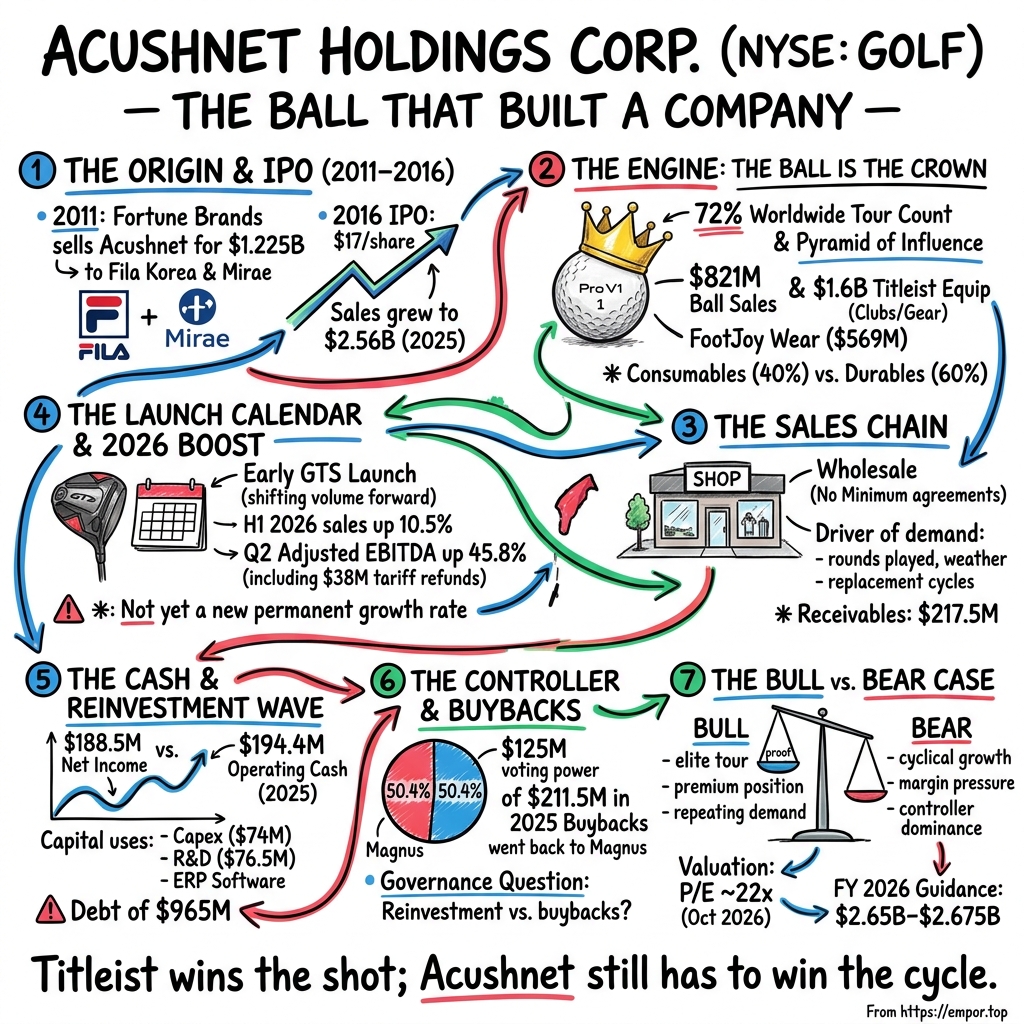
Acushnet Holdings Corp.: The Ball That Built a Company
I. The Driver Launch That Came Early
Golf's selling season usually follows a script that club fitters and pro-shop buyers could recite in their sleep. The new golf balls arrive for spring. The irons and wedges fill the racks as courses open. And Titleist's newest drivers, the most expensive and most argued-over clubs in the bag, have typically waited for the late-summer window, when tour players have tested them and the company can sell them into the autumn and the following season. In 2026, Acushnet tore up that page. Its new GTS drivers and fairway woods, originally slated for the third quarter, arrived in the second, and golfers bought them as if they had been waiting.12
The timing was not the only unusual thing in the quarter. At almost the same moment, money started flowing back from Washington. Tariffs Acushnet had paid on imported goods under the International Emergency Economic Powers Act were refunded, and after the incentive pay those refunds triggered, about $38 million landed in the second quarter's adjusted EBITDA.1 So the quarter combined two very different gifts: an early product launch that pulled demand forward, and a cheque from the government that had nothing to do with how many golf balls Acushnet sold.
The results looked like a breakout. Sales for the first six months of 2026 rose about 10.5% to roughly $1.57 billion, compared with 4.1% growth for all of 2025, when the company reached about $2.56 billion.13 Titleist club sales jumped 42% in the second quarter alone.1 For a business whose growth usually moves at the pace of golfers replacing worn-out equipment, that is the kind of number that makes investors redraw their spreadsheets.
The question this story asks is whether they should. Management itself gave the most important clue. On the August earnings call, chief financial officer Sean Sullivan said plainly that club volume had shifted out of the third and fourth quarters and into the second, and that the comparison later in the year would get harder.2 In other words, the people who know the order books best said a good part of the surge was a calendar change, not a new growth rate. The acceleration is real. The rate is not yet proven.
That distinction matters because Acushnet is not a story about a single hot quarter. It is a story about whether a golf-products company can keep turning premium brands into growth and cash, defend its margins through product cycles that rise and fall every two years, and spend its money in a way that serves every shareholder fairly, when one shareholder controls the vote.
It helps to be precise about what that company is. The listed entity is Acushnet Holdings Corp., a Delaware holding company trading on the New York Stock Exchange under the ticker GOLF, together with its consolidated subsidiaries, including the operating company Acushnet Company.3 Its controlling shareholder is Magnus Holdings, a wholly owned subsidiary of Misto Holdings, the Korean group formerly known as Fila Holdings. Misto's other businesses, including the Fila brand itself, are not part of the listed company's numbers, and nothing in this story borrows them.3
What the listed company does is sell golf. Titleist golf equipment, meaning the balls, clubs, wedges and putters, generated about $1.60 billion of 2025 sales, roughly 62% of the total.3 FootJoy, the shoes, gloves and apparel business, contributed about $570 million. A third segment, Golf gear, which covers bags, headwear and accessories, added roughly $245 million.3 Titleist is the engine. FootJoy and Golf gear are smaller rooms in the same house.
Over the next few hours, the investigation runs along three lines. The first is the source and durability of growth: how much comes from golfers buying more, how much from higher prices, and how much from launches landing in one period rather than another. The second is the moat: where Titleist's advantage is real and measurable, and where the evidence thins out. The third is the money trail: how much of reported profit becomes cash, and who receives that cash when Acushnet spends it. To follow that trail, the story starts where the current ownership began, in a deal in which the company changed hands for about one year's worth of sales.
 Subscribe on LinkedIn
II. The $1.2 Billion Golf Business That Went Public Without Raising Cash
Long before Wall Street knew the ticker GOLF, Acushnet was a rubber company in a Massachusetts town of the same name. Phil "Skipper" Young founded the Acushnet Process Company in 1910, and the company entered the golf ball business in 1932.3 By the time the modern ownership story begins, Titleist and FootJoy were already among the most recognised names in the sport, and the decisions that shaped today's Acushnet were being made by a parent that wanted out of golf entirely.
That parent was Fortune Brands, a conglomerate whose portfolio stretched from bourbon to kitchen faucets. Its first move came in March 2010, when Acushnet agreed to sell Cobra Golf, the Carlsbad, California club maker, to Puma.4 Wally Uihlein, then Acushnet's chairman and chief executive, explained that the sale let the company devote all of its resources to the global growth of Titleist and FootJoy.4 It is worth noticing who made that call. Cobra's exit was a portfolio decision taken under the previous owner, not a move by today's management, and it narrowed Acushnet to the two brands that still define it.
The second move was larger. Fortune Brands had decided to focus on spirits and separate its home-products business, and in May 2011 it agreed to sell Acushnet to a group led by 휠라코리아 Fila Korea and 미래에셋 Mirae Asset Private Equity, with the National Pension Service of Korea and the Korea Development Bank among the partners.5 The deal closed on July 29, 2011, for $1.225 billion in cash.6 Fortune Brands used the after-tax proceeds of about $1.1 billion to strengthen its balance sheet ahead of splitting into Beam and a home-and-security company.6
For Fila Korea, this was a startling leap. A company known for sportswear was buying a golf business with more than $1.2 billion of annual sales in 2010, a business that was considerably larger than the acquirer's own core.5 Gene Yoon, Fila Korea's chairman and chief executive, said the acquisition transformed his company's platform with "a stable of premier world class brands."5 Uihlein stayed on to run the company from its headquarters in Fairhaven, Massachusetts, with his management team intact.5
Was the price a bargain? The tempting shortcut is to say that a business bought for roughly one times sales must have been cheap. But a sales multiple alone cannot settle the question, because it says nothing about how much of each sales dollar became profit or cash, or what buyers of comparable golf businesses paid at the time. Fortune Brands sold in the aftermath of a financial crisis, into a golf market that was already shrinking from its Tiger Woods-era peak. The fair verdict is that the buyers paid about a year of revenue for brands that would grow considerably over the following decade, and that the public record does not support a confident claim that they overpaid or underpaid relative to peers.
Five years later, the owners took the company public. The structure of that offering is the key to understanding the shareholder base today. Acushnet Holdings priced 19.3 million shares at $17 each on October 28, 2016, raising $329 million, well below the $21 to $24 range it had indicated.7 Every one of those shares was sold by existing holders, namely the financial investors who had joined Fila in 2011: funds affiliated with Mirae Asset, an affiliate of the Woori-Blackstone Korea Opportunity fund and an affiliate of the Neoplux fund.8 Acushnet itself received nothing from the sale.8
The market mood helps explain the price. In August 2016 Nike had announced it was leaving the golf-equipment business, and Adidas was trying to sell TaylorMade.7 Uihlein was blunt about the industry's condition. "You can't be in denial that the industry was overbuilt," he said, pointing to the excess courses and inflated expectations left behind after the Woods boom.7 A golf IPO in that climate was always going to be a hard sell.
There was a second transaction hidden inside the first. In parallel with the IPO, Fila's subsidiary Magnus bought about 14.8 million shares directly from the financial investors at $17.85 a share, financed by a Korean won term loan, lifting its stake from about 33% to about 53%.8 Magnus paid more per share than public investors did, and in exchange it walked away with control. Acushnet became a "controlled company" under exchange rules on the day it listed.8 The IPO broadened ownership; it did not dilute the controller. It concentrated control.
Then came the listed-company arc. Sales were roughly flat in the years around the IPO, moving from about $1.50 billion in 2015 to $1.57 billion in 2016 and $1.56 billion in 2017.89 That flatness matters, because it describes the base the company was working from before the pandemic changed golf. When lockdowns made an outdoor, socially distanced sport newly attractive, demand surged, and sales reached about $2.15 billion in 2021 and $2.27 billion in 2022.10 Growth continued afterwards, at a slower pace, until 2025's $2.56 billion.3 The decade's growth is real, but it was not a smooth compounding curve. It was a plateau, a step change driven by an unusual external event, and then a slower climb.
Acushnet also made small additions. In July 2019 it bought KJUS, a premium ski and golf apparel brand, through a majority-owned subsidiary; its cash outlay on business acquisitions in the first nine months of 2019 was about $28 million.11 That is a rounding error against a $1.2 billion core, and the company has never presented KJUS as a rival engine to Titleist. With no standalone returns published, there is no basis for calling the deal either a success or a mistake. What it does show is that Acushnet's growth has come overwhelmingly from its existing brands rather than from buying new ones.
So the ownership history leaves two legacies. The first is a business that grew from roughly $1.5 billion to more than $2.5 billion of sales under its Korean controller. The second is a shareholder structure in which public investors own a growing business but do not control it. Before following that second legacy into the boardroom, it is worth understanding what the business actually sells, and how a golfer's habits become revenue.
III. The Shop Counter Is Where the Business Gets Paid
Picture a Saturday morning at a pro shop. One golfer grabs a dozen Pro V1 balls on the way to the first tee, because the last dozen ended up in a pond. Another has booked a fitting for a new driver and will spend an hour on a launch monitor before paying several hundred dollars. A third is replacing shoes that have finally split at the seam. Each of those purchases eventually becomes Acushnet revenue. But almost none of them is a sale Acushnet makes directly to the golfer.
The company's revenue unit is a physical product sold, mostly, to someone else who sells it on. Acushnet ships golf balls, clubs, footwear, apparel and gear to on-course golf shops, specialty retailers, sporting-goods chains and distributors, and it recognises revenue when those goods change hands.3 There is no subscription and no disclosed recurring-revenue line. Retailers place orders; Acushnet fills them. Its filings warn that a small number of large customers could materially affect results, and that those customers are not bound by minimum purchase agreements.3 If a big chain decides to run its inventory lean for a season, nothing in a contract stops it.
The products themselves split into two families with very different rhythms. Golf balls and gloves are consumables, because they wear out or get lost, and they made up nearly 40% of 2025 sales.3 Clubs, shoes, apparel and gear are durables, bought less often, and they made up more than 60%.3 That mix is the first important clue about the business. The consumable share behaves something like a utility bill for the dedicated golfer: as long as people play, balls disappear into the trees and need replacing. The durable share behaves more like a car purchase, deferred when money is tight and accelerated when a compelling new model arrives.
What drives demand through that chain? It starts with participation and rounds played, because a golfer who plays more loses more balls and wears out more gloves. Then come forces Acushnet cannot control: weather, which can close courses for weeks and shut the on-course shops with them, and consumer discretionary spending, because no one needs a new driver.3 Layered on top are the forces the company does shape, chiefly the product-launch calendar and the replacement cycle it creates.
One demand stream deserves its own sentence, because it is easy to miss. Custom-imprinted golf balls, with corporate logos, tournament names or club crests, are estimated to account for about 25% to 30% of global golf-ball sales, and most of that custom work is done for corporations.3 A company handing out logo balls at a sales conference is not making a golf decision; it is making a marketing-budget decision. That ties a meaningful slice of the ball business to corporate spending, which can be cut quickly when the economy turns.
The seasonal shape of the business shows up most clearly on the balance sheet. Retailers stock up in late winter and spring, so Acushnet's receivables, the money customers owe it, peak from late in the first quarter through the second quarter, and then typically fall in the second half as collections rise and sales slow.3 The company describes that pattern, and how it estimates credit losses, but it does not publish an ageing table showing how many invoices are overdue or by how long.3 Investors can see that money comes in waves; they cannot see how many of the waves are late.
Behind the counter sits a physical machine that most golfers never see. Acushnet owns three golf-ball plants, two in the United States and one in Thailand, together covering roughly 600,000 square feet, plus seven custom-imprinting operations around the world, six club-assembly locations and a glove factory in Chonburi, Thailand.3 About 500 sales representatives call on the shops and retailers, and around 200 people work in research and development.3 That footprint is part of the product. Making the ball in-house lets Acushnet control the consistency that tour players demand, and assembling clubs close to markets lets it turn a custom fitting, with a particular shaft, length and loft, into a delivered club within days rather than weeks.
The map of customers is broader than a typical American consumer brand's. In the first half of 2026, the United States produced about 60% of sales, with the rest spread across Europe, the Middle East and Africa, Japan, Korea and other markets.1 Korea, the controller's home market and one of golf's most passionate, was the soft spot: sales there slipped about 3.5% in dollars in the first half, and were roughly flat in local currency, while management flagged softness in Japanese and Korean footwear and apparel even as equipment held up.12 A global footprint diversifies demand, but it also means a strong dollar or a weak Asian consumer can dent results in quarters when American golfers are buying happily.
Put together, this is a business with an attractive blend. It has repeat purchases that keep the lights on, plus higher-ticket equipment that can drive growth when products are compelling. But it is also exposed at every link of the chain to things that do not show up in a brand-strength argument: a retailer's order timing, the weather in April, the corporate events budget, and its own launch schedule.
That last exposure creates the tension at the heart of this story. The same product cadence can move sales from one quarter or one model year into another, as the early 2026 launch showed. To understand whether Acushnet's advantage survives that calendar, the place to look is the product that made it famous, a golf ball that debuted on a range in Las Vegas.
IV. The Ball Is the Crown; the Rest of the Bag Is the Test
On October 11, 2000, the PGA Tour arrived in Las Vegas for the Invensys Classic, and Titleist's tour team arrived with a new ball.12 For decades, the best players had used wound balls, built around a core wrapped in rubber thread under a soft cover. The new ball, the Pro V1, used a solid core with a urethane cover, an engineering bet that a golfer could get distance off the tee without sacrificing the spin and control around the green that wound balls offered. Titleist's planners expected perhaps 20 to 25 players to put it in play immediately.13
They were badly wrong. Forty-seven players switched that week.13 Mac Fritz, Titleist's senior vice president of tour promotions at the time, later summarised the forecast in one line: "I missed the forecast by about 50 percent."13 Then the ball won. Billy Andrade took the title, and the runner-up was also playing a Pro V1, a one-two finish in its first week on tour.13 Word spread from the range to the locker room to the retail counter, and by Titleist's own account golfer demand brought the ball's public release forward.12 Within four months of launch it was the best-selling ball on the market.8
What made that week so valuable was that no advertising budget could have bought it. Tour professionals are paid to play equipment, but they are also obsessive about the one variable that determines their livelihood, and the speed with which they adopted the ball told amateurs something marketing could only claim. By the time of the IPO, Acushnet said it had sold more than 110 million dozen Pro V1 and Pro V1x balls since 2000, generating more than $4 billion of revenue.8 Through late 2024, the two models had been played in PGA Tour competition more than 97,000 times, more than six times the nearest competitor's total, according to the Darrell Survey count Titleist cites.13
Today the ball business is the most measurable part of Acushnet's advantage. The company reported about $821 million of golf-ball sales in 2025.14 Callaway, the largest listed rival, reported about $322 million of golf-ball sales for the same year.[^15] Those are reported revenues, not market shares, and they do not capture every ball maker, including privately held TaylorMade, which publishes no comparable audited figures. But a gap of roughly two and a half times between Acushnet and its closest listed competitor is not a statistical quirk. It is evidence of scale.
On tour, the gap is even wider. Titleist balls accounted for 72% of all balls played across the worldwide professional tours in 2025, more than seven times the nearest competitor.3 Acushnet counted 2025 as Titleist's 77th consecutive year as the leading ball on the PGA Tour.14 Tour usage is not consumer market share, and it should not be read that way; professionals are a few hundred people, and some are paid to play. What it measures is credibility, the sense among serious golfers that the ball the best players choose is the one to trust.
The company has a name for how that credibility travels. It calls it the "pyramid of influence": golfers learn by imitating skilled players, so Acushnet aims for its products to be the most played by the best players, professional and amateur, creating aspirational appeal for golfers at every level below them.3 Picture a pyramid with tour professionals at the peak, elite amateurs and club professionals below them, and tens of millions of recreational golfers at the base. The theory is that endorsement flows downward, because the weekend golfer wants to play what the club champion plays, and the club champion wants to play what the tour winner plays.
Where the pyramid's evidence runs thin
The theory is elegant. The question is how far it reaches. The competitive field is crowded and well funded: Callaway, TaylorMade, Ping, Srixon, Bridgestone, Mizuno and PXG all compete for the same golfer.3 In scale, Callaway's 2025 sales from continuing operations were about $2.06 billion, compared with Acushnet's $2.56 billion.153 The two companies' scopes differ, so the comparison is rough, but it is a reminder that Acushnet is the largest player in a field of serious rivals, not a monopolist.
The strongest form of the pyramid argument holds in balls, where tour dominance, sales scale and decades of repeat purchases point the same way. In clubs, the record is different. Acushnet does not publish club market share. It does not disclose customer retention, repurchase rates or the share of golfers who own both Titleist balls and Titleist clubs. Club leadership on tour changes from brand to brand and model to model; TaylorMade, Callaway and Ping have each spent years at the top of driver counts. A golfer who plays a Pro V1 can carry a TaylorMade driver without friction, and many do. That is the mechanism that would break a broader moat claim: substitution at the point of purchase, every product cycle.
So the honest reading of the pyramid is narrower than the marketing. Titleist's tour proof creates a credibility advantage that makes golfers willing to try its products and pay premium prices for them. It does not create switching costs. There is no contract, no data lock-in and no ecosystem that makes leaving expensive. A golfer can switch balls next weekend at the cost of a single box of balls.
The segment economics make the difference between the ball and the rest of the bag concrete. In 2025, Titleist golf equipment, combining balls and clubs, earned about $245 million of segment operating income on its $1.60 billion of sales, a margin of roughly 15%.3 FootJoy earned about $28.5 million on $570 million, a margin of about 5%.3 Golf gear earned about $36 million on $245 million, roughly 15%.3 Titleist equipment, in other words, produces most of the company's segment profit, and FootJoy, despite being the number-one shoe and glove in golf by the company's account, earns thin margins for its size.3
There is a further subtlety inside the Titleist number. Acushnet reports balls and clubs together as one segment's operating income, so investors cannot see the profit split between them. That matters, because balls are the most evidenced moat and clubs are the most volatile product line. When the segment's profit moves, it is hard to tell from the outside whether the ball engine is weakening or a club launch is cycling.
The verdict is a calibrated one. Titleist has unusually strong performance, brand and tour proof in golf balls, and that proof supports a premium position that the company's scale over its nearest listed rival confirms. That claim survives the evidence. A broader claim, that the same advantage extends equally into clubs, shoes and apparel, is narrowed by the record: the clubs are a large, valuable business in a market where leadership rotates, and FootJoy's single-digit margin does not look like the economics of a moat. The ball is the crown. Clubs are the largest adjacent growth opportunity, and they are a separate test, one that is graded every time a new model hits the racks.
V. A Launch Calendar Can Make a Good Business Look Better—or Worse
There is a moment in the life of every golf club that the industry knows well. In its first season, a new driver or iron is the thing every fitter wants to show and every serious golfer wants to try. Prices hold, volumes run high, and the launch quarter looks wonderful. In its second season, the same club is still good, but it is no longer new. Some golfers who wanted it already have it. Competitors have launched their own new models. The fitters' attention shifts. Sales fade until the next generation arrives.
Acushnet's 2025 numbers show that cycle almost in real time. The new Pro V1 and Pro V1x, refreshed for 2025 and introduced on tour in Las Vegas in the autumn of 2024, lifted ball volumes; new GT hybrids and T-Series irons lifted club sales.133 At the same time, second-year drivers and wedges sold less, as did some performance balls further down the line.3 Total sales rose 4.1%, helped by club pricing, higher golf-ball volumes and those newer products, with the second-year declines partly offsetting the gains.3
The puzzle is what happened to profit. Titleist equipment's segment operating income fell about 10.6% in 2025, to roughly $245 million, even though its sales rose.3 The company attributed the decline to higher operating expenses, manufacturing costs and tariffs, which outweighed the growth in gross profit.3 That is the first clue that a launch can make the top line look healthy while the cost structure absorbs the benefit.
The company-wide gross margin tells the same story at a larger scale. Gross margin slipped from about 48.3% in 2024 to 47.7% in 2025.3 Decomposed simply, sales rose by about $102 million while cost of goods sold rose by about $68 million, so gross profit still increased by about $34 million, but each extra dollar of sales carried more cost than the average dollar had before.3 Management named tariffs as the main identifiable culprit.3 The lesson is that pricing power did not fully cover a cost shock that arrived in a single year.
The other two segments moved in different directions. FootJoy's sales slipped about 0.8%, mainly because fewer pairs of shoes were sold, even as higher average prices and a richer product mix helped profitability.3 Golf gear rose about 5.5%, chiefly because of higher prices rather than more units.3 Taken together, the 2025 record shows a company that can raise prices across its brands, which is a real sign of brand strength, but whose volumes in some categories are not growing alongside those prices. When price does the lifting and volume does not, investors should ask how long the price can keep rising.
Acushnet has not responded to the margin squeeze by cutting investment. Research and development spending rose from about $65 million in 2023 to $76.5 million in 2025, edging up from about 2.7% to 3.0% of sales.3 Capital spending held at roughly $74 million to $75 million a year across the same period, around 3% of sales, and management expected about $95 million in 2026.3 On top of that, the company capitalised about $38 million of costs for a new enterprise resource planning system in 2025 and expected roughly $25 million more in 2026.3 For a non-specialist, an ERP system is the central nervous system of a manufacturer, the software that connects orders, inventory, factories, shipping and the books. Replacing one is expensive, disruptive and, if it goes badly, capable of damaging a selling season.
Where is the rest of the money going? The company describes expanding its fitting networks and product capacity, developing business-to-business and direct-to-consumer capabilities in new regions, and investing in the Titleist Performance Institute, its golf-fitness and instruction arm.3 On the August call, management added that its ball plants were running near full capacity, that expansion was focused on cast urethane production in Massachusetts and Thailand, and that new lines can take 12 to 18 months to come online.2 These are current operating investments in the core, not separate businesses with their own economics. That is reassuring in one way, because it means the company is not wandering into unrelated ventures. It also means their returns are buried inside the segment numbers.
The company was simultaneously trying to trim costs. A 2025 voluntary bridge-to-retirement programme aimed to reduce operating expenses, and Acushnet ended the year with about 7,300 associates.3 The combination of rising product investment and selective cost reduction suggests a management team trying to protect the engine while tightening the chassis.
The useful conclusion from 2025 is not that Acushnet is in trouble. It is that higher sales do not automatically produce higher Titleist profit, because launches, tariffs, manufacturing costs and operating expenses all move at once. The right way to judge this business is across a full launch cycle, comparing segment sales, operating income and gross margin from one generation of products to the next, not by admiring the launch quarter. That is precisely the discipline the first half of 2026 would test, because its launch quarter arrived early, and arrived with a refund attached.
VI. The 2026 Beat Came With a Calendar Change
On August 6, 2026, Acushnet's executives dialled into their second-quarter call with numbers that needed no salesmanship. Second-quarter sales had risen about 14% to $820 million. Adjusted EBITDA had jumped nearly 46% to about $209 million.1 David Maher, the chief executive, opened by calling it a strong quarter and a strong half, led by Titleist golf equipment, and singled out the "initial success of new GTS drivers and fairways."12
To weigh that performance, it helps to start with the base rate. Over the decade from 2015 to 2025, Acushnet's sales grew about 5.5% a year, and in 2025 they grew 4.1%.83 First-half 2026 growth of about 10.5%, or 9.5% in constant currency, ran roughly double that pace.1 When a mature company suddenly grows twice as fast as its history, there are only a few possible explanations: demand has shifted upward, prices have risen faster, or revenue has moved between periods. The task is to work out the blend.
The first adjustment is the refund. The roughly $38 million of net IEEPA tariff refunds in the quarter was a one-time recovery of costs paid in earlier periods.1 Take it out, and second-quarter adjusted EBITDA was roughly $171 million, still up about 19% on the prior year. Sullivan made the same point for the half: first-half adjusted EBITDA rose about 25%, or about 12% excluding the net refund benefit.2 The gross margin told a similar story. It rose to about 50.9% for the half including refunds, but excluding them it was about 48.1%, actually down half a percentage point.2 Underneath the refund, tariffs and costs were still squeezing.
The second adjustment is the calendar. Titleist club sales rose 42% in the quarter and about 24% for the half, while golf balls grew about 7% for the half, FootJoy about 2% and Golf gear about 7%.1 Clubs were the outlier, and the outlier had a known cause. In prepared remarks, Maher credited growth across segments and regions, early GTS adoption and healthy golf participation, with first-half rounds projected up low single digits.2 Then the analysts got their turn.
The question the analysts kept asking
Simeon Gutman of Morgan Stanley pressed on the obvious point: how big was the pull-forward? Sullivan declined to put a number on it.2 He did describe its shape. The early launch had shifted meaningful club sales and earnings into the first half, clubs should keep performing in the third quarter, and the sharper comparison would come in the fourth quarter, when the business would be lapping the prior generation's launch season.2 He said the quarter's club timing had come in "slightly better than expected," that the analyst community had modelled more club revenue in the third quarter than the company now expected, and called it "a timing shift." Outside clubs, he said, "Everything else is as expected."2 When Matthew Boss of JPMorgan asked about the back half, Maher said balls, FootJoy and Golf gear should look similar to the prior year, with clubs as the exception.2
That answer deserves credit and scrutiny in equal measure. Credit, because management volunteered the uncomfortable part: a good portion of the quarter's excitement was borrowed from later in the year, and the second half would show it. Scrutiny, because declining to quantify the shift leaves investors to estimate it themselves, and the guidance is the best tool for doing so.
The guidance arithmetic is revealing. The company's updated outlook called for full-year 2026 sales of about $2.65 billion to $2.675 billion and adjusted EBITDA of about $450 million to $470 million, including about $30 million of net IEEPA refunds.1 The full-year refund figure is smaller than the second-quarter benefit because incentive compensation tied to the refund would be expensed over the rest of the year, and Sullivan said all refunds had been received.2 Take the midpoint of sales guidance, subtract the first half's roughly $1.57 billion, and the second half comes to about $1.09 billion. The second half of 2025 was about $1.12 billion. So management was guiding to second-half sales down roughly 3%, consistent with its own "low single digits" language, and for second-half adjusted EBITDA to fall year over year.2
The more telling comparison runs across three calls. In February 2026, alongside its fourth-quarter results, Acushnet first guided to 2026 sales of $2.625 billion to $2.675 billion and adjusted EBITDA of $415 million to $435 million, and lifted its quarterly dividend 8.5% to $0.255 a share.16 In May, after a first quarter in which sales rose about 7% but adjusted EBITDA margin dipped as tariffs bit, it reaffirmed both ranges.17 By August, the EBITDA range had moved up by $35 million at each end, but $30 million of that was the refund. Excluding the refund, the outlook was about $420 million to $440 million, only about $5 million higher than where it started the year. Meanwhile management had cut its full-year tariff cost estimate to about $54 million from roughly $70 million originally.2
That is the clearest single test of what the first half really meant. A business that had truly accelerated would be expected to raise its underlying profit outlook meaningfully after a 10% half. Acushnet nudged its underlying number up modestly while booking a refund and enjoying lower tariff costs than it had feared. Read that way, the guidance discipline held: management did not chase the first half's momentum, and the underlying year it described looks a lot like the base rate.
The product evidence should be read with the same care. GTS drivers won on tour quickly and drew strong early acceptance, which establishes product validation. Tour victories, though, are what the Pro V1 story teaches investors to value as a first proof, not a final one. Sell-through to golfers, reorder patterns from retailers and the 2027 club results will show whether the launch converted into durable demand or simply arrived early. Maher told analysts that channel inventories were steady and that fitting lead times had lengthened because of demand, which is encouraging but not yet the full answer.2
The cost side deserves the last word on the call. Tariff costs persisted even after the refunds, and when Gregory Miller of Truist asked about inputs, Maher said material costs had "moderated a bit," but that synthetic rubber remained volatile with oil prices, tungsten had eased only slightly, and freight remained elevated.2 Synthetic rubber goes into ball cores; tungsten is the dense metal club designers use to move weight around a clubhead. Both are reminders that the company's margin depends on commodity markets it cannot control.
The verdict on the 2026 beat is mixed in a specific way. Management gave a concrete, candid explanation of the timing shift and guided to a weaker second half, which helps its credibility. But the first half was not a new growth rate, and its earnings flattered the underlying business. The next question is the one that matters most for any owner: when Acushnet earns a dollar of profit, how much of it arrives as cash?
VII. The Cash Arrives in Waves
Close the books on a golf company in December, and the picture is deceptive. The warehouses are filling with next season's balls and clubs. The retailers have paid most of what they owed from spring and summer. The fourth quarter itself typically loses money; in late 2025, Acushnet's attributable net loss for the quarter was about $35 million.16 Cash and profit are moving to different calendars, and the only way to judge the business honestly is to look at full years and to look at several of them.
At first glance, 2025 looks tidy. Acushnet reported about $188.5 million of attributable net income and about $194.4 million of operating cash flow.3 Almost a dollar of cash for every dollar of profit is respectable for a manufacturer. The three-year record is more uneven. Operating cash flow was about $372 million in 2023, $245 million in 2024 and $194 million in 2025, against attributable net income of about $198 million, $214 million and $189 million.3 Cash conversion fell from almost twice net income to roughly one times in two years.
The explanation is working capital, the money tied up in inventory and in amounts customers owe. In 2023, after the post-pandemic supply-chain scramble had left the industry overstocked, Acushnet released about $59 million of inventory, turning goods on shelves back into cash.3 That was a one-time unwinding, not a repeatable source of cash. By 2025 the flow had reversed: inventory absorbed about $20 million and other assets and liabilities absorbed about $72 million, while receivables released about $12 million.3 The company cited ERP spending and working capital as the main reasons operating cash flow declined.3
There is also an accounting wrinkle that makes 2025 profit look better than its cash. In January 2025, Lionscore, the joint venture that had made FootJoy shoes, stopped manufacturing at its factory in Fuzhou, China, and production shifted to a third-party factory in Long An, Vietnam, run by an affiliate of the joint-venture partner; Acushnet kept a 40% interest in the sourcing and manufacturing venture.3 When the venture was deconsolidated, Acushnet booked a non-cash gain of about $20.9 million.3 That gain lifted reported other income, which totalled about $15 million for the year, but it was not money, and it was deducted when reconciling net income to operating cash.3 Partly offsetting it on the earnings line, a $17 million loss on extinguishing debt during the year's refinancing reduced net income.16 Neither item is part of the repeatable business.
The reinvestment burden then takes another bite. Annual capital spending of about $74 million, plus ERP implementation costs that were being capitalised, sat on top of the working-capital swings.3 With capex guided to about $95 million for 2026 and another $25 million of ERP costs expected, the claim on cash is rising, not falling.3 Add 2025's capex to the operating cash flow picture and free cash flow came to roughly $120 million, well below the $211.5 million the company spent on buybacks that year, before dividends.3 That gap had to be bridged by borrowing, which becomes important when the story reaches the boardroom.
The receivables line looks calm. Net receivables ended 2025 at about $217.5 million, almost unchanged from the year before.3 The allowance for expected credit losses ended the year at about $6.9 million, after a $0.4 million provision and $0.8 million of write-offs; write-offs had been around $0.6 million to $0.7 million in each of the two prior years.3 That is a small allowance against a large receivable book, consistent with customers who mostly pay. But the company does not publish an ageing table or quantify overdue balances, so investors cannot independently see whether delinquency is concentrated in a particular channel or region. The allowance is reassuring; it is not a window.
Currency is the quietest risk in the business, and one of the most structural. More than 40% of Acushnet's sales and more than 25% of its operating expenses are denominated in foreign currencies.3 Outside the U.S., Acushnet sells mostly in local currencies, yet about 80% of its cost of goods sold is in U.S. dollars.3 Imagine a ball sold in Tokyo for yen, made from inputs paid for in dollars. When the yen weakens, the same box of balls brings home fewer dollars while the cost stays put, and gross profit shrinks unless prices rise. The company hedges forecast transactions with forward contracts, typically up to 24 months ahead, with a gross notional amount of about $231 million at year-end 2025.3 Hedges smooth the timing; they do not remove the mismatch, and they do not touch the translation of foreign profits back into dollars.
The legal and tax picture, as the company presents it, is benign. The 2025 annual report describes ordinary-course proceedings and says management does not expect pending matters to have a material effect; it quantifies no specific material tax demand or regulatory action.3 PwC issued a clean opinion on the financial statements and on internal controls, with no emphasis-of-matter paragraph.3 That is the company's assessment and the auditor's sign-off, which is meaningful, but it is not proof that risk is zero.
The balance sheet is where the cash story ends and the capital-allocation story begins. At June 30, 2026, Acushnet's borrowings totalled about $965 million before lease liabilities: about $442 million drawn on its revolving credit facility, $500 million of 5.625% senior notes due 2033 and about $23 million of local borrowings.18 The November 2025 refinancing extended the revolver to 2030 and created the notes, so the maturities are concentrated in two years, 2030 and 2033.18 The company had about $504 million of undrawn revolver capacity and reported compliance with its covenants.18 Management told analysts its net leverage was just under two times EBITDA, down from about 2.3 times in the first quarter and below its 2.25 times target.2
That is manageable near-term liquidity. It is also a meaningful amount of debt for a business whose cash flows arrive in waves and whose free cash flow in 2025 did not cover its buybacks. Every dollar of that debt competes with reinvestment and with share repurchases. And the largest single recipient of Acushnet's repurchase dollars was not an anonymous seller on the stock exchange.
VIII. The Controller Sells Shares Back to the Company
In April 2025, and again in July, Acushnet's treasury wrote cheques to a shareholder it knew very well. Each payment was about $62.5 million, and the recipient was Magnus, the Misto subsidiary that controls the company.3 Over the year, Acushnet bought about 1.89 million shares from Magnus for $125 million, as part of a total repurchase programme of $211.5 million.16 About 59% of the year's buyback dollars, in other words, went to the controlling shareholder.
The first thing to establish is what the related-party relationship actually looks like, because in controlled companies the fear is usually a royalty, a management fee or a loan to the parent that quietly drains minority holders. Acushnet's disclosures do not show any of those. Neither the 2025 annual report nor the 2026 proxy discloses royalty or brand fees, intercompany loans, guarantees or balances owed by the parent.319 There is a service agreement under which Acushnet provides Misto with IFRS financial-statement preparation and Korean tax-compliance information, but the proxy does not quantify what Acushnet receives for that work.19 The clearest recurring cash transfer to the controller is the share repurchase itself.
The structure of those purchases matters. The agreements priced Magnus's shares on the same weighted-average basis as Acushnet's open-market purchases over the relevant period.3 Across 2025, the company bought its shares at an average of about $67.50, and the Magnus block worked out to roughly $66 a share.16 The controller was not paid a premium. That is a real fairness protection, and it deserves to be stated clearly.
What matched pricing cannot answer is whether buying back stock was the best use of the money in the first place. A company with about $965 million of borrowings, rising capital spending and an ERP programme underway could instead have paid down debt or kept more cash. And there is a structural asymmetry. When Acushnet buys shares from the open market, the controller's percentage stake rises automatically, because the share count shrinks around it. When it buys shares from Magnus in proportion, the controller turns part of its stake into cash while keeping its percentage roughly level. Either way, the controller keeps control. The buyback structure gives Magnus a reliable, priced exit for part of its holding without ever surrendering its majority.
The arrangement continued into 2026. In June, Acushnet agreed that Magnus could sell it up to another $52.5 million of shares on a share-for-share basis as the company repurchased stock elsewhere.20 Through June, though, the company had returned a relatively modest $57 million to shareholders, about $31 million in dividends and $26 million in repurchases.2 As of April 2026, Magnus held about 29.5 million shares, approximately 50.4% of the voting power.19 The share count had fallen from about 67 million weighted-average basic shares in 2023 to about 58.6 million at the proxy record date.319 Shareholders who stayed own a larger slice of a smaller company. The controller still owns the majority of it.
The people in charge
The man running the business is a company lifer. David Maher joined Acushnet in May 1991 and spent the next quarter-century climbing through Titleist's sales and operations organisation, holding roles that included vice president of Titleist U.S. sales, senior vice president of Titleist worldwide sales and global operations, and chief operating officer, before becoming president and chief executive in January 2018.19 He is not a celebrity executive or a turnaround hire. He is a salesman who learned the business from the golf-shop counter outward, and the call transcripts sound like it: comfortable on channel inventory, fitting lead times and product cadence, disciplined about what the company will not quantify. As of April 2026 he held about 863,000 shares, roughly 1.5% of the company.19
Above him sits the controlling family. Gene Yoon has chaired Acushnet's board since 2011; he led Misto as chairman from 1994 until February 2026, when he became honorary chairman, and was its chief executive from 1991 to 2018.19 His son, Kevin Yoon, has been Misto's president and chief executive since 2018 and sits on Acushnet's board.19 The board says that although it qualifies as a controlled company, it has chosen to keep a majority-independent board and fully independent compensation and nominating committees.19 That choice matters, but the voting arithmetic still runs through Seoul.
Maher's pay has risen steadily. His reported total compensation was about $9.7 million in 2024 and about $10.6 million in 2025, a year in which attributable net income fell about 12%.1916 His annual cash incentive was weighted 90% to adjusted EBITDA and 10% to strategic objectives.19 In 2025 adjusted EBITDA came in at $410.4 million against a $412 million target, about 99% achievement, and his bonus paid out at about 99% of target.19 That is a fair reading of the formula. But it also shows what the formula rewards. Adjusted EBITDA rose about 1.5% in 2025, while Titleist segment operating income, the clearest measure of the core engine, fell by more than 10% and came in at about 84% of the goal the company set for it in the bonus plans of other executives.193 The CEO's incentive did not use that measure.
The annual meeting in June 2026 offered a limited but useful signal of how other shareholders feel. The advisory vote on pay passed overwhelmingly, with about 54.8 million votes for and fewer than 0.2 million against.21 The director votes were more interesting. Gene Yoon received about 9.6 million withheld votes and Kevin Yoon about 7.3 million, against about 5.9 million for Maher.21 If Magnus voted its 29.5 million shares in favour of every nominee, as a controller ordinarily would, then something like a third or more of the votes cast by other shareholders were withheld from the chairman. The minority cannot change the outcome. It can register its view, and it did.
The case for current management is real. Maher has run the company through a pandemic boom, a supply-chain crisis, an inventory hangover and a tariff shock, and sales grew from about $1.56 billion the year before he took over to about $2.56 billion in 2025.93 The August call's candour about launch timing was an example of a management team choosing credibility over a flattering headline. The tests of that credibility are concrete: full-year results against guidance once the refund and the timing shift are stripped away, margin delivery after tariffs, and whether buybacks remain balanced against debt and investment in the core. Those tests, together with the moat and the price the market is paying, are the material for weighing the whole case.
IX. Analysis & Bear vs. Bull Case
On October 23, 2026, GOLF closed at $81.31.22 That price put the company at about 22 times its trailing earnings, after a sharp run around the strong first half, and Morningstar's valuation series from mid-September showed the stock trading above its own five-year average price-to-earnings ratio of roughly 20 times.22 With about 58.6 million shares outstanding, the market value was roughly $4.8 billion; adding about $965 million of borrowings gives an enterprise value of about $5.7 billion, or roughly 12 to 13 times guided 2026 adjusted EBITDA depending on whether the refund is counted.19181 The market, in short, is paying a modest premium to Acushnet's own history. The question is whether the evidence supports paying it.
It helps to translate that multiple into what the market appears to assume. At about 22 times earnings, an investor is paying for an earnings yield of roughly 4.5%, below the 5.625% coupon Acushnet itself pays on its 2033 notes.18 The quarterly dividend of $0.255 a share adds up to about $1.02 a year, a yield of roughly 1.25% at the October close.122 Those numbers only make sense if earnings keep growing from here—in other words, if the 2026 base, stripped of its refund and calendar effects, is a launch pad rather than a plateau. A buyer at this price is implicitly betting that the underlying growth rate is at least the decade's 5% or so, and that margins hold through the next tariff, currency or commodity surprise. The price does not demand a breakout. It does demand that the business keep doing what it has done, without a repeat of 2025's margin slippage.
The bull case starts with the ball. Titleist's tour dominance, its sales scale over the nearest listed rival and a quarter-century of Pro V1 repeat purchases give it a consumer franchise most equipment makers would envy. Around that core sit successful price increases, a fitting network that puts Titleist clubs into golfers' hands under expert guidance, and steady reinvestment in product and capacity. Participation has held up; management cited a roughly 2% rise in worldwide rounds in 2025 and low-single-digit growth in the first half of 2026.162 If rounds keep growing and launches convert into reorders, Acushnet can grow without a major acquisition, return cash and gradually reduce leverage. In this telling, today's multiple is the price of quality.
The bear case does not deny the brands. It argues that the value they create may not compound as quickly for minority holders as the multiple implies. Growth has historically been moderate and cyclical, running about 5.5% a year over a decade that included a pandemic surge. In 2025, net income fell, Titleist's segment operating income contracted and gross margin narrowed. The first half of 2026 then looked spectacular partly because of a refund and partly because clubs arrived early, and the company itself guided to a weaker second half. Add leverage that is manageable but not trivial, currency exposure built into the cost structure, and a controller that takes the largest share of buyback dollars, and the bear sees a good company priced as if its best half-year were its new normal.
Testing the moat through the industry's forces
The industry's structure helps decide between them. Rivalry is intense: Callaway, TaylorMade, Ping, Srixon, Bridgestone, Mizuno and PXG all refresh products on regular cycles and spend heavily on tour staff, so no brand can rest on last year's model. Buyer power is significant, because large retailers and distributors can order without minimums and can shift shelf space between brands every season.3 The threat of new entrants is moderate in clubs, where PXG showed that a well-funded newcomer can build a premium brand, but much lower in tour-grade balls, where urethane-cover manufacturing at scale requires plants, process knowledge and validation that take years to build; the company says its own capacity additions take 12 to 18 months.2 Supplier power shows up in commodity inputs such as synthetic rubber and tungsten and in the factories that make shoes, as the Lionscore transition showed.23 Substitutes are the weakest force; there is no digital replacement for a physical golf ball, and AI is a risk to product development, systems and commerce rather than to the product itself.
Through the lens of Hamilton Helmer's seven powers, the sources of Acushnet's advantage become clearer, and narrower. Branding is the strongest power, and it is concentrated in balls, where golfers pay a premium for the confidence that tour validation creates. Scale economies are real in ball manufacturing, where Acushnet's sales are roughly two and a half times its largest listed rival's and its owned plants run near capacity.14[^15]2 Counter-positioning does not apply; rivals can and do copy the tour-validation model. There are no meaningful switching costs and no network effects, because a golfer loses nothing by changing brands. Cornered resources are limited, though decades of tour relationships and fitting expertise come close. Process power, the accumulated know-how of making a consistent premium ball at scale, is plausible but not directly measurable from the outside. The moat, on this analysis, is real but narrow: one brand power and one scale advantage, concentrated in one product.
The stress test for the moat outside balls is what happens to price and volume together. In 2025, Golf gear grew mainly through price and FootJoy footwear lost volume.3 Price increases without volume growth can signal pricing power, or they can signal a franchise drawing down its goodwill. For clubs and wear, the measures that would confirm a broader moat are pricing against unit volumes, segment operating income and reorder behaviour through a full product cycle. Tour wins alone are not a commercial moat; they are the start of one.
The capital-allocation record is thinner than either side would like. The 2011 purchase and the small additions that followed expanded the portfolio, but the company does not publish standalone returns for KJUS, and its consideration was small. There is no basis for calling the acquisitions accretive or value-destroying. The larger capital-allocation decisions are the recurring ones: buybacks, more than half to the controller, alongside rising capex.
Management's record is best judged by keeping its best and worst recent moments together. The 2025 segment-profit miss, with Titleist operating income falling well short of its internal goal, is one moment. The August 2026 call, with its candid explanation of the timing shift and disciplined underlying guidance, is the other. A team that misses on cost but explains timing honestly is credible about what it can see and less proven about what it can control.
Governance is the final stress test, and the one most specific to this company. Same-price repurchases reduce the risk that the controller extracts value through price. They do not eliminate the opportunity-cost question, and they do not remove the control discount that can limit minority influence and make an outside takeover nearly impossible without Magnus's consent. A skeptical activist would focus here: on whether the buyback programme is sized to Acushnet's needs or to the controller's liquidity, on the unquantified Misto service agreement, and on whether incentive targets reward the measures that matter most to the core.
Credit markets offer an outside view. S&P affirmed Acushnet at BB with a stable outlook on September 2, 2026, a sub-investment-grade rating that reflects real but manageable leverage.23
For an investor following the company, three measures carry most of the story. The first is Titleist equipment sales and segment operating income through launch cycles; in 2025, they moved in opposite directions.3 The second is gross margin after tariffs and pricing; it narrowed in 2025 and again in the first half of 2026 excluding refunds.32 The third is operating cash flow after working capital, ERP spending and buybacks; it weakened sharply between 2023 and 2025.3 None of these measures depends on what management says. All of them reveal whether the brand's strength is reaching the owners.
The material risks follow from the same mechanisms: discretionary demand that can soften when consumers or corporate marketing budgets tighten, launch execution in a business graded every two years, tariffs and input costs that move margin by tens of millions of dollars, a currency mismatch built into the cost base, seasonal swings in receivables and inventory, and a refinancing wall concentrated in 2030 and 2033. Weighed together, the bull case has stronger evidence in balls than anywhere else in the portfolio. The bear case is not that the brands lack value. It is that cyclicality, costs, leverage and control may limit how much of that value compounds for the people who do not hold the majority.
X. Business & Investing Lessons
A tour stop, a practice range, a dozen golfers trying a new ball and liking it: that is how most consumer franchises in golf begin and end, because the next week a rival brings a new ball to the same range. Acushnet's history shows what it takes to turn that kind of moment into something that lasts a quarter-century, and it also shows where the moment's power runs out.
The first lesson is that a tour win starts the proof, and the golfer's next purchase finishes it. The tour signal was spectacular, but the reason it built a company was what happened afterward: amateurs bought the ball, lost it, and bought it again, year after year, until those boxes added up to billions of dollars of revenue. Visibility opened the door. Repeat demand walked through it. For founders, the wider point is that endorsement is a marketing event while repurchase is an economic one, and only the second compounds. For investors, it means that the GTS drivers' early tour success is the opening of the argument, not the conclusion.
The second lesson is that a strong brand can price up, but it still has to earn the next margin point. In 2025, rising costs outpaced pricing, and Titleist equipment earned less despite sales growth. The brand did its job; the cost structure did not cooperate. Pricing power is often treated as a permanent shield, but in a physical-goods business it is a race between what customers will pay and what the factory, the freight forwarder and the customs office will charge, and that race is run again every year.
The third lesson is that buybacks are a capital-allocation decision every time, even when the seller is the controller. Acushnet's purchases from Magnus were fairly priced, but that answers only one question. The others, whether the money would have done more paying down a revolver or expanding urethane capacity, and whether the programme's size reflects the company's needs or its controller's, remain every time a cheque is written. A fair price can still be the wrong purchase.
The fourth lesson is that the quarter is not the cycle. The early driver launch and tariff refund made the first half of 2026 look exceptional, but management said the timing shift would weigh on the second half. For anyone analysing a launch-driven business, the unit of measurement is the full product generation, from the first shipment of a new model to the last discounted unit of the old one, and the cash that survives the whole journey.
XI. Epilogue
Tonight, Acushnet sits between two halves of a year that will look very different on paper. The first half brought early clubs, a refund and healthy demand. Management warned that the second half would reflect the club sales shifted into spring. Its full-year outlook includes the refund benefit, while borrowings remain about $965 million.118 What happens next will either confirm the cautious reading of 2026 or force a rethink.
The first moment comes when the full-year results arrive. If reported sales land inside the range and adjusted EBITDA excluding the refund tracks the level implied by guidance, then the August explanation will have been right: timing and a refund lifted a year otherwise close to the long-run base rate. If second-half sales fall more steeply than the low-single-digit decline management described, the timing shift was larger than it implied, and analysts will press harder next time for a number. If they hold up better, some of the GTS demand was genuinely new.
The second moment is 2027's club season, which will be the first full year of GTS life without a launch-quarter comparison to flatter it. Sell-through, retailer reorders, Titleist club operating income, ball pricing against ball volume and the direction of FootJoy footwear volumes will show whether the brand's 2026 strength becomes repeat demand or simply moved earlier. The 2025 cycle is the warning: a second-year product fades, and the segment's profit can fall even as its sales rise.
The third moment is in the cash flow statement. Investors will want to see operating cash flow recover after the ERP spend peaks, whether capex reaches the guided $95 million, and whether the company uses its cash to reduce the revolver ahead of its 2030 maturity or to buy more shares, including from Magnus under the June agreement. The balance between those uses will say more about capital discipline than any statement of priorities.
And then there is the boardroom. The next proxy will show whether Acushnet quantifies what it receives for its services to Misto, whether the controller's stake drifts, and whether the withheld votes against the Yoons grow, shrink or stabilise. None of these will change who controls the company. They will show whether minority holders feel the trade-offs of control are being managed in their interest.
All of these moments circle one decisive test. Do Acushnet's product launches produce repeat demand and cash after the launch quarter has passed? If they do, the premium the market pays has a foundation. If they do not, the first half of 2026 will be remembered as a calendar trick that looked like a breakout.
XII. Outro
Go back to the range at the Invensys Classic in October 2000, where the Pro V1 made its first splash on tour.13 Its lasting credibility is part of a much longer record of Titleist tour leadership.14
That trust is Acushnet's most valuable asset. But trust on the range is not the same as returns on capital, and the public-company test is what happens after the golfer leaves the range: whether the next launch converts, whether the next margin point is earned, whether the next dollar of cash goes where it serves every owner. Titleist wins the shot; Acushnet still has to win the cycle.
References
-
Second Quarter and Year-to-Date 2026 Results — Acushnet Holdings Corp./SEC, 2026-08-06 ↩↩↩↩↩↩↩↩↩↩↩↩↩↩↩
-
Q2 2026 Earnings Call Transcript — StockAnalysis/Quartr, 2026-08-06 ↩↩↩↩↩↩↩↩↩↩↩↩↩↩↩↩↩↩↩↩↩↩↩↩
-
2025 Form 10-K — Acushnet Holdings Corp./SEC, 2026-02-27 ↩↩↩↩↩↩↩↩↩↩↩↩↩↩↩↩↩↩↩↩↩↩↩↩↩↩↩↩↩↩↩↩↩↩↩↩↩↩↩↩↩↩↩↩↩↩↩↩↩↩↩↩↩↩↩↩↩↩↩↩↩↩↩↩↩↩↩↩↩↩↩
-
Acushnet sells Cobra Golf to Puma — Golf Business News, 2010-03-10 ↩↩
-
Acushnet Company Acquired for $1.225 billion — Golf Business News, 2011-05-23 ↩↩↩↩
-
Fortune Brands Completes $1.225 Billion Sale of Acushnet — Fortune Brands/SEC, 2011-07-29 ↩↩
-
Acushnet raises $329 million in initial public offering — GOLF.com, 2016-10-28 ↩↩↩
-
Final IPO Prospectus — Acushnet Holdings Corp./SEC, 2016-10-28 ↩↩↩↩↩↩↩↩
-
Form 10-Q for quarter ended September 30, 2019 — Acushnet Holdings Corp./SEC, 2019 ↩
-
25 Years of Innovation: New Pro V1 and Pro V1x Launch on PGA Tour — Golf Business News, 2024 ↩↩↩↩↩↩↩
-
Fourth Quarter and Full Year 2025 Results — Acushnet Holdings Corp./SEC, 2026-02-26 ↩↩↩↩↩↩↩
-
First Quarter 2026 Results — Acushnet Holdings Corp./SEC, 2026-05-06 ↩
-
Form 10-Q for quarter ended June 30, 2026 — Acushnet Holdings Corp./SEC, 2026-08-06 ↩↩↩↩↩↩
-
2026 Proxy Statement — Acushnet Holdings Corp./SEC, 2026-04-17 ↩↩↩↩↩↩↩↩↩↩↩↩↩↩
-
Magnus Share Repurchase Agreement — Acushnet Holdings Corp./SEC, 2026-06-08 ↩
-
2026 Annual Meeting Voting Results — Acushnet Holdings Corp./SEC, 2026-06-11 ↩↩
-
Valuation History — Morningstar, Acushnet Holdings Corp. ↩↩↩
 LinkedIn
 WhatsApp
 Reddit
 Hacker News
 Email
 Kindle
 RSS Feed
 Spotify
 Apple Podcasts
 Amazon Music
 Audible
 YouTube