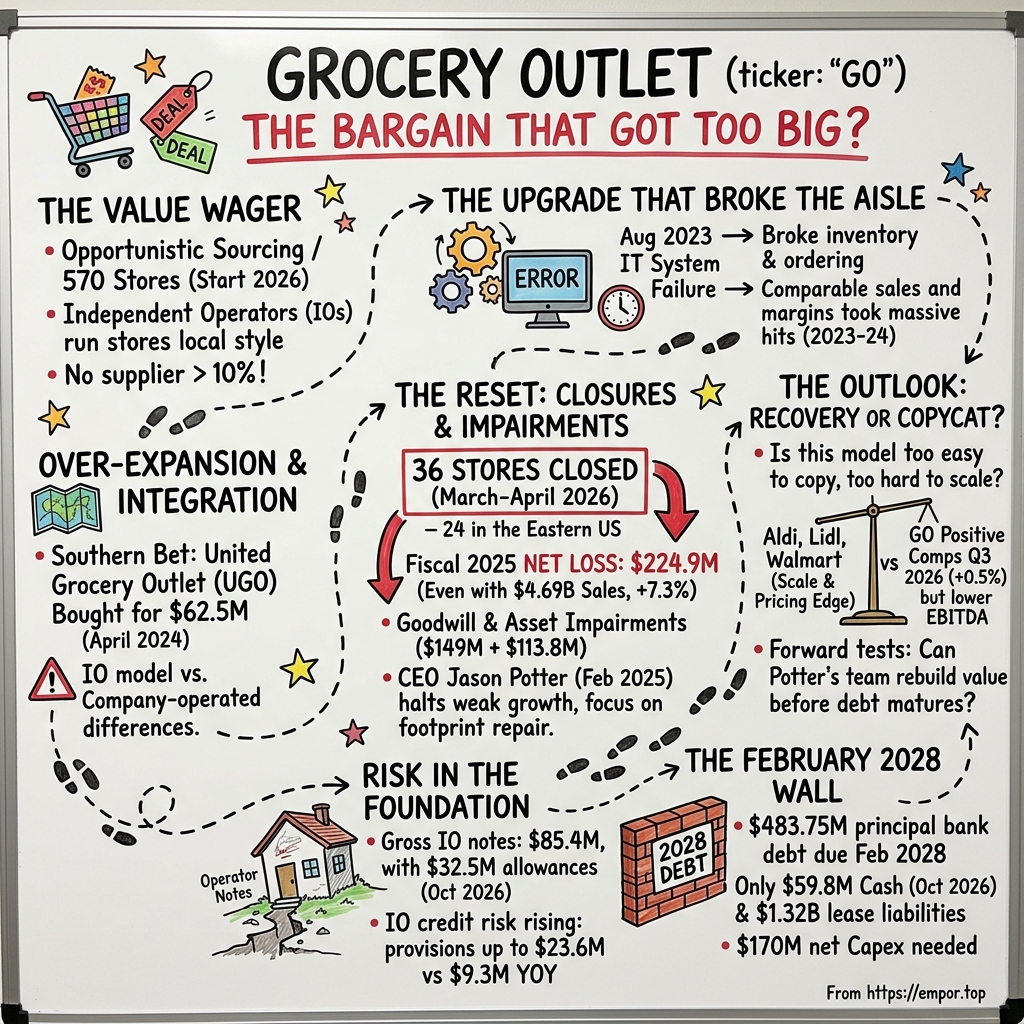
Grocery Outlet: The Bargain That Got Too Big?
I. Thirty-Six Stores Close
On March 4, 2026, Grocery Outlet did something that a growth retailer almost never does in public. It told investors that the store count, the number that had defined its story for a decade, was going to shrink. Thirty-six stores would close in March and April, and twenty-four of them sat in the eastern United States, the very territory the company had spent the previous few years trying to conquer.1 On the same day, chief executive Jason Potter described the fourth-quarter results as unacceptable.1[^2] For a company whose investor pitch had always been built on new-store openings, it was the retail equivalent of a pilot announcing that the plane would be turning back.
The reset was abrupt in another sense, too. These were not ancient, tired locations in neighborhoods that had moved on. Many of the closures were in markets Grocery Outlet had entered recently, in an expansion that was supposed to prove its California-born format could travel. That is why the announcement landed harder than a routine pruning. A chain that closes a few old stores is tidying up. A chain that closes a cluster of young ones is admitting that some of its recent bets did not work.
The headline numbers made the contradiction impossible to miss. In fiscal 2025, Grocery Outlet's net sales reached about $4.69 billion, up 7.3% from the year before.[^2]2 By the standard most retail investors reach for first, that is a healthy business: more stores, more shoppers, more dollars through the registers. Yet the same year ended with a net loss of about $224.9 million.[^2]2 Some of that sales growth was flattered by a 53rd week in the fiscal calendar, and on a like-for-like basis comparable-store sales rose only about half a percent.2 The loss, meanwhile, was driven by write-downs on goodwill and on store assets, accounting entries that are the corporate equivalent of a confession: the company had paid for, or built, things that were no longer expected to earn what it once believed.
So the central question of this story is not whether Grocery Outlet can sell groceries. It plainly can, at enormous volume. The question is whether its locations can earn their keep, and what went wrong when expansion seemed to outrun the business underneath it. The 36 closures make that tension visible in bricks and leases. The impairments make it visible in the accounts. Together they suggest that a decade of sales growth did not reliably translate into a decade of value creation.
Three narrower questions hang off that larger one, and they will recur throughout the story. The first is whether a distinctive closeout model, built on branded bargains that come and go, can recover the value proposition that made shoppers drive past other supermarkets to find it. The second concerns the independent operators who run Grocery Outlet's stores, many of whom borrow money from the company itself: is that lending a clever growth tool, or a credit exposure that grows more dangerous as stores struggle? The third is about cash. The company's bank debt comes due in early 2028, and the business has to fund its rebuild in the meantime. Can it do both?
It helps to be precise about who is who before going further. The listed company is Grocery Outlet Holding Corp., which trades on the Nasdaq under the ticker GO. It owns the operating business, Grocery Outlet Inc., and its consolidated results include United Grocery Outlet, a southeastern discount chain it bought in April 2024.2 For years the company's story was also the story of a private-equity owner. Hellman & Friedman held about 63.8% of the shares after the 2019 initial public offering, then distributed its remaining 9.6 million shares to its own investors in May 2020.34 Since then, no sponsor has controlled Grocery Outlet. The largest holders today are investment managers such as T. Rowe Price and BlackRock, not a controlling parent.5 When the company stumbled, then, there was no private-equity owner pulling the strings behind the curtain. The decisions, good and bad, belonged to the board and management of the listed company.
Potter's response to the stumble was a list of repairs rather than a slogan. He talked about sharpening value so shoppers believe again that Grocery Outlet is the cheapest place to fill a basket, improving the experience inside the stores, restoring the opportunistic assortment that is supposed to make each visit feel like a treasure hunt, closing the weak locations and reshaping how and where the company grows.1[^2] Each of those is sensible. None of them is proof. A turnaround plan is a hypothesis, and this one will be tested in comparable sales, margins, store returns and cash.
There is a reason to take the plan seriously rather than dismiss it. Grocery Outlet is not a generic supermarket that lost its way. It sells something genuinely unusual in American grocery, and the closures only make sense once you understand what that something is. To understand why the company might recover, and why it might not, you have to walk into one of its stores.
 Subscribe on LinkedIn
II. A Store Built Around the Deal
Picture an ordinary Grocery Outlet aisle on an ordinary weekday. A shopper pushing a cart finds the things any grocery store sells: milk, eggs, bread, bananas. But scattered among them are surprises. A premium brand of olive oil at a fraction of its usual price. A case of name-brand snacks in last season's packaging. A bottle of wine that a distributor overbought. Some of these items will be gone by next week, replaced by different bargains that the store did not stock last month and may never stock again. The company has a word for these finds: in its own materials it describes the shopping experience as a "treasure hunt," and the bargains as "WOW!" deals.3
That is the core of what Grocery Outlet sells. It is not simply cheap groceries, though the prices are low. It is the chance to find a deal that may not be there next week. The model began in 1946, when the company's founder started selling surplus goods in San Francisco, and it grew into a chain built on buying what other retailers and manufacturers could not sell: excess inventory, packaging changes, short-dated products, overruns.3 Manufacturers want to clear that stock quietly, without disrupting the prices they charge mainstream grocers. Grocery Outlet offers them a fast, discreet outlet. Shoppers get brand names at closeout prices. In theory, everyone wins.
The mechanics of the transaction are less obvious than the shelf suggests, and they matter for everything that follows. Grocery Outlet owns the goods in its stores. It recognizes revenue when a customer buys something at the register, one grocery transaction at a time, with no subscriptions, memberships or long-term contracts.2 But the stores themselves are run by independent operators, local entrepreneurs who hire the staff, manage the floor and decide much of what goes on the shelves. Grocery Outlet pays those operators a commission based on each store's gross profit, the difference between what the goods sold for and what they cost.23 At the time of the IPO, the company described that split as roughly half of the store's gross profit going to the operator.3
That arrangement is the genius and the vulnerability of the format. It is a little like a franchise, but inverted. In a typical franchise, the local owner buys inventory and pays the brand a royalty. Here, the brand owns the inventory and pays the local owner a share of the profit. The operator is rewarded for selling goods at a healthy margin, which aligns them with the company. And because operators are local, they can tune the assortment to the neighborhood. A store in one town might lean on Hispanic staples, another on organic produce, another on wine. The company's buyers source the opportunistic deals; the operators pick from what is available and decide what their customers will buy.3
The customer's reward is discovery. The operating challenge is keeping the mix compelling. A treasure hunt only works if there is treasure. If the closeout deals dry up, or arrive in the wrong stores, or sit next to staples that are no cheaper than the supermarket down the road, the format loses its magic and becomes simply a smaller, less convenient grocer. That is the quiet risk underneath the business: it depends on consistently finding attractive inventory and converting a changing selection into repeat traffic.
The operator relationship carries its own fragility. Either side can end an operator agreement on 75 days' notice.23 That is a short leash in both directions. It lets Grocery Outlet replace an operator who is not performing, and it lets an operator walk away from a store that is not paying. So recruiting good operators and keeping them becomes central to execution in a way it is not for a conventionally managed chain. A supermarket company can transfer a store manager. Grocery Outlet has to persuade a small-business owner that this store is worth their savings, their time and, often, a loan.
Scale gives the business resilience at the level of its customers. Fiscal 2025 sales of about $4.69 billion came from millions of separate purchases, and no individual customer or store accounted for more than 10% of sales in any year from 2023 through 2025.2 The company entered 2026 with about 570 stores.2[^7] That diversification means no single neighborhood, operator or shopper can sink the company. It also means there is no single customer whose loyalty can be counted on.
The evidence limit is worth stating plainly. Customer concentration is low, but Grocery Outlet does not disclose how concentrated its suppliers are, nor does it quantify how much better its sourcing is than a rival's.2 It does not say what share of its goods are opportunistic closeouts versus everyday staples bought at ordinary terms, or how much cheaper its basket is, on average, than the competition's. So the model's distinctiveness is visible on the shelf and in the company's description of itself. A durable sourcing moat, an advantage competitors cannot copy, is much less proven.
That gap matters because the changing assortment immediately raises a harder question. If the reason to visit is that Grocery Outlet's deals are better, what happens when competitors with far more buying power decide to make their deals better too? Shoppers can switch stores as easily as they can turn left instead of right out of a parking lot. The treasure hunt has to keep winning a price fight that is being waged in every aisle of American grocery.
III. The Price Fight in Every Aisle
Imagine the war room of a discount grocer in the mid-2020s, with a map of the United States on the wall and pins showing where competitors are opening stores. The pins are multiplying. Aldi, the German discounter, agreed in August 2023 to buy roughly 400 Winn-Dixie and Harveys supermarkets across the Southeast, one of the largest expansions in its American history.6 Lidl, its German rival, had been pushing into East Coast markets for years. Walmart, the largest grocer in the country, kept sharpening its prices and its delivery. Every pin represents a store fighting for the same shopper Grocery Outlet wants: the household that watches every dollar.
Grocery Outlet's own filings describe the same battlefield from the inside. The company says it competes with conventional supermarkets, mass merchants such as Walmart, warehouse clubs, online sellers, and discount chains including Aldi, Lidl and WinCo.2 It has also reported that intensified competition and more promotional activity pressured its results, which is why Potter's plan begins with sharpening value.[^2]2 When a company says it needs to improve how shoppers perceive its prices, it is telling you that shoppers had started to doubt them.
It is important not to turn this into a misleading league table. Grocery Outlet's roughly 570 stores and $4.69 billion of annual sales make it a substantial retailer, but it is small beside Walmart's grocery business or the large supermarket groups.2 Aldi and Lidl are a different kind of threat. They are not bigger in the U.S. in the way Walmart is, but they are focused discounters with deep pockets, private-label supply chains and a stated appetite for growth. Industry research from Consumer Edge has suggested that discount grocers' share of the American grocery market plateaued after a period of strong gains, which implies a more crowded, zero-sum contest among discounters rather than a rising tide that lifts them all.7
So how does Grocery Outlet defend its turf? It is worth working through the forces that shape the fight one at a time, because each reveals something about whether the company's edge is structural or circumstantial.
Start with the shopper. Grocery customers face almost no switching costs. There is no contract to break, no data to migrate, no loyalty program so valuable that it locks anyone in. A household can buy milk at Grocery Outlet on Tuesday and at Aldi on Thursday. That gives buyers enormous power in aggregate, even though no single buyer matters.
Now the suppliers. The company does not say how reliably it wins the best closeout lots against other off-price buyers.2 Without that evidence, the supplier relationship looks like a capability rather than a lock.
Then rivalry and substitution. Competitors can respond to Grocery Outlet's deals with price promotions of their own, and the company's disclosures say they did.2 A big chain can run a weekly loss-leader on the same brand Grocery Outlet is selling as a closeout, and the treasure hunt suddenly looks like a regular price. Barriers to entry exist, but they are physical rather than proprietary: store leases, distribution centers and the time it takes to build a network. Those barriers slow new competitors down; they do not stop well-funded ones like Aldi, which can buy hundreds of stores in a single deal.
Finally, the operator network. Grocery Outlet's independent-operator format is a real capability, and it is rare in American grocery. Local owners with skin in the game can be more attentive than salaried managers. But it is not a patent, and it is not an exclusive resource. It also has a cost, which later sections of this story will examine: operators need capital, and they need stores that make money.
When the claimed advantage is tested against the record, the conclusion narrows. If Grocery Outlet had a decisive price edge, you would expect it to show up as steadily rising comparable sales without sacrificing margin, as evidence that shoppers return again and again, and as new stores that pay back quickly. The company does not publish customer-retention data or disclose returns by the year a store opened.2 What it has published is comparable-store growth of about half a percent in fiscal 2025 on a 52-week basis and an admission that promotions and competition pressured results.[^2]2
That does not mean the edge is gone. Differentiated closeouts may well create a reason to visit that Aldi's tightly controlled private-label shelves cannot replicate. The verdict is that the evidence shows a reason to visit, not yet a moat that protects margins. The forward test is simple to state: comparable-store sales together with gross margin and store-level returns. Rising sales bought by cutting prices would show the fight is being won expensively. Rising sales at stable margins would show the format still has pull.
Which brings the story to an episode that tested the format in a different way entirely. For a business built around unpredictable inventory, the hardest competitor is sometimes not Aldi or Walmart. It is the company's own computer systems. In 2023, Grocery Outlet tried to upgrade them, and the aisles paid the price.
IV. The Upgrade That Broke the Aisle
Every retailer dreads the weekend of a systems cutover. The old software goes dark, the new software goes live, and for a few days everyone hopes the orders flow, the trucks arrive and the shelves fill. In late August 2023, Grocery Outlet went through that weekend as it moved to new technology platforms for ordering, inventory and related functions.[^10] What followed was not a few bumpy days. It was months of disruption that, by the company's own account, left stores short of the right products and less able to execute the very model that made them distinctive.[^10]2
Think about why this hurt Grocery Outlet more than it would hurt a conventional supermarket. A traditional grocer sells largely the same items week after week. Its ordering system can lean on history: if a store sold 200 boxes of a cereal last week, it will probably sell about 200 next week. Grocery Outlet's shelves are different by design. The opportunistic deals arrive in irregular lots, in varying quantities, and must be allocated across hundreds of stores whose operators are each choosing what to buy. That requires ordering, replenishment and inventory visibility that work precisely and quickly, so a closeout lot of premium coffee lands in the stores that will sell it, before the deal goes stale. When the systems falter, a treasure hunt becomes a scavenger hunt with empty spaces. The disruption was not a back-office detail. It struck at the beating heart of the format.
Management quantified the damage. In March 2024, the company estimated that the systems disruption had reduced fiscal 2023 comparable-store sales by about 90 basis points, a little under one percentage point, and gross margin by about 50 basis points, half a percentage point.[^10] Those numbers sound modest, but in grocery, where margins are thin and every fraction of a point matters, they are meaningful. And the effects did not end with 2023. Grocery Outlet later said the disruption also reduced sales and gross margin in fiscal 2024.28
What is striking, looking back, is the tone that accompanied the bad news. In the same early-2024 results, management highlighted record sales and gains in market share, framing the systems problem as a temporary obstacle on a path of continued progress.[^10] Both things could be true at once: the company was growing, and the systems were hurting it. But the optimism set an expectation that the disruption would wash out quickly. The record shows a longer tail. Sales and margins were still being affected the following year, and an IT control weakness, which the company says it remediated by the end of fiscal 2025.2
The longer consequence came through the accounts. Fiscal 2025 included large impairment charges on goodwill and long-lived store assets, plus restructuring costs, and then, in the first quarter of 2026, another goodwill impairment of about $158 million.29 Impairment testing is essentially a forecast exercise: the company and its auditors estimate the future cash a business or a store will generate, discount it back, and compare that to the value on the balance sheet. If the expected cash has fallen, the asset is written down. Grocery Outlet's auditor flagged those valuations as critical audit matters, noting that they depend heavily on judgments about future sales, margins, cash-flow forecasts, comparable-company multiples and discount rates.2 In plain English: the write-downs reflect a less optimistic view of what the business will earn. The systems episode is not the only reason for that view, but a disruption that damaged sales and margins for more than a year is precisely the kind of event that erodes a forecast.
There is also a legal overhang. Shareholders filed securities class actions in 2025 alleging that the company made misleading statements about the systems conversion, and a separate 2026 class action alleges misleading statements about growth strategy, financial performance and the effectiveness of restructuring.29 Related derivative cases have been stayed while those proceedings move forward.9 These are allegations, not findings, and the company has said it does not currently expect the disclosed matters to have a material adverse effect.9 But the existence of two waves of litigation, one about the upgrade and one about the reset that followed, tells you how investors experienced the period: as a series of surprises.
The interesting test for anyone studying management credibility is to compare what was said in prepared remarks with what came out under analyst questioning. In early 2024, the prepared narrative emphasized resilience and growth while quantifying the damage.[^10] By the fourth-quarter 2025 results and the third-quarter 2026 call, the narrative had shifted toward recovery, value perception and store optimization, and the conversation had moved from how quickly a disruption would fade to how long a repair would take.[^2]10 The direction of travel is from "temporary disruption" toward "structural repair," which is itself an acknowledgment that the problem ran deeper than a single weekend.
The verdict on this chapter is two-sided. The specific technical failure appears to have been addressed: management says the control weakness was remediated, and the systems are now running.2 But the episode exposed something more uncomfortable. A format that depends on shifting inventory, hundreds of independent decision-makers and fast allocation is harder to scale cleanly than a standardized discounter. Recovery in sales and margins remains the operating proof that the business has absorbed the lesson.
And the systems were not the only source of complexity the company took on in those years. In 2024, while the aftershocks of the upgrade were still rippling through the stores, Grocery Outlet made its biggest strategic move in years: it bought a chain in the American South.
V. The Southern Bet for $62.5 Million
In April 2024, Grocery Outlet completed the purchase of United Grocery Outlet, a discount grocery chain with stores across the southeastern United States.8 The price was $62.5 million, paid with cash on hand.82 For a company with more than $4 billion of annual sales, it was not a bet-the-company deal. But it was a bet on geography, on the idea that Grocery Outlet's bargain model could be planted in a region where it had little presence, and where competitors such as Aldi were simultaneously making their own enormous push.
It is worth being clear about how the deal worked, because the structure tells you whose story this is. The buyer was Grocery Outlet Inc., the wholly owned operating subsidiary of the listed company, which acquired the parent of United Grocery Outlet.8 This was not a transaction made by some larger group above the listed company; it was a decision made by Grocery Outlet's own management and board, with Grocery Outlet's own cash. Its results, good and bad, belong in the listed company's record.
The strategic logic was easy to sketch. United Grocery Outlet shared the closeout DNA, selling discounted and opportunistic goods. A southeastern base could extend Grocery Outlet's reach, add buying opportunities for closeout lots sourced closer to that region, and give the company a platform from which to grow in a fast-growing part of the country. Instead of planting stores one by one in unfamiliar territory, the company could buy an existing footprint and the local knowledge that came with it.
But there was a crucial difference beneath the shared bargain-hunting culture. Most United Grocery Outlet stores were company-operated, run by employees rather than independent operators.2 That matters more than it might first appear. Grocery Outlet's whole operating model is built on the independent operator, the local owner who earns a share of gross profit and bears much of the store-level labor cost. A company-operated store puts those costs, and the management burden, directly on Grocery Outlet's own books. The effect showed up in a telling statistic: the company's headcount roughly doubled after the acquisition, to about 2,200 people at the start of 2026, because it suddenly employed store staff it had never directly employed before.2 The acquisition did not just add stores. It added a different kind of store, with a different cost structure, and it asked a company already wrestling with systems problems to integrate a second operating model.
Was $62.5 million cheap or expensive? The honest answer is that the public record does not allow a clean verdict. Grocery Outlet disclosed the purchase consideration and the cash funding, but not a standalone revenue and profit history for the acquired business that would let an outsider calculate a purchase multiple, nor a clear series of returns since the deal closed.82 Without those, any claim that the price was a bargain or a blunder is guesswork. What can be said is that the deal's strategic value depends entirely on whether the acquired stores can produce acceptable returns after integration and closures.
And that is where the story connects to the opening scene. The 36 closures announced in March 2026 included 24 in the eastern United States.1 It would be wrong to assign every one of them to the United Grocery Outlet purchase; the company's eastward expansion also included stores it opened itself, and the closures were part of a wider plan to cut underperforming locations across the network.1[^2] But the geography is suggestive. The eastern expansion, of which the southern acquisition was a central piece, was where the company found the most stores it no longer wanted to run. To judge the integration, investors would need store-level results by the year a location opened and by format, independent-operator versus company-run. Grocery Outlet does not publish them.
A skeptical investor would ask a pointed question here. In the same window that the company bought a company-operated chain, its own systems were disrupting its core stores, and competition in the Southeast was intensifying as Aldi absorbed hundreds of Winn-Dixie locations.6 Was this the right moment to add complexity? Management's answer, implicitly, was that the opportunity would not wait. The record so far, closures concentrated in the East, does not yet vindicate that answer.
The acquisition was, in the end, a modest-sized but revealing capital-allocation decision: cash-funded, strategically coherent on paper, and operationally demanding in practice. It was also one piece of a broader pattern of investment, new stores, remodels, the systems platform, that the company is now testing through impairments and closures. To understand how that pattern produced a large loss in a year of record sales, the story has to step back and look at the whole growth machine.
VI. Growth Meets the Write-Down
There is a particular chart that growth retailers love to put in investor presentations. It shows sales rising steadily, year after year, like a staircase. Grocery Outlet has one. Its net sales climbed from about $1.63 billion in 2015 to about $4.69 billion in fiscal 2025, which the company describes as an 11.0% compound annual growth rate.[^7] Very few grocers in America can show a staircase like that over a decade. It reflects hundreds of new stores, new states and a format that, for most of that period, kept pulling in shoppers.
But a staircase chart of sales can hide what is happening on the floor below. Put the profit line next to the sales line, and the picture changes. Grocery Outlet earned roughly $15 million to $21 million a year in net income from 2017 through 2019, years when it carried the heavy debt load of its private-equity ownership.11 In 2020, as the pandemic sent shoppers into grocery stores and the IPO proceeds helped cut interest costs, net income jumped to about $106.7 million.112 Then it drifted down, to about $79.4 million in 2023 and $39.5 million in 2024, before collapsing to the $224.9 million loss of 2025.2 Sales nearly tripled across the decade. Profits went up, then down, then off a cliff.
The long sales record, in other words, overstates the consistency of returns. Store growth was steady. Earnings were not. And the recent impairments directly challenge the assumption that adding stores compounds value.
To understand what the 2025 loss says, it helps to break it into its pieces. The year included about $149 million of goodwill impairment, about $113.8 million of long-lived-asset impairment, mostly on stores, and about $45.9 million of restructuring charges.2 Of the store-asset charges, about $109.8 million was tied to stores the company later slated for closure.2 Goodwill, for those who have not had the pleasure, is the accounting residue of acquisitions: the amount paid for a business above the value of its identifiable assets. Writing it down means the company now expects that business to be worth less than it once believed. Writing down store assets means a similar thing at the level of individual buildings and fixtures: those stores are not expected to earn back their carrying value.
These are noncash charges. No money left the bank when the accountants recorded them. That is an important point, and it is one bulls often emphasize. But it cuts both ways. Noncash does not mean costless. The cash was spent years earlier, when the stores were built or the business acquired. The impairment is simply the moment the company recognizes that the investment will not return what was expected. It marks down expectations for earlier expansion. It is not evidence that the stores' economics have recovered; if anything, it is evidence that they had not.
Potter's plan answers with a concrete tradeoff. Close the underperformers, refresh the stores that remain, slow growth in weak markets and keep investing where returns look better.[^2][^15] The company has not stopped opening stores. In its third-quarter 2026 outlook, it guided to 30 to 31 net new stores for the year, excluding the closures under its optimization plan, and about $170 million of capital spending net of tenant allowances.[^15] That is not a company retreating into maintenance mode. It is a company trying to grow and repair at the same time.
The investment record helps explain why that balance is difficult. Purchases of property and equipment rose from about $169 million in fiscal 2023 to about $198 million in 2025.2 Each year, the company poured more capital into stores and systems. And each year, profits fell. A retailer can sustain rising investment while profits dip if the new stores mature into strong earners. The impairments suggest that, at least for a meaningful slice of recent openings, that maturation did not happen.
The honest way to test the growth claim is against the company's own history. Historical earnings volatility, the systems-related sales damage, the impairments and the closures all challenge the idea that Grocery Outlet executes expansion consistently. That record does not mean every new store is a mistake. Most of the network is still operating. But it narrows the claim. The defensible version is not "Grocery Outlet compounds value by opening stores." It is "Grocery Outlet can open stores that work, but has opened enough that did not to require a costly correction." The confirming evidence would be store-vintage contribution margins and cash-on-cash returns after the closures, showing that the stores the company keeps and the stores it now opens earn back their investment. Grocery Outlet does not publish those figures, which leaves outsiders inferring returns from impairments rather than observing them directly.
Potter's new-store discipline is, for now, a plan rather than a demonstrated recovery. And even if the plan works at the store level, it has to be financed. The company must fund the rebuild while managing two other pressures that sit quietly in the footnotes: the loans it has made to the people who run its stores, and a large debt maturity approaching in 2028. The first of those is where the story goes next, because it is where the struggles of individual stores turn into credit risk for the company.
VII. The Operator's Note Comes Due
Picture a would-be operator sitting across a table from a Grocery Outlet representative. They have retail experience, a family willing to work long hours and some savings, but not enough to stock and run a grocery store on their own. Grocery Outlet's answer has long been to lend them part of the money. The operator signs a note, the company takes a security interest in the store's assets, and the operator opens the doors.23 It is a bargain of its own kind: Grocery Outlet gets a motivated local owner, and the owner gets a business they could not otherwise afford.
The reason the company lends is baked into the model. Independent operators are the engine of the format, and the pool of people who can both run a store well and fund it themselves is limited. Lending widens that pool. It lets Grocery Outlet open more stores faster, and with operators whose talent outruns their bank balance. In good times, the arrangement works like a flywheel: a healthy store earns its operator commissions, the operator repays the note, and the company recycles the capital into the next store.
In bad times, the flywheel spins backward. When a store's gross profit falls, the operator's commission falls with it, because the commission is a share of that gross profit. The operator still has to pay staff, utilities and suppliers. And here the filings contain a sentence that every investor in the company should read slowly. Grocery Outlet says that operators generally pay their third-party operating payables before they reduce the notes they owe the company.2 In other words, when money is tight, the landlord's vendors and the payroll get paid first. Grocery Outlet's loan waits at the back of the line. That is not a moral failing on anyone's part. It is simply how a small business survives. But it means the company's credit exposure rises precisely when its stores are under the most strain.
The latest quarter shows that strain clearly. At October 3, 2026, gross notes and receivables from independent operators totaled about $85.4 million, against which the company held about $32.5 million of allowances for losses.9 That reserve covers more than a third of the gross balance, a striking ratio for what is supposed to be a growth tool rather than a distressed loan book. Even more telling is the speed of the change. Over the first 39 weeks of 2026, the provision for operator and other receivable reserves was about $23.6 million, compared with about $9.3 million in the same period a year earlier.9 Grocery Outlet set aside roughly two and a half times as much for expected losses, in a year it is closing stores and fighting to restore comparable sales.
It is worth walking through the arithmetic of a struggling store from the operator's side, because it explains why the reserve can climb so quickly. Suppose a store's sales slip a few percent and, at the same time, the company asks operators to sharpen prices to win back shoppers. Gross profit falls on both counts: fewer dollars through the register and a thinner margin on each one. Because the operator's commission is a share of that gross profit, the operator absorbs part of the hit directly. But the operator's own costs—wages, utilities and supplies—barely move. A small business with fixed costs and a shrinking top line runs out of slack fast, and the note payment to Grocery Outlet is the bill that can be deferred most easily. The same price investment that is meant to restore the company's comparable sales therefore squeezes the people whose loans the company holds. That is the tension in the model during a reset: the lever that helps the company's traffic can hurt its operators' solvency.
Actual write-offs, the loans formally given up as uncollectable, have so far been much smaller, rising gradually from about $2.2 million in 2023 to $3.7 million in 2025.2 The gap between those modest write-offs and the much larger reserve build is the key to reading this risk. Reserves are a forecast; write-offs are history. A company that sharply raises its reserves is telling you it expects losses to rise ahead of where they have been. Grocery Outlet's own provision suggests it expects operator distress to be worse in the period ahead than in the recent past.
The company does have defenses. It takes collateral, and it uses a cohort-based expected-credit-loss methodology, grouping loans by shared characteristics to estimate future losses.2 No single operator represented more than 10% of the notes and receivables at the end of fiscal 2024 or 2025, so the risk is spread across many small borrowers.2 Those are genuine protections. But collateral in a struggling grocery store, used fixtures, inventory and equipment, is rarely worth its book value in a forced sale. And diversification across many operators does not help much if they are all exposed to the same forces: the same competitive pressure, the same value-perception problem, the same thin margins.
What outsiders cannot see is the shape of the losses over time. Grocery Outlet does not publish delinquency curves by loan vintage, conventional ageing buckets, restructuring rates or recovery rates.2 Without those, it is impossible to say whether the reserve build reflects a few troubled stores, most likely including some slated for closure, or a broader deterioration across the network. The size of future losses therefore remains uncertain, and the way to track it is to watch provisions, write-offs and recoveries against the number of operating stores and closures each quarter.
The verdict is that operator financing supports the model but has become a real credit risk. It is not a catastrophic one at today's balance; $85.4 million of gross exposure is small beside a $4.7 billion sales base. But it is a risk that grows in exactly the scenario that would also hurt the rest of the business. And that is the connection to the next chapter. Weak operator economics and weak corporate cash generation could collide with the company's investment plans and its debt repayment, all at the same time.
VIII. Cash, Rent and the February 2028 Wall
Here is a puzzle that confuses many people reading Grocery Outlet's fiscal 2025 accounts for the first time. The company lost about $224.9 million that year. Yet its operating cash flow was about $222.1 million.2 How does a business lose nearly a quarter of a billion dollars and generate nearly the same amount in cash?
The answer lies in what the loss was made of. The loss included the impairments discussed earlier, along with about $130.4 million of depreciation and amortization and about $10.5 million of share-based compensation, all charges that reduced profit without consuming cash in the year.2 Add them back, and the loss turns into a positive cash number. On top of that, working capital moved favorably: the company said its operating cash flow rose by about $110.2 million from the prior year mainly because of changes in inventory, trade payables and accruals, including timing effects connected to the systems conversion.2
That last detail is the important one for anyone tempted to treat $222 million as the company's recurring earning power. Working-capital swings are timing, not earnings. When a company reduces inventory or pays its suppliers later, it frees up cash once; it cannot keep doing so forever. The evidence that 2025's cash flow flattered the underlying run rate came quickly. In the first 39 weeks of fiscal 2026, operating cash flow fell to about $113.9 million, from about $149.8 million in the same period a year earlier, while the company posted a net loss of about $161.4 million.9
Now consider what that cash has to pay for. Capital spending guidance for 2026 is about $170 million, net of tenant allowances.[^15] Operating cash flow over the first three quarters was well below that annual figure, which helps explain why the cash balance slipped from about $69.6 million at the start of the year to about $59.8 million by October 3, 2026, and why the company leaned on its revolving credit line.9
It is crucial here to separate two kinds of obligation that often get lumped together. The first is bank debt. At October 3, 2026, Grocery Outlet's gross borrowings were about $502.5 million: a $262.5 million term loan and $240 million drawn on its revolving credit facility.9 The second is rent. The company carried about $1.32 billion of operating lease liabilities, the accounting value of its future lease payments on stores and warehouses.9 Those leases are real obligations, and they make the business more leveraged in an economic sense, because rent must be paid whether a store is busy or not. But they are not bank borrowings, they do not come due in a lump, and they are spread across hundreds of locations and many years. Closing a store does not always end its lease, which is one reason closures carry restructuring costs.
The bank debt is a different matter, because it is concentrated in time. The facility matures in February 2028, and about $483.75 million of principal falls due in fiscal 2028.9 That is the wall in this chapter's title. The credit agreement also requires the company to keep total net leverage at or below 3.25 times and interest coverage of at least 1.75 times.9 Grocery Outlet said it was in compliance at October 3, 2026.9 But the revolver balance has risen, earnings are under pressure, and the measures that determine covenant headroom depend on the same adjusted earnings that have been falling.
A rough frame helps. Net of cash, the company's bank debt was a little under $450 million. In early November 2026 the shares traded around $13, giving the equity a market value of about $1.4 billion, well below the $22 price at which the stock was sold to the public in June 2019.123 Put those together and investors were valuing the whole enterprise, before counting leases, at under $2 billion for a business with nearly $5 billion of annual sales. The market, in other words, was not pricing Grocery Outlet as the high-growth retailer of its IPO. It was pricing a company whose earnings had to be rebuilt and whose debt had to be refinanced. The shares had also been far lower within the previous year, touching under $6 at the trough, so the recent price reflects some recovery in confidence rather than none at all.12
The key capital-allocation choice, then, is sequencing. Cash must support capital spending and store improvements, service the debt, absorb operator losses and prepare for refinancing. Something has to give if operating cash does not recover. The company could cut capital spending, slowing new stores; it could draw further on the revolver, raising leverage just as it needs to refinance; or it could find other sources of capital. The company does not disclose an independent credit rating rationale, so investors have the issuer's covenant disclosures but not an agency's view of its strengths and constraints.29
The verdict on the balance sheet is that Grocery Outlet is not in distress, but it has limited room for execution slippage. The decisive pieces of evidence will be the financing plan the company lays out during 2027 and its free cash flow after rent and maintenance capital spending. Both depend on whether the stores improve. And whether the stores improve depends on the people now in charge of them.
IX. Potter's Reset, Still on Trial
When Jason Potter walked into Grocery Outlet's California headquarters in February 2025, he arrived as an outsider in a company that had been run by insiders for most of its modern history.13 He came from The Fresh Market, the upscale specialty grocer, where he had served as chief executive since March 2020, and before that he had spent 26 years in leadership roles at Sobeys, the Canadian supermarket operator.13 That is a résumé built in conventional grocery, about as far from the closeout trade as one can get within the same industry. It is also, arguably, exactly what Grocery Outlet's board wanted: someone who knew how to run store operations and merchandising with discipline, at a moment when the company's execution had faltered.
The leadership turnover that preceded him tells its own story. Robert Sheedy, known as RJ, had become chief executive in 2023 and departed in 2024, and Eric Lindberg, the longtime former CEO and chairman, returned as interim chief executive from October 2024 until Potter took over.135 Lindberg remains chairman of the board.13 By the time of the November 2026 quarterly filing, Ian Ferry was serving as chief financial officer, after Christopher Miller had held the role in fiscal 2025.95 So within roughly two years, the company changed CEOs twice and its CFO once. That is not unusual for a company in trouble, but it means the current team has a short record, and much of the damage it is repairing was done before its arrival.
Potter's first full year ended with the $224.9 million loss and the closure program. His early message had been one of confidence in strategic progress. By the fourth-quarter results in March 2026, his language had shifted to calling the quarter unacceptable and acknowledging that more work was needed.1[^2] That shift is worth noting, and not only critically. A new CEO who names a problem plainly is doing something useful: setting a baseline against which he can be judged. The question is what comes next.
His pay deserves explanation rather than a single headline. Potter's reported compensation for fiscal 2025 was about $9.5 million, but that figure included about $3.3 million of new-hire equity grants and a gross relocation allowance of $625,376.5 Those are one-time costs of recruiting an executive from outside and moving him across a continent. The proxy also offered an adjusted combined CEO figure for the year, stripping out the new-hire grants, the relocation and Lindberg's interim-CEO severance and director pay, of about $5.8 million.5 For comparison, Sheedy's reported compensation in fiscal 2024 was about $9.5 million.5 The adjusted number is the company's own framing, and it is reasonable as far as it goes. But shareholders still paid the headline number, in a year when the company lost a great deal of money.
Ownership tells a different part of the story. The largest individual stake on the board belongs not to the new chief executive but to the chairman: Lindberg held about 3.1% of the shares as of April 2026, a legacy of his long tenure at the company.5 Potter's exposure to the share price comes mainly through the equity grants that made up much of his package, which ties a large part of his pay to how the stock performs over the next several years.5 That aligns some of his incentives with those of outside investors. It does not guarantee good decisions, and it means the person with the most capital at stake in the boardroom is also the director who drew some of the heaviest shareholder opposition.
The capital-allocation record over this period shows a shift in priorities. In fiscal 2024, under prior leadership, Grocery Outlet spent about $81.4 million repurchasing its own shares, while funding the United Grocery Outlet purchase with cash.28 In fiscal 2025, there was no repurchase outflow, even though $100 million of authorization remained.2 Capital spending continued, and the 2026 closures followed. That is a turn toward footprint repair and away from returning cash to shareholders. In hindsight, the 2024 buyback, spent at a time when the systems problems were weighing on results and the eastern expansion was about to need cash and closures, looks like money the company would rather have today. That judgment belongs mainly to the prior regime; Potter's own allocation record is simply too short to grade.
The most revealing test of management credibility is consistency across calls. On the third-quarter 2026 call in November, management could point to comparable-store sales turning positive, up about 0.5%, with transactions up about 2.4%, which suggests more shoppers coming through the doors.[^15]10 But the same quarter showed adjusted EBITDA down about 10.9%, to about $59.4 million, and the full-year earnings outlook was reduced.[^15] The obvious question for anyone listening was why rising traffic was not yet translating into profit, and the only reconciliation consistent with Potter's plan is sequencing: invest in price and the store experience first to win back shoppers, then let margins follow if the volume holds.10 That is a coherent strategy. It is also the explanation every retailer reaches for when margins fall, and the market's reaction on the day suggested investors wanted to see the second half of the sequence before giving credit for the first.14 The difference between strategy and excuse will only become clear if margins recover in coming quarters while traffic holds.
Governance signals are mixed but proportionate. Eight of the ten director nominees were designated independent, and the say-on-pay vote at the 2026 annual meeting passed comfortably, with about 79.0 million votes for and about 1.8 million against.515 Two directors drew notable opposition: Lindberg received about 9.6 million votes against, and Jeffrey York about 10.8 million.15 That is not a revolt, but it is a visible signal from some shareholders that they hold the long-serving board partly accountable for the years that led to the reset. The securities suits remain allegations, and management reports that the earlier IT-control weakness has been remediated.29
The verdict on this leadership team is that it has named the operational problems clearly and taken visible corrective action, but the record is too short to establish execution credibility. The forward test is concrete: sustained comparable-sales growth without margin erosion, better store-level returns, declining operator-credit provisions and credible progress on refinancing. Those are the outcomes that will decide whether this reset is remembered as Potter's turnaround or as another chapter of the slide. And they are also the outcomes on which the larger investment debate turns.
X. The Case for a Bargain That Works
On November 10, 2026, Grocery Outlet reported its third-quarter results, and the market got the whole argument in a single press release. Comparable-store sales had returned to positive territory, while net sales were up about 1.8% over the first 39 weeks. Yet adjusted EBITDA fell, and management trimmed its full-year earnings outlook, guiding to comparable sales growth of only 0.2% to 0.4% for fiscal 2026.[^15] The shares fell on the news even though the quarter topped analysts' estimates.14 Investors were being asked to decide which number mattered more: the return of growth, or the shrinking profit that came with it.
The bull case deserves to be stated in its strongest form. Grocery Outlet's distinctive closeout format and local operators give shoppers a reason to visit. At roughly 570 stores, it has a decade of demonstrated sales growth behind it.2[^7] If the reset restores value perception, positive transactions will become positive comps, and positive comps at stable margins will turn the large store base into an earnings engine again. The latest transaction growth is an early sign of that possibility.[^15]10
The bear case also deserves its strongest form, and today it has more evidence on its side. Aldi, Lidl, Walmart and conventional grocers are competing for the same pressured shopper, and several have far greater purchasing power and logistics scale.67 Grocery Outlet has not published evidence of a durable advantage in price, customer retention or supplier access.2 Its recent history shows execution failures, expansion mistakes, rising reserves against operator loans, weaker operating cash flow and a debt maturity concentrated in 2028. Positive comps bought with lower prices are not the same thing as a recovery; they can just as easily be a sign that the company is spending its margin to hold its customers.
To weigh those cases properly, it helps to run the moat analysis once, in full.
The five forces point to a structurally tough industry: buyer power and substitutes are high, supplier power remains unclear, entry barriers are moderate, and rivalry is intense.26 That is why American grocery has always been a game of thin margins won by operational excellence.
Now apply Hamilton Helmer's seven powers, the sources of durable advantage that let a business earn above-normal returns. Scale economies favor Grocery Outlet's larger rivals rather than Grocery Outlet itself; Walmart and the supermarket giants buy and ship at volumes it cannot match. Network effects do not apply to a grocery store. Switching costs are negligible. Brand is real but modest: shoppers who love the treasure hunt are loyal to the experience, but the company has not shown that its brand lets it charge more or retain customers better than peers. A cornered resource, something rivals cannot access, would be the closeout supply itself, but the company does not show that it has exclusive or preferred access. Counter-positioning is the most interesting candidate. The independent-operator model and the opportunistic assortment are things that a conventional supermarket cannot easily copy without undermining its own structure, which depends on standardized ranges and salaried managers. And process power, the deeply embedded know-how of running an unpredictable supply chain across hundreds of independent stores, is plausible, but the 2023 systems disruption is evidence that the process is fragile rather than a fortress.
Put that together, and the conclusion is calibrated. Grocery Outlet's competitive advantage is possible but unproven. The strongest version of the claim, counter-positioning through closeouts and local operators, survives the historical record in a narrower form: it gives the company a distinctive format, but not one that has protected margins through competition and execution stumbles. The operator model brings both local knowledge and credit exposure. And scale, the most reliable power in grocery, belongs to the competitors.
The risk radar, kept to the mechanisms that matter, is short. Consumer price sensitivity and rising promotional intensity pressure both sales and margins at once. Systems execution can disrupt the inventory flow on which the format depends. Weakness among operators feeds directly into credit losses. The choice of which stores to close and which to open determines whether capital earns a return. And the 2028 maturity creates refinancing risk that grows if earnings do not recover.
Three numbers capture most of what an investor needs to track. Comparable-store sales and transactions should be read alongside gross margin and adjusted EBITDA; the latest quarter showed sales and traffic improving while adjusted EBITDA fell.[^15]10[^15] Operator-loan provisions also warrant attention after their sharp rise in 2026.9 Store-vintage returns and refinancing disclosures would add evidence if and when the company publishes them.
The asymmetry the listener should leave with is simple. Positive comps are an early signal, and they are better than the alternative. But they must become better unit economics before the growth story is restored. Until then, Grocery Outlet is a distinctive format searching for proof that its distinctiveness pays.
XI. Lessons from the Closeout Aisle
Somewhere tonight, in one of Grocery Outlet's stores, a shopper is holding a branded jar of pasta sauce at a price that seems like a mistake. It is not a mistake; it is a closeout, and next week it may be gone. A few aisles away, an operator is deciding whether the neighborhood wants more of it or something else entirely. That small scene contains almost every lesson this company teaches.
The first lesson is that a bargain is only an advantage if the customer can find it again. The treasure hunt is thrilling the first time. It becomes a business only when shoppers believe the treasure will keep appearing. Grocery Outlet's sales growth proved shoppers love the thrill. Its recent struggle with value perception proved that thrill alone does not guarantee a return visit. Founders who build around novelty should remember that surprise is a marketing strategy, and repeat traffic is the business model.
The second lesson is that local judgment scales only when the system around it works. The independent-operator model is a beautiful idea: put a motivated owner in every store and let them read their neighborhood. The 2023 systems disruption and rising operator credit burden showed how much that judgment depends on infrastructure.[^10]9 Decentralization is not a substitute for infrastructure. It is a multiplier of it, for better and for worse.
The third lesson is that a new store is a hypothesis until its cash comes back. Grocery Outlet's decade of sales growth looked like a proof. Recent impairments and closures showed otherwise.21 Opening a store is easy to count and easy to celebrate. Earning back the capital it consumed is slower, quieter and far more important. Investors who measure a retailer by store count rather than by the returns on each cohort of stores are reading the wrong chart.
The fourth lesson is that a turnaround begins when a company names the controllable mistake, and ends only when the numbers agree. Potter's reset was a necessary start.1[^2] But naming a problem is the cheapest part of fixing it. The proof will be improved unit economics and a credible refinancing. A confession is not a cure.
XII. The Next Four Quarters
Tonight, Grocery Outlet stands at an awkward midpoint. It has closed 36 stores, written down hundreds of millions of dollars of goodwill and store assets, changed its leadership and returned to positive comparable sales.12[^15] It has also watched earnings fall, operating cash shrink and reserves against operator loans more than double.9[^15] The next year will decide whether this is the bottom of a repaired business or a temporary bounce in a format still searching for its footing.
The first moment to watch is the fourth-quarter report, expected in early 2027, along with the guidance for fiscal 2027. The question is whether positive comps persist, and whether they are driven by more transactions rather than by price or product mix alone. More shoppers coming back would mean the value message is working. Rising sales from a handful of higher-ticket items would mean much less.
The second is whether gross margin and EBITDA begin to recover as promotions settle, closure costs fade and the restored assortment takes hold. If comps keep rising but margins keep falling, the market will conclude that Grocery Outlet is buying its customers back, a strategy that cannot last forever in a business with thin margins and a lot of rent.
The third is the net store count. The company guided to 30 to 31 net new stores in 2026, excluding optimization closures.[^15] Each of those openings is a new hypothesis. Investors should watch whether the company begins to disclose store-vintage contribution and cash-on-cash returns, the figures that would show whether its new-store discipline is real.
The fourth is credit and capital. The trajectory of operator reserves, write-offs and recoveries will show whether the stress among the people who run the stores is easing. And at some point during 2027, the company will need a credible plan for the bank debt that matures in February 2028.9 A smooth refinancing on reasonable terms would remove the most immediate financial pressure. A difficult one would force harder choices about investment and growth.
There is a fifth, quieter thread running underneath the others: the courtroom. The securities class actions over the systems conversion and over the growth and restructuring claims will move at their own pace, and the company has said it does not currently expect them to have a material adverse effect.9 Even so, a ruling on a motion to dismiss, or a settlement, would tell investors something about how the period from 2023 to 2026 looks under oath rather than on an earnings call. And the next impairment test will be its own verdict. If the forecasts behind the remaining goodwill and store assets hold, the write-downs of 2025 and early 2026 will look like a one-time reckoning. If they need to be cut again, the market will conclude that the reset has not yet found the floor.
Each of these moments points back to the central question with which this story began. Is the deal still good when the store, the operator and the balance sheet all have to make money? For years, Grocery Outlet's growth meant that only the first of those had to work. Now all three do, at once.
XIII. Outro
The aisle is being rearranged again. A closeout that sold out last week has disappeared, and a new one, a different brand at a different price, takes its place. The shopper does not know what will be there next time, and that uncertainty is the whole point. It is the promise of a store that is always a little bit different, always a little bit cheaper, always worth a second look.
Every one of the 36 stores that closed in the spring of 2026 was a place where that promise stopped adding up.1 Grocery Outlet's wager is that changing bargains and local operators can make value feel personal across hundreds of neighborhoods. Its story now turns on whether that experience can produce repeatable returns before debt and execution narrow its choices. The deal will keep changing on the shelf. What has to stay the same is the business behind it, and its ability to keep its promise.
References
-
Grocery Outlet announces 36-store optimization plan and fiscal 2025 results — Associated Press, 2026-03-04 ↩↩↩↩↩↩↩↩↩↩
-
Annual Report on Form 10-K for fiscal 2025 — Grocery Outlet Holding Corp., 2026-03-04 ↩↩↩↩↩↩↩↩↩↩↩↩↩↩↩↩↩↩↩↩↩↩↩↩↩↩↩↩↩↩↩↩↩↩↩↩↩↩↩↩↩↩↩↩↩↩↩↩↩↩↩
-
Final IPO prospectus — Grocery Outlet Holding Corp., 2019-06-20 ↩↩↩↩↩↩↩↩↩
-
Form 10-K for fiscal 2022 — Grocery Outlet Holding Corp., 2023 ↩
-
2026 Proxy Statement — Grocery Outlet Holding Corp., 2026-04-21 ↩↩↩↩↩↩↩↩↩
-
Aldi to buy 400 Winn-Dixie and Harveys stores — Associated Press, 2023-08-16 ↩↩↩↩
-
Checking Out: Discount Grocer Share of Grocery Market Plateaus — Consumer Edge, 2025 ↩↩
-
Form 10-K for fiscal 2024 — Grocery Outlet Holding Corp., 2025-03-05 ↩↩↩↩↩↩
-
Form 10-Q for the quarter ended October 3, 2026 — Grocery Outlet Holding Corp., 2026-11-10 ↩↩↩↩↩↩↩↩↩↩↩↩↩↩↩↩↩↩↩↩↩
-
Grocery Outlet (GO) Q3 2026 Earnings Call Transcript — The Motley Fool, 2026-11-11 ↩↩↩↩↩
-
Form 10-K for fiscal 2019 — Grocery Outlet Holding Corp., 2020-03-03 ↩↩
-
Grocery Outlet Holding Corp. (GO) stock quote — Fox Business, 2026-11-06 ↩↩
-
Grocery Outlet names Jason Potter president and CEO — Grocery Dive, 2025 ↩↩↩↩
-
Earnings call transcript: Grocery Outlet tops Q3 estimates but shares fall — Investing.com, 2026-11-11 ↩↩
-
Form 8-K: 2026 Annual Meeting Voting Results — Grocery Outlet Holding Corp., 2026-06-03 ↩↩
 LinkedIn
 WhatsApp
 Reddit
 Hacker News
 Email
 Kindle
 RSS Feed
 Spotify
 Apple Podcasts
 Amazon Music
 Audible
 YouTube