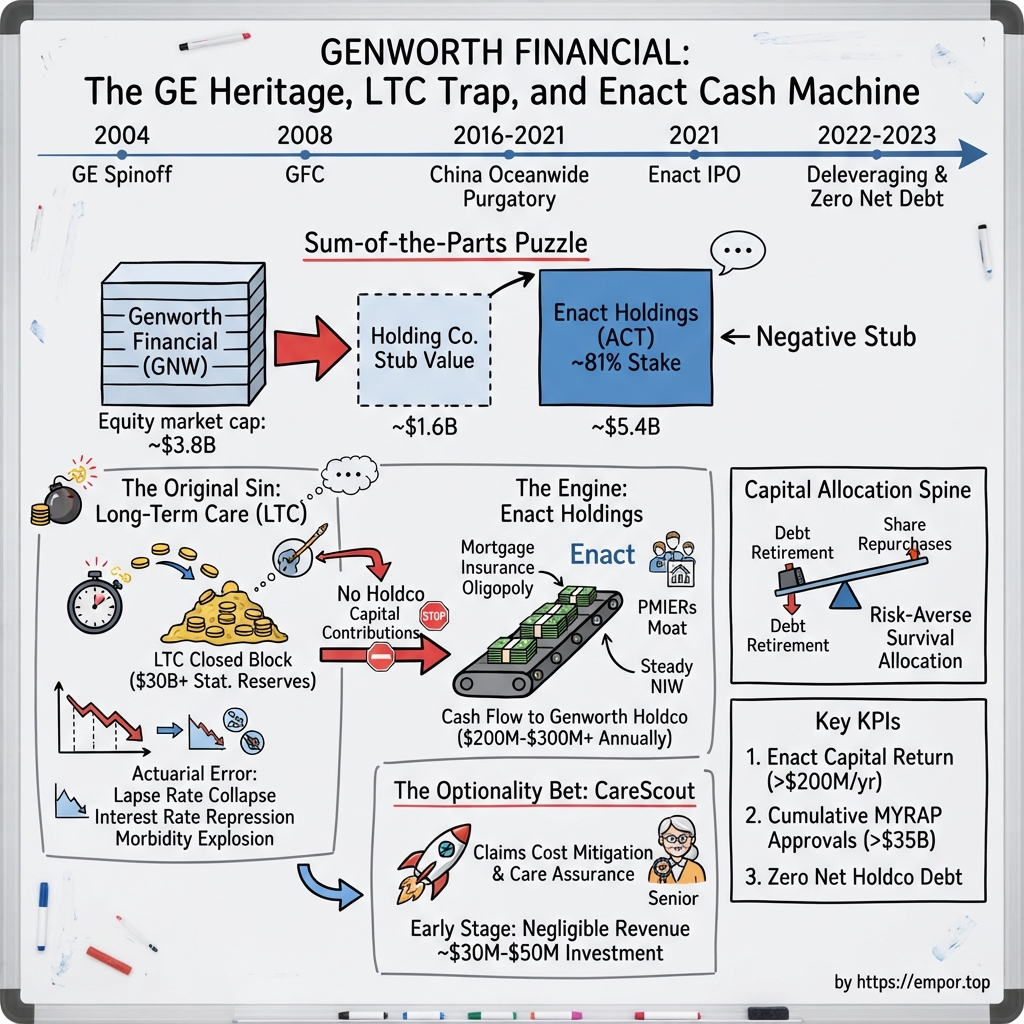
Genworth Financial: The $4 Billion Stub, the Long-Term Care Trap, and the Enact Cash Machine
I. Prologue & The Wall Street Anomaly (00:00 – 00:15)
On February 24, 2026, Genworth Financial's fourth-quarter earnings call reached the question-and-answer segment, and the operator opened the lines. Nothing happened. After a pause, the head of investor relations, Christine Jewell, stepped in and read out a question that had arrived by email—a friendly inquiry about why it made sense to invest in both services and insurance under the CareScout brand. Then the operator tried again for live questions. Again, silence. The call ended.1
This is a company with $88 billion of assets on its balance sheet, a controlling stake in one of America's six licensed private mortgage insurers, and roughly one million legacy long-term care policyholders whose claims will extend past 2050.2 Yet on the day it reported its full-year results, not a single Wall Street analyst queued to ask a question.
That indifference sets up the valuation puzzle at the center of the company.
The sum-of-the-parts problem
Genworth Financial (GNW on the NYSE) owns approximately 81% of Enact Holdings (ACT on Nasdaq), a publicly traded private mortgage insurer.3 In early September 2026, Enact shares traded near $49 and Genworth near $10. That pricing yields an equity market capitalization for Genworth of roughly $4 billion against a look-through market value for its Enact stake of well over $5 billion.
The difference represents what investors call a "negative stub." Stripping out the publicly traded mortgage insurer implies that the market assigns a negative value—on the order of minus $1.5 billion—to everything else Genworth owns: the corporate holding company, roughly $215 million in holding-company cash, the legacy life and annuity operations, the entire closed block of long-term care insurance, the CareScout aging-care platform, and a contingent legal claim that management estimates could be worth about $750 million if resolved in its favor.45
Markets rarely produce such pricing by accident. A negative stub reflects a skeptical consensus: investors treat the remaining businesses as a net liability and doubt the valuable mortgage-insurance asset can ever be cleanly uncoupled from the rest of the enterprise.
The central question
How did a business that GE Capital assembled during the Jack Welch era—and that GE floated in 2004 in the largest U.S. IPO in two years—end up as an actuarial Hotel California: a holding company that could exit almost every business it once owned, but could never leave the one that nearly destroyed it?6
And the mirror-image question: how does that same trapped holding company sit atop a mortgage insurance subsidiary that sent it $407 million in cash in 2025 and is guided to distribute $445 million to $485 million in 2026?71
The roadmap
The narrative unfolds in seven parts: the General Electric inheritance and the structural flaws engineered into long-term care insurance during the 1980s and 1990s; the 2008 financial crisis that gutted mortgage insurance; the five-year purgatory of an aborted takeover by China Oceanwide; the subsequent restructuring that brought an IPO for Enact, aggressive debt reduction, and a regulatory ring-fence around the legacy insurance block; the economics of the private mortgage insurance oligopoly that funds the holding company; the grinding, state-by-state rate-increase campaign preventing the legacy block from failing; and finally, the strategic bet on CareScout—an effort to re-enter the senior-care market armed with decades of hard-earned actuarial lessons.
Throughout, management's assertions about business moats, underwriting discipline, and strategic optionality must be weighed against the company's operating record. Genworth's corporate history provides extensive evidence that warrants testing every executive premise.
Start with the inheritance.
 Subscribe on LinkedIn
II. The GE Heritage & The Original Sin of Long-Term Care (00:15 – 00:45)
The financial supermarket inside an industrial company
Understanding Genworth requires understanding what GE Capital was designed to do.
Through the 1980s and 1990s, General Electric under Jack Welch delivered what public equity markets prized above almost everything else: smooth, predictable quarterly earnings growth that reliably beat consensus estimates by a penny. Industrial businesses—turbines, locomotives, jet engines—do not naturally produce smooth earnings; they generate volatile, capital-intensive cycles. GE Capital functioned as the corporate shock absorber. A sprawling financial conglomerate bolted onto an industrial parent, it could accelerate or defer gains, originate consumer and commercial assets, and, critically, hold insurance float.
Into that structure GE accumulated an eclectic portfolio of insurance assets. The Life Insurance Company of Virginia, founded in 1871, arrived through acquisitions in the late 1990s. GE Capital Mortgage Insurance Corporation underwrote private mortgage insurance on U.S. residential home loans. And beginning in the late 1980s, the conglomerate became one of the earliest and largest underwriters of a product that seemed, at the time, like an obvious demographic winner: long-term care insurance.
The appeal of insurance float to an industrial conglomerate was straightforward: policyholders pay premiums upfront, while claims arrive years or decades down the road. In the interim, the insurer invests the cash and pockets the spread. The cash flow boosted return on equity and smoothed reported quarterly earnings. What it did not do was force anyone to confront, in real time, whether the liabilities were priced correctly—because the actuarial bill would not come due for thirty years.
Immelt's exit
Jeff Immelt succeeded Welch as GE chief executive in September 2001 and inherited a brewing strategic problem: investors were beginning to question how much of the conglomerate's earnings stemmed from industrial manufacturing versus financial engineering. The balance had shifted heavily toward finance. The insurance operations, in particular, were capital-intensive, balance-sheet-heavy, and analytically opaque.
GE opted to offload them into the public market. On May 25, 2004, GE priced 145 million shares of Genworth Financial Class A common stock at $19.50 apiece, alongside 24 million equity units at $25. It was the largest U.S. initial public offering since 2002, raising roughly $3.5 billion in total and around $2.8 billion for GE itself.6 The newly created company took on the assets and liabilities of GE Financial Assurance Holdings, wrapped in a newly minted corporate name meant to project a clean break.
GE did not linger. In March 2006, the parent sold its remaining 71 million shares in a secondary offering priced at $32.75, with Genworth concurrently repurchasing 15 million Class B shares from GE for $479 million. GE had fully exited ahead of the timeline it had outlined to shareholders, netting approximately $2.8 billion from that final transaction alone.8
Two decades later, Genworth trades around $10. GE walked away at $32.75. Whatever else may be said about the transaction, the industrial parent's exit timing proved exceptional—and not by accident. What GE sold harbored a structural flaw that would take another decade to fully emerge.
How long-term care insurance was supposed to work
Long-term care insurance is a simple consumer promise wrapped around an extraordinarily difficult long-horizon forecast.
A customer in their fifties buys a policy with a level annual premium—paying the exact same nominal amount every year for decades. In exchange, if they eventually become unable to perform basic activities of daily living without assistance, the insurer covers care in a nursing home, assisted living facility, or home setting. Many policies incorporated an annual inflation rider that compounded the daily benefit by 5% each year, often for the remainder of the policyholder's life.
To price that coverage, an actuary in 1992 had to forecast four variables across a forty-year horizon: how many policyholders would drop their coverage before filing a claim (the lapse rate), what the insurer's bond portfolio would earn (the reinvestment yield), how many policyholders would ultimately need care and for how long (morbidity and claim duration), and what care would cost when they did.
A material error in any one of those four assumptions corrupts the pricing model. Genworth and its competitors missed on all four, in the same adverse direction.
Lapse rates collapsed. Industry pricing assumed that 3% to 5% of policyholders would voluntarily surrender coverage each year—a standard assumption across retail life and health lines. Over a thirty-year policy life, that compounding effect is decisive: at a 5% annual lapse rate, the majority of policies expire without ever generating a claim. In reality, annual lapse rates dropped to roughly 1% or lower. Policyholders recognized the immense financial value of the coverage and held on. In long-tail insurance, high customer retention can simply be adverse selection under a different name.
Interest rates collapsed. Underwriters assumed reinvestment yields between 6% and 8% on the long-dated fixed-income portfolios backing policy reserves. After the 2008 financial crisis, the Federal Reserve pinned benchmark policy rates near zero for much of the subsequent decade. Long-duration liabilities discounted at 3% instead of 7% balloon in present value, compounding balance-sheet deficits over thirty years. Genworth's recent disclosures demonstrate the dilemma in reverse: with interest rates normalized, new money in the life companies was being invested at roughly 6.2% to 6.5% in 2025 and 2026—the yields the original pricing assumed, arriving twenty years too late to matter for a block that was already funded.41
People lived longer—and stayed on claim longer. Advances in medicine lengthened life expectancies. But while physical treatments extended survival, cognitive decline from conditions like Alzheimer's disease and other dementias did not shorten care needs; it extended them, frequently by years. Meanwhile, the actual cost of care inflated faster than general consumer prices, driven by escalating caregiver wages in a chronically tight labor market. Genworth's annual Cost of Care survey, which the company conducted for roughly two decades, put home care around $76,000 a year and nursing home care as high as $125,000 in some markets.1
The reckoning, and the falsification of the scale thesis
For two decades, Genworth and its peers operated under an implicit thesis: first-mover scale in long-term care confers underwriting dominance and superior actuarial data. Underwrite more policies, build a larger claims database, refine assumptions, and dominate the market.
The operating record contradicted that theory.
When a financial product is systematically underpriced, volume does not create an economic moat—it accelerates balance-sheet damage. Genworth's data advantage was genuine in the sense that it possessed more policyholder history than any competitor, but that history proved uninformative: thirty years of early-policy experience provided minimal insight into claims behavior that only surfaced once policyholders entered their eighties. By the time actuaries saw the actual claim curves, it was far too late to reprice the policies without emergency regulatory intervention.
The consequences arrived through a succession of painful reserve charges. The most severe landed in November 2014, when Genworth completed a comprehensive review of its long-term care claim reserves and booked a $531 million pre-tax increase ($345 million after tax), driven by changes to assumptions on claim terminations—particularly for later-duration claims—and on benefit utilization, reflecting the finding that claimants were staying on claim longer and using more of their available benefits than the models assumed.9 The stock market reacted immediately, wiping out more than a third of the company's equity value.
Legal fallout followed. In March 2016, Genworth agreed to a $219 million settlement to resolve a securities class action alleging that the company and certain officers had misrepresented the profitability of the long-term care business and understated required reserves in 2013 and 2014 disclosures. Of that, $150 million came from insurance carriers and $69 million pre-tax from the company.[^10] At the time, it represented the largest securities class action recovery ever obtained in Virginia.
Actions across the broader industry offered the definitive test. Major peers—including MetLife, Prudential Financial, Unum, and John Hancock—all exited the stand-alone individual long-term care market. Scale offered no protection to the market leader; it merely guaranteed that Genworth had the largest liability to absorb. By 2025, Genworth had formally ceased writing long-term care business in Genworth Life Insurance Company altogether.1
What this means: The premise that first-mover scale provides a competitive moat in long-term care was not merely challenged by the evidence—it was falsified. Any investment thesis for Genworth must be grounded in something other than legacy long-term care franchise value. The central operational question is not whether the legacy book is an attractive business; it is not. The question is whether the holding company can be structurally separated from it.
That question was about to get answered in the worst possible way, by the other half of the portfolio.
III. The Dual Crisis & The Five-Year China Oceanwide Purgatory (00:45 – 01:15)
2008: the other shoe
Mortgage insurance is a business that can appear placid for a decade and then deteriorate all at once.
The product exists because Fannie Mae and Freddie Mac are legally barred from purchasing conventional single-family mortgages with loan-to-value ratios above 80% unless private credit enhancement covers the exposure above that threshold—a requirement routinely satisfied by private mortgage insurers. The insurer absorbs the first loss on a defaulted mortgage. Under ordinary economic conditions, borrower defaults are idiosyncratic: an unexpected job loss, a divorce, or a serious illness. Risk remains diversified across geographies, and earned premiums comfortably outpace claims.
In 2008, defaults ceased to be idiosyncratic. Subprime and Alt-A originations defaulted simultaneously across the country and across consecutive underwriting vintages. The default-correlation assumption embedded in every private mortgage insurer's capital model approached one. Industry peers buckled: Triad Guaranty halted new originations, while PMI Group collapsed into insolvency. Genworth survived by tightening underwriting standards, consuming holding-company capital, and contracting its balance sheet, but it exited the housing bust with a downgraded credit profile and a legacy portfolio of troubled mortgages that required years of workout and runoff.
By 2012, Genworth faced two concurrent balance-sheet pressures: a mortgage insurance operation still recovering from systemic shock, and a legacy long-term care portfolio whose deep reserve deficiencies were only beginning to become apparent. Michael Fraizer, who had served as chief executive since the 2004 IPO, stepped down in 2012 following sustained investor dissatisfaction. Chief Financial Officer Martin Klein assumed the interim leadership post.
Enter Tom McInerney
In January 2013, the board appointed Thomas J. McInerney, an experienced insurance executive who had led ING's U.S. operations and served as chief operating officer of ING Groep's insurance division. McInerney joined as a turnaround executive rather than an expansion-minded operator. His diagnosis of the enterprise was unusually direct for an insurance executive: Genworth could not grow its way out of legacy liabilities. The path forward required shrinking the perimeter, simplifying the corporate structure, negotiating regulatory rate increases, and legally ring-fencing liabilities.
That strategic framework has guided the holding company for thirteen years. McInerney continues as chief executive today, having returned on September 2, 2026, from a temporary medical leave that began on July 7, 2026, during which Chief Financial Officer Jerome Upton served as interim president and CEO.1011 A thirteen-year tenure during which the equity price produced negligible net appreciation provides an extensive operating record against which to evaluate management's public commitments and strategic execution.
The deal that would fix everything
By 2016, McInerney had concluded that Genworth required a well-capitalized parent. Public equity markets were unwilling to fund multi-billion-dollar reserve adjustments in long-term care, and the corporate holding company faced near-term debt maturities that exceeded its projected organic cash generation.
On October 23, 2016, Genworth announced a definitive merger agreement to be acquired by China Oceanwide Holdings Group, a privately held financial conglomerate founded by Lu Zhiqiang, for approximately $2.7 billion in cash, or $5.43 per share. In addition to the equity purchase price, Oceanwide pledged to inject $600 million of cash to address holding-company debt maturing in 2018 and another $525 million to bolster the U.S. life insurance subsidiaries.[^13]
The strategic rationale appeared complementary. Oceanwide sought a scaled global insurance platform and a prominent U.S. regulatory footprint. Genworth sought an exit from public earnings volatility and a balance-sheet backstop for its long-term care obligations.
1,400 days and counting
The transaction soon entered an unprecedented regulatory and operational impasse.
The Committee on Foreign Investment in the United States (CFIUS) conducted repeated reviews of the acquisition. The central national security concern involved safeguarding the sensitive health records and personal financial data of millions of American policyholders under a parent company subject to Chinese jurisdiction. When statutory review windows lapsed without resolution, the parties withdrew and refiled their applications. Concurrently, state insurance regulators in Delaware, New York, Virginia, and other jurisdictions demanded enforceable ring-fencing agreements and local solvency guarantees. At the same time, authorities in Beijing tightened outbound capital restrictions, while Oceanwide's domestic liquidity weakened, complicating the transfer of transaction financing offshore.
Genworth and Oceanwide extended their merger agreement roughly fifteen times. By 2020, the transaction ranked as the longest-pending corporate acquisition of a U.S. public company valued at $1 billion or more, remaining unresolved after more than 1,400 days.12
On April 6, 2021, Genworth's board terminated the merger agreement, concluding that Oceanwide could not close the acquisition within a viable timeline and enabling Genworth to execute an independent restructuring centered on a partial public offering of its domestic mortgage insurance unit.13
Testing the credibility claim
Management maintained throughout the five-year saga that it acted with strategic discipline while external regulatory approvals progressed. The historical record reveals a more nuanced reality.
Between 2017 and 2020, Genworth repeatedly assured investors that regulatory milestones were advancing and financing arrangements remained on schedule. In practice, the primary hurdles—national security clearance and Oceanwide's offshore funding liquidity—were becoming progressively more restrictive. While management reported factual process updates, its communications consistently framed a closing as imminent long after structural constraints indicated significant transaction risk.
The extended delay imposed real operational costs. Under the restrictive covenants of a pending merger, a public company's strategic flexibility is constrained, capital return programs are halted, and executive resources are diverted from core operations. To satisfy corporate debt maturities during the transaction freeze, Genworth divested valuable international subsidiaries. In August 2019, it agreed to sell its 57% controlling interest in Genworth MI Canada to Brookfield Business Partners; the transaction closed on December 12, 2019, at C$48.86 per share, valuing the Canadian business at roughly C$2.4 billion and providing approximately US$1.8 billion in net liquidity.14 Genworth subsequently divested its Australian mortgage insurance subsidiary, reclassifying the asset as discontinued operations by mid-2021.15
The sequence revealed a stark trade-off: to service holding-company debt while awaiting a buyout designed to rescue the enterprise, Genworth sold two of its three core profitable operating units, leaving behind only the domestic mortgage insurer to support the holding company.
What this means: Management's foundational premise—that the legacy insurance book required external capital backing—was grounded in balance-sheet reality. However, its prolonged public confidence in the merger's execution departed from the deteriorating regulatory and financial circumstances. That strategic delay carried a permanent cost: the liquidation of high-return foreign subsidiaries to fund debt obligations. The relevant analytical test is whether the same leadership team, now offering guidance on holding-company share repurchases, CareScout commercialization, and state insurance rate approvals, delivers against its forward forecasts—an evaluation this analysis returns to in Sections VII and VIII.
The termination of the Oceanwide merger in April 2021 marked the point where Genworth regained operational independence. How the company redeployed that independence formed the foundational restructuring phase of its modern corporate era.
IV. The Great Unbundling & Balance Sheet Resurrection (01:15 – 01:40)
Plan B
By spring 2021, Genworth possessed one genuinely valuable, cash-generative, and separable asset—the domestic mortgage insurance business—alongside a holding company carrying roughly $1.7 billion in public debt plus an AXA-related liability, leaving its credit profile deep in junk territory.15
Plan B pursued three interlocking objectives, each structured to fund and enable the next.
First, monetize a minority stake in the mortgage insurance unit without ceding voting control, preserving the holding company's access to ongoing dividend streams. Second, direct the offering proceeds toward retiring parent-level debt, eliminating the near-term refinancing pressures that threatened to trigger a parent restructuring. Third, structurally isolate the legacy long-term care block legally and operationally, ensuring that liabilities in the life subsidiaries could not pierce the corporate veil to reach Genworth Financial, Inc.
The Enact IPO
The mortgage insurance business was rebranded Enact Holdings—a deliberate distancing from the Genworth name and its associations with long-term care liabilities—and taken public in September 2021.
Enact priced 13,310,400 shares at $19.00 on September 15, 2021, alongside a concurrent private sale of 14,655,600 shares at $17.86 (the public offering price less the underwriting discount). Gross proceeds reached approximately $553 million, all retained by Genworth Holdings. Following the close of the offering and the partial exercise of the over-allotment option on September 20, Genworth beneficially owned approximately 81.6% of Enact.1617
The offering structure served several distinct financial and regulatory purposes. A complete spin-off would have distributed Enact shares directly to Genworth shareholders, leaving the parent holding company without operating cash flow to service its debt, maintain corporate overhead, or fund legacy obligations. A minority initial public offering, by contrast, achieved four objectives simultaneously: it generated immediate cash, established a transparent public market valuation for the asset (forming the empirical foundation for sum-of-the-parts calculations), created an independent equity currency and corporate governance structure for Enact, and preserved the 80% ownership threshold required to keep Enact inside Genworth's consolidated U.S. federal tax group—a status that generated meaningful intercompany tax payments to the holding company in subsequent years.
The deleveraging
Management moved aggressively to pay down debt. In 2021 alone, Genworth retired more than $1.2 billion of parent holding-company debt through a rapid series of repurchases and redemptions: redeeming $338 million principal of 7.20% notes in February for a $350 million cash payment, repurchasing $146 million principal of 7.625% notes in March, redeeming the remaining $532 million of those 7.625% notes early in July, and retiring the remaining $334 million of 4.90% notes due 2023 in December.18 That balance-sheet contraction continued into 2022, as the company repurchased $130 million principal of its 4.80% notes due 2024 during the first half and called the remaining $155 million in September. By September 30, 2022, Genworth had reached its stated leverage target of $1.0 billion or less in parent public debt, with $900 million outstanding.19
Rating agencies responded in turn. Moody's upgraded Genworth four times between September 2021 and July 2022, capped by a two-notch increase to Ba2 in July 2022.20 Within twelve months, the holding company had stabilized its capital structure.
Myth versus reality: the "zero net debt" story
A persistent misconception in retail investor commentary suggests that Genworth achieved zero net debt at the holding company between 2022 and 2023. Financial filings show that it did not, and still has not.
As of the second quarter of 2026, holding-company debt stood at $768 million against $215 million in holding-company cash and liquid assets—of which roughly $81 million was earmarked for future obligations and excluded from management's own capital-allocation buffer calculation.4 Recent debt retirement has been modest and opportunistic, repurchasing debt at discounts: $10 million in principal during the second quarter of 2026 and about $7 million across all of 2025—routine balance-sheet housekeeping rather than structural deleveraging.41 With public maturities deferred into the next decade and cash interest coverage running near nine times, the capital structure is manageable. It remains, however, a leveraged structure. Genworth successfully reduced parent debt by roughly 80% from its peak and deferred refinancing pressure, but significant debt remains on the balance sheet.
Testing the capital allocation claim
Management has framed its early debt retirement as an optimal capital allocation strategy. The primary challenge to that assertion lies in the pricing of the alternative asset available at the time: Genworth's own equity.
Throughout 2021 and 2022, Genworth retired notes largely at or near par, with several tranches carrying modest coupons between 4% and 6%. Over that same span, Genworth's common stock traded around $3.50 or lower—less than half the look-through market value of its stake in Enact alone. During the second-quarter 2022 earnings call, analyst Geoffrey Dunn of Dowling & Partners questioned McInerney on the company's valuation framework. McInerney outlined a conservative model: value Enact at roughly one times book value across the housing cycle, assign zero value to the life insurance subsidiaries, and add holding-company net cash. Under management's own formula, Genworth shares were trading at an acute discount to intrinsic value. Yet Genworth allocated just $15 million to share repurchases that quarter compared to $48 million for debt retirement, explicitly stating that substantial equity buybacks would wait until the 2024 notes were fully retired.20
A second capital-allocation commitment also shifted. On that same 2022 call, management noted that the board intended to consider paying a quarterly dividend to Genworth shareholders in 2023.20 By 2026, Genworth had yet to initiate a common dividend, directing surplus capital toward share repurchases and funding the CareScout platform. While prioritizing discounted repurchases over dividends represents sound financial logic when shares trade below intrinsic value, it demonstrates that executive guidance on shareholder distributions has diverged from actual execution.
What this means: The evidence suggests that management's strategy was not optimal capital allocation in the sense of maximizing total equity returns, but rather risk-averse survival allocation. Confronting junk-tier credit ratings, lingering tail risk in the life insurance subsidiaries, and the institutional memory of the 2008 crisis, executives prioritized debt reduction and solvency over aggressive equity capture. While that conservatism secured holding-company stability, it deferred share repurchases during an acute window of equity undervaluation. Substantial buybacks commenced only after debt fell below the $1.0 billion threshold.
Understanding how those buybacks are funded requires examining the underlying cash engine of the holding company.
V. The Core Economic Engine: Enact Holdings & The U.S. Mortgage Insurance Oligopoly (01:40 – 02:10)
What Enact actually sells
Strip away the financial jargon, and private mortgage insurance functions as a toll booth created by federal housing policy.
When a homebuyer purchases a property with less than a 20% down payment and secures a conventional mortgage intended for acquisition by Fannie Mae or Freddie Mac, federal rules mandate private credit enhancement to cover the exposure down to the 80% loan-to-value threshold. The borrower pays a monthly premium—typically a fraction of a percent of the loan balance annually—to a private mortgage insurer like Enact, which assumes the first loss if the borrower defaults. Once accumulated principal payments and home price appreciation push borrower equity to 20%, the coverage terminates and premium collections cease.
The underlying economics create a powerful operating asymmetry: the underwriter collects monthly premiums across its entire active portfolio, while paying claims on only the small fraction of delinquent loans where the home's value falls below the mortgage balance. In flat or rising housing markets, delinquent loans frequently "cure"—the borrower catches up on overdue payments, refinances, or sells the property—enabling the insurer to release previously established loss reserves back into reported earnings. Enact released $37 million of pre-tax reserves in the second quarter of 2026, $39 million in the first quarter of 2026, and $60 million in the fourth quarter of 2025, producing loss ratios of 14%, 15%, and 7%, respectively.451
Loss ratios in the single digits and teens are atypical in the insurance sector. They reflect a remarkably benign credit backdrop operating on substantial operating leverage—and they do not represent through-cycle underwriting performance.
The barrier: PMIERs
The reason the United States has six private mortgage insurers rather than sixteen traces back to a single regulatory document.
Following the 2008 financial crisis, the Federal Housing Finance Agency directed Fannie Mae and Freddie Mac to overhaul eligibility standards for approved counterparties. The resulting Private Mortgage Insurer Eligibility Requirements (PMIERs), published in April 2015 and made effective on December 31, 2015, established stringent operational, liquidity, and risk-based capital mandates calibrated to the precise credit profile of every insured loan.21
The practical consequence is an imposing barrier to entry. Launching a new private mortgage insurer requires billions of dollars in qualifying capital, an extensive government-sponsored enterprise (GSE) vetting process, and nationwide lender distribution systems—all before underwriting a single loan. Since PMIERs took effect, not a single new entrant has entered the market.
Enact measures its capital compliance through a "sufficiency ratio," tracking available assets as a percentage of required assets. At the end of the second quarter of 2026, Enact reported a sufficiency ratio of 161%, representing approximately $1.9 billion in surplus capital above PMIERs requirements.4 That capital cushion provides the regulatory clearance to upstream cash dividends to Enact Holdings and, from there, directly to Genworth.
The six
The six approved underwriters are Enact, MGIC Investment, Radian Group, Essent Group, Arch Capital's mortgage segment, and NMI Holdings. Market shares cluster within a narrow band. In the first quarter of 2026, industry-wide new insurance written totaled $76.7 billion, with Enact underwriting $13 billion, or roughly one-sixth of the total.225 In the second quarter of 2026, Enact wrote $15 billion, an increase of 15% year over year as overall market origination volumes expanded.23
Market share distribution remains narrow and stable across the six participants. The sector operates as a rational oligopoly: no individual carrier possesses a sufficient cost or distribution advantage to launch a price war profitably, and all six operate with the institutional memory of the insolvencies that followed 2008.
Enact's operating position
Enact's primary insurance in force reached $274 billion at the end of the second quarter of 2026, up 2% year over year, supported by new writings and elevated policy persistency. The quarterly persistency rate reached 80%, indicating that four out of five policies remained active on the books.423 Persistency has served as an underappreciated earnings stabilizer across the cycle: millions of borrowers who locked in mortgage rates near 3% during the pandemic have little incentive to refinance at prevailing market rates above 6%, keeping their existing mortgage insurance policies active and paying premiums. Despite that portfolio stability, Enact's earned premiums were $245 million in the second quarter of 2026, virtually unchanged from the prior year.4
Flat earned premiums against an expanding portfolio in force highlight an underlying operational trend: premium yields per unit of risk have drifted lower even as underwriting volume has held. That dynamic points to quiet competitive pricing pressure within the sector—an essential metric to monitor as an early warning that oligopoly discipline may be softening.
For Genworth shareholders, however, the paramount metric is cash flow. Enact contributed $558 million of adjusted operating income to Genworth in 2025 and $143 million in the second quarter of 2026.14 Comparing those figures to Genworth's consolidated 2025 adjusted operating income of $144 million illustrates the holding company's operational reality: Enact does not merely account for the majority of Genworth's operating earnings—it generates all of them and more, offsetting substantial GAAP operating losses in the legacy closed block.1
Enact distributes this liquidity through a regular quarterly dividend—raised to $0.24 per share during 2026—supplemented by periodic special distributions and share repurchases, in which Genworth participates proportionally to maintain its roughly 81% ownership stake.23 Enact's board authorized an additional $500 million share repurchase program in early 2026.1 In total, these capital returns delivered $407 million in cash to Genworth in 2025, followed by $99 million in the first quarter of 2026 and $103 million in the second quarter, with full-year 2026 cash distribution guidance raised to between $445 million and $485 million as Enact lifted its own annual capital return target to between $550 million and $600 million.154
Testing the moat
Management maintains that Enact possesses a durable regulatory moat capable of sustaining mid-teens returns on equity across cycles. Evaluating that assertion requires examining the specific vulnerabilities that could disrupt it.
The 2008 precedent. In 2008, private mortgage insurance produced correlated defaults that bankrupted competitors. Today, mitigations are substantive: strict PMIERs capital buffers, extensive use of reinsurance treaties and mortgage insurance-linked notes (MILNs) to offload catastrophic tail risk to capital markets, substantial home equity accumulated over a decade of property appreciation, and an insured portfolio concentrated in high-credit-score prime borrowers. Enact's contemporary portfolio differs fundamentally from its 2006 underwriting vintage. Yet structural evolution does not guarantee immunity: an economic downturn featuring falling home prices and rising unemployment would simultaneously increase loss reserves, erode PMIERs capital cushions, and curtail dividend distributions to Genworth.
Substitution by the GSEs. Fannie Mae and Freddie Mac manage their own credit-risk transfer programs, distributing mortgage credit exposure directly to institutional investors. Freddie Mac has also tested alternative execution models—such as the Integrated Mortgage Insurance (IMAGIN) pilot—that route mortgage credit risk directly to reinsurers rather than through conventional private mortgage insurers.24 As a result, the government-sponsored enterprises serve simultaneously as Enact's primary regulators, operational gatekeepers, and prospective competitors. That dual role qualifies the durability of the regulatory moat: the barrier exists at the discretion of counterparties governed by public policy rather than long-term commercial contracts.
Buyer power. National mortgage originators, across wholesale and retail channels, command significant loan volumes and possess the leverage to reallocate business rapidly. Enact has responded by integrating proprietary pricing engines directly into lenders' loan origination workflows, providing automated, loan-level quotes rather than static rate cards. While this software integration increases operational friction when switching providers, it does not provide genuine pricing power against large mortgage lenders capable of shifting volume to rival underwriters.
What this means: The assessment of Enact's competitive moat holds, but within clear boundaries. PMIERs establishes an effective regulatory barrier to new entrants that preserves oligopoly returns, but Enact lacks autonomous pricing power. Its operational performance remains cyclical, vulnerable to shifts in federal housing policy, and boosted by cyclical tailwinds—notably reserve releases and persistency driven by pandemic-era interest rates—that cannot persist indefinitely. For Genworth, the strategic relevance of Enact's moat reduces to a single operational reality: whether Enact can reliably deliver more than $400 million in annual cash distributions to the parent company.
That cash stream leads directly to the legacy liability it is tasked with insulating.
VI. Defusing the Bomb: Ring-Fencing the LTC Closed Block & The MYRAP Gauntlet (02:10 – 02:35)
The most important sentence Genworth says every quarter
On call after call, in nearly identical language, Genworth's executive leadership repeats a formulation that serves as the load-bearing wall of the entire investment thesis:
"We remain committed to managing GLIC and its subsidiaries as a closed system, leveraging their existing reserves and capital to cover future claims. We will not put capital into these companies. And given the long-tail nature of our LTC insurance policies, with peak claim years still over a decade away, we also do not expect capital returns."1
That statement functions simultaneously as a commitment and a warning. Genworth Financial, Inc.—the parent entity whose shares trade on the NYSE—does not guarantee the obligations of Genworth Life Insurance Company (GLIC) or Genworth Life Insurance Company of New York (GLICNY). Holding-company cash, Enact dividends, and debt proceeds do not flow down into those regulated entities. The corollary is equally absolute: capital does not flow up either. GLIC's $3.6 billion of capital and surplus belongs entirely to policyholders, not equity holders, and will remain tied to those liabilities for decades.1
This operational boundary forms the ring-fence. It has served as management's governing discipline since roughly 2015, and it remains the primary structural reason Genworth Financial trades as a viable going concern rather than as a call option on a bankruptcy workout.
The MYRAP: negotiating with fifty regulators
If the corporate parent will not subsidize the legacy portfolio, the block must fund itself. The vehicle is the Multi-Year Rate Action Plan—known as MYRAP—which represents one of the most protracted regulatory campaigns in modern American insurance.
Long-term care policies are guaranteed renewable: an insurer cannot cancel coverage unilaterally, but it can raise premiums across an entire risk class with state insurance department approval. Genworth has pursued such filings continuously since 2012.
The negotiation with a state insurance commissioner carries an uncomfortable structural logic. A commissioner's statutory mandate is to shield local consumers from punitive rate shocks. Yet if the operating subsidiary runs out of statutory capital, GLIC enters state rehabilitation or liquidation, and unpaid policy claims fall onto state guaranty associations—which typically cap coverage at a fraction of promised benefits and fund those payouts through mandatory assessments on every solvent insurer operating in the state. A commissioner's practical choice is between approving an agonizing premium increase today or overseeing an insolvency that inflicts far steeper benefit cuts on the same policyholders tomorrow. In practice, Genworth confronts regulators with the arithmetic of a controlled burn.
Policyholders facing an approved rate increase receive a menu of choices: pay the higher premium to maintain full coverage; accept a reduced benefit—such as a lower daily maximum, a shorter benefit duration, or a downgraded inflation rider—to preserve the original premium; or exercise a paid-up non-forfeiture option, discontinuing premium payments altogether in exchange for a capped, paid-up pool of benefits.
The scale of it
Since 2012, Genworth has secured approximately $34.8 billion in approved premium increases and benefit reductions measured on a net present value basis—comprising $34.5 billion through year-end 2025 alongside incremental approvals achieved through mid-2026.41 The fourth quarter of 2025 alone yielded $100 million of gross incremental premium approvals, bringing the full-year total to $209 million at an average approved rate hike of 38%.1 For full-year 2026, management guided approvals and benefit reductions to contribute roughly $1 billion of incremental net present value, matching the 2025 pace.4
The behavioral response of policyholders represents the less visible—and financially more decisive—half of the program. Roughly 62% of policyholders presented with a rate action have elected to reduce their benefits rather than pay the higher cash premium.4
The cumulative impact on the portfolio's risk profile has been substantial: exposure to the 5% compound inflation rider—the most hazardous feature in the portfolio because it compounds liabilities without matching investment yields—has dropped to roughly 35% of the block from 57% in 2014, while the proportion of policies offering unlimited lifetime benefits has declined from 24% to 11%.4
That shift defines the true economic function of MYRAP. It operates less as a revenue-generating premium increase than as a liability-reduction mechanism, using price signals to induce policyholders to voluntarily surrender the most volatile features of their contracts. Management estimates that roughly $5 billion in additional net present value remains to be achieved through future filings, noting that the cumulative value recognized from benefit reductions rose by $2.3 billion in its 2025 annual assumption review.1
Testing the "problem solved" claim
Management's implicit premise holds that MYRAP has neutralized statutory and GAAP deficit risk in the closed block. The empirical record qualifies that confidence.
The GAAP numbers still bleed. Following the adoption of Long-Duration Targeted Improvements—the accounting standard adopted on January 1, 2023, and applied retrospectively to a January 1, 2021 transition date to remeasure liabilities against current assumptions and market discount rates—the closed block has posted persistent losses from "actual to expected" variances.25 These averaged $75 million per quarter in 2025 and drove a full-year closed block adjusted operating loss of $317 million, including a $326 million loss in long-term care.1 For 2026, management guided to roughly $300 million of A-to-E losses—and then, during the second-quarter earnings call, acknowledged that first-half experience had "trended above the level implied by our full year expectation" and that full-year losses could be higher.4
Management characterizes these variances as GAAP accounting artifacts that "do not impact our cash flows, economic value or how we manage the business."4 That distinction is technically accurate: statutory accounting, which dictates solvency, operates under separate rules. Yet the argument warrants scrutiny. An actual-to-expected variance indicates that claims, lengths of care, or policyholder terminations are diverging negatively from actuarial models. If that divergence persists, it eventually forces formal assumption revisions, which feed into higher statutory reserve requirements and compress risk-based capital. Reported GAAP losses may not dictate current cash flow, but they serve as an early indicator of statutory pressure.
The statutory buffer is thinner than the rhetoric. GLIC's consolidated risk-based capital (RBC) ratio stood at 300% at year-end 2025, down from 306% a year earlier, supported by $3.6 billion in statutory capital and surplus and a cash flow testing margin in the $0.5 billion to $1 billion range.1 By the first quarter of 2026, the RBC ratio had slipped to 289%.5 Management maintains a stated operating target of 250% or higher. When asked directly on the first-quarter 2026 call whether an RBC decline could force the holding company to inject capital, McInerney responded that the parent faces no regulatory requirement to do so and that the operating subsidiary remained capitalized at nearly three times required capital.5 While legally correct, the cushion remains lean: the capital ratio has retreated across consecutive periods, peak claims remain more than a decade away, and a cash-flow testing margin under $1 billion offers narrow protection against multi-decade liabilities.
Regulatory and legal friction is permanent. Rate approvals remain uneven and subject to administrative delay. The first quarter of 2026 yielded just $5 million of gross incremental premium approvals before rising to $45 million in the second quarter and an additional $27 million in July, prompting management to acknowledge that "the timing of approvals can be difficult to predict."54 Concurrently, the aggressive rate campaign has provoked a decade of policyholder class actions over disclosure adequacy: Skochin in January 2019, Halcom in January 2021, and Haney in January 2022, resolved through a series of nationwide settlements—the last of which received final judgment on February 15, 2023, and became final on March 27, 2023—with each requiring specialized election options for affected policyholders and ongoing administrative compliance.26 Financially, those settlements proved advantageous to Genworth, contributing a $355 million statutory benefit in 2024 that did not repeat in 2025.1 Yet they establish an enduring template: policyholders consistently litigate disclosure adequacy, and each negotiated agreement constrains future operating flexibility.
The runway is shortening by design. On the second-quarter 2026 call, management stated plainly that "as we enter the later stages of MYRAP, we expect the relative impact of benefit reductions to increase while the relative impact of premium increases declines. This reflects the shrinking runway of future premium from Genworth policyholders as the closed block ages."4 In its own disclosures, executive leadership is acknowledging the eventual depletion of its most effective restructuring tool. Any valuation thesis that treats MYRAP as an indefinite, repeatable defense must account for that structural sunset.
What this means: The analytical conclusion narrows from an assertion that the long-term care problem has been solved to a far more specific reality: MYRAP has converted an open-ended liability drain into a fragile, zero-dividend equilibrium that has held for thirteen years. The strategy prevents state receivership, but it does not eliminate tail risk, and its primary restructuring tool is gradually losing potency. The signposts of distress remain defined and observable: a GLIC risk-based capital ratio approaching the 250% floor, regulatory moratoria on rate filings in key states, or an adverse assumption update large enough to force an emergency statutory reserve build.
The company's strategic response to a depleting restructuring lever is to build a new business—which is where Genworth's corporate narrative turns speculative.
VII. The Optionality Bet: CareScout & Re-Engineering Senior Care (02:35 – 02:55)
Sizing it honestly, first
Before examining the strategic narrative, the baseline financial figures demand an objective accounting: the demographic thesis is expansive, but the operating scale remains modest.
CareScout generated $6 million of revenue in the first quarter of 2026 and $12 million in the first half, pacing toward a full-year target of $25 million.54 Across 2026, Genworth projected capital investments of $50 million to $55 million in CareScout services, having already invested $85 million in CareScout Insurance during 2025 to satisfy regulatory capital requirements for a new product launch, alongside $15 million to acquire Seniorly in the fourth quarter of 2025.1 The business resides within Genworth's Corporate and Other reporting segment, which posted a $31 million adjusted operating loss in the second quarter of 2026.4
The resulting financial profile is straightforward: approximately $25 million in annualized revenue set against roughly $50 million in annual operating investment, nested inside a corporate holding company with $88 billion in assets. CareScout functions essentially as an early-stage venture incubation funded by Enact's dividend flow, and its contribution to enterprise valuation warrants evaluation on that basis.
What it is trying to be
Nevertheless, the strategic framework is coherent, addressing the only operational initiative within Genworth designed to alter the holding company's long-term growth trajectory.
CareScout is organized into two distinct operating arms.
The services business combines a curated senior care provider network with clinical navigation. Genworth credentials home care agencies and senior living communities against quality benchmarks and negotiates preferred pricing, citing fee discounts near 20%.1 It then connects care seekers to those providers through a nationwide network of nurses who conduct clinical assessments, supported by local advisers who provide on-the-ground placement guidance. By the end of the second quarter of 2026, the network encompassed more than 1,100 home care locations, with a target of integrating at least 2,000 senior living communities by year-end, and deployed local advisers across 26 states after doubling their ranks during the year.4 Network home care coverage reached approximately 97% of the U.S. population aged 65 and older.5
The commercial model varies by care setting: home care operates on preferred-rate differentials, while senior living generates a one-time placement fee upon a resident's move-in, aligning with industry practice.4 The December 2025 acquisition of Seniorly for $15 million added a direct-to-consumer senior living marketplace, accelerating expansion beyond Genworth's existing insurance base.1
The central economic synergy of this network does not register as top-line revenue. When a claimant in Genworth's legacy closed block uses a discounted network provider, the lower cost directly dampens claim severity charged against GLIC's statutory reserves. Management has projected between $1 billion and $1.5 billion in net present value of long-term claim savings to the closed block over time—while noting that it will "continue to monitor their progress as they mature before incorporating them into our assumptions," confirming that these savings remain prospective rather than recognized in statutory models.1
The insurance business represents the more demanding strategic initiative: an attempt to re-enter long-term care underwriting. CareScout Care Assurance launched in the fourth quarter of 2025, operating in 39 states at year-end and expanding to 40 by February 2026, with four additional state approvals pending.271 The contract structure deliberately repudiates legacy product design, featuring conservative pricing assumptions, strictly capped benefit amounts and coverage durations instead of lifetime guarantees, and integrated access to CareScout care planning and provider networks. An employer-sponsored worksite version was approved and positioned for launch across at least 34 states as of August 2026.4 In parallel, management has outlined hybrid products in development that link a baseline long-term care benefit to asset-accumulation accounts.5
Testing the optionality claim
Management's core thesis holds that CareScout represents a capital-light, scalable growth platform capable of transforming Genworth into an integrated leader in senior care. Evaluating that premise against operating realities reveals significant structural hurdles.
The industry's track record on reviving LTC is dismal. Between 2010 and 2025, virtually every major U.S. life insurer that attempted to sustain or re-enter stand-alone long-term care insurance abandoned the effort. The underlying obstacle was neither distribution reach nor brand recognition; it was that multi-decade tail risk resists precise actuarial pricing, and consumers routinely balk at paying the premiums required to underwrite that risk prudently. While Care Assurance’s conservative parameters explicitly address those historical vulnerabilities, lower benefit caps and restricted durations translate into less perceived value per premium dollar—making the commercial sale more difficult rather than less.
Navigation services have low barriers and high customer acquisition costs. Established referral networks such as A Place for Mom, private geriatric care managers, and hospital discharge planners already control key patient entry points. Placement-fee structures in senior housing are mature, highly competitive, and transactional. Genworth’s primary proprietary advantage—decades of claims history and a captive base of legacy policyholders—is operationally useful but structurally bounded: those legacy policyholders represent a closed, aging, and inevitably shrinking population.
Approval is not revenue. State insurance department approvals across 40 jurisdictions represent an administrative milestone rather than commercial validation, and Genworth has not disclosed active policy sales or premium volumes for the new offering. Executive commentary has remained deliberately measured, noting that "we expect adoption to build gradually," and that "scaling these businesses and achieving breakeven will take time."1 Those disclosures are transparent, but they confirm the absence of immediate commercial scale.
And the first real test of guidance is already showing strain. In 2025, CareScout exceeded its operational match targets, completing 3,255 care matches against an initial goal of 2,500 and a revised target of 3,000, tripling its 2024 volume.1 Leadership subsequently established a 2026 target of approximately 7,500 matches, reaffirming on the first-quarter call that performance remained "on track."5 By the second-quarter call, following approximately 2,950 matches during the first half, executive disclosures shifted, acknowledging that "current match volumes are pacing below the level that would be required to reach the full year target."4 While full-year revenue guidance of $25 million was maintained, volume growth moderated sharply.
Management addressed the operational slowdown directly, but the cadence warrants scrutiny: an operational target introduced in February, reaffirmed in May, and curtailed by August, during the very first fiscal year CareScout operated under public quantitative targets. This execution sequence highlights the core analytical distinction facing investors: leadership has demonstrated disciplined capabilities in administering a runoff block and ring-fencing liabilities, but building and forecasting a competitive growth business demands an entirely different operating skill set.
What this means: CareScout is best understood as an unproven call option carried near its accumulated investment cost, rather than as a dependable pillar of equity value. The underlying strategy is rational, and the internal claim-mitigation mechanism represents its most defensible element: lowering GLIC's statutory claim severity does not depend on capturing external retail market share, requiring only that Genworth's existing claimants utilize credentialed network providers. The external commercial business, by contrast, remains early-stage corporate R&D. Meaningful equity recognition would require concrete operational milestones: fee-based services achieving genuine financial materiality—generating positive EBITDA rather than $25 million in revenue against $50 million in operating spend—alongside audited underwriting volumes for Care Assurance. Until then, CareScout remains an expense stream subsidized by mortgage insurance dividends.
The question of whether corporate R&D belongs inside this holding company at all is where the skeptics take their stand.
VIII. Strategy, Governance, & The Activist Stress Test (02:55 – 03:15)
The people
Thomas J. McInerney has led Genworth since January 2013, compiling a thirteen-year record spanning multi-billion-dollar reserve charges, securities class action litigation, the prolonged Oceanwide review, the Enact public offering, and the development of CareScout. His formative background at ING, where he directed U.S. operations and served as chief operating officer of the group's insurance division, shaped an operating posture focused on balance-sheet management, corporate entity structures, regulatory rate negotiations, and runoff mathematics. During earnings presentations, McInerney frequently elaborates on the analytical rationale behind capital decisions rather than relying on standard corporate commentary—notably during the second-quarter 2022 call, when he observed directly to an analyst that the holding company assigned zero intrinsic value to its own life insurance subsidiaries.20
McInerney took a temporary medical leave of absence announced on July 7, 2026, and returned to his executive duties on September 2, 2026.1011 Board Chair Melina Higgins framed the leave as a medical recovery with an anticipated return, and the company declined to elaborate further during the second-quarter earnings call.104
Jerome T. Upton has served as chief financial officer since March 2023, having worked at Genworth and its predecessor entities since 1998 across various finance and operating assignments in multiple business lines and regions.10 Upton served as interim president and CEO during McInerney's medical leave. His leadership of the second-quarter 2026 earnings call emphasized operating continuity: reaffirming the holding company's three core priorities, maintaining the established capital-allocation strategy, and raising financial guidance. During that call, management emphasized that the executive leadership team averaged nearly twenty years of tenure at the firm.4
That deep institutional longevity carries dual implications. The executives negotiating with state insurance commissioners over policies issued in the 1990s have observed the full operating evolution of the closed block. At the same time, the leadership group deciding whether to continue funding CareScout is the identical team that conceived and launched the initiative.
Compensation. For 2023, McInerney's total reported compensation reached approximately $9.87 million against a $1 million base salary, with the remainder structured in performance equity and annual incentive awards.[^30] Executive compensation design is formulaic, linked to operational metrics that include adjusted operating income, holding-company liquidity, and, distinctively, cumulative premium rate action approvals on in-force long-term care policies.28 Weighting executive incentives toward MYRAP net present value directly aligns executive compensation with enterprise solvency, given that holding-company viability depends on continuing rate relief. That incentive structure does not, however, incorporate total shareholder return over the measurement horizon.
The activist case
No activist investor has launched a public campaign at Genworth. The company's 2025 annual proxy statement reflected an uncontested slate of ten incumbent directors nominated by the board, without dissident challengers.28 Nevertheless, the theoretical activist thesis is clear, and its strategic rationale warrants objective examination.
The thesis: Genworth's negative $1.5 billion stub valuation demonstrates that equity markets view the existing corporate holding structure as an impediment to value realization. An activist proposal would target that discount structurally: distribute the 81% Enact holding directly to Genworth shareholders through a tax-free spin-off under Section 355, or monetize the position through secondary public offerings and return the net cash. Shareholders would then hold the mortgage insurer directly at unencumbered market pricing, while the residual assets—the closed block, CareScout, and parent debt obligations—would trade independently or run off on their own balance sheets. That approach would also terminate the practice of deploying roughly $50 million in annual mortgage insurance dividends into an early-stage healthcare venture, redirecting those cash flows toward repurchasing shares at steep discounts to look-through net asset value.
The counter-arguments require equal scrutiny:
Tax consolidation. Retaining an ownership interest above 80% maintains Enact within Genworth's consolidated federal tax group, historically allowing the parent to offset operating deductions and legacy tax attributes against Enact's taxable income and receive intercompany tax payments. While management noted that those attributes would be largely exhausted around 2023, reducing their relative advantage compared to 2021, the consolidated tax arrangement continues to deliver financial utility.20
Regulatory retaliation risk. This operational factor represents the most serious structural impediment, though it is seldom highlighted in investor presentations. State insurance departments are asked each year to approve significant premium increases on the basis that the regulated operating companies require additional premium income to meet future policyholder claims. Were Genworth to spin off its principal cash-generating subsidiary to public shareholders, state regulators could view the separation as an extraction of parent capital ahead of potential solvency strain. The resulting regulatory friction could involve delayed or denied rate increases, expanded administrative oversight, or formal demands for parent capital contributions—the specific outcomes the corporate ring-fence was constructed to prevent. The ring-fence functions not merely as a legal boundary, but as an ongoing regulatory compact that relies on the holding company maintaining perceived stewardship.
Credit ratings and commercial standing. The holding company's targeted liquidity cushion of $300 million to $500 million, alongside interest coverage running near nine times, underpins the corporate credit profile supporting Enact's standalone financial ratings and institutional reinsurance relationships.4
These operational constraints do not wholly refute the activist argument, but they establish why a corporate separation is not costless. Executing a spinoff would trade an immediate resolution of the holding-company stub discount against heightened regulatory exposure across the life subsidiaries. Management has consistently chosen regulatory stability over rapid capital extraction. That stance represents a deliberate strategic calculation renewed each quarter rather than an immutable legal condition.
What management does instead
Management's adopted alternative centers on systematic, continuous equity repurchases.
Following its initial authorization in May 2022, Genworth repurchased approximately $922 million of common stock through July 31, 2026, at an average execution price of $6.48 per share.4 Between May 2022 and February 2026, total common shares outstanding declined 24%, falling from 511 million to 388 million.1 For full-year 2026, executive guidance initially targeted share repurchases of $175 million to $225 million in February, raised the expected range to $195 million to $225 million in May, and increased it again to between $225 million and $250 million in August as Enact expanded its capital distribution targets.154
Executing share repurchases at an average cost of $6.48 against an equity price near $10 reflects accretive execution. The mathematical impact on per-share value is pronounced: when a holding company whose dominant asset is a static 81% stake in an operating business retires 5% to 8% of its equity base annually, the look-through ownership of Enact per Genworth share steadily compounds, regardless of how the broader market prices the stub discount.
Two operational qualifications balance that dynamic. First, the repurchases are funded by dividend payments from a cyclical mortgage insurance business; if housing market stress restricts Enact's distribution capacity, Genworth's buyback capacity would contract at the precise point when its equity traded at the deepest cyclical discounts. Second, repurchasing shares exploits a structural valuation discount without dismantling it. Management has framed buybacks as value capture, but equity repurchases alone do not resolve the underlying conglomerate discount.
The disclosure signal
A final governance metric centers on market engagement. Across its fourth-quarter 2025 and first-quarter 2026 earnings conference calls, Genworth received a combined total of two live analyst questions—both occurring during the first-quarter call from a credit analyst examining GLIC's risk-based capital floor and private credit exposures.15 The second-quarter 2026 call attracted a single equity analyst, Ryan Krueger of KBW, who submitted two questions regarding the pending AXA litigation.4 The fourth-quarter 2025 call generated no live analyst questions, requiring investor relations to read an emailed submission to conclude the session.
For a corporate holding company managing a pronounced sum-of-the-parts valuation discrepancy, that absence of market dialogue is noteworthy. It indicates an institutional analyst and investor audience that has largely stepped back from active coverage—a condition that serves simultaneously as an underlying cause of the valuation discount and as an ongoing consequence of it. While limited research coverage can present informational inefficiencies, it also explains why structural holding-company discounts can endure over long time horizons.
Which leads directly to the analytical frameworks that explain why.
IX. Playbook, Powers, & Enduring Business Lessons (03:15 – 03:35)
Seven Powers, applied
Hamilton Helmer's framework evaluates the structural barriers that prevent competitors from replicating an enterprise's economic returns. Applied across the two halves of Genworth, it yields sharply divergent results.
Enact: Cornered Resource, conferred rather than owned. Counterparty eligibility under PMIERs functions like an operating franchise license. Neither capital nor talent can substitute for formal government-sponsored enterprise approval, and stringent asset requirements have deterred prospective entrants since 2015. Yet in Helmer's taxonomy, a cornered resource is an asset a firm proprietary owns—such as a patent portfolio, a unique mineral deposit, or specialized operational talent. Enact's resource is instead granted by Fannie Mae and Freddie Mac under the direction of the Federal Housing Finance Agency, meaning the same regulatory authorities retain the discretion to alter or revoke it. It functions, in effect, as a leased cornered resource: commercially potent, but structurally contingent.
Enact: Scale Economies and modest Process Power. Enact distributes the fixed costs of its underwriting infrastructure, actuarial systems, and regulatory compliance across a $274 billion in-force insurance portfolio. In addition, proprietary risk-scoring engines integrated directly into lenders' origination workflows create operational friction against switching carriers. Neither advantage, however, proves decisive against five similarly scaled competitors—explaining why the private mortgage insurance sector generates rational oligopoly returns rather than unconstrained monopoly profits.
Legacy LTC: Process Power in regulatory negotiation. This capability represents an unusual manifestation of process power. Thirteen years of continuous rate filings across more than fifty regulatory jurisdictions have created an operational apparatus—spanning actuarial justification, legal defense, policyholder communication, and election processing at scale—that an outside party could not easily replicate. That institutional capability has secured $34.8 billion in net present value of rate relief and benefit reductions. By design, however, it remains a capability with no commercial growth application: it is an operational engine built exclusively to manage the runoff of a contracting legacy book.
Legacy LTC: Negative Power. While absent from traditional strategy frameworks, negative power explains the persistence of the negative stub valuation. The closed block represents a balance-sheet liability that no rational third party would assume without a multi-billion-dollar cash subsidy. It cannot be sold, spun off, or reinsured away at any valuation Genworth could accept. In strategic terms, it acts as the inverse of an economic moat: an institutional structure that prevents capital from exiting in either direction.
CareScout: No structural power yet. CareScout exhibits no network effects across its 1,100 home care locations, generates no meaningful customer switching costs from placement fees, and lacks scale economies at $25 million in annualized revenue. In practice, it operates as an early-stage distribution experiment pairing preferred provider credentialing with proprietary claims data. If structural power emerges, it will most likely take the form of counter-positioning—delivering an integrated insurance-plus-services product that traditional long-term care carriers cannot duplicate because they lack navigation platforms and have no appetite to build them. That remains a coherent strategic thesis, but not yet an established operating reality.
Porter's Five Forces on mortgage insurance
Threat of new entrants: very low. Risk-based capital mandates under PMIERs, formal counterparty approval from the GSEs, and entrenched nationwide lender distribution networks create imposing barriers to entry. Not a single new underwriter has entered the sector since 2015.
Bargaining power of buyers: moderate to high. Large national mortgage originators concentrate substantial loan volumes and possess the operational leverage to redirect business among six comparable product offerings. Software integration into loan origination systems introduces workflow friction, but it does not eliminate buyer pricing leverage.
Bargaining power of suppliers: overwhelming. Fannie Mae and Freddie Mac dominate the industry's operating environment. They are not conventional suppliers; they represent the regulatory foundation of the product itself. The GSEs establish capital standards, determine approved counterparties, set guarantee fees that dictate whether private mortgage insurance or Federal Housing Administration coverage is more economical for a borrower, and administer credit-risk transfer programs that can substitute for private insurance entirely. Any fundamental restructuring or privatization of the GSEs represents a first-order event for the sector.
Threat of substitutes: moderate. FHA lending competes directly for low-down-payment home purchasers, with market share shifting according to relative pricing differentials. In addition, lender-paid mortgage insurance, piggyback second mortgages, and direct GSE credit-risk transfer transactions compete at the margin.
Competitive rivalry: rational but disciplined. Six established carriers operate within narrow market share bands, constrained by the collective memory of the 2008 housing collapse. However, flat earned premium revenues alongside an expanding in-force portfolio illustrate quiet competitive pricing pressure—an essential trend to monitor across the housing cycle.
Three lessons that outlive the company
One: never write a long-tail guarantee without a contractual right to reprice it. Genworth's legacy long-term care policies pledged open-ended, inflation-indexed benefits supported by level annual premiums, leaving repricing entirely dependent on discretionary approvals from fifty separate state regulators. The company has spent thirteen years and significant corporate resources securing, jurisdiction by jurisdiction, an adjustment mechanism that should have been embedded directly in the policy contracts in the 1990s. Any enterprise managing multi-decade commitments—from pension obligations and extended warranties to long-term service contracts and industrial decommissioning liabilities—faces an identical structural exposure.
Two: legal entity architecture is a core corporate strategy, not an administrative formality. The most consequential strategic decision executed by Genworth's leadership was ensuring that the financial liabilities of the life insurance subsidiaries remained contained within those specific operating balance sheets. That structural ring-fence—relying on no parent guarantees, zero downstream capital contributions, and management of the block as a closed system—allowed a holding company confronting liabilities larger than its equity market capitalization to avoid corporate bankruptcy and operate an independent mortgage insurance subsidiary alongside the legacy runoff. That protection carries a defined trade-off: the ring-fence operates in both directions, leaving GLIC's $3.6 billion in statutory capital and surplus permanently unavailable to equity shareholders.
Three: an asset-backed stub can remain discounted indefinitely. Significant, mathematically demonstrable value within a holding-company discount does not close automatically. It resolves only when executive leadership possesses the balance-sheet capability, the regulatory consent, and an actionable catalyst to distribute the underlying asset. Genworth has held a publicly traded 81% controlling stake in Enact for five years while its conglomerate discount has persisted. Holding-company share repurchases exploit that valuation gap, but only an outright capital distribution or structural separation can dismantle it.
X. The Investment Spine: Bull vs. Bear & Key KPIs (03:35 – 03:55)
Why this wins from here
The bull case is mechanical rather than visionary, which is its central operational appeal.
Genworth's controlling stake in Enact carries a book value attributable to Genworth of $4.4 billion, and Enact's public market valuation implies a look-through worth substantially greater than Genworth's entire equity market capitalization.4 Enact is guided to distribute between $445 million and $485 million of cash to the holding company in 2026.4 Against that inflow, parent-level fixed obligations remain modest: roughly $50 million annually for debt service and corporate overhead, alongside $50 million to $55 million in planned CareScout services investment. Residual cash flow is directed almost entirely into equity repurchases, with management guiding to between $225 million and $250 million in buybacks for 2026.4
That dynamic creates an explicit compounding identity. If Genworth retires roughly 5% of its share base annually while maintaining an 81% ownership interest in Enact, the look-through value of Enact per Genworth share expands by roughly 5% each year before accounting for Enact's own positive book value growth. The holding-company stub discount does not need to narrow for the arithmetic to compound; it merely needs to avoid widening.
Two potential windfalls sit on top of that base case. First, the AXA litigation: in July 2025, the UK High Court ruled against Santander, awarding AXA approximately £680 million in damages, interest, and costs related to mis-sold payment protection insurance underwritten by entities Genworth sold to AXA in 2015. Under its recovery-sharing rights, Genworth expects to recover approximately $750 million with no expected tax liability if the judgment is upheld.2930 The appeal was heard July 21–23, 2026, with a decision expected within roughly three to six months.4 That recovery represents roughly 20% of Genworth's market capitalization and remains excluded from management's capital allocation guidance. Second, CareScout provides an unpriced call option, valued by public markets near zero.
Meanwhile, the closed block has remained self-funding across thirteen years: GLIC's risk-based capital ratio has consistently held near or above 290%, the rate action plan continues to deliver, and the holding company has injected zero capital into the insurance subsidiaries.
What breaks it
The housing cycle hits the only source of cash. This represents the most probable bear path, requiring no esoteric trigger. A macroeconomic downturn accompanied by rising unemployment and declining home prices would lift mortgage delinquencies, exhaust the reserve releases that have flattered recent loss ratios, consume PMIERs capital cushions, and compress Enact's dividend-paying capacity. Because parent buybacks, CareScout funding, and holding-company liquidity rely entirely on that single pipeline, the correlation is punitive: the conditions that would make Genworth stock look cheapest are precisely the conditions that would choke off the cash required to repurchase it.
The closed block ceases to be self-sustaining. The primary balance-sheet threat is not a single catastrophic event, but an accumulation of incremental pressures: actual-to-expected claims losses outpacing actuarial forecasts, as occurred during the first half of 2026; assumption updates requiring statutory reserve increases; the risk-based capital ratio slipping toward the 250% regulatory floor; key states enacting moratoria on rate filings; or new policyholder class actions restricting benefit-reduction options. Any combination that forces the market to price a realistic probability of the ring-fence failing would reset the stub calculation, giving state insurance commissioners both the motive and the legal standing to challenge intercompany tax sharing and scrutinize parent distributions.
The government-sponsored enterprises alter the rules. Enact's operating model rests on a regulatory framework established by Fannie Mae, Freddie Mac, and the Federal Housing Finance Agency. Expanded credit-risk transfer programs, altered PMIERs capital factors, guarantee-fee revisions that shift borrowers toward Federal Housing Administration programs, or a structural privatization of the GSEs would reprice the private mortgage insurance industry overnight. Because this is regulatory policy risk rather than commercial market risk, it cannot be hedged.
The conglomerate discount endures indefinitely. The quietest bear case requires no operational crisis: executive leadership continues to fund corporate overhead and CareScout, avoids spinning off Enact due to regulatory friction, and Genworth trades at a persistent discount to look-through net asset value. Shareholders capture the accretion from share buybacks and little else. Five years of market trading since the Enact public offering show that this holding-company discount can endure across full market cycles.
The competitive frame
Relative to its standalone mortgage insurance peers—MGIC, Radian, Essent, Arch Capital's mortgage segment, and NMI Holdings—Enact operates as a disciplined participant in a rational oligopoly. Crucially, each of those rivals provides public investors direct exposure to the same housing credit economics without the encumbrance of a legacy long-term care block.
That peer comparison clarifies the source of Genworth's valuation discount. Investors seeking mortgage insurance exposure can acquire it cleanly elsewhere in the market. Owning Enact through Genworth requires accepting the legacy closed block, holding-company corporate overhead, and the ongoing cash burn of CareScout in exchange for a discounted entry valuation. Whether that trade proves attractive depends entirely on the durability of the regulatory ring-fence—which is why the insulation of the closed block, rather than the operations of the mortgage insurer, serves as the load-bearing pillar of the investment thesis.
The three things to track
1. Cash distributions from Enact to the Genworth holding company. Combining regular quarterly dividends, special distributions, and Genworth's proportional participation in Enact share buybacks, this single metric dictates whether parent repurchases, CareScout investments, and holding-company liquidity reserves remain fundable. That cash stream delivered $407 million in 2025 and is guided to between $445 million and $485 million in 2026.14 It is also the first liquidity flow that would contract during a housing downturn.
2. GLIC's statutory risk-based capital ratio, alongside cumulative MYRAP net present value. The risk-based capital ratio serves as the vital sign of the regulatory ring-fence—registering at 300% at year-end 2025 before softening to 289% in the first quarter of 2026, against management's 250% operating target.15 Cumulative rate action value, which reached $34.8 billion in net present value through the second quarter of 2026 with roughly $5 billion in potential future approvals identified, is the operational input required to sustain that capital cushion.41 Tracking these figures in tandem is essential: slowing premium approvals paired with a declining RBC ratio would signal that the closed block's self-funding equilibrium is deteriorating.
3. Share count reduction measured against holding-company liquidity. In the absence of an outright subsidiary spinoff, equity repurchases serve as the primary mechanism for compounding per-share value. Investors must track share count contraction—which dropped from 511 million to 388 million shares between May 2022 and February 2026—against holding-company cash and liquid assets, which stood at $215 million in the second quarter of 2026 against management's targeted operating range of $300 million to $500 million.14 A slowdown in buyback activity driven by a thin cash buffer provides the earliest practical warning that parent liquidity is narrowing.
Secondary operational milestones—such as CareScout match counts, Care Assurance state licensing tallies, or quarterly GAAP actual-to-expected adjustments—remain either financially immaterial at current scale or too clouded by accounting noise to alter the core valuation calculus.
XI. Epilogue (03:55 – 04:00)
Twenty-two years ago, General Electric took a collection of insurance businesses it no longer wanted, gave them a new name, and sold them to the public at $19.50 a share. Two years later, GE sold the remainder of its stake at $32.75 and exited entirely, ahead of schedule, having netted several billion dollars while shedding a portfolio of thirty-year liabilities whose ultimate cost had yet to be recognized.
Everything since has been the story of the enterprise left holding them.
Genworth nearly failed in 2008 when mortgage credit collapsed. It nearly failed again in 2014 when long-term care reserves proved deficient, wiping out more than a third of its equity value in a single trading session. It spent five years—more than 1,400 days—waiting for China Oceanwide to complete a takeover that never closed, divesting its Canadian and Australian mortgage insurance units along the way to satisfy holding-company debt maturities. Then, with the merger terminated and independent options constrained, management executed an effective restructuring: it floated roughly a fifth of its domestic mortgage insurer, used the proceeds to reduce parent debt by roughly 80%, ring-fenced the legacy insurance liabilities that had imperiled the firm, and began repurchasing its discounted equity.
That pivot represents a rigorous exercise in balance-sheet triage and legal-entity architecture, executed by a leadership team that recognized the mathematical limits of what could be repaired.
Yet thirteen years into the turnaround, the transformation remains incomplete. The closed block continues to post persistent quarterly GAAP losses. The regulatory rate-increase campaign that preserves statutory solvency faces a diminishing runway as the legacy policy base ages. The CareScout growth platform generated just $12 million of revenue in the first half of 2026 while tracking below its full-year operational match targets. The corporate holding company still carries $768 million of public debt. And public equity markets continue to value everything outside of Enact at a negative $1.5 billion discount.
Whether that valuation reflects an exploitable conglomerate discount or an accurate appraisal of an intractable corporate structure remains the central dilemma. Genworth's operating history provides substantial evidence for both interpretations—which is precisely what makes the holding company one of the most instructive case studies on Wall Street.
References
-
Genworth Financial Fourth Quarter and Full Year 2025 Earnings Conference Call and Results — Genworth Financial, Inc., 2026-02-24 ↩↩↩↩↩↩↩↩↩↩↩↩↩↩↩↩↩↩↩↩↩↩↩↩↩↩↩↩↩↩↩↩↩
-
Annual Report on Form 10-K for the Fiscal Year Ended December 31, 2025 — Genworth Financial, Inc., 2026-02-27 ↩
-
Enact Holdings, Inc. Investor Relations — Enact Holdings, Inc. ↩
-
Genworth Financial Second Quarter 2026 Earnings Conference Call — Genworth Financial, Inc., 2026-08-06 ↩↩↩↩↩↩↩↩↩↩↩↩↩↩↩↩↩↩↩↩↩↩↩↩↩↩↩↩↩↩↩↩↩↩↩↩↩
-
Genworth Financial First Quarter 2026 Earnings Conference Call — Genworth Financial, Inc., 2026-05-06 ↩↩↩↩↩↩↩↩↩↩↩↩↩↩
-
Genworth Financial to Begin Trading on New York Stock Exchange; 145,000,000 Shares of Class A Common Stock Priced at $19.50 in Initial Public Offering — GE News, 2004-05-25 ↩↩
-
Genworth Financial Investor Relations — Genworth Financial, Inc. ↩
-
GE Announces Plans to Sell Remaining Shares of Genworth Financial — GE News, 2006 ↩
-
Genworth Financial Third Quarter 2014 Results, Form 8-K Exhibit 99.2 — Genworth Financial, Inc., 2014-11-05 ↩
-
Genworth Financial President & CEO Thomas J. McInerney to Take Temporary Leave of Absence; Jerome Upton, Genworth CFO, Named Interim President & CEO — Genworth Financial, Inc., 2026-07-07 ↩↩↩↩
-
China Oceanwide's 1,400-Day Takeover Odyssey Is the Epic Journey That Refuses to End Amid Deteriorating US-China Ties — South China Morning Post, 2020 ↩
-
Genworth Announces Termination of Merger Agreement with Oceanwide — Genworth Financial, Inc., 2021-04-06 ↩
-
Genworth Completes Sale of Its Stake in Genworth MI Canada Inc. to Brookfield Business Partners — Genworth Financial, Inc., 2019-12-12 ↩
-
Genworth Financial Announces Second Quarter 2021 Results — Genworth Financial, Inc., 2021-08-03 ↩↩
-
Enact Announces Pricing of Initial Public Offering — Enact Holdings, Inc., 2021-09-15 ↩
-
Genworth Financial Announces Completion of the IPO of Enact Holdings, Inc. — Genworth Financial, Inc., 2021-09-20 ↩
-
Annual Report on Form 10-K for the Fiscal Year Ended December 31, 2021 — Genworth Financial, Inc., 2022-02-25 ↩
-
Annual Report on Form 10-K for the Fiscal Year Ended December 31, 2022 — Genworth Financial, Inc., 2023-02-28 ↩
-
Genworth Financial Second Quarter 2022 Earnings Conference Call — Genworth Financial, Inc., 2022-08-02 ↩↩↩↩↩
-
Fannie Mae & Freddie Mac Private Mortgage Insurer Eligibility Requirements (PMIERs) — Federal Housing Finance Agency ↩
-
Private Mortgage Insurer (PMI) Market Trends and Highlights, 1Q 2026 — Milliman, 2026 ↩
-
Enact Reports Second Quarter 2026 Results; Announces $0.24 Quarterly Dividend — Enact Holdings, Inc., 2026-08-05 ↩↩↩
-
Freddie Mac's IMAGIN Pilot — Federal Housing Finance Agency Office of Inspector General, 2018 ↩
-
Recast of Historical Financial Information for Long-Duration Targeted Improvements, Form 8-K/A Exhibit 99.1 — Genworth Financial, Inc., 2023 ↩
-
Quarterly Report on Form 10-Q for the Quarter Ended March 31, 2023 — Genworth Financial, Inc., 2023-05-02 ↩
-
CareScout Launches Care Assurance, First Insurance Solution for Company — Genworth Financial, Inc., 2025-10 ↩
-
Preliminary Proxy Statement for the 2025 Annual Meeting of Stockholders (Schedule 14A) — Genworth Financial, Inc., 2025-03-25 ↩↩
-
Genworth Issues Statement on Favorable Ruling for AXA in UK Payment Protection Insurance Case — Genworth Financial, Inc., 2025-07-25 ↩
-
AXA Urges Court to Reject Santander Appeal Over £677 Million PPI Indemnity Ruling — The Insurer, 2026-07-21 ↩
 LinkedIn
 WhatsApp
 Reddit
 Hacker News
 Email
Email Kindle
 RSS Feed
 Spotify
 Apple Podcasts
 Amazon Music
 Audible
 YouTube