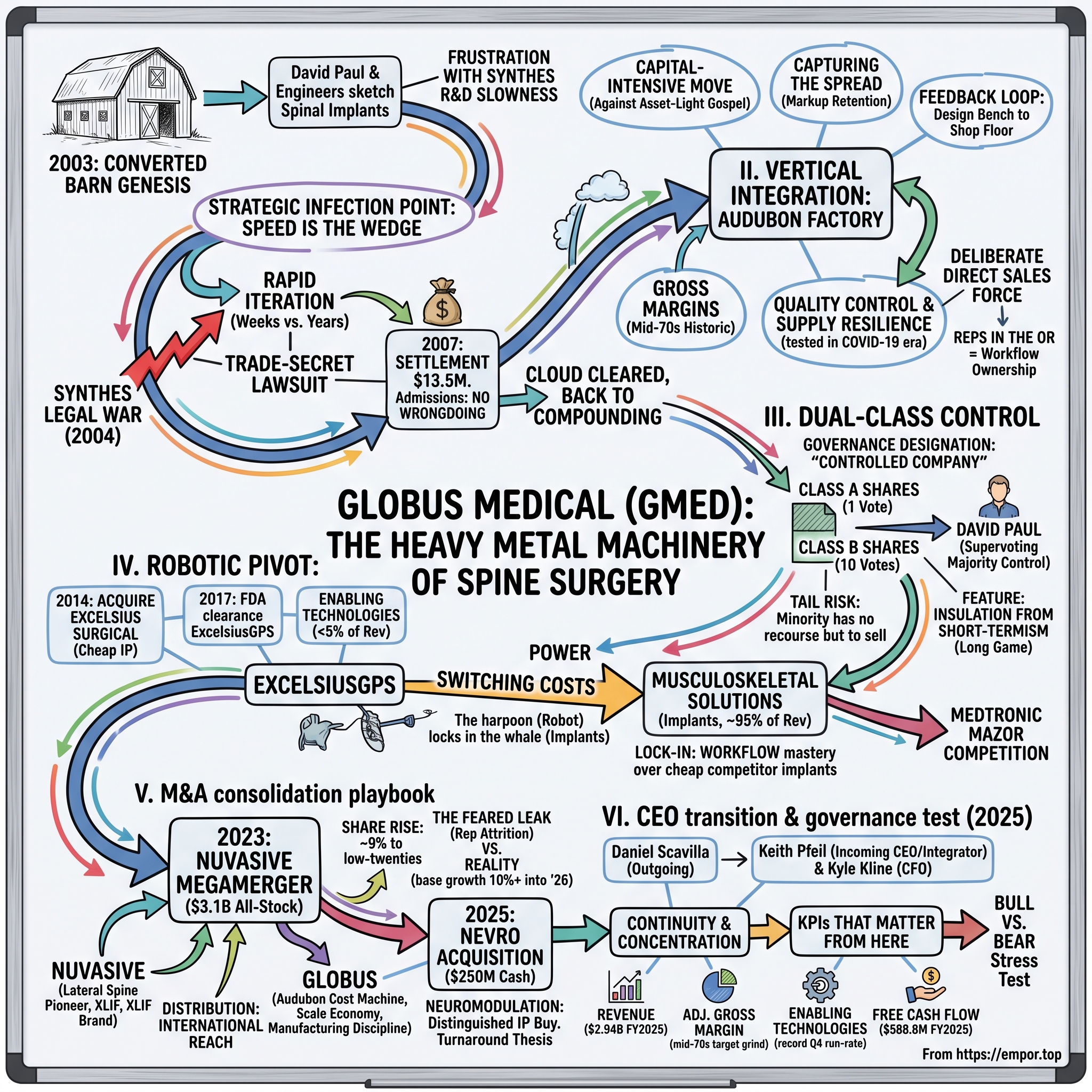
Globus Medical: The Heavy Metal Machinery of Spine Surgery
I. Introduction & Episode Roadmap
Picture a barn in the exurbs of Philadelphia in the winter of 2003. Not a metaphorical barn — an actual converted farm building in Audubon, Pennsylvania, with space heaters fighting the Delaware Valley cold. Inside, a handful of engineers who had just walked out of one of the most respected orthopedic companies on earth were sketching spinal implants and arguing about thread pitches. The man at the center of it, David Paul, had spent years inside Synthes watching surgeons beg for faster iteration and watching corporate R&D deliver at a glacial pace. He decided he could do it faster. He was about to be sued for it.
Twenty years later, that barn-born company did something almost nobody in medtech saw coming. In February 2023, Globus Medical announced it would absorb NuVasive — a company that was, by revenue, roughly its equal and by reputation the pioneer of an entire surgical technique — in an all-stock deal valued at $3.1 billion.1 When the deal closed that September, the combined entity leapt to the clear number-two position in the global spine market, trailing only the Goliath of the industry, Medtronic.[^2]
Here is what makes Globus worth an episode. Most medical device companies are, underneath the lab coats, sales-and-marketing organizations. They design a product, outsource the metalworking to contract machine shops, and pour their energy into the relationship between a rep and a surgeon. Globus did close to the opposite. It built its own factories, machined its own titanium, compressed its development cycle to a fraction of the industry norm, and then — crucially — bolted a robotics-and-imaging business on top that quietly locks surgeons into buying Globus implants for years.
The result is a financial profile that looks almost anomalous for a company its age: adjusted gross margins that have historically run in the low-70s and, even after digesting a lower-margin acquisition, still sit near 69%.[^3] For the full year 2025, Globus reported worldwide net sales of $2.94 billion, up 16.7%, with a consolidated adjusted EBITDA margin of 31.3%.[^3]
So the core question of this story: how did a company started by a fired-up engineer in a barn build a moat wide enough to deliver those margins while carrying a dual-class share structure that hands one man majority control, fighting off aggressive competitor litigation, and pulling off one of the most complex integrations in medtech history? And — the harder question for an investor — how much of that moat is real and durable, and how much is a story management tells well?
Here's the roadmap. First, the engineering genesis and the $13.5 million Synthes trade-secret war that nearly strangled the company in its crib. Then the secret engine of the whole model: vertically integrated manufacturing in Audubon. Then the robotic Trojan horse — how a business that is less than 5% of revenue drags the other 95% along behind it. Then the M&A consolidation playbook: the NuVasive megamerger and the opportunistic, distressed-asset purchase of Nevro. Then the abrupt 2025 CEO transition and the governance stress test. And finally, the bull-versus-bear war-game and the handful of numbers that actually matter from here.
One framing note before we begin, because it shapes everything that follows. Spine is a strange corner of healthcare. It is not a mass-market business — the number of surgeons in the world who perform complex spinal reconstructions is measured in the tens of thousands, not millions. That concentration means the industry is governed less by brand advertising or payer negotiation than by something closer to craft relationships: a rep who knows a surgeon's preferences, an implant system a surgeon has used a thousand times, a workflow burned into muscle memory. In a market that small and that personal, distribution is not a channel — it is the product's other half. Hold that thought. It explains why Globus built the sales force it did, why the NuVasive merger was so frightening to investors, and why the robot matters far more than its revenue line suggests.
Let's start in the barn.
 Subscribe on LinkedIn
II. The Engineering Rebel: David Paul & The Synthes Legal War (2003–2007)
Every founding myth needs an antagonist, and Globus's was a company most Americans have never heard of but whose hardware is probably holding somebody's spine together right now: Synthes, the Swiss-American orthopedic titan that Johnson & Johnson would later buy for roughly $20 billion. Synthes was the establishment. Its trauma and spine implants were the gold standard, its engineering culture rigorous, its pace deliberate. And deliberate, to a certain kind of engineer, is a synonym for slow.
David Paul was that kind of engineer. Trained as an engineer rather than a physician or a salesman, he had risen to become Synthes's head of spine-products development.2 That detail matters more than it first appears. In medical devices, the CEO chair is usually occupied by someone who came up through sales or general management, because the perceived core competency is commercial: get the rep in the room, get the surgeon to convert, negotiate the hospital contract. An engineer-founder makes different trades. He optimizes for the product and the process, and he tends to believe — sometimes correctly, sometimes expensively — that a better-engineered thing delivered faster will beat a better-sold thing delivered slowly.
From the head-of-development seat, Paul could see the gap between what surgeons wanted and what the corporate machine could deliver. A surgeon in the operating room would ask for a slightly different implant geometry, a modified screw, a better cage — small, iterative improvements that in a fast-moving field could win real clinical loyalty. Inside a company the size of Synthes, that request disappeared into a multi-year development and approval funnel, competing for engineering resources against a global portfolio of trauma and craniomaxillofacial products. There is nothing irrational about that; a company with Synthes's installed base and regulatory exposure has genuine reasons to move carefully. But Paul's frustration was not with the engineering. It was with the clock.
So in 2003 he left, and with co-founders he stood up Globus Medical in that Audubon barn. The premise was almost aggressively simple: build spinal implants, but build them fast. Turn the surgeon's request into a prototype in weeks, not years, and let that speed become the brand. The insight underneath was that in a field advancing rapidly — new fusion techniques, new materials, new minimally invasive approaches — the incumbent's slowness was not a temporary weakness but a structural one. Big companies do not choose to be slow; they become slow as a byproduct of scale, process, and risk aversion. That slowness is therefore reliable, and a competitor can build a business model on the assumption it will persist.
Synthes did not take it quietly. In a lawsuit filed in 2004, Synthes accused Paul and other Globus executives of walking out the door with the crown jewels — product designs, manufacturing methods, and regulatory strategies lifted from confidential files.2 This is the existential threat that most origin stories gloss over. A startup with a garage full of prototypes can survive a lot of things; a well-funded trade-secret injunction from the dominant incumbent is not usually one of them. The suit threatened to freeze Globus's product pipeline, poison its reputation with the surgeons it needed to court, and drain a young company's cash into a courtroom.
The case actually went to trial. In July 2007, a jury began hearing testimony before a federal judge in Philadelphia — and then, mid-trial, the two sides settled.2 Globus paid Synthes $13.5 million, admitted no wrongdoing, and agreed not to solicit or hire Synthes employees until August 2008.2
Sit with that number for a moment in context. For a company only a few years old, $13.5 million was not a rounding error; it was a serious chunk of capital handed to the very competitor you were trying to displace. But look at what it bought. It cleared the legal cloud hanging over the product line. It let Globus stop litigating and start selling. And it converted an existential threat into a one-time, bounded cost. You can read the settlement two ways, and an honest investor holds both: as vindication (no admission, no injunction shutting the company down) and as a tacit acknowledgment that the line between a founder's knowledge and a former employer's secrets is genuinely blurry when the founder ran the department. The truth is probably somewhere in the middle, and Globus paid to make the ambiguity go away.
There is a second, more practical lesson buried in the settlement, and it recurs throughout Globus's history: this is a company that has always been comfortable using the balance sheet to buy time. Pay to end the lawsuit. Pay to buy the robotics IP. Pay to absorb the rival. In each case the pattern is the same — convert an open-ended strategic risk into a known, one-time cash cost, and get back to compounding. That is a genuine institutional temperament, and it is worth naming early because it will show up again at much larger dollar figures.
What Globus built with the runway it bought was a process, not just a product. The company drove its development cycle down toward roughly 12–18 months against an industry norm often quoted at three to five years, and it launched new implant systems at a cadence that early-adopter surgeons found intoxicating.3 Speed became the wedge. Every rapid iteration deepened the relationship with a surgeon who felt heard, and every satisfied surgeon became a reference for the next.
It is worth being precise about how that speed was possible at all, because "move faster" is easy to say and nearly impossible to do in a regulated industry. Most spinal implants in the United States reach the market through the FDA's 510(k) pathway, which allows clearance based on demonstrating substantial equivalence to an existing legally marketed device rather than running large new clinical trials. That pathway is the structural reason a fast-iterating implant company can exist: an improved pedicle screw system is, regulatorily speaking, an incremental variation on a known category, not a novel therapy requiring years of trials. Globus did not invent this pathway or exploit a loophole — every competitor uses it. What Globus did was organize its entire company around minimizing the time between "a surgeon asked for this" and "the cleared product is in the OR," while competitors treated the regulatory clock as fixed and optimized elsewhere.
The strategic consequence compounded. In a field where surgeons build habits around specific systems, being first with a meaningfully better version of a common implant does not just win one sale — it wins a workflow. And workflows, as the later chapters of this story make clear, are the most valuable thing a spine company can own.
But speed on the design side is only half a story. You cannot iterate in weeks if your factory is on another continent and answers your calls in a different time zone. Which brings us to the decision that actually defined Globus — the one Wall Street told it not to make.
III. The Secret Weapon: Vertical Integration & Audubon Manufacturing (2007–2012)
To understand how contrarian Globus's next move was, you have to remember what the smart money believed in the 2000s. The gospel of the era was "asset-light." Shed your factories. Machining is a commodity; let a contract shop in a low-cost country stamp out your screws while you keep the high-margin work of design, regulatory strategy, and — above all — the sales relationship. Own the brand, rent the metal. Nike doesn't own its shoe factories; why should a device company own its screw factories?
David Paul looked at that logic and rejected it. Instead of outsourcing, Globus poured capital into a vertically integrated machining and manufacturing operation anchored in Audubon, Pennsylvania — building the physical capacity to make its own high-precision titanium screws, rods, cages, and instruments in-house.
Why would a young, capital-constrained company deliberately take on the cost and complexity that everyone else was fleeing? Two reasons, and they compound.
The first is margin. When you machine your own implants, you are not paying a contract manufacturer's markup, and you are not paying it on every unit forever. In a product category where the raw material is a modest fraction of the selling price and the value is in precision and design, owning the factory means capturing the spread that a contract shop would otherwise pocket. This is the mechanical source of Globus's most striking financial feature — gross margins that for years sat in the mid-70s, a level that made analysts double-check the model when the company came public.4
The second reason is the one that actually connects back to the barn: the feedback loop. If a surgeon asks for a change to a screw's thread pitch, a Globus engineer can, in principle, walk from the design bench to the shop floor, have a prototype milled, and get it into a test rig in a matter of days. That is physically impossible if your machining lives inside a third party's queue halfway around the world. Vertical integration is what makes the 12–18 month development cycle real rather than aspirational. The factory is not a cost center bolted onto a design company; it is the design company's nervous system.
There is a third benefit that gets less attention but may matter most in a regulated industry: quality control and supply resilience. When a contract manufacturer produces an implant that will be permanently placed inside a human spine, the device company still owns the regulatory liability but not the process. Every specification change requires a negotiation; every quality excursion requires an investigation conducted at arm's length across a contractual boundary. Owning the line collapses that distance. It also means that when a global supply chain seizes up — as it did comprehensively in the early 2020s — you are not standing in someone else's queue behind a hundred other customers. The pandemic era was, in retrospect, a brutal live test of asset-light orthodoxy, and vertically integrated manufacturers generally came through it better than those who had outsourced their capacity to the lowest bidder.
The trade-off is real and should be stated plainly rather than waved away: vertical integration converts variable costs into fixed costs. A company that owns its factories has operating leverage in both directions. When volumes grow, margins expand beautifully — which is exactly the story of Globus's last two decades. When volumes fall, those same fixed costs sit there absorbing profit, and you cannot renegotiate them the way you can cancel a contract manufacturer's purchase order. Globus has never really been tested by a sustained volume decline. Elective spine procedure volumes are somewhat economically sensitive and were badly disrupted during the pandemic's peak, but the structural demand driver — an aging population with degenerating spines — has been reliable enough that the downside of the model has stayed theoretical. An investor should note that the operating leverage cuts both ways, and that the bull case implicitly assumes procedure volumes keep growing.
Globus paired this with a deliberately high-touch, direct sales model. Rather than selling through generalist medical distributors who carry a dozen vendors' catalogs, Globus built a specialized direct sales force trained to be in the operating room, handing the surgeon the exact instrument and implant for each step of a complex reconstruction. This is expensive and hard to scale, but it creates something a distributor never can: a personal, high-trust relationship between a Globus rep and a specific surgeon, reinforced case after case. It is also, as we'll see, the single most vulnerable asset the company owns — because a relationship that lives in a rep can walk out the door with that rep.
It is worth pausing on the economics of that sales model, because they are unusual and they explain a great deal about the industry's structure. A spine rep is not a salesperson in the ordinary sense. They carry inventory — trays of implants and instruments in multiple sizes, because the surgeon will not know until they are inside the patient exactly which size is needed. They are present during surgery, often for hours, guiding the technical use of the system. They are effectively an outsourced member of the surgical team who happens to be paid by a manufacturer. That model is enormously expensive: it is why selling, general, and administrative expense in this industry runs around 40% of sales, a figure that would be alarming in almost any other manufacturing business but is simply the cost of doing business here. Globus's FY2025 SG&A ratio of roughly 40% of sales sits right in that band.[^3]
But look at what the expense buys. It buys a relationship that cannot be replicated by a catalog, a website, or a price cut. And it buys information: a rep in the OR every week learns what surgeons actually want long before that preference shows up in a market research report. In a vertically integrated company, that information has somewhere to go — straight back to Audubon's engineers. The sales force and the factory are two ends of the same feedback loop, and this is the part of the Globus model that is genuinely difficult to copy. A competitor can build a factory. A competitor can hire reps. Wiring the two together so that a surgeon's request in a Tuesday operation becomes a milled prototype by Friday is an organizational capability, and organizational capabilities are the slowest thing in business to replicate.
By 2012, this machine was ready to be shown to public markets. On August 3, 2012, Globus priced its IPO of 8.33 million Class A shares at $12 per share, and the stock began trading on the NYSE under the ticker GMED, with the offering closing on August 8.5 It came public not as a speculative story stock but as a profitable, fast-growing device maker with manufacturing margins that most peers could only envy — proof, at least on paper, that the contrarian bet on owning the metal had worked.
But the IPO did something else that would shape the company for the next decade and a half. It didn't just raise capital. It enshrined control.
IV. Dual-Class Power & The Founder's Shadow
There is a particular kind of decision a founder makes at the moment of going public that tells you how he sees the world, and Globus's was unambiguous. When the company listed, it did so with a dual-class share structure. The Class A shares that the public bought carry one vote each. The Class B shares, concentrated in the hands of David Paul, carry ten votes each.6
The arithmetic of that structure is worth making concrete, because it explains everything about how Globus makes decisions. As of the April 2026 record date, Globus had roughly 113 million Class A shares and about 22.4 million Class B shares outstanding.6 Run the votes: the Class A block controls about 113 million votes, while the much smaller Class B block controls about 224 million. The minority of shares holds the majority of the votes. That is why Globus formally discloses itself as a "controlled company" under NYSE rules — more than half the voting power sits with David Paul.6 Post-NuVasive, that concentration put roughly two-thirds of the company's voting power in one man's hands, a figure consistent with the Class B block alone commanding around 66% of votes.
A controlled-company designation is not a scandal; it is a disclosed fact with real consequences, and it exempts Globus from certain NYSE board-independence requirements — including, notably, the requirement that a majority of the board be independent and that compensation and nominating committees be composed entirely of independent directors. Globus has been consistent and transparent about this status in its filings; there is no concealment here. The structure also has a built-in sunset mechanism of a sort: each Class B share converts automatically into a Class A share upon any transfer other than a permitted transfer, and can be converted voluntarily at any time.6 In other words, the supervoting power is personal to the holder and does not travel freely to third parties. That is a meaningfully better design than a perpetual dual-class structure that can be sold or inherited indefinitely, though it still leaves control in place for as long as the founder chooses to hold.
The interesting question is whether concentrated founder control is a feature or a bug — and the honest answer is that it is both, depending on the year.
The bull case for the supervoting structure is the case for patient capital. It insulates management from the quarterly tyranny of public markets. When Globus wanted to bet the company on absorbing NuVasive and eat a violent short-term stock reaction, no activist could stop it and no hostile acquirer could pick the company off during the vulnerable integration window. Founder control let Globus play a long game in an industry where integrations take years to pay off. If you believe the strategy is right, concentrated control is what makes it executable.
The bear case is the governance discount, and it is not theoretical. Minority shareholders of Globus have essentially no say over capital allocation, executive compensation, or the composition of the board. Every major transaction is executed on the controlling shareholder's terms. Institutional investors who care about governance — and many index and pension funds now do — will rationally pay less for a dollar of Globus earnings than for the same dollar at a one-share-one-vote peer, because they are buying cash flows they cannot influence. When management and the controlling founder's interests are aligned with minority holders, this costs nothing. The risk is entirely in the tail: the day those interests diverge — an overpriced acquisition, a related-party arrangement, a compensation package — the minority has no recourse but to sell. A skeptical investor should treat the governance structure not as a reason to avoid the stock but as a permanent term in the discount rate, and watch capital-allocation behavior over time as the real test.
There is a useful way to think about this that avoids both cheerleading and reflexive governance scolding. Founder control is leverage on the founder's judgment. If the judgment is good, control amplifies the returns; if it deteriorates, control removes the circuit breaker. So the analytical work is not to litigate whether dual-class shares are good in the abstract — it is to track the quality of the decisions being made with that control, transaction by transaction, and to watch for the specific warning signs that concentrated power tends to produce: related-party transactions, compensation disconnected from performance, board seats filled by long-time associates, or acquisitions that expand the empire without expanding returns on capital. On the record so far, the two largest uses of that control — the NuVasive merger and the Nevro purchase — were defensible strategic moves rather than empire-building, and the operating results have broadly supported them. That is the evidence available. It is not a guarantee, and it should be re-underwritten every year rather than assumed.
One more governance note worth flagging for completeness: David Paul remains Chairman of the Board and Executive Chairman, meaning he retains an active executive role alongside his voting control even as operational leadership has passed to a professional management team.6 Investors should read the founder's continued presence as both stabilizing — institutional memory, strategic continuity — and as a constraint on how independently a CEO can operate. Those are simply two descriptions of the same arrangement.
So far, that behavior has been the founder's best defense of his own control — because the biggest thing he did with it was buy a robotics company almost nobody thought was a good idea. That turned out to be the most important acquisition in the company's history.
V. The Robotic Pivot: ExcelsiusGPS & The Power of Switching Costs
Here is a scene from a modern spine operating room. A surgeon is about to place a pedicle screw — a screw driven into the small, dense pedicle of bone that connects to a vertebra, millimeters from the spinal cord and major nerves. Get the angle wrong and the consequences are catastrophic. For decades, this was a matter of surgical feel, fluoroscopy, and experience. Now, increasingly, a rigid robotic arm holds the trajectory, guided by real-time CT imaging, and the surgeon drives the screw down a path the machine will not let wander. That machine, in a growing number of ORs, is Globus's ExcelsiusGPS.
The seed of it was cheap. In January 2014, Globus acquired a small company called Excelsius Surgical for an amount reported in the range of tens of millions of dollars — a modest bet on early-stage robotic navigation intellectual property at a time when surgical robotics in spine was unproven.7 It took years and a rejected FDA submission to turn that IP into a product. On August 17, 2017, Globus announced that ExcelsiusGPS had received 510(k) clearance from the FDA — a robotic guidance and navigation platform combining a rigid arm with real-time imaging to place screws with sub-millimeter targeting.[^10]
It is worth explaining what these machines actually do, because "surgical robot" conjures images that are mostly wrong. The Excelsius system is not an autonomous surgeon. It does not cut, and it does not make decisions. Think of it instead as an extremely precise drill guide with a memory. Before or during the operation, the system builds a three-dimensional map of the patient's anatomy from CT imaging. The surgeon plans the exact trajectory for each screw on a screen. The robotic arm then physically moves to hold a rigid guide tube along that planned path and holds it there, immovably, while the surgeon does the actual work of driving the screw. The value is not automation; it is the elimination of drift. A human hand, however skilled, wobbles. A rigid arm anchored to a registered anatomical map does not.
The Excelsius3D imaging system is the companion piece — an intraoperative imaging platform that lets the surgical team acquire the images that feed the navigation, and verify placement, without moving the patient to a separate radiology suite. Together the two products describe an ambition larger than either: to own the digital layer of the operating room, the place where the anatomy, the plan, the instruments, and the implants all meet.
Now, why does a business this small matter so much? Look at the 2025 segment split. Globus reports in two segments. Musculoskeletal Solutions — the core spinal hardware, biologics, and now neuromodulation — generated $2,797.9 million in 2025, roughly 95% of revenue. Enabling Technologies — the capital equipment, meaning the ExcelsiusGPS robots and Excelsius3D imaging systems themselves — generated just $141.0 million, under 5% of the total.[^3]
An investor glancing at those numbers might dismiss Enabling Technologies as a rounding error. That would be a serious misread, and understanding why is the entire strategic point of this section. The right frame comes from Hamilton Helmer's 7 Powers, specifically the power he calls Switching Costs.
Think about what happens when a hospital buys an Excelsius system. It pays a large capital sum — these systems run into seven figures — and then it invests something even more valuable than money: time. Surgeons and OR staff spend dozens of hours training on the robotic workflow, learning the software, integrating it into their surgical routine. That workflow is calibrated around Globus's own implants and instruments. Once a surgeon is fluent in the Excelsius system, the path of least resistance — and often the only validated path — runs through Globus's proprietary, high-margin screws and cages.
Now imagine a competitor's rep walks in and offers cheaper implants. To switch, the surgeon would have to abandon the expensive robot they mastered, or run a parallel non-robotic workflow, or wait for the competitor to build an equivalent system and retrain the entire team. The switching cost is not the price of the implant; it is the sunk investment in the workflow. The $141 million robot business is, in effect, a loss-leader anchor that locks in the far larger implant stream behind it. The capital equipment is the harpoon; the recurring implant revenue is the whale.
That is the theory, and it is genuinely powerful. But a neutral analysis has to test it rather than admire it, and there are two real cracks worth naming. First, the lock-in is only as strong as the robot's relative advantage. Medtronic's Mazor robot and Stryker's platforms are direct competitors, and on the Q1 2026 call, management itself acknowledged that deal cycles for capital equipment have lengthened as buyers deliberate.8 A hospital that has not yet bought is not yet locked in — and the competition for that initial sale is intense. Second, Globus is deliberately loosening its own grip on the razor to sell more blades. Management said on that same call that it is moving away from insisting on outright robot purchases and toward leases and rentals, explicitly to drive more implant, disposable, and service pull-through.8 That is a rational move — it lowers the barrier to getting a robot into an OR — but it also quietly concedes that the upfront capital sale had become a friction point, and it shifts the reported revenue mix in ways investors will need to watch.
There is a third consideration that cuts in Globus's favor and deserves equal weight. Unlike a pure robotics company, Globus does not need the robot business to be profitable on a standalone basis. A competitor whose entire model is selling surgical robots must earn its return on the capital sale itself. Globus can afford to be aggressive on robot economics — discounting, leasing, placing systems at attractive terms — precisely because it monetizes on the implant stream behind it. That is a structural advantage over any robotics specialist, and it is the same razor-and-blades asymmetry that has decided competitive battles in industries from printers to medical diagnostics. The party that owns the consumable can always outbid the party that only owns the hardware.
The counterweight is that Medtronic possesses exactly the same asymmetry, and possesses it at greater scale. Medtronic's Mazor robotic platform sits alongside the industry's largest spinal implant franchise, which means it can play the same game with a deeper balance sheet. So the robotics battle in spine is not a case of an integrated player against specialists; it is two integrated players with similar logic, competing for placements in a finite number of hospitals. That dynamic tends to compete away excess returns on the hardware itself while preserving them on the implants — which is roughly what the numbers show.
The pull-through thesis, in other words, is real but conditional. It works beautifully once a surgeon is trained and locked in; it is fiercely contested at the moment of the initial sale. Which is exactly why scale in that sales motion matters so much — and why, in 2023, Globus made the biggest bet in its history to buy more of it.
VI. The $3.1 Billion Megamerger: Globus Swallows NuVasive (2023)
For most of its life, NuVasive was the company Globus measured itself against — and in one important dimension, envied. NuVasive had pioneered lateral spine surgery, most famously the XLIF procedure, which approaches the spine from the patient's side rather than the back, reducing disruption to muscle and nerve. It was a genuine clinical innovation, and it gave NuVasive a brand among surgeons and an international footprint that Globus, the scrappy domestic operator, had never matched. What NuVasive did not have was Globus's manufacturing discipline. It was, relative to Globus, less profitable and operationally heavier — a great franchise wrapped in a mediocre cost structure.
So when Globus announced on February 9, 2023 that it would combine with NuVasive in an all-stock deal, the strategic logic was legible: buy the pioneer's technology, brand, and international reach, and then run it through Audubon's cost machine. NuVasive shareholders would receive 0.75 of a Globus Class A share for each NuVasive share, valuing NuVasive at roughly $3.1 billion, with NuVasive holders ending up owning about 28% of the combined company and Globus holders about 72%.1[^2]
The market's first reaction was not applause. It was something closer to panic. Globus's stock fell hard on the announcement as investors scrambled to price a deal that looked, on its face, like the kind of transformative merger that destroys value.9 And their skepticism was rational, because they were pattern-matching to a real and ugly history. Medical-device mergers are notorious for "diseconomies of scale": integration chaos, culture clashes, distracted management, and — most dangerously in this industry — sales-force flight. In spine, the surgeon relationship lives in the rep. The moment a merger is announced, competitors like Medtronic and Stryker send headhunters to poach the best reps, dangling signing bonuses and the promise of stability, hoping to walk out with entire surgeon "books of business" while the acquirer is distracted by integration. The bear thesis on the deal, in a sentence: Globus was about to pay $3.1 billion for a customer base that could quietly leak out the back door.
There was a second, subtler reason for the market's discomfort, and it had to do with the currency. This was an all-stock deal. Globus was issuing shares — diluting existing holders by roughly 28% — to buy a company that earned lower margins than itself.1 Mechanically, that transaction is dilutive to the acquirer's margin profile on day one and only becomes accretive if the acquirer can lift the target's economics to something approaching its own. Everything depended on execution. The market was, in effect, being asked to underwrite a promise about factory migrations and synergy capture that would take years to verify, made by a management team whose controlling shareholder they could not vote against. Given that setup, a sharp negative reaction was a reasonable initial price, not an irrational one.
It also helps to understand why Globus wanted NuVasive specifically, rather than a smaller or cheaper target. Three things were on offer. First, international reach: NuVasive had built a genuine ex-US footprint that Globus, historically US-centric, had struggled to replicate organically. Buying a distribution network in a business where distribution is half the product is faster and more certain than building one country by country. Second, procedural breadth: NuVasive's lateral approach and its neuromonitoring capability gave Globus techniques and technologies it did not own. Third, and most bluntly, share. In an industry with two giants and a long tail of subscale players, moving from roughly 9% share to the low twenties changes what you are — it changes your negotiating position with hospital purchasing groups, the depth of the portfolio you can offer a surgeon, and the fixed-cost base you can leverage.[^2]
Whether Globus actually defied that history is the crux of the whole investment case, so it deserves scrutiny rather than a victory lap. The deal closed on September 1, 2023.[^2] Over the following two years, Globus set about doing exactly what its model predicted: migrating NuVasive's outsourced implant manufacturing into its own plants, stripping out duplicated overhead, and consolidating the sales structure.
The evidence that it worked is in the margin trajectory, and it is worth reading carefully because it is the closest thing to proof the bull case has. When you merge a high-70s-gross-margin company with a structurally lower-margin one, the blended margin drops — that is arithmetic, not failure. The full-year 2025 GAAP gross margin came in at 64.3%, with adjusted gross margin at 69.2% in the first quarter of 2026, up from 67.3% a year earlier.[^3][^13] The direction is what matters: the blended margin has been climbing back toward legacy-Globus levels as NuVasive volume shifts onto Audubon's cost base. That upward grind is management delivering on the specific, falsifiable promise it made at announcement.
The scale prize was real. The combination pushed Globus's share of the global spine market from roughly 9% to the low-twenties, crowning it the clear number two behind Medtronic.[^2] And critically, the base business kept growing organically through the integration — U.S. Spine posted its third consecutive quarter of roughly 10% growth into early 2026, which is the single best sign that the feared rep exodus did not gut the franchise.[^13] It did not eliminate attrition — some reps always leave — but the numbers are inconsistent with the catastrophic-leak scenario the bears feared in early 2023.
The cash generation is the other proof point, and arguably the harder one to fake. A company that is quietly bleeding out during an integration does not throw off $753.4 million of operating cash flow and $588.8 million of free cash flow in a year, as Globus did in 2025.[^3] Accounting profits can be shaped by assumptions about intangible amortization and integration charges; cash is harder to dress up. The combination of expanding adjusted margins, continued organic growth in the core, and heavy free cash generation is the analytically strongest evidence that the Audubon insourcing thesis is doing what management said it would.
An activist skeptic would still press two points. First, "cleanest integration in medtech" is a claim management makes about itself, and the organic-growth figures, while genuinely reassuring, are also the metric most flattered by careful disclosure choices; the real test runs for a few more years as legacy NuVasive territories fully anneal. Second, the deal was done in stock the controlling founder governs, so minority holders were diluted into a transaction they could not vote down in any meaningful way. So far the results vindicate the bet. But "so far" is doing real work in that sentence, and the next acquisition would test a different muscle entirely.
VII. The Neuromodulation Opportunistic Buy: Nevro (2025)
Spine surgery has a humbling limitation. A surgeon can mechanically fix a structural defect — fuse a joint, decompress a nerve, stabilize a vertebra — and the patient can still be in chronic pain afterward, because pain is a signaling problem in the nervous system, not only a structural one. That gap is the entire premise of neuromodulation: implanting a device that delivers electrical pulses to the spinal cord to interrupt pain signals before they reach the brain. It is a market worth roughly $2.5 billion, and until 2025 Globus had no foot in it.10
Enter Nevro. Nevro was, for a stretch, one of the darlings of medtech — the creator of the Senza spinal cord stimulation system and, later, the HFX iQ platform using high-frequency 10 kHz therapy and AI-driven cloud insights to personalize pain relief.10 At its peak the company was valued in the billions. Then the story soured: commercial execution misses, competitive pressure, and softening demand in the SCS market collapsed its valuation from market darling to distressed asset.
Globus stepped into that distress. On April 3, 2025, it completed the acquisition of Nevro for $5.85 per share in an all-cash deal valued at roughly $250 million.10 Set that against Nevro's former multi-billion-dollar valuation and the shape of the trade is obvious: Globus was buying a real, FDA-cleared, clinically validated product portfolio at a fraction of its former price, betting that Nevro's problem was distribution and execution, not the underlying technology.
This is a different kind of acquisition than NuVasive, and it reveals a distinct strategic muscle. NuVasive was a scale-and-cost play between two roughly comparable operators. Nevro is a turnaround — buy quality IP cheap because someone else couldn't sell it, then run it through your own superior distribution. The logic: Globus now has a vastly expanded global orthopedic sales force calling on exactly the surgeons who perform spinal fusions and who see, firsthand, which of their patients still hurt afterward. Cross-selling SCS into that installed base is the whole thesis. And if Globus can eventually apply its vertical-integration playbook to Nevro's complex electronics manufacturing, the margin upside could be substantial.
A brief explanation of the technology, since it is genuinely different from everything else in the Globus portfolio. Conventional spinal cord stimulation delivers low-frequency pulses that mask pain by replacing it with a tingling sensation called paresthesia — many patients find that trade acceptable, others find it unpleasant. Nevro's core innovation was high-frequency stimulation at 10 kHz, which aims to interrupt pain signaling without producing that tingling. The later HFX iQ system layered on cloud-connected software and algorithms that adjust therapy based on patient-reported outcomes over time.10 Strip away the marketing and what Globus bought was a differentiated therapeutic mechanism plus a software layer — a genuinely distinct asset class from titanium screws.
That distinction is the source of both the opportunity and the risk. Neuromodulation is an electronics-and-software business wearing an implant's clothing. The manufacturing competence Globus spent twenty years building — precision machining of metal — does not transfer directly. Insourcing an implantable pulse generator with a battery, telemetry, and firmware is a fundamentally different problem than milling a pedicle screw, and it involves a different regulatory pathway too: novel neuromodulation devices generally require the FDA's more demanding premarket approval process rather than the 510(k) route that governs most implants. Globus has stated the ambition to bring Nevro's manufacturing in-house over time; whether it can execute that in a domain adjacent to but distinct from its core is an open engineering question, not a settled one.
But this is the acquisition where a neutral analyst should apply the most pressure, because turnarounds are where confident acquirers get humbled. Buying a distressed asset cheap only creates value if you can actually reverse the distress, and neuromodulation's headwinds were not entirely Nevro-specific — the whole SCS category has faced reimbursement scrutiny and slowing growth. Management has been refreshingly candid about the near-term pain here. On the Q1 2026 call, CFO Kyle Kline told analysts plainly that the Nevro business "will probably get a little bit worse before it gets better," pointing to a 2025 sales-force restructuring and framing recovery only in late 2026.8[^13] That is the opposite of overpromising, and it earns management some credibility. But it also confirms that the integration is not yet working, that the electronics-insourcing prize remains a plan rather than an achievement, and that a $250 million purchase price can still destroy value if the SCS market itself keeps shrinking. Nevro is optionality bought cheaply, not a proven win — and it should be held in the mind as exactly that.
Both of these deals were architected by the same executive — the man who would, in the summer of 2025, unexpectedly find himself running the whole company.
VIII. Current Era & The CEO Transition (2025–Today)
The news landed with the abruptness that markets hate. In July 2025, Daniel Scavilla — Globus's president and CEO, the man who had led the company through the NuVasive integration — resigned to take the top job at Dentsply Sirona, the dental-equipment maker, effective that August.11 CEO departures are always unsettling; a CEO leaving mid-integration, to run a company in an entirely different corner of healthcare, is the kind of event that makes investors reach for the sell button and ask what he saw that they didn't.
Globus's answer was speed and continuity. Effective July 18, 2025, the board named Keith Pfeil — previously executive vice president, COO, and CFO — as president and CEO, and elevated Kyle Kline, the senior VP of finance, to CFO.1112 The choice was pointed. Pfeil was not an outside stabilizer parachuted in to reassure Wall Street; he was the operator who had actually engineered the financial integration of NuVasive and the acquisition of Nevro. If the entire investment case rests on integration execution, promoting the chief integrator is about as on-message as a succession can be. The risk, of course, is concentration: the same person now holds strategic, operational, and — until Kline stepped up — financial authority, inside a company already controlled by a single founder. Continuity and concentration are two names for the same fact.
What has Pfeil actually delivered so far? The FY2025 scorecard is genuinely strong. Worldwide net sales reached $2.94 billion, up 16.7% as reported, split between $2.80 billion in Musculoskeletal Solutions and $141 million in Enabling Technologies.[^3] Enabling Technologies finished the year with real momentum — a record fourth-quarter run-rate of $55.6 million, up 18.5% year over year — which matters far more than its small absolute size, because that segment is the harpoon that sets the implant pull-through in motion.[^3] Consolidated adjusted EBITDA margin was 31.3% for the full year, moving toward the company's stated ambition of the mid-30s within roughly three years of the NuVasive close.[^3] Full-year GAAP net income was $537.9 million, and free cash flow was a robust $588.8 million — real cash, not adjusted abstraction.[^3]
The momentum carried into 2026. First-quarter net sales were $759.9 million, up 27% as reported, with the base business excluding Nevro up 13.2% — evidence the core franchise is not merely coasting on acquired revenue.[^13] Management raised full-year non-GAAP EPS guidance to $4.70–$4.80 from $4.40–$4.50 while holding revenue guidance at $3.18–$3.22 billion — the classic signature of a company confident in margins even amid mix uncertainty.[^13]
The earnings calls are where you can pressure-test management's credibility, and the tone under Pfeil has been notably disciplined. Analysts have consistently pressed on two things: the organic health of legacy NuVasive territories (watching for rep attrition) and the timeline for insourcing Nevro's electronics manufacturing. On both, management's answers have been concrete rather than promotional — leading with hard synergy capture and cash generation, openly conceding that Nevro will worsen before it improves, and declining to slap a specific date on the mid-70s gross-margin ambition rather than manufacture one.8 For a controlled company where investors cannot vote, that willingness to under-promise on the hard parts is one of the few credibility signals the minority actually gets. It is worth more than any single quarter's beat.
The consistency across calls — same emphasis on manufacturing insourcing, same conservative framing of Nevro, same refusal to over-project robotics growth — is itself the evidence. Management is telling a stable story and hitting the near-term numbers inside it. That doesn't guarantee the long-term thesis, but it is the behavioral profile of a team executing a plan rather than improvising a narrative.
Two caveats belong here so the picture stays honest. First, guidance raises are the easiest form of credibility to accumulate and the easiest to lose; raising EPS while holding revenue flat means the beat is coming from margin and cost control rather than from demand running ahead of plan. That is good news about execution and neutral-to-mixed news about the top line, and investors should read it that way rather than as an unambiguous acceleration. Second, one of the specific things Pfeil has declined to do is attach a date to the mid-70s gross margin ambition.8 That refusal is defensible — nobody can precisely forecast the pace of a multi-plant manufacturing migration — but it also means the single most important element of the bull case has no deadline attached to it, and therefore no clean moment at which management can be judged to have missed. An investor should supply their own timeline and hold the company to it.
Set against the industry backdrop, the picture is of a company executing well in a market that is itself growing at mid-single digits. Globus's base-business organic growth in the low double digits implies it is taking share rather than merely riding the market — the most direct available evidence that the combination of speed, integration, and robotic lock-in is producing a real competitive result rather than an accounting one.[^13]
IX. Playbook: Business & Strategic Lessons
Step back from the quarter-to-quarter and three durable lessons emerge from the Globus story — each one a strategic principle with evidence behind it.
Vertical integration is not dead — where the market rewards it. The dominant business fashion of the last quarter-century was to shed physical assets and go asset-light. Globus is the counterexample that proves the rule has exceptions. In a market defined by high customization and a surgeon's demand for rapid iteration, owning your own factories is simultaneously a margin fortress and a prototyping engine. The lesson is not "always own your factory" — that would be wrong for a commodity business. It is that when speed of iteration and cost control are the competitive battleground, the company that controls its own metal controls its own destiny. The proof is in the margin structure that survived even a dilutive megamerger.
The capital-equipment Trojan horse. Never evaluate a hardware segment by its direct revenue weight alone. A piece of capital equipment that reshapes a customer's workflow and requires proprietary consumables to operate is worth far more than its own sales line — its true value is the discounted cash flow of the locked-in pull-through it generates. Globus's $141 million robotics business is the case study. But the corollary, which the company is now living, is that the lock-in must be continually re-earned at the point of the initial sale, and shifting to leases to lower that barrier is a tacit admission that the harpoon has gotten harder to throw.
Buy distressed IP, not just cash flow. The Nevro playbook — wait for a high-quality product portfolio to hit commercial trouble, buy it at a steep discount, and rehabilitate it through superior distribution — is a genuine capital-allocation edge if you have the distribution to make it work. The caveat, equally important, is that distress you cannot reverse is just a value trap wearing a discount tag. This lesson comes with an asterisk, because as of this writing the Nevro rehabilitation is a hypothesis, not a result.
Which sets up the real question for an investor: does the whole edifice hold together from here, or are there cracks that widen under stress?
X. Analysis, Risk Radar & Bear vs. Bull Stress Test
Let's war-game it properly, using the frameworks that cut through the narrative.
The Strategic Power Heatmap (Helmer's 7 Powers and Porter's Five Forces). Two of Globus's powers are genuinely strong. The first is Switching Costs — the surgeon lock-in created once a team is trained on the Excelsius workflow and running on Globus implants. The friction to switch, once embedded, is high and real. The second is Scale Economies: post-NuVasive, Globus spreads its fixed manufacturing base across roughly a fifth of the global spine market, letting it leverage its Audubon plants far better than any mid-tier competitor can, and giving it a structural cost advantage that compounds as insourcing continues.
On Porter's forces, the threat of new entrants is low, and this is one of the most durable features of the whole industry. Building a competitor requires clearing FDA hurdles (510(k)s and, for novel devices, PMAs), constructing a global robotic navigation platform from scratch, and — hardest of all — fielding a clinical sales force capable of standing in operating rooms. That combination is a multi-hundred-million-dollar, multi-year moat that protects all the incumbents, Globus included. The real competitive pressure comes not from new entrants but from existing giants — the rivalry axis — where Medtronic's scale and Stryker's balance sheet keep pricing and innovation under constant tension. Buyer power is rising too, as hospital systems consolidate purchasing and scrutinize capital budgets, which is part of why those robot deal cycles have lengthened.
Myth versus reality. Three consensus narratives about Globus deserve fact-checking before the stress test.
The first myth is that Globus is a robotics company. It is not, and the segment numbers make that unambiguous: robotics and imaging are under 5% of revenue.[^3] Globus is a spinal implant manufacturer that uses robotics as a distribution and lock-in mechanism. This distinction matters enormously for valuation, because a robotics multiple and an orthopedic implant multiple are very different things. Anyone underwriting the stock on a robotics growth narrative is buying a story the income statement does not tell.
The second myth runs the opposite direction: that the robot is therefore a distraction, a low-margin capital-equipment business dragging on an otherwise clean implant model. That reading misses the pull-through mechanism entirely. The right way to value Enabling Technologies is not by its own revenue or profit but by the incremental lifetime implant revenue each placement generates. The segment is best understood as a customer-acquisition cost that happens to be revenue-generating rather than a business line in its own right.
The third myth is that the NuVasive merger was a bold contrarian success the market simply failed to appreciate. The more accurate reading is that the market's initial skepticism was well-founded given the base rate of medtech integration failures, and Globus has since produced roughly two and a half years of evidence — expanding adjusted margins, continued organic growth, heavy free cash flow — that placed it in the favorable tail of that distribution. Those are different claims. The first credits foresight; the second credits execution and acknowledges that the outcome was genuinely uncertain when the bet was made. The second is what the evidence supports.
Now the stress test, held in genuine tension.
The bull case rests on three pillars, each with evidence behind it. First, continued margin recapture as NuVasive manufacturing fully transitions to Audubon — a thesis already partway proven by the climb in adjusted gross margin toward legacy levels. Second, a Nevro turnaround that beats the low expectations management itself has set, expanding the addressable market by $2.5 billion and adding a genuinely new growth vector. Third, robotics acceleration — ExcelsiusFlex extending the platform into total knee arthroplasty, cranial applications, and beyond — deepening the switching-cost moat and pulling through ever more implant revenue. If all three hit, Globus compounds from a position of structural advantage.
The bear case attacks each pillar at its weakest joint. The first and most concrete risk is the rep-attrition leak: the entire integration thesis depends on retaining the surgeon relationships that live inside sales reps, and a determined poaching campaign by Medtronic or Stryker could still quietly bleed away books of business in legacy territories over time. The organic growth numbers argue this hasn't happened at scale — but it is a slow leak, not a sudden break, and it won't show up in a single quarter. Second, neuromodulation headwinds: if the SCS market keeps softening on reimbursement pressure, Nevro drags on consolidated profitability rather than lifting it, and the $250 million turns into a distraction. Third, the persistent governance discount: with roughly two-thirds of voting power in one man's hands, a class of institutional capital will simply never fully underwrite the stock, capping the multiple regardless of operating performance. None of these is a knockout blow on its own; the bear case is that they compound — a little rep attrition, plus a Nevro that stays broken, plus a permanent governance haircut — into years of underperformance even if the business itself is fine.
The risk radar, restricted to what is actually material. Three risks deserve attention and several commonly cited ones do not. Regulatory and reimbursement risk is real and specific: spine procedure volumes and the price of implants depend heavily on what payers — Medicare above all — decide to reimburse, and neuromodulation in particular has faced reimbursement scrutiny. A tightening there hits Globus's newest business directly. Execution risk in transformation is the second, and it is elevated by construction: Globus is simultaneously integrating a merger of equals, turning around a distressed acquisition, and launching into adjacent orthopedic categories with ExcelsiusFlex. Each of those individually is demanding; running all three concurrently under a first-year CEO is a genuine stretch of management bandwidth. The third is key-personnel concentration — not at the executive level, but at the rep level, where the customer relationships literally reside.
What is not a material risk, despite frequent mention: AI disruption of the core business (AI in surgical planning is a feature Globus is building, not a substitute for titanium), and, on management's own account, tariffs and geopolitics, which they characterized as having no material impact — a claim that is plausible precisely because so much manufacturing is domestic.8 The vertical integration that costs Globus flexibility in a downturn buys it insulation from trade disruption, which is a fair trade in the current environment.
There is also a straightforward accounting-and-disclosure aside worth flagging: the gap between GAAP and adjusted numbers is wide (FY2025 GAAP gross margin of 64.3% versus adjusted 69.2% in Q1 2026), driven by integration and acquisition-related charges. That gap is legitimate for a company mid-integration, but it is exactly the kind of adjustment an investor should watch shrink over time; if "one-time" integration costs persist year after year, they stop being one-time.
The peer comparison, which is where the thesis lives or dies. Set Globus against its two relevant reference points. Medtronic is the scale leader, with a spine franchise embedded inside a vastly larger diversified medical device conglomerate. That is both its strength — resources, reach, bundling power with hospitals across many product categories — and its weakness, because a spine business competing for capital and attention inside a conglomerate inherits precisely the institutional slowness that David Paul left Synthes to escape. Globus's structural edge over Medtronic is not scale; it is focus and speed.
The second reference point is the subscale tail: the mid-tier and emerging spine companies. Against them, Globus's edge is the reverse — pure scale. A company doing a few hundred million in revenue cannot fund a competitive robotics platform, cannot spread fixed manufacturing costs efficiently, and cannot field a global direct sales force. The post-NuVasive scale gap is what pushes those competitors toward niches rather than head-on confrontation.
Globus therefore occupies a genuinely defensible middle position: large enough to fund the robotics platform and leverage its factories, focused enough to still move fast. That position is the real answer to "why does this company win from here." It is not one magic advantage; it is the combination of a cost position competitors cannot match at similar focus, a distribution model that is expensive but sticky, and a workflow lock-in that compounds with every robot placed.
And here is the falsification test — what would break the case. If adjusted gross margins stop climbing and plateau well short of legacy levels, the insourcing thesis is wrong and the merger was merely a scale grab rather than a value creator. If base-business organic growth decelerates toward the market rate of mid-single digits, the share-gain story is over and the moat is not doing what the bulls claim. If Enabling Technologies growth stalls, the pull-through flywheel is losing its throw and the implant business loses its future lock-in engine. Any one of those three would materially damage the thesis; two together would break it. Those are specific, observable, and falsifiable, which is exactly what a credible investment case requires.
The KPIs that actually matter. Cut through everything and three numbers tell the story from here. First, the consolidated adjusted gross margin rate — the single cleanest proxy for whether the Audubon insourcing machine is doing to NuVasive (and eventually Nevro) what it did to legacy Globus; the target to watch is a grind back toward the mid-70s. Second, Enabling Technologies revenue growth — because this small segment is the leading indicator of future implant pull-through; sustained high-teens-or-better growth here feeds the whole flywheel, while a stall would signal the harpoon is losing its throw. Third, sales-force retention and legacy-NuVasive organic growth — the direct readout on whether the merger's surgeon relationships are holding. Watch those three and you are watching the actual mechanism of the business, not the noise around it.
XI. Epilogue
The arc bends back to the barn. David Paul left a Swiss-American titan, got sued for it, paid to make the lawsuit disappear, and then made a series of bets that ran directly against the conventional wisdom of his industry — owning the factory when everyone said rent it, building a direct sales force when everyone said distribute, buying a robotics company when robots in spine were unproven, and absorbing a rival his own size when the market said the integration would fail. Enough of those bets paid off that a company started in a converted farm building now sits second only to Medtronic in global spine.
What lies ahead is a widening of the definition. With ExcelsiusFlex pushing into knee and hip reconstruction, cranial navigation extending the robotic platform beyond the spine, and AI moving into pre-operative planning, Globus is deliberately outgrowing the label "spine implant company." The ambition is to be a comprehensive musculoskeletal technology platform — a company that owns the robot, the implant, the workflow, and increasingly the software layer that ties them together.
Whether that ambition compounds into durable returns or dilutes into diworsification is the open question, and it will be answered by the same things that built the company: manufacturing discipline, the strength of the surgeon lock-in, and the judgment of a controlling founder whom minority investors must trust but cannot check. The barn is long gone. The bet on controlling your own metal, and your own destiny, is still being placed.
References
-
Globus Medical and NuVasive to Combine in All-Stock Transaction — NuVasive, 2023-02-09 ↩↩↩
-
Synthes, Globus settle suit on secrets — The Philadelphia Inquirer, 2007-08-21 ↩↩↩↩
-
About Globus Medical: History and Milestones — The Spine Market Group ↩
-
Spine-product rivals now battle in court — The Philadelphia Inquirer, 2007-07-26 ↩
-
Globus Medical Announces Pricing of Initial Public Offering — Business Wire, 2012-08-03 ↩
-
Globus Medical, Inc. Definitive Proxy Statement (DEF 14A) — SEC EDGAR, 2026 ↩↩↩↩↩
-
Globus Medical Receives FDA 510(k) Clearance for Excelsius GPS Robotic System — ORTHOWORLD, 2017-08-17 ↩
-
Globus Medical (GMED) Q1 2026 Earnings Call Transcript — The Motley Fool, 2026-05-07 ↩↩↩↩↩↩
-
NuVasive, Globus Medical ink $3.1B orthopedic device merger, sending investors scrambling — Fierce Biotech, 2023-02-09 ↩
-
Globus Medical completes acquisition of Nevro Corp. — Nevro Newsroom, 2025-04-03 ↩↩↩↩
-
Globus promotes Keith Pfeil to CEO as former exec leaves for Dentsply — MedTech Dive, 2025-07 ↩↩
-
Globus Names New CEO, CFO Following Sudden Resignation — ODT Magazine, 2025-07 ↩
 LinkedIn
 WhatsApp
 Reddit
 Hacker News
 Email
Email Kindle
 RSS Feed
 Spotify
 Apple Podcasts
 Amazon Music
 Audible
 YouTube