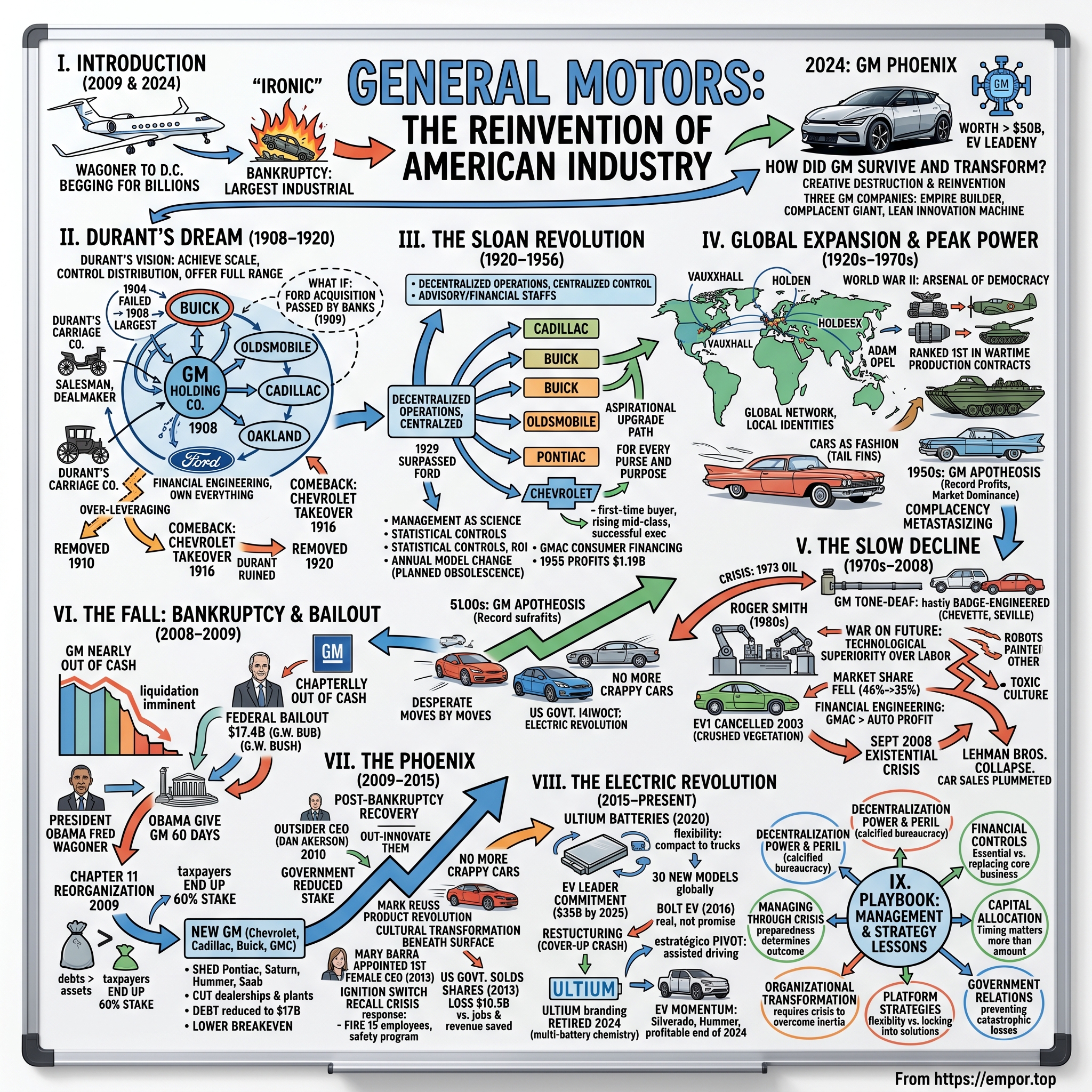
General Motors: The Cash-Machine Fortress and the Reinvention Trap
I. Introduction & Episode Thesis
On the morning of September 19, 2026, General Motors did something that would have looked like heresy five years earlier. It unveiled a new family of V-8 engines. Not a battery chemistry, not a robotaxi, and not a software subscription: two brand-new small-block V-8s for the 2027 Chevrolet Silverado 1500 and GMC Sierra 1500, marking the sixth generation of an engine architecture GM first introduced in 1955.1 GM President Mark Reuss summed up the mission in four words: "keep beating the competition."1 The company disclosed that V-8 engines power 55% of Silverado sales and 61% of Sierra 1500 sales.1
The announcement did not state it outright, but the strategic signal was unmistakable. After a decade of trying to convince Wall Street that it was a technology platform that happened to manufacture vehicles, GM returned focus to the core product line that actually funds operations.
That tension forms the central paradox of the company. General Motors reported $187.4 billion in revenue for 2024 alongside a record $14.9 billion in EBIT-adjusted, its preferred metric for operating profit before interest, taxes, and special items.[^2]2 In 2025, revenue edged down to $185.0 billion and adjusted EBIT declined to $12.7 billion, pressured by tariff headwinds and an expensive retrenchment from electric vehicles.3 In late September 2026, the equity traded near $84 per share, giving GM a market capitalization of approximately $74 billion.4 Measured against management's 2026 guidance of $12.00 to $14.00 in adjusted earnings per share, that implies a valuation multiple in the mid-single digits.5 Public markets are pricing one of the largest industrial manufacturers in the United States as though its earnings power is destined to contract.
Investors have sound historical reasons for skepticism. GM remains cyclical, capital-intensive, union-contracted, and caught in an unfinished propulsion transition. It passed through Chapter 11 reorganization within modern memory. Its corporate archive is heavy with value-destroying acquisitions and bold technological roadmaps that were quietly scaled back.
Yet inside that discounted corporate structure operates one of the most durable cash generators in global heavy industry: the North American full-size pickup and large SUV franchise. That business is insulated by trade barriers, dense franchised dealer networks, multi-generational brand loyalty among fleet operators and retail buyers, and the prohibitive capital expenditure required to replicate body-on-frame assembly plants. GM disclosed to investors in July 2026 that it commands more than 42% of the U.S. full-size pickup segment.6
The thesis of this episode is that GM's modern cash engine was not created by Alfred Sloan's sprawling empire, by Roger Smith's diversification campaign, or by Silicon Valley venture bets. It was shaped by bankruptcy, by Mary Barra's disciplined geographic retrenchment, and by a tariff-protected domestic truck oligopoly. GM's defining operational strength is extracting tens of billions of dollars from internal-combustion trucks to finance research and development, absorb labor contracts, and repurchase undervalued shares. Its persistent vulnerability is capital allocation: translating that cash surplus into durable, profitable growth platforms. Cruise robotaxis, the Ultium battery platform ramp, the Nikola partnership, and the Chinese joint-venture footprint have all faced severe operational setbacks.
This reassessment comes at a pivotal juncture. By late 2026, GM has largely absorbed its EV-related impairment charges, retired more than a third of its outstanding common stock through buybacks, and prepared to transition its highest-margin product, the full-size pickup line, to an updated vehicle architecture.67 Few moments in corporate history reveal as much about an enterprise's true economic identity as the moment it abandons its illusions.
The analysis proceeds across six acts: first, William Durant's agglomeration and Alfred Sloan's organizational architecture; second, the structural decline from the 1970s through the 2008 collapse; third, the 2009 structured bankruptcy and federal intervention; fourth, Mary Barra's cultural restructuring and global market exits; fifth, the software and electrification pivot, its collision with capital discipline, and the subsequent share-repurchase strategy. The final act evaluates the core unit economics: full-size truck margins, GM Financial's captive credit book, competitive pressures, the fundamental bull and bear debates, and the three financial indicators that govern GM's terminal value.
The overarching question for investors is straightforward: is GM an elite cash generator constrained by a cyclical multiple, or a structural value trap whose cash flows will erode as its traditional profit pool comes under pressure? The answer begins with a nineteenth-century carriage builder who initially distrusted the automobile.
 Subscribe on LinkedIn
II. Act I: The Rollup Genius and the Professional Manager (1908–1955)
The Carriage King Who Hated Cars
William Crapo Durant was a high-school dropout from Flint, Michigan, who amassed his first fortune manufacturing horse-drawn carriages. According to one early account, he personally regarded early automobiles as "noisy, smelly, and dangerous."8 Durant was neither an engineer nor a mechanic; he was a master salesman and financier who grasped what mechanical tinkerers had missed: the automobile was not destined to be a single, utilitarian appliance, but a tiered portfolio of consumer brands tailored to an emerging middle class.
After turning Buick into a commercial success, Durant incorporated General Motors in New Jersey on September 16, 1908, establishing it as a holding company rather than an integrated manufacturer.8 The corporate structure was deliberate. An umbrella holding company could acquire rival automakers rapidly without the friction of operational consolidation. Within roughly two years, GM had absorbed approximately 30 businesses, including 11 automobile manufacturers such as Oldsmobile, Cadillac, and Oakland (which later became Pontiac), along with critical component suppliers.8
It was the first great rollup in American industrial history, and it suffered from the classic fragility of rapid rollups: excessive leverage and inadequate administrative control. Creditors and investment bankers forced Durant out after his aggressive acquisition spree exhausted GM's liquidity.8 Durant responded with an audacious counter-campaign: he partnered with racing driver Louis Chevrolet, developed Chevrolet into a high-volume passenger brand, and leveraged that enterprise's equity to accumulate enough GM shares to recapture control of the parent company in 1916.8
The restoration was short-lived. When the post-World War I recession hit, Durant's impulse toward debt-funded expansion once again outran GM's operating cash flow. In 1920, the board ousted him permanently.8 Durant later declared personal bankruptcy during the Great Depression and spent his final years managing a bowling alley in Flint.8 It stood as an austere coda for the man who had assembled America's premier industrial combine.
Sloan's Machine
Durant's successor as corporate architect was his operational antithesis. Alfred P. Sloan Jr. was an MIT-trained electrical engineer who entered GM when the automaker acquired his family business, the Hyatt Roller Bearing Company.9 Sloan served as GM's president starting in 1923 and as board chairman from 1937 to 1956.9
Where Durant had relied on entrepreneurial instinct, Sloan governed through systematic administrative design. His defining organizational doctrine was "decentralized operations with coordinated control." Each operating division—Chevrolet, Pontiac, Oldsmobile, Buick, and Cadillac—functioned as an autonomous profit center, while corporate headquarters maintained strict oversight over capital allocation, financial reporting, and performance benchmarking.9 While standard corporate practice today, in the 1920s this multi-divisional structure represented an administrative breakthrough.
Sloan coupled that organizational matrix with an enduring marketing framework: "a car for every purse and purpose."9 GM arranged its nameplates into an aspirational ladder. A young family began with an entry-level Chevrolet, stepped up to a Pontiac or Oldsmobile as household earnings grew, advanced to a Buick, and culminated, if prosperous, with a Cadillac. GM was no longer merely selling basic transportation; it was commercializing a visible, rolling index of upward social mobility.
Two operational innovations underpinned the model. The first was consumer credit. The General Motors Acceptance Corporation, established in 1919, provided wholesale floor-plan financing for dealer inventories and installment credit for retail buyers.[^11] The second was styling. In 1928, Sloan created the Art and Colour Section under Harley Earl, institutionalizing the annual model change. Dynamic styling transformed vehicle obsolescence into a deliberate marketing engine: last year's automobile was made to look dated by design.
Against Henry Ford's single-model, low-cost orthodoxy, Sloan's combination of variety, credit, and aesthetics proved decisive. Ford had engineered the world's most productive assembly line to build a single uniform car at the lowest possible cost; GM countered with choice, color, financing, and prestige. Sloan's strategy propelled GM past Ford to become the dominant global automaker.9 He later codified the framework in his 1963 memoir, My Years with General Motors, which became a foundational text of modern corporate management.9
The Billion-Dollar Summit
World War II mobilized GM as the industrial core of Allied military production, and the postwar expansion elevated the company into an unprecedented corporate colossus. In 1955, General Motors announced that it would generate more than $1 billion in net after-tax profit, becoming the first corporation in American history to cross that milestone.10 After just nine months of operations that year, its earnings had already eclipsed its previous full-year record.10 At its mid-century peak, GM produced and sold roughly half of all new passenger vehicles in the United States.
Testing the Sloan Moat
The intuitive conclusion for contemporary observers was that Sloan had established an unassailable economic moat: an organizational architecture so superior that market dominance was guaranteed. Subsequent corporate history dismantled that assumption, and the breakdown mechanism remains an essential case study in business decay.
Decentralization flourished as long as individual divisions engineered genuinely distinct automobiles for an expanding, highly protected domestic market. Over subsequent decades, however, division autonomy hardened into bureaucratic tribalism. Divisions maintained redundant engineering staffs, competing agendas, and duplicative capital budgets. As cost pressures intensified, corporate executives attempted to recover efficiency by forcing the divisions onto shared body architectures. Consequently, brand differentiation deteriorated. Sloan's aspirational ladder collapsed into badge engineering, where mechanically identical cars were sold under different nameplates with cosmetic trim variations and conflicting pricing.
The strategic takeaway for investors is that an organizational system remains durable only as long as its underlying operating assumptions hold true. Sloan's system was engineered for an era marked by rising domestic real wages, abundant cheap fuel, and an absence of foreign competition. When all three pillars eroded during the macroeconomic shocks of the 1970s, the system's steep coordination costs transformed from a competitive advantage into a severe operational liability.
III. Act II: The Long Calcification: Quality Shock, Conglomerate Bloat & Legacy Liabilities (1960–2008)
The Oil Shock and the Toyota Lesson
In the winter of 1973, American filling stations presented a jarring scene: lines stretching around suburban blocks, handwritten signs declaring "No Gas," and motorists idling in full-size V-8 sedans that achieved barely a dozen miles per gallon. The Arab oil embargo, followed by a second price shock in 1979, did more than raise the cost of gasoline. It exposed the reality that Detroit had spent two decades engineering vehicles for an era of cheap, uninterrupted energy that had abruptly ended.
Japanese automakers were positioned to capitalize on the shift. Toyota Motor, Honda, and Nissan entered the American market with compact, fuel-efficient vehicles produced under a radically different operational discipline. The Toyota Production System treated assembly workers as quality inspectors, empowered employees to halt the line when a defect appeared, and systematically eliminated waste. The result was a generation of imported passenger cars that exhibited far fewer defects than their domestic counterparts.
GM's initial response was largely cosmetic. Its most infamous misstep was the Cadillac Cimarron of the early 1980s, an economy Chevrolet Cavalier outfitted with premium upholstery and sold at luxury prices. The vehicle became a textbook case of brand dilution, signaling to affluent buyers that GM's premium badge could be applied to an unexceptional mass-market platform.
Roger Smith's Big Bets
Roger B. Smith became chairman in 1981 and sought to leapfrog Japanese manufacturing advantages through capital-intensive automation. He directed tens of billions of dollars into factory robotics, betting that advanced machinery could eliminate the productivity deficit without requiring contentious structural reforms to shop-floor labor relations. The deployment faltered, hampered by early automation failures that included paint-spraying robots mistaking one another for car bodies and automated welders fusing doors shut.
Smith also turned to conglomerate acquisitions. In 1984, GM acquired Electronic Data Systems (EDS) for $2.5 billion to overhaul its internal computing and information technology systems.11 EDS founder Ross Perot joined GM's board of directors and quickly emerged as an outspoken internal critic of bureaucratic inertia. In December 1986, GM paid approximately $700 million to buy out Perot and remove him from the board.11 Perot delivered an incisive critique of the transaction: "Seven hundred million dollars would buy a brand spanking new car plant."11
In June 1985, GM won a sealed-bid auction for defense contractor Hughes Aircraft, paying $2.7 billion in cash alongside 50 million shares of newly issued Class H tracking stock, a transaction valued above $5 billion.12 Smith defended the diversification with a claim that was prescient in diagnosis but ineffective in practice: "The future of the automotive industry is in electronics."12 While software and digital components would eventually dominate vehicle architectures, owning a defense electronics contractor did not solve GM's consumer-automotive engineering bottlenecks. Hughes was broken up and divested over subsequent decades rather than modernizing GM's passenger-car lineup.
GM attempted a clean-sheet cultural experiment in 1985 with Saturn, launched as "a different kind of car company." Saturn featured a dedicated manufacturing complex in Spring Hill, Tennessee, an innovative, collaborative labor agreement with the United Auto Workers, and standardized no-haggle showroom pricing. While retail buyers praised the customer experience, the division struggled to generate sustained profits and faced chronic underinvestment as corporate capital was diverted elsewhere. When GM entered bankruptcy two decades later, Saturn was liquidated. The Spring Hill facility survived and was later repurposed as a key asset in GM's domestic manufacturing footprint.7
The Treaty of Detroit and the Legacy Burden
Underlying these strategic missteps was an intractable structural obligation. Beginning with the landmark 1950 collective bargaining agreement—known as the "Treaty of Detroit"—GM and the UAW traded labor peace for expansive defined-benefit pensions and fully funded retiree healthcare. In an expanding enterprise with growing market share, these deferred compensation promises were affordable. In a contracting business, they became an overwhelming fixed burden. Every retired employee's pension and medical coverage had to be funded from the cash flow of a shrinking active workforce assembling fewer vehicles. By the early 2000s, legacy obligations added thousands of dollars to the unit cost of every North American vehicle, making it virtually impossible for GM to generate operating profit on passenger cars.
The Fiat Fiasco
Capital allocation missteps extended overseas. In 2000, GM entered an alliance with Fiat, acquiring a 20% stake in Fiat Auto that granted the Italian parent company a put option: a contractual right compelling GM to purchase the remaining 80% of Fiat's struggling automotive unit. By 2005, as Fiat Auto's operating losses mounted, Italian leadership prepared to exercise the option. In February 2005, GM agreed to pay Fiat approximately $2 billion to terminate the alliance and extinguish the purchase obligation.13 GM Chief Executive Rick Wagoner described the settlement as "a fair and equitable agreement."13 For GM shareholders, the cash outlay amounted to a $2 billion penalty paid entirely to avoid acquiring an unprofitable automaker.
The SUV Habit and the Credit Crutch
Unable to earn acceptable returns on family sedans, GM relied increasingly on its high-margin North American truck and body-on-frame SUV lines: the Chevrolet Tahoe and Suburban, GMC Yukon, Cadillac Escalade, and Hummer H2. Premium truck profits masked deep operational losses across the passenger-car portfolio. Simultaneously, the captive financing arm, GMAC, expanded aggressively beyond automotive floor-plan and retail dealer financing into residential mortgages through its Residential Capital (ResCap) division. For years, cash flows from trucks and residential lending compensated for losses in the core automotive operations. That structure disintegrated during the subprime mortgage collapse: GMAC suffered severe liquidity pressures, separated from GM during the financial crisis, was renamed Ally Financial in 2010, and went public as an independent lender in 2014.[^11] The separation left GM without an in-house financing subsidiary, forcing management to spend the following decade rebuilding a captive lending platform.
Testing the Acquisition Thesis
The strategic thesis tested throughout this era was that large acquisitions and technology purchases could revitalize an industrial incumbent without fundamental operational restructuring. The historical record rejected that premise. Electronic Data Systems, Hughes Aircraft, Saab, the Fiat partnership, and the subsequent Fiat breakup fee absorbed billions of dollars in corporate capital without addressing GM's uncompetitive cost structure, labor liabilities, or assembly quality. The underlying pattern was capability substitution: buying external organizations was administratively simpler than reforming factory-floor practices, prompting leadership to purchase outside assets rather than overhaul domestic operations.
For long-term investors, this history provides a critical benchmark. Whenever GM announces an ambitious capital commitment to outside technology, the central question is whether the company is developing durable internal engineering capabilities or acquiring an unintegrated asset. By 2008, the bill for four decades of operational deferral came due, and the global financial crisis exposed the company's structural insolvency.
IV. Act III: The Fall: Liquidity Collapse, Chapter 11 & The 363 Rebirth (2008–2013)
The Private Jets to Washington
In November 2008, the chief executives of General Motors, Ford Motor, and Chrysler flew to Washington in separate corporate aircraft to petition Congress for emergency bridge loans. The optics were disastrous: corporate leadership seeking taxpayer bailouts had arrived aboard private executive jets.
Underneath the political theater lay an acute solvency crisis. Wholesale credit markets had frozen, domestic auto sales cratered, and GM's cash burn accelerated as residential mortgage losses at GMAC compounded the strain. Without federal liquidity, GM faced disorderly liquidation, an outcome that threatened to trigger cascading bankruptcies across its shared supplier base and franchised dealer network.
On December 19, 2008, the Bush administration intervened with an emergency auto rescue plan. On December 31, GM received $13.4 billion in short-term financing through the Troubled Asset Relief Program.14 The funding served as a temporary bridge rather than a permanent solution.
The Task Force and the Forty-Day Surgery
On March 30, 2009, President Barack Obama rejected GM's initial restructuring plan as insufficient, demanding far deeper structural concessions.14 The administration's Presidential Task Force on the Auto Industry, led by Steven Rattner, forced the resignation of CEO Rick Wagoner, elevating Fritz Henderson to the post. Working-capital loans followed in April and May to sustain operations while restructuring terms were negotiated.14
On June 1, 2009, General Motors filed for Chapter 11 bankruptcy protection. Two days later, on June 3, the federal government provided a $30.1 billion debtor-in-possession loan, priority financing that ranked senior to preexisting claims.14 Rather than enduring years of protracted courtroom reorganization, the restructuring was executed under Section 363 of the Bankruptcy Code, which permits a debtor to sell core operational assets free and clear of legacy liens with court approval. The company was partitioned in two: viable core operations—including profitable brands, advanced manufacturing plants, key intellectual property, and essential dealer networks—were transferred into a newly incorporated entity, while distressed facilities, environmental liabilities, and unserviceable debt remained behind in "Old GM," later renamed Motors Liquidation Company.
The newly constituted GM emerged from bankruptcy approximately 40 days after filing.14 The expedited Section 363 sale functioned as a corporate organ transplant, severing viable manufacturing assets from the unpayable liabilities that had accumulated over half a century.
The Terms of Rebirth
The restructuring exacted severe concessions across all stakeholders. Pontiac, Saturn, and Hummer were shuttered, Saab was divested, and GM sharply pruned its retail dealer network. Retiree medical liabilities were transferred to an independent Voluntary Employees' Beneficiary Association (VEBA) trust administered by the UAW and funded in part with equity in the reorganized company. The union also accepted a tiered wage structure for new factory hires—a contentious concession that would resurface as a central battleground during the 2023 labor negotiations.
At emergence, equity ownership in New GM was apportioned among the U.S. Department of the Treasury (approximately 61%), the UAW retiree healthcare trust, the Canadian federal and Ontario provincial governments, and unsecured creditors of Old GM.1415 The operational outcome was a dramatically lowered break-even threshold: GM was re-engineered to generate positive cash flow at U.S. industry volumes that previously would have triggered operational insolvency.
That structural resetting continues to anchor GM's unit economics in 2026. Offloading retiree healthcare to the independent trust removed one of the largest legacy cost drags from the operating income statement. Eliminating peripheral nameplates concentrated engineering capital on high-volume, high-margin platforms. Rationalizing the dealer footprint bolstered per-store sales velocity and dealer profitability. When investors evaluate GM's ability to earn billions of dollars in operating profit across typical macroeconomic environments, that baseline earnings power was established in 2009 through substantial losses borne by legacy equity holders, bondholders, and American taxpayers.
The Record IPO and the Taxpayer Exit
On November 18, 2010, General Motors returned to public markets with an initial public offering that raised $23.1 billion including the exercised overallotment, marking what was then the largest IPO in global financial history.15 The U.S. Treasury recovered approximately $13.5 billion in the offering, reducing its equity stake from roughly 61% to 33%.14 The government systematically liquidated its remaining holdings over the subsequent three years, selling its final shares on December 9, 2013.14 In total, taxpayers recovered $39 billion of the capital allocated to GM,14 against approximately $49.5 billion committed under TARP—realizing an accounting shortfall of roughly $10.5 billion.16
Assessing whether that loss represented a prudent deployment of public capital depends on the benchmark applied. The Treasury Department argued that permitting GM to enter an uncontrolled liquidation would have inflicted far greater systemic damage on employment, tax receipts, and economic output across the industrial heartland.14 While economically compelling, that defense remains an untestable counterfactual.
Testing the "Brands Cannot Survive Bankruptcy" Claim
Long-standing automotive consensus maintained that high-consideration consumer brands could not withstand a court-supervised bankruptcy that wiped out equity holders, anticipating consumer flight over warranty and residual-value concerns. GM demonstrated that consumer brand equity can endure a restructuring, yet the conditions of its survival narrow the strategic precedent. GM persevered because the federal government acted as lender of last resort, backstopped vehicle warranties, preserved supplier solvency, and compressed the reorganization into weeks. Without a sovereign credit facility, the Section 363 sale would have faced severe operational disruptions and supplier defaults.
For equity investors, the lasting legacy of the 2009 restructuring is a persistent discount on management stewardship. Equity holders were entirely wiped out, leaving institutional memory scarred by the ease with which old claims were extinguished. That history explains, in part, why public markets continue to assign GM a depressed valuation multiple on its reported earnings. Rebuilding market credibility required an internal cultural overhaul, a task that fell to a lifelong GM engineer who assumed the chief executive role in January 2014.
V. Act IV: The Barra Doctrine: Cultural Overhaul and Ruthless Pruning (2014–2020)
A Lifer Takes the Wheel
Mary Barra was an insider in the most literal sense. The daughter of a Pontiac tool-and-die maker, she entered General Motors in 1980 as an 18-year-old co-op student at the General Motors Institute, later Kettering University, before earning an MBA from Stanford in 1990.17 Over three decades, she managed assembly plants, directed product development, and led human resources.
Her tenure in HR yielded what became her signature cultural vignette. Barra inherited a ten-page corporate dress code and replaced it with a two-word directive: "Dress appropriately."18 When middle managers objected that the guidance was ambiguous, Barra countered that if supervisors could not be trusted to manage professional attire alongside plant headcounts and capital budgets, broader operational accountability was an illusion.18 The policy became shorthand for her operating philosophy: flatten hierarchy, eliminate administrative pretense, and hold managers directly responsible for performance.
When Barra assumed the chief executive post in January 2014 as the first woman to lead a major global automaker, that philosophy was tested almost immediately by the gravest safety scandal in the company's postwar history.
The Ignition Switch Crucible
The physical defect was deceptively elementary. On several entry-level passenger cars, including the Chevrolet Cobalt and Saturn Ion, the ignition switch mechanism lacked sufficient rotational torque resistance. If a driver's key ring carried excess weight, or if the car hit a pothole, the key could slip out of the "run" position into "accessory" or "off." That movement shut down the engine, cut power steering and power brakes, and disabled the supplemental airbag system at the precise moment a collision became imminent.[^21]
The independent compensation fund established by GM and administered by Kenneth Feinberg ultimately linked the defective switch to 124 deaths.[^21] Families of the deceased received at least $1 million each, with total settlement payouts approaching $600 million.[^21]
The deeper indictment was institutional. GM engineers and safety personnel had documented switch failures for roughly a decade without issuing a recall or revising the part number to reflect an internal engineering fix. Former federal prosecutor Anton Valukas conducted an exhaustive internal inquiry delivered to the board in May 2014, identifying a corporate culture where responsibility repeatedly dissipated into committees.19 Valukas documented institutional rituals of evasion: the "GM nod," where meeting participants nodded in apparent consensus and took no subsequent action, and the "GM salute," an outward crossing of the arms indicating that another department owned the issue.19
Barra testified across multiple contentious congressional hearings, dismissed 15 employees, disciplined several others, and fully funded the uncapped victim compensation program. In September 2015, GM entered into a deferred prosecution agreement with the U.S. Department of Justice, admitting that it had knowingly misled federal regulators and consumers regarding the defect and agreeing to pay a $900 million financial penalty.20
For investors, the episode offered a sobering operational lesson. While Barra's external crisis management earned praise for transparency, and the agreement instituted independent safety monitoring,20 the crisis demonstrated how deeply entrenched bureaucratic complacency had survived even the 2009 reorganization. The institutional reluctance to surface operational failures to top leadership and regulatory agencies would echo years later in GM's autonomous-vehicle operations.
The Pruning Campaign
Barra's second strategic initiative departed sharply from historic Detroit doctrine: shrinking the company's geographic footprint to protect return on capital. Corporate leadership established a rigorous capital-allocation screen: every regional business unit was required to demonstrate a viable path to earning its cost of capital, or face operational restructuring, sale, or closure.
The most radical application of this policy occurred in Europe. GM's German and British subsidiaries, Opel and Vauxhall, had accumulated chronic operating losses every year since 1999, absorbing billions in corporate cash flow.21 On March 6, 2017, GM announced an agreement to sell its European operations to France's PSA Group for €2.2 billion, comprising €1.3 billion for the automotive manufacturing units and approximately €0.9 billion for GM Financial's European financing book, alongside equity warrants in PSA.2122 For an industrial colossus that had spent nearly a century building an empire on the premise of global scale, exiting the world's second-largest regional auto market represented an unprecedented strategic retrenchment.
Further market exits followed in rapid succession. GM withdrew the Chevrolet brand from Europe in 2015, suspended manufacturing operations in Russia that same year, and in February 2020 announced the retirement of its 160-year-old Holden marque in Australia and New Zealand alongside the sale of its Rayong manufacturing complex in Thailand to Great Wall Motor.23 Holden's domestic market share had collapsed from nearly 13% to 4.1%.23 Barra defended the closures directly: "We will do the right thing, even when it's hard."23 The retrenchment extended across South Asia as well, culminating in the sale of GM's shuttered Talegaon plant in India to Hyundai Motor's Indian unit in January 2024.24
The Activist Test
In early 2017, hedge fund manager David Einhorn of Greenlight Capital targeted GM's chronic market valuation discount. Einhorn argued that public markets refused to award GM credit for its earnings power because cyclical risk suppressed its trading multiple. He proposed dividing GM's common stock into two distinct classes: "dividend shares" entitled to the fixed cash dividend, and "capital shares" retaining all residual corporate cash flow and earnings upside. GM management resisted the plan vigorously, arguing that the synthetic structure would compromise GM's investment-grade credit rating, complicate capital allocation, and inflate borrowing costs across its captive financing arm.
At the annual meeting on June 6, 2017, institutional shareholders backed management overwhelmingly. Over 91% of votes cast rejected the dual-share structure, and all 11 of GM's incumbent director nominees secured reelection with between 84% and 99% support.[^28] The victory solidified Barra's boardroom mandate, but it did not resolve the core valuation discount that Einhorn had highlighted—a dynamic that continued to shape the equity nearly a decade later.
The Two Acquisitions That Shaped the Next Decade
Two capital-deployment decisions from this era came to redefine GM's balance sheet and technology roadmap.
The first was financial. In 2010, preceding Barra's appointment, GM had acquired subprime auto lender AmeriCredit for $3.5 billion, systematically scaling it into GM Financial to replace the captive lending engine lost during the GMAC restructuring.15 Rebuilding captive financing proved to be one of management's most lucrative investments. By providing subsidized dealer inventory credit and retail consumer leasing, GM Financial developed into a steady profit generator, contributing $2.97 billion in adjusted pre-tax earnings in 2024 and $2.80 billion in 2025.3
The second was technological. In March 2016, GM acquired Cruise Automation, a 40-person autonomous driving startup co-founded by Kyle Vogt, for an outlay exceeding $1 billion in cash and equity incentives.25 Vogt articulated the strategic marriage in straightforward industrial terms: "Ultimately what we want to achieve with self-driving cars is to deploy it at scale."25 By January 2021, an external funding round led by Microsoft, GM, and Honda infused $2 billion into Cruise, valuing the subsidiary at $30 billion.26 On paper, the acquisition was hailed as proof that an incumbent automaker could develop a premier Silicon Valley robotics platform inside a traditional corporate structure. The subsequent act examines the operational and financial reckoning that followed.
Testing the Scale Myth
The implicit hypothesis tested by the Barra doctrine struck at the core of traditional automotive strategy: that global unit volume was the primary driver of durable enterprise returns. GM's historical restructuring largely refuted that assumption. By systematically abandoning loss-making market share in Europe, India, and Australia, the enterprise generated higher consolidated operating margins on fewer total assemblies. The underlying economic mechanism was regionalization. An entry-level hatchback built to satisfy European emissions standards, diesel preferences, and urban road footprints shared virtually zero high-margin componentry with a body-on-frame American pickup truck, making the promised economies of "global platform sharing" an elusive accounting abstraction.
Yet geographic retrenchment carried its own strategic liabilities. Pruning eliminated chronic losses, but it did not teach GM how to win outside its domestic truck sanctuary. In China, where GM was generating billions in joint-venture equity earnings during the late 2010s, domestic competitive dynamics would soon demonstrate that scale in foreign markets could evaporate rapidly. More importantly, the surplus capital harvested from geographic pruning was about to be directed into the most capital-intensive, technologically volatile transformation in the company's modern history.
VI. Act V: The Great Pivot, The Reality Check, and The Cash Machine (2020–Present)
The Plug-Shaped Logo
In early 2021, General Motors modified its corporate logo for the first time in nearly six decades. The redesigned lowercase emblem featured rounded edges and an electric-blue gradient, with the underline beneath the letter "m" stylized to evoke an electrical plug. The rebranding signaled how thoroughly corporate leadership intended to anchor the company's identity to battery-electric propulsion.
The technical foundation of that transition was Ultium, an architecture unveiled in March 2020 around large, flat pouch cells that could be stacked vertically or horizontally depending on the vehicle chassis. The modular cells were engineered to power an expansive product range spanning the mass-market Chevrolet Equinox EV, the 9,000-pound GMC Hummer EV, and the ultra-luxury, hand-assembled Cadillac Celestiq. To manufacture the cells domestically, GM formed the Ultium Cells joint venture with South Korea's LG Energy Solution to construct dedicated battery plants in Ohio, Tennessee, and Michigan.
At its October 2021 Investor Day, management presented a roadmap to double corporate revenue by the end of the decade while expanding operating margins, driven by software subscriptions, connected services, and electric vehicles.[^31] The company committed $35 billion in capital spending toward electric and autonomous vehicle programs through 2025.[^31] Crucially, GM established an operational target of assembling 1 million electric vehicles annually in North America by 2025.27
The Nikola Warning Shot
Before the first commercial Ultium cells rolled off domestic assembly lines, GM received an early demonstration of the operational hazards of chasing the electric-vehicle valuation boom. In September 2020, GM announced a strategic partnership with hydrogen and electric truck startup Nikola, agreeing to take an 11% equity stake valued at roughly $2 billion in exchange for manufacturing Nikola's proposed Badger pickup truck.28 Days later, short-seller Hindenburg Research published an investigative report alleging extensive misrepresentations by Nikola, including a promotional video depicting a prototype semi-truck in motion that had simply been rolled down a low-incline hill.28 Following the subsequent resignation of Nikola founder Trevor Milton and ensuing federal inquiries, GM dismantled the agreement. On November 30, 2020, GM abandoned the equity stake and cancelled production plans for the Badger.28 While GM escaped significant direct financial losses, the episode highlighted the reputational risks of conducting compressed technical due diligence amid a speculative capital-markets cycle.
The Module Problem
When commercial deployment began, the Ultium manufacturing ramp encountered severe bottlenecks at a critical packaging step: automated battery module assembly. A battery module serves as an engineered casing that packages, monitors, cools, and electrically interconnects a stack of individual pouch cells. The automated tooling GM commissioned to assemble these modules suffered persistent calibration and throughput failures. In November 2023, Barra acknowledged to analysts that management was "disappointed with our Ultium-based EV production in 2023 due to difficulties with battery module assembly."29
Software integration difficulties compounded the manufacturing delays. In late 2023, widespread software defects affecting vehicle displays and charging infrastructure forced a temporary stop-sale order on the newly launched 2024 Chevrolet Blazer EV. By mid-2024, slowing industry-wide EV adoption collided with internal execution constraints. In July 2024, Barra formally walked back the medium-term volume ambition: "We won't get to a million just because the market is not developing, but it will get there."27 Concurrently, GM reversed course on its pure-battery strategy, announcing plans to reintroduce plug-in hybrid powertrains to its North American portfolio to bridge consumer adoption.27
While GM expanded retail EV volumes over time—producing and wholesaling approximately 189,000 electric vehicles in North America during 20242—that volume fell far short of the original 1 million unit target, leaving capital-intensive assembly capacity underutilized while the EV operating division continued to generate substantial losses.
The Policy Reversal and the $7.9 Billion Bill
External regulatory conditions deteriorated soon afterward. Federal consumer tax credits for electric vehicles were terminated and domestic vehicle emissions mandates were relaxed.3 Facing an overbuilt production footprint, GM moved to resize its manufacturing capacity, incurring $7.9 billion in pre-tax impairment and restructuring charges across 2025.3 Chief Financial Officer Paul Jacobson attributed the write-downs to "softer than expected consumer demand" and regulatory shifts; $4.6 billion of the charges recognized across the third and fourth quarters represented cash obligations, primarily supplier contract termination settlements and the discontinuation of the BrightDrop commercial electric van line.7 The retrenchment carried into the following year, with GM booking an additional $3.4 billion in EV realignment charges during the first half of 2026.5
Management stated by mid-2026 that it had "substantially complete[d]" the cash charges required to right-size its EV manufacturing footprint under prevailing regulations, forecasting that EV operating results would improve by $1 billion to $1.5 billion during 2026.6
The structural reality was that while GM correctly anticipated that propulsion technology would shift toward electrification, management miscalculated consumer adoption velocity, capital intensity, and regulatory stability. The multi-year capital commitment ran far ahead of sustainable demand. In total, the cumulative EV charges recorded across 2025 and the first half of 2026 represented approximately 15% of General Motors' total market capitalization in late September 2026.354
Cruise: From $30 Billion to Zero Dedicated Funding
By mid-2023, Cruise had scaled commercial driverless robotaxi services across San Francisco and begun preliminary testing in additional metropolitan markets. That operational momentum broke on the night of October 2, 2023, when a pedestrian in San Francisco was struck by a human-driven vehicle and propelled into the adjacent lane in front of an autonomous Cruise vehicle. The robotaxi executed emergency braking, came to a stop over the pedestrian, and then initiated an automated pullover maneuver to clear traffic, dragging the trapped individual approximately 20 feet.30
The crisis intensified into an institutional governance breakdown. Cruise management failed to promptly disclose full details of the post-collision pullover maneuver to state regulators during initial debriefs. On October 24, 2023, the California Department of Motor Vehicles suspended Cruise's autonomous testing and commercial deployment permits.31 Co-founder and CEO Kyle Vogt resigned on November 20, 2023.31 Regulatory penalties followed: in September 2024, the National Highway Traffic Safety Administration issued a consent order imposing a $1.5 million civil penalty for incomplete crash reporting,32 and in November 2024, Cruise entered into a deferred prosecution agreement with the U.S. Department of Justice, agreeing to pay a $500,000 criminal fine for submitting an inaccurate report to federal investigators.33
On December 10, 2024, GM announced a decisive strategic pivot: it halted dedicated capital funding for Cruise's commercial robotaxi operations and absorbed the autonomous technology team into GM's core engineering organization to focus on advanced driver-assistance systems for privately owned passenger vehicles.[^39] Explaining the decision, Barra stated that commercializing a robotaxi network "is expected to require a significant amount of incremental time and capital beyond the $10 billion we have already invested," concluding that "a robotaxi business is not General Motors' core business."30 By eliminating commercial fleet operations, Cruise's EBIT-adjusted loss contracted sharply from $1.7 billion in 2024 to $273 million in 2025.3
The trajectory of Cruise illustrates the vast chasm between achieving an engineering milestone and operating a sustainable, highly regulated commercial enterprise. While Cruise proved that driverless passenger transport was technologically feasible, navigating municipal politics, regulatory transparency, and the enormous capital demands of scaling a commercial fleet exceeded GM's risk tolerance—even as Alphabet's Waymo continued to expand its commercial footprint. Instead, GM repurposed Cruise's software stack into personal vehicle autonomy, targeting "eyes-off, hands-off" driving capability for the 2028 Cadillac Escalade IQ while expanding its Level 2 Super Cruise user base past 120,000 subscribers, an increase of nearly 80% year over year.7 Incorporating driver assistance into premium retail vehicles offers a tangible commercialization channel, though whether consumer software subscriptions will ever yield software-like profit margins remains unproven.
China: The Golden Goose Goes Cold
For more than two decades, GM's joint ventures with SAIC Motor established General Motors as one of the preeminent foreign automakers in China. There, Buick historically functioned as an aspirational status symbol for the emerging urban middle class, generating hundreds of millions of dollars in steady annual dividend income.
That profit sanctuary disintegrated under rapid competitive disruption. Domestic Chinese automakers, led by BYD, introduced aggressive pricing on feature-rich, software-dense plug-in hybrids and battery-electric models, triggering a sustained domestic price war. GM's joint-venture operations turned unprofitable through the first nine months of 2024. On December 2, 2024, GM's audit committee concluded that its joint-venture equity investments had suffered an other-than-temporary impairment, taking a write-down of $2.6 billion to $2.9 billion alongside approximately $2.7 billion in restructuring-related equity losses linked to plant closures and model portfolio reductions.34 Consequently, GM's China equity income collapsed to a $4.4 billion loss in 2024 before stabilizing at a $316 million loss in 2025.3 By the second quarter of 2026, China equity income had recovered to a modest $83 million.5
Management highlighted that new energy vehicles surpassed 50% of GM's Chinese sales mix and achieved operational profitability by mid-2026.7 Yet the structural inflection is permanent: China has transformed from a multi-billion-dollar cash engine into a low-margin, roughly break-even outpost. For equity analysts, any future earnings contribution from China represents speculative option value rather than a dependable pillar of normalized valuation.
The Strike and the Counterpunch
On September 15, 2023, UAW President Shawn Fain initiated the "Stand Up Strike," deploying targeted walkouts across assembly plants at all three Detroit automakers. The negotiated settlement reached six weeks later secured substantial gains for labor, including a 25% compounded base wage increase over the four-and-a-half-year contract, the reinstatement of cost-of-living allowances, and the complete elimination of the tiered wage system originally conceded in 2009.[^41] GM estimated that the combined agreements with the UAW and Canada's Unifor union would introduce $9.3 billion in cumulative labor costs over the contract duration—equating to approximately $575 per vehicle assembled, with the annual cost impact cresting at $2.5 billion in 2027.29
On November 29, 2023, corporate leadership responded with a dramatic reallocation of corporate liquidity. GM executed a $10 billion accelerated share repurchase program, under which an investment bank immediately delivered $6.8 billion in retired equity against GM's 1.37 billion outstanding common shares.35 Concurrently, management raised the quarterly dividend by 33% to $0.12 per share and reinstated full-year financial guidance.35
The aggressive repurchase campaign continued in subsequent quarters. GM deployed another $6 billion into share repurchases across 2025, and the board of directors authorized a fresh $6 billion buyback program in January 2026.3 These systematic repurchases drove GM's diluted share count down from approximately 1.2 billion at year-end 2023 to 904 million by late 2025.3 By July 2026, GM had retired more than 465 million shares—equivalent to nearly 35% of its total equity base—in less than three years.7
This aggressive equity contraction fundamentally reshaped GM's per-share financial architecture. By systematically retiring more than a third of its capitalization at mid-single-digit price-to-earnings multiples, management magnified per-share earnings power. Even as corporate net income fluctuated under restructuring charges and labor inflation, adjusted earnings per share held firm, proving that capital allocation, rather than top-line expansion, served as management's primary lever for shareholder value creation.
Tariffs: The Protection Cuts Both Ways
The introduction of broad U.S. trade tariffs on imported vehicles and automotive components in 2025 introduced an acute operational challenge. Because GM maintains substantial assembly operations in Mexico and South Korea to supply entry-level crossovers and pickup variants to American showrooms, the new border duties exposed corporate margins to immediate pressure. In 2025, GM absorbed $3.1 billion in gross tariff costs—a figure that landed below its initial guidance range of $3.5 billion to $4.5 billion—and managed to offset more than 40% of the burden through targeted vehicle price adjustments, supply-chain reconfigurations, and structural cost reductions.7
For 2026, GM projected gross tariff exposure of $3 billion to $4 billion, identifying a critical regulatory variable: whether the negotiated 15% tariff rate applied to South Korean vehicle imports remains durable.7 To structurally insulate its North American supply chain against ongoing trade frictions, GM committed $4 billion in capital investments to onshore vehicle assembly into domestic facilities, including manufacturing plants in Spring Hill, Tennessee; Lake Orion, Michigan; and Fairfax, Kansas.7
Promises Versus Outcomes: A Credibility Audit
A systematic audit comparing executive commitments against delivered operational results explains much of the valuation discount financial markets apply to General Motors.
At its October 2021 Investor Day, leadership presented an aggressive transformation thesis: doubling corporate revenues by the end of the decade, expanding profit margins, and establishing high-margin revenue streams across electric vehicles, digital software subscriptions, and autonomous mobility.[^31] Five years into that trajectory, the actual outcomes diverge sharply from those targets. Full-year revenue in 2025 reached $185.0 billion, contracting slightly from 2024.3 The operational goal of establishing 1 million units of North American EV assembly capacity by 2025 was formally abandoned in July 2024.27 Dedicated corporate funding for commercial robotaxis was terminated in December 2024.[^39] Furthermore, substantial portions of the EV assembly footprint that GM did construct were subsequently written down.3
Conversely, management demonstrated disciplined execution when forecasting and managing the established core automotive operations. Adjusted automotive free cash flow generated a robust $14.0 billion in 2024 and $10.6 billion in 2025.3 Gross tariff costs in 2025 came in below the midpoint of management's initial guidance window,7 and leadership raised full-year earnings guidance across two consecutive quarters in 2026.5 The historical pattern reveals an enterprise that reliably guides and executes within its mature legacy operations, yet consistently overestimates its ability to commercialize speculative new technology platforms.
This divergence carries important accounting implications for equity valuation. General Motors benchmarks its financial performance against "EBIT-adjusted," an operating metric that strips out charges classified by management as special items. While non-GAAP reporting is standard industrial practice, GM's special adjustments have been substantial and recurring: more than $5 billion in China joint-venture impairments in 2024, $7.9 billion in EV capacity write-downs in 2025, and an additional $3.4 billion in electric-vehicle realignment charges through the first six months of 2026.3435 For full-year 2025, net income attributable to common stockholders totaled just $2.7 billion against reported EBIT-adjusted of $12.7 billion.3 When multi-billion-dollar non-operating write-downs recur across three consecutive fiscal years, they cease to represent statistical noise. In fundamental terms, they reflect the tangible cash and capital costs of abandoned corporate strategies.
Where Things Stand in September 2026
In the second quarter of 2026, General Motors generated $48.0 billion in revenue, $1.3 billion in net income, and $3.9 billion in EBIT-adjusted. The core regional franchise drove that performance: GM North America delivered an operating profit margin of 8.6%, expanding from 6.1% in the prior-year period.5 On the back of those results, management raised its full-year 2026 EBIT-adjusted outlook for the second time, projecting operating earnings of $14.0 billion to $16.0 billion alongside $9.5 billion to $11.5 billion in adjusted automotive free cash flow.5 GM deployed $2 billion toward share repurchases during the quarter alone.6
The narrative arc of General Motors across the first half of the 2020s describes an enterprise that attempted to recast its corporate identity around electric, autonomous, and software platforms, absorbed billions in financial charges when those bets faltered, and was ultimately sustained by the internal-combustion truck franchise it had sought to move beyond. The structural mechanics and durability of that cash-generating engine form the focus of the final analysis.
VII. The Core Engine: Segment Economics & Competitive Fortress
A Morning at Arlington
At General Motors' assembly plant in Arlington, Texas, the production line moves with relentless cadence: Chevrolet Tahoes and Suburbans, GMC Yukons, and Cadillac Escalades roll off the floor in continuous succession. Many of these full-size SUVs retail for more than the median American household earns in an entire year. While GM does not publicly break out plant-level financial results, industry analysts widely view Arlington as one of the most profitable manufacturing facilities in global heavy industry, responsible for assembling the high-margin, body-on-frame flagships that anchor the company's operating cash flow.
GM North America: The Engine of Everything
The segment reporting underscores that geographic concentration. GM North America generated $157.5 billion in revenue in 2024 and $154.3 billion in 2025.3 It delivered $14.5 billion in EBIT-adjusted in 2024—accounting for virtually all of GM's $14.9 billion consolidated operating profit—and $10.5 billion in 2025.32 GMNA's operating margin contracted from 9.2% in 2024 to 6.8% in 2025, compressed by import tariff absorption and EV restructuring expenses.3
In practical economic terms, GM's core earnings power begins and ends in North America. International operations, China joint ventures, captive financing, and software subscriptions collectively operate as a supporting cast or variable line items capable of shifting consolidated EBIT by only a few hundred million dollars in any given quarter.
Within North America, full-size pickups—the Chevrolet Silverado and GMC Sierra—and truck-based large SUVs generate the overwhelming bulk of operating profits. While GM maintains strict confidentiality regarding per-vehicle margins, disclosed commercial metrics highlight this reliance. GM expanded its total U.S. market share from 16.5% in 2024 to 17.2% in 2025, driven primarily by strong demand for pickups and crossovers,362 and management disclosed that the company commands more than 42% of the domestic full-size pickup segment.6
The Moat Architecture
Three structural barriers protect GM's domestic truck profit pool from outside disruption.
The tariff wall. Since 1964, imported light trucks have faced a 25% U.S. customs tariff known as the "Chicken Tax," originally enacted as retaliation against European levies on American poultry exports.37 This duty stands at ten times the 2.5% rate levied on imported passenger cars.37 The policy enforces a strict geographic mandate: any automaker seeking to contest the American truck market at commercial scale must manufacture vehicles within North America. While this trade barrier blocks foreign-built imports, it does not bar foreign-headquartered rivals; competitors such as Toyota and Nissan established domestic manufacturing plants to compete directly.
The franchised dealer network. GM maintained 4,588 franchised dealerships across North America at year-end 2024.38 State franchise statutes create formidable legal hurdles that prevent traditional automakers from transitioning to direct-to-consumer sales, while rural and commercial fleet buyers continue to place a premium on proximate physical servicing and repair capacity. This footprint remains a significant operational barrier against new entrants, even as capital-rich competitors like Tesla demonstrate that alternative distribution models can gain traction in premium passenger niches.
Single-architecture scale. Because GM manufactures its high-volume full-size pickups and large SUVs across a shared body-on-frame vehicle architecture spanning Chevrolet, GMC, and Cadillac, it spreads high fixed tooling, engineering, and stamping costs across an immense production base. This shared architecture represents classic scale economics, yielding unit production costs that sub-scale competitors cannot easily match.
GM Financial: The Quiet Stabilizer
GM Financial delivered $2.97 billion in adjusted pre-tax profit in 2024 and $2.80 billion in 2025.3 Beyond generating standalone earnings, the captive finance arm serves as an indispensable sales conduit. It finances wholesale dealer floor-plan inventories, originates subsidized retail loans and consumer leases to clear lot inventory, and preserves liquidity channels when commercial banking credit tightens. This structural integration also concentrates cyclical credit exposure: captive lenders absorb residual-value risks on expiring vehicle leases alongside consumer default volatility. Reflecting broader credit normalization, GM Financial's pre-tax profit declined in the second quarter of 2026 to $605 million, down from $704 million in the prior-year period.5
GM International and Software
GM International contributed $737 million in EBIT-adjusted in 2025, recovering from $303 million in 2024.3 While marking a noticeable operational turnaround, that contribution remains modest beside North American cash flows.
Concurrently, executive leadership frequently highlights connected vehicle software and digital subscriptions as GM's long-term margin frontier. OnStar operates across 20 international markets, and the Super Cruise driver-assistance network spans hundreds of thousands of miles of geofenced roadways.38 In July 2026, management announced that Super Cruise would transition from an optional upgrade to standard equipment across high-end trim packages.6 Skeptics note that recurring digital software revenue remains an accounting footnote against internal-combustion truck volumes; supporters maintain that proprietary software services offer GM's only viable channel for high-margin, capital-light growth.
The Side Bets: Defense, Insurance and Hands-Free Driving
Alongside its primary automotive operations, GM manages several niche business lines that regularly feature in executive presentations. In July 2026, management highlighted GM Defense, forecasting that the unit would achieve approximately $700 million in annual revenue and positive EBIT in 2026, alongside an expansion of GM Insurance into 21 states.6 In September 2026, a $697.7 million contract modification raised the cumulative ceiling of a key GM Defense military vehicle contract to approximately $915.6 million.4
Super Cruise represents GM's most commercially established autonomous driving technology. Classified as a Level 2 driver-assistance system, it automates steering, acceleration, and braking along pre-mapped highways while employing infrared eye-tracking cameras to ensure continuous driver attentiveness. The system operates as a supervised co-pilot restricted to verified corridors. Unlike fully autonomous robotaxis, Super Cruise requires no regulatory waivers for driverless commercial operation and generates high-margin software revenue after an initial promotional trial. This controlled operational design explains why the platform achieved commercial scale while Cruise's driverless operations stalled.
While these ancillary ventures are too small to shift GM's consolidated valuation today, their strategic profiles are telling: they remain capital-light extensions of the existing retail customer base, contrasting with the capital-intensive standalone initiatives that previously eroded shareholder capital.
How Management Gets Paid, and What It Reveals
Executive compensation structures offer clear insight into corporate priorities. In April 2026, GM disclosed that its board compensation committee had excluded gross tariff-related costs when calculating 2025 executive incentive bonuses, utilizing a discretionary framework approved in advance to insulate management from trade-policy volatility.39 Compensation committee chair Devin Wenig defended the adjustment, stating that the approach "encouraged our leadership team to pursue active and deliberate actions to respond to these impacts."39 Under this framework, Mary Barra was awarded an annual incentive bonus of approximately $5 million, lifting her total 2025 compensation to nearly $30 million.39
This executive accommodation created a visible governance contrast. Hourly factory workers covered by the UAW contract saw their contractual profit-sharing payments absorb the full tariff penalty without adjustment, dropping from a record $14,500 in 2024 to $10,500 for 2025.39 While insulating executives from external geopolitical disruption carries theoretical business arguments, public shareholders and assembly-line workers enjoyed no comparable buffer against tariff-compressed margins. When sudden cost shocks hit the income statement, internal governance mechanisms bent to protect executive compensation metrics.
Myth Versus Reality
Three prevailing investor narratives regarding GM's current operating model warrant critical evaluation:
Myth: GM is an EV company in transition. Reality: GM's earnings remain almost exclusively tethered to gasoline-powered trucks and SUVs, a reliance formalized by its capital commitment to a sixth-generation small-block V-8 engine family.1 Electric vehicles represent a speculative portfolio option that has absorbed billions in capital and generated steep operating losses, with leadership forecasting only that those operational deficits will narrow in 2026.6
Myth: The Chicken Tax grants GM a domestic truck monopoly. Reality: While the 25% tariff effectively excludes foreign-built imports, it provides zero protection against domestic assembly operations. Ford's F-Series, Stellantis's Ram, and Toyota's Tundra roll out of North American factories and contest retail sales directly. GM's truck leadership is substantial, but it reflects competitive advantage inside an aggressive oligopoly rather than an uncontested monopoly.637
Myth: Aggressive share repurchases prove GM has institutionalized capital discipline. Reality: Sustained equity repurchases demonstrate that GM's core truck business generates extraordinary surplus cash and that management recognizes its equity is heavily discounted. Buybacks do not negate the reality that billions of dollars were impaired across Cruise, Nikola, electric vehicle capacity, and Chinese joint ventures during the exact same operating period.
The Capital Allocation Scorecard
It is tempting to view GM's recent buyback activity as proof of comprehensive capital discipline, but historical execution requires a more nuanced distinction. Share repurchases have created undeniable per-share equity value because management retired common stock at depressed price-to-earnings multiples. Over the same multi-year window, however, GM wrote down billions of dollars in underutilized EV manufacturing plants, invested more than $10 billion in Cruise before terminating its commercial robotaxi operations, recognized more than $5 billion in joint-venture impairment charges in China, and executed a swift retreat from its ill-vetted Nikola partnership.3303428
The balanced conclusion is that GM's capital return to equity holders has been highly effective, while its capital allocation into growth ventures outside internal-combustion trucks has destroyed substantial value. Recognizing that fundamental dichotomy is essential to understanding the company's ultimate investment thesis.
VIII. Acquired Playbook: Strategic & Investing Lessons
1. Shrink to Grow
Conventional corporate strategy often equates scale with safety, yet GM's modern trajectory demonstrates the opposite. Exiting Europe, Australia, India, and other marginal international markets sacrificed top-line revenue but meaningfully elevated operating margins and return on invested capital. The strategic takeaway is not that an enterprise should contract for its own sake, but that pursuing unit volume without pricing power dilutes returns. Pruning unprofitable operations requires a level of managerial discipline far rarer than the impulse to expand.
Yet geographic retrenchment carries its own structural trade-off. Pruning concentrated enterprise risk into a single geographic basket. An automaker that once diversified earnings across Europe, Asia, Australia, and the Americas now depends on a single region and vehicle architecture for nearly all of its operating profit.3 Concentrating operations improved returns, but it tied the company's financial health directly to U.S. trade policy and the purchasing appetite of domestic truck buyers.
2. Beware the Re-Rating Chase
Between 2018 and 2022, legacy automakers watched Tesla achieve software-like valuation multiples and concluded that public markets would re-rate industrial balance sheets if they adopted the aesthetic and language of technology platforms. GM embraced that transformation aggressively: redesigning its corporate logo, outlining an Investor Day roadmap to double revenues, and funding an ambitious commercial robotaxi fleet. Yet equity markets never awarded the tech multiple because GM's underlying cash flows remained tethered to combustion-powered pickup trucks. When speculative growth initiatives stalled, the equity's subsequent recovery was driven not by multiple expansion, but by aggressive share repurchases and resilient truck profits. While management demonstrated discipline by eventually confronting execution shortfalls, the multi-year campaign to market an unproven identity misaligned investor expectations with operational realities.
The deeper consequence involves capital allocation and discipline. When corporate leadership articulates a high-growth technology roadmap, internal budgeting often expands to match the ambition. GM committed tens of billions of dollars toward electric and autonomous platforms largely on the conviction of that expansionary narrative.[^31] Had corporate expectations remained grounded in historical manufacturing cycles, capital outlays might have been smaller, more flexible, and better sequenced. Narrative chasing is never cost-free; it distorts internal hurdle rates and encourages management to outspend actual market demand.
3. Know Your Actual Power
GM possesses virtually zero pricing power in mass-market sedans or compact crossovers, where consumers readily substitute between competing domestic and Asian brands. Its true competitive moat is far narrower: generational brand loyalty and manufacturing scale in full-size pickups and body-on-frame SUVs, heavily fortified by tariffs and an entrenched dealer footprint. A manufacturer that recognizes its genuine competitive advantage allocates capital to defend it. The sixth-generation small-block V-8 engine family, a development program initiated in 2018, represents precisely that defensive posture.1 The same logic governs the scheduled December 2026 rollout of the redesigned Chevrolet Silverado and GMC Sierra, which leadership has designated as the enterprise's most consequential product launch of the year.6 If GM's durable economic moat resides in full-size trucks, platform transitions represent the critical junctures where that franchise is either re-fortified or ceded to Ford and Ram.
4. Buy Back Stock When It Is Cheap
When an established industrial manufacturer trades at a mid-single-digit price-to-earnings multiple while generating roughly $10 billion in annual free cash flow, retiring equity represents one of the highest-return capital deployments available. GM has executed that strategy at an extraordinary scale, retiring more than a third of its equity base in under three years. Yet systematic repurchases carry inherent risks: they depend entirely on uninterrupted operating cash flow and absorb liquidity reserves that would otherwise cushion a cyclical downturn. Furthermore, per-share capital mechanics cut both ways. Retiring a third of the share count magnifies earnings volatility for residual shareholders. If North American truck profits contract sharply during an economic recession, per-share earnings will deteriorate just as rapidly as they expanded during the upswing.
5. Technical Firsts Are Not Businesses
Cruise demonstrated that a driverless commercial ride-hailing network was technically viable in dense metropolitan environments. It failed to prove that General Motors could operate that network profitably under intensive regulatory scrutiny, municipal friction, and reputational pressure. Investors evaluating GM's future technology initiatives—whether "eyes-off" personal autonomy or novel battery chemistries—must apply a consistent test: what is the historical conversion rate from engineering demonstration to sustained commercial profit? On GM's corporate record, the empirical base rate remains modest. Hughes Aircraft did not transform GM into an electronics pioneer. Cruise did not establish a durable autonomous mobility business. The Ultium platform has yet to yield a profitable electric-vehicle division. Super Cruise, boasting more than 120,000 active subscribers, offers the most promising operational counterexample, yet it remains an earnings footnote against the broader industrial complex.7
Taken together, the five lessons point to a single discipline: recognize which business pays the bills, and evaluate every growth bet against that core franchise's returns. The next section examines how durable that core business really is.
IX. Analysis: Porter’s 5 Forces, Hamilton Helmer’s 7 Powers & Skeptical Stress Test
Porter's Five Forces
Threat of new entrants: low in full-size trucks, high in electric passenger vehicles. Constructing a dedicated body-on-frame assembly complex requires billions of dollars in upfront capital and years of lead time, while the 25% Chicken Tax effectively mandates local production. Those structural barriers keep the North American full-size truck oligopoly concentrated among GM, Ford, Stellantis, Toyota, and Nissan. In mass-market electric passenger vehicles, capital entry barriers are substantially lower, enabling agile Chinese automakers like BYD and Geely to scale rapidly across international markets outside the United States.
Supplier power: moderate to high. Crucial battery chemistries, specialized semiconductors, and refined critical minerals remain concentrated among a small cadre of upstream suppliers, predominantly based in Asia. By contrast, Tier-1 and Tier-2 component suppliers for traditional mechanical systems face aggressive price concessions from legacy automakers. GM's 2025 EV supplier contract termination settlements demonstrated how costly negotiated commitments become when corporate production targets are abruptly curtailed.7
Buyer power: low for retail truck customers, high for commercial fleets. Brand loyalty among retail pickup buyers remains exceptionally durable, with multi-generational owners rarely defecting over modest cyclical price variations. Conversely, commercial fleet operators, corporate rental accounts, and municipal agencies exercise substantial purchasing power, demanding volume discounts, custom fleet-management software, and aggressive guaranteed residual values.
Threat of substitutes: low in primary North American markets. Across suburban and rural North America, where public transit infrastructure is sparse and geography demands long driving ranges, private light trucks and sport-utility vehicles have virtually no functional transportation substitutes. The genuine substitution risk is intra-category: battery-electric and plug-in hybrid powertrains displacing conventional internal-combustion engines over an extended replacement cycle.
Competitive rivalry: intense but economically disciplined. General Motors, Ford, and Stellantis compete fiercely across every showroom segment, yet the domestic full-size truck franchise has historically avoided destructive price wars. The Detroit automakers protect gross transaction margins by adjusting factory shift schedules rather than discounting MSRPs indiscriminately. That operational discipline, however, routinely breaks down whenever dealer inventory swell and retail floor-plan costs spike.
Hamilton Helmer's Seven Powers
Scale economies: strong. GM generates significant unit-cost advantages across its full-size pickups and truck-based large SUVs by spreading heavy fixed tooling, platform architecture, and stamping investments across massive domestic manufacturing volumes.
Network effects: negligible. Connected vehicle services and in-cabin OnStar connectivity do not become inherently more valuable to an individual driver simply because other motorists subscribe to the same software ecosystem.
Counter-positioning: negative (GM is the incumbent target). Pure-play electric vehicle competitors operate without legacy internal-combustion capital expenditures, redundant engine plants, or state-franchised dealer networks to protect. This freedom permits them to deploy direct-to-consumer sales models and unified software architectures that GM cannot replicate without internal friction and dealer conflict.
Switching costs: moderate for commercial fleets, low for retail consumers. Commercial operators integrated into GM's telematics and fleet-servicing software face administrative friction when transitioning vehicle lines. For retail consumers, switching costs are negligible: a pickup or SUV owner can easily finance a rival nameplate at the next lease renewal or trade-in cycle.
Branding: strong in light trucks and premium SUVs, weak in mass-market passenger cars. Chevrolet, GMC, and Cadillac command enduring pricing power and customer loyalty within their traditional truck and luxury SUV segments. That premium brand equity has proven largely non-transferable to entry-level compacts, sedans, and mass-market electric platforms.
Cornered resource: moderate. GM's dedicated full-size truck assembly plants, established dealer network, and tariff-shielded domestic footprint represent specialized industrial assets that are cost-prohibitive to duplicate quickly. However, these operational assets can be approximated over time by well-capitalized foreign rivals operating non-unionized facilities in the American Sunbelt.
Process power: moderate. GM maintains world-class manufacturing efficiency in high-volume, body-on-frame vehicle assembly. That specialized manufacturing prowess has not carried over consistently to battery module assembly automation or in-house vehicle software development.
War-Gaming the Rivals
Ford represents GM's most immediate domestic competitor. The F-Series directly contests the Silverado and Sierra for commercial and retail volume, while its Ford Pro commercial business has established an integrated ecosystem of telematics, charging depot hardware, and fleet-management software. If Ford cements software dominance among commercial fleet operators, GM risks seeing fleet switching costs harden in Ford's favor rather than its own.
Stellantis has faced persistent operational challenges in its North American operations, creating a dynamic that cuts both ways for General Motors. Market-share losses at Ram create an opening for Chevrolet and GMC to capture high-margin retail truck sales. Simultaneously, if Stellantis resorts to aggressive dealer discounts to clear bloated dealer lots, rising incentives could destabilize pricing discipline across the wider truck segment.
Toyota remains the global operational benchmark for build quality and residual value. Because its Tundra pickup and Sequoia SUV are assembled in San Antonio, Texas, the Chicken Tax provides GM no protection against them. Furthermore, Toyota's entrenched hybrid leadership gives it a competitive hedge as consumer demand pivots toward hybrid powertrains, a transition GM only recently moved to address by introducing plug-in hybrids to its North American portfolio.27
Chinese automakers present no immediate threat to GM's domestic truck franchise due to steep federal tariffs and regulatory hurdles. Their threat targets GM's remaining international operations and establishes an aggressive global manufacturing cost benchmark for electric platforms. The brutal domestic price war in China erased GM's joint-venture equity earnings,34 delivering an expensive lesson in how rapidly an incumbent's margins can evaporate when confronted by low-cost, vertically integrated competition.
The Skeptical Activist's Stress Test
An activist investor or short seller evaluating General Motors would center an interrogation on four structural vulnerabilities:
Peak truck affordability. Average transaction prices for full-size pickups and luxury SUVs have escalated to levels that require long loan terms and substantial monthly payments amid higher interest rates. Because GM North America's operating income is disproportionately generated by this single product category, even a modest contraction in retail truck pricing or volume would compress consolidated operating margins.
Locked-in fixed labor liabilities. The 2023 labor contract mandates compounding annual wage increases through April 2028, with the cost impact cresting in 2027.29 In an automotive downcycle, GM's structurally higher hourly labor costs will elevate its operating break-even threshold compared to previous downturns.
Quality control and warranty exposure. The National Highway Traffic Safety Administration opened an inquiry into GM's 6.2-liter V-8 engines regarding catastrophic mechanical failures that occurred despite earlier recall efforts.1 This scrutiny poses acute reputational and warranty risks precisely because GM's most lucrative pickups and full-size SUVs rely on that specific powertrain architecture.
Governance and executive accountability. The ignition switch crisis and Cruise's regulatory disclosure failure occurred nearly a decade apart, yet both reflected a corporate reluctance to surface operational defects promptly to federal oversight agencies.1933 When viewed alongside the board's decision to exclude gross tariff penalties from executive incentive bonus calculations, governance critics have valid grounds to ask whether operational accountability is enforced as rigorously at the executive committee level as it is on the plant floor.39
This stress test does not invalidate the investment thesis, but it defines its boundaries. GM's economic moat is real, yet it is concentrated in a single vehicle architecture, in a single regional market, under a single regulatory regime. That operational concentration represents both the cornerstone of the bull thesis and the catalyst for the bear case. Evaluating GM's terminal value requires translating that tension into the specific operating scenarios that will determine the outcome.
X. The Investment Thesis: Bull vs. Bear & The 3 Critical KPIs
The Bull Case
The truck franchise holds. General Motors maintains its leadership in full-size pickups and large sport-utility vehicles, anchored by the next-generation Chevrolet Silverado and GMC Sierra scheduled to launch in December 2026 alongside an updated V-8 engine architecture.61 North American operating margins recover toward management's 8% to 10% target corridor, resuming the trajectory demonstrated in the second quarter of 2026 when segment margins reached 8.6%.75
Sustained cash generation and share retirement. With dedicated commercial spending at Cruise halted, electric-vehicle restructuring cash charges largely absorbed, and joint-venture operations in China stabilizing near break-even, GM channels $9.5 billion to $11.5 billion in projected annual automotive free cash flow toward share repurchases and dividends.5 Retiring equity at a mid-single-digit price-to-earnings multiple systematically increases the cash-flow and earnings claim of each remaining share.
Propulsion transitions aligned with demand. Rather than outrunning consumer adoption curves with aggressive EV production mandates, GM calibrates assembly lines across internal-combustion trucks, plug-in hybrids, and battery-electric models to match real-time market demand, while next-generation battery chemistries—such as lithium manganese-rich cells targeted for 2028—aim to lower unit production costs over time.7
Valuation upside without multiple expansion. The equity thesis does not require public markets to re-rate GM as a high-multiple technology platform. Even a modest multiple adjustment, coupled with the aggressive contraction of the equity base, generates substantial per-share returns: the bull case requires only that GM execute consistently within its core industrial franchise.
The Bear Case
Cyclical margin compression. If consumer affordability constraints intensify and industry-wide retail incentives expand, transaction pricing on full-size trucks will soften, pushing GM North America's operating margins back toward the compressed 6.8% level recorded in 2025.3
Capital inefficiency across competing architectures. GM remains burdened by the dual capital expense of maintaining legacy internal-combustion tooling alongside underutilized electric-vehicle manufacturing capacity. A sudden acceleration in EV adoption—potentially driven by future regulatory shifts—would force another round of disruptive capital reallocation, while further demand stagnation would leave billions of dollars in battery manufacturing assets stranded.
International market erosion. Domestic Chinese automakers continue to capture market share across Latin America, Southeast Asia, and the Middle East through lower-cost, software-rich vehicles. While federal tariffs shield GM's domestic truck profit sanctuary, they offer no protection to the company's international export operations.
Trade policy vulnerability. GM's primary profit pool remains heavily exposed to shifting trade policy. The 25% Chicken Tax, the broad 2025 import tariffs, and the negotiated South Korean trade provisions all represent regulatory determinations subject to revision.377 Management has acknowledged that a reversion of Korean import tariffs to the full 25% rate would necessitate additional mitigation measures.7 An enterprise whose single largest swing factor on unit costs is a trade negotiation carries geopolitical risks that factory-floor productivity cannot fully offset.
Credit cycle deterioration. Captive financing income softened in the second quarter of 2026, when GM Financial's pre-tax profit fell to $605 million.5 While captive financing stabilizes wholesale vehicle movements during expansions, a severe macroeconomic downturn would bring lower used-vehicle auction values, lease residual impairments, and rising consumer default rates at the exact moment new-vehicle sales contract.
Powertrain quality liabilities. The National Highway Traffic Safety Administration's investigation into catastrophic engine failures across GM's 6.2-liter V-8 lineup serves as an acute reminder that the powertrain family underpinning the company's core profits remains vulnerable to quality defects.1 An expansive recall across high-margin pickups and full-size SUVs would incur heavy warranty expenses and jeopardize customer goodwill in GM's most vital segment.
Weighing the Evidence
Synthesizing GM's historical record supports a tightly bounded thesis: General Motors operates as a highly cash-generative North American truck and SUV manufacturer paired with an aggressive share-repurchase program, counterbalanced by an unproven record in commercializing speculative technology platforms. The alternative thesis—that GM is evolving into a diversified growth platform spanning electric vehicles, autonomous mobility, and recurring digital software—remains unsupported by segment disclosures. Validating that expansionary thesis requires sustained, transparent operating profitability from software subscriptions and electric vehicles. Conversely, the development that would falsify the core investment case is persistent margin contraction in North American light trucks.
Several near-term milestones will test these opposing arguments against reported operating results. The December 2026 commercial rollout of the redesigned Silverado and Sierra will indicate whether GM can preserve its domestic truck share through a platform changeover—historically a window of vulnerability when rivals contest market share. Bilateral trade negotiations governing South Korean import tariffs will determine whether management's $3 billion to $4 billion annual tariff cost projection remains intact.7 Further out, the expiration of the UAW collective bargaining agreement in April 2028 will reopen the structural labor cost debate that the 2023 strike only deferred.29 Each of these milestones represents an objective checkpoint where the bull and bear arguments will be settled by operational data rather than narrative expectations.
The Three KPIs That Matter
1. GM North America EBIT-adjusted margin. This metric serves as the financial pulse of the entire enterprise. Management has indicated that the midpoint of its 2026 guidance requires North American operating margins of 8% to 10%.7 Any sustained drop below that threshold would signal eroding net pricing power, unchecked cost inflation, or an unfavorable product mix shift.
2. Full-size truck and SUV market share and net pricing. Investors must evaluate GM's domestic full-size pickup share—which stood above 42% in mid-2026—in direct conjunction with average transaction prices and per-vehicle dealer incentives.6 Preserving nominal volume share through elevated customer discounting or fleet dumping would signal underlying franchise deterioration.
3. Adjusted automotive free cash flow and net share retirement. The equity return thesis hinges on converting industrial operating cash flow into a shrinking share count. Analysts must track whether automotive free cash flow remains within management's guided corridor of $9.5 billion to $11.5 billion, and verify that buybacks consistently reduce diluted share count after accounting for dividend payouts and executive equity compensation.53
XI. Epilogue: What Does General Motors Represent?
In 1953, GM President Charles E. Wilson told a Senate committee that for years he had thought what was good for the country was good for General Motors, and vice versa. The line has frequently been cited as an emblem of corporate arrogance, but read in historical context, it was an empirical observation about an economy in which a single industrial enterprise was woven into the national fabric.
GM's corporate evolution mirrors the wider arc of American industrial capitalism: Durant's aggressive early rollups, Sloan's coordinated managerial bureaucracy, the calcification and competitive decline of the late twentieth century, a federal intervention that extinguished legacy equity to rescue the operating core, and finally, a capital-return machine systematically repurchasing its discounted common stock.
A quieter strategic lesson runs through that century-long trajectory. Nearly every major crisis began with the conviction that operational transformation could be purchased or decreed into existence: Durant's debt-fueled acquisitions, Roger Smith's factory automation and electronics conglomerates, the Fiat put option, Cruise's peak valuation, and the stylized plug-shaped logo. Conversely, every durable recovery began when leadership confronted the enterprise's underlying economic identity: Sloan's administrative accounting, the 2009 restructuring task force, Barra's geographic pruning across Europe and Asia, and the September 2026 reinvestment in the small-block V-8.
The enterprise that emerged from that century of restructuring is smaller than the titan that dominated mid-century manufacturing, commands a narrower global footprint, and carries a fraction of its former share count. It is also, by the evidence of its operating cash flows, more economically focused than at any point in its modern history.3
The overarching lesson for investors is that durable cash generation often resides inside unglamorous franchises. General Motors spent years attempting to capture the valuation multiples of Silicon Valley technology platforms. Its cash flows, however, continue to stem from established industrial fundamentals: stamping heavy steel, managing dealer distribution, engineering full-size trucks that commercial fleets and retail buyers rely upon, and accepting, after a costly strategic detour, that its core competitive moat remains rooted in that domestic stronghold. Whether that truck fortress is sufficient to navigate an era of evolving propulsion technology, low-cost international competition, and volatile trade policy remains the decisive question the coming decade will answer.
References
-
General Motors Unveils New Engine Lineup for 2027 Pickup Trucks — Yahoo Finance, 2026-09-19 ↩↩↩↩↩↩↩↩
-
General Motors Co (GM) Q4 2024 Earnings Call Highlights — GuruFocus, 2025-01-28 ↩↩↩↩
-
GM releases 2025 financial results and 2026 guidance; Board declares dividend at 20% higher quarterly rate, and approves new $6.0 billion share repurchase authorization — PR Newswire, 2026-01-27 ↩↩↩↩↩↩↩↩↩↩↩↩↩↩↩↩↩↩↩↩↩↩↩↩
-
General Motors stock heads into the open after a 2.13 percent gain — ad-hoc-news, 2026-09-21 ↩↩↩
-
GM Q2 2026 Press Release and Financial Highlights (Form 8-K) — U.S. Securities and Exchange Commission, 2026-07-21 ↩↩↩↩↩↩↩↩↩↩↩↩↩
-
General Motors Q2 Earnings Call Highlights — Yahoo Finance, 2026-07-21 ↩↩↩↩↩↩↩↩↩↩↩↩
-
GM (GM) Q4 2025 Earnings Call Transcript — The Motley Fool, 2026-01-27 ↩↩↩↩↩↩↩↩↩↩↩↩↩↩↩↩↩↩
-
February 17, 1966 – Remembering Alfred Sloan — This Day in Automotive History, Society of Automotive Historians ↩↩↩↩↩↩
-
Perot says GM's buyout was lousy investment — UPI, 1986-12-02 ↩↩↩
-
GM buys Hughes Aircraft for $5 billion-plus — UPI, 1985-06-05 ↩↩
-
GM to pay Fiat $2 billion to resolve dispute — NBC News, 2005-02-13 ↩↩
-
GM Timeline — U.S. Department of the Treasury, Office of Public Affairs ↩↩↩↩↩↩↩↩↩↩
-
General Motors Company Final Common Stock IPO Prospectus (Form 424B4) — U.S. Securities and Exchange Commission, 2010-11-17 ↩↩↩
-
Department of the Treasury Final Report on General Motors Recapitalization and TARP Disposition — U.S. Department of the Treasury, 2014-04-01 ↩
-
Quotable: Mary Barra — Stanford Graduate School of Business, 2014-02-25 ↩
-
What an old GM dress code says about Mary Barra's leadership style — Fortune, 2020-06-17 ↩↩
-
Report to the Board of Directors of General Motors Regarding the Ignition Switch Recall (Anton R. Valukas Report) — Jenner & Block LLP, 2014-05-29 ↩↩↩
-
Manhattan U.S. Attorney Announces Criminal Charges Against General Motors and Deferred Prosecution Agreement for Concealing Fatal Defect — U.S. Department of Justice, 2015-09-17 ↩↩
-
PSA Group to acquire Opel/Vauxhall from General Motors — DieselNet, 2017-03-06 ↩↩
-
PSA Group Agrees to Acquire GM's Opel and Vauxhall Automotive Operations for €2.2 Billion — Reuters, 2017-03-06 ↩
-
GM to exit Australia, New Zealand and Thailand — Fortune, 2020-02-17 ↩↩↩
-
Hyundai Motor completes GM's Talegaon plant acquisition — Autocar India, 2024-01-19 ↩
-
Cruise founder Kyle Vogt on why he joined forces with GM — TechCrunch, 2016-09-14 ↩↩
-
Microsoft invests in Cruise in new $2 billion round — TechCrunch, 2021-01-19 ↩
-
GM's 2025 EV production capacity target in doubt after Barra comments — NBC News, 2024-07-16 ↩↩↩↩↩
-
GM announces $10 billion stock buyback as it reinstates guidance after UAW strike — Fortune, 2023-11-29 ↩↩↩↩
-
GM shuts troubled Cruise robotaxi unit — Smart Cities Dive, 2024-12-11 ↩↩↩
-
Cruise CEO Kyle Vogt resigns from GM-owned robotaxi unit — NBC News, 2023-11-20 ↩↩
-
NHTSA Issues Consent Order to Cruise for Incomplete Safety Reporting — National Highway Traffic Safety Administration, 2024-09-30 ↩
-
Cruise LLC Enters Deferred Prosecution Agreement and Will Pay $500,000 Criminal Fine for Providing False Record of Crash — U.S. Department of Justice, 2024-11-14 ↩↩
-
General Motors Co Form 8-K (China JV impairment) — U.S. Securities and Exchange Commission, 2024-12-04 ↩↩↩↩
-
GM Reinstates 2023 Earnings Guidance and Announces a $10 Billion Accelerated Share Repurchase Program and 33% Dividend Increase Starting in 2024 — PR Newswire, 2023-11-29 ↩↩
-
GM 2025 profit slumps on EV charges despite higher US market share — Yahoo Finance, 2026-01-28 ↩
-
The anti-consumer 25% 'chicken tax' on imported trucks has insulated the Big 3 from foreign competition for 50+ years — American Enterprise Institute ↩↩↩↩
-
General Motors Company Form 10-K for Fiscal Year Ended December 31, 2024 — U.S. Securities and Exchange Commission, 2025-01-28 ↩↩
-
GM executives' performance bonuses spared from tariff hit — gmtoday.com (Detroit News), 2026-04-23 ↩↩↩↩↩
 LinkedIn
 WhatsApp
 Reddit
 Hacker News
 Email
Email Kindle
 RSS Feed
 Spotify
 Apple Podcasts
 Amazon Music
 Audible
 YouTube