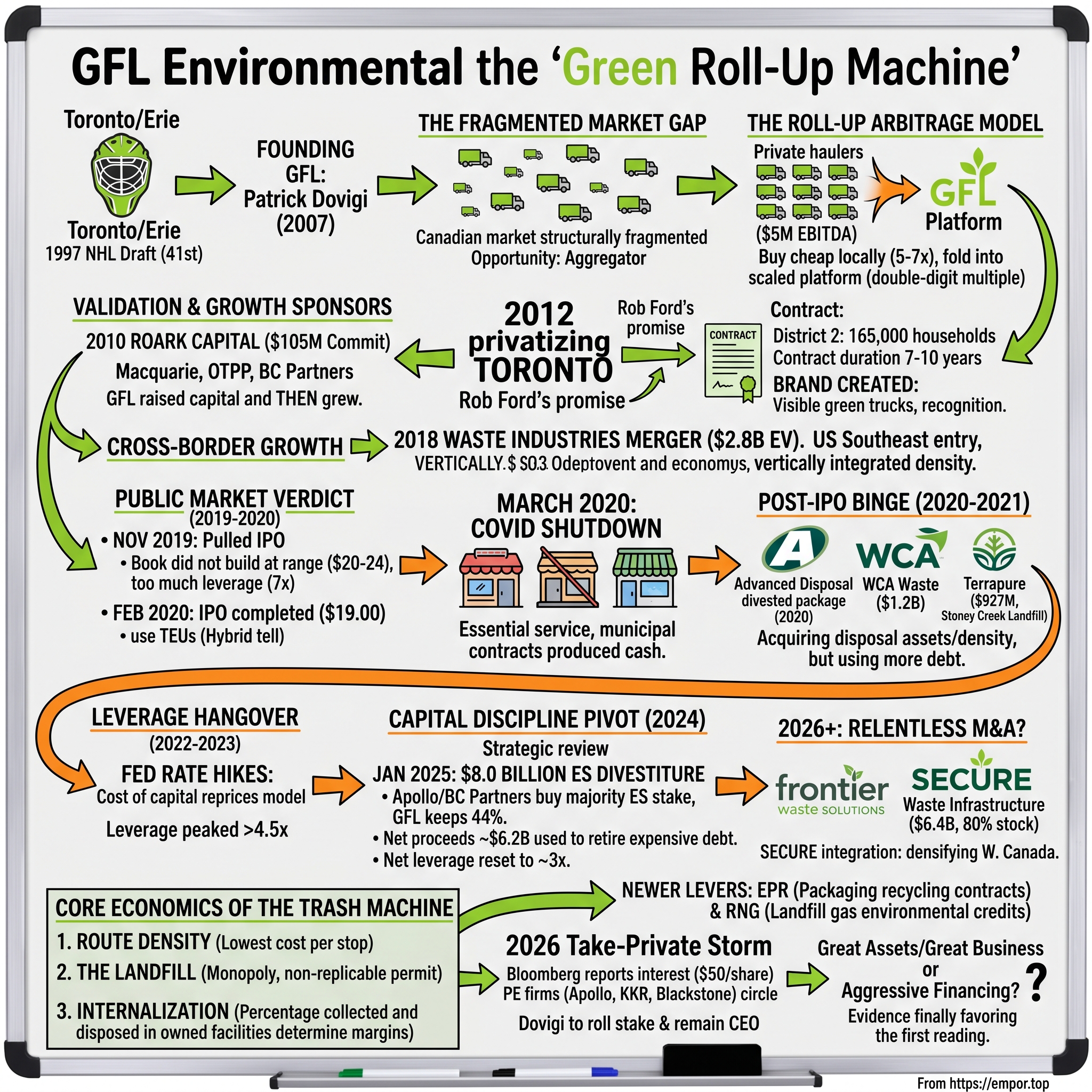
GFL Environmental: The Story of Patrick Dovigi and North America's Green Roll-Up Machine
I. Introduction & Episode Roadmap
There is a particular shade of green — somewhere between lime and safety vest — that has become one of the most recognizable colors on North American roads. It is on garbage trucks in the west end of Toronto, on roll-off containers behind strip malls in the Carolinas, on transfer station signage outside Houston and Detroit and Edmonton. It is not a color any brand consultant would have chosen for hauling other people's trash. That is precisely why it works.
The man who chose it was a former professional hockey goaltender from Sault Ste. Marie, Ontario, drafted 41st overall by the Edmonton Oilers in the 1997 NHL Entry Draft, who never played a game in the NHL.1 Patrick Dovigi founded Green For Life Environmental in 2007. Not quite nineteen years later, in July 2026, the company he built was fielding takeover interest from the largest private equity firms on earth at a price that would value its equity at roughly $17.5 billion, with about $7.1 billion of debt sitting behind it.2
That is the hook. Here is the harder question.
The North American solid waste industry is one of the most structurally attractive businesses in the developed world — local monopolies on disposal, near-zero threat of substitution, pricing power that compounds annually, and a customer base that has no choice but to keep producing the product. It is also one of the most consolidated. Waste Management, Republic Services, and Waste Connections had been assembling landfill networks and route density for decades before Dovigi bought his first truck. Breaking into that oligopoly from a standing start, in the 21st century, with no landfills and no capital, should have been impossible.
GFL did it anyway. The question this story turns on is how — and whether the answer is durable.
Because there are two entirely coherent readings of GFL Environmental. In the first, GFL is a genuine compounding machine: a company that identified fragmented, under-priced local markets, bought them at private-market multiples, integrated them into a platform with real route density and real disposal assets, and now converts that scale into industry-leading pricing power and margin expansion. In the second, GFL is a financial construct — a leveraged roll-up that grew through the cheapest decade of debt in modern history, got caught badly when rates normalized, and has spent the years since selling pieces of itself to repair a balance sheet that its own acquisition strategy broke.
The uncomfortable truth is that both readings are supported by the evidence, and the tension between them has never fully resolved. It is arguably the reason the stock has spent most of its public life trading at a discount to peers, and arguably the reason private equity is circling now.
This is the arc: from the gravel pits and family haulers of southern Ontario, through the political theater of Rob Ford's Toronto and the contract that put those green trucks in front of 165,000 households; through the private equity fuel tank that made a $2.8 billion cross-border acquisition possible; through the humiliation of a pulled IPO and the improbable timing of listing days before the world shut down; through the acquisition binge that followed and the leverage hangover that came due; through the January 2025 divestiture that reset the entire capital structure; and into the strange present, where a company that has spent two years telling public markets it deserves a re-rating is simultaneously entertaining offers to leave those markets entirely.
 Subscribe on LinkedIn
II. From Goalie Pads to Waste Pads: Patrick Dovigi & The Founding of GFL
Being a goaltender is a peculiar apprenticeship for a career in capital allocation, but it is not a bad one. The position rewards a specific temperament: comfort with being the last line of defense, tolerance for high-variance outcomes, and an almost pathological ability to forget the goal you just let in. Dovigi played in the Ontario Hockey League for the Erie Otters across parts of three seasons in the late 1990s, was drafted by Edmonton, and then — as happens to the overwhelming majority of drafted goaltenders — did not make it.1
What he did instead was unusual for a junior hockey graduate. He went into corporate finance in Toronto, and in doing so stumbled into an industry that most finance professionals find beneath their attention: waste.
Why trash looked like an opportunity in 2007
To understand what Dovigi saw, you have to understand the shape of the Canadian market at that moment. It was, in the language of private equity, structurally fragmented. The large American operators — Waste Management chief among them — owned significant disposal infrastructure north of the border, but they ran Canada as a peripheral geography. Meanwhile, the actual work of collection was done by a long tail of family businesses: one or two trucks, a founder in his sixties, a customer list built over thirty years, no succession plan, and no ability to bid on a municipal contract that required a $40 million performance bond.
Between those two poles was a gap. Nobody was building a Canadian-branded, full-service environmental company that could serve a national industrial customer with solid waste in Ontario, liquid waste in Quebec, and soil remediation in Alberta under one contract and one invoice.
That gap was the founding thesis. GFL launched in Vaughan, Ontario in 2007 with the brand promise embedded in the name — Green Today, Green For Life — and a deliberately broad service perimeter: solid waste, liquid waste, and soil remediation bundled into a single vendor relationship.3 The bundling mattered less as a source of margin than as a source of access: it gave a tiny company a reason to be in the room with large industrial and municipal buyers who would never have taken a meeting with a two-truck hauler.
The roll-up begins
The early acquisitions were small, local, and unglamorous — Ontario collection businesses whose founders wanted liquidity. The arbitrage available was simple and it is worth stating plainly, because it is the engine of everything that follows. A single-market hauler with $5 million of EBITDA, no scale, and key-man risk sells for perhaps five to seven times earnings. Folded into a platform with regional density, shared maintenance facilities, and a landfill to internalize the volume into, that same EBITDA is worth substantially more — and the platform itself, once public, gets valued at a double-digit multiple.
The gap between the purchase multiple and the platform multiple is the value created. That is the whole trick. Everything else — route density, internalization, brand — is either an input to making the trick work or a consequence of having done it enough times.
There is a second, less obvious reason the early acquisitions worked. The sellers were rarely optimizing for price. A hauler in his sixties with no children in the business, a fleet approaching replacement age, and a growing awareness that municipal contracts were consolidating toward larger bidders is a seller with limited alternatives. Dovigi's pitch to those owners was reportedly personal and direct: keep your name on the trucks for a while, keep your people, take the cheque. In an industry built on local relationships, being the buyer that founders actually wanted to sell to was itself a sourcing advantage — and it is a genuinely difficult advantage for a large, process-driven corporate acquirer to replicate.
But the trick requires capital, continuously, and a company founded in 2007 with no track record could not borrow it. Banks lend against assets and history. GFL had neither.
The first outside validation
The unlock came in November 2010, when Roark Capital Group — an Atlanta firm best known for franchise businesses and multi-unit roll-ups — committed C$105 million to what was then GFL Waste & Recycling Solutions, investing C$60 million at closing and reserving C$45 million for growth and acquisitions.3
Roark's involvement is more interesting than the dollar figure. Roark's entire discipline was buying fragmented, franchise-like businesses with predictable local unit economics and rolling them up. That a firm with that specific pattern-recognition wrote a nine-figure cheque into a three-year-old Canadian garbage company is the earliest external evidence that the underlying model was sound — not just that Dovigi could sell a story.
It also established the template GFL would follow for the next decade: equity from a rotating cast of sophisticated financial sponsors, deployed into acquisitions faster than organic cash flow could ever have funded them. GFL would not be a company that grew and then raised capital. It would be a company that raised capital and then grew.
What it still lacked was proof it could operate at scale. That proof arrived from an unlikely source: a chaotic Toronto mayoral administration with a grudge against public sector unions.
III. The Rob Ford Launchpad: Privatizing Toronto's Trash
In the summer of 2009, Toronto's inside and outside municipal workers went on strike for thirty-nine days. Garbage piled up. The city opened temporary dump sites in public parks, and residents of one of the wealthiest cities in North America spent five weeks driving their household waste to a hockey rink parking lot. The images were indelible, and they did more political damage to organized labor in Toronto than a decade of campaigning could have.
Rob Ford won the 2010 mayoral election on a populist platform in which contracting out residential garbage collection was a signature promise. The specific plan: privatize collection in District 2, the swath of the city between Yonge Street and the Humber River.
The underdog bid
When the tender went out, GFL was still a regional company with essentially no profile in large municipal contracting. It bid anyway — and won, with a $186.4 million contract covering roughly 165,000 households, at a price materially below its nearest competitor.4 City staff had projected the privatization would save roughly $6 million a year; GFL's bid implied closer to $11 million.5 A subsequent city auditor's review concluded contracting out saved taxpayers about $11.5 million in the first year while delivering satisfactory service.5
Council approved the deal, handing Ford the clearest policy win of his mayoralty, and GFL began service in August 2012.4
What the contract actually bought GFL
The revenue mattered, but it was not the point. Three other things were.
First, credibility. Winning and then executing a large, politically scrutinized municipal contract is the single most efficient way to prove you belong in the tier of companies that can bid on large, politically scrutinized municipal contracts. Every subsequent RFP in Canada became winnable in a way it had not been before.
Second, brand. This is the underrated one. Residential collection is close to a marketing loss leader in the waste industry — margins are thinner than commercial, and the contracts are competitively bid. But a bright green truck in front of a home every week, for 165,000 homes, in Canada's largest media market, is advertising that no waste company had previously thought to buy. GFL's commercial sales force in the Greater Toronto Area was, from 2012 onward, selling into a market that already recognized the logo. In an industry where the product is undifferentiated and the buying decision is largely about trust and reliability, that recognition has genuine commercial value.
Third, contract duration. Municipal residential contracts run seven to ten years and renew, often without full re-tender. Toronto extended GFL's arrangement rather than re-competing it — a decision that drew criticism from councillors and observers who noted the city had limited comparative data to justify the extension.6
The uncomfortable part
It would be dishonest to present the Toronto years as an unbroken success. Service was rocky early on — missed pickups, complaints, and the ordinary friction of a company scaling its operational capabilities faster than its systems. GFL has also been a persistently controversial neighbor in parts of the Greater Toronto Area, where residents living near its facilities have raised sustained complaints about odor and operations.7
This matters analytically, not just as color. The waste business runs on social license. Landfills, transfer stations, and organics facilities require permits, and permits require political tolerance. A company that generates a lot of local friction is a company that will eventually pay for it — in permitting delays, in contract losses, in litigation. It is a real, if slow-burning, cost of the growth-first operating style.
There is also a fairness point that gets lost in the triumphal version of this story. The savings Toronto realized came substantially from labor — private collection crews are paid less and work under different terms than the municipal workforce they replaced. That is a real economic transfer, and whether it constitutes efficiency or arbitrage depends largely on where one sits. For investors, the analytically relevant observation is narrower: GFL's cost advantage in the bid was not primarily technological or logistical. It was structural, and it was available to any private bidder. What distinguished GFL was the willingness to price aggressively enough to win.
That willingness — to take the thinner deal to establish the position — recurs throughout GFL's history, and it is arguably the closest thing to a consistent strategic signature the company has. It won Toronto on price. It would later win share in the United States on speed and price. Aggression as strategy works well when capital is available and cheap. It works considerably less well when it is not, which is the story of the next fifteen years compressed into a sentence.
Still, by 2013 GFL had what it needed: an operating record, a brand, and a sponsor base that believed. What it did not have was scale. That would require considerably more money than Roark had put in.
IV. The Private Equity Fuel Tank & The Waste Industries Megadeal
If the first phase of GFL's history was about proving the model, the second was about financing it at a scale that would have been unrecognizable to the company that bought its first truck.
The sponsor carousel
Roark exited in 2013, replaced by new financial partners. Macquarie's infrastructure arm arrived with a $458 million equity investment supporting GFL's C$800 million acquisition of Services Matrec in 2016 — a Quebec-focused business that gave GFL genuine national coverage.3 The Ontario Teachers' Pension Plan came in, and then BC Partners, and by the eve of the public listing GFL's ownership was a consortium of some of the most sophisticated infrastructure and private equity capital in the world.
There is a pattern here worth naming. GFL never had a single controlling sponsor for long. Each time an owner wanted liquidity, the business was re-marked and recapitalized rather than sold outright to a strategic buyer. That structure had two consequences. It kept Dovigi in the chair through six or seven changes in the capital structure — unusual, and a genuine testament to sponsors' assessment of him as an operator. And it meant each recapitalization loaded incremental debt onto a business whose EBITDA was itself partly acquired rather than organically grown.
The compounding of acquired EBITDA and acquisition debt is the central financial fact of GFL's first decade. It worked beautifully while credit was cheap and abundant. It was never stress-tested against a different rate environment, because between 2009 and 2021 there wasn't one.
The border crossing
By 2018, GFL had consolidated most of what was economically attractive in Canada. Growth had to come from the United States, and Dovigi chose to enter not gradually but in a single decisive move.
On October 10, 2018, GFL announced a merger with Waste Industries, a Raleigh, North Carolina operator, at an enterprise value of US$2.825 billion.8 The deal closed on November 15, 2018.9 Financing came from an additional equity investment by GFL's consortium — led by BC Partners and Ontario Teachers' — alongside rollover from Waste Industries' existing owners, including the founding Poole family and HPS Investment Partners.8
The strategic logic was strong. Waste Industries operated across the US Southeast — the Carolinas and Georgia — with a vertically integrated collection-and-disposal footprint in exactly the demographic corridor experiencing the fastest population inflows in the United States. Waste volumes are a derivative of household formation and commercial construction; buying density in the Southeast in 2018 was, in effect, buying a call option on internal US migration. The combined business became the largest privately held environmental services company in North America, operating in twenty US states and every Canadian province except Prince Edward Island.9
Was $2.825 billion too much?
This is where independence matters. The strategic case was sound; the price was aggressive, and it was funded in a way that left GFL structurally vulnerable.
The deal roughly doubled the company and did so on a capital structure already carrying substantial acquisition debt. It transformed GFL from a Canadian company with US operations into a genuinely North American business — which is precisely what made a public listing possible, and precisely what made the terms of that listing so contentious when GFL finally attempted it.
Consider what GFL was actually buying and how. Waste Industries was a well-run, high-margin business with a strong regional position — which is to say it was not cheap, and it was not distressed. There were no obvious operational fixes to underwrite. The return on the transaction would therefore have to come from three sources: the growth embedded in the Southeast's demographics, the synergies from combining back offices and procurement across a continental platform, and — critically — from the multiple expansion GFL expected to earn by becoming large enough to be a public company. The third source is the one worth pausing on, because it is not a business return at all. It is a financing return, and it depends entirely on the market agreeing to pay the multiple you have assumed.
This is the structural weakness of a debt-funded roll-up that has run out of small targets. Early acquisitions create value through arbitrage that exists whether or not markets cooperate. Late, large acquisitions increasingly create value only if the exit multiple materializes. GFL had crossed that line.
Because the market was about to render its own verdict on how much leverage it was prepared to underwrite — and it would not be the verdict management had modeled.
V. The IPO Drama: A Tense Retreat and a March into the COVID Storm
There is a specific kind of humiliation available only to companies that get all the way to the end of an IPO roadshow and then have to walk away.
November 2019: the market says no
GFL went out in the autumn of 2019 seeking to raise as much as US$2.42 billion at a range of $20 to $24 per share. It would have been among the largest listings in Canadian history.
Institutional investors declined. The books never built at the range; underwriters found demand only around $18.10 The objections were specific and, in retrospect, entirely reasonable. GFL carried a leverage ratio in the vicinity of seven times adjusted EBITDA. It had a history of net losses. Investors examining the business wanted leverage below four times before they would underwrite a premium multiple — and the arithmetic did not close, because at a lower share price the offering would not raise enough to delever to the level those same investors were demanding.11
That is the trap in its purest form. The IPO existed to fix the balance sheet; the balance sheet was the reason the IPO could not be priced.
Dovigi pulled it. The stated rationale was that $18 did not represent fair value.10 It was a genuine gamble — sponsors seeking liquidity do not enjoy being told to wait, and a pulled IPO carries a stigma that can follow a company for years.
February 2020: the second attempt
Four months later GFL came back, priced lower, and got it done. The offering was priced at US$19.00 per subordinate voting share, with 75,000,000 shares sold alongside a concurrent offering of 15,500,000 tangible equity units at a stated amount of US$50.00 each, for total gross proceeds of US$2,168.8 million.12 The shares began trading on the NYSE and TSX under "GFL," with the tangible equity units listed on the NYSE separately.12
The tangible equity unit deserves a plain-English explanation, because it is the tell. A TEU is a hybrid: part prepaid forward contract to buy shares in the future, part senior amortizing note. Companies use them when they need more capital than the common equity market will absorb at an acceptable price. GFL used them because straight equity demand at $19 was insufficient to raise what the balance sheet required. It was a solution to a problem, and the problem was that public investors were not enthusiastic about the leverage.
The listing was completed in early March 2020.
And then the world closed
Within roughly ten days, North America shut down.
What followed was the single luckiest stretch in GFL's corporate history, and it is worth being precise about why. Waste collection was designated an essential service everywhere. Commercial and industrial volumes collapsed as offices, restaurants, and construction sites closed — a genuine hit. But residential volumes surged as an entire population stayed home and generated household waste at rates no forecast had contemplated. And the municipal contract book, with its multi-year terms and contracted price escalators, kept producing cash regardless of what the broader economy did.
The pandemic functioned as an unplanned stress test of the industry's core claim: that waste is non-cyclical, non-discretionary, and effectively substitute-proof. The claim survived. In the depths of the worst demand shock in modern history, the trash still had to be collected, and someone still had to be paid to collect it.
For a newly listed, heavily leveraged company, that was the difference between a difficult year and an existential one. It also handed Dovigi something more dangerous than survival: validation, at exactly the moment capital became free.
VI. The Aggressive Post-IPO Acquisition Binge
By mid-2020, GFL had public equity currency, a demonstrably recession-proof business model, and access to a credit market where interest rates had been driven to the floor by emergency central bank policy. A company whose founding instinct was to acquire found itself with every constraint on acquiring simultaneously removed.
It did what you would expect.
The Advanced Disposal windfall
The first opportunity was regulatory. When Waste Management moved to acquire Advanced Disposal Services, the US Department of Justice required divestitures to preserve competition in overlapping markets. GFL acquired the divested package — landfills, collection operations, and fleet across ten US states — for US$835 million in October 2020.13
Antitrust-mandated divestitures are among the most attractive assets in any consolidating industry, and the reason is structural. The seller is not optimizing for price; it is optimizing for regulatory clearance on a deadline. The buyer pool is restricted to parties the DOJ will accept. For a fourth-place operator with the balance sheet to write the cheque, this was as close to a structurally advantaged transaction as the industry offers.
WCA and Texas
Two months earlier, in August 2020, GFL had agreed to acquire Houston-based WCA Waste from an affiliate of Macquarie Infrastructure Partners II for US$1.212 billion, closing that October following DOJ approval.14 WCA brought Texas and Gulf Coast density — the second large bet on Sun Belt population growth, following the same logic as Waste Industries.
Terrapure and the regulator
In March 2021 GFL agreed to acquire the solid waste and environmental solutions business of Terrapure Environmental for C$927.5 million, closing that August.15 The prize was Canadian industrial and liquid waste leadership, and specifically the Stoney Creek industrial landfill in the Hamilton area — a genuinely irreplaceable permitted asset.
It was not clean. In November 2021, the Competition Bureau challenged the transaction, alleging the merger substantially lessened competition in certain markets.[^16] This is the recurring cost of a roll-up strategy pursued to its logical conclusion: eventually you buy enough of a local market that the state notices. It is also, perversely, confirmation that the underlying assets are scarce. Regulators do not challenge the acquisition of commodities.
What the binge actually bought — and what it cost
GFL paid full prices in this period, frequently in the range of ten to eleven times post-synergy EBITDA — well above the five-to-seven-times private-market multiples that made the early roll-up so profitable. The defense management offered was that these were not tuck-ins; they were disposal assets, and disposal assets carry different economics.
That defense has real merit. But the arbitrage that justified the entire model — buy low locally, get valued high as a platform — narrows considerably when the purchase multiple approaches the platform multiple. And every one of these deals was funded with debt against a capital structure that public investors had already flagged as too levered.
There is a defensible way to think about the tradeoff. Disposal assets — landfills, transfer stations — are perpetual, non-replicable, and structurally advantaged. Paying eleven times for a permitted landfill in a growing market is a different proposition from paying eleven times for a collection route, in the same way that buying farmland is different from buying a tractor. If the assets truly are irreplaceable, the multiple paid matters less than whether you own them at all.
The counterargument is equally straightforward. A permanent asset bought with floating-rate debt is only permanent if you can continue to service the debt. GFL had, in effect, made a leveraged bet on very long-duration assets funded with short-duration liabilities — the classic asset-liability mismatch that has ended more financial stories than any other single mechanism.
Management was building the case for a re-rating by acquiring quality. The market was watching the leverage ratio. In 2020 and 2021, with money costless, only one of those two things seemed to matter.
That was about to change abruptly, and the change would come not from anything GFL did but from a decision made in Washington.
VII. The Leverage Hangover & The $8 Billion ES Masterstroke Divestiture
The Federal Reserve began raising rates in March 2022 and did not stop for sixteen months. The Bank of Canada moved in parallel. For a business model whose entire premise was arbitraging the gap between cheap capital and acquired cash flows, this was not a headwind. It was a repricing of the model itself.
The market's verdict
GFL's leverage — which had peaked above four and a half times net debt to EBITDA — moved from being a footnote to being the entire investment debate. The comparison that hurt most was Waste Connections, an operator whose reputation rests on disciplined capital allocation, conservative leverage, and a deliberate focus on secondary and exclusive markets where competition is structurally limited. Waste Connections generated $9.467 billion of revenue in 2025 with a balance sheet that never gave investors reason to worry.16 GFL, with roughly two-thirds of that revenue, traded at a persistent discount.
Earnings calls through 2023 and 2024 developed a repetitive quality. Analysts asked, in progressively less polite formulations, when GFL would stop buying companies and start paying down debt.
To management's credit, they did not deflect indefinitely. The narrative shifted — visibly and in a way that can be tracked across successive calls — from growth-at-pace toward capital discipline and an explicit ambition to reach an investment-grade credit rating. On the Q1 2026 call, CFO Luke Pelosi described the conclusion reached coming out of 2023 and 2024 directly: that operating at three to three-and-a-half times leverage "is ultimately what's going to yield the best sort of path for ideal cost of equity."17
That is an unusually candid admission. It concedes that the prior leverage policy was wrong, and it reframes deleveraging not as balance sheet housekeeping but as the mechanism for fixing the equity multiple. Whether the company has actually held to it is the question the rest of this story tests.
The strategic review
In 2024 GFL placed its Environmental Services division — liquid waste and soil remediation, the original diversification that had made GFL a "one-stop shop" back in 2007 — under strategic review. Skepticism was reasonable. ES was more cyclical than solid waste, exposed to industrial activity, and structurally a lower-multiple business. Selling it into a soft market seemed likely to realize a disappointing price.
The transaction
On January 7, 2025, GFL announced the sale of a majority stake in Environmental Services to funds managed by Apollo Global Management and BC Partners at an enterprise valuation of C$8.0 billion — approximately US$5.6 billion.18 Apollo and BC Partners each took roughly 28%; GFL retained 44%, an equity interest valued at about $1.7 billion, with a five-year option to repurchase the business.18 Net cash proceeds to GFL were approximately $6.2 billion after the retained equity and taxes.19 The sale completed on March 3, 2025.20
The capital deployment was straightforward. A large portion went to retiring GFL's most expensive debt, resetting pro forma net leverage from the mid-four-times range to roughly three times. Up to $2.25 billion was earmarked for share repurchases.18
Reading the deal honestly
This was, by any reasonable standard, an excellent transaction, and the reason is arithmetic rather than narrative. GFL sold a division at a valuation multiple materially above the multiple the market was applying to GFL as a whole. When a conglomerate's parts are worth more than the sum, selling a part and buying back the whole is close to a risk-free value transfer to remaining shareholders. Doing it while simultaneously fixing the leverage problem that caused the discount is better still. And retaining 44% plus a repurchase option preserved participation if the ES business performs under private ownership.
The skeptical framing is equally valid, and it is this: the sale was necessary because of a problem management created. GFL spent a decade assembling a diversified environmental services platform, then sold the diversification to repair the leverage incurred assembling it. The 2025 transaction is best understood not as a masterstroke of portfolio strategy but as an unusually well-executed corrective to an earlier strategic error.
A related move followed in August 2025, when Green Infrastructure Partners — the vertically integrated infrastructure business established in 2022 by GFL, HPS Investment Partners, and Dovigi personally — was recapitalized at a $4.25 billion enterprise value with an investment from Energy Capital Partners. GFL received roughly $200 million of a $585 million shareholder distribution and retained a 30.1% interest valued at approximately $895 million.[^22] The direction of travel was consistent: monetize adjacencies, concentrate on solid waste.
The second-layer diligence questions
Two aspects of the ES transaction warrant more scrutiny than they generally receive.
The first is the retained 44% stake. It is presented as preserved upside, and it may well be. But it is also a non-controlling minority position in a private company controlled by two of the most sophisticated private equity firms in the world, whose incentives around timing, leverage, and eventual exit are their own. Minority stakes in sponsor-controlled vehicles are not liquid, are difficult for public shareholders to value, and reintroduce exactly the portfolio complexity the divestiture was meant to eliminate. The same applies to the 30.1% retained in Green Infrastructure Partners. GFL emerged from its simplification with two illiquid private minority interests on the balance sheet.
The second is the five-year repurchase option on Environmental Services. Framed as optionality, it is genuinely valuable only if GFL would want the business back — and the entire rationale for selling was that the business was worth more to someone else. An option to repurchase an asset you divested for strategic reasons is more likely to be a negotiating concession than a source of value. Investors should treat it as such until management articulates a specific circumstance in which exercising it would make sense.
Neither observation undermines the transaction. Both are the kind of detail that separates reading a press release from reading a company.
The result was a cleaner, simpler, more focused company. Which raises the question of what that company is actually worth — and that requires understanding how the trash business makes money.
VIII. Core Economics: How the Trash Business Works & Who Rules North America
Strip away the fleet and the facilities and the waste industry reduces to three ideas. They are simple enough to explain over a coffee and powerful enough that they have supported one of the best long-run compounding records in the industrial economy.
Idea one: route density
A garbage truck costs the same to run whether it services 400 stops or 600. The driver's wage, the fuel, the maintenance, the depreciation, the insurance — nearly all of it is fixed for the day once the truck rolls out of the yard. Adding one more customer on a street the truck already drives down costs almost nothing and adds full-margin revenue.
The implication is severe and it explains the entire industry structure. In any given neighborhood, the operator with the most customers has the lowest cost per customer, and can therefore price below anyone trying to enter while still earning more. Density is not a nice-to-have. It is the whole game, and it is why the industry consolidates relentlessly, and why acquisitions that add customers in markets you already serve are worth far more than acquisitions that add customers somewhere new.
This is also why GFL's tuck-in acquisitions — dozens of them, most too small to warrant a press release — matter more in aggregate than the headline megadeals. Each one thickens a route.
Idea two: the landfill
You essentially cannot build a new landfill in North America. Not because the engineering is hard, but because the permitting requires environmental approvals, hydrogeological studies, and — decisively — the consent of people who live nearby, who never consent. Existing permitted landfills are therefore a finite, non-replicable resource, and each one is a local monopoly within the radius that makes trucking economically sensible.
Dovigi made this point about the Western Canadian assets GFL agreed to buy in 2026 with unusual directness on the Q1 call: the permitting environment is such that "these are impossible to replicate assets," which is what produces the margin profile and the returns on invested capital that come with them.17
That is not marketing. It is the single most reliable structural fact in the industry.
Idea three: internalization
Put the first two ideas together and you get the metric that determines margins. If GFL collects waste but does not own a nearby landfill, it must pay a tipping fee to a competitor to dispose of it — writing a cheque to a rival, on every load. If GFL owns the landfill, that cost becomes internal, and the disposal margin is captured rather than surrendered.
The percentage of collected volume disposed of in owned facilities is the internalization rate, and it is the clearest single explanation for why some waste companies earn more than others on identical revenue. GFL has historically internalized less of its US volume than Waste Connections or Republic Services, which is a straightforward reason its margins have trailed. It is also the reason management can credibly point to a self-help path: routing existing collected volume into owned disposal is margin that requires no new customers and no acquisition, only logistics.
The evidence suggests this is working. GFL reported a full-year 2025 adjusted EBITDA margin of 30.0%, up 130 basis points from 28.7% in 2024, on revenue of $6,615.9 million and adjusted free cash flow of $755.9 million.21 In the first quarter of 2026, margin reached 29.1% — a 180 basis point year-over-year improvement and, per management, the highest first-quarter margin in company history.22 At its 2025 Investor Day, GFL targeted adjusted EBITDA margins in the low-to-mid 30s by 2028 with roughly 40 basis points of annual organic expansion.23
Three consecutive years of delivered margin expansion is real evidence, not a management assertion. It is the strongest single data point in the bull case.
The two newer levers: EPR and renewable natural gas
Two revenue streams have emerged over the past several years that did not meaningfully exist a decade ago, and both are worth understanding in plain terms.
Extended producer responsibility is a regulatory regime, adopted across several Canadian provinces, that shifts the cost of recycling packaging from municipalities and taxpayers onto the companies that produce the packaging. Practically, this converts what was a low-margin, commodity-price-exposed recycling business into a contracted service business: a producer responsibility organization pays an operator a negotiated rate to collect and process material, regardless of what the resulting bales fetch on the open market. For a company with GFL's Canadian density, EPR replaces volatile commodity revenue with contracted revenue. GFL invested substantial growth capital into EPR infrastructure through 2024 and 2025; management indicated the bulk of those contracts came online through 2026 with associated growth capital expenditure falling toward $100–125 million going forward, and residual Alberta collection and processing contracts continuing to ramp into 2027.17
Renewable natural gas is the second. Landfills generate methane as buried organic waste decomposes. Historically this was flared off as a regulatory obligation. The economics changed when environmental credit regimes made captured, cleaned landfill gas saleable as pipeline-quality fuel. The appeal for a landfill owner is that the input is free, involuntary, and already owned. The caution is that a meaningful share of RNG economics depends on environmental credit prices set by policy rather than by markets — which makes the revenue politically contingent in a way that collecting garbage is not.
Together, EPR and RNG were a central component of GFL's 2028 targets, with the company projecting $285–440 million of revenue and $270–380 million of adjusted EBITDA contribution from EPR, RNG, and internal self-help levers over 2026–2028.23 That is a large share of the promised growth resting on initiatives whose returns depend partly on regulatory regimes remaining intact. It is not a reason for alarm. It is a reason to track it separately from the core hauling business.
The hierarchy
The North American industry is an oligopoly with a stable pecking order. Waste Management sits at the top with revenue above $20 billion, built on unmatched scale and now extended into medical waste through the Stericycle acquisition. Republic Services follows in the mid-teens of billions with a reputation for consistent operational execution and strong margins.24 Waste Connections, at $9.5 billion in 2025, is the industry's capital allocation benchmark, having deliberately concentrated in secondary and exclusive markets where competitive intensity is lower and pricing power correspondingly higher.16
GFL is fourth, and post-divestiture it is a focused solid waste business guiding to revenue of $7.32 billion to $7.34 billion for 2026.22 It is the youngest of the four by decades, the most urban in mix, and the only one whose history is primarily financial rather than operational.
Which makes the question of whether it possesses genuine competitive advantage — as opposed to merely having assembled assets that do — worth examining directly.
IX. Strategic Powers: Helmer's 7 Powers & Porter's 5 Forces for GFL
Frameworks are useful mainly for the discipline they impose: they force you to distinguish between advantages a company actually holds and advantages it merely describes in its investor deck. Applied to GFL, the exercise is clarifying, because it separates advantages that belong to the industry from advantages that belong to GFL.
Hamilton Helmer's 7 Powers
Scale economies — strong, but partly industry-level. Route density is a genuine and durable cost advantage, and GFL holds it in the specific geographies where it has built density. But it is not a company-specific power; every incumbent has it in its own territories. The relevant question is whether GFL's density is superior in the markets it competes in, and there the answer is mixed — strong in Ontario and parts of the US Southeast, thinner in markets entered recently by acquisition.
Cornered resource — very strong, and genuinely GFL's. Permitted landfill capacity cannot be replicated at any price. GFL's disposal assets in Canada in particular are irreplaceable. This is the most defensible power in the portfolio.
Switching costs — moderate to strong. Municipal contracts run seven to ten years with meaningful transition friction. Commercial agreements typically auto-renew and include liquidated damages provisions. Neither is absolute — contracts do get re-tendered, and commercial customers do switch — but the friction is real and it shows up in the retention data. Management attributed part of its Q1 2026 pricing outperformance specifically to retention rates running above plan.17
Process power — moderate, and improving. Routing optimization, fleet maintenance discipline, procurement leverage, and landfill gas capture are all operational competencies where GFL has demonstrably closed ground. Management pointed to five consecutive quarters of year-over-year reductions in both operational and SG&A cost intensity as a share of revenue.17 Sustained cost intensity reduction across five quarters is difficult to fake; it is the operational evidence that GFL is becoming a better operator rather than merely a larger one.
Brand — moderate, and real but limited. The green trucks generate genuine local recognition and municipal goodwill. This has commercial value in bidding and in commercial sales. It does not command a price premium.
Counter-positioning — weak. GFL runs the same business model as its competitors. Its early share gains came from aggressive bidding and sponsor-funded speed, not from a model incumbents could not copy. That is a real distinction: speed is an advantage that erodes the moment your competitor decides to move fast too.
Network effects — essentially absent. Waste collection does not become more valuable to each customer as more customers join. Route density is a cost phenomenon, not a network phenomenon, and conflating the two overstates the moat.
The honest summary: GFL's most durable advantages are the ones it shares with the industry, plus the specific irreplaceable assets it owns. Its company-specific edge is narrower than the narrative implies, and rests substantially on execution — which is precisely why the recent operational data matters so much.
Porter's Five Forces
Threat of new entrants: very low. Capital intensity plus permitting impossibility. No one is starting a landfill company.
Threat of substitutes: extremely low. There is no alternative to physical waste disposal. Recycling, composting, and waste-to-energy are streams within the industry, not replacements for it — and each requires its own permitted infrastructure, which incumbents own.
Supplier power: low. Truck manufacturers and fuel suppliers have limited leverage. Fuel cost is passed through via surcharges — imperfectly, and with a lag. GFL's Q1 2026 results illustrated the mechanism precisely: diesel prices rose nearly 10% year over year and 40% in March alone, creating a $10 million cost headwind of which only $1 million was recovered in the quarter, because surcharges bill in arrears against prior-month pricing.17 Management expected full recovery by the second quarter. The economics of the surcharge are worth understanding: it recovers dollars but dilutes percentage margin, because it adds equal amounts to both revenue and cost.
Buyer power: low to moderate. Commercial customers have little leverage. Municipalities have real leverage, but only during competitive tender windows that arrive once a decade. GFL pushed core pricing of 7.0% in Q1 2026 — 8.5% in Canada and 6.3% in the US — against an inflation backdrop well below that.17 Sustained pricing at a spread above cost inflation, with retention holding, is the cleanest available proof that buyer power is genuinely weak.
Rivalry: rational. The four major operators compete for acquisitions and for municipal tenders, but not through destructive price competition in overlapping routes. Everyone understands that density determines cost, that cutting price to win a route you cannot serve efficiently destroys value, and that the industry's returns depend on this restraint holding. It has held for decades. It is not guaranteed to hold forever, but the incentive structure supporting it is unusually robust.
The industry is excellent. The question is what GFL earns above what the industry provides — and that leads directly to the person who has controlled the answer for nineteen years.
X. Playbook & Leadership Scorecard: Incentives, Margin Loans, and Governance
Assessing Patrick Dovigi requires holding two things simultaneously: a genuinely remarkable entrepreneurial record, and a governance structure that a dispassionate investor would not design.
The record
Start with what is not in dispute. Dovigi built a $17 billion enterprise from nothing in under two decades, in an industry with high barriers to entry, against entrenched competitors, while retaining operational control through six or seven changes in the capital structure. Sophisticated financial sponsors — Roark, Macquarie, Ontario Teachers', BC Partners, HPS, Apollo — have repeatedly chosen to back him. That is not a small signal.
The more interesting question is whether he has demonstrated the capacity to change strategy when the evidence demanded it. The answer, largely, is yes. The 2019 IPO withdrawal showed a willingness to accept short-term embarrassment rather than a bad price. The 2024–2025 pivot to capital discipline was a genuine reversal of a decade-long operating philosophy, executed rather than merely announced, and the ES divestiture was superbly timed and structured.
The record's asterisk
But the pattern has not fully broken. Having spent two years telling investors that leverage would be held between three and three-and-a-half times, GFL entered 2026 acquiring aggressively again — eight acquisitions in the first four months, including Frontier Waste Solutions in Texas, with a stated pipeline for a further $300 million to $500 million before year-end.17 Net leverage at the end of Q1 2026 was 3.6 times, with management acknowledging second-quarter acquisitions would push it up roughly another 30 basis points before deleveraging back toward the mid-threes by year-end.22
Then, in April 2026, GFL announced the acquisition of SECURE Waste Infrastructure at an enterprise value of approximately $6.4 billion — $24.75 per SECURE share, a 23% premium to the 60-day volume-weighted average price, structured as roughly 80% GFL shares and 20% cash, and presented as net-leverage-neutral.25 SECURE shareholders approved on May 27, 2026, with approximately 79% of votes cast in favor.26
An analyst on the Q1 call put the tension directly to management: cost of equity had improved through the deleveraging process, and the market was penalizing the stock again as M&A accelerated — did that reframe the appropriate pace of dealmaking? Pelosi's answer conceded the dynamic while defending the strategy, calling short-termism "one of the flaws of the public equity markets."17 Dovigi's answer was less accommodating, noting the industry had sold off before GFL announced anything and that "we don't know what makes the stock go up or down."17
That is worth flagging as an analytical observation rather than a criticism. Management explicitly acknowledged expecting the share price to fall four or five percent on the SECURE announcement and proceeded anyway.17 Investors can reasonably read that either as admirable long-term conviction or as a founder-controlled company doing what it prefers. The structure means shareholders have limited ability to express the second view.
Notably, the SECURE deal also drew opposition from Abrams Capital, a respected concentrated investor on the SECURE side, which publicly stated its intention to vote against on the grounds that SECURE was better off standalone.26 Dovigi addressed this on the call with something close to grace — praising Abrams' work and disclosing he had reached out despite never having met them.17 The deal passed comfortably, but a sophisticated holder taking a public position against a transaction is a data point about price, not merely about strategy.
The control structure
GFL operates a dual-class share structure. Multiple voting shares carry ten votes each; subordinate voting shares carry one. Dovigi holds 100% of the multiple voting shares, which translates to roughly 25.5% of total voting power against an economic interest of under 6%.27 The structure sunsets on the twentieth anniversary of the IPO — 2040 — or earlier if Dovigi's ownership falls below 2% or he ceases to serve as a director or in senior management.28
There is a nuance often missed: for so long as BC Partners holds at least 15% of outstanding shares, the Dovigi group is required to vote its multiple voting shares consistently with the recommendations of BC Partners' board nominees.28 This partially constrains unilateral control, though it substitutes one concentrated interest for another rather than empowering the broader shareholder base.
The pledging problem
The governance issue that deserves the most attention is the least discussed. All of the multiple voting shares held by the CEO have been pledged as collateral securing obligations under a margin loan, and a substantial block of subordinate voting shares held by an affiliated entity has been similarly pledged.27
The mechanics matter. A margin loan against shares carries a maintenance requirement. If the share price falls far enough, the lender issues a call. If the borrower cannot post additional collateral, the lender can sell the pledged shares. In GFL's case, that means a severe stock decline could force liquidation of the controlling voting block — precisely at the moment the company could least absorb the disruption. It creates a reflexive link between the share price and corporate control that does not exist at companies without pledging, and it introduces at least a theoretical incentive to support the share price through means that may not serve long-term holders.
None of this is an allegation. It is a structural risk that exists in the disclosed facts, and it is the sort of thing an activist investor would put at the center of a campaign.
Incentive design
Historically, GFL's compensation framework weighted adjusted EBITDA and revenue growth — metrics an acquisitive company can hit by acquiring, regardless of whether the acquisitions create value per share. That is the classic roll-up incentive defect: it rewards size. The stated post-2024 shift toward free cash flow per share and net leverage reduction addresses the defect directly, and free cash flow per share is materially harder to manufacture through M&A because the denominator moves when you issue shares to pay for deals.
Whether the redesigned incentives bind in practice is testable, and the SECURE transaction — funded 80% in stock — is the test. Management projected it would be immediately accretive to adjusted free cash flow per share by 12% to 15%.25 If that materializes, the incentive realignment is working. If it does not, the old pattern has simply been re-labeled.
XI. The Take-Private Storm & Bear vs. Bull Case
On July 2, 2026, Bloomberg reported that GFL was exploring strategic options amid buyout interest.29 Within days the picture sharpened considerably: Dovigi was reportedly willing to accept a take-private transaction at approximately $50 per share, conditional on rolling over his entire stake and continuing to run the business privately.30 Shares jumped roughly 8% on the report, closing at $40.49 on July 6.31 Apollo, Blackstone, and KKR were among firms reported to have shown interest, with deliberations described as early-stage and with no certainty of a transaction. Some suitors were reported to be considering minority stakes rather than a full buyout.31
As of July 21, 2026, GFL traded at $38.65, giving a market capitalization of roughly $13.5 billion, against a 52-week range of $33.33 to $51.51.32
The reported condition — that Dovigi roll over and remain CEO — is the most revealing detail. It confirms that the buyer is acquiring an operator as much as an asset base, and it means any transaction requires the acquirer to accept a founder-controlled arrangement in private form. It also means the roughly $7.1 billion of debt sitting on the business is a live obstacle: a leveraged buyout of a company that already carries substantial leverage is a difficult financing to underwrite at scale.2
Why GFL wins from here
The bull case rests on four mechanisms, and it is stronger than GFL's trading history would suggest.
The margin gap is real and closing on schedule. Three consecutive years of expansion, five consecutive quarters of declining cost intensity, and a stated path to low-to-mid 30s margins by 2028 constitute an unusually well-evidenced improvement story. The gap to Republic Services and Waste Connections is a quantified opportunity rather than a hope, and the levers — internalization, route optimization, procurement, turnover reduction — are mechanical rather than speculative.
Pricing power is demonstrably intact. Core pricing of 7.0% in Q1 2026, with retention above plan, against cost inflation running materially lower, is direct evidence of weak buyer power. GFL captures the spread. Management guided to potentially ending 2026 20 to 30 basis points above original pricing guidance.17
The balance sheet is fixed, or close enough. Leverage in the mid-threes with a credible path to investment grade is a different company from the one that could not get an IPO priced in 2019. Pelosi's observation that GFL borrows at roughly 140 basis points over treasuries versus 70 to 80 for investment-grade peers — and his framing that the real prize is cost of equity capital rather than cost of debt — is a precise articulation of what the re-rating case is actually about.17
The valuation gap invites a floor. Whether or not a take-private materializes, the demonstrated willingness of large sponsors to transact near $50 establishes something like a private-market reference point.
What breaks the case
Organic volume is flat to negative. This is the most important bear point and it is frequently underweighted. Q1 2026 volumes were down 120 basis points year over year; normalized for prior-year hurricane and one-time transfer station volumes, underlying volume was up about 80 basis points.17 Construction and demolition volumes at landfills were down 7.5%.17 GFL's organic growth is therefore almost entirely a pricing story. Pricing power in this industry is durable — but a business growing on price alone is a business whose growth ceiling is set by how much customers will absorb before they seek alternatives or municipalities re-tender aggressively. If C&D volumes stay weak and pricing normalizes toward inflation, the organic growth algorithm compresses meaningfully.
The M&A treadmill has restarted. Eight acquisitions in four months, a $6.4 billion stock-funded transaction, and a pipeline of several hundred million more — after two years of promising discipline — is a pattern an activist would characterize as recidivism. Management's counter is that the combined business can deploy $1.8 billion to $2 billion annually while maintaining leverage commitments.17 That may be true. It is also exactly what a company that likes acquiring says.
The SECURE integration is a genuine execution risk. GFL is acquiring roughly $1.5 billion to $1.6 billion of 2026 revenue, of which management indicated approximately half derives from post-collection waste activities and the balance from tangential energy-related services including specialty chemicals and energy infrastructure — expected to represent under 8% of pro forma 2027 revenue.17 Management argued over 80% of SECURE's business is tied to ongoing production rather than new drilling, insulating it from rig-count volatility, though sustained WTI below roughly $45 could reduce the production activity generating those volumes.17 This is a defensible argument. It is also a company that just finished divesting its cyclical, non-solid-waste division buying exposure to energy-adjacent waste streams eighteen months later. The strategic consistency is not obvious, and the burden of proof sits with management.
Governance is a live discount factor. Dual-class control to 2040, pledged controlling shares, and a demonstrated willingness to proceed with dilutive transactions over evident market objection. In a take-private scenario this ceases to matter. If the buyout does not happen, it remains a reason the multiple stays depressed.
The deal-failure scenario. If takeover interest dissipates, the shares likely give back the premium, and GFL returns to being judged on execution against 2028 targets — with an integration in progress and leverage above its own stated range.
Capital intensity is not going away. Fleet transition to compressed natural gas and electric vehicles, landfill gas capture, and extended producer responsibility infrastructure all consume capital. GFL guided to 2026 net capital expenditure of $825 million against adjusted free cash flow of $850 million.22 The organic EPR investment cycle is winding down — management indicated growth capex associated with those programs falling to $100–125 million going into next year — but the baseline requirement remains heavy.17
The activist lens
A skeptical investor building a case against GFL would not attack the assets. They would attack the structure: a founder with 25.5% of the votes and under 6% of the economics, whose controlling stake is pledged against personal borrowings; a company that promised deleveraging and returned to large-scale M&A within eighteen months; a stock-funded acquisition that dilutes public holders while the founder's voting control remains intact; and a take-private discussion in which the founder rolls over — a structure in which the person negotiating the price is also on the buy side. That last point is the sharpest. In any take-private where management rolls equity, the alignment between the CEO and the selling shareholders is imperfect by construction, and the role of the independent directors becomes the only meaningful protection.
None of that means the business is bad. It means the equity carries a governance discount that is rational rather than sentimental.
XII. Epilogue: Key Lessons & KPIs to Watch
Nineteen years is not long in an industry where the incumbents were assembling landfill networks before Dovigi was born. What GFL has proven is narrower than the founding myth suggests, and more interesting.
What the story actually teaches
Roll-up arbitrage is real, and it has an expiry date. The gap between what a two-truck hauler sells for and what a $7 billion platform is valued at is genuine, repeatable, and enormously profitable. But it narrows as you scale — when you are paying ten to eleven times for disposal assets, the spread is thin — and it is entirely dependent on the cost and availability of capital. GFL executed the arbitrage brilliantly through a decade of free money and then discovered, in 2022 and 2023, that the model had an interest rate assumption embedded in it that nobody had written down. The lesson is not that leverage is bad; it is that a strategy whose returns depend on the price of capital is a strategy with a hidden macro position.
Focus can create more value than diversification. The 2007 insight — bundle solid, liquid, and soil into one vendor — was correct for a company that needed a reason to get into the room. By 2024 that diversification was worth more to someone else than it was to GFL's own shareholders, because the market applied a conglomerate discount to a business it could not cleanly compare to peers. Selling the majority of Environmental Services at a valuation above GFL's own trading multiple, while retaining 44% and a repurchase option, was the single best capital allocation decision in the company's history. That it was made necessary by earlier decisions does not diminish the execution.
Operating credibility compounds slower than financial credibility, but lasts longer. GFL spent a decade being valued as a financial structure. Only in the last three years — through delivered margin expansion, declining cost intensity, and sustained pricing above inflation — has it started building the operating record that would justify being valued like Waste Connections. That record is still short. It is also, right now, the most persuasive thing about the company.
The three numbers that matter
For an investor tracking GFL from here, most of the reported financial detail is noise. Three metrics carry the actual signal.
1. Net leverage. This is the vital sign. It determines the credit rating, the cost of capital, and — as management itself has argued — the equity multiple. GFL has stated a target range of roughly three to three-and-a-half times. Whether reported leverage stays inside that range through the SECURE integration and continued tuck-in acquisitions is the single cleanest test of whether the post-2024 discipline is a permanent change in behavior or a temporary response to market pressure.
2. Core pricing growth. Because organic volume is flat to slightly negative, pricing is GFL's organic growth. It is also the direct measure of whether the competitive structure that makes this industry attractive is holding. Pricing sustained meaningfully above the company's internal cost inflation confirms the moat. Pricing converging toward inflation would indicate either competitive erosion or customer resistance, and would undermine the entire margin expansion path in a way no cost program could offset.
3. Adjusted EBITDA margin, and specifically the US segment. This is where the internalization opportunity is quantified. The gap between GFL's US margins and those of its larger peers is the measurable value of routing more collected volume into owned disposal. Closing it delivers margin that requires no new customers, no acquisitions, and no pricing risk. Failing to close it would suggest the disposal assets acquired at premium multiples are not producing the internalization benefit that justified the prices paid.
Where it stands
There is a version of the ending in which private equity takes GFL out, Dovigi rolls his stake, and the company spends the next decade compounding away from public scrutiny — which, given the governance structure, would arguably be the more honest arrangement for everyone involved. There is another version in which the talks go nowhere, the shares retrace, and GFL is left to prove its case quarter by quarter against 2028 targets while integrating its largest acquisition since Waste Industries.
What makes GFL genuinely interesting is that the fundamental business is now demonstrably better than at any point in its history — more focused, better capitalized, operationally improving on evidence rather than assertion — and the market has still not decided what to make of it. Nineteen years after a former goaltender bought a truck and painted it an unmissable shade of green, the central question about GFL Environmental remains unchanged: is this a great business that was financed aggressively, or an aggressive financing that happened to buy great assets?
The evidence is finally starting to favor the first reading. Whether public shareholders will be around to collect on it is a different question entirely.
References
-
GFL Environmental explores take-private deal amid buyout interest, Bloomberg reports — BNN Bloomberg, 2026-07-03 ↩↩
-
Roark Capital Commits C$105 million to GFL Waste & Recycling Solutions Corp. — Newswire, 2010-11 ↩↩↩
-
Winning bidder for Toronto garbage contract no stranger to controversy — The Globe and Mail ↩↩
-
Ford's push for private trash collection pays off — The Globe and Mail ↩↩
-
City extends privatized waste collection deal without competition ahead of blue box changes — CBC News ↩
-
GFL Says It's 'Green For Life' — Its Neighbours Disagree — The Local ↩
-
GFL Environmental and Waste Industries announce Merger Creating Leading Environmental Services Company in North America — GFL Environmental, 2018-10-10 ↩↩
-
GFL Environmental Announces Closing of Merger with Waste Industries — GFL Environmental, 2018-11-15 ↩↩
-
GFL Environmental to scrap IPO plans after investors balk at price — The Globe and Mail, 2019-11 ↩↩
-
Why GFL's IPO failed: Debt concerns, and private backers playing hardball — The Globe and Mail, 2019-11 ↩
-
GFL Environmental Inc. Prices US$2.2 Billion IPO and Concurrent Offering of Tangible Equity Units — GFL Environmental, 2020-03 ↩↩
-
Waste management firm GFL to buy competitor Terrapure for $927-million — The Globe and Mail, 2021-03-15 ↩
-
GFL Environmental closes $1.2B WCA Waste acquisition, now in 27 states — Waste Dive, 2020 ↩
-
GFL Environmental Announces Closing of Acquisition of Terrapure Environmental — GFL Environmental, 2021-08-17 ↩
-
Waste Connections, Inc. Form 8-K, Q4 and Full Year 2025 Results — SEC EDGAR ↩↩
-
GFL Environmental Q1 2026 Earnings Call — earnings call transcript coverage, 2026-04-30 ↩↩↩↩↩↩↩↩↩↩↩↩↩↩↩↩↩↩↩↩
-
GFL Environmental Inc. Announces Agreement to Sell Environmental Services Business Valued at $8.0 Billion — Apollo Global Management, 2025-01-07 ↩↩↩
-
GFL selling environmental services division to Apollo, BC Partners for $5.6B — Waste Dive, 2025-01-07 ↩
-
GFL completes sale of its Environmental Services business — Waste Today, 2025-03 ↩
-
GFL Environmental Reports Fourth Quarter and Full Year 2025 Results; Provides Full Year 2026 Guidance — PR Newswire, 2026-02-11 ↩
-
GFL Environmental Reports First Quarter 2026 Results and Raises Full Year 2026 Guidance — PR Newswire, 2026-04-29 ↩↩↩↩
-
GFL 2025 Investor Day Presentation — GFL Environmental, 2025-02-27 ↩↩
-
Waste Management vs Republic Services vs Waste Connections: 2025 Comparison ↩
-
GFL Environmental and SECURE Waste Infrastructure announce acquisition by GFL, further expanding and densifying GFL's Western Canadian footprint — PR Newswire, 2026-04-13 ↩↩
-
SECURE Shareholders Overwhelmingly Approve Transaction with GFL Environmental — SECURE Waste Infrastructure, 2026-05-27 ↩↩
-
GFL Environmental Inc. Form 20-F for fiscal year 2020 — SEC EDGAR ↩↩
-
Canada's GFL Environmental Explores Strategic Options Amid Buyout Interest — Bloomberg, 2026-07-02 ↩
-
GFL Environmental CEO willing to accept takeover offer around $50/shr — Seeking Alpha, 2026-07 ↩
-
GFL Environmental (GFL) CEO Open to $50 Take-Private Offer Amid Rising Interest — GuruFocus, 2026-07-06 ↩↩
-
GFL Environmental Inc. real-time quote — Financial Modeling Prep, 2026-07-21 ↩
 LinkedIn
 WhatsApp
 Reddit
 Hacker News
 Email
Email Kindle
 RSS Feed
 Spotify
 Apple Podcasts
 Amazon Music
 Audible
 YouTube