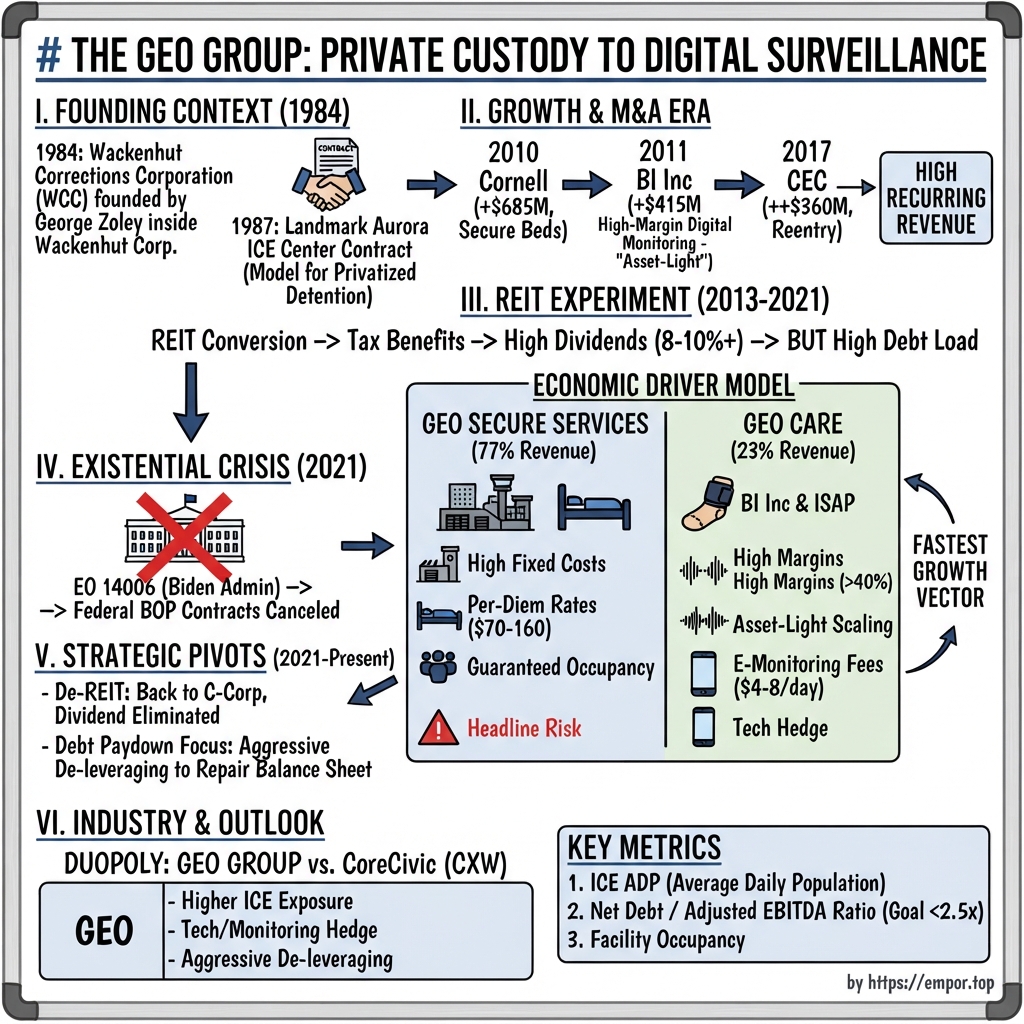
The GEO Group: The Business & Economics of Private Custody and Digital Surveillance
I. Introduction & Episode Roadmap
On the afternoon of August 6, 2026, a conference line opened in Boca Raton, Florida, and a 76-year-old executive who founded his company the year the Macintosh launched began reading numbers into a microphone. Revenue was up 15 percent. Net income rose 63 percent. Guidance was raised. Then, almost as an aside, George C. Zoley told analysts that the United States government had recently bought four detention facilities from his largest competitor for more than $2.2 billion—roughly $300,000 per bed—and that GEO itself was "engaged in an active process for the sale of several of our turnkey facilities."[^1]
That single announcement captures the unusual economics of The GEO Group. Here is a company whose primary customer is also, increasingly, its acquirer; whose assets carry value largely because they are politically difficult to replicate; and whose stock traded between $12.51 and near $32.92 over the twelve months leading into late August 2026—a range driven less by fundamental operating performance than by political control in Washington and congressional appropriations.1
The GEO Group, Inc. (NYSE: GEO) carried a market capitalization of roughly $4.4 billion in late August 2026.1 It reported $2.63 billion of revenue in fiscal 2025, and as of December 31, 2025, it managed or owned approximately 75,000 beds across 95 secure and community-based facilities in the United States, Australia, and South Africa, employing about 18,000 people.2 Alongside physical real estate, the company operates digital surveillance: through its BI Incorporated subsidiary, GEO monitored roughly 184,000 individuals on the federal immigration "non-detained docket" as of mid-2026, using GPS ankle bracelets, wrist-worn devices, and a smartphone application called SmartLINK.[^1]
The central question. How did a division of a Florida security-guard company—founded in 1984 with no facilities, no beds, and no contracts—become the single largest private counterparty to U.S. Immigration and Customs Enforcement, and then bolt onto that a digital surveillance business that supervises more people than it detains?
The paradox that makes it interesting. GEO owns heavy, illiquid, single-purpose real estate that cannot easily be repurposed into apartments or warehouses. It sells to a monopsonist—the federal government—that can alter policies by executive order. It was, for a period, effectively frozen out of the commercial banking system on environmental, social, and governance grounds. And yet it generates recurring per-diem revenue under contracts that often carry occupancy floors, converts a high share of EBITDA into cash, and enjoys barriers to entry so severe that only one comparable competitor exists in the United States.
Those two dynamics—extreme counterparty concentration and high entry barriers—are the same economic reality viewed from opposite ends. The factors that make GEO's position defensible are precisely the conditions that make it fragile.
What this story covers. First, the origin: Zoley building a corrections business inside The Wackenhut Corporation, and the 2003 transaction that finally cut the cord. Second, the acquisition sequence that turned a bed operator into a diversified services company—Cornell in 2010, BI Incorporated in 2011, Community Education Centers in 2017—and the REIT experiment that financed it. Third, the 2021 near-death experience, when a presidential executive order and a bank boycott arrived in the same eighteen months. Fourth, the current business: what each segment actually earns, and why the "high-margin technology" story deserves harder scrutiny than it usually gets. Fifth, the competitive structure and the durability of the moat. Sixth, a governance record that includes three chief executives in fourteen months. And finally, the honest bull and bear cases, and the two or three numbers that actually determine what happens next.
A note on posture before beginning. GEO's management says the stock is "significantly undervalued" and that its assets have intrinsic value the market refuses to recognize.3 That is a claim, not a finding. This piece treats it as one, and asks what evidence would confirm or refute it.
 Subscribe on LinkedIn
II. Founding Context & The Wackenhut Era (1984–2003)
He arrived at Ellis Island at three years old.
George Christopher Zoley was born on February 7, 1950, in Florina, a remote town in northwestern Greece near the Albanian and North Macedonian borders, in a house without plumbing or electricity. His father had gone ahead to Ohio; his mother and sister followed with the toddler.4 Decades later, the immigrant child would run the largest private operator of American immigration detention facilities—a biographical contrast no novelist would risk writing. Zoley earned bachelor's and master's degrees in public administration from Florida Atlantic University and a doctorate in public administration from Nova Southeastern University. He continues to use the academic title, appearing as "Dr. Zoley" in SEC filings.5 Later in his career, he named GEO's captive insurance subsidiary Florina, after his birthplace.2
That academic grounding shaped the business model. Zoley did not come from law enforcement or real estate; he emerged from the academic study of public sector procurement. The foundational GEO thesis—that public agencies would outsource custody if a private operator could provide it faster and at lower cost, and that the binding constraint on government was capital budgeting and construction timelines rather than available funds—is a public-administration thesis rather than a security concept.
1984: a division, not a company. Wackenhut Corrections Corporation began in 1984 as a division of The Wackenhut Corporation, the security-guard firm established by former FBI agent George Wackenhut.6 It inherited the parent company's name, balance sheet, and federal relationships, but lacked an established market, as privately operated prisons barely existed in the United States at the time.
1987: the template. The unit won its first contract in 1987 for what became the Aurora Processing Center in Colorado—a federal immigration detention facility.6 That sequencing reframes the company's historical arc: while popular narrative often depicts GEO as a traditional prison operator that later pivoted to immigration, immigration detention was its initial product. Holding individuals pending immigration proceedings—a demand driven by policy shifts rather than domestic crime rates—served as the original line of business and has remained the company's anchor for thirty-nine years.2
The economic structure created for Aurora continues to govern the firm. When a government agency requires bed capacity in a target location, it can avoid issuing municipal debt, conducting multi-year construction procurements, hiring civil service staff, or assuming long-term pension liabilities. GEO finances, constructs, and staffs the facility, charging a per-diem rate per detainee. Certain contracts guarantee a minimum occupancy floor regardless of actual population, while others pay strictly for actual usage.2 That distinction between guaranteed occupancy floors and pure per-diem pricing represents a key driver of the company's operating leverage, an element analyzed further in subsequent sections.
1992–1994: going global, then going public. The company expanded into Australia and the United Kingdom in 1992, and in 1993 its Australian affiliate secured the contract for the first private correctional center in New South Wales.6 An initial public offering followed in 1994, listing 2.2 million shares on NASDAQ.6 However, public ownership remained limited. Wackenhut Corrections floated only a minority equity stake; the parent company retained majority control, brand rights, and shared corporate services, including payroll, human resources, tax, and IT infrastructure.5
2002: the Danish problem. In 2002, Danish security firm Group 4 Falck acquired The Wackenhut Corporation, gaining a 57 percent controlling stake in the publicly traded corrections subsidiary.5 While the strategic logic aligned in Copenhagen, it created tension in Washington. A European parent company with global corrections ambitions now controlled a firm whose primary clients were U.S. federal agencies requiring a domestic, politically unencumbered contractor. Structural conflicts emerged over which entity would bid on specific international contracts.
July 9, 2003: the cord is cut. Zoley directed the separation. Under a share purchase agreement dated April 30, 2003, the company repurchased all 12 million shares held by Group 4 Falck for $132 million in cash.5 Days prior, it sold its 50 percent stake in Premier Custodial Group, a UK joint venture, to Serco for approximately $80.7 million pre-tax to help fund the buyback.5 The transaction also required a complete rebrand: Wackenhut Corrections Corporation surrendered the Wackenhut name and officially became The GEO Group, Inc., on November 25, 2003.5
This buyback concentrated ownership among public shareholders, retired 57 percent of outstanding equity, and established GEO as an independent American contractor eligible to bid unencumbered for U.S. federal contracts. In government contracting, operational independence serves as a critical bidding qualification.
What the first two decades built. By 2003, GEO had established four core structural elements: a per-diem contracting model backed in part by occupancy floors, multi-decade relationships with federal agencies, in-house facility design and construction capabilities, and leadership deeply tied to the firm's operations.
However, those advantages also concentrated risk, as all four elements relied heavily on a small group of government counterparties. The next chapter examines how this structure performed when supported by expanded access to capital.
III. The Growth Engine: M&A, Scale, and the REIT Era (2004–2020)
Independence is expensive. Having spent $132 million to buy its freedom, GEO spent the following decade proving that an unencumbered balance sheet in a consolidating industry is an engine for compounding—and, eventually, for overextension.
The pattern started small and expanded. In 2005, GEO acquired Correctional Services Corporation, adding roughly 8,000 beds. In 2007, it bought CentraCore Properties Trust—a real estate trust that owned facilities GEO already operated and leased—bringing 13 facilities and more than 8,000 beds onto its own balance sheet.6 That second transaction signaled a fundamental strategic shift: GEO was transforming itself from a manager of third-party facilities into a property owner. Ownership captured the real estate return alongside the operating margin and guaranteed control: a landlord cannot decline to renew a lease if the operator is the landlord.
Cornell Companies, 2010: buying the platform. On April 19, 2010, GEO and Cornell Companies announced a merger at an estimated enterprise value of $685 million, including the assumption of roughly $300 million in Cornell debt. Cornell shareholders could elect 1.3 GEO shares per Cornell share or a cash alternative, with cash capped at 20 percent of shares outstanding to preserve tax-deferred status. The terms implied $24.96 per Cornell share—a 35 percent premium.7 The transaction closed that August, creating a company with roughly $1.5 billion in annual revenue.6
Cornell brought secure beds, but it also added community-based reentry and residential treatment facilities. GEO was assembling what it later termed a "continuum of care"—custody at one end, halfway houses and community supervision at the other. The commercial rationale was clear: a government agency moving individuals through a correctional pipeline prefers a single contractor capable of managing multiple stages.
BI Incorporated, 2011: the most consequential $415 million in company history. On February 11, 2011, GEO closed its acquisition of B.I. Incorporated for $415 million in cash. BI, founded in Boulder, Colorado, in 1978, was the country's largest provider of electronic monitoring services, tracking more than 60,000 people for approximately 900 federal, state, and local agencies—and serving as the sole supervision provider to U.S. Immigration and Customs Enforcement under the Intensive Supervision Appearance Program, or ISAP.8
ISAP represents a distinct operational model within the business. When the federal government elects not to detain an individual pending immigration proceedings, it can mandate community supervision, combining check-ins, location monitoring, and case management. BI supplies both the underlying technology and the caseworkers. Monitoring tools range in intensity: a smartphone application using facial recognition, voice verification, and GPS to confirm location during scheduled check-ins at the lower end, and a GPS ankle bracelet providing continuous real-time tracking at the higher end.[^1] The financial model mirrors streaming versus periodic software services: continuous tracking commands higher per-diem reimbursement rates.
Strategically, BI functioned as a hedge against structural shifts in detention demand. If policy or public sentiment reduced physical custody, demand would shift toward community supervision, allowing GEO to capture revenue on both sides of the trade. On paper, it was textbook counter-positioning—acquiring the business built to benefit from the disruption of the core model.
Whether the acquisition fulfilled that promise over the long term is a question examined with fifteen years of segment data in Section V. For a decade, the business generated high margins before encountering new operational and political headwinds.
Community Education Centers, 2017: the deal that aged worst. On April 6, 2017, GEO completed the $360 million all-cash acquisition of Community Education Centers, a provider of reentry and in-prison treatment services managing more than 12,000 beds, including over 7,000 community reentry beds.9 The deal expanded GEO's total capacity toward 100,000 beds and added roughly $250 million in annual revenue. However, it also introduced a portfolio of halfway houses with thinner operating margins and higher integration costs than original underwriting anticipated. Reentry eventually became GEO's smallest domestic segment by operating profit, generating $61.0 million of segment operating income on $286.5 million of revenue in 2025.2 While profitable, the segment fell short of the transformative returns implicit in the acquisition price.
The 2013 REIT conversion: financial engineering as strategy. Effective for fiscal 2013, GEO converted into a Real Estate Investment Trust.6 The underlying tax mechanics were central to the strategy: a REIT pays virtually no corporate income tax provided it distributes at least 90 percent of taxable income to shareholders.10 For a company owning a large portfolio of real estate leased to creditworthy government counterparties, the structure offered clear advantages: eliminate tax leakage, pay high dividends, and attract yield-focused investors during a period of near-zero interest rates.
For several years, the REIT model functioned as intended. It lowered GEO's cost of equity, supported higher valuation multiples, and provided equity currency to fund further acquisitions.
The trap inside the structure. The structural limitation lay in retained earnings. A REIT that distributes nearly all of its taxable income cannot fund facility construction, corporate acquisitions, or debt retirement out of operational cash flow. Every unit of growth capital requires issuing new equity or incurring additional debt. In an era of low interest rates and open capital markets, this model accelerates growth. However, if access to capital markets contracts, the requirement to distribute cash becomes a binding operational constraint.
During the late 2010s, GEO expanded its debt burden to acquire facilities and operating assets while maintaining dividend yields that reached 8 to 10 percent. Rather than signaling deep value, the elevated yield reflected market skepticism regarding the sustainability of the payout.
By 2019, capital access began to narrow. Beginning in March 2019, JPMorgan Chase announced it would cease lending to GEO and CoreCivic. Within months, Wells Fargo, Bank of America, SunTrust, BNP Paribas, Fifth Third, Barclays, and PNC announced similar policies.11 The bank decisions were driven by corporate reputational policies rather than credit risk, as GEO continued to generate positive cash flow and service its obligations. Nonetheless, the withdrawal severed access to low-cost commercial banking credit for a firm built on continuous capital market access.
The REIT era demonstrated a broader corporate finance reality: a tax-optimized capital structure dependent on high distributions relies on uninterrupted capital market access. GEO's capital access was about to face restrictions from both political and financial channels.
IV. Existential Crisis & Strategic Pivots (2021–2023)
Six days into his presidency, on January 26, 2021, President Joseph Biden signed Executive Order 14006, directing the Attorney General not to renew Department of Justice contracts with privately operated criminal detention facilities.10 For a company whose federal relationships spanned four decades, it was the corporate equivalent of a major customer publicly announcing plans to sever ties.
The market reaction was swift, though in one key respect, misplaced.
What the order actually did — and did not do. Executive Order 14006 applied to the Department of Justice—specifically the Bureau of Prisons and the U.S. Marshals Service. It did not apply to the Department of Homeland Security, and therefore excluded ICE.10 That carve-out was not an oversight; DHS detention authority rests on a separate statutory and operational foundation. But the distinction was largely lost in initial headlines, and GEO's equity was priced as though its entire federal franchise had been canceled.
The operational damage was real but bounded. BOP contracts gradually phased out. By fiscal 2025, the Bureau of Prisons accounted for just 2.6 percent of GEO's consolidated revenue, down from 3.1 percent the prior year—a minor fraction for a business that once counted the BOP among its anchor clients.2 Facilities went idle. Some were eventually marketed to state corrections agencies, while several sat vacant for years. Crucially for GEO's later trajectory, those idled properties were primarily former BOP sites built with high-security, single-cell designs—infrastructure built for the wrong customer at the wrong moment that would later prove appealing to a subsequent administration.
December 2, 2021: unwinding the REIT. With dividend payouts absorbing cash that the company needed internally and commercial bank financing unavailable, GEO's board acted. On December 2, 2021, the board announced that it had unanimously approved a plan to terminate its REIT election and convert to a taxable C corporation effective for the fiscal year ending December 31, 2021, while also voting unanimously to discontinue the quarterly dividend.12
That step marked the most consequential capital-allocation decision in GEO's modern history, directly reversing the strategy used to attract yield-focused investors over the preceding eight years. Income investors held GEO primarily for the dividend, making its elimination a trigger for mandatory selling. The board proceeded because the alternative—continuing to distribute cash while unable to access routine bank refinancing—was unsustainable. Trading tax efficiency for balance-sheet preservation made strategic sense given capital constraints, though it also marked an explicit admission that the assumptions behind the 2013 REIT conversion no longer held.
The cost of being uninvestable. Excluded from traditional commercial bank syndicates, GEO refinanced through high-yield and private credit markets at a steep cost. The 2024 debt restructuring illustrated the penalty. On April 3, 2024, GEO announced an offering of senior notes to refinance approximately $1.5 billion of existing debt, including its Tranche 1 and Tranche 2 term loans, 9.50 percent and 10.50 percent senior second-lien secured notes, and 6.00 percent senior notes due in 2026.13 The replacement debt included 8.625 percent senior secured notes due in 2029.2 While the transaction cleared maturity hurdles, it incurred $86.6 million in pre-tax debt-extinguishment charges in 2024 alone. That charge was the primary reason GAAP net income for the year dropped to $32.0 million, or $0.22 per diluted share, on $2.42 billion in revenue.14
To put that performance in perspective: in 2024, GEO generated $463.5 million of adjusted EBITDA and $101.0 million of adjusted net income, yet reported GAAP earnings of just twenty-two cents a share.14 The variance largely reflected the financial cost of refinancing outside traditional banking channels.
Deleveraging as the whole strategy. From 2021 through 2024, management directed nearly all discretionary cash toward debt reduction, omitting dividends, pausing share repurchases, and capping growth capital expenditures. Annual interest expense tracked the resulting reduction, falling from $218.3 million in 2023 to $190.6 million in 2024, and reaching $160.5 million in 2025.14 Net debt, which the company continued to reduce through 2025, stood at approximately $1.5 billion by mid-2026, bringing total net leverage below three times adjusted EBITDA.3
January 20, 2025: the order is revoked. On his first day back in office, President Donald Trump rescinded Executive Order 14006 as part of a broader package of revocations.15 The prohibition on Department of Justice contracts ended. More significantly, the administration's broader enforcement posture signaled an expansion in detention demand. GEO shares had rallied following the November 2024 election, and the formal revocation reinforced that momentum.
However, the distinction between executive directives and operational funding remains vital. Executive Order 14006 had never targeted ICE, which generated the overwhelming share of GEO's federal revenue. The structural change in 2025 and 2026 derived instead from congressional appropriations, which determined the actual capital allocated for detention capacity and enforcement operations. Policy signals influence market sentiment, but congressional appropriations drive realized revenue.
The crisis years left GEO with lower leverage, substantial idle capacity, and a portfolio of high-security facilities that had shifted from underutilized liabilities to high-demand assets. That outcome reflected political shifts rather than an easily repeatable operational formula, as the company's valuation trajectory remained tied to federal policy decisions outside its direct control.
That dynamic sets the stage for how the operating model functions today.
V. Segment-Level Breakdown & Economic Drivers
Strip away the politics and GEO is four businesses stapled together, and only two of them meaningfully move the earnings. The 2025 segment disclosures make the hierarchy unambiguous.
Of $2,631.5 million in fiscal 2025 revenue: U.S. Secure Services produced $1,827.0 million, Electronic Monitoring and Supervision Services $320.9 million, Reentry Services $286.5 million, and International Services $197.1 million.2 Segment operating income ran $328.6 million, $125.0 million, $61.0 million and $16.5 million respectively.2
U.S. Secure Services: the concrete. This is roughly seven dollars in ten of revenue and about six in ten of segment profit. The economics are those of a hotel with a single corporate customer and no ability to discount: a large fixed cost base — correctional officers, nurses, food service, utilities, insurance, maintenance — against revenue that is a per-diem rate multiplied by occupied bed-days.
Segment operating margin came in near 18 percent in 2025, up modestly from the prior year.2 That is a fine margin for a labor-intensive services business, and it is also fragile in a specific way: because the cost base barely flexes, small changes in population produce large changes in profit. Company-wide facility occupancy averaged 89.2 percent in 2025 across 68,157 active beds, excluding 6,646 idle beds.2
The most instructive operational detail of the last two years is buried in an earnings-call answer. On the Q1 2026 call, an analyst asked why margins improved even as ICE populations at GEO facilities fell from roughly 24,000 to 21,000. Zoley's answer was that lower populations "actually promoted an increase in our EBITDA," because heavy intake and outflow activity — processing new arrivals, assigning housing, arranging off-site transport and medical visits — is the expensive part, and much of it was being staffed on overtime. He added that GEO was "seeing a population that is more sickly than we have historically had," requiring more off-site visits and more staff.[^17]
That is a genuinely useful disclosure and it complicates the simple "more detainees equals more profit" model. GEO's cost structure is driven less by the level of population than by the churn in population. A facility running at a stable 90 percent is more profitable than one oscillating between 60 and 100 percent at the same average. It also means the labor-cost tailwind management has been booking is partly a function of quiet conditions, and management has been candid that its own guidance assumes "more moderate contributions from labor cost savings" going forward.3
Electronic Monitoring: the story that needs rechecking. This is the segment sold to investors as the asset-light, software-like, high-margin growth engine. The fifteen-year data does not entirely support the pitch.
Segment revenue was $425.9 million in 2023, $332.8 million in 2024 and $320.9 million in 2025. Segment operating income over the same span went $212.9 million, $147.4 million, $125.0 million — a margin that compressed from roughly 50 percent to roughly 39 percent while revenue fell by a quarter.2 In other words, over the exact period when GEO's detention business was booming, its technology business shrank by nearly a hundred million dollars of revenue and lost nearly ninety million dollars of operating profit.
Two forces caused it. The first is volume mix set entirely by federal policy: ISAP enrollment is a function of how many people the government places on the non-detained docket and how it chooses to supervise them, not of GEO's sales effort. The second is price. GEO won a new two-year ISAP contract on September 30, 2025 — an important competitive win, given BI has held the program for more than twenty-one years and runs it through roughly 100 offices and close to 1,000 employees — but management has repeatedly acknowledged that the ISAP V contract carries "reduced pricing."1416
What has partially offset the price cut is a device mix shift, and this is the most quantitatively interesting dynamic in the company right now. Participants on GPS ankle monitors rose from approximately 17,000 in early 2025 to roughly 48,000 by May 2026 and about 54,000 by August 2026, while SmartLINK app users fell from roughly 159,000 to about 131,000 over the first stretch of that period.[^17]3 Case-management enrollment — which involves actual staff interaction rather than passive monitoring — rose to approximately 116,000 individuals.3 Asked to quantify the effect, Zoley said simply that "the app is far less expensive than the ankle monitors."[^1]
So the segment's revenue can grow with a flat headcount, purely by moving people up the intensity ladder. Total ISAP participation has been roughly stable at 180,000 to 184,000 through 2026.[^17]3 Second-quarter 2026 electronic monitoring revenue fell less than $3 million, or about 3.5 percent, year over year — which, given a contractual price cut, management fairly characterizes as evidence the mix shift is working.3
Here is the analytical conclusion an investor should draw, and it is more sober than the pitch. BI is not a software business. It is a government program administrator with hardware, field offices and about a thousand employees, whose price is set in a competitive re-bid every couple of years and whose volume is set by immigration policy. Its 39 percent segment margin is excellent by services standards and unremarkable by technology standards, and it has been falling, not rising. The "counter-positioning hedge" thesis — that ISAP grows when detention shrinks — was not observably true in 2025 and 2026, when detention grew and ISAP did not. On the Q2 2026 call, an analyst put this directly to management, noting that ISAP counts had been "pretty flat here now for probably two years" against earlier hopes of approaching 400,000 participants. Zoley's answer was candid: "the focus of ICE has been on increasing detention capacity."[^1]
Reentry and International: the remainder. Reentry Services — residential reentry centers and non-residential day reporting — earned $61.0 million on $286.5 million of revenue in 2025, a roughly 21 percent segment margin that has been slowly improving.2 International Services, principally three managed facilities in Australia and one in South Africa plus the GEOAmey transport joint venture in the United Kingdom, produced $16.5 million on $197.1 million — an 8.4 percent margin, and about 7 percent of consolidated revenue, down from 9 percent in 2024.2 International is a diversification story on paper; on the numbers it is a low-return appendage.
Customer concentration, stated plainly. This is the number that should govern position sizing. In fiscal 2025, three federal agencies accounted for 66.6 percent of GEO's total consolidated revenues, up from 61.8 percent in 2024. ICE alone accounted for 47.6 percent, up from 41.5 percent. The U.S. Marshals Service accounted for 15.9 percent, down from 17.2 percent. And a broader group — the federal government plus California, Texas, Florida and Australian state entities — represented approximately 81 percent of consolidated revenue.2
GEO is more concentrated on ICE today than at any point in its history, and the concentration increased in the most recent fiscal year. Every diversification initiative of the past fifteen years — BI, Cornell, CEC, Australia — has been outrun by the growth of the core exposure.
The transportation business nobody models. Quietly, a fourth revenue stream has been scaling. In 2025 GEO signed a five-year contract with the U.S. Marshals Service covering 26 federal judicial districts across 14 states, expanded secure ground transportation at seven ICE facilities, and grew its subcontracted support work under ICE Air. Management valued the new and expanded transportation contracts at roughly $60 million of incremental annual revenue, with another $20 million combined attached to two new facility contracts.[^17]3 Transportation revenue is reported within the managed-only line rather than broken out separately, which makes it hard for outsiders to track — a genuine disclosure gap, and one worth pressing management on.
The segments explain how GEO makes money. The next question is why anyone else cannot.
VI. Industry Structure, Competition & Moats (Helmer & Porter Analysis)
Building a competitor to The GEO Group requires roughly $300,000 per bed in capital, judging by what the federal government recently paid for existing facilities.[^1] A newcomer would also have to find a host county willing to grant zoning approval—an increasingly difficult task that several states now legally prohibit. Add the mandatory requirements of American Correctional Association accreditation, federal security clearances, and a proven track record acceptable to procurement officers, plus years of pre-revenue construction and litigation. At the end of that process sits a single-purpose facility whose residual value depends entirely on the appetite of a single federal customer.
Few entrants attempt it. That barrier defines the company's moat.
The structure: a duopoly with a private third. In North America, private secure detention is effectively GEO and CoreCivic, Inc. (NYSE: CXW), with Management and Training Corporation—closely held, and therefore invisible to public-market investors—competing mainly for state contracts and select federal work. The two public players are close in scale and diverging in strategy.
In the second quarter of 2026, GEO generated $732.1 million in revenue and $142.0 million in adjusted EBITDA, while CoreCivic reported $684.9 million in revenue—up 27.3 percent—and $109.4 million in adjusted EBITDA.317 GEO remains the larger operator and proved more profitable during that period. On GEO's first-quarter 2026 earnings call, Zoley estimated that GEO maintained roughly 6,000 idle beds available for reactivation, while CoreCivic held "maybe 10,000," noting that both providers could expand capacity further.[^17]
The strategic divergence between the two firms became clear in mid-2026. CoreCivic sold four facilities to the federal government—the California City facility and the 1,994-bed Otay Mesa Detention Center on July 2, 2026, followed by its Prairie and Midwest facilities on August 4—for $2.2 billion in gross proceeds. That generated an aggregate gain of approximately $1.8 billion, yielding about $1.6 billion in net proceeds after roughly $500 million in taxes and transaction costs. Under the agreement, CoreCivic expects to continue operating all four facilities under government management contracts.17
That transaction serves as the template GEO aims to replicate. Zoley articulated the underlying strategy on an earnings call: "We believe we have two types of assets. The buildings and the businesses of providing support services. We are pursuing a potential sale of the buildings but we want to retain the business. We consider ourselves primarily a support services operator."[^1]
Why would the government want to own the buildings? Asked directly why the federal government would choose to acquire real estate it previously leased, Zoley framed the decision around legal exposure rather than pure real estate economics. Federal ownership, he argued, offers "more protections from unwarranted litigation," particularly from state governments and local courts asserting regulatory oversight over medical services, food operations, and facility conditions at privately owned sites. Under federal ownership, he contended, the Supremacy Clause provides stronger legal protection.[^17]
Regardless of the constitutional merits, the argument underscores a structural reality: owning detention real estate carries substantial litigation risk alongside property value. GEO's fiscal 2025 financial statements included a $38.2 million pre-tax non-cash contingent litigation reserve, primarily associated with a single lawsuit in Washington State.14 Transferring facility ownership to the federal government shifts that liability to the customer. Simultaneously, it monetizes an illiquid and politically sensitive asset class at replacement cost—the valuation methodology Zoley noted is being applied.3
Testing the 7 Powers. Evaluating GEO through Hamilton Helmer's 7 Powers framework reveals strong positioning on two powers, partial strength on two, and no advantage on the remaining three.
Cornered resource — strong, and expanding. The physical portfolio represents GEO's primary structural moat. Facilities are situated along border transit corridors and near federal judicial districts, operating under grandfathered zoning approvals that municipalities no longer grant and state laws increasingly prohibit. Zoley emphasized this location advantage in valuation discussions, noting that ICE facilities sit "in or near urban areas," with several located "in blue states, which makes their development very difficult to establish and very problematic to replicate," while confirming that appraisals rely on replacement cost at those specific sites.[^17][^1] Paradoxically, political hostility enhances asset value by raising the replacement cost of existing infrastructure.
Switching costs — present, but conditional. Transferring large detainee populations involves complex logistics, yet federal authorities routinely reallocate individuals across the network, currently managing roughly 68,000 detainees across approximately 225 facilities, primarily local jails.[^1] Switching friction is higher within BI's electronic monitoring division, where 21 years of program execution, an established national office infrastructure, and integration with federal case workflows create operational continuity. Even there, contracts remain subject to periodic competitive rebids, with the most recent award resulting in lower pricing.14
Counter-positioning — unproven. As established in prior sections, the electronic monitoring division has yet to demonstrate an inverse financial correlation during periods of declining detention populations.
Scale economies — modest. Corporate general and administrative expenses represented approximately 9 percent of revenue in the second quarter of 2026, unchanged year over year, after dipping to 8.6 percent in the first quarter from 9.6 percent in the prior-year period.3[^17] While corporate overhead scales slightly across higher revenue, operating a facility in Colorado provides minimal cost efficiencies for a site in Georgia. The business lacks the compounding scale dynamics of software or logistical platforms.
Network economies, branding, and process power — absent. Private detention features no network effects, while corporate branding presents net challenges in commercial capital markets. Furthermore, despite marketing its "Continuum of Care" rehabilitative services, GEO has not demonstrated a proprietary cost structure that peers cannot duplicate.
Porter's five forces, applied without flattery.
Buyer power: extreme. Counterparty concentration dominates the economic structure. ICE accounts for 47.6 percent of total revenue and retains unilateral power to reshape operations through administrative directives, budget appropriations, or policy pivots.2 Regulatory disclosures explicitly note that agency clients "may request in the future that we reduce our per diem contract rates."2 The contractual rate reduction on ISAP V confirms that federal buyers exercise this pricing power.
Threat of new entrants: minimal. Capital intensity, regulatory barriers, and public opposition limit new competition, providing GEO with a durable defensive position against new market entrants.
Supplier power: moderate to high. Specialized labor—including security staff, registered nurses, and mental health professionals—remains in tight supply across rural facility locations, where GEO competes against public sector employers offering government pensions. Medical expenditures present a persistent cost pressure, reinforced by management's disclosures regarding a higher-acuity, sicker detainee population.[^17]
Threat of substitutes: high and evolving. Alternatives to private beds include municipal jail leases, government-owned facilities, and electronic supervision. Federal agencies utilize all three options. Crucially, the government's strategic push to consolidate operations from 225 scattered locations into fewer, larger, federally owned sites represents both a major near-term transaction opportunity and a primary long-term substitution risk for private landlords.[^1]
Competitive rivalry: low. Market structure resembles a duopoly in which the primary customer relies on both major providers to maintain reserve capacity, minimizing price competition.
The strategic balance. GEO's competitive moat is highly effective against corporate rivals yet exceptionally vulnerable to its primary customer. The business operates less as a traditional moat and more as a single-counterparty franchise—placing executive relationship management and capital allocation at the center of long-term performance.
VII. Current Management, Capital Allocation & Governance
In fourteen months, The GEO Group had three chief executives.
That sentence is the single most important governance fact about the company today, and it is worth walking through slowly because the disclosures are scattered across three filings.
On December 16, 2024 — in the same press release that announced a $70 million capital investment to expand ICE service capabilities — GEO disclosed that Chief Executive Officer Brian Evans had given notice of his retirement "to pursue other opportunities," effective December 31, 2024, and that J. David Donahue, a corrections veteran with more than forty years of experience, would become CEO effective January 1, 2025.18 Evans had been the finance executive who steered the company through the de-REIT conversion and the deleveraging campaign. He departed on the eve of the largest demand upcycle in the company's history.
Fourteen months later, on February 6, 2026, Donahue gave notice of his own retirement, effective February 28, 2026. His separation package included a consulting agreement paying $104,167 per month — $1.25 million a year — through February 28, 2028, plus continued vesting of unvested equity awards.19 On February 9, 2026, the board appointed George C. Zoley, then 76 and serving as Executive Chairman, as Chief Executive Officer effective March 1, 2026, on a base salary of $1,200,000, a target annual bonus of 200 percent of base, and annual restricted stock with a grant-date fair value of at least 300 percent of base.19
Then the finance seat turned over too. On March 5, 2026, GEO announced that Chief Financial Officer Mark Suchinski would leave effective March 31 "to accept a position in another industry," and that Shayn March, an internal executive of seventeen years' standing, would become CFO on April 1, 2026.20
How should an investor read this? Charitably: a founder with irreplaceable relationships stepping back in during a once-in-a-generation demand surge, backed by a long-tenured internal finance hire. Skeptically: two professional CEOs departed within fourteen months of each other, the second with a two-year consulting arrangement that reads more like a negotiated exit than a retirement, and the CFO left mid-cycle for a different industry. Neither departure was accompanied by an explanation of substance. GEO is a founder-controlled company in culture if not in voting power, and the succession record now shows that the founder's chair does not stay vacated.
There is no evidence of impropriety here, and none is alleged. But an activist investor examining GEO would put succession planning at the top of the list — because the entire ICE relationship, the piece of the business that generates nearly half of revenue, is bound up in a set of relationships held by one man in his seventies with an employment agreement running to April 2, 2029.19 Key-person risk is not a checkbox at this company. It is arguably the largest unhedged exposure on the balance sheet, and it does not appear anywhere on the balance sheet.
Capital allocation: the promise, and the pivot. Through the crisis years, management's stated priority was singular — free cash flow to debt reduction. It executed. Interest expense fell by roughly a quarter between 2023 and 2025, and by the second quarter of 2026 net debt stood near $1.5 billion with net leverage below three times adjusted EBITDA and about $300 million of total available liquidity.143
Then, with leverage still above three times, the board pivoted to buybacks. On August 4, 2025 it authorized a $300 million repurchase program, announced alongside second-quarter results.21 Three months later, on November 6, 2025, it increased the authorization to $500 million and extended it to December 31, 2029.16 By the end of the second quarter of 2026, GEO had repurchased approximately 10.1 million shares for roughly $177 million, leaving about $323 million available, with approximately 130 million shares outstanding.3
This deserves scrutiny rather than applause. Buying back stock while carrying $1.5 billion of net debt at coupons starting at 8.625 percent is a defensible choice only if the equity is meaningfully undervalued relative to that hurdle. Management asserts exactly that — Zoley has said on consecutive calls that the stock "continues to trade at a relatively low multiple despite the intrinsic value of our assets."[^1] But note the price path: GEO repurchased 3.6 million shares for roughly $50 million in the first quarter of 2026, at an average near $14, and 1.6 million shares for roughly $36.6 million in the second quarter, at an average near $23.[^17]3 The early repurchases look excellent in hindsight. The later ones were made into a doubling stock, and the marginal buyback competes directly with retiring debt that costs more than 8.6 percent after tax-shield.
The company has also stated where any facility sale proceeds would go: debt reduction first, subject to restrictions in the indenture and credit agreement, then returns to shareholders. On the Q2 2026 call, CFO Shayn March said GEO would "absolutely look to deploy as much capital as we can to returning it back to shareholders" once those restrictions were satisfied.[^1] That is a clear statement of intent. It is not a stated leverage target, and the absence of one is notable for a company that spent four years defining itself by deleveraging.
Narrative consistency: a mixed report card. The honest way to assess management credibility is to compare what they said on prior calls with what happened.
Where they have been right: the 2025 contract wins. Management said 2025 produced up to approximately $520 million of annualized new business, "the most successful year for new business wins in our Company's history," and that these would normalize into 2026 results.14 They did. First-half 2026 revenue rose 16 percent to $1.44 billion and adjusted EBITDA rose 25 percent to $273.4 million, and guidance was raised twice — full-year adjusted EBITDA moving from an initial $490–510 million range in February to $550–560 million by August.143 That is a genuine record of setting a target and beating it.
Where they have been optimistic: timing. In February 2026, GEO guided the Graceville and Bay contracts in Florida — roughly $100 million of combined annual revenue — to transition on July 1, 2026.14 By August, those had been pushed a full year to July 1, 2027, attributed to unresolved "budgetary issues."3 On the facility sales, Zoley guessed in May 2026 that initial transactions might land in "late Q2, maybe early Q3" — and by early August, with CoreCivic having closed $2.2 billion of sales, GEO had none completed and "no definitive agreement in place."[^17]3 The skip-tracing contract, valued at up to $60 million a year when announced in December 2025, generated no revenue at all in the second quarter of 2026.143
None of these are misrepresentations. Government timelines slip; that is the nature of the customer. But the pattern is consistent enough to be predictive: GEO's operational execution has been better than its guided timing, and the difference has repeatedly favored the optimistic case in the initial telling. An investor underwriting announced-but-not-yet-realized revenue should discount both the amount and the date.
To their credit, management has generally excluded unrealized items from guidance rather than baking them in — the raised 2026 outlook explicitly contains no contribution from the two new facility activations or from the delayed Florida contracts.3 That is the conservative choice, and it is the right one.
The question that follows: what should an outside investor actually watch?
VIII. Key Performance Indicators (KPIs) & Material Risk Radar
There is a page on the U.S. Immigration and Customs Enforcement website that publishes detention statistics.22 It is a dense collection of spreadsheets, yet it functions as the single most critical investor-relations document The GEO Group does not control.
That context defines the operational reality of the business. GEO does not control customer demand. It manages its cost base, sets its bid pricing, and waits for federal agency allocations. Consequently, the operational metrics that drive performance are few, public, and central to the thesis.
KPI 1: ICE population — at the facilities, and on the ankle.
The primary driver of GEO's earnings is the number of individuals ICE holds in GEO facilities, alongside the supervision intensity applied to those on the non-detained docket.
Both figures matter, and they provide distinct signals. In physical custody, GEO's census across active ICE facilities stood at approximately 24,000 in early August 2026 against roughly 27,000 contracted beds—rebounding after dipping to about 21,000 earlier in the year.[^1] With total national ICE detention around 68,000, GEO houses more than a third of all federal immigration detainees.[^1]
In community supervision, the key variable is mix rather than total enrollment under the Intensive Supervision Appearance Program (ISAP), which has remained flat for two years. Investors must track the ratio of higher-intensity GPS ankle monitors to lower-intensity smartphone application users, as well as the total count assigned to active case management. Because reimbursement scales with supervision intensity, segment revenue can expand on a flat participant base or contract even as overall enrollment grows.
Analyzing both metrics together provides clarity on strategic direction. Management has noted that ICE is prioritizing physical detention capacity before expanding community supervision, with Executive Chairman George Zoley suggesting a shift toward supervision could occur "maybe next year."[^1] If detention populations rise while electronic supervision remains flat, the historical thesis that electronic monitoring acts as an operational hedge loses validity. If both expand, product diversification delivers measurable value. If detention declines without a corresponding rise in supervision, revenue faces downside pressure across both segments.
KPI 2: net debt to adjusted EBITDA.
Leverage determines how operational cash flow is split between debt service and equity returns. GEO closed the second quarter of 2026 with net leverage below three times adjusted EBITDA and approximately $300 million in available liquidity.3
Tracking leverage is essential because management has not defined a explicit debt-target threshold. While leadership outlined a capital sequence—allocating cash to debt reduction first before expanding capital returns to shareholders, subject to credit agreements and debt covenants—it has not committed to a fixed target for that transition.[^1] Furthermore, the company initiated share repurchases while leverage remained above three times. As a result, net leverage serves as an empirical indicator of management's capital allocation choices for excess cash flow.
KPI 3: U.S. Secure Services segment operating margin.
Segment operating margin serves as the direct measure of pricing power against operational inflation. Because GEO manages a diverse portfolio of federal processing centers, state correctional facilities, and international sites, overall per-diem averages are not disclosed. Operating margin indicates whether per-diem rates and facility occupancy are keeping pace with labor costs, medical inflation, utilities, and insurance.
In 2025, U.S. Secure Services generated an operating margin of roughly 18 percent, making the underlying driver of margin movement more important than the absolute percentage.2 Margin expansion resulting from sustained occupancy growth represents structural operating leverage. Conversely, margin gains stemming from lower intake processing and reduced staff overtime—the pattern observed in early 2026—are cyclical, a distinction management acknowledged by guiding toward "more moderate contributions from labor cost savings."3 Finally, margin increases achieved via deferred capital expenditures warrant caution. Management lowered unreimbursed capital expenditure guidance from $135–145 million in 2026 to below $100 million in 2027, attributing the decline to the completion of facility activation cycles rather than deferred maintenance.3[^1]
The risk radar.
Political and appropriations risk — the dominant exposure. Federal agencies represent nearly half of GEO's revenue, leaving performance tied to congressional appropriations and executive policy. The near-term fiscal structure is supportive: the Secure America Act, enacted on June 10, 2026, following a 76-day partial shutdown of the Department of Homeland Security, authorized approximately $70 billion for ICE and Customs and Border Protection through fiscal 2029, including $38.5 billion allocated directly to ICE—nearly four times its prior annual budget.23 This multi-year funding builds on prior budget reconciliation legislation that provided roughly $45 billion in discretionary funding for immigration enforcement through September 30, 2029.[^1][^17]
Multi-year federal appropriations function as multi-year revenue visibility, insulating operations through the current fiscal cycle. However, these authorizations do not extend past the 2028 election cycle, leaving long-term policy and demand subject to future political shifts.
Litigation — a cash exposure with non-cash accounting. The primary legal overhang stems from Nwauzor v. GEO Group, involving detained worker pay at the Tacoma, Washington processing center. A jury awarded plaintiff class members $17.3 million for minimum wage violations from 2014 through 2021, while the district court separately ordered GEO to pay $6.0 million to Washington State for unjust enrichment and enjoined the company from operating detainee work programs below state minimum wage. The Ninth Circuit Court of Appeals affirmed the judgment on August 13, 2025.24
GEO appealed the ruling to the U.S. Supreme Court, obtaining a stay pending review. On its balance sheet, the company established a $38.2 million pre-tax non-cash contingent litigation reserve in full-year 2025 to cover potential liabilities.14 While booking the reserve represents standard conservative accounting, the operational precedent presents a broader challenge. Facility cost structures across multiple states rely on voluntary detainee work programs paid at nominal daily rates. If legal challenges eliminate those wage structures nationwide, operational labor expenses would permanently reset higher.
Labor and medical cost inflation. Facilities rely on a workforce of roughly 18,000 employees.2 Recruiting correctional officers and medical personnel in rural locations remains competitive, particularly against public sector positions offering traditional pensions. In addition, management noted that recent detainee cohorts exhibit higher medical acuity, requiring expanded off-site medical transport and increased clinical staffing—a cost factor that directly impacts operating margins over time.[^17]
Refinancing and cost of capital. While near-term debt maturities have been extended, high debt coupons persist, led by senior secured notes carrying an 8.625 percent interest rate.2 Access to traditional commercial bank credit is improving; GEO expanded its revolving credit facility twice, increasing capacity from $310 million to $450 million and ultimately to $550 million in January 2026.214 This expansion indicates renewed bank participation, though access remains sensitive to shifting market and corporate governance standards.
Data security and privacy governance. Through its BI Incorporated subsidiary, GEO maintains location tracking, biometric verification data, and administrative records for approximately 184,000 monitored individuals.25[^1] The segment operates under expanding state regulatory frameworks, including the California Consumer Privacy Act.2 A security incident involving sensitive monitoring datasets would create unique operational liability and heightened public scrutiny.
Reporting transparency. Reporting practices leave visibility gaps in specific operating areas. Transportation services—an expanding line of business—are consolidated within managed-only facility revenue rather than broken out separately. Additionally, idle facility economics are disclosed annually rather than quarterly. For 2026, management estimated the carrying cost of idle assets at $23.4 million, including $12.0 million in non-cash depreciation. Reactivating all eight idle secure and reentry facilities at 2025 average rates and occupancy would generate approximately $240 million in incremental revenue, translating to an estimated $0.20 to $0.25 in annual earnings per share.2
Distinguishing earnings from operating run-rates. GAAP net income of $1.82 per diluted share in 2025 does not represent normalized operational performance. That total included a $232.4 million pre-tax gain on asset sales—primarily the $312 million sale of the 2,388-bed Lawton Correctional Facility to Oklahoma—offset by debt extinguishment charges and litigation reserves. Adjusted net income for 2025 stood at $0.86 per diluted share.14 Assessing valuation solely on unadjusted GAAP results overstates core earnings power.
These quantitative and structural metrics provide the framework for evaluating the company's operating performance and long-term outlook.
IX. Bull vs. Bear Case & Investor Playbook
There are two coherent ways to interpret the $2.2 billion CoreCivic transaction with the federal government in the summer of 2026, and an investor's view of The GEO Group depends almost entirely on which interpretation holds.
Reading one: the government revealed the replacement value of real estate that public markets had been pricing at a steep discount, and GEO owns more of those assets than any competitor—roughly 50,000 owned beds across about 70 facilities, including 23 ICE detention facilities compared to CoreCivic's remaining eleven.[^17][^1] In this view, equity markets heavily discounted physical assets whose scarcity was created by political and regulatory barriers.
Reading two: the primary customer is vertically integrating. By purchasing facility real estate, the government leaves private operators with support and staffing contracts—lower-margin, shorter-duration agreements subject to competitive rebidding, without property ownership as a backstop. Executive Chairman George Zoley stated plainly that GEO intends to sell facility real estate while retaining operating contracts.[^1] The bear question is whether the operating business, stripped of its real estate portfolio, carries the valuation investors attribute to it.
Both perspectives derive from the same transaction facts, defining the central debate surrounding GEO's stock.
The bull case, stated at its strongest.
Funded demand, not hoped-for demand. The relevant distinction lies between political sentiment and appropriated funds. GEO possesses federal budget backing through fiscal 2029. Management estimates the federal government aims to expand detention capacity to approximately 100,000 beds while consolidating operations from roughly 225 locations into fewer, larger facilities—leaving a capacity gap of roughly 30,000 beds relative to the current national census.[^1]
Idle capacity is the cheapest growth in the business. GEO holds approximately 4,500 idle beds across five company-owned facilities. These sites—primarily former Bureau of Prisons facilities with high-security, single-cell configurations—match federal procurement requirements. Management estimates these facilities could generate over $250 million in incremental annual revenue at full occupancy.[^1] Activating these beds requires no land acquisition, zoning approval, or construction cycle. Increasingly, activation does not require GEO's capital: under the Big Horn and Rivers contracts, ICE agreed to reimburse the capital expenditures needed to reactivate the facilities and to fund startup costs during activation.[^1]
That structural adjustment alters return dynamics. Customer-funded reactivations convert a capital-intensive real estate model into an asset-light management contract, generating operating margins without requiring upfront capital. If adopted as standard practice, this structure permanently raises GEO's incremental return on capital.
The mix-shift lever in supervision. Revenue growth in supervision stems from pricing intensity rather than participant volume. The GPS ankle-monitor population more than tripled in eighteen months while total participant counts remained flat.[^17][^1]
Deleveraging as an equity transfer. With enterprise value divided between roughly $1.5 billion in net debt and equity, every dollar of debt retired transfers value directly to shareholders, provided enterprise value remains constant. Combined with available share repurchase capacity and potential real estate monetization at government-established benchmarks, this creates a mechanical path for equity value creation independent of revenue growth.
The bear case, stated at its strongest.
Concentration risk is expanding, not contracting. While management justified past acquisitions as diversification initiatives, ICE represents a larger share of consolidated revenue today than at any point in company history.2 Buying GEO functions primarily as a leveraged wager on U.S. immigration enforcement policy.
The structural hedge remains unproven. The counter-positioning thesis posits that electronic supervision expands when physical detention contracts. In 2025 and 2026, physical detention expanded while supervision stalled—and the supervision segment lost roughly $88 million in annual operating income between 2023 and 2025 while accepting reduced rates on its newest contract.214 An unproven hedge provides limited downside protection.
Monetizing real estate alters the business model. The bull case relies heavily on GEO's ownership of scarce real estate. If GEO sells its facilities, it becomes a pure services contractor operating under fixed-term, recompeted contracts. In 2026, four of GEO's facility contracts faced competitive rebidding—a process Zoley acknowledged offers incumbency advantages but no guarantees.[^1] Monetizing real estate provides immediate cash but forfeits long-term asset value.
Cost of capital remains constrained. Although institutional capital exclusion has eased marginally, ESG restrictions continue to limit the investor base. A company generating mid-teens returns on capital while trading at a persistent valuation discount risks remaining a value trap.
Operational timelines slip consistently. Management's execution timeline shows a pattern of delays: Florida contract transitions were deferred by a year, facility sales were guided to close within quarters but remained unfinalized, and skip-tracing contracts generated no revenue in the quarter following execution.
Founder dependency and succession risk. Executive Chairman George Zoley is 76 years old, and the company has not publicly disclosed a clear succession plan.
Myth versus reality.
Myth: GEO is primarily a private prison operator profiting from mass incarceration. Reality: The Bureau of Prisons generated just 2.6 percent of consolidated revenue in 2025.2 The business primarily provides immigration processing, federal marshals custody, state correctional management, and electronic supervision.
Myth: Executive Order 14006 threatened the core business. Reality: The order excluded ICE facilities entirely. The primary disruption stemmed from bank credit exclusions and a REIT capital structure that restricted cash retention.
Myth: BI Incorporated functions as a high-margin technology business. Reality: BI operates as a government program administrator with roughly 100 offices and nearly 1,000 employees. Its operating margin compressed from approximately 50 percent to roughly 39 percent over two years.142 It operates as a service provider rather than a high-multiple technology platform.
Myth: Guaranteed occupancy floors insulate revenue from population fluctuations. Reality: Contract terms vary; while select agreements include fixed-price minimums, many pay strictly on a per-occupied-bed basis, as disclosed in company filings.2
The activist stress test.
An institutional investor evaluating board governance would target five primary questions. Why has management not established a formal net-leverage target to guide the transition from debt reduction to share repurchases? Why is transportation—generating over $60 million in annualized revenue—omitted as a separate reporting line? What is the formal succession plan, and what were the circumstances surrounding the departure of two chief executives in fourteen months, including one receiving $1.25 million annually in consulting fees? Why allocate capital to share repurchases at rising valuations while carrying debt at 8.625 percent interest rates? Finally, what governance safeguards protect minority shareholders if the government acts as both real estate acquirer and primary operating customer?
These items represent key operational and governance questions requiring management clarity.
What would change the picture.
The bull thesis gains validation if facility sales close near the $300,000-per-bed benchmark with long-term operating contracts retained, if idle beds activate under customer-funded capital arrangements, and if supervision enrollment expands alongside stable detention populations. Conversely, the thesis breaks down if asset sales stall on price, if contract renewals compress operating margins, or if supervision revenue continues to decline.
Three durable lessons.
Government contracting provides both high entry barriers and customer reliance. The monopsonist customer that creates barriers for competitors retains unilateral power over revenue terms. Revenue concentration cannot be mitigated by adding service lines; it requires customer diversification, which GEO has not achieved over forty years of operation.
Tax-optimized capital structures rely on uninterrupted capital access. The REIT structure functioned effectively in 2013 but created liquidity risks in 2020. Restricting retained cash leaves operations vulnerable to capital market disruptions.
Strategic hedges require empirical verification. The acquisition of BI Incorporated represented a logical strategic expansion. However, whether electronic monitoring functions as an operational hedge against declining physical detention remains unproven, with recent segment data showing divergent performance.
X. Epilogue & Strategic Outlook
Forty-two years after a public-administration scholar started a corrections division inside a Florida security firm, the enterprise he built has arrived somewhere none of its early participants anticipated.
It is not primarily a prison company. It is a logistics and supervision contractor for the federal immigration system—running processing centers, managing ground and air transport between facilities, and monitoring an additional 184,000 individuals through electronic tracking and case management. Roughly seven out of every ten revenue dollars derives from secure physical real estate; the remainder comes from a services and technology stack assembled through acquisition. Two of its three largest customers are federal law enforcement agencies. It employs 18,000 people and is once again led by its founder.
The company stands at a genuine strategic fork—one that will shape its next decade more than any acquisition in its history.
Down one path, GEO remains an owner-operator: holding physical buildings, absorbing the political and litigation risks of property ownership, and collecting both real estate returns and operating margins. Down the other, it sells hard assets to the federal government at replacement cost, uses proceeds to retire debt and repurchase stock, and transforms into what management characterizes as a pure support-services operator. That version of GEO would be asset-light with higher returns on capital, yet far more exposed to contract recompetition—resembling a defense services contractor rather than a real estate investment trust.
Management has signaled clearly which path it prefers. What it has not yet demonstrated is that it can execute the transition on terms that favor shareholders over the buyer on the other side of the table—a counterparty that serves simultaneously as the source of nearly half its revenue and the author of the regulations that dictate its demand.
The broader lesson extends well beyond GEO. The model of public-private partnership in custody was premised on a simple assertion: private capital can construct and staff facilities faster and at lower cost than government procurement permits. Over four decades, that premise largely held up operationally. What the model never resolved was the underlying political economy. A private contractor can build a facility, but it cannot control customer demand, dictate congressional appropriations, or insulate itself from the reality that its core product remains politically contested in ways that a toll road or data center is not.
GEO's history is ultimately a forty-two-year case study in that structural constraint. Every period of expanding returns coincided with a favorable policy shift; every operational crisis originated in Washington rather than from a commercial rival. The resulting enterprise is unusually well defended within its industry, yet uniquely vulnerable to political variables outside its control.
Investors who recognize that fundamental trade-off—durable protection from rivals in exchange for permanent exposure to a single counterparty's politics—will at least be equipped to evaluate what comes next.
References
-
The GEO Group, Inc. (GEO) — MarketWatch Financial Overview ↩↩
-
The GEO Group, Inc. — Annual Report on Form 10-K for fiscal year ended December 31, 2025, filed 2026-02-25 ↩↩↩↩↩↩↩↩↩↩↩↩↩↩↩↩↩↩↩↩↩↩↩↩↩↩↩↩
-
The GEO Group Reports Second Quarter Results and Updates Full Year 2026 Guidance — SEC Form 8-K, Exhibit 99.1, 2026-08-06 ↩↩↩↩↩↩↩↩↩↩↩↩↩↩↩↩↩↩↩↩↩↩
-
GEO Group founder, accused of mistreating ICE detainees, came to the US via Ellis Island — CNN ↩
-
The GEO Group, Inc. — Annual Report on Form 10-K for fiscal year 2004, filed 2005 ↩↩↩↩↩↩
-
The GEO Group and Cornell Companies Announce $685 Million Merger — SEC Form 8-K, Exhibit 99.1, 2010-04-19 ↩
-
The GEO Group Closes $415 Million Acquisition of B.I. Incorporated — SEC Form 8-K, Exhibit 99.3, 2011-02-11 ↩
-
The GEO Group Closes $360 Million Acquisition of Community Education Centers — SEC Form 8-K, Exhibit 99.1, 2017-04-06 ↩
-
Executive Order: Reforming Our Incarceration System to Eliminate the Use of Privately Operated Criminal Detention Facilities — White House Briefing Room, 2021-01-26 ↩↩↩
-
GEO Group Runs Out Of Banks As 100% Of Banking Partners Say 'No' To The Private Prison Sector — Forbes, 2019-09-30 ↩
-
The GEO Group Announces Change in Corporate Structure — SEC Form 8-K, 2021-12-02 ↩
-
The GEO Group Announces Senior Notes Offering — SEC Form 8-K, Exhibit 99.1, 2024-04-03 ↩
-
The GEO Group Reports Fourth Quarter and Full Year 2025 Results — SEC Form 8-K, Exhibit 99.1, 2026-02-12 ↩↩↩↩↩↩↩↩↩↩↩↩↩↩↩↩
-
Trump Reverses Biden Order that Eliminated DOJ Contracts with Private Prisons — Brennan Center for Justice ↩
-
The GEO Group Reports Third Quarter 2025 Results and Increases Share Repurchase Authorization to $500 Million — SEC Form 8-K, Exhibit 99.1, 2025-11-06 ↩↩
-
CoreCivic Reports Second Quarter 2026 Financial Results — SEC Form 8-K, Exhibit 99.1, 2026-08-05 ↩↩
-
The GEO Group Announces $70 Million Investment in Expanding ICE Services Capabilities and New Corporate Reorganization — SEC Form 8-K, Exhibit 99.1, 2024-12-16 ↩
-
The GEO Group, Inc. — Current Report on Form 8-K (Item 5.02, CEO transition), 2026-02-12 ↩↩↩
-
The GEO Group Announces Senior Management Changes — SEC Form 8-K, Exhibit 99.1, 2026-03-05 ↩
-
The GEO Group Reports Second Quarter 2025 Results and Announces $300 Million Share Repurchase Program — SEC Form 8-K, Exhibit 99.1, 2025-08-06 ↩
-
Detention Management — U.S. Immigration and Customs Enforcement ↩
-
What's in the Secure America Act? — American Immigration Council, 2026 ↩
-
Nwauzor v. The GEO Group, Inc., No. 21-36024 — U.S. Court of Appeals for the Ninth Circuit, 2025-08-13 ↩
-
BI Incorporated — Electronic Monitoring and Supervision Technologies ↩
 LinkedIn
 WhatsApp
 Reddit
 Hacker News
 Email
Email Kindle
 RSS Feed
 Spotify
 Apple Podcasts
 Amazon Music
 Audible
 YouTube