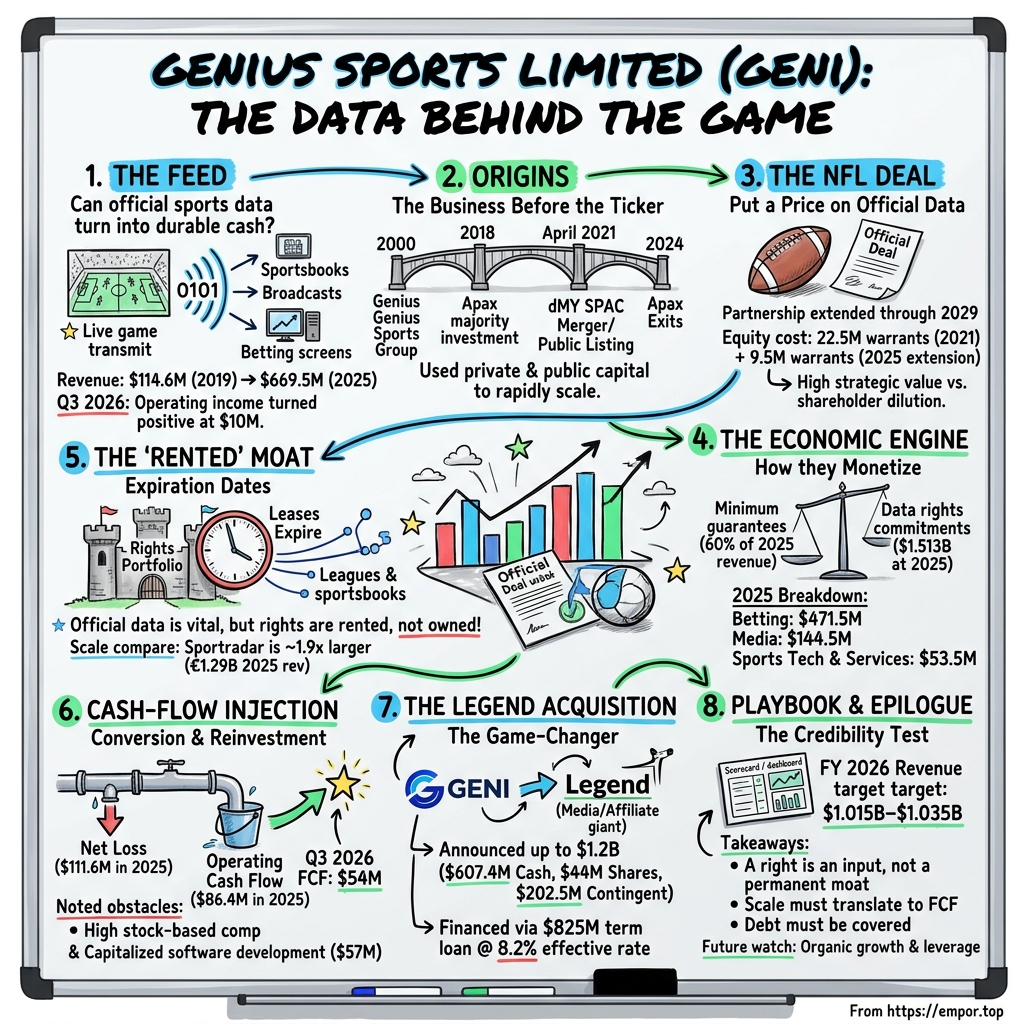
Genius Sports Limited: The Data Behind the Game
I. The Feed Behind the Final Score
A quarterback takes the snap, drops back, and throws a slant across the middle. The receiver is dragged down nine yards later. In the stadium, the crowd reacts. On the field, an official spots the ball. And somewhere in the gap between the whistle and the next huddle, that play stops being a moment and starts being a product.
Within seconds, the result has become a line of structured data: down, distance, yard line, clock, the name of the player who made the catch. It travels out of the stadium to a sportsbook, which suspends one betting market, settles another and reprices a third. It reaches a broadcaster's graphics engine. It lands in an app on a phone held by someone sitting on a couch three time zones away, who now has a fresh price on whether the drive ends in a touchdown.
The company that sits in the middle of that pipe for the National Football League is Genius Sports. It does not own the game. It does not own the players, the stadium or the broadcast rights. What it owns, or more precisely what it rents, is the right to be the official route by which the game's data reaches the businesses that want to sell around it.
That position has produced one of the fastest growth records in sports technology. Genius took in about $115 million of revenue in 2019.1 By 2025 the figure was about $670 million, roughly six times larger, a compound growth rate of around a third a year for six years.2 Then came a transforming acquisition, and in the third quarter of 2026 revenue reached about $270 million in a single three-month stretch, up 62% on the year before.3
That same quarter carried a quieter milestone. Genius reported operating income of about $10 million, which the company called its "first-ever quarter of income from operations."3 A business that had been growing at high speed for most of a decade had, for one quarter, finally earned more from operations than it spent.
The timing of that milestone was no coincidence. The third quarter is when American football returns, and with it the busiest stretch of the betting calendar. On the results call, Locke told investors that gross gaming revenue on NFL games had risen nearly 60% over the first four weeks of the new season compared with a year earlier, with in-play wagering up nearly 50%.4 Those are sportsbook figures, not Genius revenue, and they flatter the start of any season. But they show why the company's fortunes rise and fall with the rhythm of the sports calendar, and why a single autumn quarter can look very different from a full year.
So the question this story has to answer is not whether Genius matters to live sport. It plainly does. The question is whether a company that routes official sports data can turn its place in the game into durable cash for its own shareholders, or whether the leagues that own the rights, the sportsbooks that buy the feeds and the lenders that funded its latest deal will capture most of what it creates.
Three tests run through everything that follows. Can Genius renew its most important rights without surrendering the economics? Can it turn rapid revenue growth into free cash flow, after the software it builds and the shares it hands out? And can Legend, the digital sports and gaming media business it agreed to buy in early 2026 and paid for largely with borrowed money, earn back what it cost?5
A word on what the company is. Genius Sports Limited is a holding company incorporated in Guernsey and listed on the New York Stock Exchange under the ticker GENI. It was created as a holding company for the 2021 business combination that took the group public, and it reports 48 wholly owned subsidiaries.2 The NFL, the football leagues and the other sports bodies that appear throughout this story are partners, suppliers and in one case a shareholder. They are not part of the company. When the NFL renews a deal, it is negotiating against Genius, not alongside it.
Today the business has two big engines and a smaller third. Betting, the sale of official data feeds, odds and related services to sportsbooks, remains the largest by far. Media, the business of helping leagues, brands and operators reach sports fans with advertising and content, has become much bigger because of Legend.3 A smaller sports technology line serves leagues and federations directly. And with Legend came something Genius had never carried before: an $825 million term loan.6
Genius has made itself part of the machinery around live sport. The rest of this story is about whether that machinery can earn more than it costs, starting with the decades-old data business that existed long before anyone in New York knew the ticker.
 Subscribe on LinkedIn
II. The Business Was There Before the Ticker
Most investors met Genius Sports in 2021, in the frenzy of special purpose acquisition companies and American sports-betting legalization. It looked like a new company built for a new market. It was neither.
The business traces its roots to 2000, a time when betting on sport was overwhelmingly a British and European affair, smartphones did not exist and "live data" usually meant someone in a press box phoning in a score.7 The founder at its centre was Mark Locke, who has run the business ever since and is still its chief executive today.3 For most of its first two decades, the company did unglamorous work: collecting live sports data, turning it into odds and feeds, and selling that to bookmakers who needed to price thousands of events they could not possibly staff themselves.
The core capability is easier to understand by analogy. Think of a wire service like the Associated Press, but instead of reporting the news after the fact, it reports every point, foul, corner and substitution while the match is still being played, in a format a machine can read instantly. Then build software on top of that wire. Give the leagues tools to capture and manage their own statistics. Give the bookmakers pricing models and trading tools. Give the broadcasters graphics. Each layer makes the original data more useful and the customer a little more dependent.
Underneath the software sits a surprisingly human operation. Somebody has to watch the match and record what happens, especially in the thousands of lower-league fixtures that have no optical tracking cameras. Genius built that capability over two decades, and it still runs it today. At the end of 2025, the company counted roughly 2,700 staff: almost 2,000 employees and about 700 contingent workers. It also relied on separate networks of statisticians who collect data at events.2 That network is not glamorous, and it rarely appears in investor presentations. But it is the reason Genius can promise a sportsbook coverage of a basketball game in one country and a football match in another on the same evening, and it is the kind of accumulated operating know-how that a new entrant cannot buy off the shelf.
By 2018 that operation had grown big enough to attract private equity. Funds advised by Apax Partners agreed that summer to acquire a majority of Genius Sports Group, bringing capital for international expansion and acquisitions in a sports-rights market that was changing quickly.7 The timing mattered. American sports betting was on the cusp of opening up state by state, and a company that already knew how to feed bookmakers in Europe could see a vast new market forming across the Atlantic. Expanding into it would take money, rights and people before it produced revenue, which is exactly what private-equity capital is for.
Apax's money went to work on the thing that would define Genius's public-market identity: official rights. In 2019, Genius won the rights to distribute official data for English and Scottish professional football through Football DataCo, the body that sells data rights on behalf of the leagues.8 That was a statement deal. It meant Genius was not merely collecting data on its own; it was becoming the authorized pipe for one of the most bet-on sports products in the world.
Here the story tells something important about the business model. Unofficial data, gathered by scouts watching broadcasts or sitting in stands, can be cheap. Official data, supplied by or with the blessing of the league, is faster, more reliable and carries the league's endorsement for integrity purposes. But it has to be bought. The Football DataCo win put Genius in the business of paying large sums for exclusive access and then trying to sell that access at a profit. That trade-off, between the cost of the right and the value of what can be built on it, is the spine of everything that follows.
Then came the listing. In April 2021, Genius completed its business combination with dMY Technology Group II, a special purpose acquisition company, and began trading on the New York Stock Exchange.8 The listed parent sat above an operating group that had existed for two decades.2 The company the public market bought was therefore younger on paper than in reality. The data business, its relationships and its habits date from the turn of the century.
Apax stayed on for a while after the listing. It finally exited its equity position in 2024, roughly six years after its original investment.9 Its departure removed a large legacy holder and left Genius without any controlling shareholder. By March 2026, the biggest disclosed owners were Locke himself at 7.8%, NFL Enterprises at 6.0% and Wellington Management at 5.3%.2
That ownership list contains a clue about where this story goes next. One of the company's three largest shareholders is also its most important supplier. The NFL did not buy into Genius on the open market. It received its stake as part of the price of letting Genius carry its data, in a deal announced in the same month the company went public.
III. The NFL Deal Put a Price on Official Data
April 2021 was a heady month to be a sports-betting stock. American states were legalizing at a remarkable pace, sportsbook advertising was everywhere, and investors were paying rich prices for anything that touched the American wagering boom. Into that moment, just as it became a public company, Genius announced the deal that would define it: a multi-year partnership with the National Football League.8
The scope was broad. Genius became the NFL's exclusive distributor of official league data to sportsbooks and the betting ecosystem, and it took on international distribution of NFL video to betting operators along with a role in betting-related advertising.8 For a company whose pitch rested on official data, this was the crown jewel. American football is the most valuable sports property in the most important new betting market in the world.
The strategic logic was simple and powerful. In-play betting, the business of wagering on what happens next while the game is running, depends on speed and trust. A sportsbook that offers a price on the next play needs to know, within moments, how the last play ended, and it needs to be certain the data is right. A provider with official status, low latency and the league's blessing can sell that certainty at a premium, and once its feed is wired into a sportsbook's pricing engine and app, ripping it out is not trivial.
But official rights have a price, and in the NFL's case part of that price was paid by Genius shareholders. Under the original agreement, the NFL received warrants to acquire up to 22.5 million Genius shares at an exercise price of one cent each.8 A one-cent warrant is effectively a share delivered in instalments. Each one that vests transfers a slice of the company to the league for essentially nothing in cash.
Accounting caught the cost even if the cash statement did not. Genius's net loss for 2021 was almost $600 million, swollen by non-cash charges connected with the listing and the NFL warrants.1 That loss says little about the operating health of the business that year, but it says a lot about the scale of the equity Genius gave away to win and launch its marquee partnership.
The renewal told the same story a second time. In 2025, the NFL extended the partnership through the 2029 season.10 The extension came with another grant: 9.5 million additional warrants.2 By the time of the 2025 annual report, 14.5 million vested NFL warrants were exercisable, and the league's 6% stake included shares it could acquire through them.2
What the extension did not come with was a public price tag in cash. Genius does not separately disclose the incremental rights cost of the renewal or the revenue attributable to NFL data, so investors cannot calculate a return on the relationship.2 They know the NFL and UK football rights together make up a majority of the company's third-party data-rights fees.2 They know the term. They know the warrants. They do not know whether each new season of NFL access earns more than it costs.
There is a second thread from 2021 worth following, because it shows how management talked about investment when the money was flowing. When Genius first presented itself to public investors, its plan included adjusted EBITDA for 2021 in the range of $10 million to $20 million.11 On the first-quarter call that year, Locke and his team described a company leaning hard into growth, taking on new rights and expanding in the United States.12 By the third-quarter results in November 2021, revenue guidance had gone up, but adjusted EBITDA guidance had gone down to roughly break-even, with management explaining that it was choosing to reinvest for growth.13
That explanation was coherent. Rights, people and technology for a new market cost money before the revenue arrives. But a stated choice to invest is not the same as proof that the investment paid off. The fair test is what followed. Revenue did climb steeply over the next four years. Yet Genius did not report a full year of positive operating income in any of those years, and it took until the third quarter of 2026 to post a single positive operating quarter.3
The relationship has also become the stage for a newer argument about where sports wagering is going. Prediction markets, exchanges where users trade contracts on the outcome of events, have grown quickly in the United States and have drawn interest from leagues and data providers alike. On the second-quarter 2026 call, Locke addressed the NFL's posture directly, saying Genius did not expect the league to "green-light prediction markets in the near future" and that NFL prediction-market business "is not and never has been included in any of our numbers."14 That was a careful answer. It acknowledged an upside investors were speculating about while refusing to build guidance on a decision that belongs to the league, not to Genius. It was also a reminder of who holds the switch.
So the NFL partnership was a genuine strategic coup. It proved that official data rights could anchor a company's products and put Genius at the centre of America's most valuable sport. It also put a visible price on that access, paid in dilution, and left the most important number, the renewal economics, out of public view. To see whether those economics work, it helps to follow a single dollar through the business, from the rights bill to the customer invoice.
IV. Every Live Feed Begins With a Rights Bill
Picture two contracts sitting on the same desk. The first is with a league. It grants Genius access to a competition's official data for a fixed number of seasons and specifies what Genius must pay, often a guaranteed amount that rises over time. The second is with a sportsbook. It promises that sportsbook the feed, the pricing tools and the services built on top, in exchange for fees.
Genius's economics live in the gap between those two pieces of paper. The rights contract creates the cost. The customer contract creates the revenue. Everything else, the data collectors in stadiums, the engineers, the cloud servers, is the machinery that turns one into the other.
On the customer side, Genius uses two main pricing models. In the first, a sportsbook pays a fixed recurring fee that covers a specified number of events, plus extra charges if it uses more. In the second, the fee is variable and tied to the sportsbook's own gaming revenue, either gross or net, usually with a guaranteed minimum payment underneath. Contracts can also carry built-in price escalators.2
The guaranteed minimums are the most important feature of the model, and they explain why Genius's revenue is steadier than the betting activity it serves. If a slow month of sport or a soft patch in wagering hits a sportsbook, the minimum still has to be paid. In 2025, about 60% of Genius's total revenue was tied to those contractual minimum guarantees.2 On the third-quarter 2026 call, Locke put the share of Betting revenue from fixed minimums even higher, at roughly 70% to 80%.4
Think of it like a gym membership with a usage charge on top. The gym knows most of its monthly income in advance because members pay whether or not they show up. The extra comes from those who use more than the plan covers. That visibility is valuable, but it is only as good as the length of the contracts and the willingness of members to renew at the same or better terms.
Here is how revenue was split in 2025. Betting brought in about $472 million, roughly seven of every ten dollars. Media contributed about $145 million. Sports Technology and Services, the software and services sold to leagues and federations, was about $54 million, roughly 8% of the total.2 That smaller line matters as a relationship tool more than a profit pool. Lower-tier leagues often receive Genius technology in exchange for their data rights instead of cash, which means the sports technology business doubles as a way of acquiring content cheaply.2
Now put the other contract on top. Data-rights costs reached about $247 million in 2025, up from about $188 million a year earlier.2 That increase, almost a third, roughly matched the 31% growth in revenue. In other words, for every extra dollar Genius took in during 2025, a substantial share went straight back out to the rights holders.
The forward commitments are larger still. At the end of 2025, Genius owed at least $1.5 billion in future minimum payments under its data-rights agreements.2 That is more than twice its entire 2025 revenue, and those payments are committed whether or not customer demand keeps pace. It is the mirror image of the minimum guarantees Genius collects. The company receives floors from its customers and pays floors to its suppliers, and the investment case depends on the first set of floors outrunning the second.
There is evidence that it can. Management told investors on the third-quarter 2026 call that data-rights costs were "declining significantly as a percentage of revenue" and that long-term agreements for its major rights gave it good visibility over the next several years.4 That is plausible, because the NFL runs through the 2029 season and UK football through 2028–29.2 Locked-in rights costs and rising customer prices should widen the gap for a while. The catch is the word "while". The visibility runs out exactly when those deals come up for renewal, and the rights holders know what Genius has built on their data.
Another clue to visibility sits in the accounting. At the end of 2025, Genius reported remaining performance obligations, contracted revenue not yet recognized, of about $516 million, with roughly 56% expected within a year.2 That figure understates the true contracted book, because it excludes certain short-term contracts and variable revenue that cannot yet be estimated reliably.2 It is a floor on visibility, not a forecast.
Who holds the power on each side of these contracts? On the customer side, one sportsbook supplied 13% of revenue in both 2024 and 2025, and one customer accounted for 12% of receivables at both year-ends.2 Genius does not name that customer. On the supplier side, two vendors made up 56% of accounts payable at the end of 2025, after a single vendor represented 68% a year earlier.2 Genius does not name those vendors either, but in a business where rights fees are the largest cost, it is reasonable to read that concentration as reliance on a small number of rights holders.
The balance sheet adds one more layer. Because some contracts deliver service before Genius can bill for it, the company carries contract assets, revenue it has earned but not yet invoiced. Those reached about $83 million by September 2026, up from about $57 million at the end of 2025.6 The auditor treated the estimation of contract assets and liabilities as a critical audit matter, because of their size, their effect on revenue and the judgment involved.2 On the other side, Genius held about $128 million of deferred revenue, cash billed in advance of service, at the same date.6 The two balances roughly offset, which is reassuring. The growth in unbilled revenue is worth watching, because it is the part of the book that depends most on estimates.
What Genius does not publish is an aging schedule for its receivables, which would show how much is overdue and by how long.2 Its allowance for credit losses fell from about $5.5 million at the end of 2025 to about $2.3 million by September 2026, against similar gross receivables of around $136 million.6 Nothing in the filings says the largest customer pays late. Nothing in them proves the opposite, either, beyond the modest write-offs the company has reported.2
Step back and the picture is clear. Contractual floors give Genius revenue visibility that many growth companies would envy. But the floors run in both directions, and a business that has committed more than twice its annual revenue to rights holders is only as strong as its next renewal. Betting is still the economic engine; Media is growing from a smaller base. The obvious next question is whether those rights make Genius hard to replace, or whether they simply give it a lease that someone else can outbid.
V. The Moat Is a Rights Portfolio With an Expiration Date
Imagine the trading floor of a large American sportsbook on a Sunday afternoon. The live betting screen is built from several data sources at once. Official NFL data arrives through Genius. Other leagues arrive through Sportradar or another supplier. Odds models, risk tools and integrity alerts come from a mix of vendors. Meanwhile, in an office somewhere, a league's commercial team is deciding who will hold its official data rights next season, and what that privilege will cost.
That scene captures the competitive reality of the business better than any marketing slide. Genius is not the only pipe. It is one of a handful, and the most important of its rivals is larger.
Sportradar, the Swiss-founded company that is Genius's closest listed competitor, reported about €1.29 billion of revenue in 2025.15 At 2025 exchange rates that was roughly 1.9 times Genius's revenue. IMG Arena and Stats Perform are also in the market for sports data and betting services. Neither Genius nor Sportradar publishes a market-share series that would let an outsider rank the field precisely, and any precise market-share claim would be invention. What can be said is that Genius is a serious number two in a concentrated market, not the default supplier to the whole industry.
Why does this kind of data matter enough to support a business at all? Because in-play betting is a race. When a goal is scored, every sportsbook offering markets on that match has to suspend and reprice before bettors who saw the goal on a faster feed can exploit stale odds. A delay of a few seconds can cost real money. Official feeds collected at the venue, sent with very low latency and guaranteed by the league, reduce that risk. The same official status matters for integrity: leagues and regulators want betting settled on data the league stands behind, and they want suspicious patterns flagged quickly.
So the edge is real. But a durable edge, the kind that lets a company earn high returns for a long time, needs more than a useful product. It needs a reason customers and suppliers cannot easily take the value elsewhere. That is where the structure of this industry starts to bite.
Start with the suppliers. Leagues control scarce rights and sell them for fixed terms. Tier-one rights such as the NFL or English football are acquired competitively, which means a rival can bid at every renewal.2 The NFL used its leverage visibly in the 2025 extension, extracting another 9.5 million warrants on top of the original grant. The lesson is not that Genius lost; it kept the deal. It is that keeping the deal cost more equity, and the league set the price.
Now the customers. Sportsbooks rarely rely on a single data provider. They buy official data where it exists, buy other sports from whoever holds those rights, and maintain alternatives where they can. A customer that is already multi-sourcing has bargaining power, because it can shift volume at the margin even if it cannot drop a provider entirely. And Genius's largest single customer, unnamed in the filings, supplies about one dollar in every eight of revenue.2
The variable-fee contracts add a further twist. In 2025, about $126 million of Genius's revenue came from revenue-share contracts tied to sportsbooks' own gaming results.2 Those deals let Genius participate in a growing market, but they also tie part of its income to the fortunes and promotional spending of the very customers it negotiates against.
There is a third cost line that the industry structure imposes, and it is easy to miss. Delivering data at low latency to hundreds of customers around the world requires a great deal of computing capacity, and Genius buys much of it from cloud providers under long-term commitments. At the end of 2025 those cloud and service purchase obligations stood at about $97 million, falling to about $84 million by September 2026 as the company consumed them.26 Those commitments are much smaller than the rights bill, but they push in the same direction: they are fixed, they are owed to powerful suppliers, and they have to be paid whether a given season's betting volumes rise or fall. Squeezed between leagues that own the content and cloud giants that own the infrastructure, Genius has to earn its margin in the middle.
What about switching costs? Integration helps. Once a provider's feed drives a sportsbook's pricing engine, its in-play markets and its integrity monitoring, replacing it means engineering work, testing and risk during a live season. Long-term contracts add stickiness. But switching costs only become a moat when they show up in the numbers, as high customer retention and rising prices. Genius does not publish a customer retention or churn series, so the strongest available evidence is indirect. In 2025, about $100 million of Betting revenue growth came from existing customers, including renewals, repricing and product expansion.2 On the third-quarter 2026 call, management again pointed to pricing uplift on recent contract renewals as a driver of 33% Betting growth.4 That is real evidence of pricing power with sportsbooks. It is not yet a long series, and it sits beside the plain fact that sportsbooks can and do buy from more than one provider.
Then there is technology, where Genius tells its most forward-looking story. Its GeniusIQ platform and its use of artificial intelligence are meant to improve data collection, generate richer statistics, and power new betting and media products. The 2021 acquisition of Second Spectrum, an optical-tracking business that uses computer vision to map player movement, sits at the heart of that pitch.1 These capabilities may well make Genius's products better and its operations cheaper. But a technical capability is not a revenue stream. Genius does not report a distinct revenue line for its AI products, and nothing in its disclosures shows that better technology has lowered the price it pays for rights. Software can make a feed faster. It cannot make a league sell its data more cheaply.
Pulling the strands together, the moat argument can be made once and then left to stand. Genius's advantage is a bundle: official rights, decades of data-operations know-how, and integration into customers' systems, each reinforcing the others. That bundle is real and has been tested by the NFL renewal and by pricing gains with sportsbooks. But the bundle is rented, not owned. The supplier sets the price at renewal, the customer multi-sources, and the largest competitor is almost twice the size. The history narrows the moat claim to a smaller version: Genius has a strong, renewable position in official data, not a permanent franchise. The figure that would confirm or falsify even that narrower claim is renewal economics, the incremental rights cost against the related revenue when the NFL and UK football deals next come up.
For now, the more immediate question is whether this position already produces cash. On that front, Genius's own financial statements tell a stranger story than the headline growth suggests.
VI. Growth Reached the Cash-Flow Statement
Open Genius's 2025 annual report and two numbers sit uncomfortably side by side. The company lost about $112 million for the year. And it generated about $86 million of cash from operations.2 How does a business lose more than $100 million and still bring in cash?
The answer is the difference between accounting and money, and in Genius's case it has three parts.
The first and largest is stock-based compensation. In 2025, Genius recorded about $161 million of expense for shares and share awards granted to employees and executives, almost three times the roughly $56 million of a year earlier.2 That expense reduces reported profit, but no cash leaves the building. The company's own explanation of its 2025 cash flow attributed much of the increase in non-cash adjustments to that higher stock compensation.2 The auditor, for its part, singled out the valuation of performance-based share awards as a critical audit matter.2
Here is the comparison that matters. Adjusted EBITDA for 2025 was about $136 million, the profit measure management prefers.2 Stock compensation was larger than that. In plain English, the company handed out more in equity during the year than it reported in adjusted earnings. Non-cash does not mean free. Every share granted to an employee dilutes every existing shareholder, and the cost shows up not in the cash-flow statement but in the share count.
The second part is depreciation and amortization, the gradual writing down of software, equipment and acquired intangibles. Those charges reduce profit without consuming cash in the year. But they exist because Genius spent cash in earlier years, and it keeps spending.
That brings in the third part, and the one that most changes the picture: reinvestment. In 2025, Genius capitalized about $57 million of software development, cost that it treated as an asset rather than an immediate expense.2 It also spent about $22 million on property and equipment.2 Reported research and development expense was only about $31 million, a little under 5% of revenue, which can make the company look like a light spender on technology.2 Add the capitalized software and the picture changes. The company had more than 500 people in its R&D organization at year-end 2025, a large engineering bench for a company of its size.2
Now do the simple arithmetic. Take the $86 million of operating cash flow and subtract the roughly $79 million that went into software and equipment. What remains is a few million dollars.2 That is free cash flow, the money genuinely left over for shareholders, and in 2025 it was close to zero. The impressive operating cash figure was real, but almost all of it was reinvested in the platform.
The longer record points in the same direction. Across 2023 to 2025, Genius reported cumulative net losses of about $260 million and cumulative operating cash flow of about $183 million.216 Cash did flow in. It did not flow in at a rate that left much after investment.
Currency added a layer of noise. Genius reports in dollars but operates internationally and does not hedge its currency exposure.2 In 2025, a foreign-exchange gain of about $34 million offset roughly 29% of the pre-tax loss.2 In the first nine months of 2026 the swing reversed into a loss of about $10 million.6 Neither number says anything about the underlying business, but both move the reported bottom line enough to mislead anyone who reads only the headline.
Then came the third quarter of 2026, and with it the first genuine sign of conversion. Genius generated about $54 million of free cash flow in the quarter, about 61% of its adjusted EBITDA.3 Stock compensation fell to about $15 million, around 6% of revenue, down from almost 16% a year before.3 Operating income turned positive. On the call, Locke said he was "holding my team and myself accountable to free cash flow generation" and told investors to expect him to keep referencing the metric.4
That is a meaningful change in tone and, for one quarter, in results. But the quarter has to be read in context. Genius's business is seasonal. On the second-quarter call, the chief financial officer said plainly that "Q2 is always our seasonal low point for cash."14 The third quarter, with the start of the American football season, is the opposite. And for the first nine months of 2026 taken together, free cash flow was an outflow of about $136 million, while operating cash flow was negative by about $68 million.36 Some of that outflow reflects one-off costs of buying Legend, including about $37 million of transaction expenses and about $21 million of acquisition-related employee payments.3 Some of it reflects a new burden: interest on the term loan.
The second-quarter numbers showed how lumpy the path can be. Cash fell from about $197 million at the end of March to about $155 million at the end of June, a drop the chief financial officer attributed predominantly to about $41 million of debt financing costs for the Legend loan.14 Excluding one-time items, he said, underlying operating cash flow "would have been roughly break even" in that quarter.14 He then laid out the second-half plan with unusual precision: about $145 million of unlevered free cash flow, roughly 70% of an expected $210 million of adjusted EBITDA, which after about $30 million of interest and $10 million of debt repayment would leave around half of EBITDA as levered cash.14 He added that capitalized software spending was beginning to flatten.14 That level of specificity is a welcome change from the 2021 era. It also gives investors an exact yardstick against which to judge the fourth quarter.
Management has put a number on what it expects next. It guided to year-end cash of about $260 million, which implies more than $100 million of free cash flow in the second half of 2026.3 It has also set a 2028 goal of converting 60% of adjusted EBITDA into unlevered free cash flow, meaning before interest.14
Those are concrete targets, which is to management's credit. They are also targets, not results. What would actually settle the conversion question is a record: several consecutive years of positive operating income and positive free cash flow, measured after capitalized software and after cash interest, with the dilution from stock compensation visible alongside. One excellent football-season quarter is a milestone. A year is evidence. Three years would be a track record.
And the interest line is no longer a footnote. The reason it matters is the boldest decision Genius has made since the NFL deal.
VII. Legend Changes the Bet
In early February 2026, Genius announced that it had agreed to buy Legend, a digital sports and gaming media network, in a deal worth up to $1.2 billion.5 The deal closed at the end of April.6 In three months, Genius went from a company with no meaningful debt to one carrying $825 million of borrowings, and from a business built mainly on selling data to sportsbooks to one with a large stake in winning the attention of sports fans and bettors directly.
What exactly did Genius buy? Legend operates digital media properties around sports and gaming, building audiences through content and earning revenue largely through affiliate marketing, the business of referring readers to sportsbooks and other operators in exchange for fees.5 If Genius's original business sells the data that powers a betting screen, Legend helps decide which betting screen a fan opens in the first place.
The strategic pitch follows from that. Genius already sold sportsbooks the data and tools to price markets, and its Media business already helped brands and operators target fans with advertising. Legend adds owned audience and the ability to turn it into revenue. Management framed the combination as "a digital sports and gaming media powerhouse".5 The idea is that the same sports moment can be monetized three ways: through the data feed, through the advertising around it, and through the fan's decision about where to place a bet.
The change in the shape of the company is immediate. In 2025, Media generated about $145 million against about $472 million from Betting.2 In the first nine months of 2026, Media revenue more than doubled, rising about 110% to around $237 million, while Betting grew about 32%.3 In the third quarter alone, Media revenue was about $117 million, close to Betting's $153 million.3 Legend was the main driver of the Media jump, and Genius does not report Legend's standalone revenue or profit.3
What did the deal cost, and is the price sensible? The provisional accounting in the third-quarter filing recorded total consideration of about $844 million: roughly $607 million in cash, about $44 million in Genius shares and about $203 million of contingent consideration, an earnout that depends on Legend's future performance.6 The announced figure of up to $1.2 billion is the ceiling if everything goes right.5
Genius did not disclose a transaction multiple, but its own guidance makes a rough one possible. Before the deal, management's standalone outlook for 2026 called for revenue of $810 million to $820 million and adjusted EBITDA of $180 million to $190 million.17 When it announced Legend, it framed the combined business at about $1.1 billion of revenue and $320 million to $330 million of adjusted EBITDA on an annualized basis.18 The difference between those two outlooks, roughly $130 million to $150 million of adjusted EBITDA, is a reasonable stand-in for what Legend was expected to contribute.
Divide the maximum $1.2 billion price by that range and Genius paid roughly eight to nine times Legend's expected earnings. On the lower provisional consideration recorded so far, the multiple is closer to six. Those figures are estimates built on management's projections, not on audited standalone Legend accounts, and they ignore financing costs, integration expenses and the uncertainty of the earnout. But they suggest the headline price was not absurd for a business management expected to grow quickly. The question is whether the earnings show up as cash.
Now the financing. The cash portion was funded in part with an $825 million term loan carrying an effective interest rate of about 8.2%, maturing in April 2031, with quarterly tests on leverage and interest coverage.6 At that rate, the loan costs roughly $68 million a year in interest. Genius reported about $34 million of interest expense in the first nine months of 2026, compared with net interest income a year earlier, and the loan had been in place for only about five of those months.6 Genius was in compliance with its covenants at the end of September, and its $220 million revolving credit facility was undrawn.6
Put the pieces together. With about $206 million of cash at September 30, net debt was roughly $620 million.6 Against the midpoint of the raised 2026 adjusted EBITDA guidance, around $292 million, that is a little over two times.3 The chief financial officer told investors on the second-quarter call that he expected to "exit the year at approximately two times net leverage" and to keep reducing it in 2027.14 That is not dangerous leverage for a business with contracted revenue. It is enough leverage that cash generation now has to service a lender before it can reward a shareholder.
How has the integration gone so far? Management's account has been consistently upbeat. On the second-quarter call, the chief financial officer said integration synergies were "already landing ahead of schedule" and described organic growth "solidly above 20% for both Genius and Legend Media."14 Genius pointed to new direct agreements with the prediction-market operators Kalshi and Polymarket as early proof that combining Legend's audience with Genius data could open new business.14 By the third quarter, Locke said integration was "progressing as planned" and that the company was "realizing revenue synergies ahead of schedule."4
Those statements are management's own, and they should be weighed as such. Genius has not quantified synergies in dollars, has not reported Legend's standalone earnings, and did not discuss the earnout on the third-quarter call.4 Analysts asked about organic Media growth; the answers stayed qualitative.4 One detail also complicates comparisons: a growing share of self-serve advertising revenue is recognized net rather than gross, which lowers reported revenue relative to the underlying spend.4
There is a longer record to set beside the Legend thesis. Genius has bought capabilities before. In 2021 it acquired FanHub, a fan-engagement games business, and Second Spectrum, the optical-tracking company.1 In 2025 it bought Sports Innovation Lab, a fan-data and research firm.2 Each added media, engagement or technology capability. None has a separately reported revenue or return series that would let an investor judge whether it earned its price. That record does not argue that Legend will fail. It argues that capability and commercialization are different things, and that Genius has not historically given investors the data to tell them apart.
So the Legend decision changed the risk profile of Genius before it proved anything about strategy. It made the company bigger, more diversified and more indebted, all at once. The thesis will be tested by a few hard numbers: Legend's cash contribution after integration costs, interest and earnout payments, and the speed at which net leverage falls. Those numbers will be delivered, or not, by the same leadership that has run Genius for a quarter of a century.
VIII. Mark Locke's Long Bet Meets Its Hardest Test
On November 5, 2026, Mark Locke presented the best set of results in Genius's history as a public company. Revenue had beaten the quarter's guidance. Adjusted EBITDA had beaten it too. Full-year guidance was going up again. And, in the release, Locke declared that "our strategy is working, and we are well positioned to deliver sustained growth, profitability and free cash flow."3
Locke has earned the right to say that more than most chief executives. He has led the business since its earliest days, through the bookmaker years in Britain, the private-equity era under Apax, the listing and the American expansion.73 He bet early that official data would become more valuable than unofficial scraping, bet again that the American market would open, and bet a third time that a data company could become a media company. He has been right about the direction of the industry far more often than not. He is also, by temperament, a builder who has preferred investing for growth over reporting profits, which is exactly why the next two years are his hardest test.
His style on public calls is that of a salesman for the whole ecosystem rather than a numbers man. He talks about fans, moments and partners, describes Legend's integration in terms of teams "merging really well," and leaves the detailed bridges to his finance chief.14 Asked by analysts in 2026 for a framework to size synergies or for the financial effect of a possible NFL prediction-market deal, he answered with conviction and without figures.14 That approach has served him well in winning rights and partners. It is less suited to a phase in which investors want proof in dollars.
He has not done it alone. In October 2025, Bryan Castellani became chief financial officer, succeeding Nick Taylor.19 Castellani came from senior finance roles at Disney's ESPN and Warner Music, a background in media economics that fits a company now leaning into advertising and audience monetization.19 It is notable that the CFO who will be held to the Legend cash targets joined only months before the deal was announced.
Start with alignment. Locke's stake was meaningful skin in the game.2 Two details soften it. Part of his holding was pledged to secure a personal loan.2 And on the third-quarter 2026 call, Locke disclosed that he had sold about 800,000 shares in September and arranged a collar, a hedging structure that limits both gains and losses, over 4.4 million more.4 Founders sell and hedge for many legitimate reasons, and he disclosed the moves openly. But a collar over a large block reduces his exposure to the very outcomes he is asking investors to believe in.
Then pay. Genius discloses executive compensation only in aggregate. For 2025, its executives together received about $57 million, of which about $52 million came in share-based awards.2 Company-wide stock compensation was about $161 million that year.2 Without individual CEO and CFO pay, and without a multi-year comparison of pay against profit, an investor cannot judge whether the incentive scheme rewards the right outcomes. As a foreign private issuer, Genius is not required to provide the detailed U.S.-style compensation tables. It has chosen not to.
Now the behavioral record, which is the best guide to how much weight to put on any management promise. In 2021, the company told new public investors to expect positive adjusted EBITDA, then cut that guidance to roughly break-even within months, explaining that it was reinvesting.1113 In 2026, the pattern has run the other way: management raised guidance after the second quarter and again after the third, beating its own quarterly adjusted EBITDA targets each time.143 The recent record is better than the early one, and the explanations then and now have been consistent in substance: invest first, earn later. What has changed is that the earnings are finally arriving, at least on an adjusted basis.
Capital allocation tells its own story. In 2025, Genius sold about 17.65 million new shares in a public offering, raising about $144 million.2 In May of that year its board approved a $100 million share repurchase program, and it then bought back no shares at all during 2025.2 The NFL warrants and the shares issued for Legend added further dilution. By September 30, 2026, Genius had about 268 million shares outstanding, up from about 246 million at the end of 2025, an increase of almost 9% in nine months.6 On the third-quarter call, management said debt repayment came first, ahead of buybacks.4 That is the right order for a newly leveraged company. It also means the repurchase program has, so far, been an authorization rather than a policy.
Governance shows mostly clean signals with one sharp exception. The 2025 audit opinion was unmodified, and the auditor judged internal controls over financial reporting effective.2 At the December 2025 annual meeting, however, about 42% of votes cast opposed the reappointment of director Daniel Burns, while other directors received near-unanimous support.20 That was not a company-wide revolt, but it was a pointed one, and Genius did not publish a detailed account of the reasons.
The hard question for Locke and his board is not whether they believe in Legend. They plainly do. It is what they will commit to. If management is confident the combined business can generate durable cash, what leverage level and what return on the Legend investment should it reach before it considers another acquisition or a buyback? Locke has said as much.4 The next step in credibility would be to make that accountability measurable: a leverage target with a date, a Legend cash-contribution figure, and individual pay disclosure that shows whether the executives are rewarded for delivering it. With the people and the record in view, the full case for and against the company can now be laid out.
IX. The Case for Genius, and the Case Against It
The third quarter of 2026 was a symbol of where Genius stood, because it supported both sides of the argument at once. On one side sat its first positive operating quarter, alongside strong growth.3 On the other sat the cash-flow demands of the Legend acquisition and its new debt.6 Management raised full-year guidance again.3 Which side of the scale is heavier?
Why it may win
The case for Genius begins with the evidence of the last two years. Betting kept growing, and management pointed to renewal pricing as one driver.24 That is the behavior of customers who value what they buy and cannot easily do without it. The contractual minimums underneath most of that revenue turn the business into something closer to a subscription than a commission.
The rights themselves are locked in for several more years. With the NFL through 2029 and UK football through 2028–29, Genius has a window in which its largest costs are known while its prices to customers can still rise.2 Management says rights costs are already falling as a share of revenue.4 If that continues, margins should keep widening without any heroic assumptions.
The product range also gives the company several ways to earn from the same moment. Official data feeds sportsbooks. The Media business sells advertising around games. Legend brings audience and affiliate revenue. Prediction-market operators are a new class of customer, signed after the second quarter on terms Locke described as similar to sportsbook deals, with fixed minimums and upside.14 And the third quarter showed what operating leverage looks like when revenue grows much faster than costs.
The Legend bull case follows. Owned audience lets Genius capture value that previously went to other media companies, and it gives the data business a direct line to fans. Media grew rapidly after the acquisition.3 If management's claim of organic growth above 20% at Legend holds, the acquisition will grow into its price quickly.14
Why it may not
The case against Genius starts with the same contracts, read from the other side. Rights holders hold the scarcer asset, and every major renewal is a chance to reprice. Genius has committed more than $1.5 billion to future minimum rights payments, and the NFL has twice taken a share of the company's equity as part of its price.2 Sportsbooks multi-source, one customer supplies 13% of revenue, and the largest competitor is almost twice Genius's size.215
The Legend bear case is about size, price and leverage. The deal was large relative to the business Genius already had, it was paid for with debt costing around 8%, and its standalone cash return has not been shown. Synergy claims are qualitative. The earnout could add up to several hundred million dollars more in cost if Legend performs, which is good news operationally and still a claim on cash.65
Seen through Michael Porter's five forces, the industry's structure explains why Genius's results have been strong on revenue and slow on profit. Supplier power is high, because leagues own unique, non-substitutable rights and sell them competitively. Buyer power is meaningful, because large sportsbooks multi-source and are concentrated. Rivalry is intense among a handful of capable providers. The threat of substitutes is moderated by the value of official status for in-play betting and integrity, which is Genius's best structural defense. New entrants face high barriers in rights acquisition and data operations, but a well-funded rival can still bid at renewal. That is a structure in which the middleman can earn a living, but rarely an outsized one, unless it adds something the supplier and customer cannot replicate.
Hamilton Helmer's seven powers framework sharpens the point. Genius plausibly has a form of cornered resource in its exclusive official rights, but a resource rented for a term and repriced at renewal is a weak version of that power. Switching costs exist through integration, yet the company publishes no retention data to prove their strength, and multi-sourcing limits them. Scale economies in data operations are real, but Sportradar is larger. Process power, the accumulated know-how of running live data collection across thousands of events, is probably Genius's most underrated advantage and the hardest to measure. Network effects and brand are weak, and counter-positioning is absent. The verdict is that Genius has real but partial powers, all of them bounded by the expiration dates on its rights.
The financial stress test is straightforward. Cash generation remained uneven through the first nine months of 2026, and the term loan added a substantial interest bill.6 Covenant compliance today is evidence of present health, not a guarantee of future headroom if a renewal goes badly or advertising softens. There is a regulatory layer too: Locke himself warned on the third-quarter call that "rules around access products and taxation will change."4 State-level betting tax increases, or limits on prediction markets, would flow straight through sportsbooks' economics into Genius's revenue-share contracts and renewal negotiations.
Geography adds a further sensitivity. On the second-quarter call, the chief financial officer said the Americas accounted for about half of revenue.14 That concentration is the source of Genius's growth, because the American market is still maturing state by state, and it is also the source of its exposure. American sportsbooks face rising customer-acquisition costs and shifting tax regimes, and an analyst pressed management on exactly that point on the third-quarter call.4 When the customers who pay the minimums are themselves under margin pressure, renewal negotiations get harder even if the data is indispensable.
Then the trust and reporting limits. Contract assets are material and judgment-heavy, and the company publishes no receivable aging.2 Executive pay is disclosed only in aggregate. One director faced substantial dissent at the last annual meeting.20 None of these is a red flag on its own, and the clean audit and effective-controls opinion count in Genius's favor. Together they mean investors are asked to take more on trust than the company's size and leverage now justify.
Three measures matter more than any others. The first is Betting growth and renewal pricing, which show whether Genius's position with sportsbooks is strengthening; Betting growth remained strong in the third quarter.34 The second is free cash flow after capitalized software and cash interest, which has yet to turn positive for a full year.3 The third is net leverage, which management expects to be about two times at the end of 2026 and falling.14
The calls themselves show a shift from growth investment to cash conversion, while answers on Legend's organic growth and synergies remain qualitative.1213144 The tone has changed for the better. The disclosure has not yet caught up with the tone.
Weighing it all, the win case has real operating evidence: contractual floors, price increases and a cash inflection in the third quarter. But the moat is rented, the new media scale must prove it can service the debt, and the thesis remains plausible rather than proven through a full year of cash generation. The lessons from that tension reach well beyond one sports-data company.
X. Playbook: Business & Investing Lessons
The NFL renewal captured the trade-off: Genius kept the most valuable data relationship in American sport, but the deal came with 9.5 million more warrants.102 That moment, a win and a bill arriving together, contains most of what Genius has to teach.
The first lesson is that a right is an input, not a moat. Owning access to someone else's scarce asset feels like a fortress until the lease comes up. Genius's NFL and UK football deals are genuine strategic assets, but they expire, and at expiry the owner of the asset decides how much of the value it wants back. The extension through 2029 buys time. Whether that time creates value depends entirely on the economics of the next renewal. For founders, the lesson is to build things on top of rented rights that the landlord cannot easily rebuild, so that renewal is a negotiation between partners rather than an auction. For investors, it is to value a rights-based business at the renewal, not at the press release. Rent is not a moat. Genius proves you can build a great house on leased land, and that the lease still sets the terms.
The second lesson is that scale is only useful if it converts. Genius's cash-conversion record makes the point. Then came a single quarter with about $54 million of free cash flow.3 That quarter is a milestone, not a verdict. The broader point for any growth company is that the market should be measuring how many times the cash comes back, not how quickly the revenue line climbs. One great football-season quarter is a highlight reel. A business is a full season of film.
The third lesson is that acquisitions change a company's risk before they prove its strategy. Legend is the clearest example. The returns arrive only later, through cash generated and debt repaid. Management can describe synergies from the first call onward, but an investor should count them only when they appear as falling leverage and rising free cash flow. Buying growth with debt is a bet that the lender gets paid first and the shareholder second, and Genius has placed that bet.
The fourth lesson is that equity compensation is a real price. Genius's share count kept rising through stock awards, the NFL warrants, a share offering and Legend stock.26 The phrase "non-cash" in an earnings release is accurate and misleading at the same time. When a company pays its supplier in warrants and its employees in shares, it is still paying. The bill is just sent to the shareholders instead of the bank. At Genius, the most expensive currency was never the dollar; it was the share.
XI. Epilogue
Tonight, Genius stands in the middle of its most important season. The NFL is in full swing, the business is carrying Legend through its first complete American football autumn, and management's second-half cash-flow promise is coming due.3 By the time the full-year report arrives in early 2027, investors will know whether that promise was kept.
That report is the first decisive moment. If the fourth quarter delivers cash at a level comparable to the third, the narrative will shift from a growth company that might one day convert to a business that has started converting. If it falls short, the debate returns to where it has been for most of Genius's public life: impressive revenue, adjusted profits and a cash-flow statement that never quite catches up.
The second set of moments will come slowly and matter more. Those rights expire in 2028–29 and 2029, respectively.2 Long before either expires, negotiations will begin. The key number will be the rights cost per dollar of related revenue in the new deals. If Genius can renew at a cost that rises more slowly than its customer prices, the rented moat holds. If the leagues reprice sharply, or a rival outbids it, the economics of the entire business will reset, regardless of how well Legend performs.
The third set concerns Legend itself. Investors will want Genius to separate organic from acquired growth wherever it can, to report Legend's cash contribution after integration costs, interest and earnout payments, and to set that against the synergies management has described. Betting growth should be watched against its 2025 base,2 quarterly cash generation against the third-quarter benchmark,3 and debt against the term loan.6 Each tells a different part of the same story.
There is also a wild card, and it belongs to the league. Prediction markets are a fast-moving corner of American wagering, and Genius's agreements with Kalshi and Polymarket already give it a foothold.14 Management was explicit that any NFL participation in that market was excluded from its numbers.14 If the league ever opens that door, Genius's position as its official data distributor could matter a great deal. If it keeps the door shut, or regulators close it, nothing in the current guidance changes. Either way, the decision will be made in the NFL's offices, which is the story of this company in miniature.
Leverage and covenant headroom will be the fourth thread. Management said it expected net leverage of around two times at the end of 2026 and lower in 2027.14 Hitting that would be the clearest evidence that Legend is paying its own way. Missing it, while also facing rights renewals, would compress the company's room for error at exactly the wrong moment.
Finally, there is disclosure. Receivable aging, contract-asset collections, individual executive pay and profitability by product line are the details that would let outsiders verify what management already says. A company that wants to be valued as a cash-generative platform will eventually have to report like one.
The next year can show whether Genius is becoming a cash-generative sports platform or simply a larger company whose rights bills and interest payments absorb the value it creates. The data will arrive in seconds. The answer will take seasons.
XII. Outro
Go back to that slant across the middle. The receiver goes down. The official spots the ball. And before the teams are back in the huddle, the play has already become three things at once: a data point in a sportsbook's pricing engine, a graphic on a broadcast, a prompt on a fan's phone. Genius built the road that carries it.
Genius can own the moment's infrastructure; it still has to earn the next season.
References
-
2025 Form 20-F — Genius Sports Limited, 2026-03-17 ↩↩↩↩↩↩↩↩↩↩↩↩↩↩↩↩↩↩↩↩↩↩↩↩↩↩↩↩↩↩↩↩↩↩↩↩↩↩↩↩↩↩↩↩↩↩↩↩↩↩↩↩↩↩↩↩↩↩↩
-
Q3 2026 results release (Form 6-K, Exhibit 99.2) — Genius Sports Limited, 2026-11-05 ↩↩↩↩↩↩↩↩↩↩↩↩↩↩↩↩↩↩↩↩↩↩↩↩↩
-
Genius Sports (GENI) Q3 2026 earnings call transcript — The Motley Fool, 2026-11-05 ↩↩↩↩↩↩↩↩↩↩↩↩↩↩↩↩↩↩
-
Genius Sports Enters into Definitive Agreement to Acquire Legend — Genius Sports Limited, 2026-02-05 ↩↩↩↩↩↩
-
Q3 2026 interim report (Form 6-K, Exhibit 99.1) — Genius Sports Limited, 2026-11-05 ↩↩↩↩↩↩↩↩↩↩↩↩↩↩↩↩↩↩↩
-
Funds advised by Apax Partners to acquire Genius Sports Group — Genius Sports, 2018-07-30 ↩↩↩
-
Business-combination registration statement (Form F-4) — Genius Sports Limited, 2021 ↩↩↩↩↩
-
Funds advised by Apax Partners LLP fully exit their equity position in Genius Sports — Genius Sports, 2024 ↩
-
NFL extends strategic partnership with Genius Sports — NFL.com, 2025 ↩↩
-
Genius Sports Q1 2021 earnings call transcript — Stock Analysis, 2021 ↩↩
-
Genius Sports Reports 70% Third Quarter Revenue Growth and Raises 2021 Revenue Guidance — Genius Sports, 2021-11-11 ↩↩↩
-
Genius Sports Q2 2026 earnings call transcript — Stock Analysis, 2026-08-06 ↩↩↩↩↩↩↩↩↩↩↩↩↩↩↩↩↩↩↩↩↩
-
Q4 and full-year 2025 results — Genius Sports Limited, 2026-02-26 ↩
-
Acquisition of Legend investor presentation — Genius Sports, 2026-02 ↩
-
Bryan Castellani, Former Disney, ESPN and Warner Music Executive, Joins Genius Sports as Chief Financial Officer — Genius Sports, 2025-10-01 ↩↩
-
2025 AGM voting results (Form 6-K) — Genius Sports Limited, 2025-12-10 ↩↩
 LinkedIn
 WhatsApp
 Reddit
 Hacker News
 Email
 Kindle
 RSS Feed
 Spotify
 Apple Podcasts
 Amazon Music
 Audible
 YouTube