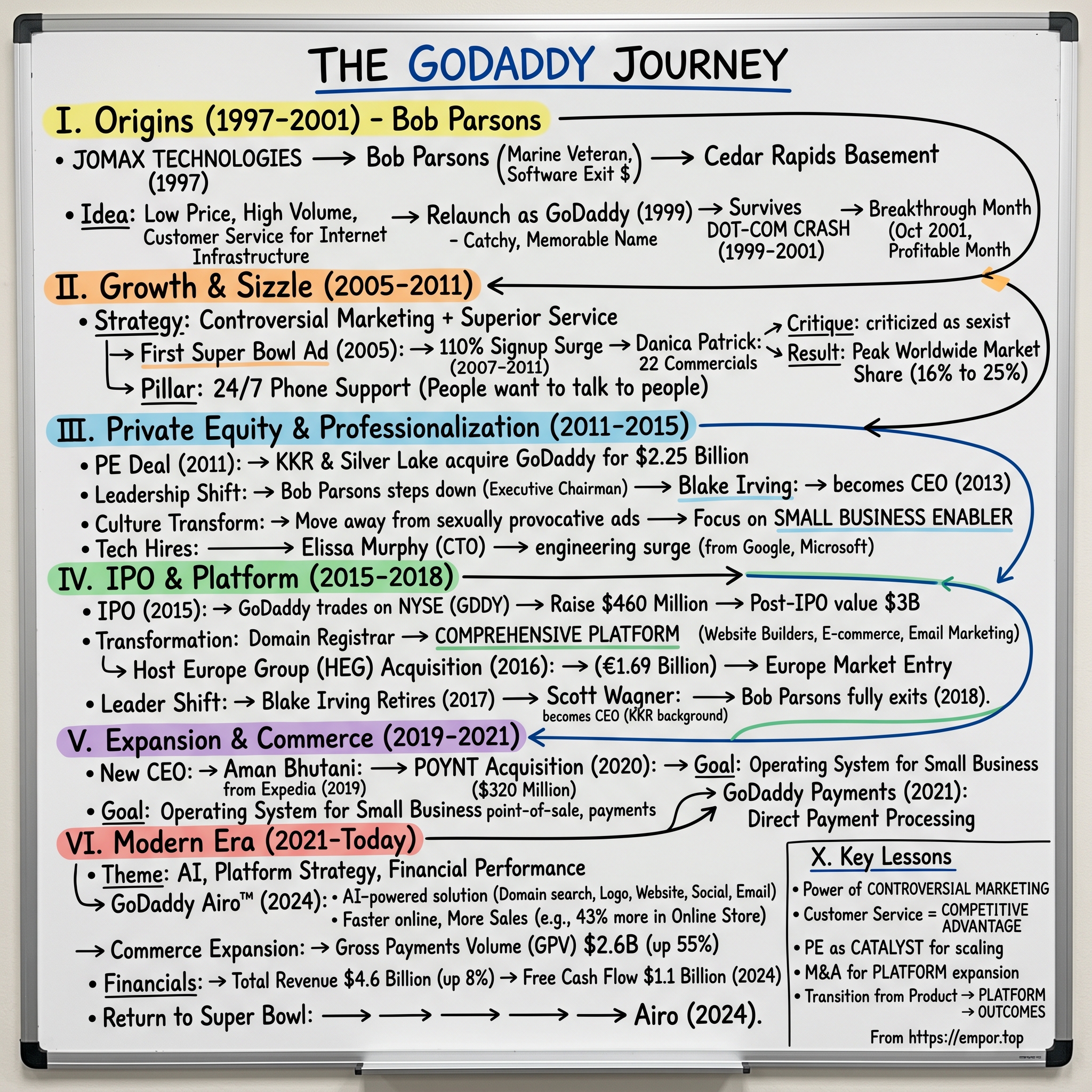
GoDaddy Inc. (NYSE: GDDY): The Domain Tollbooth, The Activist Crucible, and The Software Flywheel
I. Introduction & The Core Investment Thesis
On the morning of February 25, 2026, GoDaddy shareholders confronted an unexpected paradox. The prior evening, the company had reported the strongest financial results in its history: $5.0 billion in revenue, up 8%, a normalized EBITDA margin of 32%, and $1.6 billion in free cash flow, an increase of 19%.1 By the closing bell, however, the stock had tumbled 14% to $79.12.2 Within months, a plaintiffs' law firm began soliciting shareholders for a class action alleging that executives had failed to adequately disclose the drag that a $4.99 introductory one-year .com promotion would exert on forward bookings.2 By June 11, 2026, the stock had dropped 58% from its 52-week high of $181.49, touching $75.17.3
How a business generates record cash while public markets slash its equity value by more than half is the defining question of GoDaddy's modern era. It also points to an operating reality far detached from the company's popular reputation.
In the public imagination, GoDaddy remains tied to its mid-2000s Super Bowl campaigns, Danica Patrick sponsorships, and an outspoken founder who courted controversy. Beneath that legacy branding sits an infrastructure powerhouse. GoDaddy manages approximately 81 million domain names, representing roughly 22% of all registered domains globally.4 It serves 20.4 million customers—predominantly micro-businesses and solo entrepreneurs—generating an average of $242 annually per user, up 10% in 2025.1 Meanwhile, between January 2022 and April 2025, management repurchased and retired more than a quarter of the company's fully diluted shares.5
The central mystery. Domain registration is among the most commoditized utilities on the internet. Wholesale pricing for .com addresses is fixed by VeriSign under agreements supervised by ICANN and the U.S. government, while competitors such as Cloudflare sell domain registrations strictly at cost with zero markup.6 Yet GoDaddy has converted this undifferentiated utility into a top-of-funnel customer acquisition engine generating more than $1 billion in annual free cash flow.
The mechanics behind that transition unfolded across four distinct operating phases:
- The Bootstrapped Frontier (1997–2011). Bob Parsons, a Marine combat veteran turned software entrepreneur, combined brash marketing with high-touch phone support to wrest market share from entrenched incumbents.
- The Financial Engineering Era (2011–2016). A leveraged buyout led by KKR, Silver Lake, and TCV institutionalized corporate governance and took the business public in 2015.
- The Empire-Building & M&A Hangover (2016–2021). Aggressive European acquisitions, an expansion into payment processing, and a foray into social-media management yielded scale, but also balance-sheet bloat and organizational friction.
- The Activist Crucible & Modern AI Era (2021–Present). Activist pressure from Starboard Value catalyzed a capital-allocation overhaul under chief executive Aman Bhutani and financial chief Mark McCaffrey, alongside a strategic pivot to generative AI—marketed under the Airo brand—intended to convert entry-level domain buyers into higher-margin software subscribers.
The investment spine. The bull thesis treats GoDaddy as an indispensable tollbooth for digital commerce: steady, high-margin cash flows from domain renewals fund the software ecosystem, while sustained share repurchases compound per-share earnings even with single-digit revenue growth. The bear thesis views GoDaddy as a mature utility confronting customer saturation. In that framework, top-line gains rely on raising prices across a stagnant customer base, while generative search engines, automated coding tools, and walled-garden platforms increasingly make standalone websites unnecessary for small merchants.
The 2026 market rout signaled that investors are divided on which narrative will prevail. Assessing that debate requires examining GoDaddy's financial and operational foundation, beginning with the founder who established its model.
 Subscribe on LinkedIn
II. The Bob Parsons Era & The Commodity Counter-Position (1997–2011)
A lance corporal on Hill 190
In 1969, an 18-year-old from Baltimore arrived in Vietnam as a rifleman with Delta Company, 1st Battalion, 26th Marines. Bob Parsons had enlisted at 17. About a month into his tour, near Hill 190, he was wounded.7 He returned home decorated with a Purple Heart, a Combat Action Ribbon, and the Vietnamese Cross of Gallantry.8
Parsons subsequently graduated magna cum laude with an accounting degree from the University of Baltimore and passed the certified public accountant exam on his first attempt.87 He then taught himself computer programming. In 1984, he invested roughly $40,000 to launch Parsons Technology, a personal-finance software company. He expanded the business to approximately 1,000 employees and $100 million in annual revenue before selling it to Intuit in 1994 for $64 million.89
Retirement proved brief. In January 1997, Parsons founded Jomax Technologies, named after a road near his home in Scottsdale, Arizona.10 Backing the venture with an estimated $36 million from the Intuit sale, he had burned through all but roughly $6 million by early 2001.11 The origin of the company's permanent name was incidental: Parsons recalled that an employee suggested "Go Daddy," checked GoDaddy.com in a browser to confirm availability, and registered the domain. The business formally adopted the name in 1999.1213
Breaking a monopoly's price umbrella
The timing aligned with a regulatory inflection point. Throughout most of the 1990s, Network Solutions held an exclusive, government-sanctioned monopoly to register .com, .net, and .org web addresses, charging $35 annually sold in mandatory two-year blocks for $70 upfront.14 In April 1999, the newly formed Internet Corporation for Assigned Names and Numbers (ICANN) designated its first five competitive testbed registrars, dismantling the monopoly and opening retail registration to competition.15
Parsons recognized what legacy operators overlooked: once a central registry database existed, a domain registration was a pure digital commodity with negligible marginal cost. The commercial value lay not in the database entry itself, but in the customer acquiring it. GoDaddy undercut the market aggressively. By 2006, its standard retail price for a one-year .com registration was $8.95, a fraction of Network Solutions' legacy fee.10 The low price served as a customer acquisition wedge rather than the end product.
Surviving the bust with other people's cash
When the dot-com collapse eliminated wave after wave of venture-backed internet startups in 2000 and 2001, GoDaddy survived. According to corporate lore recounted by Parsons, he had contemplated selling the business as his personal capital dwindled, but after observing an unbothered hotel valet in Hawaii, he resolved to persevere. "That October [2001], we turned the corner, and we've been making money ever since," he later recalled.1211
That assertion of profitability requires an essential accounting qualifier that illustrates GoDaddy's core financial model. The company's 2006 regulatory filing revealed net losses under standard accounting principles in every year from 2002 through 2005, including a net loss of $11.6 million in 2005. Yet over that same period, operating cash flow expanded steadily, rising from $7.7 million in 2003 to $15.5 million in 2004 and $30.6 million in 2005.10
The divergence stemmed from deferred revenue. Because customers paid for multi-year registrations upfront, cash entered GoDaddy's bank accounts on day one, while accounting standards required recognizing that revenue ratably over the life of the contract. Parsons' turning point was a cash-flow breakeven rather than an accounting profit. That dynamic established an enduring pattern: upfront customer cash funded operational expansion, allowing cash generation to consistently outpace reported net income.
"Sawdust with sex appeal"
In February 2005, GoDaddy broadcast a Super Bowl commercial parodying the previous year's television wardrobe controversy, depicting professional wrestler Candice Michelle testifying before a mock congressional committee. According to Parsons, Fox and the NFL pulled the commercial before a scheduled second airing.16 The ensuing media attention converted a single broadcast slot into weeks of mainstream press coverage, generating an estimated $11.7 million in earned publicity, according to one academic study.17 GoDaddy subsequently claimed that its share of new domain registrations rose from 16% to 25% following the broadcast—a figure that reflects internal company attribution rather than an independently audited market-share series.18
That promotional playbook became a decade-long staple. Race-car driver Danica Patrick made her debut in a GoDaddy Super Bowl commercial in 2007 and went on to appear in 13 of the company's game-day spots through 2015.19 Although frequently criticized as gratuitous and sexist, the provocative advertisements executed a deliberate economic strategy: customer-acquisition arbitrage. By manufacturing cultural controversy around an otherwise invisible utility, GoDaddy built mass awareness at a fraction of the cost required by conventional corporate advertising.
The phone-support fortress
High-decibel advertising represented only the front door; customer service drove the underlying economics. While tech industry orthodoxy in the mid-2000s steered users toward automated help pages and email ticketing, GoDaddy positioned round-the-clock, live telephone support as a core product differentiator.10 The target demographic—independent tradespeople, florists, and sole proprietors—rarely understood domain name system records or web hosting architectures, and valued direct human guidance to get their businesses online.
Crucially, those inbound support calls functioned as high-conversion distribution channels. Representatives assisting customers with domain configuration regularly cross-sold hosting plans, SSL security certificates, and customized email inboxes. The operational model persisted long after Parsons' tenure: as late as 2019, GoDaddy disclosed in its annual filing that it engaged approximately 3,300 customer-care contractors, known internally as Guides, alongside roughly 7,000 full-time staff.20 Customer service operated not as an overhead cost center to minimize, but as an inbound sales funnel.
The wall
By the late 2000s, two developments exposed the operational limits of Parsons' playbook.
The aborted IPO. In May 2006, GoDaddy filed for an initial public offering to raise up to $200 million through underwriters led by Lehman Brothers, Merrill Lynch, and UBS. The registration statement documented rapid growth, with 2005 revenue surging 92% to $139.8 million across 13.6 million domains under management, while Parsons retained 100% ownership.10 That August, GoDaddy abruptly withdrew the registration.21 Management cited unfavorable market conditions, while Parsons publicly described the Securities and Exchange Commission's quiet-period regulations as "suffocating" for an outspoken chief executive.22 For a high-growth enterprise, abandoning a public listing highlighted the friction between Parsons' idiosyncratic leadership style and institutional public-market governance.
Brand fatigue. In March 2011, Parsons posted a video depicting himself hunting and killing an elephant in Zimbabwe. Animal-rights organizations prompted calls for customer boycotts, to which Parsons responded that the hunt was "certainly nothing to be ashamed of."23 Nine months later, in December 2011, GoDaddy faced severe industry backlash over its vocal endorsement of the Stop Online Piracy Act (SOPA), prompting a customer boycott that forced management to reverse its stance within days.24
The insurgent counter-positioning that had disrupted a legacy monopoly had turned into an operational liability for a dominant market leader. Provocative branding can accelerate customer acquisition for an upstart, but it risks alienating commercial clients once a platform becomes core digital infrastructure. By 2011, GoDaddy commanded substantial cash flow and market share, but its governance had reached a structural ceiling. The transition to institutional ownership arrived later that year through private equity.
III. The Private Equity Playbook: KKR, Silver Lake & The 2015 IPO (2011–2016)
The buyout
On July 1, 2011, GoDaddy announced that investment funds affiliated with KKR, Silver Lake, and Technology Crossover Ventures would acquire a controlling stake in the company. At the time, GoDaddy served 9.3 million customers and managed more than 48 million domain names.25 The firms did not disclose financial terms, but The Wall Street Journal reported a valuation of approximately $2.25 billion,26 with later reporting indicating the sponsors acquired a combined interest of roughly 65%.27 The transaction closed on December 16, 2011,13 while Parsons retained a significant minority shareholding.25
The sponsors' investment thesis treated the business as an annuity: millions of customers automatically renewing low-ticket subscriptions, paying upfront, backed by an operations-heavy support model that could be professionalized. By moderating the company's provocative marketing, expanding engineering talent, and broadening adjacent web services, private equity aimed to take GoDaddy public at the multiple of a software-as-a-service provider rather than that of a commodity registrar.
A revolving door, then a professional
The initial operational handoff proved turbulent. Longtime executive Warren Adelman took over as chief executive when the transaction closed, but stepped down in July 2012 after less than eight months. Scott Wagner, an operating executive from KKR, stepped in as interim chief executive.28 In December 2012, the board appointed Blake Irving as chief executive, effective January 2013. Irving brought established big-tech operating credentials, having spent 15 years at Microsoft—including as corporate vice president for Windows Live—before serving as chief product officer at Yahoo.29
Irving provided a deliberate counterweight to Parsons: understated, product-oriented, and focused on institutional rehabilitation. Under his leadership, GoDaddy retired its provocative advertising campaigns and repositioned its target audience around the concept of the "everyday entrepreneur." Irving expanded technical hiring and pursued tuck-in acquisitions to diversify GoDaddy's software and services catalog. In September 2013, GoDaddy acquired the domain aftermarket platform Afternic, alongside SmartName and NameFind, from NameMedia on undisclosed terms.30 That transaction established the foundation for GoDaddy's secondary-market domain operations.
The 2015 IPO
On March 31, 2015, GoDaddy priced 23 million Class A shares at $20, above its initial marketed range of $17 to $19, raising $460 million.3132 The stock opened at $26.15 on the New York Stock Exchange the following day, gaining 31%.32
The final offering prospectus established an operating baseline that framed the company's subsequent decade. In 2014, GoDaddy generated $1.39 billion in revenue and $1.68 billion in bookings, supported roughly 12.7 million customers, and managed about 59 million domains, with average revenue per user at $114. It also posted a net loss of $143.3 million, burdened by leverage incurred in the buyout, intangible asset amortization, and equity compensation.33 Following the offering, the private equity sponsors and Parsons retained combined voting control of 59.4%.33
Comparing that 2014 baseline against 2025 illustrates the business's long-term operating trajectory. Over that period, average revenue per user more than doubled from $114 to $242,331 while the customer base expanded by approximately 60%, from 12.7 million to 20.4 million.331 The contrast reveals that the primary engine of GoDaddy's post-IPO growth was not customer acquisition, but extracting higher revenue per customer—an economic pattern that would become even more pronounced in later years.
The exits, and the fine print
The sponsors gradually unwound their positions over the next four years. TCV fully liquidated its equity by February 2018, while affiliates of KKR and Silver Lake reduced their stakes below the 5% regulatory reporting threshold by February 2019. Parsons stepped down from the board of directors in October 2018 after his holding company, YAM Special Holdings, sold its remaining shares.3435 Irving retired at the end of 2017, handing the chief executive role on January 1, 2018, to Scott Wagner, the former KKR partner who had served as GoDaddy's chief operating officer and chief financial officer.36
While the sponsor exit is often viewed as a textbook private equity monetization, it included a costly coda. At the time of its initial public offering, GoDaddy entered into tax receivable agreements with its pre-IPO owners, obligating the public company to pay the sponsors and Parsons a share of future tax savings generated by the transaction structure. In July 2020, GoDaddy agreed to pay $850 million to terminate the tax receivable agreements with KKR, Silver Lake, TCV, and YAM.37 A shareholder derivative lawsuit followed, and in 2023 the Delaware Court of Chancery refused to dismiss the complaint, finding a reasonable inference that the board and the then-chief financial officer had acted in bad faith in approving the buyout.38
The procedural ruling did not constitute a finding of liability, but it highlighted how pre-IPO contractual encumbrances transferred substantial capital from public shareholders back to early sponsors. With the private equity consortium fully exited and institutional governance established, GoDaddy turned toward an aggressive acquisition strategy to build a broader software and hosting ecosystem.
IV. The M&A Roll-Up & Capital Allocation Hangover (2016–2021)
The European land grab
On December 6, 2016, GoDaddy announced its largest transaction to date: the acquisition of Host Europe Group (HEG) for €1.69 billion (approximately $1.79 billion). The purchase price comprised roughly €605 million paid to selling shareholders alongside €1.08 billion in assumed net debt, valuing HEG at approximately 11 times its estimated 2016 adjusted EBITDA after factoring in projected synergies.39 The acquisition delivered more than 1.7 million customers, over 7 million domain names, and a portfolio of regional European hosting brands including 123 Reg, Domain Factory, Heart Internet, and Host Europe.39
The transaction closed in April 2017. That July, GoDaddy agreed to sell HEG's enterprise managed-hosting division, PlusServer, to funds advised by BC Partners for €397 million, applying the proceeds toward repaying a €500 million bridge loan.40 Strategically, the carve-out was straightforward: GoDaddy retained the mass-market small-business assets that aligned with its core retail model while shedding an enterprise operation outside its focus.
Assessing the long-term performance of the remaining HEG assets proved more complicated. Acquiring a collection of regional European hosting providers saddled GoDaddy with a patchwork of disparate legacy systems. Because GoDaddy does not break out HEG's standalone financial results or return on invested capital, an exact economic accounting remains elusive. What became evident, however, was the technical liability. When GoDaddy disclosed a major security breach in November 2021, the compromise swept across 123 Reg, Domain Factory, Heart Internet, Host Europe, Media Temple, and tsoHost alongside its own Managed WordPress environment.41 Integration debt represented more than an operational expense; it expanded the company's attack surface.
Building the aftermarket clearinghouse
A quieter, more durable acquisition initiative took shape in the secondary domain market. Following its 2013 purchase of Afternic, GoDaddy agreed in February 2020 to acquire Uniregistry's registrar and marketplace operations, alongside investor Frank Schilling's portfolio of approximately 375,000 domain names.42 The company's subsequent annual filing disclosed $196.9 million paid for two acquisitions during that quarter, without itemizing Uniregistry's standalone purchase price.43 In July 2022, GoDaddy expanded its footprint further by acquiring domain marketplace Dan.com for $71.4 million in cash.44
The commercial logic relied on a two-sided network. Domain investors sought distribution where the highest volume of retail buyers conducted searches, and GoDaddy operated the industry's largest domain search portal. Prospective buyers, conversely, gravitated toward the platform offering the deepest secondary inventory. Consolidating Afternic, Uniregistry, and Dan.com channeled dispersed listings into a unified distribution network, creating one of the few structural network effects across GoDaddy's portfolio.
Yet secondary-market brokerage introduces earnings volatility. Unlike primary domain registrations, aftermarket transactions do not produce predictable subscription cash flows. In 2026, management cited an estimated 200-basis-point drag on revenue growth, driven in part by the expiration of GoDaddy's .co registry services contract and in part by a deliberate decision to exclude volatile, high-value aftermarket domain transactions from forward guidance.3 While secondary brokerage provides lucrative commissions, it lacks the recurring annuity profile of core registry renewals.
Chasing the full stack
Two transactions illustrated the strategic boundaries of attempting to control the full small-business software stack.
Main Street Hub. In January 2018, GoDaddy agreed to acquire Main Street Hub, an Austin-based firm that managed social media accounts and customer reviews for more than 10,000 local merchants, for $125 million in cash plus up to $50 million in potential earn-outs.45 Regulatory filings ultimately reflected total purchase consideration of $182.0 million, with approximately $135 million allocated to goodwill.46 The business relied on labor-intensive, human-managed marketing services rather than automated software, limiting operating leverage. In June 2020, GoDaddy closed both Austin offices of the unit—rebranded as GoDaddy Social—and laid off 331 local employees among 814 workforce reductions company-wide, with chief executive Aman Bhutani attributing the cuts to the economic disruption of the COVID-19 pandemic.47 Less than three years after the acquisition, GoDaddy dismantled the standalone operation.
Poynt. In December 2020, GoDaddy agreed to acquire smart payment-terminal developer Poynt for $320 million in cash alongside $45 million in deferred consideration contingent on performance and employment conditions.48 Poynt founder Osama Bedier, who previously ran Google Wallet and served as a longtime PayPal executive,49 was appointed to lead GoDaddy's newly created commerce division. At signing, Poynt supported more than 100,000 merchants and handled over $16 billion in annualized gross payment volume.48 The acquisition closed in February 2021.50
Management framed the transaction as an omnichannel bridge linking online storefronts to in-person physical checkout, positioning GoDaddy to challenge specialized merchant acquirers such as Block's Square, Fiserv's Clover, and Toast. However, assessing the standalone commercial impact has proved difficult. GoDaddy does not report gross payment volumes or active terminal counts independently, aggregating commerce operations into its broader Applications & Commerce reporting segment. Rather than emerging as a standalone merchant acquirer winning share against dedicated payment processors, GoDaddy's payment features have primarily functioned as an attach product cross-sold into its existing web-hosting and domain customer base.
The cost-structure trap, correctly diagnosed
A conventional critique of GoDaddy's roll-up era assumes an unchecked expansion of corporate headcount. Annual regulatory filings complicate that narrative: the company employed 7,024 full-time personnel at the close of 2019 and 6,910 at year-end 2022, holding overall staffing effectively flat.2051
The underlying cost inflation surfaced instead in overhead and development expense. Starboard Value later highlighted roughly $800 million in annual technology and development outlays in 2022 as primary evidence of structural cost inefficiency.52 With organic revenue growth moderating into the high single digits, continuous M&A obscured operating performance and complicated GoDaddy's equity narrative. By the early 2020s, public markets valued GoDaddy as a fragmented conglomerate of disparate hosting and software properties rather than an integrated platform.
The security bill
Rapid inorganic expansion also left GoDaddy managing a sprawling, heterogeneous technical infrastructure across multiple legacy hosting architectures.
- 2020: In its February 2023 annual filing, GoDaddy disclosed that a "sophisticated and organized group" had targeted its hosting environments across multiple years.53 In March 2020, unauthorized actors used compromised credentials to access the hosting accounts of approximately 28,000 customers.53
- 2021: Attackers leveraged a compromised password in September 2021 to infiltrate GoDaddy's provisioning environment. Discovered that November, the intrusion exposed personal data across up to 1.2 million active and inactive Managed WordPress users, including the exposure of certain private SSL keys.41
- 2022: In December 2022, unauthorized actors installed malware across GoDaddy's cPanel shared-hosting servers, intermittently redirecting customer websites to malicious external domains.53
In May 2025, the Federal Trade Commission finalized a consent order finding that GoDaddy had failed to implement basic cybersecurity safeguards, including multi-factor authentication and robust network intrusion monitoring, despite marketing "award-winning security." The regulatory settlement mandated that GoDaddy maintain a comprehensive information security program subject to biennial independent third-party assessments.54
For a digital infrastructure provider entrusted with customer identities and commercial websites, repeated security failures represented a material operational liability. By the close of the roll-up era, GoDaddy possessed global scale and substantial cash generation, but carried a bloated cost structure and an unintegrated technical portfolio. Understanding why the business continued generating robust cash flows through those operational strains requires examining the unit economics of the core domain engine.
V. Inside the Machine: Core Platform Economics & The Domain Tollbooth
"Really just a commodity"
On September 27, 2018, Cloudflare announced a retail domain registrar that would charge customers strictly the registry's wholesale price, with no markup. Co-founder Matthew Prince framed the launch as a challenge to industry incumbents, decrying "deceitful pricing around a service that is really just a commodity."6 If domain registration was purely commoditized and an established infrastructure provider was giving it away at cost, GoDaddy's core business appeared vulnerable.
Eight years later, GoDaddy still manages roughly 81 million domains, representing about 22% of the global total.455 Understanding why the tollbooth endured requires examining the mechanics of the domain registration hierarchy.
Three layers: registry, registrar, registrant
The industry operates like a property recording system:
- The registry functions as the central land registry. For
.comand.net, that entity is VeriSign, which maintains the authoritative master database under an agreement with ICANN and a cooperative agreement with the U.S. Department of Commerce. Every.comdomain sold anywhere in the world costs the retail seller VeriSign's uniform wholesale fee. - The registrar acts as the retail agent: GoDaddy, Namecheap, Squarespace, Cloudflare, and hundreds of accredited competitors. The registrar manages customer accounts, billing, domain name system (DNS) records that route names to numeric server IP addresses, and customer support.
- The registrant is the retail end-user, who does not purchase permanent property rights in a domain, but licenses the right to use it for an agreed term subject to annual renewals.
Because every registrar pays the registry the identical wholesale fee, commercial competition unfolds entirely in the retail agent layer through pricing, bundled services, platform convenience, and customer support.
The Core Platform in numbers
GoDaddy reports its domain business, alongside legacy hosting and website security products, in its Core Platform segment. In 2025, the segment generated approximately $3.1 billion in revenue, up 5%, delivering an EBITDA margin of 33.0%.1 That built on 2024 revenue of $2.92 billion, which grew 3.4% with a 31.9% margin.56 Through the second quarter of 2026, Core Platform revenue expanded 3.9%.57
The financial profile reflects a mature, cash-generative utility growing in the low single digits while operating margins expand gradually through disciplined cost control. Furthermore, the cash-flow dynamics established in the Parsons era continue to operate at enterprise scale. Because customers frequently pay for multi-year contracts upfront, GoDaddy collects cash well before recognizing revenue, generating negative working capital where subscribers effectively provide interest-free operational financing with every renewal.
The pricing stress test
Under its regulatory agreement, VeriSign holds the contractual right to increase wholesale .com registry prices by up to 7% annually in four years out of every six-year cycle.58 The registry operator has exercised that pricing authority systematically:
- 2021: Wholesale fees increased from $7.85 to $8.39, effective September 2021.59
- 2024: Wholesale fees rose to $10.26, effective September 2024.60
- 2026: In April 2026, VeriSign announced an increase to $10.97, scheduled to take effect November 1, 2026, under a cycle that could eventually lift the wholesale rate to $13.42.58
ICANN formally renewed the .com registry agreement in November 2024.61
Skeptics argue that GoDaddy remains vulnerable because its primary upstream supplier operates as an exclusive legal monopoly with guaranteed contractual price increases. However, GoDaddy's operating metrics demonstrate substantial pass-through resilience. In 2025, even as its total customer count remained essentially flat, average revenue per user climbed 10% to $242.1 Meanwhile, GoDaddy reported steady customer retention of approximately 85%.55 That stability indicates the company passed through wholesale increases—plus an incremental retail spread—without triggering meaningful customer churn. For an active commercial enterprise, a domain is inexpensive relative to the business operations dependent on it; paying a few additional dollars annually is negligible compared to the operational disruption of breaking active corporate email accounts and web traffic.
Yet that pricing leverage carries an essential structural limitation: it applies almost exclusively to renewals rather than initial customer acquisition. When acquiring uncommitted new users, price sensitivity remains high. That divergence was underscored by the 2025 bookings performance. During GoDaddy's fourth-quarter 2025 earnings call, analysts pressed executives regarding an aggressive $4.99 introductory one-year .com promotional campaign. Management conceded that shifting new cohorts toward shorter annual contracts and lower initial order values had compressed forward bookings.62 While GoDaddy exercises reliable pricing power over its entrenched installed base, it must still discount heavily at the top of the funnel to capture new registrations. Its pricing power is real, but it is an instrument of retention rather than expansion.
The competitive map
Cloudflare. Despite predictions that Cloudflare's at-cost model would siphon away GoDaddy's registrations, GoDaddy's domain portfolio expanded from roughly 59 million names around its 2015 initial public offering to approximately 81 million, though growth flattened between 2024 and 2025.3355 The two providers largely target different buyer profiles: Cloudflare's registrar caters primarily to technical operators already utilizing its content delivery and cybersecurity network, whereas GoDaddy serves non-technical entrepreneurs seeking automated setup and live assistance. In practice, the platforms have found points of alignment; Cloudflare subsequently partnered with GoDaddy on an open agent-naming standard.63
Squarespace and Google Domains. In June 2023, Squarespace reached an agreement to acquire Google's domain registrar business and its portfolio of approximately 10 million registrations,64 completing the transaction that September for roughly $180.7 million.65 Google's exit underscored that operating a standalone domain registrar without an integrated small-business software ecosystem offered little strategic return, even for a technology titan. In October 2024, private equity sponsor Permira completed a take-private acquisition of Squarespace at an aggregate valuation of approximately $7.2 billion.66 The consolidation signaled both the commoditized economics of unbundled domain sales and the emergence of a well-capitalized, design-focused competitor positioned to aggressively cross-sell higher-margin services into its acquired subscriber base.
The automated frontier. The more profound structural threat to GoDaddy's customer acquisition funnel stems not from rival retail registrars, but from shifting search and onboarding habits. During the fourth-quarter 2025 earnings call, Bhutani acknowledged that "a lot of companies are facing challenges of traffic from search," observing that "the world is changing very, very quickly, and I don't think anyone is insulated from it."62 When generative AI assistants, automated coding platforms, and programmatic tools deploy websites and register domains directly via developer application programming interfaces (APIs), transactions naturally flow to the lowest-cost programmatic registrar rather than a consumer brand with consumer marketing heritage. While GoDaddy can construct developer-facing interfaces, machine-to-machine transactions neutralize the high-touch phone support and retail cross-selling channels that historically anchored its competitive moat.
The domain registration business functions as a durable cash-flow annuity supported by reliable pass-through pricing upon renewal. It is no longer an organic growth driver, and its role as an exclusive customer gateway for micro-enterprises faces mounting platform competition. Consequently, the company's valuation increasingly hinges on its higher-margin software and commerce services.
VI. Applications & Commerce: The Margin Engine & The Airo Pivot (2021–Today)
The five-minute business
On February 26, 2024, GoDaddy unveiled GoDaddy Airo. The pitch was that a first-time entrepreneur would type in a business idea and, within minutes, AI would generate a logo, a website, a matching email address, social posts and ad copy, all tied to the domain they had just bought.67 The target was the oldest problem in the industry: people buy a domain, stare at a blank page and never build anything. When the renewal notice arrives a year later, they let it lapse.
What is inside A&C
The Applications & Commerce (A&C) segment houses everything GoDaddy sells on top of the domain:
- its website builder and marketing tools;
- Managed WordPress;
- productivity products, most importantly professional email and Microsoft 365 sold through GoDaddy;55
- commerce services, including payments and the Poynt-derived point-of-sale hardware.
It is the smaller segment, but it has been the faster-growing and more profitable one. In 2024 A&C revenue was $1.65 billion, up 15.6%, with a 44.7% segment EBITDA margin.56 In 2025 it grew 14% to about $1.9 billion, and the margin rose to 45.4%, reaching 47.1% in the fourth quarter.1
Mix shift is the engine of GoDaddy's margin story. A&C's margin runs well above the Core Platform's, so every dollar of A&C growth lifts the company average.
The land-and-expand logic
The strategic idea is that the domain purchase is the earliest moment of commercial intent in a small business's life. It usually comes before a bank account, a payment processor or an accounting system, which means before most other vendors know the business exists. A domain on its own is a low-value transaction. Attach email, then a website, then security, then payments, and the same customer becomes several times more valuable, with every added service raising the cost of leaving.
The Microsoft relationship illustrates the capital-light version of this. GoDaddy does not build a rival email system. It sells a best-in-class product, sets it up automatically inside the domain flow, and earns recurring revenue with little development risk. The trade-off is dependence: the economics rest on a supplier with its own direct small-business channel.
Decelerating, not accelerating
The bull narrative is that A&C will grow into a larger share of the business and carry corporate margins upward. The segment's trajectory complicates that. Its growth rate has stepped down:
- 15.6% in 2024;56
- 14% in 2025;1
- 12% in the first quarter of 2026;63
- 11% in the second quarter of 2026, even as the segment margin rose to 46.8%.57
Margins are still rising while growth is fading. That is the pattern of a business being harvested and optimized, not one entering a new growth phase. Management has also said that do-it-for-you services and template-driven website builders are in structural decline. It estimated about 100 basis points of bookings drag as it migrates legacy products into Airo.68
This is where the juxtaposition matters. The mix shift toward A&C is real, but it is not guaranteed to keep going. If A&C's growth converges toward the Core Platform's, the corporate margin expansion that powered 2022–2025 will slow to whatever cost cuts alone can deliver.
Airo's evolution and the commercialization test
Airo has evolved quickly:
- Airo Plus. GoDaddy launched this version, with more advanced marketing features, in 2024.56
- Airo.ai beta. In November 2025 it launched this beta with six AI agents: a general Airo agent, an app builder, a compliance agent, a domain agent, a website builder and a logo maker.69
- Scale. By its FY2025 results, it said Airo.ai had 25 agents in production.1
- Early monetization. In April 2026, management said its AI builder had reached a multi-million-dollar annualized bookings run rate within weeks of its beta launch.63 By July, the Airo annualized bookings run rate had reached $50 million, five times the prior quarter.57
The progress is real, and fivefold quarterly growth is not trivial. It must be set against the scale of the business. GoDaddy's annualized recurring revenue in the second quarter of 2026 was about $4.4 billion.57 A $50 million run rate is roughly 1% of that. Investors appeared to grasp the proportion: shares fell about 17% after the Q2 2026 report, despite earnings that beat consensus, as commentators noted how small Airo still was.7068
GoDaddy's own history also argues for caution. Poynt and Main Street Hub were each presented as a way to capture more of the small-business wallet. Neither became a disclosed, independent growth engine, and one was shut down. That record does not mean Airo will fail. It means the burden of proof sits on the numbers, not on the demo.
The KPI that would settle it is not Airo's standalone run rate. It is whether new-customer cohorts that use Airo renew and attach paid products at materially higher rates than those that do not. GoDaddy has not published cohort retention data at that level.
The agent-naming bet
The most intriguing optionality is also the most speculative. In October 2025 GoDaddy announced an Agent Name Service (ANS), a system that uses DNS and digital certificates to give AI agents verifiable identities.71 It has since signed partners including LegalZoom and Cloudflare63 and said it will contribute ANS to the Linux Foundation.57 The logic is elegant. If AI agents will transact with each other, they need trusted names, and names are what GoDaddy knows.
Contributing a standard to an open foundation, however, is the opposite of cornering a resource. It may make ANS more widely adopted and GoDaddy more central to the ecosystem, but it does not by itself create revenue. This is a technical first, not yet a business line.
Bhutani has said the "majority of our code is now AI-driven or AI-generated," a statement about GoDaddy's own cost base as much as its product.62 That points toward the other half of the modern story: how a mature company, under pressure, learned to treat its cash flow as the product.
VII. The Activist Reckoning & The New Capital Allocation Blueprint
The letter in the mailbox
On December 27, 2021, reports surfaced that Starboard Value, the activist hedge fund led by Jeffrey Smith, had accumulated a 6.5% stake in GoDaddy valued at roughly $800 million.72 Starboard's operating playbook was familiar across corporate boardrooms: target an established technology enterprise whose cost structure and capital allocation lag operational peers, then publicly advocate for margin expansion, aggressive share repurchases, board refreshment, or a full corporate sale.
GoDaddy's executive leadership had only recently taken shape. Aman Bhutani took over as chief executive in September 2019 following nine years at Expedia Group, where he had advanced from technical leadership to president of Brand Expedia Group, succeeding Scott Wagner after Wagner stepped down for health reasons.73 Mark McCaffrey arrived as chief financial officer in June 2021 after more than two decades as a partner at PricewaterhouseCoopers, where he led the firm's U.S. technology, media, and telecommunications practice.74
The pairing combined an engineer's focus on software platforms with an auditor's discipline for operational metrics. Neither executive, however, had previously led an independent public company.
The first answer: buybacks and targets
GoDaddy moved preemptively before Starboard formalized public demands. At its February 11, 2022 Investor Day, management established multi-year targets running through 2024:75
- compound annual revenue growth of at least 10%;
- a normalized EBITDA margin between 24% and 26%;
- roughly $3.8 billion in cumulative unlevered free cash flow; and
- a $3 billion multi-year share repurchase authorization, committing approximately 80% of free cash flow to buybacks.
Three days later, GoDaddy initiated a $750 million accelerated share repurchase agreement with Goldman Sachs and Morgan Stanley.76
The eventual scorecard on that 2022 framework illustrated an enduring corporate pattern. Management exceeded its operational profitability commitments, delivering a 2024 normalized EBITDA margin of 30.5%.56 Top-line expansion, however, fell short: 2024 revenue grew 8%, missing the double-digit target.56 The executive team proved capable of controlling internal operational costs, even as customer-driven revenue growth trailed guidance.
Cost discipline deepened in early 2023. That February, GoDaddy eliminated approximately 550 positions, representing roughly 8% of its workforce, incurring between $55 million and $65 million in restructuring charges.77
Starboard goes public
On September 12, 2023, Starboard escalated the dispute, publishing an open letter addressed to Bhutani and board chairman Brian Sharples. The activist disclosed that GoDaddy had repeatedly rebuffed its requests for board representation and demanded direct shareholder oversight.78 Starboard's position had expanded to roughly 7.8%, making it the company's third-largest shareholder. The fund criticized GoDaddy's roughly $800 million in annual technology and development spending in 2022, demanded that management reach a combined growth-plus-margin benchmark of at least 40% by year-end 2024, and cautioned that the board should evaluate strategic alternatives—including a company sale—if execution faltered.52
Starboard partner Peter Feld followed with a second public letter on January 31, 2024, confirming a stake exceeding 6%. Feld urged management to adopt prudent financial guidance and outlined concrete cash-flow expectations: approximately $9 in free cash flow per share for 2024, roughly $14 by 2026, and more than $4 billion in cumulative free cash flow over the three-year stretch.79[^80]
Significantly, Starboard never secured a seat on GoDaddy's board. The hedge fund exercised influence entirely through public scrutiny and the structural threat of a proxy contest. GoDaddy's response was to execute the activist's operational recommendations while conceding none of its formal governance.
March 2024: the new algorithm
At its March 6, 2024 Investor Day in Tempe, Arizona, management unveiled an updated three-year operating framework spanning 2024 through 2026:80
- annual revenue growth between 6% and 8%;
- a normalized EBITDA margin reaching approximately 33% by 2026;
- at least $4.5 billion in cumulative free cash flow; and
- compound annual free-cash-flow-per-share expansion exceeding 20%.
The revised financial parameters lowered top-line expectations while establishing more ambitious cash-generation goals, tacitly acknowledging that the prior double-digit revenue targets were out of reach.
Management largely met those revised benchmarks across the subsequent reporting periods:
- Revenue: GoDaddy posted top-line growth of 8% in 2024 and 8% in 2025,561 before narrowing full-year 2026 revenue guidance to between $5.215 billion and $5.255 billion, representing annual growth of 5% to 6%.57
- Margins: Normalized EBITDA margin reached 32% in 2025 and 33.4% in the second quarter of 2026, tracking full-year guidance above 33%.157
- Free cash flow: The platform generated $1.36 billion in free cash flow in 2024 and $1.6 billion in 2025, alongside full-year 2026 guidance of roughly $1.8 billion, keeping cumulative generation on pace to exceed the $4.5 billion target.56157
The executive team established credibility with institutional investors by establishing quantifiable operational metrics and delivering on them. Yet that execution carries two material qualifications.
First, performance concentrated entirely in operational variables directly within executive control—operating expenses, margin expansion, and share repurchases. The variable dependent on broader customer adoption, top-line revenue expansion, remained near the bottom of guidance and continued to decelerate.
Second, executive compensation did not explicitly tie bonuses to free-cash-flow-per-share generation. The company's 2025 proxy statement revealed that long-term performance share units vested based exclusively on total shareholder return relative to a Nasdaq internet index, while annual incentive compensation was evaluated across a blended scorecard of revenue, normalized EBITDA, bookings, and unlevered free cash flow.81
The buyback cannon, and its aim
GoDaddy's capital allocation unfolded most visibly in its share count:
- 2022 through early 2024: GoDaddy repurchased 34.2 million shares for $2.6 billion at an average price of $74.99, retiring approximately 20% of diluted shares outstanding.82
- 2024: The company deployed an additional $676.5 million toward repurchases.56
- April 2025: Two accelerated share repurchase agreements retired 4.4 million shares at an average price of $176.02, totaling $767.4 million. Those transactions completed an expanded $4 billion program that ultimately bought back 43.7 million shares at an average cost of $91.45, retiring more than a quarter of the company's fully diluted equity. The board subsequently authorized a replacement $3 billion repurchase program running through 2027.5
- Full-year 2025: Repurchases totaled $1.6 billion across 10.2 million shares.1
- 2026: GoDaddy deployed another $851.8 million to retire 9.8 million shares through late July.57
While the initial tranches completed near $75 proved accretive, later executions revealed the risks of programmatic capital return. In 2025, GoDaddy deployed $1.6 billion at an average price near $157 per share, anchored by the April 2025 accelerated repurchase executed at $176. By June 2026, the equity traded down to $75.3 Buying heavily into a market peak reflected rigid execution rather than valuation sensitivity.
Furthermore, capital returns proceeded alongside approximately $2.7 billion in net debt rather than balance-sheet deleveraging, while senior executives reduced personal holdings: the chief financial officer sold shares in June 2026,3 and Bhutani sold roughly $12.7 million in company stock in September 2026.83
Recognition, and departure
GoDaddy gained admission to the S&P 500 on June 24, 2024.84 With its thesis largely adopted and capital returned, Starboard systematically trimmed its equity stake, reducing its holding from approximately 6.4 million shares in March 2024 to zero by March 31, 2025, according to regulatory filings.85 The activist completed its exit near the cyclical high.
The activist campaign reshaped a sprawling corporate footprint into an efficient cash-return utility. It also brought the business to a strategic crossroads: once internal cost restructuring is exhausted, sustained shareholder value depends on reviving underlying customer and revenue growth.
VIII. Acquired Frameworks: 7 Powers & Porter's 5 Forces
The bakery that cannot leave
Consider a local bakery that has operated on the same domain name for a decade. Its corporate email accounts run through it. Its point-of-sale receipts link to it. Its Google Business profile, its supplier invoices, and the QR code printed on every cake box point back to that single address. Transferring to an alternative registrar to save five dollars a year would require unlocking the domain, requesting an authorization code, re-pointing nameservers, reconfiguring DNS records for email routing, and re-issuing SSL security certificates. A single technical error could take the business's website and order inbox offline on a busy Saturday morning.
The business owner will simply never make that switch. That operational friction, multiplied across millions of small enterprises, represents the foundational reality of GoDaddy's economics.
Hamilton Helmer's 7 Powers
1. Switching costs (strong, but asymmetric). GoDaddy's reported customer retention rate of approximately 85%55 and its capacity to increase average revenue per user by 10% in 2025 while holding its overall customer count flat1 offer clear empirical evidence of switching costs. The structural limitation, however, is asymmetry: high switching costs insulate the existing installed base, but do nothing to accelerate customer acquisition. They explain why mature cohorts renew, yet offer no guarantee that newly formed businesses will enter GoDaddy's funnel.
2. Scale economies (moderate). Maintaining ICANN accreditation, managing registry connections, running round-the-clock customer care, and overseeing fraud prevention represent substantial fixed overhead spread across more than 80 million domains. That operational leverage enabled GoDaddy to generate a 33.0% Core Platform EBITDA margin in 20251 on an underlying product whose wholesale cost is determined by an upstream monopoly. While valuable, this scale is not unassailable; well-capitalized rivals, including Cloudflare and Permira-backed Squarespace, operate with comparable infrastructure scale.
3. Network effects (moderate, confined to the aftermarket). As detailed in Section IV, the secondary domain marketplace anchored by Afternic and Dan.com forms an authentic two-sided network: listing liquidity draws retail buyers, while buyer traffic attracts domain investors. This dynamic does not extend to the primary registration engine, where one subscriber registering a domain name provides zero marginal value to another.
4. Counter-positioning (historical, now reversed). In the early 2000s, Bob Parsons counter-positioned against Network Solutions by unbundling commodity registrations and pairing low upfront fees with direct telephone support. Today, GoDaddy occupies the legacy position. A new generation of AI-native website builders, automated coding platforms, and developer-centric registrars now counter-positions against GoDaddy's high-touch, upsell-heavy retail model. Management has acknowledged this vulnerability, conceding that traditional do-it-for-you services and template-driven website builders are in structural decline.68
5. Cornered resource (weak). GoDaddy possesses no proprietary top-level domain monopoly; VeriSign controls .com. The 2026 loss of GoDaddy's .co registry services contract demonstrated that even key backend agreements can be reassigned to competitors.3 The company's most distinctive asset is widespread brand recall among non-technical micro-business owners, an advantage that faces steady erosion as digital discovery shifts from traditional web browsers to generative AI assistants.
6–7. Process power and branding (modest). Nearly three decades of refining high-volume, support-intensive retail operations for non-technical entrepreneurs constitutes genuine organizational know-how that competitors cannot easily duplicate overnight. The GoDaddy brand commands near-universal public recognition. However, it does not function as a luxury or enterprise asset capable of commanding a standalone price premium. Furthermore, regulatory enforcement actions—most notably the Federal Trade Commission's 2025 findings regarding cybersecurity deficiencies54—preclude the brand from serving as a clear market signal for enterprise-grade security.
Verdict. GoDaddy's defensible competitive power is concentrated almost entirely in installed-base switching costs supported by operating scale. That combination provides an exceptional mechanism for harvesting cash flow, but an increasingly ineffective tool for acquiring new cohorts.
Porter's Five Forces
Supplier power (high, but passed through). VeriSign dictates wholesale .com pricing under regulatory agreements that permit regular 7% annual increases, including the hike scheduled to take effect in November 2026.58 Because GoDaddy cannot source .com domains from an alternative registry, supplier leverage is absolute. Historically, however, GoDaddy has neutralized this dynamic by passing wholesale price increases—alongside an incremental retail markup—directly on to customers. The primary structural vulnerability would emerge if regulatory authorities or ICANN restricted retail registrar spreads, an intervention that has not occurred.
Buyer power (very low individually, elevated at acquisition). GoDaddy's 20 million small-business subscribers are highly fragmented and possess virtually zero collective bargaining leverage over annual subscription renewals. At the initial point of purchase, however, price sensitivity remains acute, compelling GoDaddy to deploy steep introductory promotions, such as its $4.99 first-year .com campaigns.62
Threat of new entrants (low for retail registrars, high for alternative gateways). Heavy regulatory, technical, and support overhead discourages startups from launching conventional retail domain registrars. The structural threat emerges instead from AI software suites, design platforms, and cloud hosting providers that bundle domain registration invisibly into broader product offerings, turning the standalone registrar from a destination into a background feature.
Threat of substitutes (moderate to high, and rising). Social-media storefronts on Instagram and TikTok, hosted merchant marketplaces on Amazon and Etsy, and generative search engines that answer commercial queries without directing traffic to third-party websites all diminish the necessity of operating an independent corporate website. GoDaddy's plateauing total customer count aligns with this broader shift in how new merchants establish digital visibility.
Industry rivalry (moderate). The retail domain and hosting landscape historically maintained rational pricing through clear market segmentation: Cloudflare and Namecheap competed on wholesale pricing and developer utility; Squarespace and Wix emphasized curated design; and Shopify dominated dedicated e-commerce workflows. That segmentation is increasingly blurring as each platform incorporates generative AI tools, intensifying direct competition over the initial onboarding moment of new businesses.
These competitive frameworks point to a unified conclusion: GoDaddy's moat remains remarkably effective at defending its existing cash-generating base, but the strategic contest has shifted to who controls the entrepreneurial journey at its point of origin. That tension frames the core debate between the bull and bear investment theses.
IX. The Bull vs. Bear Case & What to Watch
The day the numbers stopped mattering
On July 30, 2026, GoDaddy reported second-quarter financial results that appeared robust across key operating metrics:5768
- revenue increased 7%;
- normalized EBITDA margin reached 33.4%, expanding 210 basis points year over year;
- free cash flow rose 13%; and
- earnings per share arrived at $1.83, exceeding the consensus estimate of $1.69.
Yet during the following trading session, the stock tumbled roughly 17% to close at $82.74.70 Management narrowed its full-year revenue guidance, while investors focused on how modest Airo's bookings remained relative to the overall enterprise.70 When a company beats quarterly profit expectations but sells off sharply on moderated growth, public markets send a transparent message regarding which variable dictates valuation.
The bull case
A cash machine with minimal capital requirements. Free cash flow reached $1.6 billion in 2025 and management projected roughly $1.8 billion for 2026, closely matching normalized EBITDA.157 Free cash flow tracks EBITDA because upfront customer prepayments generate positive working capital, while ongoing capital expenditures remain modest.
Per-share compounding independent of rapid top-line growth. Having retired more than a quarter of its shares between 2022 and early 2025, GoDaddy illustrates how sustained capital return can amplify per-share results. With substantial free cash flow, even mid-single-digit revenue growth translates into double-digit expansion in cash flow per share, while a discounted stock price makes ongoing share repurchases more accretive.
Demonstrated pricing leverage across renewals. Average revenue per user climbed from $114 at the 2015 initial public offering to $242 in 2025 and $250 by mid-2026, anchored by an entrenched subscriber base with annual retention near 85%.3315755 VeriSign's wholesale price increase scheduled for November 2026 provides GoDaddy another immediate pass-through catalyst to expand retail margins without triggering meaningful churn.
Operational execution against revised targets. Management has consistently delivered against the March 2024 Investor Day framework across revenue growth, normalized EBITDA margins, and cumulative free cash flow. Executive leadership has established predictability in cost control, reversing a historical pattern of missed top-line ambitions.
Long-term optionality in AI infrastructure. If GoDaddy Airo and the Agent Name Service establish the platform as the default infrastructure layer where emerging AI agents and automated businesses acquire identities, email, and payment rails, the company could successfully revitalize its top-of-funnel customer acquisition engine.
The bear case
Growth driven by price rather than customer expansion. GoDaddy's total customer base has remained stagnant at between 20.4 million and 20.5 million accounts since 2024,56157 while total domains under management held flat at roughly 81 million in 2025.55 Top-line growth has relied almost exclusively on raising prices across an existing user base rather than acquiring new customers—a strategy that risks hitting an elasticity ceiling if retention begins to erode.
Deceleration across higher-margin software. Growth in the Applications & Commerce segment slowed from 15.6% in 2024 to 11% by the second quarter of 2026.5657 The software division intended to drive long-term top-line expansion and support software-as-a-service valuation multiples is decelerating toward single digits.
Disintermediation of the entry-level funnel. Management has explicitly acknowledged the structural threat, noting that commercial search traffic is shifting toward large language models and that no company is insulated from the shift.62 If newly formed enterprises increasingly originate inside automated coding environments and AI workflows that register web addresses programmatically via low-cost developer APIs, GoDaddy's consumer brand equity and telephone support model are bypassed at the point of origin.
Value destruction from pro-cyclical share repurchases. Management deployed $1.6 billion toward share repurchases in 2025 at an average price near $157 per share—more than double the equity's trading level in mid-2026.13 Programmatic buybacks executed aggressively near cyclical market peaks misallocated capital that could have strengthened the balance sheet or accelerated technical reinvestment.
Persistent legal and regulatory overhangs. Ongoing compliance and litigation matters continue to burden the corporate narrative:
- a shareholder class action filed in 2026 alleging inadequate disclosure regarding the impact of promotional pricing on forward bookings, covering purchases from September 2025 to February 2026, with a lead-plaintiff deadline approaching on October 20, 2026;2
- the 2025 Federal Trade Commission consent order, which subjects GoDaddy's information security infrastructure to biennial independent audits;54 and
- derivative litigation in the Delaware Court of Chancery examining the board's approval of the $850 million tax receivable agreement buyout.38
While none of these proceedings presents immediate solvency risk, collectively they highlight lingering scrutiny over corporate governance, security oversight, and disclosure practices.
Balance-sheet leverage in a higher-rate environment. GoDaddy carried approximately $3.8 billion in total debt and $2.7 billion in net debt as of mid-2026,57 with senior notes maturing in 2027 and 2029 alongside term loan facilities due in 2029 and 2031.55 While manageable against approximately $1.7 billion in annualized normalized EBITDA, that debt load limits capital allocation flexibility should operating cash flow compress or refinancing costs remain elevated.
An activist's stress test
A disciplined institutional investor evaluating GoDaddy's capital structure and governance confronts four central challenges:
- Capital allocation discipline versus balance-sheet leverage. Why prioritize aggressive programmatic share repurchases while carrying $2.7 billion in net debt and managing decelerating top-line growth, rather than paying down upcoming debt maturities or accelerating technical investments in AI capabilities?
- Executive incentive misalignment. Why are long-term performance share units tied exclusively to relative total shareholder return against an equity index, rather than fundamental operating health metrics such as organic customer additions, cohort retention, or free cash flow per share?
- The drag of legacy infrastructure. What is the true operating and security cost of supporting disparate European hosting brands from the Host Europe Group acquisition, alongside legacy do-it-for-you website tools that management acknowledges are in structural decline?
- Insider transactions versus corporate messaging. While insider stock dispositions can reflect routine financial planning or Rule 10b5-1 trading programs, personal stock sales by both the chief financial officer in June 20263 and the chief executive in September 202683 contrast uncomfortably with public messaging that the company's equity represents an exceptional repurchase opportunity.
The three KPIs that matter
Three operating metrics will determine whether the bull or bear thesis prevails:
- Free cash flow per share. As the ultimate synthesis of operating efficiency, pricing leverage, and share-count reduction, this metric represents the core test of GoDaddy's capital-compounder model. Sustained expansion above management's 20% annualized target validates the financial algorithm, even amidst modest top-line revenue growth.
- Applications & Commerce expansion and margins. Re-accelerating segment revenue growth above 10% while sustaining EBITDA margins in the mid-40% range would demonstrate that GoDaddy Airo is successfully converting entry-level domain buyers into higher-value software subscribers. A continued slide toward single-digit expansion would indicate that the software cross-selling engine has matured.
- Customer count trajectory and cohort retention. A resumption of net customer additions would signal that GoDaddy has stabilized its top-of-funnel acquisition against AI-native alternatives. Conversely, continued customer stagnation or any degradation of the historical 85% retention rate would indicate that aggressive pass-through pricing is finally eroding the installed base.
Beyond the operational scorecard, GoDaddy's multi-decade trajectory offers broader strategic lessons for mature technology platforms navigating capital allocation, activist interventions, and architectural disruption.
X. Business & Investing Playbook Lessons
1. Own the initial intent, and know that it can be taken
The domain registration represents the initial commercial act for millions of micro-enterprises, and GoDaddy built a durable franchise by positioning itself at that point of origin. Capturing the start of an entrepreneurial journey is a formidable competitive advantage, but only as long as the commercial sequence remains intact. If generative AI tools, automated development environments, and closed-loop platforms shift that initial moment elsewhere—as GoDaddy's plateaued customer count suggests—the upstream customer acquisition wedge weakens.
2. Customer support can be a sales engine
Bob Parsons' decision to invest heavily in round-the-clock telephone support ran counter to tech industry orthodoxy, creating customer trust, high retention, and an inbound sales channel for non-technical entrepreneurs. In the modern era, management has attempted to replicate that guided experience through software via Airo, aiming to deliver personalized onboarding at negligible marginal cost. Yet converting support into automated software introduces a structural gamble: whether an AI interface can inspire the same loyalty, retention, and willingness to purchase add-on services as a live human guide remains unproven.
3. Negative working capital is a quiet superpower
Upfront multi-year customer prepayments have provided GoDaddy with interest-free operational financing since its earliest days, allowing cash generation to consistently outpace reported accounting profits. This negative working capital explains how the company can fund aggressive capital returns without starving core operations of liquidity. However, that financial structure cuts both ways: any deceleration in multi-year bookings compresses cash collections immediately, surfacing in cash flow long before ratable revenue recognition reflects the slowdown—as the 2025 promotional pricing episode demonstrated.
4. When growth slows, capital allocation becomes the product, up to a point
GoDaddy's most effective operating phase for public shareholders arrived when management abandoned empire-building acquisitions and treated free cash flow and per-share compounding as the primary product. That capital-return model demonstrates how mature utilities can generate shareholder value even amidst decelerating revenue growth. Yet programmatic capital return carries its own pitfalls: deploying record free cash flow into share buybacks at market peaks while underlying growth slows can rapidly erode the economic gains realized from repurchases at lower valuations. Capital allocation requires valuation discipline, not merely consistent deployment.
5. AI as an attach-rate catalyst, not a standalone product
Rather than marketing artificial intelligence as an expensive standalone tier, GoDaddy deployed Airo to eliminate onboarding friction and help novice entrepreneurs launch viable storefronts. For price-sensitive micro-businesses, bundling generative tools directly into core subscriptions matches customer buying behavior. Yet that integration makes strategic success difficult to evaluate externally: the true return on investment surfaces in higher renewal rates and software attach, rather than separate product revenue. Until management discloses cohort-level retention and cross-sell data, headline booking run rates offer an incomplete measure of whether the software flywheel is truly turning.
XI. Epilogue & Conference Call Roadmap
Where are they now?
Bob Parsons has spent his post-GoDaddy years building YAM Worldwide, the holding company for his private commercial interests. These include Scottsdale National Golf Club, golf-equipment manufacturer PXG, motorcycle dealerships, and real estate, alongside large-scale philanthropy through the Bob & Renee Parsons Foundation.8 The Marine combat veteran who once observed that he disliked setting goals built a second business empire largely outside the public markets that GoDaddy once shied away from.11
Aman Bhutani and Mark McCaffrey remain at the helm as chief executive and financial chief.8357 Having steered GoDaddy into the S&P 500 and achieved the operating targets established at the 2024 Investor Day, they now confront the more demanding challenge of reigniting customer growth in a landscape reshaped by artificial intelligence. Their executive record will ultimately be evaluated less by the margin expansion already delivered than by whether GoDaddy remains the primary digital gateway for new entrepreneurs.
A reading and listening guide for the next analyst
- March 6, 2024 Investor Day. The foundational presentation outlining the company's current operating blueprint. It details the 2024–2026 financial framework and features management's first comprehensive demonstration of GoDaddy Airo.80[^87]
- Starboard Value letters (September 12, 2023, and January 31, 2024). Essential reading on the activist campaign that reshaped corporate governance, cost discipline, and capital allocation, establishing the specific per-share cash-flow benchmarks that guided executive leadership.78[^80]
- Q4 and full-year 2024 results (February 2025). The high-water mark of the transformation narrative, showcasing 8% revenue growth, a 30.5% normalized EBITDA margin, and Applications & Commerce expanding above 15%—an operational milestone immediately followed by a 14% share-price drop on a quarterly earnings miss.5686
- Q4 2025 earnings call (February 2026). A revealing transcript in which analysts pressed executives on the bookings drag from $4.99 promotional pricing, flat customer counts, and generative AI search disruption, providing the clearest window into how management assesses top-of-funnel threats.62
- Q2 2026 earnings call (July 2026). A critical discussion covering narrowed full-year revenue guidance, the initial $50 million annualized bookings run rate for Airo, and executive acknowledgement that legacy template-driven website builders are in structural decline.6857
- The Host Europe Group announcement (December 2016). A valuable historical contrast. The leveraged, cross-border M&A playbook of that era offers an instructive benchmark against today's disciplined focus on share repurchases and software cross-selling.39
More than a quarter-century after Parsons typed an offhand name into a browser, GoDaddy has become what its founder never quite constructed: a disciplined, institutional cash engine. Whether that engine is compounding an enduring franchise or steadily harvesting a mature one is the central question that every future earnings call must answer.
References
-
GoDaddy Reports Fourth Quarter and Full Year 2025 Results (Form 8-K Exhibit 99.1) — GoDaddy Inc. / SEC, 2026-02-24 ↩↩↩↩↩↩↩↩↩↩↩↩↩↩↩↩↩↩↩
-
GDDY Shareholder Alert: GoDaddy Inc. Securities Class Action Lawsuit — Levi & Korsinsky / PR Newswire, 2026-09 ↩↩↩
-
GoDaddy Has Fallen 58% From Its 52-Week High: Is GDDY Stock a Bargain or a Trap? — TIKR, 2026-06 ↩↩↩↩↩↩↩
-
GoDaddy Inc. Form 10-K for Fiscal Year 2024 — GoDaddy Inc. / SEC, 2025 ↩↩
-
GoDaddy Reports First Quarter 2025 Results (Form 8-K Exhibit 99.1) — GoDaddy Inc. / SEC, 2025-05-01 ↩↩
-
Cloudflare Launches the First Domain Registrar You Can Love — Cloudflare, 2018-09-27 ↩↩
-
Not Bad for a Lance Corporal — Leatherneck / Marine Corps Association, 2022-10-17 ↩↩
-
Scrappy, adaptive, inventive: Fireside chat with GoDaddy's Bob Parsons — ASU News, 2024-12-19 ↩
-
Go Daddy Group, Inc. Form S-1 Registration Statement — SEC, 2006-05-12 ↩↩↩↩↩
-
Racy ads and refusing to set goals: How GoDaddy founder Bob Parsons built his business empire — The Business of Business, 2022-04-18 ↩↩↩
-
GoDaddy's Bob Parsons: We're Only Seeing the Tip of the Iceberg — Practical Ecommerce, 2005-10-05 ↩↩
-
GoDaddy Inc. Form S-1/A Registration Statement — GoDaddy Inc. / SEC, 2015-02 ↩↩
-
ICANN Names Competitive Domain-Name Registrars — ICANN, 1999-04-21 ↩
-
GoDaddy says toned-down ad yanked by NFL, Fox — Arizona Republic via superbowl-ads.com, 2005 ↩
-
Go Daddy Gone: Moral Panic, Advertising, and the Super Bowl — Media Ethics (Lawrence A. Wenner), Spring 2005 ↩
-
Go Daddy Super Bowl press release — Go Daddy via WebWire, 2008-01-25 ↩
-
GoDaddy Inc. Form 10-K for Fiscal Year 2019 — GoDaddy Inc. / SEC, 2020 ↩↩
-
Outspoken GoDaddy CEO Claims IPO Quiet Period Was Just Too Tough — Techdirt, 2006-08-10 ↩
-
Go Daddy CEO Bob Parsons' Elephant Hunt Video Sparks Outrage — ABC News, 2011-04-01 ↩
-
GoDaddy bows to boycott, now opposes SOPA copyright bill — Nextgov (via CNET), 2011-12-30 ↩
-
Go Daddy Enters Partnership with KKR, Silver Lake, TCV — Silver Lake, 2011-07-01 ↩↩
-
Go Daddy sold to private equity firms for $2.25 billion — VentureBeat, 2011-07-01 ↩
-
The IPO Road: GoDaddy's Years in the Making Preparation for Wall Street — Data Center Knowledge, 2014-06-23 ↩
-
GoDaddy CEO Steps Down, Scott Wagner Named Interim CEO — TechCrunch, 2012-07-30 ↩
-
GoDaddy Has A New CEO: Ex-Yahoo Blake Irving — TechCrunch, 2012-12-11 ↩
-
GoDaddy Buys Afternic To Beef Up Its Domain Marketplace — TechCrunch, 2013-09-19 ↩
-
GoDaddy Announces Pricing of Initial Public Offering — GoDaddy Inc. / PR Newswire, 2015-03-31 ↩
-
With IPO Priced Above Range, Web Host GoDaddy Raises $460 Million — Data Center Knowledge, 2015-04-01 ↩↩
-
GoDaddy Inc. Final IPO Prospectus (Form 424B4) — GoDaddy Inc. / SEC, 2015-03-31 ↩↩↩↩↩↩
-
GoDaddy Inc. 2019 Proxy Statement (DEF 14A) — GoDaddy Inc. / SEC, 2019 ↩
-
Bob Parsons resigns from GoDaddy board — Domain Name Wire, 2018-10-03 ↩
-
GoDaddy Announces Retirement of CEO Blake Irving; Scott Wagner to Succeed Irving — GoDaddy Inc. / PR Newswire, 2017-08-22 ↩
-
GoDaddy Inc. Form 8-K: Termination of Tax Receivable Agreements — GoDaddy Inc. / SEC, 2020-07-31 ↩
-
Special Committees Require Special Attention: Lessons from GoDaddy — Sidley Austin (Enhanced Scrutiny), 2023-09 ↩↩
-
GoDaddy Acquires Host Europe Group, Becomes Market Leader in Europe for Small Business Cloud Services — GoDaddy Inc., 2016-12-06 ↩↩↩
-
GoDaddy Inc. Announces Sale of PlusServer — GoDaddy Inc. / PR Newswire, 2017-07-18 ↩
-
GoDaddy Confirms Breach Affects 1.2 Million Customers — BankInfoSecurity, 2021-11-23 ↩↩
-
GoDaddy acquires Uniregistry and Frank Schilling's domain portfolio — Domain Name Wire, 2020-02-11 ↩
-
GoDaddy's Uniregistry acquisition — Domain Name Wire, 2020-02-21 ↩
-
GoDaddy paid $71.4 million for Dan.com — Domain Name Wire, 2022-08-04 ↩
-
GoDaddy To Purchase Main Street Hub For $125 Million — MediaPost, 2018-01-24 ↩
-
GoDaddy Inc. Form 10-Q for Q3 2018 — GoDaddy Inc. / SEC, 2018 ↩
-
GoDaddy shutting Austin offices and laying off hundreds of employees — CultureMap Austin, 2020-06-24 ↩
-
GoDaddy Acquires Poynt, Expands Commerce Services with Offline Sales and Integrated Payments — GoDaddy Inc., 2020-12-15 ↩↩
-
Former Google Wallet Head Launches Poynt, A Future-Proofed Payment Terminal — TechCrunch, 2014-10-29 ↩
-
GoDaddy Completes Acquisition of Poynt — GoDaddy Inc. / PR Newswire, 2021-02-09 ↩
-
GoDaddy Inc. Form 10-K for Fiscal Year 2022 — GoDaddy Inc. / SEC, 2023 ↩
-
Activist investor to GoDaddy: Cut costs — The Register, 2023-09-14 ↩↩
-
GoDaddy Discloses Multi-Year Security Breach — The Hacker News, 2023-02-18 ↩↩↩
-
FTC Finalizes Order with GoDaddy over Data Security Failures — U.S. Federal Trade Commission, 2025-05-21 ↩↩↩
-
GoDaddy Inc. Form 10-K for Fiscal Year 2025 — GoDaddy Inc. / SEC, 2026 ↩↩↩↩↩↩↩↩
-
GoDaddy Reports Fourth Quarter and Full Year 2024 Results (Form 8-K Exhibit 99.1) — GoDaddy Inc. / SEC, 2025-02-13 ↩↩↩↩↩↩↩↩↩↩↩↩
-
GoDaddy Reports Second Quarter 2026 Results (Form 8-K Exhibit 99.1) — GoDaddy Inc. / SEC, 2026-07-30 ↩↩↩↩↩↩↩↩↩↩↩↩↩↩↩↩↩
-
Breaking: VeriSign raising wholesale .com prices — Domain Name Wire, 2026-04-23 ↩↩↩
-
Breaking: VeriSign announces .com price hike to $8.39 — Domain Name Wire, 2021-02-11 ↩
-
VeriSign announces .com price hike to $10.26 — Domain Name Wire, 2024-02-08 ↩
-
ICANN Renews .COM Registry Agreement with VeriSign — ICANN, 2024-11-27 ↩
-
GoDaddy (GDDY) Q4 2025 Earnings Call Transcript — The Motley Fool, 2026 ↩↩↩↩↩↩
-
GoDaddy Reports First Quarter 2026 Results (Form 8-K Exhibit 99.1) — GoDaddy Inc. / SEC, 2026-04-30 ↩↩↩↩
-
Squarespace Form 8-K Exhibit 99.1: Agreement to Acquire Google Domains Assets — Squarespace Inc. / SEC, 2023-06-15 ↩
-
Squarespace Inc. Form 10-Q for Q3 2023 — Squarespace Inc. / SEC, 2023 ↩
-
Permira Completes Acquisition of Squarespace — Permira, 2024-10-17 ↩
-
The Future of Business, Now Unlocked with GoDaddy Airo — GoDaddy Inc., 2024-02-26 ↩
-
Earnings call transcript: GoDaddy beats Q2 2026 estimates but shares fall — Investing.com, 2026-07-30 ↩↩↩↩↩
-
GoDaddy Brings Agentic AI to Small Businesses with Launch of Airo.ai — GoDaddy Inc., 2025-11-13 ↩
-
GoDaddy (GDDY) Stock Plunges 17% After Q2 Earnings — TIKR, 2026-08-02 ↩↩↩
-
GoDaddy Creates Trusted Identity Naming System for AI Agents — GoDaddy Inc. / PR Newswire, 2025-10-02 ↩
-
Starboard has nearly $800 million worth of stake in GoDaddy — Fox Business, 2021-12-27 ↩
-
GoDaddy Appoints Aman Bhutani as CEO (Form 8-K Exhibit 99.1) — GoDaddy Inc. / SEC, 2019-08-01 ↩
-
GoDaddy Names Mark McCaffrey Chief Financial Officer — GoDaddy Inc. / SEC, 2021-05-05 ↩
-
GoDaddy Outlines Key Strategic Growth Initiatives and Outlook at 2022 Investor Day — GoDaddy Inc. / PR Newswire, 2022-02-11 ↩
-
GoDaddy Announces $750 Million Accelerated Share Repurchase (Form 8-K) — GoDaddy Inc. / SEC, 2022-02-14 ↩
-
GoDaddy Inc. Form 8-K: Restructuring Plan — GoDaddy Inc. / SEC, 2023-02-08 ↩
-
Starboard Delivers Letter to GoDaddy — Starboard Value LP / PR Newswire, 2023-09-12 ↩↩
-
Starboard urges GoDaddy to set 'prudent' guidance and offer specifics on cost savings — CNBC via NBC DFW, 2024-01-31 ↩
-
GoDaddy Outlines Long-Term Profitable Growth Strategy at Investor Day — GoDaddy Inc. / PR Newswire, 2024-03-06 ↩↩
-
GoDaddy Inc. 2025 Proxy Statement (PRE 14A) — GoDaddy Inc. / SEC, 2025-04 ↩
-
GoDaddy Reports Fourth Quarter and Full Year 2023 Results (Form 8-K Exhibit 99.1) — GoDaddy Inc. / SEC, 2024-02-13 ↩
-
GoDaddy CEO Amanpal Bhutani sells $12.7m in stock — Investing.com, 2026-09-03 ↩↩↩
-
KKR, CrowdStrike Holdings and GoDaddy Set to Join S&P 500 — S&P Dow Jones Indices, 2024-06-07 ↩
-
Starboard Value LP ownership in GDDY — Fintel, accessed 2026-09 ↩
-
GoDaddy stock plummets after earnings report — Domain Name Wire, 2025-02-14 ↩
 LinkedIn
 WhatsApp
 Reddit
 Hacker News
 Email
Email Kindle
 RSS Feed
 Spotify
 Apple Podcasts
 Amazon Music
 Audible
 YouTube