Glacier Bancorp: The Federated Empire of Community Banking
I. Introduction & Episode Roadmap
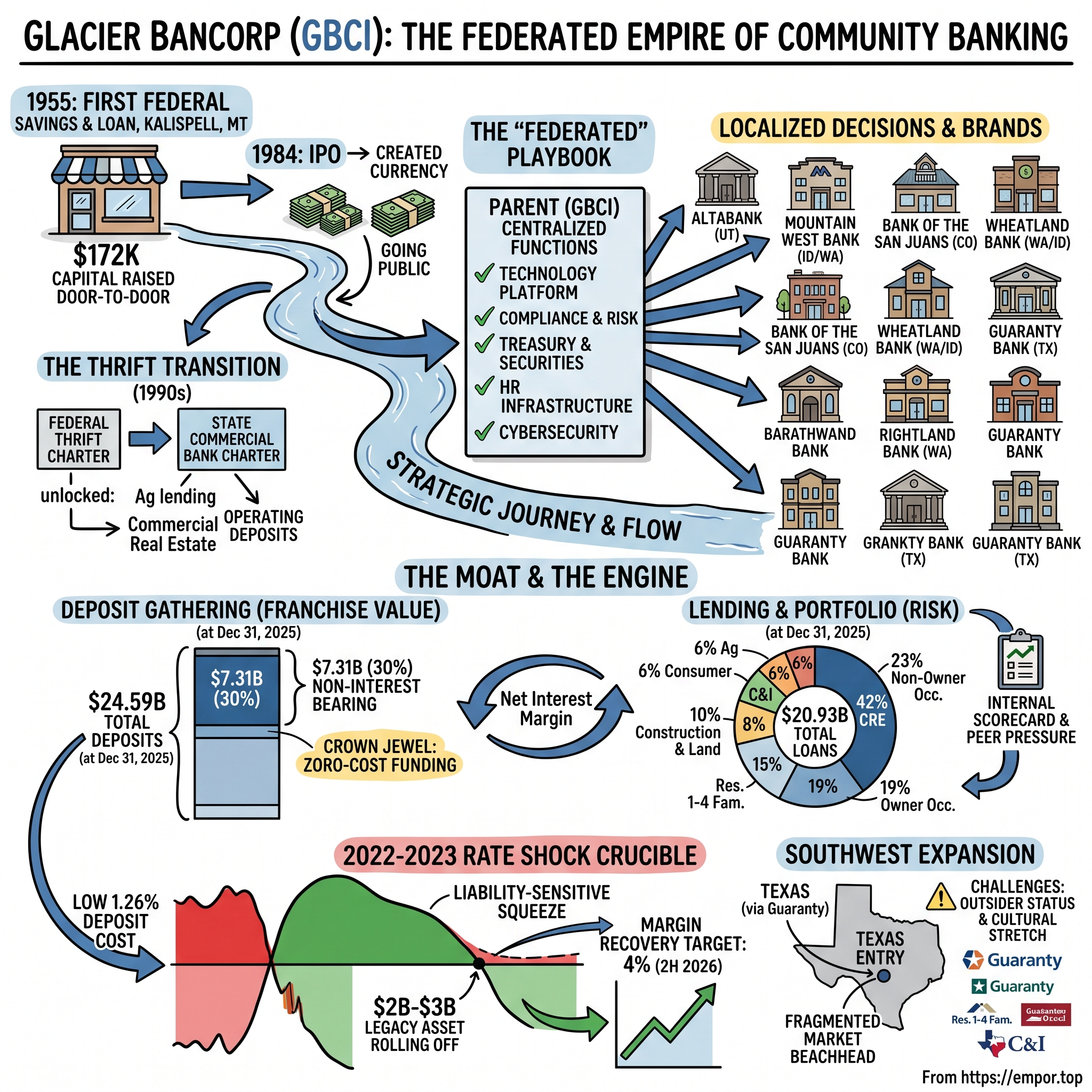
In 1955, in a storefront in downtown Kalispell, Montana — a lumber and railroad town of maybe eight thousand people, wedged between the Flathead River and the eastern wall of the Rockies — two employees opened the doors of a brand-new savings and loan. The charter had cost $150,000. The founding directors had raised $172,000 by going door to door among 127 local citizens, essentially passing the hat around the Flathead Valley to capitalize a bank.1 The institution was called First Federal Savings and Loan. Its business was taking deposits from people who cut timber and ran cattle and lending the money back out so those same people could buy houses in the same valley.
Seventy-one years later, that storefront has become Glacier Bancorp, Inc. — a bank holding company with $31.98 billion in total assets, 281 banking locations, and roughly 4,087 full-time-equivalent employees spread across nine Western and Southwestern states.2 It is, on a deposit-market-share basis, one of the most entrenched franchises in the Rocky Mountain West.
But the headline number is not the interesting part. Plenty of small banks have become big banks. What makes Glacier genuinely unusual — the reason it is worth 12,000 words — is how it is organized. Glacier does not operate a single bank with 281 branches. It operates eighteen separately branded bank divisions, each with its own name, its own local president, its own advisory board, and its own authority to approve loans. Altabank in American Fork, Utah. Mountain West Bank in Coeur d'Alene, Idaho. Heritage Bank of Nevada in Reno. The Foothills Bank in Yuma, Arizona. Bank of the San Juans in Durango, Colorado. Guaranty Bank & Trust in Mount Pleasant, Texas.2 To a customer walking into a branch in Bozeman or Powell or Yuma, "Glacier" is often an invisible parent — a name on the back of a statement, not on the front door.
This is the paradox that organizes the whole story. For forty years, the dominant logic of American banking consolidation has been the opposite of this. You buy a bank, you rip out its core system, you re-sign the building, you consolidate the back office, you fire the redundant staff, you centralize credit decisions into a scoring model in a distant headquarters, and you harvest the cost synergies. The industrial term for it is "in-market efficiency," and it has been the engine of nearly every large regional bank roll-up since the 1980s. Glacier looked at that playbook and, in significant part, declined it. It centralized everything the customer never sees — the treasury, the securities portfolio, the compliance function, the cybersecurity apparatus, the core technology stack — and it deliberately left in place the expensive, duplicative, "inefficient" parts that the customer does see.
The company's implicit wager is that in non-metropolitan markets, the local brand and the local credit decision are not overhead. They are the product. That trust, once established over decades in a town where the banker and the borrower see each other at the high school football game, is a genuinely durable source of cheap deposits — and cheap deposits are the raw material of banking profit.
That is the thesis. This article's job is to test it rather than to repeat it — because the wager is more contestable in 2026 than it was in 2016, and the numbers surface real tension. Glacier's efficiency ratio, the industry's standard measure of what it costs to produce a dollar of revenue, ran at 62.50% for full-year 2025 — an improvement from 66.71% in 2024, but well above the mid-50s range management calls its "traditional" performance.23 Skeptics have a straightforward reading: running eighteen brands, eighteen boards, and eighteen presidents costs real money, and the deposit franchise may not be worth the premium.
Here is the roadmap. We begin in the Flathead Valley, with a thrift that spent thirty years going nowhere in particular and then found a formula — and with Mick Blodnick, a smelter worker's son from Anaconda, Montana, who started as a teller and left as the architect of a $10 billion bank. We will dissect the federated operating model in mechanical detail: who actually decides what, and where the scale economies genuinely live versus where they are asserted. We will then put the acquisition machine under a microscope, including one deal where Glacier paid a price so far above its normal discipline that the outline of this story initially got it wrong by a full turn of book value. We will sit inside the 2022–2023 rate shock and the regional banking panic, and ask why a bank that was structurally vulnerable to rising funding costs nonetheless came through without a deposit run. We will follow the company 1,500 miles south into Texas, into a market where it has no history, no name recognition, and formidable incumbents. We will dissect the loan book and the deposit base that generate essentially all of the earnings. And we will end with an honest bull-and-bear spine, an activist's stress test, and the small handful of numbers that will actually tell you whether the thesis is working.
Start where the money started: a valley in northwest Montana, and a man who did not intend to become a banker.
 Subscribe on LinkedIn
II. The Rocky Mountain Origins & Mick Blodnick's Manifesto (1955–2016)
Anaconda, Montana, in the 1960s was a company town in the most literal sense. The Anaconda Copper Mining Company's smelter stack — at the time among the tallest freestanding masonry structures on earth — dominated the skyline and the economy. Mick Blodnick's father worked at the smelter. So did both of his grandfathers. When Blodnick was in the fourth grade, the family lost their house and moved into public housing.4
Nothing about that childhood pointed toward a career in finance. Blodnick studied sociology and criminology at the University of Montana and went to work for Head Start, the federal early-childhood program. He arrived at First Federal Savings and Loan in Kalispell in 1978 — as a line teller.4 Thirty-eight years later he retired as chief executive of a roughly $10 billion commercial bank.
The thrift years, and why they had to end
To understand what Blodnick eventually built, you need to understand the constraints that shaped the institution he walked into. A savings and loan in 1978 was not a bank in any meaningful competitive sense. It was a narrowly chartered utility for housing finance, and it operated under Regulation Q, the Depression-era rule that capped the interest rate a depository could pay on deposits. Regulation Q was designed to prevent banks from competing themselves to death for funding. Its practical effect, in an era of accelerating inflation, was to make thrifts structurally fragile: they held long-duration fixed-rate mortgages funded by short-duration deposits whose rate they were legally forbidden from raising. When market rates ran away in the late 1970s and early 1980s, savers left for money market funds, and a large share of the American thrift industry became insolvent.
First Federal survived it, which is itself a data point about conservatism. And in 1984 it did something that would matter more than anything else in the company's history: it went public, offering 550,000 shares as First Federal Savings Bank of Montana.1 At the time this was a small capital raise for a small institution in a small state. In retrospect it was the single most consequential decision the company ever made — because it created a currency.
The corporate restructuring came in stages that are frequently compressed and misreported. In October 1990, the holding company was redesignated Glacier Bancorp, Inc., and the First Federal branches took the Glacier Bank name. The conversion of the underlying banks from federal thrift charters to state commercial bank charters did not happen until 1997.1 Those seven years matter, because the commercial charter is what unlocked the business Glacier actually became: commercial real estate, business lending, agriculture, and the low-cost operating deposits that come with commercial relationships. A thrift takes retail savings and writes mortgages. A commercial bank banks businesses — and businesses keep large balances in checking accounts that pay no interest at all. Hold that thought; it becomes the crown jewel of the entire story.
The ceiling problem
By the late 1990s Glacier faced an arithmetic problem that every successful rural bank eventually faces. It was very good at banking the Flathead Valley. But the Flathead Valley contained a finite number of people and businesses, and the organic growth rate of a market is bounded by the growth rate of the economy underneath it. Montana was not going to compound at 15% a year. If Glacier wanted to grow, it had to buy other banks.
That posed an immediate strategic question, and the answer Glacier arrived at defines the company to this day. If the reason a small-town bank is profitable is that the community trusts it, then acquiring that bank and immediately erasing its name, replacing its president, and shipping its credit decisions to Kalispell would destroy the very asset you paid for. You would have purchased a customer list, not a franchise.
So Glacier chose not to erase. When Blodnick became CEO in 1998, he built the acquisition program around semi-autonomous community banks that kept their own management teams and their own local decision-making, while the parent centralized the back office, compliance, and support functions.4 The phrase most often attached to Blodnick in retellings of this story is "a company of banks, not a banking company." That formulation is widely repeated but difficult to source to him directly; what he is documented as saying is that Glacier operates as a "family of banks."4 The distinction is worth flagging precisely because so much of the Glacier legend is transmitted secondhand — and this article's posture is that the model should be judged on its operating evidence, not on its slogan.
The scale of what followed is genuinely striking. Blodnick oversaw roughly 25 acquisitions over 25 years. Asked about them near the end of his tenure, he offered a claim that is either a sign of excellent underwriting or of unexamined confidence, and reasonable people can disagree about which: "I look back at these 20-plus transactions and there's not a one that I regret doing."4 Glacier was a $72 million thrift when he arrived and roughly $10 billion when he left. An investor who put $10,000 in at the 1984 IPO and reinvested dividends ended up with more than $3 million — a total return above 30,000%.5
The crisis that proved the underwriting
The Global Financial Crisis is where the Glacier legend hardened, and it is also where the popular version of the story needs correcting. Glacier is sometimes described as a crisis-era acquirer of failed banks. In the available record — the FDIC's failed-bank list and Glacier's own filings from 2009 through 2011 — there is no FDIC-assisted or failed-bank transaction by Glacier. Its downturn deals were ordinary open-bank purchases.
The documented story is better anyway, because it is about capital discipline rather than opportunism. In November 2008, Glacier was approved for the Treasury's Capital Purchase Program — the TARP bank recapitalization facility that hundreds of institutions accepted. On December 30, 2008, Glacier publicly declined it. Blodnick's stated reasoning was that with $94 million in net proceeds from a common stock offering, the company was "already one of the most strongly capitalized banking companies in the country, with total risk-based capital of approximately 16%," and that taking government capital was not in shareholders' interests.6 Glacier did participate in the FDIC's Transaction Account Guarantee Program through the end of 2009 — a deposit-insurance backstop, not a capital injection.6
Turning down free-ish government capital at the precise moment the banking system was freezing was not a costless decision; it forgave optionality in exchange for avoiding the dividend restrictions, compensation limits, and stigma that came attached. It was, in effect, a public statement that Glacier believed its own credit book.
The book mostly cooperated. Glacier stayed profitable straight through, earning $12.9 million pretax in 2009 against $30.5 million in 2008.7 That is a severe deterioration — roughly a 58% decline — and it should not be sanitized. The federated structure also produced a revealing internal divergence: the Mountain West division swung to a $21 million pretax loss in 2009 from $12.7 million of pretax income the year before.7 One division blew up. The consolidated entity absorbed it and stayed in the black.
That is arguably the single best piece of evidence for the decentralized model in the entire historical record — not because local underwriting proved infallible, but because the portfolio of eighteen independently underwritten local books did not fail in a correlated way. And Glacier kept buying through the downturn: Bank of the San Juans in Durango, Colorado closed December 1, 2008, its first entry into Colorado, and First National Bank & Trust of Powell, Wyoming — roughly $280 million in assets — closed October 2, 2009, structured to strip out nonperforming out-of-market loan participations before Glacier took ownership.8
A bank that can buy while its peers are recapitalizing has a structural advantage. To understand where that advantage comes from operationally, we have to open the hood.
III. Decoding the "Federated" Playbook: Centralized Scale, Decentralized Soul
Picture a small business owner in Powell, Wyoming — population roughly six thousand — who needs $1.4 million to buy the building next door and expand her equipment dealership. At a large national bank, her application enters a workflow. It is scored against a model calibrated on national data. A credit officer she will never meet, in a city she has never visited, evaluates a debt-service-coverage ratio and a property appraisal from a third-party vendor who has never seen a Wyoming equipment yard. The model does not know that her family has run that dealership for three decades, that the local ranchers buy from her because her service department actually answers the phone, or that the vacant building next door has been vacant because the previous owner was ill, not because the location is bad.
At First Bank of Wyoming — a Glacier division — the person evaluating that loan probably knows all four of those things without asking. That informational asymmetry is the core of the entire Glacier thesis. The question worth examining is whether it is a genuine and durable economic edge, or a nice story that happens to coexist with a decent bank.
The division of labor
The federated structure resolves into a fairly precise split. The parent holding company owns everything that is capital-intensive, expertise-intensive, or regulatory in nature and gets cheaper per unit as it grows: the investment securities portfolio, liquidity and interest-rate-risk management, wholesale funding, internal audit, regulatory compliance and BSA/AML, cybersecurity, human resources infrastructure, and the core banking technology platform.
The division owns the customer: deposit gathering, relationship management, community presence, and — critically — credit underwriting up to a meaningful local limit.
The logic here is not arbitrary. It maps almost perfectly onto a distinction between activities where scale creates advantage and activities where local information creates advantage. Cybersecurity is the cleanest example. A modern bank must defend against nation-state-grade adversaries, and the cost of doing so competently is close to fixed regardless of institution size. Spread across a $31.98 billion balance sheet, that fixed cost is bearable; spread across a standalone $600 million community bank, it is close to ruinous.2 The same holds for compliance. The regulatory apparatus imposed on American banks after Dodd-Frank does not scale down gracefully — a $500 million bank and a $30 billion bank face substantially similar rulebooks with vastly different capacity to interpret them.
This is the honest version of Glacier's scale argument, and it is a real one. A Glacier division gets an enterprise-grade technology and compliance stack at a cost per dollar of assets that no independent competitor in Yuma or Durango can match, while retaining a decision-making speed that no money-center bank can match. That combination — not the branding per se — is the actual structural claim.
Competition inside the family
The obvious failure mode of a decentralized federation is drift. Give eighteen units autonomy and no accountability and you get eighteen comfortable fiefdoms, uneven underwriting standards, and an expense base nobody owns. Glacier's stated answer is measurement and peer pressure: divisions are ranked against each other across operating metrics — loan and deposit growth, funding costs, efficiency, nonperforming assets, net charge-offs — and division presidents see where they stand relative to their peers.
The mechanism is behaviorally shrewd. Being told by a corporate executive that your efficiency ratio is poor is a performance review. Having every one of your seventeen peers see it in a ranked list is something else entirely, and it recruits status competition in service of the parent's objectives. It also creates an internal transfer mechanism for practices: a division that has solved a problem is visibly identified, and struggling divisions are pointed at it.
An independent reader should hold two caveats. First, the internal scorecard is not externally disclosed, so its rigor cannot be verified from outside — investors are taking the company's characterization of its own management process largely on faith. Second, ranked-metric systems have well-documented pathologies. If loan growth is prominently ranked, a division president under pressure has an incentive to grow loans, and loan growth is the easiest thing in banking to manufacture by lowering price or standards. The safeguard has to be the credit architecture.
How credit risk is actually contained
The genuinely counterintuitive claim at the center of Glacier is that pushing credit authority outward reduces rather than increases risk. That runs against the entire post-1990s trend of American consumer and small-business lending, which moved decisively toward centralized statistical scoring on the grounds that models are consistent and loan officers are sentimental.
Glacier's containment structure has three layers. Local loan committees approve standard commercial credits within defined limits, using knowledge that would not appear in any model. The parent sets hard portfolio concentration limits, risk-rating standards, and underwriting guidelines that bound what any division may do. And any credit above a division's threshold escalates to parent-level review.
So the accurate description is not "decentralized credit." It is bounded local authority inside centrally defined risk limits. Divisions get discretion within a box; the parent draws the box. The distinction matters because it is what prevents a single aggressive division president from concentrating the company into a bad property market.
Does it work? The historical evidence is suggestive rather than conclusive. Glacier came through 2008–2009 profitable while carrying meaningful construction and land exposure — a portfolio composition that destroyed many Western banks — and the divisional divergence in that period showed the parent absorbing a subsidiary failure without systemic damage.7 That is genuine evidence. But it is one cycle, in a footprint that never experienced the housing collapse Arizona, Nevada, and Florida did at their epicenters, and the current portfolio is considerably more commercial-real-estate-weighted than the 2008 book. The model has been tested. It has not been tested at present scale or present concentration.
The other thing that changed since Blodnick is the person allocating the capital.
IV. Randy Chesler's Era & The Capital Deployment Machine: M&A Under the Microscope
On June 22, 2015, Glacier announced that Randall M. Chesler would become president of Glacier Bank and succeed Blodnick as chief executive in 2017.9 The choice was, by the standards of a company whose retiring CEO had started as a teller in the same building, remarkably external.
Chesler had spent more than forty years in financial services, almost none of it in the Rocky Mountain West. Immediately before joining Glacier in 2015, he was president of CIT Bank, the Salt Lake City–based banking subsidiary of CIT Group — a commercial finance company with a very different culture from a Montana community bank. Across ten years at CIT he had run small business lending and consumer finance. Before that: Size Technologies, Associates First Capital, Visa, and Citibank.10
Read that résumé carefully and the appointment starts to look deliberate rather than incongruous. Blodnick's Glacier had solved the problem of being a community bank federation. The problems Chesler was hired into were different: integrating larger and more complex acquisitions, managing a balance sheet approaching and then exceeding the $10 billion regulatory thresholds that trigger heightened supervision, and running a technology and payments stack against competitors with vastly larger budgets. A Visa and Citibank background is an odd fit for Kalispell and a sensible fit for those problems.
Chesler took over as president and CEO on January 1, 2017.10 He is now 67 and has served on the board since 2016.10
On alignment, honestly
It is worth being precise about the incentive question, because it is frequently overstated. Glacier's 2026 proxy reported Chesler holding 94,982 shares as of February 26, 2026, including 7,590 held in the company 401(k) — footnoted as less than 1% of the 130,107,508 shares outstanding on the record date.10 Against roughly 130 million shares, that is on the order of seven one-hundredths of one percent, worth somewhere in the low-to-mid single-digit millions of dollars depending on where the stock trades.
That is real money and real skin in the game. It is not, however, a controlling or founder-scale stake, and it should be weighed against his 2025 total compensation of $3,661,972 on a salary of $1,039,860.10 In any given year, Chesler's cash and equity compensation is meaningfully larger relative to his existing holdings than a "heavily aligned owner-operator" framing would suggest. The alignment case for Glacier's management rests more persuasively on the long-run behavioral record — twenty-plus years of consistent strategy, a dividend never cut — than on insider ownership magnitude.
The pending gap in the bench
On February 9, 2026, Glacier announced that Ron J. Copher, executive vice president, chief financial officer and secretary, would retire after twenty years with the company.11 Copher agreed to remain as CFO until a successor is appointed by the board, then move to an advisory role. The company engaged Korn Ferry and said it was considering both internal and external candidates.11
As of this writing on July 18, 2026, no successor has been named. That is a five-month search with no announced conclusion, and it is a legitimate thing for an investor to watch. A CFO who has been in the seat for two decades holds an enormous amount of undocumented institutional knowledge — how the securities portfolio has actually been positioned through three rate cycles, which acquisition assumptions have historically proven optimistic, where the internal reporting has soft spots. Chesler's public assessment of him was warm and conventional: Copher "has been an exceptional CFO and an invaluable partner whose steady leadership, integrity, and financial expertise have helped shape Glacier Bancorp."11 The real question is not whether Copher was good. It is whether Glacier's underwriting and capital-allocation discipline is institutionalized in process, or resident in two or three long-tenured people's judgment. The next few years will answer that, and it is not answerable in advance.
The math of the machine
Glacier's acquisition model has a specific financial engine that deserves plain explanation, because it is where most of the shareholder value has historically been created.
When one bank buys another with stock, the arithmetic that matters most to existing shareholders is the relationship between the multiple of tangible book value the buyer's own stock commands and the multiple it pays for the target. If your shares trade at a high multiple of tangible book and you issue them to buy a bank at a lower multiple, you mechanically increase the tangible book value per share of the combined company — you have effectively sold expensive currency to buy cheap assets. If you pay a higher multiple than your own stock commands, you dilute tangible book per share and must earn it back over time through cost savings.
"Tangible book value" is simply the bank's equity minus goodwill and other intangibles — the hard, countable net worth. "Earnback period" is how long it takes accumulated cost synergies to restore the tangible book per share you gave up. Bank investors watch it obsessively because a long earnback means you are betting on distant, uncertain savings.
Glacier's historical advantage has been that a consistently profitable, low-volatility bank earns a premium valuation, and a premium valuation is an acquisition weapon. But the record is not uniform, and one deal in particular departs sharply from the disciplined-buyer narrative.
Altabancorp (2021). Announced May 18, 2021, this was a $933.5 million all-stock acquisition at an exchange ratio of 0.7971 Glacier shares per Altabancorp share, roughly $49 per share.12 Altabancorp — formerly People's Utah Bancorp — was headquartered in American Fork, Utah, with about $3.5 billion in assets, $1.8 billion in loans, and $3.2 billion in deposits across 25 branches running from Preston, Idaho down to St. George, Utah.12 It closed October 1, 2021, became "Altabank, Division of Glacier Bank," and was Glacier's 24th acquisition since 2000.13
Here is the part that must be stated plainly: Glacier paid 290.1% of tangible book value — roughly 2.9 times.14 American Banker, analyzing the transaction at the time, pegged it near 270% of tangible book and framed the story around exactly that question: why was Glacier paying up?15 Either way, this was among the richest bank acquisition multiples of 2021 and Glacier's largest deal ever. It is emphatically not an example of valuation discipline, and any account of Glacier that presents it as a modest ~1.9x purchase is simply wrong on the facts.
The defensible case for it runs as follows: Utah's Wasatch Front is one of the fastest-growing commercial markets in the United States, Altabancorp offered instant scale there, and Glacier's own stock was itself trading at an elevated multiple in 2021, which softened the relative dilution. The company projected the deal to be immediately accretive to tangible book value per share, roughly 5.2% accretive to 2022 earnings per share excluding merger costs, with cost savings equal to 17.5% of Altabancorp's noninterest expense and an internal rate of return above 15%.12 Those were management projections at announcement, not audited outcomes, and readers should treat them as such.
The skeptical case is simpler: nearly three times tangible book is the price you pay when you have concluded you must be in a market and are bidding against others who have concluded the same thing. That is a growth decision, not a value decision.
Bank of Idaho Holding Co. (2025). Announced January 13, 2025: $245.4 million in aggregate consideration including options and stock appreciation rights, $52.47 per share, at an exchange ratio of 1.100 Glacier shares per Bank of Idaho share, based on Glacier's $47.70 close on January 10, 2025.16 The Idaho Falls–based company held roughly $1.3 billion in assets, $1.0 billion in loans, and $1.1 billion in deposits.16 The deal was priced at approximately 190.4% of tangible common equity — about 1.9 times.17 Final regulatory approvals came on April 9, 2025, and the transaction was completed April 30, 2025, with 5,029,137 Glacier shares issued.1819 It moved Glacier to the third-largest deposit market share position in Idaho and marked its 26th bank acquisition since 2000 — and its twelfth announced transaction in a decade.1920
Guaranty Bancshares (2025). Announced June 24, 2025: a $476.2 million all-stock merger at a clean 1.0000 Glacier share per Guaranty share, valuing Guaranty at $41.58 per share against Glacier's June 23 close of exactly $41.58.21 The pricing worked out to about 1.65 times tangible book value — materially below what Glacier paid for Altabancorp, and below the Bank of Idaho multiple as well.22 Guaranty, founded in 1913, ran 33 banking locations across 26 Texas communities with roughly $3.2 billion in assets, $2.1 billion in loans, and $2.7 billion in deposits.21 It closed October 1, 2025 with about $3.36 billion in total assets at completion.23
Read the three together and a pattern emerges that is more interesting than "Glacier is disciplined." Glacier paid its richest-ever multiple to enter Utah in a frothy 2021 M&A market, a mid-range multiple to deepen a market it already dominated, and its cheapest multiple of the three to make its largest geographic leap. The Texas entry was, on price, the most conservative of the recent deals — which is either evidence of genuine discipline in a market where Glacier had no incumbent advantage to defend, or evidence that Guaranty had fewer competing bidders. Both readings are available; the price alone does not distinguish them.
The integrate-or-preserve decision
Which brings us to a structural question that reveals how Glacier actually thinks. Guaranty became the 18th separate bank division, retaining its brand and management team.23 Bank of Idaho did not survive as a brand at all: its eastern Idaho operations folded into Citizens Community Bank, Boise into Mountain West Bank, and eastern Washington into Wheatland Bank, with combined operations running under those existing names from the third quarter of 2025.18
The governing principle appears to be geography and density rather than sentiment. Where Glacier enters a genuinely new market at meaningful scale, it preserves the local franchise, because the acquired brand is the market position — Glacier has no name in Texas and nothing to gain by imposing one. Where it acquires inside an existing footprint, it folds the target into the incumbent division, capturing the full cost savings and building density in markets where it already owns the trust relationship.
This is the sophisticated version of the decentralization argument, and it is worth stating explicitly: Glacier is not ideologically committed to eighteen brands. It is committed to owning the local trust asset wherever that asset is valuable, and to eliminating duplication wherever it is not. The eighteen divisions are an output of that calculation, not an input.
That calculation was about to be stress-tested by something no acquisition strategy could control — the fastest interest rate increase in four decades.
V. The Crucible of 2022–2023: Liability Sensitivity, NIM Squeeze, and SVB Contagion
To understand what happened to Glacier in 2022 and 2023, you first need to understand a piece of banking mechanics that sounds technical and is actually intuitive.
A bank is, at its core, a spread business. It pays a rate on money it takes in and earns a rate on money it puts out. The gap between the two, expressed against the earning assets, is the net interest margin — the single most important operating number in traditional banking.
Now the complication. The assets and the liabilities do not reprice at the same speed. A thirty-year fixed-rate mortgage or a ten-year Treasury security in the investment portfolio locks in a yield for years. A money market deposit account can be repriced tomorrow. When a bank's liabilities reprice faster than its assets, it is called liability-sensitive, and it means the bank gets hurt when rates rise quickly and helped when they fall.
The useful analogy is a landlord who has signed ten-year leases with tenants at fixed rent, financed by a mortgage that floats monthly. If the landlord's borrowing cost triples, the rent does not move. He is squeezed, and he stays squeezed until the leases roll.
Glacier entered the 2022 tightening cycle in exactly that position. Like most community banks, it had accumulated an enormous pile of pandemic-era deposits and deployed a large share of them into securities and loans at 2020–2021 yields — which is to say, at some of the lowest yields in modern financial history. Then the Federal Reserve raised the policy rate by more than 500 basis points in roughly eighteen months.
The result was severe and predictable margin compression. Glacier's funding costs climbed as depositors woke up to the fact that Treasury bills suddenly paid 5%, while a very large portion of its earning assets sat frozen at yields set when money was free. By the fourth quarter of 2024 — well after the peak of the tightening — Glacier's tax-equivalent net interest margin had been ground down to 2.97%.2 For a bank whose historical franchise value rested on a superior margin, that was a genuinely difficult number.
March 2023: the panic that skipped Montana
Then came the run. In March 2023, Silicon Valley Bank collapsed in a matter of days, followed by Signature Bank and eventually First Republic. The proximate mechanism was the same interest-rate problem described above — enormous unrealized losses on long-duration securities — but the accelerant was the composition of the deposit base. SVB's depositors were venture-backed technology companies: a small number of very large, overwhelmingly uninsured accounts, concentrated in a single industry, connected to each other through a shared network of investors who could and did coordinate withdrawal in hours.
Glacier's deposit base is close to the structural opposite. Its funding comes from tens of thousands of households, ranches, contractors, dealerships, and small professional firms spread across small towns in nine states. There is no venture capital concentration, no crypto exchange exposure, no single industry whose distress would move the whole book. Critically, these depositors are not connected to one another by a common information network that can trigger simultaneous flight. A rancher in Wheatland, Wyoming and a dentist in Yuma, Arizona do not sit in the same group chat.
That fragmentation is the actual reason Glacier was not at risk of a run, and it is worth being precise about it, because it is often described loosely as "sticky deposits." Stickiness is not a moral quality of rural customers. It is a structural property of a deposit base that is small-denomination, geographically dispersed, relationship-based, largely insured, and informationally uncoordinated.
But — and this is the part that management commentary tends to underplay — not facing a run is not the same as not facing pressure. Glacier still had to compete for money. Even loyal depositors notice when a certificate of deposit at a competitor pays 5%. The pressure showed up not as flight but as migration: money moving from free checking into interest-bearing money market accounts and CDs within the same institution. That migration is invisible in total deposit balances and devastating to net interest margin, because it silently converts zero-cost funding into expensive funding.
The inflection
The recovery, when it came, was mechanical rather than miraculous — and it is important to understand why, because it determines whether it continues.
By the fourth quarter of 2025, Glacier's tax-equivalent margin had recovered to 3.58%, up 19 basis points from 3.39% in the prior quarter and a full 61 basis points from the 2.97% trough a year earlier.2 Full-year 2025 came in at 3.32%.2 The cost side had also stabilized: cost of deposits including non-interest-bearing funds was 1.26% in the fourth quarter, and total cost of funding was 1.52%, down 19 basis points year over year.2
A cost of deposits of 1.26% in an environment where the risk-free rate had spent two years above 4% is the single most impressive number in Glacier's financial statements. It is the quantitative expression of everything the first half of this article described. Glacier's depositors, in aggregate, did not demand market rates.
The margin recovery accelerated into 2026. Glacier reported a first-quarter 2026 net interest margin of 3.80%, another 22 basis points higher and 76 basis points above the prior-year quarter, with funding costs falling further to 1.40%.24
The engine here is the reverse of what caused the damage: those low-yield legacy assets are finally rolling off. On the fourth-quarter 2025 call in January 2026, treasurer Byron Pollan told analysts the company expected "north of $2 billion of assets [to] reprice and we'll be gaining 75 to 100 basis points on that balance," and said Glacier expected "to hit 4% at some point later this year, probably second half of '26. So, green lights ahead."3 By the April 2026 call the figure had grown with the balance sheet: "We have $3 billion of loans repricing in the next 12 months from March 31," earning an incremental 75 to 100 basis points, against new production yielding 6.75%.24 Pollan reiterated: "we are on track to hit that 4% target."24
Two analytical points deserve emphasis. First, management has explicitly framed the margin expansion as "not in any way Fed dependent" — the lift comes from contractual repricing of existing assets, not from a forecast about monetary policy.3 That is a meaningfully stronger claim than most banks can make, and it is falsifiable: if the margin stalls below 4% in the second half of 2026 while the repricing schedule runs as described, the explanation would have to be that funding costs rose to offset it.
Second, management stated the same target across two consecutive calls with consistent framing and an updated, larger repricing figure. Narrative consistency across calls is one of the few things an outside investor can actually audit, and here it holds up. It does not make the target correct. It does make it a real commitment with a specific deadline, against which management can and should be measured.
The margin story also reframed the strategic question. With the balance sheet healing and a premium currency restored, where does the next decade of growth come from?
VI. The Southwest Expansion: Texas and Idaho in Focus
There is a moment in the life of every successful regional consolidator when the map runs out.
Glacier reached it sometime in the early 2020s. In Montana, Wyoming, and Idaho, it had become one of the dominant deposit franchises — the Bank of Idaho transaction alone lifted it to third place in Idaho by deposit share.19 Dominance is wonderful for returns and terrible for growth arithmetic. Once you hold a leading position in a market, incremental share gets expensive, antitrust review gets harder, and the growth of your business converges on the growth of the local economy. Montana's economy is not going to compound at 15%.
So on June 24, 2025, Glacier announced it was buying a bank in Texas.
Why Texas
The strategic logic is not subtle, which is part of what makes it worth scrutinizing. Texas has among the strongest demographic inflows in the United States, a large and genuinely diversified commercial economy, and — most relevant to a consolidator — one of the most fragmented banking markets in the country. Texas's history of restrictive branching law and its sheer geographic size produced an unusually large population of independent community banks. For a company whose core competency is acquiring community banks and leaving them recognizably intact, that fragmentation is the entire attraction. Guaranty is not primarily a growth asset. It is a platform and a beachhead.
Guaranty's footprint reinforces the reading. Its 33 locations span 26 Texas communities: East Texas, Dallas/Fort Worth, Houston, Bryan/College Station, and Austin.21 That is a barbell — a base of small-city East Texas markets that look demographically and culturally much like Glacier's existing rural franchise, plus toeholds in four of the largest metropolitan economies in America. The East Texas piece is where Glacier's model most plausibly transplants. The metropolitan piece is where it is least tested.
One factual note worth flagging for precision: Glacier's own announcement identified Guaranty as headquartered in Mount Pleasant, Texas, while some deal coverage listed Addison, Texas — reflecting that Guaranty had located executive offices in the Dallas suburb while remaining chartered in Mount Pleasant.2122 Small detail, but it captures the duality of the franchise.
The outsider problem
Now the hard part, and it deserves to be stated without hedging.
Everything this article has described about Glacier's advantage is local and accumulated. The reason a Glacier division in Kalispell or Coeur d'Alene or Bozeman gets deposits at 1.26% is that it has been there for decades, the branch manager's kids went to the local school, and three generations of a family have banked there. That asset was not bought. It was compounded over seventy years.
In Texas, Glacier owns none of that. It owns Guaranty's version of it — a franchise built since 1913 — but Glacier itself is an outsider, headquartered 1,500 miles away in a state most Texas business owners have never visited. The honest formulation is that Glacier did not build a trust moat in Texas. It purchased one, at 1.65 times tangible book. Whether a purchased trust moat behaves like an earned one is precisely the open question, and it will not be answered for years.
The competitive environment is also materially tougher than anything in the Mountain West. Prosperity Bancshares has spent three decades executing a Texas-focused acquisition strategy with a well-earned reputation for cost discipline. Cullen/Frost Bankers has been banking Texas since 1868 and has an institutional relationship depth that no newcomer can replicate — and notably, both appear in Glacier's own designated peer group alongside First Interstate BancSystem and Columbia Banking System.25 These are not sleepy incumbents waiting to be consolidated. They are sophisticated operators who understand the Texas community bank acquisition math as well as Glacier does, and who will be bidding against Glacier for every subsequent target. The 1.65x multiple Glacier paid for Guaranty may prove to be the cheapest Texas deal it ever gets.
The cultural stretch
The deeper execution risk is organizational. Glacier's model depends on granting genuine autonomy to local presidents while maintaining consistent credit standards — a balance that requires a great deal of implicit trust and shared context. Within the Mountain West, that context is real: division presidents know each other, attend the same meetings, come from the same regional banking culture, and are physically reachable from Kalispell.
Texas is a different banking culture with different property markets, different legal conventions, different competitive dynamics, and a nine-hundred-mile gap from the nearest Glacier division. The parent's ability to sense trouble at a division has historically been informal as much as formal. Distance degrades that.
There is also a subtler risk that the eighteen-division structure creates its own ceiling. Each additional division adds coordination load on the parent — another president to manage, another board, another set of credit exceptions to review. Somewhere there is a number of divisions past which the federated model stops being an elegant solution and starts being an org chart problem. Nobody knows what that number is, including Glacier. But the company has now added a division at maximum geographic distance from the center, which is the least favorable circumstance under which to discover the answer.
The bull's response is reasonable: Guaranty came with an intact management team that has run these markets for years, and Glacier's explicit strategy is to let them keep running them.23 Glacier is not trying to teach Montanans to bank Texans. It is trying to give Texans a Montana back office.
Whether that works is an empirical question, and the place it will show up first is in the loan book.
VII. Segment & Portfolio Deep Dive: Dissecting the Core Engine & Speculative Optionality
Strip away the eighteen brands and the origin story, and Glacier is a machine that does two things: it gathers deposits cheaply and it lends against Rocky Mountain and Texas real estate. Nearly everything else is commentary.
As of December 31, 2025, Glacier held $20.93 billion in loans receivable, up 11% in a single quarter — a jump driven overwhelmingly by the Guaranty closing rather than organic demand.2 Here is what that book is made of, and — more importantly — what each piece implies about the risk being taken. (Note that the percentage mix figures below are computed against total loans; Glacier's disclosures report the dollar balances, not the mix percentages.)
Commercial real estate: the concentration that defines the risk profile
Commercial real estate is $8.81 billion — roughly 42% of all loans.2 Nothing else in the portfolio matters as much. Within it, $4.86 billion is non-owner-occupied — property leased to third-party tenants — and the remaining $3.95 billion is owner-occupied, meaning the borrower operates its own business out of the building.2
That distinction is the most important credit split in the entire company, and it is routinely glossed over. Owner-occupied CRE is, in economic substance, a business loan secured by real estate: repayment depends on whether the dental practice or the machine shop or the auto dealership generates cash flow, and the owner has powerful reasons to keep paying — it is where the business lives. Non-owner-occupied CRE is an investment property loan: repayment depends on tenants continuing to pay rent and on the property retaining enough value to refinance at maturity. When commercial property markets deteriorate, non-owner-occupied is where the losses concentrate.
So the sharper framing of Glacier's CRE concentration is that roughly $4.86 billion — about 23% of total loans — sits in the genuinely cyclical bucket. That is a substantial but not extreme exposure by community banking standards, and it is materially less alarming than the headline "42% CRE" figure implies. It is also the number most worth monitoring if property values in the mountain and Texas markets soften.
The rest of the book
Residential 1–4 family stands at $3.20 billion, about 15% of loans, with the overwhelming majority — roughly $3.10 billion — in first-lien position and only about $106 million in junior liens.2 First liens get paid first in a foreclosure; a book that is 97% first-lien is a conservatively structured mortgage portfolio. Residential mortgage is not where Glacier's risk lives.
Land, lot, and other construction totals roughly $2.03 billion, near 10% of the book, with residential construction reported separately at about $519 million.2 This is the most cyclically dangerous category in community banking, full stop. Construction and land development lending is what killed hundreds of Western banks between 2008 and 2011. The loans fund projects with no cash flow until completion, collateral values move violently, and borrowers are typically developers with limited capacity to absorb a downturn. Glacier ran meaningful construction exposure through the last crisis and survived it. Roughly 10% is a real exposure, actively managed, and worth watching in any regional slowdown.
Commercial and industrial is $1.65 billion, about 8%.2 C&I is the segment management has said it wants to grow, for the sound reason that it diversifies away from real estate and brings operating deposit relationships along with it. It is also the segment where Glacier faces its most direct competition from large regional and national banks, which can offer treasury management platforms and credit capacity that a community bank division cannot. Growing C&I share against that competition without loosening credit standards is genuinely hard, and progress here is a fair test of whether the local-relationship advantage extends beyond real estate.
Agriculture is $1.28 billion, about 6%.2 It punches above its weight strategically. Agricultural lending is relationship-intensive, requires specialized understanding of commodity cycles, land values, and operating seasonality, and is nearly impossible to underwrite from a distant credit model. It is exactly the niche where Glacier's structure should confer real advantage — and exactly the kind of business that large banks have retreated from.
Consumer lending rounds out the book at about $1.31 billion, roughly 6%.2
The crown jewel
Now the liability side, which is where Glacier's actual economic advantage resides.
Total deposits at year-end 2025 were $24.59 billion, up $4.04 billion or 20% year over year, largely reflecting the Guaranty acquisition.2 Of that, $7.31 billion — a full 30% — was non-interest-bearing.2
Take a moment with that number, because it is the entire ballgame. Nearly a third of Glacier's funding costs exactly nothing. In a world where the risk-free rate has spent years above 4%, holding $7.3 billion of zero-cost money is worth several hundred million dollars a year in pre-tax earnings relative to a bank that must pay market rates for the same funding. It is the reason the blended cost of deposits could sit at 1.26% through a high-rate environment. And it is the single hardest thing in banking to replicate, because it is not a product — it is the residue of thousands of operating relationships where a business keeps its working capital at the bank it actually banks with.
The loan-to-deposit ratio was 85.26%, meaning Glacier lends out about 85 cents of every deposit dollar and holds the rest in securities and cash.2 That is a conservative posture. A bank running at 95%+ is stretching its funding and will be forced into expensive wholesale borrowing if loan demand accelerates or deposits soften. At 85%, Glacier has room to grow loans without buying deposits — a meaningful competitive advantage in a period when many banks are constrained by funding.
The obvious counter-question a skeptic should ask: is the 30% non-interest-bearing share durable, or is it an artifact of an acquisition that just closed? Guaranty brought $2.7 billion of Texas deposits into the mix.21 The honest answer is that the pre-Guaranty franchise carried a similar profile through the rate shock — the cost of deposits stayed near 1.25% for full-year 2025 — so the low-cost character predates the deal.2 But investors should watch whether the acquired Texas deposit base behaves like the Mountain West base over a full cycle.
The optionality nobody underwrites
Glacier also operates wealth management and trust businesses. These are genuinely small relative to community banking, which drives the overwhelming majority of revenue, and Glacier does not break out wealth and trust assets under management as a separately disclosed line — so the specific AUM figure is not disclosed in the materials reviewed here.
The strategic logic is nonetheless real and under-discussed. Glacier's footprint includes some of the most extreme wealth-concentration zones in the American West: Jackson Hole, Bozeman, Park City, Coeur d'Alene, Whitefish. These are places where enormous personal wealth has accumulated, often in the hands of aging business owners and landholders facing generational transfer. A local trust officer who has banked a family for thirty years is structurally advantaged in capturing that business against a national wirehouse.
The investor-relevant point is what kind of revenue this is: fee income, not spread income. It does not consume capital, does not carry credit risk, and does not fluctuate with the Federal Reserve. For a bank whose earnings are dominated by interest rate dynamics, a growing fee stream is disproportionately valuable to valuation. It is real optionality — but it is optionality, not a current earnings driver, and it should not be capitalized into a thesis today.
Having assembled the pieces, the question becomes structural: how defensible is any of this?
VIII. Porter's 5 Forces & Hamilton Helmer's 7 Powers Analysis
Community banking is an industry that looks commoditized from a distance and turns out, on inspection, to have unusual structural properties. Money is the most fungible product imaginable. And yet the industry sustains thousands of independent competitors and persistent differences in profitability. Two analytical frameworks help explain why.
Porter's Five Forces
Threat of new entrants: very low. Starting a bank in the United States requires regulatory chartering, substantial capital, and a compliance infrastructure whose fixed cost is punishing at small scale. De novo bank formation in America has been near historic lows for over a decade. But the regulatory barrier is only half the story, and the smaller half. The real barrier in Glacier's markets is time. A new bank in Kalispell could be capitalized tomorrow. It could not manufacture seventy years of relationships, and it certainly could not fund itself at 1.26%. The entry barrier is accumulated trust, and trust is the one input that cannot be bought at any price — which is precisely why Glacier has to buy banks rather than build branches.
Bargaining power of borrowers: moderate to high. This is the force most often understated in bullish accounts of community banking. A creditworthy commercial borrower has real options: national banks, other regionals, credit unions, and increasingly private credit funds. Loan pricing is genuinely competitive and transparent. Glacier's counter is not price — it is speed and flexibility of decision, which for a business owner with a time-sensitive opportunity can be worth more than 25 basis points. That is a real but bounded advantage, and it does not protect pricing on large, well-banked credits.
Bargaining power of depositors: moderate, and rising. Historically this force was weak in rural markets — limited alternatives, high inertia. Digital banking has weakened that. Any depositor with a smartphone can open a high-yield online account in ten minutes. The 2022–2024 migration from checking into money market accounts and CDs was exactly this force asserting itself. Glacier's low deposit beta is impressive evidence that the force remains muted in its markets, but the direction of travel favors depositors, and each successive rate cycle tests it again.
Threat of substitutes: moderate. Fintech lenders and private credit funds have taken share in specific commercial lending niches, often competing on speed and structure rather than price. What they generally cannot replicate is the full operating relationship — the business checking account, treasury management, payroll, the line of credit, the owner's mortgage, and the trust relationship, all in one place with one person who answers the phone. Substitutes attack pieces of the bundle; the bundle itself is more defensible than any component.
Rivalry: high. Glacier competes against First Interstate BancSystem across its Montana core, against Columbia Banking System and other Northwest regionals, against Zions and others across the Intermountain overlap created by the Altabank footprint, and now against Prosperity and Cullen/Frost in Texas.25 Community banking rivalry is intense, and it is intensifying, because the acquisition targets that fuel every consolidator's growth are a shrinking pool and the buyers competing for them are numerous and well capitalized.
Hamilton Helmer's 7 Powers
Cornered Resource — the strongest of Glacier's powers. Helmer's cornered resource is preferential access to a valuable asset on attractive terms. Glacier's $7.31 billion of non-interest-bearing deposits qualifies almost perfectly.2 It is a genuinely scarce input — zero-cost, long-duration funding — held on terms competitors cannot match and cannot bid away, because the depositors are not making a price-driven decision. Critically, this resource was accumulated over seventy years and cannot be replicated on any reasonable timeframe. If Glacier has one durable power, this is it.
Switching Costs — high for commercial customers, moderate for retail. A business that has integrated its operating account, payroll, merchant processing, treasury management, and credit facilities with a bank faces meaningful friction in moving: operational disruption, re-underwriting risk, and the loss of a lender who already understands the business. A retail depositor faces much less. This is a real power, but it is concentrated in the commercial book — which is another reason management's push into C&I matters strategically beyond diversification.
Scale Economies — moderate, and the most contestable claim. The centralized technology, compliance, and cybersecurity stack does spread genuine fixed costs across nearly $32 billion in assets, giving a $600 million division cost access it could never buy standalone. That is real. But Glacier's own efficiency ratio complicates the story: at 62.50% for 2025 it lags what a fully consolidated bank of similar size can achieve, which is precisely the trade-off the federated model makes.2 Glacier is not the low-cost operator. It is buying revenue quality with cost.
Branding — real, and unusually structured. Glacier's branding power is genuinely counterintuitive, because the valuable brands are the ones the parent does not own the name of. Altabank means something in Utah County. Mountain West means something in Coeur d'Alene. Guaranty means something in East Texas. Consolidating all of them into "Glacier" would generate immediate cost savings and destroy exactly the affinity that produces the cheap deposits. Preserving them is the deliberate purchase of brand power at the cost of scale economies.
Two powers Glacier notably lacks: network economies (a bank's value to one customer does not meaningfully rise with the number of other customers) and counter-positioning (there is nothing about Glacier's model that incumbents are structurally unable to copy — First Interstate and others could adopt a federated structure tomorrow if they chose). The absence of counter-positioning matters. Glacier's model is not protected by a competitor's inability to imitate. It is protected by the seventy years of accumulated local relationships that any imitator would still have to acquire one bank at a time.
That is a moat. It is a moat made of time and price rather than of structural impossibility — which means the right way to attack the thesis is to ask what would erode it.
IX. The Bear Case, Activist Stress Test, and Current Risk Radar
Every durable business story eventually needs a skeptical reading, and Glacier's is not hard to construct. Here is what a thoughtful short seller or an activist with a stake would put on the table.
The current risk radar
Commercial real estate concentration. The $4.86 billion non-owner-occupied CRE book is the most consequential exposure Glacier carries.2 The mechanism of loss is worth spelling out because it is not primarily about default: it is about maturity refinancing. A commercial property loan written in 2021 at low rates, on a valuation set when capitalization rates were compressed, comes due into an environment of higher rates and lower valuations. Even a fully performing property with paying tenants can fail to support a refinancing at the new rate, and the borrower must inject fresh equity or hand back the keys. This is a slow-burn risk that surfaces on maturity schedules rather than in monthly delinquency reports, which is exactly what makes it hard to see coming.
Glacier's mitigants are genuine: the owner-occupied half of the book is structurally safer, its markets did not experience the office-vacancy collapse that hit major coastal downtowns, and local underwriters plausibly know their properties better than a model would. But CRE concentration is the reason bank regulators have been scrutinizing mid-sized banks for three years, and Glacier is squarely in the cohort.
Interest rate and repricing risk. The margin recovery to 3.80% rests on the repricing of $3 billion of legacy loans over twelve months.24 That mechanism is contractual and largely reliable on the asset side. The uncertainty is entirely on the funding side. If competition for deposits reintensifies — because rates rise again, or because a competitor gets aggressive, or because depositors continue migrating toward yield — the funding cost could climb enough to offset the asset lift. The 4% target is not a forecast about the Federal Reserve; it is a bet that Glacier's deposit franchise holds while its assets reprice. The franchise has held so far. It is the thing to watch.
Succession and institutional memory. The CFO seat remains unfilled more than five months after the retirement announcement, with an external search underway.11 Combined with Chesler's age of 67, Glacier has a genuine executive transition ahead within a foreseeable timeframe.10 The specific worry is not competence — Korn Ferry will find a capable CFO — but the transmission of judgment. A model that depends on knowing when to say no to a division president, and on refusing to chase a deal at the wrong multiple, is a model that depends on culture more than on process documentation.
The activist stress test
An activist investor looking at Glacier would press on four points, and they deserve to be taken seriously rather than dismissed.
One: the efficiency ratio is not a rounding error. At 62.50% for 2025, Glacier spent about 62.5 cents to generate a dollar of revenue.2 Management characterizes the mid-50s as its traditional range, and Chesler told analysts in January that "this year, we will be able to hit mid-50s, 54% to 55%," with Pollan specifying that as a second-half-2026 target.3 But the first quarter of 2026 came in around 63% on a reported basis, with the 54–55% figure framed as a core operating target.24 The activist's question is direct: if the mid-50s is the "traditional range," why has the company been well outside it for two full years? Management attributes the gap to acquisition and integration costs, which is credible given three deals in under five years. The falsifiable test arrives in the second half of 2026. If the ratio does not compress toward the mid-50s once the Guaranty integration costs run off, the structural-inefficiency critique of the eighteen-division model gains real force.
Two: the Altabancorp price undercuts the disciplined-buyer narrative. Paying approximately 2.9 times tangible book value is not the behavior of a value-disciplined acquirer.14 It may well have been the right strategic decision, and Utah has been a strong market. But investors who hold Glacier specifically because they believe management refuses to overpay should reconcile that belief with this transaction. The bull's rejoinder — that Glacier's own currency was expensive in 2021 too — is legitimate but incomplete, since it makes the deal's merit contingent on the buyer's stock having been overvalued.
Three: growth fatigue and geographic drift. The sequence — dominate Montana, dominate Idaho, pay up for Utah, leap to Texas — is consistent with a consolidator progressively exhausting its home markets. That is not a scandal; it is the natural lifecycle of a roll-up. But it means the marginal acquisition is being made further from the center of competence, against better-resourced competition, at a stage when the returns on capital that justified the strategy in Montana may not be available in Dallas.
Four: the disclosure gap on the operating model. Glacier asks investors to believe that its internal scorecard and local underwriting produce superior credit outcomes. The divisional profit-and-loss detail that would let an outsider verify this — division-level efficiency, division-level charge-offs, division-level deposit costs — is not routinely disclosed. Investors are asked to accept management's characterization of the machine's inner workings.
The bull and bear spine
Why Glacier wins from here. The case rests on three legs, and only one of them requires a forecast. First, the funding advantage is documented, not asserted: a 1.26% cost of deposits through the highest rate environment in two decades is hard evidence that the deposit franchise behaves as claimed.2 Second, the margin expansion is mechanical — $3 billion of loans repricing 75 to 100 basis points higher is contractual, not hopeful, and management has correctly framed it as Fed-independent.243 Third, Texas opens a genuinely large consolidation runway in the most fragmented major banking market in America, and Glacier acquired its entry point at 1.65x tangible book, the most restrained of its three recent multiples.22 Underneath it all sits a capital-return record that is close to unimpeachable: as of June 2026, Glacier had declared 165 consecutive quarterly dividends and raised the dividend 49 times, most recently declaring $0.33 per share payable July 16, 2026.26 Forty-one years of uninterrupted quarterly dividends spanning the S&L crisis, the dot-com bust, the financial crisis, a pandemic, and a regional banking panic is a behavioral track record, not a marketing claim.
Why the case could break. Credit is the first and most obvious failure mode: a meaningful deterioration in the $8.81 billion commercial real estate book would hit earnings and, more damagingly, hit the premium valuation that makes the whole acquisition machine work — a bank trading at a low multiple of tangible book cannot buy anything with stock. Second, the funding advantage could erode structurally rather than cyclically, as generational turnover replaces depositors who have banked locally for forty years with ones who move money by app and have no attachment to the branch. That erosion would be slow, hard to detect quarter to quarter, and fatal to the thesis. Third, the Texas expansion could simply prove that the model does not travel — that autonomy granted at 1,500 miles produces drift rather than entrepreneurship. And fourth, the executive transition could cost the company the judgment that has historically kept it out of trouble.
What to actually track
If you follow one thing, follow three. Everything else is derivative.
Net interest margin against the stated 4% target. Management has committed publicly, twice, to reaching 4% in the second half of 2026 through mechanical repricing.324 This is the rare guidance that is both specific and falsifiable on a known timeline. Hitting it validates both the repricing math and the deposit franchise. Missing it, absent a clear rate-environment explanation, means funding costs are rising faster than management expected — which would be the first real evidence that the deposit moat is narrowing.
Non-interest-bearing deposits as a percentage of total deposits. Currently 30%.2 This single ratio is the purest measure of the cornered resource. If it drifts steadily downward over several quarters — particularly in a stable rate environment, where there is no yield-chasing excuse — the core economic advantage is eroding, and it will show up here long before it shows up in reported earnings.
The efficiency ratio. Currently 62.50% for 2025 against a stated 54–55% target for the second half of 2026.23 This is the direct scoreboard for the central question of the entire Glacier story: is running eighteen brands a worthwhile investment in franchise quality, or is it structural overhead? Two years of elevated readings have a credible acquisition-cost explanation. A third would not.
X. Epilogue & Playbook Lessons
Return, finally, to Kalispell — to those 127 citizens who put up $172,000 in 1955 to charter a savings and loan because their valley needed one.1 Seventy-one years later the institution they capitalized has $31.98 billion in assets and operates in nine states.2 What is genuinely remarkable is not the growth. It is that the thing they built — a bank whose value came from being of a specific place — was replicated eighteen times rather than diluted once.
The counterintuitive insight
The dominant assumption of the last forty years of corporate strategy has been that duplication is waste. Consolidate, standardize, centralize, eliminate redundancy. Glacier's history is a sustained argument that this assumption, applied indiscriminately, destroys value in businesses where the customer relationship is the asset.
Eighteen brands, eighteen presidents, eighteen advisory boards, eighteen sets of local underwriters — every efficiency consultant in America would identify these as costs to be eliminated. And they would be right that eliminating them would improve the efficiency ratio. The question they would fail to ask is what happens to the 30% non-interest-bearing deposit share when the sign on the building in American Fork changes to a Montana company's name.
Glacier's implicit answer is that the "waste" is the moat. The reason this argument is interesting rather than merely comforting is that it is expensive and measurable: the company pays for it in efficiency ratio points, and it earns it back in deposit cost. Both sides of that trade are visible in the financial statements, which means the wager can be evaluated rather than merely believed. Over most of the last two decades, the trade has paid. Whether it continues to pay in Texas, at eighteen divisions and $32 billion, is genuinely unsettled.
The premium currency lesson
The second lesson is about corporate finance, and it generalizes far beyond banking. Glacier's acquisition engine has never been primarily about finding cheap targets. It has been about being the kind of company whose own stock is expensive.
Consistent profitability, low credit volatility, an uninterrupted dividend, and a comprehensible strategy earned Glacier a premium valuation. That valuation was not merely a scoreboard — it was working capital. Every point of multiple premium was purchasing power in a stock-funded acquisition. The discipline that produced the premium and the growth the premium financed were the same flywheel.
The corollary is the risk that should worry a long-term holder most, and it is the reason credit quality matters more than any single quarter's earnings. The flywheel runs in reverse. A credit accident compresses the multiple; a compressed multiple makes stock-funded acquisitions dilutive; an inability to acquire removes the growth that justified the premium. For a serial acquirer, valuation is not an output of the strategy. It is an input.
The playbook
Two principles survive from seventy-one years, and they are more transferable than the banking specifics suggest.
Scale where scale wins; stay local where locality wins. The entire Glacier design rests on correctly identifying which activities benefit from size and which benefit from proximity. Cybersecurity, compliance, treasury, and core technology are the former — invisible to the customer and brutally expensive at small scale. Underwriting judgment, relationship management, and community presence are the latter. Most companies get this wrong in one direction or the other: they centralize the customer relationship in pursuit of efficiency, or they fail to centralize the back office and drown in duplicated cost. Glacier's contribution is the specificity of the split.
Stay inside the demographic circle of competence. Glacier has essentially never tried to compete in dense metropolitan markets against money-center banks on price and product breadth. It has stayed in growing non-metropolitan markets where relationships still determine commercial outcomes and where large banks' cost structures make small-market presence unattractive. That is not timidity. It is a clear-eyed judgment about where its particular advantages actually function — and the most important open question about the Texas expansion is whether Dallas, Houston, and Austin sit inside that circle or outside it.
Seventy-one years in, the bank that 127 people in the Flathead Valley chartered has made a wager it will spend the next decade settling: that trust built in one valley can be bought, division by division, across nine states — and that it will still behave like trust once it has been purchased rather than earned. The margin target arrives in six months. The efficiency target arrives with it. Texas will take considerably longer.
References
-
Glacier Bancorp, Inc. Announces Results for the Quarter and Period Ended December 31, 2025 (Form 8-K, Exhibit 99.1) — U.S. Securities and Exchange Commission, 2026-01-22 ↩↩↩↩↩↩↩↩↩↩↩↩↩↩↩↩↩↩↩↩↩↩↩↩↩↩↩↩
-
Glacier Bancorp (GBCI) Q4 2025 Earnings Call Transcript — The Motley Fool, 2026-01-23 ↩↩↩↩↩↩↩
-
Community Banker of the Year: Glacier Bancorp's Mick Blodnick — American Banker, 2014-12-18 ↩↩↩↩↩
-
The Archetype of an Extraordinary Banker — Maxfield on Banks ↩
-
Glacier Bancorp, Inc. Declines Participation in the U.S. Treasury Capital Purchase Program (Form 8-K, Exhibit 99.1) — U.S. Securities and Exchange Commission, 2008-12-30 ↩↩
-
Glacier Bancorp, Inc. Annual Report on Form 10-K for the Fiscal Year Ended December 31, 2009 — U.S. Securities and Exchange Commission ↩↩↩
-
Glacier Bancorp, Inc. Announces Acquisition of First National Bank & Trust, Powell, Wyoming (Form 8-K, Exhibit 99.1) — U.S. Securities and Exchange Commission, 2009 ↩
-
Glacier Bancorp, Inc. Selects Randall M. Chesler to Become President of Glacier Bank and to Succeed Mick Blodnick as CEO of Glacier Bancorp in 2017 — GlobeNewswire, 2015-06-22 ↩
-
Glacier Bancorp, Inc. Definitive Proxy Statement (Form DEF 14A) — U.S. Securities and Exchange Commission, 2026-03-12 ↩↩↩↩↩↩
-
Glacier Bancorp Announces CFO Transition — Ron Copher to Retire After 20 Years with Company — GlobeNewswire, 2026-02-09 ↩↩↩↩
-
Glacier Bancorp, Inc. Announces Agreement to Acquire Altabancorp (Form 8-K, Exhibit 99.1) — U.S. Securities and Exchange Commission, 2021-05-18 ↩↩↩
-
Glacier Bancorp, Inc. Completes Acquisition of Altabancorp in American Fork, Utah — GlobeNewswire, 2021-10-01 ↩
-
Glacier to Buy Altabancorp in Utah in Largest-Ever Acquisition — The Bank Slate, 2021-05-18 ↩↩
-
Why Glacier Bancorp Is Paying a Premium for Altabancorp — American Banker, 2021 ↩
-
Glacier Bancorp, Inc. Announces Acquisition of Bank of Idaho Holding Co. — GlobeNewswire, 2025-01-13 ↩↩
-
Bank M&A 2025 Deal Tracker: 11 Deals Announced in January — S&P Global Market Intelligence, 2025-02 ↩
-
Glacier Bancorp Completes Acquisition of Bank of Idaho Holding Co. (Form 8-K, Press Release Dated May 1, 2025) — U.S. Securities and Exchange Commission, 2025-05-01 ↩↩
-
Glacier to Buy Bank of Idaho Holding Co. in $245M Deal — Banking Dive, 2025-01-13 ↩↩↩
-
Glacier Bancorp Receives Final Regulatory Approvals for Its Acquisition of Bank of Idaho Holding Co. — GlobeNewswire, 2025-04-09 ↩
-
Glacier Bancorp, Inc. to Expand Southwest Presence and Enter Texas Through Acquisition of Guaranty Bancshares, Inc. (Form 8-K, Exhibit 99.1) — U.S. Securities and Exchange Commission, 2025-06-24 ↩↩↩↩↩
-
Glacier Acquires Guaranty in a $476.2 Million All-Stock Deal — InsideArbitrage, 2025-06-25 ↩↩↩
-
Glacier Bancorp Completes Acquisition of Guaranty Bancshares, Inc. (Form 8-K, Press Release Dated October 1, 2025) — U.S. Securities and Exchange Commission, 2025-10-01 ↩↩↩
-
Glacier Bancorp (GBCI) Q1 2026 Earnings Call Transcript — The Motley Fool, 2026-04-24 ↩↩↩↩↩↩↩
-
Glacier Bancorp, Inc. Registration Statement on Form S-4 — U.S. Securities and Exchange Commission, 2019 ↩↩
-
Glacier Bancorp, Inc. Declares Quarterly Dividend — GlobeNewswire, 2026-06-23 ↩
 LinkedIn
 WhatsApp
 Reddit
 Hacker News
 Email
Email Kindle
 RSS Feed
 Spotify
 Apple Podcasts
 Amazon Music
 Audible
 YouTube