GATX Corporation: The Quiet Titan of Global Rail and Heavy Asset Leasing
I. Introduction & Episode Roadmap
On January 1, 2026 — a holiday, when most of corporate America was dark — a team of engineers and data specialists in Chicago executed a single, irreversible switch. Hundreds of thousands of records moved in one motion: car files, contract records, mechanical histories, customer data, billing instructions. When it was done, roughly 101,000 railcars that had belonged to Wells Fargo the day before were being commercially managed by GATX Corporation.3 There was no ribbon-cutting. There was a press release four days later.7
That is a fair introduction to GATX. It is a 128-year-old Chicago company that owns a substantial share of the steel tubes and hoppers that carry North America's chemicals, plastics, fuels, grain, cement and food ingredients — and almost nobody outside the freight-rail industry can tell you what it does. Its equity was worth roughly $6.6 billion in late July 2026,25 which makes it a mid-cap company sitting on top of an asset base that, after the Wells Fargo transaction, exceeds $17.9 billion.1 That gap between market presence and physical footprint is the first thing worth noticing.
The business model in one sentence. GATX buys long-lived industrial transport assets — railroad tank cars and freight cars, spare commercial aircraft engines, and tank containers — and leases them to companies that would rather not own them, mostly under multi-year contracts where GATX also handles the maintenance and regulatory compliance.
It collects rent for decades, collects repair revenue along the way, and periodically sells the assets into a secondary market that has, over the past decade, paid GATX an average of more than $70 million a year above book value for equipment the accountants had already partly written off.3
Why this is an interesting business rather than just a boring one. Owning a railroad requires you to run trains, negotiate with unions, and answer to the Surface Transportation Board. Manufacturing railcars requires you to keep a factory full whether or not anyone wants cars. Leasing railcars requires you to do neither. GATX's 2025 return on equity was 12.8% by the company's own measure, on a balance sheet the company describes as running at roughly 3.3 times leverage.112
Those are not spectacular numbers in isolation. What makes them interesting is their persistence: this is a company that has paid an uninterrupted quarterly dividend since 1919 — through the Depression, two world wars, the 1970s rail bankruptcies, the 2008 crisis and COVID.1
The comparison that makes the point sharpest is with the companies that build the cars. Trinity Industries both manufactures railcars and leases them, and ended 2025 with a wholly owned lease fleet of 101,485 cars running at 97.1% utilization.17 Greenbrier, the other integrated manufacturer-lessor, keeps a much smaller owned fleet of roughly 17,000 cars fed largely by its own factories.19 Both must decide every year how full to run a plant. GATX has not built a railcar since the 1980s and buys from whoever offers the best terms, which means its worst-case scenario in a downturn is simply to stop buying and collect rent.5 That is a structurally different risk profile from a manufacturer's, and it is the single clearest reason the leasing model has produced steadier returns than either building the cars or running the railroad.
A caution before the enthusiasm. GATX's own promotional history is tidier than the record. The company has not been continuously profitable in "modern history"; it took a $51 million net loss in 1997 on restructuring charges tied to terminals and warehousing, businesses it later exited entirely.5 It exited whole-aircraft leasing in 2006–2007 not out of strategic elegance but because management concluded GATX lacked the scale and cost of capital to compete.13 The company that exists today is the survivor of a long, expensive conglomerate detour — and that history is the most useful lens for judging the Wells Fargo deal.
The 2026 catalyst. The transaction that closed at the start of this year roughly doubled the railcars under GATX's commercial control in North America, to approximately 206,100 cars including boxcars at the end of March 2026.1 It is by a wide margin the largest deal in the company's history. It is also structured in a way that most headlines glossed over: GATX owns only 30% of the joint venture that holds those cars, with Brookfield Infrastructure holding 70%, and GATX holds annual call options to step up over time.2 Fleet count and economic ownership are two very different things here, and the difference matters enormously to how you read every operating statistic the company now publishes.
What we will test in this piece. Four threads run through it. First, the mechanics of the full-service operating lease — why GATX gets paid more than a financial lessor and what it must actually do to earn that. Second, counter-cyclical asset allocation: whether GATX genuinely buys when others cannot, or merely says it does. Third, the Lease Price Index, the single number that drives the earnings cycle and that management has trained the sell side to watch. And fourth, the two businesses that most investors underweight — the Rolls-Royce spare-engine joint venture, and the European and Indian rail platforms — which together contribute far more profit than the company's "rail lessor" label implies.
One framing note before we begin. "Quiet titan" is an accurate description of GATX's public profile and a misleading description of its financial position. This is a company with more than $12 billion of recourse debt, exposure to hazardous materials liability, a large European footprint in a weak economy, and an aviation joint venture whose earnings swing violently quarter to quarter.12 Quiet does not mean safe. It means under-examined, which is a different and in some ways more interesting condition.
To understand why any of this works, you have to start with a 23-year-old in the Chicago stockyards who had no money and a very good idea.
 Subscribe on LinkedIn
II. Founding & Evolution: From General American Tank Car to Pure-Play Asset Lessor (1898–2000s)
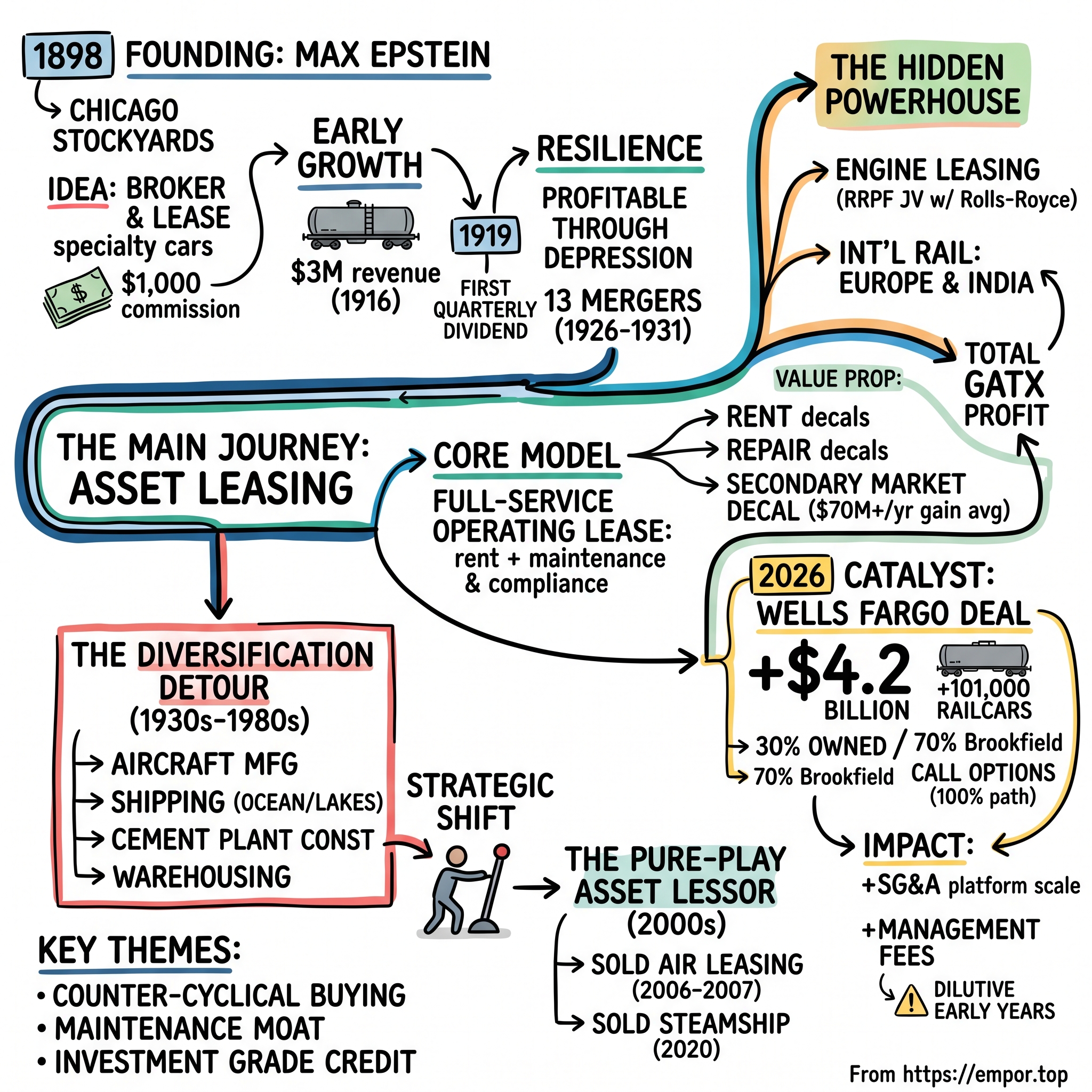
The founding story is almost too neat, but the documentary record supports it. In 1898, Max Epstein was working the Chicago stockyards when he learned that a Pittsburgh brewer, Duquesne, needed refrigerated railcars, and that Armour and Co. had 48 old ones it wanted to unload. Epstein brokered the introduction, earned a $1,000 commission, and then did something unusual: instead of pocketing the fee, he used it as a down payment to buy 28 of the cars on a mortgage.5 He had turned himself from a middleman into an owner overnight, on borrowed money, with a customer already in hand. GATX's own account of the founding quotes Epstein with characteristic dryness: the company "started out with quite a large capital in 1898, only it did not consist of money."4
The insight underneath the anecdote was the one that still funds the company. Epstein's competitors rented cars on an as-needed basis — a spot business, priced by the day, with the lessor absorbing all the idle time. Epstein instead leased specialty cars to shippers on long-term contracts.5 He was selling certainty to industrial customers whose real problem was not the cost of a railcar but the risk of not having one when a plant needed to ship. That is a fundamentally different product, and it commands a fundamentally different price.
The business incorporated in 1902 as German-American Car Company, and by 1907 it operated 360 tank cars and 73 refrigerator cars.5 That same year it did the thing that separated it from every financial lessor that followed: it opened repair and maintenance shops in East Chicago, Indiana, and began building its own steel tank cars.45 This was vertical integration long before the phrase existed, and the logic was practical rather than theoretical. A tank car carrying acid or liquefied gas is a pressure vessel that must be inspected, requalified and certified on a regulatory calendar. If you own the shops, you control the schedule, you control the cost, and — critically — you know what the asset is actually worth, because you have seen inside it. A lessor who outsources all maintenance is, in a meaningful sense, guessing.
By 1916 the company had 2,300 cars and about $3 million in revenue, sold stock to the public, and renamed itself General American Tank Car Corp.5 The quarterly dividend began in 1919 and has never been interrupted since.1 NYSE listing followed in 1920.4
The Depression, counterintuitively, was good to the company: petroleum and food kept moving, leases were multi-year, and maintenance work continued regardless. Profits grew every year through the 1930s, and the company completed thirteen mergers between 1926 and 1931 — buying distressed fleets from distressed owners.5 By 1940 it operated 60,000 freight cars, the largest such leasing system in the country.5
Two details from that era still echo. The first is that the company built its bulk-liquid storage terminals into the largest public terminal network in the country — an adjacency that made sense, because a company that moves chemicals by rail is close to a company that stores them.5 It would nonetheless be sold decades later, and the reason it was sold is the theme of the next act. The second is that the company learned in the 1930s that the leasing model's real virtue is not high returns in good years but positive returns in terrible ones. That lesson has been the organizing principle of GATX's balance sheet ever since.
Then came the part of the story GATX's marketing materials handle gently. From the late 1930s onward, the company diversified: aircraft manufacturing interests, Great Lakes shipping, cement-plant construction with the 1954 purchase of Fuller Co., heavy engineering with Traylor in 1959, and equipment finance through GATX Leasing in 1967.5
It stopped manufacturing freight cars in 1968, bought American Steamship in 1973, renamed itself GATX Corporation in 1975 to signal its holding-company ambitions, and in 1979 paid $65 million for an ocean-tanker business at what proved to be almost exactly the wrong moment — the shipping industry then entered an overcapacity depression that contemporaries described as worse than the 1930s.5
It is worth being fair about why they did it, because the logic was not stupid at the time. Railcar leasing in the 1960s looked like a mature, slow-growing business attached to an industry — American railroading — that was heading toward bankruptcy court. Diversification into shipping, engineering and equipment finance was the standard prescription of the era, and GATX's management was applying it to a franchise they reasonably feared was in structural decline. The error was not diversifying; it was diversifying into businesses where GATX brought no advantage other than a balance sheet. Capital alone is not an edge, and the 1970s and 1980s taught the company that lesson at enormous cost.
The 1980s were a slow, humiliating retreat. Manufacturing operations were closed outright in 1984, Fuller was sold in 1986, and the ocean shipping lines went with them.5 In 1985–86 three investment firms — Leucadia National, Adler & Shaykin, and Gabelli & Co. — circled the company; GATX accepted Leucadia's offer only for the bidder to withdraw two hours before the deadline, after which GATX repurchased 30% of its own stock and installed takeover defenses.5 A conglomerate that has to buy back a third of itself to stay independent is a conglomerate the market has already judged.
Even after that lesson, the retreat was not complete. GATX built the largest U.S. warehousing business through the 1989 Associated Unit Companies acquisition, expanded bulk-liquid terminals internationally, and grew aircraft leasing through a joint venture with Credit Lyonnais.5 The bill arrived in 1997: restructuring charges at Terminals and Logistics produced a $51 million net loss on record revenue of $1.7 billion.5 That is the datapoint that should discipline anyone tempted to describe GATX as a company that has never lost money.
What followed over the next decade was the actual transformation. The European terminals network was sold in 2001.5 The technology-leasing unit went to CIT in 2004 for roughly $200 million.5 The aircraft leasing business — about $1.5 billion of net book value, or 21% of total assets — was sold to a Macquarie-led group in two closings in late 2006 and January 2007, generating $1.3 billion of gross proceeds, of which roughly $800 million retired debt.13
Management's stated reason is worth quoting in substance because it is unusually honest for a divestiture rationale: relative to competitors, GATX's lower scale and higher cost of capital were a competitive disadvantage in aircraft.13 The last piece, American Steamship, went to Rand Logistics for $260 million in 2020.23
There is a second, subtler lesson buried in that sequence, and it bears directly on 2026. Every business GATX exited was one where it owned assets but did not control the operating economics — tankers priced by a global charter market, warehouses priced by local competition, aircraft priced by lessors with cheaper capital. Every business it kept was one where it owned the asset and the service wrapped around it. That is the distinction that actually separated the winners from the losers in GATX's portfolio, and it is a sharper test than "core versus non-core."
The pattern is clear once you line it up. GATX exited every business where it was a subscale price-taker and kept — then reinforced — the two where it had either scale or a privileged partner: railcar leasing with an owned maintenance network, and spare aircraft engines alongside Rolls-Royce. The strategic discipline is real, but note what it cost and how long it took. This was roughly forty years of shrinking to greatness, and much of the value destroyed along the way was never recovered. The relevant question for today is whether a management team that inherited that discipline has retained it while doing the largest acquisition in company history.
To answer that, we need to understand what a railcar lease actually is.
III. The Core Engine: Rail North America Industry Structure & Unit Economics
Picture a polyethylene plant on the Gulf Coast. It runs continuously; stopping and restarting a cracker is enormously expensive. Its output has to leave in covered hopper cars, hundreds of them, on a schedule. The plant manager's nightmare is not the monthly lease bill — it is a compliance failure that strands twenty cars in a repair queue during a production run. That asymmetry, between a modest recurring cost and a catastrophic operational failure, is the whole reason full-service leasing exists.
The structure of the market. North America's railcar fleet numbers well over a million cars, and ownership is split three ways: the railroads themselves, shippers who own their own cars, and lessors. Within leasing, the field has consolidated into a handful of serious operators. Union Tank Car Company and its Canadian affiliate Procor — both owned by Berkshire Hathaway's Marmon Group — together own roughly 120,000 cars and are the historical benchmark in tank cars.18
Trinity Industries, which both manufactures and leases, ended 2025 with a wholly owned lease fleet of 101,485 railcars at 97.1% utilization, plus another 44,785 cars managed for third-party investors.17 Greenbrier, the other integrated manufacturer-lessor, runs a much smaller owned lease fleet of roughly 17,000 cars sourced largely from its own factories.19
Below them sits a long tail of institutional owners — pension funds, infrastructure funds, insurers — that Paul Titterton, GATX's head of Rail North America, described on the Q1 2026 call as "extremely active in the marketplace" and, notably, as eager buyers of GATX's used cars.3
GATX now sits at the top of that list by car count, with approximately 206,100 cars in Rail North America including a boxcar fleet of about 9,900 as of March 31, 2026.1 Management is willing to say plainly that it is the largest owner of railcars in North America.2 What management is more careful about — correctly — is that roughly half those cars sit in the Brookfield joint venture, and GATX's economic share of that half started at 30%.
Full-service versus net lease, in plain language. A net lease is a financing product. The lessor hands over the car; the lessee pays for maintenance, taxes, insurance and regulatory compliance, and returns the car at the end. It is common for standard boxcars and grain hoppers and it is, economically, a loan secured by steel. A full-service lease is an operating product. GATX provides the car and runs the maintenance program: routine repairs, the federally mandated tank qualification and requalification cycle, mobile repair units, and the administrative machinery of keeping a hazmat asset legal. The customer gets one invoice and one phone number.
The premium GATX earns for that is not free money — it is payment for a real cost structure the customer would otherwise have to build. GATX's FY2025 10-K describes a Rail North America maintenance network of six major facilities, one smaller facility, three customer-dedicated sites, and three mobile-unit locations, which together with third-party shops performed roughly 36,000 service events in 2025; third parties accounted for about 23% of the segment's maintenance network expense.9
The company employed 2,371 people globally at year-end 2025, roughly 39% of them covered by collective bargaining agreements.9 That is a labor-intensive industrial services business bolted onto a leasing balance sheet, and it is the part competitors cannot replicate by writing a check.
It is also the part that can go wrong. Maintenance is guided to roughly $500 million in 2026, up about $150 million year over year almost entirely because of the acquired fleet.2 Ellman flagged on both the fourth-quarter and first-quarter calls that a relatively small percentage change in that line is one of the two largest swing factors in full-year earnings.23 A cost structure that creates switching costs also creates operating leverage in the wrong direction when labor and parts inflate.
What "compliance" actually means, in plain terms. It is worth pausing on the technical reality, because it is the least understood part of the business and the most important to the moat. A tank car is a certified pressure vessel on wheels. Federal regulation requires it to be periodically taken out of service and requalified: the tank is emptied and cleaned, the shell and welds are inspected for thinning and cracking, valves and fittings and pressure-relief devices are tested, linings are checked or replaced, and the whole thing is documented in a record that follows the car for its life. Depending on the car and its service, that cycle runs on a multi-year clock, and it is not optional — a car whose qualification has lapsed is legally a piece of scrap sitting on a siding.
Now scale that mentally. GATX must keep a rolling calendar of requalification dates across a fleet an order of magnitude larger than any customer's, forecast the shop capacity to meet it years ahead, and stage substitute cars so a shipper's plant does not go short while its cars are in the shop. That planning problem is the actual product. It also explains why GATX's maintenance spend does not move smoothly: 2026 is another heavy compliance year, with the calendar expected to moderate afterward.2 Investors who treat the maintenance line as a simple cost-inflation item are missing that it is substantially a regulatory calendar with a cost attached.
Utilization: what the number really tells you. GATX's Rail North America utilization was 98.1% at the end of March 2026 — down from 99.0% the prior quarter and 99.2% a year earlier.1 Read carelessly, that looks like softening demand. It is not. GATX's legacy fleet entered the transaction at 99.0% utilization; the Wells Fargo fleet was at 96.5%.1 The blended number is arithmetic, and management said so before the fact, guiding to 98%–99% by year-end 2026.2
The more interesting implication is the reverse one: the acquired fleet's 250-basis-point utilization gap is the clearest single piece of evidence for where GATX thinks it can add value. Roughly 2,500 idle cars, placed at market rates, is a meaningful earnings item. Whether they get placed is a testable claim, and the metric to watch is whether consolidated utilization drifts toward 99% rather than away from it.
The Lease Price Index. The LPI is GATX's signature disclosure: the percentage change between the rate on an expiring lease and the rate on its renewal, for cars renewed in the quarter. In the first quarter of 2026 it was positive 22.3%, following 21.9% in the fourth quarter of 2025 and 24.5% in the first quarter of 2025, with an average renewal term of 56 months.1
The mechanism deserves care because it is easy to over-read. A +22% LPI does not mean revenue grows 22%. It means that the specific slice of the fleet renewing this quarter — a few percent of cars — repriced upward by that much, and locked the new rate in for roughly four and a half years. Because leases run three to seven years, today's LPI compounds into revenue slowly and then persists.
The corollary is the part bulls tend to skip: the LPI is high partly because it is comparing against leases signed in a weak market five years ago. Titterton acknowledged this directly on the July 2025 call — "we've got expirations coming off of a weaker pricing environment, and so that has continued to provide a pretty strong LPI result," while absolute lease rates have been roughly flat sequentially for some time.20 A flat absolute rate with a shrinking gap to expiring rates produces a decaying LPI mechanically, with no deterioration in the market at all.
Management's structural argument for why the market stays supportive is a supply story, not a demand story. New railcar production has been running well below replacement levels, while high scrap steel prices pull old cars out of the fleet permanently; the net North American fleet is shrinking.2 Titterton has called this a "supply-led" market for several years running, and the consistency of that framing across calls is itself a data point in management's favor. It is also, by construction, a claim that will break if new-car production normalizes or scrap prices collapse.
The secondary market — the quiet profit center. GATX generated approximately $50 million of gains on asset dispositions in the first quarter of 2026 and has guided to roughly $200 million for the full year, versus $130 million in 2025.12 Over the past decade the company has averaged more than $70 million a year in gains on asset sales.3
Understand what a gain on sale means here. GATX depreciates railcars on a schedule; the market prices them on remaining useful life and replacement cost. When a 25-year-old tank car sells above net book value, the market is telling you the accounting depreciation was conservative. Doing that consistently for a decade is not luck — it is evidence that the carrying value of the fleet understates its economic worth.
But this is also where the disclosure gets interesting.
On the Q1 2026 call, an analyst noted that a peer had publicly claimed its fleet's market value sat 35%–45% above book, and asked whether GATX had a comparable figure. Ellman declined: "a theoretical quantification probably does not provide a ton of value since we see it in a very practical way when we receive actual cash for the assets we sell."3 That is a defensible answer and an evasive one at the same time. It is defensible because mark-to-model on 200,000 railcars is genuinely soft. It is evasive because investors are being asked to trust that embedded value exists without being given a range. An investor who wants to underwrite hidden asset value here has to build it from disclosed gain-on-sale history rather than from anything management provides.
Myth versus reality on the gains line. The consensus story is that gain-on-sale is a "hidden" recurring profit stream proving conservative accounting. Two corrections. First, gains are not free: every car sold is a car no longer earning rent, so the earnings quality of a disposition-heavy year is genuinely lower than an equivalent quarter of lease revenue. Second, and specific to 2026, of the ~$200 million guided, roughly $70 million is expected to come from the joint venture — where GATX keeps only its ownership share, the rest flowing out through the non-controlling interest line.2 The headline number and the number that reaches GATX shareholders are meaningfully different this year.
That distinction becomes central once you look at how the Wells Fargo deal was actually built.
IV. Key Inflection Points & M&A Strategy: Navigating Cycles & Crises (2008–2026)
There is a particular kind of phone call that only gets made in a crisis: a lessor with an investment-grade balance sheet calling a railcar manufacturer whose order book has just gone to zero. In late 2008 and 2009, GATX was one of the few buyers still able to make that call, and the pattern it established then — commit capital into troughs, sell into strength — is the through-line connecting every deal in this section.
Inflection point 1: the discipline that survives cycles. GATX's capital allocation framework, as Lyons has stated it repeatedly and near-verbatim across calls, has three tiers in fixed order: acquire hard assets at attractive valuations first; manage the balance sheet and leverage prudently second; return excess capital via dividend or repurchase third.2
The ordering is not decoration. It explains why GATX's buyback authorization granted in 2019 took until the fourth quarter of 2025 to exhaust, and why the company repurchased just $46.5 million of stock in that quarter at an average of about $160 per share before the board authorized a new $300 million program in February 2026.2 A company that buys back stock only when it has nothing better to do with capital will look shareholder-unfriendly during asset booms and very smart afterwards. Investors who want aggressive buybacks are, structurally, in the wrong stock.
The credit rating is the enabling mechanism, and management treats it as a hard constraint rather than a target. As of March 2026, Moody's rated GATX Baa1 at the issuer level and Baa2 senior unsecured with a stable outlook; S&P has held BBB since 2010; Fitch has assigned BBB+ since 2023 — all three stable.10 Investment grade is what lets GATX issue unsecured debt at scale and buy fleets that unrated private buyers must finance more expensively. It is a genuine, quantifiable competitive advantage, and it is also a leash: the balance sheet cannot be levered up for shareholder returns without forfeiting the very thing that makes the buying strategy work.
Inflection point 2: Lac-Mégantic and the DOT-117 mandate. In the early hours of July 6, 2013, an unattended crude oil train rolled down a grade into the center of Lac-Mégantic, Quebec, and derailed. Oil released from roughly 63 DOT-111 tank cars ignited; 47 people died.[^17] It remains the defining safety event of the modern North American tank car business.
The regulatory response was fast and structural. In May 2015, PHMSA and the Federal Railroad Administration, coordinating with Transport Canada, issued the enhanced tank car standards rule for high-hazard flammable trains, creating the DOT-117 specification — thicker shells, full-height head shields, thermal protection, top-fitting protection, improved bottom outlet valves — and a phased retirement or retrofit schedule for the legacy fleet, with most flammable-liquid deadlines running through May 1, 2025 and a residual category extending to May 1, 2029.16
The conventional narrative is that GATX "won" the DOT-117 transition. The defensible version is narrower and more useful.
A mandated retrofit cycle is an enormous, non-optional capital and shop-capacity event. Owners with internal shop networks and long-standing third-party relationships could schedule the work; owners without them competed for scarce shop slots at rising prices. The regulation converted GATX's maintenance network from a cost center into a scheduling advantage, and it raised the barrier to entry for anyone who thought tank car leasing was a pure financial trade. It also created a durable liability: GATX's 10-K continues to identify environmental remediation and hazmat exposure as principal contingencies, while noting environmental costs were not material to its financial position at the end of 2025.9 Compliance advantage and catastrophe exposure are two sides of the same asset.
Inflection point 3: geographic and product adjacencies. On December 29, 2020, GATX acquired Trifleet Leasing Holding B.V. of the Netherlands — then the world's fourth-largest tank container lessor, serving roughly 300 customers across chemicals, industrial gases, energy, food, cryogenics and pharmaceuticals — for approximately €175 million in cash.14 Trifleet sits in GATX's "Other" segment and is small relative to rail.9 Its strategic logic is that a tank container is the same customer problem as a tank car — certified containment of a hazardous liquid, leased rather than owned — solved for ocean and road rather than rail. Its strategic risk is that it is a fourth-place position in a market where GATX has no maintenance-network advantage. Five years on, it has not become a major earnings driver, and investors should size it accordingly.
Europe has been the more consequential adjacency. In September 2025, GATX Rail Europe agreed to acquire approximately 6,000 freight railcars from DB Cargo AG in a sale-and-leaseback, closing after regulatory approval in November 2025 and lifting GRE's fleet from roughly 30,500 cars to over 36,600.151 Sale-leaseback with a struggling incumbent operator is a classic lessor play — the counterparty needs balance-sheet relief, the lessor gets assets with a contracted revenue stream attached — and it was executed into a European macro environment that Lyons openly described as having failed to improve during 2025.2 Buying European rolling stock while German industrial output disappoints is the counter-cyclical thesis in its purest and riskiest form.
Inflection point 4: the Wells Fargo transaction. On May 29, 2025, GATX announced a definitive agreement to acquire approximately 105,000 railcars from Wells Fargo for $4.4 billion, through a newly formed joint venture with Brookfield Infrastructure Partners and its institutional partners.6 All required regulatory clearances arrived on December 22, 2025, and the deal closed January 1, 2026, at approximately 101,000 railcars for approximately $4.2 billion, reflecting the fleet count at closing.87 Separately, Brookfield directly acquired Wells Fargo's rail finance-lease portfolio of roughly 22,000 railcars and about 400 locomotives, and GATX purchased 200 locomotives outright for approximately $30.4 million.79
The structure is the story. GATX owns 30% of the joint venture; Brookfield owns 70%; GATX holds annual call options to acquire up to 100% of the equity over time.62 GATX contributed $385.3 million of equity for its initial stake and anticipated exercising a first option for a further 3.5% of the JV on June 30, 2026 for approximately $66 million.92 Because GATX is the controlling partner from day one, U.S. GAAP requires it to consolidate 100% of the JV, with Brookfield's share stripped out in a single non-controlling interest line.2 GATX also guarantees the JV's $2.96 billion term loan.9
The pro forma disclosures GATX filed alongside the closing make the scale of the change legible in a way the segment commentary does not: this was not a bolt-on that flatters a few line items but a transaction that materially reshapes revenue, depreciation, interest expense and the balance sheet simultaneously.22 The closing announcement itself confirmed the essential terms — the January 1 effective date, GATX's role as manager of every railcar involved in both the joint venture and Brookfield's directly held portfolio, and the expectation of modest first-full-year EPS accretion with more substantial contributions later.21 That last phrase is the one to hold onto. Management told investors up front that year one would be underwhelming.
That structure accomplishes three things simultaneously. It gave GATX control of a fleet it could not have bought alone without wrecking its leverage. It preserved roughly $1 billion of annual investment capacity across GATX's other businesses — Ellman explicitly framed the deal design as protecting the ability to fund attractive opportunities elsewhere.2
And it created a management-fee stream that is pure margin: approximately $44 million a year for managing the JV plus approximately $11 million for managing Brookfield's directly owned finance-lease portfolio, against roughly $30 million of incremental SG&A.2 GATX more than doubled its owned-and-managed fleet while SG&A rose only from $246 million in 2025 to a guided ~$275 million in 2026 — a little over 10%, inclusive of normal wage inflation.2 That is a genuine demonstration of platform scalability, and it is the strongest single argument in the deal's favor.
Did GATX overpay? The honest answer is that outsiders cannot yet tell, and the accounting will obscure it for years. Lyons flagged the mechanism himself: operating lease accounting is dilutive in the early years of ownership because depreciation is straight-lined while interest expense is front-loaded and burns down over time.2 Total 2026 EPS contribution from the transactions is guided at $0.20–$0.30, reaffirmed as on-target at the first quarter.3 For a $4.2 billion asset purchase, that is modest — which is exactly what GATX said it would be.
The real valuation test is the secondary market, and it will play out slowly. The JV is structured to run down rather than reinvest; GATX expects to sell perhaps 3,000–4,000 cars out of it in 2026, generating around $70 million of gains, with reinvestment opportunities flowing to GATX's own balance sheet.2 Critically, the Wells Fargo fleet was about 95% freight cars, and freight cars are the most liquid segment of the secondary market — tank cars have a smaller, more specialized buyer universe.2 So GATX bought the more saleable half of the market at a moment when capital is flooding toward railcars and new production is depressed. If disposition prices hold, the purchase price will look good. Watch the JV's realized gains per car over the next eight quarters; that is the scoreboard.
What should make a skeptic uncomfortable. Three things. First, the first quarter's JV asset disposition gains were about $2 million against a $70 million annual target, which is why the non-controlling interest line showed a $6.4 million loss rather than a profit.31 Management called this expected and integration-driven; it is also a back-loaded plan, and back-loaded plans are where guidance goes to die.
Second, GATX bought a fleet whose maintenance had been performed entirely by third parties — Wells Fargo, as a bank, was not permitted to own shops — historically about $135 million a year across close to 80 shops.2 GATX has begun consolidating that vendor list, but its own shops are at full capacity, so the in-housing synergy is a multi-year hope, not a 2026 event. Third, GATX has explicitly excluded incremental synergies beyond the disclosed items from 2026 guidance.2 That is conservative framing, and it is also a hedge that makes the deal harder to grade.
While all of this was consuming Chicago's attention, two other businesses were quietly out-earning expectations.
V. The Hidden Powerhouse: Engine Leasing & International Rail
A Rolls-Royce Trent engine is roughly the price of a small apartment building and about as illiquid. An airline that operates a fleet of wide-bodies needs spare engines on the ground — because when an engine comes off wing for a shop visit, the aircraft is grounded until a replacement is fitted, and shop visits currently take a long time. But a spare engine sitting in a warehouse is the single worst asset an airline can own: enormous capital, zero revenue, entirely idle by design.
That is the arbitrage GATX has quietly harvested for nearly three decades.
Rolls-Royce & Partners Finance. GATX formed its aircraft spare engine leasing partnership with Rolls-Royce plc in 1998.4 The structure is a 50/50 joint venture — GATX supplies capital and asset-management discipline, Rolls-Royce supplies the engines, the technical knowledge and the customer relationships. Neither partner could run it as well alone. Rolls-Royce gets a financing channel that helps sell engines without carrying them; GATX gets access to an asset class where the manufacturer is on the same side of the table.
The economics have compounded quietly. In 2025 the RRPF affiliates invested over $1.4 billion, bringing the joint venture's total asset base above $5.7 billion, and the affiliates invested a further approximately $135.0 million during the first quarter of 2026 with what management called a robust pipeline.21 GATX has additionally built a wholly owned engine portfolio — GATX Engine Leasing, established in 2021 for direct spare-engine investment — now exceeding $1 billion.42
A note on how this shows up in the financials. RRPF is a joint venture, not a subsidiary, so GATX does not consolidate it. Its contribution arrives through the "share of affiliates' earnings" line — $20.8 million in the first quarter of 2026 against $25.1 million a year earlier — and through GATX's "investments in affiliated companies" balance, $752.4 million at March 31, 2026.1
What that means practically is that a business with more than $5.7 billion of assets behind it appears on GATX's balance sheet as a three-quarter-billion-dollar equity stake and on the income statement as a single after-tax line.21 There is no revenue, no depreciation, no engine-level detail. Investors get segment profit and management's commentary, and that is all. It is a legitimate accounting treatment for a 50/50 venture, and it is also the least transparent corner of GATX's disclosure.
Financially this is not a side business. Engine Leasing segment profit was approximately $165 million in 2025 and is guided to $180–$185 million in 2026, an increase that follows a nearly $50 million jump between 2024 and 2025 — the fastest growth of any GATX business in that year.2
For context, Rail North America segment profit is guided to roughly $415 million in 2026 on an asset base many times larger.2 Engine leasing generates a materially higher return on the capital GATX has in it, and the joint venture is self-funding: Ellman noted that GATX does not typically make capital contributions to RRPF, yet GATX's proportional share of the JV's investment activity ran roughly $700 million in 2025 and an anticipated ~$500 million in 2026.2 That is growth GATX participates in without consuming its own balance sheet capacity.
Why the returns are high right now, and what would end that. The current supply-demand imbalance is a manufacturing and MRO bottleneck, not a demand boom. New engine production is constrained and maintenance-shop backlogs are long; these are extraordinarily complex assets and, as Lyons put it, "you can't really scale up quickly to do that kind of work."2 When you cannot easily build a new engine or quickly repair an existing one, the value of an engine already flying rises, and the lessor gets pricing leverage. This is the same structural argument GATX makes in rail — constrained supply of a long-lived asset, not booming demand — which is intellectually consistent and worth flagging as a pattern in how management thinks.
The obvious risk is that it reverses. If Rolls-Royce and the MRO network work through their backlogs, engine scarcity fades and lease rates normalize. Two nearer-term risks are visible in the disclosure. Earnings are lumpy in a way that regularly confuses the sell side: remarketing income was under 10% of RRPF earnings in the first quarter of 2026, against roughly a third for full-year 2025, and has swung between about 15% and nearly 70% across recent quarters.3 Engine leasing segment profit consequently fell year over year in the first quarter, to $35.3 million from $38.6 million, even as operating income rose on more engines on lease at higher rates.13 Anyone extrapolating a single quarter here will be wrong roughly half the time.
The second is geopolitical. GATX's first-quarter release and call both flagged the Middle East conflict and its potential implications for global air travel and airline financial health, and Ellman named wide-body long-haul routes specifically as the exposure that matters.13 Management's position is that the industry has demonstrated resilience through decades of external shocks and that no material impact had appeared through the first quarter. That is a reasonable base case and an explicitly unhedged one.
Rail International. Rail International delivered segment profit of $31.6 million in the first quarter of 2026 versus $25.7 million a year earlier, driven by more railcars on lease, higher lease rates, and currency.1 The two platforms inside it could hardly be more different.
GATX Rail Europe operated over 36,600 railcars at the end of March 2026, at 94.7% utilization — flat sequentially and down slightly from 95.1% a year earlier.1 Europe entered GATX's portfolio in 1997 via an investment in KVG and doubled through Polish acquisitions in 2002–2003; Poland remains the operational center, and roughly 68% of Rail International's maintenance expense is externally sourced, a very different model from North America.49 The European story right now is one of grinding execution against a poor macro backdrop: the team has pushed renewal rates higher across the majority of car types while customers delay fleet planning decisions.1
Rail International's customer concentration is also notably higher than North America's — approximately 300 customers, with a single customer at roughly 17% of segment revenue and the top ten at about 47%, versus roughly 800 customers and a top-ten concentration near 25% in North America.9 That is a real, if second-order, risk concentration that the consolidated numbers hide.
India is the opposite: small, fast, and structurally advantaged. GATX Rail India operated approximately 12,500 railcars at March 31, 2026, at 100.0% utilization.1 GATX entered in 2012 as the first company registered to lease wagons under Indian Railways' wagon leasing scheme and is now among the largest private wagon owners in the country, serving intermodal, cement, steel and automotive logistics.426
Full utilization is a pleasant problem that tells you the constraint is capital deployment rather than demand. The long-run case is a national freight system shifting volume from road to rail with heavy government infrastructure investment behind it. The realistic caveat is scale: 12,500 wagons against 206,100 North American railcars means India can be GATX's best growth rate for a decade without becoming its biggest profit source.
Which raises the question of who is making these allocation decisions, and how they are paid to make them.
VI. Management, Corporate Governance, & Capital Allocation Record
In December 2021, GATX's board announced that Brian Kenney, chief executive since 2005, would retire the following April, and that Robert C. Lyons — then executive vice president and president of Rail North America — would succeed him effective April 22, 2022, with Kenney remaining as non-executive chairman until October 31, 2022.12 It was the least dramatic CEO transition imaginable: internal candidate, telegraphed four months in advance, orderly handoff of the chair. For a company whose entire business model is measured in decades, that is arguably the correct amount of drama.
Robert C. Lyons. Lyons had been at GATX for roughly a quarter century before taking the top job, having served as chief financial officer and then run the North American rail business.12 On the first-quarter 2026 call, discussing an unusually high renewal success rate, he remarked that "in my 30 years at GATX Corporation, I have never seen one with a nine in front of it."3 That aside is more revealing than it looks. It is the reflex of someone with a long internal time series in his head, and it is exactly the kind of pattern recognition that matters in a business where the mistakes are made at cycle peaks.
Lyons's communication style is unusually specific for a CEO. His January guidance sessions walk line by line through expected lease revenue, maintenance expense, depreciation, interest expense, other operating expense and segment profit — the fourth-quarter 2025 call ran through all of them for Rail North America before he addressed anything strategic.2 That practice creates accountability by construction: a CEO who publicly forecasts seven line items has seven ways to be caught out. It also gives investors something rare, which is a checkable record.
Thomas A. Ellman, executive vice president and chief financial officer since August 2018, came to the role having run Rail North America from 2013 and, before rejoining GATX in 2006, having served as chief risk officer and head of asset management at GE's railcar services business. That background — risk and asset management rather than accounting — shows in how he answers questions: his instinct on valuation questions is to point to realized cash from asset sales rather than modeled values, and his framing of full-year variance is consistently about remarketing timing and maintenance spend rather than demand.3
Paul F. Titterton, executive vice president and president of Rail North America since April 2022, previously served as the segment's chief operating officer from 2018. He handles the commercial questions on calls and is notably willing to concede uncertainty — asked in the first quarter why average renewal term had ticked down, he attributed it to fleet-mix noise and then added, "If I sound like I am speculating, I am, because we are just in the beginning of digesting this fleet."3 Executives who label their own speculation as speculation are, on balance, easier to underwrite.
How they are paid. GATX's annual incentive is tied to net income excluding tax adjustments and other items. Long-term performance shares are earned over three years against two equally weighted measures: three-year average LTI-adjusted return on equity, and three-year cumulative investment volume.11 Roughly 84% of the CEO's target compensation and about 70% of other named executives' target compensation is performance-based and at risk.11 Executive stock ownership guidelines run to 5.0x base salary for the CEO and 2.5x for other executive officers, with a requirement to retain half of after-tax equity award profits until the guideline is met.11
This design deserves both credit and scrutiny. The credit: pairing a return metric with a growth metric is precisely how you avoid the two classic lessor failure modes — growing the balance sheet at bad returns, or protecting returns by refusing to invest.
The scrutiny: "cumulative investment volume" pays management for deploying capital, and in the 2022–2024 cycle investment volume exceeded target while average LTI-adjusted ROE fell slightly short, producing a 136.8% payout.11 In other words, the growth leg carried the return leg. In a year when management closed a $4.2 billion transaction, an investor is entitled to ask whether an incentive that rewards volume is fully aligned with an incentive that rewards discipline. GATX's proxy also concedes a genuine benchmarking problem: there is no meaningful peer group for total shareholder return comparison because there are essentially no other independent, publicly traded railcar leasing companies.11 That is honest, and it also means the compensation committee is largely grading its own exam.
The capital allocation record, tested. Take the most checkable claim. Coming into 2025, management expected EPS growth of roughly 8%; the company delivered 11%, with full-year net income of $333.3 million and diluted EPS of $9.12 against $284.2 million and $7.78 in 2024, while holding return on equity above 12% and leverage at roughly 3.3x.2 Revenue rose to $1.74 billion from $1.59 billion.27
That is a beat delivered without leverage expansion, which is the version of a beat that counts.
Trace the guidance path within that year and it holds up under a finer lens. In July 2025 management raised full-year guidance to $8.50–$8.90 per diluted share, excluding tax adjustments and other items and excluding any Wells Fargo impact, attributing most of the increase to engine leasing.20 Reported full-year EPS came in at $9.12 including a net positive $0.37 from tax adjustments and other items — which puts the underlying result at $8.75, squarely inside the range management had set six months earlier.2 That is an unglamorous kind of credibility: guidance raised on a specific, named driver, and then delivered on the same basis it was set. It is also a reminder to read GATX's headline EPS carefully, because tax items have swung the reported number by tens of cents in both directions across recent years.2
Extend the series and the picture is more nuanced. GATX's return on equity was in the 7% range through 2020–2022 before stepping up to roughly 11%–12% from 2023 onward.27 That step-change tracks the railcar lease repricing cycle almost exactly. A fair reading is that management has executed well into a favorable market — not that it has manufactured returns independent of one. The cyclical nature of the ROE improvement is the single most important thing a long-term investor should hold in mind when extrapolating.
The dividend record supports the discipline claim more cleanly. The quarterly payout has run uninterrupted since 1919, and in February 2026 the board raised it 8.2%, a step up from several years of roughly 5% increases, alongside a new $300 million repurchase authorization.12 Raising the dividend growth rate in the same quarter as closing the largest acquisition in company history is a deliberate signal about cash flow confidence. It is also, notably, the kind of signal that is expensive to retract.
On buybacks, the behavior matches the stated philosophy closely enough to be believable, and investors should understand what that implies. GATX does not run a programmatic repurchase; it treats the share count as a residual after asset investment and balance sheet management.2 The practical consequence is that repurchases arrive in bursts, at moments when the stock is cheap relative to what management thinks the assets are worth and when better uses of capital are scarce. Anyone underwriting GATX on an expectation of steady share count reduction is underwriting something the company has never promised and rarely done.
The place where behavior is least tested is the one that matters most from here: GATX has never integrated an acquisition of this magnitude. Everything management says about the integration is currently unfalsifiable in the sense that it is early and self-reported. Which is why the calls are worth reading closely.
VII. Primary Sources & Earnings Call Q&A Nuances
GATX's earnings calls have a distinctive texture. The prepared remarks are usually short — Lyons noted in February 2026 that "for those of you that participate in our calls regularly, we're usually very brief at the opening" before delivering an unusually long one.2 The Q&A is where the substance lives, and the analyst roster is small and persistent: Goldman Sachs, Citigroup, Susquehanna, Sidoti, Gabelli. These are people who have been modeling the same eight line items for years, and they ask like it.
What management chooses to emphasize. Across the last several calls, the emphasis has been remarkably stable: the LPI, fleet utilization, renewal success rate, the supply-led market thesis, and the strength of the secondary market. That consistency is analytically useful. When a management team uses the same causal framework across a dozen quarters — constrained new-car supply plus scrap-driven attrition equals net fleet shrinkage equals pricing power — you can at least test whether the framework predicts. So far it has.
What analysts push on. Three friction points recur.
The structure of the Wells Fargo deal and where the earnings actually land. Citigroup's Ben Moore opened the first-quarter Q&A by asking why the non-controlling interest line had added to net income rather than subtracting — that is, why the JV showed a loss.3 Ellman's answer was specific: JV asset disposition gains were about $2 million in the quarter against a roughly $70 million annual expectation, because integration took priority over asset sales in the first weeks of ownership.3
Gabelli's Justin Bergner returned to the same line later in the call, asking what besides gains could turn the NCI positive; Ellman's answer was essentially "nothing material," since most railcars in any given quarter simply sit there earning rent with predictable maintenance.3 The exchange is worth understanding because it reveals how binary the JV's reported contribution is: it is a rent-and-depreciation machine with a gains overlay, and the gains overlay is the entire swing factor.
The durability of the LPI. Analysts have pressed repeatedly on whether a 22%–24% LPI is sustainable or a catch-up effect. Management's consistent answer is to reaffirm full-year guidance — high teens to low 20s — and decline to forecast beyond the current year.3 Titterton has been careful to note that the first-quarter LPI did not include material impact from the acquired fleet, and that the Wells Fargo cars will enter the index progressively over time.3 That is an important disclosure: the LPI investors are watching in 2026 is still substantially a legacy-fleet metric, and its composition will shift underneath them.
Maintenance and cost inflation. Moore flagged in the first quarter that Rail North America maintenance expense had come in at roughly 27.6% of revenue against an expected ~31%, and asked whether this was synergy capture. Titterton declined to claim victory — "in any given quarter, there can be noise in maintenance" — and reaffirmed the full-year guide, with Lyons volunteering that annualizing the first quarter would produce roughly $485 million against a ~$500 million guide.3 Declining to bank a favorable quarter into guidance is the behavior you want from a management team. It is also the behavior of a team that knows a heavy compliance calendar is still ahead: Titterton has flagged 2026 as another busy railcar qualification year, with moderation expected afterward.2
What is notably absent from the friction. A refinancing wall — maturing low-coupon debt repricing into a higher-rate environment — is the question one would expect to dominate a leveraged lessor's calls. It has not. Interest expense is guided to roughly $440 million in 2026, up about $180 million, but management attributes the increase overwhelmingly to the new fleet rather than to refinancing legacy debt at higher rates.2 The economic logic management would offer — that lease rates reprice upward alongside the cost of capital, preserving spread — is real but slow-acting, since leases reset on a three-to-seven-year cycle while debt reprices on its own schedule. Investors should hold this as an unresolved question rather than a settled one; the fact that analysts have not forced the issue is not evidence that the issue does not exist.
The European question, and what the answers reveal. Chemical production softness has been the other recurring theme, and the answers have been notably less confident than on North America. Ellman told analysts in July 2025 that Rail International's apparent strength was largely a currency effect, that correcting for exchange rates left segment profit roughly flat year on year, and that this was "a little bit below expectations" because weakness in the European intermodal market had spread to other car types.20 That is a management team volunteering a miss and naming the mechanism rather than blaming the macro and moving on.
Six months later, Lyons opened the full-year call by saying the team had been "hopeful that the economic environment would improve as the year progressed, but it did not."2 Neither statement is spin. For an investor trying to calibrate how much to trust guidance, the willingness to state a disappointment plainly in the same breath as good news elsewhere is worth more than any single quarter's beat.
Consistency check. Comparing the February 2026 guidance session against the May 2026 results call, the striking thing is how little changed. Lyons ran through lease revenue, gains, maintenance, and Rail International segment profit and reported that "everything fell very close to in line," with Ellman adding that if you pulled up the prior quarter's opening comments and ticked through them, "it is very much in line."3 For one quarter, that is weak evidence. As a habit sustained over years, it is the foundation of management credibility — and it is the reason the July 30, 2026 second-quarter release is worth reading closely, since it will be the first quarter in which the integration excuse for soft JV disposition gains no longer applies.24
What to listen for next. Three specific things on the July 30 call would move the analytical picture more than the headline EPS number.24 Whether joint venture disposition gains have begun to materialize in volume, which tests the credibility of a back-loaded $70 million plan. Whether consolidated utilization has moved up from 98.1% toward the legacy fleet's level, which tests whether GATX is actually placing the acquired fleet's idle cars. And whether the June 30 call option on an additional 3.5% of the joint venture was in fact exercised at roughly $66 million as anticipated, which tests whether the step-up path management described in February is proceeding on schedule.2 None of these is a headline. All three are more informative than one.
That live record is the raw material for the structural question: is any of this actually defensible?
VIII. Strategic Frameworks: Porter's 5 Forces & Hamilton Helmer's 7 Powers
Strip away the narrative and ask the war-game question: if you had $5 billion and wanted to take share from GATX, what would you do, and where would you fail?
Scale economies — the primary power, with an asterisk. GATX now controls roughly 206,100 railcars in North America and spreads a fixed cost base — regulatory engineering, spare parts procurement, shop overhead, IT, commercial coverage of over 1,000 customers — across it.13 The clearest proof of the scale economy is the SG&A math already noted: fleet and managed portfolio more than doubled while SG&A rose only a little over 10%.2 That is close to a controlled experiment in operating leverage, and it is the single most persuasive quantitative evidence for scale advantage in the entire GATX story.
The asterisk is ownership. Scale in management is not the same as scale in economics. GATX captures 100% of the commercial and maintenance benefit of the JV fleet but only its equity share of the profits, plus fees. Until the call options are exercised, GATX's scale advantage is partly rented.
Switching costs — high, but earned rather than structural. Replacing a full-service lessor requires a shipper to build or contract regulatory compliance capability, secure third-party shop capacity in a tight repair market, and absorb residual value risk. Rail North America's roughly 800 customers, with the top ten at about a quarter of segment revenue and no single customer above a modest share, suggests a diversified and sticky base.9 But GATX's own renewal success rate — 79.1% in the first quarter, guided to the high 70s to low 80s for the year — tells you the truth: roughly one in five expiring leases does not renew with GATX.12 These are meaningful switching costs, not lock-in. Customers shop, and GATX has to win the renewal.
Counter-positioning — the most underrated advantage. Trinity and Greenbrier are manufacturers with leasing arms; their factories create pressure to keep building. GATX has not manufactured railcars since the 1980s and buys them from whoever offers the best terms — through multi-year programmatic supply agreements, the spot market, and the secondary market simultaneously.25 Under its 2022 Trinity supply agreement GATX had placed over 8,400 railcars through the first quarter of 2026.3
The asymmetry is that GATX can simply stop buying in a downturn and harvest cash from an existing fleet; an integrated manufacturer cannot idle a plant so cheaply. This is genuine counter-positioning: the incumbent manufacturers cannot copy GATX's flexibility without abandoning the assets that define them.
Process power in maintenance. The owned shop network combined with a curated third-party network is difficult to replicate quickly. GATX has already cut the Wells Fargo fleet's shop count materially from close to 80 vendors within weeks of closing.2 But note what it cannot do yet: its own shops are at full capacity, so the highest-value version of this advantage — moving the acquired fleet's ~$135 million of annual third-party maintenance spend in-house — is deferred.2
Porter's five forces, briefly.
Threat of new entrants: low, but not zero. The capital requirement is enormous and the compliance apparatus for hazmat service takes years to build. But capital has been flowing into railcars precisely because the asset class is attractive, and Lyons has explicitly acknowledged competing against "a far lengthier list of institutions" with sub-50,000-car fleets that are active bidders.3 Financial entrants can and do buy fleets; what they cannot easily buy is a full-service maintenance platform. The barrier protects the service business, not the asset ownership business.
Supplier power: moderate and shifting. Railcar manufacturing is concentrated among Trinity, Greenbrier and a handful of others, and GATX's volume gives it real negotiating leverage. But the current environment of depressed new-car production means manufacturers have less capacity to discount, and GATX's own thesis holds that low production is the source of its pricing power. GATX benefits from a weak manufacturing sector — an uncomfortable dependency to state out loud.
Buyer power: moderate. Large chemical and agricultural shippers are sophisticated and have alternatives. The one-in-five non-renewal rate is the honest measure.
Substitutes: low for the core. Trucks cannot economically move bulk liquids and dry bulk at rail volumes over long distances, and pipelines serve fixed point-to-point routes. The core tank car and specialty covered hopper franchise is well protected. The periphery is not: Titterton has identified boxcars specifically as a car type more sensitive to macroeconomic softness, with downward pricing pressure.2 GATX carries about 9,900 boxcars and reports fleet statistics excluding them, which is itself a small tell about that fleet's economics.1
Rivalry: rational, and probably more so after 2026. Consolidation reduced the number of large independent lessors. Asked directly whether more consolidation was coming, Lyons declined to speculate and pivoted to maximizing returns on the existing portfolio.3 The competitive structure looks stable, but "rational oligopoly" is a description of current behavior, not a guarantee of future behavior.
Myth versus reality. The consensus narrative is that GATX enjoys a wide, durable moat. The more precise version: GATX has a strong and demonstrable advantage in full-service tank car and specialty leasing, a moderate advantage in freight car leasing where financial buyers compete effectively, and a favorable but cyclical market backdrop that is currently being mistaken for structural advantage by some observers. Separate the three and the investment case becomes considerably more testable.
Which is exactly what a skeptic would do.
IX. Activist Stress Test & Current Risk Radar
Imagine an activist letter landing on GATX's board in the autumn of 2026. What would it actually say?
"You are a leveraged asset manager trading at a leasing multiple." The bear case starts with the balance sheet. At March 31, 2026, GATX carried $12.43 billion of recourse debt against $2.78 billion of GATX shareholders' equity and $878.1 million of non-controlling interest.1 First-quarter net interest expense was $151.0 million, up from $94.9 million a year earlier, and full-year interest expense is guided to roughly $440 million.2 Against 2026 guided EPS of $9.50–$10.10, the equity's earnings are a relatively thin residual on top of a very large fixed-cost obligation.1
A skeptic's framing: shareholders own a levered call option on railcar lease rates. When rates rise, equity returns amplify; when they fall, the debt does not care.
"Your returns are cyclical, and you are being paid for a cycle." As noted, GATX's return on equity sat near 7% through 2020–2022 and stepped to roughly 11%–12% from 2023.27 The step is the lease repricing cycle. If the LPI decays toward zero — which is arithmetically likely as expiring leases catch up to current market rates — the ROE improvement partially unwinds without any operational failure. Management's own guidance implies a decelerating LPI (high teens to low 20s, versus 22.3% in the first quarter and 24.5% a year earlier).21
"You have obscured the economics of your largest deal." An activist would press hardest here. GATX consolidates 100% of a joint venture it owns 30% of, guarantees $2.96 billion of that venture's term debt, reports fleet statistics on a combined basis, and reports the partner's economics in a single non-controlling interest line.29 Every headline operating metric — fleet size, utilization, and eventually the LPI — now describes assets whose profits GATX largely does not keep. This is entirely GAAP-compliant and management explained it clearly in advance.2 It is nonetheless a genuine complexity cost, and the burden of translation falls on the investor. The call option structure means this will keep changing: each exercise shifts the ratio, so year-over-year comparisons will be distorted for years.
"Your incentive plan pays for volume." Covered above: the growth leg of the performance share plan is cumulative investment volume, and in the most recently completed cycle it was the leg that exceeded target while the return leg missed.11 An activist would argue that a company doing a $4.2 billion deal should have a return hurdle that binds.
"Your disclosure has gotten worse as your business got more complex." A related and fair complaint. GATX reports Rail North America as a single segment with combined operating metrics — utilization, LPI, renewal success rate — spanning legacy and joint venture cars, on the explicit rationale that it manages them as one fleet and has an obligation to its partner not to discriminate between them.2 Operationally that is the right answer; a customer with 500 renewing cars wants one conversation, not two.2
Analytically it means investors can no longer observe how the legacy fleet is performing on its own. Titterton's clarification that the first-quarter LPI contained no material contribution from acquired cars was helpful precisely because the reported metric does not otherwise reveal it.3 Over the next several years, as acquired cars enter the index and GATX's ownership percentage steps up, the same reported number will mean progressively different things.
What the bear case gets wrong. Two things. The leverage critique understates the asset quality: this is not financial leverage against goodwill but against long-lived steel assets with a decade-plus record of selling above book, and against contracted cash flows averaging roughly four and a half years of remaining term on renewals.13 And the cyclicality critique understates the duration: even if new business repriced at zero growth tomorrow, the existing book would take years to roll.
Current risk radar — the four that actually matter.
Cost of capital and refinancing. Discussed in the prior section and genuinely unresolved. The mechanism to watch is spread compression: if debt costs rise faster than lease rates reset, segment margins compress silently over several years rather than dramatically in one quarter.
Class I railroad service and network structure. GATX does not control the railroads its cars run on. Service degradation lengthens cycle times, which paradoxically increases car demand in the short run while damaging customer economics and freight volumes. The consolidation question is live: asked in July 2025 about a proposed transcontinental merger, Lyons declined to assess near-term impact given regulatory uncertainty but argued that greater rail efficiency and more carload traffic are long-term positives for lessors.20 Titterton was blunter on the secondary market question: no impact at all, because capital flowing into railcars is the dominant driver.20 Both answers may be right; neither is a hedge.
Aviation and geopolitics. Named explicitly by management as the exposure they are watching, with wide-body long-haul routes as the specific vulnerability.3 Engine Leasing is guided to $180–$185 million of 2026 segment profit; a genuine long-haul travel disruption would hit both lease rates and the remarketing income that has been a third of RRPF earnings.2
Hazmat liability. Structural and permanent. GATX's 10-K identifies environmental remediation and potential Superfund exposure among its principal contingencies, while stating that environmental costs were not material to its financial position at the end of 2025.9 The tail risk is a catastrophic derailment involving GATX-leased tank cars carrying hazardous material — an event that is low-probability, potentially very large, and impossible to underwrite from outside. Lac-Mégantic is the reason this cannot be dismissed.
European concentration. Secondary but real: a single Rail International customer at roughly 17% of segment revenue, in a region management describes as macro-challenged, following a sale-leaseback that increased exposure to a large incumbent operator.915
None of this is disqualifying. All of it is the price of admission for owning a levered, cyclical, regulated asset business — which brings us to what the whole story teaches.
X. Playbook & Investing Lessons
Somewhere in a GATX shop right now, a tank car built when Ronald Reagan was president is being stripped down, inspected, relined and sent back out to haul chemicals for another decade. It will probably be sold at some point to a pension fund, at a price above what GATX carries it for. That single object — old, unglamorous, still earning, still worth more than the books say — contains most of what this business teaches.
Lesson 1: Operating leases convert lumpy capital cycles into recurring cash — but only if you can service the asset. The distinction between GATX and a financial lessor is not the lease document; it is the shop network, the compliance calendar, and the 36,000 service events a year.9 Any well-capitalized institution can buy railcars. Very few can promise a chemical shipper that its cars will be legal, available and repaired on schedule. That promise is what converts an asset into a franchise, and it is why GATX's most defensible economics sit in tank cars rather than in the freight cars that dominate the acquired fleet.
Lesson 2: Conservative depreciation is a strategic asset, not just accounting prudence. A decade of averaging more than $70 million a year in gains on asset sales is the market repeatedly telling GATX that its books understate its fleet.3 The strategic value is optionality: a company whose assets are worth more than they are carried at can always sell into strength to fund investment or absorb a bad year. The discipline lesson attached to it is that GATX declines to publish a mark-to-market estimate even when a peer does.3 Embedded value you can realize in cash is worth more than embedded value you can only assert.
Lesson 3: Investment-grade credit is an offensive weapon, not a defensive posture. The Baa1/BBB/BBB+ complex is what allowed GATX to sit at the table for a $4.2 billion portfolio and to guarantee a $2.96 billion term loan without a downgrade.109 The corollary, which management appears to have internalized, is that the rating must be treated as a constraint rather than a variable — which is precisely why the Wells Fargo deal was structured with a partner instead of on GATX's balance sheet alone.
Lesson 4: Partner where you lack the right to win. The Rolls-Royce joint venture has produced GATX's fastest-growing profit stream while requiring essentially no incremental capital contributions and no corporate overhead expansion.2 The counter-example is instructive: GATX tried to own whole-aircraft leasing outright and sold the business in 2006–2007 after concluding it lacked the scale and cost of capital to compete.13 Same industry, same customers, entirely different structure — and the structured version survived while the owned version did not. The Brookfield joint venture is the same instinct applied to rail, at ten times the size, and it will be judged on whether GATX exercises those call options at prices that still look good in hindsight.
Lesson 5: Beware confusing a good cycle with a good moat. GATX's returns improved when railcar lease rates improved. The advantages are real, but the returns are cyclical, and the discipline of separating the two is what distinguishes an investor in this business from a passenger.
Lesson 6: In asset-heavy businesses, the exit discipline matters more than the entry. The most valuable habit in GATX's institutional memory is not knowing what to buy — plenty of firms bought railcars in the 2010s — but knowing when a business will never earn its cost of capital and leaving before the balance sheet is hostage to it. Terminals, warehousing, tankers, whole aircraft: each exit was late, expensive, and correct.51323 A century-old company is not one that never made mistakes; it is one that stopped funding them. Whether today's leadership retains that reflex is the thing an investor is really underwriting when they buy a business at twice the size it was two years ago.
XI. Bear vs. Bull Case & The 3 Critical KPIs
Every investment case in a cyclical asset business eventually reduces to a single argument about time. Bulls say the repricing runway is long enough to outlast the cycle. Bears say the cycle is the runway. Here is the strongest version of each.
The bull case. Four things have to be roughly true. First, the supply-led market thesis holds: new railcar production stays below replacement, scrap economics keep pulling old cars out, and the North American fleet keeps shrinking, supporting utilization and pricing.2 Second, the acquired fleet gets repriced — management has stated that a little over two-thirds of the combined fleet has been repriced in the current favorable environment, leaving "meaningful runway" across the remainder, and the acquired cars have barely entered the LPI yet.3 Third, the maintenance synergy eventually arrives: consolidating vendors now, in-housing work later as shop capacity and efficiency allow.2
Fourth, engine leasing continues compounding on constrained global engine and MRO supply, contributing $180–$185 million of segment profit in 2026 after growing nearly $50 million the prior year.2 Layer on the call options to increase JV ownership, and there is a mechanical path to earnings growth that does not require the market to get better — only to not get worse.
The bear case. The LPI decays as expiring rates catch up to market, taking the ROE improvement of the past three years partly with it. Interest expense — roughly $440 million guided for 2026 — grinds higher as debt reprices faster than a three-to-seven-year lease book can reset.2 Maintenance and labor inflation erode the full-service margin, in a year management has already flagged as a heavy compliance calendar.2 A North American industrial slowdown suppresses chemical and manufacturing carloads. And the JV's back-loaded $70 million disposition gain target — of which about $2 million had been realized through the first quarter — either arrives in the remaining quarters or does not.3
How the two cases compare against the peer set. The competitive frame sharpens both. Against the integrated manufacturers, GATX's advantage is flexibility in a depressed new-build market — but that advantage disappears if production normalizes, and Trinity's ability to feed its own lease fleet at factory cost becomes an advantage instead.17 Against Union Tank Car, which sits inside Berkshire Hathaway and faces no quarterly earnings pressure, GATX's disadvantage is patience: a competitor with a permanent balance sheet can outwait a public company in a price war.18
Against the financial buyers flooding the secondary market, GATX's advantage is the maintenance platform they cannot replicate — but those same buyers are also GATX's customers on the sell side, which means the capital inflow that threatens its returns on new investment simultaneously supports its gains on disposals.3 The competitive picture is genuinely two-sided, and any version of the bull case that treats rival capital as purely a threat, or purely a tailwind, is missing half of it.
Where the case would break most quietly. Not in a dramatic quarter. It would break in a slow drift: LPI falling from the low twenties into single digits over two years, utilization sliding from 98% to 96%, maintenance running $30 million over guide, and gains on sale normalizing toward the historical $70 million average rather than the guided $200 million. Each individually is survivable. Together they would take a meaningful bite out of earnings power without a single headline event.
The three KPIs that matter. Everything above reduces to three numbers, disclosed quarterly, that a long-term holder should track without needing to model anything else.
1. The GATX Lease Price Index, read alongside average renewal term. The LPI is the pricing signal, but the term is what converts pricing into duration. A high LPI on shortening terms is a weaker outcome than a moderate LPI on lengthening terms, because the latter locks the rate in. The first quarter of 2026 showed 22.3% at 56 months, against 24.5% at 61 months a year earlier — a small deterioration on both axes.1 Watch whether that becomes a trend, and watch the composition shift as acquired cars enter the index.3
2. Rail North America fleet utilization. This is the demand and integration signal in a single number. The specific thing to look for is not the absolute level but convergence: whether the blended 98.1% moves toward the legacy fleet's 99% as the acquired cars are placed, or stalls.1 That single trajectory is the cleanest available test of whether GATX's commercial platform is actually adding value to the fleet it bought.
3. Net gain on asset dispositions, split between wholly owned and joint venture. This is simultaneously the residual-value proof point, the earnings-quality question, and the Wells Fargo scoreboard. The guided split for 2026 is roughly $130 million from GATX's own fleet and $70 million from the JV.2 Track both legs. Persistent gains on the wholly owned fleet validate that carrying values remain conservative; the JV leg tells you whether GATX bought the Wells Fargo portfolio well, since selling acquired cars above the price recently paid for them is the most direct evidence available.
Three numbers. Reported every quarter. Everything else in this business is commentary on them.
XII. Epilogue & Conclusion
There is a version of GATX's story that is pure romance: a 23-year-old with a broker's commission and no capital buys 28 secondhand beer cars in 1898 and, 128 years later, his company controls over 200,000 railcars, a $5.7 billion aircraft engine joint venture, and rail platforms on three continents.521 The romance is not wrong. It is just incomplete, and the incomplete part is the more useful part.
What GATX actually demonstrates is that durability in a capital-intensive business is not a matter of never being wrong. GATX was wrong about ocean tankers, wrong about warehousing, wrong about terminals, wrong about whole-aircraft leasing, and took a nine-figure loss learning some of it.513 What it did was recognize each error, exit, and redeploy the proceeds into the two things it could do better than anyone else: owning and servicing hazardous-liquid rolling stock, and partnering with a manufacturer in a market where it could never have won alone. Forty years of that discipline produced a company that could credibly bid on a $4.2 billion portfolio and finance it without straining its credit.
The open question is whether that inheritance survives its own success. GATX now runs a business roughly twice the size of the one it operated eighteen months ago, most of the increment held through a joint venture it does not majority-own, financed partly by guarantees, and reported through a consolidation that makes every headline operating metric harder to interpret than it was in 2024. Management has been unusually clear about all of it in advance, which is the best available proxy for good faith. But clarity about complexity is not the same as an absence of complexity.
Max Epstein's original insight — that industrial companies want to move their products, not manage a fleet — has proven to be one of the more durable business ideas of the twentieth century, and it remains intact in the twenty-first. What is genuinely undecided is the twenty-first-century question: whether a company built on owning its assets outright can compound just as well by managing assets it only partly owns. The next several years of disposition gains, option exercises, and utilization prints will answer that, one quarter at a time.
References
-
GATX Corporation Reports 2026 First-Quarter Results — GATX Corporation, 2026-05-07 ↩↩↩↩↩↩↩↩↩↩↩↩↩↩↩↩↩↩↩↩↩↩↩↩↩↩↩↩↩↩↩↩
-
GATX Corporation (GATX) Q4 2025 Earnings Call Transcript — Seeking Alpha, 2026-02-19 ↩↩↩↩↩↩↩↩↩↩↩↩↩↩↩↩↩↩↩↩↩↩↩↩↩↩↩↩↩↩↩↩↩↩↩↩↩↩↩↩↩↩↩↩↩↩↩↩↩↩↩↩↩↩↩↩↩↩↩↩↩↩↩↩
-
GATX Corporation (GATX) Q1 2026 Earnings Call Transcript — Seeking Alpha, 2026-05-07 ↩↩↩↩↩↩↩↩↩↩↩↩↩↩↩↩↩↩↩↩↩↩↩↩↩↩↩↩↩↩↩↩↩↩
-
History of GATX Corporation — FundingUniverse / International Directory of Company Histories ↩↩↩↩↩↩↩↩↩↩↩↩↩↩↩↩↩↩↩↩↩↩
-
GATX Corporation and Brookfield Infrastructure to Acquire Wells Fargo's Rail Assets — Business Wire, 2025-05-29 ↩↩
-
GATX Corporation and Brookfield Infrastructure Complete Acquisition of Wells Fargo's Rail Assets — Business Wire, 2026-01-05 ↩↩↩
-
GATX Corporation and Brookfield Infrastructure Receive All Required Regulatory Clearances to Complete the Acquisition of Wells Fargo's Rail Assets — Business Wire, 2025-12-22 ↩
-
GATX Corp Form 10-K for fiscal year 2025 — U.S. Securities and Exchange Commission, 2026-02-19 ↩↩↩↩↩↩↩↩↩↩↩↩↩↩↩
-
GATX Corporation 2026 Proxy Statement — GATX Corporation ↩↩↩↩↩↩↩
-
GATX Corporation Announces CEO Leadership Transition Process — Business Wire, 2021-12-07 ↩↩
-
GATX Corp Form 10-K for fiscal year 2007 — U.S. Securities and Exchange Commission, 2008-02-29 ↩↩↩↩↩↩
-
GATX Corporation Completes Acquisition of Trifleet Leasing, Form 8-K Exhibit 99.1 — U.S. Securities and Exchange Commission, 2020-12-29 ↩
-
GATX Corporation to Acquire Approximately 6,000 Freight Railcars From DB Cargo AG — Business Wire, 2025-09-23 ↩↩
-
PHMSA Safety Advisory Notice: DOT-111 Tank Cars in Flammable Liquid Service — U.S. Department of Transportation, Pipeline and Hazardous Materials Safety Administration ↩
-
Trinity Industries, Inc. Announces Fourth Quarter and Full Year 2025 Results — Trinity Industries, 2026 ↩↩↩
-
Union Tank Car Company and Procor Limited Unveil Key Leadership Changes — Marmon Holdings ↩↩
-
GATX Corporation (GATX) Q2 2025 Earnings Conference Call Transcript — Seeking Alpha, 2025-07-29 ↩↩↩↩↩
-
GATX Corp Form 8-K Exhibit 99.1 (Wells Fargo rail transaction closing) — U.S. Securities and Exchange Commission, 2026-01-05 ↩
-
Unaudited Pro Forma Condensed Combined Financial Information, Form 8-K Exhibit 99.2 — U.S. Securities and Exchange Commission, 2026 ↩
-
American Steamship Company Sold for $260 Million — gCaptain, 2020 ↩↩
-
GATX Corporation Sets Date for 2026 Second-Quarter Earnings Release and Conference Call — Business Wire, 2026-07-08 ↩↩
-
GATX Corporation (GATX) Stock Price & Overview — Stock Analysis ↩
-
GATX Corporation (GATX) Financial Statements and Ratios — Stock Analysis ↩↩↩
 LinkedIn
 WhatsApp
 Reddit
 Hacker News
 Email
Email Kindle
 RSS Feed
 Spotify
 Apple Podcasts
 Amazon Music
 Audible
 YouTube