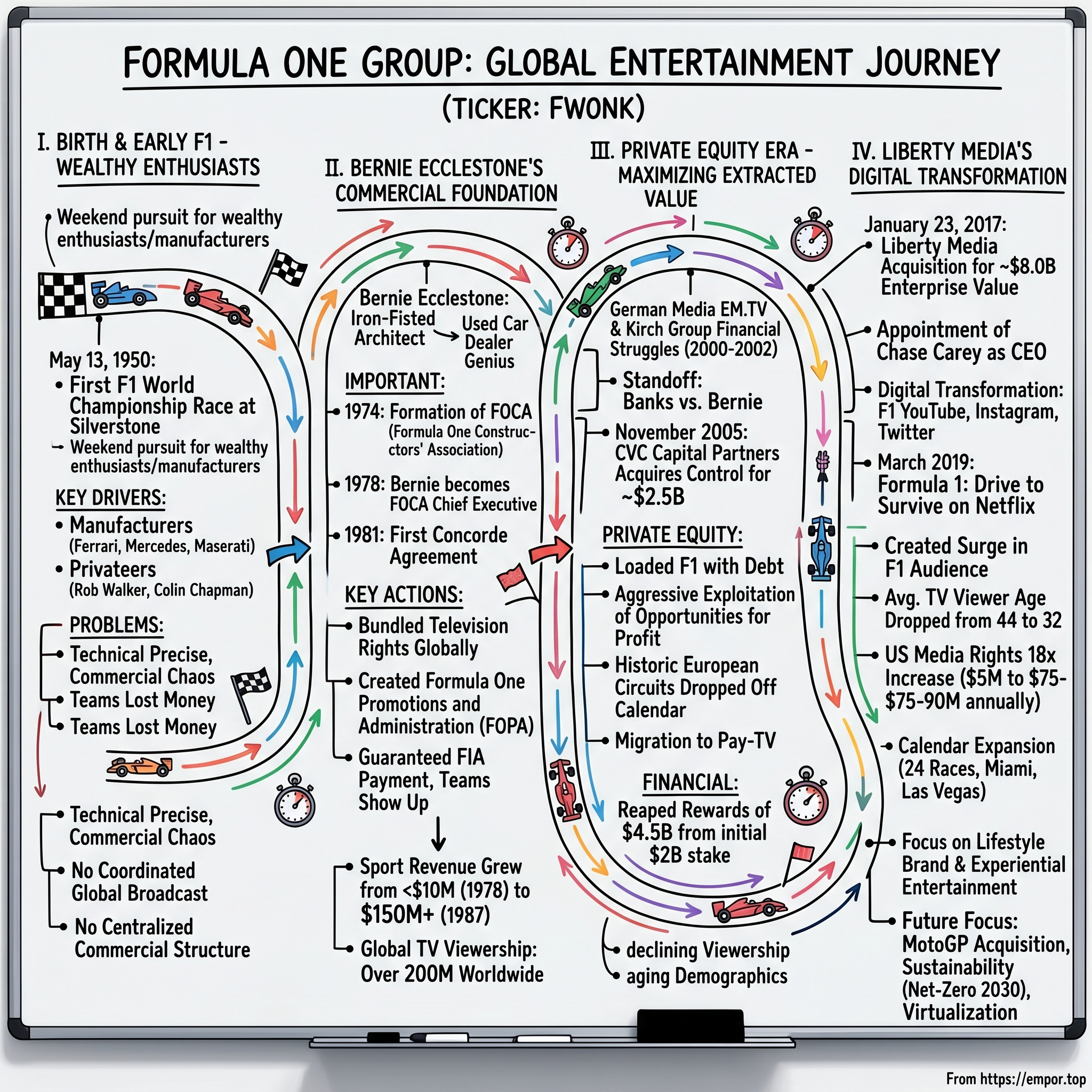
Formula One Group (NASDAQ: FWONK): The Monetization of Velocity
I. Introduction & The $8B Media Arbitrage
Picture the Las Vegas Strip just after midnight in November 2023: the fountains at the Bellagio were still, the neon was blazing, and twenty cars worth millions of dollars apiece lined up on a public boulevard that, hours earlier, had carried taxis and tourists. A company headquartered in suburban Colorado orchestrated that spectacle. It acquired real estate, paved asphalt, erected a permanent pit building, and sold hospitality packages priced like luxury vehicles—all to stage a Grand Prix in a city that had not hosted Formula 1 in four decades.
Seven years earlier, the sport was managed by an octogenarian former car dealer who openly dismissed younger demographics. Races were steadily migrating behind pay-television paywalls, teams were prohibited from posting video from the paddock, and the United States—the world's largest sports media market—had just a single race in Austin alongside a broadcast agreement that generated minimal viewership.
The distance between those two eras defines the turnaround of Formula One Group, the tracking-stock business of Liberty Media that trades under the tickers FWONK and FWONA. Following the split-off of its Live Nation stake in December 2025, Liberty Media operates primarily as a pure-play motorsport holding company that controls the commercial rights to Formula 1 and, since July 2025, holds a controlling interest in MotoGP.12
The Malone thesis
On September 7, 2016, John Malone's Liberty Media agreed to acquire Formula 1 from a consortium led by CVC Capital Partners at an enterprise value of $8.0 billion and an equity value of $4.4 billion.3 The $3.6 billion difference represented debt that CVC had layered onto the business. Liberty funded the transaction with $1.1 billion in cash, 138 million newly issued shares of the tracking stock that became FWONK, and a $351 million exchangeable note, while purchasing an initial 18.7% interest for $746 million at signing.3 The transaction closed in January 2017.4
Malone and longtime chief executive Greg Maffei recognized that Formula 1 was less a pure sporting league than an under-monetized media franchise operated for cash extraction rather than growth. The previous stewardship had neglected digital channels and traded broadcast reach for near-term pay-TV fees. Crucially, the asset featured a contractual structure rare in professional sports: its exclusive commercial rights are leased from the governing body through 2110.5
The core thesis of this story
Analyzing Formula 1 as an investment requires viewing it not merely as a racing series, but as a regulated global sports cartel and content syndicator. A non-profit governing body headquartered in Paris, the FIA, writes the technical and sporting rules and owns the championship. A commercial entity, owned by Liberty, holds the exclusive license to monetize the property: distributing television feeds, selling trackside sponsorship, charging race-promotion fees, and operating the paddock hospitality suites. A binding commercial pact, the Concorde Agreement, obligates the ten teams to compete at every race and governs the distribution of operating profits.6
Three revenue streams support that infrastructure: host nations and municipalities pay sanctioning fees to stage a Grand Prix; television networks and streaming platforms license broadcast rights; and corporate sponsors purchase global marketing association. Liberty introduced a fourth multiplier to this model: narrative-driven multimedia marketing, initiated by Netflix's Drive to Survive and expanded across social platforms, streaming partnerships, and film productions.
For long-term investors, the central question is not whether Formula 1 generates high returns. It historically has. The debate centers on how much of its post-2017 financial expansion represented a one-time release of latent value, how much constitutes durable pricing power, and where the cartel's structural defenses face emerging operational or regulatory strain.
This assessment is timely. In September 2026, the business sits at a pivotal juncture. It concluded its strongest financial year on record with 2025 revenue of $3.873 billion.1 Yet in the first half of 2026, revenue contracted 15% after regional conflict forced the cancellation of two Middle Eastern races, American audiences transitioned from ESPN to Apple under a new rights package, a single team established competitive dominance under revised technical regulations, and the company began integrating a second major racing series acquired for €4.2 billion.78910 Several core tenets of the initial investment case are being tested simultaneously.
The roadmap
This analysis reviews the sport's hazardous early decades and Bernie Ecclestone's creation of the modern commercial-rights framework, examines the debt-heavy CVC ownership era, and details Liberty's operational turnaround through the pandemic disruptions that reshaped team finances. It explores Liberty's capital allocation shift from asset-light licensing to direct event promotion in Las Vegas and its €4.2 billion acquisition of MotoGP, cross-references management's disclosures against reported financial results, and concludes with three operating metrics that will determine equity returns over the coming decade.
Evaluating whether Formula 1 was underpriced and readily revitalized requires understanding how an independent auto dealer consolidated and commercialized the broadcasting rights to an international championship.
 Subscribe on LinkedIn
II. Origins of the Cartel: From Gentlemen Racers to the Concorde Accord (1950–1987)
In May 1950, a crowd gathered at Silverstone, a former Royal Air Force bomber airfield in Northamptonshire, to watch the inaugural round of a new World Drivers' Championship sanctioned by the FIA. The circuit was lined with hay bales, and Alfa Romeo's factory team dominated the afternoon. None of the spectators would have mistaken the spectacle for an organized commercial enterprise.
For the next two decades, it barely resembled one. Formula 1 during the 1950s and 1960s operated as an informal patchwork of aristocratic privateers, legacy factory teams like Ferrari and Alfa Romeo, and an emergent class of British garagistes—independent builders such as Colin Chapman at Lotus, Bruce McLaren, and Ken Tyrrell, who fabricated chassis in modest workshops and outpaced established manufacturers through technical ingenuity. The enterprise was also perilous: driver fatalities were frequent, and safety was treated as an exercise in individual bravery rather than institutional responsibility.
The underlying economics were structurally inefficient. Promoters negotiated separately with individual teams, paying appearance fees dictated by driver prestige and local whims. Television coverage remained an afterthought rather than a centralized, pooled commercial asset. Teams subsisted on the wealth of private patrons and, beginning in the late 1960s, commercial tobacco sponsorships. The supply side—the racing teams—was fragmented. The demand side—the circuit promoters—remained strictly local. No single entity monetized the championship as an integrated global media property.
Enter Bernie
Bernard Charles Ecclestone was an astute commercial strategist: a blunt, pragmatic dealmaker who began his career trading used motorcycles and automobiles in postwar London. Beginning in 1965, he managed Austrian driver Jochen Rindt, guiding him to Brabham and Lotus before Rindt died in a crash at Monza in 1970. In late 1971, Ecclestone acquired the Brabham team from its co-founder, Ron Tauranac, for roughly $120,000.11
Ecclestone's critical insight centered on economic leverage. Working through the Formula One Constructors' Association (FOCA), he organized the independent British teams into a unified bargaining bloc. Rather than allowing promoters to negotiate separate appearance terms with individual entrants, FOCA commercialized the entire starting grid as a single package.11 Aggregating grid supply shifted commercial leverage from regional track owners to the constructors almost overnight, establishing Ecclestone as the indispensable mediator in every commercial negotiation.
The FISA–FOCA war
The established motorsport hierarchy resisted this consolidation. Jean-Marie Balestre, the combative president of FISA (the sporting arm of the FIA), viewed FOCA as a renegade union attempting to wrest governance from the governing body. The ensuing dispute, remembered as the FISA–FOCA war, was fought ostensibly over technical regulations like ground-effect aerodynamics, but the substantive conflict centered on governance authority and commercial revenues. Constructors boycotted official briefings, the regulator levied fines and threatened license revocations, several Grands Prix were cancelled or stripped of championship status, and tire supplier Goodyear threatened to exit the series entirely.6
Ecclestone, working alongside his legal adviser Max Mosley, engineered a compromise. On January 19, 1981, following thirteen consecutive hours of negotiations at the FIA's headquarters on the Place de la Concorde in Paris, the factions signed the inaugural Concorde Agreement.6 The pact established a clear division of responsibilities: the FIA retained administrative authority over sporting and technical regulations, while the teams formally committed to contest every Grand Prix on the calendar. In exchange, FOCA—and in practical terms, Ecclestone—secured the mandate to negotiate international television contracts on the sport's behalf.6
That mandatory attendance covenant became the cornerstone of Formula 1's commercial model. Broadcasters and commercial sponsors require predictable schedules to commit advertising capital. By legally binding every constructor to every round, the Concorde Agreement transformed an erratic sequence of regional races into an integrated, reliably scheduled broadcast product that could be marketed and syndicated months in advance.
Centralising the feed
Ecclestone established Formula One Promotions and Administration (FOPA) to manage the television rights on behalf of the teams.6 Rather than permitting networks to purchase rights on a race-by-race basis, FOPA required television networks to commit to full-season packages. During the 1990s, Ecclestone internalized host broadcasting operations, creating a standardized "world feed" that replaced the erratic camera work and varied production quality of local host stations.12 Circuit promoters were progressively stripped of broadcast revenues, leaving them dependent on gate receipts and corporate hospitality to cover escalating hosting fees.
While the precise distribution of broadcast revenues during this era remained closely guarded, the structural trajectory was decisive: promoters paid for the right to host races, networks paid for the broadcast signal, global sponsors paid for trackside visibility, and teams relied on Ecclestone's administrative entity for prize-money allocations. The architecture of modern sports-rights syndication—where an organizing body markets a standardized, globally syndicated media product through a centralized commercial counterparty—was established directly out of a paddock motorhome.
The lasting strategic takeaway is that Formula 1's economic value never resided solely in the machinery on track. It stemmed from the enforceable contractual web that guaranteed twenty cars would line up at each circuit on schedule. The subsequent challenge was converting that temporary contractual stewardship into long-term commercial ownership.
III. The Ecclestone Empire & The Private Equity Harvest (1987–2016)
On June 28, 2000, delegates of the FIA's member clubs convened in Geneva to approve a transaction unprecedented in modern sports governance: granting the exclusive commercial rights to the Formula One World Championship for a term of one hundred years, running through 2110.5 The agreed consideration was reported at just over $300 million, paid in 2001 by Ecclestone-linked SLEC Holdings.5 A century of global commercial rights to motorsport's premier championship was conveyed for less than the enterprise value of a single mid-tier racing team today.
That concession established the structural foundation of the modern business. Unlike North American leagues where franchise owners collectively govern the commercial entity and periodically renegotiate terms, Formula 1 operates under a commercial lease so protracted that it functions as de facto ownership. The FIA retained regulatory control and the official sporting rulebook, but relinquished operating cash flows for generations. While critics argued that the close relationship between Ecclestone and then-FIA president Max Mosley compromised regulatory independence, the commercial division was permanent: the commercial rights holder extracts operating profits, while the governing body oversees sporting integrity and safety compliance.
The ownership carousel
Ecclestone's equity interests were increasingly consolidated within offshore family trusts. Around the turn of the millennium, German media conglomerates EM.TV and Kirch Group acquired controlling stakes in SLEC, ultimately holding a combined 75% interest while Ecclestone retained 25%.5 Following Kirch's collapse in 2002, that majority holding defaulted to a consortium of lending institutions led by Bavarian state-backed lender BayernLB.
The transaction created an operational stalemate: creditor banks controlled the majority of Formula 1's equity but lacked the commercial expertise to manage it. Ecclestone, despite holding a minority interest, retained direct control over the operational relationships with circuit promoters, television networks, and competing teams. The institutions held an illiquid asset whose commercial value remained dependent on an executive they could neither effectively oversee nor replace.
The CVC decade
A liquidity solution arrived through private equity. In March 2006, the European Commission cleared CVC Capital Partners' buyout of SLEC, attaching a binding antitrust condition: CVC was required to divest Dorna Sports, the commercial rights holder of MotoGP, which CVC already owned.13 European Competition Commissioner Neelie Kroes concluded that consolidating the European Union's two most valuable motorsport properties under single ownership risked inflating broadcast-rights fees and diminishing consumer choice.14 That regulatory ruling established the core precedent Liberty Media would have to confront nearly two decades later.
CVC executed a disciplined private equity extraction model over the following decade. The firm leveraged the operating company's balance sheet, funded cash dividends through debt recapitalizations, syndicated equity stakes to institutional co-investors, and empowered Ecclestone to push race-sanctioning fees and broadcast tariffs steadily higher. According to Forbes, CVC had extracted approximately $4.4 billion from Formula 1 by mid-2015, making it the most lucrative private equity investment in sports history.15 In 2012, CVC structured an initial public offering on the Singapore Exchange, but the listing was abandoned that June amid broader equity market volatility.16
The original acquisition financing subsequently generated legal fallout. German prosecutors indicted Ecclestone for allegedly paying a $44 million bribe to former BayernLB risk officer Gerhard Gribkowsky to facilitate the bank's equity sale to CVC. While Gribkowsky was convicted and imprisoned, Ecclestone's trial before a Munich court ended in August 2014 after he agreed to pay a $100 million settlement, without admitting guilt.17 For several months, the chief executive of a global sports enterprise managed day-to-day commercial operations while standing trial in a German criminal proceeding.
The hidden decay
Beneath those financial extractions, the core product suffered structural neglect. Ecclestone remained openly dismissive of digital distribution and younger audiences, arguing that luxury watch and banking sponsors demanded affluent, older demographics. Consequently, Formula 1's online footprint remained heavily restricted and aggressively policed against unauthorized fan footage.18
The commercial pressure applied to race organizers proved equally destabilizing. Escalating sanctioning fees eroded the financial viability of traditional European circuits that relied almost entirely on ticket sales, causing historic events like the French Grand Prix to lapse from the calendar while the German Grand Prix became intermittent.18 Concurrently, broadcast coverage across major European markets migrated from terrestrial free-to-air channels behind subscription pay-TV walls, generating immediate contractual revenue growth while curtailing cumulative television reach.18
By 2016, Formula 1 operated as a highly cash-generative cartel burdened by leverage, governed by an octogenarian chief executive, and dependent on an aging core audience. CVC had harvested substantial equity value from contractual repricing, but sustained expansion required institutional capital and strategic reinvestment. That imbalance created the opening for an operator with a longer-term media strategy.
IV. The Liberty Media Coup & The Cultural Turnaround (2016–2021)
On January 23, 2017, the day Liberty completed its acquisition, Bernie Ecclestone's four-decade reign ended. He was named chairman emeritus, an honorific carrying advisory duties but no operating power.4 The incoming chairman and chief executive was Chase Carey, a former 21st Century Fox and DirecTV executive who had spent his career packaging media rights for premium distribution.4
What the money bought
Liberty's transaction structure proved as significant as the headline valuation. By funding the purchase partly with shares of a tracking stock tied to Formula 1, Liberty enabled public equity markets to value the racing business independently while preserving voting control within John Malone's holding company.3 That architecture explains why public investors today hold shares in FWONK rather than direct equity in an independent racing league.
In hindsight, an $8.0 billion enterprise value for a global sporting franchise shielded from relegation, supported by a century-long rights lease, and largely unmonetized in North America appeared attractive. In late 2016, however, the investment case faced genuine skepticism. Television viewership was contracting across historic European markets, circuit promoters were absorbing heavy financial losses, constructors were lobbying for larger prize payouts, and the entire commercial apparatus remained dependent on the personal dealmaking of an eighty-six-year-old executive. Liberty's core thesis was that these vulnerabilities reflected operational mismanagement rather than secular terminal decline—an arbitrage between under-exploited intellectual property and modernized media distribution.
New people, new instincts
Carey divided executive leadership between commercial distribution and sporting governance. Sean Bratches, a veteran ESPN sales and marketing executive, assumed control of commercial operations, while Ross Brawn—the technical architect behind Michael Schumacher's title-winning Ferrari teams and the unexpected 2009 championship with his eponymous Brawn GP outfit—took charge of sporting and technical matters.19 The organizational structure separated the mandate to monetize the spectacle from the engineering required to improve on-track competition.
The initial operational changes were cultural rather than financial. Carey dismantled paddock filming restrictions, permitting constructors and drivers to publish behind-the-scenes content across social channels. The company expanded its digital operations, and in 2018 it launched F1 TV, a direct-to-consumer over-the-top streaming platform that offered live race feeds in uncommitted territories alongside customized onboard camera angles and telemetry data. While standard practice in North American properties such as the NBA or European soccer leagues like the Premier League, direct digital engagement represented an unprecedented strategic departure for Formula 1.
Drive to Survive
The commercial inflection point emerged from an initiative the prior administration had consistently rejected. Production company Box to Box Films pitched an all-access documentary series for streaming distribution. Season one of Formula 1: Drive to Survive, documenting the 2018 championship, premiered on Netflix on March 8, 2019.20
Two structural dynamics drove its breakout success. When front-runners Mercedes and Ferrari declined to participate in the debut season, producers shifted narrative focus to the midfield, highlighting interpersonal rivalries, the candid commentary of Haas team principal Guenther Steiner, and the career jeopardy of drivers like Daniel Ricciardo. That constraint humanized a technically complex motorsport, reframing mechanical competition into character-driven drama. Simultaneously, the production demystified paddock politics and regulatory disputes for uninitiated viewers. Management later credited the series with fundamentally lowering the average age of the audience and expanding its female viewership base.20
The commercial mechanics created substantial economic asymmetry. Formula 1 did not require a premium licensing fee from Netflix; rather, the documentary functioned as low-cost customer acquisition. Downstream monetization materialized as casual viewers converted into ticket buyers, broadcast viewers, and consumers of team merchandise, substantially increasing the commercial value of Formula 1 inventory to domestic networks and corporate sponsors.
Attribution requires analytical discipline, however. While management has consistently highlighted Drive to Survive as the catalyst for its cultural renaissance, the series coincided with the relaxation of social media controls, an expanding calendar, and broader secular growth in streaming consumption. The documentary was less an isolated growth driver than the premier marketing vehicle in a coordinated effort to remove distribution friction.
The COVID crucible
In March 2020, the championship arrived in Melbourne for the season opener. Hours before opening practice, a positive COVID-19 test within the McLaren garage prompted a chaotic cancellation. Racing halted globally for nearly four months.
The financial contraction was immediate. Formula 1's full-year 2020 revenue dropped 43% to $1.145 billion, the business generated an operating loss of $386 million, and prize payouts distributed to the ten constructors declined approximately 30% to $711 million.21 Liberty preserved commercial commitments by orchestrating a compressed 17-race calendar held predominantly behind closed doors across European circuits.21
The acute liquidity crisis provided Liberty with the political leverage to enact the defining structural reform of its ownership. With several independent constructors facing insolvency, the FIA's World Motor Sport Council ratified a mandatory financial regulation in May 2020: a cost cap set at $145 million for 2021, tapering to $135 million by 2023, subject to indexation for inflation and calendar expansion.22 That framework was codified in the eighth Concorde Agreement, which bound all ten constructors from 2021 through 2025.
Functioning as a regulatory ceiling on engineering expenditure, the cost cap disrupted decades of uncontrolled balance-sheet competition, where well-funded factory programs outspent independent rivals by multiples of three or four. By curtailing annual developmental outlays, the regulations allowed baseline prize disbursements and commercial sponsorship to generate positive operating cash flow. Private capital recognized the transition from subsidized vanity assets to self-sustaining professional sports franchises: by late 2025, Forbes estimated the enterprise value of Scuderia Ferrari at $6.5 billion and determined that every team on the grid was worth at least $1.5 billion, a benchmark achieved by only four outfits two years earlier.23
By capping costs, however, the cartel created unintended structural friction. Enforcing financial parity and profitability incentivized incumbent team principals to protect their newly established equity valuations, forming a unified front resistant to grid expansion—a protectionist posture that would ultimately draw scrutiny from antitrust regulators in Washington. Before that confrontation unfolded, the commercial engine entered an unprecedented expansion phase.
V. The Domenicali Era & The Modern Business Engine (2021–Present)
Stefano Domenicali had sat on the pit wall before, under very different pressures. In 2014, as Scuderia Ferrari's team principal, he resigned following a title drought, taking public responsibility for the team's competitive slump. After subsequent executive stints at Audi and as chief executive of Lamborghini, he returned to the paddock in January 2021 as president and chief executive of Formula 1, while Chase Carey transitioned to non-executive chairman.24
Domenicali's operating style diverged sharply from Ecclestone's autocratic playbook. Where Ecclestone was combative, secretive, and transactional, Domenicali proved diplomatic and consensus-oriented—an industry insider with longstanding relationships across every garage. That temperament suited an era requiring coordinated alignment among ten constructor teams, two dozen host municipalities, and an expanding roster of commercial partners. In March 2025, Liberty Media extended his contract through 2029.25
Executive turnover followed at the parent company. Greg Maffei stepped down as chief executive of Liberty Media at the end of 2024, with John Malone serving as interim chief executive until Derek Chang—a seasoned sports and media executive from the NBA, DirecTV, and Charter who had served on Liberty's board since 2021—assumed the role in 2025.2627 Malone's high-vote shares continued to anchor voting control, providing a patient controlling shareholder while preserving a corporate governance structure that affords public tracking-stock investors minimal direct influence.
The engine in numbers
Formula 1's financial expansion accelerated between 2023 and 2025. Revenue reached $3.222 billion in 2023, up 25% year-over-year, bolstered by the inaugural self-promoted Las Vegas Grand Prix; operating income totaled $392 million, and Adjusted OIBDA stood at $725 million.28 In 2024, across a record 24-race calendar, revenue grew 6% to $3.411 billion and Adjusted OIBDA reached $791 million.29 In 2025, holding calendar volume flat at 24 rounds, revenue rose 14% to $3.873 billion, operating income climbed 28% to $632 million, and Adjusted OIBDA expanded 20% to $946 million.1
The financial figures demonstrated clear operating leverage, with operating profits expanding faster than the top line. Yet that leverage carries structural limits: a substantial portion of every incremental revenue dollar is remitted to the constructors, and capital-intensive ventures like Las Vegas dilute the margins of the traditional asset-light licensing model.
Media rights: the biggest stream
Media rights represented the business's largest revenue component, contributing 31.3% of total revenue in 2025.1 The most significant broadcast realignment occurred in the United States. ESPN had paid an estimated $85 million annually; starting in 2026, Apple took over exclusive domestic rights under a five-year agreement reported at approximately $140 million per year.9 For international context, Sky's long-term UK broadcast contract commands an estimated £200 million annually.12
The Apple agreement underscored sustained American interest and Big Tech's appetite for live sporting inventory. It also introduced strategic platform risk: shifting from linear cable on ESPN and ABC to a subscription-only streaming service threatened to truncate top-of-funnel casual viewership. ESPN concluded its broadcast tenure in 2025 with its most-watched Formula 1 season on record.30 On Liberty's second-quarter 2026 earnings call, management reported that total hours viewed in the US rose 13% under Apple, with viewership demographics skewing younger and more female.31 Those selective engagement metrics, however, do not provide a direct like-for-like comparison to average linear television audiences; evaluating whether the digital pivot preserved audience scale will require a full season of audited streaming data.
Race promotion: the host-city tax
Race-promotion fees accounted for 26.7% of total revenue in 2025, down from 29.3% in 2024 as other commercial streams expanded faster.129 While individual contract values remain confidential, the commercial hierarchy is well established: sovereign-backed venues across the Middle East and Asia pay premium sanctioning fees, while historic European circuits reliant on ticket admissions operate on heavily discounted terms. Monaco illustrates that shifting commercial balance. After decades of enjoying uniquely favorable terms, the Automobile Club de Monaco conceded control of its international host broadcast feed to Formula 1 in 2022, securing an extension that keeps the race on the calendar through 2031.32
Sponsorship: the luxury upgrade
Global sponsorship expanded rapidly, rising to 21.7% of revenue in 2025 from 18.6% in 2024.129 The centerpiece commercial pact arrived in October 2024, when Formula 1 announced a ten-year global partnership with LVMH beginning in 2025, integrating luxury houses Louis Vuitton, Moët Hennessy, and TAG Heuer—which replaced Rolex as the championship's official timekeeper.33 While terms were not officially disclosed, reported estimates valued the agreement at up to $100 million annually.33 Beyond the headline fee, the agreement carried symbolic weight: the world's preeminent luxury conglomerate committed significant marketing capital to the championship through the mid-2030s.
Other revenue: hospitality, freight, licensing
The remaining 20.3% of 2025 revenue came from a secondary cluster comprising Paddock Club hospitality, Las Vegas ticketing, centralized freight and logistics fees charged to teams, consumer licensing, and the FIA Formula 2 and Formula 3 feeder series.1 These direct-to-consumer and operational activities capture greater revenue per attendee but introduce execution complexity, inventory risk, and higher overhead than pure intellectual property syndication.
The Concorde payout engine
The business's largest operating cost remains prize disbursements to the teams. In 2023, Formula 1 distributed $1.215 billion in team payments, representing roughly 63% of Adjusted OIBDA before constructor distributions.28 In 2024, payments rose to $1.266 billion, while the payout ratio moderated to 61.5%; in 2025, the ratio contracted further to 59.7% of Adjusted OIBDA.291 Liberty describes these distributions as fully variable within the Concorde framework.29
This profit-sharing mechanism anchors the cartel's internal cohesion. Constructors are not merely operational vendors; they are equity-like beneficiaries of central commercial growth, removing incentives for a breakaway series while aligning the grid to defend common commercial interests. In 2025, Formula 1, the FIA, and all ten teams ratified a ninth Concorde Agreement extending through 2030.1
The compression in the team payout percentage through 2025 provided an underappreciated tailwind for public equity holders. That margin expansion, however, is not structural. On the second-quarter 2026 earnings call, management disclosed that the year-to-date payout ratio had reverted to 61.7%.31 The constructor distribution is ultimately a negotiated political settlement rather than a fixed operational efficiency.
By 2025, Formula 1 had assembled a formidable commercial licensing engine. Liberty's subsequent strategic pivot, however, pushed the company directly into operational event promotion, beginning with its most capital-intensive and visible wager.
VI. Capital Allocation & The Next Frontier: Vegas, Quint, and MotoGP
In March 2022, Liberty disclosed that it was paying $240 million for 39 acres east of the Strip to build a permanent pit and paddock complex.34 Industry observers took notice. For seven decades, Formula 1 had operated under an asset-light model: host cities or independent promoters paid sanctioning fees, absorbed ticket and construction liabilities, and allowed the commercial rights holder to collect guaranteed checks. In Las Vegas, Liberty chose to become the promoter.
The Las Vegas bet
The commercial logic centered on direct upside. As promoter, Formula 1 retained all ticketing, hospitality, and local sponsorship revenues rather than accepting a fixed hosting fee. The year-round facility, later named the Grand Prix Plaza, offered secondary rental income between races, while the visual spectacle of cars racing along the Strip served as a global showcase for the championship.
Setup costs, however, quickly outpaced early projections. By mid-2023, Liberty signaled that infrastructure and launch expenses were running substantially above budget.35 Including the initial land acquisition, the total investment was widely estimated at roughly $500 million.34 In practical terms, an intellectual property licensor had taken on the capital commitments of a real estate developer alongside the operational friction of shutting down a major global tourist corridor.
Financial returns from that outlay remain opaque because Liberty does not report Las Vegas profitability as a standalone segment. Disclosures for 2024 showed lower ticketing receipts than in the inaugural year, partially offset by $33 million in rental income from Grand Prix Plaza.29 In the second quarter of 2026, the Plaza generated $6 million in rental revenue.7 The Grand Prix sold out each of its first three editions, and in June 2026 Formula 1 and local authorities agreed to a ten-year extension securing the event through 2037.36
The operational record remains mixed. Las Vegas is an established fixture and a potent marketing platform. Yet public disclosures do not provide the granular data required to calculate a return on the half-billion dollars invested, and management acknowledged lower attendance and ticketing yield in year two. Owning the underlying land provides asset backing that cushions the downside, but holding real estate does not deliver the returns on capital typical of a pure licensing business.
Quint and the hospitality stack
In September 2023, Liberty agreed to acquire QuintEvents, the Charlotte-based provider of ticket-and-hospitality packages behind F1 Experiences, for $313 million.37 The strategic rationale was to capture more fan spending by bringing travel, ticketing, and VIP hospitality operations in-house.
The direct ownership proved brief. When Liberty completed the split-off of Liberty Live Group in December 2025, Quint was bundled into that entity and ceased to be a Liberty Media subsidiary.38 The transfer suggested that Quint's primary commercial value lay across live events broadly rather than in dedicated Formula 1 integration. While minor relative to the group's total balance sheet, the transaction showed how corporate reorganizations can abruptly alter operational strategies.
MotoGP: repeating the playbook
On April 1, 2024, Liberty announced an agreement to acquire 86% of Dorna Sports, the commercial rights holder of MotoGP, at an enterprise value of €4.2 billion and an equity value of €3.5 billion, with Dorna management retaining roughly 14%.10 Sellers were structured to receive approximately two-thirds of the equity consideration in cash and one-fifth in FWONK shares, with Liberty funding the cash component from balance-sheet reserves and new debt while leaving Dorna's existing borrowings in place.10 Maffei called MotoGP "a global league with a loyal, enthusiastic fan base, captivating racing and a highly cash flow generative financial profile."10
The transaction prompted an in-depth antitrust review by the European Commission, the same regulatory authority that had blocked the combined ownership of both series under CVC in 2006. In June 2025, the Commission cleared the transaction unconditionally.3940 Liberty completed the acquisition on July 3, 2025—roughly six months behind its initial schedule—concluding with an 84% equity interest.2
The investment rationale mirrored Liberty's 2017 playbook for Formula 1. MotoGP commanded dedicated followings in Southern Europe and Southeast Asia alongside competitive on-track racing, but lacked modern commercialization in digital media and the United States. Liberty anticipated that applying its media, licensing, and promotional playbook could materially enhance the asset's commercial value.
Initial financial results indicated steady execution rather than immediate transformation. In 2025, MotoGP's revenue increased 14% in dollars (9% in constant currency) to $573 million, operating income rose 86% to $54 million, and Adjusted OIBDA grew 15% to $201 million across 22 Grands Prix compared to 20 in the prior year.1 In-person attendance expanded 21% to over 3.66 million spectators, while broadcast viewership rose 9%.1 In 2026, MotoGP secured five-year agreements with its manufacturers and teams through 2031, appointed CAA as its global sponsorship agency, renewed key media rights with DAZN in Spain and Sky in German-speaking territories, and lowered borrowing expenses by repricing its debt.7 On a pro forma basis, first-half 2026 revenue increased 6%.7
Scale warrants perspective. MotoGP's top line is roughly one-seventh of Formula 1's, meaning even robust percentage growth moves consolidated earnings only incrementally for years. The series also carries a higher debt load: at year-end 2025, MotoGP's leverage stood at 4.7 times, compared to 2.8 times at Formula 1.1 By mid-2026, that ratio had eased slightly to 4.5 times.7
The pure-play restructuring
In November 2024, alongside the announcement of Maffei's departure, Liberty disclosed plans to separate Liberty Live Group from its motorsport properties.26 The split-off was completed on December 15, 2025.1 In a farewell letter, Maffei claimed Liberty's composite value had compounded at 17% annually during his tenure versus 11% for the S&P 500—a management-calculated benchmark that should be viewed as an internal claim rather than an audited performance record.26
The corporate restructuring simplified the investment narrative into a pure-play motorsport holding company, but it also concentrated operational exposure. Formula 1's financial performance now dictates group results without the cushion of non-racing assets. At mid-2026, consolidated debt stood at $4.86 billion against cash of $1.47 billion, resulting in consolidated leverage of 3.4 times; Liberty had executed no share repurchases since late 2025 and retained $1.1 billion in unused buyback authorization.71
An investor reviewing this capital allocation history faces three central questions. First, why commit capital to a leveraged secondary racing series at full valuation while the core Formula 1 asset still offers expansion potential? Second, why leave $1.1 billion in buyback capacity idle if leadership views the equity as attractively valued? Third, why withhold standalone financial reporting for Las Vegas after committing half a billion dollars in capital? Management's implicit rationale—that MotoGP extends an established operational playbook, that deleveraging takes near-term priority, and that Las Vegas benefits the wider Formula 1 brand—remains plausible, but none of these premises has yet been confirmed by segmented returns.
The capital allocation track record reveals a management team willing to embrace operational complexity and financial leverage. The question that follows is whether the cartel's competitive moats are robust enough to support those ambitions.
VII. Strategic Frameworks: Helmer’s 7 Powers & Porter’s 5 Forces
A useful thought experiment highlights the structural durability of Formula 1's position: consider what it would require to launch a credible rival today. A competing consortium would need to assemble elite driving talent, persuade major automotive manufacturers to engineer powertrains, secure sanctioning agreements with more than twenty host cities, convince global networks to buy an unproven broadcast product, and cultivate a worldwide fan base from scratch. When leading European carmakers threatened a breakaway championship in the mid-2000s—the Grand Prix Manufacturers Association—they ultimately disbanded without staging a single Grand Prix. That historical episode illustrates both the strength of the cartel's competitive moats and where their limits lie.
Helmer's 7 Powers
Cornered resource: very strong. The exclusive commercial rights agreement extending through 2110 serves as the franchise's structural bedrock.5 No rival entity can market an FIA Formula One World Championship. Unlike North American or European team sports that must periodically renegotiate collective bargaining terms with player unions or independent club owners, Formula 1's commercial rights holder controls monetization rights for the remainder of the century. The primary constraint is governance: the FIA retains authority over sporting and technical regulations, leaving the commercial owner tethered to an independent governing body whose institutional priorities do not always align with maximizing commercial cash flows.
Network economies: strong, but indirect. While Formula 1 does not operate as a direct digital network, it benefits from a self-reinforcing multi-sided feedback loop. Expanding global viewership attracts corporate sponsors and media networks; higher broadcast fees and commercial sponsorship draw automotive manufacturers seeking engineering prestige; and manufacturer participation deepens sporting credibility, which in turn broadens fan engagement. The 2026 grid—incorporating Cadillac as an eleventh constructor alongside the arrival or return of Audi, Honda, and Ford under revised engine regulations—demonstrates that this commercial loop continues to attract industrial capital.1
Scale economies: strong. Formula 1 internalizes the production of a single centralized broadcast feed, syndicating it simultaneously across dozens of international networks. Each incremental international broadcast agreement generates revenue at near-zero marginal production cost. On Liberty's second-quarter 2026 earnings call, Domenicali highlighted this operational control, characterizing Formula 1's internalization and production of its own content as a defining asset amid a shifting media landscape.31
Counter-positioning: modest. The cost cap established financial discipline across the paddock, transforming loss-making vanity projects into cash-generative franchises and distancing Formula 1 from rival motorsport series burdened by uncontrolled spending. However, a regulatory expenditure ceiling is a governance mechanism rather than an asymmetric business model that competitors are structurally prevented from adopting.
Switching costs: moderate to high for hosts, lower for media partners. Host circuits incur hundreds of millions of dollars in track modifications and civic infrastructure to meet Grade 1 FIA standards—investments municipalities justify through international tourism and global branding. Yet promoters can choose not to renew if sanctioning fees become punitive, and television networks face few barriers to exiting when bidding escalates, as occurred when ESPN relinquished domestic coverage after Apple outbid it.9
Process power: moderate. Transporting thousands of tons of sensitive equipment, hospitality suites, and personnel across five continents under rigid turnaround windows represents a formidable operational capability developed over four decades. While this logistical execution deters casual entrants, operational competency alone does not constitute an insurmountable economic moat.
Branding: very strong. The Formula 1 brand has expanded well beyond traditional motorsport enthusiasts, positioning itself at the intersection of technical engineering, luxury lifestyle, and global celebrity culture. The multi-brand sponsorship pact with LVMH and the commercial performance of Apple's F1 feature film—which ranked as the highest-grossing original film of 2025 with more than $600 million in global box office receipts—demonstrate a brand reach that extends well beyond traditional racing enthusiasts.3341
How the peers compare
Benchmarking Formula 1 against peer sporting properties clarifies its commercial positioning. MotoGP, the closest motorsport peer, generated $573 million in revenue in 2025—roughly one-seventh of Formula 1's $3.873 billion—despite staging an equivalent calendar of events across many of the same international markets.1 That revenue disparity highlights the monetization power of Formula 1's commercial apparatus: two championships operating high-speed racing on world-class circuits, yet monetized at vastly different levels of intensity. Domestic American racing properties like NASCAR and IndyCar remain regionally concentrated, while Formula E and the World Endurance Championship retain OEM backing without achieving mainstream cultural resonance.
The more instructive comparison is against elite global sports leagues competing for identical media budgets and corporate sponsors. The English Premier League and the NFL command broadcast revenues that dwarf Formula 1's media take. That contrast supports two competing interpretations. The skeptical view holds that Formula 1 remains a secondary media property relative to top-tier team sports, constrained by international time zones and niche sporting appeal. The bullish interpretation argues that this valuation gap represents untapped monetization runway, and that Apple's willingness to pay a substantial premium over ESPN indicates technology platforms are beginning to close it.9
A fundamental structural difference shapes this comparison. Traditional sports leagues schedule hundreds of fixtures each season, whereas Formula 1 stages only twenty-four race weekends. While event scarcity amplifies the spectacle and pricing power of each Grand Prix, it also heightens operational fragility: the cancellation of even one or two events, as the geopolitical disruptions of early 2026 demonstrated, extracts a disproportionate toll on annual financial results.
In sum, Formula 1's competitive moats rest primarily on its cornered commercial license and global brand equity, amplified by broadcast scale economies. Yet the strength of its multi-sided network effect ultimately hinges on an exogenous variable that management cannot engineer by decree: close, compelling on-track competition.
Porter's 5 Forces
Bargaining power of buyers (circuit promoters and broadcasters): low to moderate. Promoter demand consistently exceeds calendar supply, with dozens of metropolitan and sovereign bidders competing for a limited slate of twenty-four dates, conferring substantial pricing power on the rights holder. However, the highest-fee contracts are concentrated among a select group of state-backed hosts in the Middle East and Asia, while a small consortium of premium broadcasters accounts for the bulk of media revenues. Consequently, regional cancellations or the loss of key distribution partners can materially impact annual cash flow.
Bargaining power of suppliers (teams and engine manufacturers): moderate, and structurally entrenched. The competing constructors represent Formula 1's indispensable input. The Concorde Agreement's variable profit-sharing mechanism aligns their economic incentives with top-line growth, but an organized collective of eleven multi-billion-dollar franchises constitutes a formidable bargaining bloc. In addition, legacy entrants—most notably Scuderia Ferrari, which retains a historic contractual veto and an independent heritage payout—wield outsized influence. While team principals share Liberty's interest in expanding aggregate revenues, negotiations over how those cash flows are divided remain contentious.
Threat of new entrants: very low. Structural barriers to entry are practically prohibitive. Replicating the championship would require securing FIA sanctioning, navigating a crowded international calendar, building bespoke track facilities, and overcoming the exclusive rights lease through 2110. For new constructors attempting to join the existing grid, the barriers are financial and political: incoming participants must secure commercial consensus and absorb substantial anti-dilution entry fees, as demonstrated by Cadillac's reported $450 million anti-dilution fee to join the grid.42
Threat of substitutes: moderate. Within motorsport, alternative racing categories like IndyCar, NASCAR, Formula E, and sports car endurance series lack the global geographic diversity, engineering prestige, and cultural resonance of Formula 1. The substantive substitute threat comes from outside racing: premier sports leagues like the Premier League, NFL, and NBA, alongside streaming services, video gaming, and prestige live entertainment, all compete for identical leisure hours, subscriber fees, and corporate marketing budgets.
Competitive rivalry: low within motorsport, intense across global entertainment. Formula 1 commands a virtual commercial monopoly within top-tier international open-wheel racing. However, it operates in a hyper-competitive broader ecosystem where maintaining premium rights valuations requires continually proving its relevance against the world's most sophisticated entertainment franchises.
These analytical frameworks depict a highly defended economic enterprise. Yet theoretical competitive moats must ultimately be tested against operational reality and reported disclosures. The following section examines the friction points where Formula 1's commercial narrative confronts regulatory, financial, and competitive pressures.
VIII. The Skeptical Investor & The Historical Falsification Layer
On January 31, 2024, Formula 1 published a statement formally rejecting Andretti Global's bid to join the grid. Management concluded that the applicant had not demonstrated it would add value to the championship, asserting that Formula 1 would confer value to the Andretti brand rather than the reverse.43 The rejection was designed to close the issue. Instead, it triggered a political and regulatory backlash that culminated in the US Department of Justice opening an antitrust investigation into Liberty Media.44
That episode illustrates a central principle of the investment case: even Formula 1's most formidable structural moats have operational and legal limits. Evaluating the business requires subjecting management's core premises to historical falsification—testing each claim against the strongest disconfirming evidence in the company's operating record.
Test 1: Promoter pricing power
The claim: Demand to host races far exceeds calendar supply, allowing Formula 1 to steadily increase race-sanctioning fees.
The disconfirming evidence: Traditional European circuits have repeatedly revealed the ceiling on host-city pricing power. Germany—home to Mercedes, Porsche, and Audi—has been absent from the calendar, and France's Grand Prix lapsed during the CVC ownership era.18 Even Monaco required prolonged, public negotiations over hosting fees and commercial television control before securing an extension.32
The more acute test unfolded in early 2026. Following regional conflict and military strikes across the Gulf states, Formula 1 cancelled the Bahrain and Saudi Arabian Grands Prix without immediate replacement rounds.8 These were precisely the premium, state-subsidized fixtures that underpinned the sport's high-margin fee growth. Staging three fewer races in the first half of the year than in the prior-year period caused first-half revenue to contract 15% and Adjusted OIBDA to drop 30%, as fixed operational expenses could not be trimmed proportionately.7
Verdict: narrowed. Pricing power is real but concentrated among sovereign-backed promoters, converting a pricing advantage into geopolitical exposure. Formula 1 can escalate hosting fees where governments subsidize the spectacle, but must accept economic constraints where circuits depend purely on local gate admissions. What would confirm the stronger thesis is a full, uninterrupted calendar generating rising revenue per race; what would falsify it is recurring cancellations or fee renegotiations among its highest-paying sovereign hosts.
Test 2: The fan boom is durable
The claim: Drive to Survive and digital distribution created an expanded fan base that remains engaged regardless of on-track competitive balance.
The disconfirming evidence: In 2023, amid Red Bull's near-total competitive dominance, ESPN's average US television audience declined to 1.11 million viewers from a record 1.21 million in 2022.45 Casual viewers reacted to an uncompetitive title race by tuning out.
The confirming evidence: That pullback did not become a structural downturn. ESPN concluded its broadcast partnership in 2025 by delivering its most-watched Formula 1 season on record, while management reported global live race viewership expanded 21% across 2025.301
The live test: The 2026 season, contested under an overhauled engine and aerodynamic regulatory framework, has been dominated by Mercedes, with rookie Kimi Antonelli leading the drivers' championship ahead of teammate George Russell.46 While management reported growth in total hours viewed on Apple's streaming platform,31 initial hours viewed during a debut season on a subscription streaming service do not yet confirm durable long-term audience retention.
Verdict: narrowed, not rejected. Formula 1's global audience is substantially larger and more demographically diverse than it was before Liberty's acquisition, but it remains sensitive to one-team runaway seasons. The decisive operating metrics will be full-season live viewership trends during prolonged periods of dominance and the pricing commanded when major broadcast packages next come up for renewal.
Test 3: Self-promoted races are a high-return engine
The claim: By acting as its own race promoter in destination markets like Las Vegas, Formula 1 captures significantly higher economic returns than a traditional sanctioning fee provides.
The disconfirming evidence: The inaugural Las Vegas weekend began with an operational setback: on November 16, 2023, opening practice was halted after a loose water valve cover heavily damaged Carlos Sainz's Ferrari, forcing spectators to be cleared from grandstands before a delayed session ran in the early morning hours. Liberty and race organizers subsequently agreed to pay more than $3 million to settle a resulting class-action lawsuit.47 In the event's second year, Derek Chang acknowledged to investors that financial results for Las Vegas fell short of internal expectations for revenue and OIBDA, with Chief Accounting Officer Brian Wendling noting that the shortfall was primarily driven by lower ticket sales.48
The confirming evidence: The Grand Prix sold out each of its first three editions and secured a ten-year contractual extension through 2037, with management stating on the second-quarter 2026 earnings call that the event operates profitably and that future infrastructure capital requirements should moderate.3631
Verdict: narrowed. Las Vegas has demonstrated civic and commercial staying power, but has not yet proven that direct operational promotion generates superior return on capital compared to asset-light licensing. Without segmented disclosures detailing Las Vegas net profit against the estimated $500 million invested, the high-return thesis remains unconfirmed. The key metrics to monitor are standalone OIBDA disclosures relative to invested capital; the falsifying signals would be renewed capital calls or ticket discounting.
Test 4: The cartel is legally unassailable
The claim: Formula 1 and its incumbent constructors hold unilateral authority over grid expansion and can price entry at will.
The disconfirming evidence: Following the commercial rejection of Andretti Global, a bipartisan group of US senators led by Amy Klobuchar urged federal scrutiny, and in August 2024 Liberty confirmed that the US Department of Justice had launched an antitrust investigation.44 In November 2024, Formula 1 announced an agreement in principle for a General Motors-backed Cadillac entry to join the grid for 2026, granting formal approval in March 2025.[^49]49 Reports indicated Cadillac agreed to pay an anti-dilution fee of approximately $450 million to be distributed among the ten incumbent teams.42
Verdict: narrowed. Formula 1 retains significant control over grid entry, but cannot indefinitely resist pressure from federal antitrust regulators or a major American automotive conglomerate. The cartel's exclusionary barriers function effectively only until challenged by a politically connected applicant with industrial backing. Public filings reviewed for this analysis disclose no formal enforcement action, and the formal status of the Justice Department's inquiry remains undisclosed in company materials.
Test 5: MotoGP was a frictionless duplication
The claim: Replicating Formula 1's commercial turnaround across MotoGP would represent a straightforward execution of an established playbook.
The disconfirming evidence: Regulatory clearance proved protracted. In 2006, European antitrust authorities compelled CVC to divest Dorna Sports as a mandatory condition for acquiring Formula 1.13 Nearly two decades later, in 2024 and 2025, the European Commission initiated another in-depth Phase II merger review before approving the transaction.40
Verdict: intact, but it came at a cost. While Liberty secured unconditional clearance—reversing the 2006 regulatory precedent—the transaction's closing timeline slipped by approximately six months.2 The critical unresolved issue is no longer regulatory clearance but capital discipline: whether MotoGP's operating cash flows can justify a €4.2 billion enterprise valuation and substantial leverage. The decisive metrics remain MotoGP's Adjusted OIBDA growth rate and the speed of consolidated balance-sheet deleveraging.
Test 6: The cost cap made team economics permanently sound
The claim: The financial cost cap permanently eliminated paddock spending wars, transforming constructors into durable, self-sustaining franchises content to share central commercial proceeds.
The disconfirming evidence: Regulatory expenditure ceilings are political compromises rather than fixed economic constants. The cost cap launched at $145 million in 2021 and stepped down to $135 million, but baseline figures have been repeatedly adjusted upward for inflation and calendar expansion, and revised financial regulations introduced for 2026 substantially increased the headline ceiling by altering the scope of regulated costs.22 Moreover, the best-capitalized teams continue to allocate heavy capital to uncapped categories, including driver compensation and proprietary engine development. Simultaneously, constructor franchises now valued in the billions have greater equity value to defend, making them the most vocal opponents of an eleventh team.2342
Verdict: intact but unproven over a full cycle. The cost cap has held through its initial five-year cycle and materially improved team financial stability. What would falsify the permanent-solvency claim is a leading constructor breaching the financial cap without decisive sporting penalties, or an uncontrolled spending race migrating into exempt operational categories. What would confirm it is sustained franchise profitability throughout the 2026 technical reset.
Test 7: Management compounds capital with discipline
The claim: Liberty Media operates as an exceptionally disciplined capital allocator, as highlighted in Greg Maffei's farewell letter citing a 17% compound annual return in Liberty's composite equity value versus 11% for the S&P 500 during his tenure.26
The disconfirming evidence: While the initial 2017 acquisition of Formula 1 generated substantial value, capital allocation decisions since 2022 present a more complicated record. The Las Vegas Grand Prix required capital outlays well above initial projections and fell short of internal expectations in its second running.3548 QuintEvents was acquired for $313 million in late 2023, only to be transferred out of the motorsport entity barely two years later during the Liberty Live split-off.3738 MotoGP was purchased at an enterprise value of €4.2 billion, adding substantial debt that pushed Dorna's leverage above four times.101 Meanwhile, $1.1 billion in authorized share repurchase capacity sat completely unutilized through mid-2026.7
Verdict: narrowed. The 2017 turnaround of Formula 1 remains a hallmark private equity-style operational success. However, capital deployments over the subsequent four years reflect higher operational risk, elevated debt, and returns that remain unverified by segmented public reporting. Derek Chang's characterization of "disciplined capital allocation" in August 2026 will ultimately be evaluated by transparent Las Vegas returns and MotoGP's deleveraging trajectory over the next several years, rather than the initial success of the 2017 buyout.7
The broader takeaway is clear. None of the core bullish claims has been categorically disproven, but most have been qualified by operational friction, and several remain untested across a full economic and competitive cycle. Formula 1 operates a highly cash-generative global sports cartel, but it is not the frictionless compounder depicted in promotional narratives. The section that follows examines how executive leadership has framed these frictions for public shareholders.
IX. Primary Sources & Conference Call Autopsy
Earnings calls are where management's promotional narrative confronts investor scrutiny. Liberty Media's quarterly calls since 2024 reveal an executive team consistent and confident when discussing Formula 1's core commercial operations, but markedly guarded regarding its capital-intensive wagers—a posture accentuated by the company's longstanding policy of withholding formal financial guidance.
Q4 2023 (February 2024): Selling the spectacle
The full-year 2023 earnings release led with the inaugural Las Vegas Grand Prix, highlighting more than 16 billion social media impressions during race week and record in-person attendance across the global calendar.28 Yet the figures institutional investors sought most—the event's standalone operating profit and return on invested capital—were conspicuously absent from segmented reporting. This practice of leading with top-of-funnel engagement metrics while withholding project-level economics established a pattern that would recur over subsequent quarters.
Q2 2024 (August 2024): The antitrust question
On August 8, 2024, Liberty disclosed that the US Department of Justice had opened an antitrust investigation into the rejection of Andretti Global's bid to join the grid. On the conference call, Greg Maffei asserted that Formula 1's determination complied with all applicable US antitrust statutes, confirmed that Liberty would fully cooperate with the inquiry, and emphasized that an established regulatory process required approval from both the FIA and the commercial rights holder for any expansion team.44 The response defended bureaucratic procedure rather than explaining the commercial rationale for excluding a prominent American racing outfit backed by General Motors. Less than four months later, Formula 1 agreed in principle to admit General Motors under its Cadillac brand.[^49] While management never framed the concession as a reaction to federal regulatory scrutiny, the compressed timeline spoke for itself.
Q4 2024 (February 2025): Owning the miss
Serving as Derek Chang's debut earnings call as chief executive, the fourth-quarter 2024 presentation provided a critical benchmark for managerial credibility. Chang acknowledged directly that the second Las Vegas Grand Prix had missed internal projections for revenue and operating profit. Chief Accounting Officer Brian Wendling attributed the financial shortfall primarily to softer ticket sales and hospitality demand, clarifying that the broader margin variance analysts had detected in constructor distributions was overwhelmingly Vegas-related.48 Chang characterized the commercial challenges as "durable and fixable," outlining corrective operational measures that included insourcing ticketing operations, restructuring hospitality packages and pricing tiers, and tightening event overhead.48
The exchange reflected positively on executive candor, but less so on predictive forecasting. Management neither obscured the operating miss nor hesitated to present an operational remedy. However, the cultural enthusiasm generated by the inaugural race had failed to deliver the durable unit economics management's early framing had implied, and public shareholders learned of the operational shortfall only after the financial year had closed.
Q4 2025 (February 2026): The victory lap
Following a record financial year, the tone on the call shifted toward consolidation. Chang characterized 2025 as "an exceptional and productive year," pointing to the closing of the MotoGP transaction, the ratification of the ninth Concorde Agreement binding all ten constructors and the governing body through 2030, and the successful split-off of Liberty Live Group.1 Stefano Domenicali highlighted the championship's record attendance and commercial intake, alongside the looming arrival of Cadillac, Audi, Honda, and Ford under the 2026 technical regulations reset.1 In keeping with established practice, management provided no quantitative financial guidance for the upcoming year.1
Q2 2026 (August 2026): Managing disruption
The second-quarter 2026 call was dominated by the geopolitical disruption in the Middle East. Management explained that revenue is recognized across an assumed calendar and that staging fewer rounds reduced recognized revenue, while fixed operating expenses did not contract proportionately.31 Liberty highlighted consolidated liquidity of approximately $1.5 billion against a total debt load of roughly $5 billion, resulting in consolidated net leverage of 3.4 times.31 Chang described ongoing media-rights discussions as "dynamic and market-specific," pointing to renewals with Sky and DAZN while noting commercial uncertainty in Germany as Sky Deutschland and RTL navigated integration.31 Management also reported that high-margin Paddock Club hospitality suites were entirely sold out for the remainder of the season.31
An accounting convention explains the quarter's reported volatility. Formula 1 recognizes the majority of its annual broadcast and sponsorship revenue, as well as associated operating costs, pro rata based on the number of races completed relative to an assumed full-season calendar. During the first half of 2026, that calculation was pegged to an assumed 22-race schedule, which management subsequently revised to 23.7 While standard under GAAP and fully disclosed in regulatory filings, this mechanism means reported quarterly growth rates reflect executive assumptions about calendar completion, meaning race cancellations or rescheduling can shift substantial revenue and profit recognition across quarters. For equity analysts, evaluating interim performance during disrupted seasons requires checking the underlying race count before interpreting top-line growth rates.
What the earnings presentation did not deliver was a precise accounting of how much sanctioning and broadcast revenue was permanently forfeited versus deferred, or whether force majeure contract terms and event-cancellation insurance offset the financial impact. Chang reiterated that "disciplined capital allocation remains a core priority," a characterization that must be evaluated against a multi-year record encompassing cost overruns in Las Vegas, the short-lived acquisition of Quint, and the substantial leverage incurred to acquire MotoGP.7
Taken together, the transcripts reveal an executive team that communicates core commercial expansion with clarity and concedes operating missteps when forced by the numbers. The recurrent blind spots are the disclosure of project-level returns on capital-intensive wagers and an absence of forward guidance that would allow public shareholders to hold leadership accountable to quantitative operational benchmarks. With that record established, the strategic lessons of the turnaround and the forward metrics governing the investment case come into focus.
X. Playbook: Business & Investing Lessons
Every compelling business turnaround offers lessons that apply beyond its home industry. Formula 1 provides several durable principles for media and sports investing, each accompanied by an operational caveat drawn from its own history.
1. The rights arbitrage: buy analog, deliver digital
Liberty acquired an asset with deep enthusiast loyalty trapped behind restrictive, analog distribution. By dismantling filming restrictions, embracing social platforms, commissioning a streaming documentary, and launching direct-to-consumer digital channels, management expanded the commercial value of its entire intellectual property catalog. The strategic takeaway: seek out assets where audience passion is high but legacy stewards optimized for near-term cash extraction rather than top-of-funnel reach. The caveat: distribution arbitrage represents a one-time step-change. Once operational friction is eliminated, incremental growth requires contractual repricing and geographic expansion, both of which face natural ceilings.
2. The regulatory cartel as an economic moat
The Concorde Agreement remains one of the most effective commercial pacts in professional sports. By binding competitors to a centralized profit-sharing formula, it transforms fierce on-track rivals into aligned business partners who collectively defend the ecosystem. The caveat, underscored by the Andretti dispute, is that an exclusionary sports cartel operating in the United States remains subject to federal antitrust scrutiny. The more overtly incumbents use their contractual moats to preserve franchise valuations by locking out qualified entrants, the more vulnerable they become to regulatory challenge.
3. Indirect value capture
Formula 1 licensed access to Netflix, and subsequently to Apple's feature film production, accepting modest direct licensing fees in exchange for global cultural reach. The strategic lesson: the most profitable media partnership is often the one that functions as low-cost customer acquisition rather than maximum upfront rights revenue. The caveat: indirect audience conversion is difficult to isolate and easy for management to overcredit, particularly when broader secular entertainment tailwinds coincide with promotional campaigns.
4. Counter-positioning via regulation
The financial cost cap halted decades of destructive engineering arms races, transforming chronic loss-making operations into self-sustaining, profitable franchises. The strategic lesson: a platform organizer can unlock substantial enterprise value by imposing regulatory constraints on its own participants. The caveat: financially fortified partners develop significant equity value to protect, equipping them with greater leverage to resist commercial initiatives or calendar expansions that threaten their profit margins.
5. The peril of moving down the value chain
Sanctioning fees represent high-margin revenue where municipalities and third-party promoters absorb construction costs, weather volatility, and ticketing risk. Staging the Las Vegas Grand Prix traded that asset-light simplicity for gross revenue upside burdened by real estate development, infrastructure cost overruns, and local political friction. The investment lesson: capital allocators must distinguish between high-return intellectual property licensing and capital-intensive event production, and insist on transparent, segmented return-on-invested-capital disclosures before endorsing a replicated model.
6. Cross-motorsport platform consolidation
The MotoGP acquisition wagers that Formula 1's commercial apparatus—centralized media syndication, premium sponsorship sales, and narrative-driven promotion—can be exported to an adjacent motorsport. The industrial logic is coherent, and early operational indicators have been positive. However, MotoGP's revenue base is roughly one-seventh the size of Formula 1's, while carrying higher relative balance-sheet leverage. Even sustained double-digit expansion in the two-wheel championship will move consolidated group earnings only modestly for years.
Myth vs reality
Myth: Netflix created Formula 1's modern commercial success. Reality: Drive to Survive was an effective marketing accelerant, but it gained traction only because Liberty had already dismantled legacy media restrictions. Crucially, the series succeeded because the foundational infrastructure—the Concorde attendance covenant guaranteeing full grids and the single, standardized world broadcast feed—made the sporting product immediately syndicable. A behind-the-scenes documentary about a fragmented, uncoordinated racing league lacking centralized commercial control would not have generated comparable enterprise value.
Myth: Formula 1 operates as a pure licensing business insulated from operational risk. Reality: While that description characterized the Ecclestone era, direct operations now carry meaningful exposure. Approximately one-fifth of total revenue derives from the secondary cluster encompassing Paddock Club hospitality, centralized freight logistics, and direct Las Vegas ticketing.1 Furthermore, the race cancellations in early 2026 demonstrated that fixed operational overhead cannot be reduced proportionately when scheduled events are removed from the calendar.7
Myth: The racing constructors are dependent, subordinate suppliers. Reality: The regulatory cost cap and expanding central prize distributions transformed constructor teams into self-sustaining franchises valued in the billions, granting them formidable collective bargaining power, the leverage to demand a reported $450 million anti-dilution entry fee from new entrants, and an indispensable seat at every future Concorde negotiation.2342
Myth: A century-long commercial lease insulates Formula 1 from regulatory intervention. Reality: The 100-year contract secures exclusive monetization rights through 2110, but it confers no immunity from statutory trade laws. As the Department of Justice's antitrust investigation into constructor exclusion and the European Commission's prolonged review of the MotoGP acquisition demonstrated, commercial cartels remain bound by US antitrust enforcement and international merger control.4440
These lessons outline a management team adept at unlocking latent media value through deregulation and modernized distribution, yet less proven when deploying balance-sheet capital into complex operational ventures and leveraged acquisitions. That strategic divergence defines the analytical divide between the bull and bear cases.
XI. Bull vs. Bear Case & The 3 KPIs That Matter
The bull case
A bidding war for media rights. Apple's agreement to pay a substantial premium over ESPN for exclusive domestic broadcast rights demonstrated that major technology platforms view Formula 1's young, affluent audience as premium subscription inventory.9 If international broadcasters follow that trajectory as legacy contracts expire, rights distributions could step up materially. Furthermore, internalizing host broadcast production provides Formula 1 the operational agility to syndicate across linear television or direct-to-consumer streaming depending on commercial terms.
A luxury-grade sponsorship platform. Global sponsorship represents the business's fastest-expanding revenue stream, and the ten-year partnership with LVMH aligns the championship with the world's preeminent luxury conglomerate.133 Establishing marketing relationships with elite consumer brands creates commercial validation that eases negotiations with subsequent blue-chip partners.
The MotoGP rerating. If Liberty can expand MotoGP's American audience, media contracts, and corporate sponsorship through its operational playbook, the acquisition could establish a meaningful second commercial engine. In its first year under Liberty ownership, MotoGP expanded Adjusted OIBDA by 15%.1
Deeper automotive manufacturer alignment. The introduction of the 2026 engine and chassis regulations attracted or retained Cadillac, Audi, Honda, and Ford, confirming Formula 1's industrial and technical relevance to global automotive manufacturers for the coming decade.1
Operating margin expansion from constructor payouts. If team prize distributions as a percentage of pre-payment earnings continue the gradual decline recorded through 2025, an increasing share of incremental commercial revenue will flow directly to tracking-stock equity holders.1
The bear case
Geopolitical and host-city concentration. Formula 1's highest-margin race-promotion fees are concentrated among sovereign-backed hosts in the Middle East. The cancellation of the Bahrain and Saudi Arabian rounds in early 2026 demonstrated that regional conflict can abruptly strip high-yield fixtures from the calendar with little lead time.8 Concurrently, state-linked commercial sponsorships introduce reputational exposure across traditional European markets.
Competitive imbalance and audience elasticity. Mercedes' dominance during the inaugural season of the 2026 technical reset highlights the risk of competitive monotony, echoing the 2023 season when US television viewership contracted during Red Bull's winning streak.4645 Migrating domestic coverage to Apple's subscription streaming platform makes audience fatigue more difficult to measure and risks curtailing top-of-funnel fan acquisition.
Capital allocation drift and margin dilution. Venturing into direct event promotion in Las Vegas, the short-lived acquisition of Quint, and the debt-funded purchase of MotoGP indicate a shift away from high-margin intellectual property licensing toward capital-intensive, operationally complex businesses that disclose minimal segmented return metrics.
Regulatory and antitrust constraints. The Department of Justice's antitrust investigation into constructor entry barriers confirmed that federal authorities will scrutinize efforts to protect incumbent franchise values, while the European Commission's extended review of the Dorna acquisition underscored ongoing regulatory vigilance over motorsport consolidation.4440
Balance-sheet leverage and foreign exchange exposure. With approximately $4.9 billion in total debt, consolidated leverage of 3.4 times at mid-2026, and substantial euro-denominated debt and cash flows from MotoGP, the group is more exposed to benchmark interest rates and currency fluctuations than the historic asset-light licensing model implied.731
Broadcast market consolidation. Mergers among regional media buyers, such as the combination of Sky Deutschland and RTL in Germany, threaten to reduce the number of credible bidding counterparties for live sporting rights in key European markets.31
The 3 KPIs that matter
1. Revenue per Grand Prix. Dividing total Formula 1 revenue by the number of contested Grands Prix isolates pure pricing power across hosting sanctioning fees, hospitality suites, corporate sponsorships, and media rights into a single operational metric. Importantly, this measure normalizes performance during seasons disrupted by calendar cancellations, such as the regional shocks of 2026.
2. Team payments as a percentage of pre-distribution Adjusted OIBDA. This variable payout ratio measures how much incremental commercial growth accrues to Liberty shareholders versus the competing constructors. It serves as the primary gauge of whether the financial terms of the ninth Concorde Agreement through 2030 prove more or less favorable to capital providers than prior accords.
3. Audited live viewership and renewal pricing across major media rights. Live race audience metrics and the contracted value of subsequent broadcast renewals represent the most reliable leading indicators of fan engagement and future pricing power. They provide the decisive test of whether the cultural boom catalyzed by Drive to Survive represents durable secular demand through periods of one-team dominance, or a transient media cycle.
Those three measures will tell investors whether Formula 1's post-2017 financial expansion represents a durable compounding machine or a one-time repricing of an under-monetized media asset. The concluding question is how management directs its capital allocation and commercial strategy from here.
XII. Epilogue: If We Were Running Liberty Motorsports
Imagine being handed the keys to Liberty's motorsport empire this autumn, with a Mercedes team running away with the championship, two Gulf races cancelled, a new American streaming partner, and a second series still being integrated. What would a clear-eyed owner do differently?
Stay asset-light
The Las Vegas extension to 2037 locks in the one self-promoted race, and that is reasonable.36 But without disclosed returns, the case for repeating the model elsewhere is weak. The better default is to keep F1 in the licensing business, letting host cities absorb construction, disruption, and ticket risk, while pushing for disclosure that lets investors judge Las Vegas on its merits.
Rebalance the calendar
The 2026 cancellations showed the cost of dependence on a few high-paying, geopolitically exposed hosts. A deliberate effort to diversify, adding strong venues in Asia and the Americas while protecting historic European races, would trade a little near-term pricing for more resilience.
Build Asia deliberately
F1's growth has come mainly from the US and the Middle East. Asia remains underdeveloped relative to its population and wealth. Investment in local digital content and grassroots motorsport there would be a long-term bet, but one that fits a rights lease that runs to 2110.
Tell MotoGP's human story
MotoGP's racing is, by many accounts, more visceral than F1's. Its riders are visible, the overtakes are constant, and the risk is plain to see. A premium docuseries built around its biggest personalities would be the most direct way to replicate the F1 playbook.
Keep the peace
With Cadillac on the grid and a new Concorde Agreement signed through 2030, the aim should be to avoid another public fight over entry and to keep regulators satisfied that the closed shop is not being used to exclude legitimate competitors.1
Publish the numbers that matter
The most shareholder-friendly change would cost almost nothing: disclose Las Vegas profit and invested capital, report revenue per race and media-rights mix consistently, and provide at least directional multi-year targets. Management has shown it will acknowledge misses after the fact. Committing to measurable goals in advance would let investors judge execution in real time rather than through quarterly surprises.
Revisit capital return
With F1 leverage below three times and a large unused buyback authorisation, the balance between deleveraging MotoGP, funding growth, and returning capital deserves an explicit framework. A controlled company is not obliged to satisfy every shareholder preference, but clarity about priorities would reduce the suspicion that the next large acquisition is always around the corner.7
The biggest surprises
Three findings stand out. First, how close the teams came to financial ruin in 2020, when payments to them fell by nearly a third, before the cost cap changed their economics.21 Second, how cheaply the 100-year rights lease was secured, a deal that still shapes the sport's economics a quarter-century later. Third, how quickly apparent certainties have been tested since 2024: a closed grid that opened to Cadillac, a regulator that reversed its 2006 stance on MotoGP, and a calendar that lost two of its richest races in a matter of weeks.
Final reflection
Formula 1's story is a lesson in the power of packaging. A dangerous, technical, and often baffling contest became one of the most valuable entertainment properties on earth, not because the cars got faster, but because the product got easier to love and harder to copy. The next chapter will depend on whether Liberty can keep growing that package without letting the risks it has added, in Las Vegas, in the Gulf, and in MotoGP, erode the simplicity that made the original business so valuable.
References
-
Liberty Media Corporation Reports Fourth Quarter and Year End 2025 Financial and Operating Results — Liberty Media (SEC Form 8-K Exhibit 99.1), 2026-02-26 ↩↩↩↩↩↩↩↩↩↩↩↩↩↩↩↩↩↩↩↩↩↩↩↩↩↩↩
-
Liberty Media Corporation Completes Acquisition of MotoGP — MotoGP.com, 2025-07-03 ↩↩↩
-
Liberty Media Corporation Agrees to Acquire Formula One — Liberty Media, 2016-09-07 ↩↩↩
-
Liberty Media Corporation Completes Acquisition of Formula 1 — Liberty Media, 2017-01-23 ↩↩↩
-
FIA confirms 100-year F1 commercial agreement — Autosport ↩↩↩↩↩
-
What is the F1 Concorde Agreement? All to know about the contract — Autosport ↩↩↩↩↩
-
Liberty Media Corporation Reports Second Quarter 2026 Financial and Operating Results — Liberty Media (SEC Form 8-K Exhibit 99.1), 2026-08-06 ↩↩↩↩↩↩↩↩↩↩↩↩↩↩
-
Bahrain and Saudi F1 race cancellations confirmed due to Iran war — Al Jazeera, 2026-03-14 ↩↩↩
-
Apple and F1 reach 5-year media deal, bringing all races to Apple TV streaming in the U.S. — CNBC, 2025-10-17 ↩↩↩↩↩
-
Liberty Media Announces Agreement to Acquire Commercial Rightsholder of MotoGP — Liberty Media, 2024-04-01 ↩↩↩↩↩
-
Bernie Ecclestone: Races, Wins and Teams — F1 History (formulaonehistory.com) ↩↩
-
Going live: how F1 TV became a billion-dollar business — Motorsport.com ↩↩
-
Case No COMP/M.4066 — CVC / SLEC merger decision — European Commission, 2006-03-20 ↩↩
-
CVC Becomes Formula One's Most Successful Owner With $4.4 Billion Haul — Forbes, 2015-07-27 ↩
-
F1 Billionaire Bernie Ecclestone Off The Hook As German Court Takes $100M To Settle Bribery Charges — Forbes, 2014-08-05 ↩
-
How F1 changed under CVC – and what Liberty may mean — RaceFans, 2016-09-08 ↩↩↩↩
-
Chase Carey out as Formula One CEO — The Hollywood Reporter ↩
-
Formula 1 and Netflix put "Drive to Survive" on pole position — Formula One World Championship Limited ↩↩
-
Formula One revenues dropped by $877 million in 2020 — CNBC, 2021-02-26 ↩↩↩
-
F1 cost cap: What is it and how does it work? — Motorsport.com ↩↩
-
Formula 1's Most Valuable Teams 2025 — Forbes, 2025-11-20 ↩↩↩
-
Stefano Domenicali to replace Chase Carey as F1 CEO — Sky Sports, 2020-09-25 ↩
-
Stefano Domenicali to continue as President and CEO of Formula 1 through 2029 — Formula 1, 2025-03 ↩
-
Liberty Media announcement on Greg Maffei leadership transition (Form 8-K Exhibit 99.1) — Liberty Media, 2024-11-12 ↩↩↩↩
-
Derek Chang Named CEO of Liberty Media — The Hollywood Reporter ↩
-
Liberty Media Corporation Reports Fourth Quarter and Year End 2023 Financial Results — Liberty Media, 2024-02-27 ↩↩↩
-
Liberty Media Corporation Reports Fourth Quarter and Year End 2024 Financial Results — Liberty Media, 2025-02-26 ↩↩↩↩↩↩
-
ESPN finishes final Formula 1 season with all-time viewership record — ESPN Press Room, 2025-12 ↩↩
-
Liberty Media Corp (FWONA) Q2 2026 Earnings Call Highlights — GuruFocus, 2026-08 ↩↩↩↩↩↩↩↩↩↩↩
-
Formula 1 to race in Monaco until 2031 after new deal agreed — Formula 1 ↩↩
-
LVMH and Formula One announce 10-year partnership — CNBC, 2024-10-02 ↩↩↩↩
-
Why F1 is spending $240m on a Las Vegas construction plot — Motorsport.com, 2022 ↩↩
-
Liberty expects Las Vegas Grand Prix set up costs to rise to over £300m — RaceFans, 2023-08-05 ↩↩
-
Formula 1 to race in Las Vegas through 2037 following new 10-year extension — Formula 1, 2026-06 ↩↩↩
-
Liberty Media Corporation Announces Definitive Agreement to Acquire QuintEvents — Liberty Media, 2023 ↩↩
-
Liberty Media Corporation Form 10-K for fiscal year 2025 — SEC EDGAR, 2026 ↩↩
-
European Commission approves Liberty Media's acquisition of MotoGP — MotoGP.com, 2025-06-23 ↩
-
European Commission Approves Liberty Media's Acquisition of MotoGP — Baker Botts, 2025-06 ↩↩↩↩
-
Brad Pitt's "F1" movie roars past $600m to become year's biggest original — Motorsport.com, 2025 ↩
-
GM Paid Competitors $450 Million To Get Cadillac F1 Team Approved — GM Authority, 2025-03 ↩↩↩↩
-
Full statement: F1's decision to reject Andretti's entry bid for 2025 — Motorsport.com, 2024-01-31 ↩
-
Justice Department opens investigation into Liberty Media over F1 Andretti clash — NBC News, 2024-08-08 ↩↩↩↩↩
-
F1 2023 season on ESPN was second-most watched in US — Sportcal, 2023 ↩↩
-
Antonelli vs Russell, Hamilton's charge, Verstappen's future and more – F1 legends on the 2026 season so far — Formula 1, 2026 ↩↩
-
Las Vegas Grand Prix settles class action lawsuit over water valve cover incident — Las Vegas Review-Journal ↩
-
F1 "disappointed" by Las Vegas GP earnings, ticketing changes for 2025 race — RaceFans, 2025-03-05 ↩↩↩↩
-
TWG Motorsports and GM receive formal approval for Cadillac Formula 1 team — Cadillac Newsroom, 2025-03-07 ↩
 LinkedIn
 WhatsApp
 Reddit
 Hacker News
 Email
Email Kindle
 RSS Feed
 Spotify
 Apple Podcasts
 Amazon Music
 Audible
 YouTube