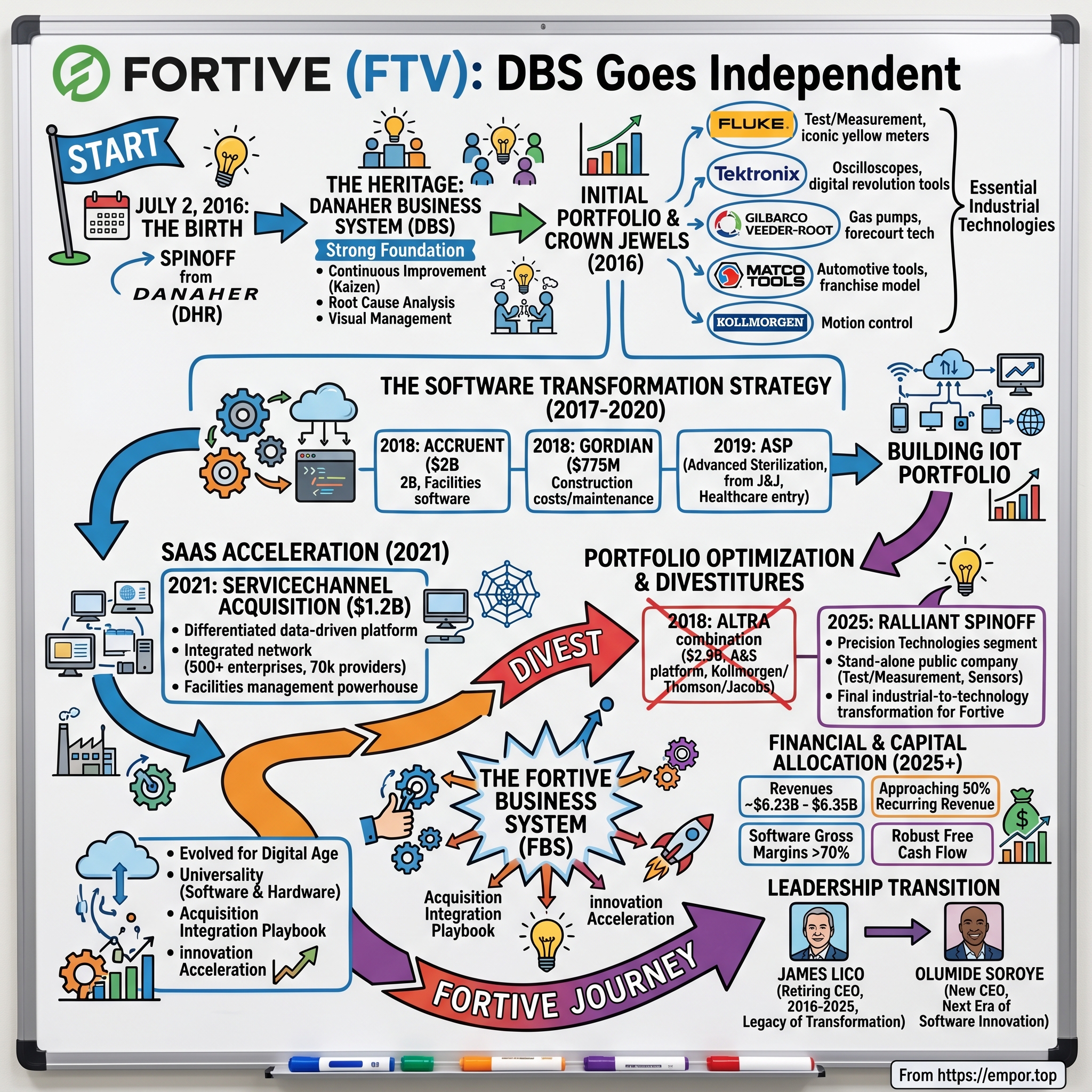
Fortive: The Danaher Business System Goes Independent
I. Introduction & The Conglomerate Paradox
On July 29, 2026, Fortive reported financial results that its leadership had spent nearly a decade trying to produce. Core revenue grew 6.7%, adjusted EBITDA rose 12%, and adjusted earnings per share climbed 28% to $0.74, leading the company to raise its full-year guidance.1 Taken in isolation, the performance looks like a conventional beat-and-raise quarter. Viewed against Fortive's corporate history, however, it provides the first concrete evidence that an enterprise designed around a specific managerial theory might finally be validating it.
The underlying thesis is simple to state but difficult to execute. Over three decades, Danaher Corporation turned principles borrowed from Japanese manufacturing into one of the strongest compounding records in corporate America. In 2016, Danaher spun off its mature industrial businesses—including multimeters, oscilloscopes, fuel pumps, mechanics' tools, and motion-control motors—as Fortive. The immediate question for the new entity was whether that operating engine could perform once separated from the parent company. Could the Danaher Business System, rebranded as the Fortive Business System (FBS), deliver comparable returns from Danaher's legacy hardware lines?
The answer has proven complicated. Since its debut, Fortive has functioned in a state of perpetual corporate restructuring. It divested its motion-control assets in 2018, spun off its fueling and fleet operations as Vontier in 2020, and separated its legacy test-and-measurement core as Ralliant in 2025. In their place, the company acquired nearly a dozen software, worker-safety, and healthcare businesses. On June 28, 2025, the last of those separations took effect: Fortive shareholders received one share of Ralliant for every three Fortive shares held, while longtime chief executive James Lico retired and handed leadership to Olumide Soroye, a former McKinsey partner and software executive.2
What remains is a leaner and substantially altered enterprise. The restructured Fortive employs more than 10,000 people across roughly 50 countries and reports through two operating segments.3 Intelligent Operating Solutions (IOS) combines Fluke test tools, ServiceChannel, Gordian, Accruent, Industrial Scientific, and Intelex. Advanced Healthcare Solutions (AHS) combines Advanced Sterilization Products (ASP), Censis, Fluke Biomedical, Landauer, and Provation.3 In 2025, the company generated $4.16 billion in revenue, with IOS accounting for $2.86 billion and AHS contributing $1.30 billion. Organic core growth across the consolidated portfolio, however, was a modest 1.7%.4
That gap highlights the central paradox of the business. Fortive possesses an operating methodology widely respected across corporate boardrooms, generates dependable free cash flow, and has executed intricate portfolio transitions with discipline. Yet for most of its time as a standalone public company, its organic growth failed to match management's ambitious positioning. Investors have had sound reasons to ask whether eight years of relentless divestitures and acquisitions were genuinely compounding value or simply rearranging assets.
The analysis that follows traces Fortive's lineage back to Danaher and its 2016 spin-off, details the divestitures that reshaped the legacy portfolio, and assesses the software and healthcare acquisitions brought in to replace them. It then evaluates the primary investment arguments against the company's operating record, examines the inner workings of the Fortive Business System, analyzes the competitive landscape, and reviews executive incentives under the new leadership. Understanding why Fortive spent a decade repeatedly pruning itself requires starting where the philosophy itself began: with two brothers on a Montana trout stream.
 Subscribe on LinkedIn
II. The Danaher Dynasty & The Roots of the Machine (1984–2015)
A Fishing Trip and a Holding Company
In the early 1980s, Steven and Mitchell Rales talked business while fishing along Danaher Creek in western Montana. The company they founded in 1984 took the creek's name.5 The initial model mirrored a private-equity firm: acquire established industrial businesses, improve their operations, and compound the gains.6 Between 1984 and 1990, Danaher acquired a dozen business-to-business manufacturers, targeting what the brothers called "solid businesses that were being poorly run."6
While Danaher's early narrative is often framed around financial engineering, the defining transformation occurred on the factory floor. In 1986, Danaher bought Chicago Pneumatic, and with it the Jacobs Engine Brake division—maker of the "Jake Brake" compression release engine brake that retards heavy trucks on steep downgrades.6 Jake Brake's general manager, George Koenigsaecker, had studied Japanese lean manufacturing principles. In 1987 and 1988, he brought in Yoshiki Iwata and Chihiro Nakao, consultants steeped in the Toyota Production System. They rearranged the plant's production lines overnight. When employees arrived the following morning, many began implementing long-delayed workflow ideas, having waited years for corporate permission to reorganize their workstations.6
From Factory Trick to Corporate Religion
Danaher became one of the first North American corporations to embrace kaizen (改善, continuous improvement), the philosophy at the core of the Toyota Production System.5 What began as a shop-floor efficiency initiative evolved into the Danaher Business System (DBS). Its methodology incorporated visual management boards, standardized work, root-cause problem-solving, and policy deployment—the Japanese discipline of hoshin kanri (方針管理), which cascades a handful of breakthrough strategic priorities down to monthly operating targets for individual managers. DBS ultimately governed every facet of Danaher's operations, from factory assembly lines to acquisition screening and leadership development.5
Danaher's system was later popularized under the label "a knockoff of the Toyota Production System," and chief executive George Sherman, who joined from Black & Decker in 1990, turned it into an acquisition engine.76 The playbook was disciplined and repeatable: acquire a solid industrial business with defensive market share, implement DBS to eliminate operational waste, expand operating margins, and reinvest the freed cash flow. Over the ensuing decades, that playbook spread well beyond Danaher as company alumni carried it into other manufacturing and technology corporations.8
Fluke: The Proof Case
One of those acquisitions still sits at the center of Fortive's portfolio. In April 1998, Danaher agreed to acquire Fluke Corporation of Everett, Washington, an electronic test-tool manufacturer founded in 1948, for approximately $625 million.9 Fluke manufactured market-leading hardware but carried an inefficient cost structure. At the time of the transaction, the business generated a 53% gross margin but converted just 9% into operating income, with selling, general, and administrative expenses consuming roughly a third of revenue. Within a year, Danaher's integration team reduced overhead to roughly 25% of sales and raised Fluke's operating margin to 15%.7
The transaction exemplified the classic Danaher playbook: acquire a premier brand saddled with excess overhead, introduce disciplined operating tools, and rapidly extract cash flow. Yet it also foreshadowed the core strategic tension Fortive would later confront. DBS proved exceptionally capable at rationalizing costs and expanding margins within well-positioned hardware lines. Whether the methodology could manufacture organic top-line expansion in mature, slow-growth end markets remained an open question.
The Culp Refinement
When Larry Culp became CEO in 2001, he shifted Danaher's acquisition focus toward businesses with high gross margins and substantial aftermarket revenue, where an initial sale predictably yields recurring follow-on purchases.6 The operating system evolved alongside the portfolio. What had begun as the "Danaher Production System" was formally renamed the "Danaher Business System," with managers evaluated against eight core metrics: core organic revenue growth, operating margin expansion, free cash flow conversion, return on invested capital, on-time delivery, defect rates, internal fill rates for open roles, and employee retention.6 The governance mechanism remained consistent across disparate product lines: track a focused scorecard, review metrics continuously, and immediately target root causes whenever an indicator turned red.
That shift established the strategic benchmark Fortive would inherit. Culp's insistence on recurring, high-margin revenue became an institutional standard. The 2016 spin-off did not discard that template; instead, it required Fortive's mature industrial operations to satisfy those expectations without the tailwind of high-growth life-sciences assets to lift the consolidated numbers.
The 2015 Crossroads
By 2014, Culp had handed executive leadership to Tom Joyce.6 By that stage, Danaher operated as two divergent corporations housed under a single ticker. One was a life-sciences and medical diagnostics franchise characterized by high recurring revenue, secular market tailwinds, and a premium valuation multiple. The other was a cyclical collection of industrial instruments, retail fueling systems, and motion-control hardware tied closely to factory capital expenditure and broader industrial output. On May 13, 2015, Danaher announced two landmark decisions: an agreement to acquire filtration specialist Pall Corporation for roughly $13.8 billion, and a plan to split into two independent public companies.10 Joyce explained that Pall was compelling because recurring revenue accounted for roughly 75% of sales, paired with mid-single-digit organic growth.11
That transaction made Danaher's long-term identity explicit. The high-recurring-revenue life-sciences assets would define the retained corporation, while the industrial portfolio would receive its own balance sheet and, in Joyce's words, "access to the capital necessary to pursue organic and inorganic growth opportunities."10 Yet while the industrial portfolio departed, its institutional heritage remained intact. From its inception, Fortive would be measured against the very benchmark that drove the split: its ability to transform an industrial hardware legacy into the kind of high-margin, recurring-revenue compounding engine Danaher had just spent nearly $14 billion to assemble.
III. The 2016 Spinoff: Birth of Fortive & The Legacy Portfolio
Separation Day
On July 2, 2016, Danaher completed the spin-off, distributing one Fortive share for every two Danaher shares held at the close of business on June 15—a distribution totaling roughly 345 million shares. The new company contained Danaher's Test & Measurement segment, its Industrial Technologies segment except the Product Identification platform, and its Retail/Commercial Petroleum platform.12 Fortive began regular-way trading on the New York Stock Exchange on July 5 under the ticker FTV.12
The newly independent company debuted with approximately $6.2 billion in 2015 revenue and more than 24,000 employees across more than 40 countries, establishing its corporate headquarters in Everett, Washington—Fluke's longtime home.13 Derived from the Latin fortis, meaning "strong," the corporate name fronted a portfolio that was dependable, entrenched, and distinctly capital-goods oriented. Fluke multimeters hung from electricians' belts; Tektronix oscilloscopes sat on engineers' workbenches; Gilbarco Veeder-Root manufactured retail fuel dispensers and underground storage-tank monitors; Matco Tools sold hand tools from franchised mobile vans; Kollmorgen, Thomson, and Portescap supplied precision motors and motion-control assemblies; and Jacobs Vehicle Systems continued manufacturing the Jake Brake.
The Founding CEO
Jim Lico was not an external turnaround executive brought in to re-engineer an industrial manufacturer; he was the institutional embodiment of the Danaher system. Having joined Danaher in 1996 after operational roles at AlliedSignal and General Motors, Lico served as an executive vice president from 2005 to 2016. During that tenure, he led the centralized DBS office and directed corporate expansion across Asia and the Middle East.14 On separation day, he characterized Fortive around themes that would anchor his public messaging for the next nine years: "our strong heritage and experienced management team, leading market positions, and culture of continuous improvement."13
That operating background shaped the company's early trajectory. Trained in a management philosophy that treated operating units as processes to optimize and corporate portfolios as holdings to actively prune, Lico held little sentimental attachment to legacy product lines—an operational detachment that would define the company's next decade.
A Portfolio Built for a Different Era
Fortive's initial businesses shared a defining commercial attribute: their revenue came almost entirely from physical hardware installed into physical infrastructure. Filling stations required dispensers and monitoring probes, mechanics required hand tools, automated assembly lines required precision motors, and design engineers required oscilloscopes to test printed circuit boards. In 2016, that footprint made Fortive a reliable proxy for broad industrial activity. Yet it also exposed the enterprise to three secular shifts: the long-term rise of electric vehicles threatening fuel-dispenser demand, intensifying competition in motion control and factory automation, and industrial customers increasingly demanding integrated software and data workflows alongside traditional hardware.
None of those crosscurrents represented an immediate threat in 2016. Free cash flow was dependable and the individual brands commanded leading market shares. The strategic dilemma was what that collection of businesses would look like ten years later if left unchanged. Lico's answer, executed over the following nine years, was that most of the original assets did not belong in Fortive's permanent portfolio.
The Implicit Mandate
The initial investment case was straightforward: Fortive would convert operating profit into reliable free cash flow, expand operating margins through the Fortive Business System, and deploy the retained capital into acquisitions that would raise both its organic growth rate and its valuation multiple. Early results aligned with that narrative. In the second quarter of 2017, core revenue expanded 5.4%, meeting management's mid-single-digit target.15
The underlying vulnerability was not Fortive's pace of expansion in 2017, but the composition of that revenue. The legacy businesses generated the bulk of their revenue from one-time hardware sales routed through wholesale distributors and tied to cyclical capital expenditures in factories and retail fuel stations. Public markets assign substantially lower valuation multiples to transactional hardware sales than to recurring software subscriptions or proprietary consumables. The decade that followed became a concerted effort by Lico and his team to alter what Fortive's revenue was made of, rather than simply how fast it grew.
IV. The Industrial Dilemma: Why Cash Generation Wasn't Enough (2016–2018)
The Ceiling Above a Great Industrial Company
A Fluke multimeter illustrates the dilemma at the heart of Fortive's original portfolio. Engineered to withstand harsh industrial environments, the tool commands fierce customer loyalty precisely because it rarely breaks. For the manufacturer, that durability means an electrician buys a multimeter once and may not purchase another for a decade. Demand rises when factories expand and slows when industrial capital budgets tighten. The business generated healthy margins, but it remained fundamentally cyclical.
Much of Fortive's day-one portfolio shared those economics. While cash flow was dependable, top-line expansion depended heavily on customer capital spending. Because capital budget cycles are unpredictable, public equity markets historically awarded industrial-hardware manufacturers lower earnings multiples than businesses supported by recurring subscription or consumables revenue. Fortive's leadership understood the valuation penalty early. From the company's first post-spin presentations, management consistently framed future capital deployment around an explicit goal: shifting the revenue mix toward software, recurring services, and connected workflows.
The Gross-Margin Clue
Gross margin offered the clearest signal of structural pricing power. An industrial equipment maker must purchase components, fund assembly, and cede margin to wholesale distributors before capturing a return. By contrast, a software enterprise or proprietary-consumables provider retains the vast majority of each incremental revenue dollar. Fortive's executives focused their acquisition screening on businesses that enjoyed that operating leverage—companies whose customers paid repeatedly because a product was woven into an operational workflow, a regulatory compliance mandate, or an essential safety routine.
The First Moves: Safety as a Service
The company's first two significant acquisitions signaled how that strategy would function in practice. In July 2017, Fortive agreed to acquire Industrial Scientific, which it described as "a leading provider of portable gas detection equipment and a safety-as-a-service pioneer."15 Industrial Scientific manufactured detectors that protected workers from hazardous gas leaks in oil refineries, underground mines, and chemical plants. Crucially, the company had begun shifting customers from one-time hardware purchases to a subscription model: clients paid an ongoing fee, and Industrial Scientific supplied, calibrated, and maintained the sensor fleet. Lico noted that the transaction "accelerates our digital strategy and creates a stronger platform for connected solutions."15 Fortive did not disclose the purchase price in the initial announcement.
Two months later, Fortive targeted Landauer, offering $67.25 per share, or approximately $770 million including debt and net of cash.16 Landauer supplied radiation dosimetry badges—passive monitors worn by radiology technicians, nuclear workers, and research personnel exposed to ionizing radiation. The business model was virtually all subscription: Landauer generated $143 million of revenue in 2016, and more than 80% was recurring, driven by mandatory periodic badge exchanges, analytical reporting, and compliance record-keeping.16 Lico said Landauer would "strengthen our safety-as-a-service position."16 The tender offer closed in October 2017.17
The timing of these purchases underscored management's intent. Fortive's legacy assets were performing well: in the third quarter of 2017, sales from existing businesses rose 4.8%, with low-double-digit growth in high-growth markets.17 Management was not acquiring recurring revenue to rescue a struggling core; it was moving because it anticipated that transactional hardware faced a lower long-term valuation ceiling. By reshaping the portfolio while operating performance was solid and the balance sheet remained strong, Fortive initiated its transition before slowing growth forced its hand.
While Industrial Scientific and Landauer were relatively small additions to Fortive's total revenue, they defined the profile of the assets leadership wanted to own: mission-critical tools supported by regulatory mandates and recurring cash flows. Expanding that playbook to a meaningful scale, however, would require far more capital than operating cash flow alone could provide. To fund its next phase of transformation, Fortive would have to begin selling pieces of itself.
V. The Portfolio Sculpting Machine: Pruning to De-Risk (2018–2025)
Selling the Birthplace
The first major divestiture carried a historical irony. On March 7, 2018, Fortive agreed to combine its Automation & Specialty platform with Altra Industrial Motion, transferring four operating units: Kollmorgen, Thomson, Portescap, and Jacobs Vehicle Systems.18 Jacobs was the Jake Brake business where Danaher had first applied kaizen three decades earlier. Fortive was selling the factory where its own operating philosophy had started.
The transaction used a Reverse Morris Trust, an arrangement where a parent company spins off a subsidiary that immediately merges with another corporation on a tax-free basis. Total consideration reached approximately $3.0 billion, comprising roughly $1.4 billion in direct cash proceeds and debt reduction for Fortive, alongside 35 million newly issued Altra shares valued at about $1.6 billion for Fortive shareholders. That equity distribution gave Fortive's investors roughly a 54.4% ownership stake in the combined entity.18 The businesses Fortive surrendered had generated about $907 million in revenue in 2017.18
Lico described the transaction as "a major step forward in our portfolio enhancement work towards increasing our focus on software and service exposure, while adding significantly to our M&A capacity."18 Motion-control businesses depend heavily on factory automation schedules and vehicle production cycles, making their operating results inherently cyclical. By converting those assets into cash and equity, Fortive reduced its exposure to volatile industrial end markets without incurring a substantial tax bill. The trade-off was tangible: Fortive gave up reliable, cash-generative businesses to fund software and healthcare acquisitions that had not yet proven themselves under the Fortive Business System.
Vontier: Separating Out the Gas Pump
The second separation was larger and addressed a different structural challenge. On October 9, 2020, Fortive completed the spin-off of Vontier, distributing 80.1% of the new entity's shares at a ratio of two Vontier shares for every five Fortive shares held.19 Vontier absorbed Fortive's retail fueling and mobility platforms. In its launch release, Vontier noted that its systems served more than 260,000 fueling sites, monitored more than 480,000 commercial vehicles, and supplied more than 600,000 automotive technicians.20 The portfolio housed Gilbarco Veeder-Root's fuel dispensers, fleet telematics units, and Matco Tools' franchised mobile tool vans—staples of Fortive's original 2016 portfolio.
The strategic rationale centered on terminal demand. A company whose largest division manufactures retail gasoline dispensers faced persistent investor skepticism regarding the rise of electric vehicles, regardless of the adoption timeline. Carving out Vontier allowed public markets to evaluate and value that cash stream independently. Fortive initially retained 33.5 million Vontier shares, and on January 19, 2021, it transferred the entire block to Goldman Sachs in exchange for roughly $1.08 billion of its own debt.21 The retained equity had served its purpose: facilitating balance-sheet deleveraging without consuming operating cash flow.
Ralliant: Separating the Test-and-Measurement Core
The third separation reached into the legacy core that originally defined the enterprise. On September 4, 2024, Fortive announced a plan to spin off its Precision Technologies segment, which contained Tektronix alongside its industrial sensor and safety instrument brands.22 In 2024, Precision Technologies generated $2.23 billion in revenue, representing approximately 36% of Fortive's $6.23 billion consolidated total.23 By carving out those transactional instrument lines, management projected that recurring revenue at the remaining enterprise would rise to roughly 50%.22
The announcement also formalized the executive succession plan. Lico would retire upon completion of the separation, Soroye would advance from head of IOS to chief executive of Fortive, and Tami Newcombe—who had overseen Precision Technologies and AHS—would take the helm of the spun-off company.22 Between the announcement and the closing, Fortive committed to allocating roughly 75% of available free cash flow toward share repurchases.22 Moody's affirmed Fortive's Baa1 investment-grade credit rating with a stable outlook following the announcement.24
The tax-free spin-off closed on June 28, 2025, with Ralliant listing on the New York Stock Exchange under the ticker RAL.2 Headquartered in Raleigh, North Carolina, Ralliant debuted with more than 7,000 employees and more than 90,000 customers.25 Prior to the separation, Ralliant distributed a $1.15 billion cash dividend to Fortive. Management deployed roughly $294 million of those proceeds to redeem €252 million of euro-denominated notes and directed $421 million toward paying down euro and yen term loans. In parallel, Fortive funded $483 million of share repurchases using the dividend cash.3
What the Sequence Means
In less than nine years, Fortive separated businesses that together accounted for most of its original revenue. The mechanical execution was disciplined: tax-efficient structures such as Reverse Morris Trusts and spin-off dividends insulated public shareholders from immediate tax liabilities while delivering cash to pay down corporate debt. Yet that restructuring sequence also highlighted an awkward strategic reality. When an enterprise repeatedly concludes that its operating units can achieve full valuation multiples only outside its corporate umbrella, it concedes that its internal management system could not manufacture that valuation premium on its own. Sections VI and VII examine whether what Fortive bought with the proceeds justified those separations.
VI. The Software & Healthcare Buying Spree (2018–2022)
Two Weeks in July 2018
In July 2018, Fortive committed more than $2.7 billion to software acquisitions across two transactions announced just weeks apart. On July 2, it agreed to buy Gordian from private-equity firm Warburg Pincus for approximately $775 million in cash.26 Gordian supplied construction cost data, software, and estimating services, and management projected it would generate roughly $130 million in 2018 revenue.27 Its primary asset was the RSMeans database—a benchmark used by school districts, universities, and government agencies to estimate construction expenses, from drywall installation to electrical conduit, across specific local markets. The purchase price represented roughly six times forward revenue.
Later that month, Fortive agreed to acquire Accruent for approximately $2.0 billion in cash. Accruent provided physical resource management software for real estate, corporate facilities, and asset maintenance across a client base of more than 10,000 customers. The business was expected to generate roughly $270 million in 2018 revenue, with recurring contracts having accounted for about 70% of sales in 2017.28 Lico characterized Accruent as "a premium software asset of scale with strong upsell and cross-sell capabilities."28 The transaction valued the business at roughly 7.4 times forward revenue.
Combined with Fluke's digital test tools, Accruent and Gordian established the foundation for what leadership branded the Facility and Asset Lifecycle workflow. The strategic rationale envisioned commercial building operators managing the full life of physical structures—from capital planning and construction budgeting to maintenance scheduling and sensor monitoring—within an integrated Fortive software suite.
ASP: A Carve-Out From Johnson & Johnson
Fortive's largest single transaction during this phase expanded its footprint into healthcare. On April 1, 2019, the company completed the acquisition of Advanced Sterilization Products from Johnson & Johnson for an aggregate valuation of approximately $2.8 billion, comprising $2.7 billion in cash alongside $100 million of customer receivables retained by J&J. In 2018, ASP had generated roughly $800 million in revenue.29 The business supplied capital systems, consumables, and software designed for low-temperature terminal sterilization and high-level disinfection of reusable surgical instruments.29
Because delicate surgical tools like flexible endoscopes and powered robotic devices cannot survive the heat and moisture of traditional steam autoclaves, ASP's proprietary STERRAD systems sterilize them at lower temperatures using vaporized hydrogen peroxide. The commercial appeal for Fortive lay in the underlying revenue mechanics. A hospital purchased the sterilization console once, but every subsequent cycle required single-use chemical cassettes and biological indicators to verify sterilization efficacy. The model echoed the classic razor-and-blade structure, reinforced by hospital accreditation standards and infection-control mandates. Executing the transition, however, carried operational friction. Because ASP had operated as an integrated division of J&J's Ethicon subsidiary,29 Fortive had to disentangle its global supply chains, regulatory filings, and enterprise software from its parent corporation—a corporate carve-out that proved both slower and more operationally demanding than integrating an independent business.
Later that year, Fortive supplemented the platform with Intelex, a provider of environmental, health, safety, and quality management software, and Censis Technologies, which specialized in surgical instrument tracking—both of which were integrated into the permanent portfolio.3
2021: Buying at the Peak
On July 12, 2021, Fortive agreed to acquire ServiceChannel from Accel and Bayard Capital for approximately $1.2 billion.30 ServiceChannel operated a multi-sided marketplace connecting more than 500 enterprise customers, including national retail and restaurant chains, with a network exceeding 70,000 facilities-maintenance service contractors across more than 70 countries.30 When an urgent equipment failure occurred—such as a commercial walk-in refrigeration breakdown—the platform allowed facility managers to locate qualified contractors, dispatch work orders, verify completion through mobile check-ins, and settle invoices digitally. Management projected ServiceChannel would produce roughly $125 million in 2021 revenue, with recurring subscriptions generating about $117 million of that total, alongside long-term organic growth in the mid-teens. Fortive stated the transaction would contribute roughly 50 basis points to consolidated organic revenue growth and achieve a 10% return on invested capital within five years.30 At nearly ten times forward revenue, the purchase took place near the historic peak of software valuation multiples.
Five months later, in December 2021, Fortive agreed to purchase clinical software provider Provation from Clearlake Capital for $1.425 billion. Provation served more than 5,000 hospitals, health systems, and ambulatory surgery centers, and was projected to generate about $110 million in 2021 revenue, with roughly 70% coming from recurring software fees.31 The company's specialized software allowed gastroenterologists and other clinical specialists to record procedural documentation for endoscopies and surgical cases, incorporating clinical decision support and standardized coding to protect hospital reimbursement. Fortive projected "double-digit-plus" revenue expansion and expected the investment to yield a high-single-digit return on invested capital within five years.31 The transaction priced Provation at roughly 13 times forward revenue.
The EA Postscript
A final transaction illustrated the shifting perimeter of Fortive's portfolio strategy. On October 23, 2023, the company agreed to acquire EA Elektro-Automatik, a German manufacturer of high-power electronic test equipment for energy storage, electric mobility, hydrogen fuel cells, and renewable energy grids, for $1.45 billion. Fortive framed the valuation at a mid-teens multiple of projected 2024 EBITDA net of anticipated tax benefits.32 Lico stated that the acquisition would "enhance our leading position in electronic test and measurement, helping to enable the global energy transition."32
Yet less than a year after closing, Fortive announced that the Precision Technologies platform housing EA would be separated into Ralliant.22 EA remained inside Fortive for barely long enough to establish an operational baseline under the Fortive Business System before being handed off to anchor another company's public listing.
What the Prices Say
The trajectory of transaction multiples reveals an escalating appetite for software assets. Fortive paid roughly 3.5 times revenue for ASP in 2019, approximately 6 times for Gordian in 2018, about 7.4 times for Accruent later that summer, nearly 10 times for ServiceChannel in mid-2021, and roughly 13 times for Provation by late 2021. With each transaction, management committed progressively more capital for every dollar of acquired revenue, culminating in two multibillion-dollar purchases executed near the cyclical peak of enterprise-software valuations. Management's stated investment hurdles reflected those lofty entry prices, targeting a 10% return on invested capital within five years for ServiceChannel and a high-single-digit return for Provation.3031 Fortive has not disclosed whether either platform achieved those return thresholds—an omission that underscores the valuation scrutiny examined in the section that follows.
VII. The Historical Falsification Layer: Testing the Core Claims
The investment case for Fortive rests on several foundational claims. Testing them against the company's operating record requires examining the evidence most capable of challenging each premise.
Claim 1: FBS Accelerates Growth, Not Only Margins
The claim. The Fortive Business System can take an acquired business, particularly a software asset, and accelerate its revenue growth.
The test. The most meaningful benchmark is sustained organic core revenue growth over several years rather than an isolated quarter. For full-year 2024, the final year before the Ralliant separation, core revenue grew just 1.3%.23 In 2025, the restructured Fortive reported consolidated core growth of 1.7%, with IOS expanding 2.1% while AHS managed only 0.8%.4 The composition of that expansion was revealing: IOS sales growth in 2025 came entirely from price increases of 2.2%, including tariff-related adjustments, while unit volume declined slightly. AHS followed the same pattern, with pricing contributing 2.2% while volume fell modestly as demand for sterilization equipment and biomedical test tools softened following shifts in U.S. healthcare policy.3
A business that generates all of its growth from price increases while unit volume declines does not demonstrate an accelerating franchise. While pricing power is valuable, relying entirely on rate increases indicates that an enterprise is struggling to sell more units. On the fourth-quarter 2025 earnings call, Soroye was candid about the drivers of performance, describing the improvement as "execution-driven rather than inflections in underlying demand."33
The counterevidence. The trajectory changed in 2026. Consolidated core growth reached 6.7% in the second quarter, led by a 7.4% rise in IOS and 5.3% growth in AHS, prompting management to raise its full-year core-growth guidance from 2–3% to approximately 4%.134 Leadership attributed a substantial portion of that improvement to Fluke's data-center products.34
Verdict: narrowed, and the new version is unproven. Over nine years, the historical record demonstrates that FBS reliably protects operating margins and enforces pricing discipline. Its ability to generate organic volume growth, however, has emerged only recently—and that rebound relies heavily on a data-center construction boom that Fortive does not control. The confirming signal will be core growth at or above 4% for full-year 2026 and 2027 driven by higher volume rather than price increases. A retreat toward the 1–2% range once data-center construction normalizes would reject the stronger growth claim.
Claim 2: The Facility and Asset Lifecycle Suite Is Greater Than Its Parts
The claim. Accruent, Gordian, and ServiceChannel together form an integrated workflow that customers will purchase as a unified package, generating cross-selling momentum and enhanced pricing power.
The test. The strongest gauge of suite integration is customer behavior. Large enterprises typically rely on separate tools for construction planning, enterprise asset management, and facility contractor maintenance, and public disclosures provide little evidence that Fortive's FAL businesses have altered that practice. Corporate reporting describes the brands separately, and management has not published cross-sell rates or multi-product customer metrics. Operational results also point to localized vulnerability. On the second-quarter 2025 earnings call, management noted that Gordian faced constrained government spending and weaker year-end budget deployments.35 On the fourth-quarter 2025 call, when analysts asked when the FAL portfolio would stabilize, management declined to predict a specific turning point.33
Verdict: rejected in its strong form, intact in a narrower form. The assets function as capable specialized tools, each serving its own customer base. Neither corporate disclosures nor the organic growth record support the premise of an integrated suite that customers purchase as a single system. The metric that would challenge this conclusion is a disclosed cross-sell or multi-product adoption rate, which Fortive does not currently publish.
Claim 3: ASP Is a Regulated Razor-and-Blade Franchise
The claim. Recurring consumables protect ASP's economics regardless of hospital capital-spending cycles.
The test. Evaluating that thesis requires assessing both profitability and cyclical resilience. AHS reported GAAP operating margins of 6.8% in 2023, 10.8% in 2024, and 10.6% in 2025.3 While those figures were depressed by acquisition-related amortization—which equaled 13.8% of AHS sales in 20253—the underlying margins remain modest. Even on an adjusted EBITDA basis, AHS delivered a 26.1% margin in the second quarter of 2026, down 80 basis points from a year earlier, compared with 34.9% for IOS.1 Furthermore, hospital capital budgets proved vulnerable to broader headwinds: in 2025, healthcare providers deferred equipment purchases amid reimbursement uncertainty, with management citing customers' "precautionary deferral of spending" on sterilization and quality-assurance equipment.35
Verdict: intact but cyclical, with lower margins than the story implies. The razor-and-blade model for consumables and service contracts held up, with management reporting in 2026 that both categories were growing across every major region.34 The capital-equipment side, however, remains exposed to hospital procurement cycles, and AHS still earns meaningfully lower margins than IOS. The key metric to watch is the AHS adjusted EBITDA margin. A sustained move toward the IOS level would support the franchise claim, while continued margin erosion would indicate that the razor-and-blade model is failing to offset the capital-equipment cycle.
Claim 4: Fortive Allocates Capital With Discipline
The claim. Management buys well, sells well, and returns cash to shareholders at sensible prices.
The test. Three episodes in Fortive's capital-allocation history test that assertion. First, Fortive bought ServiceChannel and Provation at approximately 10 and 13 times revenue, respectively, near the 2021 software peak.3031 Second, it acquired EA Elektro-Automatik for $1.45 billion in October 2023, only to announce less than a year later that the business EA had joined would be spun off into Ralliant.3222 Third, after the separation announcement, management shifted its capital deployment heavily toward buybacks, directing most of its free cash flow to repurchases.22 In 2025 alone, the company repurchased 30 million shares for approximately $1.61 billion.3
The balance sheet provides an essential counterweight to that criticism. Fortive recorded no goodwill impairments in 2023, 2024, or 2025. In the 2025 impairment test, the fair value of each reporting unit exceeded its carrying value by roughly 1.5 to 4.7 times.3 Fortive avoided writing down its software acquisitions, unlike peers that absorbed substantial impairments after paying peak valuation multiples.
Verdict: narrowed. The absence of impairments shows that the acquisitions have not destroyed capital in accounting terms. It does not prove, however, that they earned their cost of capital. Fortive has not disclosed realized return on invested capital for ServiceChannel or Provation against its own five-year targets. Until management provides that data, disciplined capital allocation remains an unverified assertion rather than a demonstrated track record.
VIII. The Engine Room: Deconstructing the Fortive Business System (FBS)
What It Actually Looks Like
A visitor to a Fortive operating company would immediately notice the visual boards: physical whiteboards and digital displays tracking daily performance targets, color-coded red and green indicators, and the name of the individual accountable for resolving each operational variance. The company describes FBS as a culture of "high expectations, inclusion, humility, and transparency" anchored by "a disciplined operating cadence."3 Its annual report formalizes those expectations into explicit corporate values, including "Kaizen is our way of life" and "We compete for our shareholders"—a phrase carried over directly from George Sherman's tenure leading Danaher.36
In practice, the system operates across three tiers. The first is lean manufacturing and operations: standardized work routines, visual management, and the systematic elimination of waste. The second is commercial execution: structured toolsets designed to govern sales pipelines, value-based pricing, and customer retention. The third is policy deployment (hoshin kanri): cascading a focused set of multi-year strategic priorities into annual operating targets, monthly performance reviews, and individual accountability. Whenever an operational metric flashes red, the system demands an immediate root-cause investigation and a concrete countermeasure, rather than an explanation.
From Factory Floors to Code Repositories
The defining operational test for Fortive has been whether a management methodology forged on factory assembly lines can deliver comparable results in enterprise software, where the product consists of lines of code rather than manufactured components. Management has branded its contemporary iteration "FBS Amplified," which the company describes as integrating "artificial intelligence and machine learning" to drive "accelerated innovation, greater commercial success and more recurring customer value."3 While Fortive has operated an internal AI Center of Excellence since 2017, Soroye has credited generative AI tools with lifting software engineering productivity by roughly 20% and helping double the company's research-and-development pipeline over three years without incremental spending.36
Soroye framed that objective expansively: "Our focus on AI is using it as a companion to help a team of 10,000 feel like 100,000."36 That characterization reflects executive ambition, but it warrants the same skepticism applied to Fortive's earlier growth targets. Internal engineering velocity does not automatically translate into commercial demand. Prior to the 2026 data-center acceleration, Fortive's modest organic growth demonstrated that expanding the product pipeline does not guarantee that enterprise customers will accelerate their purchasing.
Translating Kaizen Into Software
The translation of shop-floor kaizen into digital workflows highlights both the adaptability and the limitations of the methodology. On an assembly line, engineers can physically watch a component move between workstations and measure each step with a stopwatch. In an enterprise-software business, the unit of work is an onboarding workflow, a customer-support ticket, or a software pull request. Applying lean principles requires mapping every handoff, tracking how long a task sits idle in a queue, and eliminating redundant approval layers or recurring code defects. The conceptual goal mirrors rearranging machines on a factory floor to shorten transit times. The practical difference is that digital friction is harder to detect: a stalled ticket buried in a software backlog does not clutter an office the way physical inventory piles up on a factory floor.
Policy deployment operates as a hierarchy of nested operational commitments. Executive leadership outlines several multi-year breakthrough objectives—such as expanding recurring revenue or shortening product release cycles. Operating companies convert those mandates into annual divisional goals, which frontline managers break down into monthly milestones. At regular operating reviews, any missed target triggers a structured problem-solving countermeasure. That governance mechanism explains why Fortive has consistently hit its cost-reduction, operating-margin, and cash-generation targets. It is structurally less effective, however, when performance depends on macroeconomic demand or client capital budgets—external variables that internal process discipline cannot control.
The Cash Machine
The structural strengths of FBS appear most vividly in cash conversion. In 2025, Fortive generated $931 million in free cash flow.4 Over the twelve months ending in June 2026, free cash flow reached $1.044 billion.1 Chief Financial Officer Mark Okerstrom noted on the second-quarter 2026 earnings call that free-cash-flow conversion ran "well north of 100%."34 That cash engine is supported by asset-light software operations, disciplined working-capital management, and an institutional culture that treats excess inventory as operational waste. In turn, that cash flow has funded the share repurchases, balance-sheet deleveraging, and portfolio acquisitions that reshaped the enterprise over the past decade.
Yet the operational boundaries of the system remain distinct. The Fortive Business System excels at extracting efficiency, expanding margins, and generating cash from mature, entrenched franchises. Historically, however, it has not reliably manufactured top-line expansion in end markets that lack structural growth. The fundamental question for Fortive's new leadership is whether FBS Amplified can overcome that historical ceiling—a test that will ultimately be decided not by internal productivity benchmarks, but by sustained organic unit volume.
IX. Competitive Landscape & Segment-Level Economics
The Shape of the New Company
Following the Ralliant separation, Fortive operates as a two-segment enterprise marked by a pronounced size and profitability imbalance. In 2025, Intelligent Operating Solutions generated $2.86 billion in revenue, while Advanced Healthcare Solutions contributed $1.30 billion—giving IOS roughly 69% of the corporate total.4 Profitability diverged just as sharply: IOS posted a 25.8% GAAP operating margin in 2025, whereas AHS delivered 10.6%, weighed down by non-cash acquisition amortization.3 The business also maintains substantial international exposure, with approximately 44% of 2025 sales generated outside the United States.3 For 2026, management's guidance projected reported revenue to reach approximately $4.35 billion.34
Intelligent Operating Solutions: The Fluke Engine and the Software Stack
IOS pairs two distinct operating models under a single divisional roof. The first comprises physical instruments: Fluke's electrical meters, thermal imagers, and network test tools, alongside Industrial Scientific's portable gas monitors. The second consists of enterprise software: Accruent, Gordian, ServiceChannel, and Intelex.
Hardware remains the primary growth catalyst. In the second quarter of 2026, IOS expanded 7.4% on a core basis, led by professional test tools, facility solutions, and gas detection, while its adjusted EBITDA margin reached nearly 35%.134 Management singled out Fluke's CertiFiber Max, an optical tester that accelerates fiber-optic cable certification in data-center construction and acts as a gateway pulling demand toward other Fluke instruments.34 On Fortive's fourth-quarter 2025 earnings call, executives reported that Fluke's recurring revenue had been expanding at a double-digit clip, while Industrial Scientific had picked up market share in Europe through its subscription-based safety-as-a-service model.33
The competitive dynamics vary across each product line. In gas detection, Industrial Scientific faces entrenched industrial safety peers, including MSA Safety, Honeywell, and Drägerwerk. In test tools, Fluke contends with Keysight Technologies at the complex, high-frequency end of the market and lower-cost Asian manufacturers at the entry level. Across facilities software, Fortive competes against enterprise-asset-management suites from IBM Maximo and SAP, cloud construction platforms like Procore, and a fragmented array of niche specialists. Fortive commands defensible positions within specific workflows, but it lacks cross-category dominance.
The division's primary asset is Fluke's enduring brand equity. Electricians and field technicians troubleshooting high-voltage infrastructure treat certified safety ratings as paramount, creating substantial barriers for unproven competitors to dislodge established tools. The segment's vulnerability lies in its software portfolio, which must defend its footprint against better-capitalized enterprise platforms and remains sensitive to government and educational spending cycles, as the 2025 procurement slowdown at Gordian demonstrated.35
Advanced Healthcare Solutions: Sterilization, Software and Compliance
Advanced Healthcare Solutions combines ASP's terminal sterilization consoles and chemical consumables, Censis surgical instrument tracking, Fluke Biomedical calibration instruments, Landauer radiation monitoring, and Provation procedural documentation software.3 Together, these platforms supply specialized tools designed to ensure clinical safety, regulatory compliance, and surgical record-keeping.
The segment occupies entrenched niches, yet it confronts formidable competitive pressures. In terminal sterilization and disinfection, ASP squares off against STERIS and Getinge, two larger infection-prevention incumbents with broader hospital equipment portfolios and deeply entrenched procurement ties. In clinical software, Provation faces a subtle but persistent structural risk: electronic health record giants such as Epic Systems and Oracle Health, which possess the capability to build or bundle procedural documentation modules directly into the enterprise software suites hospitals already operate. While Provation's chief executive characterized the business at acquisition as "a market leader in procedure documentation software" for more than 25 years,31 Fortive has not disclosed its post-acquisition market share.
Recent operating performance reflects this bifurcated model. Core revenue grew 5.3% in the second quarter of 2026, buoyed by worldwide demand for consumables and service agreements. Yet the segment's adjusted EBITDA margin contracted roughly 80 basis points year-over-year to 26.1%, weighed down by a lower proportion of high-margin capital equipment and expanded investments in enterprise accounts.134 To broaden its infection-control footprint, Fortive acquired a majority stake in UV Smart, with management signaling that future bolt-on acquisitions would center on its anchor franchises, particularly Fluke and ASP.34
Trade and Geography
Global trade policy represents a persistent operational crosscurrent. Generating approximately 44% of its revenue outside the United States and maintaining manufacturing footprints across Europe and Asia, Fortive remains exposed to shifting customs duties and supply-chain barriers.3 Tariff increases in 2025 prompted compensatory price hikes, while the company's annual report cited legal challenges—including a Supreme Court ruling that invalidated specific tariff regimes—as introducing further regulatory ambiguity into its operational outlook.3 During the second-quarter 2026 earnings call, executives indicated that Fortive anticipated receiving between $20 million and $25 million in net tariff refunds over subsequent quarters.34 While the direct financial impact has remained manageable, the disruption underscored that Fortive's instrument operations continue to depend on physical supply networks, even as the corporate narrative emphasizes recurring software and services.
What the Segment Economics Reveal
Evaluating the segment economics reveals a stark structural divergence. Intelligent Operating Solutions generates substantially higher operating margins and carries Fortive's near-term growth momentum, lifted by industrial and data-center demand. Advanced Healthcare Solutions offers regulatory moats and recurring consumable streams, but it delivers lower margins and remains vulnerable to hospital procurement deferrals. This imbalance carries significant implications for Fortive's valuation multiple and capital-allocation priorities. Operationally, the two divisions share few commercial customers, distribution channels, or manufacturing sites; they are linked almost exclusively by the governance rituals of the Fortive Business System and the shared capital of the corporate balance sheet.
X. Hamilton Helmer's 7 Powers & Porter's 5 Forces Analysis
Seven Powers: Where the Moats Are Real
Hamilton Helmer's 7 Powers framework evaluates whether a business possesses a durable structural advantage that allows it to generate persistent, above-average economic returns. Applied across Fortive's restructured portfolio, the results diverge significantly across operating units.
Switching costs: strong in healthcare and compliance. Provation is embedded in hospital procedural documentation, coding, and clinical billing workflows, making replacement costly in both clinician retraining and administrative disruption. Landauer's radiation dosimetry records support mandatory regulatory compliance for exposed personnel, creating substantial friction for any hospital or laboratory seeking to switch vendors. ASP's chemical consumables are tied directly to validated sterilization protocols and regulatory approvals. Together, these form the most defensible moats across the enterprise. Their primary vulnerability comes from scale: large electronic health record (EHR) vendors or consolidated hospital group purchasing organizations can gradually erode switching costs by bundling adjacent modules or demanding pricing concessions.
Cornered resource: moderate at Gordian. Gordian's proprietary RSMeans construction cost database contains decades of localized material and labor pricing that competitors cannot readily duplicate. The limitation is that Gordian's top line depends heavily on state and local public-sector capital budgets, as the 2025 procurement slowdown demonstrated,35 showing that exclusive data assets cannot fully insulate an operating company from client budget cycles.
Branding: strong at Fluke. Field technicians and electricians rely on Fluke tools for high-voltage testing where personal safety is at stake, giving the brand enduring customer loyalty. That reputation confers meaningful pricing power, as reflected in the company's 2025 financial results, where price realization drove virtually all organic growth across the business.3
Network economies: moderate at ServiceChannel. A larger enterprise customer base attracts commercial facilities contractors, while a denser contractor network draws additional national retail and restaurant chains. Yet that two-sided network effect remains inherently localized: an abundance of commercial refrigeration technicians in Phoenix offers no utility to a store manager in Boston. Furthermore, the model faces friction over contractor fee tolerance and platform take rates.
Process power: moderate to strong, but concentrated in cost and pricing. The Fortive Business System represents the company's most distinct operational capability. Its track record demonstrates exceptional strength in expanding operating margins, enforcing pricing discipline, and maximizing free cash flow conversion. Historically, however, that process discipline has proved far less capable of generating organic volume growth.
Scale economies: limited. Because Fortive operates a decentralized federation of specialized businesses, the portfolio realizes few operational scale advantages beyond corporate overhead, shared back-office procurement, and the common rituals of FBS.
Counter-positioning: absent. Fortive functions as an incumbent industrial and software consolidator, not a disruptive challenger operating an asymmetric business model that incumbents cannot replicate.
Porter's Five Forces
Threat of new entrants: low to moderate. Strict regulatory clearances, clinical validations, and ingrained technician brand trust create high barriers to entry in hospital sterilization, radiation monitoring, and professional test instruments. Conversely, barriers are considerably lower in commercial facilities and asset software, where modern cloud frameworks and artificial intelligence lower software development hurdles.
Bargaining power of buyers: moderate to high. Hospitals procure equipment and consumables through aggressive group purchasing organizations, while national retail and dining chains exercise substantial leverage in facilities software contracts. Similarly, public-sector agencies—critical to Gordian—can abruptly defer or curtail discretionary capital allocations.
Bargaining power of suppliers: low to moderate. Component sourcing is broadly distributed across independent hardware suppliers. Supply chains remain sensitive to international trade policy, however: management estimated gross tariff costs of $40 million to $55 million in 2025, with an annualized pre-mitigation run rate between $80 million and $120 million.35
Threat of substitutes: moderate. Core electronic health record platforms can incorporate native procedural documentation features to displace specialized software like Provation, while alternative sterilization modalities or outsourced central sterile processing can substitute for on-site STERRAD consoles. In enterprise facilities management, broad enterprise resource planning platforms can bundle maintenance modules to absorb standalone point solutions.
Competitive rivalry: high. Fortive faces entrenched, well-capitalized competitors across each of its major categories, contending with STERIS and Getinge in hospital infection prevention, Honeywell and MSA Safety in industrial gas detection, Keysight Technologies in high-end test instrumentation, and enterprise software giants including IBM, SAP, and Epic Systems in facility and clinical workflows.
The AI Question
Artificial intelligence introduces a dual dynamic to Fortive's competitive positioning. Management has argued that generative and agentic AI disproportionately benefits established incumbents, contending that enterprise clients prefer AI-driven workflows integrated directly into the platforms they already operate, thereby deepening customer retention.33
That thesis holds substantial merit where Fortive pairs software with physical assets and proprietary records. Fluke's massive installed base of test hardware, Landauer's historical dosimetry archives, and Gordian's decades of localized construction pricing provide proprietary training data that standalone software startups cannot easily replicate.
The competitive vulnerability is more pronounced in workflow and facilities software. As automated coding and AI tools reduce the cost of building maintenance dispatch, work-order routing, and clinical documentation software, the defensive moat surrounding established applications risks eroding. Concurrently, large horizontal enterprise platforms can integrate generative-AI features directly into the core ERP suites that clients already license. For Fortive, artificial intelligence functions simultaneously as an internal engineering productivity catalyst and an external threat to the long-term pricing power of its software portfolio.
Evaluated across both strategic frameworks, Fortive's most durable economic moats reside in regulated consumables and compliance workflows, its premier brand equity remains anchored in Fluke, and its most vulnerable competitive positions lie in the enterprise software platforms acquired at the peak of the market.
XI. Management, Governance, & Incentives: The Soroye Era
From Lagos to Everett
Olumide Soroye's background contrasts sharply with the classic Danaher pedigree. He grew up in Lagos, Nigeria, as the youngest of six children, studied engineering in Nigeria, qualified as a certified public accountant, and earned an MBA from Harvard Business School.36 He subsequently spent more than a decade at McKinsey & Company.36 Prior to joining Fortive, he served as a senior vice president at QuinStreet and managing director of CoreLogic's Property Intelligence and Risk Management segment, where he oversaw software, data, and artificial intelligence products.37 He joined Fortive on August 9, 2021, as president and chief executive of Intelligent Operating Solutions, later adding responsibility for Advanced Healthcare Solutions.3736
Soroye has described his leadership philosophy in pragmatic terms: "I don't know it all, but I can run it all. I can use the team around me and learn and figure it out."36 He has linked those operational instincts to his early background: "I grew up learning how to survive. There are five bigger humans around you that could really trample you if you're not savvy."36 His appointment marked a fundamental departure in executive lineage. Whereas Lico spent two decades steeped in Danaher's manufacturing culture and directed its central DBS office,14 Soroye developed his career in management consulting and digital software. While the underlying operating system remains central to the corporate identity, its chief custodian absorbed its disciplines as an external recruit rather than a factory-floor apprentice.
A New CFO With Deal Experience
The chief financial officer succession reflected a parallel shift toward digital platforms and capital markets. Chuck McLaughlin, who had served as finance chief since the 2016 spin-off, retired on March 24, 2025. He was succeeded by Mark Okerstrom, the former chief financial officer and later chief executive of Expedia Group, who had also served as president and chief operating officer at digital freight network Convoy.38 Okerstrom holds a law degree from the University of British Columbia and an MBA from Harvard Business School.38 As a result, both Fortive's chief executive and finance chief stepped into their roles from outside the legacy Danaher orbit, bringing backgrounds rooted in technology marketplaces and corporate transactions rather than traditional industrial manufacturing.
"Fortive Accelerated"
Leadership formalized its operational mandate under the banner "Fortive Accelerated," defined across three core commitments: "profitable organic growth acceleration powered by FBS Amplified, disciplined capital allocation, and a commitment to building investor trust."4 That third objective is revealing. Established public corporations rarely elevate investor trust to an explicit strategic pillar unless leadership recognizes that market credibility has frayed. The phrasing amounted to a candid concession that investors had grown skeptical of past growth targets following years of portfolio restructuring that yielded modest organic expansion.
The management team's early communications reflected an effort to establish greater operating transparency. During the second quarter of 2025, prior to the Ralliant separation, leadership attributed quarterly headwinds to distinct operational frictions: hospital systems deferring capital equipment purchases, Fluke distributors pausing short-cycle orders amid tariff uncertainty, and public-sector clients curtailing year-end budget deployments at Gordian.35 Addressing the shortfall, Okerstrom maintained that "recent near-term revenue volatility has absolutely no impact on our confidence in the future outlook for our business."35 While specific diagnostic detail represented a constructive departure from generic corporate explanations, public market credibility ultimately hinges on delivering targets rather than explaining variances.
The initial test of that credibility appeared in the cadence of financial guidance. For 2026, management initially established conservative core revenue growth guidance of 2% to 3%.33 Following stronger results in the second quarter, executives raised that outlook to approximately 4%.34 While establishing cautious baselines and raising guidance offers an established playbook for rebuilding Wall Street confidence, it shifts the burden of proof to the second half of 2026, where Fortive must prove that accelerated growth can outlast temporary demand inflections.
How Management Is Paid
The executive compensation structure adopted for 2026 reflects the board's attempt to align incentives with strategic priorities. Performance share units granted to executive leadership allocate 60% of the award to Fortive's total shareholder return relative to the S&P 500 over the 2026–2028 performance period, with the remaining 40% tied to the three-year average payout on core revenue growth under the executive incentive plan.39 The relative TSR metric pays out at 100% of target if Fortive reaches the 55th percentile—slightly above median peer performance—scaling to 200% at or above the 75th percentile, while yielding zero payout below the 25th percentile. If absolute TSR turns negative over the three-year window, payout is capped at 100% of target regardless of relative ranking.39
This compensation architecture creates mixed managerial incentives. Weighting core revenue growth at 40% directly addresses the operating deficiency that had long weighed on Fortive's valuation, rewarding leadership for genuine top-line expansion. Conversely, tying 60% of long-term equity to relative share performance leaves substantial executive compensation exposed to market multiple expansion and aggressive share repurchases, which can elevate stock returns independently of underlying operational improvements.
Governance support for the leadership transition has remained solid. At the annual shareholder meeting on June 9, 2026, approximately 94% of votes cast endorsed the advisory say-on-pay resolution, totaling roughly 265.9 million votes in favor against 15.7 million opposed.40 All eight director nominees won re-election with commanding majorities.40
Capital Allocation Under the New Team
In its first year at the helm, the new executive team channeled corporate capital aggressively toward share repurchases. Over the four quarters ending in June 2026, Fortive spent roughly $2 billion repurchasing approximately 38 million shares, retiring about 11% of its outstanding common stock.1 That repurchase program exerted an immediate mathematical effect on profitability: on the fourth-quarter 2025 earnings call, Okerstrom noted that buybacks had contributed approximately 600 basis points to adjusted earnings-per-share growth, net of financing costs.33
Funding that volume of repurchases, however, required drawing on the balance sheet alongside operational cash flow. Long-term debt increased to $3.51 billion at the end of June 2026, compared with $2.31 billion in long-term borrowings and $0.90 billion in current debt at the close of 2025.1 While repurchasing shares can generate value when an enterprise trades below intrinsic worth, relying heavily on share reductions to drive per-share earnings growth obscures underlying operating performance. For investors evaluating Fortive's operational turnaround, distinguishing between structural earnings expansion and the temporary financial tailwind of share shrinkage remains an essential discipline.
XII. The Skeptical Investor & Activist Stress Test
Consider how a skeptical activist investor might frame Fortive in a presentation. While there is no public record of an activist campaign at the company, the hypothetical critique offers a disciplined framework for evaluating where the investment thesis faces its sharpest scrutiny.
Charge 1: "Serial Spin-Offs Hid Weak Organic Growth"
The critique. Fortive separated Altra's businesses in 2018, Vontier in 2020, and Ralliant in 2025. Each divestiture altered the corporate mix and cosmetically improved the financial profile of what remained. Meanwhile, organic core growth in 2024 and 2025 stayed below 2%.234
The defense. Management executed the separations through tax-efficient structures, leaving shareholders with direct equity ownership in the independent businesses. Following the Ralliant carve-out, recurring revenue accounts for roughly 50% of the enterprise.22 Furthermore, the growth acceleration in 2026 provides leadership with initial evidence that the streamlined portfolio can expand organically.
Assessment. Both arguments carry merit. The divestitures were executed cleanly, but James Lico's advisory-firm biography notes that Fortive's market capitalization expanded from $16 billion to $25 billion during his nine-year tenure.14 While that calculation excludes the equity distributed through spin-offs, it demonstrates that the retained enterprise compounded at a far more measured pace than the Danaher heritage had suggested.
Charge 2: "The 2021 Software Deals Will Not Earn Their Cost of Capital"
The critique. Fortive acquired ServiceChannel and Provation at roughly 10 and 13 times forward revenue, respectively, near the historic peak of software valuations.3031 Multiples compressed sharply across the sector in 2022, and leadership has not disclosed whether either platform has met its five-year return on invested capital target.
The defense. The company has recorded no goodwill impairments, and the estimated fair value of each reporting unit continues to exceed its carrying value by a comfortable margin.3 Both businesses generate healthy free cash flow and remain deeply embedded within customer operating workflows.
Assessment. The absence of balance-sheet write-downs satisfies accounting standards, but it does not prove economic value creation. Because ServiceChannel's five-year target window concludes in 2026, management faces a natural milestone to provide transparent return metrics.
Charge 3: "Separate IOS and AHS"
The critique. Intelligent Operating Solutions and Advanced Healthcare Solutions share virtually no customers, distribution channels, or technical workflows. An investor seeking exposure to hospital sterilization and clinical documentation must simultaneously own construction cost databases and portable gas monitors. Lacking meaningful operational synergies, the conglomerate structure warrants a holding-company valuation discount.
The defense. Unifying both operating segments under the Fortive Business System provides disciplined operational governance, a shared balance sheet, and diversified cash flows that reduce cyclical volatility while funding share repurchases and bolt-on acquisitions.
Assessment. Fortive's corporate history weakens its defense. For nearly a decade, leadership argued that focused, independent entities unlock greater long-term value for shareholders. A skeptical investor can reasonably ask why that logic should not apply equally to separating its healthcare and industrial-software divisions.
Myth vs. Reality
Myth: Fortive is now a pure-play software company. Reality: Hardware instruments—anchored by Fluke—remain the foundation of Intelligent Operating Solutions and served as the primary catalyst for the growth acceleration reported in 2026.34 Software represents an essential component, but the enterprise remains tied to physical tools and global supply chains.
Myth: The spin-offs were financial engineering designed to mask weak core growth. Reality: The transactions were structured tax-efficiently and distributed viable, independent businesses to shareholders. Moreover, they did not conceal operating performance: Fortive openly reported sluggish core growth of 1.3% in 2024 and 1.7% in 2025.234
Myth: The Fortive Business System guarantees top-line growth. Reality: The demonstrated strength of FBS lies in operating margin expansion, pricing discipline, and cash conversion. Its organic volume growth record prior to 2026 was subdued, and recent gains are too fresh to prove that the system can manufacture sustained market expansion.
Myth: Peak-cycle acquisitions destroyed shareholder capital. Reality: Fortive recorded no goodwill impairments from 2023 through 2025, with reporting-unit fair values comfortably exceeding book values.3 While this confirms that the acquired assets have avoided accounting write-downs, it does not demonstrate that they have earned their cost of capital.
Charge 4: "Buybacks Are Replacing Growth"
The critique. Share-count reductions have driven a substantial portion of recent earnings-per-share expansion, funded in part by higher corporate debt.331
Assessment. Leverage remains manageable for an enterprise generating more than $1 billion in annual free cash flow.1 Nevertheless, per-share earnings growth engineered through buybacks is not an operational substitute for top-line expansion, and Fortive's valuation multiple will ultimately depend on organic performance.
XIII. Key Operating KPIs to Watch
For investors tracking Fortive's turnaround under Olumide Soroye, three operating indicators offer the clearest signals of whether the enterprise is fundamentally improving or continuing to cycle through temporary demand tailwinds.
1. Core Revenue Growth, Split Between Price and Volume
This remains the primary operational benchmark. Throughout much of Fortive's standalone history, top-line gains stemmed primarily from price increases rather than expanding unit demand. In 2025, consolidated results illustrated this limitation: both operating segments relied entirely on price increases to deliver modest growth while unit volumes contracted.3 While core revenue growth rebounded in 2026, that acceleration will remain unproven until Fortive demonstrates sustained volume expansion that outlasts the cyclical boom in data-center buildouts. Investors must track divisional core growth alongside management's quarterly disclosures on the price-volume split to verify whether the business is winning new demand or simply charging existing customers more.
2. Recurring Revenue Mix and AHS Margin Resilience
Expanding recurring revenue sat at the center of Fortive's nearly decade-long portfolio transformation. Following the separation of Ralliant, management projected that recurring contracts and consumables would account for approximately half of consolidated revenue.22 A steadily climbing recurring share, paired with an Advanced Healthcare Solutions adjusted EBITDA margin that resists hospital capital-equipment budget cycles, would provide tangible evidence that acquired software platforms and sterilization consumables are delivering their intended defensive stability.
3. Free Cash Flow Conversion and Acquisition Returns
Converting operating earnings into cash represents the most dependable capability of the Fortive Business System, with management noting that free-cash-flow conversion continues to track "well north of 100%."34 The critical question is whether cash conversion remains near those levels as the company directs additional capital into internal development, and whether leadership begins disclosing realized returns on invested capital for acquisitions, such as ServiceChannel, that have crossed their five-year post-close milestones.
Why These Three
Together, these three metrics address the fundamental tension across Fortive's corporate narrative. Deconstructing core growth into price and volume reveals whether the Fortive Business System can generate genuine commercial demand or merely extract price realization from established products. Tracking the recurring revenue mix and healthcare margins indicates whether the software and clinical acquisitions are delivering the resilience that justified selling off legacy industrial operations. Monitoring cash conversion alongside acquisition returns tests whether management's capital allocation has created durable economic value or simply avoided accounting impairments.
Notably absent from this scorecard is adjusted earnings per share. Because substantial debt-funded share repurchases elevated per-share earnings growth in 2025 and 2026, the headline figure reflects balance-sheet contraction far more than underlying operational progress.33
XIV. Playbook: Business & Investing Lessons
Lesson 1: An Operating System Improves Businesses but Cannot Create Markets
Danaher's operational overhaul of Fluke in 1998 remains a classic case study in lean manufacturing.7 Yet Fortive's subsequent operating record illustrates the structural boundaries of that philosophy. A disciplined operating system can eliminate shop-floor waste, streamline internal workflows, and enforce pricing realization. What it cannot do is manufacture customer demand in sluggish end markets or prevent clients from defecting to focused competitors. The Fortive Business System serves as a powerful mechanism for extracting operating efficiency and margin expansion from entrenched assets, but it cannot substitute for underlying market growth.
Lesson 2: Tax-Efficient Separations Are a Powerful Tool, With a Cost
The Altra, Vontier, and Ralliant transactions demonstrate how an industrial conglomerate can reshape its portfolio without triggering punitive corporate tax liabilities.18192 The strategic cost, however, is more subtle. Every divestiture or spin-off carries an implicit concession: that an operating asset can achieve higher valuation multiples and compound more effectively outside the conglomerate than within it. While successive corporate carve-outs are often presented as decisive portfolio pruning, they can also serve as retrospective evidence that the original corporate assembly generated few durable operating synergies.
Lesson 3: Moving From Hardware to Software Is Hard
Selling a durable handheld test meter through third-party wholesale distributors bears little resemblance to negotiating multi-year enterprise software subscriptions with corporate facility executives. Commercial go-to-market motions, pricing architectures, engineering release cycles, and customer-retention requirements all diverge fundamentally. Fortive's multi-year pivot reveals that bridging that divide takes considerable time and operational friction—and that software assets acquired at peak-cycle multiples can require years of sustained compounding before delivering an attractive economic return on invested capital.
Lesson 4: In Regulated Markets, the Consumable Is the Moat
In healthcare infection prevention, the physical sterilization console is not what creates a defensible economic moat. Rather, the true franchise value lies in the proprietary chemical consumables, biological indicators, and validated clinical protocols required for every procedural cycle. Stringent regulatory mandates transform a routine procurement purchase into an entrenched clinical workflow, establishing formidable customer switching costs. At the same time, that model remains vulnerable to broader healthcare spending headwinds, as regulatory protections cannot fully insulate capital-equipment sales from hospital budgetary constraints or shifts in clinical reimbursement policy.
Lesson 5: Guidance Discipline Is a Form of Capital
Fortive's leadership transition provided a case study in rebuilding public market credibility. Management initiated 2026 with conservative core revenue growth guidance of 2% to 3%—a baseline that market analysts initially questioned as overly cautious—before raising the outlook to approximately 4% following two consecutive quarters of outperformance.3334 While establishing modest targets and raising them can be viewed skeptically as expectation management, the strategic benefit is concrete. Consistently meeting or exceeding public commitments restores investor confidence in forward-looking targets. For an enterprise emerging from years of portfolio restructuring and sluggish organic expansion, rehabilitating management credibility can prove as influential to multiple expansion as any capital-allocation decision.
XV. Bear vs. Bull Case & Final Analysis
The Bull Case
A reshaped portfolio positioned for growth. Following the separation of Ralliant, Fortive operates as a leaner, more focused enterprise. Second-quarter 2026 core revenue growth of 6.7% and management's increased full-year guidance suggest that the streamlined portfolio may finally be delivering top-line expansion beyond its modest historical pace.134
Dependable cash generation. Generating more than $1 billion in trailing twelve-month free cash flow provides leadership with ample balance-sheet flexibility to fund share repurchases, support dividends, pursue targeted bolt-on acquisitions, and reduce corporate debt.1
Durable structural moats across anchor franchises. Fluke's brand equity, ASP's regulated sterilization consumables, Landauer's mandatory radiation monitoring, and Provation's clinical workflow integration create high switching costs that protect core revenues from unproven competitors.
Executive incentives aligned with operational expansion. Structuring long-term equity awards so that 40% of performance share units vest based on core revenue growth—with the remaining 60% linked to relative total shareholder return—aligns executive compensation directly with top-line compounding and shareholder value creation.39
The Bear Case
Near-term acceleration may prove cyclical. A meaningful share of recent outperformance stems from Fluke's data-center testing products; if data-center construction normalizes, Fortive's core growth could easily slip back toward the sluggish 1% to 2% range seen in recent years.
Peak-cycle software valuations remain a drag on returns. Acquired at approximately 10 and 13 times forward revenue, ServiceChannel and Provation continue to face scrutiny over whether their long-term cash flows can earn back their steep purchase prices and satisfy management's return-on-invested-capital targets.3031
Advanced Healthcare Solutions trails in profitability. Operating margins in AHS lag well behind Intelligent Operating Solutions, while capital-equipment purchasing remains vulnerable to hospital budgetary caution and shifts in clinical reimbursement.135
Earnings-per-share expansion driven by balance-sheet leverage. Relying heavily on debt-funded share repurchases to lift per-share profit growth creates a temporary financial tailwind rather than an operational compounder, carrying diminishing mathematical returns as debt levels rise.133
A persistent conglomerate discount. Intelligent Operating Solutions and Advanced Healthcare Solutions share virtually no customers, distribution channels, or technical workflows. Fortive's own decade-long history of carving out mature units makes it structurally difficult to justify keeping two divergent divisions under a single corporate roof.
The Competitive Lens
Evaluating both arguments through competitive frameworks clarifies the central trade-off. The bull thesis leans into Fortive's most defensible moats: Fluke's trusted brand equity, high customer switching costs in healthcare compliance, and the regulatory protections surrounding ASP's consumables. The bear thesis targets the portfolio's vulnerabilities: facilities software competing against enterprise platform giants and nimble AI-driven alternatives, alongside customer groups—such as hospital group purchasing organizations and public-sector procurement offices—that wield considerable bargaining power. For investors, evaluating Fortive ultimately hinges on whether its entrenched, high-margin franchises can outgrow and outweigh its more exposed workflow assets.
Weighing the Evidence
Over a decade of perpetual restructuring, Fortive demonstrated that the Danaher Business System can successfully operate outside its parent company. The system reliably defended operating margins, maximized free cash flow conversion, executed tax-efficient separations, and avoided goodwill write-downs. What it has yet to prove is that FBS can manufacture sustained, Danaher-like organic expansion across disparate end markets. While the accelerated financial results in 2026 provide encouraging early signs, two quarters of demand outperformance cannot substitute for multi-year evidence. The trajectory of organic volume growth through 2027 will ultimately determine whether the restructured Fortive has evolved into a true compounding enterprise or remains a meticulously managed collection of cyclical niche businesses.
XVI. Epilogue & Reflections
Nine Years of Surgery
When Fortive debuted as an independent public company in 2016, it generated roughly $6.2 billion in revenue and employed more than 24,000 people across the globe.13 Nearly a decade of continuous portfolio surgery left behind a substantially leaner enterprise, generating approximately $4.2 billion in revenue with just over 10,000 employees.43 Along the way, Fortive divested the Jacobs Vehicle Systems business where Danaher first embraced kaizen, spun off its retail fueling and fleet operations as Vontier, and separated Tektronix and the legacy test-and-measurement core into Ralliant. In their place sits an assembled roster of worker safety, facility software, and clinical healthcare platforms that equity markets now expect to expand on their own merits.
The Family Tree
Those separations created an expanding family tree of independent public entities, each serving as an active test of the same corporate operating philosophy. Vontier assumed the fueling, fleet telematics, and vehicle-repair operations under chief executive Mark Morelli.20 Ralliant absorbed Tektronix and the precision instrumentation portfolio under Tami Newcombe.25 The automation and motion-control assets were merged with Altra Industrial Motion in a tax-free combination.18 While each corporate offshoot inherited the core disciplines of the Danaher and Fortive operating systems, each operates across distinctly different commercial end markets.
For investors, this corporate lineage offers a rare natural experiment: a single operating methodology deployed across independent balance sheets facing divergent commercial cycles. Over the coming years, comparing the operating performance and valuation trajectories of Fortive, Vontier, and Ralliant will provide an unusually clear verdict on how much of their long-term compounding derives from the operating system itself—and how much depends on the underlying momentum of the markets they serve.
What the Founders Might Say
Steven and Mitchell Rales built Danaher around an unsentimental operating principle: relentlessly refine the process, and never form an emotional attachment to an asset. Fortive followed that directive with clinical discipline. Over nearly a decade, leadership demonstrated that it was willing to carve out even its foundational hardware franchises once it concluded that those assets could achieve higher valuations or greater operational focus outside the corporate fold.
Yet the original Danaher playbook rested on an equally vital second premise: once optimized, the retained businesses had to compound shareholder value through durable organic growth. Fortive's first nine years demonstrated that the organization had mastered portfolio pruning, margin protection, and cash extraction. The years ahead under new leadership will determine whether Fortive can satisfy the second test—delivering sustained organic expansion on the strength of its operating engine, without the perpetual restructuring that defined its first decade.
References
-
Fortive Reports Second Quarter 2026 Results — Fortive via SEC EDGAR, 2026-07-29 ↩↩↩↩↩↩↩↩↩↩↩↩↩↩
-
Fortive Announces Completion of the Ralliant Separation and Appointment of Olumide Soroye as President, CEO and Director of Fortive — Fortive IR, 2025-06-30 ↩↩↩
-
Fortive Corporation 2025 Annual Report (Form ARS) — SEC EDGAR, 2026 ↩↩↩↩↩↩↩↩↩↩↩↩↩↩↩↩↩↩↩↩↩↩
-
Fortive Reports Fourth Quarter and Full Year 2025 Results — Fortive IR, 2026-02-04 ↩↩↩↩↩↩↩↩
-
Danaher: Masterful Capital Allocation and Lean Manufacturing, Combined — Commoncog Case Library ↩↩↩↩↩↩↩↩↩
-
How Danaher's Business System Spread Across Industrial America — Wall Street Journal, 2018-11-20 ↩
-
Fluke To Be Sold To Danaher — Everett Manufacturer To Fetch $625 Million — The Seattle Times, 1998-04-27 ↩
-
Danaher's Big Deals: Purchasing Pall for $13.8 Billion, Splitting in Two — IndustryWeek, 2015-05-13 ↩↩
-
Danaher To Acquire Pall Corporation For $127.20 Per Share, Or $13.8 Billion — Danaher IR, 2015-05-13 ↩
-
Danaher Corporation Completes Separation of Fortive Corporation — Danaher IR, 2016-07-02 ↩↩
-
Fortive Completes Separation from Danaher and Launches as an Independent, Publicly Traded Company — Fortive IR, 2016-07-02 ↩↩↩
-
Fortive Reports Second Quarter 2017 Results and Announces Agreement to Acquire Industrial Scientific Corporation — Fortive IR, 2017-07-27 ↩↩↩
-
Fortive to Acquire Landauer for $67.25 Per Share, or Approximately $770 Million — Fortive IR, 2017-09-06 ↩↩↩
-
Fortive Corporation Form 10-Q for the Quarter Ended September 29, 2017 — SEC EDGAR ↩↩
-
Fortive Announces Agreement to Combine Automation and Specialty Businesses with Altra Industrial Motion Corp. — Fortive IR, 2018-03-07 ↩↩↩↩↩↩
-
Fortive Corporation Form 10-Q for the Quarter Ended September 25, 2020 — Fortive IR, 2020-10-27 ↩↩
-
Vontier Completes Separation from Fortive and Launches as an Independent, Publicly Traded Company — Vontier IR, 2020-10-09 ↩↩
-
Fortive Corporation Form 8-K (Debt-for-Equity Exchange of Retained Vontier Shares) — SEC EDGAR, 2021-01-21 ↩
-
Fortive Announces Intention to Separate Precision Technologies Segment (Exhibit 99.1) — Fortive IR, 2024-09-04 ↩↩↩↩↩↩↩↩↩
-
Fortive Reports Strong Fourth Quarter and Full Year 2024 Results; Introduces First Quarter and Full Year 2025 Outlook — Fortive IR, 2025-02 ↩↩↩↩
-
Moody's Ratings: Fortive Corporation Credit Rating Rationale Post-Separation — Moody's Investors Service, 2024-09-10 ↩
-
Ralliant Completes Separation from Fortive and Launches as Independent, Publicly Traded Company — Ralliant IR, 2025-06-30 ↩↩
-
Fortive to Acquire Gordian for Approximately $775 Million in Cash — Warburg Pincus, 2018-07-02 ↩
-
WilmerHale Represents Fortive in $775M Acquisition of Gordian — WilmerHale, 2018-07-05 ↩
-
Fortive to Acquire Accruent for Approximately $2.0 Billion in Cash — Fortive IR, 2018-07 ↩↩
-
Johnson & Johnson Completes Divestiture of Advanced Sterilization Products (ASP) to Fortive Corporation — Johnson & Johnson, 2019-04-01 ↩↩↩
-
Fortive to Acquire ServiceChannel for Approximately $1.2 Billion and Provides Preliminary Financial Information for the Second Quarter 2021 — Fortive IR, 2021-07-12 ↩↩↩↩↩↩↩
-
Fortive to Acquire Provation, a Leading Healthcare Workflow Software Provider — Fortive IR, 2021-12-03 ↩↩↩↩↩↩↩
-
Fortive to Acquire EA Elektro-Automatik, an Industry-leading Provider of Electronic Test & Measurement Solutions — Fortive IR, 2023-10-23 ↩↩↩
-
Fortive (FTV) Q4 2025 Earnings Call Transcript — The Motley Fool, 2026-02-04 ↩↩↩↩↩↩↩↩↩↩
-
Fortive Q2 Earnings Call Highlights — Yahoo Finance, 2026-07 ↩↩↩↩↩↩↩↩↩↩↩↩↩↩↩
-
Fortive (FTV) Q2 2025 Earnings Call Transcript — The Motley Fool, 2025-07-30 ↩↩↩↩↩↩↩↩
-
Meet Olumide Soroye: Fortive's New CEO Helps Industrial Giant Refine Focus — With Help From AI — GeekWire, 2025-06-30 ↩↩↩↩↩↩↩
-
Fortive Appoints Olumide Soroye as Leader of Its Intelligent Operating Solutions Segment — Fortive IR, 2021 ↩↩
-
Fortive Appoints Mark Okerstrom Chief Financial Officer — Fortive IR, 2025-03-04 ↩↩
-
Fortive 2026 Performance Stock Unit Award Agreement (Exhibit 10.2) — SEC EDGAR, 2026 ↩↩↩
-
Fortive Corporation Form 8-K (2026 Annual Meeting Voting Results) — SEC EDGAR, 2026-06 ↩↩
 LinkedIn
 WhatsApp
 Reddit
 Hacker News
 Email
Email Kindle
 RSS Feed
 Spotify
 Apple Podcasts
 Amazon Music
 Audible
 YouTube