Fortrea: The CRO That Had to Prove It Could Stand Alone
I. The Backlog That Hasn’t Turned Into Growth
On the morning of July 29, 2026, Fortrea put out a set of numbers that read well from the top down. The company said it had won more new work than it had burned through for the fourth quarter in a row.
Its backlog, the stockpile of clinical-trial work customers had awarded but not yet paid for, stood at about $7.8 billion. Over the trailing twelve months, it had booked $1.12 of new business for every dollar of revenue it recognized. And management raised its full-year outlook.1
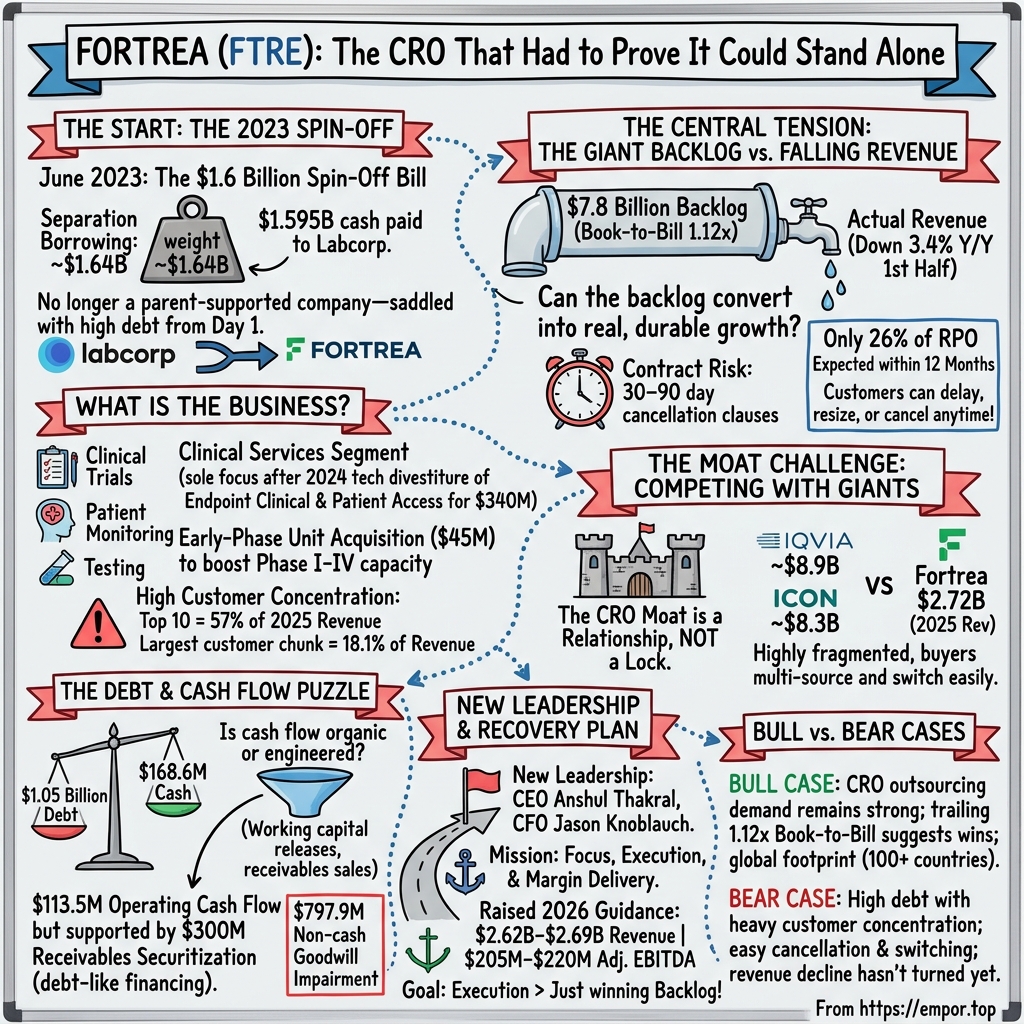
Read the same release from the bottom up, and a different story appeared. Second-quarter revenue was $678.2 million, about 4.5% lower than a year earlier.1 Across the first half of 2026, revenue fell 3.4% to roughly $1.31 billion.2 Even the raised full-year range, $2.62 billion to $2.69 billion, sat below the $2.72 billion the company had reported for 2025.13 A business that keeps telling investors its order book is growing was, on its own forecast, still shrinking.
It would be unfair to say nothing had improved. A year earlier, in the second quarter of 2025, Fortrea had reported a net loss of $374.9 million, most of it a goodwill write-down. In the second quarter of 2026, the net loss was $13.2 million, and adjusted EBITDA, the company's preferred measure of operating profit before interest, taxes and non-cash charges, had risen to $58.7 million from $54.9 million.1 The company was losing far less money on a smaller revenue base. That is what a cost program looks like when it is working. It is not yet what growth looks like.
That gap is the whole puzzle of Fortrea. In most industries, a growing order book is a promise that revenue will follow. A clinical research organization, or CRO, is different. A CRO runs drug trials on behalf of pharmaceutical and biotech sponsors: recruiting hospitals and doctors, monitoring patients, cleaning data, filing safety reports. Its backlog is real work with real names attached.
But the sponsor decides when a trial starts, whether it expands, whether it is paused after a disappointing interim readout, and whether it is cancelled entirely. Most of Fortrea's contracts can be terminated on 30 to 90 days' notice, and when that happens Fortrea generally has no claim to the full award value, only to the costs it has incurred.3
The company's own accounting gives a sober read of how much of that backlog is close at hand. At the end of June 2026, Fortrea reported $4.44 billion of remaining performance obligations, a stricter measure than backlog that excludes contracts a customer could cancel before any work starts. Only 26% of it was expected to become revenue within the next twelve months.2 The rest is spread over years, and every one of those years carries the customer's escape clause.
So the question this story has to answer is not whether Fortrea is winning work. It is whether that work can become durable revenue growth, rising margins and real cash before the company's other obligations, chiefly its debt, set the terms.
Fortrea carried a little over $1.05 billion of borrowings at the end of June against about $169 million of cash.2 A healthy CRO can live comfortably with that. A CRO whose revenue keeps slipping, or whose largest customer pulls back, has much less room.
That largest customer matters more than most investors realize. One sponsor generated 18.1% of Fortrea's 2025 revenue and 17.0% in the first half of 2026.32 Fortrea does not name it. But a single relationship that large means one boardroom decision at one pharmaceutical company can move Fortrea's results more than a year of incremental wins elsewhere.
To understand how Fortrea got here, it helps to know what the company is today. It is a Nasdaq-listed CRO that was spun out of Labcorp, the diagnostics giant, in mid-2023.4 It reports a single segment, Clinical Services, after selling the technology and patient-support businesses it was born with.3
It runs work from first-in-human clinical pharmacology studies through the large late-stage trials that support regulatory approval, and on into post-approval research.3 Its people and facilities carry a pedigree that goes back decades. What they did not carry, on the day of the spin, was a record as an independent company.
That is why this story will keep returning to three measures rather than to the awards themselves. The first is revenue conversion: does the backlog become growth, quarter after quarter, once pass-through costs are set aside? The second is operating margin: is cost cutting producing a business that earns more on each dollar of work, or merely a smaller one? The third is cash: does Fortrea generate money from running trials, or from the timing of when customers pay and when receivables are sold?
Management's July message was that the turn has begun. The record so far says the turn has been booked, not yet delivered. The difference between those two statements starts with the way Fortrea came into the world, carrying a bill of roughly $1.6 billion.
 Subscribe on LinkedIn
II. A Spin-Off With a $1.6 Billion Bill
The business that became Fortrea did not begin as a startup in a garage. It began as one of the oldest names in contract drug development. Covance had spent decades running trials and early clinical studies for drug makers before Labcorp acquired it in 2015 and folded it into a drug-development division alongside the diagnostics labs that most Americans know from blood tests.4
When Labcorp decided to separate that clinical-development business, it was splitting off a company with tens of thousands of trial specialists, clinical pharmacology units where healthy volunteers take first doses of experimental drugs, and long relationships with large pharmaceutical sponsors.
The idea behind the separation was simple and widely shared at the time. Labcorp's diagnostics business and a CRO serve different customers, have different growth rates and attract different investors. Separated, each could be valued on its own terms and run by managers focused on one market. The drug-development business would become a pure-play CRO, free to invest, hire and compete without sitting inside a lab-testing giant.
The mechanics were tidy. On June 30, 2023, Labcorp distributed one Fortrea share for every Labcorp share its investors held, and Fortrea began regular trading on Nasdaq on July 3.43 There was no cash IPO, no new money raised from public investors and no controlling parent left behind. Labcorp did not keep a stake that would make Fortrea a subsidiary.4 Fortrea's shareholders were, on day one, simply Labcorp's shareholders, and many of them had not chosen to own a standalone CRO at all.
The less tidy part came in the financing. To separate, Fortrea borrowed about $1.64 billion and paid Labcorp roughly $1.595 billion in cash.53 In plain terms, the new company started life by taking on debt and sending almost all of it to its former parent.
Spin-offs are often structured this way; the parent gets cash out of the business it is releasing, and the new company inherits the obligation. But it meant Fortrea was not a lightly capitalized growth company with room to make mistakes. It was a leveraged services business from its first day of trading, with interest to pay before shareholders saw a dollar.
There was also the question of what it would cost to run Fortrea on its own. Before the spin, Labcorp provided the centralized functions that a public company needs: finance, legal, information technology, human resources and more. In 2023, those corporate and other allocations from Labcorp totalled $194.0 million, about 6.2% of Fortrea's revenue that year. On top of that, Fortrea bought about $48.8 million of direct services from Labcorp, another 1.6% of revenue.35
Those figures can be misread. They were not a permanent toll Labcorp kept collecting after the separation. They were the cost of being part of Labcorp, and much of that cost had to be rebuilt inside Fortrea, sometimes more expensively, once the company stood alone.
Fortrea's own statements cautioned that the allocations, though based on a reasonable measure of usage, might not equal what a standalone company would spend.3 Some transition services continued for a time after the spin while Fortrea built its own systems.3 The arrangement that mattered after mid-2023 was not a parent fee. It was a duplicated cost base that had to be stripped out.
That is where investor expectations and reality first diverged. Shareholders who later sued Fortrea alleged that the company had misled them about how long it would take to remove those transition costs and about how profitable the long-term contracts inherited from Labcorp would turn out to be. They pointed to rising overhead after the spin and to stock drops after the company's second-quarter 2024 call and again on March 3, 2025.6
A federal judge dismissed the case in full in September 2026, finding that most of the challenged statements were forward-looking or immaterial and that the plaintiffs had not adequately shown the executives knew they were false.6 The dismissal settled the legal question. It did not change the business fact underneath it: the inherited backlog and the inherited cost base both proved harder to work through than the separation story had suggested.
There is a further caveat for anyone trying to read Fortrea's history from its financial statements. The figures for periods before July 2023 are carve-out accounts. They were assembled by slicing Labcorp's books to estimate what the drug-development business looked like, with allocated overhead and without the debt Fortrea later took on.
On that basis, the business reported revenue of just over $3.0 billion in 2021 and about $3.1 billion in 2023, with net income of $98.0 million in 2021 and $192.9 million in 2022.5 Those were the years when the combined unit still included the businesses Fortrea later sold.
When the company redrew its history to show only the operations it kept, 2023 revenue became about $2.84 billion with a net loss of $25.2 million.3 So the clean comparison is not the flattering carve-out record of 2021 and 2022.
It is the continuing business after the spin, which has carried standalone overhead, a heavy interest bill and a smaller portfolio. Comparing Fortrea today with the Labcorp-era unit is like comparing a household's budget before and after the children move out and take on a mortgage. The family is the same. The economics are not.
The spin, then, achieved what it set out to do in the narrow sense. It created an independent, focused CRO with a ticker, a board and its own strategy. What it did not create was a company with a clean balance sheet or a proven standalone cost structure. Fortrea had to earn those after the fact, while serving customers who were under no obligation to wait for it.
Which brings the story to the thing Fortrea actually sells, and to how little control it has over when that sale becomes revenue.
III. The Trial Contract That Can Disappear
Picture a mid-sized biotech company with a promising drug for a chronic disease. It has finished early safety work and now needs to run a large trial across dozens of hospitals in North America, Europe and Asia. It does not have the people to find those hospitals, train their staff, monitor every patient visit, clean the resulting data and keep regulators informed. So it puts the job out to bid. After weeks of proposals and presentations, it awards a multi-year program to a CRO.
That award is the moment the CRO records new business. It is also the moment the story's central tension is born. The CRO will not be paid the award value. It will be paid as work is performed: as sites are activated, as patients enroll, as monitoring visits happen and as data are delivered.
If enrollment is slow, revenue is slow. If the drug fails an interim analysis and the sponsor stops the trial, the remaining revenue disappears. And because the sponsor holds termination rights, the CRO cannot force the trial to continue.
Fortrea runs this kind of work across the life of a drug. At the front end is clinical pharmacology, the first studies in humans, often in healthy volunteers who stay overnight in dedicated research units while scientists measure how a drug is absorbed, metabolized and cleared.
Then come the larger Phase II and Phase III studies that test whether the drug works, and Phase IV studies after approval. Around those trials, Fortrea sells project management, site monitoring, data management and biostatistics, drug-safety reporting and consulting.3 A sponsor can buy a whole trial from it or carve off pieces.
The pricing unit matters, because it determines how much risk sits with Fortrea. Its contracts are generally fixed-price, fee-for-service or, in a few cases, software-as-a-service, and they are adjusted when the scope changes.3 On a fixed-price study, Fortrea quotes a price for a defined set of work and keeps the margin if it delivers efficiently, or absorbs the loss if it does not.
Fee-for-service work is billed by the unit or the hour. Revenue recognition on these contracts depends on estimates of the total cost to complete them, which is why Fortrea's auditor singled out revenue estimates as a critical audit matter.3
Then there is pass-through revenue. Fortrea pays investigators, the doctors and hospitals running trial sites, and other out-of-pocket costs, and these reimbursable amounts flow through its revenue line.3 They add to reported sales but carry little or no margin. This is why a CRO's revenue can fall without much change in the underlying service business, and why management's explanation for the second-quarter decline, that it was due primarily to lower pass-through costs, has to be read carefully.7
Lower pass-throughs can mean the trial mix shifted toward lighter site costs. They can also mean fewer patients were being treated at sites. The company does not break out service-fee revenue separately in its quarterly results, so investors have to take the split on trust.1
The second model Fortrea sells is quite different. Under a functional service provider arrangement, or FSP, a sponsor does not hand over an entire trial. It rents capacity: a team of clinical research associates, data managers or safety specialists who work inside the sponsor's own processes and systems. FSP deals can run for years and are often large.
But they are staffing in all but name, and the customer can resize them at will. That has been a sore point. Management cited continued FSP headwinds in its second-quarter explanation and said pricing had become more rational after the previous year's FSP price competition.7 Translation: in 2025, sponsors used their leverage to push FSP rates down, and Fortrea felt it.
Both models can be described as long-term. Fortrea's contracts typically last one to eight years.3 Neither model guarantees the full contract value, and Fortrea does not disclose what share of its revenue is recurring or whether any customer is bound by a minimum purchase commitment.32 An investor who hears "multi-year contracts" and thinks "subscription" has made a category error. A subscription is a commitment to pay. A trial contract is a commitment to pay for work if and when the customer wants it performed.
This is where the two order-book numbers diverge. Backlog, which Fortrea put at $7.8 billion in June 2026, counts awarded work broadly, including studies that may take years to perform.1 Remaining performance obligations, the accounting measure, stood at $4.44 billion and excluded contracts that are wholly unperformed and can be cancelled unilaterally by the customer.2
The difference between the two is, roughly speaking, work that Fortrea has been promised but that the customer could still walk away from without owing anything. And of the stricter measure, only about a quarter was expected to turn into revenue within a year.2
A good analogy is a wedding caterer with a long list of booked weddings. The list is real, and many of the couples will go through with it. But the caterer is paid only when each wedding happens, some will be postponed, a few will be called off, and the deposit, if there is one, rarely covers the menu. Nobody would value that caterer on the length of the list alone. They would watch how many weddings actually take place each month.
Customer concentration adds a second layer of risk to the same picture. In 2023, Fortrea's two largest customers each accounted for a little over 11% of revenue. In 2024, two customers made up 14.3% and 10.5%.8 By 2025, a single customer generated 18.1% of revenue, the ten largest accounted for 57% and the twenty largest for 69%.3
In the first half of 2026, the largest customer still represented 17.0%.2 The direction is the point. Over the period when Fortrea's total revenue was shrinking, it was becoming more dependent on a small group of very large sponsors, and on one in particular.
That cuts both ways. A sponsor that sends nearly a fifth of Fortrea's business is obviously satisfied with the work, and large pharmaceutical companies tend to use preferred-provider relationships that run for years. But the same sponsor knows precisely how much it matters. In a renewal negotiation or a decision about where to place its next big FSP team, it has leverage that no biotech customer does.
Fortrea has never named a customer bankruptcy or major contract exit in its 2024 or 2025 annual reports, and its 2023 report attributed part of a profit decline to an earlier FSP cancellation without naming the customer.583 What the record shows is not a history of catastrophic losses. It shows a business whose fortunes rest heavily on the purchasing decisions of a few buyers.
The newest bookings hint at where Fortrea is trying to rebalance. Net new business in the second quarter was about $720 million, and management said it was weighted toward biotech customers.7 It described growth in China as driven by Chinese biotechs and their Western partners, and reported no material shift in therapeutic or geographic mix.7
Biotech work tends to come in full-service form, because smaller sponsors lack the internal teams that FSP models assume, and it can carry better margins. It also carries funding risk: a biotech that cannot raise its next round can pause a trial faster than any large pharmaceutical company. A shift toward biotech would reduce Fortrea's dependence on its largest customer, at the cost of a different kind of volatility.
Which leads to the question every CRO bull eventually has to answer. If sponsors can cancel on a few months' notice, split work among vendors and push down rates, what exactly keeps them with Fortrea?
IV. The CRO Moat Is a Relationship, Not a Lock
Imagine the sourcing team at a large pharmaceutical company planning its next oncology program. It has a short list. At the top are the global full-service giants that can open hundreds of sites in dozens of countries at once.
Beside them sit specialist CROs that know one disease area deeply, and staffing-style FSP providers that can drop experienced monitors into the sponsor's own systems. The team rarely picks just one. It places the pivotal trial with one firm, the early pharmacology work with another and an FSP data team with a third. It keeps every vendor on notice that the next award is not guaranteed.
That is the market Fortrea competes in. Sponsors choose CROs on therapeutic expertise, geographic reach, the quality of the specific team assigned, speed of site start-up and record of execution.3 Those are real differentiators, but they are mostly about people and process, and people can move between firms.
Scale is the first hard fact. Fortrea's 2025 revenue was about $2.72 billion.3 IQVIA's research and development solutions business, the part of IQVIA that competes most directly, reported about $8.9 billion that year and a contracted backlog of $32.7 billion.9 ICON reported about $8.25 billion of 2025 revenue.10
In other words, each of Fortrea's two largest rivals is roughly three times its size, with an order book to match. Parexel and Syneos Health, both now privately owned, and Thermo Fisher's clinical research business, built on its purchase of PPD, compete in the same arena, though their reporting does not allow a clean segment-to-segment comparison.
An outside referee recently described the field. In March 2026, when the European Commission cleared Thermo Fisher's purchase of Clario, a clinical-trial technology provider, its market investigation listed ICON, IQVIA, Parexel, Fortrea and Syneos Health as CRO players in a "fragmented and highly competitive market."11 Customers told the Commission that while they sometimes work with specific CROs, they "preserve the flexibility to engage other providers as appropriate."11 The Commission also noted that Thermo Fisher's CRO share did not exceed 10% globally, and that sponsors can switch to many competing CROs.11
When a regulator investigating market power concludes there is plenty of choice, that is good news for buyers of CRO services. It is not good news for anyone hoping a mid-sized CRO enjoys pricing power.
ICON's own year offered a second reminder about this industry's economics. Alongside its 2025 results, ICON disclosed the outcome of an audit-committee investigation and said it was restating 2023 and 2024 revenue, which it had overstated.10 The episode concerns ICON, not Fortrea. But it shows how much judgment sits inside a CRO's revenue line, where progress on multi-year fixed-price contracts is estimated rather than counted. It is the same area Fortrea's auditor flagged as a critical audit matter.3
Now give Fortrea's case its strongest form. The company operates in about 100 countries and had 62 facilities in 42 countries at the end of 2025.3 It traces more than 30 years of heritage through Covance, and it can run work from first-in-human pharmacology all the way through post-approval research.3
That breadth matters to a sponsor that wants one partner to take a molecule from its first dose to its regulatory filing, because each handoff between vendors is a chance to lose time and data. The clinical pharmacology units are physical assets with trained staff, regulatory track records and volunteer databases, and they cannot be replicated overnight. A long record of inspections passed and studies delivered is the closest thing this industry has to a brand.
The test of a moat, though, is not what the company has. It is whether customers behave as if they cannot easily leave. Here the evidence is thin. Fortrea does not disclose customer retention rates or price realization, and there is no public sign that it earns a price premium over larger rivals.3 Its customers multi-source, as the Commission's investigation found industry-wide.11
Its revenue has declined since the spin even as the broader industry has kept outsourcing trials.3 And FSP pricing remains under pressure, as the 2025 competition showed.7
Weighing all of this, the history narrows the moat claim rather than rejecting it. Fortrea has real credentials that keep it on sponsors' shortlists, and its concentrated customer base shows that some very large buyers trust it with a great deal of work. What the record does not support is the stronger claim that customers are locked in or that Fortrea can set prices.
Its advantage is a relationship that has to be re-won with each award. The KPI that would strengthen the claim is sustained organic revenue growth at stable or rising margins while the largest customer's share holds steady or falls. The event that would weaken it is a sizeable loss of work from that customer without replacement.
Technology is the new variable. On the second-quarter call, Anshul Thakral, the chief executive, said that most requests for proposal now ask about artificial intelligence, but that buyers are not yet choosing a CRO on AI alone over operational experience.7 He described AI as a productivity multiplier: Fortrea had rolled out Microsoft Copilot to about 14,000 employees, and a mobile app for clinical research associates had cut nearly 30 minutes of preparation from site visits in one Spanish study.7
Asked whether this was showing up in win rates, he said it was too early to tell.7 That is a candid answer, and the evidence it supports is modest: AI is an efficiency and execution race that every CRO is running, not a disclosed revenue stream and not a moat. If anything, it may lower the cost of some monitoring and documentation work for everyone, which would make scale and data advantages, where larger rivals are stronger, matter more.
Against that backdrop came Fortrea's most concrete capability move of 2026. In September, it agreed to buy the early-phase services division of Worldwide Clinical Trials for approximately $45 million in cash.[^12] The deal brought a 200-bed clinical research unit in San Antonio, a bioanalytical laboratory in Austin and a biospecimen storage facility nearby in Texas.[^12] Management said the beds took Fortrea's global early-phase capacity to more than 570, and that the in-house bioanalysis would reduce handoffs between clinical and laboratory work.[^12] The acquisition closed in October.[^13]
The logic is plausible. Early-phase studies are where a CRO first meets a molecule, and winning that work can lead to later-phase awards if the drug advances and the sponsor is satisfied. Owning the laboratory that measures drug levels in volunteers' blood shortens timelines.
But Fortrea did not disclose the acquired unit's revenue, profit or occupancy, and beds are capacity, not demand.[^12] The purchase is a targeted capability addition. It is not, by itself, evidence that sponsors want more early-phase work from Fortrea than its existing units could already handle.
That sets up the question for the next act. Fortrea's competitive edge depends on people, delivery quality and a broad footprint. Its recovery plan depends on cutting costs. Can it improve execution and margins without losing the very people and capacity it needs to keep winning studies?
V. The Pure-Play That Sold Part of Itself
A year after the spin, the company that had been sold to investors as a focused, standalone clinical-services platform decided it was not quite focused enough. In June 2024, Fortrea agreed to sell its Endpoint Clinical business and the assets of Fortrea Patient Access to Arsenal Capital Partners, a private-equity firm.12 Together, those operations formed what Fortrea called its Enabling Services segment.8
They were not trivial businesses. Endpoint Clinical made software for randomizing patients and managing the supply of trial drugs, the plumbing that ensures each patient in a blinded study receives the right kit at the right time. Fortrea Patient Access ran programs that help patients get access to and stay on therapies. Both sat next to the trial business without being the trial business itself. Selling them left Fortrea with one reportable segment: Clinical Services.3
The price was set in two pieces. Arsenal paid $295 million at closing, with up to $45 million more tied to milestones.128 After adjustments, the final price was about $340 million, and Fortrea recorded a loss of $19.6 million on the disposal.3 The milestone money arrived in 2025.3 Fortrea used the proceeds, along with other cash, to pay down debt: in 2024 it repaid $70.2 million of term loan A and $412.5 million of term loan B.3
What does that sale say about capital allocation? Fortrea chose liquidity and simplicity over owning adjacent technology and patient-support businesses. A loss on disposal means the sale price was below the businesses' carrying value, which in turn reflects what Labcorp-era accounting had recorded for them.
It does not, by itself, prove the price was poor; the carrying values were legacy figures, and Fortrea did not publish the businesses' earnings or comparable deal multiples. The fair reading is that the public record supports neither "bargain" nor "fire sale." It was a deleveraging divestiture by a company that needed to reduce debt.
There is also a quieter strategic cost. Randomization and trial supply software is exactly the kind of technology that rivals such as ICON and IQVIA bundle with services, and the European Commission's review of the Thermo Fisher–Clario deal shows that integrated CRO-plus-technology offerings remain a live strategic theme.11 Fortrea stepped away from that combination in exchange for a cleaner balance sheet. That may prove sensible. It also narrows the menu Fortrea can put in front of a sponsor.
The harder question is whether focus produced the result focus was supposed to produce. Here the record is unforgiving. On the continuing-operations basis that excludes the sold businesses, revenue was about $2.84 billion in 2023, $2.70 billion in 2024 and $2.72 billion in 2025.3 So two years after the spin, the pure-play was about 4% smaller than at the start, not larger. Net losses widened from $25.2 million in 2023 to $328.5 million in 2024 and $986.2 million in 2025.3
Most of that 2025 loss came from a single line. Fortrea wrote down $797.9 million of goodwill in the first half of 2025, cutting the recorded value of its Clinical Development reporting unit.3 Goodwill is the premium paid for a business above the value of its identifiable assets, much of it a legacy of Labcorp's Covance purchase.
Writing it down is a non-cash charge, so it did not drain the bank account. But it is an accountant's formal admission that the business was no longer expected to generate the cash flows that once justified its book value. In plain language, the market and the company's own forecasts had falsified the assumptions under which the business had been carried.
That is the strongest piece of disconfirming evidence against the idea that the spin and the sale had already created value. The value question is still open, but on the record so far, the pure-play strategy has delivered a simpler, smaller company with lower debt and a large write-down, rather than a growing one.
The strategy also changed hands. Thomas Pike, Fortrea's first chief executive as a standalone company, left in May 2025, and Peter Neupert, the chairman, served as interim CEO until Anshul Thakral took over on August 4, 2025.13[^16] Thakral's framing of the plan has four parts: commercial execution, operational excellence, financial discipline and sustainable growth.13 Those are sensible words. They are also the words almost every turnaround uses, which is why the measure of them has to be results rather than vocabulary.
The early-phase acquisition is the first capital-allocation decision that bears Thakral's signature. At about $45 million, it was small next to Fortrea's annual revenue of roughly $2.7 billion and next to the $340 million it had raised selling businesses two years earlier.[^12]3 A modest price limits the downside.
But Fortrea did not disclose the acquired unit's revenue or earnings, so there is no way to calculate the multiple paid or compare it with other deals.[^12] Whether Fortrea bought well will be known only when the San Antonio beds and the Austin lab show up as higher early-phase revenue and better utilization.
There is a mild irony in the sequence. In 2024, Fortrea sold adjacent businesses to simplify. In 2026, it bought a specialist unit to deepen its core. Both moves can be consistent with focus; the first removed things that were not trial services, and the second added trial capacity.
But together they show that the definition of "focus" is a judgment call that each management team makes again. A skeptical investor would want to see the second move judged by the same standard the first one should be: did it improve revenue, margins and cash?
And cash is where the next part of the story leads. In a year when Fortrea reported a near-billion-dollar loss, it still reported positive operating cash flow. Did simplification and cost control produce that cash, or did the calendar?
VI. The Cash Flow That Changes With the Receivables
At first glance, Fortrea's 2025 numbers look contradictory. The company reported a net loss of $986.2 million. Yet it reported $113.5 million of positive cash flow from operations in the same year.3 How does a company lose almost a billion dollars and still generate cash?
The first clue is the non-cash goodwill write-down.3 Strip it out, and the loss shrinks to something much smaller. That accounts for most of the gap between the headline loss and the cash. But it does not account for all of it, and the remainder is where the real lesson about this business lies.
The second clue is working capital. A CRO has no warehouse and no inventory story. Its balance sheet runs on three moving parts: money customers owe for work already billed, money they owe for work performed but not yet billed, and money customers have paid in advance for work not yet performed. When customers pay faster, or prepay more, cash comes in ahead of earnings. When they pay slower, or when work runs ahead of billing milestones, cash lags.
In 2025, those moving parts helped. Receivables and unbilled services released about $70.9 million of cash, and deferred revenue, the prepayments, rose by about $114.8 million; a $109.9 million drop in amounts owed to suppliers partly offset that.3 In 2024 the help was even larger.
A $309.9 million release from receivables, alongside a $140.0 million rise in deferred revenue, helped produce $262.8 million of operating cash flow in a year when Fortrea reported a $328.5 million net loss.3 None of that is improper. But a release of receivables is not the same thing as earnings. It is a one-time conversion of an asset into cash, and it cannot be repeated indefinitely.
The first half of 2026 shows what happens when the wind turns. Operating cash flow was only $11.9 million, because receivables and unbilled services absorbed about $70 million of cash, partly offset by higher payables and prepayments.2
Management pointed to second-quarter free cash flow of about $19.9 million and days sales outstanding of 20 days as signs of discipline.7 Twenty days is a strikingly fast collection cycle. It is also flattered by two things investors should keep in view: customer prepayments that are netted against what customers owe, and receivables that Fortrea has sold.
That sale is the third clue. Fortrea runs a receivables securitization facility, under which it sells customer invoices to a financing vehicle for cash before the customers pay. It had sold $300 million of receivables under that program at both the end of 2025 and the end of June 2026, and related costs were $17.8 million in 2025.32 Think of it as a payday advance on the invoices.
The cash arrives earlier, the balance sheet shows smaller receivables, and the company pays a fee for the privilege. On $300 million, a cost of nearly $18 million is in the same territory as an interest rate on high-yield debt. Moody's, Fortrea's credit rater, treats the facility as debt-like for exactly that reason.14 It is financing, not organic cash conversion.
The quality of the receivables themselves is reasonable but not risk-free. Unbilled services, work Fortrea has performed but not yet invoiced, stood at about $503 million in June 2026, much larger than the $189 million of billed trade receivables.2 Unbilled balances are normal for a CRO, because billing milestones lag effort. But they depend on estimates of progress, and they become cash only when the sponsor agrees the milestone has been met.
One pharmaceutical customer accounted for 18.2% of gross receivables plus unbilled services at June 2026.2 The allowance for doubtful accounts has eased, with the annual charge falling from $22.2 million in 2024 to $12.0 million in 2025.3 Fortrea says most balances are current, but it does not publish an aging table, so investors cannot see how much is overdue or by how long.32
Now set that cash picture beside the debt. At the end of June 2026, Fortrea owed about $1.05 billion before discounts and fees: roughly $494 million of 7.5% senior notes due in 2030, about $417 million of term loan A due in 2028 and about $155 million of term loan B due in 2030.2
It held $168.6 million of cash and had about $448 million available on an undrawn revolving credit line.2 Management said that about 35% of the original spin debt had been paid down, and that quarterly interest expense had fallen to $19.3 million from $23.3 million after debt repurchases.7 It bought back $75.7 million of senior notes in 2025.3
Follow the cash, and the priorities are clear. Very little of it has gone into physical expansion. Capital spending fell from about $40 million in 2023 to roughly $25 million in each of 2024 and 2025, under 1% of revenue, mostly on projects supporting the core business.53
It picked up in the first half of 2026, to $17.0 million from $10.4 million a year earlier.2 Fortrea does not report a separate research and development line, which is normal for a CRO whose development work is paid for by customers; its reinvestment shows up instead in staffing, systems and facilities.3
Nor has cash gone to shareholders. Fortrea's filings from 2023 through mid-2026 show no common-share buyback, and its share count rose from about 93.1 million at the end of 2025 to about 95.1 million in June 2026, mainly through employee stock plans.32 That is modest dilution, but it is dilution, and it is the quiet cost of an equity-heavy pay structure. The cash, in short, went to lenders.
That is real progress in reducing the spin's bill. It is also a reminder of how heavy that bill was. Fortrea amended its loan covenants in February 2025 to give itself more room and reported being in compliance in June 2026.2 The term loan A maturity in 2028 is the nearest refinancing test.
Nothing is due tomorrow, but a company with roughly $200 million of expected adjusted EBITDA, about a billion dollars of on-balance-sheet debt and another $300 million of sold receivables has limited tolerance for a cash disappointment.12
Two other items are worth keeping in proportion. Currency swings have moved Fortrea's reported earnings around: a $26.9 million foreign-exchange loss in 2025, then a $13.2 million gain in the first half of 2026.32 But those swings come mostly from balance-sheet remeasurement and from forward contracts that are not hedge-accounted, so their fair-value changes flow straight through earnings.2
The underlying operating exposure is small; Fortrea estimated that a 10% move in the euro would change operating income by only about $0.2 million before hedging.2 Tax uncertainty is similarly minor, with unrecognized tax benefits of just $0.5 million at the end of 2025.3 Those are not the risks that will define this company.
The risk that will define it is simpler. Fortrea's cash flow over the past two years has been supported by working-capital releases and accelerated by selling receivables. Neither is a durable source of value. The test for investors is full-year operating cash flow and free cash flow before working-capital swings and before securitization proceeds, set against the company's adjusted EBITDA. If those numbers converge, the cost cutting is producing cash. If adjusted EBITDA keeps rising while cash stays dependent on timing, the improvement is mostly on paper.
Which puts the spotlight on the people making those numbers, a new chief executive and a new chief financial officer whose first months on the job were anything but routine.
VII. A New CEO, a New CFO, and a Recovery Plan Under Test
When Fortrea's management team dialed in to present second-quarter results on July 29, 2026, one seat was conspicuously filled by a stand-in. Four days earlier, the Delaware Court of Chancery had issued a temporary restraining order barring Jason Knoblauch, Fortrea's newly appointed chief financial officer, from working in the role while a lawsuit brought by his former employer was pending.15
The suit alleged he had breached restrictive covenants and kept confidential information.15 David Smith, a Fortrea director, stepped in as interim CFO.15 On the call, Thakral addressed the situation and moved on to the numbers.7
It was an awkward backdrop for a company trying to project stability. Fortrea had already been through a CEO transition the year before. Now its finance chief was sidelined by a dispute that had nothing to do with Fortrea's operations.
The episode resolved quickly: the parties signed a settlement and mutual release, and on September 9, 2026, the board reinstated Knoblauch as CFO on the same compensation terms.15 It is best read as a governance and continuity disruption that has been resolved, not as evidence about how well Fortrea runs trials. But it added noise at precisely the moment management wanted investors focused on the turn.
The man at the center of that turn is Anshul Thakral. He came to Fortrea with an engineer's training, bachelor's and master's degrees in biomedical engineering from Johns Hopkins and an MBA from Wharton, and a career that ran through consulting, expert networks and the CRO business itself.13 He was an associate principal in McKinsey's healthcare practice and ran the global life-sciences unit at Gerson Lehrman Group before joining PPD, one of Fortrea's long-standing rivals.13
There he held senior roles including chief commercial officer and head of peri- and post-approval services, and he led PPD's biotech business.13 He then co-founded Launch Therapeutics and served as its chief executive.13 Neupert, in announcing the appointment, emphasized his deep familiarity with the CRO industry.13
That background fits the job. Fortrea's problem is commercial: winning work at sensible prices, converting it efficiently and keeping the largest customers. A CEO who ran a rival's commercial engine and its biotech franchise has seen how sponsors buy. What the background cannot tell investors is whether he can make a leveraged, shrinking organization grow. With a little over a year in the role, that verdict belongs to the results.
His pay was structured to tie him to those results. In 2025, Thakral's total compensation was about $11.6 million, of which roughly $10.5 million was stock awards.[^16] Pike, who left in May 2025, received about $7.8 million for 2025, most of it in compensation following his departure; in 2023, his first year leading the standalone company, his package had been about $26.3 million.[^16]
Fortrea said its 2025 incentive payouts came in below target in a year of large losses.[^16] Equity-heavy pay aligns a CEO with the share price in principle. It does not prove alignment with long-term value, because a turnaround CEO's grant often vests on the strength of a recovery from a very low base.
Shareholders have so far accepted the arrangements. Say-on-pay passed with more than 94% of votes cast in 2025, and in 2026 about 73.5 million votes were cast in favor and 3.88 million against.[^16]16 Seven of the eight current directors are classified as independent.[^16]
The register has also attracted attention from the kind of investor that asks pointed questions. Starboard Value disclosed about 4.86 million shares in February 2025 and reached an agreement with Fortrea on a board appointment.[^16] BlackRock reported a stake of about 14.6% in the 2026 proxy, with Vanguard at about 9.2% and Goldman Sachs at about 8.5%.[^16]
The large holders have not been static. BlackRock's reported position grew from about 11.5 million shares in the 2025 proxy to about 13.8 million in the 2026 proxy, while Vanguard's fell from the 9.8 million it reported in early 2024.[^20][^16]
Those are index-heavy managers whose holdings move with benchmarks as much as with conviction, so the shifts say more about where Fortrea sits in indices than about a verdict on Thakral. In June 2025, while its shares were under pressure, Fortrea's board adopted a limited-duration shareholder rights plan, which expired in June 2026.3
The best way to judge a new management team is to compare what it says across successive calls. In February 2026, alongside fourth-quarter results, Fortrea guided to 2026 revenue of $2.55 billion to $2.65 billion and adjusted EBITDA of $190 million to $220 million.17 It said its 2025 cost savings had exceeded previously communicated targets, and it reported a fourth-quarter book-to-bill of 1.14x, though the trailing twelve-month figure was only 1.02x.17
In May, with first-quarter revenue of about $637 million, down from about $651 million a year earlier, it reaffirmed that guidance; book-to-bill was 1.15x in the quarter and the trailing figure rose to 1.05x.18 In July, it raised both ranges, revenue to $2.62–$2.69 billion and adjusted EBITDA to $205–$220 million, on the back of second-quarter adjusted EBITDA of $58.7 million, up from $54.9 million a year earlier.1
The pattern is consistent and, so far, disciplined. Management set a conservative revenue range that already assumed a decline, held it, and then lifted it. It has not overpromised in 2026. That is worth recognizing, particularly after the shareholder suit over the spin-era messaging. But consistency in guidance is not the same as growth. Even the raised revenue range sits below 2025's $2.72 billion.13 The quarter's improvement came from cost savings and operational efficiency, not from a larger top line.7
Analyst questions on the July call probed exactly that. One analyst noted that the quarter's 1.06x book-to-bill was below the company's typical full-year level, and that it would have been higher without the revenue beat.7 Thakral credited commercial execution and a more diversified client base and said he had not seen a clear seasonal pattern.7
Asked how the second half would be split, management declined to break it out, saying it expected stable, flat performance.7 Asked whether the industry rule of thumb, that a 1.2x book-to-bill implies mid-single-digit growth, still held, Thakral said it did, but had to account for pass-through revenue.7 On pricing, he said the market had become more rational but would not discuss specific renegotiations.7
Those are not evasive answers, but they are not fully quantified either. The company has not given a target for service-fee revenue growth, a timeline for returning to reported growth or a breakdown of how much of the cost savings it expects to keep.
Cost savings also carried a sting: year-to-date, gross savings of about $34 million translated into only about $19 million of net savings, partly because of a higher-than-expected accrual for variable compensation.7 In other words, as the company performed better, it paid its people more, which is reasonable but limits how much of the efficiency reaches shareholders.
The legal and audit record is bounded. Deloitte gave unqualified opinions on Fortrea's 2025 financial statements and internal controls, with revenue estimates and goodwill valuation flagged as critical audit matters, the two areas where management judgment most affects reported results.3
The court denied further leave to amend the spin-era securities class action, which was dismissed in September 2026.6 Fortrea recorded about $1.9 million of 2025 legal expense for matters predating the spin and said it did not expect pending claims to be material.3
The risk radar, stripped to the mechanisms that matter, is short. Sponsor budget cuts or trial cancellations hit revenue directly, because of the termination rights already described. Weak conversion feeds into high leverage and makes the 2028 refinancing harder. Data privacy and regulatory compliance are part of delivery, since a CRO handles patients' health data across dozens of jurisdictions. Currency affects reported earnings but, on Fortrea's own estimate, barely touches operating income.2
So the management test is plain. Can this team deliver several consecutive quarters of organic revenue growth, rising operating margin and cash generation that does not rely on releasing working capital? Four quarters of strong bookings say the commercial engine has improved. They do not yet say the business has turned.
VIII. Analysis & Bear vs. Bull Case
Lay two boards side by side. On the left, the evidence a bull would pin up: four consecutive quarters of book-to-bill above 1.0x, a trailing figure of 1.12x and a backlog of about $7.8 billion.17 On the right, the evidence a bear would pin up: a first half in which revenue still fell 3.4%, guidance that still points below 2025, and about $1.05 billion of debt.21 Both boards are true. The question is which one will describe Fortrea a year from now.
The bull case starts with the industry. Drug development keeps getting more complex, with more global trials, more specialized patient populations and more regulatory demands, and most sponsors, particularly smaller biotechs, cannot staff all of that themselves. Outsourcing is how the industry runs.
Fortrea has the global delivery network, clinical pharmacology capability and multi-decade operating record that sponsors look for when they draw up shortlists.3 Management described demand as improving on the July call, with net new business weighted toward biotech customers and biotech funding strengthening.7 If those awards convert, Fortrea's revenue should stop shrinking.
The bull case then adds operating leverage. A CRO's biggest cost is people. Fortrea cut headcount from about 18,000 in 2023 to roughly 14,300 by the end of 2025.3 In the first half of 2026, direct costs fell to 80.0% of revenue from 81.6% a year earlier, which is the cost-cutting showing up in gross margin.2
If revenue merely stabilizes while that leaner structure holds, margins rise, cash improves and leverage falls almost mechanically. Add the new early-phase capacity and a more integrated offer from first dose to late-stage trials, and a bull can sketch a path to better win rates and utilization.
The bear case starts with the customer. Sponsors multi-source, they can cancel on short notice and one of them accounts for roughly a sixth of revenue.32 Continuing revenue in 2025 remained below its 2023 level despite an industry that kept outsourcing.3 And the $797.9 million goodwill impairment is the business's own record falsifying the value assumptions it once carried.3
The leaner cost base also cuts both ways. In 2025, direct costs actually rose to 81.5% of revenue from 80.2% the year before, despite lower personnel costs and restructuring, because revenue did not cooperate.3 Cost cuts in a people business can save money, but they can also thin the teams that win the next study.
The decisive question is why Fortrea would win from here. The best answer is integration and focus, backed by a commercial leader who knows how sponsors buy. The early-phase acquisition adds capacity,[^12] but its revenue contribution remains undisclosed.[^12] The answer, as it stands, is a plausible plan rather than a demonstrated edge.
Why it may not win is easier to state. IQVIA and ICON are each roughly three times Fortrea's size, with deeper data and technology assets and larger backlogs.910 Customers retain the bargaining power the European Commission documented.11 And Fortrea's balance sheet makes a long recovery harder, because every year of flat revenue is another year of interest payments and refinancing exposure.
Moody's affirmed Fortrea at B3 with a stable outlook in February 2026, a move from a negative outlook that reflected expected improvement; it still described leverage as very high, at 12.3x its adjusted measure in September 2025 and 15.6x counting the receivables facility, and it expected that to fall below 10x within 12 to 18 months only if execution held.14
S&P had downgraded Fortrea in June 2025, citing weak margins, high leverage and negative cash flow, while acknowledging the cost plan and bookings.19 Credit agencies are not stock analysts, but their view tells equity holders how little margin for error the lenders see.
Michael Porter's five forces frame the economics clearly. Buyer power is high: concentrated sponsors, cancellable contracts and the ability to split work across vendors. Rivalry is intense, among global giants, privately owned full-service CROs and specialists, in a market the Commission called fragmented and highly competitive.11
Barriers to entry are moderate: regulatory know-how, inspected facilities and global site networks take years to build, which protects incumbents from startups, but they do not protect any one incumbent from another. Supplier power is mixed; the key supplier is skilled labor, which can move to rivals, and investigator sites that every CRO competes to use. Substitutes come from sponsors doing work in-house and, increasingly, from technology that automates parts of monitoring and data handling.
Hamilton Helmer's seven powers ask a narrower question: which durable advantage lets Fortrea earn more than its cost of capital? Scale economies favor the larger rivals rather than Fortrea. Network effects are weak in trial services. Switching costs exist within a running trial, because changing CROs mid-study is painful, but they reset with each new award, which is why the contracts' termination rights matter.
Counter-positioning, cornered resources and process power have no clear public evidence at Fortrea; there is no proprietary dataset, unique facility or operating method the record shows rivals cannot match. Brand, in the sense of a reputation for delivery, is real but shared with every major competitor. On the evidence, Fortrea's position is that of a credible, mid-scale incumbent without a demonstrated power. That does not doom it to poor returns. It means returns will depend on execution, quarter by quarter.
A skeptical activist would focus on two numbers. The first is margin. At the midpoints of the raised guidance, Fortrea expects adjusted EBITDA of a little over $210 million on revenue of about $2.65 billion, a margin of roughly 8%.1 ICON reported an adjusted EBITDA margin of about 18.6% in 2025.10 Even allowing for differences in mix and definitions, the gap is wide. Closing even part of it would transform Fortrea's cash flow and leverage, which is the heart of the bull case.
Failing to close it, years after the spin, would raise the question every activist eventually asks: is this business better owned by someone else, perhaps a larger CRO that could absorb it, or a private owner willing to run it for cash? Fortrea has given no indication of a sale, and none should be assumed. But the Starboard stake and board seat show that the register already includes investors who think in those terms.[^16]
The second number is the largest customer. Seventeen percent of roughly $2.65 billion is around $450 million of annual revenue tied to a single sponsor.21 If that customer moved a meaningful share of work elsewhere, the lost revenue would come with only partial relief on costs, because the trained staff and overhead serving it would not vanish on the same day.
Moody's leverage measure, already well above 10x on its September 2025 calculation, would move the wrong way.14 Fortrea does not disclose the contribution margin, backlog or contract terms attached to that customer, so investors cannot size the risk precisely. They can only see that it is large.
Valuation adds little certainty. Recent GAAP losses make price-to-earnings ratios meaningless, and with about a billion dollars of debt and $300 million of sold receivables, the equity is a thin slice on top of the enterprise. That structure means small changes in operating performance produce large swings in equity value, in either direction. The market price implies a view on whether recovery comes; it does not, by itself, signal that the shares are cheap or expensive.
What, then, would settle the case? Three measures stand above the rest. The first is organic revenue growth excluding pass-through costs; on reported revenue, growth remains negative, with first-half revenue down 3.4%.2 The second is direct costs as a share of revenue, which improved to 80.0% in the first half of 2026 from 81.6% a year earlier.2
The third is cash flow; first-half operating cash flow was only $11.9 million.2 If all three move the right way at once, the bull board wins. If bookings stay strong while the first and third stall, the bear board does.
The case comes down to something broader than one company's turnaround plan. What does Fortrea's story teach about turning an inherited service business into a company that can stand on its own?
IX. Playbook: Business & Investing Lessons
Go back to the day the spin was completed. A newly independent CRO woke up with thousands of trial specialists, long-standing sponsor relationships, research units full of beds and a name nobody had heard of. It also woke up owing roughly $1.6 billion, having just paid almost all of it to its former parent.3 Everything since has been an attempt to make the first half of that inheritance pay for the second.
The first lesson is that a spin-off gives you a ticker before it gives you standalone economics. Fortrea's pre-spin record was a carve-out, not a forecast of its standalone economics.5 After the separation it had to rebuild corporate functions, unwind transition services and service a leveraged balance sheet.
The investors who later sued over the speed of that unwinding lost their case, but the difficulty was real.6 For founders and boards contemplating a separation, the moment of independence is the start of the cost-reduction plan, not the end of it. For investors, the carve-out history is a hint, not a forecast.
The second lesson is that backlog is a promise with an escape clause. Fortrea's large order book represents real work from real sponsors,1 but contracts can be cancelled and only about a quarter of the stricter performance-obligation measure was due within a year.32
In businesses like this, the useful question is never how big the backlog is. It is how fast it burns, how often it shrinks before it burns and what margin it earns along the way.
The third lesson is that a smaller portfolio is not automatically a better business. Fortrea's sale of Endpoint Clinical and Patient Access simplified the company and brought in $340 million, but it also produced a loss on disposal.3
Two years later, the focused company was still smaller than it had been at the spin, and it had written off almost $800 million of goodwill.3 Focus is a means, not a result. A divestiture earns the word "strategic" only when the remaining business grows faster or earns more than the combined one did.
The fourth lesson is that cash flow has to survive the calendar. Fortrea reported positive operating cash flow in years of heavy losses, helped by working-capital movements, and sold $300 million of invoices for cash early at a cost of nearly $18 million in 2025.3 Those are legitimate tools. They are not recurring profit. The investor's discipline is to ask what cash would look like in a year when nothing about the timing helped.
The final lesson is about discipline in the small decisions. Fortrea's early-phase purchase was modest in price.[^12] But a sensible price is only the first half of good capital allocation. The second half is using the added capacity and turning early-phase studies into later-phase awards. Until that happens, the acquisition is a well-sized bet, not yet a return.
X. Epilogue
Tonight, Fortrea sits between promises. The company says its raised 2026 outlook calls for $2.62 billion to $2.69 billion of revenue and $205 million to $220 million of adjusted EBITDA.1 It has a freshly closed acquisition in Texas.[^13] It has a CFO back at his desk after a summer in court, and a shareholder lawsuit behind it.156 And it has a backlog of work that is still, in large part, waiting to become billable.
The next quarterly report is the first moment that matters. Investors will compare third-quarter revenue against the raised range and against management's July description of a stable, flat second half.7 A quarter at or above that path would show the guidance raise was grounded. Another guidance revision downward would reopen every doubt the raise was meant to settle.
The second thing to watch is whether bookings finally become growth. Four quarters above 1.0x book-to-bill should eventually help revenue, though the industry rule of thumb management cited was 1.2x for mid-single-digit growth.7 If the 2027 outlook, when it comes, points to growth over 2026 in service revenue, the conversion story is working. If it does not, the backlog is being consumed by cancellations, delays or low-margin work faster than the bookings suggest.
The third is margin alongside headcount. Fortrea has already removed thousands of roles since the spin.3 The next phase of improvement has to come from utilization and pricing, not from further cuts that thin delivery teams. Watch whether direct costs as a share of revenue keep falling while customer wins and retention hold.
The fourth is cash. The full-year 2026 cash flow statement will show whether operating cash flow recovered from a weak first half, and how much of it depended on receivables, prepayments and the securitization facility. A receivables release would flatter the year again. Recurring conversion, cash that tracks adjusted EBITDA, would be the stronger signal.
The fifth is whether the new early-phase capacity starts producing revenue.[^12]
And through all of it runs the management question. When a quarter misses, does this team explain why with numbers, adjust the plan visibly and keep the same scorecard? So far it has set conservative guidance and raised it, which is a good start.171 The next year will show whether that discipline holds when the news is less kind.
The story turns on conversion, not confidence. Sustained organic growth and recurring cash would confirm that Fortrea has become the standalone company its spin promised. Continued revenue decline, or cash that only arrives when working capital cooperates, would leave the central question exactly where it was on the day of the spin.
XI. Outro
Fortrea has a large backlog of awarded work, but customers can still cancel most contracts on short notice.1 Its balance sheet still carries substantial debt.2
Fortrea inherited the capabilities of one of the world's oldest contract research businesses, but it still has to prove they can earn their keep on their own.
References
-
Fortrea Reports Second Quarter 2026 Results (Exhibit 99.1) — SEC, 2026-07-29 ↩↩↩↩↩↩↩↩↩↩↩↩↩↩↩↩↩
-
Fortrea Q2 2026 Form 10-Q — SEC, 2026-07-29 ↩↩↩↩↩↩↩↩↩↩↩↩↩↩↩↩↩↩↩↩↩↩↩↩↩↩↩↩↩↩↩↩
-
Fortrea 2025 Form 10-K — SEC, 2026-02-26 ↩↩↩↩↩↩↩↩↩↩↩↩↩↩↩↩↩↩↩↩↩↩↩↩↩↩↩↩↩↩↩↩↩↩↩↩↩↩↩↩↩↩↩↩↩↩↩↩↩↩↩↩↩↩↩↩↩↩↩↩↩↩↩
-
Fortrea Form 10-12B/A Information Statement — SEC, 2023-06-02 ↩↩↩↩
-
Court Dismisses Fortrea Holdings (FTRE) Securities Lawsuit Over Spin-Off Cost and Backlog Claims — TipRanks, 2026-09 ↩↩↩↩↩
-
Fortrea (FTRE) Q2 2026 Earnings Call Transcript — The Motley Fool, 2026-08-07 ↩↩↩↩↩↩↩↩↩↩↩↩↩↩↩↩↩↩↩↩↩↩
-
IQVIA Reports Fourth-Quarter and Full-Year 2025 Results; Issues Full-Year 2026 Guidance — IQVIA, 2026-02-05 ↩↩
-
ICON Reports Fourth Quarter and Full Year 2025 Results and Provides Outcome of Audit Committee Investigation — BioSpace, 2026 ↩↩↩↩
-
Case M.12264 – Thermo Fisher / Clario, Commission Decision — European Commission, 2026-03-19 ↩↩↩↩↩↩↩
-
Fortrea Form 8-K: Divestiture of Endpoint Clinical and Patient Access — SEC, 2024-06-04 ↩↩
-
Fortrea Names Anshul Thakral Chief Executive Officer (Exhibit 99.1) — SEC, 2025-06-11 ↩↩↩↩↩↩↩
-
Moody's Affirms Fortrea Holdings B3 Rating, Revises Outlook to Stable — Investing.com, 2026-02-10 ↩↩↩
-
Fortrea 2026 Annual-Meeting Voting Results (Form 8-K) — SEC, 2026-06-12 ↩
-
Fortrea Reports Fourth Quarter and Full-Year 2025 Results; Issues Full-Year 2026 Guidance (Exhibit 99.1) — SEC, 2026-02-26 ↩↩↩
-
Fortrea Reports First Quarter 2026 Results — Santélog, 2026-05-05 ↩
-
Fortrea Holdings Downgraded by S&P Global Ratings Due to Weak Credit Metrics — Investing.com, 2025-06-06 ↩
 LinkedIn
 WhatsApp
 Reddit
 Hacker News
 Email
 Kindle
 RSS Feed
 Spotify
 Apple Podcasts
 Amazon Music
 Audible
 YouTube