FirstSun Capital Bancorp: How Much Does a Bigger Bank Have to Earn?
I. The Merger That Started With a Balance-Sheet Diet
Most bank mergers begin with a victory lap. The combined company announces that it is now bigger, and the slide deck shows a map with more pins on it. FirstSun Capital Bancorp's biggest merger started differently: with a diet.
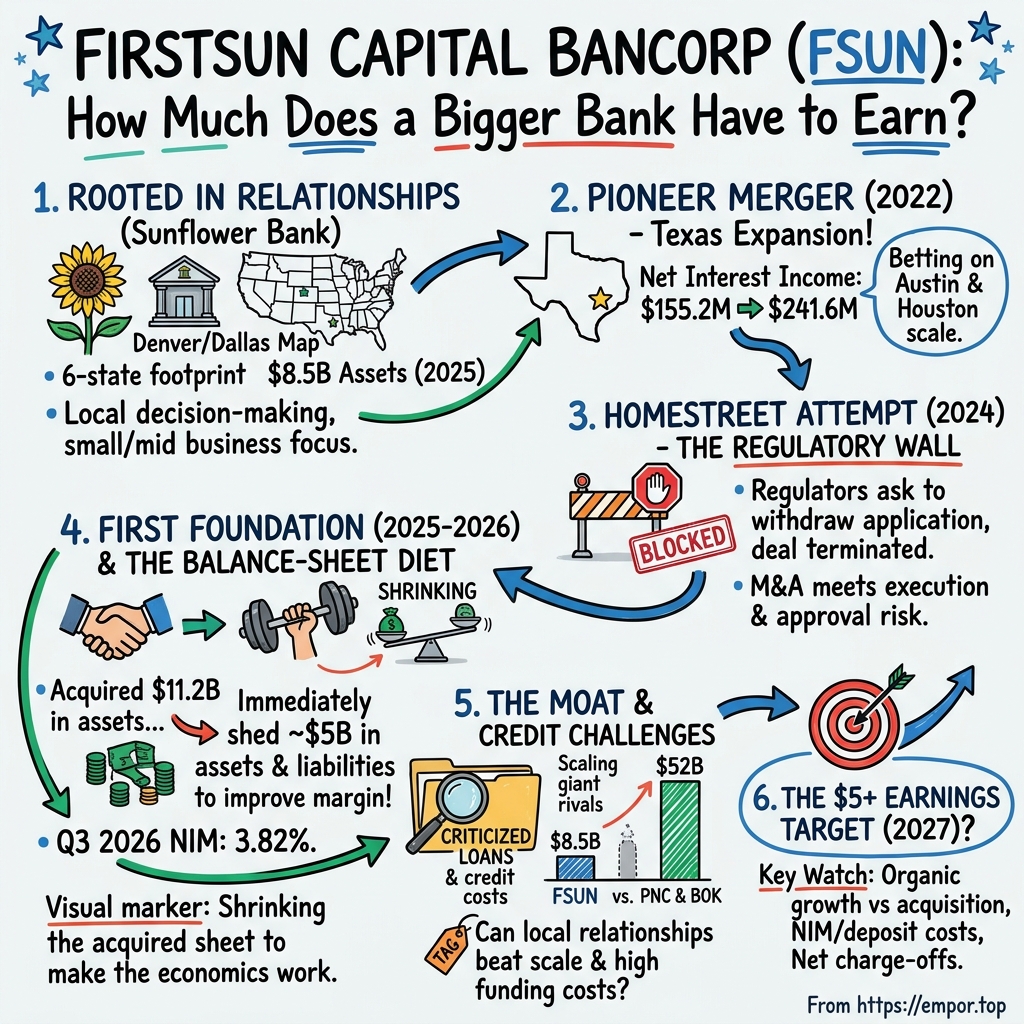
On April 1, 2026, FirstSun closed its acquisition of First Foundation, a California bank and wealth manager. The deal added about $11.2 billion of assets and $8.8 billion of deposits to a company that had ended 2025 with $8.5 billion of assets of its own.12 Overnight, the bank that had spent a century and a quarter growing from a Kansas community lender into a multistate regional more than doubled in size. And then, within the same quarter, it began throwing weight overboard. FirstSun sold loans and securities and used the cash to pay down billions in deposits and borrowings. By the end of June, roughly $5 billion of assets and $3.9 billion of liabilities were gone from the balance sheet.13
Think of it as buying a house and immediately tearing out a wing. It sounds wasteful until you learn what the wing was costing you. First Foundation's balance sheet carried expensive funding: certificates of deposit and wholesale borrowings that paid out more than the loans and bonds they financed could comfortably earn. Keeping those balances would have made FirstSun bigger. Shedding them was meant to make it better paid.
The early results show both the logic and the cost. In the second quarter, the first one with First Foundation inside, FirstSun reported a net loss of $22.9 million, as merger expenses and credit provisions swamped the earnings of the enlarged bank.3 One quarter later, after the asset sales and the funding paydown, net interest margin, the spread a bank earns on its earning assets after paying for its funding, had risen to 3.82%, and the company was profitable again.4 The diet was working, at least on the scale that a margin can measure.
So who is FirstSun? It is the listed holding company over Sunflower Bank, N.A., together with a set of mortgage, wealth and trust businesses. Since April 1, 2026, its consolidated results also include First Foundation's bank and its advisory arm, First Foundation Advisors.25 The holding company is headquartered in Denver, while the bank's main office sits in Dallas.2 No single shareholder controls it, and it is not part of a larger group, so the story of its economics is entirely its own.6
That independence makes the questions sharper. The first concerns growth. FirstSun has grown in large steps, and two of the biggest steps were acquisitions. How much of the bank's growth has come from winning customers, and how much from buying other banks' customers? The second concerns credit. A bank's earnings are only as good as the loans that produce them, and FirstSun has spent the last two years taking losses on a handful of business loans while absorbing a merger partner with problem credits of its own. The third concerns the moat. FirstSun competes in Texas, Colorado, Arizona, New Mexico, Kansas and California against regional banks several times its size and national banks many times larger. Does a relationship-banking model give it something those giants cannot easily copy?
One warning belongs at the start, because it shapes every number that follows. The FirstSun of 2026 is not the same-sized business as the FirstSun of 2025. Year-over-year growth figures for 2026 include First Foundation's acquired balances, which flatter revenue. Reported profit includes merger charges and credit provisions, which depress it. Neither headline, on its own, says much about the underlying franchise.
That makes the title question the one that matters. A bigger bank has a bigger equity base, more shares outstanding and more costs to cover. How much does it have to earn before the merger counts as a success? To answer that, the story needs to begin where the franchise began, with a Kansas bank that built its identity on relationships long before anyone spoke of a $5-a-share earnings trajectory.
 Subscribe on LinkedIn
II. Sunflower's Relationship-Banking Bet
Sunflower Bank was founded in 1892, when the Kansas plains were still being stitched together by railroads and grain elevators.2 For most of its history it was the kind of institution that small-town America took for granted: a place where the banker knew the borrower, where a loan decision might depend as much on a handshake and a family's reputation as on a credit score, and where deposits came from the same farmers, merchants and households that the bank lent to.
The modern company looks very different. FirstSun is a multistate bank holding company. Its 2025 annual report described operations across Texas, Kansas, Colorado, New Mexico, Arizona, California and Washington, and a mortgage platform with lending capabilities in 44 states.2 It had $8.5 billion of assets and $7.1 billion of deposits at the end of 2025.2 That is a substantial regional bank, but not a national one.
The leader who presided over much of the transformation was Mollie Hale Carter. She became president and chief executive of FirstSun in 2005 and also ran Sunflower Bank until 2018, then moved to executive chairman when the current team took charge in April 2022.6 Carter brought an unusually broad board résumé to a regional bank, having served as a director of the agricultural giant ADM for more than two decades and of the Kansas utility Westar, later Evergy.6 She remains one of the company's largest shareholders, with 5.80% of voting common stock in the 2026 proxy.6
The current operator is Neal Arnold, and his background explains a great deal about how FirstSun thinks. Arnold spent the late 1990s and early 2000s as chief financial officer of Fifth Third Bancorp, the Cincinnati bank that was then famous for an aggressive, sales-driven culture and a long string of acquisitions.6 Before that he had been CFO and chief operating officer of a community bank in the 1980s.6 He joined Sunflower as its CEO in 2018 and became FirstSun's chief executive on April 1, 2022.6 His chief financial officer, Robert Cafera, has held that role since 2012 and also came out of Fifth Third, where he had been CFO of the commercial bank.6 In other words, the two people running FirstSun learned banking at a large acquisitive regional, then came to a smaller one. It is not surprising that their strategy combines relationship banking with deal-making.
What exactly is a relationship bank selling? The cleanest way to picture it is as a bundle. A midsized business keeps its operating accounts at the bank, the money that comes in from customers and goes out to suppliers and payroll. It pays for treasury-management services that help it collect, pay and track that cash. It borrows on a working-capital line, perhaps an equipment loan, perhaps a commercial mortgage. The owner may take a home mortgage through the bank's mortgage arm and, if the business is sold someday, place the proceeds with the bank's wealth or trust advisers. Each piece makes the others stickier. A business that runs its payroll through a bank does not move its operating account for a quarter point of interest, and a bank that sees a customer's cash flowing every day understands that customer's credit better than a lender that only sees an annual financial statement.
That is the theory, and FirstSun's own investor materials leaned into it. Its October 2024 investor presentation described a low-cost, low-beta core deposit base, meaning deposits whose interest rates did not have to rise much when the Federal Reserve raised its rates, and highlighted a shift toward commercial and industrial lending, the operating loans to businesses that sit at the centre of the relationship model.7 Those are useful claims because they can be tested. If the deposits are really relationship deposits, their cost should stay low relative to peers through a rate cycle. If C&I lending is really relationship lending, the bank's credit losses on it should be controlled, because it knows its borrowers. Later in this story both claims run into evidence that complicates them.
The First Foundation merger added a new piece to the bundle. First Foundation Advisors managed about $6.8 billion of client assets when the deal was announced.8 Wealth management is attractive to banks because fees do not depend on the interest-rate spread and because wealthy clients tend to bring deposits. But a word of proportion is necessary. FirstSun does not report First Foundation Advisors' revenue or profit as a separate segment, so it is impossible to say from the outside how much the advisory business earns. It is a strategic addition with fee potential, not a demonstrated second engine.
The filings describe a service model; they do not show that customers pay FirstSun a premium for it, or that they stay longer than they would at a competitor. FirstSun does not publish customer retention data, relationship-level profitability or market-share trends. The relationship bet may well be real. The public record simply has not proven it yet.
And that leads to the tension that runs through the rest of the story. Relationship banking grows slowly. You win one business at a time, by poaching bankers who bring their clients, by opening offices in growing metros, by being there when a bigger bank's loan committee says no. When a bank wants to grow faster than that, the shortcut is to buy someone else's relationships. FirstSun took that shortcut in 2022, and it changed the numbers so much that it is hard to see the underlying franchise through them.
III. Pioneer Made the Numbers Jump
On April 1, 2022, FirstSun closed its merger with Pioneer Bancshares, a Texas bank holding company with a presence in Austin and Houston.910 The price was paid largely in stock: FirstSun issued about 6.47 million shares, and the total consideration came to roughly $241 million.910 Pioneer brought around 19 Texas branches into the network.2 FirstSun's merger documents argued that the combination would expand its position in Texas, one of the fastest-growing banking markets in the country.9
To see why Pioneer mattered, look at what came before. FirstSun's net interest income, the money it made from the spread between loans and deposits, was essentially flat in 2018 and 2019, at about $127 million in each year.9 It then climbed to about $136 million in 2020 and $155 million in 2021.911 Net income moved from about $19 million in 2018 to around $43 million in 2021, with a pandemic-era bump in 2020 when mortgage refinancing boomed.911 That is a modest, uneven growth record for a bank of its size. Some of the improvement came from the refinancing wave and from loan growth, but a business whose core spread income barely moved for two years was not compounding quickly on its own.
Then Pioneer arrived, and the numbers jumped. Net interest income rose from $155 million in 2021 to about $242 million in 2022, an increase of more than half.1110 Net income rose from $43 million to $59 million.10 A listener could easily take that as proof that FirstSun had found a new gear. The better reading is that it bought one.
Three forces were tangled together in that 2022 step-up, and it helps to pull them apart. The first was Pioneer's own balance sheet: from April onward, FirstSun's income statement included the interest earned on Pioneer's loans and paid on Pioneer's deposits. The second was the rate cycle. The Federal Reserve began raising rates aggressively in March 2022, and banks with lots of low-cost deposits and floating-rate loans saw their spreads widen, at least at first. The third was organic loan growth from the existing FirstSun franchise. FirstSun's filings do not separate the contribution of each in a single number, which is itself a lesson: once a bank buys another bank, its growth rates stop being a clean measure of its franchise.
The next year looked even better. Net income reached about $104 million in 2023, the highest in the company's history.10 That peak came when rising rates were still lifting loan yields faster than deposit costs. It did not last: net income fell to about $76 million in 2024, before partly recovering to about $98 million in 2025.102 Net interest income, meanwhile, rose much more slowly after the Pioneer year, from about $293 million in 2023 to $297 million in 2024 and $317 million in 2025.102 The acquisition had lifted the base; the rate cycle had briefly pushed profit above it; and then organic growth settled into the mid-single digits, with 2025's net interest income up 6.9%.2
That pattern raises the first warning about the denominator. When a bank buys growth with shares, its earnings get bigger, but so does its share count. Pioneer's 6.47 million new shares meant existing shareholders owned a smaller slice of a larger pie. Whether they came out ahead depended on the price paid, the cost savings achieved, the quality of the acquired loans and the deposits that stayed after the deal. Headline asset growth answers none of those questions. A shareholder in a serial acquirer has to watch per-share earnings and tangible book value per share, the bank's net worth excluding goodwill and other intangible assets, not the size of the balance sheet.
On the per-share test, Pioneer looks respectable rather than transformational. FirstSun's earnings power in 2023 through 2025 was clearly larger than before the deal, and the Texas franchise became central enough that the bank moved its main office to Dallas in November 2023.2 But the bank's most profitable year came during an unusual rate environment, and the subsequent years showed that a bigger platform did not by itself produce steadily rising earnings.
The Pioneer deal also set a habit. Earlier mergers had already brought FirstSun branches in New Mexico, Colorado and El Paso.2 Pioneer deepened Texas. Each deal pushed the footprint further south and west, toward faster-growing markets than the Kansas home base. By 2024, with its shares newly listed on the Nasdaq Global Select Market after years of trading over the counter, FirstSun was ready for a much bigger leap: a merger that would carry it to Seattle and Southern California.12
IV. HomeStreet Ran Into the Regulators
In January 2024, FirstSun and HomeStreet announced that they would merge.13 HomeStreet was a Seattle-based bank with branches in the Pacific Northwest and selected Southern California markets, a long history in mortgage lending and, by 2024, a balance sheet that had been badly bruised by rising rates. Its loan book was heavy with multifamily mortgages made at low fixed rates, while its funding costs had climbed quickly. It was exactly the kind of bank that a stronger acquirer might buy at a discount and repair.
FirstSun did not plan to do it alone. Alongside the merger agreement, it arranged to sell about 2.46 million shares at $32.50 each to funds managed by Wellington Management, raising $80 million.6 That placement was tied to the proposed transaction: new capital to absorb the marks on HomeStreet's loans and keep the combined bank's capital ratios comfortable.6 Wellington's arrival also brought a sophisticated institutional holder into the register; it still held 6.78% of voting common stock in the April 2026 proxy.6
The deal had obvious strategic logic. It would have given FirstSun a West Coast presence in one stroke and roughly doubled the scale of the franchise. It also had obvious risk. HomeStreet's balance sheet was precisely the problem that banks across the country were struggling with after the 2023 regional-bank failures, and bank regulators had become noticeably more careful about approving mergers in which one side carried large unrealized losses or depended on expensive funding. Through 2024 the parties revised the transaction, including the terms of the capital raise and the exchange ratio, as they tried to make it work.13
Then the wall appeared. In October 2024, the companies said that the required regulatory approvals had not been obtained and that they had been asked to withdraw their applications.13 For a bank merger, that is about as clear as a regulator's no gets without being formally written down. In November 2024, FirstSun and HomeStreet terminated the agreement by mutual consent.14
What did the failure cost? Not, on the evidence of the filings, a disclosed accounting loss. The more visible effect showed up in executive pay. In 2024, Neal Arnold and Robert Cafera had received restricted stock awards contingent on the HomeStreet merger, worth $4.0 million and $2.0 million respectively at grant; when the merger died, those awards were cancelled.6 That is why Arnold's reported 2024 compensation of $7.54 million fell to $3.34 million in 2025, and Cafera's from $3.47 million to $1.63 million.6 The drop is less a pay cut than a comparison against a deal-specific award year. It is also a reminder of how heavily the management team's incentives were tied to closing a transformative merger.
It would be easy to read HomeStreet as a strategic failure: management chased a troubled bank, regulators said no, and the company wasted a year. The record supports a narrower verdict. The deal did not deliver the promised scale. The setback came from approval, not from a disclosed loss or a later write-down. And the failed attempt does not prove that FirstSun's management abandoned capital discipline; it proves that the acquisition playbook depends on parties outside management's control. A bank's deal pipeline can be full of willing partners and still empty of closable transactions if the regulator does not like the funding profile of the combined company.
That constraint is worth holding onto, because it changed how the next deal was built. The HomeStreet episode taught FirstSun that a merger plan needed a credible answer to the question regulators kept asking: what happens to the expensive funding? When FirstSun went looking again, it chose a different target, in a market it had wanted all along, and it arrived with a much more explicit plan to shrink and repair the acquired balance sheet.
V. First Foundation: Cheap Enough, Complicated Enough
In late October 2025, FirstSun and First Foundation announced an all-stock merger valued at about $785 million.15 First Foundation brought exactly what HomeStreet had promised in the south: a Southern California banking franchise, plus something HomeStreet never offered, a wealth-management business. It also brought a familiar post-2022 problem. Like many banks that had grown quickly in the era of cheap money, First Foundation carried commercial real estate and multifamily loans made at low rates, a large securities portfolio and funding that had become expensive when rates rose.168
So the deal was both a strategic fit and a balance-sheet project. FirstSun's leaders were, in effect, offering to buy a franchise and a renovation at the same time. The question every investor had to answer was whether the price was low enough to pay for the renovation.
The price, measured two ways
The announced headline looked cheap. At about $785 million, FirstSun was paying roughly 0.80 times First Foundation's stated tangible book value, the net worth on its balance sheet excluding goodwill and intangibles.15 For context, bank deals in 2025 were priced at a median of about 1.43 times tangible book value.17 By that comparison, FirstSun was paying well under half the typical premium and in fact a discount to book.
But a bank's stated book value is only as good as the marks on its assets. When one bank buys another, accounting rules require the buyer to restate the target's loans, securities and deposits at fair value on the day of closing. If loans were made at 4% and market rates are 7%, those loans are worth less than their face value, and the write-down reduces the equity the buyer is really acquiring. Problem credits get marked down too.
At closing, FirstSun recorded about $518 million of pretax fair-value adjustments to First Foundation's balance sheet, before tax effects.1 By the time the deal closed on April 1, 2026, the consideration had also fallen, to about $704 million, as share prices moved and balance-sheet values changed.1 That price exceeded First Foundation's adjusted tangible equity of about $628 million by roughly $76 million, so the closing multiple was about 1.12 times adjusted tangible equity.1
Here the investigation reaches its first reveal. The deal was not really bought at 0.80 times book, because the book shrank when it was marked to market. It was bought at a modest premium to a much smaller, more honest number. Even so, 1.12 times adjusted tangible equity sits comfortably below the 2025 industry median of about 1.43 times stated tangible book.17 The comparison is imperfect, because the median reflects deals with different asset marks, credit mixes and target conditions, and few of those targets needed the surgery First Foundation did. But it is hard to read the price as an obvious overpayment.
What did FirstSun's own shareholders give up? The deal diluted tangible book value per share by about 10% at closing, and management projected that it would take about 3.3 years of the combined bank's extra earnings to earn back that dilution.1 Management also projected that the deal would add to earnings per share in 2027 and that cost savings would come from eliminating overlapping systems and functions.8 Those are forecasts, not realized returns. The 3.3-year earnback is a promise that existing shareholders will be made whole by roughly mid-2029, if the savings arrive and the credits behave.
Regulators, this time, approved. The Federal Reserve issued its order approving the merger on March 11, 2026.18 The contrast with HomeStreet is telling. The two deals were similar in strategic intent, both aimed at a West Coast presence and greater scale, but the First Foundation plan came with a much more explicit balance-sheet repair programme. Whether that explains the different outcomes cannot be proven from the outside, but it is consistent with what HomeStreet taught.
The renovation, in public
The repair began as soon as the deal closed. In the second quarter, FirstSun sold about $1.3 billion of loans and $1.4 billion of securities.13 It used the proceeds to reduce deposits by about $2.5 billion, much of it high-cost certificates of deposit and brokered funding, and to pay down about $1.4 billion of borrowings.13 It was an unusual sight: a bank that had just bought $11 billion of assets voluntarily shrinking by almost half of that within a single quarter.
The logic was arithmetic. Expensive deposits funding low-yielding securities and loans earn little or even lose money. Remove both sides of that trade, and the remaining balance sheet earns a wider spread, needs less capital and carries less refinancing risk. The fair-value marks helped: because the loans and securities had already been written down to market value at closing, selling them did not create big new losses on top of the purchase accounting.
The income statement did not look pretty while the surgery was under way. FirstSun reported a $22.9 million net loss in the second quarter.3 Merger expenses and credit provisions drove much of the gap between that reported result and the adjusted figure management preferred to highlight.3 Some of the provision expense was mechanical, because accounting rules require a new allowance for acquired loans that are not already credit-impaired, but some reflected real problems in both legacy books, including elevated commercial and industrial charge-offs.35 Net charge-offs in the second quarter reached an annualized 1.45% of average loans, a painful figure for a commercial bank.4
By the third quarter, the picture had improved. The core-system conversion, the moment when First Foundation customers move onto FirstSun's banking technology, was completed in September 2026.419 That is often the riskiest operational moment of a bank merger, the point at which customers find that their online banking login has changed or that a payment did not arrive, and it is the moment when competitors try hardest to poach accounts. FirstSun came through it without a disclosed disruption. Net interest margin improved to 3.82%, and annualized net charge-offs fell to 0.11%.4
Yet the third quarter also showed what remained unfinished. Average loans had fallen, partly by design after the loan sales, and partly because the bank was not yet growing fast enough to replace what it had shed.419 Criticized loans, the ones that regulators and the bank's own credit officers flag for weakness, were roughly evenly split between legacy FirstSun and legacy First Foundation.19 That detail matters. It means the credit issues were not simply imported with the acquisition. Some of them were home-grown.
Here is the deal reduced to its essentials. FirstSun bought a franchise at a price below the industry's typical premium, and it accepted roughly 10% dilution to tangible book value in exchange for a projected earnback in a little over three years. It then shrank the acquired balance sheet aggressively to improve its economics, accepted a loss in the first quarter of ownership and returned to profitability in the second.
The low price is not, by itself, evidence of value. A small premium for a bank whose loans turn sour, whose deposits leave for higher-yielding rivals or whose cost savings slip a year is no bargain at all. The industry median is a benchmark, not a verdict; it tells you what other buyers paid, not whether they got their money's worth. What makes the First Foundation price defensible is that much of the bad news was marked into the balance sheet at closing. What keeps it unproven is that the remaining credits, in both legacy books, are still working through.
The deal's unanswered question is therefore a simple one, even if the answer is not. Can the acquired franchise, once its expensive funding is gone and its systems are converted, produce enough recurring earnings to repay both the price and the disruption? To answer that, it helps to understand exactly what a bank like FirstSun sells, and why the price of its product is set as much by its depositors as by its borrowers.
VI. The Spread Is the Product—and Funding Sets the Price
Picture the owner of a 60-person distribution company in suburban Phoenix on the first business day of the month. Customer payments arrive into her operating account. Payroll goes out of it on Friday. She draws on a working-capital line to buy inventory ahead of the busy season, and repays it as the receivables come in. Her controller logs into the bank's treasury portal to send wires, run positive-pay checks against fraud and sweep excess cash overnight. Every one of those actions happens inside the same bank, and every one of them is part of what FirstSun sells.
But what is the product, exactly? A software company sells licences. A manufacturer sells units. A bank's main product is a spread: the difference between the interest it earns on loans and securities and the interest it pays on deposits and borrowings. Lend a dollar at 7%, fund it with a deposit that costs 2%, and the bank keeps five cents a year, before paying for its branches, bankers, technology and the occasional loan that never comes back.
That is why FirstSun's revenue is dominated by net interest income, and why its central metric is net interest margin: the spread expressed as a percentage of earning assets. In 2025, that margin was 4.10%.2 That is a healthy spread for a commercial bank, and it reflects both a loan book weighted toward commercial lending and a deposit base that, through 2025, had not required the bank to pay away most of the rate increases of the previous three years.
The "price" here is not a single posted rate. It is the result of thousands of individual decisions. A floating-rate business loan reprices every month with benchmark rates. A fixed-rate commercial mortgage may not reprice for five years. A noninterest-bearing operating account costs the bank nothing in interest but a great deal in service. A certificate of deposit costs whatever the market demanded on the day it was opened. Loan mix, repricing schedules, customer credit quality and funding costs all pull on the spread at once, which is why two banks with similar loan books can earn very different margins.
Around the spread sit the fee businesses. In 2025, FirstSun earned $101.9 million of noninterest income, about 24.3% of total revenue.2 That is a larger fee share than many community banks manage, and it explains part of why the bank describes itself as diversified. But the composition matters more than the total. Mortgage banking contributed $47.1 million, nearly half of all fee income.2 Mortgage revenue is real money, but it is cyclical: it rises when rates fall and homeowners refinance, and it shrinks when housing activity stalls. The rest comes from deposit service charges, treasury management, card fees, and wealth and trust services, which diversify income but are not reported as separate profit segments.2 It would be wrong to call wealth or mortgage a second earnings engine on the strength of what FirstSun discloses. They are meaningful supports to a spread business, and one of them is tied to the housing cycle.
What First Foundation did to the spread
The First Foundation merger changed this arithmetic. By the third quarter of 2026, the margin was 3.82%, and noninterest income had fallen to 21.9% of revenue.4 Both moves have an explanation in the deal. First Foundation brought a larger balance sheet with a thinner spread: more securities, more multifamily loans at low fixed rates and more costly certificates of deposit. That diluted the combined margin even after purchase accounting, which helps by writing low-yielding loans down and letting the discount accrete back into income over time.
The balance-sheet diet was designed to reverse as much of that dilution as possible. In the third quarter, deposit costs fell as higher-cost acquired certificates of deposit were sold or allowed to run off.420 The improvement from the second quarter was visible, and on the third-quarter call management walked analysts through the deposit-cost and margin path it expected as the remaining acquired funding repriced.20
Comparing 2025's 4.10% with the third quarter's 3.82% is therefore not a clean test of whether FirstSun's franchise has weakened. Acquisition accounting, the Federal Reserve's rate cuts, asset sales and a changed mix of loans and deposits all complicate the comparison. What the comparison does show is that the combined bank, for now, earns a thinner spread than legacy FirstSun did, and that the gap must be closed through funding repricing and loan growth rather than assumed away.
There is one more trap for an investor used to analysing industrial companies, and it is worth naming because it changes how this business should be judged. For a manufacturer, a good test of earnings quality is whether profit turns into operating cash flow. For a bank, that test barely works. Loan originations, repayments and deposit inflows and outflows dominate the cash-flow statement, and their classification between operating, investing and financing activities says little about whether the bank is healthy. The better lens is capital, liquidity, credit costs and deposit behaviour. At the end of the third quarter FirstSun held about $729 million of cash, mostly at the Federal Reserve, and about $1.8 billion of available-for-sale securities, up from roughly $470 million at the end of 2025 as the acquired portfolio was folded in and repositioned.52 Its common equity Tier 1 capital ratio was 12.0%.21 Those are the numbers that tell a regulator, a rating agency or a depositor whether a bank can absorb a bad year.
The mortgage business carries one more moving part that a listener should understand, because it shows up in the results in confusing ways. When a bank promises a borrower a mortgage rate before the loan closes, it is exposed to rates moving in the meantime, so it hedges those commitments with derivatives. FirstSun's derivatives are principally interest-rate swaps and these mortgage-banking hedges; it has no foreign-currency hedges and no material currency exposure.2 In the first nine months of 2026, its mortgage derivative assets produced a $3.3 million gain while derivative liabilities produced a $10.4 million loss.5 Those swings are part of running a mortgage pipeline, not a side bet, and they are one reason mortgage income is noisier than a quick glance at the fee line suggests.
Nor is the spread earned without spending. A bank does not report research and development, but it does invest in people, branches and systems. FirstSun spent about $7.5 million on premises and equipment in 2025, up from about $4.3 million two years earlier, and its occupancy, equipment and software expense reached about $36.3 million.2 Those are modest sums for a bank of its size, and they matter because the next decade of competition for business customers will be fought partly through treasury portals, fraud detection and faster credit decisions. FirstSun does not quantify how much it spends on technology such as artificial intelligence or what that spending saves, so the question of whether it can keep pace with far larger rivals' technology budgets has no public answer yet.
The dependency that decides everything
The business owner in Phoenix is the hero of the bank's story only if she keeps her operating balances there without being paid much for them. If she decides that a money-market fund pays 4% and her bank pays 0.5%, and moves her excess cash, the spread shrinks. If FirstSun keeps her by raising its deposit rates, the spread shrinks too. Good customers and stable deposits matter only if the bank can hold them without paying away the margin they are supposed to create.
That question cannot be settled inside FirstSun's own walls. It depends on how hard the competition is pushing, and in FirstSun's markets, the competition has just become much larger.
VII. Can Relationships Hold Their Ground Against Scale?
In January 2026, three months before FirstSun closed its merger, a much bigger deal closed in the same territory. PNC Financial Services completed its acquisition of FirstBank, a privately held Colorado bank with about $26.8 billion of assets and 95 branches, concentrated in Colorado and Arizona.2223 The price implied a transaction value of about $4.1 billion.22 With that, one of the largest banks in the United States gained a dense branch network in two of the states where FirstSun had spent a decade building its own position.
That is the competitive backdrop for any claim that FirstSun has an edge. Its footprint sits beside BOK Financial, a Tulsa-based regional with about $52 billion of assets; beside National Bank Holdings, a Denver-based bank with about $9.9 billion of assets; beside UMB and Zions' Vectra Bank; and beside the national banks, credit unions and digital lenders that compete for the same customers everywhere.2425 Legacy FirstSun, at $8.5 billion of assets at the end of 2025, was roughly the size of National Bank Holdings and about one-sixth the size of BOK.22524 Even after First Foundation, it remains a mid-sized regional bank competing against much bigger balance sheets.
Who holds the power in a business bank
Rivalry in banking is intense almost by definition. FirstSun competes with local and regional banks for business loans and deposits, with credit unions for consumers, with mortgage lenders and brokers for home loans, with money-market funds for idle cash and with fintech companies for payments and small-business lending. Nobody needs a licence to compete with a bank's deposit rate; a brokerage sweep account will do.
Buyers, on both sides of the balance sheet, have power. Business borrowers can shop a loan among several banks, and good borrowers know it. Depositors can move balances to higher-yielding accounts with a few clicks, a lesson the industry relearned in 2023. The flip side of buyer power appeared in FirstSun's own 2025 results. The bank's net charge-offs that year were elevated by write-downs on two commercial and industrial relationships totalling $28.3 million, or 0.43% of average loans.2 Two borrowers moved a full year's credit cost. That is what concentration looks like in a bank: not a dominant customer that supplies most of the revenue, but a small number of large credits that can swing a year's results.
Suppliers, in banking, are mostly the providers of funding, and depositors are the most important of them. When a bank needs more funding than its relationship customers provide, it pays market rates for brokered deposits, certificates of deposit or borrowings. First Foundation's high-cost funding is the clearest illustration of the price of deposits that do not come from relationships. It is precisely what FirstSun spent the second quarter of 2026 paying off.
Substitutes are everywhere. Money-market funds substitute for deposits; private credit funds and nonbank lenders substitute for commercial loans; national banks' digital services raise the bar for what a business customer expects from a treasury portal. FirstSun's answer is local decision-making and bankers who know the client, which is a real advantage when a midsized business needs a quick, sensible yes, but a weaker one when the customer cares mainly about rate or technology.
Barriers to entry are high in one sense and low in another. Capital requirements, regulation and local underwriting knowledge make it expensive to start a bank from scratch, and established relationships take years to build. But none of those barriers gives FirstSun exclusive territory. A large bank can enter Colorado by buying FirstBank, and a regional can open an office in Austin by hiring a team of bankers from a competitor.
Searching for a power
Hamilton Helmer's framework asks a sharper question: does the company have a source of persistent differential returns that a competitor cannot simply copy? Run through the seven powers and most of them do not apply. FirstSun has no network effect and no proprietary technology. It does not hold a cornered resource. Its brand is regional, and it does not command a price premium that the filings demonstrate. Scale economies exist in banking, especially in technology and compliance spending, but they favour BOK and PNC, not FirstSun.
That leaves two candidates. The first is switching costs. A business customer whose payroll, receivables, treasury services and credit lines all sit at FirstSun faces real friction in moving them: new account numbers, new integrations, new credit approvals. That is a genuine source of stickiness. The second is a softer form of process power: an underwriting culture and local decision-making that, if superior, would show up as lower credit losses or better loan pricing over a cycle.
Both of these are mechanisms, and mechanisms leave evidence. If switching costs were strong, FirstSun's deposit costs should rise less than peers' when rates rise and its noninterest-bearing deposit share should hold up. If underwriting were superior, its C&I losses should be lower than peers'. The record is mixed on both. The 2024 presentation's low-cost deposit claim was credible for the legacy franchise, which supported a 4.10% margin in 2025.72 But the two large C&I write-downs in 2025, and C&I net charge-offs of 2.01% of average loans in the first nine months of 2026, are hard to reconcile with a claim of superior business underwriting.25 FirstSun does not publish customer retention, market-share trends or relationship-level pricing, so those mechanisms remain untested from the outside.
A word, again, about First Foundation Advisors. Its $6.8 billion of assets under management at announcement adds fee potential and gives the bank a way to deepen ties with wealthy clients.8 But without disclosed segment profit, it cannot carry the weight of a moat argument.
The verdict on the moat, then, is that FirstSun has a credible regional relationship model across a broad set of growing markets, but the moat is unproven. History narrows the claim rather than rejecting it: the deposit franchise looked genuinely low-cost before the merger, while the credit record argues against any claim of exceptional underwriting. The clearest forward proof would be organic loan and deposit growth with stable funding costs and controlled losses. The question that matters to investors is whether FirstSun can grow without winning deposits and loans chiefly by paying more for them or accepting more credit risk. That question has a specific test attached to it, and management has put a number on what passing it looks like.
VIII. The $5 Earnings Trajectory Meets the Credit File
On October 27, 2026, the day after FirstSun reported third-quarter results, an analyst on the earnings call asked management to revisit the "$5-plus" earnings-per-share trajectory for 2027 that had been part of the First Foundation story.20 The balance sheet had shrunk faster than many had modelled. Mortgage revenue had weakened. Average loans were down. Was the target still real?
The question went to the heart of management's credibility, because the 2027 trajectory is the yardstick against which the whole merger will be judged. Robert Cafera answered with specifics: deposit-cost and margin figures for the quarter, the expected path of funding costs as acquired certificates matured, and an acknowledgement that the balance sheet would produce a somewhat lower "annuity" of interest income than earlier assumed because of the asset sales.20 He maintained confidence in the 2027 targets.20 Neal Arnold pointed to strong loan pipelines in the bank's markets.20 The answers were concrete rather than evasive. But a pipeline is a list of prospects, not a stream of income, and the call did not yet prove that it would convert into profitable growth.
Analysts pressed elsewhere too: on the loan sales and whether more were coming, on the criticized loans, and on how far deposit costs could fall.20 That pattern of questioning is itself informative. The market's concern was not whether FirstSun could close and convert a merger, which it had done, but whether the combined bank could grow and keep its credit clean at the same time.
The best way to judge a management team is to compare what it said with what happened. FirstSun's record over the Arnold–Cafera era gives several data points.
On growth, net interest income rose from about $128 million in 2018 to about $317 million in 2025, a rise of roughly two and a half times.92 That is an impressive headline, but much of it came from the Pioneer acquisition and the rate cycle, and 2026's further increase includes First Foundation. Net income peaked at about $104 million in 2023, fell in 2024 and partly recovered to about $98 million in 2025, which means the latest full year was still below the peak.102 The organic growth rate underneath the acquisitions has been mid-single-digit, not spectacular.
On the deposit franchise, the October 2024 investor presentation emphasised low-cost, low-beta core deposits and low commercial real estate exposure.7 Eighteen months later, FirstSun had acquired a bank with higher-cost funding and meaningful CRE exposure, while also absorbing two large C&I write-downs in 2025 and elevated C&I charge-offs into 2026.25 The acquisition does not contradict the earlier claim about the legacy deposit base, but it did change the character of the combined bank. Investors who bought FirstSun for the 2024 description now own something different.
On credit, the second quarter's 1.45% annualized net charge-off ratio and the third quarter's 0.11% show both the problem and the improvement.4 Through the first nine months of 2026, net charge-offs were 0.75% of average loans, with C&I at 2.01%.5 Nonperforming assets were 1.46% of total assets at the end of the third quarter, up from the prior quarter.4 And criticized loans remained split roughly evenly between the two legacy banks.19 The improvement in charge-offs is encouraging; the rise in nonperforming assets and the persistence of criticized credits in the legacy FirstSun book are not.
On deal execution, the record splits cleanly. The HomeStreet merger failed after regulators withheld approval. The First Foundation merger closed, received Federal Reserve approval and completed its core-system conversion in September 2026.184 That is a real execution milestone, and it should be credited as one.
Incentives, ownership and the board
The incentive structure points management at the right things, broadly. In 2025, Arnold and Cafera each received cash bonuses of about 102% of base salary, tied to corporate metrics including noninterest income, net income, deposits, return on assets and return on tangible equity.6 Including deposits and return on tangible equity in the scorecard rewards franchise quality and capital efficiency rather than pure size. Directors and executive officers together held 10.49% of voting shares in the 2026 proxy, a meaningful stake.6 The largest outside holders were JLL/FCH Holdings at 7.94%, Wellington at 6.78% and Mollie Carter at 5.80%, and certain major holders retain board-representation arrangements.6
The shareholder vote at the June 2026 annual meeting was uneventful at the top line: all seven nominees were elected.26 One director, John Fleshood, received 615,014 withheld votes, more than any other nominee.26 That is a modest signal rather than a revolt, but it is the kind of number that is worth watching in the next proxy, when the post-merger ownership base votes for the first time with First Foundation's former holders on the register. The merger also added a nonvoting common class: on November 6, 2026, there were 42.50 million voting and 2.77 million nonvoting shares outstanding.5
In the third quarter, FirstSun repurchased 1.25 million shares for $49.7 million, under a $150 million authorization.4 Buying back shares near tangible book value can be an efficient way to accelerate the earnback of merger dilution: every share retired at roughly book value raises earnings per share without diluting book value per share. A skeptical investor would ask the obvious follow-up question. A bank still working through criticized credits, with nonperforming assets rising and loan growth not yet visible, might prefer to hold that capital as a cushion. Both arguments have merit. The answer depends on whether the credit file improves, and on whether FirstSun's 12% CET1 ratio proves to be comfortable or merely adequate.21
The debt stack adds a small wrinkle. The merger brought in First Foundation subordinated notes with original principal of about $24.2 million and $150 million, alongside FirstSun's own $25 million note from 2022.5 Their fixed-rate periods end in January and February 2027, after which they move to floating SOFR-based rates.5 No covenant breach or near-term refinancing pressure has been disclosed, but the reset is one more way that funding costs could move in 2027.
The share count is the other half of the per-share arithmetic, and the merger changed it substantially. To make room for First Foundation's holders, stockholders approved raising FirstSun's authorized voting common shares from 50 million to 80 million and created 20 million nonvoting shares.6 The nonvoting class matters for governance as well as for arithmetic: banks typically use nonvoting stock so that a large investor can hold an economic stake without crossing the voting thresholds that trigger bank-control rules, and its existence means the voting-share denominator is now distinct from the total number of shares that share in the profits. For a shareholder judging the $5-plus trajectory, the relevant figure is earnings divided by all common shares, voting and nonvoting alike.
An outside view
KBRA, the rating agency, offered a useful external check in its October 27, 2026 action. It affirmed FirstSun's BBB senior unsecured rating with a Stable outlook, citing geographic and business-line diversification, relationship-based C&I banking, CET1 capital of 12.0% and the balance-sheet repositioning.21 It also flagged the constraints: higher-cost acquired funding, a lower share of noninterest-bearing deposits, recent C&I charge-offs and elevated nonperforming and criticized assets.21 KBRA judged the credit issues manageable while noting that they had been particularly evident over the past year.21 That is a fair summary of where the bank stands: investment-grade, adequately capitalised and carrying more credit noise than its relationship model would ideally produce.
The routine items belong in proportion. Related-party loans and deposits were small, ordinary-course banking balances, about $1.6 million of loans and $2.7 million of deposits at the end of 2025.2 A check-fraud lawsuit brought by Rodeo Electrical Services produced a jury award of about $2.1 million in 2024, was settled in August 2025 and was paid by the bank's insurer in January 2026.2 Crowe LLP gave an unqualified audit opinion on the 2025 financial statements.2 None of these changes the investment case.
What will change it are three numbers. The first is organic loan and deposit growth, now that the acquired balance sheet has been resized. The second is net interest margin together with the cost of deposits, which tell whether the funding repair is holding. The third is net charge-offs alongside nonperforming assets, which tell whether the credit file is healing or merely quiet for a quarter. Those three readings frame the argument between bulls and bears.
IX. Analysis & Bear vs. Bull Case
When FirstSun reported its third quarter, the headline earnings per share were $0.82, flat with the same quarter a year earlier.4 That is a strange outcome on its face. The bank had more than doubled its balance sheet, closed a merger, converted its core systems, sold billions in low-yielding assets and repaid billions in costly funding. Yet reported earnings per share had not moved. On an adjusted basis, which excludes merger expenses and certain other items, EPS was $1.03.4 The gap between those two numbers is the space in which the bull and bear cases live.
The year-to-date figures sharpen the contrast. Through September 2026, FirstSun reported net income of $37.1 million, about half the $73.1 million of the same period in 2025.5 Adjusted net income was $92.9 million, up from $73.7 million.4 Merger expenses of $73.5 million and credit provisions of $53.1 million explain most of the difference.5 A bull reads the adjusted number as the true earnings power of the combined bank. A bear points out that credit provisions are not one-time costs in a bank; they are the cost of doing business, and FirstSun's have been elevated in both legacy books.
The bull case
The optimistic reading starts with the repaired balance sheet. FirstSun did the hardest part of the integration in two quarters: it marked First Foundation's assets to market at closing, sold the lowest-yielding pieces, repaid the most expensive funding and converted the systems. What is left is a larger regional bank with a diversified footprint across Texas, the Mountain West, the Southwest and Southern California, a wealth-management business, a mortgage platform and a CET1 ratio of 12%.21 Cost savings from eliminating duplicated systems and staff still lie ahead; FirstSun had 1,587 full-time-equivalent employees in September 2026, compared with 1,177 at the end of 2025 before the acquired staff joined, so the opportunity to consolidate is visible.52
The bull would add that the price was reasonable. A deal bought at about 1.12 times marked tangible equity, below the industry's typical premium, leaves room for value creation if the combined bank earns a normal return.117 And the market is not demanding much. At the November 20, 2026 close of $36.01, FirstSun's shares traded at about 1.0 times their September tangible book value of $35.60 per share.274 For a bank, trading at tangible book implies that investors expect it to earn roughly its cost of equity, no more. If FirstSun can deliver a return on tangible equity in the low to mid teens once the integration costs fade, that price would understate the franchise.
The bear case
The skeptical reading starts with the growth record. Strip out Pioneer and First Foundation, and FirstSun's organic growth has been modest, and the 2023 profit peak owed much to an unusual rate environment. A bank that grows mostly through acquisitions is exposed to the regulators who blocked HomeStreet, to the price of the next deal and to the integration risk each time.
The second plank is funding. The 3.82% margin depends on deposit costs continuing to fall as acquired certificates mature, and on the bank holding its relationship deposits without having to raise rates. KBRA's point about a lower share of noninterest-bearing deposits is the crux.21 If the Federal Reserve's path turns, or if competitors like PNC and BOK price aggressively for deposits in FirstSun's markets, the spread could compress.
The third plank is credit. The C&I losses were not imported with First Foundation; they began in legacy FirstSun's book in 2025. Nonperforming assets rose in the third quarter even as charge-offs fell, and KBRA's measure of nonperforming assets approached 1.8% on its own basis.214 Commercial real estate in Southern California, the heart of First Foundation's lending, remains a sensitive asset class. A bear would say the bank's improvement in quarterly charge-offs could prove to be a pause rather than a turn.
There is also a structural plank that is easy to miss. Every acquisition FirstSun has made pushed it deeper into markets where the competitors are larger and the funding is more contested: from Kansas into New Mexico and Colorado, then into Austin and Houston, and now into Southern California. Those are faster-growing places to lend, which is the point. But each step also moved the bank further from the small-town deposit base where relationship banking was easiest to defend, and into cities where a business owner has a dozen banks, several private-credit funds and every national bank's app competing for her account.
The fourth plank is the activist's question about capital. A bank still carrying criticized loans split between two legacy books, with an earnback period stretching to 2029, spent almost $50 million on buybacks in a single quarter.4 If credit deteriorates, that capital may be missed. A skeptic would also ask for better disclosure: organic loan and deposit growth reported separately from acquired balances, and fee revenue and profit for the wealth business.
Test the "why win" case against tangible evidence, and some of it holds. The integration was executed on schedule. The margin rose after the diet. Quarterly charge-offs fell sharply. But other promised evidence has not yet arrived: relationship growth, loan-pipeline conversion, efficiency gains and customer retention are not yet visible in the reported numbers, and FirstSun does not publish retention data at all.
Test the "why not" case against the mechanisms that could break it, and each one is live but not yet triggered. Renewed C&I losses would hit a book that has already produced two large write-downs. CRE deterioration would hit First Foundation's loans despite the purchase marks. Deposit migration to higher-yielding competitors would hit a funding base that the merger made more rate-sensitive. Savings that arrive later than promised would push out the earnback.
The 2027 earnings trajectory should be treated as management's claim, to be measured against reported results, not as a forecast to endorse. The valuation needs the same caution. One times tangible book at the latest quarter is a single reading, not a historical or peer valuation series, and FirstSun's own trading history as a Nasdaq company, since July 2024, is short. Whether the price is low or fair depends on the bank's sustainable return on tangible equity relative to its cost of capital, and that return is precisely what the next year of results will reveal.
The unresolved trade is the one this story began with. A low purchase multiple can create value, but only if the acquired loans behave and the deposits stay.
X. Playbook: Business & Investing Lessons
FirstSun's story is a compact course in how regional banks are built, bought and repaired. The lessons belong to this bank, because each was learned at a particular moment.
The first is that a relationship is an advantage only when it changes the price, the retention or the loss. FirstSun's 2024 presentation described a low-cost, low-beta deposit franchise and a move toward relationship C&I lending, and on the deposit side the 4.10% margin of 2025 suggested the claim had substance. On the lending side, two C&I relationships produced $28.3 million of write-downs in a single year. Relationship banking is not a feeling; it is a measurable effect on deposit costs, account retention and credit losses. Founders of service businesses and investors in them should demand the measurement.
The second is that a bigger balance sheet is a beginning, not an answer. Pioneer made the numbers jump in 2022, but the profit peak that followed came from rates, and earnings then fell back. First Foundation more than doubled the bank's size, and the first thing management did was shrink it. Scale is an input. Returns are the output, and the two are not the same.
The third is that a failed deal can reveal a constraint without proving the strategy was wrong. HomeStreet did not fail because FirstSun lost money on it; it failed because regulators would not approve it. That is a different kind of lesson from a bad acquisition. It tells investors that a bank's growth strategy is only as good as its ability to get a merger through a regulator's door, and that funding quality is now part of every merger application.
The fourth is that in a bank merger, the mark is part of the price. First Foundation looked like a purchase at 0.80 times tangible book on announcement day. After about half a billion dollars of fair-value marks, it was really bought at about 1.12 times a smaller equity base, with roughly 10% dilution and a 3.3-year earnback. Any investor comparing bank deals on headline multiples is comparing labels, not prices.
The fifth is that a pipeline is not a loan until it earns a spread and survives a cycle. On the third-quarter call, management pointed to strong loan pipelines and maintained its confidence in 2027. Those pipelines will matter only when they appear as rising average loans, at margins that cover the cost of deposits, with losses that stay low through the next downturn. For FirstSun, the gap between a pipeline and a profit is the whole investment case.
XI. Epilogue
Tonight, FirstSun is a different bank from the one that ended 2025. Its systems are converted. Its balance sheet is larger than legacy FirstSun's but much smaller than the simple sum of the two banks would have been. Its margin is 3.82%, its quarterly annualized charge-offs are a modest 0.11%, its nonperforming assets stand at 1.46% of total assets and its tangible book value per share is $35.60.4 Most of the promised cost savings are still ahead.
The next moments that will decide the story are already on the calendar. The fourth-quarter results, due early in 2027, will be the first full quarter after the core conversion, and the first in which cost savings should begin to show without integration noise. Watch average loans and deposits there. If they start to grow again, from customers won in Texas, Colorado and Southern California rather than from acquired balances, the relationship model will have produced its first clean evidence. If they keep shrinking, the bank's earnings power will rest on cost cuts alone.
In January and February 2027, the subordinated notes switch from fixed to floating rates, and the bank's funding costs will tell a second story. Deposit costs should keep falling as the remaining acquired certificates mature. If they do, the margin can widen toward the levels legacy FirstSun once earned. If competitors force FirstSun to pay up to keep deposits, the margin will stall.
The credit file will tell the third story, quarter by quarter. Criticized loans in both legacy books must resolve, through repayment, restructuring or charge-off. A second quarter of low charge-offs with falling nonperforming assets would suggest the worst has passed. A rebound in C&I losses, or new problems in Southern California real estate, would test both the purchase marks and the bank's underwriting.
By the end of 2027, the full-year results will set reported earnings, not merely adjusted earnings, beside management's $5-plus trajectory, and against the 3.3-year earnback of tangible book dilution. The next proxy will show how the enlarged shareholder base votes and whether buybacks continued while credit was still healing.
Each of those moments bears on the questions this story began with: whether FirstSun's growth is organic or bought, whether the combined bank can earn through its credit costs, and whether its funding is a durable advantage. The integration milestone is real. The investment case is not settled. The bank has proved it can close and convert a complicated merger; it has not yet proved that the merger makes it a better bank rather than merely a bigger one.
XII. Outro
Go back to that spring of 2026. A bank finishes the largest merger in its history, more than doubling its balance sheet, and then, before the ink is dry, starts selling pieces of what it bought. Billions in loans, billions in bonds, billions in expensive deposits, all heading out the door so that what remains can earn a living.
That image captures FirstSun better than any map of branches. Its defining bet is that local banking relationships, the kind Sunflower built across the Kansas plains in 1892 and carried into Dallas, Denver and Southern California, can support a regional platform assembled by acquisition. FirstSun has bought scale twice. Now it has to show what that scale earns once the integration costs are gone.
References
-
Purchase Accounting and Repositioning Update — FirstSun Capital Bancorp, 2026 ↩↩↩↩↩↩↩↩↩
-
2025 Annual Report on Form 10-K — FirstSun Capital Bancorp, 2026-03-06 ↩↩↩↩↩↩↩↩↩↩↩↩↩↩↩↩↩↩↩↩↩↩↩↩↩↩↩↩↩↩
-
Q2 2026 Earnings Call Transcript — Seeking Alpha, 2026-07-28 ↩↩↩↩↩↩↩
-
Q3 2026 Earnings Release — FirstSun Capital Bancorp, 2026-10-26 ↩↩↩↩↩↩↩↩↩↩↩↩↩↩↩↩↩↩
-
Q3 2026 Quarterly Report on Form 10-Q — FirstSun Capital Bancorp, 2026-11-09 ↩↩↩↩↩↩↩↩↩↩↩↩↩
-
2026 Proxy Statement — FirstSun Capital Bancorp, 2026-04-21 ↩↩↩↩↩↩↩↩↩↩↩↩↩↩↩↩↩
-
2024 Investor Presentation — FirstSun Capital Bancorp, 2024-10-29 ↩↩↩
-
First Foundation Merger Proxy/Prospectus — FirstSun Capital Bancorp, 2026-01-15 ↩↩↩↩
-
Pioneer Merger Proxy/Prospectus — FirstSun Capital Bancorp, 2021-08-06 ↩↩↩↩↩↩↩
-
2024 Annual Report on Form 10-K — FirstSun Capital Bancorp, 2025-03-07 ↩↩↩↩↩↩↩↩
-
2021 Annual Report on Form 10-K — FirstSun Capital Bancorp, 2022-03-25 ↩↩↩
-
FirstSun Capital Bancorp Announces Uplisting to Nasdaq Global Select Market — Nasdaq, 2024-07-11 ↩
-
FirstSun Says Regulators Won’t Approve HomeStreet Deal — Bloomberg Law, 2024-10-29 ↩↩↩
-
HomeStreet Merger Termination, Form 8-K — FirstSun Capital Bancorp, 2024-11-19 ↩
-
FirstSun to Buy First Foundation in $785 Million All-Stock Deal — Reuters via Investing.com, 2025-10-27 ↩↩
-
First Foundation Merger Agreement and Background, Form S-4 — FirstSun Capital Bancorp, 2025-10-27 ↩
-
The M&A Monitor: 2025 Year in Review — Olsen Palmer, 2026 ↩↩↩
-
Federal Reserve Order Approving the FirstSun–First Foundation Merger — Federal Reserve Board, 2026-03-11 ↩↩
-
Q3 2026 Earnings Presentation — FirstSun Capital Bancorp, 2026-10-26 ↩↩↩↩
-
FirstSun Capital Bancorp Q3 2026 Earnings Call Transcript — Stock Analysis, 2026-10-27 ↩↩↩↩↩↩↩
-
KBRA Affirms Ratings for FirstSun Capital Bancorp — KBRA, 2026-10-27 ↩↩↩↩↩↩↩↩
-
PNC Announces Agreement to Acquire FirstBank, Significantly Growing its Presence in Colorado and Arizona — PNC Financial Services Group, 2025-09-08 ↩↩
-
PNC Completes Acquisition of FirstBank, Exhibit 99.1 — PNC Financial Services Group, 2026-01-05 ↩
-
BOK Financial Corporation Fourth Quarter 2025 Earnings Release — BOK Financial, 2026-01 ↩↩
-
National Bank Holdings Corporation Announces Fourth Quarter and Full Year 2025 Financial Results — National Bank Holdings, 2026-01-27 ↩↩
-
2026 Annual Meeting Voting Results, Form 8-K — FirstSun Capital Bancorp, 2026-06-05 ↩↩
-
FirstSun Capital Bancorp (FSUN) Share Quote — Yahoo Finance ↩
 LinkedIn
 WhatsApp
 Reddit
 Hacker News
 Email
 Kindle
 RSS Feed
 Spotify
 Apple Podcasts
 Amazon Music
 Audible
 YouTube