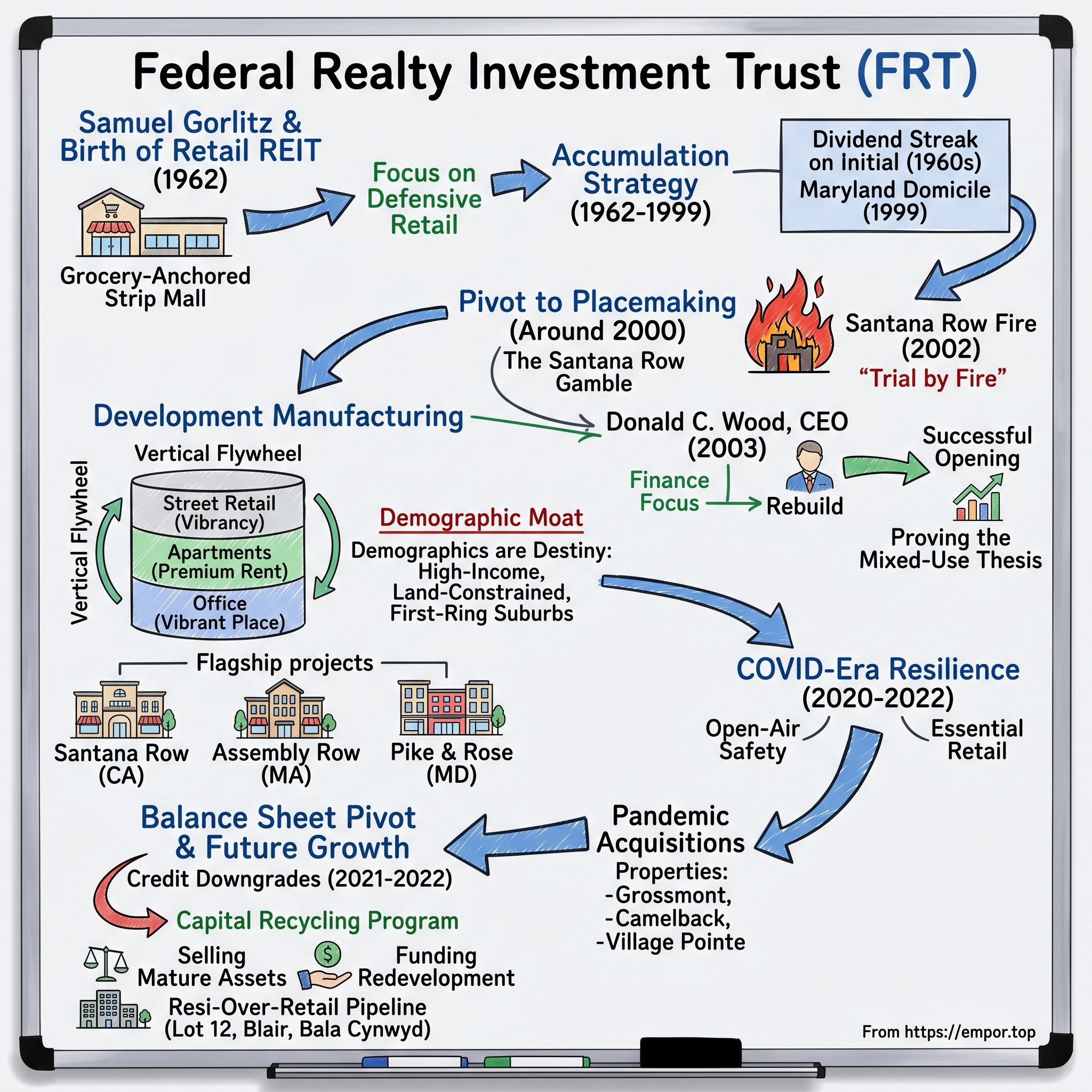
Federal Realty Investment Trust: The Place-Making Pioneer and the Moat of Suburban Demographics
I. Introduction & Episode Roadmap
On a warm August night in 2002, the largest structure fire in the history of San Jose, California lit up the sky over a 42-acre construction site called Santana Row. The blaze started in the project's biggest building — a concrete-podium structure meant to hold ground-floor shops beneath scores of luxury apartments — and it grew with terrifying speed, escalating alarm by alarm until more than two hundred firefighters and dozens of engines were battling it. Embers leapt across the street and torched a neighboring apartment complex, driving families into the night. By morning, the crown jewel of a roughly $450 million development was a smoking ruin, and the damage ran to well over a hundred million dollars.34
The timing could not have been crueler. Santana Row was months from its grand opening. It was the single largest bet Federal Realty Investment Trust had ever made — a wild, controversial attempt by a staid strip-mall landlord to reinvent itself as a builder of European-style urban villages in the American suburbs. And the executive who would inherit the wreckage was a finance man just stepping into the top job, about to receive one of the most literal "trials by fire" in the history of American real estate.
That man, Donald C. Wood, is still running the company more than two decades later. How Federal Realty survived that night, rebuilt, opened Santana Row anyway that November, and turned a catastrophe into the template for modern mixed-use real estate is the spine of this story.4
But the fire is the drama. The thesis is something quieter and, for a long-term investor, more interesting. Federal Realty (NYSE: FRT) holds a distinction no other real estate investment trust can claim: as of 2025 it had raised its dividend for 58 consecutive years, the longest unbroken streak in the entire REIT industry, making it the sector's only "Dividend King."1 That streak is the headline. The real story is what sits underneath it — a highly concentrated, actively managed, quality-over-quantity bet on a specific and narrow slice of American geography: land-constrained, high-income, first-ring coastal suburbs where the average household in a three-mile radius earns far more than the national norm.
Federal Realty is not a passive rent collector, and that is precisely what makes it worth studying. Most shopping-center REITs are aggregators: they own hundreds or thousands of properties and their job is to collect checks and keep the lights on. Federal Realty owns roughly a hundred properties and treats real estate development as a manufacturing business — buying raw material, adding density and tenants, manufacturing value, and recycling the proceeds into the next project.2 It is a smaller, denser, more hands-on, and more complex animal than its peers, and that complexity cuts both ways.
Here is the roadmap. We will start in 1962, with a founder and a brand-new tax structure. We will watch the company pivot around 2000 from strip-mall collector to master planner, and live through the Santana Row disaster. We will unpack the "demographics are destiny" thesis and the three flagship mixed-use districts that made Federal Realty famous. We will stress-test the balance sheet through the pandemic, the credit downgrades, and the pivot to a "resi-over-retail" development pipeline. And we will war-game the competition, run the frameworks, and lay out the honest bull-and-bear case — why this company can keep winning from here, and exactly what could break it.
Let's begin with a founder and a idea that, in 1962, barely existed.
 Subscribe on LinkedIn
II. The Genesis: Samuel Gorlitz & The Birth of the Retail REIT (1962–1999)
In 1960, the U.S. Congress did something small and technical that would eventually reshape how ordinary Americans owned real estate. Tucked into the Cigar Excise Tax Extension of that year was a provision creating the Real Estate Investment Trust — a corporate structure that let investors pool money into income-producing property, receive mutual-fund-like tax treatment, and, in exchange for paying out substantially all of their taxable income as dividends, escape corporate income tax entirely. For the first time, a schoolteacher in Ohio could own a slice of a shopping center the way she owned a share of a steel company.
Two years later, in 1962, a real estate man named Samuel J. Gorlitz founded Federal Realty in Washington, D.C., to do exactly that.2 The concept was almost boring in its simplicity, and that was the point. Gorlitz's playbook was to buy open-air, grocery-anchored neighborhood shopping centers in the stable, growing middle-class suburbs of the Mid-Atlantic, sign tenants to long-term leases, and pass the rent through to shareholders. In an America that was busily emptying its cities and filling its suburbs — the great postwar migration to the split-level and the station wagon — the neighborhood strip center anchored by a supermarket was one of the most reliable cash machines in the economy. People had to eat. They had to buy socks and shampoo and hardware. And they increasingly did it at the open-air center a five-minute drive from the cul-de-sac.
The genius of the grocery anchor, then and now, is that it is recession-proof in a way that almost nothing else in retail is. When money is tight, consumers trade down, they cut back on travel and restaurants and big-ticket splurges — but they still buy groceries, and they still stop at the pharmacy. A center anchored by a supermarket generates dependable foot traffic in every kind of weather and every point in the economic cycle, and that traffic spills over to the smaller "in-line" tenants — the dry cleaner, the nail salon, the sandwich shop — that pay the highest rents per square foot. Federal Realty built its foundation on exactly this dynamic, and it layered in a second defensive category alongside groceries: off-price and discount apparel, the segment that would eventually be dominated by TJX Companies, whose T.J. Maxx and Marshalls banners actually do better when the economy sours and shoppers hunt for bargains. Groceries plus off-price gave the portfolio a barbell of resilience. To this day, TJX and grocery operators such as Ahold Delhaize and Albertsons remain among the company's very largest tenants.2
It's worth pausing on why the REIT structure itself shaped everything that followed. The 90%-payout rule is a double-edged sword. On one hand, it forces discipline: a REIT cannot hoard earnings to build empires the way a conglomerate can, because it must push almost all of its taxable income out the door to shareholders every year. On the other hand, it means a REIT can rarely fund its own growth from retained profits — it must return to the capital markets, again and again, to raise the equity and debt it needs to buy or build the next property. This single structural fact — that a REIT lives and dies by its access to outside capital — is the thread that runs through Federal Realty's entire modern history, and it is why a company famous for a 58-year dividend streak would one day find its growth ambitions colliding with the bond market. Every REIT is, at bottom, a machine for converting access to capital into rent-producing real estate, and its cost of capital is its lifeblood.
For its first three-plus decades, Federal Realty grew the way most REITs of the era grew: steadily, unglamorously, by accumulation. It bought centers, it collected rent, it raised the dividend a little every year, and it built the streak that would later become its calling card. This was the age of the retail REIT as a bond substitute — a slow, dependable, income-producing security for investors who wanted a coupon and a good night's sleep. Crucially, the company treated the dividend increase not as a discretionary bonus but as a covenant with shareholders — a promise so central to its identity that management would later organize the entire balance sheet around never breaking it. That psychological commitment, more than any single asset, is what turned Federal Realty from a landlord into an institution.
In 1999, the company completed a housekeeping step that mattered more than it looked: it reorganized as a Maryland-chartered REIT.2 Maryland had, by then, become the Delaware of the REIT world — a state whose corporate law was purpose-built to be friendly to the trust structure, offering directors and management a well-understood legal framework and defensive flexibility. Nearly every major REIT is domiciled there for the same reason nearly every public company is incorporated in Delaware: predictability. It was the corporate equivalent of moving your legal address to the neighborhood everyone in your industry already trusts.
But by the turn of the millennium, the quiet strip-center model faced a looming structural problem. Standard suburban retail was commoditizing. The barriers to building another grocery-anchored center in a growing Sun Belt suburb were low — flat land was cheap, zoning was permissive, and any developer with a bank line could throw one up across the road and start a rent war. Meanwhile, the retail landscape above Federal Realty was being reshaped by the rise of the enclosed regional mall and, more ominously, the "power center" — the vast, big-box-anchored asphalt plain of Home Depots and Best Buys and Circuit Citys that was hoovering up retail demand. A landlord whose entire edge was owning ordinary shopping centers in ordinary suburbs was, in effect, selling a commodity in a market that was rapidly adding supply.
The company that had spent forty years perfecting the art of the dependable strip center now had to answer a dangerous question: what do you do when the thing you're good at is becoming a commodity that anyone can build? The answer, when it came, would nearly burn the company to the ground.
III. Trial by Fire: The Santana Row Gamble & Don Wood's Ascension (2000–2003)
Around 2000, Federal Realty made a bet so aggressive that much of Wall Street thought it had lost its mind. If ordinary retail was commoditizing, the reasoning went, then the way to escape the commodity trap was to build something that could not be commoditized — something so distinctive, so hard to replicate, and so woven into the daily life of an affluent community that no power center and no website could ever substitute for it. The company gave the idea a name that would become its identity: "placemaking."
The concept was audacious. Instead of buying a shopping center, Federal Realty would buy a large suburban parcel and build, from scratch, an entire walkable urban district — a master-planned village with a genuine street grid, ground-floor shops and restaurants, offices, and, crucially, hundreds of luxury apartments living directly above the retail. The idea was to manufacture, in the middle of car-dependent American suburbia, the thing that suburbia conspicuously lacked: a downtown. A place where you could park once and spend the whole day, where residents on the third floor could take the elevator down to dinner, where the retail wasn't a destination you drove to so much as a neighborhood you lived in.
The proving ground was Santana Row, a 42-acre site in San Jose, in the heart of Silicon Valley. The plan was a European-style pedestrian boulevard lined with high-end shops and outdoor dining, wrapped in office space and topped with apartments — a multi-hundred-million-dollar swing that represented far and away the largest and riskiest undertaking in the company's history.4 And the risk was not merely financial; it was conceptual. Federal Realty was a retail REIT. It knew how to buy shopping centers and sign leases with T.J. Maxx. Santana Row asked it to become, simultaneously, a luxury multi-family developer, an office landlord, a hospitality operator, and an urban planner — disciplines it had no track record in. Skeptics on Wall Street saw a strip-mall company betting the balance sheet on a business it didn't understand.
Into this high-wire act stepped Donald C. Wood. Wood was not a real estate lifer; he was a finance man. He had trained as an accountant at Arthur Andersen, served as vice president of finance for the Trump Taj Mahal in Atlantic City, and spent eight years at the conglomerate ITT Corporation, including a stint as chief financial officer of its Caesars World casino subsidiary.5 He joined Federal Realty in 1998 and rose through the finance ranks — chief financial officer, then president — before being named the successor to retiring CEO Steven Guttman, formally taking the chief executive role in 2003.5 A CFO by temperament, Wood understood balance sheets, leverage, and the cold arithmetic of a project that could either compound value for decades or sink the company.
Then, on an August night in 2002, the largest building on the Santana Row site caught fire.
The blaze — which grew to eleven alarms and became the biggest structure fire San Jose had ever seen — destroyed the project's signature building, incinerating the roughly three dozen ground-floor retail spaces and a large share of the apartments that were to sit above them, and inflicting damage that ran to roughly $129 million. Flying embers ignited a neighboring apartment complex, displacing residents and turning a construction accident into a community emergency.4 Investigators ultimately attributed the fire to an accident rather than arson.3 But cause was cold comfort in the moment. The company had a half-built, partially destroyed mega-project, nervous lenders, an insurance claim to fight, and a brand-new-ish CEO staring at the possibility that the signature gamble of his tenure would become its epitaph.
What happened next is the part of the story that matters for judging management. Federal Realty did not retreat. Wood and his team worked through the insurance settlement, reassured the lenders financing the project, and made the counterintuitive decision to open the rest of Santana Row on schedule that November — roughly eighty days after the fire — even as the destroyed building sat as a scar to be rebuilt.4 It was a bet that momentum and proof-of-concept mattered more than waiting for perfection. Shoppers and diners came. The apartments leased. The offices filled. And over the following years, Santana Row rebuilt its lost building and matured into one of the highest-rent, most successful mixed-use properties in the country — a place where, more than two decades later, every square foot of office space would be fully leased even as the office market three miles away in downtown San Jose sat one-third empty.6
The experience marked Wood permanently, and it is worth understanding the man because he has now defined Federal Realty for longer than any single person in its history. His instincts are those of a finance executive, not a starry-eyed developer: he speaks in occupancy-cost ratios and purchasing power and yields on cost, and he carries a visible wariness — the "scar tissue" he still references two decades later — about the kinds of speculative development that nearly consumed the company. That combination is unusual and, arguably, exactly what the placemaking model needs. Placemaking is a romantic, ambitious, easy-to-oversell strategy; pairing it with a CEO whose reflex is to interrogate the downside is a governor on the engine. On earnings calls, Wood's register swings between salesmanship — he will tell analysts to "let that sink in for a minute" about a leasing statistic — and blunt candor, as when he flatly conceded that the affluence thesis had produced little visible advantage for years.6 For an investor trying to gauge management, that willingness to name the uncomfortable truth alongside the boast is a meaningful signal.
The disaster, in other words, became the validation. Santana Row didn't just survive; it proved the thesis that an "urban village in the suburbs," built to a standard no commodity developer could match, could command premium rents across retail, residential, and office simultaneously. It set the template for everything Federal Realty would build afterward. The near-death experience had, improbably, produced the company's defining competitive weapon — and a CEO forged in the fire who would spend the next twenty years refining it.
IV. The Mixed-Use Blueprint & The Demographic Moat (2004–2019)
Walk down the main pedestrian spine of Santana Row on a Saturday evening and you understand instantly why the model works — and why it is so hard to copy. The sidewalks are full. Diners spill out of restaurants onto the street. Shoppers drift between a Gucci and a local boutique. Above them, residents lean over apartment balconies, and around the corner, office workers who chose to be here rather than in a soulless suburban office park are grabbing a coffee. It is, deliberately, a place — engineered scarcity in physical form.
After Santana Row proved the concept, Federal Realty spent the 2004–2019 stretch turning a single audacious project into a repeatable, if capital-hungry, discipline. The first refinement was where to play. The company concentrated its capital in a small set of high-barrier, land-constrained, affluent coastal metros — the Boston-to-Washington corridor of the Northeast, plus Silicon Valley and Southern California, later reaching into markets like Miami and Phoenix. These are places where you cannot simply buy cheap flat land and build a competing village, because the land is finite, expensive, and wrapped in decades of zoning restrictions and neighborhood opposition.
This is where the intellectual core of the entire Federal Realty thesis lives — the idea management has repeated across two decades of filings and calls: demographics are destiny. The company's animating belief is that the single best predictor of a retail property's long-term resilience and pricing power is the wealth of the households in its immediate trade area. Federal Realty targets locations where the average household income within a three-mile radius sits far above the national average; on the first-quarter 2026 earnings call, Wood put the portfolio-wide figure at roughly $167,000 in three-mile household income and framed each shopping center as sitting atop something like $11 billion of local purchasing power.6
Why does this matter so much? Because affluent trade areas do two things for a landlord. First, they generate resilient consumer spending that holds up through recessions and inflation — wealthy households keep dining out, keep shopping, keep spending, precisely when lower-income areas pull back. Second, and more importantly for the economics, they attract the strongest national retailers, who must locate where the affluent customers are and will pay premium rents for the privilege. That combination — resilient demand plus tenants competing for scarce space — is what gives a landlord genuine pricing power. It is the difference between a strip center where the landlord begs tenants to renew and a district where tenants line up for the last vacancy.
The honest analytical caveat is that this thesis is easy to assert and harder to prove in every environment, and management itself has admitted as much. On the Q1 2026 call, Wood conceded that "there hasn't been a lot of obvious evidence over the past few years that great demographics, particularly an affluent customer base, make a demonstrable business difference," blaming population shifts, government subsidies, and favorable supply-demand dynamics that lifted lower-quality retail too.6 His argument is that in a bifurcated, "K-shaped" economy — where high-income households thrive while lower-income households struggle — the demographic edge reasserts itself. That is a plausible claim, but it is a claim, and a skeptical investor should note that for long stretches the affluence premium was invisible in the numbers.
With markets chosen, Federal Realty deployed the placemaking playbook two more times at scale, creating what became its flagship trilogy. Assembly Row in Somerville, Massachusetts, transformed a contaminated brownfield — the site of a former Ford Motor Company assembly plant on the Mystic River, just outside Boston — into a transit-oriented district with its own stop on the region's subway system, roughly a thousand apartments, offices, a hotel, and outlet-oriented retail. Pike & Rose in North Bethesda, Maryland, took a tired mid-Atlantic strip mall on Rockville Pike and rebuilt it vertically into a dense district of retail, hundreds of apartments, a hotel, and Class-A offices. Each took the better part of a decade and a small fortune to build.
The financial logic of placemaking is a kind of vertical flywheel. The street-level retail and restaurants create foot traffic, energy, and a sense of place. That vibrancy, in turn, lets Federal Realty charge premium rents for the apartments built directly above — people will pay up to live where they can walk to dinner — and premium rents for the offices, because employers in a war for talent want their people in vibrant, walkable locations rather than isolated office parks. At Santana Row, technology employers leased entire office buildings for exactly this reason. Each layer subsidizes and reinforces the others. Done right, the whole is worth far more than the sum of a shopping center, an apartment building, and an office block valued separately.
There is a deeper strategic point buried in the mechanics, and it explains why Federal Realty describes development as a manufacturing business rather than a speculative one. A speculator buys land and hopes it appreciates. A manufacturer buys raw material, applies a repeatable process, and produces a finished good worth more than its inputs. Federal Realty's process — assemble a parcel, entitle it, design a district, lease the retail, build the residential and office above, stabilize the cash flow — is deliberately industrial. When management underwrites a project to a 7% yield on cost and the finished, stabilized asset trades in the private market at a 5% cap rate, that gap between the cost of building and the value of the built asset is the manufacturing margin. It is, in principle, value created out of skill and patience rather than out of leverage or luck. The catch, and it is a large one, is that unlike a factory that produces a widget in hours, this manufacturing line takes five to ten years per unit, ties up hundreds of millions of dollars the entire time, and can be derailed by a construction-cost spike, a demand shift, or — as San Jose learned — a fire.
Assembly Row illustrates both the promise and the patience. Beyond the roughly thousand apartments and the retail already built, Federal Realty holds entitlements to expand the district dramatically, and on the Q1 2026 call Wood described the company's work to entitle the adjacent Assembly Square Marketplace power center for millions of additional square feet — a process he framed as "value banking" that "I don't expect to be paid for in stock price today," but which will define the property's worth over the coming decade.6 That is the honest texture of placemaking: enormous latent value that sits on the balance sheet for years, invisible to the quarterly earnings that Wall Street actually trades on, waiting for the moment the numbers finally pencil.
Done wrong, of course, the same complexity becomes a multi-year cash drain with three different ways to disappoint. That tension — between placemaking as a moat and placemaking as a treadmill — is the fault line that the pandemic, and then the bond market, would press on hard.
V. Crisis & Consolidation: The Pandemic Shock & COVID-Era M&A (2020–2022)
In March 2020, American retail simply stopped. Lockdowns emptied the enclosed regional malls — those climate-controlled boxes where shoppers breathed the same recirculated air for hours — and the mall REITs that had already been bleeding from e-commerce now faced an extinction-level event. Several of the largest mall landlords in the country would tip toward or into bankruptcy over the following two years. For a moment, it looked as though physical retail itself was the endangered species.
Federal Realty's portfolio told a very different story, and the reason was structural. Its centers are open-air. There is no shared enclosed concourse, no food court, no recirculated air — you park outside the store, walk in, and walk out. Overnight, the humble open-air format that had looked old-fashioned next to the glossy enclosed mall became the safest way to shop in a pandemic. And because so much of the portfolio was anchored by groceries and essential retail — supermarkets, pharmacies, and the like — a large share of the tenant base was legally allowed to stay open as "essential" businesses even at the depths of lockdown.2 The walkable mixed-use districts, with their outdoor dining and open sidewalks, became preferred social destinations precisely when indoor gathering was dangerous.
That is not to say it was painless. Federal Realty granted temporary rent deferrals to smaller, local tenants who genuinely could not pay, and collections took a real hit in the worst months of 2020. But its large, national, investment-grade credit tenants — the grocers, the pharmacies, the off-price giants — largely kept paying, and the essential-retail mix meant the cash flow bent without breaking. The pandemic became an accidental stress test of the "quality real estate in affluent, essential-heavy trade areas" thesis, and the portfolio passed it far more convincingly than the enclosed-mall model did.
This is a useful moment to separate a common myth from the reality. The consensus narrative during the 2010s was that e-commerce was a slow-moving asteroid that would eventually render all physical retail obsolete — that the only question was the timing of extinction. The pandemic, paradoxically, disproved the crude version of that thesis. What died was not physical retail but a specific format of it: the enclosed, commodity, mid-tier mall selling goods you could buy more cheaply online. What thrived was open-air, convenience-and-experience retail anchored by uses the internet cannot replicate — groceries, pharmacies, restaurants, fitness, medical clinics, and services. Federal Realty's centers were built, almost by accident of their format and their affluent locations, on the right side of that divide. The reality, then, is not that Federal Realty "beat e-commerce"; it is that it owned the category of retail that e-commerce was never going to take. That distinction matters, because it also defines the boundary of the moat: the day a Whole Foods or a boutique fitness studio can be delivered through a screen, the thesis weakens — but that day is not visibly on the horizon.
Then came the interesting part. As the immediate panic faded through 2021, most retail landlords were still playing defense — hoarding cash, suspending acquisitions, waiting for clarity. Federal Realty went shopping. Management's logic was classically contrarian: dislocation creates the best entry points, and a company with a strong balance sheet and a long time horizon should buy quality when others can't or won't.
In June 2021, Federal Realty announced the acquisition of four properties in a single tranche — the Grossmont Center near San Diego, the Chesterbrook center in McLean, Virginia, and the Camelback Colonnade and Hilton Village assets in the Phoenix–Scottsdale market — totaling roughly 1.75 million square feet for about $407 million, taking controlling interests in the range of 60% to 98%.14 It followed with off-market deals such as the roughly 110,000-square-foot Twinbrooke Shopping Centre in Fairfax, Virginia, acquired for about $33.8 million later in 2021, and the Kingstowne Towne Center in Northern Virginia in 2022. (A note for precision: these deals spanned a year and were a mix of marketed and off-market transactions, not a single tidy off-market package — a reminder to read management's characterizations against the actual filings.)
What the analyst should take from this M&A burst is not the square footage but the style. Federal Realty does not, as a rule, buy stabilized, fully-leased, problem-free centers at rock-bottom cap rates the way a passive aggregator does — paying a high price for a low, safe yield. It hunts for properties with a value-add angle: a vacant anchor box to re-tenant, a merchandising mix to upgrade, or, best of all, excess land or surface parking where residential density can later be added. The goal is to buy at a going-in yield in the mid-5% range and, through leasing and redevelopment, drive the yield on cost toward 7% or higher over time. On the Q1 2026 call, chief investment officer Jan Sweetnam described exactly this edge, noting that the assets where Federal Realty "competes best" are "more complicated, probably have more leasing opportunities," which "thins out the crowd" of rival bidders.6
The Congressional-and-Kingstowne pattern that would come later — buying the "hole in the doughnut" to control an entire node — was already visible in this earlier burst. The strategic logic is about control as much as yield: when Federal Realty owns most of the good retail on a corridor, it gains leverage over merchandising, over which tenants go where, and over the pace at which value is created across the whole district rather than a single center. That kind of local dominance is invisible on a spreadsheet but real in negotiations, and it is a subtle form of moat that only a concentrated, high-conviction owner can build.
That is a genuine and defensible competitive advantage — a specialized skill in complex, hairy, value-add retail that most buyers avoid. But it is also, by definition, more capital-intensive and slower to pay off than buying finished product, and it requires borrowing and spending against future rent that hasn't arrived yet. Do enough of it, fast enough, and you strain the very balance sheet that lets you do it in the first place. Which is precisely what the credit rating agencies concluded.
VI. The Balance Sheet Pivot: Downgrades, Capital Recycling, & "Resi-Over-Retail" (2022–Today)
For most of its modern history, Federal Realty carried one of the most pristine balance sheets in all of real estate — an "A" family credit rating that only a tiny handful of REITs on earth could match. That gold-plated rating was a source of pride and a real economic asset: it let the company borrow more cheaply than almost any peer. So when the rating agencies started taking it away, it stung.
The move actually began before the pandemic acquisitions were fully digested. In April 2021, Moody's downgraded Federal Realty's senior unsecured rating to Baa1 from A3, explicitly citing "deteriorated leverage metrics" and "high development exposure" — a mixed-use development and redevelopment pipeline that had grown to more than 10% of the company's gross assets, with leverage metrics stretching well beyond the company's historical comfort zone.7 Then, in early 2022, S&P Global Ratings followed, lowering its issuer credit rating to BBB+ from A- on the same essential concern: prolonged elevated leverage tied to the capital-hungry development machine.8
Here is the crucial nuance for judging management. A one-notch downgrade from A- to BBB+ is not a distress signal — BBB+ is still a solidly investment-grade rating, and plenty of excellent REITs live there permanently. But for a company whose whole identity was built on financial conservatism and a 50-plus-year dividend streak, it was a shot across the bow. The agencies were effectively saying: your ambition on the development side has outrun the balance sheet you built your reputation on. Fix it.
To management's credit, it did not spend the next two years blaming interest rates or the pandemic. Wood and chief financial officer Dan Guglielmone leaned into a strategy they now describe on nearly every call as a "laser-like focus": an aggressive capital recycling program designed to fund growth from within rather than by leaning on expensive debt and dilutive equity.6
The mechanics are elegant, and worth understanding because they are the engine of the current investment case. Federal Realty sells mature, fully-valued assets — a stabilized apartment building at Santana Row, a non-core strip center — at very low cap rates, meaning very high prices relative to the income they produce. On the Q1 2026 call, it reported selling the Misora apartments at Santana Row and a shopping center in Rockville for a combined $159 million at a blended cap rate "well inside 5%."6 A sub-5% cap rate is a rich price: the buyer is accepting a low current yield in exchange for a trophy asset. Federal Realty then takes those proceeds and reinvests them into redevelopment and acquisitions yielding 7% or more. Sell low-yield, buy-and-build high-yield, and the spread between the two — funded without issuing new stock — is pure, self-generated growth. Across 2025 and into 2026, the company guided to roughly $540 million of asset sales at blended cash yields in the low-to-mid 5% range, with an additional pipeline of sales in process, explicitly framing this recycling as a cheaper "cost of capital" than the public markets were offering.610
The most important expression of this internal-funding philosophy is the initiative management brands "resi-over-retail." In February 2026, Federal Realty highlighted a roughly $400 million pipeline to build about 781 residential units across four projects sitting on land it already owns — The Blair at Bala Cynwyd outside Philadelphia (217 units), a project at 301 Washington Street in Hoboken, New Jersey (45 units), Lot 12 at Santana Row (258 units), and an addition at Willow Grove outside Philadelphia (261 units) — at blended development yields approaching 7%.9 The insight is simple and powerful: the most expensive input in coastal development is land, and Federal Realty already owns some of the most valuable land in America, much of it sitting under surface parking lots and single-story retail. By building apartments on top of, or adjacent to, existing shopping centers, the company adds high-yielding density at little or no incremental land cost. As Wood put it on the Q1 call, "with little or no incremental land costs, the math to work in the right locations."6 Once stabilized, management projects this densification will add nearly 800 units and roughly $27 million of new operating income.6
Alongside the internal pipeline, Federal Realty kept acquiring dominant, market-leading centers where it saw value to add. In February 2025 it expanded on the West Coast with the Del Monte Shopping Center in Monterey, California — a roughly 674,000-square-foot, Whole Foods-anchored center on 47 acres, purchased for $123.5 million and only 83% leased, leaving obvious room to drive occupancy.11 In December 2025 it bought Village Pointe in Omaha, Nebraska — a roughly 453,000-square-foot open-air lifestyle center for $153.3 million, anchored by strong tenants like Apple and lululemon.12 And in March 2026 it acquired Congressional North on Rockville Pike in Maryland for $72.3 million at a 7% stabilized yield.13 The Congressional North deal reveals the strategic mind at work: on its own, Wood admitted, it was "a power center with a vacant Bed Bath & Beyond" that historically "we wouldn't be all that interested" in — but it was the last sizable box-anchored center Federal Realty didn't control on a corridor where it already owned five other properties, so buying it was, in his words, "a no-brainer" for tightening its grip on one of the most important retail nodes in the Washington market.6
There is a subtle logic to the secondary-market moves that a careful listener could hear on the acquisition calls. Federal Realty is not buying just anything in Omaha or Kansas City; it is buying the single dominant, market-leading center in each — the property that affluent local households treat as their place to shop, with the same relative pricing power in its metro that Santana Row has in San Jose. The demographic thesis, in this reading, is not strictly "coastal" but "wherever the wealthiest local trade area concentrates its spending." That is a defensible reframing. It is also, conveniently, a reframing that justifies expanding the acquisition universe at a moment when competition for coastal deals has intensified and prices have compressed — which is exactly why a skeptic should keep watching whether the returns on these secondary-market bets actually match the core.
The financing machinery underneath all of this got a tune-up too. Subsequent to the first quarter of 2026, Federal Realty recast its revolving credit facility, upsizing it to $1.4 billion, extending the term to 2030 with options into 2031, and shaving the spread over the benchmark rate — the kind of housekeeping that keeps a development-heavy REIT liquid and flexible.6 The company also guided to generating more than $100 million of free cash flow after dividends and maintenance capital in 2026, rising in the following years as straight-line rent converts to actual cash rent.6 Free cash flow after the dividend is the oxygen of a self-funding model: it is the money the company can reinvest without asking the capital markets for a dime.
Notably, this Nebraska-and-Omaha expansion complicates the tidy "affluent coastal suburbs only" narrative. Management now speaks warmly of markets like Omaha, Kansas City, and Annapolis — dominant assets in secondary metros, not just the Golden Circle. Whether that is prudent diversification or mission drift away from the demographic moat is a fair question for a skeptical investor to keep asking. For now, the balance sheet response has worked: with recycling executed on a roughly leverage-neutral basis, the company reported first-quarter 2026 net debt to EBITDA of about 5.5x, guiding toward improvement over the year, and reported year-end 2025 leverage in the high-5x range with fixed-charge coverage climbing back toward its 4x internal target.610
VII. The Core Engine: Retail Economics, Competitors, & Segment Dynamics
Strip away the placemaking romance and the mixed-use trophies, and Federal Realty is still, at its core, a shopping-center company. Retail is the engine that drives the overwhelming majority of the company's net operating income, with multi-family residential contributing a meaningful minority and office the smallest slice. As of the end of 2025, the residential portfolio comprised roughly 2,700 owned units, with entitlements in hand to build thousands more — the raw material for the resi-over-retail pipeline.16 The story is retail first, with residential and office as high-value garnish that most competitors can't produce.
That office garnish, though, cuts both ways, and it deserves scrutiny because it is a risk standard shopping-center REITs simply don't carry. When you lease entire buildings to technology employers, you inherit the technology sector's cyclicality and the structural overhang of remote work. Federal Realty's answer, delivered on the Q1 2026 call, was a flex: it reported that Santana Row's office space was 100% leased — capped by a lease signed with PNC Bank — while Class-A office vacancy in downtown San Jose, just three miles away, stood at a staggering 36%.6 Across the flagship districts, the office portfolio was 99% leased overall. That is genuinely impressive and validates the "employees want to be in vibrant places" thesis. But it is worth reading management's own body language: asked on the same call whether he would start building new office space again, Wood replied bluntly that he "still has scar tissue" and would only build office on a pre-leased, build-to-suit basis — "I'm not going to spec."6 That is a management team that has learned, the expensive way, how quickly office optionality can turn into office liability.
How does Federal Realty stack up against its shopping-center peers? The natural comparisons are the larger open-air REITs: Regency Centers, Kimco Realty, and Brixmor Property Group. Those companies own far more properties across a broader swath of the country, and their business is closer to the classic aggregator model — scale, breadth, and steady grocery-anchored income. Federal Realty is deliberately the opposite: fewer, denser, higher-quality assets in richer trade areas, commanding some of the highest average base rents per square foot in the sector. The evidence that this quality is real shows up in leasing spreads and demand. In the first quarter of 2026, Federal Realty signed more than 100 comparable leases covering 649,000 square feet at a 13% cash rent increase over the expiring rents — 23% on a straight-line basis — its highest first-quarter leasing volume ever and third-highest of any quarter in its history.6 Rent spreads in the low-to-high teens, quarter after quarter, are the clearest single proof that the landlord, not the tenant, holds the pricing power.
There is a gap worth noticing between "leased" and "occupied" — 96.1% versus 93.8% at the end of the first quarter of 2026 — and that gap is not a weakness but a coiled spring.6 The difference represents tenants who have signed leases but have not yet opened their doors and started paying rent; the space is spoken for but not yet productive. Eastern Region President and chief operating officer Wendy Seher quantified the spring on the Q1 2026 call: executed-but-not-yet-occupied deals would contribute an incremental $36 million of rent over the balance of 2026 and into 2027, with a further pipeline of more than 1.7 million square feet under active lease negotiation.6 For an investor, that signed-but-not-open backlog is one of the most valuable disclosures a landlord provides, because it is contracted future revenue — growth that has already happened commercially but hasn't yet shown up in the income statement.
The operating metrics reinforce the pricing-power story. Comparable property operating income grew 4.7% in the first quarter of 2026 even through an unusually rough Northeast winter that spiked snow-removal costs, foot traffic rose, and — a detail that captures the affluence thesis vividly — full-service restaurants in the portfolio averaged $723 per square foot in sales and fast-casual restaurants $873, both more than double the national averages, with occupancy cost ratios low enough to give tenants a comfortable cushion.6 When a restaurant's rent is a small fraction of its sales, that tenant is healthy, sticky, and able to absorb rent increases — which is exactly the flywheel the whole strategy is designed to produce. Seher put a finer point on the affluence thesis, noting that it wasn't just value retailers thriving in the centers but "full price and aspirational concepts" — Crate & Barrel, Anthropologie, Madewell, Aritzia — outperforming, which is the retail signature of the upper end of a bifurcated economy.6
Tenant concentration, meanwhile, is a quiet strength. No single tenant dominates the rent roll: according to the FY2025 disclosures, the largest tenant, TJX Companies, accounted for roughly 2.5% of annualized base rent, followed by Ahold Delhaize at around 1.8% and Albertsons at under 1%.2 The top of the roster reads like a list of the most defensive, cycle-resistant retailers in America — off-price apparel and groceries. If any single tenant went bankrupt tomorrow, the damage to Federal Realty's income would be measured in tens of basis points, not points. That diversification, combined with the quality of the trade areas, is what has underpinned the dividend streak through every recession since the 1960s.
The core engine, then, is genuinely strong: pricing power backed by real leasing spreads, defensive tenancy, and demand that lets a landlord push rents. The question the frameworks help answer is why that pricing power exists — and how durable it really is.
VIII. Hamilton Helmer's 7 Powers & Porter's 5 Forces Analysis
Strategy frameworks are only useful if they cut through a company's own marketing, so let's apply them as a skeptic would — looking for where the moat is real, and where it's thinner than the story suggests.
Start with Hamilton Helmer's 7 Powers, and specifically the one that fits Federal Realty best: the Cornered Resource. A cornered resource is preferential access to a coveted asset that others can't get on equal terms. For Federal Realty, that asset is the physical land itself. First-ring suburban parcels in places like Bethesda, Somerville, and San Jose are, quite literally, irreplaceable — there is a fixed quantity of well-located land near affluent, established communities, and essentially none of it is being newly created. Layer on top of that the twin fortifications of restrictive local zoning and the ferocious "not in my backyard" politics of wealthy suburbs, and a would-be competitor faces a nearly insurmountable barrier: even if they had the capital, they could not assemble the parcels or win the entitlements to build a rival village next door. This is the single most durable element of the Federal Realty moat, and it is genuinely powerful precisely because it does not depend on management being clever — it is baked into geography and politics.
The second applicable power is Scale Economies, though in a specialized form. Redeveloping a 40-acre master-planned district is not something a small regional developer can do. It requires the ability to absorb a decade-long timeline, hundreds of millions in at-risk capital, and the patience to carry a project through zoning fights, construction, and lease-up before it produces a dime of stabilized profit. Federal Realty's balance sheet, its access to capital markets, and its deep institutional relationships let it play a game that is simply out of reach for smaller players. The nuance is that this is scale within a niche — Federal Realty is tiny compared to a Kimco in property count, so its scale advantage is not about being the biggest landlord but about being one of the few operators large and patient enough to execute placemaking at all.
The third is Brand, understood not as consumer marketing but as reputation with the people who grant permission to build: municipal governments. Cities and towns actively seek out Federal Realty to revitalize tired retail corridors because it has a multi-decade, visible track record of delivering high-quality, tax-generating, community-enhancing districts rather than half-finished eyesores. That reputation lowers the political friction on the next project — a real, if soft, advantage in a business where the biggest risk is often the planning board, not the market.
Now the skeptic's counterweight, via Porter's 5 Forces. The threat of new entrants is genuinely very low, for all the land, capital, and zoning reasons above — this is the strongest leg of the analysis. The bargaining power of tenants is low-to-moderate and tilts in Federal Realty's favor: high-end national retailers must be where affluent consumers are, and the leasing spreads prove the landlord holds the leverage. The threat of substitutes — chiefly e-commerce — is lower than for commodity retail, because you cannot download an outdoor dinner, a haircut, a gym class, a medical appointment, or a Saturday-evening stroll through a lively district; experiential, service, and grocery uses are structurally resistant to the internet.
But two forces the outline underweights deserve honest airtime. Rivalry among existing landlords for the best acquisitions has intensified — Sweetnam himself acknowledged on the Q1 2026 call that the market is "more competitive now than it was a year ago," which compresses the returns on new deals.6 And the force that actually humbled Federal Realty's credit rating isn't in Porter's original five at all: the bargaining power of capital providers. Rating agencies and the bond market are, in effect, a supplier — the supplier of the cheap debt that makes capital-intensive development possible — and when that supplier repriced Federal Realty's risk, it forced a genuine strategic course-correction. A moat against tenants and competitors is worth less if the cost of capital moves against you, and that is the vulnerability the frameworks most need to flag before we turn to the explicit bull and bear case.
IX. Playbook: Business & Investing Lessons
Step back from Federal Realty specifically, and the sixty-year arc offers a handful of transferable lessons for how durable value gets built — and a few cautions about the costs.
First: demographics can be a more durable moat than any product feature. The deepest lesson of the Federal Realty story is that who your customer is can matter more than what you sell them. A landlord who anchors in affluent, economically resilient trade areas inherits pricing power that survives inflation and recession, because the underlying consumer keeps spending when others stop. This is a general principle far beyond real estate: businesses positioned in front of wealthy, sticky, growing customer bases enjoy a structural tailwind that no amount of operational excellence can manufacture in a poor market. The caution — as management itself conceded — is that this edge can lie dormant for years and only reassert itself in the right macro environment, which tests investor patience.
Second: control your own growth pipeline. Federal Realty's response to the credit downgrades — funding growth by recycling internally-generated value rather than by tapping expensive capital markets — is a template for any capital-intensive business operating in a high-rate world. When you can sell mature assets at rich prices and reinvest into higher-yielding projects you develop yourself, you partially insulate your growth from the whims of interest rates and equity valuations. The discipline is hard because it requires selling things you love at the top; the reward is that you are not a hostage to Mr. Market when you need to fund the next project.
Third: placemaking is a moat, but only if you actually execute it. A commodity strip mall is a place consumers pass through; a genuine master-planned, transit-connected, live-work-play district is a place they organize their lives around. That difference creates the closest thing retail has to switching costs and habit — the "third place" between home and work — and it is far more resistant to e-commerce than a box of retail. But the lesson comes with a warning label written in the smoke of the Santana Row fire and the scar tissue of the office cycle: placemaking is enormously capital-intensive, slow, and exposed to construction cost inflation and demand shifts across three property types at once. It is a moat you have to survive building.
Fourth: align incentives with long-term survival, and watch whether management actually does. Federal Realty ties executive pay to normalized funds-from-operations per share and balance-sheet health in the near term and to relative total shareholder return over the long term, according to its proxy disclosures — and Wood's own multi-decade tenure and substantial personal equity stake give him skin in the game.15 The general lesson is that in a business where the temptation is always to juice near-term growth by over-leveraging, the governance question that matters is whether incentives reward durable compounding or short-term empire-building. The way to judge it is not the compensation table but the behavior: did management protect the balance sheet when the agencies pushed, or double down? In Federal Realty's case, the recycling pivot suggests the former — a data point in management's favor that we can now weigh in the full investment case.
X. The Investment Spine: Bull vs. Bear & The Skeptical-Investor Stress Test
Every long-term investment comes down to a simple two-sided question: why does this company win from here, and what would have to go wrong for it to lose? Let's make both sides explicit and test them, rather than assume them.
The bull case — why Federal Realty wins. The first pillar is the demographic engine already dissected: the richest average-household-income footprint in the shopping-center REIT universe, generating leasing spreads and rent resilience that the operating metrics repeatedly confirm.6 The second is the resi-over-retail engine — a genuinely differentiated, high-margin growth channel that unlocks trapped value by building apartments on land the company already owns, sidestepping the single biggest cost in coastal development and self-funding growth at yields approaching 7%.9 The third is the dividend aristocracy itself: 58 consecutive years of increases is not a marketing gimmick but hard evidence of a business model that has thrown off growing cash through every recession, oil shock, financial crisis, and pandemic since Lyndon Johnson was president.1 For an investor whose goal is decades of compounding, that track record is a rare and valuable floor.
The bear case — what could break it. The most serious risk is the one the rating agencies already identified: capital cost and refinancing risk. Federal Realty's entire growth model depends on a favorable spread between the ~7% yields it earns on development and the cost of the debt and equity that fund it. In a prolonged high-rate environment, that spread narrows, and the value-creation math gets thin. The company itself flagged that refinancing its cheap legacy debt is a real headwind: on the Q1 2026 call, Guglielmone noted that resetting a maturing 1.25% note to roughly 4.5% represented about 175 basis points of drag, without which FFO growth guidance would have exceeded 8% rather than the 6.3% it reported.6 That is the treadmill made visible — the company is running hard just to offset the rising cost of its own borrowing.
The second bear pillar is the capital-intensive development treadmill more broadly. Mixed-use projects are multi-year cash drains, and construction cost inflation in materials and labor can quietly compress the yield on cost between the day a project is greenlit and the day it stabilizes. A development underwritten at a 7% yield can become a 5.5% yield if costs run over and rents disappoint — and by then the capital is already spent. Federal Realty's history of delivering these projects is a mitigant, but every new project is a fresh bet.
The third is office and residential saturation. The office components carry remote-work and tech-cycle risk that pure shopping-center peers avoid; management's "no more spec office" posture is a tacit admission of the danger. And on the residential side, a wave of new suburban luxury apartment supply in a given market could crimp the very rent growth the resi-over-retail pipeline depends on. The affluent-suburb land moat protects against retail competition, but it does not fully protect against a national apartment-construction cycle.
An activist or short-seller would press on a few additional pressure points. Portfolio complexity: running retail, residential, office, and hospitality under one roof makes Federal Realty genuinely harder to value than a pure-play peer, and complexity sometimes masks underperformance. Mission drift: the recent pushes into Omaha, Kansas City, and Annapolis sit awkwardly next to a thesis built on scarce coastal land, and a skeptic would ask whether the company is chasing growth into markets where its core moat is weaker. Leverage discipline: having promised balance-sheet repair after the downgrades, management must keep demonstrating restraint rather than reverting to aggressive development the moment the market improves.
Guidance discipline is a useful lens here, because it reveals whether a management team sets targets it can hit. Coming out of the first quarter of 2026, Federal Realty raised its full-year core funds-from-operations guidance to a range of $7.46 to $7.55 per share, implying roughly 6.3% growth over the prior year, on the back of a quarter in which FFO of $1.88 per share came in about 3.6% above the midpoint of its own forecast.6 Guglielmone walked analysts through the raise with unusual granularity — attributing pennies to occupancy, expense savings, lease-termination fees, and redevelopment income, and openly flagging which items were merely timing pull-forwards rather than durable gains.6 That kind of bridge-the-numbers transparency, and a pattern of beating and raising rather than over-promising and missing, is exactly what a fundamental investor wants to see. The counter-note a skeptic would file: management also leaned heavily on a spring 2026 Investor Day to tell the multi-year earnings-trajectory story rather than commit to it in filings, deflecting several forward-looking questions on the Q1 call with "I don't want to steal the thunder."6 Reserving the big-picture narrative for a staged event is a common and legitimate tactic, but it is worth remembering that an Investor Day is a marketing exercise, and the numbers that matter are the ones that show up in the 10-K afterward.
On the management credibility question, the behavioral record is, on balance, a mark in the company's favor. Wood has run the company since 2003 through the fire, the financial crisis, the pandemic, and the downgrades, with a strikingly consistent narrative across two decades of filings and calls — the same emphasis on affluent demographics, placemaking, and disciplined capital allocation appears in 2006 and in 2026. He has been willing to explain misses concretely rather than blame macro forces, as the post-downgrade recycling pivot shows, and his personal equity stake — substantial per the 2026 proxy — aligns him with common shareholders.15 The fair critique is the flip side of that longevity: after more than two decades, succession is an open question the company has not fully answered, and a single dominant CEO is himself a concentration risk.
Which brings us to what an investor should actually watch. Amid all the moving parts, three KPIs cut closest to whether the thesis is intact. First, comparable property operating income growth — Federal Realty's version of same-store growth, the truest read on organic pricing power and demand; management has guided to a roughly 3% to 3.6% range for 2026, and sustained results in that band or better signal the demographic engine is working.6 Second, net debt to EBITDA — the single metric the rating agencies punished, and the clearest gauge of whether management's capital discipline is real; the trajectory back toward and below the mid-5x range is the number that either rebuilds or further erodes the balance-sheet story.6 Third, the signed-but-not-yet-occupied lease pipeline — the rent that tenants have committed to but haven't started paying, which is the best forward indicator of near-term revenue growth; management pointed to roughly $36 million of such executed-but-not-occupied rent set to flow in over 2026 and into 2027, a visible, contracted tailwind that de-risks the earnings ramp.6
Track those three, and you are watching the actual load-bearing walls of the investment case rather than the quarterly noise.
XI. Epilogue & Outro
The story of Federal Realty is, in the end, a story about refusing to be a commodity. A company that could have spent the last sixty years as a sleepy collector of suburban strip centers — a bond substitute with a good dividend and no ambition — instead made a series of hard, capital-intensive, occasionally near-fatal bets to become something rarer: a manufacturer of places.
The fire at Santana Row in 2002 could have been the end. Instead, it became the forge. What emerged was a discipline — buy the best land in the richest suburbs, build districts that people organize their lives around, extract premium rent from retail and residential and office stacked on top of one another, and recycle the created value into the next project — that no competitor has fully replicated because few are willing to endure the complexity, the capital intensity, and the decade-long timelines it demands.
That same complexity is the honest counterweight. The demographic moat is real but occasionally dormant; the placemaking edge is genuine but expensive to build and exposed on three property fronts at once; the balance sheet, once gold-plated, has been tested and downgraded and is still being repaired in full public view. Federal Realty is not a passive, worry-free income stock, and its 58-year dividend streak should not be mistaken for a guarantee about the next 58.
What it is, is a masterclass — still in progress — in how a retail company survived the two existential threats of its era, the commoditization of the strip mall and the rise of e-commerce, by transforming itself into a premier suburban developer. Whether the next chapter rewards that transformation depends on the spread between what it earns and what its capital costs, on the discipline of a management team that has mostly earned trust, and on whether affluent American suburbs remain the durable moat the company has bet everything on. Those are the questions to keep watching.
References
-
Federal Realty Investment Trust Reports Third Quarter 2025 Results — PR Newswire (Federal Realty), 2025-10-31 ↩↩
-
Form 10-K (FY 2025) — Federal Realty Investment Trust SEC Filing, 2026-02-12 ↩↩↩↩↩↩
-
Santana Row Development Fire — After-Action Review — ResponderHelp ↩↩↩↩↩
-
Donald C. Wood — Leadership — Federal Realty Investment Trust ↩↩
-
Federal Realty Investment Trust (FRT) Q1 2026 Earnings Call Transcript — Seeking Alpha, 2026-05-01 ↩↩↩↩↩↩↩↩↩↩↩↩↩↩↩↩↩↩↩↩↩↩↩↩↩↩↩↩↩↩↩
-
Federal Realty Investment Trust downgraded to Baa1 by Moody's — Moody's via Yahoo Finance, 2021-04-28 ↩
-
S&P Global Ratings Downgrades Federal Realty Investment Trust to BBB+ — S&P Global Ratings, 2022 ↩
-
Federal Realty Highlights $400 Million Resi-Over-Retail Pipeline — PR Newswire (Federal Realty), 2026-02-26 ↩↩
-
Federal Realty (FRT) Q4 2025 Earnings Call Transcript — The Motley Fool, 2026-02-12 ↩↩
-
Federal Realty Expands West Coast Presence with Acquisition of Del Monte Shopping Center — PR Newswire (Federal Realty), 2025-02-26 ↩
-
Federal Realty Announces the Acquisition of Village Pointe in Omaha, NE — PR Newswire (Federal Realty), 2025-12-01 ↩
-
Federal Realty Acquires Congressional North Shopping Center in Montgomery County, Maryland — PR Newswire (Federal Realty), 2026-03-16 ↩
-
Federal Realty Investment Trust Announces Acquisition of Four Properties — PR Newswire (Federal Realty), 2021-06-07 ↩
-
Federal Realty Investment Trust — SEC DEF 14A Definitive Proxy Statement (2026) ↩↩
-
Federal Realty Highlights $400 Million Resi-Over-Retail Pipeline (residential unit count) — StockTitan, 2026-02-26 ↩
 LinkedIn
 WhatsApp
 Reddit
 Hacker News
 Email
Email Kindle
 RSS Feed
 Spotify
 Apple Podcasts
 Amazon Music
 Audible
 YouTube