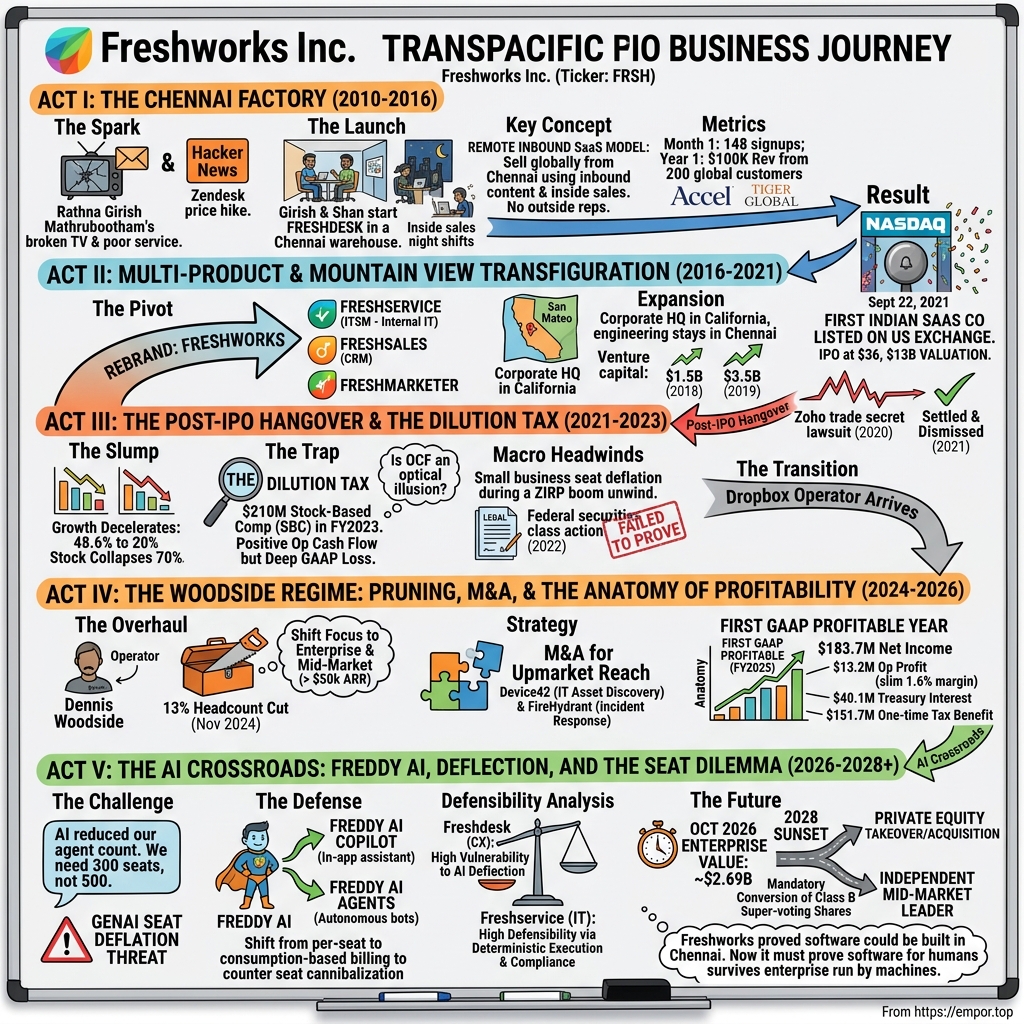
Freshworks: The Transpacific Software Machine at the AI Crossroads
I. Introduction & Episode Roadmap
On the morning of September 22, 2021, the screens wrapped around the NASDAQ MarketSite in Times Square showed a green logo that most American investors had never seen. Six thousand miles away in Chennai, employees crowded into offices and living rooms to watch a live feed of their founder, Girish Mathrubootham, ringing the opening bell. Freshworks had priced its initial public offering at $36 a share, and by the close of trading it was worth more than $10 billion12. No software-as-a-service company born in India had ever listed on an American exchange. The coverage in India treated it less as a financing event and more as a national coming-of-age story: proof that a product company, not an outsourcing shop, could be built in Tamil Nadu and sold to the world214.
Five years later, the picture looks very different. The founder no longer runs the company and no longer sits on its board35. The CEO is Dennis Woodside, a Silicon Valley operator who came from Dropbox and Motorola9. On October 2, 2026, the stock closed at $12.78, roughly a third of the IPO price, giving the company a market value of about $3.4 billion. Strip out the roughly $665 million of cash and securities on the balance sheet and the market values the operating business at about $2.7 billion, around three times its trailing revenue of about $904 million4. For a company with 85% gross margins and no debt, that is the price the market charges when it doubts the future of the product itself.
The doubt has a name: generative AI. Freshworks sells software priced, for the most part, per human seat: a support agent in Freshdesk, an IT technician in Freshservice, a salesperson in Freshsales3. If AI agents answer a large share of the tickets those humans used to answer, the customer needs fewer seats. The whole playbook that built Freshworks—engineering-heavy, Chennai-based, digitally sold to small and mid-sized businesses—now faces the question of whether the unit it sells is shrinking beneath it.
This story moves through five acts. Act I is the Chennai factory, 2010 to 2016: a broken television, a hostile customer-service experience, and the invention of a low-cost, inbound way to sell Western-grade software from India. Act II covers the multi-product pivot, the rebranding to Freshworks, the shift of headquarters to California, and the euphoric IPO. Act III is the hangover: growth halving, stock-based compensation consuming more than a third of revenue, and a securities class action. Act IV is the Woodside regime: restructuring, two acquisitions, and an honest look inside the first year of GAAP profit. Then the story turns to the AI crossroads, to governance and the 2028 expiry of super-voting shares, and finally to the frameworks, the bull and bear cases, and the lessons.
The central questions are simple to state and hard to answer. Can Freshworks move from seat-based pricing toward outcomes and consumption before AI deflates the seat? Is its new profitability a real operating achievement or a product of interest income and tax accounting? And when the founders' and venture investors' ten-vote shares convert in late 2028, who will decide what happens to the company? To answer them, the story has to start with a television.
 Subscribe on LinkedIn
II. Act I: The Broken TV and the Chennai Inbound Engine (2010–2016)
The story Mathrubootham has told for more than a decade begins with a shipment. After years working in the United States, he moved home to Chennai and had his belongings shipped across the world. His television arrived damaged. What followed, by his account, was months of chasing a shipping company that seemed to have no functioning way to receive a complaint, let alone resolve one14. Around the same time he read a heated discussion on Hacker News, the technology message board, about Zendesk raising its prices sharply. Frustrated customers were looking for an alternative. Mathrubootham, then a product-management executive at Zoho, the bootstrapped Chennai software company founded by Sridhar Vembu, saw both sides of the same problem: companies were bad at customer service, and the leading tool for fixing it had just made itself more expensive14.
He did not do it alone. Shan Krishnasamy, a Zoho engineer, became his co-founder, and in 2010 the two started Freshdesk in Chennai114. The product was a browser-based helpdesk: a shared inbox that turned customer emails into tickets, assigned them, tracked them and measured how fast they were closed. None of that was new. What was new was where it was built and how it was sold.
Selling to the world without leaving Chennai
The incumbent playbook in enterprise software was field sales. A vendor like BMC or Salesforce flew account executives to customer offices, bought dinners, and negotiated multi-year contracts. That model works when each contract is worth hundreds of thousands of dollars. It collapses when the customer is a 30-person e-commerce company paying a few hundred dollars a month.
Freshdesk inverted the model. A small business found the product online, often through content marketing or comparison searches, started a free trial, and was nudged toward a paid plan by inside-sales staff in Chennai who worked hours aligned to American and European customers, closing deals by chat, email and phone114. A Chennai engineer or salesperson cost a fraction of a San Francisco equivalent. Even in 2025, after years of wage growth, the company's median employee earned about $44,000 a year, and that median employee was based in India5. A Bay Area SaaS company of comparable size pays several times that. That wage gap was the founding economic edge. It let Freshdesk sell at prices Western competitors found painful and still fund a large engineering team.
The prospectus captured where this model led: by the time of the IPO, the company served customers in more than 120 countries, with no single customer anywhere near material to revenue1. The geography of revenue tells the same story today. North America is less than half of sales, Europe, the Middle East and Africa almost two-fifths, and Asia-Pacific most of the rest3. Few software companies of this size are so spread out. That is the inbound engine's fingerprint: the product traveled wherever search results and word of mouth took it.
The venture bet
Accel's India team, which would become the company's largest outside shareholder, backed Freshdesk early, and the cap table later added Tiger Global, Sequoia India and Google's growth fund CapitalG1. The Accel relationship matters to the end of this story, because Accel still holds the single largest block of voting power fifteen years later5.
The flaw hidden in the wedge
The same features that made Freshdesk easy to launch made it easy to copy. A helpdesk is a well-understood product. Groove, Help Scout, Kayako, Zoho's own Zoho Desk and many others offered similar tools at similar prices. The customers Freshdesk won most easily, small businesses that signed up online, were also the customers most likely to leave: when a small business fails or cuts costs, its software subscription goes with it. Even now, after years of moving upmarket, about 13% of annual recurring revenue (ARR) still sits on monthly contracts that can be cancelled at short notice3.
The verdict on Act I is that the Chennai model was real and powerful. It created a cost-to-build advantage and a sales channel that reached the whole world without a field sales force. But it was an advantage in how the product was made and sold, not in what the product was. A cheaper, friendlier helpdesk can be matched. The next act is Mathrubootham's attempt to find a product that could not be matched so easily.
III. Act II: The Multi-Product Pivot, Rebranding, and the Path to Times Square (2016–2021)
By 2017, the company was no longer called Freshdesk. The rebranding to Freshworks signaled a bet that one helpdesk product could become a suite: Freshdesk for customer support, Freshservice for internal IT, Freshsales for sales teams, and Freshmarketer for marketing1. The company moved its corporate headquarters to San Mateo, California, and reorganized under a Delaware parent, while the bulk of its people stayed in India13. It was a deliberate transfiguration: an Indian product company putting on the clothes American institutional investors expected.
The accidental crown jewel
Of all the new products, one mattered more than the others. Freshservice applied the ticketing idea to internal IT. When an employee's laptop breaks, a new hire needs software access, or a server goes down, someone opens a ticket. The discipline that manages this is called IT service management, or ITSM, and it comes with formal frameworks, compliance requirements and dedicated budgets. ServiceNow had built a giant on it, but ServiceNow is expensive and complex, often requiring consultants to implement. Freshservice offered mid-sized companies a lighter, faster alternative.
The economics of ITSM differ from customer support in an important way. A company can tolerate a slow reply to a customer email. It cannot tolerate employees unable to log in. IT software therefore tends to be stickier, with larger contracts, because it sits on top of the company's inventory of devices, licenses and systems. Over time, Freshservice became the part of the business management describes as its largest and fastest-growing franchise, and its push into larger companies is the core of the current strategy37. CRM was a harder fight: Freshsales landed in front of HubSpot and Salesforce, two companies with far deeper pockets and ecosystems.
Momentum into the IPO
The growth in these years was striking. Revenue went from about $172 million in 2019 to about $371 million in 2021, more than doubling in two years, with 2021 growth near 49%116. Pandemic-era digitization helped: companies moving to remote work needed both online customer service and remote IT support. Losses also grew, from about $31 million in 2019 to about $192 million in 2021, but in the market of 2021 that hardly registered116.
There was one legal shadow. In March 2020, Zoho, Mathrubootham's former employer, sued Freshworks in California, alleging that former Zoho employees had taken confidential information to Freshworks[^14]. The dispute was awkward for a company preparing to go public, both because trade-secret claims attack the integrity of the product and because the two firms competed head to head. The suit was settled and dismissed in November 2021, after the IPO, without disclosed material ongoing liability[^14]3.
Times Square
The IPO sold 32.8 million Class A shares, including the underwriters' option, at $36, raising about $1.03 billion after underwriting costs13. The shares jumped on the first day2. In India, the listing became famous for its employee wealth: Mathrubootham said a large number of employees held stock options, and Indian media celebrated hundreds of new rupee millionaires214. For Chennai's startup ecosystem, it was a demonstration effect that is hard to overstate.
For investors, the more important fact was buried in the structure. Freshworks came public with two share classes: Class A shares with one vote each, sold to the public, and Class B shares with ten votes each, held by the founders and pre-IPO investors1. At $36 a share and roughly 45% growth, nobody worried about who controlled the company. That changed within a year.
IV. Act III: The Post-IPO Hangover and the Dilution Reality (2021–2023)
The stock peaked at above $50 within weeks of the listing. Then 2022 arrived. Central banks raised interest rates at the fastest pace in decades, and the valuations of unprofitable software companies, which depend on profits far in the future, collapsed. Freshworks fell by roughly 70% from its high. In November 2022, shareholders filed a securities class action in federal court in Northern California, alleging that the IPO documents had painted an overly rosy picture of customer growth1211.
The slowdown
The numbers tell the story with brutal simplicity. Revenue growth went from about 49% in 2021 to 34% in 2022 and about 20% in 2023815. The net dollar retention rate (NDR), which measures how much existing customers spend this year compared with last, fell from levels comfortably above 110% toward the low 100s by 20247. An NDR of 103% means that the average existing customer base barely grew its spending: expansions were mostly eaten by downgrades and departures. That is the signature of an SMB-heavy customer base under pressure. Small businesses cut seats first.
The losses, meanwhile, got bigger before they got smaller. GAAP net loss was about $232 million in 2022, larger than in the IPO year8.
The cash-flow illusion
By 2023 management could point to a positive number: operating cash flow of about $86 million, after years near breakeven or worse15. A careless reader could have concluded the business was now self-funding. The reconciliation tells a different story. The company lost about $137 million on a GAAP basis in 2023, yet reported positive operating cash flow because about $211 million of employee pay was handed out in stock rather than cash, and stock compensation is added back in the cash-flow statement15.
Put those two numbers next to revenue of about $596 million, and something remarkable appears. More than a third of every dollar of revenue was being paid to employees in newly issued equity. That expense does not drain the company's bank account, but it does drain shareholders. Each new share issued dilutes existing owners' claim on future profits. Calling the operating cash flow "earnings" in that year would be like a restaurant counting the meals it paid its staff with IOUs as profit.
Why was stock compensation so high? Part of the answer is IPO mechanics: grants made before and around the listing vest over several years. Part is the culture of American tech compensation layered onto a mostly Indian workforce, with senior leaders paid in Silicon Valley-sized equity awards. Whatever the cause, it is the single fact that explains why a company with healthy gross margins remained deep in the red.
The court and the operator
The class action turned on whether management knew that SMB demand was weakening before the IPO. On April 10, 2025, Judge Haywood Gilliam granted summary judgment to Freshworks and its executives, finding plaintiffs had not established their claims; the plaintiffs have appealed, and a related derivative suit remains stayed123. The ruling removed most of the legal overhang, but it did not change what the numbers showed: the business had slowed sharply, whatever anyone knew in 2021.
The more consequential move of these years was a hire. In 2022 Freshworks brought in Dennis Woodside as President9. Woodside's résumé read like a map of tech operating jobs: years at Google running its Americas business, CEO of Motorola Mobility under Google ownership, then chief operating officer at Dropbox, where he helped steer a famous consumer brand toward disciplined margins after its own IPO9. He is not a product visionary in the founder mold. He is the kind of executive boards hire when growth is no longer enough and the business needs a P&L owner. His arrival was the clearest signal yet that the founder era was ending.
V. Act IV: The Woodside Regime: Pruning, M&A, and the Anatomy of Profitability (2024–2026)
On May 1, 2024, Freshworks announced that Dennis Woodside would become CEO, and that Girish Mathrubootham would step back to Executive Chairman9. The founder framed it as a chance to focus on the long-term and on the Indian startup ecosystem. The market read it as what it was: the operator was now in charge. Within a year, Mathrubootham had left the board entirely35.
Pruning
In November 2024, the board approved a restructuring that cut about 13% of the workforce, roughly 660 people137. The charges were small, about $10 million, mostly severance7. Bloomberg framed the cuts in the context of software firms grappling with AI13. Management described it as simplifying the organization and concentrating investment.
The productivity effect over the whole period is the clearest evidence that something real changed. Headcount peaked near 5,400 in 2022 and settled around 4,500 by the end of 2025, while revenue kept rising83. Revenue per employee therefore rose from about $81,000 in 2021 to about $186,000 in 2025, more than doubling163. Research and development fell from about a third of revenue to about a fifth163. Stock compensation dropped from about $217 million in 2024 to about $147 million in 2025, from roughly 30% of revenue to about 17.5%73. That last number is the biggest single change in the company's economics, and part of it comes from a one-time source: when Mathrubootham resigned, his unvested performance awards were cancelled, producing a $5.1 million reversal of previously recorded expense3.
Buying upmarket
The strategy also had an acquisitive side. In June 2024, Freshworks completed the purchase of Device42 for about $238 million103. Device42 discovers and maps IT assets: it scans a company's network to find every server, application and dependency, and draws the map of what connects to what. For an ITSM product, this is the foundation. You cannot manage a change to a server safely if you do not know which applications depend on it. Device42 gave Freshservice a credible answer to one of ServiceNow's strongest arguments with larger customers10.
In January 2026 came FireHydrant, an incident-management company, for about $80 million in cash114. FireHydrant coordinates the response when systems go down: paging engineers, running the playbook, writing the post-mortem. It pushes Freshservice from routine IT requests toward the more operational world of IT operations.
Both deals are coherent with an upmarket ITSM strategy. Neither is yet proven. Freshworks does not separately disclose the revenue contributions of either acquisition, and the company's history with multi-product expansion is mixed: the CRM products, after years of investment, never became the growth engine ITSM did. The right verdict on the M&A is that it is consistent with the strategy and modest in size, but its returns remain unproven.
Dissecting the first profitable year
Then came the headline. For fiscal 2025, Freshworks reported GAAP net income of about $184 million on revenue of about $839 million3. For a company that had lost money every year as a public company, it looked like a transformation. It deserves a forensic walk-through.
Step one: operating income. This is what the software business earned after all its costs, including stock compensation. It was about $13 million, a margin of roughly 1.6%3. That is genuinely positive and compares with an operating loss of about $139 million a year earlier7. The swing is real, and it is mostly the story of lower stock compensation and a flatter headcount.
Step two: other income. Add about $40 million of interest earned on the IPO cash sitting in Treasuries, money-market funds and deposits3. Pre-tax income becomes about $53 million. In other words, about three-quarters of pre-tax profit came from the treasury portfolio, not the software.
Step three: taxes. Because Freshworks had lost money for years, it had built up deferred tax assets—future tax deductions—but had held a valuation allowance against them, essentially saying it was not confident it would ever earn enough to use them. In 2025, with profitability in sight, it released about $152 million of that allowance, producing a net tax benefit of about $130 million3. That benefit is an accounting recognition, not cash. It turned $53 million of pre-tax income into $184 million of net income.
The verdict is not that the profit is fake. It is that the profit has three parts of very different quality. The operating part is small but real. The interest part is real cash but depends on keeping a large cash pile that the company is now spending. The tax part is a one-time accounting event. The trend in 2026 confirms the point. In the first half of the year, interest income fell to about $6 million from about $26 million a year earlier, as cash went into buybacks and FireHydrant4. The company posted a small operating loss for the half overall, though the second quarter turned an operating profit of about $6 million4. Revenue grew about 16%4.
Cash flow, though, is better than the GAAP figures suggest. Operating cash flow rose to about $242 million in 2025, and after capital spending of about $22 million, free cash flow was about $221 million3. The company collects annual subscriptions up front, which keeps deferred revenue comfortably larger than receivables3. Even after adjusting for stock compensation, the business now produces real cash, something it could not claim in 2023.
Pay and dissent
Executive pay drew attention. Woodside's reported compensation for 2025 was about $15.6 million, mostly in stock, and the ratio of his pay to the median employee's was 354 to 15. At the May 28, 2026 annual meeting, about 57 million shares voted against the advisory say-on-pay resolution, compared with about 378 million in favor, with a large block abstaining: roughly one in five votes cast against, depending on how abstentions are counted6. Because insiders' ten-vote shares heavily favor management, that level of opposition likely represents a considerably larger share of independent Class A holders. Two directors, Roxanne Austin and Sameer Gandhi, also drew sizable withhold votes6. For a company whose stock remains far below its IPO price, that is a clear message from part of the shareholder base.
The operating turnaround is real, then, but its foundations are narrow, and the biggest threat to those foundations is not the cost structure but the product's pricing unit.
VI. Act VI: The AI Crossroads: Freddy AI, Deflection, and the Seat Dilemma
Imagine the renewal meeting that keeps Freshworks executives awake. A mid-sized retailer runs a 500-person support team on Freshdesk. Over the past year it turned on AI features: an assistant that drafts replies and summarizes long ticket threads for agents, and an autonomous bot that answers routine questions—order status, returns, password resets—before a human ever sees them. Tickets fall. Resolution times fall. The customer is delighted. Then procurement arrives with a spreadsheet: if the bots handle half the volume, why pay for 500 seats? The scenario is hypothetical, but its mechanism is what every seat-based support vendor is pricing in.
How the threat works
Freshworks earns most of its revenue from subscriptions sold per user or per managed asset3. In customer support, the user is a human agent. Generative AI is exceptionally good at exactly the kind of work Tier-1 support agents do: reading a question, finding the answer in a knowledge base, and replying politely. If that work moves to software, the number of seats a company needs shrinks. The more successful the AI, the more it can cannibalize the seat.
Freshworks is also not the only vendor offering the bot. Specialist AI-native companies such as Sierra and Decagon sell autonomous customer-service agents priced per resolution, and incumbents such as Intercom, Zendesk and Salesforce have built their own. A customer could keep Freshdesk as a thin system of record while buying the intelligence elsewhere, which would push Freshworks toward commodity status.
The response: Freddy AI
Freshworks' answer is its Freddy AI family. Freddy AI Copilot is an assistant for human agents and IT technicians: drafting replies, summarizing tickets, suggesting solutions. Freddy AI Agent is customer-facing automation that handles conversations without a human3. The pricing defense is to charge for these separately: Copilot as a paid add-on per user, and the autonomous agent on a consumption basis, sold in blocks of sessions3. If it works, the revenue lost on seats returns as revenue on AI usage.
The evidence so far is encouraging but incomplete. Net dollar retention recovered from 103% at the end of 2024 to 108% at the end of 2025, and customers paying more than $50,000 a year grew about 23% to roughly 3,760, now accounting for about 54% of ARR, up from half a year earlier37. Those numbers show larger customers are spending more. But Freshworks does not disclose AI revenue as a share of ARR in a form that would let an investor see whether AI fees are actually offsetting seat losses. Until it does, the claim that AI is a net tailwind remains management's claim.
Why Freshservice is the safer half
There is an important asymmetry inside the company. Customer support handles external conversations: the questions are repetitive, the answers are in documents, and the stakes of a wrong answer are usually low. Bots can absorb much of it.
IT service management is different. Provisioning a new employee's laptop, granting access to a financial system, approving a change to production infrastructure: these require permissions, audit trails, integration with identity systems, and compliance with ITIL, the standard playbook for IT operations. An AI can make the work faster, but the system of record and the workflow engine remain essential. Device42's asset map and FireHydrant's incident tooling deepen that system of record. The AI risk is therefore real for Freshdesk and more manageable for Freshservice. Freshworks' future depends heavily on how fast the mix shifts toward the safer half.
There is one more cost mechanism. AI features consume computing power, and Freshworks runs on Amazon Web Services, with about $256 million of non-cancellable cloud and subscription commitments as of the end of 20253. Gross margin actually improved to about 85% in 20253, but model inference is a new variable cost, and a shift toward AI revenue could pressure margins if pricing does not keep pace.
VII. Act VII: Corporate Governance and the 2028 Sunset
Picture the San Mateo boardroom in 2026. The CEO who runs the company holds about 1.2% of the Class A stock and less than 1% of the votes5. The founder who no longer works there still controls about 18% of the voting power through his Class B shares. Accel controls about 24%, and CapitalG about 17%5. Every quarter, though, that grip loosens, and in a little over two years it ends entirely.
How the sunset works
Under Freshworks' certificate of incorporation, Class B shares carry ten votes and Class A shares one1. Class B shares convert automatically to Class A when they are transferred, with limited exceptions, and all of them convert on a fixed date: the last trading day of the fiscal year following the seventh anniversary of the IPO, which points to the end of 202815. Earlier conversion happens if Class B falls below a threshold of total shares1.
The conversion is already under way. Class B shares fell from about 58 million at the end of 2024 to about 35 million by March 2026, as venture funds distributed holdings and holders sold75. Even so, Accel, Mathrubootham and CapitalG together held close to 59% of the voting power at that date5. Until the sunset, a small group can block any transaction they dislike.
Buybacks as defense and as cost
The company has turned from issuing equity to retiring it. In May 2024 the board authorized a $400 million repurchase program; about $14 million was spent in 2024 and about $386 million in 2025, retiring roughly 28 million shares3. In February 2026 the board authorized another $400 million3. The buybacks matter because they offset the dilution from stock compensation; without them, share count would keep rising.
They also carry a cost. The cash spent on buybacks is the cash that earned the interest income that made up most of 2025's pre-tax profit. Liquid assets fell from about $844 million at the end of 2025 to about $665 million by June 202634. Each dollar spent on buybacks removes about four cents of annual interest income. That is a reasonable trade if the shares are cheap, but it makes the GAAP income statement more dependent on operating profit, which is still small.
The waiting room
The obvious comparison is Zendesk, Freshdesk's original foil, which Hellman & Friedman and Permira took private in 2022 in a deal valuing it at about $10.2 billion. Freshworks today trades at a fraction of that multiple, with no debt, positive free cash flow, and an Indian engineering base that a private-equity owner could run for cash. When the super-voting shares disappear, there will be no structural barrier to an unsolicited bid. That is not a prediction that one will come. But the combination of a depressed multiple, net cash, and an expiring control structure is exactly what take-private sponsors look for, and any analysis of Freshworks' value has to account for it.
The governance clock connects to the economics, which is where the frameworks come in.
VIII. Business & Investing Frameworks
Hamilton Helmer's 7 Powers
Scale economies: partial. The India cost base is real. A median employee costing about $44,0005 lets Freshworks fund a large engineering team with R&D at about a fifth of revenue3. But this is a cost advantage, not scale economies in Helmer's sense: Zoho has the same advantage in the same city, and AI coding tools are shrinking the cost of engineering everywhere.
Switching costs: high in Freshservice, moderate in Freshdesk. Once a company's IT asset inventory, workflows, approvals and integrations live in Freshservice, moving is painful, and Device42 deepens that. Freshdesk is easier to replace: tickets can be exported and a support team retrained in weeks. Net dollar retention of 108%3 and the falling share of monthly contracts suggest switching costs are rising as the mix shifts upmarket, but a 103% low in 20247 shows they were not strong enough to prevent contraction in a downturn.
Network effects: absent. One customer's tickets do nothing for another's. AI trained on aggregate data could, in theory, create a weak data advantage, but Freshworks has not shown evidence of it.
Counter-positioning: historical, now eroded. In 2011 Freshdesk's low price, free tier and self-serve onboarding were hard for incumbents to copy without hurting their own businesses. Today every competitor offers free trials and transparent pricing, and Freshworks itself is adopting a more traditional enterprise sales motion. Ironically, the counter-positioner today is the AI-native vendor charging per resolution, which a seat-based incumbent struggles to match without cannibalizing itself.
Cornered resource: absent. No unique patents, data, licenses or people that competitors cannot obtain.
Process power: moderate. The ability to build and sell multiple products from India with a global inside-sales engine is a genuine organizational skill. Zoho, Postman and BrowserStack show it can be replicated.
Brand: moderate. Freshdesk and Freshservice are well known among mid-market buyers, but lack ServiceNow's credibility in the Global 2000.
The honest summary: Freshworks has one strong power, switching costs in ITSM, and one durable cost advantage. Everything else is weak or eroding.
Porter's Five Forces
Threat of new entrants: high. Cloud infrastructure, open APIs and AI coding agents have made a basic helpdesk easier to build than ever.
Buyer power: moderate to high. No customer exceeds 1% of ARR and the top ten are below 5%3, so no single buyer can hold Freshworks hostage. But collectively the SMB base is price-sensitive and quick to churn.
Supplier power: high. AWS hosts the platform, and the company is committed to about $256 million of cloud and subscription spending over three years3. Model providers are a new supplier class whose pricing affects AI margins.
Threat of substitutes: high. Autonomous AI agents are a direct substitute for seat-based support software.
Rivalry: intense. ServiceNow holds the enterprise high ground in ITSM; Zendesk, Salesforce and Intercom fight for CX; HubSpot dominates SMB CRM; and Zoho competes from below with lower prices and no outside shareholders to satisfy.
Put together, Freshworks operates in an industry structure that is getting harder, and its defensibility sits overwhelmingly in one product line.
IX. Bull vs. Bear Case & What to Watch
The bull case
The mid-market ServiceNow. Freshservice, now with Device42 and FireHydrant, keeps winning mid-sized and larger customers for whom ServiceNow is too expensive and complex. The evidence supports the direction: large customers are the fastest-growing cohort and now account for more than half of ARR3. The test is whether that share keeps rising.
AI as revenue, not erosion. Freddy AI add-ons and consumption fees push net retention above its current 108%. The 2024-to-2025 recovery73 is consistent with this, but without disclosure of AI revenue it cannot be distinguished from a cyclical rebound.
Operating leverage. With stock compensation down and headcount flat, operating margins can expand from near zero. The second quarter of 2026's operating profit4 is a small but positive data point.
Valuation optionality. At about 3 times revenue and about 12 times trailing free cash flow, with net cash and active buybacks43, the market is pricing in little growth. The 2028 sunset removes a barrier to takeover.
The bear case
Seat deflation. Freshdesk's seat base shrinks faster than Freshservice and AI add-ons grow, pinning growth below 10%. The deceleration from about 49% to about 16% over five years164 shows the direction of travel even before AI deflation fully arrives.
Profitability fades. Interest income falls as cash is spent, the tax benefit does not recur, and operating margin stays thin. The first half of 2026, with a small operating loss and sharply lower interest income4, shows how quickly the 2025 headline can disappear.
The squeeze. Too small and too mid-market for the Global 2000, undercut by Zoho at the low end, and attacked by AI-native vendors in support.
Governance friction. Persistent dissent on pay6 and the transition of control raise the risk of leadership churn or an opportunistic bid at an unattractive price for public shareholders.
Myth vs. reality
Myth: Freshworks became solidly profitable in 2025. Reality: Operating profit was about $13 million; most of the $184 million headline came from interest and a one-time tax release3.
Myth: The company has been self-funding since 2023. Reality: Operating cash flow was positive, but for years more than 30% of revenue was paid in stock157. Only since 2025 has free cash flow comfortably exceeded stock compensation.
Three KPIs to watch
- Share of ARR from customers above $50,000. Latest reading: about 54%, up from 50% a year earlier3. Rising share means the business is shifting toward stickier, ITSM-heavy accounts.
- GAAP operating margin. Latest full-year reading: about 1.6% in 2025, slightly negative for the first half of 2026 with a positive second quarter34. This is the profit that does not depend on interest rates or tax accounting.
- Net dollar retention. Latest reading: 108% at the end of 2025, up from 103%37. This is where seat deflation or AI monetization will show up first.
X. Playbook: Business & Investing Lessons
Lesson 1: Labor arbitrage builds a company; it does not protect one. Freshdesk reached customers in more than 120 countries1 with sales staff in Chennai working American and European hours. That cost advantage funded the whole machine. It did not prevent SMB customers from leaving when their own businesses shrank, and it did not stop Zoho, with the same arbitrage, from attacking from below. The broader lesson for founders: a cheaper way to build and sell is a head start, not a moat. "Chennai can build your software for less; it cannot make your customers stay."
Lesson 2: Operating cash flow paid in stock is not owner earnings. In 2023, Freshworks celebrated about $86 million of operating cash flow while issuing about $211 million of stock compensation15. Investors who capitalized the cash flow were valuing a stream of money that was actually being paid to employees in shares. "When a third of revenue is paid in equity, the cash flow belongs to someone else."
Lesson 3: The second product may be the real company. Freshdesk was the origin story, but Freshservice became the franchise because IT departments cannot ignore their own tickets. The asset-mapping and incident tools Freshworks later bought only make sense in that world. "Customer support is the department that answers the phone; IT is the department that owns the keys. Build for the keys."
Lesson 4: Read the first profitable year line by line. Freshworks' $184 million of 2025 net income contained about $13 million of operating profit, $40 million of interest and $130 million of tax accounting3. Within six months, interest income had fallen by more than three-quarters4. "When software turns profitable, check whether the profit came from the code or from the Treasury bill."
Lesson 5: Dual-class control without the founder is a countdown. The man running Freshworks controls less than 1% of the votes; the founder who left and the venture funds hold most of the rest, on shares that expire at the end of 20285. "A dual-class structure without its founder is not a fortress; it is an auction with a timer."
XI. Epilogue
Tonight Freshworks is a very different company from the one that rang the bell in 2021. It is smaller in people but larger in revenue, with about $665 million of cash and securities, no debt, positive free cash flow and a business tilted toward larger customers43. It is also a company whose valuation says the market doubts the future of its main pricing unit.
Three moments will decide the next chapter. The first is the full-year 2026 results, due early next year. The question is simple: can operating margin expand without help from interest income or tax releases? A meaningful, sustained operating margin would confirm that the Woodside restructuring built a durable profit engine. A margin stuck near zero would suggest 2025 was mostly accounting.
The second is AI disclosure. If Freshworks begins reporting AI revenue or non-seat ARR and that number grows faster than seats shrink, the seat-deflation thesis weakens. If retention slips back toward 103% while AI usage grows, the bear case is confirmed.
The third is the end of 2028, when the ten-vote shares convert. Before then, Accel, CapitalG and the founder must decide whether to hold, sell, or support a transaction. After it, every shareholder's vote counts equally, and a bidder would face no structural blocker.
The tension that remains is that the business Freshworks is betting on, IT service management, is getting stronger, while the business it started with, customer support, is the one AI is most likely to shrink. The company's future depends on which of those curves bends faster.
XII. Outro
It began with a damaged television and a support process that did not work. From that frustration came a company that showed Indian engineers could build software for the world, sell it from Chennai and list it in Times Square, creating wealth for employees who had never expected to own shares in an American public company.
Now the same mechanism that inspired it, the slow, human, ticket-by-ticket work of customer support, is being automated away. Freshworks proved the world's software could be built in Chennai. Dennis Woodside now has to prove that software priced for human agents can survive when the agents are machines.
References
-
Form 424B4 (Prospectus Filed Pursuant to Rule 424(b)(4)) — SEC EDGAR, 2021-09-22 ↩↩↩↩↩↩↩↩↩↩↩↩↩↩↩
-
Freshworks IPO: Indian SaaS pioneer debuts on Nasdaq in landmark listing — Reuters, 2021-09-22 ↩↩↩↩
-
Form 10-K (Annual Report for Fiscal Year Ended December 31, 2025) — SEC EDGAR, 2026-02-26 ↩↩↩↩↩↩↩↩↩↩↩↩↩↩↩↩↩↩↩↩↩↩↩↩↩↩↩↩↩↩↩↩↩↩↩↩↩↩↩↩↩↩↩↩
-
Form 10-Q (Quarterly Report for the Period Ended June 30, 2026) — SEC EDGAR, 2026-08-04 ↩↩↩↩↩↩↩↩↩↩↩↩↩
-
Form DEF 14A (Definitive Proxy Statement for 2026 Annual Meeting) — SEC EDGAR, 2026-04-09 ↩↩↩↩↩↩↩↩↩↩↩↩
-
Form 8-K (Current Report: 2026 Annual Meeting Voting Results) — SEC EDGAR, 2026-05-29 ↩↩↩
-
Form 10-K (Annual Report for Fiscal Year Ended December 31, 2024) — SEC EDGAR, 2025-02-20 ↩↩↩↩↩↩↩↩↩↩↩↩
-
Form 10-K (Annual Report for Fiscal Year Ended December 31, 2022) — SEC EDGAR, 2023-02-23 ↩↩↩
-
Freshworks Announces Leadership Transition: Dennis Woodside Named CEO, Girish Mathrubootham to Become Executive Chairman — Freshworks Press Release, 2024-05-01 ↩↩↩↩
-
Freshworks Completes Acquisition of Device42 — Freshworks Press Release, 2024-06-05 ↩↩
-
Freshworks to Acquire FireHydrant to Modernize Incident Management — Freshworks Press Release, 2026-01-20 ↩↩
-
Order Granting Defendants' Motion for Summary Judgment, In re Freshworks Inc. Securities Litigation (Case No. 22-cv-06771-HSG) — U.S. District Court for the Northern District of California, 2025-04-10 ↩↩
-
Freshworks Cuts 13% of Workforce as Software Firms Grapple With AI — Bloomberg, 2024-11-06 ↩↩
-
How Freshworks Built a $13 Billion Global SaaS Giant from Chennai — Forbes, 2021-09-23 ↩↩↩↩↩↩
-
Form 10-K (Annual Report for Fiscal Year Ended December 31, 2023) — SEC EDGAR, 2024-02-16 ↩↩↩↩↩
-
Form 10-K (Annual Report for Fiscal Year Ended December 31, 2021) — SEC EDGAR, 2022-02-23 ↩↩↩↩↩
 LinkedIn
 WhatsApp
 Reddit
 Hacker News
 Email
Email Kindle
 RSS Feed
 Spotify
 Apple Podcasts
 Amazon Music
 Audible
 YouTube