Flowers Foods: The Bread Route to a Turnaround
I. The dividend gets cut in half
Every morning, before most of America is awake, trucks pull away from bakery docks across the South, the Midwest and the West carrying something nobody thinks about: the loaf of sandwich bread that will be on the shelf when a parent stops for groceries on the way home. It is the most ordinary product in the supermarket. It is bought every week, eaten every day, and almost never celebrated. And on May 21, 2026, the company that bakes more of it than almost anyone in the country told its shareholders it could no longer afford to pay them the way it had for a generation.
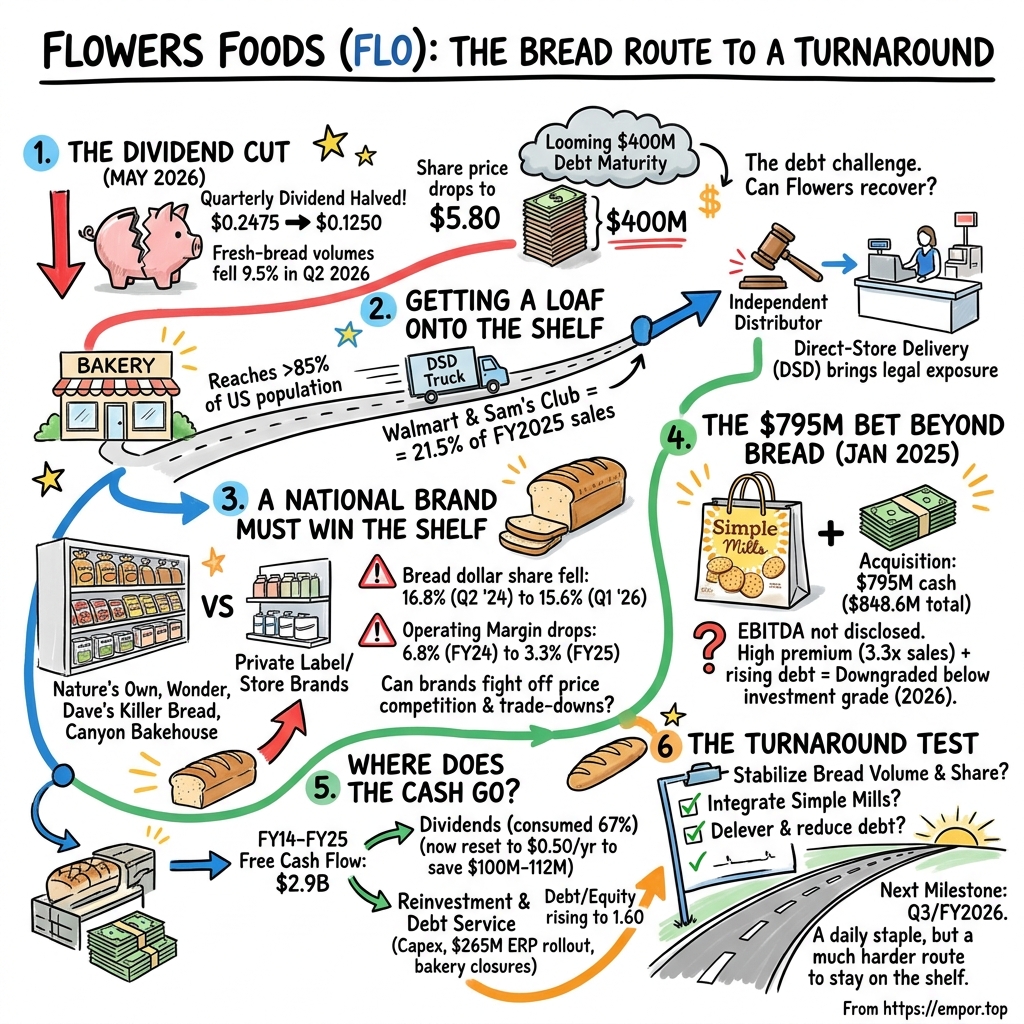
That evening, Flowers Foods reported its first-quarter results and, in the same release, "reset" its dividend. The quarterly payment fell from $0.2475 a share to $0.1250, an annual rate of $0.50 instead of roughly a dollar.1 The company chose its word carefully. It did not say "cut." It said the reset would let it "prioritize meaningful debt reduction" while still investing in its brands, and that dividends would "remain an important component" of what shareholders received.1 For a stock that had been owned for years by people who wanted exactly one thing from it, a steady and rising check, the choice of verb did not matter much. The check had been halved.
The reasons were stacked up behind the announcement like pallets on a loading dock. The core business, fresh packaged bread, was shrinking. Flowers' unit sales of fresh packaged bread fell 3.7% in the fourth quarter of 2025, 6.6% in the first quarter of 2026, and then 9.5% in the second quarter, a slide that got steeper every three months.2 An analyst on the August earnings call called that last figure what it was: "a big number."3
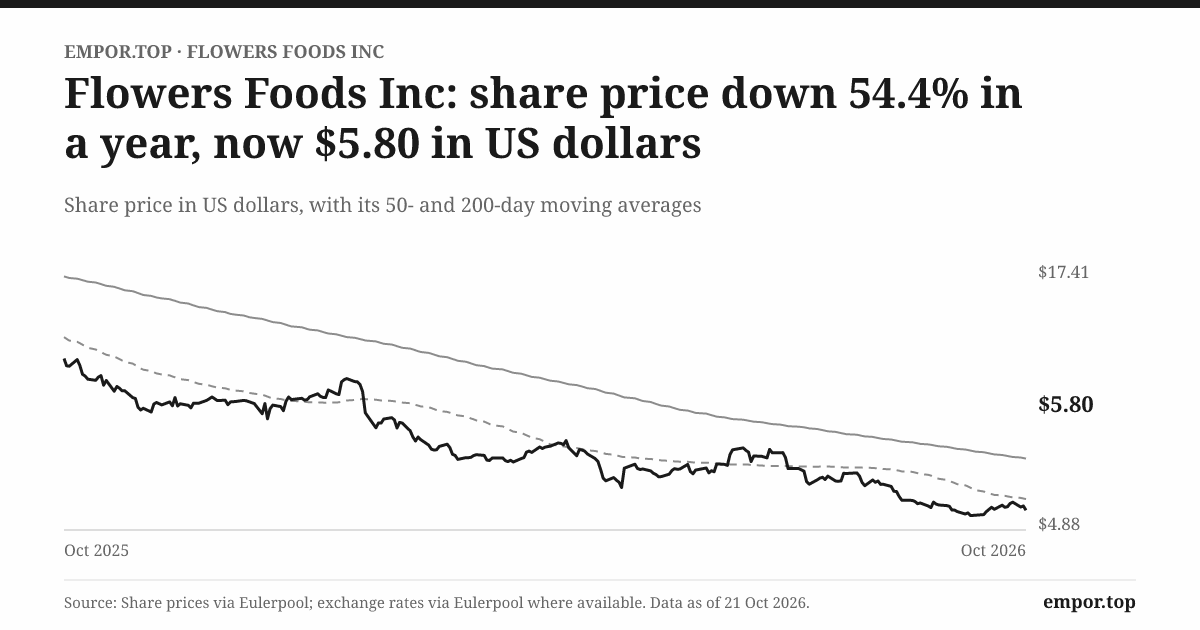
Meanwhile, a $400 million bond carrying a 3.5% coupon was due in October 2026, and the company had spent heavily the year before to buy a snack maker called Simple Mills with borrowed money.4 By the time the third quarter ended, the market had rendered its own verdict. On October 21, 2026, Flowers shares closed at $5.80, roughly 55% below their high of the previous twelve months.5
This is the paradox at the heart of the story. Bread is one of the least cyclical, most habitual purchases a household makes. Flowers owns the best-selling loaf brand in America, Nature's Own, and the best-selling organic bread, Dave's Killer Bread.4 It runs one of the densest fresh-delivery networks in the country. And yet the company that controls all of that has watched its profits shrink for a decade, borrowed to buy growth outside bread, lost its investment-grade credit rating, and cut the payout that defined its stock. How does a staple become a turnaround?
Four questions organize the answer. The first is whether Flowers can stop the volume losses in its core loaves, because a bakery is a fixed-cost machine and every lost loaf makes the remaining ones more expensive to bake and deliver. The second is whether its brands and its route network give it a real edge against retailers who control the shelf and store brands that sell for less. The third is whether Simple Mills, bought for $795 million in cash, can earn back its price and the debt that paid for it.6 The fourth is whether the current management team, which made that acquisition while promising to protect the company's credit standing, can restore trust while paying the debt down.
It helps to be clear about what kind of company this is. Flowers Foods is a Georgia corporation with no parent company and no controlling shareholder; its largest investors are index and institutional funds, and its directors and executives together own a little over 7% of the stock.7 It sells almost entirely in the United States, in dollars. There is no group structure to untangle and no foreign subsidiary whose economics need separating. What happens in American bread aisles is what happens to Flowers.
One more piece of housekeeping, because it is the first number a casual investor sees. Screens showed Flowers with a dividend yield near 12.8% in October 2026, a figure that looks like either a gift or a trap. It is neither. That yield is backward-looking, built on the old payout of roughly a dollar a share. At the reset rate of $0.50 and a $5.80 share price, the forward yield is about 8.6%.1 That is still high, which tells you how much risk the market is pricing in. But the old number describes a company that no longer exists.
The dividend cut bought Flowers time. Whether that time turns into a recovery depends on something much older than the balance sheet: the way a loaf of bread gets from an oven in Thomasville, Georgia, or Milwaukie, Oregon, onto a grocery shelf before the store opens.
 Subscribe on LinkedIn
II. What it takes to get a loaf onto the shelf
Start at the back of a bakery in the hours before dawn. The ovens have been running since the previous evening. Loaves come off the line, cool, get sliced and bagged, and roll toward the dock on racks. Waiting outside are not company truck drivers in the usual sense. They are independent distributor partners, small-business owners who have bought the right to deliver Flowers products along a defined territory. They load their trucks, drive their routes, stock the shelves themselves, pull the stale product, and rotate the fresh to the front.
That is direct-store delivery, or DSD, and it is the engine of the company. Management has described DSD as about 85% of the business.8 At the start of 2026, Flowers had 5,772 territories, of which 4,274 were owned by independent distributors and 1,365 were run by the company itself.4 Through that network, Flowers says its fresh breads, buns, rolls and snack cakes are available to more than 85% of the U.S. population.9 The reason the network exists is the product. A loaf of sandwich bread has a shelf life measured in days, not months. It cannot sit in a distribution center the way a box of crackers can. Somebody has to bring it, often several times a week, and somebody has to take the old bread away.
Now look at how Flowers actually gets paid, because this is where the romance of the route meets the arithmetic of the grocery business. Flowers sells its bread wholesale, one transaction at a time. There are no minimum-volume commitments in its contracts, no take-or-pay obligations, no subscription fees.4 Retailers renegotiate shelf space and promotional calendars constantly, and the price Flowers books is reduced by a long list of deductions: trade promotions, scan-downs, slotting fees and the cost of product that goes unsold.4 Those deductions are judgment-heavy enough that the company's auditor, PwC, flagged revenue recognition for trade promotions as a critical audit matter in its 2025 report.4 In plain terms, Flowers does not know exactly what it earned on a loaf until the promotions are settled.
That leads to the question of who holds the power in this relationship. The answer is plainly the buyers. Walmart, including Sam's Club, accounted for 21.5% of Flowers' sales in fiscal 2025, about $1.14 billion, up from 20.9% two years earlier.4 It was the only customer above 10% of sales, but it was not alone at the top: the ten largest customers together took 57.7% of revenue.4 Each of those buyers runs its own store-brand bread program. Each decides how many feet of bread wall Nature's Own gets and how often it goes on promotion. When one customer buys more than a fifth of everything you make and also sells a cheaper version of your product under its own label, you do not set the terms. You negotiate them.
So what does the route actually buy Flowers? The honest answer is service, and service has value. A distributor who visits a store several times a week can spot an empty shelf, fix a display, pull damaged product and talk to the store manager. For a perishable item, that kind of attention is the difference between a full shelf and a bare one. It also makes Flowers a reliable supplier, which matters to a retailer that cannot run out of bread on a Saturday. But reliability is a reason to keep a supplier, not a reason to pay it more. The route network makes Flowers good at keeping shelves stocked. It does not guarantee that the shelves stay as wide.
The money behind the routes tells a second story. On the customer side, Flowers gets paid quickly. Debtor days, the average number of days of sales sitting in receivables, were 26 in fiscal 2025 and have stayed between 24 and 27 for a dozen years.4 That is the signature of a business selling to big, creditworthy grocery chains on short terms. The allowance for bad debts was about $18 million against roughly $371 million of gross receivables.4 Nobody is using slow payment to hide weak sales here.
The distributor side is different. Independent distributors buy their territories, and many of them finance the purchase through Flowers. At the end of fiscal 2025, the company carried $108.5 million of long-term notes receivable from distributors, loans that can run up to ten years, secured by the route rights themselves.4 Those loans earned Flowers about $17.4 million of interest income in 2025.4
It is a neat arrangement while routes are valuable: the company sells a territory, lends the buyer the money, earns interest, and holds the route as collateral. But it means Flowers is partly a lender to its own sales force, and the collateral is only as good as the volume moving down each route. When fresh-bread units fall 9.5% in a quarter, the value of a route falls with them, and so does the safety of the loan.
Then there is the legal question that has shadowed the DSD model for years. Distributors in several states have sued Flowers, arguing that they are not independent business owners at all but misclassified employees entitled to overtime and benefits. At the end of fiscal 2025, Flowers was defending ten such lawsuits, six of which sought class or collective treatment.4 In one of them, Martins v. Flowers Foods in federal court in Florida, a judge in November 2024 denied the company's motion to decertify a collective action.4 Flowers has paid to settle before. It recorded a $55 million settlement in fiscal 2023, paid in 2024, together with a phased repurchase of about 350 territories in California.4 It settled further distributor claims for $2.1 million in 2025 and agreed in the first quarter of 2026 to pay $11.0 million on distributor claims and $3.4 million on other claims.10
Those sums are small next to a $5 billion revenue base. The risk is not the size of past settlements. It is the shape of a different outcome. If courts eventually decided that distributors must be treated as employees, Flowers would inherit payroll taxes, benefits, vehicles and fuel that today sit on the distributors' own books, and it would have to unwind route sales that underpin those $108.5 million of notes.
California already showed what that unwinding looks like in miniature: Flowers bought back hundreds of territories there rather than keep defending the model.4 Management maintains the risk to the broader model is manageable, and when analysts asked in February 2026 about a pending Supreme Court case, the CEO called it "more of an operating issue" with no material financial impact expected.8 That may prove right. It is a forecast, not a finding.
The route network, then, is real, valuable and fragile in specific ways. It keeps bread fresh and cash flowing. It also concentrates the company's fortunes in the hands of a few powerful retailers and thousands of small route owners whose legal status is still being argued in court. If the network ever had to be rebuilt on an employment model, who would absorb the extra labor, fleet and route costs? The answer would almost certainly be Flowers. Which raises the next question: if the delivery system does not lock customers in, do the brands on the trucks do the job instead?
III. A national brand still has to win the shelf
Picture a shopper standing in front of the bread wall on a Tuesday night. At eye level is Nature's Own Honey Wheat, in the familiar green-and-gold bag. A shelf below, at a noticeably lower price, sits the store's own wheat bread, baked to a similar spec and sliced to the same thickness. Further along is a short, fat loaf of sourdough, and above it a half-size loaf for a household that never finishes a full one. The shopper reaches for one of them in about three seconds. Somewhere in a regional office, a category manager for the retailer is deciding how many feet each of those options will get next quarter. Flowers' entire strategy has to work inside those three seconds and that one spreadsheet.
Flowers calls itself the second-largest producer and marketer of packaged bakery foods in the United States.4 The largest is Bimbo Bakeries USA, the American arm of Mexico's Grupo Bimbo, which operates on a global scale far larger than Flowers. Campbell's Pepperidge Farm competes at the premium end, and below them is a long tail of regional bakers, retailer-owned bakeries and store brands.4 Flowers' advantage over the small players is reach. Its disadvantage against Bimbo is size. Its permanent competitor everywhere is the store brand.
Its portfolio is built to cover the whole bread wall. Nature's Own is the best-selling loaf bread in America, with estimated retail sales of about $1.5 billion in fiscal 2025.4 Dave's Killer Bread is the country's top-selling organic bread brand, with about $1.2 billion of retail sales.4 Canyon Bakehouse leads in gluten-free bread, Wonder carries 93% brand awareness, and Tastykake anchors snack cakes.4 On paper, few bakers have a better collection of names. Flowers held about 74% of dollar sales in organic fresh packaged bread and about 38% in gluten-free in 2025.11 Those are dominant positions in growing niches.
Now look at the economics of the industry through the forces that actually shape it. Buyer power is high, because a handful of retailers control most of the shelf and Walmart alone takes more than a fifth of Flowers' sales. Rivalry is intense, because Bimbo, regional bakers and store brands all fight for the same few feet of bread wall, often with promotions. The threat of substitutes is constant: a shopper can switch to a store brand, a cheaper branded loaf, tortillas, or simply eat less bread, with no cost and no contract to break.
Supplier power is moderate; flour, sweeteners and oils come from a concentrated group of national millers and processors, and their prices move with commodity markets. The threat of new entrants at national scale is low, because nobody is going to build a national bakery network and thousands of routes from scratch. Freshness and route density matter, and they protect Flowers from small upstarts. They do not protect it from the retailer that already owns the shelf.
That distinction matters because the bull case for Flowers is often stated in its strongest form: leading brands plus a national delivery network equals a moat. The evidence supports something narrower. Leading positions in organic and gluten-free bread, together with reach to 85% of the population, prove that Flowers has distribution and brand presence. They do not prove it can hold price or volume across the categories that make up most of its sales.
The best test is the company's own share in fresh packaged bread overall. Flowers held about 16.7% of dollar sales in the first quarter of fiscal 2025 and 16.6% in the second.11 By the fourth quarter of 2025, its share had fallen to 15.6%, down 110 basis points from a year earlier.12 A point of share in a category this size is a lot of loaves.
The weak spot has a name, and the CEO used it himself. "The real issue for us is traditional loaf," Ryals McMullian told analysts in February 2026, referring to the standard 20-ounce white and wheat sandwich breads where Nature's Own lives and where Flowers "under-index[es]" the category.8 Traditional loaf is about 38% of Flowers' branded retail sales, he said in May.13 The sub-segment had been shrinking at 5% to 6% a year even as the broader category fell only 2.5% to 3%, and Flowers is heavily exposed to it.11 This is the shelf that matters most to Flowers, and it is the one most open to substitution.
The company's explanation of who is winning that shelf has shifted, and the shift is revealing. In February, McMullian argued that this downturn was different from past ones. Traditionally, he said, shoppers squeezed by inflation traded down to private label. This time they were trading to "lower-priced branded offerings that are pricing at parity or slightly above private label," while private label itself was down.8 In other words, rival brands were undercutting Flowers on price.
By May, he acknowledged that after Flowers raised prices late in 2025, "the pricing gaps have remained a bit wider than we would like," and that this had hurt volume, especially in traditional loaf.13 By August, he said that "there has been some amount of trade down to private label and lower-priced items," but insisted the "bigger factor" was gaps in the portfolio: too few half loaves, too little sourdough, not enough protein and fiber.3 Each explanation was plausible. Together, they describe a company whose prices got ahead of its competitors at the same moment shoppers' tastes moved away from its biggest product.
This is the margin mechanism in one sentence: when Flowers raises price, some shoppers leave, and when shoppers leave, the bakeries and routes do not get cheaper. A bakery runs most efficiently at full speed. Its ovens, its labor shifts and its trucks are largely fixed costs. Lose 9.5% of your units and you spread those costs over 9.5% fewer loaves. The CFO, Anthony Scaglione, put it plainly in August: the bakery network is "our highest fixed cost," and squeezing efficiency out of it "becomes harder and harder with the volume declines."3 Price kept gross margin surprisingly steady through the second quarter, he said, but price is also what invites elasticity.3
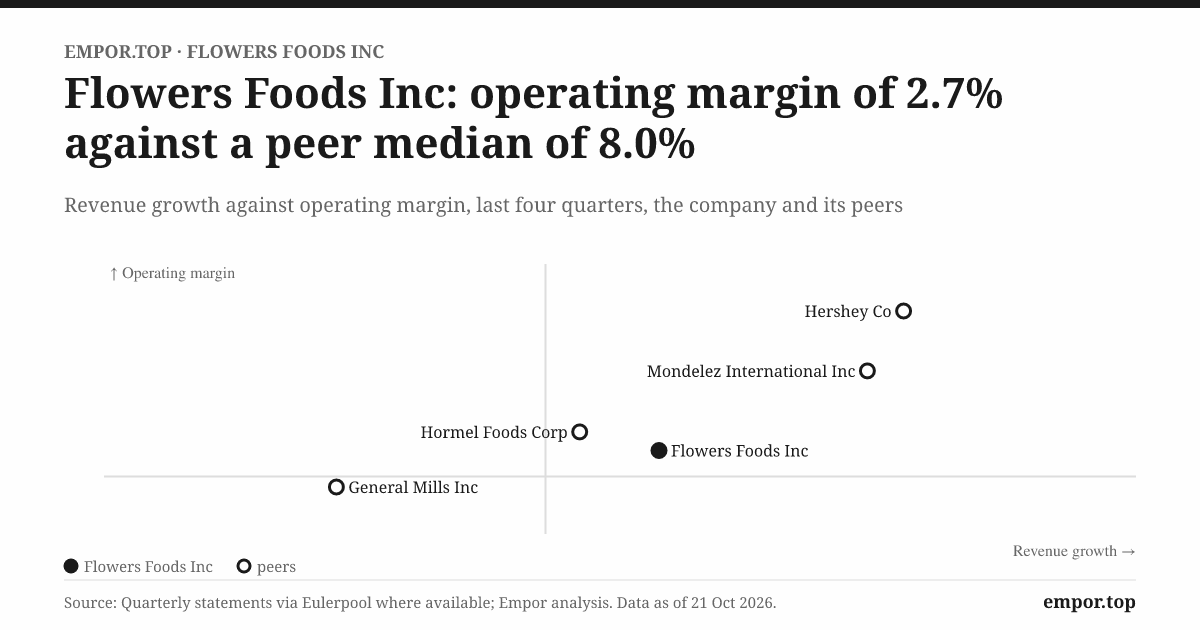
The full-year numbers show the result. Flowers' operating margin fell from 6.8% in fiscal 2024 to 3.3% in fiscal 2025.4 Part of that collapse was a one-time charge, a $136 million write-down of two regional bread trademarks taken in the fourth quarter, which Flowers kept using but on a more limited basis.4 Strip that out and margins were still down, and the second quarter of 2026 brought fresh deterioration: adjusted EBITDA fell 19% from a year earlier, and selling, distribution and administrative costs rose to almost 40% of sales.14 Those are the costs of keeping the route system running while fewer loaves travel down it.
Input costs add another layer. Flowers hedges wheat, oils, sweeteners, natural gas and diesel through futures and forward contracts.4 That program worked well enough that by 2026 the company was "virtually fully hedged" for the year on the commodities it covers.13 But hedges only smooth the timing of costs; they do not remove them. After oil prices spiked in early 2026, diesel and the plastic resin used in bread bags rose in ways the company had not planned for at the start of the year.13
By August, Scaglione was warning that inflation would need to be addressed in 2027, and when an analyst pointed out that Flowers had raised price by mid-teens percentages during the 2022 commodity cycle, the CFO conceded that "price probably is not going to be the only lever" this time.3 Currency, by contrast, barely enters the story: this is a dollar business, baked and sold at home.4
So the central test of Flowers' competitive position is not whether its brands are famous. They are. It is whether the combination of brand and route earns Flowers a better position on the shelf, with pricing that covers its costs, or whether retailer power turns that network into a service Flowers must keep providing at thinner and thinner margins. The record so far leans toward the second answer. Recognizing that, the company did what packaged-food companies under pressure usually do. It went shopping for growth somewhere else.
IV. The $795 million bet on growth beyond bread
On January 8, 2025, Flowers announced that it would buy Simple Mills, a maker of almond-flour crackers, cookies, snack bars and baking mixes, for $795 million in cash.6 The brand had been founded in 2012 by Katlin Smith, who would stay on as its leader, and it had grown its sales an estimated 14% in 2024 to about $240 million.15
McMullian said Simple Mills "perfectly fits our strategy" of adding better-for-you brands that diversify the portfolio.15 The financing came from a $795 million term loan committed by Royal Bank of Canada, and Flowers expected net debt of about $1.9 billion at closing, or roughly 3.1 to 3.3 times its pro forma EBITDA.6 In the same announcement, Flowers said it was "committed to its investment grade debt rating."6 That sentence would age badly.
To understand why Flowers made the bet, it helps to see the company's history as a series of acquisitions, each one bought to fix a weakness. Flowers traces its roots to a bakery founded in Thomasville, Georgia, in 1919, and it grew for most of a century by buying regional bakeries and stitching them into its route network.4 The modern era began with a bankruptcy. When Hostess Brands collapsed in 2012, Flowers bid for its bread business, and in July 2013 it completed the purchase of 20 bakeries, 36 depots and five brands, including Wonder, for about $355 million.16 That deal gave Flowers national reach and one of the most recognized names in American bread.
Two years later came the acquisition that defines the bull case for every deal since. In September 2015, Flowers paid about $275 million in cash for Dave's Killer Bread, an organic, seed-studded bread from Oregon, run with an unusual mission of hiring people with criminal records.17 Then-CEO Allen Shiver promised Flowers would stay "true to the recipes, baking process, and other factors" that made the brand distinctive.17
It largely did, and Dave's became Flowers' second-largest brand, with about $1.2 billion of retail sales and still more than 45% of the workers at its Oregon bakery hired through second-chance programs.4 Dave's showed that Flowers could buy a premium brand, scale it through its network without ruining it, and earn a good return. Papa Pita, a maker of bagels, pitas and flatbreads, followed in fiscal 2023, adding capacity in a growing format.4
Simple Mills was meant to be the next Dave's, but it was a different kind of bet. Dave's was bread, delivered fresh through the same route system Flowers already ran. Simple Mills is shelf-stable snacks and baking mixes, sold mainly through warehouses and the center of the store, a different category with different competitors. That is precisely the point of the deal: it moves Flowers toward faster-growing, better-for-you categories and away from its dependence on sandwich bread. It is also why the deal is harder to judge. Flowers kept Simple Mills as an independent subsidiary with its own leadership team, which preserves the brand's culture but limits how much of Flowers' delivery advantage it can use.15
Now for the price. The headline $795 million equaled roughly 3.3 times Simple Mills' 2024 sales. Flowers itself, by October 2026, was valued at about 0.6 times its sales on an enterprise-value basis. That gap is large, and it is not by itself proof that Flowers overpaid. A small, fast-growing snack brand with high margins should command a far richer multiple than a mature bread baker growing at low single digits.
But the gap is a warning: Flowers paid a growth price, which means it needs growth to justify it. And there is no clean way to check whether the price was fair on profits, because Flowers never disclosed Simple Mills' standalone EBITDA. Investors were told the deal would be accretive to sales growth, EBITDA growth and EBITDA margins immediately, and to earnings per share in 2026.6 They were not given the earnings number that would let them test that claim.
The deal closed on February 21, 2025.4 By the time the accountants had finished, the total consideration was about $848.6 million, of which roughly $792 million was cash paid at closing.4 The difference includes a payment to the sellers tied to Flowers realizing certain tax benefits from the transaction, the same kind of feature that had added to the cost of Dave's Killer Bread a decade earlier.4
On the balance sheet, the purchase created about $368 million of goodwill for the Simple Mills reporting unit, alongside $177.8 million of customer relationships and $355.4 million of trademarks.4 PwC singled out two of these as critical audit matters: the valuation of the acquired customer relationships and trademarks, and the testing of Simple Mills goodwill for impairment.4 Auditors flag those areas when the numbers depend heavily on management's forecasts. Here, the forecast is that Simple Mills keeps growing fast enough to support its price.
The funding changed the shape of Flowers' balance sheet. Total borrowings rose from about $1.4 billion at the end of fiscal 2024 to about $2.1 billion a year later, and debt-to-equity jumped from 0.96 to 1.60.4 The company refinanced the acquisition loan with long-dated bonds, $500 million of 5.75% notes due 2035 and $300 million of 6.2% notes due 2055.4 Those coupons were well above the 3.5% on the notes coming due in 2026, a reminder that the money Flowers borrowed for growth cost more than the money it had borrowed a decade earlier.
How has Simple Mills performed? The honest answer is that investors cannot fully see it. Flowers reports as a single segment, so Simple Mills' revenue and profit are blended into the company's results. What the filings show is that the acquisition contributed about 2.3 percentage points of sales growth in the first quarter of 2026, until the anniversary of the deal passed on February 21, and nothing separable after that.1
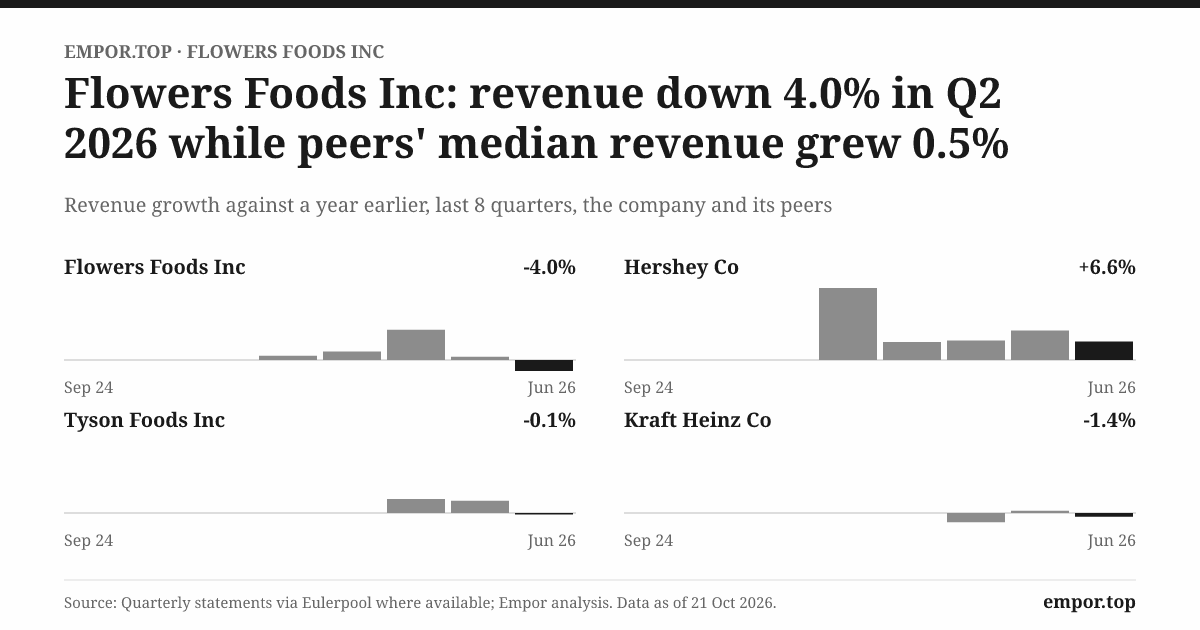
Flowers estimated Simple Mills' retail sales at about $283 million in fiscal 2025, which suggests continued growth.4 Management also said Simple Mills would have a record year of innovation in 2026, with 13 new items.8 But once the deal lapped its anniversary, Flowers' total sales fell 4.0% in the second quarter of 2026.14 Whatever Simple Mills added, it was not enough to offset the bread decline.
This is the core tension of the deal, and it is worth stating plainly. Simple Mills is a credible business in an attractive category, and the Dave's Killer Bread precedent shows Flowers can build an acquired brand. But Simple Mills is still small next to a company with more than $5 billion of sales; even its retail sales are only about 5% of Flowers' revenue.
It cannot carry the whole company, and the debt used to buy it now weighs on a business whose core is shrinking. The test going forward has three parts: whether Simple Mills keeps growing, whether Flowers discloses enough to show that growth translates into profit, and whether the goodwill and trademarks on its books survive their annual impairment tests. Growth alone will not be enough if it fails to earn back the cost of the capital.
There is also a lesson in the timing. Flowers bought a growth brand at a growth price just as its own bread volumes were starting to fall faster. When the core business weakened through 2025 and 2026, the debt from the deal left the company with less room to respond. The next question is the one that analysts kept asking on every earnings call: why did the bread aisle stop growing, and what is Flowers doing about it?
V. When the promised growth did not show up in the bread aisle
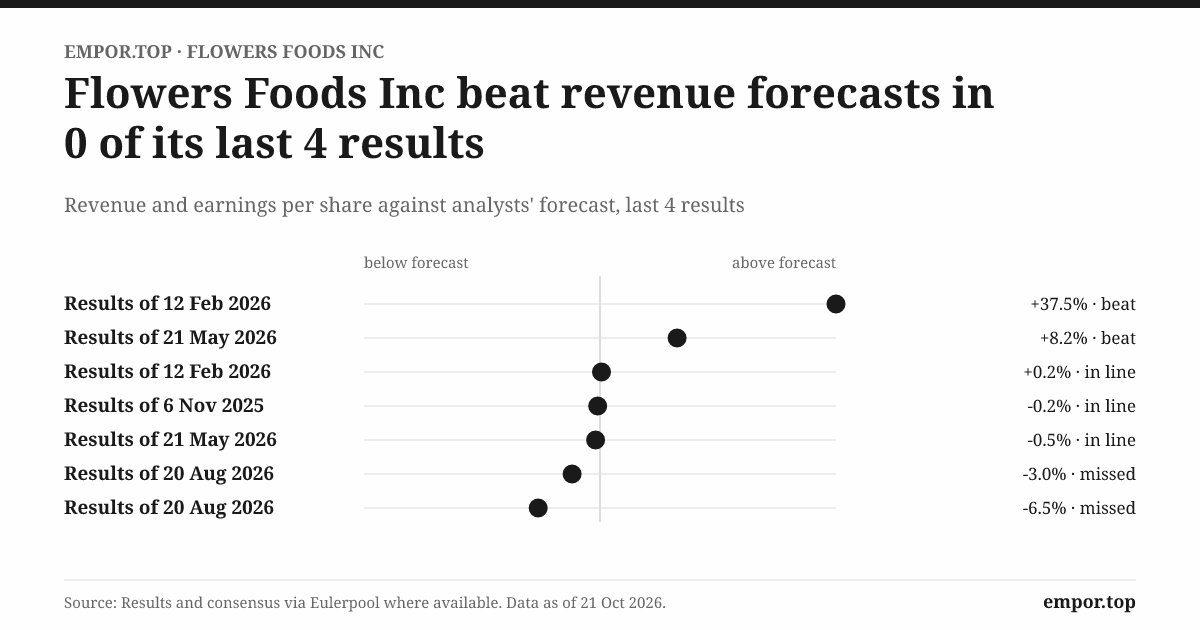
On the morning of August 21, 2026, McMullian opened the second-quarter call with an admission that did not leave much room for interpretation. "Our second quarter results did not meet our expectations," he said, citing pressure on household budgets, shifting consumer preferences and "sustained competitive activity."3 The day before, the company had cut its full-year sales guidance to between about $5.07 billion and $5.14 billion, a decline of 2.2% to 3.5%, down from a range that had previously allowed for roughly flat sales.14 Adjusted earnings guidance came down too.14 In the second quarter, volume across the company fell 5.8%, and in branded retail, the heart of the business, it fell 7.6%, offset only partly by price and mix that rose 3.8%.14
The analysts' questions came in from several directions, but they kept circling the same problem. Steve Powers of Deutsche Bank noted that even the low end of the new guidance implied improvement in the back half that the category was not providing. "It sounds like you're expecting your own standing versus the category to improve," he said, and asked what would drive it.3
McMullian named three things: "some pretty significant new business wins" coming in the back half, additional cost savings on top of "the roughly $200 million we've taken out of the business over the last several years," and innovation.3 Then he said the most candid thing anyone said on the call: "the speed of the shift in consumer preferences, frankly, got a little bit ahead of our innovation pipeline."3
To see how Flowers reached that point, step back from the quarterly noise and look at the long-run record. Over the ten years to fiscal 2025, revenue grew about 3.4% a year, from roughly $3.8 billion to $5.3 billion.4 Over the same decade, operating profit shrank about 5.2% a year, and net profit fell from $189 million to $83 million.4 A company that sells more every year but earns less is not running in place. It is going backward, and acquisitions and price increases have been doing the work of hiding it.
The decline was not a straight line, and the turning points explain a lot. The pandemic pushed Americans back into their kitchens in 2020, and sales rose more than 6% that year.4 Then came the 2022 and 2023 input-cost cycle, when wheat, oil and energy prices surged. Flowers raised prices sharply, by mid-teens percentages in 2022 according to one analyst's model, and revenue climbed 11% that year.34 But margins were squeezed anyway, and operating margin fell to 3.4% in fiscal 2023.4 Prices stayed high after costs settled, which supported revenue but tested consumers' patience. By 2025, volumes were weakening, and by 2026 they were falling fast.
McMullian has been chief executive since May 2019, so the full arc belongs to his tenure. He is a lawyer by training who worked at the global firm Jones Day before joining Flowers, and he rose through the company's legal department, then through mergers and acquisitions, strategy and operations, becoming chief operating officer in 2018 and chief executive the following year.7 He added the chairman's title in May 2023.7 That background shows in his strategy.
McMullian is a portfolio thinker: his playbook has been to shift Flowers toward premium and better-for-you brands, buy growth where Flowers lacked it, and take cost out of the system. Under him, revenue rose from about $4.1 billion in 2019 to $5.3 billion in 2025, helped by pandemic demand, pricing and acquisitions. Operating profit fell from about $225 million to $174 million over the same period.4 The top line did what he promised. The bottom line did not.
How did management explain the decline? Across three calls in 2026, the explanations shifted in ways that tell investors something. In February, the company's guidance assumed the category would fall about 4% for the year, and management expected Flowers to offset much of that by gaining share through innovation and marketing.8 In May, McMullian attributed the volume weakness partly to price gaps that had grown "a bit wider than we would like" after the company raised prices, and to a deliberate pullback in promotions while the company saved its "dry powder" for a big brand relaunch.13
He said that in channels where the price gap narrowed, share was already improving, and the company reaffirmed its guidance.13 By August, the story had moved to portfolio gaps: half loaves, sourdough, protein and fiber.3 Each explanation was reasonable in isolation. But share gains promised in February did not arrive, the reaffirmation in May was reversed in August, and the cause shifted each time. That pattern is not dishonest. It is a sign that management was learning about its own business as it went.
The most interesting answer on the August call came when Mitchell Pinheiro of Sturdivant asked why Dave's Killer Bread, the company's star, was also losing units. McMullian pointed to sourdough. "That subsegment of the category has already grown to be a $1.3 billion subcategory," he said, and Dave's sold sourdough only on the West Coast.3 It is a revealing admission.
The company's premium brand had missed one of the biggest shifts in premium bread, in part because Flowers had not rolled out the product nationally. When asked directly whether volume declines would moderate in the third quarter, Scaglione declined to break it out. He said sales would be down year over year in the third quarter, with "a little bit more stabilization" in the fourth "as the new wins get more fully ramped."3
The flagship response to all this is the Nature's Own relaunch. In spring 2026, Flowers reformulated the brand, cutting about a third of its ingredients, earning non-GMO verification and positioning it, in McMullian's words, as "the cleanest label traditional loaf brand at scale in the country."13 The company backed the relaunch with a full marketing campaign starring the actor and former wrestler John Cena, launched in May.13 By August, McMullian said early feedback from customers and social media was good, but "it's a little bit too early to see the actual results read through."3 In the earnings release, the company noted that the relaunch had not yet meaningfully contributed to results.14
That leaves the relaunch where it belongs: as a hypothesis to test, not a result to celebrate. The same is true of the innovation pipeline. Half loaves, sourdough and protein products are aimed squarely at where consumers have moved, and the logic is sound; McMullian has argued that small loaves fit smaller households and a desire to waste less, not just tight budgets.8 But the products were arriving in the back half of 2026 and into spring 2027, after the share had already been lost.3 The question is whether Flowers can win back shelf space with them, or merely slow the loss.
The company has also reinvested and retrenched at the same time. Capital spending was about $127 million in fiscal 2025, roughly 2.4% of sales,4 and Flowers guided to $115 million to $125 million for 2026.14 A multi-year rollout of a new enterprise resource planning system, the software that runs ordering, production and finance, began in 2023 and is expected to finish in 2027.4 On the other side of the ledger, Flowers closed bakeries in Phoenix in 2022, Baton Rouge in 2024 and on Bailey Street in Atlanta in 2025.4
In the second quarter of 2026, it launched a corporate workforce reduction and recorded about $6 million of severance, part of $13.8 million of restructuring-related costs so far that year.1014 Scaglione said the cost actions taken after the first quarter would provide a tailwind of about $20 million going into 2027.3 McMullian said the formal comprehensive review, announced in February, was finished and now being executed.3
Not all of Flowers' sales go to supermarket shelves under its own labels. About a third of second-quarter revenue came from what the company reports as its other business, which includes sales to restaurants, institutions and other away-from-home customers as well as store-brand and non-branded products. Those sales fell 4.4% in the quarter, with volume down 3.4% and price and mix also lower.14
When analysts asked where the promised new business would land, Scaglione said it was "balanced" between the away-from-home business and branded retail, with some arriving in the third quarter and some in the fourth.3 Earlier in the year, McMullian had said the profitability work done in foodservice over several years had made that business "quite a bit better" even as restaurant traffic softened.13 The company has not named the customers behind the new wins or sized them. That makes them a promise investors can only check after the fact, in the sales line.
What should a listener take from this? Flowers has correctly identified the gaps: the shelf has moved to smaller loaves, sourdough and protein, and the company was underweight in all of them. It is acting, with a relaunched flagship, new products, cost cuts and new business wins. But those actions are not yet evidence of a turnaround.
The long-run record shows that revenue growth at Flowers has not translated into profit growth, and the specific promises of 2026 have shifted from quarter to quarter. The real proof will come in the third and fourth quarters: whether the new business arrives, whether volume declines moderate, and whether the relaunch shows up in share. Until then, the company's best defense is one that does not depend on shoppers at all. Flowers, for all its troubles, still turns its earnings into cash.
VI. The cash keeps coming; where does it go?
Fiscal 2025 ended on January 3, 2026, and the income statement looked grim. Net profit had collapsed to $83 million, down two-thirds from the year before.4 The fourth quarter alone showed a loss after the trademark write-down. Yet the cash flow statement told a different story: Flowers generated $446 million of cash from operations that year, more than five times its reported profit and one of the strongest cash years in its recent history.4 Anyone who looked only at earnings would have concluded the business was falling apart. Anyone who looked only at cash would have concluded it was doing fine. Both were partly right.
The gap between profit and cash is not a trick, but it needs explaining. A bakery network is full of expensive machinery and buildings that wear out slowly, and accounting spreads their cost over many years as depreciation. That charge reduces reported profit without any cash leaving the building in that year. In 2025, depreciation and amortization came to about $165 million.4 On top of that, the $136 million trademark impairment was a non-cash charge: it wrote down the value of brands Flowers had bought years earlier, but it did not cost a dollar of cash in 2025.4
Add $23 million of stock-based compensation and a plant-closure write-down, and more than $320 million of the gap between profit and cash is explained by charges that reduce earnings but not the bank balance.4 Flowers also benefits from fast-moving working capital. Bread is sold within days of baking and paid for within weeks, so the company does not need to tie up much cash in inventory or receivables.
Over the long run, the pattern holds. From fiscal 2014 through fiscal 2025, Flowers produced about $4.3 billion of operating cash flow against about $2.0 billion of cumulative net profit, so cash came in at more than twice reported earnings.4 That is the single most important thing the bulls have in their favor. Flowers is not a company whose profits exist only on paper.
But follow the money and the picture gets more complicated. Over those twelve years, after subtracting capital spending, Flowers generated about $2.9 billion of free cash flow.4 It paid out about $1.9 billion of that as dividends, roughly two-thirds.4 That left about $1.0 billion. In the same period Flowers spent about $275 million on Dave's Killer Bread and about $792 million in cash at closing on Simple Mills, more than $1 billion on those two deals alone, before Papa Pita and smaller purchases.174
The math is simple. Dividends took most of the free cash, acquisitions took more than the rest, and borrowing filled the hole. Total borrowings rose from about $0.8 billion at the end of fiscal 2014 to about $2.1 billion at the end of fiscal 2025, while cash on hand barely moved: Flowers ended fiscal 2025 with about $12 million in the bank, only $3.6 million more than it held twelve years earlier.4 The company ran lean on purpose, sweeping every spare dollar into dividends, deals or debt repayment.
The dividend deserves its own moment, because it was the thing that defined the stock. For years, Flowers raised its payout every year, a record that ran 23 consecutive years before the reset.1 But the dividend grew while profits did not. In fiscal 2014, Flowers paid out about 58% of its net profit. By 2019, it was paying out almost all of it, and in three of the last six years it paid out more than it earned.4
In fiscal 2025, Flowers paid about $209 million of dividends against $83 million of net profit, a payout ratio of 252%.4 Even measured against cash, the dividend consumed about two-thirds of 2025's free cash flow. In February 2026, an analyst from BNP Paribas asked directly why management had not cut the dividend already, given a payout far above 100% of guided earnings and leverage near the company's bank covenant. The CFO said the dividend was under review in light of the capital structure and "the bank covenant."8 Three months later, it was halved.
The reset changes the math in a specific way. Halving the payout frees roughly $100 million to $112 million a year, depending on how it is measured; management said the cash would go toward debt reduction and targeted leverage below three times EBITDA by the end of fiscal 2027.1318 In the first half of 2026, Flowers paid about $24 million less in dividends than a year earlier and repaid a net $70 million of debt.14 That is progress. It is also slow, relative to a debt load of roughly $1.7 billion in long-term borrowings.14
The balance-sheet step-up from the Simple Mills deal is visible in every ratio, including debt-to-equity, which remained elevated in fiscal 2025.4 Moody's calculated gross debt at about 3.6 times EBITDA for the twelve months ending July 18, 2026, and expected it to stay in the mid-3x range through 2027 despite repayments.18 Net interest expense was about $59 million in 2025, and Flowers guided to $65 million to $70 million for 2026.414 Those numbers are manageable for a business generating several hundred million dollars of operating cash. They are less comfortable for a business whose EBITDA is falling, because leverage gets worse even if debt stays flat.
The refinancing question, which loomed over the stock through early 2026, has largely been answered. In April 2026, Flowers arranged a $400 million delayed-draw term loan, agented by Wells Fargo, specifically to repay the 3.5% notes due in October 2026.19 The loan matures three years after it is drawn, can be prepaid, and charges interest at a margin over SOFR that rises as leverage climbs or ratings fall.19 At the same time, Flowers amended its $500 million revolving credit facility.194 One detail in that agreement deserves attention.
Both facilities carry a maximum leverage covenant of 3.75 times and a minimum interest coverage test of 4.5 times, but both also include a "covenant holiday" running through the fiscal quarter ending October 9, 2027.19 In February, an analyst had warned that Flowers was at risk of tripping that 3.75 times limit.8 The April deal suspended the test instead. Refinancing the maturity is no longer the open question. Its cost, and the pace at which leverage comes down before the holiday ends, are.
Two smaller items round out the picture. Part of the Simple Mills consideration depends on Flowers realizing certain tax benefits from the deal, which means a portion of the price is still flowing to the sellers over time.4 And the company disclosed in mid-2026 that it was reviewing about $102 million of spare-parts inventory for possible obsolescence, with write-downs reasonably possible.10 Neither changes the investment case on its own. Both are reminders that a business this asset-heavy carries quiet balance-sheet items that can turn into charges.
So the cash is real, but it is not a safety net. Flowers has always turned profit into cash, and that conversion is why the business survived a decade of falling profits without a crisis. But the cash has been committed, year after year, to a dividend that outgrew earnings and to acquisitions that outgrew free cash. The question now is whether the people who made those choices can be trusted to make better ones.
VII. A dividend cut does not settle the credibility question
On May 29, 2026, a week after the dividend reset, Flowers shareholders gathered for the annual meeting. The agenda was routine: elect directors, approve executive pay on an advisory basis, ratify the auditor. The circumstances were not. The share price had fallen sharply over the previous year, the dividend had just been halved, and Moody's already had the company's rating on a negative outlook.18 George Deese, the former chairman who had spent 61 years at Flowers, was retiring from the board.7 It was, in a quiet way, the end of an era.
Shareholders used their votes to send a message. The advisory say-on-pay proposal drew about 23.5 million votes against and 9.9 million abstentions, meaning roughly a fifth of votes cast did not support the pay package.20 A year earlier, more than 96% of shares voted had supported it.7 McMullian himself, standing for re-election as a director, drew about 20.6 million votes against and 8.4 million abstentions.20 Sterling Spainhour, a director who had joined the board in October 2025, drew about 29.9 million votes against.207 None of these votes came close to defeating anyone. But for a company whose shareholders had historically been loyal and quiet, the dissent was notable.
Look at what the pay package rewarded. McMullian's total reported compensation for 2025 was about $7.8 million, in a year when the company earned $83 million.74 But reported pay includes stock awards valued at the grant date, and the stock kept falling. The proxy's "compensation actually paid" figure, which marks those awards to the current share price, was negative $1.4 million for 2025.7 In other words, the value of the CEO's equity fell by more than his salary and bonus combined.
That is alignment of a painful kind: McMullian lost money alongside shareholders. Long-term awards are split 30% time-based restricted stock and 70% performance shares, and the performance shares are judged half on return on invested capital and half on total shareholder return.7 Adjusted EBITDA is also used as a measure in the company's incentive program.3 Those are reasonable metrics. They also mean that a debt-funded acquisition that lifts adjusted EBITDA can help pay outcomes even if it hurts returns on capital.
Ownership tells a related story. McMullian beneficially owned about 1.57 million shares, less than 1% of the company.7 Directors and executive officers as a group held about 7.2%, but much of that was associated with Deese, who held about 3.1 million shares on his own.7 The largest outside holders were index and institutional funds: BlackRock held about 8.7% and Fuller & Thaler about 6.1%.7 With Deese leaving the board, the company's remaining insiders own a modest stake. Their incentives run through pay packages more than through personal wealth tied up in the stock.
There is one governance detail that sometimes worries investors in family-rooted companies, and it is worth settling quickly. Flowers has no controlling parent, no related-party royalty arrangements and no affiliate sales to disclose. Its related-party transactions in 2025 consisted of two employment relationships: Deese's son-in-law worked as a bakery plant manager and earned about $296,000, and the son-in-law of the former CFO worked as an associate general counsel and earned about $205,000.7 Both were non-executive employees and the board approved both.7 Together they totaled about $500,000. That is a governance footnote, not an earnings driver.
The deeper credibility question is about capital allocation. When Flowers announced Simple Mills in January 2025, it said it was committed to its investment-grade rating.6 In February 2026, the CFO repeated that the company recognized "the benefit of the investment-grade rating."8 Seven months later, the rating agencies moved Flowers below investment grade. Moody's cut its senior unsecured rating from Baa3 to Ba2 in September 2026, citing slower-than-expected deleveraging after the Simple Mills acquisition and continued weakness in fresh packaged bread.18 Fitch cut Flowers to BB+ from BBB- days later, citing "pronounced volume headwinds" and leverage it expected to stay in the mid-3x range through 2027.2 The company had made a specific promise and then failed to keep it.
Seen fairly, that failure did not come from recklessness alone. The deal's projected leverage of 3.1 to 3.3 times was already close to the edge of investment grade when Flowers announced it.6 What pushed the company over was the bread business: EBITDA fell faster than management expected, so the same debt became a heavier load. But that is the point. A company whose core was already weakening chose to borrow for an acquisition that left it with little margin for error, and then the error came.
Management deserves credit for the corrective steps. It launched a comprehensive review of the brand portfolio, supply chain and financial strategy in February 2026 and said by August that the formal review was complete.83 It brought in a new CFO, Anthony Scaglione, formerly chief financial officer of Total Wine & More, the ODP Corporation and ABM Industries, who took over on January 1, 2026, after the retirement of longtime CFO Steve Kinsey.7
It cut the dividend, cut corporate staff and pushed profit-and-loss responsibility for the delivery business back down to regional leaders, which McMullian described as putting "the right people in the right places."8 Those are the moves a board would want from a team facing a downturn. But they address financial flexibility. They do not yet show that demand for Flowers' core bread has recovered, or that the capital spent on Simple Mills is earning its keep. Credibility will come from results against the new targets, especially the goal of leverage below three times by the end of 2027.13
VIII. Analysis & Bear vs. Bull Case
At $5.80 a share, Flowers was worth about $1.2 billion on the stock market in October 2026. Add its debt and the enterprise value was about $3.2 billion.54 That ratio is the first thing to understand about the stock today. Roughly two-thirds of the company's value belongs to its lenders. The shareholders hold a thin slice on top, which is why small changes in the business produce large moves in the share price.
If the total value of Flowers rose by 10%, the equity would rise by more than a quarter. If it fell by 10%, the equity would fall by the same outsized amount. A decade ago Flowers was a sleepy dividend stock. Its capital structure has turned it into a leveraged bet on whether bread volumes stabilize.
The investment spine is simple to state. Flowers wins if it uses route density, its leading brands and a wave of new products to stabilize its share of the bread shelf, integrates Simple Mills into a growing better-for-you business, and pays its debt down. It loses if private-label substitution and the shift toward sourdough, small loaves and protein keep its volumes falling faster than price increases and cost cuts can offset. Everything else is detail.
The bull case has real evidence behind it. Flowers has more than a century of baking behind it and is the second-largest packaged-bakery company in the country.4 Its brands lead in sandwich bread, organic bread and gluten-free bread, and it reaches most of the American population through a fresh-delivery network that would be enormously expensive to replicate.49 It has a long record of turning reported profit into cash, at more than twice its net earnings over twelve years.4 It has shown, with Dave's Killer Bread, that it can buy a premium brand and grow it without breaking what made it special.17 And management has identified the right gaps and is moving to fill them, with a relaunched Nature's Own, new formats and new business wins.
The bear case also has real evidence. Operating profit has fallen about 5% a year for a decade, even as revenue grew.4 Flowers lost more than a point of dollar share in fresh packaged bread through 2025.12 Unit volumes fell at an accelerating rate into the second quarter of 2026.2 Margins halved in fiscal 2025, and net profit for the latest twelve months was about $57 million.4 The Simple Mills deal added debt just before the core weakened, and the company lost its investment-grade rating at Moody's and Fitch despite promising to keep it.182
Two newer pressures sit on top of the old ones, and both work through the same mechanism: fewer loaves per household. Flowers itself lists health trends and the continued reduction of purchases in fresh packaged bread among the risks to its business, and the growing use of GLP-1 weight-loss drugs adds a structural question mark over how many carbohydrates American households will buy in the years ahead.3 The second pressure is closer to the checkout.
In February 2026, an analyst asked how cuts to the federal SNAP food-assistance budget would affect the year. The CFO acknowledged lower purchases made with SNAP benefits and pressure on lower-income households, but said the company does not break out the effect.8 Neither pressure is likely to sink a business this size on its own. Both make it harder for the core loaf to stop shrinking, which is the one thing the bull case needs most.
Now run the strategic frameworks honestly, because they sharpen the verdict. The industry forces, sketched in the shopper's three seconds at the bread wall, are unforgiving: strong buyers, intense rivalry, free substitution. The question is which of Hamilton Helmer's seven sources of lasting advantage, if any, Flowers can claim. Scale economies are its strongest candidate. Route density lowers the cost of each delivery, and a national bakery network spreads overhead across billions of loaves. But scale economies work in reverse when volume falls, and the 2026 results show exactly that: fixed costs spread over fewer units. Branding is the second candidate. Nature's Own and Dave's Killer Bread are trusted names that shoppers recognize.
But a brand only confers power if it lets the owner charge more without losing customers, and Flowers' 2026 experience, when price gaps widened and volume fell, suggests that power is limited in traditional loaf, though stronger in organic and gluten-free. Switching costs are essentially zero for both shoppers and retailers. Network economies do not apply; one more shopper buying Nature's Own does not make it more valuable to the next.
Counter-positioning, cornered resources and process power are hard to argue: the DSD model is a form of process know-how, but Bimbo runs a similar system, and the legal challenges to it are a vulnerability, not a fortress. The verdict is that Flowers has real but partial scale economies and genuine but niche branding power. That is a defensible business, not a moat.
Valuation reflects that. On enterprise value to EBITDA, Flowers traded at about 8.9 times in October 2026.5 Other large packaged-food companies, such as Campbell's, General Mills and Conagra, traded at roughly 9.5 to 11 times on similar measures, while Grupo Bimbo, the closest pure bakery peer, traded at about 7.8 times. Flowers sits between them: cheaper than diversified food giants, slightly more expensive than its largest bakery rival. Its price-to-book ratio is about 0.9 and its price-to-sales about 0.2, numbers that look cheap until you remember that book value includes almost $900 million of goodwill and intangibles from Simple Mills and that sales are falling.4 The market is not pricing Flowers as a bargain. It is pricing it as a business whose earnings may keep shrinking.
The cash yield needs particular care. On fiscal 2025 free cash flow of $319 million and the depressed $1.2 billion equity value, Flowers shows a free-cash-flow yield of about 26%.4 That number is real arithmetic, but it overstates what shareholders can expect. Fiscal 2025's operating cash was unusually strong, and 2026 EBITDA guidance is lower.14 Moody's projects free cash flow of roughly $100 million to $125 million in each of 2026 and 2027 on its own measure.18 Interest costs are rising, and the company has committed its spare cash to debt repayment rather than shareholders. A 26% yield on last year's cash is not a 26% yield on next year's.
If an activist investor bought a stake today, the questions would be pointed. Why does Flowers report as a single segment when its premium brands, its traditional loaf business and Simple Mills have such different economics? Separate disclosure would show investors which parts of the portfolio earn their capital. Why did the board approve a debt-funded acquisition when the core was already weakening, and what has the company learned? Should the two regional brands written down in 2025, and other underperforming assets, be sold rather than kept on limited use? Management has said divestitures are possible but that "nothing concrete" is on the table.8 An activist would push for an answer.
For anyone following the story, three numbers matter more than the rest. The first is fresh-bread unit volume and dollar share: units fell 9.5% in the second quarter of 2026, and dollar share was about 15.6% at the end of 2025, both moving the wrong way.212 The second is operating margin, which was 3.3% in fiscal 2025 and 5.7% in the second quarter of 2026, down from a year earlier.414 The third is net debt to EBITDA, together with free cash flow after dividends: Moody's put gross leverage at 3.6 times in July 2026, against management's goal of below three times by the end of 2027.1813
The decisive next evidence will come in the third-quarter results and the fiscal 2026 annual report. Investors will see whether volume declines moderated, whether share stabilized, how much Simple Mills contributed, what the refinancing actually cost, and whether debt fell. Those numbers will settle much more than any framework can.
IX. Lessons from a loaf on every route
Picture a single Flowers route on an ordinary morning. In the back of the truck are three generations of the company's strategy. There is Wonder, the white bread rescued from Hostess's bankruptcy. There is Dave's Killer Bread, the organic loaf bought in 2015 that became the company's second-largest brand. And there is a case of Simple Mills crackers, the snack brand bought with borrowed money in 2025. All three are going to the same store. Each one carries a lesson.
The first lesson is that a daily staple can still lose its place on the shelf. Bread is the purchase shoppers make without thinking, and that habit is exactly what made Flowers seem safe. But habits change at the edges, and the edges add up. Sourdough grew into a $1.3 billion subcategory while Flowers sold it only on the West Coast.3 Shoppers moved to half loaves, protein breads and cheaper brands while Flowers' share slipped. A product people buy every week is not the same as a product people buy from you every week. For Flowers, ubiquity was never loyalty.
The second lesson is that cash is real, but the story around it still needs testing. Flowers turned its profits into cash at twice the rate of reported earnings for twelve years, and that is a genuine strength. But in fiscal 2025, much of the gap between profit and cash came from a $136 million trademark write-down and the slow wear of an asset-heavy network.4
An impairment adds back to cash flow precisely because it records money that was spent long ago and will not come back. And cash generation did not translate into balance-sheet safety, because the company spent it faster than it came in. Strong cash conversion tells you a company is honest about its earnings. It does not tell you the company is wise about spending them.
The third lesson is that a brand portfolio is a portfolio of promises. Dave's Killer Bread kept its promise; the brand Flowers bought for $275 million now sells about $1.2 billion a year at retail.174 The two regional brands written down in 2025 did not. Simple Mills, at about $848.6 million of total consideration, is the newest and the most expensive promise, and its fate will be decided by whether its growth earns back its price. Every acquisition looks like Dave's on the day it is announced. Some years later, it looks like either Dave's or the write-down.
The fourth lesson is that a dividend is a choice, not a moat. For 23 years, Flowers raised its payout, and the rising check became part of the company's identity.1 But the dividend kept growing as profits shrank, until it was more than two and a half times earnings. When the business weakened, the dividend did not protect anyone. Cutting it protected the company and its lenders. Investors who bought Flowers for its yield learned that a dividend tells you what a board is willing to pay, not what a business can afford.
X. Epilogue
On the night of October 21, 2026, Flowers Foods stands at a junction. The $400 million bond maturity that hung over the company all year has been handled through the term loan arranged in April.19 The dividend is reset at $0.50 a year.1 The comprehensive review is finished and being executed. The Nature's Own relaunch is five months old. Moody's and Fitch have moved Flowers into high yield and expect its leverage to stay in the mid-3x range through 2027.218 And the company has told investors to expect fiscal 2026 sales of about $5.07 billion to $5.14 billion, lower than a year earlier.14
The next moments that matter are clear. The third-quarter results will be the first test of the August promises. The CFO said sales would still fall in the third quarter, so a decline alone will not be news. What will be news is the shape of it: whether unit volume declines moderate from the 9.5% drop in fresh bread, whether dollar share holds, and how much of any improvement comes from real gains rather than easier comparisons with a weak prior year. The fourth quarter is where management said the new business wins would "more fully ramp" and where the company would begin lapping its late-2025 price increases.3 If those wins arrive and volume stabilizes, the August guidance cut will look like the bottom. If they do not, it will look like the first of several.
The fiscal 2026 annual report, due early in 2027, will carry the year's most important disclosures. It will show the annual impairment tests on Simple Mills goodwill and trademarks; a write-down there would be a direct verdict on the acquisition. It will show whether Walmart's share of sales rose again and how gross margin held up. And it will show how much debt Flowers actually repaid, set against a leverage covenant holiday that ends in October 2027.19 The company needs to be well below that 3.75 times limit by the time the test returns.
Investors should also watch what management says, and how. The 2026 calls shifted from share gains in February, to pricing gaps in May, to portfolio gaps in August. The next call will reveal whether that story has finally settled, whether management can point to specific new business that arrived, and whether it explains any misses with measurable evidence or with a fresh set of reasons. A management team regaining credibility explains a miss once, precisely, and then fixes it.
Each of the four central questions now has a test. On volume, the test is whether fresh-bread units stop falling. On the moat, it is whether share and price hold as the relaunch and new products reach shelves. On Simple Mills, it is whether the goodwill survives and whether Flowers discloses enough to judge its return. On management, it is whether leverage falls toward three times while the business stabilizes. The maturity has been bridged. The recovery has not been demonstrated.
XI. Outro
Go back to the morning of May 21, 2026, the day the dividend was halved. The bakeries ran anyway. The trucks left the docks before dawn, the distributors stocked the shelves, and somewhere a shopper picked up a loaf of Nature's Own without knowing anything had changed. That is the strange resilience of Flowers Foods. Its product is too ordinary to disappear, and its route network still reaches more than 85% of the country every week.9
But the loaf moving down the route now carries a question it did not carry a decade ago. In the second quarter of 2026, 9.5% fewer of those loaves found a buyer than a year earlier.2 Flowers built one of the best systems in America for keeping bread on the shelf. The harder work, the work that will decide this story, is keeping people reaching for it.
References
-
Q1 2026 Results Press Release and Dividend Reset (Form 8-K Exhibit 99.1) — Flowers Foods / SEC, 2026-05-21 ↩↩↩↩↩↩↩
-
Fitch Cuts Flowers Foods Rating to BB+ on Volume Pressures — Investing.com, 2026-09-16 ↩↩↩↩↩↩↩
-
Q2 2026 Results Q&A Transcript — Flowers Foods, 2026-08-21 ↩↩↩↩↩↩↩↩↩↩↩↩↩↩↩↩↩↩↩↩↩↩↩
-
Form 10-K for the Fiscal Year Ended January 3, 2026 — Flowers Foods / SEC, 2026-02-25 ↩↩↩↩↩↩↩↩↩↩↩↩↩↩↩↩↩↩↩↩↩↩↩↩↩↩↩↩↩↩↩↩↩↩↩↩↩↩↩↩↩↩↩↩↩↩↩↩↩↩↩↩↩↩↩↩↩↩↩↩↩↩↩↩↩↩↩↩↩↩↩↩↩
-
Flowers Foods to Acquire Simple Mills — Flowers Foods, 2025-01-08 ↩↩↩↩↩↩↩
-
2026 Definitive Proxy Statement (DEF 14A) — Flowers Foods / SEC, 2026-04-14 ↩↩↩↩↩↩↩↩↩↩↩↩↩↩↩
-
Q4 and FY2025 Results Q&A Transcript — Flowers Foods, 2026-02-13 ↩↩↩↩↩↩↩↩↩↩↩↩↩↩
-
Form 10-Q for the Period Ended July 18, 2026 — Flowers Foods / SEC, 2026-08-20 ↩↩↩
-
Flowers Foods Aiming to Retake the Narrative in Bread — Food Business News, 2025-09-05 ↩↩↩
-
Flowers Foods Aims to Reinvigorate Nature's Own Brand — Food Business News, 2026-02-17 ↩↩↩
-
Q1 2026 Results Q&A Transcript — Flowers Foods, 2026-05-22 ↩↩↩↩↩↩↩↩↩↩↩↩
-
Q2 2026 Results Press Release (Form 8-K Exhibit 99.1) — Flowers Foods / SEC, 2026-08-20 ↩↩↩↩↩↩↩↩↩↩↩↩↩↩↩
-
Wonder Bread Owner Flowers Foods Buys Better-for-You Snack Maker for $795M — Food Dive, 2025-01-09 ↩↩↩
-
Flowers Foods Completes Acquisition of Hostess Bread Assets (Form 8-K Exhibit 99.1) — Flowers Foods / SEC, 2013-07-22 ↩
-
Flowers Foods Completes Acquisition of Dave's Killer Bread (Form 8-K Exhibit 99.1) — Flowers Foods / SEC, 2015-09-14 ↩↩↩↩↩
-
Moody's Downgrades Flowers Foods Rating on Slow Deleveraging — Investing.com, 2026-09-11 ↩↩↩↩↩↩↩↩
-
Form 8-K: $400 Million Delayed-Draw Term Loan Facility and Revolver Amendment — Flowers Foods / SEC, 2026-04-07 ↩↩↩↩↩↩
-
Form 8-K: 2026 Annual Meeting Vote Results — Flowers Foods / SEC, 2026-06-02 ↩↩↩
 LinkedIn
 WhatsApp
 Reddit
 Hacker News
 Email
 Kindle
 RSS Feed
 Spotify
 Apple Podcasts
 Amazon Music
 Audible
 YouTube