FIGS, Inc.: The Scrubs Brand That Had to Prove Itself Twice
I. A Record Quarter, With Two Asterisks
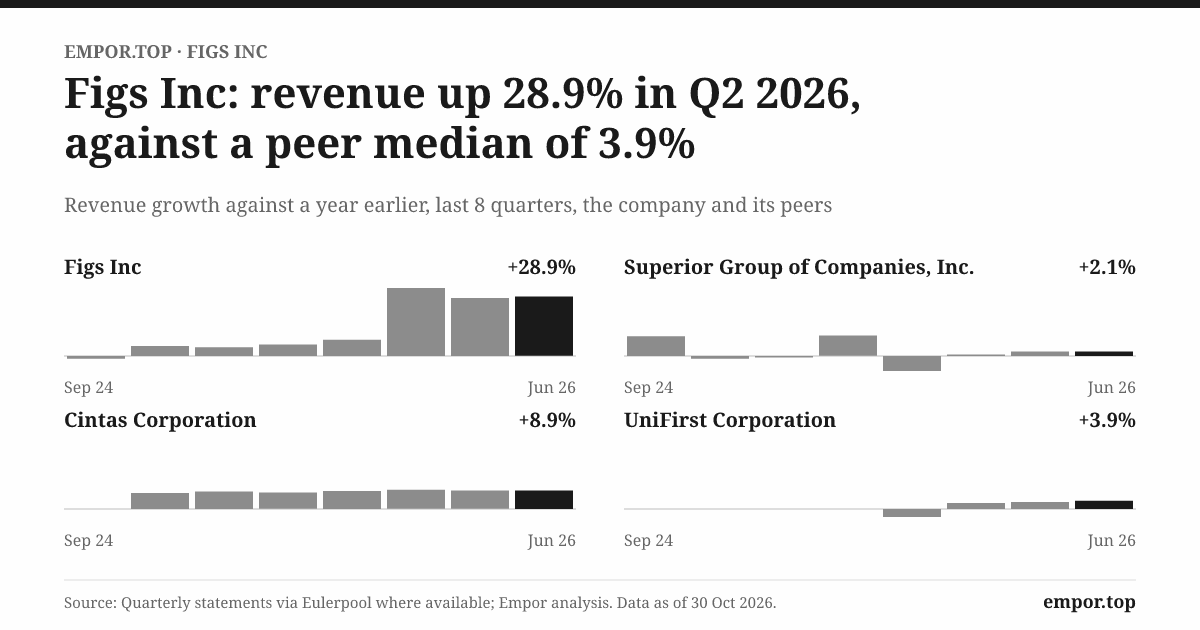
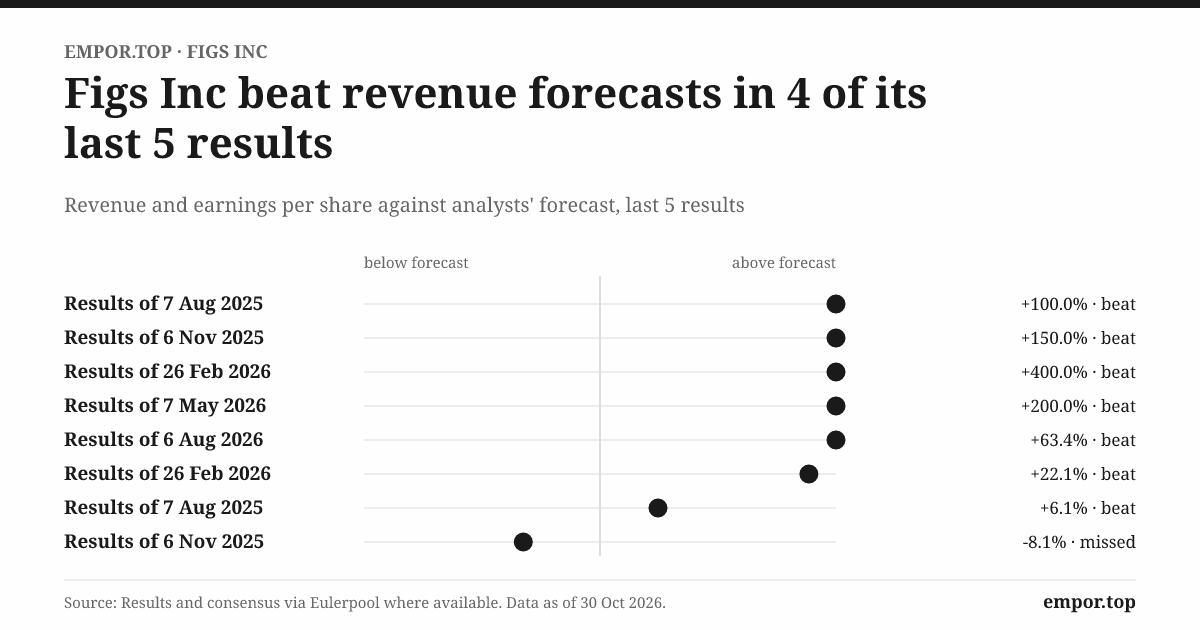
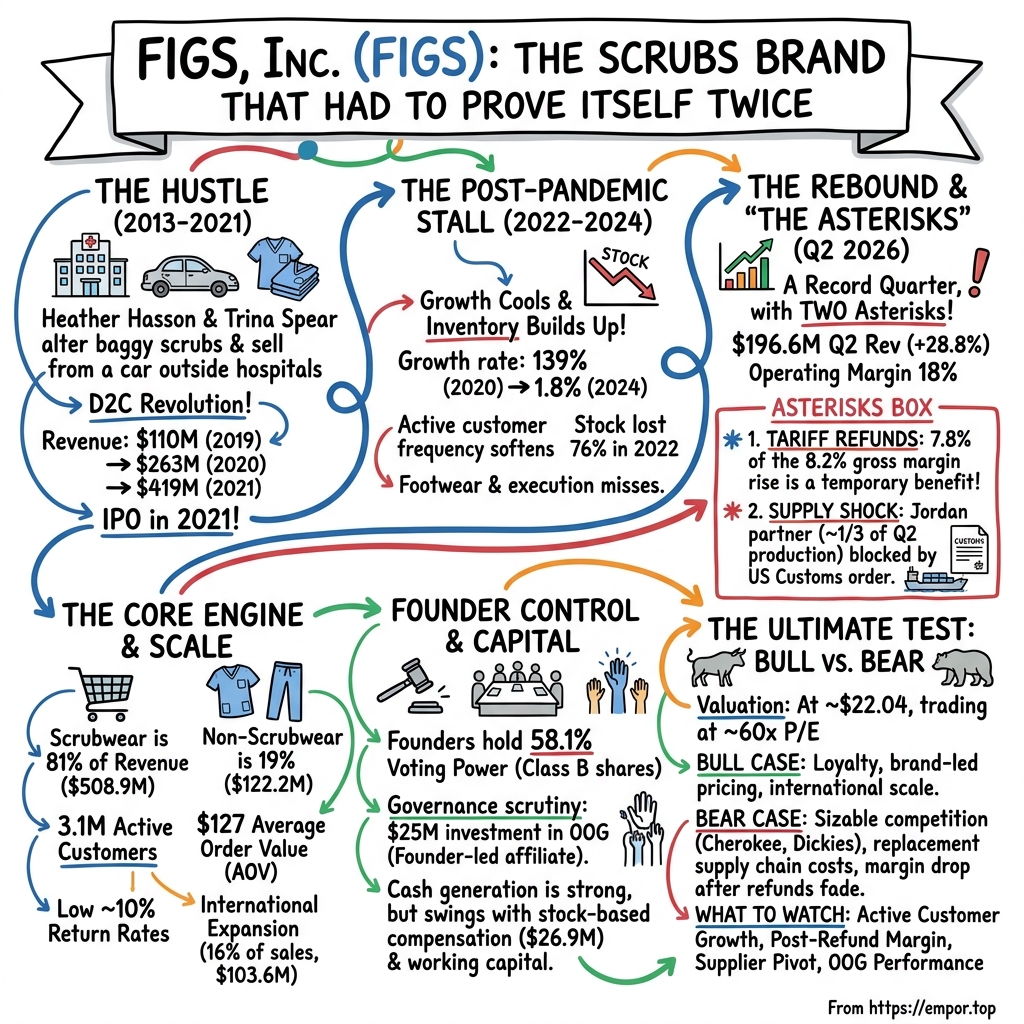
On the afternoon of August 6, 2026, FIGS told investors it had just had the kind of quarter its shareholders had been waiting nearly five years to hear about. Revenue for the three months to June reached $196.6 million, up 28.8% from a year earlier and ahead of the company's own forecast of growth "in the low 20% range."12 Operating profit came in at $35.3 million, close to 18 cents of every sales dollar, against six and a half cents a year before.1 Trina Spear, the co-founder and chief executive, called it "the strongest sustained stretch of growth we have seen since 2021," the third straight quarter in which sales had grown by a quarter or more.2
Then came the asterisks. The first sat in the gross margin, the share of each sale left after paying for the goods themselves. It jumped 8.2 percentage points, to about 75%, and 7.8 of those points came not from selling scrubs more cleverly but from the U.S. government handing money back.13 In February 2026 the Supreme Court had ruled against the tariffs imposed under the International Emergency Economic Powers Act, U.S. Customs began paying refunds in March, and FIGS booked about $20.5 million of accepted claims, including a $16 million receivable still outstanding at quarter-end that arrived in the weeks that followed.3 Strip that windfall out and the gross margin was roughly where it had been a year earlier, a little better rather than transformed.
The second asterisk pointed the other way. On June 23, 2026, U.S. Customs and Border Protection issued a withhold release order against certain garments made by FIGS' manufacturing partner in Jordan, which meant that partner's products could not enter the United States.3 That one factory group had produced about one-third of FIGS' finished goods during the quarter.3 The company warned that the order would hurt revenue, gross margin and inventory in the second half of the year, and that it might be unable, or choose not, to sell product the partner had recently finished.3
So the same results day carried three messages at once: demand was the strongest in years, the profit jump was mostly a one-time refund, and a third of the supply chain had just been cut off from the company's biggest market. The story of FIGS has always worked like this. It is a brand whose customers adore the product and whose numbers keep demanding a second look.
The stakes are easy to state. FIGS is a founder-led company with a market value of about $3.6 billion and roughly $707 million of revenue over the last four reported quarters, so investors are paying about five dollars for every dollar of annual sales.14 That price assumes something rare in apparel: that a premium brand selling a work uniform can keep its customers coming back, keep charging more than the alternatives, and turn growth into steadily higher profit. The company has tried to prove that once already. In 2021 the market believed it, then spent the following years discovering how much of the early growth had been a pandemic. Now FIGS is asking investors to believe again, and the question is whether this second proof is sturdier than the first.
The investment argument has a clear spine. The case for FIGS rests on repeat demand from healthcare workers who wear out their scrubs, on brand-led pricing that lets FIGS charge more than the uniform shops, and on operating leverage, the idea that each extra dollar of sales carries less fixed cost with it. The case against is just as concrete. Nothing locks a nurse into buying FIGS again; switching brands takes a click. A supply shock can empty the shelves of the very styles that keep that nurse loyal. And the recent profits are unusually sensitive to product mix, freight, discounts and now refunds that will not recur. To weigh those arguments, the story has to go back to where the brand began: in a hospital parking lot, with coffee and a car full of scrubs.
 Subscribe on LinkedIn
II. The Hospital Parking Lot Became a Storefront
Heather Hasson's version of the beginning starts over a cup of coffee. Hasson's friend Allison, a nurse practitioner, arrived straight from a 16-hour shift, wearing what Hasson later described as "a poorly fitting burlap sack with her size displayed in bright orange for all to see."5 The scrubs Allison wore had been bought at a uniform shop that sold "bed pans and knee braces" and closed at 5 p.m., which was not much use to someone whose shift ended at 7.5 The question Hasson took away from that meeting became the company's founding line: what about the people saving lives, and who is focused on them?5
Hasson was not a healthcare person. The future founder was a designer and serial small-business founder who had run Heather Hasson bags, a high-end handbag line, and a tie and scarf company called FIGS Ties.5 Hasson redesigned the scrubs personally, with a tailored fit, pockets in the right places and fabric that did not look like a hospital gown. What Hasson lacked was the operating and financial muscle to turn a better product into a business. That came from Trina Spear, a Tufts economics graduate with a Harvard MBA who had started out at Citigroup and then worked as an associate at Blackstone.5 The pairing was the company's first strategic decision: a product obsessive and a finance-trained operator, splitting the job between the thing and the machine that sells it.
They founded FIGS together in 2013.5 Their own account of the first year reads like a startup legend, and the details matter because they explain the business model that followed. Every morning at 7 and every evening at 7, the pair parked outside emergency rooms as shifts changed, handed tired nurses and doctors a fresh coffee, and sold FIGS out of the back of a car.5 For almost a year, they wrote, they slipped into hospital lobbies and cafeterias to do it.5 The parking lot was more than a sales channel. It was a research lab. Every sale was a conversation about what tore, what itched, what pocket held a phone and what color hid a long night. When the company moved online it kept that loop, designing its own products and selling them only through its own website rather than through the uniform shops and wholesalers that dominated the industry.5
That choice cut out a middleman and, more importantly, made FIGS the owner of the customer relationship. The incumbents largely sold through distributors and specialty stores, so they rarely knew who wore their scrubs. FIGS knew every buyer by name and order history. By the time it filed to go public, it called itself a "category-defining healthcare apparel and lifestyle brand" that had "branded a previously unbranded industry," and it described its customers, without irony, as "Awesome Humans."5 It had raised only about $60 million of outside equity between 2013 and 2020.5 The most important of those investors was Tulco, the holding company of film financier Thomas Tull, which in 2018 agreed to buy a majority stake for $20 million up front and $30 million more in payments tied to revenue targets, all of which FIGS hit.5
The numbers in the prospectus were extraordinary. Revenue climbed from about $18 million in 2017 to $263 million in 2020, a compound growth rate of 146% a year.5 It had been about $110 million in 2019, so the pandemic year alone more than doubled the business, and active customers more than doubled to about 1.3 million.5 Customers also came back: after a second purchase, 63% bought again, and after a third, 70% did.5 Returns ran at about 10% of sales, against the 30% to 40% typical of online apparel, a sign that the fit was right the first time.5 And the company was making money. In 2020 it earned about $49 million on that $263 million of revenue.56
Here is where the legend needs a footnote of its own. COVID-19 turned healthcare workers into public heroes and made scrubs the most visible uniform in the world, and FIGS leaned into the moment, including donating protective gowns and masks to hospitals.5 Demand from a workforce that was buying more uniforms, washing them harder and replacing them faster surged at exactly the moment the company was preparing to list. So the growth was real, and it was also flattered by circumstances no one could repeat. In their letter to IPO investors, the founders promised that FIGS "will still be here as the world stops clapping at 7pm."5 It was a good line. It was also an admission that the clapping would stop.
FIGS priced its initial public offering at $22 a share on the New York Stock Exchange and closed it on June 1, 2021, raising about $95 million net for the company.67 The stock opened at $28.30 and within a month touched $50.10.8 In September 2021 a follow-on offering sold nearly nine million more shares at $40.25, but every one of those shares came from Tulco and the two founders; the company received nothing.7 Revenue reached about $419 million that year, up 59%, even though stock compensation tied to the listing pushed the company to a net loss.6
The founders had found something real. Healthcare workers who bought their own uniforms had been served by functional, poorly designed products sold through tired channels, and FIGS built a recognizable brand around fixing that. What the first chapter could not prove was whether the growth rate came from the brand or from the moment. That question would get its answer quickly, and not the one the IPO buyers had paid for.
III. The Growth Story Stalled Before the Brand Did
By the end of 2022 FIGS stock had lost 76% of its value in a single year.9 By March 2023 it traded near $6, almost 90% below the summer 2021 peak.8 The easy explanation was that growth stocks everywhere had been crushed by rising interest rates, and that was part of it. But inside FIGS something more specific was happening, and it showed up in three places: the warehouse, the order book and the guidance.
Start with the warehouse. During the pandemic, ocean shipping had been so slow and unreliable that apparel companies ordered early and heavily to make sure anything arrived at all. In 2022 transit times improved, the goods arrived faster than planned, and sales came in below what the company had expected. The result was a pile of scrubs. Inventory rose 73% in 2021 and then 106% in 2022.8 Measured against its cost of goods sold, FIGS ended 2022 holding well over a year's worth of stock, more than twice the level of 2019. The excess cost money to store and, worse, to clear. Freight costs, markdowns and a shift toward lower-margin products pulled gross margin down, and a short seller, Spruce Point Capital, published a report in September 2022 accusing the company of overstating its growth prospects, margins and market size.9 Operating cash flow swung to an outflow of about $35 million that year as the company paid for goods it could not yet sell.10
Then look at the order book, because revenue alone hides what customers were doing. Active customers kept growing: up 23% to 2.3 million in 2022.8 But each customer was spending less. Net revenue per active customer slipped 1% to $221 in 2022, then fell 5% to $210 in 2023.811 The brand was still attracting new people, so the problem was not awareness. The problem was frequency. Existing customers were coming back less often.
On the call to discuss 2023, held in February 2024, Spear gave a surprisingly candid diagnosis. The company had cleared inventory through relaunches and promotional messaging, and Spear acknowledged that this "may have contributed to the lower frequency and active customer trends we're now seeing," adding that FIGS had "got away from the cohesive brand building strategy."11 Spear also pointed to the customer's wallet. Inflation was squeezing a base of buyers, "two thirds of whom make less than $100,000 a year," along with what Spear called "sustained fatigue and stress amongst healthcare professionals post-COVID."11 The CFO at the time, Daniella Turenshine, described the core business as "high margin" and "replenishment-driven."11 That phrase deserves attention. A replenishment business is one where customers rebuy as things wear out, like razor blades or printer ink. If that were fully true, frequency should be steady. The fact that frequency fell after heavy discounting suggests the replenishment cycle was real but elastic: customers could stretch it, and discounts had trained some of them to wait.
Revenue growth told the rest of the story. It fell from 139% in 2020 to under 2% in 2024.6104 Net income, about $22.6 million in 2023, shrank to about $2.7 million in 2024.104
The low point arrived on November 7, 2024. On Sarah Oughtred's first earnings call as CFO, the new finance chief joined Spear to cut the full-year outlook. The company had expected 2024 revenue to be flat to up 2%; now it expected a decline of up to 1%. The adjusted EBITDA margin, a measure of operating profit before depreciation and stock compensation, came down from 9.5%-10% to about 8%.12 Third-quarter revenue had fallen 2% when management had expected growth, and Spear called it the "trough margin quarter."12
The cut stung partly because of how the year had begun. On the February 2024 call, management had said 2023 "outperformed our expectations," with revenue up 8%, and then guided 2024 revenue to be flat to down by a mid-single-digit percentage, with an adjusted EBITDA margin of 11% to 12% that absorbed about $14 million of costs to move into a new fulfillment center.11 By the third quarter the revenue outlook had been lifted to flat to up 2%, which is what made the November reversal so jarring.12 Investors watched a company raise its forecast, then cut it, inside the same year, on problems that sat in its own product and promotion calendar rather than in the economy.
The reasons were unusually specific, which is to management's credit. Footwear was the main culprit. FIGS sells shoes designed with New Balance, and a key launch had slipped while a popular retro style ran out of stock.1210 The company had also removed footwear from its third-quarter promotion and "underestimated the impact," and it moved its back-to-school promotion later in the season, losing what Spear called "our historical brand spotlight."12 Non-scrubwear sales fell 16% in that quarter.12 When Brian Nagel of Oppenheimer pressed on whether the miss was really self-inflicted, Oughtred answered that "if we didn't have the misses in footwear and the promo, we would have met our expectations."12 Higher costs at a new fulfillment center, from labor allocation and returns processing, added to the pain, and the company built extra caution into its forecast for Black Friday.12
What happened next complicates the tidy narrative of a company that had lost its way. FIGS ended 2024 with revenue up 1.8%, above even the guidance it had issued at the start of the year, after a strong December.413 In February 2025 it forecast 2025 revenue would fall by a low single-digit percentage, partly because it planned to promote less and accepted that active customers might decline.13 Instead revenue rose 13.6% to $631 million, and fourth-quarter sales jumped 33%.414 A management team that had cut guidance in late 2024 then beat its own 2025 outlook by about 15 percentage points of growth.
Read one way, that is a recovery story. Read more carefully, it says the company's forecasting has been unreliable in both directions, which matters for anyone valuing it on next year's numbers. And the recovery was not clean. Gross margin in 2025 fell 1.1 points to 66.5%, with tariffs costing about 1.2 points and a $5.6 million write-off of aged and obsolete inventory, product that had "accumulated over a number of years," landing in the fourth quarter.415 Even in its best year since the pandemic, FIGS was still paying for guesses it had made about what customers would want.
The lesson of this stretch is about execution, not macroeconomics. Inflation and post-pandemic fatigue were real, but the record points to decisions FIGS controlled: how much to buy, when to promote, how to manage a footwear partnership and a warehouse move. That leaves the central claim, that FIGS is a brand customers keep returning to, intact but narrowed. The brand survived the bust. The growth rate did not. Which raises the question of what, exactly, a customer is buying with a FIGS order, and whether it is worth paying more for.
IV. What Does a FIGS Order Actually Buy?
Picture a respiratory therapist finishing a week of night shifts. One of the knees on a favorite pair of joggers has gone thin, a top has faded from navy to something closer to slate, and there is a wedding to attend next month that has nothing to do with work. The therapist opens the FIGS app, goes straight to a familiar style in a known size, adds two sets in a color launched that week, and, before checking out, drops a pair of compression socks and a fleece jacket into the basket. The order arrives in a few days in branded packaging. Nothing about the transaction is exotic. It is apparel e-commerce. The question this section has to answer is why that ordinary transaction has, at times, been worth a technology-company valuation.
Begin with how FIGS makes money. Almost all revenue comes from selling products through its own website and app, recognized as revenue the moment goods are handed to a shipping carrier.4 Alongside that, a business-to-business arm called TEAMS lets hospitals, medical offices and clinics place group orders for their staff, and a handful of physical stores, which the company calls Community Hubs, sell in person.4 There is no subscription, no contract and no minimum purchase. Every dollar of consumer revenue has to be won again with each order.4 That is the core fact about this business and the reason its growth can swing so sharply: FIGS has customers, not contracts.
The product mix is less diversified than the "lifestyle brand" language suggests. In 2025 scrubwear produced about $509 million, roughly 81% of revenue, while everything else, from underscrubs and outerwear to footwear and accessories, added about $122 million.4 Non-scrubwear grew about 11% that year, and in the second quarter of 2026 it accelerated to 40%, to about 18% of sales.41 That is a credible extension, especially among products worn under or over scrubs. But scrubs are still four-fifths of the business, and management conceded on the August call that non-scrubwear "does carry a lower margin."2 For now, FIGS is a scrubs company that sells some other things, not an apparel portfolio.
Now follow the dollar through an order. The cost of the garment itself, the import duty paid to bring it into the country and the freight to get it to a warehouse all land in cost of goods sold; in 2025 those absorbed about 33.5 cents of every dollar of revenue, leaving a gross margin of 66.5%.4 That is a very high gross margin for apparel, and it is the first piece of evidence for pricing power: FIGS makes its scrubs with outsourced partners at a cost that leaves two-thirds of the selling price for everything else. The everything else is substantial. Shipping orders to customers, running fulfillment centers and paying card fees go into selling expense, which ran at about 22% of revenue in the second quarter of 2026.1 Marketing took about 14.5%, and general and administrative costs, including stock compensation, about 20.5%.1 Add those up and a business with a luxury-like gross margin ends up with a single-digit or low-teens operating margin in a normal year, because it pays to deliver every order to a customer's door and to keep reminding that customer it exists.
One more ingredient matters more than it looks: time. FIGS must commit to colors, sizes and styles months before it knows what will sell, then hold that stock in warehouses. In 2025 it held about seven months of inventory measured against its cost of sales, down from the 2022 peak but still long.4 Inventory is where FIGS' cash sits while it waits for demand to show up, and where the company's mistakes turn into write-offs.
So does the brand earn its premium? The affirmative evidence is real. Active customers, defined as anyone who bought in the trailing twelve months, rose from about 2.7 million in 2024 to 3.1 million by mid-2026.41 Average order value climbed from $113 in 2024 to $127 in the second quarter of 2026, when the company raised prices early in the year and still sold more.1041 On the February 2026 call, responding to Bob Drbul of BTIG, Spear said FIGS was "seeing some demand inelasticity" after those price increases, which is executive language for customers kept buying at higher prices.15 Returns remained low, as they had at IPO.4 Revenue per active customer in the second quarter reached $229, above its pandemic-era high.1
The negative evidence is just as concrete. Every one of those customers can buy elsewhere tomorrow. FIGS names its competitors as wholesale uniform makers such as Barco Uniforms, Landau Uniforms and Superior Group of Companies, specialty retailers such as Scrubs & Beyond and Uniform Advantage, and digital brands such as Jaanuu, Mandala and Fabletics, plus large diversified apparel brands.4 Several of the older names were already selling scrubs with fitted cuts and stretch fabrics, so FIGS' original design advantage is easier to copy now than in 2013. The market is fragmented: in 2021 FIGS estimated the U.S. healthcare apparel market at about $12 billion and its own share at about 2.1%, in a study it had commissioned.5 The company has not published an updated share estimate, and it does not disclose retention by cohort, the share of revenue from repeat customers, or how sales respond to price changes, the very measures that would prove brand loyalty rather than suggest it. The cohort data in the 2021 prospectus came from the pandemic years and has not been updated in later annual reports.54
The strongest test of the brand, though, is FIGS' own record. If customers were truly locked in, revenue per active customer would not have fallen in 2023 and 2024 while the customer count kept rising, and management would not have had to explain lower frequency.1110 Brand affinity clearly existed through those years: people kept signing up and kept returning far fewer garments than the industry average. What it did not do was guarantee how often they bought or how much they paid. The history narrows the claim. FIGS has a differentiated brand with repeat appeal and some real pricing power, demonstrated by 2026's price increases. It does not have a moat in the sense of something that prevents customers from leaving.
That brings the section back to the therapist's shopping basket. The practical test for the next few years is whether FIGS can grow the number of customers and the size of each order without leaning on heavier discounts, and whether it can keep the core styles that customer reaches for every time in stock. The first half of that test now depends partly on customers in places FIGS barely served a few years ago.
V. A Brand Built Online Tries to Travel
Late in 2025 FIGS started selling in China and South Korea.15 By August 2026 it said it was serving 85 international markets, 27 of them added in the first half of the year alone.2 On the August call Spear put international first when ranking the company's growth drivers, ahead of Community Hubs and TEAMS.2 The aspiration behind all three is the same: to be the brand a healthcare worker wears both on shift and off it, whether that person works in Toronto, Sydney or Mexico City.
The numbers say international is real. Sales outside the United States grew 27.5% in 2025 to about $104 million, roughly 16% of revenue.4 In the second quarter of 2026 they jumped 67% to about $38 million, and management said more than 50 points of that growth came from markets it already operated in, not from new launches.12 That last detail matters, because opening dozens of countries can make growth look better than it is for a year or two. Growth from established markets suggests customers there are repeating, not just trying the brand once. Management also said international markets were profitable "in almost every market" apart from new entries, though it does not report margins by geography.215 Answering Nathan Feather of Morgan Stanley in August, management described a two-speed approach: "go deep" in markets where the brand already had traction, such as Canada, Australia, the United Kingdom and Mexico, while spending on broad awareness in newer markets including China, Japan, South Korea, France and Germany.2 That is a sensible sequencing, and it also means a growing share of marketing dollars is being spent where the payback has not yet been shown.
Most of this is still sold in U.S. dollars, with Canadian sales in Canadian dollars; FIGS does not hedge and has described currency effects as immaterial.4 That simplicity will not last if international keeps growing at this pace, but it is not yet a material risk.
The harder question is whether what FIGS learned in the parking lots travels. Healthcare uniforms differ by country. Some health systems buy and issue uniforms centrally; others require specific colors by role; prices and incomes vary widely. In the United States FIGS' customers largely buy their own scrubs, which is exactly what makes a direct-to-consumer brand possible. Where an employer does the buying, FIGS has to win institutions rather than individuals, a different sale with different bargaining power. TEAMS is the company's tool for that kind of buyer, and it has had wins, such as onboarding Bupa Dental Care's network of nearly 400 dental centers in the United Kingdom.2 But on the February 2026 call management described TEAMS as having only "single-digit penetration," and it does not report TEAMS revenue.15
Community Hubs deserve proportion. FIGS operated five of these stores at the end of 2025, opened New York, Houston and Chicago in the fourth quarter, and signed leases for four more, in Scottsdale, near Washington, D.C., near San Jose and in Miami, to open later in 2026.4152 Management said each store of about 2,500 square feet should pay back its cost in 24 months or less and be profitable in its first year, and it noted as early as 2024 that more than 40% of customers at its first store in Century City, Los Angeles, were new to FIGS.1511 Those are management claims; the company does not disclose hub revenue, profit or returns separately. For now the hubs are best understood as a brand and customer-service experiment, a physical version of the parking-lot conversation, rather than a second business.
The non-scrubwear push follows the same logic. FIGS added jewelry and pins in 2026 by buying V Coterie, a deal it called immaterial, and the company says its fastest-growing extras are products worn with scrubs, such as underscrubs and outerwear.2 The risk is the one that has hurt apparel brands before: every new category adds inventory bets the company has to get right, and the footwear stumble of 2024 showed what happens when it does not.
So international is a genuine growth vector, already a sixth of sales and growing faster than the core, while non-scrubwear is large enough to watch and hubs and TEAMS remain small. Proof will come from repeat purchasing and margins by geography and product, not from store openings or country counts. But in the summer of 2026, investors had a more immediate question about margins, and it had little to do with any of these initiatives.
VI. The Refund That Changed the Margin Story
The tariff money arrived in pieces. FIGS had paid about $20.6 million of duties under the emergency-powers tariffs since early 2025.3 After the Supreme Court ruled against those tariffs on February 20, 2026, Customs began processing refunds on March 4, accepted claims of about $20.5 million including interest, and by June 30 had paid roughly $4.5 million of it.3 Oughtred explained on the August call that "based on initial receipts of $4.5 million in Q2, we assessed that the recovery of the remaining claims was probable and included the full benefit in our GAAP results."2 The other $16 million arrived after the quarter closed.3
How that money hit the income statement explains almost everything about the quarter's margin. About $15.4 million went straight to reducing cost of goods sold in the second quarter: $7.9 million related to tariffs on goods FIGS had already sold in 2025, and $7.5 million to goods sold in the first half of 2026.32 The remaining $5.1 million reduced the recorded cost of goods still sitting in inventory, so it will flow into profit as those goods are sold later.3 In plain terms, one quarter absorbed the refunds for eighteen months of past sales.
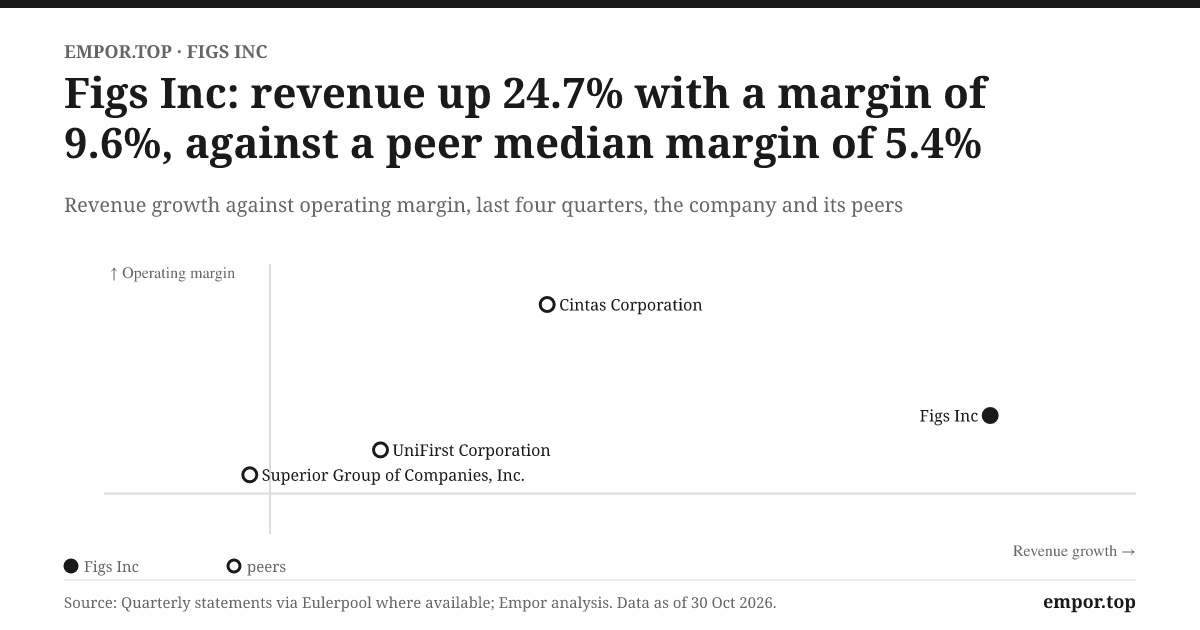
Remove the $15.4 million and the quarter looks different. Gross margin would have been about 67.4%, roughly 0.4 points better than a year earlier rather than 8.2 points. Operating profit would have been about $20 million, roughly a 10% margin, instead of $35 million and 18%. That is still a real improvement on the 6.5% margin of the year before, but it is a different company from the one the headline described.1
The underlying improvement was not imaginary. Active customers grew 13% and average order value 9%, and management cited more customers, more orders per customer, higher prices, lower discount rates and lower return rates.12 When Matt Koranda of ROTH Capital asked what was driving the higher order value, Oughtred credited "the pricing that we took in Q1" plus "lower discounts and improved returns," and said the boost would last "until it annualizes in Q1 of 2027."2 That is an honest answer, and a limiting one: price increases lift growth for one year and then become the new base. Oughtred also said the company was "not planning for that same degree of frequency growth" going forward.2 Rick Patel of Raymond James asked whether FIGS could keep promotions down; the answer was that the refund "gives us the flexibility to pull back on promo if it makes sense," but that the plan assumed "a similar cadence to last year," including back-to-school and Black Friday events.2 So the discount discipline that helped the quarter is a choice the company intends to keep making, not a structural change it can promise.
The comparison with a year earlier is also flattering for a reason that has nothing to do with refunds. The tariff and inventory hits in 2025 had pulled gross margin down to 66.5%.4 Some of 2026's margin rebound is simply the absence of those hits.
Then there is guidance. In February 2026, before the acceleration, FIGS expected revenue growth of 10%-12% for the year, a gross margin "up modestly" from 66.5% and an adjusted EBITDA margin of 12.7%-12.9%; it assumed 15% global tariffs and explicitly did not count on any tariff relief.15 By August, guidance had risen to about 20% revenue growth, a gross margin of about 69.5% "inclusive of the tariff refund," an adjusted EBITDA margin of 14.8%-15% and an operating margin of about 10.8%.2 Oughtred said the underlying gross margin outlook was "unchanged from our prior guide."2 That sentence is the key to the whole quarter. The roughly three points of extra full-year gross margin come from refunds; the core expectation did not move.
Management did not present it otherwise. When Brooke Roach of Goldman Sachs asked whether the new 15% EBITDA margin was a base to build from, Oughtred said it included the benefit of tariffs previously paid, partly offset by extra airfreight, and called it "a fairly clean base."2 Investors can reasonably disagree with "fairly clean." The guided full-year margin includes refunds for first-half goods and for inventory sold in the second half, and adjusted EBITDA includes the $7.5 million that relates to 2026 goods, excluding only the slice tied to 2025.21 The refund is real cash, but its contribution to margin will not recur.
The verdict here is not difficult. Customer growth, higher prices and lower discounting support a real operating recovery from the lows of 2024. The reported jump in second-quarter gross margin, however, is mostly a refund, so it should not be annualized into a new structural margin. The test that will settle it is the operating margin in 2027, when no refund is flowing through, measured together with revenue growth and free cash flow. And that test will be harder because of something that happened six weeks before the call, at a supplier in Jordan.
VII. One Supplier, One-Third of Production
A withhold release order is one of the bluntest tools U.S. Customs has. When the agency has reason to believe goods were made with forced labor, it can order them held at the border, and the importer cannot bring them into the country until the issue is resolved. On June 23, 2026, CBP issued one against certain garments produced by FIGS' Jordanian manufacturing partner.3 FIGS does not say what triggered the order, though its 2025 annual report had noted that "previously there were allegations relating to the working conditions at our Jordanian supplier."4
The size of the hole is the point. FIGS designs and markets its clothes but does not own factories; it relies on third-party manufacturers. In 2025 its production was split roughly evenly between suppliers in Vietnam and Jordan, with small volumes from China and Peru, and those two countries together made nearly all of its finished goods.4 By the second quarter of 2026 the balance had shifted to about 60% from Vietnam and about one-third from the Jordanian partner.3 Having two major sourcing countries had looked like prudent diversification. It now meant one order from one agency had disabled a third of the company's production for the U.S. market.
On the August call, management described its response in general terms. Spear said the team was "leveraging capacity with our other strong existing partners and expediting their production," and Oughtred said FIGS planned "to use airfreight to expedite certain products."2 That airfreight would eat most of the benefit FIGS had expected from a lower tariff rate on Asian imports, and inventory at the end of the third quarter would be "down double digits year-over-year given our supplier transitions."2
The analysts wanted more. Dana Telsey of Telsey Advisory Group asked whether another region would replace Jordan; the answer addressed Telsey's other question, about non-scrubwear margins, and left Jordan aside.2 Ashley Owens of KeyBanc Capital Markets then asked the questions that matter operationally: how many weeks of Jordan-made product were already in the United States, how long it would take to move production to Vietnam, and whether core styles would stay in stock.2 Spear did not give a number of weeks, a timeline or a production share. The CEO said FIGS was "already in the process of derisking certain products and launches given the Middle East conflict" and had "mitigated the vast, vast majority of the challenge," adding that "we would be in even a better position if it wasn't for this challenge."2 It was a confident answer without the data to check it. The plan is plausible; the replacement capacity has not yet been demonstrated.
The cost mechanism is easy to trace even without those details. Airfreight costs many times what ocean freight does per garment, so every rushed shipment raises unit cost and squeezes gross margin. If replacement factories cannot match the fabric, fit and color of the originals quickly, popular styles go out of stock, and stockouts are not a neutral event for a replenishment brand: a customer who cannot find the usual joggers may try a competitor. And if product made in Jordan cannot be sold, or arrives in the wrong mix, it risks being marked down or written off. FIGS' allowance to write inventory down to what it can be sold for stood at $4.0 million at the end of June 2026, compared with an amount it called not material six months earlier.3 The company does not link that allowance to the order, so it would be wrong to treat it all as a WRO cost, but it is a reminder that inventory risk is live.
Proportion matters here too. This is an execution risk, not a balance-sheet crisis. FIGS has close to $300 million of cash and investments and no drawn debt, so it can afford airfreight and a supplier transition.3 The question is not survival but whether the margin recovery and the customer momentum survive the transition. The company itself expected the order to weigh on revenue, gross margin and inventory in the second half of 2026.3
The order also landed in the middle of a tariff regime that kept changing under FIGS' feet. Before the Supreme Court ruling, management had said the rates it faced were 20% on goods from Vietnam and 15% on goods from Jordan.15 After the ruling, a temporary 10% tariff applied from late February to late July 2026, and new tariffs of 10% to 12.5% took effect on July 24.3 Management had planned the year around a 15% global rate, so the new rate should have been a modest help; Oughtred said the benefit would be "minimal for the fiscal year" because airfreight to replace Jordan would offset it.2 In other words, one policy change gave FIGS a little margin back and another took it away again within weeks. For a company that does not own its factories and sells mostly in one country, trade policy is not background noise. It is a line in the cost of every garment.
The next earnings calls should settle the operational facts: the share of production now coming from replacement suppliers, fill rates on core styles, the incremental cost of freight, and any measurable effect on customers or margins. Until then, the episode connects back to the therapist's shopping basket. A differentiated product earns loyalty only if customers can actually buy it. And the people who will decide how FIGS answers that challenge are not, in any meaningful sense, accountable to the investors who own most of its economic value.
VIII. The Founders Still Hold the Votes
Baron Capital is one of the most patient growth investors in America, and it has made an enormous bet on FIGS. At the April 2026 record date for the annual meeting, Baron Capital Group held about 60 million Class A shares, 37.8% of that class.16 Its stake grew in January 2025, when the Tull parties sold their FIGS shares to Baron, ending the voting agreement that had given Tulco a role alongside the founders.164 By economic ownership, Baron is the largest holder in the company. By votes, it is not in charge.
FIGS has two classes of common stock. Class A, the publicly traded shares, carries one vote each. Class B, held by the founders, carries 20.16 Spear owned about 11.9% of Class A and 66% of Class B, about 37.9% of the total vote; Hasson owned about 6.8% of Class A and 34% of Class B, about 20.2% of the vote.16 Together, the two co-founders who once sold scrubs from a car held 58.1% of FIGS' voting power.16 Outside shareholders can vote against things, but they cannot change the board or the company's direction on their own.
The roles have shifted since the IPO. Hasson stepped down as co-CEO in August 2022 to become executive chair, a role the company describes as focused on product innovation, while Spear, as sole CEO, runs strategy and operations.10 Sarah Oughtred became CFO in 2024, and held a first earnings call in the role that November.12 There has been no CEO or CFO change since. Spear's employment agreement was due to expire on May 26, 2026, and renewal was expected; the company has not disclosed the terms of a completed renewal.16
Pay is where outside shareholders have registered their views. The proxy for the 2026 meeting reported Spear's total 2025 compensation at about $8.2 million, up from $5.0 million in 2024, including a one-time $500,000 special bonus and $1.5 million of annual incentive pay; the financial components of the bonus program paid out at 200% of target after the company reached $631 million of revenue and an adjusted EBITDA margin of 11.8%.16 Those targets were set against a February 2025 forecast that had called for revenue to fall, which explains the maximum payout: the company massively beat its own guidance, and the plan paid accordingly. Whether that reflects outstanding execution or conservative targets is exactly the kind of judgment outside shareholders cannot influence. Hasson's 2025 compensation was about $8.1 million, mostly in equity, after the proxy showed no cash compensation for Hasson in 2023 or 2024.16 At the June 2026 meeting, about 46.3 million votes were cast against the say-on-pay resolution.17 It passed, as it was always going to with the founders' votes, but a block of opposition that size from shareholders whose votes count for one-twentieth as much per share is a message.
The transaction that deserves the closest look is OOG. In November 2024, on the same call where it cut guidance, FIGS announced a $25 million minority investment in OOG, "an innovative new company founded and led by FIGS' Co-Founder, Heather Hasson."12 OOG describes itself as an AI-powered education platform for healthcare professionals.10 FIGS bought about 27.5 million shares of OOG's Series A-1 preferred stock, said it would work toward a future commercial agreement setting out commercial rights and benefits, and in March 2025 licensed OOG about 2,200 square feet of unused office space for nominal consideration.4 FIGS carried the investment at $27.7 million at the end of 2025, including transaction costs, with no impairment or revaluation.4
Measured against FIGS' profits, this was a large bet. The $25 million equaled about three-quarters of 2025 net income and was roughly nine times 2024's net income.4 It was made by a public company in a private company run by its own executive chair, at a time when the public company's growth had stalled. There is a defensible logic: if OOG builds a platform where healthcare workers learn and gather, FIGS could gain a marketing channel to its exact customers. But the commercial agreement that would turn that logic into an asset was still described as prospective, and on the August 2026 call neither OOG nor Hasson came up.42 Nothing disclosed establishes that FIGS overpaid, and there is no comparable transaction or published OOG financial data to benchmark the price against. The issue is that a skeptical shareholder cannot tell either way.
The rest of capital allocation is more conventional. FIGS has never paid a dividend.4 It started a buyback program in August 2024, has repurchased about $81 million of stock since, including about $24 million in the second quarter of 2026 at an average of $11.94 a share, and in August 2026 added a further $100 million of authorization, taking capacity to $119 million.24 With the stock at $22.04 on October 30, those second-quarter purchases look well-timed. Against them sits stock compensation: the 2026 proxy reported about 45.6 million shares underlying outstanding awards, so buybacks partly offset dilution rather than shrinking the share count in any large way.16
There is also legal unfinished business from the bust years. A securities class action filed after the stock's collapse was dismissed with prejudice in February 2025, but the plaintiffs appealed, the appeal was argued in July 2026 and remained under submission, and related shareholder derivative suits were still pending.43 None of these has produced a liability on the balance sheet, and the dismissal was a meaningful win, but the appeal keeps the 2021 to 2022 period legally open. The company's other contingencies are small by comparison, including about $1.5 million reserved for possible sales-tax exposure on remote sales.4
What about credibility? The record shows a management team that explains its misses with unusual specificity. When footwear failed in 2024, it named the style, the delayed launch and the promotion mistake, and in the next quarter said the supply problem "was rectified."1213 When inventory grew stale, it wrote it off and set a target of about 200 days.15 Its weakness has been forecasting, missing high in 2024 and low in 2025, and on the newest and largest risk, Jordan, its answers have been assured rather than concrete. The governance tests ahead are clear: whether the OOG commercial agreement is signed and disclosed, how the investment performs, whether buybacks keep pace with share awards, and how the next say-on-pay vote goes.
IX. Cash Is Strong; the Quality of That Cash Still Matters
Here is a striking pair of numbers. From 2019 through 2025, FIGS reported cumulative net profit of about $119 million and cumulative operating cash flow of about $300 million.6104 For every dollar of accounting profit, about two and a half dollars of cash came in from operations. Most investors would celebrate that. The more useful question is why it happened, because the reasons say whether it will keep happening.
Two forces explain most of the gap. The first is stock compensation, which reduces reported profit but involves no cash: FIGS expensed about $46 million in 2023 and $27 million in 2025.4 That cost is real; it is paid in shares, which dilute existing owners, rather than in cash. Adding it back makes cash flow look stronger than the economic cost of running the business, which is why the share count and buybacks belong in the same conversation.
The second force is inventory and other working capital, which swings cash around from year to year. In 2022, as the warehouse filled, operating cash flow was negative. In 2023, as FIGS sold down that excess, inventory released about $58.9 million of cash.4 In 2025, inventory consumed about $12.2 million, and the timing of payments on accrued expenses cut operating cash flow by about $55.2 million compared with the prior year.4 So operating cash flow fell from about $100 million in 2023 to about $61 million in 2025, even as profits recovered.4 Some of the earlier strength was the business giving back cash it had locked up in 2022.
Free cash flow, operating cash minus capital spending, was about $53 million in 2025, after just $8.2 million of capital expenditure, down from about $17 million in each of the two prior years.4 Across 2019 to 2025 free cash flow totaled about $246 million, none of it paid as dividends.4 The first half of 2026 added about $38.6 million more.1 Capital spending was expected to rise again in 2026 as the company built Community Hubs, to about $17 million by management's February estimate.15
Where has the surplus gone? Into the balance sheet, buybacks and OOG. At the end of June 2026 FIGS held about $296 million of cash and short-term investments, in money-market funds, government securities and corporate paper.3 That pile earns interest, and the interest has mattered more than most investors realize. In 2024 other income, mainly interest, was about $12.1 million against pretax profit of $14.3 million; in other words, almost all of FIGS' pretax profit that year came from its treasury, not from selling scrubs.4 In 2025 interest was about $9.1 million of $47.2 million in pretax profit, a much healthier ratio.4
Debt needs proportion. The roughly $60 million of borrowings at the end of 2025 that appears in summary data is in fact operating lease liabilities, mostly for warehouses, offices and stores, not loans.4 FIGS has a $100 million secured revolving credit facility maturing in November 2030; at the end of June 2026 nothing was drawn and about $91.6 million was available after letters of credit.3 There is no refinancing pressure. The auditor's 2025 opinions on both the financial statements and internal controls were clean, with the critical audit matters centred on how revenue and inventory records depend on systems run by outside service providers, a reflection of how much of this e-commerce business runs on other companies' software rather than a sign of trouble.4
The verdict is that liquidity is strong and cash generation is genuine, but cash conversion is not a clean measure of earnings quality. Stock compensation and working capital timing explain a meaningful part of the gap between profit and cash. The better scorecard is several years of free cash flow after capital spending, read alongside stock compensation, share count and inventory. Which leads to the question every investor at $22 a share must answer: how much of that future cash is already in the price?
X. Analysis & Bear vs. Bull Case
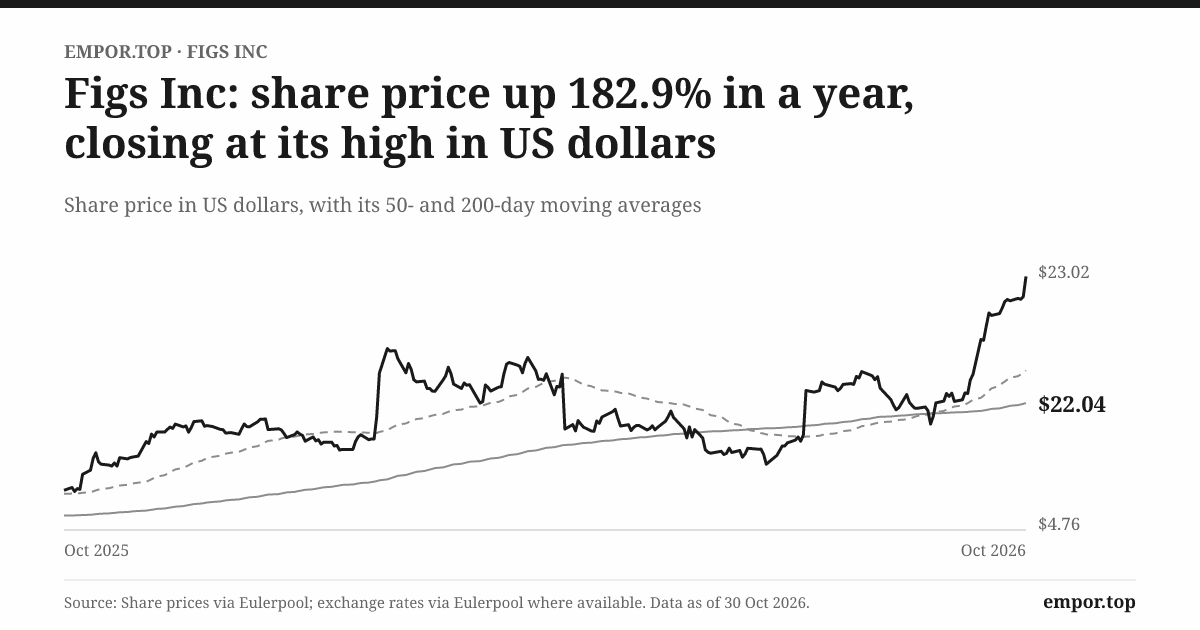
On October 30, 2026, FIGS shares closed at $22.04, their highest point of the past year and nearly three times the 52-week low of $7.38. Investors who bought at the bottom of the despair have been rewarded handsomely, and the stock is now back at the price of its 2021 IPO. At that price, the company is valued at about 60 times its trailing earnings, about 5 times its trailing sales and about 39 times its EBITDA, and its free cash flow yield, the cash it generates as a share of its market value, is about 2.7%.41 The question for this final reckoning is what all that requires FIGS to prove.
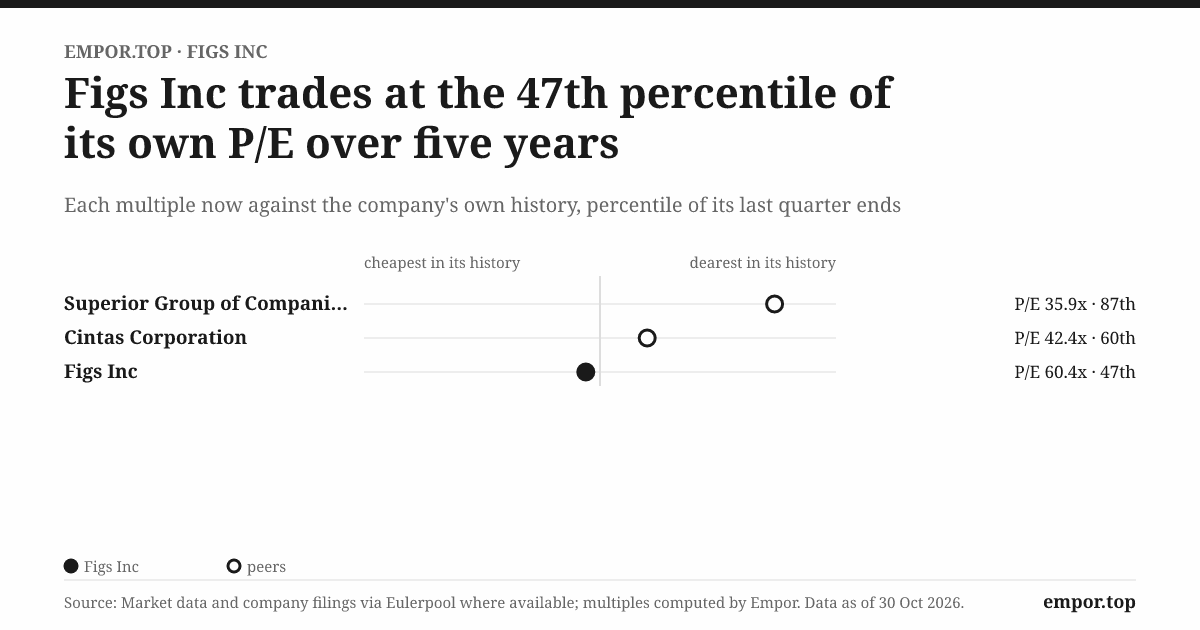
Start with the market's own memory. The 60-times multiple sits almost exactly at FIGS' five-year median of about 62 times. That sounds reassuring, as if the stock were simply back to normal. But the five-year history includes the post-IPO euphoria of 2021, when the shares traded above $50, and the collapse of 2022 and 2023, when they fell more than 90% from peak to trough.8 It also includes years in which earnings were tiny, which mechanically inflates the multiple. "Normal" for FIGS has been a very wide range, and the median is not much of an anchor.
The comparison with other consumer brands is starker. In late October 2026, Revolve traded at about 23 times earnings and 1.3 times sales, YETI at about 19 times earnings and 1.7 times sales, On Holding at about 22 times earnings and 2.8 times sales, and Boot Barn at about 16 times earnings and 1.6 times sales.18192021 FIGS, at roughly 60 times earnings and 5 times sales, is priced well above all of them. These are imperfect comparisons. None sells scrubs; Revolve is a fashion retailer, YETI sells coolers and drinkware, On makes running shoes, and Boot Barn runs western-wear stores, and each has a different mix of growth, margins and channels. They cannot show that FIGS is mispriced. What they do show is that the market is valuing FIGS less like an apparel company and more like a franchise expected to compound for years.
The bull case has real evidence behind it. FIGS is the most recognized brand in a fragmented category it helped create, where it held only a small share of a $12 billion U.S. market at the IPO.5 It has a direct relationship with 3.1 million active customers, growing 13% a year, who are paying more per order and spending more per head than at the pandemic peak.1 It raised prices in early 2026 and sales accelerated rather than faltered, and returns remain about a third of the online-apparel norm.154 International sales are growing far faster than the core and are, by management's account, profitable in established markets.2 The company produces free cash flow, holds close to $300 million in cash and investments with no drawn debt, and is run by founders whose wealth is tied to the stock.316 If those trends hold, revenue in the $700 million range today could grow for years with margins rising as fixed costs are spread more widely.
The bear case is just as specific. The brand did not prevent a multi-year slowdown, in which growth fell to under 2% and frequency weakened, and management's own guidance missed in both directions.10124 Nothing contractual keeps customers; competitors from Barco and Landau to Jaanuu and Fabletics sell close substitutes.4 Scrubwear is still about 81% of revenue, so the extensions have not changed what drives value.4 The second-quarter margin leap was mostly a one-time tariff refund, and the underlying gross margin outlook did not change.32 A single supplier that produced a third of goods has been barred from the U.S. market.3 And trailing earnings, the "E" in that 60-times multiple, include both the sharp 2025 rebound and refund income that will not recur, which means the multiple on sustainable earnings is likely higher than it appears.
Michael Porter's five forces help explain why the bull and bear cases can both be right at once. Buyers are fragmented individuals, so no single customer can dictate terms, yet each has many alternatives and almost no cost to switch, which caps how hard FIGS can push on price. The threat of new entrants is moderate: anyone can sew scrubs, but building a trusted brand and a direct relationship with millions of clinicians takes years and money, as FIGS' own history shows. Substitutes are limited, since scrubs are a workplace requirement, but cheaper scrubs are a substitute for premium scrubs. Supplier power is more relevant than it looked a year ago: FIGS outsources everything, and the Jordan episode showed what a concentrated supply base can cost. Rivalry is intense and still fragmented, competing on fit, function, price, availability and trust.
Hamilton Helmer's seven powers framework, which asks what gives a business both a benefit and a barrier rivals cannot easily overcome, is a stricter test. FIGS has no network effects; one nurse's purchase does not make the product better for another. Its scale advantages are modest against much larger apparel groups. Switching costs are low. It has no cornered resource, such as a patent or exclusive supplier, and its process power, the operating know-how that is hard to copy, is undercut by the inventory write-offs and the footwear miss. When FIGS launched, it had counter-positioning, a model the wholesale incumbents could not easily copy without undermining their own distributors. That advantage has faded as other brands have learned to sell online. What remains is the one power the evidence supports: brand, the willingness of customers to pay more because of what FIGS means to them. The 2026 price increases and the low return rates support that power. The 2023 and 2024 frequency decline bounds it.
So the moat claim, tested against the record, narrows to a smaller version. FIGS has a differentiated brand with repeat appeal and demonstrated, if limited, pricing power. It does not have an unassailable position, and its history shows that brand affinity does not by itself protect order frequency, margins or forecasts.
A skeptical investor would push on several pressure points. Why does a company holding close to $300 million of cash and investments put $25 million into a private company led by its own executive chair, before any commercial agreement exists?4 Do buybacks reduce the share count, or simply soak up the shares issued to employees and executives?16 Why is it appropriate for two founders to control the board when the largest economic owner and the other public holders cannot change it?16 And what is the operating margin target once refunds are gone, given that management has guided only to the 2026 figure that includes them?2
Three measures can settle the debate, and they should be read together. The first is active customers alongside revenue per active customer, now 3.1 million and $229 and both rising, which separates a growing audience from customers who buy more often.1 The second is gross and operating margin excluding tariff-refund effects, which on the second quarter's numbers was about 67% and 10%, modestly improving.13 The third is free cash flow after capital spending, read next to stock compensation and share count, about $53 million in 2025 against $27 million of share-based pay.4
Why FIGS wins from here is simple to state: if healthcare workers' loyalty keeps converting into repeat purchases at full price, in more countries, and its supplier base keeps the core styles reliably in stock, the business can grow into its multiple. Why it might not is just as simple: if cheaper alternatives erode its pricing, customers stretch the time between orders as they did in 2023, or the growth and margins of 2026 turn out to have depended on refunds and price increases that cannot be repeated, the valuation leaves little room for disappointment.
XI. Playbook: Business & Investing Lessons
Go back to the parking lot one more time. Two founders with a car and a supply of fresh coffee were not selling a new technology. They were selling a better version of a garment that millions of people already had to buy, and they were doing it by listening to those people at 7 a.m. and 7 p.m. The arc from rapid growth to a near standstill belongs to this company.54
The first lesson is make the customer feel seen, then prove the customer comes back. FIGS built a brand around an emotional insight, but its value lies in repetition, and repetition slipped in 2023 and 2024, even as the customer count rose.1110 Founders tend to measure love by sign-ups. Investors should measure it by how often those people return without a discount. A brand is not proved by its first sale. It is proved by the second, third and tenth.
The second lesson: a direct channel gives you the conversation; it does not guarantee the answer. Selling through its own platform gave FIGS a data advantage, but did not prevent inventory, footwear and forecasting mistakes.81213 Owning the customer relationship also means owning the cost of finding customers and shipping to them, more than a third of revenue in marketing and selling expense combined.1 Data tells a company what customers did. It still has to guess what they will do next.
The third lesson: inventory is strategy made physical. Every color launched, every size run extended and every footwear partnership becomes boxes in a warehouse months before anyone knows whether it will sell. In FIGS' case the boxes piled up in 2022, and aged product was still being written off years later.15 For an apparel brand, a strategy that does not end in a sell-through is not a strategy. It is a write-down waiting for a date.
The fourth lesson: a premium brand is only as available as its supply chain. FIGS spent a decade making customers trust that their exact joggers would be there when they needed them. The June 2026 order from U.S. Customs exposed the risk, and the company's answer was airfreight and confidence.32 The brand promise lives in the customer's mind, but it is kept or broken in a factory the company does not own.
The fifth lesson: cash is an option; capital allocation is the choice. FIGS has generated cash for choices including buybacks and a $25 million investment in its executive chair's company.4 Cash on the balance sheet buys time and flexibility. What a company does with it reveals whose interests come first. Founder-controlled companies earn their freedom by spending outside shareholders' money as carefully as their own, and they owe those shareholders the disclosures to prove it.
XII. Epilogue
Tonight, at the end of October 2026, FIGS stands at a strange crossroads. Its shares are at a one-year high. Its customers are growing in number and paying more per order than at any time in the company's history. Some garments from its biggest supply partner for the U.S. market have been blocked at the border, and its biggest profit boost of the year came from a refund that will not repeat. The next few results days will tell which of those facts defines the company.
The first moment arrives with the third-quarter report. Management guided to revenue growth of about 20% for that quarter and an adjusted EBITDA margin of about 14%, with gross margin expected to fall year over year, inventory down by double digits and airfreight weighing on costs.2 That will be the first look at what the Jordan order actually did. Investors will want to know how much production has moved to Vietnam and other partners, whether the best-selling styles stayed in stock, what expedited freight cost, and whether any Jordan-made goods had to be written down. If FIGS reports growth near its guidance with core styles available, the supply story becomes a temporary cost. If growth falls short with stockouts, it becomes a question about the brand's reliability.
The second moment is the fourth quarter, where management has guided to growth of about 10%, and then the first look at 2027.2 Next year is the test the whole story has been building toward. The price increases taken in early 2026 will annualize in the first quarter, removing one source of growth, and there will be no tariff refunds to lift gross margin.2 If FIGS can deliver double-digit growth and an operating margin near or above the roughly 10% it earned underneath the refund in the second quarter, investors will have evidence that the recovery is structural. If margins slip back toward the single digits of 2025, the 2026 surge will look like a moment, not a new level.
Throughout, the two customer measures will tell the most. If active customers keep growing and revenue per active customer holds up after the price increases annualize, the brand is pulling people in and bringing them back. If the customer count grows while revenue per customer falls, as in 2023, the pattern will be uncomfortably familiar.
The governance questions will move more slowly. Investors are waiting for disclosure of the commercial agreement with OOG and any evidence that the $25 million investment has produced rights or returns for FIGS. The next say-on-pay vote, after a year of maximum bonus payouts, will show whether the opposition of 2026 hardens or fades. And share count, set against buybacks and equity awards, will show whether capital returns actually return capital.
What would change the thesis is clear. Repeat full-price customer growth, a smooth supplier transition and margins that hold after the refunds fade would strengthen it considerably. Renewed weakness in purchase frequency, stockouts in core styles, or margins that sag once the refunds are gone would weaken it just as much. The brand has already proved it can attract millions of healthcare workers. What it has not yet proved, twice now, is that it can keep growing and earning at the pace its price implies.
XIII. Outro
In 2013 a nurse coming off a long shift could walk out of a hospital and find two founders waiting with coffee and a car full of scrubs.5 That was the whole company then: one conversation, one customer, one sale. Thirteen years later, the same exchange happens on a screen, and the business still runs mostly on scrubs.4
FIGS is unlike other public apparel companies because it built a brand in a category nobody thought could hold one, and because its customers chose it for a job they do, not an image they want. That is a powerful foundation. It is also a demanding one, since the same nurse who chose FIGS once makes the choice again every time a pair of joggers wears through, with alternatives a click away. The story now depends on whether the experience survives scale, supply shocks and the end of temporary margin help. A brand is a promise sewn into the product, and it is tested every time the customer needs another one.
References
-
FIGS Releases Second Quarter 2026 Financial Results — FIGS, 2026-08-06 ↩↩↩↩↩↩↩↩↩↩↩↩↩↩↩↩↩↩↩↩
-
FIGS Q2 2026 Earnings Call Transcript — StockAnalysis/Quartr, 2026-08-06 ↩↩↩↩↩↩↩↩↩↩↩↩↩↩↩↩↩↩↩↩↩↩↩↩↩↩↩↩↩↩↩↩↩↩↩↩
-
FIGS, Inc. Form 10-Q for the quarter ended June 30, 2026 — SEC, 2026-08-06 ↩↩↩↩↩↩↩↩↩↩↩↩↩↩↩↩↩↩↩↩↩↩↩↩
-
FIGS, Inc. 2025 Form 10-K — SEC, 2026-02-26 ↩↩↩↩↩↩↩↩↩↩↩↩↩↩↩↩↩↩↩↩↩↩↩↩↩↩↩↩↩↩↩↩↩↩↩↩↩↩↩↩↩↩↩↩↩↩↩↩↩↩↩↩↩↩
-
FIGS, Inc. Form S-1/A IPO Registration Statement — SEC, 2021-05-20 ↩↩↩↩↩↩↩↩↩↩↩↩↩↩↩↩↩↩↩↩↩↩↩↩
-
FIGS, Inc. Follow-on Offering Prospectus (Form 424B4) — SEC, 2021-09-15 ↩↩
-
Figs Stock Is Down Nearly 90% From Its High. Time to Buy? — The Motley Fool, 2023-03-11 ↩↩↩↩↩↩↩
-
Why Figs Stock Lost 76% in 2022 — The Motley Fool, 2023-01-11 ↩↩
-
FIGS Q4 2023 Earnings Call Transcript — FIGS, 2024-02-28 ↩↩↩↩↩↩↩↩
-
FIGS Q3 2024 Earnings Call Transcript — FIGS, 2024-11-07 ↩↩↩↩↩↩↩↩↩↩↩↩↩
-
FIGS Investor Relations — Quarterly Results, including the Q4 2024 earnings call of 2025-02-27 ↩↩↩↩
-
FIGS Releases Fourth Quarter and Full Year 2025 Financial Results — FIGS, 2026-02-26 ↩
-
FIGS Q4 2025 Earnings Call Transcript — FIGS, 2026-02-26 ↩↩↩↩↩↩↩↩↩↩↩↩↩
-
FIGS, Inc. 2026 Proxy Statement — SEC, 2026-04-23 ↩↩↩↩↩↩↩↩↩↩↩↩
-
FIGS, Inc. 2026 Annual Meeting Voting Results (Form 8-K) — SEC, 2026-06-08 ↩
-
Revolve Group Valuation Statistics — StockAnalysis, accessed 2026-10-30 ↩
-
YETI Holdings Valuation Statistics — StockAnalysis, accessed 2026-10-30 ↩
-
On Holding Financial Ratios — StockAnalysis, accessed 2026-10-30 ↩
-
Boot Barn Holdings Valuation Statistics — StockAnalysis, accessed 2026-10-30 ↩
 LinkedIn
 WhatsApp
 Reddit
 Hacker News
 Email
 Kindle
 RSS Feed
 Spotify
 Apple Podcasts
 Amazon Music
 Audible
 YouTube