 Chat with
this content: Summary, Analysis, News...
Chat with
this content: Summary, Analysis, News...
 Subscribe on LinkedIn


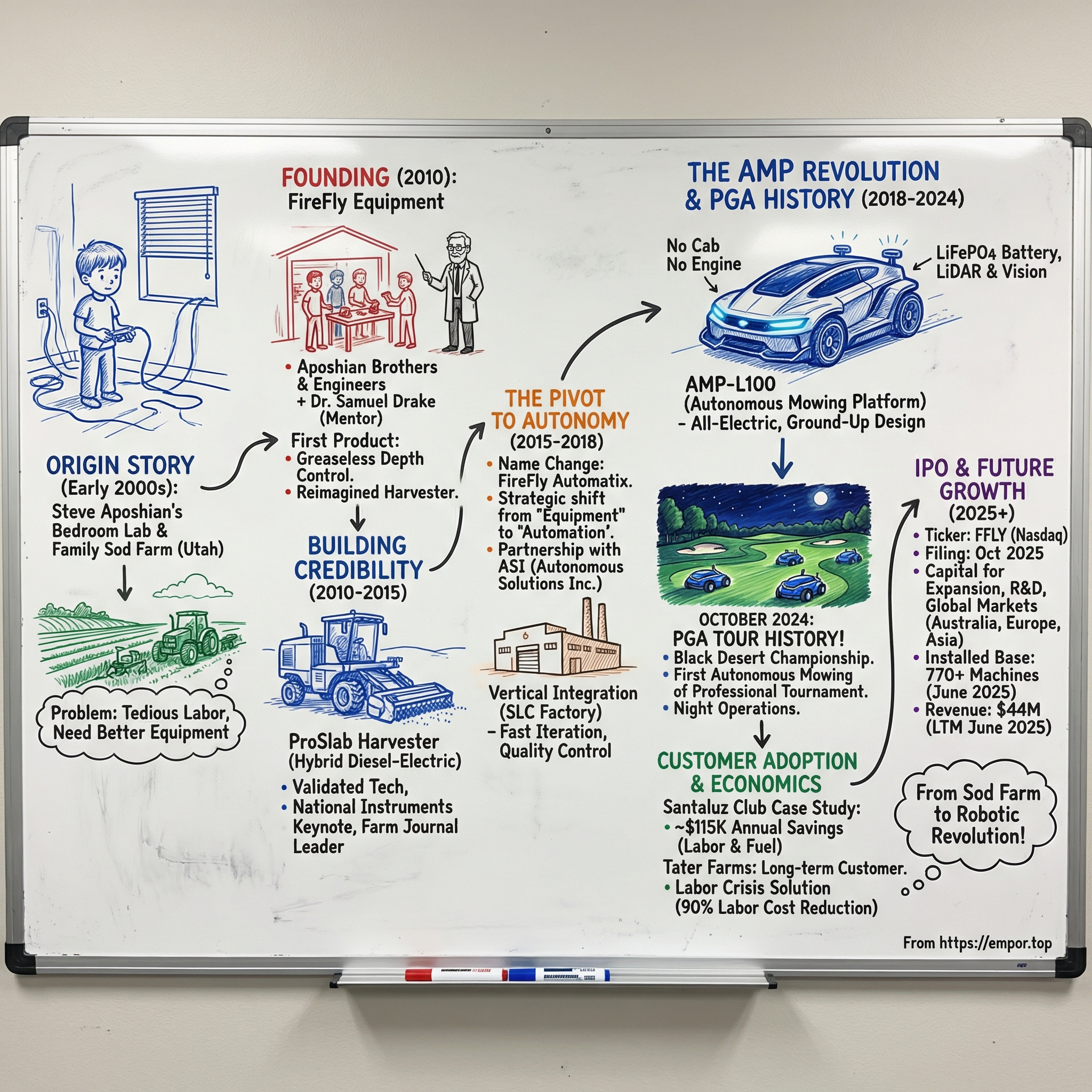
FireFly Automatix: The Utah Startup Building the Robots That Mow America
Introduction: A Moment That Changed Professional Golf Forever
At 2:00 AM on the morning of October 10, 2024, while the world slept and professional golfers rested before their second round at the Black Desert Championship, four blue machines silently glided across the fairways of southern Utah's newest resort course. No operators sat in their cabs. No diesel engines rumbled through the desert night. For the first time in PGA TOUR history, the fairways of a tournament were maintained exclusively by autonomous mowers.
The machines belonged to FireFly Automatix, a company that most golf industry veterans had never heard of just months earlier. Unknown to many prior to the Black Desert Championship PGA event in October when four blue autonomous fairway mowers silently groomed the fairways, the engineers at FireFly Automatix have quietly challenged and in many cases discarded the traditional conventions of fairway mower and cutting unit design.
The Salt Lake City, UT-based company plans to raise $25 million by offering 4.5 million shares at a price range of $4.50 to $6.50. At the midpoint of the proposed range, Firefly Automatix would command a market cap of $170 million. As of June 30, 2025, the amount of machines in use exceeds 770, purchased by customers from the United States, Australia, the United Kingdom, Brazil, Canada, South Africa, and Mexico. Firefly Automatix was founded in 2010 and booked $44 million in revenue for the 12 months ended June 30, 2025.
The central question this article explores is deceptively simple: How does a family sod farm in Utah become the company that autonomously mowed PGA Tour fairways for the first time in history? The answer involves a childhood obsession with automation, a professor who believed in his students enough to leave academia, a prescient pivot from harvesting to mowing, and an agricultural crisis that turned autonomous robots from luxury to necessity.
Part I: Origin Story — The Aposhian Brothers & The Family Sod Farm
A Nine-Year-Old's Bedroom Laboratory
How do you get from automating window blinds to designing robotic lawnmowers? Programming turf harvesters might not be your first thought, but this was the progression for FireFly Automatix and its founder Steve Aposhian. At about age 9, Steve was already trying to automate the mundane tasks in his life.
One day, he invited his mother to come see something in his bedroom. At his encouragement, and despite noticing the plastic now covering the carpet, she pushed a doorbell newly affixed to his door frame. She was surprised to be met with a spray of water, which Steve excitedly explained was a windshield washer hose he had rigged up to the doorbell. Then he invited her inside to see how he could turn on his light from his bed with a string. Dripping wet, but being the good sport that she was, she came in to see the light switch control. She also saw how he could open and close his window blinds with a controller for an electric toy car, the car's axle connected to the blind's wand.
That childhood impulse—the relentless drive to automate tedious tasks—would prove to be more than a phase. It was the kernel of a business philosophy that would later produce machines valued at $160,000 each and trusted to maintain championship golf courses during professional tournaments.
From Family Farm to Engineering Challenge
FireFly Automatix grew out of a need to solve problems we encountered on our own turfgrass farm. Our first breakthrough was our greaseless depth control system, which today is still providing reduced maintenance and improved function and durability.
The Aposhian family operated a sod farm in Salt Lake City, the kind of unglamorous agricultural operation that most people drive past without a second thought. At this point, Steve's brothers, Matt and Dan, were running Aposhian Turf Farm and wanted his advice on their new automatically-stacking harvester. They were convinced that improvements could be made to make it last longer. Steve invited Will Decker and Eric Aston, two of the smartest engineers—and farm boys—he knew, to collaborate.
Steven Aposhian is the Chief Technology Officer at FireFly Automatix, based in Salt Lake City, United States. He holds a Bachelors of Science degree from the University of Utah.
The Founding Moment
At the beginning of 2010, they decided to found a business to sell their improved designs, which were proving to be very successful. FireFly Equipment, known as FireFly Automatix now, started business in the small family farm shop. Their first product was an upgraded depth control system using high performance polymer bearings to decrease maintenance and increase durability. It was received enthusiastically.
Originally named FireFly Equipment, the company was founded at the beginning of 2010 by the Aposhian brothers and a few more engineers.
The path from replacement parts to world-changing autonomous vehicles would not be linear. After more design improvements succeeded, Steve and his engineering partners decided to take a leap of faith and give FireFly their full-time efforts to develop a completely new harvester. In fact, Dr. Samuel Drake, their professor and mentor from the University of Utah, believed in this endeavor so much, he joined his former students in their humble little shop. With experience like working on the lunar module simulator and running the Advanced Manufacturing Lab at "The U" for 22 years, Sam was invaluable. The four engineers not only designed the reimagined harvester, but at first built most of it too.
This detail—a university professor leaving academia to join a farm equipment startup—signals something important about the early FireFly culture. Dr. Drake had worked on technology that helped land humans on the moon. His choice to work in a "humble little shop" building sod harvesters suggested he saw something extraordinary in his former students' ambitions.
Part II: The Harvester Years — Building Credibility (2010-2015)
Product-Market Fit in an Unsexy Industry
Our farm crew was so happy with the new FireFly parts that we continued to develop more products. We started to market our parts to other turf producers. As more growers shared their equipment needs with us, we realized that with our expertise in grass production and mechatronics, we were poised to take automation in the turf industry to the next level.
Originally named FireFly Equipment, the company was founded at the beginning of 2010 by the Aposhian brothers and a few more engineers. Our TEAM got to work to design a better sod harvester from the ground up, which was the beginning of a long list of patented innovations, such as using synchronized servo-electric systems where speed and precision are the most important.
This progression—from solving your own problem, to selling solutions to competitors, to realizing you can transform an entire industry—follows a classic entrepreneurial arc. But what set FireFly apart was the nature of their transformation. They weren't just making existing machines cheaper or slightly more efficient. They were applying technologies from factory automation to mobile agricultural equipment.
The ProSlab Harvester: A Paradigm Shift
Debuting over a decade ago, the FireFly ProSlab harvesters were groundbreaking, not just in turf production, but across all of agriculture and heavy equipment. Steve and his team integrated the latest factory technologies, including electric servo motors, with mobile equipment to create a hybrid diesel-electric machine that propelled turf harvesting to a whole new level of automation. While the general appearance may look similar to other turf harvesters, the technology is much more sophisticated, enabling automation in conditions no other harvester had achieved and yielding better reliability, fuel economy, and durability.
The key insight was recognizing that factory automation principles—precise servo control, synchronized systems, real-time feedback loops—could work just as well on a sod farm as they did in a manufacturing plant. This was not obvious at the time. Agricultural equipment had evolved slowly, with most improvements being incremental refinements of diesel-hydraulic systems that traced their lineage back decades.
World Stage Recognition
The world took notice, and in 2015, the FireFly team found themselves on the National Instruments keynote stage with the likes of Samsung, Texas Instruments, and Jaguar. The tech world exploded with news about a little company called FireFly.
A flurry of media coverage followed this presentation. The ProSlab harvester graced the cover of OEM Off-Highway magazine, and Farm Journal named FireFly a leader "at the vanguard of agricultural IoT [Internet of Things] application."
Being featured alongside Samsung and Jaguar at a National Instruments keynote validated FireFly's engineering approach to the broader tech community. But more importantly for their business, the agricultural press coverage positioned them as thought leaders in precision agriculture—a growing field that would later become central to their autonomous mowing strategy.
FireFly Automatix dates to 2008 when co-founder Steve Aposhian and a small group of fellow mechanical engineers decided to fabricate replacement parts for the sod harvesters used on Aposhian's family's turf farm in Salt Lake City. The parts were of such high quality that they began selling them to other sod farms, some of which encouraged them to build their own complete harvesters. In 2011, Aposhian and his engineer buddies quit their day jobs and jumped into manufacturing of sod harvesters.
"We were the first to implement a lot of electric technology on a piece of mobile equipment like this," said Aposhian.
For investors evaluating FireFly today, this period matters enormously. The company spent five years building both technical credibility and customer relationships before attempting to scale. They earned their reputation in an industry where equipment failures during harvest season can devastate a farm's annual revenue.
Part III: Hypergrowth & The Pivot to Autonomy (2015-2018)
Utah's Fastest Growing Company
Our home state of Utah began to take note of the positive impact we were having. FireFly Automatix was named Utah's #1 Fastest Growing Company by MountainWest Capital Network in 2016 and 2017 and won a prestigious Utah Innovation Award in 2017. Our growing list of patents also caught the attention of the U.S. Patent Office, which sent representatives to tour our factory and congratulate us on our innovations.
Winning "fastest growing company" recognition two years running in Utah's competitive tech ecosystem demonstrated that FireFly had transcended its agricultural niche. The U.S. Patent Office visit was equally telling—the government rarely sends representatives to congratulate companies on innovation unless the innovation is genuinely novel.
The ASI Partnership: First Steps Toward Autonomy
MARCH 6, 2018 – Autonomous Solutions, Inc. (ASI), has partnered with FireFly Automatix to disrupt the turf farming industry with its M220 Self-Propelled Turf Mower. "FireFly is pioneering a dramatic shift in turf farming," said David Clyde, ASI Director of New Market Development.
ASI was not a random partner. Autonomous Solutions, Inc. is a world leader in vehicle automation. ASI's Mobius platform provides an OEM-agnostic, interoperable command and control software solution for autonomous vehicles. Mobius enables mine operations to integrate a variety of mining based vehicles under a comprehensive platform. ASI's robotic hardware and software systems allow users to safely manage their entire fleet of vehicles autonomously. We serve clients in the mining, agriculture, automotive, government, and manufacturing industries with remote control, teleoperation, and fully automated solutions, all from our headquarters and 100-acre proving ground in northern Utah.
By 2018, FireFly introduced the M220 turf mower and demonstrated our developing autonomous capabilities.
The M220 represented a critical strategic bet. "While sod harvesting only happens once a year, it needs to be mowed weekly to keep it healthy," said FireFly CEO, Andrew Limpert. "We've expressly designed and built this mower from the engine to the decks for this specific and necessary task, with future versions offering even more autonomy."
This quote reveals the strategic logic perfectly: harvesting is seasonal, but mowing is continuous. If FireFly could become the go-to provider for year-round mowing equipment, they could dramatically expand their revenue per customer while building the autonomous capabilities that would later prove transformative.
The Name Change: Signal of Strategic Shift
As we solidified our focus on automation and full autonomy, we decided our name needed to better reflect who we are as a technology company, as well as our future offerings in data services. In 2018, FireFly Equipment became FireFly Automatix, coining a new word to encompass all things related to automation and autonomy. The FireFly would remain, representing lighting the way to the future with synchronization. Also known as the lightning bug, when we think of FireFly, we think of electricity.
Corporate name changes often signal little more than marketing consultants' fees. But FireFly's transition from "Equipment" to "Automatix" reflected a genuine strategic pivot. The new name explicitly positioned them as an automation and technology company, not merely an equipment manufacturer.
Vertical Integration: The Factory Advantage
We had once again outgrown our facility and expanded into our beautiful state-of-the-art factory in Salt Lake City. By keeping all our manufacturing processes under one roof–laser cutting, bending, machining, welding, sandblast, and powder coat—we can ensure the highest quality. Raw steel comes in one door, and finished parts and machines go out the other.
In addition to showing off the impressive lineup of Firefly's automated sod harvesters and driverless lawnmowers, he's also pointing out the tens of thousands of parts that are fabricated, molded, welded, shaped, cut, bolted and painted right here on the premises to put the machines together. When FireFly says its products are made in Utah, it means made in Utah. "Steel and electronics come in one door," says Matt, "fully functioning machines go out the other side."
This level of vertical integration is rare in modern manufacturing. Most equipment companies outsource components and focus on final assembly. FireFly's decision to control the entire production process had several strategic benefits: faster iteration cycles, tighter quality control, and crucially, the ability to rapidly prototype and refine autonomous systems without depending on external suppliers.
Part IV: The AMP Revolution — Full Autonomy Arrives (2018-2024)
From M220-AV to AMP-L100: The Technical Journey
The development of truly autonomous mowing took years of iteration. FireFly Automatix announced initial customer implementation of the M220-AV, the company's first fully autonomous field mower, which has been in development since 2018. The new AV (Autonomous Vehicle) version of the popular 22-foot M220 for turfgrass production is premiering as a hybrid diesel-electric vehicle that takes the company's proven features to an entirely new level of automation.
First offered as a manned mower, the driverless model was in development for six years until its release in 2023. Using "teach-and-repeat" autonomy and LiDAR obstacle detection, the 22-foot-wide robotic mower is designed for large-scale mowing, such as natural grass farms.
With years of expertise in electric systems, FireFly was uniquely prepared to design and build an all-electric autonomous mower. After two years in development, they released the new M100-AV this July. This 100-inch (254 cm) lightweight mower is capable of operating without human input or supervision, attaining the highest level of autonomy.
The engineering philosophy behind AMP (Autonomous Mowing Platform) was revolutionary. "We wanted to make an autonomous mower, but we didn't want to just make a fairway mower that's autonomous," LeBlanc said. "We decided to make the best fairway mower on the market from the standpoints of cut quality, drive system, and operational efficiency. Let's just make it as good as we can make it, and incorporate autonomous technology in the process."
LeBlanc and his team started with a blank sheet of paper and redesigned a mower platform without a conventional combustion engine and operator station. "When we took those two pretty big design constraints out of the equation, we realized that to make the best mower on the market for fairways, it would have to be electric. Designing it from the ground up to be autonomous gave us the design freedom to go back whenever we needed to and change the way things worked mechanically and electrically to better support the autonomy."
The Economics of Autonomous Mowing
The financial case for autonomous mowing is compelling. By eliminating the need for an operator, the M100-AV is projected to alleviate labour pressures and reduce mowing labour costs by 90% and cut overall mowing costs roughly in half.
Evidence of labor challenges, the number of H-2A temporary farm worker positions increased more than seven-fold over the past 17 years, according to the USDA. Utilizing autonomous machines could meet these challenges and reduce labor costs by 90%. Powered by an advanced LiFePO4 battery, the M100-AV can quietly mow up to 25 acres per charge at speeds of 7 acres/hour and recharge in two hours. With no gasoline or operating emissions, the mower is predicted to decrease fuel costs by 87%, as well as reducing owners' carbon footprints.
In addition to the M100-AV's revolutionary driverless and EV technology, it is designed for a 65% maintenance cost reduction and a 76% longer machine life. The mower offers many other value-adding features: Four independent electric drive motors are synchronized with two independent steering motors to achieve low-impact traction. Wide stance and balanced weight distribution allow for low ground pressure and impressive sidehill performance. The RoloRocker™ cutting unit design achieves a more stable ride through the field, enabling higher speeds and a better aftercut appearance. SyncLift™ position-based lift technology reduces the need for a clean-up pass. Drive motors are engineered for a 100,000+ hour life and low maintenance.
Even with a current price tag of $160,000, the operational efficiencies of the AMP L-100 contribute to an ROI as low as two years or even lower in some cases. Efficiencies in capital expenditure, maintenance costs, energy and labor costs all contribute.
Making PGA Tour History
FireFly Automatix will use its electric AMPs (Autonomous Mowing Platforms) to robotically mow the fairways at Southern Utah-based Black Desert Resort during the night, between tournament play, for the October 9 – 13, 2024 Black Desert Championship PGA Tour event, marking the first professional golf tournament mowed by autonomous mowers. FireFly Automatix™ is thrilled to announce its selection by Black Desert Resort to autonomously mow and maintain its golf course fairways during the highly anticipated Black Desert Championship in October. For four weeks leading up to and during the tournament, FireFly is deploying a fleet of four AMPs (100-inch-wide, 5-gang reel mowers) to maintain all 60 acres of the course's fairways, marking a historic first for autonomous mowing at a professional golf tournament. The all-electric AMP, powered by a 35 kWh LiFePO4 battery pack, offers up to 25 acres of mowing capacity.
"We're proud to help sponsor the return of the PGA to Utah after 60 years. It's truly an honor to have been selected by Black Desert to maintain their fairways for such a prestigious event," said Steve Aposhian, Chairman, Chief Technology Officer, and Co-Founder of FireFly Automatix. "It validates that the technology we have built into AMP will revolutionize the industry, while also highlighting that this is the only autonomous mower on the market currently capable of taking on such a task."
In the month leading up to the tournament, four FireFly AMPs quietly maintained Black Desert's fairways, working alongside the groundskeepers and their intense fertilization, watering, and other preparations for the event. When the PGA TOUR arrived with its vast network of TV cables and spectator ropes, the autonomous mowers continued to work tirelessly through the night, ensuring the course remained in pristine condition.
Ken Yates, Black Desert's superintendent, was initially sceptical about switching his traditional fairway mowing team for automated machines, but has quickly been won over. "I'm used to having one of guys sitting on a mower," he said. "But these machines have proved that they can do it. And I'm comfortable with them. They're doing a great job. Once they mapped the course it was really easy."
Customer Adoption: Real-World Results
The Santaluz Club case study demonstrates the economics in practice. After months putting AMP to the test, The Santaluz Club's Director of Agronomy says their 3 AMPs will save them upwards of $115,000 annually. With three all-electric, self-driving AMP mowers from FireFly Automatix™, The Santaluz Club now mows its fairways in near silence 6X/week, up from 3X/week. And because AMPs mow autonomously, Director of Agronomy Jeff Miller says he's not only doubled productivity, but he expects the AMPs will save his club close to $115,000/year on labor and fuel. With the all-electric AMP, The Santaluz Club now mows all fairways autonomously and quietly in 4 – 4.5 hours, saving close to 2,000 hours annually, leading to financial gains of upwards of $115,000/year and doubled productivity.
"Traditionally, we mowed two to three times a week (with diesel-powered, worker-driven mowers)," said Jeff Miller, Director of Agronomy and Superintendent at The Santaluz Club. "But with AMP, we're now mowing 6X per week, with our three AMPs completing the entire course in 4-4.5 hours. With those calculations, we'll save about 2,000 hours/year, which works out to ~$50,000 in annual labor costs. However, now that we're mowing 6X/week, if you take the value that we're gaining (the OpEx costs), we'll actually double that amount value-wise. "Then, when we add in fuel savings, we'll save an additional $15,000/year in hard costs for diesel fuel. So that pushes our total savings/value gained each year to close to $115,000."
Tater Farms provides another validation in the turf production sector. Tater Farms has been a customer of FireFly Automatix for ten years, during which time its leaders have not only observed the evolution of the company's technology but also contributed to its development. A highlight of their partnership came nearly a year ago when the farm acquired the first production model of FireFly's AMP-L100 electric autonomous mower. From their initial automated harvester to their current fleet of harvesters and robotic mowers, Tater Farms has thrived by embracing FireFly's automation solutions.
Speaking of labor, Gage pointed out that mowing is another task that is hard to keep staffed. The farm mows their mature grass about two to three times each week. Progressive as always, the team at Tater Farms turned to fully autonomous solutions to meet their growing labor challenge. "It's kind of how we're wired. Mowing is a routine task that eats up a lot of labor time, so the autonomous mowers really help out with that—to free up time for people to work on other things." – Gage Hjort, PhD
Part V: Building the IPO Machine: Board, Leadership & Capital Formation (2023-2025)
Professional Board Build-Out
FireFly's preparation for public markets began in earnest with strategic board appointments starting in 2023.
On the heels of the most successful launch in FireFly Automatix, Inc.'s history – the recent introduction of the fully autonomous M100-AV electric professional mower – the company today appointed former Nasdaq Managing Director of the Southwest United States, Liz Hocker, to its Board of Directors. With more than 25 years' experience in business consulting, banking, HR, and Capital Markets, Hocker has positively impacted hundreds of companies through the operations and people-oriented initiatives her teams have delivered. At Nasdaq, she worked with more than 135 companies on successful new listings, representing more than $117 billion in market value, including some of the highest profile IPOs in the world.
Previously, Richardson served as a board member and Chief Financial Officer of WPP Group from 1996 to 2020, where he was responsible for WPP Group's worldwide functions in finance, information technology, procurement, property, treasury, taxation, internal audit, and corporate and social responsibility initiatives. Amid the continuing rollout of the fully autonomous AMP-L100 electric professional mower, FireFly Automatix, Inc. today announced the appointment of former WPP Group CFO, Paul Richardson, to its Board of Directors. In this role, Richardson will leverage his decades of experience gained from Global 500 company transactions to assist in the execution of capital formation and growth strategies that will help to propel FireFly's continued high growth in 2024 and beyond. The 2023 premier of FireFly's AMP-L100, the company's first fully autonomous and EV offering, has been the most successful launch in the company's 14-year history, and is paving the way for the company's next phase of accelerated growth and technology progress.
Paul is a Fellow of the Association of Corporate Treasurers, educated at the University of East Anglia and trained as a Chartered Accountant in London with KPMG. He was awarded the FTSE 100 Finance director of the year in 2007.
FireFly Automatix, Inc., an industry leader in AV and EV professional turfgrass mowing technology, today appointed JuE Wong, a five-time CEO/President with specialized expertise in turn-around and hyper-growth companies, to the company's Board of Directors. Wong's appointment follows the January 2024 addition of M. Max Yzaguirre as a strategic advisor and the recent 2023 additions of former WPP Group CFO Paul Richardson and former Nasdaq capital markets executive Liz Hocker to FireFly's board.
FireFly Automatix, Inc. announced the appointment of financial and leadership expert M. Max Yzaguirre as a strategic advisor to CEO Andrew Limpert and the board of directors. Yzaguirre brings more than 35 years of leadership experience in domestic and international business, government and law, and expertise in industries including electricity, oil and gas, banking, real estate, telecommunications and private equity investing.
Leadership Team Structure
In addition to company co-founders Steve Aposhian, Andrew Limpert, and Matt Aposhian, who currently serve on the board.
The leadership team reflects the company's hybrid nature as both an engineering-driven manufacturer and an emerging technology company:
- Andrew Limpert — Founder, CEO, Director
- Matt Aposhian — President and COO
- Steven Aposhian — Chairman, CTO
Matt Aposhian has an MBA and company leadership experience including grass farming and FireFly. His skills include strategic planning, financial management, resource management.
ATW Partners has been identified as lead investor in the company's funding rounds.
Part VI: The IPO — Going Public in 2025
Filing Details
The Utah-based firm submitted its S-1 form with the SEC on October 23, 2025, signaling its intent to list on the Nasdaq Capital Market under the ticker FFLY. The initial public offering will consist of 4,545,454 shares of common stock, with an expected pricing range of $4.50 to $6.50 per share.
Firefly Automatix filed confidentially on April 24, 2025.
The offering is being led by Roth Capital Partners and Lake Street, with Chardan Capital Markets as Co-Manager.
FireFly Automatix states in its SEC filing that IPO proceeds will be used for working capital, manufacturing expansion, and product development. The company does not disclose detailed allocation by project or specific investment categories such as battery systems, software, or leasing programmes.
Market Context
FireFly's IPO will coincide with renewed optimism in robotics and industrial innovation. The Nasdaq Robotics & Automation Index has outperformed the broader market through 2025, reflecting strong investor appetite for hardware-driven AI adoption. Market volatility around Fed rate decisions or global growth data may influence short-term trading, but the long-term outlook for automation remains favourable.
As an emerging growth company and smaller reporting company, FireFly is pursuing capital to expand operations, support R&D, and potentially gain greater market visibility. As of its filing, the company is not yet profitable and falls under the category of an emerging growth company.
FireFly Automatix, Inc. is a technology company with internally developed software and its patented mechatronic systems. The Company has integrated its technology into the design, development, and manufacturing of its Precision Automated Turf Harvester (PATH) machines and its Autonomous Electric Vehicle (AEV) robotic mowers. Its products are organized into two families: AMPs and PATH machines. The Company offers two models of its Autonomous Mowing Platform (AMP): AMP-L100 and AMP-X100. It offers two categories of PATH machines: ProSlab Harvester and R300 Roll Machine. Its self-driving, large-area AEV robotic mower AMP-L100, is specifically designed for the unique requirements of the golf course, sports field, municipal, real estate, and turfgrass mowing markets. Its AMP-X100 is a rotary mower for longer heights-of-cut.
Part VII: The Technology & Product Deep-Dive
Ground-Up Autonomous Design
The initial goal of this project was to engineer the best fairway mower on the market. AMP was engineered to be autonomous from the ground up, giving us invaluable freedom to make electrical and mechanical design decisions that would best complement the autonomy software. We made it all-electric because that allowed us to develop the entire system to achieve better traction, ground clearance, and weight balance, as well as higher torque and precision in both steering and drive systems—all without the limitations of traditional engines and hydraulic systems that have been largely unchanged for decades. In addition, we found that the cut quality is much better because there is no vibration created by an engine or hydraulic system.
Founded in 2010, FireFly Automatix Inc. is a US-based designer and manufacturer of autonomous and electric field equipment. Its products automate repetitive, labour-intensive tasks such as mowing, harvesting, and turf maintenance. The company is headquartered in Salt Lake City, Utah. FireFly's technology integrates computer vision, lidar sensors, and AI-based path-planning.
QuickPlan™ Software System
FireFly's QuickPlan™ software continues to redefine turf management. The latest updates enhance how 50/50 mow patterns are created, offering turf managers and operators more control, smoother centerlines, and consistent results across every fairway.
The FireFly M220-AV features a 21-foot wide cut, built for large expanses of grass like those found on a sod farm. Originally, the M220-AV's autonomy operated in a "teach-and-repeat" method. During the initial setup, an operator would drive the mow pattern in "teach" mode, and the mower would store the path for future "repeats" without an operator.
Levels of Autonomy
FireFly's turf harvesters automate several tasks, such as steering, rolling, stacking, and dropping pallets on-the-fly. Autonomy can be described in a continuum of human assistance. FireFly's turf harvesters automate several tasks, such as steering, rolling, stacking, and dropping pallets on-the-fly, landing them at Level 2 of autonomy, perhaps leaning into Level 3. Recognizing the potential for more autonomy, that same year (2015) FireFly engineers began development of a driverless mower.
In April of this year, the company released its autonomous version of the M220 (called the M220-AV to signify that it's an Autonomous Vehicle). With its "teach-and-repeat" autonomy, the mower leapfrogged FireFly forward to Level 4 autonomy.
Precision Technology Integration
FireFly Automatix partnered with Point One Navigation to integrate Polaris RTK corrections network into their autonomous mower, AMP. This tech upgrade delivers centimeter-level precision, allowing for perfectly striped lawns and increased efficiency. The result is a quieter, greener, and more productive mowing solution that saves time and money for FireFly's customers. They're making waves, and perfectly striped fairways, in the world of turf management.
Part VIII: Market Opportunity & Industry Context
The Addressable Market
The Robotic Lawn Mower Market is expected to reach USD 2.40 billion in 2025 and grow at a CAGR of 14.40% to reach USD 4.70 billion by 2030. The robotic lawn mower market size is projected to grow from USD 2.4 billion in 2025 to USD 4.7 billion by 2030, at a CAGR of 14.4%. The increasing adoption of battery-powered autonomous mowing systems drives this growth. The market expansion is supported by labor shortages in the landscaping industry, enhanced environmental regulations, improvements in charging technology, and advanced vision-based navigation systems that eliminate the need for boundary wires.
The global robotic lawn mowers market size was estimated at USD 8.47 billion in 2024, and is projected to reach USD 21.97 billion by 2033, growing at a CAGR of 11.3% from 2025 to 2033. The emergence of remote-controlled and GPS-equipped autonomous lawn mowers has made gardening easier by making these products easy to track, monitor, and operate. North America robotic lawn mower market accounted for a 35.34% share of the overall market in 2024.
The lawn mower market is projected to reach USD 36.33 billion by 2032 from USD 23.97 billion in 2025 at a CAGR of 6.1%. The lawn mower market is experiencing steady growth, primarily driven by the rising adoption of battery-powered and robotic models.
The Labor Crisis Driving Adoption
Conversations during USGA Course Consulting Service visits increasingly focus on labor challenges and how to meet expectations with less staff. Automated mowers may end up providing part of the answer. While automation and "smart" machines have been used in large-scale agriculture for many years, can those same technologies be applied to golf courses? Are they viable on the much smaller scale of a typical golf operation? Are autonomous mowers a feasible option to overcome staffing challenges and rising labor costs?
Courses are facing labor shortages due to various factors, requiring innovative recruitment strategies. Targeting the younger generation and leveraging technology/social media can help attract top talent to address labor shortages. Offering competitive salaries & benefits, a more flexible schedule, creating a positive work environment, and providing professional growth opportunities will help retain & motivate employees. Courses and the golf course superintendents are facing a difficult labor market because of low staff numbers, rising competition for employees, an altered immigration policy landscape due to COVID-19, as well as pressure from different industries.
The Golf Course Opportunity
Some golf courses in Europe and Canada have been using autonomous mowers for both roughs and fairways. WINSTONgolf, in Germany, has jumped into this world more than most. Course Manager Jordan Tschimperle uses 24 of the Husqvarna Automowers to mow fairways and rough on 27 of their 45 holes and a Bigmow by Belrobotics to mow their driving range. They also extensively tested the previously mentioned Turflynx all-electric fairway mower back in 2019. Current plans are to purchase a few more Automowers as well as the Belrobotics Ballpicker for their driving range this year. With more robots on their maintenance staff than people, WINSTONgolf is realizing substantial labor and fuel savings.
With more than 25 years of experience in autonomous turf care, Husqvarna has the robotic mowers you need to stay on the cutting edge of course maintenance.
Part IX: Competitive Analysis & Investment Framework
The Competitive Landscape
FireFly operates in a market with both established equipment giants and emerging robotics startups:
Husqvarna stands as the primary competitor in autonomous golf course mowing. Husqvarna is a world leader within robotic mowers and have provided reliable autonomous mowing technology since 1995. Husqvarna, the pioneer in smart commercial grounds care and robotic mowing has launched its new low-cut deck for the golf market, enabling the newly introduced professional robotic mower, CEORA™, to effectively manage more areas of the golf course, cost-save and improve the playing experience. With a capacity of 20,000–25,000m2 per day, CEORA™ can now be equipped with the new 43L cutting deck, which will be able to mow an area of up to three regular-sized fairways every day and night.
Some key players operating in the robotic lawn mowers market include Deere & Company, American Honda Motor Co., Inc., Robert Bosch GmbH, STIGA S.p.A., Robomow Friendly House, and Husqvarna Group.
Porter's Five Forces Analysis
Threat of New Entrants (MODERATE): The autonomous mowing space requires significant R&D investment, deep agricultural/turf expertise, and manufacturing capability. However, the massive established equipment companies (John Deere, Toro) could enter with substantial resources. FireFly's decade of field experience and proprietary QuickPlan software create meaningful barriers.
Bargaining Power of Suppliers (LOW-MODERATE): FireFly's vertical integration strategy—manufacturing most components in-house—reduces supplier dependency. Battery suppliers represent the most significant external dependency, but LiFePO4 battery markets remain competitive.
Bargaining Power of Buyers (MODERATE): Golf courses and turf farms are relatively fragmented markets. However, large management companies operating multiple courses could negotiate pricing. The high switching costs of autonomous mowing systems (mapping, training, integration) favor incumbent relationships.
Threat of Substitutes (LOW): Traditional manned mowers remain the primary substitute. However, the structural labor shortage makes human-operated mowing increasingly expensive and operationally challenging. No other substitute addresses the underlying labor problem.
Competitive Rivalry (MODERATE-HIGH): Husqvarna has more than two decades of commercial robotic mowing experience. Deere and Toro possess deep customer relationships and distribution networks. FireFly differentiates through its focus on large-area professional applications, fully autonomous (vs. semi-autonomous) capability, and purpose-built electric design.
Hamilton Helmer's 7 Powers Framework
Counter-Positioning: FireFly exhibits clear counter-positioning against established equipment manufacturers. The traditional players have built businesses around diesel-hydraulic systems with operator stations. Transitioning to fully electric autonomous platforms would cannibalize existing product lines and require wholesale manufacturing changes. FireFly built from scratch without these legacy constraints.
Scale Economies: Not yet a significant power—FireFly's $44 million revenue base provides limited scale advantages against competitors with billions in revenue.
Network Effects: Emerging potential through fleet data. As more AMPs operate across courses, FireFly accumulates operational data that improves autonomous performance. However, this network effect remains nascent.
Switching Costs: Moderate and growing. Once a golf course maps fairways, trains staff, and integrates AMP into operations, switching to a competitor requires significant reinvestment.
Process Power: Strong. FireFly's vertical integration, decade of electric-hybrid agricultural experience, and purpose-built autonomous design create process advantages difficult to replicate through acquisition or hiring.
Branding: Early-stage but strengthening. The PGA Tour validation provides credibility that marketing dollars cannot buy. The "first autonomous mower to maintain a PGA Tour event" positioning creates memorable differentiation.
Cornered Resource: Limited. FireFly's engineering talent is impressive but not irreplaceable. Their installed base of customer relationships with progressive golf courses provides some cornered resource characteristics.
Myth vs. Reality
| Common Narrative | Reality Check |
|---|---|
| "Just another robotics startup" | 15 years of profitable agricultural equipment sales; 770+ machines deployed globally |
| "Autonomous mowers are unproven" | Successfully maintained PGA Tour event fairways; Santaluz Club reports $115K annual savings |
| "Big players will crush them" | FireFly's fully autonomous, ground-up electric design differs fundamentally from competitors' retrofit approaches |
| "Golf is a declining market" | Golf participation surged post-pandemic; labor crisis makes automation essential regardless of market size |
Part X: Investment Playbook — What Long-Term Investors Should Watch
Key Performance Indicators
For investors tracking FireFly's ongoing performance, three metrics matter most:
1. Installed Base Growth (Units Deployed) As of June 30, 2025, the amount of machines in use exceeds 770. This number represents the primary indicator of market adoption. Tracking quarterly unit additions will reveal whether the PGA Tour publicity translates into accelerated sales.
2. Revenue per Deployed Unit (Blended) With a $160,000 AMP price point and lower-priced harvester products, revenue per unit indicates product mix evolution. Rising revenue per unit suggests successful upselling of autonomous mowing platforms versus traditional equipment.
3. Customer Geographic Expansion AMP-L100 reel units can be delivered in North America, generally within a few months. Availability in Australia is coming soon. Europe and Asia will take longer, with no announced release dates yet, but likely by end of 2026. International expansion into labor-constrained markets (Europe, Australia, Japan) represents significant growth potential.
Business Lessons from FireFly's Journey
Solve Your Own Problem First: The company exists because the Aposhians needed better equipment for their own farm. This customer intimacy created authentic product-market fit.
Build Credibility Before Going Big: FireFly spent five years (2010-2015) building harvester credibility before pursuing autonomous capabilities. This foundation enabled them to secure progressive customers willing to beta-test revolutionary technology.
Vertical Integration Creates Iteration Speed: By controlling manufacturing from raw steel to finished machines, FireFly can prototype and refine autonomous systems faster than competitors dependent on supply chains.
Patient Capital Preserves Founder Control: Bootstrapping through the early years allowed the Aposhian family to maintain strategic control while professionalizing the board for public markets.
Bull Case
- Labor crisis is structural and worsening—U.S. H-2A agricultural visa applications up seven-fold in 17 years
- PGA Tour validation creates marketing flywheel; prestigious courses will attract others
- Purpose-built electric autonomous design offers fundamental advantages over retrofit competitors
- Vertical integration enables margin expansion as scale increases
- International markets (Europe, Australia, Asia) represent untapped growth with similar labor dynamics
- Recurring revenue potential through software subscriptions, maintenance contracts, and parts
Bear Case
- As of its filing, the company is not yet profitable and falls under the category of an emerging growth company.
- Husqvarna has 25+ years of commercial robotic mower experience and global distribution
- Traditional equipment giants (Deere, Toro) may enter aggressively
- $160,000 price point limits addressable market to premium courses and large farms
- Execution risk in scaling manufacturing while maintaining quality
- Technology risk—autonomous systems require flawless operation in unstructured environments
- Regulatory uncertainty around autonomous equipment operating near humans
What to Monitor Post-IPO
Manufacturing Capacity Utilization: IPO proceeds target manufacturing expansion. Watch for announcements regarding facility upgrades and production capacity targets.
Customer Concentration: High dependency on a few large customers would increase risk. Look for diversity across golf courses, turf farms, municipalities, and sports facilities.
Software Development Velocity: QuickPlan feature releases indicate R&D productivity. Faster software iteration strengthens competitive moats.
International Regulatory Approvals: IEC 60335-2-107 and the EU's Regulation 2023/1230 mandate blade-stop controls, battery safeguards, and cybersecurity measures for connected outdoor robots. European and Asian market entry requires compliance with evolving safety standards.
Strategic Partnerships: Relationships with golf course management companies, sod producer associations, or municipalities could accelerate distribution.
Conclusion: The Robot Renaissance Begins on the Fairway
In October 2024, four blue machines quietly rewrote the rules of professional golf course maintenance. The results spoke for themselves. Both players and pundits were impressed by the flawless condition of the course. Amplifying the groundskeepers' exemplary work, FireFly's robotic mowers contributed to the visual appeal of the event and helped to streamline the tournament's operational logistics. The Black Desert Championship proved that autonomous technology can have a profound impact on professional golf. We were humbled to be part of this historic moment, providing the finishing touch to a course that had been meticulously prepared by the course's expert team.
"The AMP is truly disruptive technology. It will save you money, help the environment, reduce noise pollution, is super easy to set-up and operate, and it lowers labor requirements and costs. In fact, AMP is arguably the most transformative system to hit the golf and turfgrass industries since the first motorized mower was introduced decades ago."
FireFly Automatix represents a particular kind of American innovation story—one rooted not in Silicon Valley venture capital and consumer apps, but in Salt Lake City manufacturing and unglamorous agricultural challenges. The nine-year-old who rigged up windshield washer hoses to doorbell buttons became the engineer who built robots capable of maintaining championship golf courses without human supervision.
"We took what were the worst jobs on the sod farm," Matt Aposhian says, "now they're the best." The autonomy controller and battery box of a fully autonomous lawn mower are pictured at FireFly Automatix.
For investors, FireFly offers exposure to several powerful secular trends: the structural agricultural labor shortage, the electrification of commercial equipment, and the commercial application of autonomous vehicle technology. The company's 15-year journey from family farm workshop to Nasdaq candidate provides evidence of sustainable execution rather than hype-driven speculation.
Whether FireFly becomes a defining company of the agricultural robotics revolution or a cautionary tale of promising technology outpaced by better-resourced competitors remains to be determined. But on those October nights at Black Desert Resort, when autonomous machines maintained a professional golf tournament for the first time in history, the future of turf management announced itself unmistakably.
The machines were blue. The technology was electric. And the company behind them had been preparing for this moment since a childhood bedroom in Utah, where a boy who hated getting out of bed figured out how to make his window blinds open automatically.
FireFly Automatix (FFLY) is expected to begin trading on the Nasdaq Capital Market following completion of its IPO process. As an emerging growth company, the company is not yet profitable. Prospective investors should carefully review the S-1 filing and associated risk factors before making investment decisions.


 RSS Feed
 Spotify
 Apple Podcasts
 Amazon Music
 Audible
 YouTube