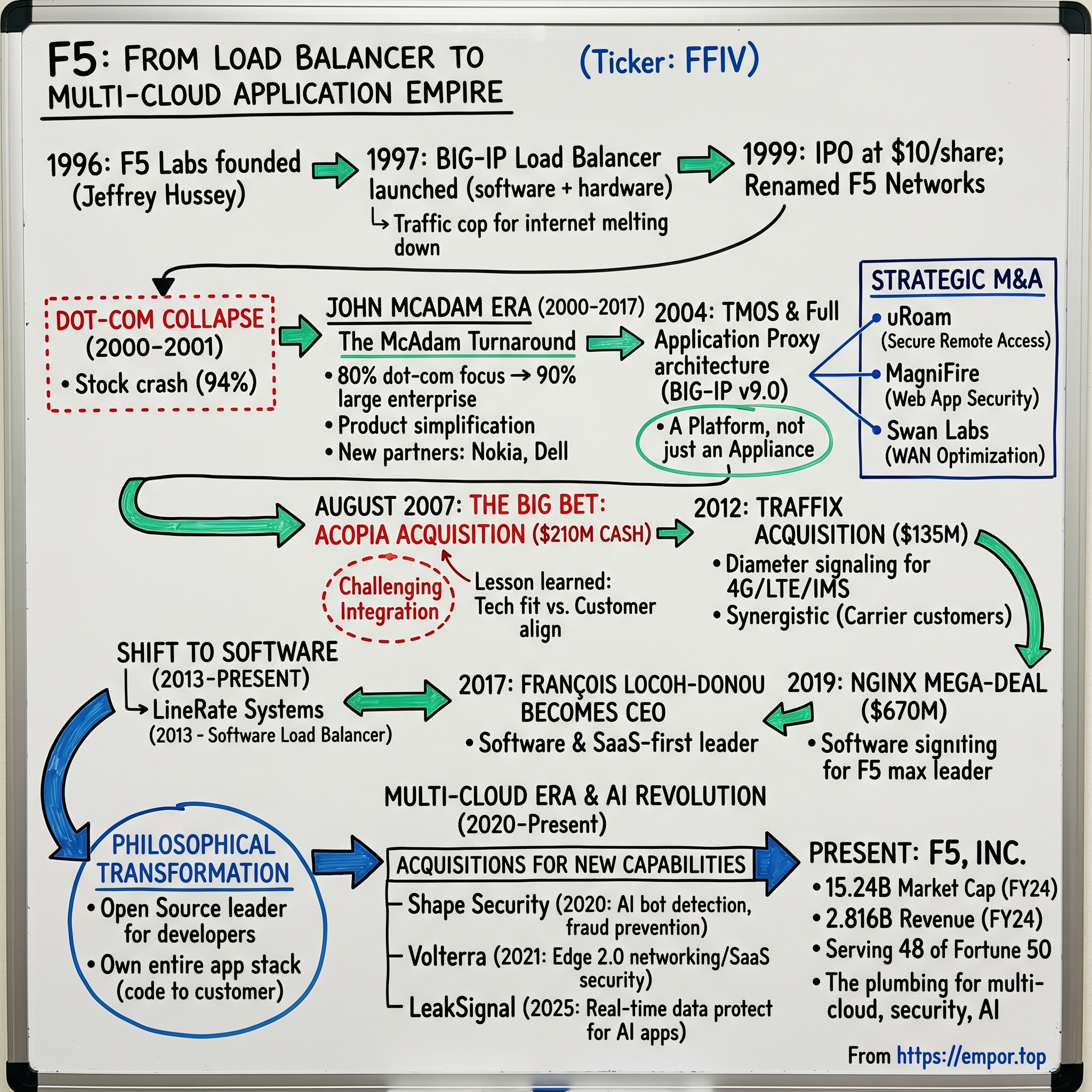
F5: From Load Balancer to Multi-Cloud Application Empire
I. Introduction & Episode Setup
On October 15, 2025, F5 filed a regulatory disclosure reporting a major security breach. A nation-state actor had accessed the company's BIG-IP product development environment and engineering knowledge management systems, exfiltrating portions of source code for F5's highest-revenue product alongside information on unpatched vulnerabilities.1 Within hours, the U.S. Cybersecurity and Infrastructure Security Agency issued Emergency Directive 26-01, ordering all federal civilian agencies to inventory their F5 devices, check whether management interfaces were exposed to the open internet, and patch by October 22.[^2]
The directive reflected the critical placement of F5's technology. CISA reserves emergency mandates for infrastructure positioned directly in front of enterprise applications—devices that terminate encrypted connections, inspect requests, route traffic to servers, and enforce security policies. For a significant portion of the U.S. government and the Fortune 500, that entry point is manufactured by F5.
That reality highlights the central paradox of F5, Inc. Headquartered in Seattle and trading on the NASDAQ Global Select Market under the ticker FFIV, the company is both a deeply embedded component of global enterprise infrastructure and one of the most persistently questioned incumbents in networking. For fifteen years, market consensus predicted its obsolescence—arguing that public cloud adoption, microservices, and open-source tools would commoditize its core load-balancing market. Over that same period, F5's revenue continued to rise.
In fiscal year 2025, ended September 30, 2025, F5 generated $3.088 billion in revenue, up 10% year over year, with a GAAP operating margin of 24.8% and a non-GAAP operating margin of 35.2%.2 The company earned $692 million in GAAP net income on that revenue, compared to $567 million on $2.816 billion the prior year.3 By September 2026, the stock trades near the mid-$400s with a market capitalization around $24 billion—roughly double its valuation from two years earlier.4
F5's revenue flows through three distinct streams. Global Services—$1.579 billion in FY2025, up 2%—is the maintenance and support annuity attached to the installed base.2 High-margin, sticky, and slow-growing, it provides a stable floor for the business. Systems—$706 million, up 31%—consists of hardware appliances, including BIG-IP rSeries devices and VELOS chassis deployed in physical data centers. Software—$803 million, up 9%—spans virtual editions of BIG-IP, subscription licenses, NGINX, and SaaS-delivered F5 Distributed Cloud Services.
In FY2025, hardware was the company's fastest-growing segment, expanding 31% while software grew 9%. That growth inversion—re-accelerating hardware demand despite years of cloud-first projections—presents a critical analytical question: whether the surge reflects a durable shift in enterprise infrastructure priorities or a temporary cyclical rebound.
F5's path to this point traces a 1996 Seattle startup named after a tornado, the dot-com crash that wiped out much of its early customer base, a turnaround under enterprise-focused leadership, an operating system that established long-term switching costs, a $2.17 billion acquisition strategy that attracted activist investor Elliott Management, a 623-person layoff, and an AI infrastructure buildout that requires the specialized traffic management capabilities F5 has developed over decades.
 Subscribe on LinkedIn
II. The Founding & Internet Gold Rush: BIG/ip & Traffic Management (1996-1999)
In 1996, the early commercial web broke frequently and predictably. When a website experienced a sudden surge in traffic, the single server hosting the domain would become overwhelmed and stop responding, returning a blank page or an error message. Without a mechanism for graceful degradation, a saturated server effectively took an entire business offline.
Jeffrey S. Hussey identified a commercial opportunity in this structural failure mode. In February 1996, he co-founded the company in Seattle, serving as chairman, chief executive officer, and president.5 The name referenced the highest rating on the Fujita tornado intensity scale—a metaphor for the overwhelming volume of internet traffic the founders anticipated enterprise infrastructure would soon need to manage.
The company shipped its first product, the BIG/ip Controller, in July 1997. To understand the hardware's function, consider a restaurant with a single entrance leading to twenty identical kitchens. While a traditional network router acts like a doorman directing visitors to a street address, BIG/ip operated like an intelligent maître d'. Sitting at the entrance, it monitored workload across kitchens, identified failing units, maintained session state so a customer stayed connected to the same kitchen, and inspected the specific request before routing it.
Inspecting the contents of that request represented F5's central technical differentiator. In standard networking architecture, Layer 3 and Layer 4 govern the outer network envelope—source IP address, destination address, and port number. Layer 7 represents the content inside the envelope: the specific HTTP request, URL path, cookie data, and headers. While traditional routers only inspected packet envelopes, BIG/ip opened and inspected the underlying application content. That capability enabled dynamic load balancing beyond basic round-robin rotation, real-time server health checks, and persistent session management that prevented e-commerce shopping carts from dropping mid-transaction.
Beyond performance management, placing an intelligent intermediary in front of infrastructure created a vital abstraction layer. Decoupling end users from specific back-end servers made underlying hardware interchangeable. Systems administrators could add server capacity, take individual machines offline for maintenance during business hours, or run parallel software versions to test code updates on a small fraction of live traffic. Standard modern operational practices—such as rolling deployments, blue-green releases, and zero-downtime maintenance—rely directly on this architectural control point. While F5 marketed a capacity management tool in 1997, it had effectively established a central control point for how web applications were operated.
In September 1998, F5 introduced 3DNS, extending traffic management across geographically distributed infrastructure. Where BIG/ip managed server selection within a single data center, 3DNS directed user requests to the optimal regional data center based on proximity and system availability. Together, the products established the core architecture for application delivery networking, validating the initial category thesis.6
Market adoption accelerated as dot-com startups and enterprise web properties invested heavily in online infrastructure. F5's revenue expanded rapidly from several hundred thousand dollars to tens of millions. In April 1999, the company changed its name to F5 Networks, Inc., and on June 4, 1999, completed an initial public offering on the NASDAQ. The company sold 2.86 million shares at $10 per share, raising approximately $25.5 million in net proceeds.6
During the late 1990s boom, sales cycles were short as IT departments sought immediate fixes for web server crashes. While Cisco offered its LocalDirector hardware and specialized startups like Alteon WebSystems and Arrowpoint Communications entered the market, overall demand outpaced vendor capacity. Valuation multiples across the sector escalated quickly, leading to high-priced acquisitions of competitors such as Alteon and Arrowpoint.
Following its IPO, F5's stock price surged from the $10 offer price to nearly $160 per share within months, valuing the young hardware vendor in the billions.
However, that market valuation concealed a structural vulnerability. F5 possessed a genuinely differentiated product based on complex Layer 7 traffic inspection, but its customer base consisted heavily of venture-backed internet startups lacking profits, sustainable revenue, or the resilience to survive a contraction in capital markets. F5 had built an essential technical product, but it had not yet secured a durable enterprise business—a distinction that would be severely tested as the dot-com bubble began to unwind.
III. The Dot-Com Collapse & The Crucible of Survival (2000-2001)
The collapse was sudden. From a peak of nearly $160 per share in early 2000, F5's stock dropped sharply over the course of the year, closing at $9.43—below its $10 IPO price and erasing its early public market gains.6
The stock drop reflected a deeper crisis in F5's customer base. The majority of F5's early clients were venture-backed dot-com startups. As the bubble burst, many of these companies ceased operations entirely. Purchase orders were canceled by bankrupt entities, receivables became uncollectible, and renewal pipelines vanished.
F5's downturn challenged a common assumption in infrastructure investing: that first-mover advantage and rapid category growth automatically create a defensible moat. Although F5 possessed a category-defining product, an established reference architecture, and strong market share, those advantages proved fragile when its customer base failed. A bankrupt client offers zero switching costs. F5's experience demonstrated that an infrastructure moat is not measured by transaction volume, customer logos, or short-term market share, but by how difficult it is for an established, profitable enterprise to replace the technology. Revenue from speculative buyers can mimic durable enterprise demand until market conditions tighten, making F5's 2000–2001 contraction an instructive case study for evaluating high-growth technology vendors.
To navigate the crisis, F5's board recruited new executive leadership. In July 2000, the company brought in John McAdam as chief executive officer. McAdam joined from IBM, where he had managed the Web Server Sales Division following senior roles at Sequent Computer Systems.6 Focused on operational discipline, McAdam prioritized pipeline coverage ratios and gross margin targets, taking control of an organization built on the assumption of unchecked demand.
McAdam concluded that F5's core vulnerability lay in its go-to-market model. Direct sales to startups exposed the company to buyers lacking procurement discipline, long-term capital budgets, and financial stability. To build a durable business, F5 needed to target established enterprises—such as financial institutions, insurers, telecommunications providers, retailers, and government agencies—that operated on multi-year IT budgets and depended on web applications for mission-critical operations.
McAdam executed a three-part restructuring strategy.
First, F5 reduced operating costs. In January 2001, the company cut approximately 15% of its workforce and began subleasing excess office space at its Seattle headquarters to align overhead with lower revenue expectations.6 The measures were essential to preserve capital as bookings declined.
Second, F5 shifted its distribution model. While direct sales had sufficed for startup buyers, reaching enterprise accounts required established channels. McAdam expanded original equipment manufacturer and reseller partnerships, including key agreements with Dell and Nokia, embedding F5's hardware into trusted enterprise sales channels.6 Although partner distribution required sharing margin and relinquishing direct customer contact, it provided access to major corporate IT departments.
Third, F5 repositioned its core product. Rather than marketing its devices primarily as web-scaling tools for fast-growing sites, F5 framed them as mission-critical data center infrastructure. This shift changed the target buyer from software engineering leads seeking performance gains to IT infrastructure directors responsible for system uptime, security, and continuous availability.
F5's financial structure provided a critical buffer during the transition. Because its business model paired capital hardware sales with recurring support contracts, customers continued paying maintenance fees on deployed appliances even as new hardware orders slowed. This recurring maintenance annuity gave management the stability and time required to pivot the business model—a structural advantage often absent in software models dependent solely on upfront transaction fees.
By the time the repositioning took hold, F5 had transformed its commercial foundation. The company traded volatile, startup-driven expansion for predictable enterprise demand, establishing a customer base with high switching costs and strict uptime requirements. That shift laid the groundwork for the technological expansion that followed over the next decade.
IV. The McAdam Turnaround & The Enterprise Standard: BIG-IP, TMOS, & Market Dominance (2001-2012)
The recovery unfolded gradually. F5 returned to profitability in fiscal year 2003 on roughly $115 million in revenue, expanding to about $171 million in fiscal 2004 with net income of approximately $33 million.6 While modest in absolute terms, those figures validated the enterprise pivot, demonstrating that F5 could rebuild demand around reliable enterprise buyers.
The strategic decision that established F5's competitive moat arrived in 2004 with the introduction of TMOS, the Traffic Management Operating System.
Most networking hardware of that era ran on general-purpose operating systems—typically variants of Linux or BSD—with networking features added on top. While sufficient for general routing, that architecture struggled when processing millions of concurrent connections within microsecond latency budgets. F5 replaced the general-purpose stack with a purpose-built, event-driven operating system designed specifically to hold, inspect, and manipulate network traffic flows with low latency.
The performance gains were significant, but the feature that fundamentally reshaped F5's competitive position was a scripting language layered on top of TMOS called iRules.
Built on Tcl, iRules enabled network engineers to write custom scripts that executed directly within the traffic path in real time. Rather than waiting for F5 to build specialized feature requests, enterprise IT teams could write rules to inspect incoming requests—evaluating geographic origin, URL paths, or cookie data—and dynamically rewrite headers, redirect traffic to specific server pools, generate logs, or block malicious patterns.
Over the following decade, this flexibility created deep operational lock-in. For example, a major bank's network team might write iRules to handle custom authentication protocols, legacy mainframe integrations, compliance logging, and routing across acquired subsidiaries. Accumulated across dozens of applications and years of staff turnover, an enterprise could end up maintaining thousands of custom scripts deeply embedded in production traffic. Replacing F5 ceased to be a simple hardware procurement decision; it became a multi-year effort to audit undocumented traffic logic, recreate those rules on a competing platform, and verify compliance without disrupting live services.
This dynamic created F5's primary economic moat: workflow entanglement. Rather than relying on network effects or brand loyalty, F5 embedded its technology directly into customer operations. Because clients built their institutional memory and operational logic on F5's platform, switching costs grew higher over time without requiring continuous product overhauls from the vendor.
With this foundation established, F5 spent the remainder of the 2000s expanding into adjacent capabilities through targeted acquisitions. In July 2003, F5 acquired uRoam for approximately $25 million, acquiring SSL-VPN remote access technology that formed the basis of its Access Policy Manager product line.6 In May 2004, the company purchased MagniFire Websystems for roughly $30 million, adding web application firewall capabilities that became Application Security Manager—F5's initial entry into security and one of its most consequential early transactions.6 Swan Labs followed in November 2005 for about $43 million, adding WAN optimization and acceleration. In February 2012, F5 acquired Traffix Systems for roughly $140 million, expanding into Diameter protocol signaling for 4G LTE networks and establishing a foothold with telecommunications carriers.6
While most of these acquisitions succeeded because the products sat directly in the application traffic path and shared a common enterprise buyer, F5 encountered limits when attempting to expand beyond application traffic.
In August 2007, F5 acquired file virtualization vendor Acopia Networks for $210 million in cash, announcing an initiative termed "File-Area Networking."7 The strategic rationale posited that F5 could extend its expertise in application traffic management to file storage, placing its hardware between applications and storage infrastructure to expand its addressable market.
The expansion failed to gain traction. The storage market shifted toward dedicated network-attached storage and storage area network arrays with built-in management software, and subsequently toward cloud object storage. Lacking control over storage protocol standards, F5 could not establish the same architectural influence it held in application delivery. The acquired technology was eventually absorbed into F5's broader portfolio without delivering significant revenue growth.
The Acopia acquisition highlighted the boundaries of F5's business model. While the $210 million purchase did not impair F5 financially, it demonstrated that the company's competitive advantage was not automatically portable to adjacent infrastructure domains. F5's strength remained tied to Layer 4 through 7 application traffic, where custom operational logic and workflow entanglement created high switching costs. Outside of that specific application layer, where F5 did not control the customer's workflow logic, it operated without a structural moat—a limitation that would resurface in future expansion efforts.
V. The Cloud Threat & The Software Pivot: Hyperscalers, Microservices, & Locoh-Donou's Arrival (2013-2018)
Around 2013, investor scrutiny surrounding F5 shifted from routine product refresh cycles to structural survival, centering on a single question: how would the company endure as enterprise workloads migrated out of traditional data centers?
The company faced two distinct architectural threats that undermined different parts of its business model.
The first threat came from public cloud hyperscalers. Amazon Web Services introduced Elastic Load Balancing—and later Application and Network Load Balancers—while Microsoft Azure and Google Cloud developed equivalent services. Although these cloud-native tools lacked the deep Layer 7 programmability and advanced traffic management of BIG-IP, they offered two structural advantages: they were natively integrated into cloud consoles and could be provisioned instantly on a pay-as-you-go basis without capital expense approvals or physical hardware installation. For new cloud-native applications, basic load balancing became the default choice.
The second threat was architectural. Enterprises increasingly decomposed monolithic software into microservices—small, independent components running in Docker containers and managed by orchestrators such as Kubernetes. In a microservices architecture, network traffic shifts from traditional "north-south" flows—user traffic entering a data center through a central appliance—to high-volume "east-west" communication between services inside a container cluster. To manage this internal traffic, software teams turned to service meshes using lightweight proxies like Envoy coordinated by control planes like Istio, running as sidecars alongside individual containers rather than relying on a centralized hardware gateway.
Taken together, these two developments supported a compelling bear case. As application traffic moved to public clouds, hardware appliance sales would contract. Simultaneously, as remaining application logic shifted to open-source proxies inside container clusters, software licensing demand would erode. Industry analysts cautioned that F5 risked following earlier hardware vendors whose specialized physical chokepoints were absorbed by general-purpose compute and cloud infrastructure.
Financial results from 2013 through 2016 appeared to support that thesis. Hardware revenue growth decelerated, putting pressure on overall operating margins. Market skeptics interpreted each quarter of soft systems revenue as evidence that cloud erosion had begun.
F5 responded with incremental adjustments. In 2013, the company acquired LineRate Systems to expand its software-based Layer 7 services. It also expanded distribution of BIG-IP Virtual Edition—decoupling the TMOS software from proprietary hardware so customers could run it as a virtual appliance on hypervisors or within AWS and Azure environments. While Virtual Edition allowed existing clients to bring F5 policies into cloud environments, it created a commercial friction point: software licenses generated lower upfront revenue than physical hardware appliances, dampening short-term top-line growth.
The pessimistic market thesis rested on an established industry pattern: specialized hardware control points often lose relevance when compute paradigms shift. However, that perspective overlooked a key reality of enterprise IT behavior. In practice, cloud adoption rarely meant a total migration; it resulted in environment accumulation. Enterprises built new applications in public clouds while retaining legacy systems in private data centers due to regulatory requirements, vendor integrations, and complex operational dependencies.
Rather than replacing legacy data centers overnight, enterprises ended up managing hybrid architectures. This multi-environment reality created new operational friction, making it harder for IT teams to enforce consistent security policies, compliance rules, and traffic management across fragmented infrastructure. F5's long-standing lock-in—rooted in customized iRules and embedded operational workflows—kept its core enterprise customer base intact even as new application spending went to public cloud platforms.
Leadership instability added to investor uncertainty during this transition. McAdam retired in 2015, and the board appointed internal executive Manny Rivelo as chief executive officer. Rivelo departed after only several months in 2015, forcing McAdam to return on an interim basis while the board conducted an executive search.6 The abrupt leadership reversal raised questions about board oversight at a critical operational juncture.
In April 2017, the board named François Locoh-Donou as president and chief executive officer.6 Raised in Togo, educated in France as a telecommunications engineer, and holding an MBA from Stanford, Locoh-Donou had previously served as chief operating officer at optical networking vendor Ciena. His tenure at Ciena—a business accustomed to managing physical hardware cycles in carrier markets—informed his disciplined focus on operational execution and multi-year strategic milestones.
Locoh-Donou took charge with a clear strategic directive: reposition F5 from a hardware-centric application delivery vendor into a software-driven, multi-cloud application security and traffic management platform, while retaining the high-margin hardware maintenance streams required to fund the transition. To accelerate that software pivot, executive leadership turned to inorganic growth through targeted acquisitions.
VI. The $2.17B M&A Spree: NGINX, Shape Security, & Volterra (2019-2021)
The strategic challenge facing Locoh-Donou extended beyond technical features to a fundamental shift in customer buyer personas.
F5 historically sold to network operations (NetOps) teams—professionals managing physical infrastructure, scheduled change-control windows, and high-uptime environments. They relied on hardware appliances and custom iRules scripts, representing a loyal, highly predictable customer base.
By 2019, however, modern application development had shifted toward DevOps engineers and platform teams. These developers bypassed traditional network change tickets, rarely purchased hardware appliances, and selected open-source software tools directly from developer repositories. If F5 failed to establish credibility with this audience, its traditional installed base risked gradual contraction as new workloads bypassed F5's infrastructure footprint entirely.
To bridge this operational divide, F5 deployed roughly $2.17 billion in capital over twenty-four months across three targeted acquisitions.
NGINX, March 2019, approximately $670 million enterprise value. NGINX offered an open-source web server and reverse proxy that powered a major share of global web traffic, with F5 citing over 375 million active sites at the time of the transaction.[^9] Widely adopted across the DevOps ecosystem for its speed and lightweight footprint, NGINX monetized through NGINX Plus, a commercial enterprise subscription generating an estimated $26 million in annual recurring revenue (ARR).
The $670 million enterprise value represented a valuation multiple of roughly 25 times ARR. F5 justified the premium by framing the acquisition not as a purchase of near-term revenue, but as an entry point into a developer community it could not reach organically—mirroring contemporary transactions like IBM's purchase of Red Hat or Salesforce's acquisition of MuleSoft. The strategic rationale was explicitly framed around bridging the operational gap between NetOps and DevOps teams.[^9]
Integration, however, brought structural friction. Open-source communities often view commercial acquisitions with skepticism, fearing that enterprise vendors will restrict open features to drive paid conversions. Over the ensuing years, key technical leaders departed, including NGINX creator Igor Sysoev and principal maintainer Maxim Dounin. In 2024, Dounin launched Freenginx as a community-governed software fork. While software forks rarely eliminate an incumbent overnight, the split highlighted the challenge of retaining community trust under corporate ownership and created an ongoing risk that developer adoption could drift toward non-monetized open-source alternatives.
Shape Security, completed January 2020, $1.0 billion in cash. Shape Security specialized in automated bot mitigation and fraud prevention. Its platform analyzed interaction telemetry—such as mouse movements, device fingerprinting, and request patterns—using machine learning to detect automated traffic attempting credential stuffing, account takeover, gift-card fraud, and web scraping.8 Shape primarily served large enterprise clients with high-value digital transactions, including major financial institutions, airlines, and retailers.
With Shape generating approximately $70 million in ARR at the time of the deal, the $1.0 billion purchase price represented a valuation multiple of roughly 14 times revenue—aligning with prevailing valuations for high-growth cybersecurity assets during that market cycle. Unlike the earlier Acopia expansion, Shape aligned directly with F5's core architectural strength. Because bot mitigation must be enforced inline within the live traffic stream, Shape's security software integrated into the application traffic path F5 already controlled across enterprise data centers.
Volterra, announced January 2021, approximately $500 million in cash plus assumed unvested equity and earnouts. Volterra provided a distributed cloud platform operating a network of points of presence that enabled enterprises to deploy applications and security policies across public clouds, data centers, and edge environments through a unified control plane.[^11] The newest and least mature of the three acquisitions, Volterra generated minimal revenue at the time of purchase. F5 subsequently integrated the platform as the foundation for F5 Distributed Cloud Services, forming the SaaS layer of its product portfolio.
Evaluating Volterra requires distinguishing software assets from commercial execution. While NGINX provided a developer community and Shape delivered established software revenue, Volterra represented a strategic architecture: the premise that enterprise IT departments would pay a third-party specialist for a vendor-neutral management plane spanning AWS, Azure, Google Cloud, and private infrastructure rather than relying solely on native cloud provider tools. By 2026, F5 Distributed Cloud Services remains a key element of management's multi-cloud narrative, though F5 provides limited granular breakdown of the platform's standalone recurring revenue series compared to its broader software segment reporting.
Collectively, the $2.17 billion acquisition campaign expanded F5's addressable product footprint over two years far faster than internal development would have permitted. However, acquiring high-multiple software businesses with significant ongoing integration costs also imposed immediate margin compression, reshaping F5's financial profile as it sought to operationalize its expanded portfolio.
VII. The Margin Crisis, Elliott Management Activism, & The 2023 Reset (2020-2023)
Acquiring software companies can quickly elevate a corporate narrative, but it often depresses short-term operating margins as an acquirer absorbs full cost structures immediately while revenue synergies materialize gradually, if at all.
F5 had historically operated as a highly profitable hardware and support business. Integrating three acquired companies—each bringing separate sales forces, engineering organizations, and cloud infrastructure expenses, along with Volterra’s unmonetized cost base—sharply reduced GAAP operating margins as expense growth outpaced revenue gains. In fiscal year 2020, F5 generated $2.35 billion in revenue with $392 million in GAAP operating income. By fiscal 2022, revenue reached $2.70 billion, yet GAAP operating income rose to just $404 million—meaning three years of top-line expansion produced virtually no incremental operating profit.3 Expense growth absorbed nearly every additional dollar of revenue.
That margin compression quickly attracted external investor scrutiny. In November 2020, reports emerged that activist firm Elliott Management had built a significant stake in F5.[^12] Elliott’s technology playbook followed a consistent pattern: identify a vendor with a defensible core franchise and an expanding cost structure, assert that management overpaid for acquisitions, and demand explicit margin targets alongside increased capital returns.
The activist critique relied directly on public disclosures. F5 had deployed $2.17 billion in cash over two years, while operating margins contracted by roughly eight to ten percentage points. Product integrations had yielded little immediate cross-selling momentum, leaving the cash-generative core business to subsidize an expensive transformation with deferred returns.
F5 avoided a public proxy contest. Management engaged with Elliott, publicly committed to expanding margins, halted major transformational acquisitions, and increased share repurchases. While avoiding a governance battle preserved board stability, the outcome reflected external pressure rather than internal initiative. Management's subsequent actions—pausing large-scale M&A, setting formal non-GAAP margin targets, and allocating substantial free cash flow to share buybacks—signaled an implicit acknowledgment that the activist critique had merit.
Evaluating the period requires considering the counterfactual to Elliott's argument. Had F5 eschewed acquisitions, it would have entered the 2020s as a high-margin hardware vendor lacking developer-centric tooling, automated bot protection, or cloud-native SaaS delivery options. Strong short-term margins would have concealed long-term competitive vulnerability as workloads shifted. Elliott’s core argument—that F5 overpaid and stumbled on integration—was far more compelling than a rejection of transformation altogether. Disentangling flawed execution from strategic necessity remains the key analytical distinction, even if short-term investors had incentive to conflate them.
Macroeconomic headwinds soon eliminated remaining operational slack. In early 2023, enterprise IT spending decelerated sharply as customer purchasing cycles slowed. Hardware refresh demand, which had accelerated during earlier supply-chain constraints, contracted. F5 subsequently lowered its fiscal 2023 revenue growth guidance from an initial 9% to 11% range down to low single digits, reflecting a rapid shift in customer buying patterns.
On April 19, 2023, F5 announced a corporate restructuring that included a 9% reduction in global headcount—affecting 623 employees—alongside office consolidations and reduced travel budgets.[^13] Beyond workforce reductions, executive compensation was directly impacted: CEO François Locoh-Donou received a zero cash bonus for fiscal 2023, while executive vice presidents saw cash bonuses reduced by approximately 70%.[^13]
This compensation reduction marked a notable departure from prevailing corporate practice, where executive payout metrics are frequently adjusted to shield leadership during restructurings. By tying executive bonuses directly to performance failures, F5 established a rare benchmark for executive accountability during an enterprise downturn.
That accountability coincided with ongoing friction in product modernization. F5 spent years developing BIG-IP Next, a complete re-architecture of its legacy TMOS platform into a modular, API-first framework designed for containerized environments. While F5 launched the platform and began customer migrations, transition timelines proved longer and more complex than initially projected. The deeply embedded iRules and custom traffic logic that create high switching costs against competitors also complicate internal upgrades. The high switching costs that protect F5's installed base from rivals effectively slow the adoption of its own modernized software, imposing a structural timeline tax on platform updates.
Ultimately, the 2020 to 2023 period demonstrated the limits of M&A-driven enterprise transformations. Deploying $2.17 billion in cash led to immediate margin erosion, activist intervention, significant guidance reductions, and a 623-employee layoff. While assets like NGINX and Shape provided essential capabilities, the experience highlighted that inorganic expansion requires strict margin discipline and operational alignment from day one. Without proactive internal controls, capital discipline is ultimately enforced by external market pressures.
For F5, the critical question entering the mid-2020s was whether externally imposed financial discipline had been permanently internalized across its operations.
VIII. The Modern Business & Multi-Cloud/AI Architecture (2024-Present)
Contrary to expectations during F5's initial software pivot, hardware demand re-accelerated sharply in the mid-2020s.
In fiscal year 2025, systems revenue grew 31% to $706 million,2 supported by a 42% expansion in the fourth quarter.2 That momentum continued into fiscal 2026. For the first quarter ended December 2025, systems sales grew 37% as part of 11% product growth and 7% total revenue expansion, with total revenue reaching $822 million.9 In the third quarter of fiscal 2026, reported on July 27, 2026, systems revenue of $240 million grew 32%, software rose 7% to $223 million, services grew 3% to $402 million, and total revenue reached $865 million—an 11% overall increase that marked a continuation of consecutive quarters of double-digit product growth.10
Management attributes this systems expansion to two primary drivers: hybrid multi-cloud evolving from a temporary transition into a permanent enterprise architecture, and physical artificial intelligence infrastructure requiring high-throughput traffic management and security. As organizations deploy graphics processing unit (GPU) clusters on-premises or in colocation facilities to optimize AI training and inference costs, they require specialized hardware to terminate encryption, distribute inference requests across accelerators, and enforce security policies at line rate.
However, evaluating the durability of this growth requires examining three alternative catalysts alongside management's explanation. First, a hardware refresh cycle: legacy iSeries appliances introduced in the late 2010s are reaching end-of-support, making migration to rSeries devices and VELOS chassis a cyclical replacement wave rather than net-new structural expansion. Second, baseline comparisons: unusually depressed systems sales in fiscal 2023 created lower year-over-year comparison hurdles. Third, post-incident remediation: regulatory mandates following F5's October 2025 breach served as an unintended catalyst for hardware replacements.
Because F5's financial disclosures do not isolate these variables, systems growth likely stems from a combination of AI deployment, cyclical hardware upgrades, base-year comparisons, and breach-related replacements. Determining the proportion attributable to durable AI demand versus cyclical replacement remains a key analytical question for evaluating F5's long-term growth trajectory.
The breach and its aftermath. F5 learned of the security intrusion on August 9, 2025, and disclosed it publicly on October 15, 2025.1 Cybersecurity reporting attributed the campaign to a China-nexus espionage group utilizing the BRICKSTORM malware family, estimating the attacker's dwell time inside F5's systems at a year or more.1 CISA's Emergency Directive 26-01 required federal civilian agencies to inventory F5 products, apply security updates by October 22, and report completion by October 29.[^2]
The initial financial impact materialized on October 27, 2025. Although F5 reported fourth-quarter growth of 8%—capping fiscal 2025 with 10% annual revenue expansion and 18% non-GAAP earnings growth—management guided fiscal 2026 revenue growth down to a range of 0% to 4%, citing operational disruption from the breach.2 The company's stock price fell $30.76 per share, or approximately 10%, over the following two trading sessions.[^16]
Legal and commercial developments subsequently diverged. On December 19, 2025, a securities class action was filed in the Western District of Washington on behalf of purchasers between October 28, 2024, and October 27, 2025, alleging misstatements about F5's cybersecurity controls and questioning both the financial impact and the roughly two-month gap between discovery on August 9 and disclosure on October 15.[^16] While filed complaints represent allegations rather than judicial findings, and disclosure timelines in cyber investigations are frequently shaped by non-public law enforcement requests, the multi-month gap between discovery and disclosure remains a notable governance consideration.
Commercially, F5 executed a rapid operational recovery. On January 27, 2026, F5 reported first-quarter results and raised fiscal 2026 revenue growth guidance to between 5% and 6%.9 By the third quarter, management raised guidance again to approximately 9% to 10% growth, projecting non-GAAP EPS of $17.21 to $17.33 compared to the prior $16.25 to $16.55 range.10
This guidance progression demonstrates that customer churn remained minimal despite a publicized breach in F5's core security domain. The strong customer retention underscores the high switching costs created by deep operational integration, as clients faced significant friction in replacing F5's traffic infrastructure. At the same time, the wide swing in full-year guidance within nine months suggests initial conservatism after the breach alongside limited near-term forecasting visibility.
The portfolio today. F5 now describes its offering as an Application Delivery and Security Platform, structured across three primary architectural tiers plus an integrated security layer. BIG-IP—available in appliance, chassis, and virtual forms—remains the enterprise anchor for Layer 4–7 traffic management, SSL offload, access control through Access Policy Manager (APM), and web application firewalling through Application Security Manager (ASM). NGINX serves developer and containerized environments as an API gateway, Kubernetes ingress controller, and microservices proxy. F5 Distributed Cloud Services provides the SaaS layer for multi-cloud networking, web application and API protection, and automated bot mitigation derived from Shape Security.
Superimposed across this architecture is an AI security strategy built through targeted 2025 acquisitions. LeakSignal, acquired in March 2025, introduced real-time classification and governance for sensitive data flowing through AI application streams. Fletch, acquired in June 2025, added agentic AI for threat detection and alert prioritization. MantisNet, acquired in August 2025, provided eBPF-based cloud-native network observability. CalypsoAI, completed September 29, 2025, for approximately $180 million, added runtime AI security, including red-teaming, inference-layer defenses, and adaptive guardrails for generative and agentic workloads.11
This acquisition series reflects a modified capital allocation strategy: four smaller transactions within twelve months, capped by a $180 million purchase, compared to the $1.0 billion check written for Shape Security in 2020. This lower-value deal structure aligns with management commitments following activist intervention from Elliott Management, reducing balance-sheet risk while expanding functional coverage. However, the strategic value of these tuck-ins depends on whether they integrate directly into F5's core traffic path. Offerings like LeakSignal and CalypsoAI inspect active AI prompt and response streams, matching F5's inline traffic management model, whereas observability assets like MantisNet and Fletch operate further from the direct data path.
Competition. Consolidation in the legacy application delivery controller market has left F5 with few direct peer competitors at the high end, as Citrix's ADC business now operates within Cloud Software Group and A10 Networks remains significantly smaller. Primary competitive threats now originate from three adjacent sectors: edge networks and content delivery providers like Cloudflare, Akamai, and Fastly selling cloud-native security services; cybersecurity vendors like Palo Alto Networks, Fortinet, and Zscaler consolidating application security into broader platform suites; and public cloud hyperscalers capturing workloads native to their environments.
F5 relies on structural counter-positioning to defend its market share. Its competitive advantage is strongest in heterogeneous enterprise environments—where organizations manage legacy data centers, private clouds, public cloud instances, container clusters, and edge deployments simultaneously. While hyperscaler management tools function effectively within their native ecosystems, they offer limited utility across competing clouds. F5 provides a neutral control plane capable of enforcing consistent security and traffic policies across fragmented infrastructure, a capability cloud providers cannot easily emulate without compromising their own ecosystem incentives.
However, this structural moat remains tied to enterprise operational complexity. F5 benefits as long as multi-cloud fragmentation persists, but rationalization of enterprise IT environments could erode the necessity for an independent multi-cloud abstraction layer over time.
IX. Management, Governance, & Capital Allocation Audit
By September 2026, François Locoh-Donou has led F5 for more than nine years and holds the chairman role alongside his positions as president and CEO.10 Combining the board chair and CEO roles concentrates executive oversight within management—a structure that frequently draws scrutiny from institutional investors concerned with independent board governance.
Proponents of Locoh-Donou's leadership point to structural execution and operational discipline. Facing predictions of terminal decline, leadership preserved the core maintenance annuity while building out a software and security portfolio. During the 2023 downturn, Locoh-Donou accepted a zero cash bonus alongside executive pay cuts while executing headcount reductions. Furthermore, management engaged activist investor Elliott Management without a public proxy contest, subsequently adjusting capital allocation and restoring non-GAAP operating margin to 35.2% in fiscal 2025 from depressed post-acquisition levels.2
Conversely, critics highlight significant operational missteps and forecasting volatility under the current leadership team. The multi-billion-dollar acquisitions that diluted margins occurred under Locoh-Donou's tenure rather than prior management. Revenue guidance has experienced wide swings—from lowering fiscal 2023 projections from 9%–11% down to low single digits, to shifting fiscal 2026 outlooks from 0%–4% up to 9%–10%—undermining visibility into underlying business trends. Most critically, the most severe security breach in F5's history—a year-long undetected intrusion into the core product development environment—took place under a management team marketing enterprise security solutions.1
Throughout his tenure, Locoh-Donou has maintained narrative consistency across market cycles. Management's central thesis—that hybrid multi-cloud infrastructure is permanent, that F5 serves as the unified policy layer across fragmented environments, and that the software pivot represents a gradual transition—has remained unchanged. When hardware sales unexpectedly re-accelerated in fiscal 2025 and 2026, management framed the expansion around AI infrastructure buildouts requiring physical traffic control, aligning the trend with its broader thesis rather than altering corporate positioning.
However, while strategic consistency can signal disciplined vision, a broadly framed thesis—such as the enduring complexity of enterprise IT—can accommodate widely varying operational outcomes. Because enterprise infrastructure complexity is nearly impossible to falsify externally, persistent management framing provides limited insight into short-term execution quality.
Executive compensation aligns heavily with equity performance. Locoh-Donou's remuneration features a base salary below $1 million, with the majority of compensation delivered in equity tied to performance metrics such as total shareholder return and non-GAAP earnings targets. This compensation structure rewarded leadership substantially as F5's stock price roughly doubled between 2024 and 2026, demonstrating strong upside alignment during periods of valuation expansion.
Capital allocation shifts following activist involvement from Elliott Management are clearly reflected in financial metrics. In fiscal 2025, F5 repurchased approximately $502 million of common stock.2 Relative to $692 million in GAAP net income and higher free cash flow generation, share buybacks represent a significant capital return program that has meaningfully reduced share count. Diluted shares outstanding dropped from approximately 62.1 million in fiscal 2021 to 58.7 million in fiscal 2025—a decrease of over 5% despite ongoing equity compensation grants.3 F5 does not pay a quarterly dividend, focusing capital returns entirely on share repurchases.
This capital return strategy is supported by low capital expenditure requirements. Capital intensity remains in the low single digits as a percentage of revenue, as F5 avoids owning semiconductor fabrication facilities or operating hyperscale cloud data centers. While the F5 Distributed Cloud Services footprint introduces modest infrastructure overhead, the core business generates strong free cash flow without requiring heavy balance-sheet expansion, sustaining ongoing share repurchases.
Revenue accounting under Accounting Standards Codification (ASC) 606 introduces additional complexity when evaluating software trends. For multi-year software subscriptions, F5 recognizes term license revenue upfront while recognizing support services ratably over the contract period. Although fully compliant with standard accounting guidelines and transparently disclosed, this treatment can introduce quarterly software revenue volatility that does not directly correlate with underlying customer operational activity. Consequently, comparing F5's reported software revenue growth directly to the annual recurring revenue (ARR) metrics of pure Software-as-a-Service (SaaS) peers misaligns accounting methodologies.
X. Porter's 5 Forces & Hamilton Helmer's 7 Powers Analysis
Evaluating F5 through structural competitive frameworks isolates the specific mechanisms driving its business model, moving the analysis past corporate narrative and toward operational realities.
Porter's Five Forces
Threat of new entrants: low. Building a carrier-grade Layer 7 traffic processor that can terminate millions of TLS connections at line rate, pass enterprise security certifications, and earn placement in front of mission-critical enterprise systems requires a multi-year, capital-intensive engineering commitment. Crucially, a new entrant faces a formidable installed-base barrier: an enterprise's existing operational logic cannot run on an unfamiliar platform. Consequently, no new vendor has successfully entered the high-end enterprise ADC market in over a decade.
Bargaining power of buyers: moderate to high, and rising. F5's customer base consists of sophisticated enterprise procurement organizations that understand their leverage during contract renewals. Buyers frequently leverage alternative deployment options—such as native cloud services—in contract negotiations, even when retaining on-premises infrastructure. Furthermore, the October 2025 security breach provided clients additional pricing leverage. F5 does not disclose granular pricing realization metrics, leaving a visibility gap for outside analysts tracking net price realization.
Bargaining power of suppliers: moderate. F5's appliances rely on commodity x86 processors alongside specialized network interface silicon and FPGAs supplied by chipmakers including Intel, Broadcom, and NVIDIA. F5 lacks the scale of major hyperscalers to command preferential allocation during supply chain constraints—a vulnerability demonstrated during the 2021–2022 component shortages that could re-emerge as artificial intelligence infrastructure consumes advanced packaging and networking silicon capacity.
Threat of substitutes: high. Open-source software proxies such as HAProxy, Envoy, and community editions of NGINX provide capable, free alternatives for traffic management. Additionally, native Kubernetes ingress controllers, service meshes, and cloud-provider load balancers serve as the default architectural choices for greenfield deployments. The primary substitute risk is not that these alternatives match BIG-IP's advanced Layer 7 capabilities, but that a growing proportion of modern application traffic does not require complex inline processing.
Competitive rivalry: high but segmented. F5 faces minimal direct competition when renewing its legacy installed base, yet encounters intense rivalry when bidding for new cloud-native workloads. The intensity of competitive pressure varies significantly across product lines, underscoring why the company's financial profile must be evaluated separately across systems, software, and global services.
Helmer's 7 Powers
Switching costs — strong, and empirically validated. High switching costs represent F5's primary economic moat. The October 2025 breach provided an empirical test of customer retention: despite nation-state access to source code and regulatory emergency directives mandating rapid patching, enterprise customer churn remained minimal and hardware revenue subsequently accelerated. This retention underscores the steep operational friction and re-engineering costs involved in replacing F5's deeply embedded traffic logic.
Scale economies — moderate. F5 spends roughly $540 million a year on research and development, amortized across a large enterprise customer base, plus a global direct sales force and channel relationships with major integrators.3 While this R&D scale provides a cost advantage over smaller peers like A10 Networks, it offers little leverage against broader security platform vendors such as Palo Alto Networks or Cloudflare, both of which operate significantly larger R&D budgets.
Counter-positioning — real but conditional. F5's multi-cloud neutrality represents a counter-positioned structural advantage over public cloud hyperscalers. Because hyperscaler incentives favor locking workloads within their respective ecosystems, cloud providers are disincentivized from building robust management layers for competing clouds. However, this power remains conditional on enterprise architectural heterogeneity—an external trend F5 does not control.
Cornered resource — weak. Although F5 maintains an extensive patent portfolio and proprietary TMOS intellectual property, neither meets the strict criteria of a cornered resource. Networking patents primarily serve a defensive function, and while TMOS represents a sophisticated software stack, it remains technically replicable over time—a reality highlighted by the exfiltration of its source code in 2025.
Process power — present but difficult to quantify. Over two decades of managing high-throughput production traffic for global enterprises has generated deep institutional knowledge regarding operational failure modes and edge cases. While unquantifiable in financial models, this operational expertise reinforces technical switching costs during major infrastructure decisions.
Branding and network economies are effectively absent. F5 possesses technical credibility rather than consumer brand pricing power, and individual customers derive no direct network benefits from the addition of other enterprises to F5's platform.
Evaluating these combined forces indicates that F5's competitive advantage is concentrated within its installed enterprise workloads. The company's market power is deep but narrow, offering limited portability into adjacent infrastructure categories—reaffirming the lessons of past expansion efforts across a broader operational dataset.
XI. Bear vs. Bull Case & Investor Stress Test
The bull case
One: Hybrid is the terminal state, not a waypoint. The prevailing assumption around 2015 held that enterprises would complete their migration to public clouds, leaving legacy data centers empty. A decade later, large organizations operate across on-premises systems, multiple public clouds, colocation facilities, and edge locations simultaneously—and are increasingly repatriating select workloads to control costs. In this environment, a vendor-neutral control plane for traffic and security policy moves from a transitional bridge to a permanent architectural requirement. F5's revenue trajectory through fiscal years 2025 and 2026 aligns with this trend.
Two: AI traffic is F5-shaped traffic. Artificial intelligence workloads generate massive volumes of API calls, require inference requests to be distributed across high-cost accelerators, and introduce distinct security challenges—including prompt injection, model exfiltration, sensitive data leakage, and autonomous agentic calls. Each of these challenges requires inspecting and routing traffic in real time—the core technical problem F5 has addressed throughout its history. Management assembled its 2025 acquisition portfolio specifically against this thesis.
Three: Operating leverage from product mix. As software and SaaS expand toward half of product revenue, incremental gross margins rise because the fixed cost base is already in place. F5's non-GAAP operating margin reached 35.2% in fiscal 2025, rebounding above post-acquisition lows, while raised fiscal 2026 earnings guidance of $17.21 to $17.33 per share indicates that operational leverage is currently working.210
Four: The refresh wave has multi-year runway. A substantial installed base of aging iSeries hardware migrating to rSeries devices and VELOS chassis—accelerated by post-breach security pressure and end-of-life timelines—provides multi-quarter support for systems revenue.
The bear case
One: The substitution clock never stops. Every greenfield application built as a cloud-native service using Kubernetes and open-source proxies like Envoy is an application that will never generate an F5 renewal. This dynamic does not trigger immediate top-line contraction; rather, it suppresses future revenue over a multi-year horizon. F5's installed base functions as an annuity, and annuities gradually amortize.
Two: Open-source adoption caps monetization. Although F5 owns the NGINX brand and codebase, the vast majority of deployments run on the free, open-source version. The 2024 Freenginx fork highlighted that community goodwill is not an owned corporate asset. Converting open-source users to paid subscriptions at scale remains unproven, and F5 does not break out NGINX Plus financials with sufficient granularity to evaluate commercial progress.
Three: Hardware re-acceleration may be cyclical. This represents the primary risk to the bull thesis and directly counters the hardware refresh narrative. If recent systems revenue growth rates of 31% in fiscal 2025 and 32% in the third quarter of fiscal 2026 reflect a temporary convergence of replacement cycles, post-breach mandates, and easy year-over-year comparisons, top-line momentum will slow sharply once the upgrade cycle matures. Current financial disclosures do not isolate these factors, leaving investors unable to determine how much growth is structural versus cyclical.
Four: Security competitors are better-capitalized and consolidating. Platform competitors like Palo Alto Networks and Cloudflare are driving security consolidation with larger research budgets and, in Cloudflare's case, a fundamentally lower-cost delivery model. When F5 sells standalone API security or web application firewalling outside its traditional hardware footprint, it competes away from its primary switching-cost moat into markets where its legacy advantage does not apply.
Five: The breach leaves unresolved tail risk. Beyond ongoing shareholder litigation, the intrusion left nation-state actors in possession of F5 source code and unpatched vulnerability research for devices positioned in front of critical enterprise infrastructure. This creates persistent exposure to future exploit discoveries—a tail risk with no expiry date and no straightforward way to quantify.
The activist stress test
A skeptical investor building a short thesis today would not focus on customer churn, given that the October 2025 breach demonstrated the durability of F5's switching costs. Instead, an activist or short seller would target three operational vulnerabilities:
First, forecasting volatility: a management team that lowered revenue growth targets from an initial 9%–11% down to low single digits in 2023, then swung fiscal 2026 guidance from 0%–4% up to 9%–10% within nine months, demonstrates limited forward visibility. The market is currently paying a valuation multiple that assumes predictable execution.
Second, disclosure opacity: F5 reports revenue across Systems, Software, and Global Services, but omits consistent breakdowns for Distributed Cloud recurring revenue or NGINX commercial metrics. This lack of transparency prevents outside analysts from verifying whether the $2.17 billion acquisition strategy successfully built a growing recurring software franchise.
Third, growth composition: if current revenue expansion is driven primarily by hardware replacement, the market is effectively assigning a software valuation multiple to a cyclical hardware rebound. A sharp valuation derating would follow if hardware growth slows without a corresponding acceleration in software.
These vulnerabilities do not represent accusations of impropriety; rather, they mark the structural gaps where the bull case relies on executive framing rather than on verifiable data, establishing the leverage points where an activist would apply pressure.
The KPIs that matter
Investors should track three core metrics to evaluate execution:
Systems revenue growth against prior-year comparisons. This figure serves as the key test between the bull and bear cases. Tracking this metric as comparisons harden through fiscal 2027 will reveal whether hardware demand is structural or cyclical.
Software revenue growth, specifically the subscription and SaaS component. Software revenue grew 9% in fiscal 2025 and 7% in the third quarter of fiscal 2026—respectable, but not transformational.210 If multi-cloud security adoption is taking hold, this line must inflect upward. Persistent single-digit growth would indicate that the 2019–2021 M&A campaign expanded functional breadth without creating a high-growth software engine.
Non-GAAP operating margin. At 35.2% in fiscal 2025, operating margin is roughly back to historical territory following post-activist commitments.2 Maintaining margin discipline while absorbing acquisitions and elevated security spending will determine whether operational efficiency is permanently embedded in corporate governance.
XII. Lessons & Reflections for Founders & Investors
Pivots are survivable; customer durability determines survival. F5 altered its core product positioning three times—from a startup web-scaling tool to an enterprise data center standard, and ultimately to a multi-cloud software and security platform—surviving each transition. What brought the company closest to failure during the dot-com collapse was not a technology migration, but selling to financially fragile customers. While founders instinctively optimize for rapid near-term demand, F5's early experience demonstrates that customer solvency and durability are at least as critical as top-line revenue growth rates.
Buy capability, but budget for the integration drag. F5's $2.17 billion acquisition campaign across NGINX, Shape Security, and Volterra provided a software and security portfolio the company could not have developed internally in time. However, absorbing those assets compressed operating margins for three years, invited activist investor Elliott Management onto the share register, and culminated in a 623-employee layoff in 2023. The core strategic error was not buying capabilities, but executing M&A without immediate sales force alignment or an enforced operating margin floor. Acquired technical capability arrives on day one; revenue synergies materialize slowly, if at all. The timing gap between upfront expenditure and deferred return creates the operational vulnerability where activist intervention takes hold.
The deepest moats are built from the customer's own work. The long-term defensibility of F5's Traffic Management Operating System stems primarily from iRules. Rather than relying solely on proprietary hardware or restrictive contracts, F5 provided a programmable traffic surface, leading enterprise engineering teams to spend two decades embedding custom operational logic directly into the traffic path. The resulting switching costs were not dictated by the vendor; they were constructed by customers who subsequently could not afford to abandon them. This operational entanglement compounds silently and resists competitive disruption far better than brand equity or feature parity, as demonstrated when customer retention held firm following the severe security breach disclosed in October 2025.
Know precisely where the moat ends. The 2007 acquisition of file virtualization vendor Acopia Networks defined the outer boundary of F5's economic moat. Shifted even one layer away from the inline application traffic path—and lacking ownership of embedded customer workflow logic—F5 operated as an un-differentiated competitor with uninspiring commercial results. Every subsequent product expansion and corporate acquisition must be evaluated against this boundary: when F5 strays from managing inline application traffic and embedded operational logic, its structural moat disappears.
Sell to the buyer who controls future spending, not the historical buyer. F5 recognized that the decision-maker for application infrastructure had shifted from traditional network operations teams to DevOps and platform engineers, and that legacy channel relationships could not compensate for that shift. Acquiring NGINX to reach developers was expensive, operationally challenging, and led to key founder departures. However, the transaction was strategically necessary. When buyer personas evolve, incumbency with historical buyers becomes a depreciating asset, leaving enterprise leaders with only one decision: how much capital they are willing to deploy to follow the customer.
References
-
F5 data breach: "Nation-state attackers" stole BIG-IP source code, vulnerability info — Help Net Security, 2025-10-15 ↩↩↩↩
-
F5 Reports Strong Fourth Quarter Results with 8% Revenue Growth; FY25 Revenue of $3.1 Billion — F5 Form 8-K Exhibit 99.1, 2025-10-27 ↩↩↩↩↩↩↩↩↩↩
-
F5, Inc. Annual Income Statement Data (FY2020–FY2025), from SEC Form 10-K filings — Financial Modeling Prep / SEC EDGAR ↩↩↩↩
-
F5, Inc. (FFIV) Quote and Market Capitalization — NASDAQ market data via Financial Modeling Prep, 2026-09-18 ↩
-
F5 Networks Inc. Definitive Proxy Statement (DEF 14A) — SEC EDGAR, 2000 ↩
-
F5 Networks, Inc. — Company History and Acquisitions Record ↩
-
F5 Completes Acquisition of Shape Security — F5 Press Release, 2020-01-24 ↩
-
F5 Reports Strong First Quarter Results with 7% Revenue Growth Including 11% Product Growth — F5 Press Release, 2026-01-27 ↩↩
-
F5 Reports Third Quarter Results with 19% Product Revenue Growth Driving 11% Total Revenue Growth Year Over Year — F5 Press Release, 2026-07-27 ↩↩↩↩↩
-
F5 paying $180M to acquire CalypsoAI to boost AI enterprise security offerings — GeekWire, 2025-09-11 ↩
 LinkedIn
 WhatsApp
 Reddit
 Hacker News
 Email
Email Kindle
 RSS Feed
 Spotify
 Apple Podcasts
 Amazon Music
 Audible
 YouTube