FirstEnergy: From Utility Empire to Bribery Scandal and the $36B Regulated Pivot
I. Introduction & Episode Roadmap
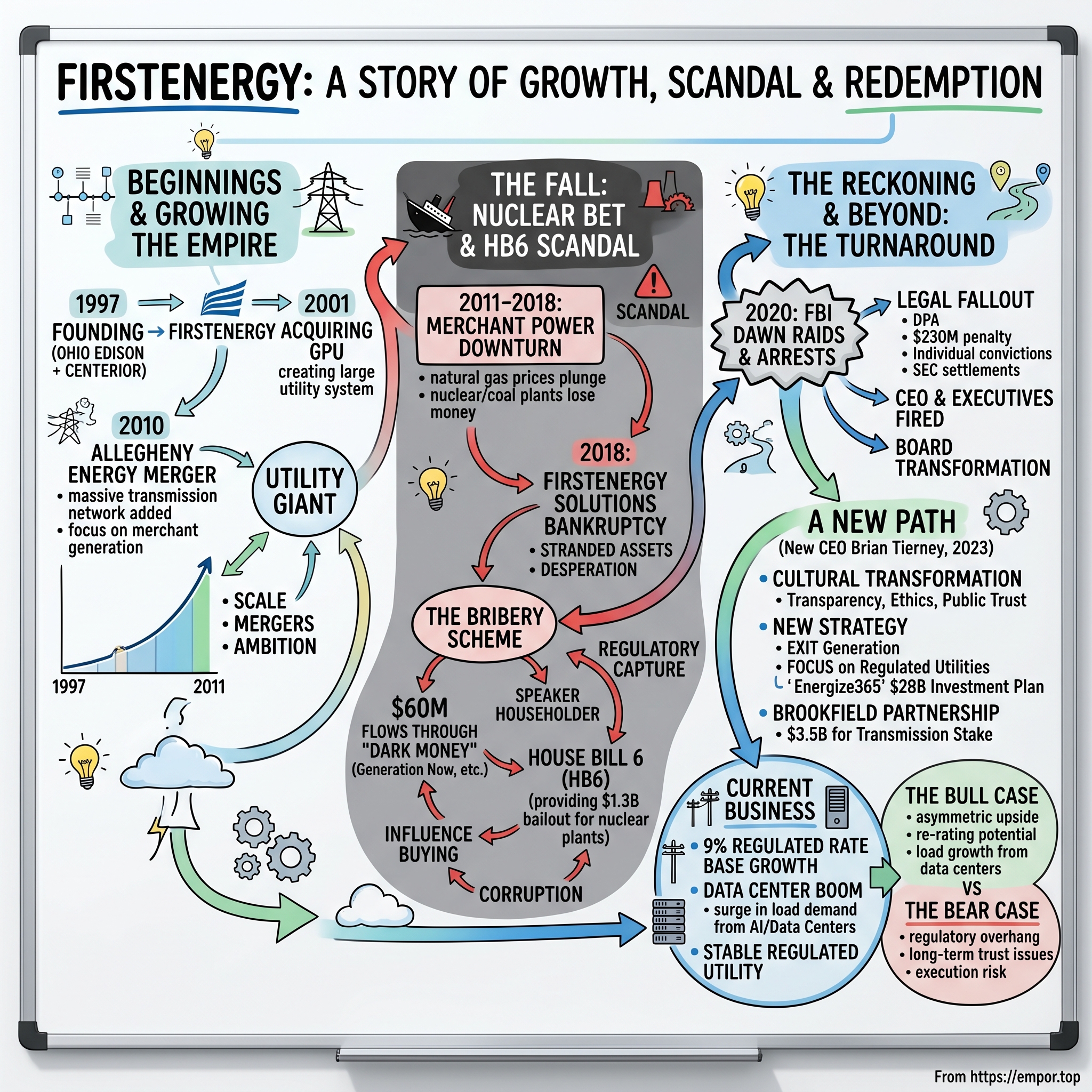
On the morning of July 21, 2020, FBI agents drove to a farm in Perry County, Ohio, and arrested Larry Householder, the Speaker of the Ohio House of Representatives. Householder — who had returned to the Speaker's chair after two decades in the state's political wilderness — was taken into custody alongside four associates. By that afternoon, U.S. Attorney David DeVillers held a press conference in Columbus to outline what his office described as "likely the largest bribery and money-laundering scheme ever perpetrated against the people of the state of Ohio." Federal prosecutors alleged that roughly $60 million in illicit funding had been funneled to secure House Bill 6, a legislative package worth approximately $1.3 billion in ratepayer-funded bailouts.5
The corporate entity supplying the $60 million was not named as a defendant in the initial federal complaint, appearing only as "Company A." Yet across Ohio, the corporate identity was immediately clear. Within 72 hours, FirstEnergy Corp. — the Akron-based electric utility serving roughly six million customers across Ohio, Pennsylvania, New Jersey, West Virginia, Maryland, and New York — lost billions of dollars in market value as its board launched an internal investigation that ultimately led to the firing of its chief executive for cause.2
For many observers, knowledge of FirstEnergy begins and ends with a utility bribing a statehouse. But the scandal represents the middle of the story rather than its beginning or end. Understanding why a regulated utility with a legally protected customer franchise resorted to buying legislative favors requires examining two decades of debt-financed expansion, a disastrous bet on merchant coal and nuclear generation executed at the onset of a historic collapse in natural gas prices, and a bankruptcy that wiped out an entire subsidiary's equity.
Understanding why FirstEnergy remains a critical case study for investors in September 2026 — trading near $45 a share with a market capitalization of roughly $26 billion[^21] — requires analyzing the operational and financial rebuild executed atop that wreckage. The company has sold a 50 percent stake in its premier transmission business to Brookfield, recruited a chief executive from Blackstone by way of American Electric Power, and committed $36 billion in capital over five years to modernize the power grid connecting Northern Virginia's data center corridor to the industrial Midwest.[^5]
The central investment debate hinges on a straightforward question: Does a company that failed across strategy, capital allocation, and governance under prior leadership merit re-underwriting under a new regime? The optimistic thesis holds that FirstEnergy simplified its business model to minimize operational risk, shifting entirely to regulated electric distribution and transmission backed by formulaic rate structures and surging power demand following two decades of stagnant load growth. The cautious counterargument emphasizes that regulated utilities depend on state utility commissions for authorized returns on equity, and FirstEnergy spent a decade giving three state regulatory bodies and federal prosecutors ample cause for skepticism.
The narrative unfolds across eight chapters: the merger-driven expansion of the empire from 1997 to 2011; the merchant generation trap triggered by the natural gas shale revolution; the bribery scheme and its legal fallout; the balance-sheet restructuring executed under activist investor pressure; the operational turnaround under CEO Brian Tierney and the Energize365 capital plan; the segment economics driving underlying earnings; the data-center expansion that anchors the growth story; and the key operational metrics that will determine whether the strategy succeeds.
The trajectory begins with a merger that appeared, at the time, entirely logical.
 Subscribe on LinkedIn
II. Origins & The Great Consolidation Era (1997–2001)
In the mid-1990s, the American electric utility industry had operated under a straightforward regulatory model for sixty years: a regulated monopoly granted an exclusive geographic franchise, permitted to earn an approved return on invested capital, and obligated to serve all customers within its territory. Executive teams managed low-beta utilities primarily as custodians rather than market entrepreneurs.
Federal legislative changes reshaped that paradigm. The Energy Policy Act of 1992 opened wholesale power markets to independent producers. Over the following decade, state regulators — including those in Ohio and Pennsylvania — began unbundling vertically integrated utilities. Transmission and distribution wires remained regulated monopolies, while power generation was separated into competitive subsidiaries exposed to wholesale pricing.
For utility executives accustomed to cost-of-service regulation, deregulation presented unprecedented market risk alongside strategic opportunity. The prevailing industry response was scale. Executives reasoned that expanding corporate footprints would allow utilities to spread fixed overhead across larger customer bases, diversify generation fleets, and gain pricing leverage in expanding regional power markets.
FirstEnergy Corp. was created through that logic in 1997 when Ohio Edison acquired Centerior Energy — the Cleveland-based holding company parent of The Illuminating Company and Toledo Edison — in an all-stock transaction valued at roughly $1.6 billion, creating a combined utility serving about 2.2 million customers across 13,000 square miles of northern and central Ohio and western Pennsylvania.1 The deal represented defensive consolidation among neighboring utilities. Beyond regional scale, the merger established a fundamental precedent: FirstEnergy would pursue growth through acquisitions, increasingly financed with leverage.
Four years later, FirstEnergy executed a significantly larger acquisition. In 2001, the company acquired GPU, Inc. in a transaction valued at approximately $11.9 billion, comprising roughly $4.5 billion in equity consideration and about $7.4 billion in assumed debt and preferred stock.1 The acquisition added three major mid-Atlantic distribution utilities — Jersey Central Power & Light, Pennsylvania Electric Company (Penelec), and Metropolitan Edison (Met-Ed) — nearly doubling FirstEnergy's customer base to 4.3 million across 36,000 square miles and expanding its reach across the PJM Interconnection regional market.
The financial structure of the GPU purchase carried long-term consequences. Struck at the height of the utility consolidation wave, the transaction valued GPU at a full enterprise multiple in the mid-to-high single digits of EBITDA, even as Pennsylvania rate caps approached expiration and legacy generation assets faced market-based pricing. Crucially, debt assumption accounted for nearly two-thirds of the total transaction value, heavily leveraging the parent company's capital structure.
This financing strategy introduced long-term structural vulnerability. In utility economics, regulated earnings derive from equity invested directly in utility rate base at commission-approved returns. Debt issued at the holding-company level to fund corporate acquisitions cannot be added to operating subsidiary rate bases. Instead, parent-level debt sits above operating units, reliant on subsidiary dividend streams for debt service, converting a low-beta utility model into a highly leveraged holding company. This reliance on parent-level debt established a pattern that eroded financial flexibility across subsequent corporate crises, including merchant generation losses, political maneuverings around House Bill 6, and eventual minority asset sales.
Alongside leverage, consolidation created a dual corporate structure with opposing risk profiles. By 2001, FirstEnergy operated regulated distribution utilities earning fixed returns on capital alongside a merchant portfolio of legacy coal and nuclear power plants whose power prices depended on marginal regional fuel costs. While executive leadership presented this combination as strategic diversification, the structure coupled stable regulated cash flows with volatile competitive generation markets, tethering the parent company's valuation to its merchant exposure.
During the early 2000s, elevated natural gas prices sustained high wholesale electricity rates across the PJM market. Because gas-fired generation frequently set marginal power prices, FirstEnergy's low-marginal-cost coal and nuclear units generated substantial merchant cash margins.
That temporary windfall reinforced leadership's commitment to competitive generation, setting the stage for an even larger expansion into merchant power markets.
III. The Allegheny Acquisition & The Merchant Peak (2010–2011)
In February 2010, FirstEnergy announced an agreement to acquire Allegheny Energy in an all-stock transaction valued at $4.7 billion, while assuming $3.8 billion in debt, bringing total enterprise value to $8.5 billion when the transaction closed in February 2011.1
The acquisition briefly rendered FirstEnergy the nation's largest investor-owned electric utility by customer count, serving roughly six million customers across 24,000 miles of transmission lines spanning a contiguous footprint from Toledo across Pennsylvania into Maryland and West Virginia.1 Allegheny brought regulated operating companies — West Penn Power, Potomac Edison, and Mon Power — alongside a large fleet of merchant coal-fired generation in the heart of the PJM Interconnection market.
Management framed the acquisition around a key strategic rationale: combining merchant coal and nuclear capacity near PJM's industrial load centers would create a natural hedge. By holding both generation capacity and retail customer load within the same regional market, executives argued that fleet scale would optimize unit operations, lower costs, and deliver durable earnings growth.
That thesis collided almost immediately with structural shifts in energy markets. As the transaction closed in 2011, hydraulic fracturing across the Marcellus and Utica shale formations beneath FirstEnergy's own service territory transformed the North American natural gas supply curve. Henry Hub natural gas prices, which exceeded $13 per MMBtu in 2008, fell below $2 per MMBtu by 2012 and remained depressed for much of the following decade.
Because gas-fired plants set wholesale electricity prices during most hours in PJM, falling gas prices suppressed power prices across the grid. This collapsed the spark spread — the margin between electricity sales prices and fuel input costs. For FirstEnergy's legacy coal plants competing against low-cost natural gas, operating margins inverted. Units that previously generated steady cash flow began operating at losses, reducing their run-times and diminishing capacity auction revenues intended to cover fixed overhead.
The promised natural hedge proved to be a structural misconception. True hedging requires offsetting risk exposures. Holding both generation capacity and retail load in the same market doubled down on wholesale power price exposure rather than insulating the company. When PJM power prices fell, merchant generation revenue dropped while regulated distribution utilities received no offsetting benefit, since distribution earnings depend on rate base capital investments rather than power generation margins. Management had confused market correlation with strategic diversification.
Ultimately, the Allegheny acquisition severely impaired shareholder value. FirstEnergy paid full enterprise valuation for coal-heavy merchant assets shortly before structural market shifts undermined their economics. The transaction pushed consolidated debt above $20 billion just as merchant cash flows entered a decade-long decline. Management's central miscalculation was assuming that operational scale could insulate a competitive generation fleet from fundamental commodity market shifts.
That misstep became a defining milestone in FirstEnergy's corporate trajectory, establishing the benchmark against which subsequent management capital allocation strategies would be judged. Demonstrating disciplined capital management after an $8.5 billion merchant expansion would require a multi-year effort — starting with the unwinding of the merchant generation fleet.
IV. The Nuclear Bet, Stranded Assets, & Bankruptcy (2011–2018)
Davis-Besse sits on the shore of Lake Erie about thirty miles east of Toledo, its hyperboloid cooling tower rising over the flat farmland of Ottawa County. A single-unit pressurized water reactor commissioned in 1977, the plant served for decades as a workhorse of northern Ohio's power grid. Perry, fifty miles east of Cleveland, is a boiling water reactor of similar vintage, while Beaver Valley operates two units on the Ohio River in western Pennsylvania. Together, these facilities formed the nuclear backbone of FirstEnergy Solutions, the competitive generation subsidiary housing the parent company's merchant coal and nuclear fleet.
Nuclear power generation operates on a distinct financial model. Fuel expenses are exceptionally low, but fixed operational costs are rigid: a facility requires hundreds of specialized personnel, dedicated security, continuous Nuclear Regulatory Commission compliance monitoring, and ongoing capital maintenance regardless of whether wholesale power trades at $60 or $25 per megawatt-hour. Output cannot be dynamically adjusted to market swings; a nuclear unit must either operate continuously at full capacity or undergo costly decommissioning — itself a multi-hundred-million-dollar liability.
That cost structure generates substantial operating leverage when wholesale electricity prices are high, but proves severe when prices fall. Through the mid-2010s, PJM wholesale energy prices remained consistently below the all-in operating costs of aging single-unit merchant reactors. The margin pressure escalated as subsidized wind and solar capacity entered the PJM market at zero marginal cost, shifting the regional supply curve downward during peak generation hours when nuclear units relied on higher prices to cover fixed overhead.
By 2015, operational losses had become unsustainable. FirstEnergy Solutions was losing cash on assets it could neither run profitably nor economically retire. In November 2016, management announced a strategic shift: FirstEnergy would exit competitive generation entirely and transition to a fully regulated utility.1 While logical, the decision arrived years after structural energy market shifts had undermined merchant fleet economics.
Executing the exit presented complex financial hurdles. FirstEnergy Solutions carried billions of dollars in debt, long-term coal supply contracts, environmental remediation obligations, pension liabilities, and nuclear decommissioning trusts that deterred potential acquirers. Consequently, on March 31, 2018, FirstEnergy Solutions and FirstEnergy Nuclear Operating Company filed for Chapter 11 bankruptcy protection.4
The financial impact reflected years of deferred asset recognition. FirstEnergy eliminated roughly $5 billion in merchant debt and associated operational liabilities, but only after recognizing cumulative impairments and write-downs exceeding $10 billion between 2016 and 2018.1 Furthermore, the parent company could not cleanly walk away from its subsidiary. To extinguish creditor claims threatening to pierce the corporate veil and resolve legal entanglements, FirstEnergy Corp. contributed approximately $2.25 billion in cash and notes to the bankruptcy settlement.1
The restructuring challenged a primary rationale of the original merchant strategy: the belief that unbundling competitive generation from regulated distribution allows shareholders to capture wholesale market upside while relying on utility operations for downside protection. In practice, equity in FirstEnergy Solutions was wiped out, while the parent company paid $2.25 billion to settle liabilities. Shareholders of the regulated holding company ultimately absorbed substantial merchant losses without participating in sustained upside across a full market cycle.
The episode underscored an enduring lesson in utility finance: separating merchant generation from regulated wires may shield utility customers and operating franchises, but it does not insulate holding-company shareholders from capital allocation failures. Structural separation alone could not compensate for uncompetitive asset economics.
Between 2016 and 2018, management sought alternative remedies before accepting full asset write-downs. The nuclear plants employed roughly 1,400 workers, anchored local tax bases in two Ohio counties, and represented billions of dollars in book value subject to write-off upon closure. Extending plant operations preserved the possibility of a political intervention.
State-level precedents existed. Both New York and Illinois had enacted zero-emission credit programs to compensate merchant nuclear plants for their carbon-free attributes, effectively transferring ratepayer funds to plant owners. FirstEnergy leadership reasoned that Ohio state government might adopt a similar framework.
Pursuing that legislative bailout would ultimately cost FirstEnergy its chief executive, its general counsel, its corporate reputation, and far more than the $60 million spent securing it.
V. The House Bill 6 Scandal: Regulatory Capture & Corruption (2017–2020)
Larry Householder had served as Speaker of the Ohio House of Representatives from 2001 to 2004, a tenure that ended under the cloud of an uncharged federal investigation. After leaving state politics and running a private business, he won back his legislative seat in 2016 and immediately began assembling support to reclaim the gavel.
Reclaiming the speakership required two elements: a faction of loyal lawmakers and the financial backing to elect them. Householder supplied the ambition, and FirstEnergy provided the capital.
The scheme operated through a tax-exempt 501(c)(4) social welfare organization called Generation Now. As a 501(c)(4), the entity could engage in political advocacy without disclosing its donors, allowing funds to enter anonymously and exit as advertising, polling, consulting fees, or transfers to other organizations. While anonymous political spending is structured to be legal on its face, federal prosecutors established that FirstEnergy and its affiliates used Generation Now as a bribery vehicle, funneling approximately $60 million to secure official legislative acts.2
The $60 million served three sequential purposes. First, it funded a slate of roughly 21 legislative candidates in the 2018 primary and general elections—Householder’s political faction—whose votes subsequently secured him the speakership. Second, once Householder held the gavel, the funds supported the campaign to pass House Bill 6. Third, the money financed an operation to defeat a citizen referendum aimed at placing HB6 on the ballot—an effort that included buying out signature collectors and broadcasting advertisements claiming that the referendum was a foreign plot to seize Ohio's power grid.
Concurrently, former Chief Executive Officer Chuck Jones and former Senior Vice President Michael Dowling arranged a payment of approximately $4.3 million to Samuel Randazzo, an energy attorney and longtime utility advocate, in early 2019—shortly before Governor Mike DeWine appointed Randazzo as chairman of the Public Utilities Commission of Ohio.3 Styled as the termination fee for a consulting arrangement, the Securities and Exchange Commission later characterized the transaction, along with the broader political spending, as conduct FirstEnergy concealed from investors while issuing misleading disclosures.3
That secondary payment represented a distinct form of regulatory capture. While the Generation Now funding purchased contested public legislation, the Randazzo payment compromised the state regulator responsible for setting FirstEnergy's Ohio distribution rates, approving its electric security plans, and auditing its cost-recovery riders.
House Bill 6 passed in July 2019. The legislation guaranteed roughly $150 million annually through 2027—totaling approximately $1.3 billion—in ratepayer-funded subsidies for the Davis-Besse and Perry nuclear plants. It also added subsidies for two aging coal plants owned by the Ohio Valley Electric Corporation, gutted state renewable portfolio and energy efficiency standards, and included a key earnings provision decoupling the Ohio utilities' revenues from electricity sales volumes.2
The legislative victory proved short-lived. In July 2020, federal agents arrested Householder and his associates, exposing the corrupt origin of the bailout.
The scandal challenged a common premise in utility investing: that political influence provides a durable competitive advantage capable of securing higher authorized returns and favorable cost recovery. FirstEnergy's experience demonstrated the systemic downside when political strategy crosses into criminal corruption.
The scheme failed across every dimension:
- Legislatively: Ohio lawmakers repealed the nuclear subsidies in 2021, and in May 2025 Governor DeWine signed House Bill 15, eliminating the remaining OVEC coal subsidies established under HB6.9
- Financially: FirstEnergy lost billions of dollars in market capitalization following the arrests. The company subsequently paid a $230 million criminal penalty to the Department of Justice, a $100 million civil penalty to the SEC, $19.5 million to the Ohio Attorney General, and, in January 2026, a $275 million settlement package before PUCO.23[^13]8
- Judicially: Householder was convicted of racketeering and sentenced to 20 years in federal prison in June 2023, representing the longest public corruption sentence in Ohio history.5 Randazzo was indicted on federal charges and died by suicide in April 2024 prior to trial.5
- Corporately: FirstEnergy's board terminated Chuck Jones for cause in October 2020 alongside two other senior executives.2
The failure illustrated that political maneuvering carries unbounded downside when governance controls fail. Weighing $60 million in illicit outlays against $1.3 billion in legislative subsidies ignored the severe tail risk of federal prosecution, civil penalties, executive displacement, multi-year regulatory hostility, and a persistent corporate valuation discount.
Emerging from the scandal in late 2020, FirstEnergy faced simultaneous balance-sheet distress, governance failures, and damaged regulatory credibility.
VI. The Reckoning & Balance Sheet Repair (2020–2024)
The immediate aftermath of the arrests created a severe liquidity crisis for FirstEnergy's finance organization. Credit rating agencies placed the company on negative watch, while short-term commercial paper markets—critical for utility working capital—became expensive and restricted. Simultaneously, FirstEnergy faced an internal investigation, inquiries from the Department of Justice and the SEC, audits by the Public Utilities Commission of Ohio, and a wave of shareholder litigation, all while carrying a debt load accumulated during its unbundled expansion.
The company's legal exposure resolved in stages over several years.
In July 2021, FirstEnergy entered into a deferred prosecution agreement with the U.S. Attorney's Office for the Southern District of Ohio. The company admitted to conspiracy to commit honest services wire fraud, paid a $230 million criminal penalty, and agreed to a three-year period of compliance monitoring and cooperation.2 Under the agreement, formal charges were deferred, leaving the threat of active prosecution in place if FirstEnergy violated its terms over the subsequent three years.
State and federal regulators followed with their own enforcement actions. In August 2024, four years after the arrests, the Ohio Attorney General's office settled state civil claims against FirstEnergy for $19.5 million.[^13] The following month, in September 2024, the SEC settled charges that FirstEnergy had defrauded investors, imposing a $100 million civil penalty—one of the largest ever levied against an electric utility—for misleading disclosures and internal accounting control failures.3
State regulatory proceedings took even longer to conclude. In January 2026, PUCO approved a comprehensive $275 million settlement with FirstEnergy's three Ohio operating utilities. The agreement provided $250 million in direct customer refunds, $5 million in residential credits, and $20 million for low-income bill assistance, weatherization, and energy efficiency programs, resolving reviews of the Corporate Separation Rider, Rider DMR, Rider DCR, and an extensive audit of political and charitable expenditures.813 The settlement delivered average monthly bill reductions of roughly $13 for Ohio Edison residential customers and nearly $18 for Toledo Edison customers, demonstrating that financial liabilities from House Bill 6 continued to linger five and a half years after the federal indictments.8
Alongside regulatory resolutions came external governance pressure. In March 2021, activist investor Carl Icahn disclosed a stake in FirstEnergy and secured two board seats for Icahn Capital representatives Andrew Teno and Jesse Lynn.[^7] The intervention reflected broader market consensus: following a $60 million political scandal, the board had lost the presumption of independent oversight, requiring external board-level monitoring to enforce governance reforms.
Rebuilding the balance sheet required substantial capital, which management executed through two major minority equity transactions at the subsidiary level. In late 2021, Blackstone Infrastructure Partners invested $1.0 billion in FirstEnergy Transmission, LLC (FET), providing parent-level liquidity without diluting common shareholders.1
FirstEnergy Transmission serves as the holding company for the parent's stand-alone, high-voltage transmission utilities. Transmission assets operate under Federal Energy Regulatory Commission formula rates, a regulatory framework that automatically adjusts annual tariffs based on actual capital expenditures and operating costs. This mechanism allows the utility to earn an approved return on capital investments with minimal regulatory lag or rate-case friction, making transmission FirstEnergy's highest-quality cash flow generator.
To complete its balance sheet restructuring, FirstEnergy expanded its partnership in FET. In 2022, the company sold a 19.9 percent minority stake in FET to Brookfield Super-Core Infrastructure Partners for approximately $2.4 billion. In March 2024, FirstEnergy closed on the sale of an additional 30.0 percent interest to Brookfield for roughly $3.5 billion, bringing Brookfield's total holding to 49.9 percent for combined proceeds of about $5.9 billion.[^6]
Management consistently presented these transactions to investors as non-dilutive balance sheet repair, emphasizing that raising capital at high subsidiary valuations funded regulated capital investments and restored credit metrics without issuing common equity at depressed market prices.12
That framing was only partially accurate. Monetizing subsidiary equity at a valuation premium above FirstEnergy's parent stock avoided immediate common share dilution during a period of reputational distress. However, the transaction permanently diluted the company's underlying earnings power. By selling a 49.9 percent stake in FET, FirstEnergy surrendered nearly half of the net income generated by its fastest-growing, lowest-risk asset. Every incremental dollar of transmission rate base—including capital deployed for region-wide data center expansion—now delivers half its financial returns to Brookfield. Selling equity in an elite operating subsidiary to avoid issuing discounted parent stock resolved a short-term balance-sheet crisis by sacrificing long-term earnings upside.
By 2024, with major legal liabilities settled and the balance sheet stabilized, the board faced the question it had deferred through the crisis: who would lead the company's operational recovery?
VII. Current Management & Strategy: The Brian Tierney Era (2023–Present)
The board's answer, announced in May 2023, was an executive who had spent his career on the other side of the table from FirstEnergy — both as a direct competitor and as an institutional investor.[^11]
Brian X. Tierney spent 23 years at American Electric Power, FirstEnergy's primary large-cap peer in Ohio, including 11 years as chief financial officer from 2009 to 2020 and a period as executive vice president of strategy in 2021.[^11] That financial stewardship served as a key credential: Tierney managed AEP's balance sheet while the utility navigated its own exit from Ohio's competitive generation market — resolving the same structural trap that forced FirstEnergy Solutions into bankruptcy, but with far less disruption. He subsequently left the utility sector for Blackstone, serving as senior managing director and global head of infrastructure operations, evaluating assets as an owner of capital rather than an operator.[^11]
That combination — a regulated utility CFO aligned with private infrastructure capital — fit FirstEnergy's immediate requirements: leadership fluent in regulatory proceedings that views assets through returns on invested capital rather than geographic expansion. Tierney assumed the role of president and chief executive officer in June 2023 and added the chairman title in January 2025.1 His total compensation for 2025 was approximately $13.45 million, weighted heavily toward performance share units tied to core EPS growth, relative total shareholder return, and operational and compliance metrics.11
The compliance targets in Tierney's pay package address the specific governance failures that enabled House Bill 6. Under his tenure, the company established structural governance reforms: appointing an independent chief ethics and compliance officer reporting directly to the audit committee, prohibiting corporate contributions to 501(c)(4) social welfare entities, and requiring public disclosure of all corporate political and lobbying expenditures.1 Unlike general statements of intent, these measures established verifiable policy boundaries aimed at closing the unmonitored channels previously used for political spending.
FirstEnergy's underlying strategy has simplified into a pure-play regulated wires model. Having exited competitive generation, the utility takes no direct commodity price risk. Instead, earnings depend entirely on authorized returns earned on capital deployed across distribution poles, substations, transmission lines, and vertically integrated regulated operations in West Virginia. In industry terms, FirstEnergy operates as a rate-base compounder: expanding its net asset base to drive authorized earnings.
The primary catalyst for this strategy is Energize365, a multi-year capital investment program. Originally launched in 2024, management expanded the plan to $36 billion covering 2026 through 2030 — a 29 percent increase over the prior five-year forecast — designed to support annual compound rate-base growth of approximately 10 percent and a core EPS compound annual growth target of 6 percent to 8 percent through 2030.[^5]7 The 2026 component alone is $6 billion.7
The mechanics of rate-base compounding appear straightforward: deploying $36 billion over five years to grow rate base at 10 percent annually while earning authorized returns generates mid-to-high single-digit earnings growth with minimal competitive displacement or commodity exposure.
However, translating capital expenditure into realized earnings growth requires overcoming three distinct execution friction points. First, state utility commissions must approve capital investments as prudent and allow full rate recovery; notably, the Public Utilities Commission of Ohio spent 2025 and 2026 ordering customer refunds. Second, operating units must achieve their allowed returns on equity. FirstEnergy's Ohio distribution utilities have historically earned below authorized returns, and earning an 8 percent return against an authorized 9.5 percent converts rate-base growth into EPS growth at a discount. Third, financing $36 billion — a sum nearly one and a half times FirstEnergy's market capitalization — requires substantial debt and potential equity issuance, testing management's commitment to avoiding shareholder dilution.
Despite these structural hurdles, management has maintained consistent financial guidance. During the second-quarter 2026 earnings call in July, Tierney reaffirmed full-year core EPS guidance of $2.62 to $2.82 alongside the $36 billion five-year plan, framing growth as tracking near the top end of the 6 percent to 8 percent target range.10
What that capital plan actually funds across FirstEnergy's operating units, and how each segment earns its return, defines the next phase of the investment thesis.
VIII. Business Segments & Economic Drivers
FirstEnergy's service footprint spans from northern Ohio across Pennsylvania, New Jersey, and Maryland to the West Virginia hills, encompassing ten operating utility companies, four state regulatory commissions, and three distinct earnings models. Analyzing these three operating segments provides the foundation for evaluating the company's income statement and revenue trajectory.
Regulated Distribution forms the largest portion of FirstEnergy's rate base and serves as its primary cash engine. As a last-mile delivery business, it encompasses local distribution poles, neighborhood transformers, and end-user meters. The segment operates through Ohio Edison, The Illuminating Company, and Toledo Edison in Ohio, regulated by the Public Utilities Commission of Ohio; Met-Ed, Penelec, Penn Power, and West Penn Power under the Pennsylvania Public Utility Commission; Jersey Central Power & Light under the New Jersey Board of Public Utilities; and Potomac Edison under the Maryland Public Service Commission.1
Distribution economics depend on formal rate cases. In these proceedings, the operating utility submits its historical costs and invested capital to state regulators, who establish the approved rate base and authorized return on equity — typically in the low-to-mid 9 percent range across FirstEnergy's distribution jurisdictions.1 Between full rate cases, regulatory mechanisms such as grid modernization riders and distribution system improvement charges permit incremental capital recovery for designated infrastructure projects without requiring full rate reviews.
Two operational frictions impact distribution profitability. The first is regulatory lag: capital is deployed immediately, but cost recovery begins only when approved rates take effect, leaving invested capital uncompensated during the intervening months or years. The second is the earned-versus-authorized return gap. While a commission may authorize a 9.5 percent return on equity, the utility realizes that return only if operating expenses remain aligned with rate-case assumptions. FirstEnergy's distribution utilities have historically operated below authorized return levels. Closing this gap represents low-cost earnings expansion, though achieving it depends on sustained operational discipline rather than management projections.
Regulated Integrated encompasses the West Virginia operations, where Mon Power and Potomac Edison remain vertically integrated, owning regulated coal and hydroelectric generation facilities while serving retail customers under traditional cost-of-service regulation.1 Unlike the bankrupt competitive merchant fleet, regulated generation earns a commission-approved return on invested capital and passes prudent fuel expenses directly to ratepayers. Primary risks in this segment shift from wholesale commodity market volatility to long-term regulatory and environmental pressures, specifically whether ongoing capital investments in coal generation remain fully recoverable as state and federal policies evolve.
Stand-Alone Transmission operates through FirstEnergy Transmission (FET), controlling high-voltage assets managed by American Transmission Systems, Incorporated in Ohio, Mid-Atlantic Interstate Transmission in Pennsylvania and New Jersey, and Trans-Allegheny Interstate Line Company.1 This business utilizes Federal Energy Regulatory Commission formula rates with allowed returns on equity typically around 10 percent, reflecting a regulatory premium designed to incentivize grid infrastructure investment. Stand-alone transmission also represents the company's fastest-growing segment: in the first quarter of 2026, transmission rate base grew 19 percent year over year within the integrated segment and 11 percent in stand-alone transmission.7
These growth figures highlight a central structural constraint in FirstEnergy's current earnings profile. The business segment featuring the most favorable regulatory mechanics, the highest allowed returns, and the fastest growth is the unit in which FirstEnergy retains only a 50.1 percent economic stake. Consequently, capital deployment and load growth are disproportionately concentrated in an asset where nearly half of incremental net income accrues to Brookfield.
Relative to peer investor-owned utilities — including American Electric Power, Exelon, Duke Energy, PPL, WEC Energy Group, and DTE Energy — FirstEnergy has traded at a persistent valuation discount of one to two-and-a-half price-to-earnings multiple turns compared with higher-rated regulated utilities.[^21] This valuation gap reflects lingering reputational effects from the House Bill 6 scandal, ongoing friction within the Ohio regulatory landscape, and structural earnings leakage from the minority equity stake in FET, where incremental transmission earnings generate lower equity value per share than at peers with full ownership of their transmission assets.
The counterargument to this valuation discount — and the core driver reframing FirstEnergy's growth trajectory beyond a pure restructuring story — rests on a fundamental shift in regional electricity demand.
IX. The Data Center & AI Demand Thesis: Hidden Optionality in PJM
For roughly two decades, the American electric utility industry faced a structural headwind: stagnant electricity demand. Efficiency gains from LED lighting, higher-efficiency appliances, and modern industrial motors offset population and economic growth. Retail load growth across mature service territories averaged approximately 0.5 percent annually, leaving utilities reliant on incremental capital deployment within existing customer bases to drive rate-base and earnings growth.
The expansion of artificial intelligence infrastructure fundamentally altered that trajectory.
Northern Virginia's Loudoun County, the world's largest data center market, operates within the PJM Interconnection grid spanning thirteen states and the District of Columbia, encompassing FirstEnergy's entire service territory. As the Virginia corridor faced capacity constraints, hyperscale developers expanded into central and northern Ohio, western Pennsylvania, and the Pennsylvania-New Jersey corridor — regions directly served by FirstEnergy's transmission and distribution system.
The resulting shift in FirstEnergy's project pipeline has been substantial. On its second-quarter 2026 earnings call, management disclosed that total forecasted data center demand across its system had increased 30 percent from the prior quarter to roughly 25 gigawatts, with an additional 2.1 gigawatts contracted during the quarter, bringing total contracted demand to 6.4 gigawatts.10 For context, 6.4 gigawatts of contracted load represents a significant fraction of peak demand across FirstEnergy's entire six-million-customer footprint — a sharp departure for a business long accustomed to flat load growth.
The structural alignment of FirstEnergy's position is that it acts as an infrastructure provider without direct commodity price exposure. FirstEnergy does not generate the power data centers consume; hyperscalers contract energy separately from independent power producers or through wholesale markets. Instead, FirstEnergy constructs the required physical interconnections, including high-voltage substations, switching stations, transmission line extensions, and distribution upgrades. These capital investments enter the utility's rate base to earn regulated returns, capturing volumetric growth while insulating the balance sheet from power price volatility — the opposite of the merchant generation strategy that previously created severe financial distress.
This dynamic underpins the optimistic investment case: an incumbent distribution and transmission monopoly situated along an expanding demand corridor can capture rate-base expansion without taking on generation risk.
However, three operational and regulatory constraints temper this thesis.
First, contracted capacity does not equal energized load. The timeline between executing an interconnection agreement and energizing a revenue-producing substation spans multiple years, constrained by the PJM interconnection queue — an industry backlog characterized by study and approval delays that extend well beyond initial developer projections.6 Projects contracted in 2026 may not draw power until the end of the decade, and a portion of announced developments could be canceled, delayed, or resized prior to completion.
Second, supply-chain bottlenecks impose physical execution limits. High-voltage transformers, circuit breakers, and specialized conductors are produced by a limited group of global manufacturers with extensive order backlogs, extending lead times for major equipment across several years. A $36 billion capital program cannot proceed faster than equipment manufacturing and delivery schedules permit. This constraint creates dual risks: it delays revenue realization while inflating capital costs, as equipment procured at elevated prices enters the rate base and requires formal prudency justification before state commissions.
Third, regulatory commissions are closely scrutinizing cost allocation. When a utility deploys hundreds of millions of dollars in infrastructure to serve a single hyperscale customer, those capital investments enter a rate base shared by all retail customers in the territory. If projected data center demand materializes, the added volume spreads fixed network costs across a broader base, lowering unit costs for all ratepayers. If demand falls short, retail customers risk absorbing the financial burden of assets built for unfulfilled load. Both the Public Utilities Commission of Ohio and the New Jersey Board of Public Utilities have examined these risks. Regulators increasingly favor specialized large-load tariffs featuring minimum-take commitments and contractual protections designed to shift stranded-asset risk to developers. While utilities benefit from risk mitigation, restrictive contract terms may lead developers to alter buildout plans, creating ongoing commercial friction.
As of September 2026, the data center demand thesis represents a tangible and material opportunity, yet its translation into realized earnings remains unproven. Characterizing AI-driven demand as an unconstrained growth driver overlooks binding bottlenecks across interconnection queues, equipment supply chains, and regulatory cost-allocation rules. Rather than guaranteed expansion, data center demand provides FirstEnergy a path to sustain rate-base growth near the top of its historical range over a longer horizon. The key metric determining success is not the 25-gigawatt pipeline forecast, but the conversion rate of contracted capacity into energized, rate-base-eligible capital.
With the growth engine evaluated, the question shifts to the operational durability of the underlying utility franchise.
X. Competitive Powers, 5 Forces, & Investment Spine
Strip away the narrative and ask the question a strategist would: what actually protects FirstEnergy's economics from erosion?
Applying Hamilton Helmer's 7 Powers framework, three elements are worth serious discussion, while the rest are absent.
Cornered Resource is the strongest. FirstEnergy's operating utilities hold exclusive, state-granted franchises to distribute electricity to defined territories covering roughly six million customer endpoints. No competitor may string a wire down the same street. This is not a moat earned through execution — it was granted by statute — but it is close to absolute in its effect. The critical qualification is the one every regulated utility investor must internalize: the franchise guarantees the customers, not the return. The commission sets the authorized return, and it can lower it.
Scale Economies are moderate and real. A transmission and distribution network is overwhelmingly fixed cost. Adding a large data center to an existing high-voltage corridor imposes far less incremental cost than the revenue it produces, which is precisely why load growth is so valuable to a wires utility and why two decades of flat demand were so damaging. The qualification is that regulation partially neutralizes this advantage: if scale economies lower a utility's cost to serve, a rate case will eventually pass much of that saving to customers. The utility captures the benefit in the years between rate cases, not permanently.
Counter-Positioning is the most interesting and the most debatable. FirstEnergy's exit from competitive generation left it as a pure regulated wires business at a moment when integrated peers still carry generation exposure. Is that a power? Only partially. Counter-positioning in Helmer's sense requires that incumbents cannot follow without damaging their existing business. Exelon, AEP, and others have executed similar separations. What FirstEnergy has is not a position competitors cannot copy, but a position they have largely already copied — and FirstEnergy reached it last, through bankruptcy, having destroyed more than $10 billion of value getting there. Calling that a competitive power inverts history. It is better described as the removal of a disadvantage.
Notably absent: Network Economies; Switching Costs in any meaningful sense (customers cannot switch, which reflects franchise protection rather than earned stickiness); Branding (FirstEnergy's brand carries negative equity in Ohio, evidenced by the termination of the Cleveland Browns stadium naming rights arrangement in 2023); Process Power; and Cornered Resource in the input sense.
Porter's Five Forces produce a picture that looks superb on the surface while concealing where structural pressure actually lives.
Threat of new entrants: Essentially zero. Legal monopoly.
Rivalry: Essentially zero. Territorial franchises do not overlap; FirstEnergy and AEP do not compete for the same household.
Threat of substitutes: Low but not zero. Rooftop solar with battery storage is the theoretical substitute, constrained in this footprint by modest solar irradiance, older housing stock, and a customer mix weighted toward industrial and commercial load. The more relevant emerging variant is large-load customers pursuing behind-the-meter generation — a data center co-locating directly with a power plant and bypassing the grid entirely. That structure has been the subject of significant FERC contention, and if it proliferates, it removes exactly the transmission investment opportunity the growth case depends on.
Bargaining power of suppliers: Moderate and rising. Transformer and high-voltage equipment manufacturers currently hold genuine pricing power, and a company committing $36 billion is a price taker on its largest input.
Bargaining power of buyers: This is where the entire analysis concentrates. Individual customers have none. Collectively, through PUCO, the Pennsylvania PUC, the New Jersey BPU, the West Virginia PSC, and FERC, regulators have effectively complete power to set FirstEnergy's return on equity, disallow imprudent investment, and order refunds. The $275 million Ohio settlement is not an abstraction of this power; it is a demonstration of it.8
That produces a clean framing of the investment spine.
Why FirstEnergy wins from here. First, the mechanical rate-base compounding described earlier, which requires execution rather than insight. Second, formula-rate transmission exposure positioned in front of a load growth cycle that is real, large, and the first genuine demand tailwind the industry has had in a generation. Third, management credibility: Tierney's background is a good fit for the problem, the compliance architecture has been rebuilt with verifiable structural changes, and guidance has been consistent across the calls since he arrived.107
What breaks the case. First, Ohio. The state that produced the scandal remains the jurisdiction where FirstEnergy has the weakest regulatory relationship and the widest earned-versus-authorized ROE gap, and it has spent the last two years ordering money returned rather than granting increases. Second, the Brookfield leakage, which permanently reduces the value of the fastest-growing segment. Third, financing: a capital program larger than the company's market value, funded into a higher-cost debt environment with roughly $20 billion-plus of long-term debt to roll, against a management promise to minimize equity issuance. Those three factors are not independent — a disappointing Ohio outcome tightens credit metrics, which increases pressure to issue equity, which dilutes the EPS growth the whole case rests on.
A disciplined investor would say the growth arithmetic is credible and the execution is unproven, and would watch the same handful of variables that regulators and management contest each quarter.
XI. Risk Radar & Activist / Skeptical Stress Test
Evaluating FirstEnergy requires focusing on risks driven by specific structural mechanisms rather than generic regulatory disclosures.
Regulatory lag and disallowance. This is the primary operational risk, and at FirstEnergy, it is far from theoretical. The utility must file and litigate rate cases across four state jurisdictions to recover a historically large capital program—and must do so in states where its political capital remains depleted. The mechanism of harm is precise: capital deployed before rates are adjusted earns no return, and capital deemed imprudent is disallowed entirely. Ohio's willingness to order $275 million in customer refunds demonstrates the baseline regulatory hostility confronting the company.8
Refinancing and cost of capital. A regulated utility operates on spread economics. State commissions set an authorized return on equity, the utility issues debt to fund a large portion of its asset base, and value creation depends on the spread between the return earned on assets and the blended cost of capital. Authorized returns adjust slowly through periodic rate cases, whereas borrowing costs shift with broader market conditions. If market rates rise faster than commissions adjust authorized returns, spreads compress mechanically—requiring no operational failure to erode earnings. For a company managing a sizable debt portfolio while deploying $6 billion annually, higher funding costs act as a continuous drag on earnings rather than a one-time event.
Execution strain. Ramping annual capital deployment from mid-$3 billion levels toward $6 billion creates operational bottlenecks alongside financial demands. The expansion requires line crews, engineers, project managers, permits, and equipment capacity, all sourced from a tight supply chain where peer utilities are competing for identical resources. FirstEnergy invested $2.9 billion in the first half of 2026—a 19 percent year-over-year increase—demonstrating that capital deployment is accelerating.10 However, accelerating outlay does not ensure five years of execution without cost overruns. In a regulated framework, cost overruns cannot simply be passed along; they face strict prudency reviews before state commissions.
Storm and climate exposure. Jersey Central Power & Light's coastal territory and the mountainous service regions in Pennsylvania face recurring weather risks that generate unbudgeted restoration expenses. While utilities typically recover storm costs through regulatory deferral mechanisms, recovery occurs with lag and remains subject to formal commission review.
Cybersecurity. As a major grid operator serving six million customer endpoints, FirstEnergy represents a target for cyber threats. A breach of operational technology systems carries severe system-wide operational consequences that extend beyond immediate financial impacts. Though difficult to model, grid security represents a low-probability, high-severity operational risk.
Beyond operational risks, a skeptical long-short investor or activist would focus on structural constraints.
The most compelling bear case does not argue that FirstEnergy is a flawed utility. Instead, it asserts that the company trades at a structural valuation discount that remains fully justified. The thesis rests on four compounding factors: half of the net income from the premier transmission business accrues to Brookfield; the largest state jurisdiction remains politically cautious and prone to clawing back revenue; earned returns persistently trail authorized targets, discounting rate-base growth; and a $36 billion capital program relative to corporate market capitalization renders future equity issuance nearly unavoidable. While each factor appears manageable individually, compounded over five years they represent the difference between 6 percent and 8 percent annual earnings growth—the boundary between the bottom and top of management's guidance range.
This dynamic sets up a key test for management's financial guidance: if state commissions in Ohio, Pennsylvania, or New Jersey trim allowed distribution returns on equity by 50 to 100 basis points in upcoming rate cases, can the 6 percent to 8 percent core earnings growth target hold? Management has indicated that core earnings growth is tracking near the top end of that range.10 Relying on the upper bound of a guidance range leaves minimal cushion for adverse regulatory rulings.
Financing strategy presents a second critical question. Management has consistently emphasized avoiding equity dilution—the primary rationale for selling minority stakes in FirstEnergy Transmission. However, with FirstEnergy maintaining a 50.1 percent controlling interest, selling additional equity in the subsidiary without ceding control is no longer an option, and a $36 billion capital program cannot self-fund. Management must either trim capital expenditures, increase holding-company leverage at the risk of credit downgrades, or issue common equity. How management navigates this trilemma will reveal whether capital discipline remains a governing policy or a transitional narrative.
A balanced counterargument to the bear case is that FirstEnergy's challenges have normalized into standard utility management issues. For the first time in two decades, the company's primary focus revolves around rate-case execution, capital allocation, and debt management rather than merchant generation losses, criminal proceedings, or subsidiary bankruptcies. Reaching ordinary operational status does not guarantee outperformance, but for FirstEnergy, establishing a predictable utility profile marks a substantial operational recovery.
That stabilization leaves a concise set of operational metrics to monitor performance.
XII. Key KPIs to Watch & Investor Playbook
Most utility disclosure is noise. Three metrics carry nearly all the signal at FirstEnergy, and an investor who tracks only these will understand the story better than one who monitors every filing.
One: the spread between earned and authorized return on equity at the operating utilities. This is the most critical number FirstEnergy discloses, directly testing the turnaround thesis. Rate base growth creates shareholder value only if the company actually earns the return the commission permits. FirstEnergy's distribution utilities — Ohio Edison and Jersey Central Power & Light in particular — have historically carried a meaningful earned-ROE shortfall against authorized levels, reflecting operational inefficiencies beyond rate-case assumptions. Every basis point of that gap closed is earnings growth requiring no new capital, no commission approval, and no data center. Every basis point that persists is evidence that operational performance has not caught up with compliance reforms. Investors should monitor this direction of travel over multiple years, rather than in any single quarter.
Two: Energize365 capital deployed versus plan, and what it cost. The $36 billion figure is a promise about the numerator of the growth equation. Two things can go wrong. The company can under-deploy — projects delayed by permits, crews, or equipment — which directly slows rate base growth. Or it can deploy on schedule at inflated cost, which grows rate base while doing nothing for customers and invites exactly the prudence challenge that turns rate base into a disallowance. Capital deployment in the first half of 2026 ran ahead of the prior year's pace.10 The question is whether that holds across a five-year program in the tightest utility supply chain in modern memory.
Three: conversion of contracted data center demand into energized, in-service capacity. The metric to watch is not the broader pipeline or forecast. The pipeline figure of roughly 25 gigawatts and contracted figure of 6.4 gigawatts are useful as directional evidence that the demand is real.10 They are not revenue and they are not rate base. The metric with content is how many of those gigawatts progress through the PJM queue, through construction, through commission approval of the associated transmission and distribution investment, and into service. A widening gap between announced pipeline capacity and energized load over several quarters would be the clearest early signal that the growth story is running ahead of physical reality.
Two broader lessons sit underneath this particular company's story.
The first concerns political risk in regulated industries. FirstEnergy's leadership treated the Ohio legislature and PUCO as assets to be acquired, and the arithmetic — $60 million of spend against $1.3 billion of subsidy — looked, on a spreadsheet, like an extraordinary return on investment. What that model omitted was that the payoff was contingent on never being caught, and that the cost of being caught was unbounded: penalties across three separate settlements plus the Ohio refund package, the destruction of the executive team, five years of regulatory penance, a valuation discount versus peers, and the permanent sale of half the premier transmission asset to repair a balance sheet strained by the scandal's fallout. Strategies with unbounded left tails are not high-return strategies regardless of how the base case scores.
The second concerns what a regulated utility actually is. It is a legal arrangement in which a company is granted a monopoly in exchange for accepting oversight, and the value of that arrangement depends entirely on the oversight body trusting the company. FirstEnergy spent a decade proving how much value is destroyed when that trust breaks. Whether it can prove the inverse — that trust, once rebuilt, restores equity valuation — remains the central open question in the stock.
XIII. Epilogue & "If We Were CEOs"
Stepping back across three decades, the corporate trajectory follows a stark arc: FirstEnergy began as a defensive merger between two Ohio utilities, expanded through a decade of debt-financed acquisitions into the nation's largest investor-owned electric utility by customer count, placed a massive bet on merchant coal and nuclear generation just as power market economics inverted, recognized more than $10 billion in write-downs, drove its generation subsidiary into bankruptcy, pursued a corrupt legislative bailout for non-competitive plants, lost its executive leadership and corporate reputation, sold nearly half of its premier transmission business to repair the balance sheet, and ultimately emerged as a regulated wires utility managing a $36 billion capital program under new leadership.
From the CEO's chair, strategic priorities resolve into a clear operational playbook — and specific execution markers for investors to monitor:
Attack regulatory lag directly. In a period of heavy capital deployment, the delay between spending capital and recovering costs acts as a drag on realized returns. That dynamic calls for filing more frequent distribution rate cases in constructive jurisdictions like Pennsylvania and New Jersey, while maximizing the share of capital flowing through formula-rate and rider mechanisms. Management has noted that the large majority of recent capital has gone into formula-rate programs, aligning investments with faster cost recovery.7
Be honest with Ohio and patient with it. The temptation following a regulatory settlement is to file immediately for rate increases. A higher-value strategic path requires spending a rate cycle demonstrably delivering reliable service, transparency, and operational efficiency before seeking major rate relief. Regulatory trust in Ohio remains a critical unquantified asset — absent from the rate base, yet essential for securing authorized returns.
Treat the Brookfield stake as a long-term capital allocation question, not a closed chapter. Every dollar of transmission rate base deployed today delivers nearly half of its net income to a minority partner. If data-center grid expansion materializes as projected, evaluating whether to repurchase a portion of that 49.9 percent interest will remain a primary capital allocation decision — balanced against the reality that repurchasing the stake would likely require the common equity issuance the initial sale was designed to avoid. A non-dilutive solution to this structural earnings leakage does not exist.
Keep the political spending prohibition absolute. The ban on 501(c)(4) social welfare contributions and the independent compliance reporting line represent direct structural responses to governance failures. Their value depends entirely on unyielding enforcement, particularly when future legislative sessions introduce attractive policy incentives.
The legal shadow of House Bill 6 is receding. The federal criminal prosecution is closed, the deferred prosecution agreement has expired, civil securities and state enforcement penalties are paid, and the Public Utilities Commission of Ohio rider reviews are resolved. What remains is a pure-play regulated utility executing a major capital program, supported by a favorable demand backdrop, bound to a shared interest in its best operating asset, and led by a management team building its track record.
For long-term investors, the core debate is no longer whether the scandal has concluded, but whether FirstEnergy's governance and operational reforms endure over time. The answer will not arrive in a press release. It will materialize through state rate-case determinations, the closure of earned-versus-authorized return gaps, and the conversion of forecasted data-center demand into energized, rate-base infrastructure.
References
-
FirstEnergy Corp. Filings and Annual Reports — SEC EDGAR Database ↩↩↩↩↩↩↩↩↩↩↩↩↩↩
-
FirstEnergy Charged With Conspiracy and Agrees to Pay $230 Million Penalty — U.S. Department of Justice, 2021-07-22 ↩↩↩↩↩↩
-
SEC Charges FirstEnergy Corp. With Fraud in Connection With Ohio Bribery Scheme — U.S. Securities and Exchange Commission, 2024-09-12 ↩↩↩↩
-
FirstEnergy Solutions Files for Bankruptcy — Reuters, 2018-04-01 ↩
-
Ex-Ohio House Speaker Larry Householder Sentenced to 20 Years in HB6 Bribery Scandal — Associated Press, 2023-06-29 ↩↩↩
-
Transmission Service Requests and Interconnection Queue — PJM Interconnection ↩
-
FirstEnergy Q1 2026 Earnings News Release, Form 8-K Exhibit 99.1 — FirstEnergy Corp. via SEC EDGAR, 2026 ↩↩↩↩↩
-
PUCO Approves FirstEnergy Settlement, Delivering Customer Benefits — FirstEnergy Corp., 2026-01-08 ↩↩↩↩↩
-
Energy Bill Eliminating Subsidies for Two Coal Power Plants from Ohio's House Bill 6 Signed Into Law — The Statehouse News Bureau, 2025-05-16 ↩
-
Earnings Call Transcript: FirstEnergy Q2 2026 — Investing.com, 2026-07-29 ↩↩↩↩↩↩↩
-
FirstEnergy Corp. Form DEF 14A Proxy Statement — SEC EDGAR, 2026 ↩
-
FirstEnergy EEI Financial Conference Investor Presentation — FirstEnergy Corp. via SEC EDGAR, 2024 ↩
-
PUCO Approves Settlement Increasing Restitution to Customers in FirstEnergy/House Bill 6 Investigations — Public Utilities Commission of Ohio ↩
 LinkedIn
 WhatsApp
 Reddit
 Hacker News
 Email
Email Kindle
 RSS Feed
 Spotify
 Apple Podcasts
 Amazon Music
 Audible
 YouTube