FedEx Corporation (NYSE: FDX): The Overnight Empire at the Crossroads
I. Introduction & Episode Preview
There is a phrase that lodged itself so thoroughly in the American lexicon that many who use it do not realize it originated as an advertising slogan: "When it absolutely, positively has to be there overnight." It was the rare piece of corporate copy that described not a product, but a promise—one that sounded improbable when first introduced. In 1973, the concept of sending a document from Boston at 5 p.m. to arrive on a desk in San Diego before the next morning's coffee was more than a new service; it was a radical shift in commercial logistics.
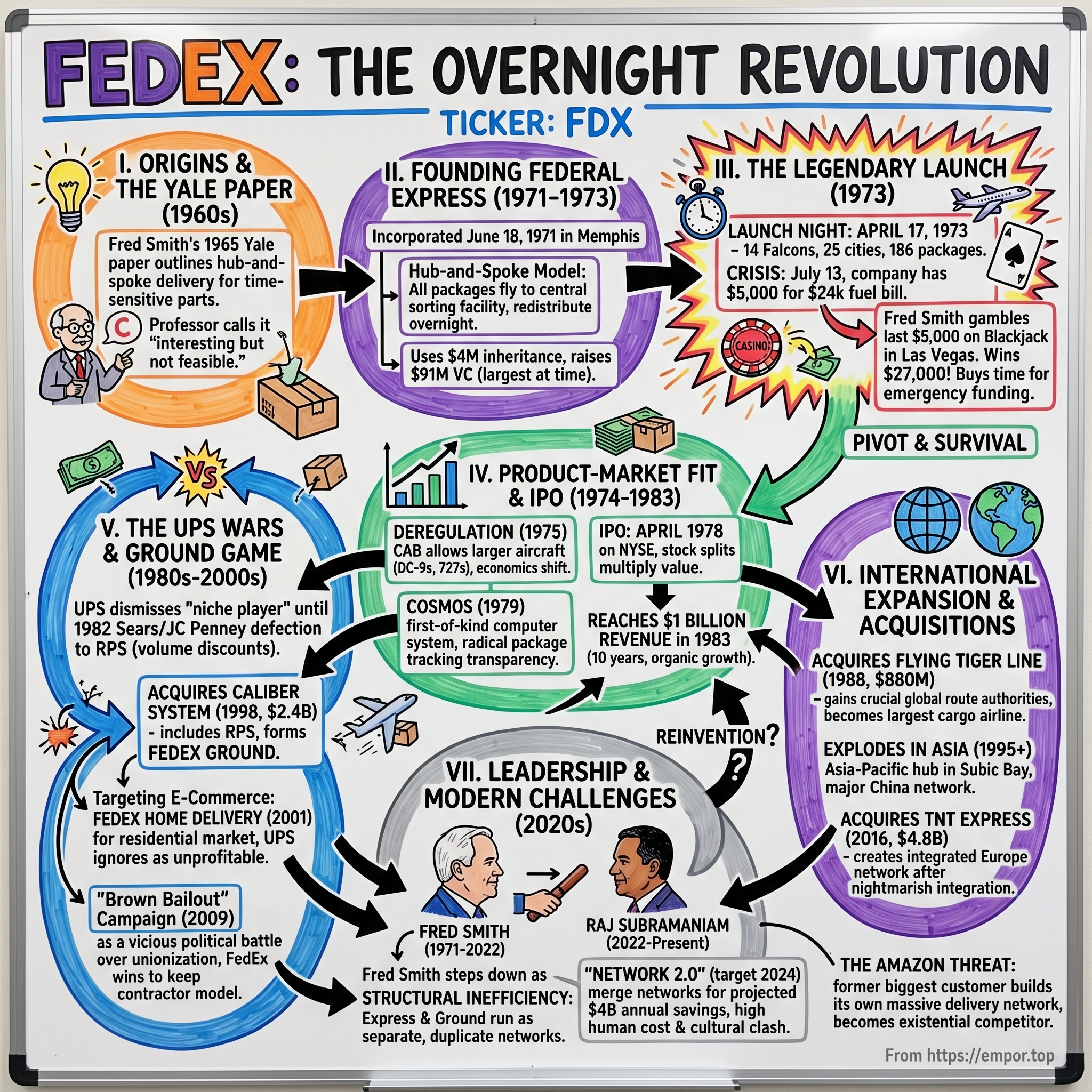
The company that delivered on that promise was built on an undergraduate term paper. Frederick W. Smith, while at Yale, outlined the economics of a dedicated air-freight network for high-value, time-critical goods—a paper that, as company lore holds, received an unimpressive grade from his professor. That concept eventually grew into an enterprise generating roughly $88 billion in annual revenue, moving millions of packages daily, and serving as a core logistical foundation for a global economy that replaced heavy buffer inventories with real-time tracking.1
By 2026, however, FedEx is undergoing the most consequential structural reorganization in its history. The underlying reason is straightforward: for roughly a quarter-century, its principal competitor operated a similar model with a materially lower cost structure. The central question for investors evaluating the company is narrow and testable: can an enterprise built on a founder's conviction that air and ground parcels required entirely separate networks successfully combine those operations, eliminate billions of dollars in duplicated costs, and reduce capital intensity? And can it do so while Amazon expands its own logistics network, UPS leverages its structural advantages, and shippers increasingly shift from premium overnight air to lower-cost ground delivery?
The roadmap ahead covers six distinct phases. First, the origin, in which a Marine Corps veteran risked a family inheritance and investor capital on a hub in Memphis, narrowly avoiding collapse. Second, the structural split of 1998, which gave FedEx a dedicated ground network but created a decades-long margin penalty. Third, the acquisition history—including Kinko's, TNT Express, and Flying Tigers—where projected synergies collided with integration realities. Fourth, the strategic ruptures of 2019 and 2024, when FedEx parted ways with Amazon and later lost its U.S. Postal Service air contract to UPS. Fifth, the portfolio restructuring that separated FedEx Freight, the highly profitable less-than-truckload unit, from the main parcel network. Finally, the central question: whether Chief Executive Officer Raj Subramaniam's "One FedEx" unification and the DRIVE cost-reduction program achieve genuine structural reform or simply reframe an enduring fixed-cost problem.
Underlying this narrative are core principles governing physical networks: the tension between capital intensity and return on invested capital, where owning widebody freighters creates a higher hurdle to earn the cost of capital than asset-light models; the reality that network density, rather than raw volume, generates true economies of scale; the customer-to-competitor paradox, in which a carrier's largest customer uses that volume to build its own competing capability; and the challenge of altering foundational network architecture after twenty-five years of deeply ingrained operational habits.
The story begins at the origin: with a founder whose early logistics experience was forged in military service before being put to the test in commercial aviation.
 Subscribe on LinkedIn
II. Origins & The Yale Paper: Founder Vision vs. Initial Execution (1965–1973)
In 1967, a 23-year-old forward air controller in Vietnam called in close air support from the ground. His job was ensuring aircraft and ground units converged on precise coordinates at the exact same moment, under conditions where systemic failure carried lethal consequences. The primary lesson Frederick Wallace Smith drew from combat was less about personal bravery and more about the extreme difficulty—and tremendous leverage—of moving physical items to precise locations on tight schedules.
Born in 1944 in Marks, Mississippi, Smith inherited substantial transportation wealth. His father, Frederick C. Smith, had built Dixie Greyhound Lines, an intercity bus network across the American South, alongside a regional restaurant chain. The elder Smith died when his son was four, leaving a trust that provided the initial capital for FedEx. That inheritance served as a crucial structural prerequisite: building a nationwide express freight network required an extraordinary tolerance for early losses, backed by capital the founder could afford to risk.
The conceptual foundation of the business traced to Smith's 1965 Yale economics paper. Rather than drafting a standard business plan, Smith analyzed structural flaws in mid-century air freight. At the time, urgent shipments moved in the cargo holds of passenger airliners as belly cargo. That model routed packages according to passenger travel demand and airline scheduling, forcing handoffs between uncoordinated carriers. While adequate for routine freight, it failed for time-critical components like replacement circuit boards needed to keep assembly lines running. Smith recognized that high-value goods—semiconductors, medical supplies, critical spare parts, and financial documents—carried a time-sensitivity premium high enough to justify a dedicated network operating its own aircraft, trucks, and end-to-end chain of custody. Though accounts of the paper's grade vary, the underlying premise was structurally sound yet entirely unbuilt.
Before putting that concept into practice, Smith served two tours in Vietnam as a Marine platoon leader and forward air controller, earning the Silver Star, the Bronze Star, and two Purple Hearts. He later cited his military experience over his Ivy League education as the foundation for his operational approach. A military rifle company and an overnight logistics network share a core operational challenge: thousands of individuals executing complex, synchronized plans in decentralized environments without direct supervision. Principles of unit cohesion, clear chains of command, meticulous logistics, and non-negotiable scheduling became the operating system of Federal Express.
Federal Express was incorporated in 1971 and launched operations on April 17, 1973. Smith committed roughly $4 million from his family trust and raised an unprecedented $91 million venture capital round from investors including New Enterprise Associates and Allstate. The company used those funds to purchase a fleet of Dassault Falcon 20 business jets, converting them for cargo use. Selecting the Falcon was a strategic regulatory move: under Civil Aeronautics Board rules, smaller aircraft operating below specific payload thresholds could run as air-taxi services, bypassing years of complex route authority approvals.
The selection of Memphis, Tennessee, as the operational hub established the physical architecture of the network. The choice rested on practical considerations: geographic proximity to the population center of the eastern United States, surplus airport runway capacity, local government cooperation, and favorable weather patterns minimizing flight disruptions. The network operated on a strict hub-and-spoke topology. Every package, regardless of origin or final destination, flew directly to Memphis. Between 11 p.m. and 3 a.m., ground crews sorted shipments for outbound flights departing before dawn. Even a package traveling between neighboring cities like Nashville and Knoxville—a three-hour drive—was routed through Memphis. This single-routing inefficiency was the necessary tradeoff for network connectivity: routing through a central hub allowed any newly added city to instantly connect to all existing destinations while keeping network oversight under a single roof.
Testing the first-mover claim. While corporate narratives often frame FedEx's early entry as an immediate competitive moat, initial execution revealed extreme financial vulnerability. On launch night in 1973, the carrier moved just 186 packages across 25 cities using 14 jets—an average of about 13 packages per plane. In a hub-and-spoke model, high fixed costs create massive negative leverage until volume scales: aircraft fly and sorting facilities operate regardless of payload density. The situation deteriorated when the 1973 OPEC oil embargo drove up jet fuel prices, severely impacting variable operating costs. Federal Express burned approximately $29 million in its first 26 months, bringing the enterprise close to insolvency.
This liquidity crisis produced the company's most famous lore: with roughly $5,000 remaining in cash and a $24,000 jet fuel bill due, Smith traveled to Las Vegas and turned the cash into $27,000 playing blackjack, generating just enough money to keep aircraft operational for another week. While often recounted as an act of entrepreneurial daring, the episode highlights how acutely undercapitalized the company was relative to its fixed overhead. During the same period, Smith faced legal challenges regarding documentation used to secure financing from his family trust, though he was ultimately acquitted.
Beyond operational hurdles, Federal Express faced a fundamental market creation challenge. Early losses stemmed not only from network inefficiency, but from lacking customer awareness. High-value overnight shipping represented a novel service class, requiring potential clients to trust an untested delivery model. The company's subsequent marketing investments—including the iconic "absolutely, positively" advertising campaigns of the late 1970s and early 1980s—served as capital expenditure for demand generation. Establishing market credibility was essential to driving the volume needed to cover the network's high fixed costs.
The reality of FedEx's first-mover advantage was therefore distinct from the popular myth: early entry alone did not create a defensive moat. Sustainable advantage emerged only after the network achieved operational density. Network scale was an outcome of surviving early losses rather than an automatic initial condition—a distinction that remains relevant when comparing FedEx's network against modern capital-rich competitors like Amazon. Establishing that initial parcel network set up the operational and cost challenges the company faced over the following two decades.
III. Scaling the Network & The Great Structural Split (1974–1998)
By 1976, the arithmetic finally flipped. The network reached the volume where the Memphis sort and nightly flight schedule were spread across enough packages to break even, allowing Federal Express to post its first profitable month. In a fixed-cost business, profitability does not arrive gradually; it arrives at a threshold and then compounds, as every incremental package beyond break-even carries minimal additional cost. Once FedEx crossed that line, the same operating leverage that had nearly pushed it into insolvency became its most powerful economic engine.
The company went public in April 1978 at $24 a share. Five years later, in 1983, annual revenue reached $1 billion, making FedEx the first U.S. company to hit that milestone within a decade of founding without relying on acquisitions. While often cited as a growth trophy, the milestone primarily illustrated latent market demand: the speed of the ramp suggested the market Smith outlined in 1965 had been unserved for years, constrained not by a lack of customer willingness to pay, but by the absence of a carrier willing to build the required asset base.
Two regulatory shifts provided a critical tailwind. Air cargo deregulation in 1977 freed FedEx from Civil Aeronautics Board route restrictions and lifted the payload ceiling that had forced the carrier to rely on small business jets. The company quickly upgraded to Boeing 727s and later DC-10s, transforming its unit economics: the cost per package of flying to Memphis dropped sharply when each aircraft carried tenfold the cargo. Deregulation did not create FedEx's business model, but it removed the structural ceiling on its scale—a reminder that in asset-heavy industries, the regulatory envelope is often the binding constraint rather than customer demand.
Through the 1980s and 1990s, FedEx evolved into essential commercial infrastructure. The spread of just-in-time manufacturing across American industry depended entirely on reliable, urgent replenishment; a factory operating without safety stock required a supplier capable of delivering replacement components overnight. FedEx became the primary mechanism that made lean inventory a viable corporate strategy. During this period, the company also launched the industry's first comprehensive package-tracking system. While marketed as a customer convenience, tracking functioned internally as an operational nervous system, as barcode scans at every handoff provided management with real-time visibility into network bottlenecks.
Then came the decision that defined the company's trajectory for the next quarter-century. In 1998, FedEx acquired Caliber System for approximately $2.4 billion. The specific assets acquired mattered far more than the headline price: Caliber owned Roadway Package System (RPS), a ground parcel network powered by independent contractor drivers; Roberts Express, a specialized critical-shipment carrier; and Viking Freight, a regional less-than-truckload operator. RPS was rebranded as FedEx Ground, while Viking and its peers formed the foundation of FedEx Freight. In a single transaction, an air-express carrier acquired the two business units that would later generate most of its operating profits—and most of its strategic friction.
Testing the separate-networks doctrine. Fred Smith maintained for a generation that express air and ground parcel were operationally incompatible and had to run as entirely independent networks—with separate fleets, hubs, sales teams, and labor models. The rationale was internally coherent: express was a time-definite business built around a rigid nightly air schedule, whereas ground was a cost-per-mile business driven by linehaul trucking and route density. Because the service guarantees and capital requirements differed fundamentally, Smith argued that combining them risked degrading the premium air service that justified FedEx's higher pricing.
The counterevidence accumulated in plain sight on suburban streets every day. Because the networks remained isolated, a FedEx Express van and a FedEx Ground van frequently covered the exact same neighborhood, passing the same homes, consuming separate fuel, and operating under completely separate cost structures—one driven by an employee, the other by an independent contractor. That duplication extended upstream through sortation hubs, pickup routes, and real estate, leaving the enterprise paying for two independent stops where a single unified delivery would have sufficed.
The competitive benchmark operated directly across the street. United Parcel Service ran a single, integrated network where a single driver delivered overnight letters and ground packages from the same vehicle. As a result, UPS's domestic parcel operating margins persistently outperformed FedEx Express's—a gap that over two decades typically spanned mid-single-digit percentage points, with UPS generating margins in the low teens compared to mid-single digits for FedEx Express.2 A margin disparity of that magnitude, sustained across economic cycles, was neither a pricing artifact nor a product-mix anomaly; it was the direct consequence of network architecture.
How should an investor evaluate Smith's doctrine? Historical performance firmly refutes its strongest claim: that separate networks were necessary to maintain service quality was disproven by a rival delivering comparable reliability from a unified network at structurally superior margins for over twenty years in the same market. What remains valid is a narrower truth: consolidating dual networks is operationally complex and carries meaningful execution risk. FedEx's eventual decision to unify its networks—announced twenty-five years after the Caliber acquisition and after Smith stepped down as chief executive—represented an explicit institutional pivot. The company that spent decades defending dual networks is now spending billions to merge them, a sequence that highlights the importance of evaluating corporate strategy against observable unit economics rather than executive conviction.
Before that consolidation began, however, FedEx spent a decade and a half testing a different growth thesis: that it could acquire its way to durable competitive advantage.
IV. M&A Autopsy & Capital Allocation Track Record
Every network business eventually confronts the same temptation: building density organically is slow and expensive, while buying it is fast and expensive. FedEx has repeatedly chosen the second option, producing a clear track record of how management across successive leadership teams has converted capital into returns. The resulting pattern does not point to simple incompetence, but to a recurring structural blind spot: FedEx consistently purchased the physical assets it wanted while underestimating the non-physical liabilities attached to them.
Kinko's, and the cost of buying a retail footprint. In 2004, FedEx paid approximately $2.4 billion in cash for Kinko's, the ubiquitous copy-shop chain. The strategic rationale was straightforward on paper: 1,200 retail storefronts in high-traffic locations would instantly serve as package drop-off and pickup nodes, while generating a steady revenue stream from small and medium-sized business customers—the precise segment where FedEx commanded its highest yields. The core thesis was to acquire the physical retail network to own the customer relationship directly at the counter.
The structural flaw was that FedEx acquired a physical document business precisely as documents were shifting to digital formats. Kinko's relied primarily on printing and copying services, which shrank as affordable desktop printers, PDF distribution, and cloud document storage expanded across the corporate sector. By 2008, FedEx recorded an $891 million non-cash impairment charge on the unit, writing down goodwill and the trade name.3 Rebranded as FedEx Office, the business survived, but the primary goal of retail drop-off density was ultimately achieved far more economically through partnerships with third-party retailers such as Walgreens and Dollar General. Those agreements provided thousands of local drop-off points without requiring FedEx to hold commercial real estate leases or manage storefront staff.
The analytical lesson extends beyond overpaying for an asset. FedEx purchased a physical network footprint but inherited an operating business in structural decline, discovering only after the fact that the underlying network access could have been leased rather than owned. For investors assessing future acquisitions, the critical question remains whether an target asset's value to FedEx can be unbundled from the acquired company's standalone business model—and whether that value can be contracted for instead.
TNT Express, and the limits of the integration model. In 2016, FedEx completed its acquisition of TNT Express for approximately €4.4 billion to address a long-standing vulnerability: its lack of a competitive intra-European road network relative to established rivals DHL and UPS. European logistics is not a single market, but a patch of national road systems governed by distinct labor laws, customs rules, and local incumbents. TNT represented a shortcut to ground density.
Fourteen months after the deal closed, in June 2017, the global NotPetya cyberattack disrupted TNT's IT infrastructure. FedEx disclosed roughly $300 million in operating income impact and, more damagingly, the attack forced TNT to run critical operations manually while systems were rebuilt.4 Beyond the immediate financial loss, the attack diverted management focus to systems remediation during peak integration years, delaying the realization of a unified European network.
Integration dragged into fiscal 2022, turning European operations into a persistent margin drag marked by repeated restructuring charges. From a financial reporting standpoint, excluding integration costs from adjusted earnings over six years effectively normalized a recurring operational expense out of headline profitability.
The broader lesson of the TNT acquisition is that cross-border logistics M&A compounds operational risks. Acquirers simultaneously absorb labor, cultural, regulatory, and technological friction, which standard deal models rarely price accurately. Consequently, projected cross-border synergies require substantial discounting.
Flying Tigers, and what a good network deal looks like. The 1989 purchase of Flying Tiger Line for approximately $883 million offers a contrasting example that clarifies the broader pattern. Flying Tigers was the world's largest heavy-cargo airline. In acquiring it, FedEx primarily purchased operating rights rather than a standard commercial enterprise: landing slots at Tokyo Narita Airport, transpacific route authority, and established Asian operating permissions that could not be acquired through open markets.
That transaction succeeded by securing an enduring position on Asia-to-U.S. express trade lanes. However, it also carried typical asset-heavy overhead: a fleet of aging freighters and substantial ongoing capital commitments that arrived just before an air cargo downturn. Across these major transactions, the pattern remains consistent: FedEx has historically been more effective at acquiring scarce regulatory rights than managing acquired operating businesses, while consistently underestimating long-term asset carrying costs.
This transaction history also provides context for evaluating current portfolio management. Historically, FedEx retained acquired assets long after the original strategic thesis was impaired. Kinko's was rebranded as FedEx Office and retained for more than fifteen years after its impairment charge, while TNT's European operations were held through prolonged losses and restructuring cycles. While long investment horizons are often defended as necessary for network seasoning, a less favorable interpretation suggests a broader institutional reluctance to divest underperforming units. In that light, the recent separation of FedEx Freight appears driven more by external investor pressure than internal strategic initiative.
For investors, this historical record serves as an essential baseline. Evaluating management's commitment to capital discipline requires monitoring actual capital deployment rather than forward-looking statements: tracking whether transformational acquisitions diminish, share repurchases and debt reduction accelerate, and capital expenditures systematically decline. The subsequent structural shocks facing FedEx, however, originated outside the enterprise—and neither could be solved by a deal.
V. The Customer-Turned-Competitor Paradox: Amazon & The USPS Contract Loss
In mid-2019, FedEx made a strategic break that highlighted the growing conflict between incumbent parcel networks and e-commerce platforms: it severed its shipping relationship with Amazon.
In June 2019, FedEx declined to renew its domestic U.S. Express air contract with Amazon, and in August it ended the domestic Ground contract as well.[^5] Management publicly framed the decision around the fact that Amazon represented less than 1.3% of FedEx's total revenue. The relationship, management argued, was not economically material, and FedEx's long-term growth lay with the broader e-commerce market rather than a single client whose strategic interests were directly diverging from its own.
That rationale was structurally sound on contribution-margin terms. Amazon shipments were low-yield residential packages, and continuing to carry them meant using FedEx's network capacity to subsidize a future competitor's operational learning curve. Walking away from thin-margin volume that strengthens a rival aligns with standard corporate strategy.
What management's public framing understated, however, was Amazon's expansion trajectory. Amazon invested tens of billions of dollars in Amazon Logistics—building out cargo aircraft fleets, regional sortation hubs, local delivery stations, and a vast contractor delivery network. By late 2023, Amazon was delivering more parcels in the United States than either FedEx or UPS.5 Rather than merely replacing the volume surrendered by FedEx, Amazon constructed a third national last-mile network in less than a decade, overcoming entry barriers that incumbents had long treated as impassable.
This rapid build-out forced a reexamination of traditional logistics economics. The primary barrier to establishing a national parcel network was never conceptual, but rather the immense capital and time required to reach volume density before initial fixed-cost losses overwhelmed the carrier. Amazon possessed a structural advantage unavailable to previous entrants: guaranteed internal volume. Because its own retail platform served as an anchor tenant, Amazon avoided the early density deficit that had nearly bankrupted Federal Express in its founding years, achieving economic scale from day one.
The resulting competitive threat was less about lost package volume than the erosion of marginal pricing power. A third national network operating with a lower cost structure—and functioning primarily as a retail cost center rather than a standalone delivery provider—established a structural ceiling on residential delivery rates across the industry. As Amazon began selling its excess logistics capacity to third-party merchants, it transformed an internal infrastructure cost into a direct market competitor. Consequently, the key performance indicator for FedEx's residential ground business shifted from overall package volume to whether revenue per package could outpace rising cost per package alongside a third national carrier.
Retaining Amazon's business offered little strategic relief. Continuing the contract would have tied up network capacity with thin-margin residential packages while Amazon built its own logistics infrastructure. Remaining an Amazon carrier would have delayed the platform's build-out by a year or two at most, while consuming capacity needed for higher-yield commercial freight. Amazon's structural advantage derived from its captive retail volume—a factor entirely outside FedEx's operational control.
The loss of daytime air volume. A second structural shock hit FedEx's air network shortly after. For over twenty years, FedEx provided domestic air transport for the U.S. Postal Service, a contract generating between $1.5 billion and $2 billion in annual revenue. Crucially, Postal Service mail filled FedEx aircraft during daytime hours when its overnight express network was otherwise inactive. For a fleet designed around a nocturnal sorting cycle, daytime mail provided vital revenue to offset fixed aircraft capital costs.
This complementary arrangement collapsed under the Postal Service's "Delivering for America" restructuring. Postmaster General Louis DeJoy shifted mail transport from air to ground to cut costs while adjusting delivery schedules. As Postal Service air volumes fell, FedEx found itself flying aircraft sized for historical demand at fixed operating costs. The contract transitioned from a profitable source of daytime asset utilization into a margin-dilutive obligation.
FedEx declined to sign an extension on terms it judged margin-dilutive, and in April 2024 USPS awarded the air cargo business to UPS, effective that October.6 While FedEx demonstrated capital discipline by refusing unprofitable volume, the decision left its express air fleet operating without either of its historical daytime anchor tenants.
In response, FedEx launched its "Tricolor" network redesign, restructuring air operations into distinct service tiers to match aircraft capacity with the actual time-sensitivity of freight rather than routing all volume through the premium overnight cycle. The program involved retiring older aircraft, including its MD-11 freighter fleet, and cutting daytime flight hours substantially. Tricolor represented an explicit institutional acknowledgment that express air demand had permanently contracted below the fleet size originally built to serve it.
Together, the loss of Amazon's volume and the Postal Service air contract accelerated a broader migration within FedEx: operating profits were shifting decisively from air to ground networks, and toward business units beyond traditional parcel delivery.
VI. Segment Deep Dive: Revenue, Profitability, & Economic Drivers
An examination of FedEx's segment disclosures throughout the 2010s reveals a striking contrast. The flagship business associated with the brand—the purple-and-orange aircraft, the overnight delivery promise, and high-profile advertising—was consistently its least profitable unit. Meanwhile, an unheralded trucking operation moving pallets of industrial freight between regional terminals produced operating margins competitive with asset-light sectors.
The architecture, old and new. For most of its modern history, FedEx reported four operating segments: FedEx Express, FedEx Ground, FedEx Freight, and FedEx Services—the shared-cost unit encompassing sales, marketing, technology, and back-office functions. That structure was more than a financial reporting convention; it reflected independent business units operating under a single brand, each managed by its own president with a separate profit-and-loss statement and an incentive to protect its own volume.
Under the "One FedEx" initiative, management consolidated the parcel businesses into a single operating unit, Federal Express Corporation, absorbing Express, Ground, and Services.7 FedEx Freight—the less-than-truckload (LTL) unit—was maintained as a standalone entity, creating the structural prerequisite for its eventual separation.
Here is how the two halves of the company sat relative to each other before the separation:
       +-------------------------------------------------------+
       |                  FedEx Corporation                    |
       |                       (FDX)                           |
       +-------------------------------------------------------+
                                   |
         +-------------------------+-------------------------+
         |                                                   |
+---------------------------------+                 +---------------------------------+
|   Federal Express Corporation   |                 |          FedEx Freight          |
|       ("One FedEx" Parcel)      |                 |   (Less-Than-Truckload - LTL)   |
|                                 |                 |                                 |
| - Express (Air/International)   |                 | - High-Margin Industrial LTL    |
| - Ground (Domestic Road/Van)    |                 | - Leading US LTL market position|
| - Integrated Fleet & Sorting    |                 | - Separated as FDXF (June 2026) |
| - Revenue: ~85% | Margin: 4-6%  |                 | - Revenue: ~10% | Margin: 15-20%|
+---------------------------------+                 +---------------------------------+
Parcel economics, explained without the jargon. The parcel business is governed by a fundamental relationship: revenue per package versus cost per package. Revenue per package—or yield—depends on service mix (where overnight air commands higher rates than deferred ground), package weight and dimensions, fuel surcharges, and contractual volume discounts. Cost per package, by contrast, depends overwhelmingly on network density.
Density represents the primary economic moat in physical logistics. Consider a delivery route spanning forty miles. Whether a driver delivers 80 packages or 160 packages, the route requires roughly the same vehicle, fuel, and driver time—making the marginal cost of additional deliveries minimal. Doubling package volume on a route nearly halves the cost per package. Consequently, scale in parcel logistics is not defined by aggregate national volume, but by packages per stop and stops per mile within a specific geographic cluster. A national carrier with a 30% market share and sparse coverage in a given county operates with inferior unit economics compared to a regional carrier holding 60% local share. This dynamic explains why operating separate Express and Ground delivery vehicles in the same neighborhood proved structurally inefficient, diluting the route density required for margin expansion across twenty-five years.
Aviation costs create a second structural drag on parcel profitability. Express operating margins in the range of 4% to 6.5% reflect heavy fixed expenses, including aircraft depreciation, maintenance, fuel, and pilot compensation governed by collective bargaining under the Railway Labor Act. Because aircraft represent fixed overhead regardless of cargo volume, the fleet redesign under the Tricolor restructuring served as an explicit operational adjustment to excess air capacity relative to market demand.
Freight economics: why the boring business earned the best returns. FedEx Freight transports palletized industrial cargo rather than individual parcels—shipments too large for a parcel network yet insufficient to fill a full trailer, sorted at regional cross-dock terminals and transported via linehaul trucking. While accounting for roughly a tenth of consolidated revenue, Freight generated operating margins in the high teens and contributed between a fifth and a quarter of total operating profit.
Three structural factors explain this margin advantage. First, LTL relies on terminal networks where real estate constraints and municipal zoning make cross-dock facilities with multiple bay doors difficult to replicate near major metropolitan areas. Second, customer demand is commercial rather than residential, eliminating residential delivery stops, failed drop-offs, and weekend operational surges. Third, the 2023 bankruptcy of Yellow Corporation eliminated approximately a tenth of national LTL capacity, allowing surviving carriers to absorb freight volume while maintaining disciplined pricing across the sector.
Beyond operating margins, return on invested capital highlights the strategic rationale for separating Freight. In asset-intensive logistics, capital intensity determines overall returns: establishing a terminal network and tractor-trailer fleet requires far less capital per dollar of revenue than maintaining a global air network of widebody freighters and automated air sorting hubs. Consequently, equivalent operating margins yield vastly different returns on capital, establishing Freight as FedEx's highest-returning business unit.
However, LTL profitability remains vulnerable to industrial cycles. Because LTL volume tracks manufacturing output, drops in industrial production immediately reduce pallet counts, creating negative operating leverage on fixed terminal overhead. Furthermore, while the removal of Yellow Corporation's capacity supported near-term pricing, historical precedent indicates that industry trucking capacity tends to expand whenever return on capital justifies new investment.
This structural divergence created a persistent valuation mismatch: a high-return, premium-multiple LTL business embedded within a lower-return parcel enterprise, where Freight's cash flow effectively subsidized capital commitments in the air network. That dynamic ultimately catalyzed external pressure to spin off the unit.
VII. The Hidden Gem & Value Unlock: The FedEx Freight Spin-Off (2024–2026)
The activist case, when it arrived, required no complex forensic accounting. It relied on simple valuation math visible to any market observer.
Pure-play less-than-truckload carriers—such as Old Dominion Freight Line, Saia, and XPO—traded at enterprise-value-to-EBITDA multiples in the high teens to mid-twenties, reflecting their superior returns on capital, pricing discipline, and freedom from aviation overhead. FedEx Corporation, despite operating the largest LTL network in the nation by revenue, traded in the high single digits. Investors purchasing FedEx stock were effectively acquiring a premium trucking asset at a steep discount, bundled alongside a capital-intensive parcel business that the market viewed with skepticism. That valuation gap was neither subtle nor temporary; it had persisted for years.
D.E. Shaw and other institutional investors pressed the argument publicly. In December 2024, FedEx's board announced the conclusion of a formal assessment regarding FedEx Freight's role in the portfolio, declaring its intention to separate the division into an independent public company.8 Bloomberg had previously reported the board's deliberations while they were underway.9
Counterarguments to the separation existed and warranted careful consideration rather than dismissive write-offs. The parcel and LTL divisions shared customer accounts, brand identity, real estate facilities, and sales coverage. A standalone Freight business lost direct access to FedEx's captive sales channel, while the core parcel network lost a dependable source of cash generation precisely as it embarked on the most expensive structural overhaul in its history. Management countered that dedicated capital allocation and focused executive oversight would serve both businesses better—a standard conglomerate-breakup rationale, yet one particularly fitting given their divergent capital requirements: one unit reinvested in widebody aircraft on decade-long cycles, while the other funded dock doors, cross-dock terminals, and linehaul tractors.
The transaction closed on June 1, 2026, structured as a tax-free separation in which FedEx distributed roughly 80.1% of FedEx Freight shares to existing shareholders—granting one FDXF share for every two FDX shares held—while retaining a 19.9% equity stake earmarked for debt reduction.10 FDXF subsequently began trading on the New York Stock Exchange as a standalone, pure-play LTL carrier.
The financial ramifications cut both ways. For the remaining parcel business, the separation introduced strict capital discipline alongside heightened operational exposure: Federal Express must now fund its capital expenditures, dividend obligations, and network consolidation entirely from its own parcel cash flows. Removing Freight's cash cushion eliminated the safety net for the DRIVE cost-reduction program; if expense savings fall short, no high-margin sibling division remains to absorb the deficit. For FDXF, the advantage lies in unencumbered capital deployment toward terminal expansion and cross-dock automation, evaluated against LTL hurdle rates rather than competing against widebody freighter acquisitions.
Ultimately, corporate separations reliably eliminate valuation discounts but only occasionally improve underlying unit operations. While FDXF shares trade on pure LTL market dynamics and the retained 19.9% stake provides a liquid, marked-to-market balance-sheet asset, the spin-off itself does not lower the cost of delivering a parcel. Instead, it removes the last accounting shelter within the enterprise. With the parcel business now operating in full view of public markets, the investment thesis hinges entirely on whether management can execute a network integration that the company spent twenty-five years insisting was impossible.
VIII. Modern Management, Governance, & Transformation ("One FedEx" & DRIVE)
Executing a fundamental strategy shift requires dismantling core operational doctrines. Chief Executive Officer Raj Subramaniam has spent four years restructuring FedEx's operating model, pursuing network integration publicly while founder Frederick W. Smith served as executive chairman.
The insider given an outsider's mandate. Subramaniam became President and CEO in June 2022, succeeding Fred Smith after more than thirty years at the company. Having joined FedEx in 1991 following graduate studies in the United States, Subramaniam advanced through marketing and international operations—serving as Chief Marketing Officer and Chief Operating Officer—rather than field operations. That background presents analytical trade-offs. An insider possesses the organizational familiarity and relationships required to steer a long-resistant corporate culture. However, an executive shaped by that legacy environment, coming from marketing rather than line operations, carries the risk of articulating a transformation strategy more effectively than executing it.
Subramaniam's primary strategic move was declaring the dual-network doctrine obsolete. In April 2023, eleven months into his tenure, FedEx announced it would consolidate its operating companies into a single organization, ending the structural separation that had defined the company since Caliber.7 Rather than a routine reorganization, the move reversed the founder's defining architectural strategy.
The CFO hired to say no. John W. Dietrich joined as Executive Vice President and Chief Financial Officer in July 2023, bringing external operational experience to the leadership team. As former CEO of Atlas Air Worldwide, Dietrich understood freighter economics, aircraft acquisition, fleet utilization, and capacity costs, while remaining independent of FedEx's internal political history. Recruiting an external aviation executive to oversee a reduction in flight capacity signaled a deliberate institutional commitment to capital discipline.
Incentives, which are the part that actually binds. Executive compensation structures reflect actual board priorities. FedEx aligned its incentive framework away from raw volume and revenue growth toward adjusted operating income, return on invested capital (ROIC), and total shareholder return. For a company that historically pursued low-margin volume to fill network capacity, tying executive pay to ROIC altered the underlying operating objective—establishing metrics that investors can verify directly in proxy filings.
DRIVE and Network 2.0: the actual mechanics. The DRIVE cost-reduction program targeted $4 billion in permanent structural savings by fiscal 2025, allocating roughly $1.8 billion to the surface network, $1.2 billion to the air network, and $1 billion to general and administrative expense.[^12] Evaluating these targets requires distinguishing between cyclical and structural savings. Cyclical cost cuts, such as reducing flight hours during temporary volume dips, automatically reverse when demand recovers. Structural savings, by contrast, permanently eliminate facilities, redundant routes, or duplicated positions. Management's credibility depends on keeping the cost base reduced once volume growth resumes.
The underlying operational mechanism is Network 2.0, which merges Express and Ground pickup-and-delivery into a single route per neighborhood. Under this model, a single driver in one vehicle delivers both premium overnight envelopes and e-commerce packages. Combining overlapping routes increases load density on delivery vans, leveraging route economics for the first time in twenty-five years. Simultaneously, the Tricolor air redesign rationalizes flight schedules, matching specific aircraft types and flight frequencies to actual service requirements.
The labor problem that makes this genuinely hard. The principal operational risk to route integration lies in labor structure. FedEx Express drivers operate as W-2 employees—encompassing roughly 110,000 workers across parcel operations—alongside pilots represented by the Air Line Pilots Association under the Railway Labor Act. In contrast, FedEx Ground deliveries are handled by Independent Service Providers: thousands of contracted businesses that own routes, employ drivers, and operate their own vehicles.
Combining these operational models introduces legal and regulatory friction. Merging physical routes raises worker classification issues: if an employee and a contractor's driver handle integrated routes using shared routing software and mixed loads, regulatory scrutiny increases. Misclassification claims have repeatedly generated litigation against FedEx Ground, where standards applied under the Fair Labor Standards Act and by the National Labor Relations Board evaluate the degree of operational control exercised by the parent company. Tightening central control to optimize route density simultaneously increases legal exposure regarding contractor classification—a structural liability bound to the projected cost savings.
Corporate governance dynamics reinforce this transition. Fred Smith moved to Executive Chairman when Subramaniam became CEO, leaving the founder on the board while his long-standing operating model was restructured. Although founder-chairmen can impede strategic pivots, subsequent decisions—including network consolidation, the spin-off of FedEx Freight, and air fleet reductions—directly reversed earlier policies.
What the calls reveal. Management's quarterly earnings calls demonstrate the operational friction behind the transformation. Prepared remarks consistently highlight progress on cost targets, station consolidations, and capital constraints. During Q&A sessions, analysts have pressed management on unscripted variables: the timeline and cost of renegotiating contracts with Independent Service Providers as routes combine, and whether ongoing pilot contract negotiations limit the operational flexibility required by Tricolor. Meanwhile, management has maintained its stated capital framework, capping annual capital expenditures in the low-$5 billion range against a revenue base near $88 billion, alongside continued share repurchase.1[^13]
That capital framework provides a testable benchmark for performance. Capital expenditure is reported quarterly and cannot be obscured. If capital intensity remains reduced while service metrics hold steady, the structural transformation is succeeding. Conversely, if capital spending drifts upward—as deferred aircraft commitments convert into active capital outlays—the DRIVE program will have delivered temporary cyclical relief rather than permanent structural reform.
IX. Playbook: Strategic & Investing Lessons
Strip away the aircraft and the Memphis mythology, and FedEx offers five strategic lessons that generalize well beyond physical logistics.
1. Density, not size, is the moat. The intuition that a larger network confers a stronger moat holds true only if incremental volume flows across existing routes. FedEx's fifty-year history demonstrates that the unit economics of a physical network are dictated locally—by packages per stop and stops per mile—making national market share a lagging summary statistic rather than a primary source of competitive advantage. The uncomfortable implication for incumbents is that a focused regional competitor with superior local density can generate higher operating returns in that geography, precisely as regional parcel carriers have accomplished in dense urban corridors.
2. Founder conviction has a half-life. Fred Smith's insistence on separate air and ground networks was not an error when established in 1998, when ground parcel was a modest business and express air served as the primary growth engine. The strategic flaw lay in the institutional refusal to re-examine that doctrine as e-commerce shifted the volume mix toward residential ground delivery. Architectural decisions calcify as corporate structures form around them—with dedicated profit-and-loss accounts, distinct executive suites, separate compensation pools, and ingrained operational identities. By the time the structural cost penalty becomes undeniable, fixing it requires dismantling career incentives. For investors, the practical lesson is to evaluate which corporate commitments are being defended with current empirical data versus historical executive conviction.
3. When a major customer is building your capability, they are not a customer. The Amazon episode provides a clear rule for network businesses. A major customer investing heavily in the delivery capabilities you sell is not a long-term partner executing a procurement strategy; it is an emerging competitor using your network volume to de-risk its initial build and fund its operational learning curve. The ambiguity lies in timing rather than trajectory. The common mistake is retaining that volume for short-term contribution margins, which effectively finances a future rival's route density. Although FedEx severed its shipping relationship with Amazon earlier than most peers, Amazon's captive retail volume provided a structural advantage that made its logistics expansion virtually inevitable.
4. Discount network synergies harshly. Across its acquisitions of Kinko's, TNT Express, and Flying Tigers, FedEx realized full strategic value only when purchasing legally scarce assets—such as international route authorities and restricted airport landing slots. When acquiring operating businesses intended for full network integration, management consistently encountered labor regulations, legacy IT systems, cultural friction, and, in TNT's case, a catastrophic cyberattack. Projected cross-border synergies require heavy discounting. Before committing capital to M&A, boards must evaluate whether network access can be leased or contracted rather than owned—a reality demonstrated when retail partnerships with Walgreens and Dollar General provided drop-off density at a fraction of Kinko's $2.4 billion acquisition cost.
5. Labor-model arbitrage has an expiration date. The independent contractor model provided FedEx Ground with significant initial advantages: capital flexibility, variable cost structures, and rapid geographic expansion without direct workforce additions. Those benefits compounded for two decades, but the model carried a deferred operational liability that materialized during network integration. Labor arbitrage functions effectively while networks remain isolated; once operational efficiency requires a single driver to handle both express air and ground packages on unified routes, the legal distinction that reduced initial costs becomes the primary hurdle to network consolidation. Any business model relying on worker classification arbitrage must be underwritten with the expectation that regulatory scrutiny or internal strategy will eventually challenge that distinction.
Five lessons, one common thread: in capital-intensive physical networks, structural architecture dictates long-term economic outcomes, and altering that architecture is extraordinarily expensive. That reality leads directly to the final evaluation: what FedEx's consolidated parcel business is worth as it executes its long-delayed operational integration.
X. Investor Analysis: 7 Powers, Porter's 5 Forces, & Bull vs. Bear Stress Test
Helmer's 7 Powers, scored honestly
Scale Economies — High, but narrower than advertised. The fixed-cost base of a global air-and-ground network forms a formidable barrier; no venture-backed newcomer can easily replicate the hub infrastructure in Memphis. However, scale defends primarily against independent startups, not against an enterprise backed by massive internal volume. Amazon proved that exception, and its impact on the industry is substantial.
Network Effects — Medium, and often overstated. Serving over 220 countries and territories creates genuine value for multinational shippers seeking a single logistics provider and unified technical integration. Yet physical parcel networks lack true two-sided network effects: adding a new customer in Ohio does not inherently improve service for a shipper in Osaka. The resulting advantage is geographic coverage—a function of scale economics rather than self-reinforcing network dynamics—and it can be duplicated by any competitor willing to commit sufficient capital.
Counter-Positioning — Low, bordering on negative. Counter-positioning requires adopting a business model an incumbent cannot replicate without cannibalizing its core operations. FedEx is not counter-positioned against UPS; rather, it is actively converging toward UPS's single integrated network model. If counter-positioning exists in parcel logistics, it belongs to Amazon Logistics, whose delivery apparatus operates to support a broader retail ecosystem rather than generating standalone carrier profit.
Switching Costs — Low to Medium. Deep software integrations through FedEx's application programming interfaces and its fdx platform create real operational friction for enterprise clients, whose label generation, rate comparison, and returns management are embedded in corporate enterprise resource planning software. However, high-volume shippers routinely split contracts across multiple carriers, and multi-carrier logistics software has lowered switching barriers significantly. Volume remains highly sensitive to base pricing and fuel surcharges.
Cornered Resource — Low, with pockets. Freighter aircraft and delivery trucks are commercial commodities available to any capitalized firm. FedEx's genuine cornered resources are narrow: international route authorities and airport landing slots accumulated through the Flying Tigers transaction and subsequent expansion, alongside prime hub positions in Memphis and Anchorage. While valuable, these assets primarily protect cross-border air express rather than the domestic parcel network, where the majority of enterprise volume resides.
Process Power — Medium. Five decades of accumulated sortation engineering, route optimization algorithms, and facility design cannot be quickly duplicated. Yet process power is double-edged: as management has acknowledged, those deeply ingrained operational routines also preserved a quarter-century of duplicated air and ground routes. Deeply embedded process power that encodes an outdated architecture remains an operational liability until network consolidation is fully realized.
Brand — Medium. The FedEx name functions as a colloquial verb, commanding a yield premium in time-critical overnight air freight where guaranteed reliability is the primary product. The constraint is that brand equity applies predominantly to a contracting share of overall parcel volume. Shippers rarely pay a brand premium for deferred two-day residential ground delivery.
Porter's Five Forces
Threat of New Entrants — Very Low, with one asterisk. Constructing a competing nationwide parcel network from scratch demands tens of billions of dollars in capital and years of initial operating losses. The critical caveat is that entry barriers stem from capital requirements and package density rather than proprietary technology or regulatory protection—meaning a heavily capitalized entrant with guaranteed internal volume can overcome them, as Amazon has demonstrated.
Supplier Power — High. Supplier power is substantial across major operational inputs. Commercial widebody freighters are supplied by a Boeing-Airbus duopoly featuring multi-year delivery lead times and rigid contract pricing. On labor, FedEx Express pilots are represented by the Air Line Pilots Association under the Railway Labor Act, while Teamsters labor agreements across the broader logistics sector—most notably the 2023 UPS labor settlement—establish industry-wide wage benchmarks. Jet and diesel fuel costs are passed to customers through surcharges in theory, though surcharge adjustments lag spot price volatility and remain subject to competitive discounting.
Buyer Power — High and rising. Large e-commerce merchants exercise considerable buyer power, securing significant contractual discounts and continuously shifting package volume between regional and national carriers. As online retail volume consolidates among a smaller group of major merchants, buyer leverage has steadily intensified.
Threat of Substitutes — Medium-High. Three forms of substitution directly affect the core business: self-delivery by major retail platforms, regional parcel carriers capturing high-density urban corridors at lower price points, and the migration of time-sensitive air freight to deferred ground transport as shippers accept two-day delivery windows. This internal product substitution is particularly dilutive, as it retains package volume within FedEx's portfolio at lower yields while stranding widebody aircraft capacity.
Rivalry — Extreme. Industry rivalry remains intense. FedEx and UPS historically operated as a rational pricing duopoly, preserving industry margins and capital returns. The entry of Amazon's delivery network into third-party logistics introduces a structural disruption, as a carrier optimizing for overall e-commerce ecosystem efficiency rather than standalone freight profitability is not bound by traditional logistics pricing discipline.
Bull case, tested
DRIVE delivers and the margin gap closes. If the $4 billion structural cost-reduction target proves permanent and Network 2.0 route consolidation proceeds facility by facility without service degradation, consolidated operating margins could expand toward the high single digits, eliminating the historical dual-network cost penalty. The supporting evidence is operational and verifiable—delivery routes are physically merged or they are not—and UPS's historical financial performance demonstrates that single-network unit economics are achievable. The counterargument rests on FedEx's mixed record with past restructuring initiatives and the fact that complex delivery routes in dense metropolitan markets—where independent service provider contracts are most entrenched—are scheduled for the final phases of integration.
Capital intensity falls and free cash flow expands. Capping annual capital expenditures in the low $5 billion range against approximately $88 billion in annual revenue—combined with active share repurchases—transforms a capital-intensive network into a consistent generator of free cash flow. This trend represents the most readily verifiable aspect of the constructive thesis, and recent capital discipline aligns with management's stated targets. The key risk is capital deferral rather than permanent reduction: postponed aircraft deliveries remain contractual obligations, and aging flight fleets ultimately require capital replacement.
The post-separation FDX re-rates. A streamlined parcel carrier with improved returns on capital and a liquid 19.9% retained stake in standalone FedEx Freight could command an expanded valuation multiple compared to the historic conglomerate structure. However, equity re-rating depends on sustained operational execution rather than financial engineering alone. Equity markets have already priced the sum-of-the-parts valuation discount; validating the higher valuation requires demonstrating durable parcel operating margins at target levels.
Bear case, tested
The integration breaks service. Merging employee-based Express operations with independent contractor Ground routes represents the primary operational vulnerability. Execution failures would manifest not merely as budget overruns, but as degraded delivery performance—damaging brand reliability and risking customer defection to competitors during a critical restructuring window. Furthermore, tighter operational coordination increases legal risks surrounding independent contractor misclassification litigation under federal and state labor standards.
Price compression from a three-player market. Should Amazon aggressively expand third-party logistics services, residential parcel pricing could suffer structural erosion. Rather than a routine cyclical decline in yields, this would mark a permanent contraction in the industry profit pool, causing cost savings from the DRIVE program to be offset by lower delivery pricing rather than expanding operating margins.
The air fleet becomes a stranded asset. If shippers continue shifting volume from premium overnight air to deferred ground services, FedEx risks maintaining capital-intensive aircraft capacity above structural market demand. While the Tricolor network redesign aims to match flight schedules with actual freight velocity, its effectiveness remains constrained by secular shifts in customer shipping preferences.
An activist's remaining questions. Even following the FedEx Freight separation, institutional investors face unresolved operational questions: whether international express operations—particularly the European network acquired through TNT Express—earn their cost of capital or require further restructuring; how long transformation expenses will continue to be excluded from non-GAAP earnings; whether FedEx Office remains a necessary strategic asset given lower-cost retail partnerships; and whether management will monetize the retained 19.9% stake in FedEx Freight to reduce balance-sheet debt on schedule. While the corporate structure is streamlined relative to prior years and financial disclosures are more transparent, a simpler organizational footprint is not equivalent to completed operational reform.
XI. Recent Earnings, Management Credibility, & Forward KPIs
Evaluating a global enterprise with roughly 400,000 employees and an $88 billion revenue base requires focusing on the core metrics that test the central investment thesis. For FedEx, three key indicators determine whether the operational transformation is succeeding:
1. Consolidated adjusted operating margin. Operating margin serves as the direct scoreboard for the "One FedEx" unification. The historical margin gap between FedEx and UPS's domestic parcel business was the primary evidence against maintaining separate air and ground networks. Consequently, narrowing that gap represents the baseline measure of structural progress. Investors should track this metric quarterly, specifically watching whether margin expansion persists during quarters with softer package volumes. Operating gains that depend on volume growth reflect temporary cyclical tailwinds, whereas margins that hold during volume contractions signal permanent structural reform.
2. Capital expenditure as a percentage of revenue. Historical capital intensity of 8% to 9% of revenue explained why FedEx long struggled to earn its cost of capital, as an asset-heavy model consuming that level of annual reinvestment required exceptional operating margins to deliver adequate returns. Management's commitment to cap annual capital spending in the low-$5 billion range—bringing capital intensity below 6.5% of revenue—provides a clear, easily verifiable benchmark. Sustaining this reduced capital intensity without degrading delivery service would provide strong evidence of a structural shift in capital allocation.
3. Yield growth versus cost-per-package growth. The spread between revenue per package and cost per package reveals underlying pricing power and operational efficiency. When yield growth exceeds unit cost growth, route density gains are successfully flowing through to net operating income. Conversely, if cost-per-package growth outpaces yield expansion, inflationary pressures or competitive pricing constraints from Amazon and regional carriers are absorbing the savings generated by the DRIVE program, transferring those gains to customers rather than shareholders.
Evaluating management's execution record. Leadership's recent actions reflect a notable departure from historical corporate governance. Completing the separation of FedEx Freight demonstrated board responsiveness to institutional shareholders after years of internal resistance. Similarly, rejecting low-margin contracts with Amazon and the U.S. Postal Service established a consistent pattern of prioritizing profitability over sheer volume across leadership transitions. Under Chief Financial Officer John Dietrich, capital spending constraints have been explicitly quantified, while executive compensation has been re-indexed to return on invested capital. Additionally, management has acknowledged operational friction directly during earnings call Q&A sessions rather than offering polished corporate platitudes.
Several operational risks remain on the watch list. FedEx has a long history of launching cost-reduction initiatives, meaning the ultimate test of the DRIVE program is whether the $4 billion cost reduction remains durable across full economic cycles. Unsettled contract negotiations with the Air Line Pilots Association continue to limit air network flexibility, and any final labor agreement will carry costs that offset structural savings. Furthermore, integrating Express and Ground delivery routes heightens legal exposure regarding independent contractor misclassification. Finally, TNT's European road network remains a persistent margin drag a decade after its acquisition.
Ultimately, current management has enacted fundamental structural reforms: dismantling the dual-network doctrine, spinning off the less-than-truckload business, capping capital intensity, and aligning executive incentives with shareholder returns. Yet executing the most complex phase of operational route integration remains an unfinished effort. The transformation is neither a confirmed turnaround nor a failed restructuring, but an ongoing operational experiment evaluated through quarterly financial results.
XII. Conclusion & Final Thoughts
There is a clear symmetry to the FedEx narrative. The company was founded on an insistence on reasoning from first principles about how goods should move, disregarding how the broader logistics industry operated. Five decades later, its long-term performance as an investment depends on leadership applying that same first-principles approach—this time questioning the operational doctrines that FedEx itself maintained for a quarter-century.
The core question facing the enterprise has shifted. For decades, FedEx centered its identity on pioneering overnight express delivery and building the Memphis sorting hub. Today, the operational challenge is more straightforward: whether a single delivery vehicle can replace two on a suburban route, hundreds of thousands of times a day, without compromising service reliability. The air network is being right-sized to match actual demand, the less-than-truckload division has been spun off to stand on its own valuation, and the founder's dual-network doctrine has been retired. Boardroom restructuring is largely complete.
What remains is operational, unglamorous, and directly measurable: merged delivery routes, reduced capital intensity, and the spread between yield and unit cost per package. These indicators will determine the success of the transformation over the coming years—evaluated publicly, quarter by quarter, through verified financial performance rather than executive assurances. For an enterprise built on selling time-definite certainty, the ultimate test rests entirely on empirical execution.
References
-
FedEx Corporation Investor Relations Portal — FedEx Corp, 2026-09-01 ↩↩
-
FedEx Corp Form 10-K Annual Report FY2024 — SEC EDGAR, 2024-06-24 ↩
-
FedEx Posts $891 Million Charge on Kinko's Unit — Reuters, 2008-06-05 ↩
-
Cyber Attack Hits FedEx TNT Unit, Costs $300 Million — Financial Times, 2017-09-20 ↩
-
Amazon Surpasses UPS and FedEx in US Parcel Volume — Bloomberg, 2023-11-27 ↩
-
USPS Awards Air Cargo Contract to UPS as FedEx Deal Expires — Reuters, 2024-04-01 ↩
-
FedEx Consolidates Express and Ground Networks into Single Unit — Wall Street Journal, 2023-04-05 ↩↩
-
FedEx Board Concludes Strategic Review of Freight Segment — FedEx Newsroom, 2024-12-19 ↩
-
FedEx Explores Freight Unit Spin-Off in Portfolio Review — Bloomberg, 2024-12-19 ↩
-
FedEx Completes Separation of FedEx Freight — FedEx Investor Relations, 2026-06-01 ↩
 LinkedIn
 WhatsApp
 Reddit
 Hacker News
 Email
Email Kindle
 RSS Feed
 Spotify
 Apple Podcasts
 Amazon Music
 Audible
 YouTube