First Bancorp: The Carolinas' Quiet Consolidator
I. The Sandhills Roll-Up and the $44 Million Kitchen Sink
Southern Pines, North Carolina, is a town better known for golf than for finance. The Pinehurst resort sits a few miles down the road, the longleaf pines line the streets, and retirees from Ohio and New Jersey fill the restaurants at lunch. It is an unlikely place to find the headquarters of a $13 billion bank. But that is where First Bancorp keeps its executive offices, and in the final months of 2025 the people in those offices made a decision that most bankers spend years trying to avoid.1
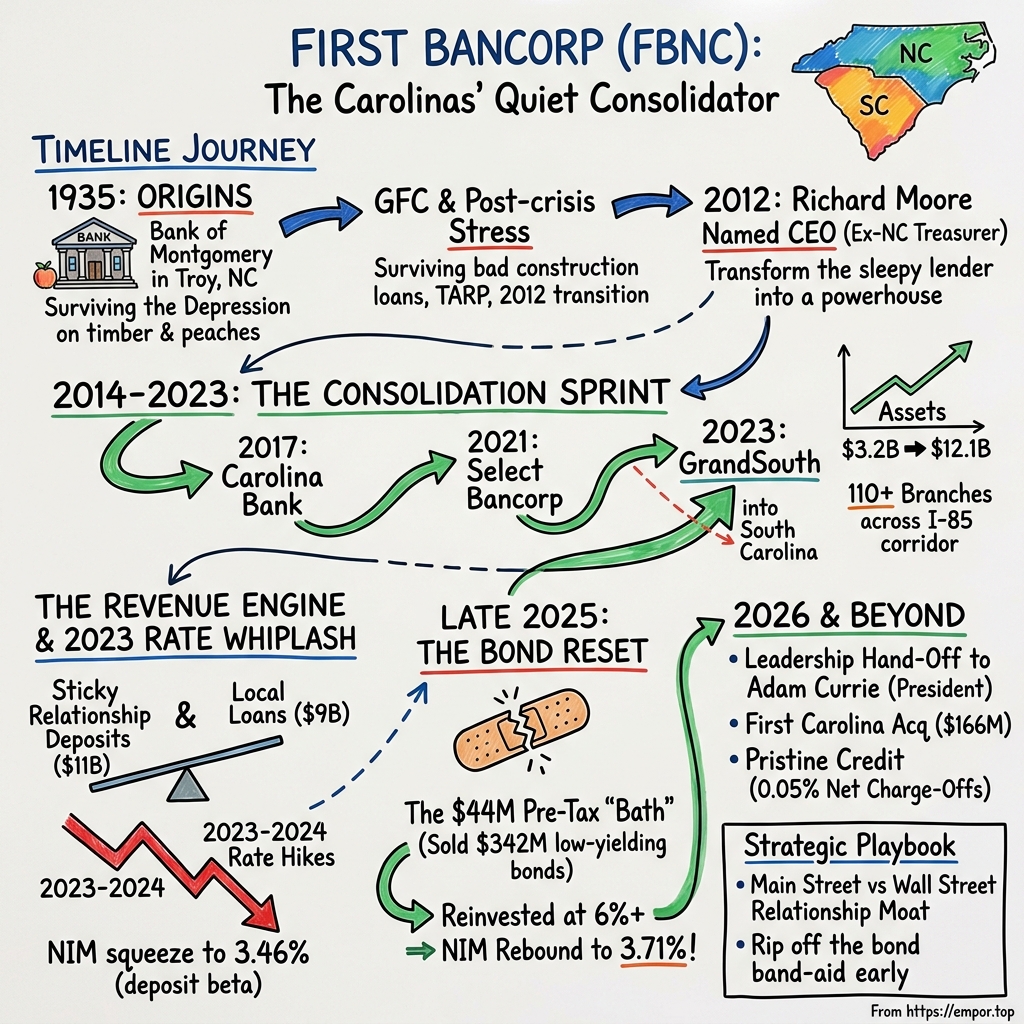
They chose to lose money on purpose. In the fourth quarter of 2025, First Bancorp sold $342 million of bonds that were paying it just 1.67% a year, and took a pre-tax loss of $43.7 million to do it.3 After tax, the hit came to $33.6 million, or about 81 cents for every diluted share, which is roughly a third of a normal year's earnings wiped out in a single trade.3 The bonds had been bought in the zero-rate world of 2020 and 2021, when 1.67% looked like a respectable return. By 2025 they looked like an anchor.
The same results release that disclosed the loss also told a second story. Net interest margin, the spread a bank earns between what it collects on loans and bonds and what it pays on deposits, had climbed to 3.58% in the fourth quarter, up from 3.46% at the end of 2024.3 And six months later, on July 14, 2026, the company announced it would buy First Carolina Bancshares, the parent of Carolina Bank & Trust, for about $166 million in stock and cash.5 Clean the balance sheet, rebuild the margin, then go shopping again. That three-step rhythm is the whole company in miniature.
To appreciate how strange this is, consider where First Bancorp started. Its bank, First Bank, was founded in 1935 in Troy, a small town in Montgomery County in the rural interior of the state.1 For most of its history it was the kind of lender that knew its borrowers by their first names and their fathers' names. Today it holds about $12.7 billion of assets on its year-end balance sheet, more than $13 billion by mid-2026, and runs over 110 branches stretching from the Sandhills to Charlotte, Raleigh, Greensboro and across the state line into Upstate South Carolina.34
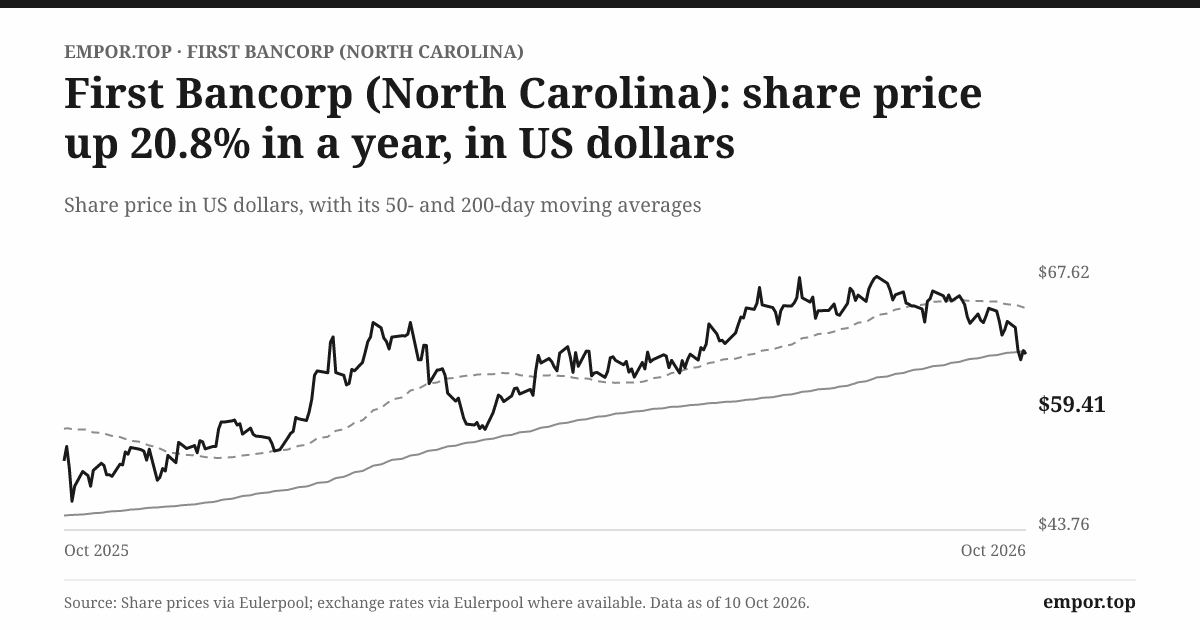
The stock market values that franchise at about $2.5 billion, with shares at $59.42 on October 10, 2026.4 That price sits at roughly 1.4 times book value, which is the market's way of saying that it believes the bank's deposits and relationships are worth something more than the accounting value of its assets minus its liabilities.4
The question this story tries to answer is whether that belief is earned. First Bancorp is, at its core, a serial acquirer. It has grown mostly by buying other community banks with its own stock, and it has done so for more than a decade under the same chief executive. Serial acquirers in banking can build enormous value, because the cost of running a bank does not double when the bank doubles. They can also hide a great deal, because every acquisition resets the accounting, adds goodwill, and makes year-over-year comparisons murky.
Three questions run through everything that follows. The first is about the margin engine: can First Bancorp hold its net interest margin above about 3.70%, where it reached in the second quarter of 2026, without bleeding cheap deposits to money-market funds and bigger competitors?4 The second is about the quality of the roll-up: has buying Carolina Bank, Select, GrandSouth and now First Carolina created real value per share, or has it simply made the bank bigger? The third is about credit: are the bank's remarkably clean loan losses, just 0.05% of loans annualized in the fourth quarter of 2025, a sign of genuinely good underwriting, or a calm before commercial real estate loans written at low fixed rates come due at much higher ones?3
The $44 million bond sale touches all three. It was an admission that something had gone wrong on the balance sheet, an investment in future margin, and a bet that the bank's capital was strong enough to absorb the pain while still buying another bank. To judge whether that bet was wise, the story has to go back to where the bank came from, and to the man who turned a cautious rural lender into a consolidator.
 Subscribe on LinkedIn
II. From the Timber Mills of Troy to the State Treasurer's Playbook (1935–2012)
Montgomery County in the 1930s was a place of pine forest, sawmills, small farms and peach orchards, set in the hilly country between the cotton belt and the Piedmont mill towns. The Depression had been brutal to rural banking across the South. Thousands of small banks failed between 1930 and 1933, and the big city banks that survived had little interest in lending to farmers and timber merchants in a county seat of a few thousand people. When First Bank opened its doors in Troy in 1935, it was filling a hole that the national financial system had left behind.1
That origin matters more than it might seem, because it set the bank's character for the next half-century. A bank that exists because outsiders will not lend locally learns to lend on local knowledge. It knows which sawmill owner pays his bills, which orchard survived the last frost, and which family is good for a mortgage. That kind of knowledge does not show up in a credit score, and it is very hard for a distant competitor to copy. It also means the bank's deposits come from the same people it lends to, which tends to make those deposits loyal.
For decades, that is what First Bank was: a conservative, town-by-town lender spreading slowly across the rural counties of central North Carolina. The region around it changed dramatically. Textile mills and furniture plants, which had employed generations of North Carolinians, closed in waves as manufacturing moved overseas. Each closure hit local deposits and local borrowers. Yet the bank kept growing, partly because it was diversified across many small towns rather than tied to a single mill, and partly because its expansion followed the money.
The money, in this case, flowed to Moore County. As golfers and retirees discovered Pinehurst and Southern Pines, the Sandhills became one of the wealthier corners of the state. First Bancorp, the holding company formed above the bank, eventually moved its headquarters there.1 The shift from Troy to Southern Pines is a quiet symbol of the strategy: keep the rural roots, but plant the flag where the deposits are richest. The company's shares trade on NASDAQ, and it has reported to the SEC as a public company for decades.1
The real test of any bank comes in a crisis, and the Great Financial Crisis was the hardest test in seventy years. North Carolina was home to two of the most aggressive banks in America. Wachovia, based in Charlotte, collapsed into the arms of Wells Fargo in 2008. Bank of America survived only with federal support. Across the state, community banks that had loaded up on construction and land loans during the housing boom found themselves holding half-finished subdivisions and lots no one would buy.
First Bancorp was not immune. It carried its share of troubled construction loans through the downturn, and like many banks of its size it raised capital to see itself through. What separates the story from the many failed banks of that era is that it came out the other side intact and still independent. That survival is not proof of brilliance; plenty of well-run banks also survived. But it does establish that the franchise could take a severe credit cycle without being forced into a sale, which matters when judging how the bank might handle the next one.
By 2012 the immediate crisis had passed, and the board made an unusual choice. In June 2012 it named Richard H. Moore as chief executive.1 Moore was not a career banker. He had been North Carolina's elected State Treasurer from 2001 to 2009, which made him the steward of the state's pension fund, one of the larger public pension systems in the country, and the official responsible for the state's debt and its relationships with Wall Street.1 He had also run for governor in 2008 and lost the Democratic primary.
It is worth pausing on what kind of experience that is. A state treasurer spends his days thinking about capital allocation, investment managers, bond markets and the long-term cost of money. He does not spend them underwriting a loan to a hardware store. Moore's arrival signaled that the board wanted a strategist, someone who would treat the bank as a platform for capital deployment rather than as a lending shop. It also brought a man with deep political relationships across the state, which matters in a business where trust and local standing open doors.
The skeptic's question about Moore is the obvious one: does a former politician know how to run a bank? The record over the following decade offers a partial answer. Moore did not try to become a credit officer. He built a team around him, most notably long-time CFO Eric Credle, who served the company for 24 years before retiring, and he concentrated on the thing he understood best, which was buying and integrating other institutions.2 The shift in strategy was from survival to consolidation. And the timing, as it turned out, was nearly perfect.
III. The Consolidation Sprint: Building the Carolinas Network (2014–2023)
Picture the map that sat on the desks of Moore and Credle in the years after the financial crisis. North Carolina was dotted with community banks of a few hundred million to a couple of billion dollars in assets. Most of them were profitable enough to survive but too small to thrive. The reason was regulation. The Dodd-Frank Act of 2010 had loaded every bank, large and small, with new compliance work, and the cost of that work did not shrink in proportion to the size of the bank. A $1 billion bank needed many of the same compliance officers, the same cybersecurity defenses and the same technology vendors as a $5 billion bank.
That created what economists call scale economies, and what bank executives call the math of consolidation. If two $2 billion banks merge, they can close overlapping branches, run one technology platform instead of two, and spread the regulatory overhead across twice the deposits. The combined bank earns more per dollar of assets than either did alone. The sellers' shareholders get a premium and liquid stock in a bigger company. The buyer gets growth.
First Bancorp's numbers tell how aggressively it played this game. Total assets grew from about $3.2 billion at the end of 2014 to about $12.1 billion by the end of 2023, almost four times larger in nine years.13 Revenue compounded at about 13% a year over the decade to 2025.3 Over the same stretch, the number of shares outstanding rose from about 29.5 million in 2018 to around 41.4 million by mid-2026, because most of the deals were paid for in stock.4
The first big move came in 2017, when First Bancorp completed its acquisition of Carolina Bank Holdings, a Greensboro-based lender with a presence in the Piedmont Triad.8 Greensboro, High Point and Winston-Salem form one of the state's three major metro clusters, and First Bancorp had been thin there. The deal, together with other activity that year, pushed total assets from about $3.6 billion to about $5.5 billion.18 It was a statement that the bank from Troy now intended to compete in North Carolina's cities, not just its small towns.
The second was larger. In October 2021, First Bancorp completed its merger with Select Bancorp, a Dunn-based bank with branches across eastern and central North Carolina.7 Select brought deposit density in markets First Bank already knew, which is the most valuable kind of acquisition because the cost savings come quickly. Total assets crossed $10.5 billion by the end of 2021.71 That threshold is meaningful in American banking. Above $10 billion, banks face caps on the debit card fees they can charge and come under the direct supervision of the Consumer Financial Protection Bureau. Crossing it is expensive, and banks generally want to clear it decisively rather than linger just above it.
The third deal crossed a state line. On January 1, 2023, First Bancorp completed its merger with GrandSouth Bancorporation, a Greenville, South Carolina, lender.6 The Greenville-Spartanburg-Anderson region, strung along Interstate 85 between Charlotte and Atlanta, is one of the fastest-growing corners of the Southeast, with a heavy concentration of manufacturers such as BMW's Spartanburg plant and the suppliers that feed them. GrandSouth gave First Bancorp a foothold there, and with it, total assets of about $12.1 billion by the end of 2023.1
Did the company pay sensible prices? The best evidence is in how it financed the deals and what happened to per-share earnings afterward. First Bancorp paid with stock rather than borrowing heavily at the holding company. Its debt-to-equity ratio, which had approached 1.0 in 2017 when the bank leaned on borrowings to fund growth, fell to near zero by 2020 and stayed low, rising to about 0.23 in 2022 and 2023 before dropping to 0.05 by the end of 2025.13 That is a bank that did not lever up to buy other banks.
The per-share record is more mixed, and it is where a skeptic should look hardest. Earnings per share rose from $1.22 in 2014 to $4.13 in the boom year of 2022, a genuinely strong compounding record over a period when the share count was expanding.1 That says the acquisitions, taken together, added more earnings than shares. But the gains were lumpy. A big jump came in 2018, when the federal corporate tax rate fell from 35% to 21%, and First Bancorp's effective tax rate dropped from about 31% to about 21%.1 Part of what looks like acquisition value creation in those years was a gift from Congress that every American bank received.
And the 2022 peak came at the very top of an interest-rate-driven earnings cycle that would reverse brutally in the next two years. Measured from 2015 to 2025, net profit compounded at about 15% a year, but over the three years to 2025 it shrank at roughly 9% a year.3 Return on equity, the cleanest single measure of whether a bank is creating value, has sat mostly between about 6% and 8% over the decade, with peaks of around 11% to 14% in 2018, 2019 and 2022.13 A bank that earns 7% on its equity when its investors probably demand something closer to 10% is not, in a strict sense, creating value. It is growing.
There is one piece of evidence that the integrations themselves were done with discipline. Property and equipment on the balance sheet peaked at about $157 million after the Select deal in 2021 and drifted down to about $139 million by 2025, even as the bank absorbed GrandSouth's branches.13 A bank that closes and sells redundant branches after a deal is capturing the cost savings that justified the deal. One that keeps every acquired branch open is buying footprint for its own sake.
The verdict on this decade is narrower than the bullish version. First Bancorp bought franchises in the right places, paid with stock rather than debt, and pruned what it bought. That much the record supports. What the record does not yet show is that the roll-up consistently produces returns on equity above the bank's cost of capital through a full cycle. The acquisitions made the bank bigger and gave it the scale to survive the next decade. Whether they made each share meaningfully more valuable depends on what the combined machine can earn, and that requires understanding how a community bank actually makes money.
IV. The Anatomy of a Community Spread Machine: How First Bank Makes Money
Imagine a contractor in Raleigh who runs a mid-sized commercial construction firm. He has a line of credit with First Bank to bridge the gap between paying his subcontractors and getting paid by his clients. His payroll runs through a First Bank operating account. His company's equipment loans are there too. When an online brokerage advertises 4.5% on cash, he notices, and maybe he moves some surplus there. But moving his operating accounts would mean renegotiating his credit line with a new lender who does not know him, re-plumbing his payroll, and risking a hiccup in the one relationship that keeps his business funded in a slow month. So the operating money stays.
That contractor, multiplied by tens of thousands of businesses and households across two states, is the entire business model. First Bank takes in deposits, pays some interest on them (or none, on plain checking accounts), and lends the money out at higher rates. The gap between the two is net interest income, and it is by far the largest source of revenue. In the second quarter of 2026, net interest income reached $111.3 million, up from $106.2 million in the fourth quarter of 2025.43
The way to think about a bank like this is as a spread machine. On one side are about $9.0 billion of loans; on the other, about $11.1 billion of deposits, as of June 2026.4 The bank lends out about 81 cents of every deposited dollar, and the rest sits in cash and securities.4 That loan-to-deposit ratio is conservative. A bank lending 100% or more of its deposits must borrow from wholesale markets to fund growth, which is expensive and can vanish in a panic. At 81%, First Bank funds itself almost entirely from customers and still has room to grow loans without chasing funding.
Fee income adds a second, smaller stream. Customers pay service charges on deposit accounts, the bank earns fees from mortgage origination and wealth management, and it makes gains from selling the guaranteed portions of Small Business Administration loans to investors in the secondary market.1 SBA lending is an interesting niche: the federal government guarantees most of the loan, the bank sells that guaranteed slice at a premium, and keeps the servicing relationship. These lines matter at the margin, but the bank's fate rises and falls with the spread.
What makes the deposit side valuable is how scattered it is. No single depositor or borrower comes close to 10% of revenue, and federal and state rules cap lending to any one borrower at roughly 15% to 20% of the bank's capital.14 That is the normal condition for a community bank, but it is worth contrasting with the banks that failed in 2023. Silicon Valley Bank's deposits were concentrated among venture-backed technology companies who all talked to each other and all moved their money on the same day. First Bank's deposits come from peach farmers, dentists, retirees and contractors who do not share a group chat.
The lending side follows the same local logic. The loan book leans toward commercial real estate, owner-occupied business property, construction and development, and commercial and industrial loans, underwritten by regional market executives who live in the communities they serve.1 That is a strength when the local manager genuinely knows the borrower. It is a concentration risk when the whole region's real estate market turns at once, a tension the story returns to when it examines credit.
The 110-plus branches are both the moat and the cost.4 Each branch is a physical reminder of the bank's presence, a place where a business owner can sit down with a lender. Each branch is also rent, salaries and maintenance. The bank's bet is that the deposits gathered through those branches are cheaper and stickier than deposits bought on the open market, by enough to more than cover the overhead.
How would anyone know if that bet is right? The honest test is behavior under pressure. In theory, relationship deposits are loyal. In practice, every bank claims its deposits are loyal, and the only proof is what happens when rates rise sharply and customers have somewhere better to put their money. Between 2022 and 2024, First Bancorp's customers got exactly that test, and the answer was less comfortable than the theory.
V. The Rate Hike Whiplash: The 2023–2024 Earnings Compression
On a Friday in March 2023, Silicon Valley Bank failed. Two days later, Signature Bank in New York followed. Within a week, depositors across America were asking a question most had never thought about: is my bank safe? And business treasurers everywhere asked a second, more expensive question: why am I keeping millions in a checking account earning nothing when Treasury bills pay 5%?
The second question was the one that hurt First Bancorp. The bank never faced a run. But the Federal Reserve had lifted its policy rate from near zero to above 5% in barely more than a year, the fastest tightening in four decades, and the gap between what customers could earn elsewhere and what their bank paid them had become too wide to ignore. Commercial clients began demanding 4% or more on operating balances. Retail savers moved money into certificates of deposit and money-market funds. The bank's cost of funding, which had sat near zero for years, began to climb.
The problem was that the other side of the balance sheet could not keep up. Like most banks, First Bancorp had taken in a flood of deposits during the pandemic, when government stimulus swelled every checking account in America. Loan demand had not grown nearly as fast, so the bank parked much of the surplus in bonds. Its securities and investments roughly doubled from about $5 billion at the end of 2019 to well over $9 billion by 2021.1 Those bonds were bought at the yields of the era: often below 2%, locked in for years.
Here is the trap in simple terms. Imagine a landlord who signed ten-year leases at low rents, financed with a mortgage whose rate resets every month. When rates jump, the mortgage cost rises immediately while the rental income stays frozen. The landlord is not insolvent; the buildings are still worth something, and the leases will eventually expire. But for years, the business earns much less than it used to. That is what happened to First Bancorp's margin.
The earnings record shows the squeeze. Net profit fell from about $146 million in 2022 to about $76 million in 2024.1 Earnings per share went from $4.13 to $1.84 over those three years, a decline of more than half.13 The bank's operating margin, measured as operating profit against revenue, slid from about 46% to about 19%.1 Revenue itself barely moved in 2024; it was the cost of funding that was eating the profit.
Part of the drop had a specific cause that was not purely about rates. In 2023 the bank had just absorbed GrandSouth, which brought one-time merger costs and its own deposit base that had to be repriced. And in the fourth quarter of 2024, earnings per share collapsed to just 9 cents, the low point of the entire cycle.1 That quarter carried the first leg of the securities repositioning the bank would later complete, along with an unusually high tax charge, so it was partly self-inflicted cleanup rather than a deteriorating business.13
The margin tells the story most precisely. At its pre-hike peak, First Bank was earning a net interest margin around 4%; by late 2024 it had compressed to about 3.46%.3 Half a percentage point does not sound like much. On roughly $11 billion of earning assets, it is something like $50 million a year of income that simply disappeared.
Analysts on the bank's earnings calls pressed CFO Elizabeth Bostian, who had taken over from Eric Credle in 2021, on two points.2 The first was the lag: how long would it take for fixed-rate loans and securities to reprice upward and catch up with deposit costs? The second was the bond portfolio itself, much of it inherited in acquisitions or bought during the pandemic, and the drag it imposed. Management's answer, repeated across several quarters, was patience: the bonds would mature, the loans would reprice, and the margin would recover.
That answer was technically correct and strategically unsatisfying. The verdict on this period is that First Bancorp's balance sheet carried an interest-rate mismatch that it did not hedge, and that its customers' deposits proved more rate-sensitive than the relationship-banking theory implied. The bank was never in danger. But a franchise whose deposits were truly immune to rate competition would not have seen its earnings fall by half. The deposits stayed; they just got much more expensive. That narrows the moat claim from "deposits are loyal" to "deposits are loyal, at a price," which is the honest version that should guide any investor. The question that hung over 2024 was whether management would keep waiting for the bonds to mature, or do something about it.
VI. The Bond Cleansing and Balance Sheet Reset (2025–2026)
Every bank's asset-liability committee meets regularly to look at the same kind of spreadsheet: what the bank earns on each pool of assets, what it pays on each pool of liabilities, and how those numbers will change if rates move. By the middle of 2025, the spreadsheet in Southern Pines was delivering an uncomfortable message. A block of available-for-sale bonds was yielding about 1.67%, while the bank could reinvest the same money at several percentage points higher. Waiting for those bonds to mature would take years. Every quarter of waiting cost real income.
The catch was accounting. Because rates had risen, those bonds were worth less than the bank had paid for them. As long as the bank held them, the loss sat in a part of shareholders' equity called accumulated other comprehensive income, visible to analysts but not run through the income statement. Selling them would turn that paper loss into a realized one, a hit to reported earnings that would show up in every headline. Many banks preferred to wait, hoping time would heal the loss. First Bancorp decided not to.
In the third and fourth quarters of 2025, the bank executed what it called securities loss-earnback transactions.3 The headline piece came in the fourth quarter: the sale of $342 million of bonds yielding 1.67%, at a pre-tax realized loss of $43.7 million.3 Reported net income for full-year 2025 came in at $111 million, or $2.68 per diluted share; excluding the securities losses, management's adjusted figure was $166.1 million, or $4.01 per share.3
It is worth understanding why a bank would choose this. The key insight is that the loss was already real. The bonds were worth less than their book value whether or not the bank sold them; the only question was whether to recognize that through slightly lower income for many years or through one big charge now. Selling converts a slow drip into a single cut, then frees the money to earn market rates immediately.
The earn-back math can be followed step by step. If the $342 million is reinvested at something around 5% to 6% instead of 1.67%, the bank picks up roughly 3.5 to 4.3 percentage points of extra yield. On $342 million, that is about $12 million to $15 million of additional pre-tax income a year. Divide the $43.7 million loss by that annual pickup, and the bank earns the loss back in roughly three to three and a half years. That is not a miracle trade. It is a reasonable one, and its payoff depends on where the proceeds actually land and on rates staying high enough to keep the reinvestment yield up.
The early evidence suggests the reset worked as intended. Net interest margin rose to 3.58% in the fourth quarter of 2025 and to 3.71% in the second quarter of 2026.34 Earnings per share were $1.13 in the first quarter of 2026 and $1.22 in the second quarter, the best quarterly results in the bank's recent history.4 Annualized, the second quarter alone implies about $4.88 of earnings per share, well above the 2022 peak.4
Not all of that improvement came from the bond sale. Deposit costs began to stabilize as the Federal Reserve eased off its peak rates, and loans written years earlier at low fixed rates continued to mature and reprice. The bond trade accelerated a recovery that was already under way. An honest reading gives management credit for speeding up the turn rather than for creating it.
The same quarter brought a second piece of cleanup. The holding company redeemed $18 million of subordinated debt early, without replacing it with new borrowing.3 Total borrowings stood at about $75 million at the end of 2025, against shareholders' equity of about $1.7 billion, a debt-to-equity ratio of 0.05.3 For a holding company, that means virtually no refinancing risk and no reliance on credit markets.
The obvious worry with any yield-chasing move is that the bank might have sacrificed safety to juice income. The evidence argues against it. Cash and short-term investments remained around $2.2 billion at the end of 2025, a large liquidity cushion for a bank of this size.3 The loan-to-deposit ratio remains conservative. The bank did not swap safe bonds for risky ones; it swapped low-yielding bonds for higher-yielding loans and securities while keeping a deep cash reserve.
So was the $44 million loss discipline or the cleanup of an avoidable mistake? The fair answer is both. Buying long-duration bonds at 1.67% in 2020 and 2021 was a bet on low rates that an unhedged bank of this size should have sized more carefully, and the bank was not alone in making it. Selling them in 2025 was the right correction, made later than ideal but earlier than many peers. Management deserves credit for the repair and some blame for the original exposure. And the repair raises a new question: a bank that now earns more on its loans must be sure those loans will be repaid.
VII. The Credit Stress Test: Underwriting in the Eye of the Storm
In late September 2024, Hurricane Helene tore across the Southeast and then stalled over the mountains of western North Carolina. The flooding was catastrophic. Entire towns along the French Broad and Swannanoa rivers were swept away, roads vanished, and Asheville was cut off for days. For any bank with borrowers in the region, the question was immediate: how many businesses, homes and properties pledged as collateral had just been destroyed?
First Bancorp set aside reserves for possible losses tied to the storm. Then it did what good credit officers do after a disaster: it inspected its exposure, borrower by borrower. By the fourth quarter of 2025, the damage had proved smaller than the initial models assumed, and the bank released $1.6 million of hurricane-related reserves back into income.3 That is a small number, but it is a revealing one. It says the bank's actual losses came in below its own cautious estimates, which is what a well-run credit book looks like.
The broader credit numbers say the same. Annualized net charge-offs, the loans the bank actually wrote off as uncollectible, were just 0.05% in the fourth quarter of 2025, or about $1.1 million.3 Non-performing assets were about $44.9 million at the end of June 2026, roughly 0.35% of total assets.4 Foreclosed real estate was just $1.4 million at year-end 2025.3 For context, a bank losing half a percent of its loans a year would be considered to be having a mediocre credit year. First Bank is running at a tenth of that.
The skeptic's job here is to ask whether those numbers are too good. Banks have some latitude in how they account for credit. Since 2023, American banks have used an accounting standard called CECL, for current expected credit losses. Under CECL, a bank must estimate, on the day it makes a loan, how much it expects to lose over the loan's whole life, and set that aside up front. It is a sensible idea, but it relies heavily on judgment: the bank chooses which economic forecasts to use and how much to adjust them for things the models cannot see.
That judgment is exactly what the bank's auditor flagged. BDO USA identified the allowance for credit losses as the sole critical audit matter in its report, because of the subjectivity of the qualitative adjustments.1 That is not a red flag in itself; nearly every bank auditor names the credit allowance as a critical matter. But it is a reminder that the reserve is an estimate, not a fact. First Bancorp's allowance stood at $124.9 million at June 2026, about 1.39% of loans, down slightly from 1.42% at the end of 2025.43 A gently falling reserve ratio during a period of clean credit is consistent with good underwriting. It is also what a bank would do if it wanted to support earnings. Only future losses will tell which.
The bank has also changed auditors, selecting Crowe LLP for the most recent audit cycle.2 Auditor rotation at a bank of this size is not unusual and the company disclosed no disagreement, but a new auditor's first look at the credit allowance is worth watching when the 2026 annual report arrives.
The biggest latent risk is commercial real estate. Much of the bank's loan book consists of property loans written at fixed rates in the low-rate years. When those loans mature, borrowers must refinance at today's much higher rates. A building whose rent comfortably covered a 4% mortgage may struggle to cover a 7% one. This is the slow-moving problem across American regional banking, and it does not show up in charge-off figures until it shows up all at once.
First Bancorp's defense is geography. The Carolinas have been among the fastest-growing regions in the country, with people and companies moving in from the Northeast and Midwest. The urban office vacancies that have hammered lenders in San Francisco or New York are far less severe in the suburban and secondary markets where First Bank lends. Its exposure leans toward owner-occupied business property, light industrial and suburban retail rather than downtown office towers.1 That makes the risk lower, not zero.
The historical record also supports the claim of conservative underwriting, within limits. Through the pandemic shock of 2020 and the regional bank scare of 2023, the bank reported no spike in charge-offs.13 Related-party lending is confined to ordinary loans to directors and officers under federal Regulation O, on the same terms as other borrowers, amounting to less than 1% of loans and none of it non-performing.2 The company discloses no material litigation and no regulatory enforcement actions.1
The verdict is that credit quality looks genuinely sound, and the bank has the reserves and capital to absorb a meaningful rise in losses. But the strongest evidence that would test it, a wave of commercial real estate refinancings at much higher rates, has not fully arrived. The claim survives, but as "unproven under the specific stress that matters most" rather than "proven." The number to watch is non-performing assets: if they climb above roughly half a percent of total assets from today's 0.35%, the story changes. And that matters more now, because the bank has just agreed to buy another loan book.
VIII. The Next Gambit: First Carolina Bancshares and the Leadership Hand-Off (2026)
On July 14, 2026, First Bancorp announced a definitive agreement to acquire First Carolina Bancshares, the holding company for Carolina Bank & Trust Co.5 The price was about $166 million, paid with roughly 1.97 million new First Bancorp shares plus $40 million in cash.5 Carolina Bank & Trust adds branches and deposits in the eastern Carolinas, filling in the map again.5 The deal is expected to close in late 2026 or early 2027.5
The announcement came just months after a leadership change at the bank itself. In early 2026, Michael Mayer, who had served as president of First Bank, stepped back from executive duties while remaining on the board, and Adam Currie succeeded him as President and CEO of First Bank.9 Richard Moore remains chief executive of the holding company. The succession matters because Moore has now led First Bancorp for more than fourteen years, and every serial acquirer eventually faces the question of whether the deal-making culture survives its architect.
Consider the deal economics. Roughly 1.97 million new shares on a base of about 41.4 million is dilution of under 5%.45 That is modest by the standards of First Bancorp's earlier deals. The cash component is small relative to the bank's liquidity. The harder question is price relative to what is being bought. Regional banks in the Southeast trade at around 1.3 to 1.6 times tangible book value, and First Bancorp itself trades around 1.4 times book.4 If First Carolina was bought at a premium to its own book value, which is normal in bank deals, First Bancorp's tangible book value per share will dip on closing, and the bank will need to earn back that dilution from cost savings.
There is also a technical accounting penalty that every bank acquirer under CECL now faces. When a bank buys another bank's loans, it marks them to fair value, which already reflects expected losses. CECL then requires it to set aside an additional reserve for those same loans on day one. The same expected loss is effectively counted twice, which reduces reported capital at closing. It is a known cost and does not change the economics, but it makes the deal look worse on paper in the first quarter after it closes.
Management's incentives deserve a look, because serial acquirers can drift toward deals that make the company bigger more than they make it better. Moore's total compensation for 2025 was about $1.64 million, including a $550,000 base salary and about $774,000 in stock awards.2 That was up about 23% from the prior year, but it is modest for the chief executive of a $13 billion bank, and the ratio of his pay to the median employee's, about 28 to 1, is low by American corporate standards.2 Shareholders have backed the pay plan with more than 93% support at recent annual meetings.2 There is no sign of a pay structure that rewards size for its own sake.
The shareholder register is equally plain. There is no controlling family or founder. BlackRock holds about 14%, Fidelity about 9%, and State Street and Vanguard about 5% each, with institutions owning roughly three-quarters of the stock and insiders about 3%.102 That is a register dominated by index funds and long-only managers, which means there is no activist pressing for a sale, but also no large owner positioned to challenge management if a deal goes wrong.
The real risk in this deal is not price; it is people. Community bank acquisitions succeed or fail on whether the acquired bank's lenders and customers stay. A local loan officer who has known a client for twenty years can walk across the street to a competitor and take the relationship. Integrating core technology systems is the other hazard: switching customers' accounts to a new platform is the moment when a bank is most likely to frustrate them into leaving. First Bancorp has done this several times, and the falling branch and property costs after earlier deals suggest it knows how. But each integration carries its own risk, and this one arrives during a leadership transition at the bank.
The verdict is that First Carolina is a sensible, modestly sized extension of a proven formula, not a reckless step. The test is whether tangible book value dilution is earned back within the period management promised and whether the acquired deposits stay. That leaves the larger question: why should a bank like this exist at all, alongside the giants?
IX. Strategic Position: Moat Analysis and the Bull vs. Bear Case
A business owner in Charlotte needs a $3 million loan to buy a warehouse. Bank of America, headquartered a few blocks away in the city's uptown tower, offers a slick digital portal, competitive pricing for clients who fit its boxes, and an enormous balance sheet. First Bank offers a market executive who will drive out to see the warehouse, meet the owner over lunch, and structure the loan around how the business actually earns money. Which one wins? The answer, for a certain kind of customer, is the second. The question for an investor is how many of those customers there are, and how much they will pay for the privilege.
Run the bank through Hamilton Helmer's framework of seven sources of lasting advantage, and most of them do not apply. First Bancorp has no network effects, no proprietary technology, no brand that lets it charge more than competitors, and no counter-positioning that larger banks cannot copy. What it does have is switching costs. A business that runs its payroll, treasury management and credit lines through one bank faces real friction in moving. That friction is the strongest source of the moat, and it is moderate to high for the commercial customers that matter most.
The second source is a weak form of scale economies. Branch density in the Sandhills, the Triad, the Triangle and Upstate South Carolina means the bank can gather deposits more cheaply than if it had to buy them in wholesale markets. But this advantage is relative. Against a $5 billion community bank, First Bancorp's scale is meaningful. Against JPMorgan Chase or Bank of America, which spend billions a year on technology, it is small.
Michael Porter's five forces sharpen the picture. Buyer power is low for any single customer because the deposit base is so dispersed, but high collectively, as 2023 and 2024 showed when depositors demanded higher rates. The threat of substitutes is high: money-market funds, Treasury bills and online banks all compete for the same savings dollars. The threat of new entrants is moderate, because chartering a bank is hard but digital competitors bypass branches entirely. Rivalry in the Carolinas is fierce, with Truist, Bank of America, Wells Fargo, and regional peers such as SouthState, TowneBank and Renasant all chasing the same growth.4 Supplier power, in a bank's case its depositors' leverage on its funding cost, proved high in the rate cycle.
Weighing that against the bank's own record, the moat is narrow. The history of 2023 and 2024 rejects the strong claim that First Bank's deposits are insulated from rate competition. What survives is a smaller claim: the bank keeps its customers through a rate cycle, but must pay them more to do it. That is a real advantage over a bank that loses its deposits altogether, but it is not pricing power.
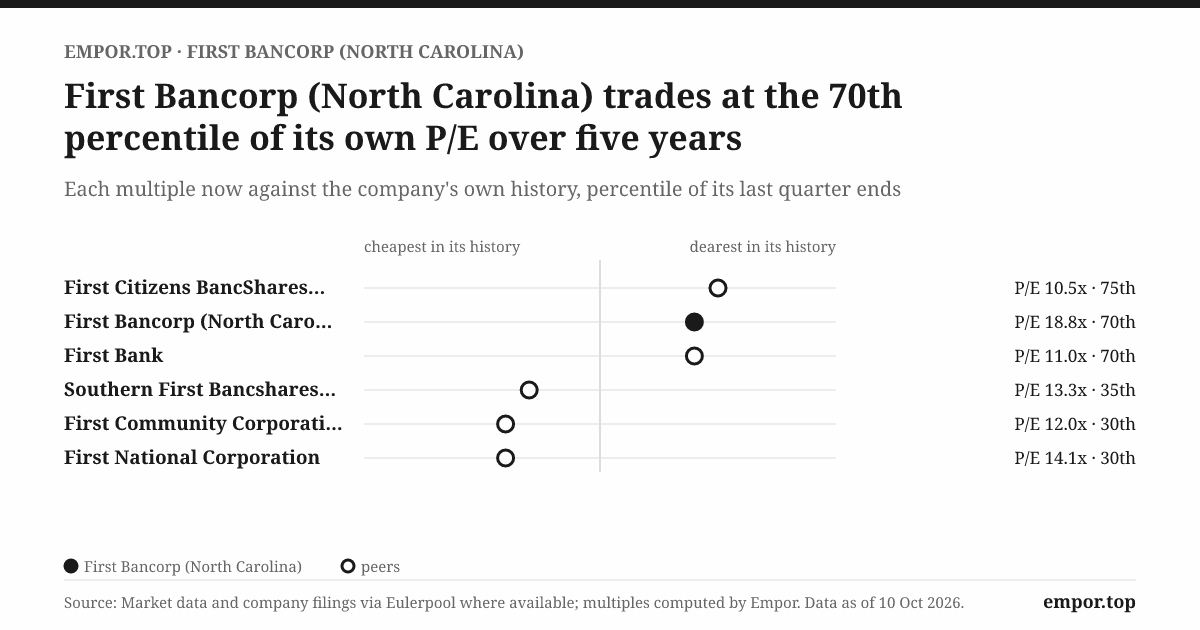
How does the market price all this? At $59.42, First Bancorp trades at about 18.8 times trailing earnings, well above its five-year median of 14.6 times.4 On its face that looks expensive. But the trailing figure includes the bond loss of late 2025, which depressed earnings. On management's adjusted 2025 earnings of $4.01 per share, the multiple is about 14.8 times; on the annualized second-quarter 2026 run rate of about $4.88, it is about 12.2 times.34 Southeastern regional peers trade at roughly 12.5 to 15.5 times earnings.4 So the market is pricing First Bancorp roughly in line with peers on a normalized basis, and the dividend yield is about 1.6%.4 The price appears to assume that the recovery in earnings is real and sustained, and that credit stays clean.
The bull case follows from that. The margin keeps expanding as more low-rate loans reprice, perhaps to 3.75% or beyond. The Carolinas keep growing faster than the nation, feeding loan demand. First Carolina closes cleanly, pushes total assets past $14 billion, and delivers its cost savings. Earnings settle near the second-quarter run rate, and the stock looks cheap in hindsight.
The bear case is the mirror. Commercial real estate loans written at low rates hit trouble on refinancing, and non-performing assets climb. Competition for deposits forces the bank to pay more, stalling the margin. The First Carolina integration stumbles, tangible book value dilution lingers, and return on equity sinks back toward the 6% to 7% range that has been its long-run norm.1 In that world, a stock trading at a normal multiple of peak-ish earnings has no margin of safety.
Three numbers will tell which story is unfolding. The first is net interest margin, last at 3.71% and rising; holding above about 3.70% is the test of the reset.4 The second is non-performing assets, at 0.35% of total assets in June 2026; a move above 0.50% would be the first serious crack in the credit story.4 The third is the cost of deposits relative to Federal Reserve moves: if the Fed cuts rates and the bank's deposit costs fall nearly as fast, the deposit franchise is as good as management says. If they do not, it is not.
X. Playbook: Business & Investing Lessons
The first lesson comes from that fourth-quarter 2025 decision to sell $342 million of 1.67% bonds at a $44 million loss.3 Most bankers in 2023 and 2024 treated their underwater bond portfolios as a cosmetic problem that time would fix, and many are still waiting. First Bancorp recognized that the loss was already real; only its timing was a choice. In banking, an unrealized loss on a bond is not a blemish, it is a tax on every future quarter until someone has the nerve to pay it. The broader principle applies far beyond banks: when an asset is earning less than the cost of the capital tied up in it, accounting optics are the worst reason to keep it.
The second lesson is in how the roll-up was paid for. From Carolina Bank to Select to GrandSouth and now First Carolina, the bank bought with shares rather than borrowed money, and holding-company debt fell to about 5% of equity.3 When rates spiked and earnings halved, there was no creditor at the door and no forced capital raise. In a cyclical business, the currency you use to grow decides whether you survive the downturn that follows. Stock dilutes; debt can kill. A roll-up funded with equity can make bad deals and live to make better ones.
The third lesson is about geography. First Bancorp did not expand across five states; it filled in the map of two, buying banks whose branches overlapped or neighbored its own, then closing the duplicates as property costs fell after each deal.13 Density, not sprawl, is what makes a community bank cheaper to run than its rivals. Ten branches in adjoining towns share lenders, marketing and reputation; ten branches scattered across a region share only a logo.
The fourth lesson is for the investor reading the screen. On October 10, 2026, First Bancorp trades at nearly 19 times trailing earnings, a figure that looks rich until one remembers that the trailing year includes a deliberate $44 million loss.43 Strip it out and the bank is priced like its peers. A trailing multiple is only as honest as the one-off charges it carries; after a restructuring, read the run rate, then test whether the run rate is real.
XI. Epilogue
Tonight, First Bancorp is a $2.5 billion bank holding company with more than $13 billion of assets, a recovering margin, a clean credit record, and a pending acquisition.45 It has spent the last eighteen months repairing a balance sheet that the rate cycle exposed, and the repair appears to be working. Its second-quarter 2026 earnings were the strongest in years. Its chief executive has been in the job for more than fourteen years, and the bank beneath him has a new president.9
The next chapters will be written on specific dates. The third-quarter 2026 results, due in late October, and the fourth-quarter results in January will show whether the margin can hold above 3.70% as the Federal Reserve adjusts rates. If deposit costs fall as fast as asset yields, the bank's claim to a loyal, relationship-based deposit franchise will gain real support. If asset yields fall faster, the margin will compress again, and the 2023 lesson will repeat in reverse.
The closing of the First Carolina acquisition, expected in late 2026 or early 2027, will reveal the fair-value marks on the acquired loans, the day-one CECL reserve, and the dilution to tangible book value.5 A clean close with modest marks would confirm that the bank's acquisition discipline holds; large credit marks would raise questions about what it bought and at what price. And the 2026 annual report, audited by a new firm, will show whether non-performing assets stayed near a third of a percent of assets or started to climb as commercial property loans came up for refinancing.
The deeper tension does not resolve on any of those dates. First Bancorp's entire case rests on the idea that a relationship bank can grow to $14 billion, then $20 billion, and still feel to its customers like the bank in Troy that knew their fathers' names. Every acquisition makes it bigger and every branch closure makes it more efficient, and both move it a little further from the thing that made its deposits worth having. The giants in Charlotte are getting better at small-business banking, not worse. Whether First Bank can keep its small-town soul while competing in the fastest-growing cities of the New South is the question the next decade will answer.
XII. Outro
In 1935, in a county of sawmills and orchards that the big banks had written off, a group of local people opened a bank because no one else would lend to them.1 Ninety years later, that bank spans two states, holds about $11 billion of its neighbors' deposits, and has spent the last fifteen years buying the community banks that grew up alongside it.4
It never tried to beat Wall Street at Wall Street's game. It simply stayed in the small towns and the fast-growing suburbs long enough, and patiently enough, to buy almost everyone else who had tried to do the same thing.
References
-
First Bancorp 2024 Form 10-K (Annual Report) — SEC EDGAR, 2025-02-26 ↩↩↩↩↩↩↩↩↩↩↩↩↩↩↩↩↩↩↩↩↩↩↩↩↩↩↩↩↩↩↩↩
-
First Bancorp 2026 Notice of Annual Meeting and Proxy Statement (DEF 14A) — SEC EDGAR, 2026-03-19 ↩↩↩↩↩↩↩↩
-
First Bancorp Reports Fourth Quarter and Full Year 2025 Results — PR Newswire, 2026-01-21 ↩↩↩↩↩↩↩↩↩↩↩↩↩↩↩↩↩↩↩↩↩↩↩↩↩↩↩↩↩↩↩↩
-
First Bancorp Reports Second Quarter and Six Month 2026 Results — PR Newswire, 2026-07-22 ↩↩↩↩↩↩↩↩↩↩↩↩↩↩↩↩↩↩↩↩↩↩↩↩↩↩↩
-
First Bancorp to Acquire First Carolina Bancshares Corporation — PR Newswire, 2026-07-14 ↩↩↩↩↩↩↩↩
-
First Bancorp Completes Merger with GrandSouth Bancorporation — PR Newswire, 2023-01-03 ↩
-
First Bancorp Completes Merger with Select Bancorp, Inc. — PR Newswire, 2021-10-18 ↩↩
-
First Bancorp Completes Acquisition of Carolina Bank Holdings — PR Newswire, 2017-03-06 ↩↩
-
First Bank Leadership Team Announcement — Local First Bank, 2026-02-15 ↩↩
-
First Bancorp Institutional Ownership (Form 13F Holdings) — SEC EDGAR ↩
 LinkedIn
 WhatsApp
 Reddit
 Hacker News
 Email
Email Kindle
 RSS Feed
 Spotify
 Apple Podcasts
 Amazon Music
 Audible
 YouTube