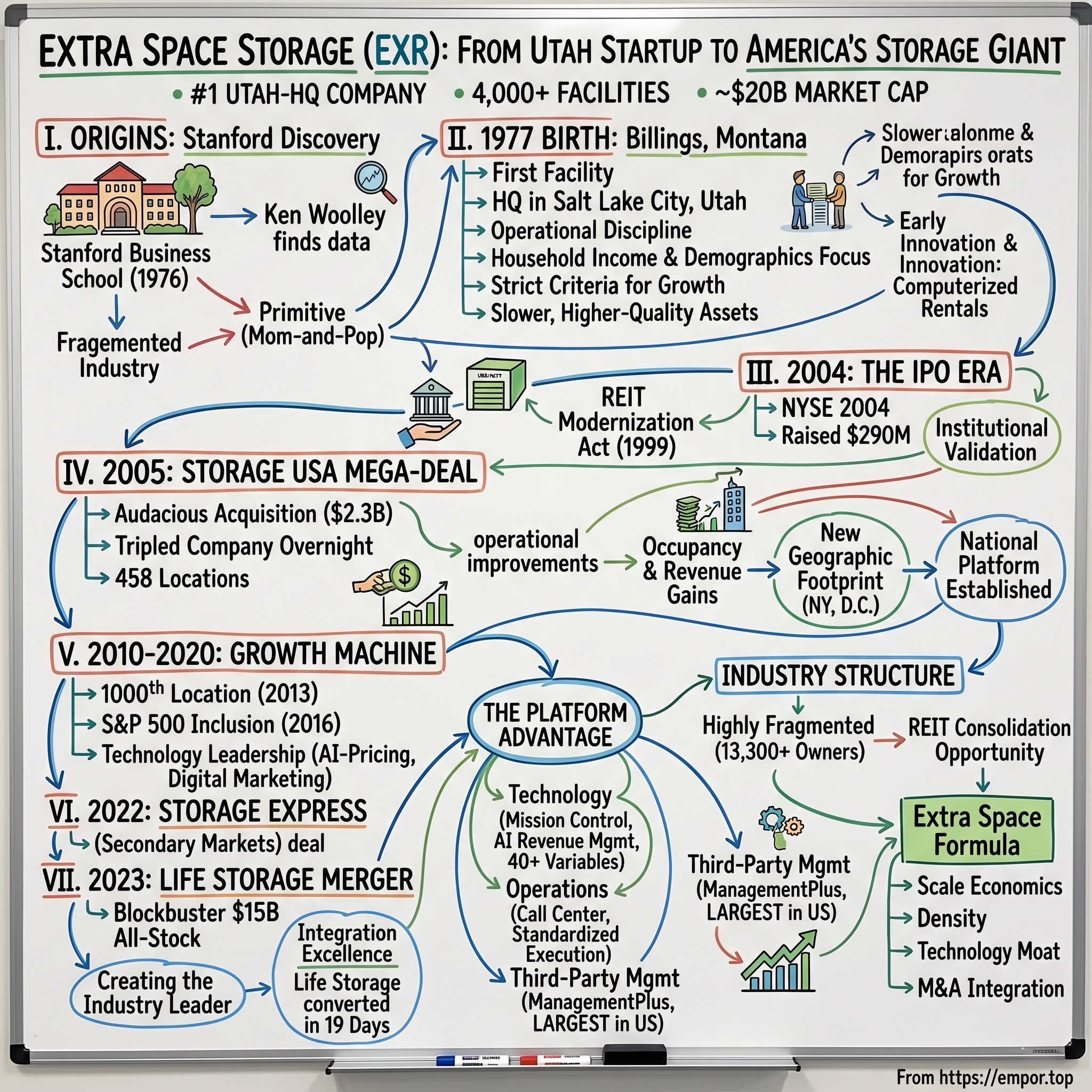
Extra Space Storage: From Utah Startup to America's Storage Giant
I. Introduction & Episode Teaser
Drive almost anywhere in America — the arterial road out of a suburb, the frontage strip beside an interstate, the dead zone between a Costco and a car dealership — and you will pass a building that nobody looks at. Low-slung. Corrugated metal. Roll-up doors in a color chosen by a committee that met once, in 1994. A sign that says something reassuring and forgettable.
It is the least glamorous asset class in American real estate. It is also, measured over the last quarter century, one of the most lucrative.
The largest owner of those buildings is not headquartered in New York or Los Angeles. It sits in Salt Lake City, Utah. As of its disclosures, Extra Space Storage Inc. owned or operated more than 4,000 self-storage properties across 42 states and Washington, D.C., encompassing roughly 2.8 million individual storage units and over 300 million square feet of rentable space.1 That is more rentable square footage than most people can picture. It is several times the entire office inventory of a mid-sized American city, spread across thousands of separate three-to-five-mile trade areas, rented one $140-a-month unit at a time to people who are moving, divorcing, downsizing, storing a boat, or simply refusing to make a decision about their stuff.
With an enterprise value in the tens of billions of dollars, Extra Space is the single largest public company headquartered in Utah — a state better known for software and skiing than for concrete boxes.
Here is the central question this story turns on. The first Extra Space property was built in Billings, Montana, in 1977, by a Stanford graduate student who had calculated the financial metrics of an asset class few respected. Public Storage — the orange-signed pioneer founded five years earlier in California — spent three decades as the dominant operator in the industry: bigger, better capitalized, less leveraged, and more widely recognized. Yet by the mid-2020s, the Utah company, rather than its California rival, owned and operated the larger store network.
How?
The central argument — which warrants rigorous stress-testing — is that Extra Space did not win simply by acquiring land and concrete better than competitors. Everyone was buying land and concrete. Instead, it built three capabilities outside traditional real estate: a dynamic pricing engine that reprices millions of units continuously; a third-party management platform that operates properties for independent owners for a fee, spreading overhead while yielding acquisition intelligence; and an M&A integration machine capable of absorbing more than a thousand properties in under a month.
That thesis carries a significant caveat. Beginning around 2022, after a decade of strong capital compounding, Extra Space encountered macro headwinds algorithms could not solve: American housing mobility froze. As mortgage rates rose toward 7% and remained elevated, existing home sales dropped to multi-decade lows, suppressing the primary catalyst for self-storage demand. Street rates fell, and same-store revenue growth slowed to near zero. The pricing algorithm proved effective at optimizing revenue from existing tenants, but ineffective at generating demand among new ones.
Both realities define the business. The operating model created genuine advantages, but it also faced hard operational boundaries.
The roadmap: the origins of self-storage economics and Ken Woolley's Stanford research; the capital markets inflection of the 2004 initial public offering and the $2.3 billion Storage USA transaction that tripled the firm's size; the twin advantages of yield management and asset-light third-party management; the acquisition playbook extending from SmartStop and Storage Express to the roughly $15 billion takeover of Life Storage in 2023; and finally, leadership succession, capital allocation performance, and an evaluation of performance when street rates fell and housing mobility stalled.
The story begins with a student, a spreadsheet, and a building in Montana.
 Subscribe on LinkedIn
II. Origins: Ken Woolley & The Stanford Discovery (1977–1990s)
In Palo Alto in the mid-1970s, Kenneth M. Woolley was a graduate student at Stanford, completing an MBA and a Ph.D. while searching for market inefficiencies. The era's primary commercial real estate sectors — office towers, regional malls, and Class-A apartment complexes — were already crowded with institutional capital and established underwriters. Woolley focused instead on an unglamorous niche that barely registered as an institutional asset class.
In 1977, self-storage was a structurally attractive business disguised as an unattractive one. The unit economics were compelling. Construction was quick and inexpensive: developers poured concrete slabs and erected metal shells without complex mechanical systems or elevator banks. Ongoing maintenance capital expenditures remained low because facilities required no plumbing inside individual units, minimal HVAC, and no tenant improvement allowances when occupants vacated. Operating overhead amounted to a front-desk manager. There were no leasing commissions, and month-to-month rental agreements — which appeared volatile on the surface — allowed landlords to reprice inventory continuously rather than staying locked into long-term commercial leases.
Demand was also stickier than traditional real estate metrics suggested. Tenants rarely made monthly calculations based purely on square-footage costs. Instead, emotional attachment to personal possessions and the physical friction of moving — renting a truck, scheduling labor, and sorting boxes — discouraged cancellation even after rent increases. Inertia functioned as the core commercial driver.
Yet the broader industry remained fragmented: competition consisted mostly of local independent operators, brand equity was nonexistent, and institutional investors largely avoided the sector.
In May 1977, Woolley built his first facility in Billings, Montana, and established the foundation for Salt Lake City–based Extra Space Storage. Selecting Billings reflected his early strategy: rather than competing for high-cost coastal land facing restrictive zoning, he targeted secondary and tertiary markets where lower land costs allowed well-located properties to generate strong cash yields.
Over the next two decades, Extra Space expanded through incremental regional deals. By 1998, twenty-one years after its founding, the firm operated 53 facilities. That averaged roughly two and a half new properties a year — a modest pace for a company that would later integrate more than a thousand properties in less than a month.
This early trajectory offers a clear test of the industry's initial dynamics.
The claim to test: Early self-storage was an effortless cash cow with favorable unit economics and fragmented competition that guaranteed rapid compounding.
The disconfirming evidence lies in the historical expansion pace. Opening 53 stores over twenty-one years reflects a capital-constrained enterprise, not an effortless compounding machine. While store-level returns were high, internal cash flows could not fund rapid national expansion. Lacking access to public equity markets, regional operators relied on bank loans, expensive private equity, and joint-venture partners who claimed substantial equity stakes in exchange for capital. The late-1980s commercial real estate downturn and the savings-and-loan crisis exposed those vulnerabilities: borrowing costs escalated just as property valuations softened, forcing surviving operators to yield substantial economic rights to capital providers.
A second operational barrier limited growth. In that era, storage demand was strictly hyper-local and driven by physical visibility: customers selected facilities by driving past them or searching local Yellow Pages listings. Managing a profitable store in Salt Lake City provided virtually no operational leverage or customer-acquisition advantage in Phoenix. Without centralized management technologies or digital platforms, the business offered attractive store-level margins but zero true scale economies.
The first two decades demonstrated that Woolley identified a high-yielding real estate category years before institutional markets recognized its value. However, structural financing constraints prevented him from scaling the model quickly. The store-level thesis was valid but insufficient. Achieving national leadership required two missing elements: a lower cost of capital to consolidate fragmented operators, and a technology platform to convert geographic scale into operational performance.
Both arrived within eighteen months of each other, beginning in the summer of 2004.
III. The IPO & Going Public Era: Capital Markets Launch (2004–2005)
By the early 2000s, Wall Street's perception of self-storage had shifted. The Real Estate Investment Trust (REIT) structure had matured, supported by a decade of resilient self-storage cash flows through the 1990s. At the same time, internet adoption began altering customer discovery, creating new commercial value for national brands backed by centralized marketing budgets.
In August 2004, Extra Space Storage listed on the New York Stock Exchange under the ticker EXR. Operating 136 locations, the company raised approximately $290 million in gross proceeds — then the largest initial public offering ever completed by a Utah-headquartered business.[^2]
With 136 stores compared to Public Storage's portfolio of more than 1,000 properties, Extra Space entered public markets not as an industry leader, but as a regional challenger with an aggressive expansion model.
That model relied on two primary financial mechanisms.
Engine one: cost-of-capital advantages. In a fragmented market, consolidation favors operators capable of bidding higher for assets while maintaining acceptable returns. A local owner financing a facility with a regional bank loan at 8% required high going-in cash yields to justify an acquisition. By contrast, a public REIT with access to investment-grade unsecured debt and liquid equity currency operated with a lower cost of capital. That spread allowed Extra Space to outbid local competitors for acquisition targets, using its public listing to secure a structurally cheaper capital base.
Engine two: the UPREIT structure. The umbrella partnership REIT (UPREIT) structure provided a distinct operational advantage over private buyers when negotiating with long-tenured independent owners.
For example, an owner who had acquired facilities decades earlier for $3 million that appreciated to $20 million faced substantial capital gains taxes and depreciation recapture upon a cash sale. Under an UPREIT structure, the seller could contribute properties to Extra Space's operating partnership in exchange for operating partnership (OP) units. Because the transaction was structured as an equity contribution rather than a sale, tax liabilities were deferred. The seller converted illiquid real estate into diversified units that paid distributions equivalent to EXR shares and could be converted into public equity over time.
While OP units were a standard financial tool available to all public REITs, they gave public consolidators a decisive edge over private equity bidders when negotiating with family-owned operators seeking tax-efficient liquidity.
The competitive landscape remained formidable. Industry leader Public Storage held dominant scale, strong brand recognition, and a conservative balance sheet that yielded the sector's lowest cost of capital. Shurgard operated a substantial portfolio with European assets prior to its acquisition by Public Storage. Sovran Self Storage — later renamed Life Storage — maintained a solid regional presence across the Northeast and Sunbelt.
Public status also introduced operational constraints. REIT regulations required distributing most taxable income to shareholders as dividends, forcing management to fund growth through external capital markets rather than retained earnings. The company faced quarterly earnings scrutiny, debt covenant obligations, and market volatility. For an enterprise that had operated privately for 27 years, transitioning to public market accountability required structural adaptation.
Armed with its new public balance sheet, Extra Space moved aggressively. Within twelve months of its IPO, the firm executed a transformational transaction that fundamentally reshaped its scale.
IV. The Storage USA Mega-Deal & Integration Playbook (2005)
In 2005, General Electric remained a AAA-rated industrial and financial conglomerate, with GE Capital ranking among the largest financial institutions in the world. Included in GE Capital's vast portfolio was Storage USA, a national self-storage platform encompassing 458 locations. GE had decided the storage business no longer fit its long-term strategic focus.
The buyer was a regional operator that had been publicly listed for only twelve months and owned just 136 stores.
Extra Space announced the acquisition of Storage USA for approximately $2.3 billion.[^2] The transaction tripled its footprint overnight, expanding the portfolio from 136 locations to roughly 600 across a national map.
In relative terms, the transaction was far larger than a routine bolt-on acquisition. A mid-tier firm was absorbing an asset base several times its own size just a year after its initial public offering, buying from one of the most sophisticated financial sellers in corporate real estate. GE Capital was unlikely to misprice its assets; whatever Extra Space paid reflected a competitive valuation negotiated by counterparties fully aware of the portfolio's underlying value.
The overpay question. Underwriting the portfolio at an initial capitalization rate in the high-six to low-seven percent range appeared aggressive relative to prevailing REIT valuations, drawing initial market skepticism. The valuation's defense rested on an unverified operational claim: that Extra Space could raise the net operating income of those 458 stores beyond what GE Capital achieved by applying centralized marketing, a national call center, and dynamic pricing. Initial capitalization rates provide only a point-in-time snapshot; ultimate investment returns depend on post-acquisition net operating income growth. While acquiring companies frequently promise operational turnarounds to justify high purchase prices, subsequent decades demonstrated that Extra Space largely delivered on its projections.
The financing. The transaction's financing structure proved particularly instructive. Lacking the balance sheet capacity to fund the $2.3 billion purchase independently, Extra Space partnered with Prudential Real Estate Investors. Prudential took a minority equity stake in a major portion of the portfolio, while Extra Space retained operational control and management fee streams.
This deal established a recurring strategic pattern: Extra Space has consistently been willing to give up economics in exchange for control and scale. A joint-venture stake in 458 locations required sharing net operating income upside. However, it enabled Extra Space to operate 458 properties, amortize corporate overhead across an expanded national network, collect management fees, and gather pricing data across hundreds of markets—all while committing a fraction of the total equity. Management prioritized platform scale over full equity ownership, building a broader operational foundation whose long-term value depended on the efficiency of its centralized systems.
The integration. The operational transition presented significant execution challenges. The merger required unifying two organizations with disparate property management software, accounting systems, pricing methodologies, field cultures, corporate branding, and customer databases. Storage USA had operated within a massive corporate hierarchy; Extra Space was an agile, regional enterprise. Establishing centralized call-center and marketing operations across a national footprint required restructuring corporate functions while continuing daily store operations.
The operational capabilities forged during the integration proved more valuable than the immediate real estate expansion. The Storage USA transition produced an institutional competency: a repeatable playbook for migrating acquired properties onto a single technology stack, retraining field staff, standardizing brand presentation, and rapidly onboarding new locations onto Extra Space's pricing and digital marketing platforms. Minimizing onboarding time was critical, as each week a property remained on legacy systems represented lost revenue optimization.
That integration playbook became one of the company's most valuable non-physical assets—a standardized process Extra Space would deploy eighteen years later at ten times the scale in nineteen days.
Before leveraging that integration engine, however, Extra Space had to build the technology platform worth migrating stores onto.
V. Building the Growth Machine: Technology, Revenue Management & Third-Party Management (2008–2020)
When the 2008 financial crisis brought American real estate development and transaction volume to a virtual standstill, commercial property companies across the country faced significant corporate overheads with few growth opportunities. Extra Space had assembled a national call center, a digital marketing team, and an operational technology stack designed to support a rapidly expanding property network. In a rising market, that infrastructure provided operating leverage; in a frozen market, it represented fixed overhead.
Rather than downsizing those capabilities, management pivoted, asking how that infrastructure could be monetized through external partners.
Inflection Point 1: Management Plus and the asset-light flywheel
During the downturn, Extra Space launched Management Plus, a third-party management platform that offered to operate self-storage properties for private owners in exchange for a fee typically in the mid-single-digit percentage of revenue.
The structure produced three distinct operational advantages:
First order: Capital-light fee revenue. The property owner supplies the real estate, balance sheet, and market risk. Extra Space provides the brand, digital marketing, contact center, pricing algorithms, and field operations, collecting a baseline management fee. For a capital-intensive real estate company, this created a high-margin income stream requiring minimal incremental capital.
Second order: Overhead absorption. Adding managed facilities spread the fixed costs of Extra Space's technology stack and marketing infrastructure over a broader footprint, improving unit economics for the owned portfolio.
Third order: Information leverage. Managing third-party facilities provided Extra Space with real-time operational data—including unit-level occupancy, move-in velocity, rate realization, local competitor pricing within a three-mile radius, and delinquency rates. When independent owners chose to sell, Extra Space held proprietary performance history unavailable to arm's-length buyers, enabling off-market acquisitions negotiated without competitive broker bidding.
This created a self-reinforcing flywheel: managing facilities generated fees, absorbed overhead, and yielded proprietary operating data, which allowed Extra Space to acquire top-performing properties at informed valuations, run them efficiently, and attract additional property owners to the platform.
However, calling this model an unassailable competitive moat requires qualification. While third-party management proved difficult for peers to replicate—by the mid-2020s Extra Space's managed store count ran well into the four figures, several times the managed portfolios of CubeSmart and Public Storage.1—it remains subject to operational risks. Management agreements are cancellable, fees face downward pressure during industry slowdowns, and dissatisfied owners can exit the platform. The program's durability depends on consistently generating higher net operating income than independent owners can achieve on their own.
Inflection Point 2: The pricing engine, explained simply
The economics of a self-storage unit closely resemble those of an airline seat. Both assets are perishable: an unrented unit on any given night represents unrecoverable revenue. Both carry minimal marginal costs to fill and serve customers whose willingness to pay varies according to transaction urgency. Following the yield-management models developed by commercial airlines in the 1980s, Extra Space replaced static rate sheets with dynamic pricing algorithms that adjusted street rates continuously based on real-time inventory, seasonality, and local market demand.
Advertised street rates fluctuated based on specific unit sizes, facility occupancy, and localized trade-area competition within a three-mile radius. For example, a ten-by-ten-foot unit at 88 percent occupancy in a Denver suburb in June was priced as a distinct product from an identical unit at 71 percent occupancy in January.
This dynamic approach addressed the dual inefficiencies of static pricing: units remaining vacant that could have rented at a modest discount, and high-demand units renting below market clearing rates.
The ECRI engine, and the uncomfortable question at its center
Existing Customer Rate Increases (ECRI) represents the secondary half of the revenue engine. Under this practice, tenants are acquired at competitive initial move-in rates, after which automated algorithms apply periodic rent increases—typically beginning several months after move-in and recurring every six to twelve months.
The economic rationale relies on tenant switching costs. Relocating stored possessions requires renting a vehicle, organizing manual labor, and confronting the physical friction of moving. Compared against those logistics, a 15% to 20% rate increase on a $130 monthly unit amounts to roughly $20 to $25 per month. Most tenants accept the adjustment; those who vacate free up units that can be re-rented to new occupants at prevailing street rates.
This dynamic became a primary catalyst for same-store revenue growth across the self-storage industry. Sector revenue gains depend significantly on systematic rate adjustments for existing tenants rather than steady increases in introductory street rates for new renters.
However, reliance on ECRI carries structural vulnerabilities: first, it requires maintaining a delicate balance between introductory street rates and seasoned tenant rates, as an excessive spread accelerates move-outs; second, it assumes tenants will not regularly comparison-shop online; and third, it introduces reputational and regulatory scrutiny, as initial low promotional rates followed by routine price increases can attract consumer protection oversight.
The digital acquisition shift
Concurrently, Extra Space shifted customer acquisition channels from print directories and street signage toward search engine marketing and direct online bookings faster than most regional competitors. This transition reflected scale economics: when a national operator with thousands of locations competes against a local operator with three facilities for digital search keywords, the national platform amortizes search infrastructure, conversion optimization, and contact center expenses across a much broader revenue base.
While early internet expansion was expected to lower entry barriers for independent real estate operators, digital advertising costs instead reinforced the competitive advantages of scale consolidators.
Milestones, and what they signify
Operational scale expanded rapidly over the following decade. Extra Space reached its 1,000th facility in October 2013. In 2015, the firm acquired SmartStop Self Storage for approximately $1.4 billion, adding 122 owned locations and 43 third-party managed properties, expanding both its real estate portfolio and its fee-management platform.
In January 2016, Extra Space was added to the S&P 500 Index. Inclusion required index-tracking funds to purchase the equity, expanding institutional ownership and lowering the company's cost of capital for subsequent acquisitions.
During the decade following the 2008 financial crisis, Extra Space delivered total shareholder returns that ranked near the top of the U.S. REIT sector, outperforming the broader S&P 500 Index. The expansion period demonstrated how centralized technology, yield management, and third-party management could generate operating leverage within a highly fragmented real estate asset class.
The falsification test: is storage recession-proof?
The claim: self-storage is an operational fortress, structurally immune to recession, because in good times people buy things and in bad times they downsize — either way, they store.
The empirical record qualifies that assumption. During the 2008–2009 financial crisis, Extra Space experienced declines in same-store net operating income, alongside falling street rates and lower occupancy across the sector.
The underlying demand drivers explain why: self-storage utilization depends primarily on life transitions—such as home sales, job relocations, divorces, or estate liquidations. When broader housing market activity slows, overall move-in volume contracts. Under economic stress, pricing algorithms cannot generate demand if customer turnover stalls. Furthermore, financially constrained tenants become more sensitive to rent increases, lowering the psychological switching threshold that supports recurring rate hikes.
Consequently, self-storage is more accurately characterized as defensive rather than recession-proof. While property cash flows decline during downturns, low capital expenditure requirements help preserve balance sheet stability, enabling relatively fast operational recoveries. The business remains moderately cyclical, cushioned by a resilient expense structure.
While this distinction received limited attention during the steady expansion of the 2010s, it emerged as a defining operational challenge after 2022. Before facing those macro headwinds, however, Extra Space sought to automate store operations entirely.
VI. The Storage Express Acquisition: Remote Operations & Secondary Markets (2022)
There is a structural problem with self-storage that gets worse the smaller the town.
A store in suburban Chicago might generate a few hundred thousand dollars of annual revenue and support a full-time manager comfortably. The same physical building in a town of 40,000 in southern Indiana might generate substantially less, yet it still requires on-site staffing to handle move-ins, show units, and manage daily operations. Payroll does not scale down proportionally with revenue. Below a certain income threshold, store-level margins deteriorate, making secondary and tertiary market opportunities—thousands of smaller-town properties that appear attractive due to lower per-square-foot land costs and lighter competition—far less lucrative in practice than on paper.
Unless an operator can run the facility without on-site staff.
In 2022, Extra Space acquired Storage Express for approximately $590 million, adding 107 self-storage properties and 14 development sites concentrated in the Midwest — Indiana, Kentucky, Illinois, Ohio.1 While the transaction expanded the real estate footprint, the physical assets were secondary to the underlying operational model.
Storage Express had spent years refining an unmanned operating model. Customers discovered facilities online, completed rentals via mobile web or on-site kiosks, received automated gate codes, and unlocked units using app-based keyless access. Customer service inquiries were routed to a centralized remote team. The physical facilities operated without on-site personnel.
Extra Space acquired an operational system as much as a property portfolio.
The strategic rationale extends beyond the marketing rhetoric surrounding tech-enabled real estate. Remote operations offer two distinct structural benefits. First, they expand store-level operating margins in locations where labor costs represent the binding constraint on profitability. Second, they alter the underwriting economics of prospective acquisitions. A small-town property generating mediocre returns under a traditional staffed model can yield attractive returns when converted to remote operation. An operator with automated management capabilities can outbid local competitors for secondary-market assets while maintaining target yield requirements—transposing the company's cost-of-capital advantage from 2004 onto the operating expense line.
The transaction also served as a proof of concept for platform versatility: testing whether a single technology stack could simultaneously manage a high-touch, climate-controlled flagship facility in a major metropolitan market and a fully automated property in rural Indiana. The two asset types demand distinct staffing, customer service, and marketing strategies; a platform unable to bridge that operational divide faces a capped addressable market.
Crucially, remote operation does not constitute a proprietary moat. Kiosks, mobile access applications, and remote customer support systems are commercially available to competing operators, including independent owners seeking to protect operating margins. Storage Express provided Extra Space with an operational head start and a proven system rather than patent-protected technology. The resulting competitive edge lies in deployment speed and operational scale rather than technological exclusivity. Extra Space's durable advantage rests not on owning unique software, but on its ability to roll out remote management across thousands of locations faster and at lower unit costs than smaller competitors.
At $590 million, the Storage Express transaction represented a targeted strategic acquisition. Within months, Extra Space would enter negotiations for a transaction twenty-five times larger—initiated by a phone call from an industry CEO whose company was facing an unwanted takeover attempt.
VII. The Life Storage Blockbuster: Overtaking Public Storage (2023–2024)
The bear hug
In late 2022, Public Storage took an unprecedented step in the self-storage sector: it launched a hostile acquisition attempt.
After quietly accumulating a stake in Life Storage — the Buffalo-based operator formerly known as Sovran, which had grown into a major national platform — Public Storage made an unsolicited, all-stock proposal in early 2023 to acquire the company for roughly $11 billion. On Wall Street, the maneuver is called a "bear hug": by making the offer public rather than private, the suitor forces the target's board to respond openly in front of shareholders, shifting the pressure from private deliberation to public accountability.
Life Storage's board, led by Chief Executive Officer Joe Saffire, rejected the proposal on the grounds that it undervalued the business, and began searching for strategic alternatives.
Saffire then reached out directly to Extra Space Chief Executive Officer Joe Margolis to explore a potential combination.
For Margolis, the call presented a rare strategic inflection point. Extra Space had operated for nineteen years as the secondary challenger to Public Storage's industry leadership. The dominant incumbent had publicly anchored a transaction price for Life Storage, and the target's leadership was now inviting Extra Space to present a rival bid. The opportunity allowed Extra Space to acquire the specific portfolio its primary rival sought, and in doing so, overtake Public Storage as the largest self-storage operator in the United States.
The deal
On April 3, 2023, Extra Space and Life Storage announced an all-stock merger agreement.2 Under the terms, Life Storage shareholders received 0.895 shares of EXR for each LSI share.3 Contemporaneous press coverage placed the equity value of the transaction at roughly $12.7 billion, with a total transaction value including assumed debt of approximately $15 billion.45 The transaction combined two major platforms to create an entity with more than 3,500 locations at announcement, which expanded past 4,000 owned and managed properties in subsequent years.1
Two structural elements of the transaction were particularly significant.
The consideration was entirely stock. This represented a crucial capital allocation decision, executed during the Federal Reserve's sharpest interest-rate tightening cycle in four decades. Raising billions in debt in 2023 would have locked in borrowing costs at nearly three times their levels from eighteen months earlier, burdening the balance sheet with heavy fixed debt service just as industry revenue growth stalled. An all-stock structure avoided debt strain, though issuing equity carried its own economic cost by diluting existing shareholders if the stock was undervalued. Management argued that equity preserved balance sheet capacity in a high-rate environment. Ultimately, the assertions that management chose stock out of financial prudence and that it relied on stock because debt markets were unattractive describe the same transaction, and both perspectives carry weight.
The acquisition premium was modest. Extra Space paid a low-double-digit percentage premium over Life Storage's standalone share price, framing the transaction as a strategic merger driven by operational synergies rather than paying a full control premium. By receiving equity rather than a cash buyout, Life Storage shareholders retained an ongoing stake in the combined enterprise and its prospective synergies. This equity participation reduced the upfront premium required by the target's board, as shareholders shared in the expected upside of the merged platform.
Nineteen days
The transaction closed on July 20, 2023.[^7]
Following the closing, Extra Space demonstrated the capabilities of its operational integration engine. Management reported that all acquired Life Storage properties — encompassing more than 1,200 stores — were fully migrated onto Extra Space's operating platform, pricing systems, and customer contact infrastructure within 19 days of closing.[^8]
Executing that transition required transferring tenant records, lease contracts, billing profiles, insurance policies, and gate-access codes across more than twelve hundred locations without disrupting automated payments or store access. Concurrently, web domain traffic, digital advertising campaigns, and localized pricing algorithms were shifted to Extra Space's systems, while thousands of field staff were trained on the unified software platform.
Integration speed generates direct financial value because operational synergies depend on elapsed time. Each day an acquired facility operates on a legacy pricing framework represents uncaptured revenue optimization. Achieving operational integration within weeks rather than months increases the present value of projected synergies and reduces operational risk by eliminating prolonged system duplication.
This rapid execution reflected the institutional playbook Extra Space had developed and refined since its acquisition of Storage USA in 2005.
The synergies, and the macro that swallowed them
Management targeted and subsequently reported annual run-rate operating synergies exceeding $100 million from the combination, driven primarily by store-level efficiencies, expanded tenant reinsurance penetration across the acquired customer base, and digital marketing consolidation, with the remainder from eliminating duplicative corporate overhead.[^8] On the Q4 2023 call, management walked analysts through the synergy delivery in detail and raised its expectations relative to the original underwriting.[^8]
Evaluating those achievements requires comparing management's projections against subsequent operational performance.
The claim: The Life Storage merger would seamlessly boost per-share funds from operations through scale and synergy.
The disconfirming evidence: The transaction closed into the weakest self-storage demand environment in over a decade. As mortgage rates surpassed 7%, existing home sales declined to multi-decade lows, sharply curtailing the housing transitions that historically drive storage demand. Industry street rates dropped from pandemic peaks, and sector-wide same-store revenue growth compressed toward zero. Extra Space's performance in 2024 reflected these broader conditions, with revenue growth around the flat line alongside downward pressure on both occupancy and rental rates.
These macro headwinds did not invalidate the operational synergies themselves. The cost reductions were achieved, but they served to cushion broader market declines rather than drive absolute earnings growth. Without the merger's operating efficiencies, performance during the downturn would likely have been weaker. However, the immediate result for shareholders was a major acquisition that produced, in its first full year, approximately flat organic growth.
The calibrated conclusion: The Life Storage acquisition confirmed Extra Space's operational integration capabilities while leaving the long-term value creation thesis unproven in a stagnant housing market. In commercial real estate, scale provides cost efficiencies and operational leverage, but it does not generate end-user demand. The ultimate financial evaluation of the transaction will depend on how the expanded portfolio performs when residential mobility normalizes and operational leverage can compound on top of recovering organic demand.
VIII. Executive Leadership, Capital Allocation & Management Succession
Extra Space has had three chief executives in nearly five decades, and the sequence reflects the company's operational evolution.
Ken Woolley (1977–2009) was the founder-builder: the Stanford analyst who identified the asset class, built the first facility in Montana, led two decades of regional expansion, and executed the 2004 IPO and the 2005 Storage USA acquisition that transformed a regional business into a national platform. He remained chairman after stepping down as CEO. His defining operational pattern across three decades was patience paired with sudden expansion: twenty years of incremental store growth followed by a tripling of the company footprint in a single transaction.
Spencer F. Kirk (2009–2016) took over during the 2008 financial crisis. Kirk's tenure focused on technology and platform infrastructure: converting third-party management from a crisis improvisation into a central operational strategy, refining the dynamic pricing engine, and establishing digital customer acquisition as the primary marketing channel. The period delivered strong shareholder returns. While Woolley identified the underlying real estate asset, Kirk industrialized the operating system.
Joseph D. Margolis (2017–2026) brought an institutional investor's perspective to the chief executive role. Having served on the Extra Space board before taking the helm, his background in capital allocation shaped his strategy: executing the Storage Express acquisition, leading the $15 billion Life Storage merger, expanding ancillary revenue streams, and maintaining balance sheet discipline.
The capital allocation record, examined rather than admired
Margolis's capital allocation strategy rested on three primary pillars: opportunistic acquisitions using the most cost-effective capital available, disciplined balance sheet leverage aimed at maintaining investment-grade metrics, and the expansion of ancillary revenue streams alongside the core rental business.
Those ancillary revenue streams warrant close evaluation, as they introduce distinct operational risk profiles to a real estate investment trust.
Tenant reinsurance involves selling customer property protection products underwritten through a captive entity. It represents a high-margin business attached directly to unit rentals, scaling automatically as the overall customer base expands. However, because it functions as an insurance enterprise embedded within a REIT, a portion of company earnings reflects underwriting risk rather than real estate cash flows.
The bridge lending program carries broader balance sheet implications. Extra Space extends short-term, floating-rate debt to independent self-storage developers and owners, building a lending portfolio measured in the billions.1 Strategically, the program generates interest income, establishes relationships with property owners who frequently join the third-party management platform, and provides proprietary visibility into potential acquisition targets. The loans are secured by self-storage properties, an asset class Extra Space knows intimately.
However, this strategy introduces distinct credit risk. Extending capital to developers means operating an active credit book, which yields attractive interest income during low-rate expansions but risks impairments during market downturns. The underlying collateral consists entirely of self-storage assets, whose valuations experience pressure from the same elevated interest rates and sluggish transaction volume that hinder borrowers' ability to refinance. Portfolio concentration is narrow: a single real estate sector in one national market exposed to one interest rate curve. Furthermore, floating-rate interest income carries a different earnings quality than long-term rental net operating income, despite both flowing into funds from operations (FFO). Consequently, investors must closely monitor non-accrual and loan modification disclosures, recognizing that storage-backed credit remains vulnerable when underlying property values soften.
On executive compensation: Margolis's annual compensation has run in the low-to-mid eight figures, heavily weighted toward performance-based equity tied to core FFO per share and relative total shareholder return rather than base salary.6 Measuring return relative to peers prevents executives from being rewarded solely by broader market re-ratings. Nevertheless, relying on core FFO per share presents standard limitations: as a per-share metric, it can be influenced by financing choices and does not fully capture the cost of equity issued for acquisitions. Additionally, executive equity ownership represents a modest fraction of total shares outstanding, making annual equity grants—rather than legacy ownership stakes—the primary mechanism aligning executive incentives with shareholder returns.
The succession
In August 2026, Extra Space announced that Joe Margolis will retire as chief executive effective December 31, 2026, transitioning to an advisory role with the board.[^10] President W. Noah Springer was named to succeed him as CEO effective January 1, 2027.[^10]
The transition structure follows a conventional internal succession model: elevating an internal executive to president, establishing a clear advance timeline, and maintaining executive team continuity—including long-serving Chief Financial Officer Scott Stubbs and the operational leaders who directed the integration playbook.7
This internal continuity carries dual implications. While retaining leadership preserves operational execution, it also anchors the company to existing playbooks when market conditions shift. Springer inherits a challenging operating environment: a proven consolidation model facing stalled organic growth due to subdued housing mobility, a sizable credit portfolio navigating a high-rate cycle, and a shareholder base adjusting from a decade of rapid compounding to flat recent operating performance. The key test for new leadership will be preserving capital allocation discipline under performance pressure, avoiding dilutive or unstrategic acquisitions when prime growth opportunities become scarce.
IX. Economics, Competitive Dynamics & Industry Structure
The structure of the prize
American self-storage generates tens of billions of dollars in annual revenue across a national property base of roughly 50,000 facilities. The sector's strategic interest lies not in its aggregate size, but in its ownership structure and ongoing consolidation dynamics.
A decade ago, publicly traded REITs owned roughly a fifth of U.S. self-storage properties. That share has nearly doubled, with major public operators—Extra Space, Public Storage, CubeSmart, National Storage Affiliates, and U-Haul's storage business—controlling a substantially larger portion of the national market.1 Extra Space and Public Storage hold the largest market shares by a wide margin, followed at a distance by mid-tier REITs.
The majority of the industry remains in the hands of independent operators, most of whom own between one and three properties.
This fragmentation underpins the industry's consolidation thesis, but the argument relies on two necessary conditions: a consolidator must acquire assets at value-accretive prices and operate them more efficiently than previous owners. A long runway of independent facilities is only valuable if transactions actually clear. During periods of depressed property valuations and tight credit markets, independent owners often decline to sell at the lower valuations buyers demand, rendering the theoretical growth runway temporarily inaccessible. While the consolidation opportunity remains real, its execution velocity depends on transaction market liquidity and prevailing interest rates.
Seven Powers, honestly applied
Scale Economies represent the primary strategic advantage. A national digital advertising budget, a centralized contact center, and an operational technology stack are fixed overhead costs amortized across thousands of locations. As the network expands, average per-store customer acquisition costs decline. By contrast, an independent operator managing three stores pays full market rates for digital customer acquisition. This cost disparity drives ongoing market consolidation despite low physical construction barriers.
Process Power provides a real, though increasingly competitive, advantage. Revenue management and existing-customer rate adjustment systems, calibrated over decades of tenant behavior data, reflect complex operational know-how. However, every major public competitor—including Public Storage, CubeSmart, and National Storage Affiliates—now operates dynamic pricing engines and regular rate-adjustment programs. Extra Space's advantage is one of degree rather than kind, consisting of superior data density, longer algorithm calibration history, and faster deployment onto acquired properties.
Counter-Positioning functions through third-party management. Third-party management targets the structural limitations of independent operators. A three-store owner cannot justify building a competing digital marketing infrastructure or dynamic pricing system due to prohibitive fixed costs. Joining Extra Space's platform converts an independent competitor into a fee-paying client and operational data source. The independent operator's alternative—remaining standalone and losing digital visibility—becomes progressively weaker. However, counter-positioning is bounded by competition among management platforms: independent owners can choose competing programs from peers like CubeSmart or Public Storage, establishing a competitive market for management fees.
Cornered Resource remains the weakest structural claim. Proponents argue that granular demand data collected across thousands of submarkets represents an unreplicable asset. In practice, this advantage is overstated: Public Storage maintains comparable market density across major regions, while third-party data providers sell localized rate and occupancy data industry-wide. Proprietary data density enhances internal revenue management algorithms, but it does not constitute an exclusive cornered resource.
Notably absent are brand equity and customer-level switching costs. Brand loyalty in self-storage remains minimal, as consumers select facilities based primarily on location, price, and immediate availability. Furthermore, the tenant switching friction that supports existing-customer rate increases stems from physical moving inconvenience rather than operator attachment. Because network effects are absent, structural limits exist on how much pricing power the operational model can generate.
Porter's Five Forces
Threat of new entrants: moderate and cyclically variable. While physical construction of self-storage facilities is simple relative to other commercial real estate, new supply is constrained by municipal zoning restrictions, elevated land costs in prime trade areas, and high construction financing costs. High interest rates create a dual effect: while they suppress consumer housing mobility and self-storage demand, they simultaneously restrict competing new development, limiting future supply additions until demand recovers.
Buyer power: low for existing tenants, but high at initial conversion. Individual renters paying monthly fees hold negligible bargaining power once their possessions are stored. However, during initial online search, prospective tenants exercise significant buyer power, actively comparison-shopping competing properties based on introductory rates. This dynamic makes introductory street rates highly price-elastic, whereas rates for existing tenants remain price-inelastic. The business functions as a price-taker at initial lease sign-up and a price-setter thereafter.
Supplier power: low. Key operational inputs—including land, concrete, steel, and general contracting services—are commodity products provided by competitive markets.
Threat of substitutes: moderate and underrated. Substitutes for self-storage include residential garages, basements, spare rooms, secondary sales channels, or discarding unused possessions. During broader economic downturns, disposing of items becomes a compelling alternative to paying monthly rental fees, rendering self-storage demand more cyclical than traditional marketing claims suggest.
Competitive rivalry: intense and hyper-local. Competition operates primarily within a three-to-five-mile trade radius, where each facility competes against a small cluster of nearby operators. While national scale yields capital allocation and digital marketing advantages, individual stores compete in localized micro-markets.
Where the money actually comes from
Extra Space's earnings stack combines real estate rentals with high-margin ancillary businesses. Wholly owned store net operating income provides the overwhelming majority of earnings and forms the basis for equity valuation. High-margin tenant reinsurance contributes disproportionately relative to its revenue line, while third-party management fees generate capital-light fee income. Interest income from bridge lending and preferred equity investments supplies the remainder.
Approximately one-fifth of total earnings originates from non-rental businesses. While this diversified earnings structure distinguishes Extra Space from peers with less developed fee and credit operations, it also complicates valuation. Fee revenue carries the risk profile of service businesses, and bridge-lending interest income reflects credit underwriting risks rather than property ownership. Capitalizing these non-real-estate earnings streams under a uniform REIT valuation multiple assumes their cash flows match the durability and risk profile of physical property rental income.
X. Playbook: Business & Investing Lessons
1. In commodity assets, the operating system is the differentiator — but do not mistake it for a moat. Two identical facilities on the same street—one operated by an independent owner and the other by Extra Space—can produce materially different revenue. That variance stems from pricing calibration, digital search reach, and conversion infrastructure rather than the physical real estate. While that infrastructure creates a measurable operational edge, it does not constitute a permanent moat: major public peers continue to build similar capabilities, narrowing the gap over time. The durable lesson is that scale converts operational competence into a cost advantage, which in turn expands acquisition capacity.
2. Asset-light management platforms generate strategic intelligence, not just fee income. The primary value of third-party management lies beyond fee income; it provides the ability to underwrite acquisitions using a seller's actual operational performance data rather than a broker's offering memorandum. An operator paid to manage facilities it may eventually acquire holds a structural information advantage over competing bidders. The constraint is operational: management contracts are cancellable, requiring the platform to consistently outperform independent alternatives.
3. Integration speed converts theoretical synergies into realized cash flow. Migrating more than a thousand properties onto a single operational technology stack in nineteen days demonstrates how integration can become a compounded institutional capability. Corporate acquirers frequently announce synergy targets but execute them slowly, eroding present value and risking operational disruption. In large-scale M&A, integration speed functions not merely as an operational virtue, but as a financial discipline that preserves capital.
4. Match the currency to the cycle. Utilizing equity during high-interest rate regimes and debt during low-interest environments appears straightforward, yet corporate acquirers often select capital sources based on convenience rather than long-term cost. However, issuing equity carries economic costs: executing an all-stock transaction when share prices are depressed transfers value to the seller. Strategic capital discipline lies in avoiding balance sheet strain rather than eliminating acquisition costs.
5. A demand-driven business cannot out-execute its demand driver. The housing market slowdown of the mid-2020s demonstrated a clear operational limit. Extra Space developed a highly refined operating platform, yet organic growth stalled when residential mobility hit multi-decade lows. Pricing algorithms optimize revenue from existing tenants, but they cannot generate new customer volume when moving activity halts. When evaluating an operationally strong enterprise, the core analytical question is what drives underlying customer demand—and whether management has the capacity to create it.
XI. Mandatory Historical Falsification Layer & Material Risk Radar
Each of the following claims is material to the investment case, and each is tested against the company's own record through the mechanism that would actually break it.
Claim 1: The dynamic pricing algorithm confers continuous pricing power regardless of macro conditions.
Rejected in its strong form; narrowed substantially.
The 2022–2025 period provided the clearest natural experiment. Thirty-year mortgage rates moved from roughly 3% to above 7% and stayed elevated, while existing home sales fell to multi-decade lows. Industry street rates — the advertised rates for new customers — fell materially across the sector from pandemic peaks, and Extra Space's same-store revenue growth compressed toward zero even after absorbing a company-transforming merger.
The failure mechanism is instructive. Dynamic pricing optimizes the allocation of demand across units and time; it does not generate demand. When the volume of prospective customers searching for storage in a submarket drops, the algorithm's rational response is to lower street rates to compete for a smaller pool. Dynamic pricing accelerated the rate decline rather than preventing it, as a system optimizing for occupancy in a demand-starved market clears inventory by cutting prices.
Consequently, Extra Space relied on Existing Customer Rate Increases (ECRI) — raising rates on the existing customer base to offset weakness at the front door. That mechanism sustained revenue, but it represents a fundamentally different and more limited dynamic than true pricing power. It extracts value from a fixed customer base rather than driving top-line expansion. It also carries a self-limiting boundary: widening the spread between street rates and existing tenant rates increases the incentive for customers to vacate.
The narrowed claim that survives: Extra Space's pricing system meaningfully improves revenue per available square foot relative to unsophisticated operators in all market environments. However, it does not insulate the company from demand cycles, and during downturns, it optimizes toward lower street rates rather than higher ones. The KPI that confirms or falsifies the revised claim: achieved street rate growth on new move-ins. That metric, rather than total revenue growth, separates genuine pricing power from ECRI harvesting.
Claim 2: Aggressive ECRI pricing carries no meaningful brand or regulatory penalty.
Left intact but explicitly unproven, with a live tail risk.
Behavioral evidence across more than a decade shows that customers absorb rate increases at levels that make periodic price hikes highly profitable; otherwise, operators would have abandoned the practice.
However, the practice has attracted growing consumer scrutiny. Advertising low introductory move-in rates followed by systematic price increases months later matches the specific fact pattern scrutinized by consumer protection regulators. The risk does not attach to Extra Space uniquely, but to the industry as a whole. It represents a genuine overhang: the primary vulnerability is not a single fine, but potential regulatory mandates that could restrict price increase frequency or mandate disclosures, thereby compressing the sector's primary source of revenue growth.
The honest position: The absence of material adverse regulatory outcomes to date reflects the current state of enforcement rather than a definitive test of long-term durability. What would falsify it: State-level rulemaking or enforcement actions that mandate fee disclosures or cap price increase frequency, directly restricting the revenue engine.
Claim 3: The Life Storage merger seamlessly boosts per-share FFO.
Narrowed, as argued in Section VII. While integration proceeded rapidly and operating synergies were delivered, a stagnant macro environment muted top-line accretion. The transaction's ultimate economic logic remains untested in a normalized housing market. Shareholders absorbed immediate equity dilution, leaving per-share FFO growth dependent on a housing market recovery outside management's control.
Claim 4: Extra Space's capital allocation has been disciplined.
Largely supported by the record, with a caveat that should be held open.
The positive evidence is substantial: the Storage USA acquisition compounded effectively over two decades, the SmartStop and Storage Express transactions were strategically coherent, and the Life Storage all-stock structure avoided balance sheet strain during an aggressive rate-tightening cycle. Management consistently maintained investment-grade discipline throughout major portfolio expansions.
The caveat involves the bridge lending book. Representing Extra Space's least-seasoned capital deployment, this credit portfolio was assembled during adverse macro conditions and has not experienced a full credit cycle. A multi-billion-dollar credit book of recent vintage introduces distinct risk. The capital allocation record remains strong regarding property acquisitions, but pending regarding credit underwriting.
Material Risk Radar
Housing market paralysis represents the primary external risk outside management's control. Storage demand remains downstream of residential mobility. Persistent mortgage rate pressures and depressed home sales keep the prospective customer funnel narrow, leaving growth reliant on acquisitions and ECRI—both of which face structural limits.
The street rate / ECRI chasm. As the spread widens between introductory street rates and seasoned tenant rates, the financial incentive increases for existing occupants to vacate and re-rent—potentially within the same facility. Accelerating vacate rates serve as the leading indicator that the pricing spread has reached an unsustainable threshold.
Third-party management churn. Third-party property owners retain the right to cancel management agreements. During extended market slowdowns, dissatisfied owners may exit the platform or demand lower management fees. While total managed store count is widely reported, fee retention and owner churn represent the critical, less visible operating metrics.
Bridge loan credit deterioration. Floating-rate loans extended to independent developers against self-storage collateral carry elevated default risk when property valuations soften and refinancing options narrow. Credit exposure remains concentrated within a single real estate sector.
Cost of capital and refinancing. As a REIT, Extra Space relies on external capital markets to finance portfolio expansion. Sustained high interest rates or a depressed equity valuation mechanically reduce its cost-of-capital advantage when bidding for acquisitions—a dynamic that directly constrains the consolidation thesis.
Supply. While new self-storage development responds to elevated rents with a multi-year lag, high construction financing costs have curtailed recent project starts. This slowdown in new deliveries provides medium-term supply relief across key trade areas.
XII. Bull vs. Bear Case & Key KPIs to Watch
Why this wins from here
The consolidation runway remains the primary structural thesis. Most U.S. self-storage properties are still owned by independent operators, and the customer-acquisition cost gap between a national platform and a local owner continues to widen as search advertising and digital booking dominate consumer discovery. Extra Space retains multiple channels to acquire these properties—using operating partnership units for tax-deferred sellers, third-party management contracts for off-market deal flow, and scale advantages that private bidders struggle to match.
Operating leverage from the Life Storage merger has been established but not fully realized under subdued market conditions. With more than $100 million in annual synergies integrated onto a single technology stack, a broader portfolio should convert future organic top-line expansion into net operating income growth faster than standalone entities could achieve. That operating leverage remains embedded in the enlarged platform.
Ancillary streams—including third-party management fees, tenant reinsurance, and bridge lending—contribute roughly one-fifth of overall earnings with low capital intensity, enhancing returns on invested capital compared to traditional real estate portfolios.
Finally, storage demand represents a delayed catalyst rather than a permanent contraction. Households that deferred moves between 2023 and 2026 have accumulated latent needs driven by life transitions such as job changes, family developments, and downsizing. Concurrently, elevated borrowing costs have curtailed new facility construction. A recovery in residential mobility into a market with restricted new supply creates a favorable supply-demand setup, even if its precise timing remains uncertain.
What breaks the case
The most serious bear argument is definitional rather than cyclical: Extra Space may have already captured most of its available operational advantage. The performance gap between platform operators and independent owners was wider in 2010 than in the mid-2020s, as third-party pricing software, digital aggregators, and online booking tools became accessible to smaller operators. Additionally, public peers have built comparable revenue management platforms. If operational capabilities converge across the sector, Extra Space risks being valued as a leveraged holder of commodity real estate rather than a premium technology compounder.
Second, sustained elevated interest rates create a threefold headwind: they restrict residential mobility and consumer demand, raise refinancing costs on existing debt, and compress equity valuation multiples needed for accretive acquisitions. Consolidation requires an attractive cost of capital, which a tight rate environment constrains.
Third, the existing-customer rate increase (ECRI) mechanism faces operational limits. Relying primarily on periodic rent increases for current tenants creates a finite growth trajectory, as each price hike increases the incentive for occupants to vacate. If move-out rates accelerate, the industry's primary short-term revenue driver weakens.
Fourth, competition with Public Storage is structural and intense. The two largest operators compete directly for digital search position across overlapping Sunbelt trade areas. Customer acquisition through paid digital search functions as an auction where well-capitalized bidders drive up customer acquisition costs for one another. Furthermore, Public Storage's historically lower leverage and low cost of capital allow it to bid aggressively for market share and major acquisitions.
Fifth, leadership transition introduces execution risks. Incoming Chief Executive Officer W. Noah Springer assumes leadership during a period of stagnant organic growth. In consolidated industries, executive transitions during market lulls carry the risk of premature or costly dealmaking to restart growth.
The KPIs that matter
Investors should track a small number of core metrics rather than an extensive dashboard:
1. Same-store revenue growth, decomposed into street rates versus existing-customer rate contributions. Aggregate revenue metrics obscure underlying drivers. Growth driven by rising achieved rates on new move-ins signals organic demand recovery and true pricing power. Conversely, growth sustained entirely by price hikes on existing occupants indicates harvesting an existing customer base—a profitable yet finite tactic that heightens vacate risks.
2. Third-party managed store count, net additions, and conversion into owned assets. These metrics evaluate the health of the asset-light platform and the acquisition pipeline. Net additions indicate whether Extra Space's management platform remains attractive to independent owners, while conversions reveal whether proprietary data yields off-market transactions. Expanding managed store counts without subsequent asset purchases transforms a compounding flywheel into a standard fee-for-service business.
3. Core FFO per share. This represents the definitive metric assessing whether portfolio expansion, equity issuances, synergies, and ancillary businesses generate per-share value for shareholders. An operator that expands asset scale faster than per-share cash flow risks diluting owner returns despite impressive headline growth.
Other operational metrics—including occupancy rates, square footage, and property counts—serve primarily as inputs to these core performance indicators.
XIII. Guidance for the Article Writer: Primary Transcripts & Call Focus
For researchers examining primary sources, a handful of earnings calls and regulatory filings contain the core evidence for Extra Space's operational claims.
The Q2 2023 call, delivered in August 2023, details the closing of the Life Storage combination and the mechanics of the platform conversion. It outlines the sequence of the 19-day system migration and highlights the specific operational hurdles management identified during integration.
The Q4 2023 and full-year call in February 2024 provides the primary record for merger synergies.[^8] Management detailed the components of its run-rate savings, set financial guidance for the first full combined year, and established the baseline figures against which subsequent operational performance must be measured.
The Q2 and Q3 2024 calls record the onset of broader macroeconomic headwinds.[^12] During these sessions, analyst questioning focused on street-rate softness, the extent of move-in discounting, the sustainability of existing-customer rate increases, and the drag from depressed housing turnover. Management's characterization of the street-rate trough and its projected recovery timeline offer a clear baseline for evaluating executive forecasting accuracy over the subsequent eighteen months.
The 2025 calls contain detail on the bridge lending portfolio and the initial framing of the executive succession.8 The bridge loan disclosures provide the key indicators for evaluating credit quality, specifically non-accruals, loan modifications, and shifting origination profiles, which offer a clearer view of underlying portfolio health than aggregate loan balances.
The primary filings — the Form 10-K, the S-4 registration statement for the Life Storage merger, and the annual proxy — disclose core underwriting assumptions, pro forma financial statements, and executive compensation structures.936 The S-4 registration statement's narrative on the background of the merger provides the primary detailed record of deal negotiations.
Key analytical focal points in analyst Q&A sessions include: the gap between advertised street rates and actual move-in discounts, which reflects underlying demand strength; management's explanations of the lag between housing mobility and storage demand; and subtle shifts in executive commentary regarding property acquisition opportunities, which signal whether consolidation pipeline targets are actively being executed.
XIV. Outro & Key Takeaways
The original building in Billings, Montana, remains unremarkable. That is, in a sense, the entire point.
What Ken Woolley recognized at Stanford in 1977 was that America's least glamorous real estate offered its most compelling economics—and nearly five decades of execution proved that the commodity nature of self-storage was an asset, not a handicap. Because the physical properties are largely interchangeable, an operator that prices more effectively, markets more efficiently, and integrates acquisitions faster can capture a persistent revenue premium over competitors. In a fragmented industry, that operational edge creates the financial capacity to purchase the next facility at a price independent owners cannot match. And because storage facilities carry low fixed operating expenses, the business model withstands downturns that would strain leveraged owners of more complex commercial property.
That compounding engine drove exceptional performance throughout the 2010s.
The 2020s revealed its structural limits. Even an industry-leading operating platform, having executed the sector's largest merger and migrated more than 1,200 properties onto its system in 19 days, delivered virtually flat organic growth when American housing mobility froze. Excellence in digital conversion cannot manufacture a customer who never searched.
For long-term investors, that tension defines the core analysis:
- The consolidation opportunity remains large, but peer platforms are building comparable systems that narrow the operational gap.
- Pricing power relies heavily on raising rates for existing tenants through periodic adjustments rather than driving advertised street rates higher in the open market.
- The core balance sheet was managed conservatively through a transformative merger, yet the newer bridge-lending book has yet to navigate a full credit cycle.
- Unlocking latent operating leverage depends on housing turnover and interest rates—macroeconomic drivers beyond management's control.
When Noah Springer assumes the chief executive role in January 2027, he inherits that exact dilemma: a platform built for a growth environment that has not yet returned, paired with strategic decisions about how to allocate capital while waiting. The company's five-decade record reflects a recurring pattern of patience followed by decisive action—twenty years of incremental growth before Storage USA, a downturn improvisation that became a fee-generating platform, and nineteen years as an industry challenger before a phone call from Buffalo.
Whether that pattern repeats remains the central question for investors—and the answer will register in operational metrics long before it becomes visible in the narrative.
References
-
Extra Space Storage Investor Relations — Extra Space Storage Inc. ↩↩↩↩↩↩
-
Extra Space Storage to Buy Life Storage in $12.7 Billion Deal — Wall Street Journal, 2023-04-03 ↩
-
Form S-4 Registration Statement (Life Storage Merger) — SEC EDGAR, 2023-06-16 ↩↩
-
Extra Space Storage to buy Life Storage for $12.7 bln in all-stock deal — Reuters, 2023-04-03 ↩
-
Extra Space to Buy Life Storage in $12.7 Billion Storage Deal — Bloomberg, 2023-04-03 ↩
-
Extra Space Storage Inc. 2024 Definitive Proxy Statement (Form DEF 14A) — SEC EDGAR, 2024-04-04 ↩↩
-
Extra Space Storage Executive Management Team — Extra Space Storage Inc. ↩
-
Extra Space Storage Inc. 2023 Form 10-K Annual Report — SEC EDGAR, 2024-02-28 ↩
 LinkedIn
 WhatsApp
 Reddit
 Hacker News
 Email
Email Kindle
 RSS Feed
 Spotify
 Apple Podcasts
 Amazon Music
 Audible
 YouTube