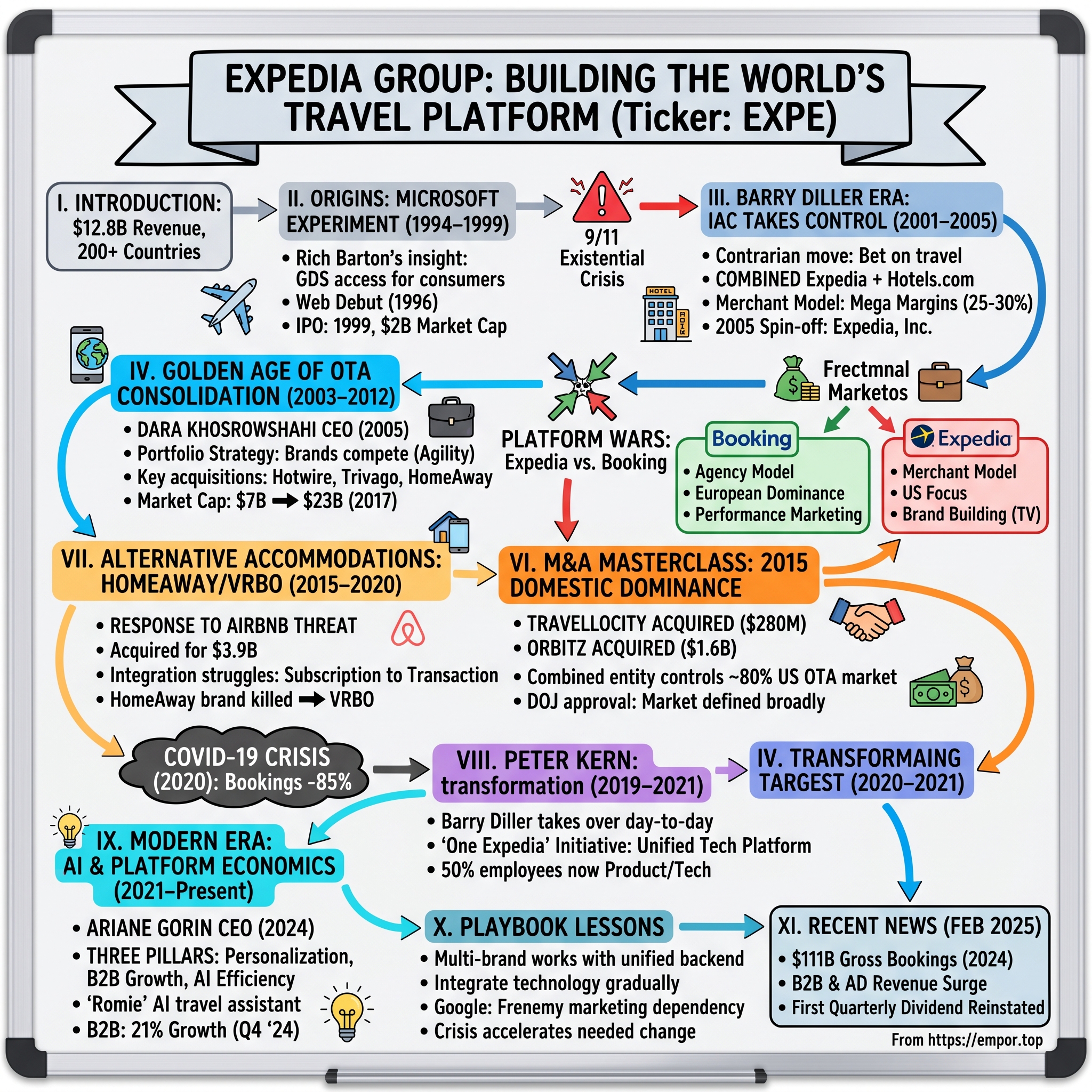
Expedia Group: Building, Consolidating, and Re-Engineering the World's Travel Engine
I. Introduction & Episode Roadmap
Somewhere over the Atlantic, a passenger scrolls a credit card rewards portal to book a hotel in Lisbon with points. The page is branded with a bank's logo. The typeface belongs to the bank. The customer service number connects to the bank's call center. Yet almost none of the underlying infrastructure belongs to the bank. The property inventory, pricing engine, cancellation logic, multi-currency settlement, fraud screening, property descriptions, and photographs are provided by Expedia Group—operating invisibly, taking a fee, and never appearing on the screen.
That is the version of Expedia that matters most in 2026, though it differs from the public perception of a blue website offering coupons and hotel search. The financial reality is a business generating $119.6 billion in gross bookings that produced $14.73 billion of revenue in 2025, $3.50 billion of adjusted EBITDA, and $3.11 billion of free cash flow.1 Roughly a third of that revenue comes from a business-to-business division that sells travel infrastructure to airlines, banks, telecommunications providers, and third-party travel agencies. In the second quarter of 2026, that segment generated $10.7 billion in gross bookings, up 21%, marking its twentieth consecutive quarter of double-digit growth.2
The corporate arc behind these numbers is among the most unusual in modern technology. Expedia began in 1996 as an internal Microsoft project—a desktop-era initiative designed to connect personal computers directly to airline reservation mainframes. It was spun out during the dot-com boom, nearly derailed by the tech crash and the travel decline following September 11, acquired and restructured under Barry Diller, spun out again, and then spent a decade acquiring direct competitors across the industry. The company built a dominant position in the American market while losing ground in Europe. It acquired a vacation-rental platform to counter Airbnb, even as Airbnb established dominant consumer mindshare. Entering the COVID-19 pandemic with high operational costs, Expedia spent subsequent years rebuilding its core technology stack from the foundation.
Three central themes define this story.
The first is the M&A debt to tech debt conversion. Every acquisition expanded market share immediately while accumulating long-term engineering obligations. Expedia spent roughly fifteen years assembling a portfolio of brands with separate codebases, isolated customer databases, and duplicate marketing budgets, followed by six years working to integrate them onto a unified platform.
The second is the B2B engine. Expedia's fastest-growing segment sells travel infrastructure directly to corporate partners. It is also the channel least exposed to search-engine marketing costs. Whether this represents a durable structural advantage or a favorable phase in the distribution cycle is the central analytical question.
The third is the arbitrage of loyalty and search—the ongoing contest between online travel agencies and top-of-funnel discovery platforms. Google served as the primary digital gatekeeper for two decades, and large language models now aim to capture a similar position. Expedia's response to both shifts has been consistent: where direct consumer traffic cannot be monopolized, the company seeks to supply the underlying inventory for external channels.
This analysis does not serve as a recommendation to buy or sell the stock. Instead, it evaluates which of Expedia's claimed strategic advantages survive contact with its operational history—and which ones its performance record refutes.
 Subscribe on LinkedIn
II. Origins & Spinout: The Microsoft Experiment to IAC Control (1994–2003)
In 1994, Microsoft product manager Rich Barton grew frustrated while trying to book a flight. The process required calling a travel agent who typed cryptic commands into a green-screen terminal linked to Sabre or Apollo—the Global Distribution Systems, or mainframes, that had held airline inventory since the 1960s—and then accepting whatever options the agent read back. The customer never saw the screen; information asymmetry was the business model.
Barton's insight was straightforward: the GDS was a database, personal computers could query databases, and consumers would prefer to search inventory directly. He pitched the concept internally as a CD-ROM product before retooling it for the web. Microsoft greenlit the project, launching Expedia in 1996 as an internal division led by Barton and colleague Lloyd Frink.
The legacy GDS operated like a wholesale warehouse without a public front door, accessible only to licensed agents. Expedia did not rebuild the warehouse; it built a web storefront that allowed consumers to query inventory directly. That core mechanism established the central structural question of the company's trajectory: who controls consumer access to travel distribution?
The 1999 spinout and the near-death experience
Microsoft floated Expedia as an independent public company in 1999 while retaining majority ownership. The separation served both financial and strategic goals: public markets were granting elevated valuations to internet ventures, while a standalone entity could execute faster, adapt its hiring, and negotiate airline agreements without Microsoft's corporate baggage.
When the dot-com bubble burst in 2000, many early online travel companies failed. Expedia survived because it generated revenue from completed travel transactions rather than relying on advertising or page views. Even with modest agency commissions, transaction revenue provided fundamental cash flow.
That resilience was tested in September 2001, when the terrorist attacks brought U.S. air travel to a temporary standstill.
Barry Diller buys a graveyard
Media executive Barry Diller was an unconventional leader for an emerging travel technology company. Having built Fox into a fourth television network after leading Paramount, Diller lacked an engineering background, but he understood distribution economics: the entity controlling audience access captures more value than the entity creating content.
Diller's USA Networks acquired a controlling stake in Expedia in late 2001, weeks after the September 11 attacks when travel bookings were depressed, and bought out the remaining shares by 2003 to fold the business into InterActiveCorp.3 Diller reasoned that air travel had survived prior crises and would inevitably recover. Acquiring core distribution infrastructure during an industry panic allowed IAC to enter the market at a significant discount.
The merchant model: the innovation that actually mattered
The most consequential operational shift of this period was commercial rather than technological. In 2002, IAC acquired Hotel Reservations Network, a Dallas-based operator later rebranded as Hotels.com.3 The transaction introduced a new revenue framework to Expedia's model.
Under the traditional agency model, the online travel agency acts as a broker. The guest pays the hotel at checkout, and the property remits a commission—typically around 15%—weeks later. Cash flows to the intermediary slowly after the stay.
Under the merchant model, the agency negotiates wholesale room rates, sets retail prices, and collects full payment from the customer at the time of booking, settling with the hotel after the stay. The spread between wholesale and retail prices forms the margin. Crucially, because bookings occur weeks or months before stays, the agency holds a substantial pool of customer funds. As booking volume expands, this negative working capital—or float—grows alongside it.
That structural feature continues to support Expedia's financial profile: the merchant model generates operating cash flow that runs well ahead of accounting net income, allowing 2025 free cash flow of $3.11 billion to comfortably exceed net income of $1.29 billion.1
Testing the founding thesis
Early internet retailers posited that moving transactions online would create a durable direct-customer relationship, bypassing traditional intermediaries.
That thesis proved incomplete. The launch of Google AdWords in 2000 reorganized consumer travel around paid search. Rather than navigating directly to specific travel sites, consumers increasingly searched for destination terms on Google. Online travel agencies used their merchant-model cash flow to become major performance-marketing buyers, competing against one another and against hotel chains for top search placement.
Disintermediation did not remove the gatekeeper; it replaced local travel agents with a centralized search provider. This shift established a recurring structural challenge for Expedia: managing customer acquisition costs controlled by external digital platforms. To address it, the company spent the next decade expanding its portfolio to build scale.
III. The Dara Khosrowshahi Era: Multi-Brand Roll-Ups & The Tech Debt Trap (2005–2015)
In 2005, IAC spun Expedia back out as an independent public company and placed it under the leadership of Dara Khosrowshahi, a former investment banker who had served as Diller's chief financial officer and primary dealmaker.3 Khosrowshahi brought an analytical, expansion-minded approach comfortable with organizational complexity. Over the following decade, he built one of the most acquisitive companies in the consumer internet sector.
The strategy rested on the premise that travel is not a single market but a collection of distinct segments, each requiring a tailored approach rather than a single mega-site. The consumer behavior supported that logic: a traveler booking a flight, hotel, and rental car package to Cancún had fundamentally different needs from someone searching for a boutique hotel in Kyoto, while a discount seeker willing to accept an undisclosed hotel for a 40% markdown represented yet another distinct segment.
To capture those distinct segments, Expedia operated Expedia.com for full-service packages, Hotels.com for standalone lodging, and Hotwire for opaque discount inventory. Operating three separate brands allowed the company to bid independently on search keywords, occupy distinct positions in search engine results, and target separate customer demographics.
Hotels.com offered one of the most effective loyalty programs in consumer travel: stay ten nights, get one free. Equivalent to a straightforward 10% rebate, the rule was easy for customers to calculate and generated genuine behavioral lock-in in a category where customer retention is notoriously difficult. That loyalty mechanism would resurface as a critical strategic factor twice more in the company's history.
The acquisition cadence
The pace of acquisitions accelerated. In 2012, Expedia acquired a controlling stake of roughly 63% in the German hotel metasearch platform trivago for approximately $632 million—a transaction that positioned Expedia on both sides of the distribution funnel by owning a comparison site that directed traffic to online travel agencies, including its own.3 In 2015, the consolidation reached its peak with two major transactions: the purchase of Travelocity for approximately $280 million, followed by Orbitz Worldwide for an enterprise value of about $1.6 billion.[^4]
The commercial rationale was straightforward. Orbitz and Travelocity brought established brand recognition in the American market, existing corporate travel accounts, and substantial gross booking volumes that directly strengthened Expedia's negotiating leverage with hotel chains. In a two-sided travel marketplace, volume drives leverage: higher room night volume yields better wholesale rates from hotels, enabling competitive retail pricing that attracts further booking volume. By absorbing its primary domestic competitors, Expedia consolidated its dominant position in the U.S. online travel market.
What was actually being purchased
What the acquisition model overlooked was the underlying technical complexity. Each acquired brand arrived with its own distinct technology stack—including separate search engines, booking paths, payment processing integrations, customer databases, and direct hotel connections that duplicated Expedia's existing inventory contracts. Expedia adopted a policy of brand autonomy, allowing each operational unit to run independently and preserve its legacy systems.
The cumulative result was a company operating roughly ten separate technology stacks performing essentially identical functions. A single hotel chain was often integrated through four or five separate pipelines, while a traveler maintaining accounts on both Expedia.com and Hotels.com existed as two separate entities in isolated databases. Engineering teams spent resources rebuilding identical features across different programming languages and release cycles, while the individual brands routinely bid against one another for the same Google search keywords, transferring operating margin directly to search providers.
These operational inefficiencies were omitted from balance-sheet valuations, but they manifested as persistent margin compression over time.
The falsification: what Booking was doing at the same time
The brand-autonomy thesis assumed that independent operating units would maintain consumer agility without compromising long-term efficiency. That thesis was tested by Booking Holdings, which pursued the opposite operational strategy during the same period.
Booking Holdings focused predominantly on a single global brand, Booking.com, operating on a unified architecture with a centralized supply pipeline. Throughout the 2010s, Booking translated that structural efficiency into higher operating margins and a dominant market share in Europe. By contrast, Expedia carried a materially thinner margin profile despite generating comparable or larger gross booking volumes in certain years.4 The resulting margin differential stemmed not from a revenue shortfall, but from duplicative administrative and engineering overhead.
The historical evidence does not demonstrate that a multi-brand strategy is inherently flawed, but it highlights a critical operational boundary: multi-brand strategies can succeed at the marketing layer, but they fail at the infrastructure layer. Running distinct customer-facing brands over a shared core architecture is cost-effective, whereas running distinct brands over isolated technology stacks compounds engineering costs over time. Expedia's subsequent multi-year project to consolidate its underlying platforms served as an explicit corporate recognition of those structural limits.
Khosrowshahi departed to become CEO of Uber in 2017. While the accumulated technical debt had not yet disrupted operations, the financial and structural consequences were becoming clear. Before addressing those legacy systems, however, Expedia executed its largest acquisition to date in a category where it lacked a presence.
IV. The Alternative Accommodations Gambit: HomeAway/Vrbo & The European Defeat (2012–2019)
Understanding why Expedia lost ground in Europe requires examining the geography of hotel ownership.
In the United States, lodging is consolidated. Major chains like Marriott, Hilton, IHG, Hyatt, and Wyndham control a large share of rooms through corporate brands and franchise systems. Securing American inventory requires negotiating with a handful of sophisticated counterparties that maintain their own mobile applications, loyalty programs, direct-booking campaigns, and substantial leverage over commission rates. Crucially, however, U.S. hotel supply enabled packaging—selling flights, hotels, and rental cars as a single opaque bundle where individual component prices are hidden. Packaging served as Expedia's core strength, and the merchant model was uniquely built to support it.
Europe presented the opposite structural landscape. Lodging there was fragmented across tens of thousands of independent hotels, family-run pensions, and small guesthouses spanning dozens of countries and languages. No single property held negotiating leverage. Rather than a complex packaging partner, European hoteliers needed an immediate demand channel with minimal onboarding friction.
Booking.com's agency model was uniquely suited to that market: it required no upfront inventory commitments, no prepayment processing, and no merchant-of-record complexity, charging a commission only after a guest completed a stay. An independent hotelier in Perugia could list inventory in an afternoon. Across an entire continent, this model created a dense supply network that competing marketing budgets could not rapidly replicate, because the primary bottleneck was acquiring individual property relationships rather than driving consumer demand.
By the mid-2010s, these dynamics had created a clear geographic divide. Expedia maintained a strong position in the United States built on its packaging engine, while Booking Holdings dominated Europe with its extensive supply network—using its European cash flow to expand aggressively into the American market. Expedia never managed to reverse that competitive imbalance.
Enter Airbnb, and the $3.9 billion answer
Meanwhile, a new competitive threat emerged. Airbnb was rapidly scaling an alternative-accommodations marketplace built on a supply base of individual homeowners—a segment where neither online travel agency maintained established relationships.
Expedia responded in 2015 by acquiring HomeAway for approximately $3.9 billion, which included the Vrbo brand, short for Vacation Rentals By Owner.[^6] At the time, the purchase marked the largest acquisition in Expedia's history, based on the rationale that it would establish an immediate, peer-equivalent position in alternative accommodations.
The integration that took six years
HomeAway's initial business model differed fundamentally from Airbnb's. Property owners paid a flat annual subscription to list their homes, guaranteeing revenue for HomeAway regardless of booking activity. However, the model limited operational control: HomeAway possessed little transaction visibility, no authority over the booking flow, no direct payment relationship with travelers, and no mechanism to enforce service standards.
Expedia subsequently transitioned HomeAway from a subscription model to a transactional marketplace powered by traveler service fees. While strategically sound, the transition created severe friction with hosts. Property owners who had relied on flat annual fees saw new guest-facing service charges introduced, driving a portion of inventory off the platform. Concurrently, engineering teams faced the technical challenge of integrating whole-home vacation rentals alongside traditional hotel inventory on Expedia.com—combining two asset types with incompatible data schemas, reservation logic, cancellation policies, and inventory definitions.
Testing the peer-equivalence claim
Management posited that acquiring HomeAway established a strategic moat against Airbnb. Operational evidence refutes that assertion for two primary reasons.
The first was inventory composition. Vrbo's core inventory consisted of traditional whole-home vacation rentals in beach and mountain destination markets. Conversely, Airbnb drove its rapid growth through urban single-room listings and apartment rentals in high-density metropolitan areas where Vrbo lacked supply. Consequently, Expedia acquired a strong footprint in an adjacent vacation category rather than a direct substitute for Airbnb's urban core, leaving Vrbo largely absent from the segment driving consumer mindshare.
The second was execution timing. The platform migration dragged from 2016 into the early 2020s. Technical consolidations of this scale impose steep organic search penalties: changing URL structures and resetting search index rankings disrupt organic traffic while search algorithms re-index listings. The years devoted to backend platform unification represented missed opportunities to expand urban inventory. During that period, Airbnb captured global consumer preference, while Booking.com attached alternative inventory to its unified global site to build one of Europe's largest alternative-accommodation offerings by volume.
A balanced assessment reveals that acquiring HomeAway secured Expedia a cash-generative footprint in North American whole-home vacation rentals. However, it failed to counter Airbnb's core market, despite an acquisition price structured for a direct competitor. Moving forward, the critical metrics are Vrbo's gross bookings growth and active listing trajectory. As of 2026, following a prolonged period of stagnation, Vrbo only recently resumed growth. That recovery remains qualified: supplier-funded promotions backed more than 40% of Vrbo's second-quarter bookings, up from roughly one-third in the prior quarter.5 While host-discounted volume represents expansion, it reflects lower-quality growth that requires ongoing monitoring.
By 2019, these strategic contradictions had accumulated to the point where they could no longer be managed quietly. The board intervened.
V. Crisis, Chaos, & Restructuring: Diller's Intervention to COVID-19 (2019–2021)
On December 4, 2019, Expedia Chief Executive Officer Mark Okerstrom and Chief Financial Officer Alan Pickerill resigned simultaneously, effective immediately. Board Chairman Barry Diller and Vice Chairman Peter Kern assumed day-to-day operations.6
While a weak quarterly performance and downgraded financial outlook triggered the executive departures, the underlying driver was a decade of deferred platform integration.
Diller offered a candid public assessment of the organization, characterizing it as bloated and inefficient, with separate brands maintaining autonomous marketing, product development, engineering, and strategy. Under that structure, the corporate center primarily managed internal friction between competing business units. While Okerstrom had initiated efforts to unify the technology stack, the board concluded that integration was proceeding too slowly and facing resistance from brand leadership.
The leadership transition highlighted Expedia's governance structure. Although Diller never held a majority of Expedia's economic equity, a dual-class stock structure enabled him to exercise voting control disproportionate to his financial stake for over two decades, remaining Chairman and Senior Executive as of 2026.7 For public shareholders, that control model presented distinct trade-offs: a controlling chairman could swiftly replace executive management and enforce structural reorganizations that non-controlled boards might hesitate to execute, though such decisions could also occur with limited initial disclosure to public investors.
Cutting before the storm
In February 2020, Expedia announced plans to eliminate approximately 3,000 positions—roughly 12% of its workforce—targeting redundant corporate functions across its brand portfolio.8 The operational goal was to eliminate duplicate marketing, administrative, and engineering teams that had accumulated across independent operating units.
Weeks later, the onset of the COVID-19 pandemic severely disrupted global travel distribution.
The travel apocalypse
For online travel agencies, the pandemic represented an operational inversion rather than a standard cyclical downturn. As travel came to a halt, cancellations rapidly surpassed new reservations, driving net gross bookings into negative territory and reversing the cash flow dynamics of the merchant model. Expedia faced simultaneous liquidity demands: travelers sought refunds for canceled trips where prepayments were held, while travel suppliers demanded settlement for completed or non-refundable bookings.
The merchant-model float, which had functioned as a low-cost source of working capital during periods of growth, demonstrated its underlying leverage. In an expanding market, customer prepayments generate positive operating cash flow ahead of stays; when transaction volumes contract sharply, accumulated cash obligations turn into immediate liabilities.
To secure liquidity, Expedia raised approximately $3.2 billion in April 2020, comprising $1.2 billion in preferred equity from Apollo Global Management and Silver Lake alongside $2.0 billion in debt.9 The preferred shares carried a 9.5% dividend yield—reflecting distressed capital pricing for a company previously holding investment-grade credit ratings. The resulting equity dilution and high borrowing costs underscored the financial risk created when merchant cash float contracts rapidly.
Peter Kern and "One Expedia"
Peter Kern was appointed Chief Executive Officer in April 2020 and utilized the broader travel shutdown to accelerate a comprehensive infrastructure rebuild.
The operational rationale recognized that consolidating legacy technology platforms would inevitably disrupt search engine rankings, feature stability, and booking conversion rates. Executing the migration during a period of severely depressed travel demand minimized the immediate revenue impact of those technical disruptions.
The "One Expedia" initiative sought to collapse approximately eighteen distinct customer data platforms, four front-end architectures, and isolated loyalty and supply systems into a single underlying architecture. The transition required re-engineering core operational software underneath active consumer channels without interrupting ongoing transactions.
The structural objectives were practical rather than aesthetic. A unified supply pipeline meant hotel inventory was integrated once rather than across five separate brand feeds. A single customer database allowed traveler transaction histories on Hotels.com to inform search recommendations on Expedia.com. A consolidated codebase enabled new feature deployments across all customer-facing brands simultaneously, while a unified data pool allowed machine-learning algorithms to train on company-wide transaction flows rather than fragmented brand datasets.
However, the migration temporarily disrupted search index rankings for Vrbo and required rebuilding Hotels.com from the foundation, impacting consumer segment performance in subsequent years. While the technical integration succeeded as an engineering effort, its long-term commercial effectiveness presented a more complex operational balance over the following six years.
VI. The Modern Business & Financial Breakdown: B2C, B2B, & Segment Economics (2021–Present)
Beyond its consumer brand portfolio, Expedia operates three distinct business units sharing a centralized supply infrastructure.
Expedia Group FY2025
├── B2C  — $83.9B gross bookings | $8.5B revenue
│   └── Expedia.com, Hotels.com, Vrbo, Orbitz, Travelocity
├── B2B  — $32.7B gross bookings | $4.9B revenue
│   └── Expedia Partner Solutions: banks, airlines, telecoms, regional OTAs
└── trivago — $0.4B revenue
    └── metasearch advertising
In 2025, the company reported B2C gross bookings of $83.9 billion on $8.5 billion of revenue, B2B gross bookings of $32.7 billion on $4.9 billion of revenue, and trivago revenue of $417 million.1
A key structural distinction lies in take rate economics. The B2C segment converts roughly ten cents of revenue for every dollar booked, whereas the B2B division converts closer to fifteen cents per dollar. While wholesale channels typically yield lower margins than retail, this gap reflects product mix: B2B bookings consist primarily of hotel reservations, where margins are substantially higher than the low-margin airfare that inflates consumer gross bookings. This divergence illustrates why gross bookings can obscure true operational performance, whereas room nights and realized revenue provide a more accurate measure of economic value.
What the B2B business actually is
Expedia Partner Solutions operates primarily as a white-label travel infrastructure platform delivered through application programming interfaces.
When a financial institution launches a rewards program allowing customers to redeem points for lodging, building the underlying capabilities requires contracting with hundreds of thousands of properties, negotiating wholesale rates, normalizing property descriptions and media, processing multi-currency transactions, managing fraud screening, handling cancellations, and staffing global customer support. Rather than undertaking a multi-year engineering project outside its core domain, the partner integrates Expedia's API, placing its own branding over Expedia's backend engine.
This model creates operational characteristics distinct from consumer-facing sites. Once a bank, airline, or telecommunications carrier embeds Expedia's infrastructure into its loyalty platform, switching providers requires renegotiating property contracts, rebuilding front-end interfaces, recertifying payment security, and migrating active customer reservations. These structural switching costs contrast sharply with the low friction of consumer booking sites. Furthermore, end users enter through closed partner ecosystems rather than public search engines, shielding Expedia from competitive search-engine keyword auctions.
This segment has delivered sustained growth. B2B gross bookings expanded 24% in the fourth quarter of 2025,10 followed by a 21% increase to $10.7 billion in the second quarter of 2026, alongside a 23% revenue rise to $1.49 billion.2 Achieving twenty consecutive quarters of double-digit expansion reflects a structural trend: consumer-facing enterprises increasingly seek to offer travel services without building independent distribution networks.
Management has pursued targeted acquisitions to widen this B2B moat rather than deepen consumer brand marketing. The company agreed to acquire attractions and experiences platform Tiqets in December 2025,11 and announced an agreement in May 2026 to acquire CarTrawler, an Irish B2B ground-transport and car-rental platform connecting over 550 rental suppliers and 500 mobility providers to more than 300 travel brands, including over 70 airlines, with closing expected in the second half of the year.12 Reported pricing for CarTrawler was around $350 million, though the company did not disclose official terms.13 The commercial objective is clear: establish a single wholesale pipeline supplying lodging, flights, ground transportation, and activities to enterprise partners.
What the numbers say about the rebuild
Financial disclosures provide concrete evidence of operating leverage resulting from the "One Expedia" platform consolidation.
In 2025, revenue grew 8% while adjusted EBITDA rose 19%, expanding operating margins by 240 basis points to 23.8%.1 That momentum continued in the second quarter of 2026, as revenue increased 14% while adjusted EBITDA grew 23% to $1.12 billion, representing a 25.9% margin.2 First-half free cash flow for 2026 reached $5.03 billion, up 39% year-over-year. However, this figure reflects the seasonal mechanics of merchant-model float, which swells in the first half as summer travel is booked and paid for before unwinding as stays complete later in the year. First-half free cash flow is a seasonal artifact rather than an annualized run rate, making full-year 2025 free cash flow of $3.11 billion the baseline metric for structural cash generation.1
The operating leverage reflects cost growth lagging revenue growth across multiple consecutive periods—the expected outcome of backend platform unification after years of multi-brand duplication. The clearest operational signal appeared in marketing efficiency: during the second quarter of 2026, consumer marketing spend rose 1% while consumer bookings grew 8%.14 For a business historically constrained by rising search acquisition costs, this operational divergence provides initial evidence of improved customer retention and direct channel performance.
Nevertheless, an important caveat remains: a single quarter of marketing efficiency during strong travel demand does not establish permanent pricing power over customer acquisition. The durability of this operational shift depends on whether marketing efficiency persists if industry booking demand tempers and competitors intensify search keyword bidding.
Falsifying the "consumer OTA vulnerable to search" frame
The characterization of Expedia strictly as a consumer-facing travel agency dependent on search engines is no longer complete. Financial segment reporting demonstrates that incremental growth and margin expansion are increasingly driven by a wholesale channel operating outside the search distribution path.
However, a balanced assessment also tempers the strongest claims for B2B insulation. The B2B division generates approximately one-third of total revenue, leaving the consumer segment as the primary contributor to absolute profit pool and enterprise cash flow. Moreover, enterprise B2B partners—such as major financial institutions and global airlines—possess the scale to demand favorable commercial terms at contract renewal or evaluate internal technology development over time. Partner concentration thus remains a relevant factor even without explicit customer disclosures. The objective conclusion is that B2B expansion has meaningfully reduced Expedia's search exposure at the margin and improved its growth composition, rather than completely insulating the enterprise from consumer acquisition dynamics.
This evolving revenue mix defines the strategic agenda for the leadership navigating Expedia's next phase.
VII. Current Management & Governance: Ariane Gorin & Barry Diller's Capital Allocation
When Expedia named Ariane Gorin chief executive on February 8, 2024, effective May 13, the appointment served as a strategy statement in itself.3 Gorin had not risen through the consumer brands. Instead, she had led Expedia for Business—the division that converted the company's internal infrastructure into a commercial product—presiding over its evolution from a secondary business unit into a multi-billion-dollar growth engine.
Gorin's background is uncommon for an executive leading an American consumer internet company. She spent years at Microsoft in Europe before joining Expedia in 2013, remains based within the company's international footprint rather than purely in Seattle, and speaks fluent French. These details carry operational significance: Expedia's primary strategic vulnerability has been its international consumer market share, while its enterprise partner base is heavily non-American. Her executive style, as reflected in earnings calls, is notably pragmatic, focusing on operational metrics and clear execution rather than rhetorical grandstanding.
What the calls actually show
Executive credibility is best evaluated by comparing corporate guidance against operational delivery, and by examining how management responds to strategy failures.
On these metrics, Gorin's record over her first two years displays consistent discipline. When reporting full-year 2025 results, the company issued 2026 guidance projecting $15.6 billion to $16.0 billion in revenue, $127 billion to $129 billion in gross bookings, and 1 to 1.25 percentage points of margin expansion.1 Following the second quarter of 2026, management raised that outlook to $16.05 billion to $16.22 billion in revenue, $129.5 billion to $130.8 billion in gross bookings, and 1.5 to 1.75 percentage points of margin expansion.2 While two conservative guidance raises do not constitute a multi-year track record, they demonstrate positive operational momentum.
How management handles failure offers a clearer signal. The rollout of the unified One Key loyalty program proved to be an operational misstep, but the company reversed course rather than defending the strategy. In 2026, Expedia relaunched Hotels.com Rewards, restoring the traditional ten-night structure replaced by One Key—this time structured as a flat cash credit earned after every ten qualifying nights.15 Management effectively acknowledged that folding a popular 10% rebate program into a diluted group-wide currency had erased more customer value than it created in cross-brand synergies. Reversing a flagship executive initiative within three years represents a clear corporate concession, but it also indicates an organization that responds to empirical performance data rather than internal narrative.
Gorin maintained a similarly measured tone regarding artificial intelligence on the second-quarter 2026 earnings call. She noted that natural-language interfaces capture roughly 60% more information about traveler intent, while explicitly acknowledging that these queries had not yet translated into higher transaction conversion rates.14 That distinction offered a realistic assessment of consumer AI adoption, establishing a transparent benchmark for evaluating future conversion gains.
Capital allocation: the real shift
The most substantive governance shift of the post-pandemic era is Expedia's transition away from large-scale acquisitions toward shareholder capital returns.
In 2025, the company repurchased approximately 9 million shares for $1.7 billion,1 and it maintains a quarterly dividend that reached $0.48 per share in the second quarter of 2026.2 With basic shares outstanding reduced to 120.2 million in the second quarter of 2026,2 steady share repurchases funded by free cash flow have combined with margin expansion to drive per-share growth. That dynamic was visible in the second quarter of 2026, when adjusted earnings per share grew 36% alongside a 23% increase in adjusted EBITDA, with the differential driven by a lower share count.2
However, claims of capital allocation discipline must be evaluated against the company's broader historical record, which remains mixed. The trivago investment ultimately required hundreds of millions of dollars in accumulated goodwill impairments,[^18] conceding that the 2012 metasearch acquisition failed to generate its expected return. Similarly, the $3.9 billion valuation for HomeAway proved difficult to justify given its subsequent integration friction, while the acquisitions of Travelocity and Orbitz secured domestic market share at the expense of severe technical debt. The underlying pattern across Expedia's acquisitive decade was a systematic underestimation of platform integration costs.
Consequently, the company's return to M&A in 2026 warrants scrutiny. While the additions of Tiqets and CarTrawler represent modest, B2B-focused tuck-in transactions—presenting a lower risk profile than a multi-billion-dollar consumer platform—they nonetheless add new codebases to an enterprise platform that must now integrate additional inventory feeds. Having spent six years eliminating platform fragmentation, Expedia is once again taking on integration complexity. The critical test on upcoming earnings calls will be whether CarTrawler's ground transportation supply is efficiently embedded into enterprise APIs on schedule, or whether it becomes another prolonged integration effort.
Executive compensation is tied to adjusted EBITDA growth, free cash flow conversion, and platform execution targets,16 aligning management incentives with the current operational plan. However, as with all adjusted metrics, these structures create incentives to define adjustments broadly. Stock-based compensation remains a key adjustment between adjusted EBITDA and GAAP net income, meaning share repurchases must be evaluated net of ongoing management dilution rather than as pure share count reduction.
Overarching these dynamics is the ongoing role of Barry Diller. Still serving as Chairman and Senior Executive, Diller continues to exercise voting control disproportionate to his economic stake.7 Board-level chairman succession remains an unaddressed governance question, representing a structural factor that public shareholders must continue to monitor.
VIII. Strategic Position & Economic Frameworks: 7 Powers & 5 Forces
Travel distribution serves as an effective laboratory for competitive strategy because the same core product—a hotel room—is sold simultaneously by the property, multiple online travel agencies, metasearch engines, credit card portals, and conversational artificial intelligence interfaces. Intermediaries must continuously justify their position in the value chain.
Hamilton Helmer's 7 Powers, applied honestly
Scale economies — genuine, and concentrated in B2B. The fixed costs of contracting, normalizing, and maintaining a supply network of over one million properties are substantial and relatively stable regardless of booking volume. Spreading those fixed costs across $119.6 billion of gross bookings1 keeps Expedia's cost per incremental transaction far below what a new entrant could achieve. This advantage is strongest in the business-to-business division, where a single API integration serves thousands of corporate partner storefronts.
Switching costs — high in B2B, effectively zero in B2C. This asymmetry represents a defining structural feature of Expedia's competitive position. An enterprise partner that builds its rewards portal on Expedia's infrastructure faces months of engineering effort and customer migration risk to switch vendors. A consumer, by contrast, needs only to open another browser tab. Loyalty programs remain the primary consumer switching cost that has proven effective in online travel—making the One Key restructuring not merely a marketing misstep, but the temporary erosion and subsequent repair of the company's main consumer moat.
Cornered resource — moderate, and weakening. Negotiated supply contracts and merchant settlement capabilities are difficult to replicate, but they are not exclusive. Almost every property listed on Expedia is also available on Booking.com.
Counter-positioning — real, in B2B specifically. A consumer-focused online travel agency cannot easily offer white-label infrastructure to major banks without risking brand cannibalization and competing directly against its enterprise partners. Expedia's willingness to operate invisibly—allowing financial institutions like Chase or Capital One to own the customer relationship entirely—represents a structural position that consumer-first rivals find awkward to emulate. It is the clearest instance of counter-positioning in Expedia's portfolio, developed under Ariane Gorin's leadership of the business-to-business division.
Network effects — present but diluted. Expanding inventory attracts more travelers, which in turn attracts additional lodging supply. While this two-sided flywheel functions in practice, the network effect remains diluted because hoteliers multi-home across competing platforms simultaneously. Unlike social networks where users remain inside a single graph, travel inventory and consumer demand span every major platform.
Process power — emerging, unproven at scale. A unified codebase and shared data platform are designed to enable faster feature deployment and more effective machine-learning model training across all brands. While margin expansion in 2025 and 2026 aligns with these operational goals, a short track record does not yet demonstrate process power in Helmer's framework—which requires an operational advantage that competitors cannot easily copy even when the strategy is transparent. Competing platforms are fully aware of Expedia's platform consolidation.
Branding — damaged, partially repairing. Expedia operates multiple consumer brands with overlapping positioning, carries the lingering effects of a loyalty program devaluation that management only partially reversed, and lacks a single consumer brand with the global mindshare of Booking.com or Airbnb. Brand equity remains the weakest competitive pillar in the portfolio.
Porter's Five Forces, as they actually bite
Threat of substitutes: very high, and evolving. Hotel chains and airlines actively encourage direct bookings by offering member-only rates. Google Travel occupies the top of the search funnel, while artificial intelligence platforms and large language models seek to become the primary conversational interface for trip planning. This substitution threat represents the most direct challenge to third-party travel distribution.
Bargaining power of buyers: high. Consumers can compare prices across multiple platforms in seconds, granting buyers substantial leverage. Expedia's primary counterweights are bundled package opacity and loyalty rewards—which underscores why the initial devaluation of its loyalty program proved commercially costly.
Bargaining power of suppliers: split. Major hotel chains possess significant bargaining power, maintaining direct booking channels and negotiating lower commission rates. Conversely, independent properties and vacation home hosts have limited individual leverage. Expedia generates higher margins on this fragmented supplier base, which aligns with the inventory segment Booking.com captured across Europe—illustrating how geographic market share directly informs corporate margin profiles.
Rivalry: intense and structurally stable. Expedia competes against Booking Holdings, Airbnb, Trip.com Group in Asia, and search platforms like Google. Because competition occurs primarily through digital marketing auctions, rival intensity manifests as customer acquisition cost inflation rather than retail price wars—creating sustained margin pressure across the industry.
Threat of new entrants: low. Building a global, multi-currency merchant-of-record hotel network from scratch presents formidable capital and operational barriers. However, defending that infrastructure barrier alone misses the evolving risk: new competitive threats arise not from standalone travel agencies, but from tech platforms that already command consumer attention and require only backend travel inventory. This dynamic explains why Expedia has increasingly focused on supplying wholesale inventory to external partners on its own commercial terms.
IX. Material Risk Radar, Activist Stress Test, & Disconfirming Evidence
In October 2025, Expedia became one of the first travel brands to launch as an application inside ChatGPT.17 Interpreted optimistically, the integration represents a travel incumbent adapting to a new distribution paradigm. Viewed critically, it marks an online travel agency voluntarily entering the same dependent relationship it spent two decades contesting with Google.
Risk one: the new tollkeeper
The mechanism warrants precise examination. In traditional search, a traveler enters a broad destination query, lands on a search results page, and selects a link. Expedia bids for that traffic. If a conversational AI model instead processes a specific query—such as requesting a four-night hotel recommendation in Porto under €200—and returns a direct, bookable recommendation, the traditional search results page disappears alongside the keyword auction that Expedia relies on for traffic acquisition. The central structural question then becomes which intermediary supplies the underlying inventory to the model, and at what fee.
Expedia has responded by seeking to act as the primary inventory provider for external models. The company deployed a Model Context Protocol server enabling third-party artificial intelligence agents to query its inventory natively, launched within ChatGPT, initiated advertising on ChatGPT in February 2026, expanded partnerships with Google and Perplexity, and acquired the conversational trip-planning application Layla.1814 Management's underlying objective is straightforward: as consumer behavior shifts toward conversational interfaces, Expedia aims to supply the foundational lodging inventory that feeds those platforms.
While strategically coherent, this approach reflects an implicit concession regarding customer ownership. An intermediary does not build turnkey supply integrations for rival distribution platforms if it expects to retain direct top-of-funnel consumer relationships.
The industry received a temporary reprieve in March 2026, when OpenAI scaled back plans for direct in-chat purchasing and repositioned ChatGPT toward discovery rather than transaction settlement, preserving online travel agencies' control over booking processing and customer payments for the time being.19 However, this adjustment represents a temporary pause rather than a permanent resolution. The long-term economics of digital travel distribution remain governed by which entity controls the transaction interface.
Management offered a pragmatic assessment of conversational interfaces, noting that while natural-language queries yield significantly richer intent data, they have not yet generated higher transaction conversion rates.14 Both observations carry analytical weight: granular intent data enhances the utility of Expedia's consolidated data platform, but the absence of conversion gains leaves the commercial return on conversational AI as an unproven thesis.
Risk two: Vrbo and the cost of migration
Beyond the historical platform integration friction, the residual risk for Vrbo is that market share loss in alternative accommodations may prove structural rather than cyclical. While Vrbo's return to booking expansion in 2026 marks an encouraging operational shift, that momentum relies heavily on supplier-funded promotions.5 The key test for investors is whether booking growth persists as promotional discounting normalizes toward baseline levels.
Risk three: loyalty, and what it revealed
The initial economic structure of the One Key loyalty rollout proved disadvantageous for core users. Hotels.com members who previously earned an effective 10% rebate under the platform's traditional ten-night rewards structure were transitioned to a consolidated multi-brand currency offering a fraction of that return.[^23] While management presented the shift as platform unification, frequent travelers experienced the adjustment as a devaluation of rewards, leading to customer churn.
Subsequent program adjustments in 2026 proved revealing. Expedia restored a traditional ten-night rewards framework for Hotels.com,15 while simultaneously restructuring One Key to align earning rates with membership tiers—offering up to 3% for top-tier members, while reducing entry-level Blue tier rates to 1%, eliminating rewards on flight bookings, and discontinuing the hotel price guarantee.20 Rather than a total strategic retreat, the revision represents a deliberate reallocation of capital, concentrating rewards on high-frequency travelers while paring back subsidies for casual bookers.
While recalibrating subsidies to focus on high-margin customers reflects sound commercial logic, executing two structural program overhauls within three years risks eroding customer trust in a category where loyalty relies on predictable value. The strategic risk is not that the program lacks utility, but that repeatedly repricing the consumer loyalty proposition undermines the creation of durable switching costs, with the full impact on repeat-booking behavior unfolding over multiple annual cycles.
The activist case
An activist or value-oriented investor evaluating Expedia in 2026 can advance three distinct structural arguments.
The valuation multiple. Expedia has consistently traded at a significant valuation discount to Booking Holdings on a forward enterprise value-to-EBITDA basis, with market screens placing Expedia between ten and twelve times EBITDA—representing roughly a 40% discount relative to Booking.21 Part of that valuation gap reflects structural factors, including lower operating margins, a smaller international footprint, brand portfolio complexity, and a controlled governance structure. However, the valuation disparity persisted into 2026 even as Expedia posted a 12% increase in second-quarter gross bookings compared with 9% growth for Booking.21 If booking growth remains comparable and operating margins continue expanding, the valuation gap becomes more difficult to justify on fundamental operational metrics alone—forming the basis for the re-rating thesis, though that case relies on maintaining execution across an economic cycle.
The sum-of-the-parts separation. A prominent activist thesis advocates spinning off Expedia Partner Solutions into an independent business-to-business travel infrastructure entity, allowing public markets to value it alongside enterprise software companies rather than traditional online travel agencies. The commercial logic is understandable: a division generating over 20% annual booking growth across twenty consecutive quarters with substantial switching costs could command a higher standalone valuation. However, the counter-argument is rooted in operational reality: the B2B segment's margin profile and contracting leverage depend directly on sharing supply networks, hotel inventory, and technical infrastructure with the core consumer business. Disentangling the two divisions would require duplicating the underlying platform that the company spent six years unifying, rendering the spin-off proposal a short-term financial engineering concept that conflicts with operational efficiency.
The multi-brand portfolio thesis. Historical evidence refutes the original premise that operating independent consumer-facing brands generates additive market share. In practice, managing five separate customer storefronts led to internal cannibalization, with internal brands competing against one another in search engine keyword auctions for identical travelers. Management's decision to consolidate backend platforms and concentrate marketing capital serves as a clear acknowledgment of those operational limits. What remains of the multi-brand thesis is a narrower operational principle: maintaining separate consumer brands can capture distinct demographic segments and search placements effectively, provided those brands share a unified underlying infrastructure and carry minimal incremental overhead.
X. Bear vs. Bull Case & Investment Analysis
                    EXPEDIA GROUP: THE SPINE OF THE DEBATE
                                   │
        ┌──────────────────────────┴──────────────────────────┐
        ▼                                                     ▼
    WHY IT WINS FROM HERE                              WHAT BREAKS IT
 • B2B compounding 20%+ with              • AI interfaces become the front
   real enterprise switching costs          door and charge a new toll
 • Unified stack converting into          • Loyalty repricing erodes the
   margin: 240bps in '25, more in '26       only consumer stickiness there is
 • Marketing spend +1% vs bookings +8%    • Vrbo growth is promotion-funded,
 • Buybacks + dividend on $3.1B FCF         not structural share recovery
 • Discount to BKNG leaves room for       • B2C still the larger profit pool,
   re-rating if execution holds             still saturated, still domestic
The case for, tested
The bull argument frames Expedia as an operational turnaround story with an enterprise growth engine attached. The self-help thesis is the most evidence-supported component of the investment case: after a decade of stagnant margins, the company expanded operating margins for consecutive years through a unified technology architecture and reduced marketing redundancy.12 The secular element is the business-to-business division, where twenty consecutive quarters of double-digit growth reflect a durable shift as corporate partners monetize their customer bases through embedded travel distribution.2
The principal vulnerability in the bull thesis is not an isolated execution risk, but a cyclical one. The two primary pillars of recent performance—margin expansion and marketing efficiency—have both occurred during a period of strong travel demand under a management team with roughly two years of executive tenure. Neither structural improvement has been stress-tested by an economic downturn.
The case against, tested
The bear argument posits that Expedia remains structurally disadvantaged as the second-place player in a duopolistic market, operating in a category where top-of-funnel consumer interfaces are being reshaped by external technology platforms. In this view, the consumer business lacks switching costs, while recent loyalty program overhauls temporarily eroded customer retention assets.
The primary weakness in the bear case is the assumption that artificial intelligence platforms will effortlessly displace online travel agencies. Intermediary distribution requires holding direct property contracts, processing global payments, handling cancellations, and staffing customer support—operational capabilities that large language models currently lack. OpenAI's decision in 2026 to scale back direct in-chat purchasing and focus on discovery highlights the substantial operational friction of managing transactions.19 Consequently, the bear thesis is most compelling regarding margin compression from customer acquisition costs, and least persuasive when claiming the online travel agency layer will disappear entirely.
The calibrated view
A balanced assessment indicates that competitive moat claims remain strong in the business-to-business segment while proving minimal in the consumer market. Management credibility is supported by consistent guidance execution, a willingness to reverse loyalty program missteps, and operating margin delivery, but remains bounded by Expedia's historical tendency to underestimate platform integration costs—a risk re-emerging with recent tuck-in acquisitions. Capital allocation is accurately characterized as improved rather than permanently disciplined: the pivot from large-scale corporate acquisitions to share repurchases enhances capital returns, but it follows a decade of deal-making that resulted in substantial asset write-downs.[^18][^6]
The KPIs that matter
Three key performance indicators will determine the trajectory of the investment thesis.
1. Business-to-business gross bookings growth. This metric tracks Expedia's primary growth driver. If expansion decelerates toward single digits as a result of partner insourcing, contract repricing, or market saturation, the company's growth story narrows significantly. Twenty consecutive quarters of double-digit expansion represent the key operational baseline to monitor.
2. Consumer marketing spend as a percentage of B2C gross bookings. This ratio provides the cleanest measure of customer acquisition efficiency against external search engines and emerging interfaces. An improving ratio indicates that platform consolidation and direct mobile application traffic are gaining traction, whereas a deteriorating ratio during an industry transition toward artificial intelligence would signal renewed distribution cost pressure.
3. Vrbo gross bookings and active listings. This trajectory serves as the clearest indicator of whether Expedia's alternative-accommodations segment is achieving structural market recovery or relying on temporary promotional discounting.
XI. Playbook: Strategic & Investing Lessons
M&A debt becomes tech debt, and tech debt has a longer duration than any bond. Expedia's acquisitions were, on the day they closed, commercially defensible: established brands, substantial booking volumes, and expanded supplier leverage. What no deal model captured was the decade of duplicated engineering that follows when acquired platforms are left autonomous. The generalizable rule is that the integration decision, not the purchase price, determines whether a roll-up creates long-term value—and that "preserve their culture, don't break what works" is often among the most expensive sentences in corporate strategy. When evaluating an acquisitive company, the central question is not what it paid, but whether the acquired systems ever actually merged.
When the front door gets taxed, sell the plumbing. The most valuable business Expedia built in the last decade was not a consumer storefront. It was the decision to package its internal capabilities—supply, payments, content, and customer support—and sell them to enterprise partners seeking travel offerings without operating an independent travel division. The pattern recurs across technology: Amazon Web Services originated as Amazon's internal infrastructure, while Shopify built its payments engine for its own merchants. If customer acquisition costs escalate faster than pricing power, packaging internal infrastructure for enterprise clients offers a structural alternative to top-of-funnel search bidding.
Do not reprice loyalty to serve an org chart. One Key existed to solve an internal organizational challenge: five brands running five separate programs without a unified customer view. It addressed that backend problem by reducing rewards value for high-frequency travelers. The subsequent partial restoration of Hotels.com Rewards reflected the market's verdict. Loyalty programs function as financial liabilities on a balance sheet but as psychological assets in a customer's mind, and executive teams routinely overweight the former. When a company changes its loyalty economics, the decision signals which customer segments management believes it can afford to lose.
Float is not capital. The merchant model's working-capital float resembles low-cost financing during periods of growth, but turns into an immediate cash obligation when transaction volume contracts. The 2020 emergency preferred equity issuance at a 9.5% dividend yield demonstrated what that miscalculation costs. Any enterprise funded by customer prepayments—whether in travel, ticketing, or subscription services—must be evaluated against how working capital behaves when booking volume declines rather than expands.
Capital allocation is judged by the fate of prior deployments, not by current pitch decks. Expedia's shift toward share repurchases and dividends offers a more disciplined framework for shareholders than the aggressive acquisition cadence that preceded it. However, an objective evaluation acknowledges that this shift follows a decade of transactions that generated substantial asset write-downs and platform friction, even as the company resumed targeted acquisitions in 2026. Capital allocation discipline is demonstrated by a multi-year track record, not a strategy slide.
XII. Epilogue & Recent Developments
By September 2026, Expedia Group presents an unusual case: a thirty-year-old consumer internet company that has quietly evolved into a B2B travel infrastructure provider, while public markets continue to value it primarily as a legacy online travel agency.
Under Chief Executive Ariane Gorin, the operational strategy is focused and legible: expand business-to-business operations internationally while broadening the product platform beyond lodging and flights to include attractions through Tiqets and ground transportation via CarTrawler, assuming that acquisition closes as scheduled in the second half of the year.1112 On the consumer side, management is working to stabilize brand performance following platform migration; the second quarter of 2026 delivered the fastest U.S. consumer growth in fifteen quarters alongside complete domestic airline coverage after adding Allegiant.14 Across the enterprise, the operating discipline remains consistent: keep marketing spend growth below booking growth while deploying free cash flow to repurchase stock.
The company's financial position bears little resemblance to its distressed state in 2020. Full-year 2026 guidance projects $16.05 billion to $16.22 billion in revenue alongside 1.5 to 1.75 percentage points of margin expansion,2 with free cash flow fully funding both dividend payouts and share buybacks. Long-term debt reached $5.46 billion by mid-2026—up from year-end levels, but manageable relative to more than $3.5 billion in annual adjusted EBITDA.21 European consumer market share remains weak, and management noted that geopolitical conflicts in the Middle East have driven up jet fuel costs and ticket prices—a reminder that travel distribution remains vulnerable to external macroeconomic shocks.14
The broader question facing the enterprise echoes the core challenge Rich Barton identified in 1994, now reposed by artificial intelligence platforms. For three decades, travel distribution has centered on controlling the gate between traveler and hotel room. The human travel agent held that position first, followed by the desktop website, then the search engine, and now conversational AI models seek to capture it. Expedia lost top-of-funnel control during the paid-search era, spending two decades remitting customer acquisition tolls to search engines.
Its current strategy avoids contesting the front door directly. Instead, Expedia aims to serve as the essential backend infrastructure behind every door—supplying the lodging inventory, payment settlement, property contracts, and customer support that any interface, human or algorithmic, requires to complete a reservation. Whether this operational model establishes a durable structural moat or merely secures a stronger bargaining position against the next gatekeeper is the central question Expedia must answer over the remainder of the decade. The empirical record thus far—twenty consecutive quarters of double-digit B2B expansion, two years of operating margin expansion, and initial evidence of marketing leverage—supports a narrower claim than management's narrative suggests, yet a far more compelling business case than public market multiples currently reflect.
References
-
Expedia Group Reports Fourth Quarter and Full Year 2025 Results (Form 8-K) — Expedia Group / SEC, 2026-02-12 ↩↩↩↩↩↩↩↩↩↩
-
Expedia Group Reports Second Quarter 2026 Results (Form 8-K) — Expedia Group / SEC, 2026-08-05 ↩↩↩↩↩↩↩↩↩↩↩
-
Barry Diller — Chairman and Senior Executive, Expedia Group leadership biography — Expedia Group ↩↩↩↩↩
-
Booking Holdings vs. Expedia: The Battle for Global Travel Dominance — Bloomberg Businessweek, 2024-05-15 ↩
-
Vrbo Q2 2026 Earnings: Hosts Are Funding The Growth — Rental Scale-Up, 2026 ↩↩
-
Barry Diller Assumes Operational Leadership of Expedia as CEO and CFO Resign — Wall Street Journal, 2019-12-04 ↩
-
Expedia Group, Inc. Definitive Proxy Statement (Form DEF 14A) — Expedia Group / SEC, 2026-04-29 ↩↩
-
Expedia to Cut 3,000 Jobs Following Disappointing 2019 Performance — Reuters, 2020-02-25 ↩
-
Expedia Group Secures $3.2 Billion in Capital from Silver Lake and Apollo — Business Wire, 2020-04-23 ↩
-
Expedia's B2B Surge Buys Time for Vrbo and Hotels.com — Skift, 2026-02-12 ↩
-
Expedia Group Announces Agreement to Acquire Tiqets to Expand Global Activities and Experiences — Business Wire, 2025-12-10 ↩↩
-
Expedia Group announces agreement to acquire CarTrawler, advancing strategy to build the most complete B2B travel platform — Business Wire, 2026-05-19 ↩↩
-
Expedia on Track for $350 Million Acquisition of CarTrawler — Skift, 2026-05-17 ↩
-
Expedia Group (EXPE) Q2 2026 Earnings Call Transcript — The Motley Fool, 2026-08-12 ↩↩↩↩↩↩
-
Expedia Group Definitive Proxy Statement — Expedia Group / SEC, 2025-04-25 ↩
-
ChatGPT Travel Apps Are Now a Thing – Starting with Booking.com and Expedia — Skift, 2025-10-06 ↩
-
Expedia Group opens its inventory to agentic AI partners to avoid being left behind — Hospitality ON, 2026 ↩
-
ChatGPT Bails on Transactions — Good News for Expedia and Booking — Skift, 2026-03-05 ↩↩
-
Expedia One Key changes: Earning rates, flight delay perk — The Points Guy, 2026 ↩
-
Expedia Group Inc (EXPE) EV/EBITDA valuation multiples — ValueInvesting.io, 2026-09-02 ↩↩
 LinkedIn
 WhatsApp
 Reddit
 Hacker News
 Email
Email Kindle
 RSS Feed
 Spotify
 Apple Podcasts
 Amazon Music
 Audible
 YouTube