Edgewise Therapeutics: Engineering the Sarcomere, the $2.65B Pivot, and the Battle for the Heart
I. Prologue: The Sarcomere Mechanics & The $1.55B Wire
There is a particular kind of silence that settles over a small-cap biotechnology company on the morning it fundamentally changes what it is.
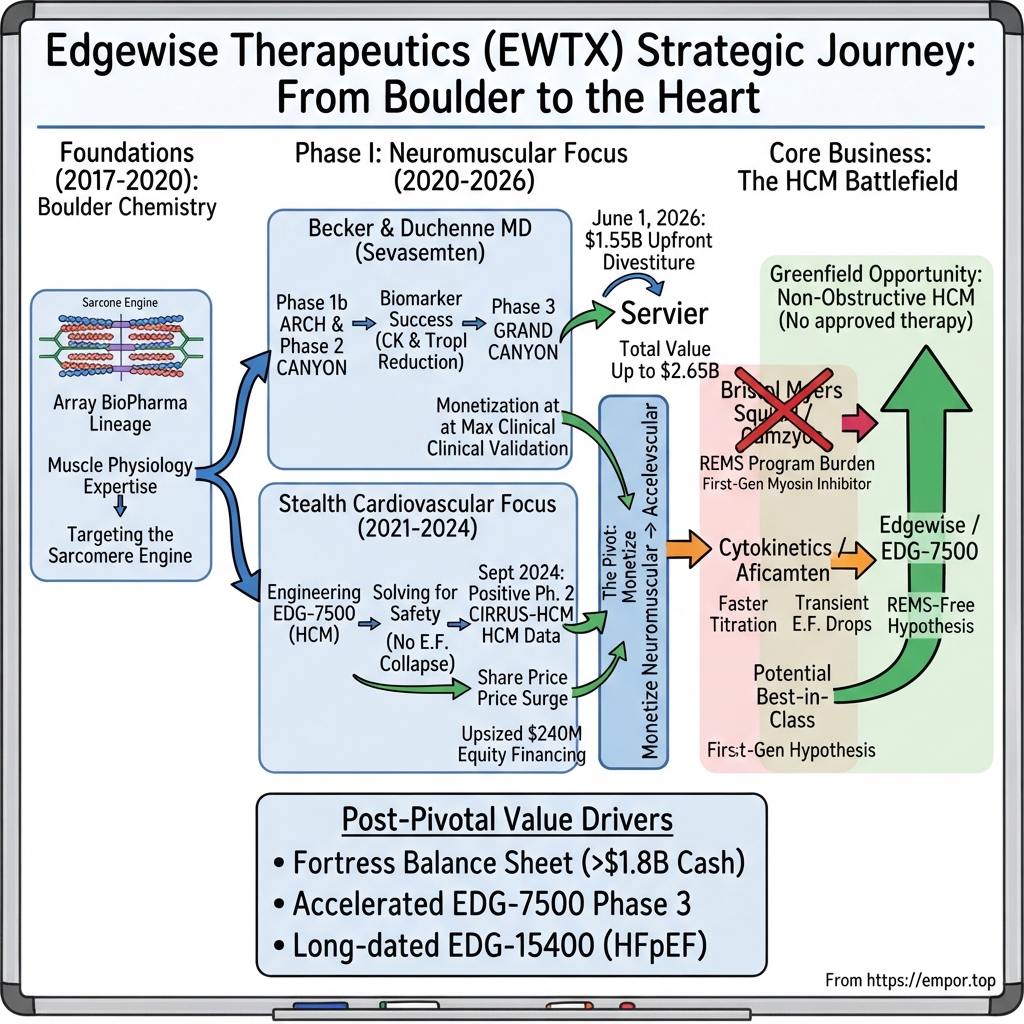
On June 1, 2026, Edgewise Therapeutics — a company of several hundred employees based in Boulder, Colorado, near the Flatirons — announced an agreement to sell the neuromuscular franchise it was founded to build. The buyer was Laboratoires Servier, the privately held French pharmaceutical group whose foundation-ownership structure allows it to deploy capital on timelines rarely available to public-company peers. The terms called for $1.55 billion in upfront cash, alongside up to $1.1 billion in potential regulatory and commercial milestones, yielding a total deal value of up to $2.65 billion.[^1]1 The transaction closed on July 13, 2026.2
What changed hands was sevasemten — internal designation EDG-5506 — an oral small molecule developed for Becker and Duchenne muscular dystrophies, together with the pivotal Phase 3 GRAND CANYON trial, the broader DMD studies, and the specialized neuromuscular team that had run them for nearly a decade.[^1] What remained behind in Boulder was an early-stage cardiovascular pipeline, a proprietary medicinal chemistry engine, and a substantial cash balance.
That sequence is rare in modern drug development. The standard biotechnology playbook involves discovering a molecule, funding it through clinical trials, and then — if regulatory data permit — hiring commercial sales representatives, establishing market-access teams, negotiating with pharmacy benefit managers, and hoping commercial adoption outpaces accumulated share dilution. While most emerging drugmakers hold onto their founding assets as long as possible, Edgewise monetized its lead franchise at the point of maximum clinical validation. It then redirected the proceeds into a cardiovascular program that, at the time of the sale, had produced only a single clinical dataset in humans.
That decision represents either disciplined capital allocation or a high-stakes pivot with little remaining room for clinical error. As of September 2026, that question remains unresolved; evaluating the outcome requires tracking the precise clinical and regulatory benchmarks ahead.
The core premise. Edgewise was founded on a straightforward mechanical concept: muscle functions as a machine, and machines can be modulated rather than simply shut down or structurally overhauled. The sarcomere serves as the fundamental contractile unit inside skeletal and cardiac muscle cells, relying on two interdigitating protein filaments — actin and myosin — that slide past one another to generate force. Most therapeutic approaches to muscle diseases have targeted the surrounding biological environment: replacing missing structural proteins, dampening inflammation, or delivering corrective genes. Edgewise's founders proposed instead to intervene directly inside the engine, tuning the velocity and force of the sarcomere's stroke.
That single pharmacological approach yielded two distinct commercial paths. Directed at fast-twitch skeletal muscle, it produced sevasemten — now Servier's operational commitment and commercial upside. Directed at cardiac muscle, it yielded EDG-7500, placing Edgewise in direct competition with Bristol Myers Squibb's Camzyos and Cytokinetics' aficamten in hypertrophic cardiomyopathy.
The transaction also provides an unusually clean natural experiment for a persistent valuation question in biopharma: what is a clinical-stage asset worth to an independent biotech compared to an acquirer with global commercial infrastructure? In whole-company acquisitions, pipeline programs, operational overhead, platform assets, and tax structures are typically bundled into an opaque purchase price. Here, a single clinical franchise was carved out and priced on standalone terms by an experienced private buyer with deep diligence access. In doing so, the deal established an explicit valuation benchmark for sarcomere-directed therapies.
The sale also served as a referendum on two contrasting therapeutic philosophies. Sevasemten's premise was that modulating mechanical strain can meaningfully alter the progression of a genetic muscle disease without correcting the underlying gene. By contrast, gene therapy programs such as Sarepta Therapeutics' Elevidys operated on the principle that restoring functional protein expression is essential to halting disease progression. For years, the two approaches competed for the same patient populations, trial investigators, and advocacy attention. In June 2026, Edgewise opted out of funding its side of that debate through commercialization, transferring the program to a partner with deeper balance-sheet resources and longer investment horizons.
What this episode covers. The underlying biophysics of muscle contraction; the Array BioPharma lineage that shaped chief executive Kevin Koch's approach to capital allocation; the clinical evidence from the Becker muscular dystrophy trials and what the biomarker data did and did not prove; and the design of the cardiovascular pipeline, specifically how Edgewise attempted to engineer around the safety margins and hemodynamic liabilities of first-generation cardiac myosin inhibitors. It also assesses whether Servier overpaid or Edgewise sold prematurely, testing the core investment thesis against the historical attrition rates of Phase 2 cardiovascular candidates.
The transformation traces back to a group of Boulder medicinal chemists who had executed this playbook once before.
 Subscribe on LinkedIn
II. Boulder Chemistry & The Biophysical Insight: Origins (2017–2020)
Boulder is not an obvious pharmaceutical hub. It lacks major teaching hospitals, century-old chemical works, and dense clusters of contract manufacturers. What it possessed instead was a specific corporate inheritance: Array BioPharma, founded in 1998, which spent two decades turning the University of Colorado’s chemistry department into an industrial-scale small-molecule discovery platform that yielded, among other therapies, the targeted melanoma combination Braftovi and Mektovi. Pfizer acquired Array in 2019 for $11.4 billion.3
Kevin Koch co-founded Array and served as its chief scientific officer before a tenure as Senior Vice President of Drug Discovery at Biogen.3 That background mattered less for institutional prestige than for operational discipline. For much of its history, Array operated not by burning speculative venture capital until a blockbuster emerged, but through medicinal chemistry partnerships—designing molecules against external targets, generating milestone revenue along the way, and retaining selective economics on promising internal programs. That model trained leadership to treat drug candidates as tradeable commercial assets with market-clearing prices rather than permanent fixtures of an institutional identity. That orientation would later dictate how Edgewise approached the monetization of its lead asset.
Koch’s scientific counterpart was Alan Russell, a muscle physiologist by training who had directed the Muscle Metabolism Discovery Performance Unit at GlaxoSmithKline and, earlier, worked as a scientist at Cytokinetics.3 That Cytokinetics background represented a foundational biographical detail. Cytokinetics had pioneered the pharmacological concept of drugging the sarcomere directly, developing mavacamten’s conceptual precursors alongside omecamtiv mecarbil for systolic heart failure, and later becoming Edgewise’s principal competitor in hypertrophic cardiomyopathy. Russell absorbed that mechanistic framework from within the company that established it.
Edgewise was assembled in 2017 with venture firm OrbiMed serving as the founding institutional sponsor, alongside Peter Thompson and Badreddin Edris among the venture-side co-founders.3 The company was a deliberately engineered corporate vehicle rather than an academic spinout, uniting experienced chemistry leadership, muscle physiology expertise, and specialized institutional capital from the outset.
The conventional paradigm, and why it was so expensive
Evaluating Edgewise’s initial scientific thesis requires examining the conventional biological model of muscular dystrophy.
Dystrophin is an elongated structural protein that lines the interior muscle cell membrane, tethering the internal cytoskeleton to the extracellular matrix. Functionally, it operates like a shock absorber bolted between the cell's contractile engine and its physical chassis. During contraction—particularly lengthening eccentric contractions, such as walking downstairs or lowering a weight—severe mechanical shear forces stress the membrane. In healthy tissue, dystrophin dissipates that mechanical load.
In Duchenne muscular dystrophy, genetic mutations eliminate functional dystrophin production entirely; affected boys typically lose independent ambulation in their early teens. In Becker muscular dystrophy, mutations yield a shortened but partially functional protein, resulting in a slower disease course where many patients remain ambulatory into adulthood.
The intuitive therapeutic solution was to restore the missing shock absorber. The biopharmaceutical industry spent more than a decade and billions of dollars pursuing this objective, primarily using adeno-associated viral vectors to deliver miniaturized micro-dystrophin genes. Yet clinical execution proved technically punishing: neutralizing antibodies and innate immune responses restricted repeat dosing, high systemic vector loads induced serious liver and cardiac toxicities, viral manufacturing at commercial scale remained capital-intensive, and transgene expression varied unpredictably across patient cohorts.
The insight: don't fix the absorber, detune the engine
Russell and his scientific team framed the mechanical problem from the opposite direction. If muscle membranes rupture because contractile force exceeds what a compromised membrane can tolerate, and if that structural damage concentrates within fast-twitch fibers generating the highest peak mechanical stress, a therapeutic could intervene directly on the force equation.
The mechanical analogy is a car with damaged suspension navigating an unpaved road. One approach is replacing the entire suspension system—an invasive, technically complex, and costly undertaking. The alternative is installing an electronic governor on the engine that caps peak acceleration over severe bumps: accepting a modest reduction in top-end power output to prevent the mechanical frame from shaking itself apart.
EDG-5506 was conceived as that mechanical governor: an orally available small molecule designed to selectively inhibit the ATPase activity of fast skeletal muscle myosin, shaving peak force in Type II fibers by roughly 10% to 20%—enough, in the founding hypothesis, to prevent micro-ruptures without meaningfully degrading what a patient can do.3
The biophysical logic was elegant, yet it carried an inherent commercial vulnerability: a small molecule that merely slows progressive structural degeneration cannot restore lost muscle tissue or correct the underlying genetic mutation. In a therapeutic landscape where patients and clinicians were actively being promised curative-intent gene therapies, an incremental deceleration of disease progression represented a far more demanding commercial case than functional genetic correction. That commercial friction persisted throughout the program’s lifecycle, ultimately informing the decision to divest the asset.
Capital formation
The company’s early financing followed the standard venture cadence of the period. Seed and Series A rounds totaling roughly $50 million came together across 2019 and 2020, with OrbiMed leading alongside New Leaf Venture Partners and Cormorant Asset Management, and with participation from patient-advocacy capital including CureDuchenne Ventures—an investor base that brings both money and credibility with the trial-enrolling community.3 A Series B of approximately $95 million followed in late 2020, funding the march into human studies.3
An aside on what "fast-twitch selective" actually required
The technical difficulty of engineering fast-twitch selectivity represented the primary scientific barrier to entry.
Human muscle tissue expresses distinct myosin isoforms across anatomical compartments. Slow-twitch Type I skeletal fibers use one isoform; fast-twitch Type II fibers utilize others; cardiac muscle depends on a distinct beta-cardiac myosin; and smooth muscle in the vasculature and gastrointestinal tract relies on an entirely separate isoform family. Because these motor proteins share common evolutionary origins, their catalytic ATP-binding pockets—the intuitive target for small-molecule inhibitors—are highly conserved. A non-selective inhibitor targeting that catalytic core risked suppressing fast skeletal muscle and the heart and the diaphragm, transforming an intended muscle therapy into acute respiratory or circulatory failure.
Edgewise resolved this selectivity problem through allosteric modulation. Rather than obstructing the primary catalytic site, the company’s medicinal chemists targeted a divergent pocket located away from the enzymatic core, altering the protein’s mechanical cycling kinetics without competing directly at the conserved catalytic domain. The mechanical parallel is adjusting the internal throttle linkage behind the dashboard rather than placing a physical block under the pedal: the intervention modulates mechanical output, but targets an architectural interface unique to that specific motor isoform.
This structure-activity optimization was the exact core competency Array BioPharma spent two decades industrializing: discovering selectivity windows across closely related protein families, then systematically engineering oral molecules that survive hepatic clearance, achieve therapeutic tissue exposure, and support once-daily dosing. That medicinal chemistry process depends on specialized empirical know-how rather than easily commoditized capital expenditure. This technical foundation underpinned Edgewise's claims to platform differentiation.
Then the clinical and financing window opened wider than initial projections had anticipated.
III. The Biotech Super-Cycle & The IPO: From Bench to Clinic (2020–2022)
For a preclinical-stage biotechnology company seeking public capital, the first quarter of 2021 offered unprecedented conditions. Interest rates hovered near zero, the rapid rollout of COVID-19 vaccines cast drug development in a heroic light, and generalist investment funds poured capital into platform stories on the strength of mechanism slides.
Edgewise priced its initial public offering in March 2021 at $16.00 per share, the top of an upsized range. The offering generated approximately $202.4 million in net proceeds and pushed the company’s valuation near the $1 billion threshold.4 The registration statement laid out the core sarcomere thesis alongside a clinical roadmap that prioritized Becker muscular dystrophy over Duchenne.4
Management’s subsequent operational choices proved more revealing than the capital raise itself. During an era when many newly public peers signed expansive facility leases and hired commercial leadership years ahead of clinical proof, Edgewise maintained a lean footprint. The organization remained focused strictly on discovery and early clinical development, with virtually no internal commercial infrastructure. That decision reflected fiscal discipline in 2021, yet by 2026 it had become an operational constraint. Strategic discipline and organizational limitation often describe the same reality viewed from different points in a company’s lifecycle.
Why Becker first
Prioritizing Becker muscular dystrophy was the sharpest strategic decision of the company's early clinical phase.
The conventional industry playbook favored moving directly into Duchenne, which offered a larger patient population, intense unmet medical need, established patient advocacy networks, and clear regulatory precedent for accelerated approval pathways. Edgewise chose Becker instead.
That decision rested on experimental clarity rather than immediate commercial opportunity. Duchenne patients are primarily young boys whose disease progresses rapidly. Their functional trajectories are heavily confounded by skeletal growth, variable corticosteroid regimens, and steep natural-history decline—a noisy baseline against which to detect a 10% to 20% modulation of contractile force. By contrast, Becker patients are typically adults who remain ambulatory and experience a far slower functional decline. Against that steady baseline, an authentic pharmacological effect had room to register clearly.
Furthermore, dystrophinopathies provide an unambiguous biochemical readout of structural damage. When fragile muscle membranes shear, intracellular proteins leak into the bloodstream—most notably creatine kinase and muscle-specific troponin I. Under the mechanical governor thesis, dampening peak contractile force should trigger a sharp and rapid decline in those circulating biomarkers long before functional motor tests could register a difference.
The clinical data matched the hypothesis. In the Phase 1b ARCH study and the Phase 2 CANYON trial, Edgewise reported reductions of roughly 70% or more in circulating muscle-damage biomarkers, accompanied by functional stabilization on the North Star Ambulatory Assessment compared to external natural-history cohorts.53 For a biophysics-driven program, the initial human data confirmed the core mechanism: the small molecule produced in patients the exact mechanical deceleration predicted in preclinical models.
Falsification test one: biomarkers are not approvals
Evaluating those findings requires distinguishing between biological target engagement and definitive clinical validation.
The claim under test: that sevasemten’s biomarker reductions in Becker established disease-modifying clinical efficacy across dystrophinopathies.
The mechanism that would break it: translation failure between circulating biomarkers and functional endpoints—an attrition mode with an extensive history in muscular dystrophy drug development.
The muscular dystrophy pipeline is lined with experimental therapies that altered biomarkers convincingly yet failed in pivotal trials. Catabasis Pharmaceuticals’ edasalonexent suppressed NF-κB-driven inflammatory markers but missed its primary functional endpoint in Phase 3. Summit Therapeutics’ ezutromid confirmed biochemical target engagement via utrophin modulation, only to be abandoned when functional benefits failed to materialize. Santhera Pharmaceuticals gathered years of respiratory biomarker and functional data for idebenone without securing a straightforward US regulatory approval. This repeated attrition reflects a biological reality: reducing the rate of ongoing muscle damage does not automatically translate into measurable functional improvements over standard trial windows.
The surviving evidence. Edgewise’s early Becker cohorts were small—numbering well under fifty patients in the initial functional analyses—and the North Star Ambulatory Assessment carries considerable patient-to-patient variability. Functional stabilization in a small, open-label cohort is encouraging, but it falls short of definitive proof. At the same time, the commercial landscape tilted decisively toward genetic medicines. Despite ongoing clinical debate regarding functional efficacy, Sarepta Therapeutics demonstrated with Elevidys that payers, physicians, and families would commit substantial budgets to one-time curative-intent gene therapies. A daily chronic pill that merely slows functional decline faced an uphill commercial battle against therapies promising genetic restoration.
Calibrated conclusion. The clinical record supports the conclusion that sevasemten is biologically active; the biomarker reductions were consistent and robust. However, that biological activity narrowed rather than expanded the asset’s commercial viability inside an independent biotech. Constructing a dedicated global commercial infrastructure to compete against Sarepta’s entrenched distribution and established corticosteroid regimens would have required hundreds of millions of dollars in selling and administrative expenses, with uncertain operating margins. The definitive test of clinical benefit remained the Phase 3 GRAND CANYON functional readout—and Edgewise ultimately chose not to carry that binary development risk on its own balance sheet.
The quiet problem with a good drug in a crowded story
An additional commercial dynamic governed the asset's trajectory, one rarely highlighted in investor presentations.
Duchenne and Becker muscular dystrophies are not typical commercial drug indications; they are tightly coordinated communities. Patient families stay closely connected, track clinical trial data in real time, coordinate across borders, and exercise considerable regulatory influence. That advocacy network established the political foundation for accelerated approval pathways in rare diseases, and its focus naturally aligned with programs offering functional genetic restoration. A therapeutic candidate predicated on slowing functional decline competed not only against rival pipelines, but against the expectation of a definitive genetic cure.
For a biotechnology company lacking an established commercial footprint, that dynamic created an expensive distribution hurdle. Identifying and reaching several thousand diagnosed Becker patients across global markets demands specialized infrastructure: field-based genetic testing initiatives, dedicated patient-finding networks, specialty pharmacy distribution, and country-by-country pricing dossiers. While annual net revenue per patient in rare diseases can be substantial, the operational cost of building that commercial engine is largely fixed and must be incurred well before product launch. Emerging biotechs that misjudge this cost structure often discover that their addressable, reachable patient pool is significantly smaller and more capital-intensive to service than broad epidemiological estimates suggest.
Laboratoires Servier already operated that commercial and regulatory machinery throughout Europe and possessed the balance-sheet flexibility to establish distribution elsewhere. Edgewise would have needed to build that apparatus from scratch. That commercial asymmetry—rather than skepticism regarding sevasemten's biological mechanism—provided the economic rationale for the two companies to agree on terms.
Yet while the market focused on the Becker clinical readouts, Edgewise had already begun directing its chemistry engine toward a much larger physiological target.
IV. The Stealth Masterstroke: Designing EDG-7500 and Entering HCM (2021–2024)
For roughly three years following its public debut, Wall Street evaluated Edgewise almost exclusively as a neuromuscular drug developer. Sell-side analysts built Becker muscular dystrophy penetration curves and modeled Duchenne market scenarios. Yet in Boulder, the medicinal chemistry engine that had tuned fast skeletal myosin was quietly redirected toward a different physiological system.
Cardiac muscle relies on the same fundamental contractile machinery as skeletal muscle, but it utilizes a distinct beta-cardiac myosin isoform and operates under an unforgiving margin for error. Modulating skeletal muscle dampens peak force with manageable clinical consequences; suppressing cardiac contraction too aggressively can precipitate acute heart failure. That pharmacological asymmetry defined every engineering choice that followed.
The prize: hypertrophic cardiomyopathy
Hypertrophic cardiomyopathy is the most common inherited heart disease, affecting roughly one in every five hundred individuals. In most cases, the underlying defect stems from a mutation in a sarcomere protein that causes cardiac muscle to contract with excessive force and relax incompletely. As the ventricular wall thickens, the enlarged septum in approximately two-thirds of patients physically obstructs blood leaving the left ventricle. This left ventricular outflow tract obstruction, quantified clinically as a pressure gradient at rest and during a Valsalva maneuver, leaves patients suffering from debilitating breathlessness, chest pain, and syncope.
For decades, medical options were limited to non-specific therapies: beta-blockers, calcium channel blockers, and, in refractory cases, invasive septal reduction through open-heart surgical myectomy or catheter-delivered alcohol septal ablation to selectively infarct the obstructing tissue.
MyoKardia demonstrated that the underlying contractile engine could be drugged directly. Bristol Myers Squibb validated that commercial thesis in 2020 by acquiring MyoKardia for $13.1 billion to secure mavacamten, which gained regulatory approval as Camzyos in April 2022.6 Cytokinetics advanced behind it with aficamten, delivering positive Phase 3 results in the SEQUOIA-HCM trial in December 2023.[^8] Within four years, a niche structural cardiology indication had expanded into a multi-billion-dollar competitive arena.
The flaw in generation one
Both mavacamten and aficamten operate through direct cardiac myosin ATPase inhibition, reducing the total number of myosin heads available to bind actin filaments. Dampening overall contractile force relieves the outflow gradient and eases clinical symptoms.
However, this first-generation approach suffers from a fundamental pharmacological tension: the therapeutic mechanism and the primary toxicity share the same biological pathway. If dosing suppresses contraction too far, the ventricle does not merely normalize—it under-contracts. When left ventricular ejection fraction, the percentage of blood expelled with each beat, falls below the fifty-percent threshold, the patient enters drug-induced systolic dysfunction.
Regulatory agencies responded to that narrow margin. Camzyos carries a boxed warning for systolic heart failure and can be prescribed only through a restricted Risk Evaluation and Mitigation Strategy program requiring baseline echocardiograms followed by repeat imaging at weeks four, eight, and twelve, and every twelve weeks thereafter.6 Furthermore, mavacamten is primarily cleared through CYP2C19 metabolism, introducing genotype-dependent exposure variability alongside extensive drug-drug interactions, while its long terminal half-life means clinical dose corrections take weeks to take effect.6
For practicing cardiologists, that pharmacological profile imposes substantial clinical and administrative friction: coordinating serial imaging, tracking non-adherent patients, enrolling in certification registries, and managing clinical liability for an inotropic boxed warning. Cytokinetics designed aficamten with a shorter half-life to enable faster and more predictable dose titration—a meaningful operational improvement—yet the molecule remains a direct myosin inhibitor, and transient reductions in left ventricular ejection fraction below fifty percent were still observed across clinical trials.[^8]
Engineering around it
Edgewise designed its cardiac candidate, EDG-7500, around an alternative biophysical hypothesis. Rather than reducing the total population of functioning myosin heads across the entire contractile cycle, the molecule was characterized as an oral cardiac sarcomere modulator that slows the velocity of early systolic contraction—the initial rapid phase responsible for generating dynamic obstruction—while preserving net stroke volume and improving early diastolic relaxation through a positive lusitropic effect.[^9]
The mechanical distinction is significant. First-generation inhibitors lower peak pressure by turning down the engine's overall power output. EDG-7500 was engineered to alter the pump's acceleration profile, displacing the same total blood volume while flattening the initial pressure spike that draws the hypertrophied septum into the outflow tract. In theory, this kinetic profile decouples gradient relief from systemic systolic suppression, widening the therapeutic window by avoiding titration along the axis of ejection-fraction collapse.
That thesis, however, hinges entirely on whether early hemodynamic observations translate reliably across larger, chronically treated patient populations.
September 2024: the number that changed the company
On September 3, 2024, Edgewise reported topline results from Part A of its Phase 2 CIRRUS-HCM trial. In patients with obstructive hypertrophic cardiomyopathy, single oral doses of EDG-7500 achieved mean reductions of approximately 60% to 70% in resting and Valsalva left ventricular outflow tract gradients—gradient reductions comparable to those achieved by approved agents—without a single treated patient experiencing an ejection-fraction decline below the 50% safety threshold.[^9]
Public markets reacted immediately, driving Edgewise shares up more than 50% in a single trading session. Demonstrating the balance-sheet pragmatism inherited from Array BioPharma, management capitalized on the valuation surge the following morning by launching an upsized public equity offering that raised approximately $240 million, extending the company’s operating cash runway well past 2027.[^10]
Yet disciplined clinical analysis demanded caution. Part A was a single-dose hemodynamic investigation conducted in a tightly selected, acute cohort. Single-dose evaluations rarely expose the toxicities associated with chronic, steady-state tissue exposure. Avoiding ejection-fraction drops below 50% in a brief single-dose setting was an indispensable preliminary milestone for the asset, but far from definitive clinical validation. The central commercial and safety question—whether that wide therapeutic window would endure through continuous daily dosing across hundreds of older, sicker, and more medically complex patients—remained entirely unanswered.
Why diastole is the underrated half of the story
Clinical discussions of hypertrophic cardiomyopathy frequently center on systole—the contractile squeeze—because that is where physical obstruction occurs and where hemodynamic gradients are tracked. Yet for treating cardiologists, the primary functional limitation for many patients stems from the opposing phase of the cardiac cycle.
Ventricular relaxation is not a passive mechanical rebound; it is an active, energy-intensive biochemical process. Following contraction, myocardial cells must actively clear intracellular calcium and dissociate bound myosin heads so the ventricle can expand and refill with blood. In hypertrophic cardiomyopathy, this active relaxation is impaired. The ventricular chamber remains stiff and non-compliant, driving up filling pressures and causing severe exertional dyspnea, even in non-obstructive variants where no mechanical gradient exists.
The mechanical contrast is intuitive: systolic dysfunction resembles a sponge unable to squeeze, whereas diastolic dysfunction resembles a compressed sponge unable to spring back open to absorb fluid. Most conventional and first-generation therapies target the squeeze. Very few effectively address the spring-back.
A therapeutic candidate that enhances relaxation operates on fundamentally different physiology than one that merely dampens contraction. Blunting systolic contraction carries the inherent risk of inducing systolic heart failure; enhancing active relaxation, in principle, avoids that specific hemodynamic hazard. That distinction forms the core scientific rationale behind EDG-7500's proposed safety window and its prospective utility in non-obstructive disease.
That distinction, however, remains a pharmacological hypothesis rather than an established clinical fact. Diastolic function is notoriously difficult to quantify accurately by non-invasive echocardiography, clinical trial surrogate endpoints are imperfect, and cardiovascular drug development history is littered with failed candidates that claimed diastolic enhancement in early studies.
What the September 2024 data unquestionably altered was the internal financial equilibrium of Edgewise. For the first time, rigorous risk-adjusted pipeline valuation indicated that the early-stage cardiovascular asset carried substantially greater enterprise value than the mature neuromuscular franchise. Twenty-one months later, management executed the corporate restructuring that aligned Edgewise's balance sheet with that clinical arithmetic.
V. The June 2026 Blockbuster: The $2.65B Servier Divestiture
Servier represents an unusual acquirer. Governed by a non-profit foundation, the French group is largely insulated from the quarterly earnings pressures that shape public pharmaceutical companies, allowing it to hold development assets over multi-decade horizons while expanding beyond its traditional cardiometabolic footprint into specialty and rare diseases.
That operating profile proved critical to the deal structure, because what Servier acquired on June 1, 2026, was not a commercial product. It was a late-stage clinical bet: sevasemten, the pivotal GRAND CANYON trial in Becker, the Duchenne studies including LYNX and FOX, and the specialized neuromuscular personnel who ran them.[^1]1 The consideration totaled $1.55 billion in cash at closing, alongside up to $1.1 billion in potential regulatory and commercial milestones.[^1] The transaction completed on July 13, 2026.2
Did Servier overpay, or did Edgewise sell cheap?
Both perspectives carry merit, and recent transaction comparables point in divergent directions.
Supporting the argument that Edgewise sold prematurely, Biogen paid $7.3 billion for Reata Pharmaceuticals—though that purchase secured an already approved rare-disease therapy with an active commercial rollout underway. More directly, Bristol Myers Squibb paid $13.1 billion for MyoKardia at a comparable stage of clinical development.6 Viewed against that benchmark, $1.55 billion upfront for a Phase 3 asset targeting a genetic disease with an organized, highly motivated patient community appears relatively modest.
Yet treating MyoKardia as a direct precedent overstates the parallel. Mavacamten addressed an indication affecting hundreds of thousands of diagnosed individuals and faced no direct mechanistic rivals at the time. Sevasemten, by contrast, was targeting Becker and Duchenne populations where Sarepta had already established gene therapy as the aspirational treatment standard, where Santhera had licensed vamorolone to Catalyst Pharmaceuticals under modest upfront terms, and where the primary functional endpoint needed to secure regulatory approval had not yet yielded definitive data. By selling prior to the GRAND CANYON readout, Edgewise transferred the franchise's single largest binary clinical risk to Servier—and received more than $1.5 billion in upfront cash for doing so.
In financial terms, $1.55 billion in immediate, non-dilutive cash amounted to roughly 40% of Edgewise’s enterprise value at the time. In exchange, the company relinquished an asset with an unproven pivotal readout and avoided building a global commercial organization from scratch. Meanwhile, the $1.1 billion in milestones preserved the upside if Servier executes.[^1] Rather than a bargain sale, the transaction reflects a classic risk transfer priced in a defensible middle ground.
What it says about capital allocation — and the limits of praise
Management's financing record warrants analytical precision rather than uncritical praise. Edgewise raised public equity twice at significant scale: first through its March 2021 initial public offering into a buoyant biotech market, and again in September 2024 through an upsized follow-on offering immediately following the initial CIRRUS-HCM data.4[^10] Both transactions raised capital from positions of strength. The alternative path facing the board in 2026 was clearly defined and capital-intensive: self-funding the remainder of the GRAND CANYON trial alongside an international commercial buildout, a path that almost certainly would have necessitated substantial equity dilution regardless of prevailing market conditions.
Yet designating this approach as disciplined capital stewardship requires important caveats. Edgewise has never brought a drug to market, defended reimbursement terms against pharmacy benefit managers, or navigated the operational friction of a commercial launch. Its capital-allocation history consists of two opportune equity financings and a single divestiture. A brief record free of operational missteps is fundamentally distinct from an established history of navigating commercial adversity. The definitive evaluation of management's capital allocation remains ahead, determined by how prudently that $1.55 billion is deployed over the coming years.
The milestones deserve a discount, not a multiple
Valuing the transaction also requires evaluating the $1.1 billion in contingent consideration, because contingent value in pharmaceutical deals is routinely mis-valued by investors in both directions.[^1]
From a corporate finance perspective, milestone structures function as call options written by the buyer and held by the seller. Their realization hinges on three variables Edgewise no longer controls: clinical trial success, regulatory clearance, and commercial marketing execution. The commercial commitment is frequently overlooked. Once a clinical program is absorbed into a larger corporate portfolio with competing priorities, development velocity and commercial staffing become internal portfolio allocations. While Servier has an economic incentive to advance the franchise, it operates under no contractual requirement to prioritize sevasemten above other internal programs.
Consequently, the probability-weighted value of $1.1 billion in staged regulatory and commercial milestones for a Phase 3 rare-disease candidate represents a fraction of the headline number. The exact discount depends on underlying clinical triggers and commercial sales thresholds that neither party disclosed in detail. Rigorous valuation requires assessing Edgewise based on the $1.55 billion in cash delivered at closing, while treating the remaining milestones as uncapitalized options that may take years to materialize. Capitalizing the headline $2.65 billion figure conflates prospective press releases with tangible balance-sheet cash.
Deploying that capital effectively is now Edgewise's central operational mandate.
VI. The Core Business: Industry Structure & The HCM Battlefield
Following the transaction's close, Edgewise emerged as a dedicated cardiovascular biotechnology company with an unusually liquid balance sheet. The cardiac pipeline—led by EDG-7500 in hypertrophic cardiomyopathy, alongside EDG-15400 targeting heart failure with preserved ejection fraction and the earlier-stage EDG-003—accounts for effectively all of the company's ongoing operating value, supported by net cash and receivables exceeding $1.8 billion following the Servier payment.[^1]7
That positioning creates an uncommon market dynamic: a clinical-stage drugmaker whose cash balance represents a substantial fraction of its overall market capitalization, preparing to compete against commercial rivals generating established product revenues.
The incumbents, honestly assessed
Bristol Myers Squibb and Camzyos. The primary competitive advantage for the market incumbent lies less in the molecule itself than in the commercial apparatus surrounding it. Bristol Myers Squibb commands an established cardiovascular field organization, entrenched institutional relationships across several hundred specialized US medical centers managing the majority of diagnosed HCM patients, and a commercial head start dating back to 2022.6 Through 2026, Camzyos steadily expanded toward blockbuster sales scale. Its primary commercial vulnerabilities remain the administrative burden of its mandatory REMS safety program, exposure variability driven by CYP2C19 metabolism, and the prolonged dose-titration schedules necessitated by its long half-life.6
Cytokinetics and aficamten. Cytokinetics brings extensive institutional depth in sarcomere pharmacology, aficamten's Phase 3 SEQUOIA-HCM trial demonstrated positive results, and its pharmacokinetics permit faster dose adjustment.[^8] Yet aficamten remains mechanistically a direct myosin inhibitor, leaving the underlying systolic-dysfunction risk intact; clinical trials still documented transient reductions in left ventricular ejection fraction below the 50% safety threshold.[^8]
Edgewise and EDG-7500. Edgewise positions EDG-7500 as a potential best-in-class second-generation challenger—a label that carries significant caveats. It remains potential because a large-scale safety database under chronic dosing has yet to be established. It is second-generation because entering a market late means confronting entrenched clinical prescribing habits.
Market commentary often overlooks an uncomfortable structural reality: while the Camzyos REMS program imposes administrative friction, regulatory requirements generate dedicated infrastructure, and infrastructure breeds institutional inertia. Major specialty centers have already established echocardiography scheduling workflows, REMS certification protocols, and dedicated clinic staffing to support regular monitoring. For a cardiologist who has already absorbed those fixed organizational costs, writing an additional monitored prescription poses little incremental burden. Displacing an institutionalized protocol demands clear therapeutic superiority rather than clinical parity, demonstrated in patient populations cardiologists recognize in their day-to-day practices.
The greenfield: non-obstructive HCM
Roughly 30% to 40% of HCM patients present with non-obstructive disease. While these individuals experience no physical outflow gradient to alleviate, they suffer from stiff, poorly compliant ventricles and debilitating heart-failure symptoms—and no approved pharmacological therapy exists for their condition. Bristol Myers Squibb's Phase 3 ODYSSEY trial evaluating mavacamten in non-obstructive HCM generated modest, equivocal outcomes, reflecting the reality that a therapeutic mechanism centered on gradient reduction provides limited clinical leverage when no gradient is present.
This clinical gap makes EDG-7500's proposed lusitropic effect strategically significant. If the molecule reliably improves diastolic relaxation independent of outflow obstruction, non-obstructive HCM represents a setting where Edgewise would not enter as a late challenger, but as a first-in-class entrant. Uncontested indications typically support far greater pricing power and market access than crowded competitive battlegrounds, suggesting that non-obstructive HCM could ultimately contribute more to the company's terminal enterprise value than competing for share in obstructive disease.
The evidentiary standing warrants rigorous qualification: this prospective advantage remains a mechanistic hypothesis supported by early hemodynamic observations rather than a validated clinical outcome in non-obstructive patients.
The long-dated bet: EDG-15400 and HFpEF
Heart failure with preserved ejection fraction affects more than three million individuals in the United States and has historically seen more failed clinical development programs than nearly any other cardiovascular indication. The underlying patient population is highly heterogeneous—encompassing phenotypes driven by obesity, metabolic dysfunction, hypertension, and advanced age—while regulatory trial endpoints remain disputed.
Edgewise designed EDG-15400 to target ventricular compliance within this physiological setting. Management frames the program as long-dated pipeline optionality rather than a near-term driver of corporate value—a stance that should be mirrored in any disciplined valuation framework. Given the historical attrition rate across the therapeutic class, an early-stage candidate in this indication warrants minimal capitalization until clinical proof-of-concept emerges.
How HCM patients actually reach a prescription
Assessing the commercial opportunity requires addressing an operational reality: hypertrophic cardiomyopathy remains substantially underdiagnosed. A significant fraction of the estimated one-in-five-hundred affected population is never formally identified. Common clinical symptoms—exertional breathlessness, fatigue, and chest discomfort—mimic numerous prevalent conditions, and formal identification requires a clinician to suspect the disease, order an echocardiogram, and interpret the imaging specifically for dynamic obstruction or septal thickening.
Diagnosed patients typically divide between two distinct care settings: academic centers of excellence and general community cardiology practices. Specialized centers manage complex presentations, lead pivotal clinical trials, and house the key opinion leaders who draft clinical practice guidelines. These centers also served as the primary launchpad for first-generation myosin inhibitors, as their specialized infrastructure readily accommodated regular echocardiographic monitoring and REMS compliance.
Community practices represent a far larger patient volume, but present a steeper commercial barrier. General cardiologists may encounter only a handful of HCM patients alongside hundreds of patients presenting with coronary artery disease, atrial fibrillation, or ischemic heart failure. Most community clinics lack the administrative bandwidth to construct dedicated REMS workflows for a few isolated cases; historically, these physicians have managed symptoms using generic beta-blockers or referred refractory cases to academic hubs.
This structural divide illustrates the commercial opportunity EDG-7500 could capture if a REMS-free profile is established. The primary value proposition lies not in displacing Camzyos within academic centers of excellence, but in unlocking community cardiology practices where patients currently remain on generic maintenance regimens. Consequently, the monitoring burden represents a decisive commercial gating factor rather than a minor clinical nuance: it dictates which prescribing channel is accessible. Broad diagnosis expansion and community adoption, rather than incremental market-share shifts within academic centers, represent the true determinant of long-term commercial value.
That commercial dynamic frames both the developmental risks and the critical clinical benchmarks ahead.
VII. Historical Falsification Layer: Testing Claims Against Reality
Several core claims carry the Edgewise investment case. Each deserves to be tested against the specific mechanism that would break it, rather than against generic risk disclosures.
Claim one: the REMS-free safety moat
The claim. EDG-7500's mechanism does not suppress left ventricular ejection fraction below 50%, enabling a regulatory label without the boxed warning and REMS monitoring program that constrain Camzyos—thereby unlocking rapid adoption by community cardiologists unwilling to construct monitoring infrastructure.
The mechanism that would break it. Sample-size escalation. Low-frequency adverse safety events that remain invisible in a cohort of 40 patients can become glaringly apparent in a trial of 400. This is not a theoretical concern in cardiology; it represents the discipline's defining pattern of clinical attrition. Experimental compounds that alter myocardial contractility—from the positive inotropes of the 1980s and 1990s through contemporary myosin modulators—have repeatedly demonstrated benign hemodynamic profiles in early-phase cohorts, only to unmask arrhythmogenic liabilities, systolic depression, or an outright absence of clinical outcome benefit when evaluated across broad, medically complex patient populations.
The disconfirming evidence, from inside this exact scientific lineage. Cytokinetics' omecamtiv mecarbil serves as the cautionary precedent. Designed as a cardiac myosin activator rather than an inhibitor—turning the dial in the opposing mechanical direction—it generated compelling contractile data in Phase 2. Yet in the 8,000-patient GALACTIC-HF trial, the compound delivered a statistically significant but clinically marginal composite outcome that failed to confer a survival benefit and ultimately failed to secure regulatory approval. The salient takeaway is not that sarcomere modulation fails biologically. Rather, it is that early-stage mechanical elegance and pivotal-stage clinical benefit are entirely separate variables, and the latter can be established only through large-scale outcomes trials.
A regulatory hurdle reinforces this dynamic. Review divisions at the FDA place substantial weight on class-wide clinical history. Once a drug class has established an inotropic heart-failure signal, the evidentiary burden required to obtain an unmonitored commercial label rests entirely with the sponsor—and that evidentiary threshold is exceptionally high.
Calibrated conclusion. The clinical record leaves this claim intact but unproven—a meaningfully weaker status than prevailing market commentary often assumes. No clinical evidence currently refutes the wide-therapeutic-window hypothesis, yet no data have confirmed it at the scale regulators demand. The decisive milestones will be the chronic-dosing safety data from expanded CIRRUS-HCM cohorts and, ultimately, the distribution of left ventricular ejection fractions in Phase 3. Until those data arrive, a REMS-free label remains an unvalidated assumption rather than a reliable valuation input.
Claim two: durable commercialization capability
The claim. Management can independently build and operate a differentiated commercial cardiovascular franchise.
The disconfirming evidence. The Servier transaction provides direct counterevidence to this assertion. Divesting the company's most clinically advanced asset specifically to avoid funding a commercial field force demonstrates, in the clearest and most definitive manner available, that leadership currently lacks commercial operating capabilities. Edgewise has never launched a commercial product, negotiated pricing and reimbursement terms with pharmacy benefit managers, or deployed a field sales organization.
Calibrated conclusion. This claim is substantially narrowed. Management has exhibited proven strengths in medicinal chemistry, mechanism-driven trial design, and opportunistic corporate transactions. Commercial execution, by contrast, remains wholly untested. This structural reality suggests that the company's most probable terminal outcome is a strategic acquisition rather than an independent commercial buildout, and valuation models should account for that scenario rather than underwriting a standalone commercial infrastructure management has shown no appetite to build.
Claim three: the fortress balance sheet
The claim. The company's post-transaction cash reserves eliminate equity dilution risk.
The disconfirming evidence. Cash reserves in biotechnology are not permanent assets; they are temporary operating inventories consumed by clinical decisions. Industry history features numerous developers that dissipated substantial balance sheets on failed pivotal programs or defensive business-development transactions. Global Phase 3 cardiovascular trials rank among the most capital-intensive undertakings in drug development, requiring thousands of patients, hundreds of international clinical sites, and multi-year follow-up periods.
Calibrated conclusion. Intact for the near and medium term, and time-bounded rather than indefinite. Upfront proceeds from the Servier transaction effectively eliminate the financing discount that burdens most clinical-stage biotechs, conferring a quantifiable advantage in corporate cost of capital over the next several years.[^1] However, a robust balance sheet cannot prevent capital from being consumed by negative clinical readouts. The primary operating metric to track is quarterly cash burn relative to the remaining balance, with the principal warning sign being operating expenditures accelerating faster than clinical milestones accumulate.
A fourth claim: that the discovery engine will keep producing
The claim. The Boulder chemistry platform is repeatable, indicating that EDG-7500 is not an isolated success and that earlier-stage pipeline candidates possess tangible intrinsic value.
The mechanism that would break it. The attrition rate in converting discovery milestones into commercial revenue. Technology-platform narratives in biotechnology most frequently falter at this juncture. That failure is rarely apparent during early stages because medicinal chemistry engines routinely generate viable molecules; where they struggle is advancing those candidates into approved, reimbursed, and profitable commercial therapies.
The disconfirming evidence, applied fairly. Edgewise has recorded zero regulatory product approvals during its nine years of operation. While that statistic appears unpromising in isolation, it represents the typical timeline for an enterprise founded in 2017, making it equivocal evidence on its own. A more informative point of comparison is the team's institutional lineage: Array BioPharma, operating under a comparable medicinal chemistry model in the same city with several of the same leaders, successfully brought Braftovi and Mektovi to market before being acquired for $11.4 billion.3 While that track record provides positive historical validation, it reflects an oncology portfolio where clinical endpoints and regulatory pathways diverge substantially from cardiovascular medicine.
Calibrated conclusion. Intact but weakly evidenced. Generating two clinically differentiated development candidates from a single chemistry platform validates the discovery engine's technical repeatability. It does not, however, prove a repeatable commercial model, and investors must distinguish between laboratory discovery capability and commercial value capture. The catalyst that would substantiate this claim is EDG-15400 or EDG-003 generating clean, differentiated human clinical data based on the same design principles. Conversely, the event that would undermine it is seeing those exploratory programs quietly omitted from corporate presentations without clinical explanation—a pattern that warrants careful monitoring across future annual regulatory filings.7
A fourth question worth asking: why did they really sell?
Management presented the divestiture as an exercise in shareholder value maximization and therapeutic focus. A skeptical interpretation is that internal investigators identified an unstated operational liability—an emerging tolerability issue, a formulation barrier, or a shifting competitive dynamic that rendered sevasemten commercially marginal.
The public record provides concrete context: Servier completed comprehensive technical due diligence before committing $1.55 billion in unconditional upfront cash, representing a significant financial commitment from a sophisticated counterparty with full access to trial data.[^1]2 Furthermore, management's rationale on the transaction conference call was consistent with its long-term operating history: funding an international rare-disease commercial organization promised a lower return on invested capital than advancing the wholly owned cardiovascular pipeline.1 That explanation is internally coherent and aligns with the company's capital allocation since 2021. Yet strategic consistency is not definitive clinical proof. The true evaluation will occur when the Phase 3 GRAND CANYON study reports results under Servier's direction: an unambiguous functional success will suggest Edgewise monetized the franchise prematurely, whereas an equivocal or negative outcome will confirm the divestiture as an exceptionally prescient trade.
VIII. Strategic Analysis: 7 Powers & Porter's 5 Forces
Strategic frameworks are most instructive when they deliver uncomfortable conclusions. Applied rigorously to Edgewise, they outline a company whose scientific advantages remain sharply constrained by its lack of commercial reach.
Hamilton Helmer's 7 Powers
Cornered Resource — moderate to high. Composition-of-matter patents covering EDG-7500 and its surrounding cardiac sarcomere modulator chemistry provide legal exclusion rights, which represent the most durable form of intellectual property in small-molecule drug development. The institutional talent behind that chemistry is rarer: Alan Russell's background in both fast-skeletal and cardiac cross-bridge kinetics, combined with the medicinal chemistry team's proprietary insight into how specific allosteric binding sites alter mechanical velocity, is difficult for rivals to duplicate quickly. However, because that knowledge resides within a compact group of researchers in Boulder, it simultaneously constitutes a distinct key-person operational risk.
Process Power — high, with an important qualification. The Boulder discovery laboratory has demonstrated a repeatable engineering capability on two separate occasions: first designing a selective, orally bioavailable fast-skeletal myosin modulator in sevasemten, and subsequently synthesizing a cardiac molecule with a differentiated kinetic profile in EDG-7500. Producing two distinct candidates from a single chemistry engine points to an underlying discovery process rather than serendipity. The crucial qualification is that process power in preclinical discovery yields development candidates rather than recurring commercial revenue. Historically, Edgewise has converted those scientific outputs into corporate transactions rather than approved pharmaceutical products.
Counter-Positioning — moderate, and conditional. This represents the most intriguing potential power in the company's portfolio. If EDG-7500 eventually secures an unmonitored regulatory label, Bristol Myers Squibb would face an acute strategic dilemma: the market incumbent could not argue that serial echocardiographic monitoring is dispensable without compromising the safety rationale for Camzyos, nor could it easily adopt a non-inhibitory mechanism without implicitly conceding the limitations of direct cardiac myosin inhibition. That dynamic fits classic counter-positioning, where an incumbent's established commitments make direct imitation economically and reputationally costly. Crucially, this power activates only if Phase 3 trials confirm a REMS-free safety profile—an outcome that remains an unproven clinical hypothesis.
Switching Costs — absent, and favoring the incumbents. Because Edgewise has no marketed products, it possesses zero customer switching costs. In fact, structural switching costs work against the company. Once specialized cardiology centers absorb the fixed operational costs of establishing regular echocardiography clinics, staff certification workflows, and REMS documentation protocols for first-generation drugs, writing additional prescriptions for monitored agents carries little incremental overhead.
Scale Economies, Network Economies, Branding — not applicable. As a pre-commercial biotechnology enterprise, Edgewise possesses none of these advantages.
Porter's Five Forces
Threat of substitutes — high. Hypertrophic cardiomyopathy features an extensive set of clinical alternatives: generic beta-blockers and nondihydropyridine calcium channel blockers that cost pennies a day, disopyramide, open-heart surgical myectomy at high-volume medical centers, and catheter-directed alcohol septal ablation. Additionally, SGLT2 inhibitors continue to gain traction across adjacent heart-failure phenotypes. Any novel candidate priced at specialty pharmaceutical tiers must substantiate its clinical value against inexpensive generic regimens that control baseline symptoms adequately for a broad portion of the patient population.
Bargaining power of buyers — extreme. In the United States, major pharmacy benefit managers—including CVS Caremark, Express Scripts, and OptumRx—manage formulary access for most commercial lives. When treating conditions with accessible generic alternatives, payers routinely mandate step therapy through generic beta-blockers alongside strict prior-authorization criteria before reimbursing specialty therapies. Moreover, the arrival of a third entrant into a drug class provides benefit managers with leverage to run competitive rebate auctions. Clinical differentiation can assist physician demand, but it does not guarantee favorable formulary placement if a competitor offers deeper pricing concessions to secure exclusive coverage.
Intensity of rivalry — intense. Edgewise faces two well-funded competitors possessing dedicated cardiovascular field teams, established relationships with key opinion leaders, and preferred access to the limited network of specialized clinical trial sites. In rare and structural cardiology, site competition during patient recruitment represents a primary operational bottleneck.
Threat of new entrants — moderate. While allosteric sarcomere chemistry presents substantial technical hurdles and patent barriers, the commercial validation established by Bristol Myers Squibb's $13.1 billion acquisition of MyoKardia has signaled the economic scale of the indication to multinational pharmaceutical research divisions.
Supplier power — low. Small-molecule synthesis relies on commoditized contract active pharmaceutical ingredient manufacturing. This standardized supply chain represents a structural cost and logistical advantage over the complex viral-vector manufacturing infrastructure required by gene therapies.
The synthesis. Edgewise's competitive posture hinges on one variable and one certainty. The variable is the potential attainment of a REMS-free regulatory label, which would establish counter-positioning against Camzyos and help bypass the incumbents' institutional distribution moat. The certainty is that Edgewise currently possesses no commercial infrastructure of its own. Together, these factors indicate that the most plausible mechanism for realizing the asset's economic value is a strategic acquisition or a commercial partnership with a multinational pharmaceutical firm, rather than an independent, company-funded launch.
That operational reality focuses attention directly on the leadership team responsible for steering those corporate decisions.
IX. Management Assessment, Incentives & Governance
The most reliable way to assess a management team is not to evaluate its corporate messaging, but to compare historical commitments against actual operational execution across as many years as the public record permits.
The behavioral record
Kevin Koch's observable pattern across five years as a public-company chief executive is consistent on one dimension: he raises equity only in response to clinical de-risking. The March 2021 initial public offering capitalized on the Becker program entering the clinic during one of the most receptive financing windows in biotechnology history.4 The September 2024 follow-on offering was executed within twenty-four hours of disclosing the CIRRUS-HCM Part A hemodynamic data.[^10] Neither financing represented an equity raise into a vacuum, and the company avoided the steady, dilutive balance-sheet drip that characterizes many clinical-stage peers.
The 2026 divestiture followed that exact economic rationale. When faced with funding a capital-intensive pivotal clinical program and an international commercial launch through equity dilution, or converting that asset into non-dilutive balance-sheet cash to focus on a higher-conviction cardiovascular pipeline, management chose conversion.[^1]1
The calibrated characterization of this record is consistent and capital-conscious, demonstrated across five public years and three defining corporate transactions. It does not yet constitute "proven capital allocation," because none of those three decisions has completed a full operational cycle. Investors underwriting Koch's capital discipline should recognize that the primary historical evidence for it—Array BioPharma's development trajectory and eventual $11.4 billion sale to Pfizer—occurred at an entirely different enterprise, during a distinct market era, and within oncology rather than cardiovascular medicine.3
Ownership and incentives
The shareholder register has been anchored by specialist life-sciences capital from the outset, led by OrbiMed from inception, with institutional investors including Deerfield, Cormorant, and Viking Global establishing positions in the post-IPO period.3 Dedicated specialist ownership represents a double-edged dynamic. It provides institutional backers who understand biological mechanism risk and possess the patience to endure multi-year Phase 3 timelines; conversely, it concentrates the register among funds that actively rotate capital based on binary clinical data, which amplifies equity volatility around major trial readouts.
Koch and Russell retain meaningful equity stakes, and executive incentive compensation has historically been weighted toward clinical development milestones—trial completions and regulatory filings—rather than commercial revenue or organizational headcount metrics.8 For a pre-commercial drug developer, that incentive architecture is conventional, though it carries an inherent structural tension: milestone-weighted compensation rewards advancing trials, whereas shareholder value often depends on running only trials where risk-adjusted returns justify the capital outlay. Deciding to divest sevasemten ran counter to the incentive of accumulating internal clinical trial milestones, representing a tangible marker of managerial discipline.
What the calls actually revealed
Two earnings and corporate presentations provide direct evidence regarding executive credibility.
During the September 2024 CIRRUS-HCM investor presentation, sell-side analysts pressed management repeatedly on left ventricular ejection fraction behavior beyond acute, single-dose exposure. Management's responses regarding Part A hemodynamic outcomes were quantitatively precise, detailing gradient magnitudes, onset kinetics, and individual patient-level distributions. By contrast, responses addressing whether preliminary discussions with the FDA had touched on prospective REMS monitoring requirements were markedly less defined.[^9] That asymmetry does not necessarily indicate a hidden regulatory liability; drug developers face strict legal and practical constraints regarding what they may disclose about ongoing agency interactions. It does, however, highlight precisely where development uncertainty resides, and the absence of clear regulatory feedback eighteen months ahead of pivotal trial design is itself a critical clinical signal.
On the June 2026 transaction call, management presented an unambiguous strategic rationale: the projected return on invested capital from building an independent rare-disease commercial organization did not justify the investment relative to funding the wholly owned cardiovascular pipeline.1 Importantly, that narrative matched the company's operating posture since 2021 rather than serving as an improvised justification—a meaningful indicator of strategic consistency. Coherent strategic messaging maintained across five years of regulatory filings and investor presentations is one of the few management signals that cannot be easily manufactured.
What an activist would push on
A skeptical institutional investor assessing Edgewise as of September 2026 would identify four distinct vulnerabilities, none of them minor.
First, the company's cash balance relative to its enterprise value. When liquid reserves constitute a substantial fraction of overall market capitalization, it implies that public markets assign limited residual value to the clinical pipeline—a dynamic that routinely invites activist pressure to return cash to shareholders if clinical readouts disappoint. Management has signaled no intention to initiate share repurchases or capital distributions, meaning the corporate reinvestment thesis rests entirely on EDG-7500 achieving commercial validation.
Second, extreme asset concentration. Following the divestiture, the vast majority of Edgewise's operating value resides in a single small molecule addressing a single disease category. That represents an inherently vulnerable corporate profile, and exploratory pipeline candidates such as EDG-15400 are too early in development to provide meaningful portfolio diversification.
Third, the granularity of clinical trial disclosures. Pre-commercial biopharmaceutical companies exercise broad discretion over how much clinical data they report, and Edgewise's communication of CIRRUS-HCM findings has prioritized aggregate hemodynamic gradient relief. An activist—or a rigorous buy-side analyst—would demand complete, patient-level distributions of left ventricular ejection fraction alongside detailed accounting of dose titrations and adverse-event discontinuations. Disclosing that "no patient fell below fifty percent" is fundamentally distinct from demonstrating that "no patient experienced a clinically meaningful ejection-fraction reduction," and that distinction becomes critical as trial cohorts expand.
Fourth, the temptation of defensive business development. Clinical-stage biotechnology companies holding substantial cash reserves following a large divestiture frequently face internal pressure to acquire external assets. Any future business development warrants rigorous skepticism, as the company's capital-discipline thesis would be quickly undermined by an overpriced or speculative in-licensing transaction executed simply to deploy balance-sheet cash.
X. The Bull vs. Bear Case & Key Performance Indicators
The bull case
The bull case rests on a four-part chain of operational and clinical assumptions, requiring every link to hold.
A best-in-class hemodynamic profile. EDG-7500 matches the left ventricular outflow tract gradient reductions demonstrated by mavacamten and aficamten while maintaining left ventricular ejection fraction safely above the 50% threshold across multi-dose Phase 2 and Phase 3 populations. While acute Part A data proved consistent with this hypothesis, chronic, steady-state clinical exposure has yet to confirm it.[^9]
An unmonitored, REMS-free label. The FDA approves the compound without a boxed warning for systolic heart failure or mandatory serial echocardiographic monitoring. This represents the central strategic hinge. Removing the monitoring burden would transform a clinical distinction into a major commercial distribution advantage, enabling community cardiologists—who manage the majority of diagnosed HCM patients but lack the administrative bandwidth to construct dedicated REMS infrastructure—to prescribe the drug within standard practice workflows. That accessibility represents the primary mechanism through which a late entrant could capture meaningful market share from entrenched incumbents.
First-mover advantage in non-obstructive disease. EDG-7500 becomes the first approved pharmacological therapy for the estimated 30% to 40% of HCM patients who present without a dynamic outflow gradient. In an uncontested indication, the commercial dynamics avoid a zero-sum share war against established marketing infrastructure, offering substantial pricing power and clinical adoption.
Balance-sheet strength and strategic optionality. Supported by net cash and receivables exceeding $1.8 billion following the Servier divestiture, Edgewise is funded through Phase 3 cardiovascular development without near-term equity dilution, insulating the company from unfavorable financing terms or premature partnering concessions.[^1]7 A de-risked, unpartnered cardiovascular candidate with clean clinical data represents an attractive target for multinational pharmaceutical firms confronting major patent expiries.
The bear case
The sample-size trap. The same statistical reality that undermined previous inotropic programs challenges EDG-7500. As enrollment scales from dozens of patients to hundreds of older, sicker, and more medically complex individuals, low-frequency reductions in ejection fraction below 50% emerge. Reasoning from extensive class precedent, the FDA mandates boxed warnings and regular echocardiographic monitoring regardless of proposed mechanistic nuances. EDG-7500 enters the market as a third-in-class agent offering comparable efficacy, equivalent monitoring friction, and a late-mover distribution deficit—collapsing its clinical differentiation into a me-too profile.
Entrenched commercial inertia. Camzyos has been commercialized since 2022, and aficamten followed close behind.6[^8] By the time EDG-7500 could secure regulatory clearance, the incumbents will have spent years establishing institutional prescribing defaults, specialized clinical workflows, and preferred formulary placement. Displacing established clinical habits is notoriously difficult, and consolidated pharmacy benefit managers may convert any marginal clinical advantage into demanded rebate concessions rather than premium pricing.
Asset concentration and HFpEF attrition. If the exploratory EDG-15400 program falters in heart failure with preserved ejection fraction—an indication marked by an exceptionally high rate of historical clinical failure—Edgewise effectively becomes a single-asset enterprise. In that scenario, substantial balance-sheet cash could be consumed by years of capital-intensive, unsuccessful clinical trials.
The structural synthesis. The bull and bear scenarios are not independent possibilities; they represent divergent branches stemming from a single clinical node. The entire investment thesis hinges on the distribution of ejection fractions under chronic dosing and how regulatory authorities interpret that safety profile. Evaluating Edgewise without taking an explicit view on that specific hemodynamic metric is an incomplete thesis.
The risks that are real, and the ones that are not
Filtering standard regulatory disclosures highlights where operational exposure genuinely concentrates.
Regulatory risk — high and decisive. The presence or absence of mandatory safety monitoring dictates the commercial addressable market.
Execution risk in transition — moderate and underappreciated. In divesting sevasemten, Edgewise transferred a significant portion of its clinical operations organization to Servier alongside the neuromuscular assets.[^1] Institutional memory disperses when specialized teams depart. Conducting global Phase 3 cardiovascular trials across hundreds of international sites demands a fundamentally different operating infrastructure than running rare-disease trials at a targeted group of academic medical centers, requiring the remaining team to establish operational scale anew.
Concentration risk — high. Corporate value rests almost entirely on a single clinical molecule.
Financing and cost-of-capital risk — exceptionally low over the near term. While permanent insulation from market conditions does not exist in biotechnology, the company's post-divestiture cash reserves substantially reduce near-term dilution risk, conferring a distinct cost-of-capital advantage over development-stage peers.
Commercial access and pricing risk — high and structural. Pharmacy benefit manager consolidation and competitive rebate discounting tend to intensify as drug classes mature, creating pricing hurdles for third-to-market entrants regardless of broader market conditions.
Macroeconomic, supply chain, and inflationary risks — largely immaterial. Active pharmaceutical ingredient synthesis for small molecules utilizes commoditized, multi-sourced contract manufacturing, the company has no commercial product revenue vulnerable to macroeconomic shocks, and material inputs represent a minor fraction of overall clinical development expenditures.
Key-person risk — moderate and concentrated. Biophysical insight and structure-activity optimization reside within a compact scientific leadership group in Boulder. The departure of key chemistry or physiology personnel would represent a far greater operational loss than it would at an enterprise sustained by commercial product revenues.
The three KPIs that matter
Cutting through secondary noise leaves three decisive performance indicators to monitor.
1. The ejection-fraction nadir rate under chronic dosing. The critical metric is not the mean or median change in left ventricular ejection fraction, but the statistical tail: the exact percentage of patients who experience an ejection-fraction drop below the 50% safety threshold during sustained daily dosing, reported across expanded CIRRUS-HCM cohorts and subsequent Phase 3 trials. A consistent zero-percent incidence across several hundred patients supports the case for an unmonitored label; an incidence of even 2% to 3% is likely sufficient to trigger class-wide monitoring requirements under established FDA regulatory practice.
2. Formal regulatory feedback on trial monitoring requirements. The clearest forward-looking indicator will emerge from End-of-Phase-2 interactions—specifically whether the FDA requires routine serial echocardiographic monitoring within the pivotal Phase 3 protocol. A trial design embedding mandatory ultrasound surveillance signals the agency's safety stance long before a commercial label is finalized. The operational protocol will reveal regulatory sentiment well before corporate disclosures interpret it.
3. Quarterly operating cash burn relative to milestone progression. The Servier transaction converted clinical assets into operating runway. The central financial question each quarter is whether operating expenditures scale in disciplined proportion to clinical milestones achieved or accelerate to fund corporate overhead—and whether management preserves that capital for its core cardiovascular programs rather than deploying it into speculative business-development acquisitions.
XI. Epilogue & Playbook Lessons
As of September 2026, the Edgewise narrative remains open. The company has executed the structural half of its corporate transformation—reallocating balance-sheet capital, pruning its pipeline, and transferring commercial risk—without yet confronting the pivotal clinical trials that will determine whether the strategy succeeded.
Three strategic lessons emerge from that transition, regardless of how the clinical data unfold.
Precision beats brute force, when the biology cooperates. The biophysical premise behind Edgewise is that molecular engines possess kinetic properties rather than simple binary states, and that altering the velocity of contraction can yield a wider therapeutic window than suppressing total force. That framework represents a meaningful departure from the conventional catalytic inhibition that characterizes much of small-molecule pharmacology. Whether that kinetic approach translates into a durable clinical advantage in cardiac tissue remains an open question; that the platform successfully generated two distinct clinical-stage candidates is an established milestone.
Knowing when to sell. A recurring vulnerability among emerging biopharmaceutical developers is institutional attachment to founding assets, often accompanied by dilutive equity offerings to fund commercial sales teams. Edgewise avoided that trajectory by treating commercialization as a return-on-capital calculation rather than an institutional imperative. Transferring sevasemten to Servier acknowledged an operational reality: monetizing an unproven Phase 3 asset for upfront cash can deliver a more defensible risk-adjusted return than absorbing the operational friction and capital requirements of a standalone global launch.
Chemistry clusters compound. Boulder lacks the traditional institutional density of established biopharma hubs, yet it sustains a specialized discovery cluster because Array BioPharma trained a cohort of medicinal chemists who remained in the region. The tacit expertise required to optimize allosteric small molecules across closely related motor proteins is transferred empirically through working partnerships rather than academic literature. Pfizer's $11.4 billion acquisition of Array secured that institutional expertise alongside late-stage oncology candidates, and Edgewise represents a second-generation realization of that same scientific talent pool.3
What remains in Boulder is an enterprise with substantial cash reserves, a focused biophysical hypothesis, a management team with a disciplined but brief public decision record, and a single unresolved empirical question: what happens to ventricular ejection fraction when hundreds of cardiac patients take a sarcomere modulator every day for a year? Everything else—the corporate pivot, the $1.55 billion cash wire, the Array pedigree, and the prospective counter-positioning—remains prologue to that decisive readout.
References
-
FierceBiotech: Edgewise Pivots to Heart Disease with $1.55B Cash Upfront from Servier — Fierce Biotech, 2026-06-01 ↩↩↩↩↩
-
Press Release: Servier Completes Acquisition of Edgewise Therapeutics' Muscular Dystrophy Business — Servier, 2026-07-13 ↩↩↩
-
Edgewise Therapeutics Form S-1 Registration Statement (IPO Prospectus) — U.S. Securities and Exchange Commission, 2021-03-01 ↩↩↩↩↩↩↩↩↩↩↩↩
-
SEC EDGAR Company Filings: Edgewise Therapeutics, Inc. (CIK 0001710072) — U.S. Securities and Exchange Commission ↩↩↩↩
-
Fast Skeletal Muscle Myosin Inhibition in Dystrophic Muscle Disease — PubMed / National Library of Medicine ↩
-
Camzyos (mavacamten) FDA Approval Documents and Prescribing Information — U.S. Food and Drug Administration, 2022-04-28 ↩↩↩↩↩↩↩
-
Edgewise Therapeutics Form 10-K Annual Report for the Year Ended December 31, 2025 — U.S. Securities and Exchange Commission, 2026-02-26 ↩↩↩
-
Form DEF 14A: Edgewise Therapeutics Definitive Proxy Statement & Executive Compensation — U.S. Securities and Exchange Commission, 2026-04-15 ↩
 LinkedIn
 WhatsApp
 Reddit
 Hacker News
 Email
Email Kindle
 RSS Feed
 Spotify
 Apple Podcasts
 Amazon Music
 Audible
 YouTube