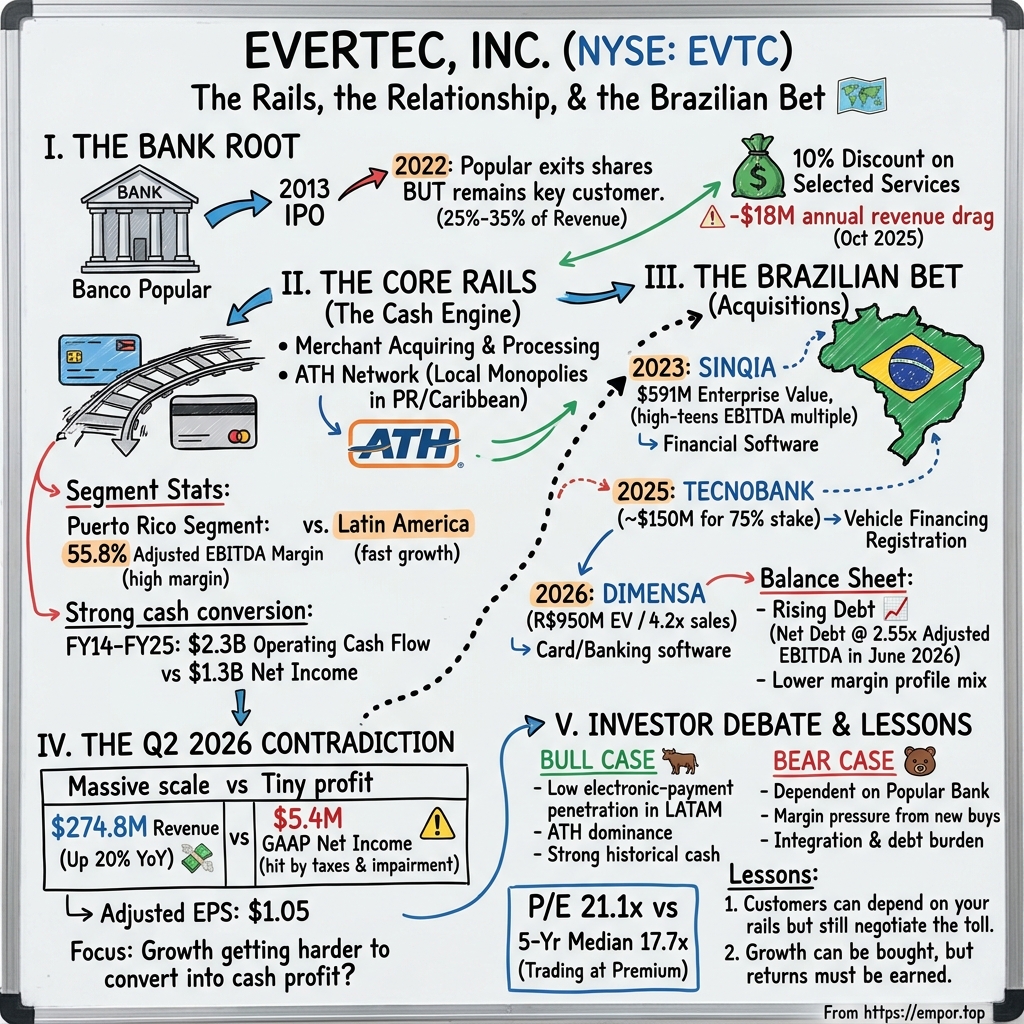
EVERTEC, Inc. (NYSE: EVTC): The Rails, the Relationship, and the Brazilian Bet
I. The quarter with $275 million in sales and $5 million in profit
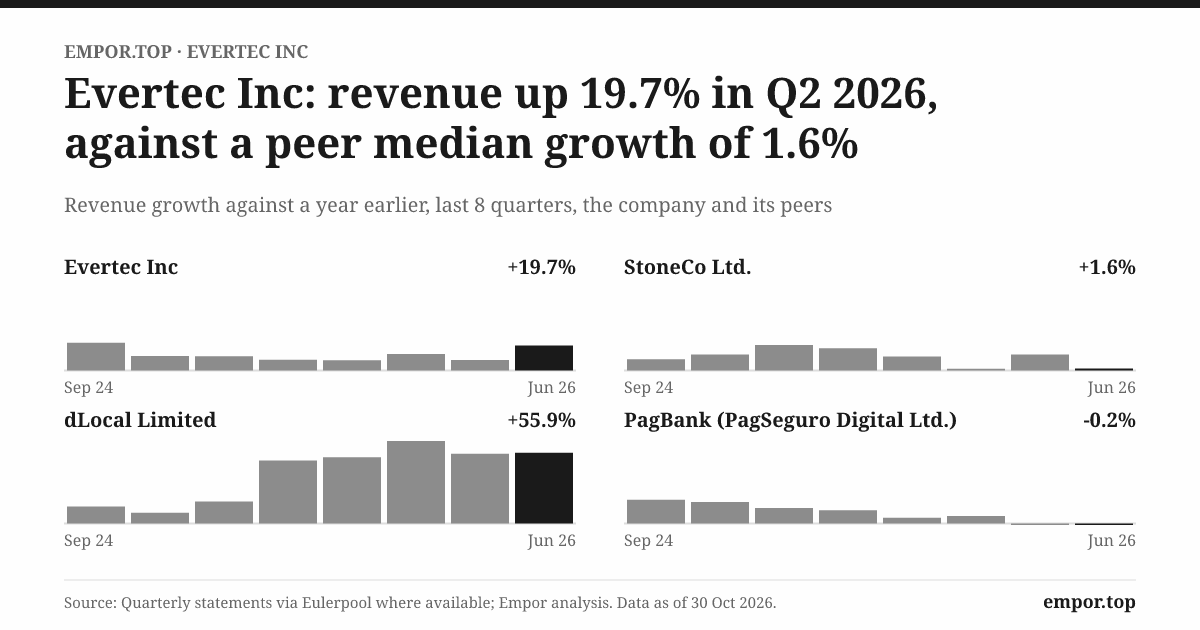
On August 4, 2026, EVERTEC put out a set of second-quarter numbers that seemed to describe two different companies.1 One was growing faster than it had in two years. Revenue came in at about $275 million, up 20% on the same quarter of 2025, and the Latin American business at the heart of the company's growth plan had grown by more than half.1 Adjusted earnings per share, the number management steers by and the one most analysts model, rose 18% to $1.05.1 By that measure it was the best quarter in the company's history.
The other company had earned almost nothing. Net income attributable to EVERTEC's shareholders was $5.4 million, or nine cents a share, against 62 cents a year earlier.1 Out of every $100 of sales, about $2 reached the owners. The tax line explained most of the gap. The company paid an effective tax rate of 74.7% that quarter, in a business that had spent most of the previous decade paying single digits.2
So which company is the real one? The reflexive answer is the adjusted one, because the tax bill and a write-down were one-time items. That answer is partly right and dangerously incomplete. The tax spike came largely from taxes on a dividend that a foreign subsidiary paid upstream to help fund the purchase of Dimensa, a Brazilian banking-software company, and from a valuation allowance on capital losses created when EVERTEC decided to exit an equity investment.1 Both are unusual. Both are also direct consequences of how the company now chooses to grow: by buying businesses abroad and moving money around a multinational group to pay for them. And underneath the tax noise, something more ordinary happened. Operating profit fell about 5% year over year, from roughly $56 million to $53 million, in a quarter when revenue rose by a fifth.1 Higher sales did not produce higher operating profit.
That is the puzzle at the center of this episode. EVERTEC is a payments and financial-technology company that grew up inside a Puerto Rican bank, still earns most of its money on that island, and is spending heavily to become a Latin American platform. Its growth is real. The question is how much of that growth survives the trip down the income statement once acquisition financing, the amortization of purchased software, integration costs, higher foreign taxes and, above all, price concessions to its biggest customer have taken their share.
The biggest customer matters more than anything else in this story. Popular, Inc., the Puerto Rican bank holding company that once owned EVERTEC outright, still generated about a quarter of its revenue in the first half of 2026.2 Popular is no longer a shareholder, but it remains the anchor tenant, and in October 2025 it began receiving a contractual 10% discount on a set of services that management has put at about $18 million a year.3 Meanwhile the Latin American segment, swollen by acquisitions in Brazil, has become the largest piece of the company and carries thinner margins than the Puerto Rican businesses it is meant to outgrow.4 The new deals are being paid for with debt. Net debt reached about 2.55 times trailing adjusted earnings before interest, tax, depreciation and amortization at the end of June, up from about 1.95 times a year earlier.5
Three questions follow, and they run through every section. Can the regional growth engine eventually make the Popular relationship a manageable part of the company rather than its defining fact? Do the Brazilian acquisitions earn back what was paid for them? And can management turn more transactions into more cash earnings per share, not just more revenue and more adjusted earnings?
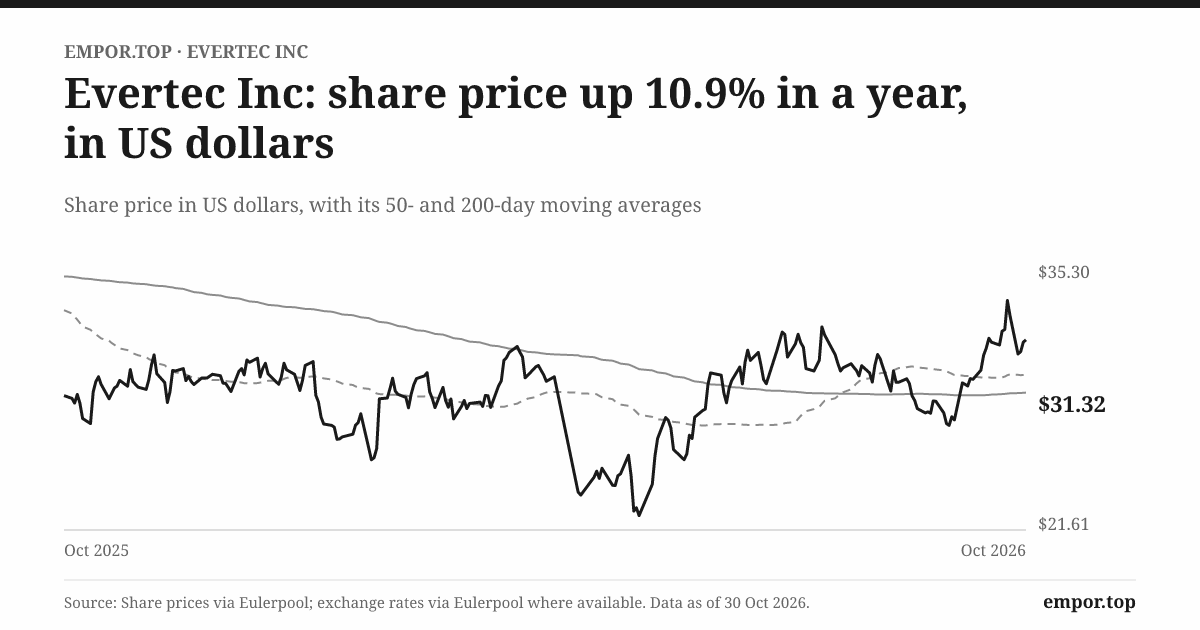
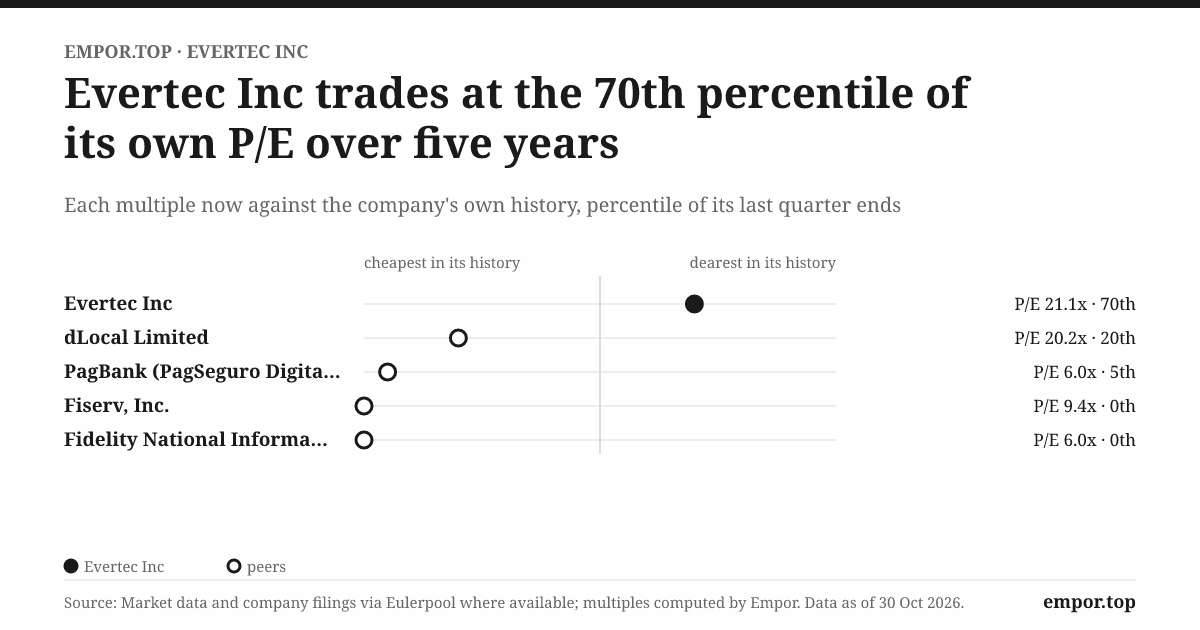
The stock market has already given its provisional answer. At $31.32 on October 30, 2026, EVTC traded at about 21 times its trailing reported earnings, against a median of about 18 times over the past five years.2 That premium is not extravagant for a payments company, and on other measures the shares look less demanding: the enterprise value is about 8.5 times EBITDA and the trailing free-cash-flow yield is about 9.5%. But a P/E multiple above its own history, applied to GAAP earnings depressed by tax and impairment charges, is a bet that the depressed number is the anomaly. Investors are paying for the adjusted company. The story of how EVERTEC got here explains why that is a reasonable bet in some respects and an unproven one in others, and it starts inside a bank.
 Subscribe on LinkedIn
II. The payment company that came out of a bank
For most of its life, EVERTEC was not a company at all. It was the technology and processing department of Banco Popular de Puerto Rico, the island's largest bank. The department ran the machinery that let Puerto Ricans withdraw cash, pay at a register and move money between accounts. Its crown jewel was ATH, the debit network whose initials became the everyday name for an ATM card on the island. If you grew up in San Juan, you did not "use your debit card." You paid with your ATH.
That is an unusual starting point for a payments company. Most processors are built to win customers. This one was built to serve a single parent, and then discovered that the systems it ran for Popular could be sold to everyone else on the island, including Popular's competitors, the government, and merchants who wanted to accept cards. The bank's back office gradually became a utility for the whole Puerto Rican financial system.
The turning point came in 2010, when Popular, in the aftermath of the financial crisis, sold a 51% stake in the business to Apollo Global Management and kept about 49%.6 The deal turned a captive department into a stand-alone company with a private-equity controlling owner. It came with a long master services agreement, dated September 30, 2010, under which Popular committed to buy processing and technology services from EVERTEC for 15 years.4 That contract was the economic spine of the new company. It guaranteed the revenue base that justified the leveraged buyout, and it hard-wired the relationship that still dominates the company today.
The listing followed in April 2013. EVERTEC marketed about 21 million shares at $18 to $20 each on the New York Stock Exchange under the ticker EVTC, and most of those shares were sold by existing holders rather than issued by the company.6 The prospectus described a business that called itself "the leading full-service transaction processing business in Latin America and the Caribbean."6 The money EVERTEC raised went largely to cleaning up the buyout balance sheet: redeeming about $91 million of 11% notes and paying to terminate consulting agreements with Apollo and Popular.6 At the same time, the company arranged $800 million of new bank financing, a term loan A, a term loan B and a revolving credit line, the same family of instruments that still makes up most of its debt today.7 Even after the offering, Apollo and Popular together owned about 72.5% of the shares, which made EVERTEC a "controlled company" under exchange rules.6
That phrase matters for understanding what the IPO did and did not change. The listing created a public company with public shareholders, a quarterly reporting rhythm and a share price. It did not create independence. The two largest owners were the private-equity firm that had financed the separation and the bank that was also the largest customer. Any negotiation between EVERTEC and Popular over price was, in a real sense, a negotiation between a company and one of its own parents.
The company that went public was a Puerto Rican processor with modest ambitions abroad. Over the following decade it built a broader shape. EVERTEC today describes four businesses. Payment Services in Puerto Rico and the Caribbean runs the ATH network, card processing for banks, and ATH Móvil, the peer-to-peer payment app that has become one of the island's preferred ways to pay.8 Merchant Acquiring signs up shops and restaurants in Puerto Rico so that they can accept cards, and earns a slice of every sale. Business Solutions provides core banking, network and technology services, much of it to Popular. And Latin America Payments and Solutions sells processing, fraud tools and banking software across the region, increasingly from Brazil.4 The company now serves 26 countries from 24 offices and had about 5,300 employees at the end of 2025, 45% of them in Brazil.4 That last figure is striking. The largest group of EVERTEC's people no longer works in Puerto Rico.
Revenue tells a slower version of the same migration. In 2025 about 61% came from Puerto Rico and 39% from Latin America and the Caribbean.4 Management's goal for 2026 was to push the outside share above 40%, a milestone Morgan Schuessler, the chief executive, presented on the year-end call as the birth of what he called "the new EVERTEC."8
The decisive break in ownership came on July 1, 2022. Popular agreed to cut its voting interest to 4.5% within three months so that EVERTEC would no longer count as its subsidiary under U.S. bank-holding-company rules, and it sold its remaining shares soon afterward.9 With the earlier sponsor no longer in control, EVERTEC had no controlling shareholder for the first time in its existence. Today its largest owners are asset managers. BlackRock and Fidelity's parent FMR each own about 14%, and American Century-related entities own about 8%.10
Here is where the central question of this episode changes shape. Before 2022, the question was whether a bank-controlled processor could serve the bank's interests and outside shareholders' interests at once. After 2022, it became something subtler: can a company be independent in control while remaining dependent in commerce? Popular left the share register. It did not leave the revenue line. And the terms under which it stayed were negotiated at exactly the moment it was leaving, which is why the bargain that came with the separation deserves its own section. First, though, it is worth understanding what exactly Popular, and every other bank in the region, would be giving up if it tried to walk away.
III. The local rails that banks cannot casually unplug
Picture a Saturday afternoon in a supermarket in Bayamón. A shopper taps an ATH debit card on the terminal. In the fraction of a second before the receipt prints, the request leaves the terminal, travels to the processor that serves the merchant, crosses the ATH network to the shopper's bank, is checked against the account balance and a battery of fraud rules, and comes back approved. Several parties earn something from that journey. The merchant's acquirer keeps a slice of the sale. The network charges a switching fee. The bank's card processor charges for authorizing and settling the transaction. In Puerto Rico, EVERTEC can be several of those parties at once.
That stacking is the essence of the business. EVERTEC earns money mostly in small amounts, many times a day, through four mechanisms. Processing and network fees are charged per transaction or per account. Merchant-acquiring revenue is a percentage of the value of card sales, net of what is paid out to the card networks and issuing banks. Business Solutions earns fees for running core banking systems, networks and technology projects. And the Latin American software businesses sell licences, subscriptions and services to banks, fund managers, pension funds and insurers. Almost all of it is recognized over time rather than in one lump: about $914 million of the roughly $932 million of revenue in 2025.11 That is a signal of repeat business, not proof of contractual recurrence. EVERTEC does not publish a consolidated recurring-revenue percentage, a renewal calendar or a portfolio-wide schedule of contract lengths and minimum commitments.11
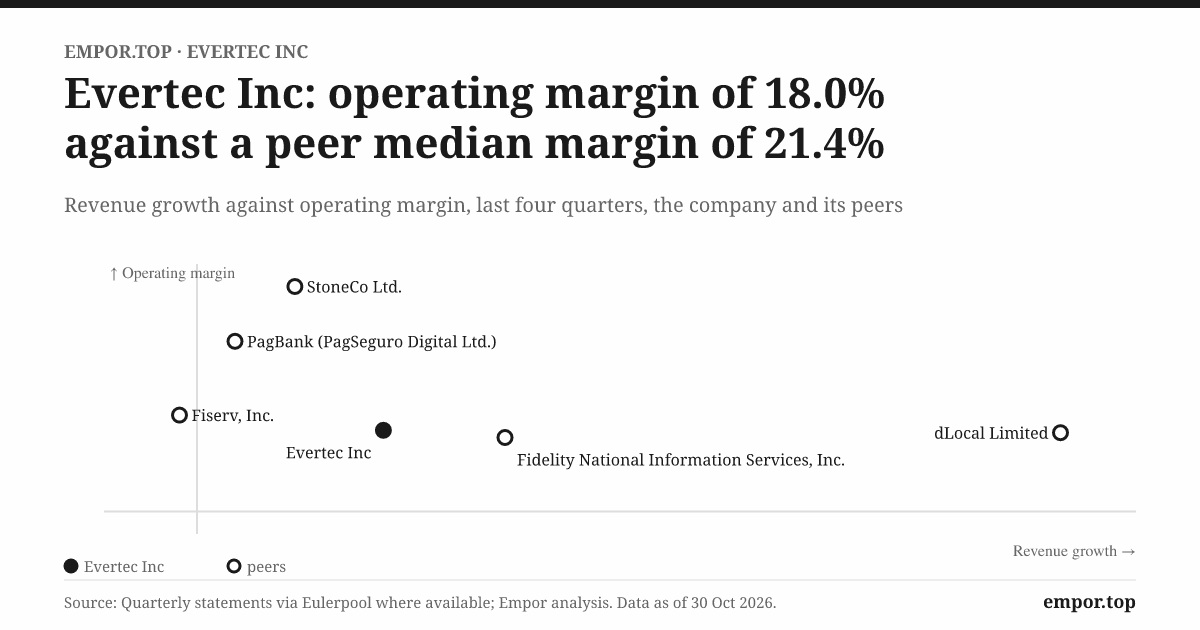
Where the money sits explains the strategy. Each segment reports its own revenue, but those figures include charges between segments for internal processing and software, so they add up to more than the company's consolidated sales and cannot simply be summed. Measured on revenue from outside customers, the Latin American segment was the largest in 2025, followed by Business Solutions, Merchant Acquiring and Puerto Rican payment services.4 On profitability, the order flips. The Puerto Rico and Caribbean payment-services segment turned about $223 million of revenue into an adjusted EBITDA margin of about 56%.4 Merchant Acquiring earned about 41%, Business Solutions about 38%, and Latin America about 29%.4 The highest-margin business is the oldest and slowest-growing. The fastest-growing business earns roughly half the margin.
And it has been growing very fast. Latin America Payments and Solutions roughly doubled from about $187 million of revenue in 2023 to about $369 million in 2025, while its margin rose from about 26% in 2024 to 29% in 2025.4 In the second quarter of 2026 it grew 52% on a reported basis, or 42% in constant currency, to about $131 million, and its margin reached about 30%.15 The Puerto Rican businesses, by contrast, grow in single digits. Payment Services there grew 8% in the June quarter and Merchant Acquiring 11%, on sales volume up about 7%.15 Those are healthy rates for a mature island economy, helped by low unemployment and tourism, but they are not the growth that justifies a premium multiple on their own.8
So the economic engine runs on two cylinders. Puerto Rico throws off high-margin cash. Latin America consumes some of that cash, plus borrowed money, and returns faster but thinner growth. The bull case requires both cylinders to keep firing. Which raises the question every investor in a payments company eventually has to ask: what stops a customer from leaving?
What the moat is made of, and what it is not
The honest answer is that EVERTEC has real advantages, and they are local, specific and partly negotiable.
Start with the rails themselves. A bank that runs its debit cards, ATMs, online banking and core accounting through EVERTEC has years of integrations, staff routines, regulatory documentation and customer-facing products built on that plumbing. Ripping it out is like changing the foundation of a house while the family still lives in it: possible, expensive and risky, and nobody wants to be the executive whose migration takes the ATMs down on a holiday weekend. Those are switching costs in Hamilton Helmer's sense, a source of power that lets an incumbent keep customers without being the cheapest option. The ATH network adds a modest network effect inside Puerto Rico, because merchants accept ATH because cardholders carry it, and banks join because merchants accept it. EVERTEC says its systems process more than ten billion transactions a year across its footprint.4 Scale in processing brings the classic fixed-cost advantage: the same data centers, fraud models and compliance teams serve more volume.
Now the strongest evidence against that moat, and it comes from the same customer that best demonstrates it. Popular, the bank most deeply wired into EVERTEC's systems, negotiated a 10% price cut on selected services, the removal of exclusivity from its master services agreement and a cap on inflation escalators.9 A customer with genuinely no alternative would not have extracted those terms. Switching costs kept Popular in the building. They did not stop Popular from lowering the rent. In Porter's terms, buyer power is high wherever buyers are large, and in EVERTEC's markets the buyers are banks, governments and processors that are often much larger than EVERTEC itself.
Competition is not hypothetical either. EVERTEC's own annual report names a long list of rivals: in payment services, Fiserv, FIS, Global Payments, Visa, Mastercard, American Express, Marqeta, dLocal and PayPal; in merchant acquiring, Fiserv, Global Payments, Elavon, Block and local banks; in business solutions, banks' internal IT departments, Jack Henry, TOTVS, Stefanini and others.4 Fiserv alone generated about $21 billion of revenue in 2025, more than twenty times EVERTEC's $932 million.[^12] That comparison is about scale, not market share, since Fiserv competes in different products in different places. But it shows what a determined, deep-pocketed rival could bring to a contract renewal.
Substitution is the slower threat. Brazil's Pix instant-payment system and similar schemes elsewhere move money between accounts without a card, and in Puerto Rico ATH Móvil is itself a substitute that EVERTEC built to compete with its own card rails. The company's strategy, in effect, is to own whichever rail wins locally. That is sensible, and ATH Móvil's growth suggests it is working on the island, but management does not break out the app's size; asked on the year-end call, Schuessler said the company does not split out such metrics.8
Reliability is the last pillar, because in payments it is what the customer actually buys. Here the record cuts both ways. The 2025 audit gave clean opinions on the accounts and on internal controls, but the auditor named revenue from activity-based payment services and merchant acquiring as a critical audit matter, because testing it required IT specialists to evaluate automated systems.4 That is not a red flag. It is a reminder that the revenue line depends on software working as designed. And in August 2025 the software failed in a costly way. Sinqia, EVERTEC's Brazilian subsidiary, detected unauthorized activity connected to Pix and halted processing; about R$710 million of unauthorized transactions affected two of its financial-institution customers, much of it recovered within days, and operations resumed on September 15.4 EVERTEC booked contractual claims for client losses in its cost of revenue, settled a substantial portion, and says remaining exposure is limited.11 Then, in June 2026, the company disclosed another cyber incident, which it says did not disrupt operations but did generate response and remediation costs in the second quarter.5
Weighing all of this, the claim that survives is narrower than "EVERTEC has a moat." The evidence supports a durable regional position built on local integration, the ATH brand in Puerto Rico, and the hassle of migrating mission-critical systems. It does not support a claim of pricing power, because the largest customer has just demonstrated the opposite. And it does not establish how often the advantage wins, because EVERTEC does not disclose market shares, customer retention, net revenue retention or win rates. Calling ATH a region-wide cornered resource would overstate it; ATH is powerful in Puerto Rico and largely irrelevant in São Paulo.
The KPI that would settle the question is not one the company publishes, so investors have to triangulate: whether Latin American growth continues after the acquisitions' anniversaries, whether the Puerto Rican margins hold, and whether new contract wins, like Banco de Chile and Grupo Aval in Colombia, keep arriving.8 Each is a clue. None is the answer. The clearest live test of how much the rails are worth, though, is the contract that tied EVERTEC to Popular when the two separated.
IV. Popular left the share register, then reset the price
On July 1, 2022, two things happened on the same day that looked like they pointed in opposite directions.9 Popular, the bank that had owned EVERTEC in some form since the business was a department, began walking out of the share register. And EVERTEC signed contracts that kept Popular as its anchor customer for years to come.
The mechanics were elegant. EVERTEC transferred certain assets to Popular and, in exchange, received about 4.6 million of its own shares that Popular owned.9 In effect, EVERTEC paid for those shares with assets instead of cash, shrinking its share count while Popular reduced its stake. Popular then cut its voting interest and sold its remaining shares.9 On the same day, EVERTEC closed the purchase of BBR, a Chilean payments company with operations in Chile and Peru, for about $53 million.9 Schuessler summarized the day in one line: the Popular transaction "extends our relationship with our largest customer while the BBR acquisition continues to expand our footprint in Latin America."9
That sentence captures the strategy and conceals the price. Look at what the contract amendments actually traded.
EVERTEC got duration. The merchant-acquiring arrangement with Popular, under which Popular's bank branches refer merchants to EVERTEC's acquiring business, was extended by ten years, to 2035, with a new revenue-sharing provision.911 The ATH network participation agreement was extended by five years. The master services agreement, the contract under which Popular buys core processing and technology services, was extended by three years, and it carries annual minimum spending commitments through September 30, 2028.911
Popular got flexibility and price. The master services agreement lost its exclusivity requirement, so Popular is free to buy covered services elsewhere. The inflation escalator that used to lift prices automatically was changed and capped. The previously noted 10% discount took effect in October 2025, three years after signing, a delayed charge EVERTEC accepted in exchange for the longer runway.911
Was that a good bargain? It was a rational one, and its costs are now visible. When the discount took effect, management described its annual value as about $18 million; Schuessler cited "the $18 million discount we had to pass to Popular" when an analyst asked about inflation in May 2026.3 Against 2025 revenue of about $932 million, $18 million is roughly 2% of sales, which does not sound like much. But a price cut falls almost entirely to the bottom line, because the cost of running the services does not shrink when the price does. Business Solutions, where most of the discount lands, saw its adjusted EBITDA margin fall from about 42% in 2024 to about 38% in 2025, even though the discount only applied for the final quarter of that year.4 On the year-end call, the company attributed the segment's fourth-quarter margin decline of roughly 370 basis points mainly to "lower revenues resulting from the 10% discount to Popular, as overall expenses remain consistent."8 That is the arithmetic of pricing power, running in reverse.
The 2026 numbers show the full effect. Management guided in February for Business Solutions revenue to decline in the low-to-mid single digits as the discount became "fully embedded in our run rate."8 By the second quarter, the segment's revenue had fallen about 9% to roughly $59 million and its adjusted EBITDA had dropped from $26 million to under $23 million.1 The decline was larger than the guidance implied, and management attributed it mainly to the Popular discount along with slower conversion of new business.15 The discount anniversary falls in the fourth quarter of 2026, which means year-over-year comparisons should get easier from there. They will not get easier in absolute terms. The lower price is now the baseline.
Concentration has eased, and that is genuine progress. Popular accounted for about 35% of EVERTEC's revenue in 2023, about 29% in 2025, and about 25% in the first half of 2026, falling to 24% in the June quarter.112 The Government of Puerto Rico, counting its agencies and public corporations together, contributed another 5% in 2025.11 Part of that decline in Popular's share comes from the denominator: Latin America grew, mostly through acquisitions, so the same Popular revenue became a smaller slice. Part comes from the numerator: Popular is now paying less. Only the first is good news.
There is also a balance-sheet dimension to the relationship. At the end of 2025, Popular owed EVERTEC about $41 million, up from about $38 million a year earlier.11 Total trade receivables rose to about $164 million from about $138 million, faster than revenue, while the allowance for doubtful accounts stayed tiny at about $3 million.11 The company notes that government invoices are due in 30 days but are commonly paid in 60 to 90.11 None of this signals a credit problem; historical losses have been low and most balances are collected within a year.11 It does mean that EVERTEC's two most important Puerto Rican customers both effectively borrow from it for a couple of months at a time, which ties up cash and adds a quiet layer of dependency to the relationship.
The most important date in this relationship is not in the past. The master services agreement's annual minimums run through September 2028.11 At that point, a customer that has already demonstrated it can extract price, and that is no longer bound by exclusivity, will negotiate again. EVERTEC will come to that table larger, more diversified and with a deeper Latin American business than it had in 2022, which improves its position. Popular will come with options it did not have before.
So treat the falling Popular share as evidence of diversification, not of a shift in bargaining power. The clues to watch are Popular's annual share of revenue, whether Business Solutions grows again once the discount anniversary passes, and what the two companies say as 2028 approaches. If the renewal arrives with another discount, the market will learn that the rails are embedded but the toll keeps falling. If it arrives at stable prices, the moat argument gets much stronger. Either way, EVERTEC's answer to its dependence on one Puerto Rican bank has been to go and buy itself a bigger world, and that answer started in Brazil.
V. Sinqia turned the growth map toward Brazil
On July 20, 2023, a Caribbean payments processor with a market value of a couple of billion dollars announced it was buying a listed Brazilian software company.12 For EVERTEC, it was the largest acquisition in its history and a declaration of identity. For Sinqia, the target, it was the end of an independent run on São Paulo's B3 exchange, where it traded under the ticker SQIA3.
Sinqia was not a payments company and not a generic "fintech bet." It was a software house for the plumbing of Brazilian finance. Its products ran inside banks, asset managers, pension funds and consórcios, the uniquely Brazilian pooled-purchase groups through which families club together to buy cars and homes.12 It sold core banking systems, investment-management software, payments modules and, through later additions, fraud-management and digital onboarding tools. Most of that revenue repeated: EVERTEC said about 85% was recurring, spread across more than 900 customers with no significant concentration.12 For a company whose single largest customer supplied about a third of its revenue at the time, a portfolio of 900 customers with none dominant was itself part of the appeal.
The price was substantial. EVERTEC offered R$27.19 a share in cash and stock, plus a small daily "ticking fee" tied to Brazil's benchmark SELIC interest rate until the deal closed.12 That valued Sinqia's equity at about R$2.3 billion, or $485 million, and its enterprise value, including debt, at about R$2.8 billion, or $591 million.12 The offer was about 24% above Sinqia's unaffected share price on the day before the announcement.12 A 24% premium is roughly typical for a public takeover and does not by itself prove overpayment; buyers almost always pay something for control. The more useful test is what the price bought in earnings, and here the announcement was notably quiet. It emphasized recurring revenue, customer count and strategic fit, and it promised that the deal would be "breakeven to slightly accretive to 2024 Adjusted earnings per share and accretive in 2025," but it did not lead with an earnings multiple.12 The price was justified by recurring revenue, growth and future accretion rather than by Sinqia's current profits, which meant EVERTEC was paying up front for synergies it still had to deliver.
The deal was financed mostly with borrowed money: 90% of the consideration in cash, 10% in EVERTEC shares, backed by $600 million of committed bank financing.12 EVERTEC issued about 1.2 million new shares for the stock portion and simultaneously enlarged its buyback authorization to $150 million to offset the dilution.12 That pairing, a large acquisition funded by debt alongside a larger buyback, is the capital-allocation pattern that runs through the rest of this story. The company wanted growth and shrinkage of the share count at the same time.
The transaction closed in November 2023.4 Its effect on the shape of the company was immediate. Management said Latin America would rise from about 20% of revenue to about 37% once Sinqia was included.12 The segment's revenue went from about $128 million in 2022 to about $369 million in 2025, nearly tripling in three years.11 Its adjusted EBITDA margin rose to about 29% in 2025 from about 26% a year earlier.4 On the year-end call in February 2026, Schuessler described Sinqia as "a great asset to roll up additional acquisitions" and said the team in Brazil had made the growth "reaccelerate."8 He credited improved customer engagement, platform modernization and contract repricing.8
That is encouraging evidence, and it should be weighed at its true strength. The segment's growth mixes three things that EVERTEC does not fully separate in public: revenue from acquisitions, organic growth from existing customers, and currency movements. Management has said that, excluding acquisitions and about $6 million of currency headwinds, Latin American growth in 2025 was in the double digits.8 That is a meaningful claim, and a good one if it holds. But double digits could mean 10% or 19%, and the company does not publish a bridge showing how much of the segment's improvement came from Sinqia versus other acquisitions closed in late 2024, versus Chilean and Colombian processing wins, versus price increases. The rising margin cannot be attributed to Sinqia alone without that bridge.
The other side of the ledger is the balance sheet, and it moved in one direction. EVERTEC's borrowings roughly doubled from about $447 million at the end of 2022 to about $986 million at the end of 2023.11 Debt to equity, which had fallen below 1.0 in 2022 after a decade of steady deleveraging from the buyout era, rose back to about 1.7.11 Reported net profit fell from about $239 million in 2022 to about $79 million in 2023, though the 2022 figure is not a clean comparison: pre-tax profit that year exceeded operating profit by about $110 million, a non-operating boost in the year of the Popular transaction.11 Even so, three new costs had arrived and stayed. Interest expense rose with the debt. The amortization of acquired software and customer relationships began flowing through the income statement as a non-cash charge. And part of the earnings of acquired businesses belongs to minority partners rather than to EVERTEC's shareholders.
That is why adjusted and reported earnings drifted so far apart. In 2025, EVERTEC reported adjusted net income of about $233 million against GAAP net income attributable to shareholders of about $142 million.811 The gap of roughly $90 million is mostly the amortization of acquired intangibles, stock-based compensation and other items management excludes. Some of those exclusions are reasonable; amortization of an acquired customer list does not consume cash. But the cash was consumed at the moment of purchase, and an investor who ignores amortization is implicitly treating the purchase price as free.
So where does Sinqia stand three years on? It established a much larger Brazilian platform, gave EVERTEC real software capability and a customer base it could not have built quickly by itself, and has been followed by faster segment growth and higher segment margins. The public record does not yet isolate Sinqia's return on invested capital or its cash contribution, and the company's own consolidated return on invested capital fell from about 19% in 2022 to about 12% in 2025.11 The acquisition succeeded at changing the company. Whether it succeeded at creating value per share remains unproven. And before that verdict could arrive, management went shopping again.
VI. The next Brazilian deals came before the Sinqia verdict
In Brazil, when someone finances a car, the loan contract has to be registered with the state transit authority so that the lender's lien is recorded against the vehicle. For decades this was a paper-heavy process. Tecnobank built a business digitizing it, registering vehicle-financing contracts electronically on behalf of banks and finance companies.4 It is an unglamorous, toll-like business: every financed car generates a registration, and every registration generates a fee.
On October 1, 2025, EVERTEC's Brazilian subsidiary bought 75% of Tecnobank.4 Reuters reported the price as about R$791 million for the stake, roughly $150 million at the time.13 EVERTEC paid about $144 million net of cash acquired and raised about $150 million of new long-term debt alongside the purchase.4 In other words, the acquisition was funded essentially dollar for dollar with borrowing.
Was that a good price? It is genuinely hard to say, and the difficulty is the point. Tecnobank was private, and EVERTEC has not published its standalone revenue, EBITDA or cash flow, so there is no clean multiple to compare with Sinqia or with listed peers. Tecnobank's contribution to consolidated results was not material in 2025, which means the deal cannot yet be judged on its own numbers.4 Management did credit Tecnobank, alongside other factors, with helping lift Latin American margins in the second quarter of 2026.5 That is a positive clue, not a return calculation. The 25% stake EVERTEC did not buy also means a quarter of Tecnobank's profits belongs to someone else, another small leak between segment results and shareholder earnings.
Only four months later came the bigger move. On February 2, 2026, EVERTEC agreed to buy all of Dimensa, a financial-technology company jointly owned by TOTVS, one of Brazil's largest software groups, and B3, the São Paulo stock exchange operator.14 Reuters reported an enterprise value of R$950 million against Dimensa's 2024 revenue of about R$224 million, which works out to about 4.2 times sales.14 Dimensa sells software for card processing, credit analysis and banking systems, and it took EVERTEC into a new vertical: insurance.8 Schuessler pitched the deal on the year-end call as a cross-selling engine, noting that Dimensa had 15,000 clients and EVERTEC had "our Rolodex of clients," with "significant cross-sell opportunities both ways" and "potentially some cost synergies as well."8 The deal closed in the second quarter, with management putting the purchase price at about $199 million.5
Here the conference calls become a revealing sequence. In February, management's guidance for 2026 explicitly excluded Dimensa, since the deal had not closed.8 It called for revenue of about $1.03 billion, adjusted EBITDA margin of 39.5% to 40.5%, and adjusted EPS growth of about 6% to 9%.8 In May, after updating for Dimensa, management raised revenue guidance by roughly $40 million at the midpoint, to between $1.073 billion and $1.085 billion, but lowered the margin range to 39% to 40%, reflecting the acquired company's lower margin profile.3 Dimensa, Schuessler said, "is expected to be neutral to slightly accretive in 2026," with synergies arriving from 2027.3 When Madison Suhr of Raymond James asked how much of the revenue raise came from Dimensa, the answer was "we don't break that out," followed by an assurance that "it's mostly 95% of it's recurring revenue."3 That 95% figure is management's characterization on a call, not an audited disclosure, and it should be weighed as such.
By August, the story had improved. Second-quarter revenue beat expectations, and management raised guidance again, to revenue of $1.085 billion to $1.095 billion and adjusted EPS of $3.94 to $4.04, growth of about 9% to 12%.1 The company said Latin America's margin expanded to about 30%, helped by Tecnobank and held back by Dimensa.5 The chief financial officer, Karla Cruz Jusino, said the integration "remains in its early stages" and that results "do not yet reflect the benefit of future synergy opportunities that we expect to realize over time."5 She attributed the growth to "organic growth across most of our segments, contributions from our recent Tecnobank and Dimensa acquisitions, and favorable foreign currency movements," without quantifying the split.5 Currency alone added about $9 million to quarterly revenue, mainly from a stronger Brazilian real.1
Notice what the sequence shows. Management has been consistent in direction: acquisitions add revenue, carry lower margins at first, and synergies come later. It has also been consistent in declining to quantify. There is no published organic growth rate excluding acquisitions and currency for 2026, no synergy target in dollars, and no standalone margin for Dimensa. Without those, investors are being asked to accept that the 2027 synergies will arrive because management says they will.
Leverage provides a harder test, because it is a number. On the May call, Schuessler said the company's leverage ratio "will still be 2.4 or less" after the Dimensa financing.3 At the end of June, management reported net debt of about 2.55 times trailing adjusted EBITDA, up from 1.95 times a year earlier, driven by the Dimensa financing.5 Definitions and timing can explain small gaps between a forecast and a quarter-end reading, and 2.55 times sits well inside the 4.0 times maximum allowed by EVERTEC's credit agreement.11 But the direction is clear: the company has stepped from the bottom of its stated two-to-three-times leverage range to the middle of it in two quarters,8 and it has done so while also buying back stock.
The second quarter also delivered a warning about a different kind of investment. EVERTEC recorded impairment charges, about $8.9 million over the first half, tied to its decision to exit a joint venture focused on developing payment services in Latin America.25 The capital losses from that exit generated a tax valuation allowance that contributed to the quarter's 74.7% tax rate.12 This was not Dimensa or Tecnobank failing; it was a separate, smaller venture. But it is a reminder that not every regional bet works, and that EVERTEC's record of investing outside Puerto Rico includes a write-off as well as a growth story.
A skeptical investor would put the question this way. EVERTEC bought Sinqia in 2023, Tecnobank in 2025 and Dimensa in 2026, plus two smaller businesses in late 2024.8 The first deal has not yet produced a disclosed return on capital. The second and third were struck before that verdict was available. Each was sensibly priced on its face; none can yet be shown to have earned its cost. And the people who decide on the next deal are the same people whose pay rises with revenue and adjusted earnings, both of which acquisitions increase mechanically. Schuessler told analysts in February that M&A would continue because "the larger our presence we have in the region, the more it makes sense to buy stuff," and that 2026 would be focused on integrating Dimensa.8 Both statements can be true. The integration year is the test of the first.
There are also signs of organic reach that do not depend on acquisitions. EVERTEC went live with Banco de Chile for acquiring processing and risk monitoring, is implementing Grupo Aval in Colombia, and in the second quarter signed Transbank in Chile, a multi-year agreement Schuessler called "one of the most significant commercial wins in our history," as well as a deal with Clip in Mexico.85 Those wins matter because they are sold, not bought. But Transbank will not ramp meaningfully until 2028, and neither contract has a disclosed revenue value, so for now they are evidence of capability rather than a new engine.5
The settling evidence is straightforward and not yet public: organic growth of the acquired businesses, segment margins after integration, the cash each acquisition contributes against its price, any goodwill impairments, and the synergies actually realized in 2027. Until those arrive, the honest verdict is that the Brazilian roll-up has broadened EVERTEC's products and distribution, and no evidence yet shows either that management overpaid or that the deals will earn their cost. What the deals definitely did is lean on the one thing EVERTEC has always been good at: generating cash.
VII. The cash is strong over a decade; the recent slope is slower
There is a simple way to check whether a company's profits are real: add up a long run of them and compare the total with the cash that actually came in. Over the twelve years from 2014 through 2025, EVERTEC reported about $1.3 billion of net profit and about $2.3 billion of operating cash flow, roughly $1.79 of cash for every dollar of accounting profit.11 That is a strong record. Companies that dress up earnings tend to fail this test, because accounting profit that never turns into cash eventually shows up as ballooning receivables or write-offs. EVERTEC's did not.
The explanation is partly structural. Payments and software companies carry heavy non-cash charges: depreciation of data-center equipment, amortization of capitalized software and acquired intangibles, and stock-based compensation, which alone was about $30 million in 2025.11 All of those reduce reported profit without reducing cash in the year. So the 179% conversion ratio is not magic; it partly reflects how much of the expense base is accounting rather than spending. Stock compensation in particular is a real cost to shareholders even though no cash leaves the building, because it shows up later as dilution that the company then spends cash to buy back.
The limits of that record show up in the recent slope. Operating cash flow fell to about $227 million in 2025 from about $260 million in 2024, even as revenue rose about 10%.118 Free cash flow, operating cash minus capital spending, came to about $136 million, down from about $172 million.11 Operating cash flow covered about two-thirds of EBITDA in 2025, compared with more than 80% across most of the prior decade.11 Part of that is working capital, especially the receivables build described in the Popular relationship. Over three years, free cash flow has been roughly flat while revenue has grown by half. That does not mean the business has stopped generating cash. It means growth has become more expensive to produce.
Reinvestment is also larger than the "asset-light payments" label implies. EVERTEC spent about $92 million in 2025 on what it calls capital resources: hardware, purchased software, internally developed software and property.11 That is roughly 10% of revenue, and management guided to about $90 million again in 2026.1 A meaningful share of software development is capitalized and amortized over three to ten years rather than expensed, which flatters near-term operating profit and shifts the cost into future amortization.11 The company does not report research and development as a separate line, so investors cannot see how much of that spending builds new products versus maintains old ones.11
Now follow the free cash. Across those twelve years, EVERTEC generated about $1.6 billion of free cash flow and paid about $211 million in dividends, about 13% of the total.11 The dividend is small and has been kept small; the yield is about 0.6%. The bigger uses have been debt reduction in the post-buyout years, then acquisitions, then share repurchases. In 2025 the company returned about $82 million to shareholders, with $66 million of buybacks concentrated in the fourth quarter "taking advantage of the attractive share price."8 Shares outstanding fell to about 61.8 million at the end of 2025 from about 63.6 million a year earlier.11 In the second quarter of 2026, EVERTEC bought another 1.9 million shares at an average of about $24.68, spending about $47 million, and on July 31 the board replenished its authorization to $150 million through December 2027.1 With the stock at $31.32 by late October, those particular purchases look well timed.
But the cash is being asked to do a great deal at once. Acquisitions used about $144 million net in 2025 for Tecnobank and about $180 million net in the first half of 2026, mostly Dimensa.112 Free cash flow of roughly $136 million a year cannot fund that pace plus $90 million of buybacks plus dividends, so debt has filled the gap. At the end of June 2026, EVERTEC owed about $392 million on its term loan A, $858 million on its term loan B and $35 million on its revolving credit line, with about $159 million of revolver capacity still available.2 Both term loans carry variable, SOFR-linked rates, partly fixed with interest-rate swaps; the weighted average rate was about 5.9% at the end of 2025.118 The term loan A matures in 2027, which makes a refinancing next year a near-certain event, and the term loan B runs to 2030.11
The unusual second-quarter tax spike and joint-venture impairment should not be extrapolated. But several other costs that hit GAAP earnings are not unusual at all. Interest expense on acquisition debt will recur as long as the debt is outstanding. Amortization of acquired intangibles will recur for years. The lower-margin mix of acquired businesses will persist until synergies arrive. And the higher tax rate on Latin American income is structural: management guided to an adjusted effective tax rate of 11% to 12% for 2026, explicitly because more income now comes from higher-tax foreign jurisdictions.8 For most of its public life, EVERTEC paid single-digit tax rates on its Puerto Rican earnings, helped by local incentives and research-and-development tax credits that produced about $13 million of gains in 2025 alone.11 Growing abroad means growing into ordinary tax rates. That is an ongoing cost of the strategy, not a one-off.
So the cash record validates the business: EVERTEC has turned accounting profit into cash reliably for more than a decade. It does not validate the current pace of capital deployment. The question is no longer whether the company makes cash but whether it can make enough of it, after higher taxes and interest, to fund deals, buybacks and the 2027 refinancing at the same time. That depends on the judgment of the people allocating the money, which brings the story to the executive suite.
VIII. A high-paid CEO, a CFO transition, and a vote that changed
In the spring of 2024, EVERTEC's shareholders delivered an unusual rebuke. At the annual meeting, only about 62% of votes cast supported the company's executive pay.10 For a say-on-pay vote, where routine approvals run above 90%, that is a loud signal. Something in the package had alienated more than a third of the people who owned the company.
The something was a single award. In 2023 the board had granted Morgan Schuessler, the chief executive, a one-time special retention grant valued at $6 million, on top of his regular compensation, which lifted his reported 2023 pay to about $14.4 million.10 In a year when GAAP net profit fell to about $79 million, a CEO package equal to almost a fifth of earnings was always going to draw attention.11 The board later acknowledged that the retention award was a key reason for the weak vote.10
Schuessler, known inside the company as Mac, has led EVERTEC since April 2015.10 He arrived from Global Payments, the U.S. payments giant, where he had been president of its international business, overseeing operations in 23 countries outside the Americas.10 That background helps explain the strategy: he came from a company that grew by stitching together processing businesses across borders, and he has spent a decade trying to make a Puerto Rican processor into a regional one. Since February 2025 he has also sat on the board of Deluxe Corporation, another payments and business-services company.10 On calls he tends toward the plainspoken and the upbeat, with a salesperson's preference for new wins over old numbers: "we only talk about those when we sign the deal and we've implemented it," he told analysts about the Latin American pipeline in February.8
The board's response to the 2024 vote was substantive by the usual standards of corporate governance. Directors and executives met with shareholders representing more than 60% of the outstanding stock, expanded the proxy disclosures, and committed not to make additional special awards to the CEO while the existing retention award runs.10 The vote recovered sharply: about 97% support in 2025, and in May 2026 about 55.0 million shares voted for the pay package against about 1.5 million against, roughly 97.4% support.1015 The chair, Frank D'Angelo, an independent director who has held the role since 2014, presided over both the dissent and the repair.10 EVERTEC separates the roles of chair and chief executive, which is good practice, though D'Angelo, at 80, has been on the board since the IPO year, and the board's independence is the board's own judgment rather than a fresh external one.10
Pay itself remains large. Schuessler's 2025 compensation was about $9.25 million, including $6.8 million in stock awards split between time-based and performance-based restricted stock units.10 The performance measures include revenue, adjusted net income, adjusted EBITDA and total shareholder return.10 Those metrics deserve scrutiny in light of the acquisition strategy. Revenue rises mechanically when the company buys businesses. Adjusted net income and adjusted EBITDA exclude the amortization of acquired intangibles, which is precisely the cost that captures what acquisitions cost. A pay plan weighted toward those measures rewards growth by acquisition more than it penalizes overpaying for it. Total shareholder return is the counterweight, and it is the only one of the four that the market sets rather than management. Schuessler beneficially owned about 146,000 shares at the March 2026 record date, well under 1% of the company.10 At $31 a share, that is worth about $4.5 million, roughly half of one year's pay. His alignment comes mostly through unvested awards rather than accumulated ownership.
The finance team changed in November 2025, at a delicate moment. Joaquín Castrillo, chief financial officer since 2018, who had joined EVERTEC in 2012 from PwC's banking practice, moved to the newly defined role of chief operating officer.10 Karla Cruz Jusino, a certified public accountant who spent more than twelve years at PwC before joining EVERTEC's finance team in 2019 and serving as chief accounting officer from 2024, became CFO.10 The transition looks like succession planning rather than a departure; both executives remain, and Castrillo's operating role suggests the company wants someone senior focused on integration. But it means the CFO presenting the Dimensa-era numbers is new to the role, and the executive who structured much of the earlier acquisition financing now runs the operations those deals created.
How has management performed against its own words? The record of the past three calls is mixed but legible. In February 2026, management flagged the Popular discount, the lower-margin Latin American mix and cost initiatives to defend margins, and it guided conservatively.8 In May, it lowered the margin range to absorb Dimensa while raising revenue guidance.3 In August, after a strong first half, it raised revenue and EPS guidance again.1 That is a pattern of guidance discipline, with surprises skewing positive. Against that, the Business Solutions decline ran deeper than the February guidance implied, leverage ended June above the level Schuessler had described in May, and the company consistently declines to quantify the organic growth and synergy figures that would let investors check the acquisition thesis.135 On AI, management has framed the technology as "a catalyst and a tailwind" and said it expects to begin incorporating AI-driven benefits into its financial outlook from 2027, which is another promise to check when the time comes.35
There are also two trust tests that sit outside the compensation debate. The auditor's focus on activity-based revenue systems and the Pix incident at Sinqia remain trust tests, though neither proves a systemic accounting or control failure.4 They are evidence that in a business where reliability is the product, the controls that protect it are under constant test, and that the newest parts of the company have already failed one.
The governance verdict, then, is a correction worth crediting and a case still to be made. The board listened when shareholders objected, and the votes show the repair worked politically. But a vote is not a result. Management earns further trust in two concrete ways: delivering measurable synergies from Dimensa in 2027 and publishing enough about acquired businesses for outsiders to judge their returns. Until then, the question of whether EVTC deserves its premium has to be answered from the business itself.
IX. Analysis & Bear vs. Bull Case
Imagine an investor with two numbers on a screen. One says the shares yield about 9.5% in free cash flow at today's price, a figure that would look cheap for almost any payments business. The other says the shares trade at about 21 times trailing earnings, above the company's own five-year median of about 18 times, at a moment when debt is rising and the growth engine is increasingly bought rather than built.112 Both numbers are true. They disagree because they measure different things. The cash-flow yield reflects a business whose non-cash charges, mainly amortization from acquisitions, depress reported profit. The P/E reflects GAAP earnings that the tax and impairment items of 2026 knocked down. A buyer at today's price is implicitly betting that the cash-flow view is closer to reality and that GAAP earnings will recover toward it.
Compared with large processors, EVTC looks expensive on earnings. In October 2026, Fiserv traded at roughly 9 times trailing earnings and PagSeguro, the Brazilian merchant acquirer, at roughly 6 times.1617 Those comparisons are rough context only; Fiserv is a global giant, PagSeguro is a consumer-facing Brazilian acquirer, and neither shares EVERTEC's Puerto Rican franchise or its mix of software and processing. The more useful comparison is EVERTEC against itself: it is priced for growth that converts, at a time when its own record over three years shows revenue compounding about 15% a year and net profit shrinking about 16% a year.11
Why it may win
The bull case starts with a long runway. Electronic payments are still far from saturation across much of Latin America, and EVERTEC sells the plumbing that banks, governments and merchants need to move from cash and paper to cards, accounts and instant payments. It has an established operating base across 26 countries, a Brazilian software platform expanded by Dimensa, and processing wins at serious banks in Chile and Colombia that were sold rather than bought.485 Its Puerto Rican businesses, including the ATH network and ATH Móvil, remain a strong local franchise, and its payment-services segment earns adjusted EBITDA margins in the mid-50s.4 Over twelve years, the company has turned accounting profit into cash at a ratio of almost two to one.11
EVERTEC's clearest advantages are local switching costs, scale economies and ATH's limited network effect; buyer power remains the force that bites hardest. Process power, the ability to integrate acquisitions better than rivals, is the power management is now trying to prove, and the evidence is not in yet.
Why it may not
The bear case does not require anything to collapse. Payment volumes can keep rising, Brazilian software can keep selling, and the investment can still disappoint, because each layer between revenue and per-share earnings is taking a larger share.
The first layer is customer power. A single bank still supplies about a quarter of revenue, has already cut its price by a measurable amount, no longer owes EVERTEC exclusivity, and faces a contract decision around 2028.211 There is no public retention, churn or win-rate data to show that the switching costs EVERTEC claims translate into renewals at stable prices; the one renewal the market can see came with a discount.
The second layer is capital allocation. Sinqia was bought on the promise of growth and accretion rather than on current earnings. Tecnobank's return cannot be independently benchmarked. Dimensa's roughly 4.2-times-sales price needs margin improvement and synergies to justify it, given the business's lower margins, which management has acknowledged.143 The company's return on invested capital has fallen from about 19% in 2022 to about 12% in 2025, which is what one would expect during a heavy acquisition phase and also what one would see if the acquisitions were simply earning less than the old business.11 An activist looking at EVERTEC would ask why a company with a 56%-margin franchise in Puerto Rico keeps buying 30%-margin businesses in Brazil, why acquisition returns are not disclosed, and why the pay plan's main metrics exclude the amortization that measures what those deals cost. Those are fair questions, and management's answer so far is a promise about 2027.
The third layer is financing. Net leverage of about 2.55 times leaves room under the 4.0-times covenant but narrows the space for more deals or aggressive buybacks, and the term loan A must be refinanced in 2027 at whatever rates prevail.511 Variable-rate debt, only partly swapped, means interest costs move with the market.
The fourth is risk that sits in the plumbing. Cybersecurity incidents and service outages strike at the reliability that customers pay for, and EVERTEC has had two disclosed incidents in a year.45 Currency moves matter more as Brazil grows: the real added roughly $9 million of revenue in the second quarter, but the same exposure produced remeasurement losses of $5 million in 2024 and $8 million in 2023, and EVERTEC does not disclose a broad currency-hedging program.111 The quarter's 74.7% tax rate reflected the dividend and investment exit. Receivables owed by Popular and the Puerto Rican government tie a slice of the company's working capital to the two customers with the most bargaining power.11
Investors looking for a separate artificial-intelligence thesis, for or against, will not find one in the filings. EVERTEC describes AI in fraud monitoring, credit scoring and internal productivity, and treats technology change as a general risk, but quantifies neither AI revenue nor AI exposure.811 The relevant technology risk is the one already described: new payment rails that bypass old ones.
Three measures will tell investors more than any other about whether the bull or bear case is winning. The first is Popular's share of revenue together with the trajectory of Business Solutions: the latest readings are about 24% of revenue in the June quarter and a 9% segment decline, both moving in the direction one would expect after the discount.21 The second is organic growth and margin in Latin America: the segment margin reached about 30% in the second quarter, rising, while organic growth remains unquantified beyond management's "double digits" for 2025.58 The third is net debt to adjusted EBITDA alongside the cash contribution of acquired businesses: leverage was about 2.55 times in June, rising, and acquired-business cash contribution is not disclosed.5
Weighing it all, the bull case has a credible foundation in regional growth and a long record of cash generation, while the evidence for durable acquisition returns and pricing power is thin. EVTC's premium to its own history asks investors to trust the second half of that sentence on the strength of the first.
X. Playbook: Business & Investing Lessons
Go back to July 1, 2022, the day Popular began stepping out of the share register and signed the contracts that kept it in the revenue line.9 In a single set of documents, EVERTEC won ten more years of merchant referrals, five more years of network participation and three more years of guaranteed minimum spending, and gave up exclusivity, inflation protection and a tenth of the price on selected services.9 Almost every lesson this company teaches is hidden in that one bargain.
The first lesson is that a customer can depend on your rails and still negotiate the toll. Popular could not easily rip EVERTEC out of its branches, ATMs and core systems, and it did not try. It did not need to. It only needed to be big enough, and the alternatives credible enough, to make EVERTEC choose between a longer contract and a higher price. EVERTEC chose duration and accepted a price cut worth about $18 million a year.3 For founders, the lesson is that switching costs protect revenue, not margins; for investors, it is that the best proof of pricing power is a renewal at stable prices, and the absence of that proof should count against a moat claim, not be ignored by it.
The second lesson is that a regional growth rate can be bought before it is built. Sinqia, Tecnobank and Dimensa turned a Puerto Rican processor into a company with nearly half its employees in Brazil and Latin America at nearly 40% of revenue.4 The growth showed up immediately in the revenue line, which is what acquisitions do. What they cannot do on day one is show whether the buyer can run the bought business better than its previous owner, and that is the only thing that makes an acquisition create value. Organic growth, segment margins and cash returns on purchase price are the evidence; revenue growth is the receipt.
The third lesson is that cash conversion is a record, not a permission slip. EVERTEC's twelve-year total, about $1.79 of operating cash for every dollar of profit, is the strongest fact in its favor.11 It describes how the company performed when it was smaller, less indebted and mostly Puerto Rican. It does not authorize simultaneous acquisitions, buybacks and dividends funded by rising leverage, and the slowing cash flow of 2025 is the reminder that past conversion does not automatically extend to a larger, more Brazilian, more taxed and more amortized company.11
The fourth lesson is that a governance correction matters most when the next promise is measurable. EVERTEC's board heard a 62% say-on-pay vote, met holders of more than 60% of the stock, and won back 97% support.1015 That is good process. But the outcome that shareholders will eventually judge is not how the board responded to a vote; it is whether the 2027 synergies arrive, whether acquired businesses earn their keep, and whether per-share earnings grow after all the costs the adjusted numbers leave out. The repair is complete only when the promise is checkable, and checked.
The wider principle ties all four together. Infrastructure that is embedded is not the same as infrastructure that is priced, and growth that is purchased is not the same as growth that compounds. EVERTEC sits exactly at the junction of those distinctions, which is why it is such a clarifying company to study, and why the next few quarters will say so much about which side of each line it lands on.
XI. Epilogue
As this story closes on October 30, 2026, EVERTEC's shares sit at $31.32, about 6% below their 52-week high and up roughly 40% from their low of the past year.2 The company is days away from reporting its third-quarter results, scheduled for early November.18 That report will not settle the big questions. It will show whether the momentum of the first half was real.
The setup is clear from what management has already said. After two guidance raises, EVERTEC expects revenue growth of about 17% and adjusted EPS growth of roughly 10% in 2026.1 That gap captures the whole story in one comparison: more growth than earnings, because the growth is coming from lower-margin acquired businesses, higher taxes abroad and heavier interest costs.
The first thing to listen for is segment growth in constant currency, especially in Latin America and Business Solutions. If Latin American growth holds up when the strong real is stripped out, and if management finally offers a figure for organic growth excluding acquisitions, the Brazilian strategy starts to look like something EVERTEC is building rather than only buying. If growth fades as currency tailwinds weaken and before Transbank ramps, the premium multiple will look harder to defend.
The second is Popular. The third quarter is the last full quarter before the discount anniversary. Popular's share of revenue should stay near a quarter; if it falls much faster, it will be because Latin America grew, not because Popular paid less. Business Solutions should show its decline narrowing as the comparison base resets. If the segment keeps shrinking after the anniversary, the problem is no longer the discount but slow new business, and the discount looks less like a one-time reset than the start of a trend.
The third is Dimensa. Management's guidance remains that it will be neutral to slightly accretive in 2026, with real synergies in 2027.3 Any quantified progress, such as cost savings achieved, cross-sold products or margin improvement, would be the first hard evidence that the integration thesis is working. A further cut to the margin range would suggest the opposite.
The fourth is the less glamorous plumbing of the income statement: the GAAP tax rate after the discrete items roll off, interest expense on the new debt, operating cash flow against adjusted EBITDA, and net leverage against the 2.55 times reported in June.5 Then, in 2027, the term loan A refinancing will reveal what lenders now charge a more leveraged, more Brazilian EVERTEC.11
The prepared remarks will tell one story. The analyst questions will test it. Listen for whether management answers questions about acquisition returns, pricing and margin recovery with numbers or with adjectives. That distinction, more than any single quarter's result, will show whether this is becoming a stronger regional platform or a larger company with the same profit and more debt. The final verdict belongs to 2027 and 2028, when the synergies are due and Popular's minimum-spending commitments under the master services agreement end. Until then, EVERTEC lives in the space between a promise and its proof.
XII. Outro
Go back to that June quarter. Nearly $275 million flowed through EVERTEC's systems as revenue, the product of card swipes in Puerto Rico, car-loan registrations in Brazil, core banking licences in São Paulo and network fees from banks across the Caribbean.1 At the bottom of the page, after taxes, interest on the debt that bought the new businesses, amortization of what those businesses cost and a write-down on a venture that did not work, $5.4 million was left for the owners.1 Most of the unusual charges behind that result will not recur. Some costs are now part of the ongoing price of the path the company chose.
That is the image that captures EVERTEC. It runs rails that an island's economy depends on, rails no bank can casually unplug. It is still negotiating the toll with the customer that built them. And it is spending that toll income, plus a good deal of borrowed money, to lay new track across a continent, betting that regional scale will turn a collection of contracts into something greater than their sum. The rails are real. The relationship is negotiable. Whether the Brazilian bet pays off is the question the next two years will answer, one quarter at a time.
References
-
EVERTEC Reports Second Quarter 2026 Results — EVERTEC, 2026-08-04 ↩↩↩↩↩↩↩↩↩↩↩↩↩↩↩↩↩↩↩↩↩↩
-
EVERTEC Q1 2026 Earnings Call Transcript — Stock Analysis, 2026-05-06 ↩↩↩↩↩↩↩↩↩↩↩↩
-
EVERTEC 2025 Form 10-K — SEC, 2026-03-02 ↩↩↩↩↩↩↩↩↩↩↩↩↩↩↩↩↩↩↩↩↩↩↩↩↩
-
EVERTEC Q2 2026 Earnings Call Transcript — The Motley Fool, 2026-08-11 ↩↩↩↩↩↩↩↩↩↩↩↩↩↩↩↩↩↩↩↩↩↩
-
EVERTEC Form S-1/A Amendment No. 3, preliminary IPO prospectus — SEC, 2013-04-02 ↩↩↩↩↩
-
EVERTEC Q4 2025 Earnings Call Transcript — EVERTEC, 2026-02-26 ↩↩↩↩↩↩↩↩↩↩↩↩↩↩↩↩↩↩↩↩↩↩↩↩↩↩↩↩
-
EVERTEC Closes Popular Transaction and BBR Acquisition — EVERTEC, 2022-07-01 ↩↩↩↩↩↩↩↩↩↩↩↩
-
EVERTEC 2026 Proxy Statement — SEC, 2026-04-07 ↩↩↩↩↩↩↩↩↩↩↩↩↩↩↩↩↩
-
EVERTEC 2025 Annual Report — EVERTEC, 2026-03-02 ↩↩↩↩↩↩↩↩↩↩↩↩↩↩↩↩↩↩↩↩↩↩↩↩↩↩↩↩↩↩↩↩↩↩↩↩↩↩↩↩↩↩↩↩↩↩↩
-
Evertec to Acquire Sinqia, a Leading Provider of Software Solutions for Financial Institutions in Brazil — EVERTEC, 2023-07-20 ↩↩↩↩↩↩↩↩↩↩
-
Caribenha Evertec compra 75% de brasileira Tecnobank por quase R$800 mi — Reuters via UOL, 2025-08-21 ↩
-
Evertec compra brasileira Dimensa da Totvs e B3 por R$950 mi — Reuters via UOL, 2026-02-02 ↩↩↩
-
EVERTEC 2026 Annual-Meeting Voting Results — SEC, 2026-05-21 ↩↩
 LinkedIn
 WhatsApp
 Reddit
 Hacker News
 Email
 Kindle
 RSS Feed
 Spotify
 Apple Podcasts
 Amazon Music
 Audible
 YouTube