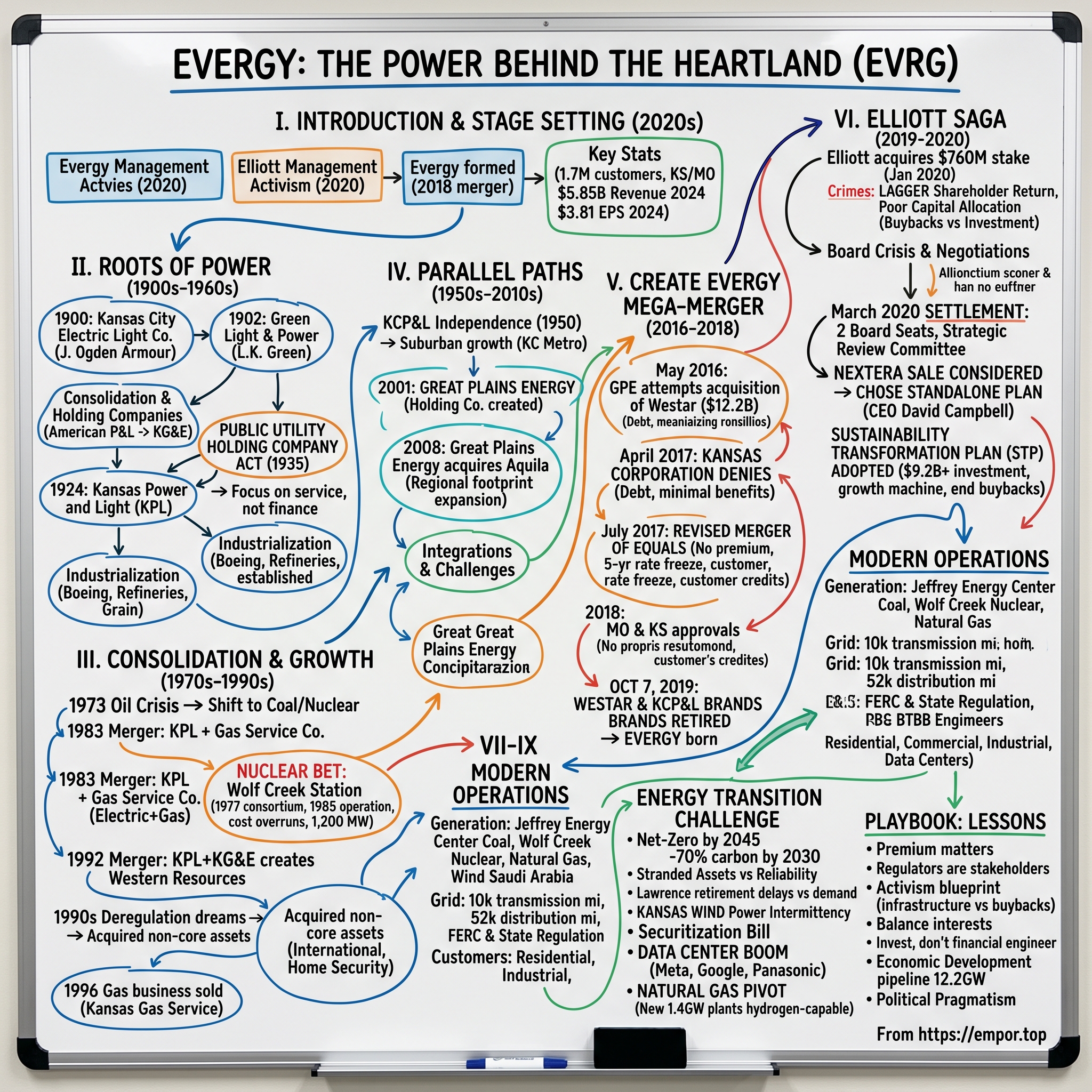
Evergy: The Power Behind the Heartland
I. Introduction & Setting the Stage
Driving west out of Kansas City on Interstate 70, the landscape quickly shifts scale. The suburbs thin, the horizon flattens, and within forty minutes the tallest structures for miles are grain elevators and steel lattice transmission towers marching single-file toward the horizon. Those towers represent essential industrial infrastructure—and, in a literal sense, Evergy's core business.
Evergy, Inc. owns most of that infrastructure across a 28,130-square-mile service territory spanning eastern Kansas and western Missouri, serving roughly 1.7 million customers from Wichita to the Kansas City metropolitan area.[^1] It trades on the NASDAQ Global Select Market under the ticker EVRG, a relative rarity among investor-owned electric utilities, most of which list on the New York Stock Exchange. In 2025, the company generated $5.96 billion in revenue and reported adjusted earnings of $893.8 million, or $3.83 per share—steady, traditional utility figures that reflect predictable regulated returns.[^2]
Yet over the past seven years, Evergy has emerged as one of the most dynamic and heavily contested utilities in the sector.
Consider the sequence of events. In 2016, two century-old Midwestern power companies agreed to merge at a substantial cash premium. Kansas regulators rejected the transaction outright in 2017—a rare outcome in utility mergers and acquisitions, where state commissions typically negotiate settlement terms rather than block deals entirely. The companies restructured the transaction as a zero-premium merger of equals, secured regulatory approval, and formed Evergy in 2018. Within eighteen months, Paul Singer's Elliott Management built a $760 million stake and publicly demanded either a strategic restructuring or a sale of the company.1 NextEra Energy, the nation's largest utility by market value and a frequent acquirer, subsequently made a takeover approach.2 Evergy's board rejected the offer, replaced the chief executive officer, and committed to a standalone operational plan. Soon after, artificial intelligence data center demand expanded rapidly across the Midwest. A utility long accustomed to flat load growth suddenly faced a queue of hyperscaler data center requests exceeding 10 gigawatts—compared with a peak system demand of roughly one-sixth that amount.3
That transformation frames the central strategic challenge. As a regulated monopoly authorized by two state legislatures and overseen by two utility commissions, Evergy faces the largest demand shock in its history. The core issue is whether the company can translate this surge in load growth into durable per-share earnings expansion, or whether it will repeat a historical utility pattern: committing massive capital investments, suffering cost disallowances or regulatory delays, and earning below its authorized return while ratepayers absorb higher bills.
Management's response, led by Chief Executive Officer David Campbell, centers on a $21.6 billion capital expenditure plan from 2026 through 2030—an estimate raised by approximately $1 billion in August 2026. Management projects this spending will drive a compound annual rate base growth rate of about 12%, while targeting adjusted earnings-per-share growth of 6% to 8%-plus through 2030, with annual EPS growth guided above 8% starting in 2028.34 This represents an ambitious growth plan for a regional utility. The critical counter-argument is straightforward: will the Kansas Corporation Commission and the Missouri Public Service Commission allow rate base expansion on this scale if regulators conclude that residential customers are bearing financial risk for infrastructure built primarily to serve major technology corporations?
The analysis that follows examines Evergy's trajectory across eight key dimensions: its territorial origins and the nuclear construction history that shaped Kansas regulatory oversight; the Aquila acquisition, which illustrated how unaligned expansion can erode returns; the merger saga that formed the modern company; the Elliott Management intervention; the company's segment architecture and regulatory earning mechanics; Campbell's execution track record; the data center expansion; the pressures of the clean energy transition; and a fundamental stress test of the company's long-term investment case.
 Subscribe on LinkedIn
II. The Roots of Power: Early Origins & Monopoly Construction (1900s–1960s)
Every utility's origin story begins with the same structural reality: electricity requires capital-intensive infrastructure, and capital will not build grid infrastructure without guaranteed customer access. The resolution of that challenge—a state-sanctioned monopoly granted in exchange for regulated rates and an obligation to serve all customers—defines Evergy's core business model, established a century before its modern corporate restructuring.
The Kansas City lineage originated with meatpacking capital. J. Ogden Armour, heir to the Chicago packing fortune, acquired the Kansas City Electric Light Company around the turn of the twentieth century. His primary motivation was operational: his electric streetcar network required power, and owning the generation assets provided the lowest-cost supply. That pattern of industrial users vertically integrating into power generation recurs throughout utility history and mirrors how modern hyperscalers evaluate behind-the-meter generation. The business was subsequently reorganized and by the early 1920s operated as Kansas City Power & Light (KCP&L).
On the Kansas side, two distinct operating companies emerged serving different regional economies. Kansas Gas & Electric (KG&E), founded in 1909 under American Power & Light, served Wichita and the southeastern coal mining communities of Pittsburg and Frontenac—an industrial, aviation-heavy, and economically cyclical region. Kansas Power and Light (KPL), organized in 1924 under Illinois Power & Light, covered the state's northeastern quadrant anchored by Topeka—an agricultural, governmental, and far stabler demand center. That structural distinction remains relevant today: Wichita's power demand has historically tracked aircraft manufacturing cycles, while Topeka's load profile has remained steady. The consolidated Kansas operations Evergy runs today reflect these underlying regional economic characteristics.
Meanwhile, in western Missouri, Lemuel K. Green founded Green Light & Power Company in 1902 across the rural territory between Kansas City and the Ozarks. That small enterprise evolved into West Missouri Power, then UtiliCorp United, and eventually Aquila, Inc.—an entity that re-emerges in Section IV as one of the most costly acquisition lessons in regional utility history.
The law that built the moat
The defining structural shift for all three predecessors was legislative rather than technological. Through the 1920s, American utilities were assembled into highly leveraged, multi-tiered holding companies where small equity investments at the parent level controlled extensive operating utility assets. The collapse of Samuel Insull's utility empire during the Great Depression wiped out hundreds of thousands of retail investors. In response, Congress passed the Public Utility Holding Company Act of 1935 (PUHCA), forcing the dismantling of pyramided holding structures and re-establishing utilities as geographically integrated single-system operations supervised by state commissions.
The statute reshaped Evergy's predecessor entities. KCP&L emerged from holding-company control around 1950 as an independent operator, consolidating its regional footprint by acquiring Eastern Kansas Utilities in 1952. American Power & Light's control over KG&E dissolved during the same period. Each company settled into the traditional regulatory bargain: an exclusive territorial franchise, a legal obligation to serve all customers within that area, and customer rates determined by a state commission rather than market forces.
That regulatory bargain forms the foundation of Evergy's investment profile. The company faces no retail electric competition within its service territory; no competitor can construct a duplicate distribution network in Topeka or Wichita. In exchange for this protected franchise, Evergy cannot set retail prices independently, unilaterally dictate capital expenditure programs, or retain profits above its commission-authorized rate of return. The customer franchise is guaranteed by statute, but the allowed financial return is negotiated with regulators.
Consequently, the primary external determinants of Evergy's long-term financial performance are the regulatory bodies overseeing its rates: three commissioners at the Kansas Corporation Commission in Topeka and five at the Missouri Public Service Commission in Jefferson City.
III. Consolidation & The Wolf Creek Nuclear Saga (1970s–1990s)
In the summer of 1992, the corporate contest that ultimately combined Kansas's primary electric utilities resembled a hostile takeover struggle more than a conventional strategic merger. Kansas Power and Light (KPL) pursued Kansas Gas & Electric (KG&E), which resisted until a competitive bidding environment drove KPL to offer a substantial premium—a purchase price that closed out rivals but strained the combined entity's balance sheet for years. The resulting company, named Western Resources, maintained KPL and KG&E as distinct operating subsidiaries. This corporate structure preserved separate rate jurisdictions and rate bases, establishing the framework under which Evergy continues to operate distinct regulated utility divisions today.
The debt burden from the acquisition eventually forced strategic portfolio realignments. In 1996, Western Resources sold its natural gas distribution business, The Gas Service Company, to ONEOK in exchange for an equity stake, exiting the local gas distribution market. Western Resources subsequently rebranded as Westar Energy in 2002.
The structural lesson of the 1992 transaction remains central to utility finance: in regulated utilities, the acquirer's premium is paid by shareholders, but the acquirer's debt is scrutinized by regulators. State utility commissions do not treat high debt leverage merely as a corporate financing decision; they evaluate it as a potential risk to service reliability and financial integrity, often resulting in more restrictive outcomes in subsequent rate cases. Kansas regulators had already adopted a rigorous stance toward capital recovery following the complex construction history of the state's largest generation project.
Wolf Creek: the cathedral that taught Kansas to say no
Located roughly ninety miles southwest of Kansas City on a man-made cooling lake in rural Coffey County sits a single pressurized water reactor rated at approximately 1,200 megawatts. Wolf Creek Generating Station entered commercial operation in 1985 under a joint ownership structure that persists today: Evergy Kansas Central and Evergy Metro each hold a 47% interest, while the Kansas Electric Power Cooperative holds the remaining 6%.5
On operational metrics, Wolf Creek represents a formidable baseload asset. Nuclear plants operate at capacity factors significantly higher than other generation technologies, produce zero direct carbon emissions, and—once initial capital expenditures are amortized—generate electricity at low marginal costs driven primarily by nuclear fuel assemblies.
Testing the thesis that nuclear ownership provides an unassailable low-cost baseload moat requires examining historical outcomes in Kansas. Conceived in the early 1970s with an initial cost estimate of roughly $1 billion, Wolf Creek encountered severe headwinds following the March 1979 accident at Three Mile Island. Heightened Nuclear Regulatory Commission requirements mandated extensive design modifications, retrofits, added redundancy, and multi-year construction delays. By the time Wolf Creek began commercial operations, total capital costs had multiplied far beyond original projections—a sequence mirrored across most domestic nuclear projects of that era.
The financial aftermath reshaped the utility's relationship with state regulators. Rather than allowing full capital pass-through to retail ratepayers, the Kansas Corporation Commission conducted exhaustive prudence reviews, determined that a significant portion of the cost overruns resulted from imprudent management, and disallowed recovery of those expenditures. Consequently, shareholders absorbed substantial write-offs and diminished earnings returns. This regulatory intervention established a legacy of strict oversight between the commission and the utility.
Nuclear ownership thus provides Evergy with a nuanced competitive position. It delivers a highly valuable operating asset in a market that increasingly values firm, carbon-free generation—a clear operational advantage as regional data center demand expands. However, it historically failed to generate strong capital returns for its original equity investors, proving that in regulated utility markets, financial returns depend less on physical asset quality than on regulatory determinations of capital prudence.
This historical precedent provides a critical framework for evaluating modern expansion plans. Although the reactor has operated reliably for over four decades, the ultimate financial outcome of major capital projects hinges not on engineering execution alone, but on whether state commissions authorize full capital recovery.
IV. Empire Building & M&A Lessons: Great Plains Energy & Aquila (2000s–2010s)
By 2001, Kansas City Power & Light management concluded that operating as a single-utility, single-metropolitan provider posed structural growth limits. Following common industry practice of the era, the company established a holding company, Great Plains Energy, as KCP&L's parent entity. The structure provided a vehicle for unregulated ventures and, more crucially, regional consolidation. The underlying strategy was straightforward: spread corporate overhead across a broader customer base, share generation assets, and achieve greater scale in fuel procurement.
An acquisition target emerged from the wreckage of the merchant energy bust. Aquila, Inc.—the former UtiliCorp United introduced in Section II—had pivoted in the late 1990s from a traditional Missouri electric provider into an energy trading operation modeled after Enron. When the trading boom collapsed, Aquila suffered severe losses, divested assets to preserve liquidity, and deferred capital investment in its core utility infrastructure. By the mid-2000s, the company was a distressed seller.
In 2007, Great Plains Energy agreed to acquire Aquila in a cash-and-stock transaction valued at approximately $1.7 billion, while Black Hills Corporation simultaneously purchased Aquila's gas utilities and select electric assets in a companion transaction. The deal closed in 2008.
The timing proved financially unfavorable. Great Plains negotiated the purchase at peak 2007 valuations and closed into the onset of the global financial crisis. Funding the transaction required issuing equity when utility stock valuations were severely depressed. Furthermore, the acquired Missouri electric operations—eventually rebranded as Evergy Missouri West—arrived with accumulated deferred maintenance that required immediate capital investment but yielded only gradual cost recovery.
Testing the thesis: does scale automatically improve utility returns?
The premise that utility mergers automatically create shareholder value through scale remains a widely cited yet frequently flawed assumption in the power sector. Evergy's historical record provides a clear case study, as the acquired Missouri business has been reported as a distinct segment for over a decade.
The performance data challenges the simplified scale thesis. Evergy Missouri West spent much of the subsequent decade earning returns on equity well below its authorized rate. This shortfall stemmed not from operational deficiencies, but from the structural framework of Missouri utility regulation. Missouri historically relied on strict historical test years with limited cost-recovery trackers. Under this framework, capital invested in initial years could not be reflected in retail rates until a formal rate case concluded years later, during which period operating costs typically escalated. This delay, known as regulatory lag, imposes an ongoing drag on returns: rapid capital deployment accelerates cost outlays before rate recovery begins.
Great Plains expanded its customer footprint, but it did not secure a more favorable regulatory framework. Consolidated return on equity was repeatedly weighed down by an operating division unable to achieve its authorized return. Evergy inherited this structural drag and continues to address it, as Missouri West has remained a persistent laggard in earned-versus-authorized return on equity into the modern era—a recurrent focus of financial analysts.
Conclusion, stated plainly: scale in a regulated utility is worth only what the state commission allows it to be worth. Operational cost synergies that would accrue to shareholders in an unregulated industry are, in regulated utilities, largely passed through to ratepayers in subsequent rate proceedings. Consequently, the primary source of shareholder value creation is rate base expansion that earns close to its authorized return—a result requiring either supportive regulatory mechanisms or exceptional operational discipline.
That structural lesson proved prescient. In 2016, Great Plains Energy attempted the largest acquisition in its history—and ran directly into a Kansas utility commission acutely aware of the historical risks of debt-financed consolidation.
V. The Mega-Merger Battle: Rejection, Compromise, & Evergy's Birth (2016–2019)
In the spring of 2016, Great Plains Energy announced a $12.2 billion agreement to acquire Westar Energy for $51.00 per share in cash and stock, aiming to consolidate two major Midwestern utilities. The offer included an equity premium of approximately $4.7 billion over Westar's standalone valuation—a substantial markup for a low-growth utility—and required funding the combined entity with more than $8 billion in debt.
The industrial rationale was straightforward. The service territories of Great Plains and Westar adjoined across the Kansas-Missouri border, the companies already co-owned the Wolf Creek nuclear plant, both operated within the Southwest Power Pool, and combined operations promised clear corporate overhead savings.
However, the transaction faced severe regulatory opposition.
April 2017: three commissioners say no
In a rare move for state regulators reviewing utility transactions, the Kansas Corporation Commission unanimously rejected the merger in April 2017.6
The commission focused squarely on the $4.7 billion acquisition premium and its impact on ratepayers. Great Plains proposed taking on heavy debt to buy assets that would deliver the same service to the same Kansas customers. Because the premium funded no new generation capacity, grid reliability upgrades, or transmission lines, the added leverage promised to increase debt service, creating upward pressure on retail rates, capital flexibility, and maintenance budgets.
The KCC concluded that the transaction would leave the combined entity financially strained while offering no tangible offsetting benefit to Kansas retail customers.6 The decision reinforced a basic principle of the regulatory compact: utilities may earn an authorized return on capital invested in customer service, but they cannot pass along the cost of a corporate control premium to ratepayers.
The rejection forced both companies to rethink their consolidation strategy.
The zero-premium restructuring
Rather than litigating or abandoning the combination, Great Plains and Westar restructured the deal in mid-2017 as a zero-premium, stock-for-stock merger of equals. Under the revised terms, Westar shareholders received approximately 52.5% of the combined company, while Great Plains shareholders held roughly 47.5%. By eliminating the cash premium, the companies avoided the $8 billion debt package. The consolidated company established its headquarters in Kansas City while maintaining operational facilities in Topeka, governed by a board drawn from both entities under a neutral corporate identity.
Regulators in Kansas and Missouri approved the restructured transaction in May 2018, and Evergy, Inc. launched operations in June 2018.7 The company subsequently retired the legacy Westar and KCP&L retail brands in October 2019, unifying operations under the Evergy banner.
Testing the thesis: do mergers of equals create immediate shareholder value?
Management projected that consolidating operations would yield approximately $750 million in net operating cost reductions over several years, primarily by eliminating duplicate corporate functions across the two central offices.
However, the timing and allocation of those savings muted the financial benefits for shareholders. As a condition of approval, state commissions required Evergy to pass a significant portion of the administrative synergies directly to retail customers through rate credits. At the same time, upfront merger-integration expenses—including severance payments, system consolidations, and IT grid integration—required immediate cash outlays, deferring net cash-flow benefits to investors well beyond the merger's close.
While the zero-premium structure addressed regulatory hurdles and secured approval, it failed to deliver the rapid earnings accretion typical of conventional merger models. By early 2020, slow earnings growth and deferred synergy realization attracted the scrutiny of activist investor Elliott Management.
VI. The Elliott Saga: Wall Street Meets Main Street (2019–2021)
On January 21, 2020, activist hedge fund Elliott Management disclosed an economic position of approximately $760 million—around 11.3 million shares, or roughly 4.9% of Evergy—and publicly argued that the utility was persistently mismanaged. Elliott asserted that Evergy traded at a discount to its peers due to prolonged underperformance and an elevated cost of capital.18
Evaluating Elliott's critique requires examining the mechanics of utility valuation.
The rate base machine, explained simply
A regulated utility's allowed revenue is determined by a standard formula: the depreciated value of capital invested to serve customers—the rate base—multiplied by an allowed return on equity and cost of debt, plus recovery of depreciation, operating expenses, and taxes. Everything begins with that initial capital term. A dollar of prudently invested, commission-approved capital earns a regulated return over decades. In contrast, a dollar spent repurchasing stock does not expand the rate base; it merely divides existing earnings across fewer shares.
While both strategies increase earnings per share, only capital investment expands total earnings. A share repurchase generates a one-time arithmetic boost, whereas rate base growth compounds over time. For this reason, utility investors typically prefer capital expenditure over share repurchases. Elliott's core accusation focused on this distinction: Evergy had allocated capital to share repurchases that boosted per-share metrics while underinvesting in grid infrastructure.
Elliott presented Evergy's board with two strategic alternatives. Path one proposed an expanded capital investment plan focused on grid modernization and reliability, paired with operational cost reductions to limit retail bill impacts. Path two suggested acknowledging structural limitations and selling the utility to a larger operator with a lower cost of capital.8
In March 2020, Evergy reached a settlement with Elliott. The company agreed to board modifications, suspended its share repurchase program, formed a strategic review committee, and raised its five-year capital investment plan from $6.1 billion to $7.6 billion through 2024.910
The NextEra approach that wasn't
Later in 2020, NextEra Energy—then the highest-valued utility in the United States—made an unsolicited takeover approach valuing Evergy in the mid-teens of billions of dollars.2
The board rejected the approach, citing regulatory obstacles. Any ownership transfer required approval from both the Kansas Corporation Commission and the Missouri Public Service Commission. Kansas regulators had rejected a debt-financed acquisition premium three years earlier; a transaction with an out-of-state buyer involving an acquisition premium presented substantial regulatory risk, alongside political sensitivities regarding corporate headquarters.
The reset
In late 2020, Evergy adopted its Sustainability Transformation Plan, committing to operate as an independent utility focused on rate base growth, grid modernization, and decarbonization. Chief Executive Officer Terry Bassham retired, and in January 2021, the board appointed David Campbell as CEO.
Campbell brought a background distinct from traditional utility executives, having earned degrees from Yale, Oxford as a Rhodes Scholar, and Harvard Law School, followed by a partnership at McKinsey & Company. He previously led Luminant, served as CEO of InfraREIT, and served as CFO of Vistra Energy, accumulating experience in competitive power markets, transmission economics, and corporate financial structuring.
Testing the thesis: does an activist-driven capex ramp guarantee outperformance?
Accelerating capital expenditure does not automatically guarantee outperformance for shareholders, as demonstrated by Evergy's 2023 rate proceedings.
Following its capital expansion plan, Evergy filed a major rate increase request in Kansas in April 2023. Rather than proceeding to a contested order, participating parties—including KCC staff, the Citizens' Utility Ratepayer Board, and commercial, educational, and environmental intervenors—reached a unanimous settlement in September 2023, which the commission approved that November.1112 Under the agreement, Evergy Kansas Central received a net revenue increase of approximately $74 million, or about 3.54%, adding roughly $4.64 to the average residential monthly bill. Meanwhile, Evergy Metro's Kansas customers received a net rate decrease of about $32.9 million, or roughly 4.53%.12
While the unanimous settlement reflected a functioning regulatory process rather than institutional conflict, the economic result illustrated the impact of regulatory lag. Capital deployed during inflationary periods remains subject to regulatory negotiation, where authorized returns are balanced against customer bill impacts.
The activist thesis is thus subject to a key constraint: capex growth creates shareholder value only to the extent it is paired with customer bill headroom.
VII. Modern Operations, Segment Architecture, & Regulatory Mechanics
In the control room of a modern electric utility, operators monitor not individual generators, but system balance—a real-time readout matching power consumption against generation alongside minute-by-minute regional market clearing prices. Evergy does not operate in isolation. It functions within the Southwest Power Pool (SPP), the regional transmission organization that dispatches generation across fourteen states, from the Canadian border to the Texas panhandle.13
The SPP framework is central to Evergy's operational economics. Membership means Evergy need not maintain enough owned generation to satisfy peak demand at every hour; it must meet its regional capacity obligation while buying from or selling into a wind-rich wholesale market. Because the regional transmission organization dispatches power in economic merit order across the footprint, owning a low-cost plant is less critical to a regulated utility's earnings than owning a prudently approved asset. In a regulated framework, fuel and purchased-power costs generally pass through to ratepayers, meaning the utility earns its return on capital assets rather than commodity spreads.
The physical system
Evergy's physical infrastructure encompasses approximately 16,000 megawatts of owned generation capacity, 10,100 miles of transmission lines, and 52,000 miles of distribution lines serving its 28,130-square-mile territory.[^1] The generation portfolio mirrors regional resources: a growing wind position, coal-fired units at the Jeffrey and Lawrence energy centers, the Wolf Creek nuclear interest, natural gas and oil peaking capacity, and a small but expanding solar fleet.
Four businesses wearing one brand
Evergy's operating structure reflects its merger history, with four primary divisions behaving under distinct regulatory and economic dynamics:
Evergy Kansas Central encompasses the former Westar Kansas system, serving Wichita, Topeka, and the surrounding rural territory. It is the largest contributor to consolidated net income, holding the company's largest rate base and its heaviest industrial load exposure.
Evergy Metro covers the Kansas City urban core, straddling the state line and regulated by both the Kansas Corporation Commission and the Missouri Public Service Commission based on meter location. High customer density provides a key structural advantage: more customers per mile of distribution line lowers service costs per customer, moderating retail bills and preserving regulatory headroom for future capital investment.
Evergy Missouri West consists of the legacy Aquila territory. While historically the company's return-on-equity laggard, it represents Evergy's fastest-growing segment. Management projects Missouri West demand growth of 10% to 11% compounded annually through 2030, driven almost entirely by data centers.4
Evergy Transmission Company holds the company's FERC-jurisdictional transmission assets. Rates for this segment are established by the Federal Energy Regulatory Commission using formula rates that adjust annually, rather than through lengthier state rate cases. Allowed returns on FERC-regulated transmission have historically exceeded state-authorized retail returns on equity while minimizing regulatory lag, making transmission investments structurally attractive within the portfolio.
Seven Powers, honestly applied
Applying Hamilton Helmer's 7 Powers framework illustrates the distinct economics of a regulated utility monopoly:
Cornered Resource — Present as state-granted exclusive retail franchises. No competitor may deliver retail electricity within Evergy's assigned service territory. While this franchise protects against downside revenue loss, it does not confer pricing power, as rates are set by state commissions on a cost-plus basis.
Scale Economies — Moderate. Scale provides procurement leverage for equipment and fuel while spreading overhead across a broader customer base. As a mid-sized investor-owned utility, Evergy lacks the purchasing scale of industry giants like NextEra Energy or Duke Energy. Its primary scale advantage is financial: larger balance sheets typically secure lower borrowing costs, a critical factor in capital-intensive infrastructure.
Process Power — Demonstrated in the institutional capability to manage dual-state regulation. Operating under distinct statutory frameworks, test-year rules, and regulatory environments in Kansas and Missouri requires specialized execution. The unanimous 2023 Kansas rate settlement highlights this competence, though historical return shortfalls at Evergy Missouri West illustrate its constraints.
Switching Costs, Branding, Network Economies, Counter-Positioning — Largely absent or non-viable within a franchised monopoly structure where retail customers lack vendor choice.
Applying Michael Porter's Five Forces framework further clarifies the competitive profile:
Rivalry: Low in retail distribution, but active in wholesale power generation within the Southwest Power Pool.
Buyer Power: Negligible for individual residential customers, but substantial for large industrial and commercial loads. Hyperscale data center developers evaluating multi-state site options exercise significant bargaining power regarding rate structures and infrastructure commitments.
Supplier Power: Elevated, driven by global supply-chain constraints for transformers, high-voltage electrical equipment, and natural gas turbines.
Substitutes: On-site generation and battery storage represent selective risks for major industrial customers seeking behind-the-meter supply.
New Entrants: Prohibited by state franchise law.
This structural synthesis underscores that Evergy's competitive moat is statutory rather than commercial. Earnings remain highly durable, but long-term growth depends on regulatory approval—which ultimately relies on maintaining acceptable customer bill impacts.
Which is why the executive overseeing the capital execution plan remains central to the investment outcome.
VIII. Management Credibility, Governance, & Capital Allocation
On Evergy's earnings calls across 2025 and 2026, Chief Executive Officer David Campbell's framing was consistently structural—focusing on tariff design, service agreement terms, and interconnection sequencing rather than quarterly weather anomalies.
The executive
Campbell assumed the role of board chairman in May 2024, consolidating executive and board leadership.[^16] Combined chair and CEO roles diminish independent board oversight. Although Evergy maintains a lead independent director structure typical of investor-owned utilities, the board consolidated governance authority under the chief executive just as the company embarked on the largest capital program in its history.
According to the proxy statement for fiscal year 2025, Campbell's total compensation reached approximately $9.5 million, heavily weighted toward equity—including roughly $7.0 million in stock awards alongside about $1.1 million in base salary.14 This structure aligns executive payouts with adjusted earnings-per-share (EPS) growth, operational and safety metrics, and total shareholder return relative to a utility peer index.
However, direct stock ownership reveals a potential gap in alignment. Campbell's direct equity holdings represent less than one-tenth of 1% of outstanding shares. While typical for a large-cap electric utility, this level of ownership contrasts with founder-led enterprises. Executive incentives are driven by annual compensation formulas rather than long-term equity ownership. Because these metrics depend on adjusted EPS calculated from a baseline established by leadership, selecting that baseline represents a pivotal strategic choice rather than a routine accounting convention.
The capital allocation regime change
The shift in Evergy's capital allocation represents a fundamental strategic pivot. Before 2020, the company relied on share buybacks, modest capital expenditures, and financial engineering to support per-share earnings growth. Following the 2020 settlement and accelerating under Campbell, capital deployment shifted toward infrastructure expansion, culminating in a $21.6 billion expenditure plan for 2026 through 2030. This program targets a compound annual rate base growth rate of roughly 12%—an increase from the 11.5% target disclosed earlier in 2026, driven by approximately $1 billion in added generation investments to serve signed customer contracts.34
This rapid expansion unfolded over a single year. Evergy introduced the $21.6 billion capital plan during its fourth-quarter 2025 earnings announcement in February 2026, projecting annual adjusted EPS growth of 6% to 8%-plus.4 By August 2026, management added $1 billion in generation projects and raised the expected rate base trajectory.3 While escalating capital commitments reflect strong regional demand, they also magnify execution and financing risks. Rapidly expanding capital budgets frequently run into supply-chain bottlenecks and regulatory resistance.
To fund this expansion, Chief Financial Officer Bryan Buckler outlined a detailed financing strategy during the second-quarter 2026 earnings call. Management projected $700 million to $900 million in equity issuance for 2026, with $425 million already executed through at-the-market forward sales as of June 30. The company also targeted a ratio of funds-from-operations to debt in the 14% to 15% range through 2028, a threshold designed to protect investment-grade credit ratings.3
This approach transforms management's earlier promise to avoid dilutive equity spikes into a strategy of continuous, pre-announced equity issuance. While forward sales smooth the market impact, they do not prevent share count dilution. Consequently, achieving targeted EPS growth above 8% starting in 2028 depends on earning a regulatory return on newly capitalized assets that comfortably exceeds the cost of capital raised to fund them.
Reading the calls against each other
Evaluating management's narrative consistency across recent earnings calls highlights three key dynamics:
First, load growth projections expanded rapidly. In early 2026, management projected weather-normalized retail demand growth of roughly 6% compounded annually through 2030.4 By August 2026, that forecast increased to approximately 7% to 8% annual retail load growth, supported by signed service agreements and an active project pipeline.3 Converting uncommitted project pipelines into executed commercial contracts remains essential to validating this growth trajectory.
Second, reported financial results have remained modest even as long-term guidance grew more ambitious. Evergy missed consensus earnings estimates in its fourth-quarter 2025 report, though shares appreciated on the expanded capital expenditure plan.15 Full-year 2025 GAAP earnings fell to $3.66 per share from $3.79 in 2024, while adjusted EPS remained virtually unchanged at $3.83 compared to $3.81.[^2] In the second quarter of 2026, adjusted net income rose to $209 million, or $0.88 per share, up from $191 million, or $0.82 per share, a year earlier, keeping the company on track toward the midpoint of its full-year guidance of $4.14 to $4.34 per share.3 Reported near-term performance remains steady, leaving the stock's valuation increasingly dependent on projected earnings acceleration after 2027.
Third, management demonstrated regulatory flexibility in its rate filings. In the pending Evergy Metro rate case in Missouri, the utility voluntarily reduced its requested revenue requirement by approximately $25 million—a 15% reduction—attributing the adjustment to anticipated data center revenues that offset costs for retail ratepayers.3 Proactively sharing commercial growth benefits with retail customers helps build regulatory goodwill ahead of larger capital recovery requests.
The key tests of management's strategy will be whether the company can close the earned return-on-equity deficit at Evergy Missouri West while turning long-term earnings projections into realized financial results.
The analysis turns next to the scale and mechanics of the midwestern data center demand shock.
IX. Hidden/Future Growth Engine: The Data Center & Industrial Load Supercycle
For roughly two decades, the central challenge for American electric utilities was flat electricity demand. Efficiency gains in lighting, appliances, and industrial motors offset population and economic growth almost exactly. Under those conditions, a utility could expand its rate base only by replacing aging infrastructure or hardening the grid—necessary investments that raised customer bills without increasing sales volumes, a difficult combination in regulatory politics.
The rapid rise of artificial intelligence reshaped that dynamic, creating power demand on a scale the industry had not anticipated.
The Kansas industrial story
The initial demand surge was industrial rather than digital. In July 2022, Kansas officials announced that Panasonic had selected De Soto—a town in Johnson County—for what the state described as the largest economic development project in its history: a multi-billion-dollar lithium-ion battery plant on the site of a former World War II ammunition factory.[^19] Battery cell manufacturing is highly power-intensive, relying on continuously operating dry rooms and calendering lines that require hundreds of megawatts of round-the-clock electricity—dwarfing any single connection to the Kansas grid in decades.
However, the initial commitment quickly evolved. In June 2026, Panasonic disclosed that it would pivot the De Soto facility toward producing battery cells for data centers and energy storage systems rather than focusing exclusively on electric vehicles, targeting production for the new lines in 2029 with an additional investment exceeding $2 billion.16 As North American electric vehicle adoption lagged expectations, the plant adapted to market demand.
This adaptation highlights a key investment dynamic that cuts both ways. The facility preserved its power consumption, benefiting Evergy, which relies on total megawatt-hour volume regardless of the specific end product. However, the shift also demonstrates that large industrial load commitments represent flexible forecasts rather than guaranteed contracts, and underlying customer markets can shift significantly within a few years of an initial announcement.
The hyperscaler wave
Digital load followed the industrial expansion. Meta opened a roughly $1 billion data center campus in the Kansas City area, while De Soto advanced a separate multi-billion-dollar data center development, with local planning documents referencing major hyperscale tenants without confirming a specific developer.1617
The expansion in contracted demand marks a structural shift for the utility. By the second quarter of 2026, Evergy had executed energy service agreements for five data center projects totaling roughly 2.5 gigawatts. Including non-tariff accounts, total large-customer commitments reached approximately 3 gigawatts. Management indicated it expected to finalize at least one more agreement in 2026, while identifying two to two-and-a-half gigawatts of expansion potential at existing sites, one to two gigawatts of advanced prospects, and an overall inquiry queue topping 10 gigawatts.3 For perspective, Evergy's entire owned generation fleet totals about 16 gigawatts of nameplate capacity.
To meet this demand, management planned 5 gigawatts of generation additions through 2032, comprising about 3.9 gigawatts of natural gas, 800 megawatts of solar, and 450 megawatts of battery storage.3 The portfolio composition underscores a key operational reality: despite long-term decarbonization goals, natural gas represents the vast majority of planned capacity. Data centers require uninterrupted, firm power, and zero-carbon alternatives capable of matching that reliability remain constrained by cost, technology, or construction timelines.
Testing the thesis: is data center load low-risk upside?
The positive thesis relies on straightforward utility economics. Adding large, high-utilization customers spreads fixed system costs—such as substations, transmission lines, and administrative overhead—across a significantly larger volume of kilowatt-hours. This lowers unit costs across the customer base, enabling Evergy to reduce its requested revenue requirement in Missouri rather than seeking a net rate increase. Growing sales volume alongside rate base provides a far more durable earnings model than relying solely on rate hikes.
However, counter-arguments grounded in historical evidence highlight substantial risks. First, as demonstrated by the Panasonic facility, industrial end-markets can shift rapidly. Second, customer concentration presents a structural vulnerability. Distributing 2.5 gigawatts across just five projects concentrates financial risk among a small group of corporate counterparties whose decisions determine whether billions of dollars in new infrastructure remain fully utilized. If a hyperscaler delays or downsizes a campus project—a common occurrence as technology capital budgets adjust—regulators could challenge the prudence of including those investments in the rate base. The same regulatory standard applied to Wolf Creek in the 1980s remains active to evaluate capital investments in the 2030s.
Third, hyperscale developers possess substantial buyer power. Unlike captive residential retail customers, technology firms compare regional regulatory regimes, negotiate rate terms, and evaluate behind-the-meter generation options. A state-granted monopoly franchise provides limited leverage against major corporate customers that can easily reallocate future data center developments to competing states.
To mitigate these exposure risks, Evergy established a specialized large-load tariff structure. The framework governing the five executed agreements includes minimum-take provisions and long-term contract terms designed to ensure that if a data center project is delayed or reduced, the developer, rather than retail ratepayers, absorbs the stranded capital costs. Chief Executive Officer David Campbell has repeatedly underscored this safeguard, stating that the executed contracts succeed in "securing the strong protections that the tariff requires for existing customers."3
The calibrated conclusion: the data center expansion offers substantial growth, but with distinct structural caveats. Rather than representing low-risk upside, it delivers contracted volume expansion accompanied by counterparty concentration and potential regulatory scrutiny. Unlike earlier utility growth cycles, however, protective mechanisms are codified directly within commission-approved tariffs rather than left to informal assumptions. Key indicators to monitor include whether signed service agreements convert into operational load on schedule and whether any major project is renegotiated or delayed—events that will test the real-world enforceability of the minimum-take contract provisions.
Meanwhile, serving this new load requires managing a generation fleet that is simultaneously undergoing a broader structural transformation.
X. The Energy Transition & Grid Modernization Dilemma
Kansas possesses wind resources comparable to Texas's oil reserves. Across the Flint Hills, wind turbines dominate the landscape—a state ranking among the national leaders in wind generation share, where on favorable nights the regional grid can satisfy a substantial portion of its electrical load from wind power. Evergy has built its supply strategy around that resource, integrating more than 4,400 megawatts of wind capacity into its portfolio, primarily through long-term power purchase agreements rather than direct asset ownership.
The company's decarbonization roadmap targets a 70% reduction in carbon dioxide emissions by 2030 relative to a 2005 baseline, aiming for net-zero emissions by 2045. These represent standard commitments for a Midwestern electric utility, functioning as voluntary corporate targets rather than statutory requirements, as neither Kansas nor Missouri law mandates carbon reductions.
The dispatchability problem, in plain language
Power grid physics requires continuous, real-time balancing of supply and demand without large-scale grid storage. When wind generation declines, alternative power sources must ramp up within minutes, requiring dispatchable generation capacity that system operators can engage on demand.
Wind and solar resources are available rather than dispatchable—a distinction that highlights the structural costs of the energy transition. A power grid deriving half its energy from renewables still requires firm, dispatchable capacity near 100% of its peak demand to maintain reliability during extreme conditions, such as a cold, still winter morning. While battery storage helps manage intraday fluctuations, current technology shifts energy over hours rather than days. This operational requirement explains why Evergy's capital investment plan couples 450 megawatts of battery storage with 3.9 gigawatts of planned natural gas generation.
This engineering reality clarifies an apparent strategy contradiction: a utility pursuing net-zero goals while expanding natural gas capacity. The decision reflects the operational necessity of serving continuous, multi-gigawatt data center and industrial loads on a grid reliant on intermittent renewable generation.
The coal endgame and the politics of retirement
Retiring legacy coal-fired generation at the Jeffrey and Lawrence energy centers involves economic complexities beyond plant operations, as both facilities carry substantial undepreciated book value. Decommissioning a power plant before the end of its regulatory life leaves unamortized capital on the utility's balance sheet. Recovering those residual costs through securitization, regulatory assets, or accelerated depreciation requires commission authorization, exposing shareholders to potential earnings write-offs if regulators disallow full cost recovery.
Concurrently, state energy policy has increasingly prioritized maintaining dispatchable generation. Missouri's Senate Bill 4, signed by Governor Mike Kehoe in 2025, marked a significant shift in state utility regulation. Among its key provisions, the law repealed Missouri's nearly fifty-year prohibition on construction work in progress for natural gas and nuclear facilities, allowing utilities to begin earning on plants under construction rather than waiting for commercial operation.1819
For Evergy's Missouri West division, Senate Bill 4 directly addresses the regulatory lag that historically suppressed earned returns on equity, as noted in Section IV. Authorizing construction work in progress provides a statutory mechanism to reduce cost-recovery delays, supporting Missouri West's potential transition from a low-performing operating unit to a faster-growing segment.
However, the statute also illustrates key elements of the bear case for the stock. Consumer advocates and environmental organizations opposed the legislation, arguing that it shifts construction and execution risk from utility investors to retail customers, and Missouri bills have been rising in its wake.1920 Legislative mechanisms that transfer financial risk to ratepayers can create political friction over time, particularly during rate adjustments or election cycles. A legislature that enacts construction work in progress recovery retains the authority to modify or restrict those provisions in future sessions.
Testing the thesis: does early renewable adoption create a cost advantage?
The investment thesis for early renewable adoption holds that low-cost wind power reduces fuel expenses, lowering customer bills and creating headroom for capital investment. However, market evidence from the Southwest Power Pool demonstrates important limitations to this assumption.
Wind farms are built where wind resources are strongest, which in Kansas and Oklahoma is often distant from major metropolitan demand centers. When local generation exceeds regional transmission line capacity, the grid operator curtails power output, causing locational marginal prices in wind-constrained zones to fall to zero or negative levels during low-demand hours. Negative wholesale power prices reflect stranded generation value—energy produced that the transmission network cannot deliver to end users.
This market dynamic demonstrates a broader utility principle: generation capacity without matching transmission is economically inert. This constraint reinforces the strategic rationale for Evergy's transmission capital investments and its higher-return, FERC-jurisdictional assets. It also indicates that the primary bottleneck in serving a 10-gigawatt data center queue is not regional wind availability, but whether interconnection processes, regional transmission planning, and supply chains can deliver grid infrastructure on schedules aligned with hyperscaler requirements. Managing those execution timelines remains a central operational variable in Evergy's long-term outlook.
XI. Bull vs. Bear Stress Test & Current Risk Radar
Imagine two investors reading the same Q2 2026 financial disclosures and arriving at opposing conclusions. Both are reasoning logically from empirical evidence, making Evergy a complex case study rather than a straightforward utility play.
The bull case, argued at its strongest
The bullish perspective highlights a structural regime change. For two decades, Evergy's predecessors expanded rate base while sales volumes remained flat, meaning every dollar invested translated into higher bills for the same customer base—a politically self-limiting model. Now, annual retail sales volume is projected to grow between 7% and 8% based on signed agreements, allowing fixed infrastructure costs to be distributed over significantly more kilowatt-hours so customer rates remain manageable even as the rate base compounds at roughly 12% annually.3 The primary evidence supporting this mechanism is Evergy Metro's pending Missouri rate case, where the utility voluntarily reduced its requested revenue requirement because revenue from incoming large-load customers offsets retail system costs—documenting the load-growth flywheel in an official regulatory filing rather than a marketing deck.
Furthermore, Senate Bill 4 in Missouri addresses historical regulatory lag in the company's Missouri West segment by authorizing construction work in progress, while the FERC-jurisdictional transmission segment provides formulaic rates and higher allowed returns on the grid upgrades required by new data centers. Management projects adjusted earnings-per-share growth exceeding 8% starting in 2028—aligned not with immediate results, but with the timeline when contracted data center loads are scheduled to energize.3
Relative to utility peers, supporters argue that Evergy trades at a valuation discount to companies like Xcel Energy, WEC Energy Group, and NextEra Energy due to its historical baggage—including the contentious 2018 merger, activist intervention, and persistent under-earning in Missouri West. If management executes on its capital plan, that historical valuation gap represents an attractive entry point.
The bear case, argued at its strongest
Skeptics start with the same historical record but draw an opposing conclusion. Evergy's predecessors compiled a troubled record on major capital deployment across multiple executive tenures: Wolf Creek incurred substantial regulatory disallowances, the KG&E acquisition forced gas asset divestitures to manage debt, the Aquila transaction resulted in a decade of below-authorized returns, and the initial 2016 Westar buyout was rejected outright by state regulators. Across four decades, four major capital or consolidation initiatives yielded adverse outcomes for shareholders. The current $21.6 billion spending program represents a larger commitment than any of those past efforts.
The second bear argument centers on financial arithmetic. Adjusted earnings per share reached $3.83 in 2025 compared with $3.81 in 2024—reflecting stagnant near-term earnings even as capital commitments expanded and the share count increased.[^2] The projected earnings acceleration is heavily back-loaded to 2028 and beyond, while the capital plan requires $700 million to $900 million in annual equity issuance through 2026 to maintain target credit metrics.3 Across the utility sector, back-loaded growth targets historically face elevated execution risk.
Third, political risks surrounding customer affordability remain active. Kansas regulators have previously demonstrated a willingness to reject unfavorable utility proposals, and the 2023 Kansas Central rate settlement granted only a fraction of the utility's initial revenue request. In Missouri, retail customers face rate increases following the passage of Senate Bill 4, prompting organized opposition from consumer advocate groups.1920 If residential bills rise faster than regional household incomes during an economic downturn or election cycle, legislative mechanisms like construction work in progress recovery can be amended or repealed by future state legislatures.
Fourth, cost pressures weigh on net margins. More than $12 billion in existing debt must be serviced and refinanced at interest rates well above the low-cost environment in which much of it was issued, while authorized returns on equity adjust only through periodic rate proceedings. Simultaneously, global supply-chain shortages for critical power equipment—including transformers, high-voltage electrical cable, and natural gas turbines—have extended equipment lead times and inflated procurement costs. In a regulated framework, unexpected capital overruns remain vulnerable to regulatory disallowances during future prudence reviews.
Fifth, governance questions persist: is consolidating the board chair and chief executive officer roles appropriate as the company embarks on the largest capital expenditure program in its history?[^16] Furthermore, measuring long-term earnings growth from a management-established 2026 baseline risks masking near-term dilution from ongoing equity sales.
Where the evidence actually points
Evaluating the empirical evidence, the midwestern data center demand expansion represents the most tangible growth opportunity in Evergy's history. Unlike the administrative synergy targets of the 2018 merger or the initial capital acceleration of 2020, current load projections are supported by executed energy service agreements containing minimum-take tariff protections. Concurrently, statutory changes in Missouri have created a more supportive regulatory framework for capital recovery than the company experienced in prior decades.
However, Evergy has not yet demonstrated that it can execute a major capital program while consistently earning returns near authorized levels across all divisions. Validating that capability will depend on the outcomes of future rate cases. The long-term growth thesis is neither disproved by past missteps nor fully confirmed by current results; the projected earnings acceleration after 2027 remains an operating hypothesis subject to regulatory and operational execution.
The KPIs that matter
Three core metrics will track management's progress against its financial targets:
1. Earned return on equity versus authorized return on equity by segment—particularly at Evergy Missouri West. This metric reflects the net impact of regulatory lag, cost management, and rate case decisions. If Missouri West narrows its historical return gap as Senate Bill 4 provisions take effect, the primary bear thesis loses traction. If the return deficit persists, capital expansion risks compounding lower-earning assets.
2. Executed energy service agreement capacity versus energized large-load capacity. Evaluating executed contracts and the actual megawatt volume drawing power on the grid provides a clear measure of load-growth conversion. Deferrals or contract renegotiations among signed large-load customers would signal friction in turning pipeline commitments into recognized utility revenue.
3. Residential bill trajectories relative to regional inflation. Maintaining acceptable residential rate levels is essential to preserving regulatory and legislative support. If residential electricity bills outpace regional income growth, public opposition could prompt regulatory commissions or state legislatures to restrict capital recovery mechanisms.
XII. Epilogue & Strategic Takeaways
There is a final image worth holding. In 1985, a pressurized water reactor came online in Coffey County, Kansas—an engineering achievement, on-spec, still running four decades later and producing carbon-free power at low marginal cost. By almost every operational measure, it was a success. Yet its owners spent the following decade absorbing cost disallowances and depressed earnings because state regulators determined that capital expenditures had been imprudently managed.
In 2026, the same company proposes a $21.6 billion capital investment plan.
That dynamic encapsulates the central tension of the regulated utility sector, and Evergy illustrates it clearly through repeated historical precedents: the 1992 Kansas combination that forced natural gas asset divestitures; the 2008 Aquila transaction that expanded customer footprint without securing a favorable regulatory framework; the 2016 acquisition proposal that Kansas regulators rejected over debt-financed control premiums; and the 2020 activist campaign that identified underinvestment but could not alter state regulatory authority.
Three strategic takeaways emerge from this trajectory:
First: regulatory alignment dominates scale. Utility mergers and acquisitions create shareholder value only when acquired assets operate within a regulatory framework that permits timely cost recovery and an authorized return on equity. Evergy's distinct operating segments illustrate this principle: identical management strategies produce disparate returns across different state jurisdictions. Evaluating utility investment prospects requires examining statutory frameworks alongside projected cost synergies.
Second: financial engineering cannot substitute for rate base expansion. Share buybacks convert permanent rate base earning capacity into a one-time reduction in share count. However, as demonstrated by historical rate proceedings, capital expenditure generates durable shareholder value only to the extent that retail rates remain affordable. The primary constraint on regulated utility growth is not capital opportunity, but customer bill headroom.
Third: electric grid infrastructure has become a key bottleneck for artificial intelligence deployment. Historically, data center site selection depended primarily on fiber connectivity, land availability, and technical talent. The critical constraint has shifted to firm megawatt capacity and high-voltage transmission infrastructure. This shift places regional power providers in a strategically central position after decades of flat load growth. However, it also introduces substantial capital requirements and counterparty risks, while regulatory approval remains subject to state utility commissions responsible to retail ratepayers.
Evergy operates at this strategic junction: a Midwestern utility monopoly navigating past capital disallowances, supported by revised regulatory statutes in Missouri while facing traditional oversight in Kansas, with roughly 3 gigawatts of contracted large-customer load, an extensive inquiry queue, and an investment plan targeting earnings acceleration after 2027. Ultimately, whether this capital expansion achieves its financial targets will be decided not in corporate boardrooms or on earnings calls, but in regulatory hearing rooms in Topeka and Jefferson City.
References
-
Elliott Takes $760 Million Evergy Stake in Push for Overhaul — Bloomberg, 2020-01-21 ↩↩
-
NextEra Is Said to Have Made Takeover Approach for Evergy — Bloomberg, 2020-11-20 ↩↩
-
Evergy (EVRG) Q2 2026 Earnings Call Transcript — The Motley Fool, 2026-08-13 ↩↩↩↩↩↩↩↩↩↩↩↩↩↩
-
Evergy Q4 2025 presentation: data centers and $21.6B investment plan to drive 6-8%+ EPS growth — Investing.com, 2026-02-19 ↩↩↩↩↩
-
Evergy EDGAR Company Filings — U.S. Securities and Exchange Commission ↩
-
Kansas Regulators Reject Great Plains' $12.2B Acquisition of Westar — Utility Dive, 2017-04-20 ↩↩
-
Great Plains Energy and Westar Energy Receive Regulatory Approval for Merger of Equals — Business Wire, 2018-05-24 ↩
-
Elliott Management Sends Letter to Board of Directors of Evergy, Inc. — PR Newswire, 2020-01-21 ↩↩
-
Evergy Announces Agreement With Elliott Management — Business Wire, 2020-03-03 ↩
-
Evergy Reaches Settlement With Activist Elliott Management — Reuters, 2020-03-03 ↩
-
Kansas Corporation Commission News Release on Evergy Rate Case Settlement — KCC, 2023-09-29 ↩
-
KCC announces approved settlement agreement in Evergy rate case — WIBW, 2023-11-21 ↩↩
-
Southwest Power Pool Regional Transmission Organization — SPP ↩
-
Evergy, Inc. Definitive Proxy Statement (DEF 14A) — U.S. Securities and Exchange Commission, 2026 ↩
-
Earnings call transcript: Evergy Q4 2025 sees stock rise despite EPS miss — Investing.com, 2026-02-19 ↩
-
Panasonic's De Soto plant will shift to start making AI data center batteries — KCUR, 2026-06-17 ↩↩
-
De Soto advances $3.1B data center project near Panasonic plant — Johnson County Post, 2025-08-26 ↩
-
Massive utility legislation expected to boost Missouri power generation — and energy bills — Missouri Independent, 2025-03-07 ↩
-
Kehoe signs law likely to increase utilities' profits, Missourians' utility bills — Energy and Policy Institute, 2025 ↩↩↩
-
Experts warn Missouri utility bills will continue to rise as legislation takes effect — The Beacon, 2026-03-04 ↩↩
 LinkedIn
 WhatsApp
 Reddit
 Hacker News
 Email
Email Kindle
 RSS Feed
 Spotify
 Apple Podcasts
 Amazon Music
 Audible
 YouTube