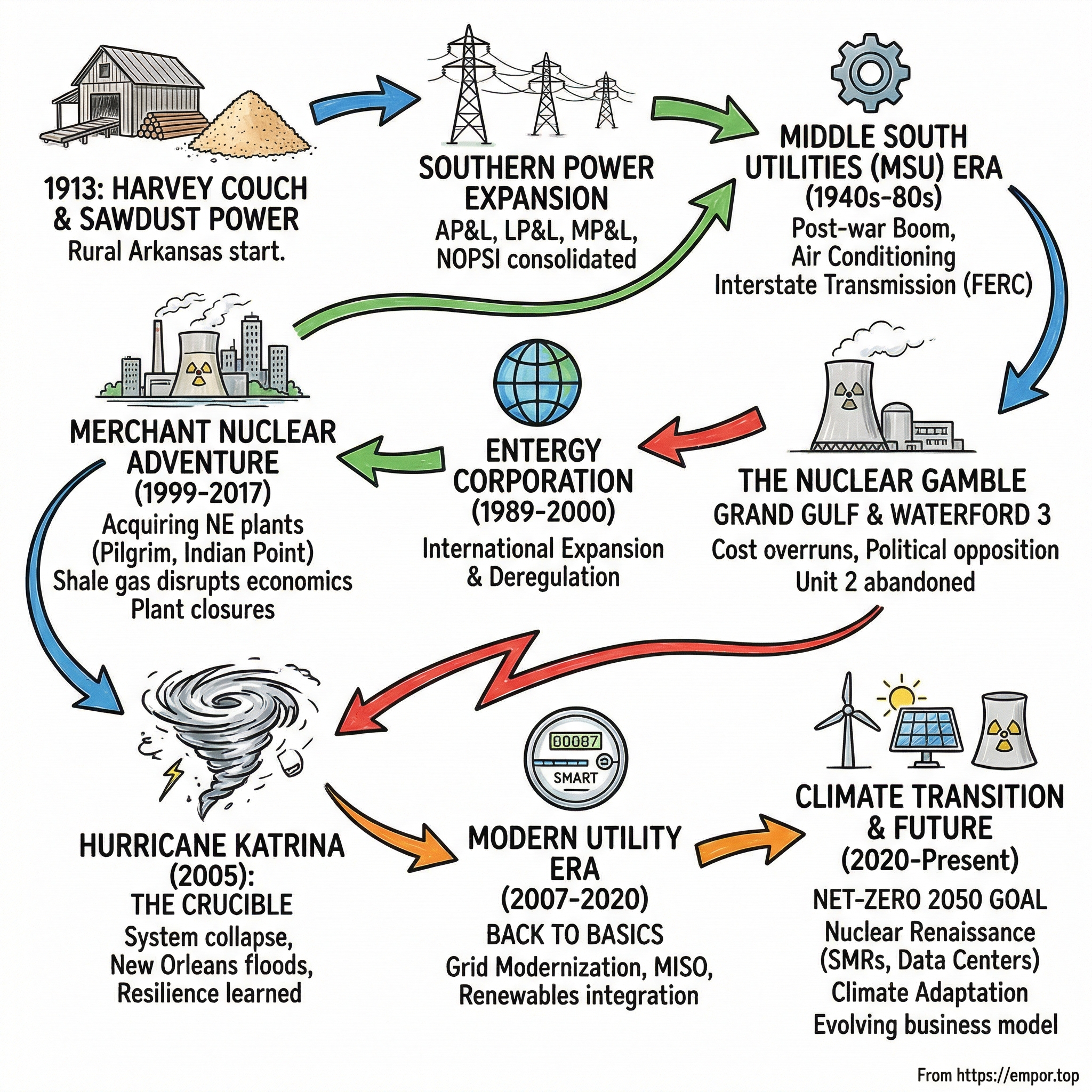
Entergy: Powering the Gulf South for Over a Century
I. Introduction & Episode Roadmap
A stretch of northeast Louisiana in Richland Parish was, until recently, mostly farmland—cotton, soybeans, and timber—the sort of location designated in state economic development brochures simply as available acreage. Today, that parcel hosts what Meta Platforms has described as its largest data center globally: a four-million-square-foot facility spanning 1,400 acres, backed by a $10 billion investment announced on December 6, 2024.1
Powering a campus of that scale requires electrical delivery far beyond the region's historical capacity. That responsibility belongs to Entergy Louisiana, which committed to construct three combined-cycle gas turbine units totaling 2,260 megawatts, alongside nearly 100 miles of new 500-kilovolt transmission lines, eight 230-kilovolt lines, and eight substations.1 The Louisiana Public Service Commission approved the buildout in 2025, and in April 2026 fast-tracked additional generation capacity tied to the same facility.2
This is the image of Entergy that equity markets are currently pricing: a regulated utility positioned at the epicenter of one of the strongest regional electricity demand surges in decades.
Entergy Corporation trades on the New York Stock Exchange under the ticker ETR. It functions as a holding company for five state-regulated operating utilities—Entergy Arkansas, Entergy Louisiana, Entergy Mississippi, Entergy New Orleans, and Entergy Texas—serving approximately three million customers across four states. Its power generation mix spans nuclear, natural gas, and an expanding solar portfolio. In fiscal 2025, Entergy generated $12.95 billion in revenue and $1.77 billion in net income, delivering diluted earnings per share of $3.91.3 For 2026, management guided to adjusted earnings per share of $4.25 to $4.45, targeting long-term annual growth of more than 8% through 2030—supported by a five-year, $67 billion capital expenditure plan.45
The central question of this story is straightforward to pose but complex to resolve: how did an enterprise founded in 1913 to sell power generated from sawmill waste in rural Arkansas become a critical utility partner for hyperscale data centers—and does its operational track record indicate it can execute its largest capital program to date without major disruption?
That distinction is critical because Entergy's historical record demonstrates significant capital allocation missteps.
Entergy's predecessor companies spent over a decade and billions of dollars constructing the Grand Gulf nuclear plant in Mississippi, a project that severely strained the company's finances before management abandoned the facility's second unit when it was two-thirds complete. Decades of regulatory disputes over cost recovery culminated in 2022 with a $300 million settlement with Mississippi regulators and customer refunds across three other jurisdictions.67 Later, during the late 1990s and 2000s, Entergy assembled an unregulated merchant nuclear fleet in the Northeast, betting that power prices would climb in deregulated markets. Instead, the domestic shale gas boom depressed wholesale electricity prices, forcing Entergy to spend the next decade closing or transferring those units—a wind-down completed only in 2022.[^8] Additionally, in September 2005, three weeks after Hurricane Katrina devastated the region, Entergy's New Orleans subsidiary filed for Chapter 11 bankruptcy protection, demonstrating that a holding company structure does not insulate operating units from severe localized shocks.8
Entergy's trajectory thus divides into two distinct eras. The first spans a century of regional consolidation, costly nuclear overreach, and crisis management. The second marks a decade-long restructuring back to pure regulated utility operations—which concluded just as an unexpected surge in industrial power demand reframed the company's growth outlook.
The story unfolds across nine core sections:
- Origins & The Couch Era (1913–1949)
- Middle South Utilities & The Grand Gulf Fiasco (1949–1990s)
- The Merchant Nuclear Trap & Katrina Bankruptcy (1999–2012)
- The Great Pivot: Denault's Clean-Up & the Regulated Grid (2013–2022)
- The Modern Engine: Drew Marsh, Hyperscale Data Centers & the Capital Program (2022–Present)
- Financial Anatomy, Segments & Economic Engine
- Porter's Five Forces & Hamilton Helmer's 7 Powers
- Historical Falsification: Stress-Testing Management & Moat Claims
- Playbook, Bull vs. Bear, & Sources
The central thesis under examination is whether Entergy's current advantages are enduringly structural—rooted in geography, exclusive service territories, baseload nuclear capacity, and high industrial load density—or whether the company is primarily benefiting from favorable timing. Entergy's historical record provides compelling evidence for both arguments.
 Subscribe on LinkedIn
II. Sawdust, Steam, & Regional Interconnection: The Founding Era (1913–1949)
In south Arkansas in 1913, pine timber harvest generated mountains of sawdust—a waste disposal burden that sawmills paid to remove.
Harvey C. Couch recognized that waste as an economic fuel source. A former railway mail clerk turned telephone entrepreneur, Couch entered the electric sector through energy arbitrage rather than technical innovation. He negotiated a contract with Arkansas Land and Lumber Co. to purchase steam generated by a sawdust-fired boiler. On November 13, 1913, he established Arkansas Power Company to construct a transmission line connecting Malvern and Arkadelphia.910
The strategic logic of Couch's initial venture established an operational precedent for the enterprise. Because fuel historically represented the largest variable expense in power generation, securing cost-free industrial waste permitted Couch to supply light and motive power to unserved rural towns at low cost. His model relied on a core economic principle: monetizing stranded energy assets by connecting them to unserved demand.
A century later, Entergy's commercial strategy with hyperscale data centers reflects a similar structural logic: building generation and transmission infrastructure that individual commercial customers cannot independently construct, then monetizing access across its system.
The interstate playbook
Couch expanded beyond local operations during the 1920s by acquiring electric utilities across state lines. In 1923, he merged four independent Mississippi companies into Mississippi Power & Light. Two years later, he established Louisiana Power & Light specifically to transport natural gas from northern Louisiana fields to his Mississippi customer base.9
This cross-border integration represented a foundational strategic shift. Rather than aggregating disconnected franchises, Couch created an integrated multi-state network where fuel sourced in one state generated electricity for customers in another, allowing regional plants to provide mutual backup power. While most contemporary utilities operated as isolated municipal systems—each required to maintain standalone generation capacity for local peak demand—Couch's interconnected grid reduced reserve requirements and lowered average generation costs per kilowatt-hour.
This physical network achieved early scale efficiencies across the Gulf South. On the demand side, Couch focused heavily on agricultural and industrial electrification, supplying power to cotton gins, rice irrigation pumps, and sawmill equipment. Unlike residential lighting customers who consumed power primarily during evening hours, industrial machines operated at high load factors over extended periods, maximizing asset utilization for the power plants.
Entergy's modern position as one of the most industrially concentrated major utilities in the United States reflects this early operational focus on heavy industrial and agricultural loads over residential customer density.
Depression, Washington, and survival
The Great Depression and federal regulation presented a severe test in the 1930s. Couch's operating utilities were subsidiaries of Electric Bond and Share Company (EBASCO), a pyramided holding company targeted by Congress under the Public Utility Holding Company Act of 1935 (PUHCA). PUHCA mandated the breakup of corporate holding structures that owned dispersed, non-integrated utilities unless owners could prove the operating companies formed a physically and operationally integrated system.
Couch's network satisfied that legal threshold. The shared fuel supply, joint transmission infrastructure, and coordinated economic dispatch built during the 1920s demonstrated genuine operational integration, preserving the system under federal scrutiny throughout the 1930s and 1940s.
Following the dissolution of EBASCO, finalized in 1949, the operating companies—Arkansas Power & Light, Mississippi Power & Light, Louisiana Power & Light, and their affiliates—reorganized under a new corporate umbrella, Middle South Utilities.9 Couch had died eight years earlier, in 1941.
The primary structural legacy of Entergy's founding era was its design as an integrated multi-state operating system rather than a federation of isolated local utilities. The physical integration that satisfied federal regulators under PUHCA in 1935 established the regional network that today enables Entergy to transmit power across state lines from facilities in coastal Louisiana to major industrial customers in northern Louisiana.
However, that cross-border operational integration also introduced complex regulatory and financial allocation challenges. Operating an integrated regional system requires multi-jurisdictional rules for allocating large infrastructure expenditures—a governance dynamic that would push Middle South Utilities to the brink of collapse when it undertook its largest nuclear construction project in the 1970s.
III. Middle South Utilities & The Grand Gulf Disaster (1949–1990s)
In 1973, oil prices quadrupled. For a utility system that had relied heavily on cheap Gulf Coast natural gas and fuel oil, the shock posed an immediate threat to the low-cost generation model that underpinned its regional franchise.
Middle South Utilities responded with the strategy adopted across much of the U.S. power sector: nuclear generation. Nuclear power promised minimal fuel expenses and continuous, high-capacity baseload output insulated from global oil supply shocks. The company committed to Arkansas Nuclear One, Waterford 3 in Louisiana, and the flagship Grand Gulf Nuclear Station in Port Gibson, Mississippi—a facility originally designed for two massive boiling-water reactors.
What went wrong, and why it kept going wrong
The cost inflation that struck nuclear construction across the industry during the 1970s and 1980s followed a distinct pattern that remains relevant to large utility capital programs today.
A nuclear power plant is a decade-long construction project subject to evolving regulatory mandates. Following the 1979 Three Mile Island accident, the Nuclear Regulatory Commission significantly expanded safety and design requirements. Projects already underway required extensive redesign and retrofitting mid-construction. Each month of delay accumulated compounding interest on debt financing, pushing total project outlays far beyond initial estimates while generating zero revenue prior to commercial startup.
Grand Gulf Unit 1 exemplified these challenges. Although licensed and brought into commercial service in 1985—remaining the largest single-unit nuclear reactor in the United States, operated by Entergy and 90% owned through a subsidiary6—its final construction cost reached several times original projections. Unit 2 suffered an even worse fate: after years of capital expenditure, construction was abandoned with the reactor two-thirds complete, yielding no power generation or productive asset.
For a capital-intensive utility, abandoning a partially constructed asset represents a severe capital loss—substantial capital committed without producing earning assets. The financial strain triggered decades of regulatory contention over cost allocation.
SERI and the allocation wars
At this juncture, the multi-state network architecture developed during Entergy's founding era created complex jurisdictional friction.
Because Grand Gulf was designed to supply power across the multi-state network rather than solely within Mississippi, Middle South established a subsidiary, System Energy Resources, Inc. (SERI), to hold the asset. SERI sold Grand Gulf's output wholesale to the operating companies under tariffs regulated by the Federal Energy Regulatory Commission (FERC) rather than state commissions. Each operating utility was assigned a mandatory fixed share of Grand Gulf's capacity and costs.
This structural arrangement had significant regulatory implications. State commissions in Arkansas and Louisiana could not directly disallow recovery of Grand Gulf's cost overruns, as the payment obligations were mandated under FERC-approved wholesale tariffs. Consequently, state regulators were forced to challenge the reasonableness of SERI's rates before FERC—initiating litigation that spanned decades.
Subsequent regulatory complaints centered on SERI's accounting treatments for corporate taxes and sale-leaseback transactions. Comprehensive resolutions were reached only in the 2020s. Entergy Mississippi agreed to a settlement valued at approximately $300 million with state regulators, providing customers with $200 million in fuel cost offsets and $35 million in direct bill credits worth roughly $80 per residential account.6 In December 2022, FERC issued orders resolving remaining proceedings, prompting SERI to initiate refunds for customers of Entergy Arkansas, Entergy Louisiana, and Entergy New Orleans.7 Arkansas regulators separately approved a $142 million settlement resolving historic Grand Gulf claims.11
In total, resolving the multi-decade Grand Gulf regulatory disputes cost the enterprise several hundred million dollars in settlements and customer refunds—paid out nearly four decades after the plant began commercial operations.
So what does this tell an investor in 2026?
Three key analytical implications emerge from this history that bear directly on Entergy's current capital cycle:
First, a regulated utility franchise does not guarantee immediate or full cost recovery. It provides a regulatory forum in which cost recovery must be litigated and justified. Entergy spent four decades litigating cost recovery for a single facility, ultimately incurring hundreds of millions of dollars in settlements and refunds.
Second, the multi-state operational structure that generates economic efficiencies also creates multi-jurisdictional political risk. When capital assets located in one jurisdiction are funded by ratepayers across four states, regulatory commissions in each state hold jurisdiction and incentive to scrutinize cost allocations.
Third, large-scale capital builds recreate historical allocation questions. Entergy is once again executing major, long-lived generation and transmission projects whose capital costs require multi-jurisdictional approval, while their benefits serve large industrial and hyperscale customer concentrations. While the assets have shifted from Grand Gulf to facilities like Richland Parish, the core governance challenge of cost allocation remains unchanged.
By the late 1980s, Middle South's primary objective was financial stabilization. To recover, the enterprise rebranded, consolidated operations, and sought growth opportunities beyond its core regulated market.
IV. The Merchant Nuclear Trap & Katrina's Crucible (1999–2012)
Middle South Utilities rebranded as Entergy Corporation in 1989—combining "enter" and "energy" to distance the business from the turbulent Grand Gulf era. In 1993, the company completed a merger with Gulf States Utilities, expanding its service territory into Texas and southwest Louisiana while acquiring River Bend, another nuclear facility burdened by construction cost overruns. The transaction established Entergy's modern four-state operating footprint.
Then came power market deregulation, leading to one of the most consequential strategic missteps in the company's history.
The thesis, and why it was seductive
During the late 1990s, states across the Northeast and Midwest restructured their electricity markets. Deregulation compelled or incentivized vertically integrated utilities to sell generating stations. Independent buyers could then operate those facilities as merchant generators—selling power into wholesale markets at market clearing prices rather than under regulated, cost-plus rate structures.
Nuclear facilities were widely viewed at the time as toxic balance-sheet liabilities. Plagued by operational complexity, future decommissioning liabilities, and a history of construction cost inflation, many utility boards sought to divest them. Consequently, nuclear assets traded at steep market discounts.
Entergy's leadership identified an operational opportunity. Armed with experience operating four nuclear reactors in the Gulf South, management wagered that nuclear operating expertise was the scarce capability. The strategic rationale was straightforward: acquire distressed reactors at a fraction of replacement cost, maintain high capacity factors, sell the baseload output into wholesale markets, and capture the margin spread.
Between 1999 and the mid-2000s, Entergy assembled a major merchant nuclear fleet: Pilgrim in Massachusetts, Indian Point Units 2 and 3 in New York, FitzPatrick in upstate New York, Vermont Yankee in Vermont, and Palisades in Michigan. Operating under a non-regulated subsidiary later named Entergy Wholesale Commodities, the segment became one of the largest merchant nuclear portfolios in the United States.
For several years, the economic model delivered strong returns. Rising natural gas prices throughout the 2000s elevated wholesale power rates, as gas-fired units frequently served as the marginal generators setting market clearing prices. Because nuclear plants operate with low variable fuel costs, higher wholesale power prices translated directly into expanded operating margins.
The thesis breaks
The primary vulnerability was not operational performance; Entergy maintained high capacity factors across the merchant fleet. Rather, the entire business segment represented an unhedged, leveraged bet on sustained natural gas prices—a commodity assumption that proved flawed.
The rapid commercialization of hydraulic fracturing and horizontal drilling unlocked domestic shale gas at a pace unaccounted for in traditional utility planning. Natural gas prices, which traded near or above $8 per million British thermal units in the mid-2000s, dropped into the $2 to $4 range for much of the 2010s. Regional wholesale electricity prices declined in tandem. The margin spread that justified the acquisition strategy compressed and ultimately inverted: burdened by heavy fixed operating costs, stringent regulatory compliance, and physical security overhead—without sufficient capacity revenues to bridge the gap—the merchant units generated ongoing cash losses.
This financial exposure was compounded by operational asymmetry. Unlike fossil-fuel plants that can reduce generation during low-price periods, a nuclear facility cannot economize during market downturns. Staffing, security, regulatory compliance, and routine maintenance remain fixed costs regardless of output. When wholesale market prices fall below a plant's fixed operating cost per megawatt-hour, management's primary recourse is permanent shutdown.
Consequently, over the next eight years, Entergy systematically retired or transferred the merchant reactors.
Katrina, and the limits of the parent company
Before the merchant nuclear unwind began, the enterprise absorbed a distinct operational and financial shock in its core regulated territory.
On August 29, 2005, Hurricane Katrina struck the Gulf Coast, causing grid destruction on a scale unprecedented in the utility industry. The storm downed transmission structures, destroyed distribution networks, and submerged New Orleans' underground electric and gas infrastructure while much of the city's population evacuated.
Entergy New Orleans faced a severe financial mismatch: immediate capital outlays required for system restoration alongside a collapse in ratepayer revenue. The subsidiary claimed roughly $620 million of damage to its electric and gas systems.8 With restoration spending required immediately and ratepayer cash flow severely diminished, operating cash flows evaporated.
On September 23, 2005, Entergy New Orleans filed for Chapter 11.[^13]
This filing underscored the structural limitations of holding-company corporate architecture. While holding company Entergy Corporation and its other operating subsidiaries remained solvent, the parent structure did not absorb the localized financial crisis, allowing its municipal utility subsidiary—the sole provider of power and gas in New Orleans—to enter bankruptcy proceedings during a major urban disaster.
Financial restructuring relied on public funding, insurance recoveries, and local regulatory relief rather than parent-level equity injections. The recovery package included roughly $200 million in Community Development Block Grants, about $250 million in insurance recoveries, and a New Orleans City Council–approved rate increase of about 8%.12 With funding secured, Entergy New Orleans emerged from Chapter 11 in May 2007.12
So what for investors
The 1999–2012 period provides two critical analytical lessons that bear directly on how investors should evaluate management's current strategic positioning:
First, the enterprise executed a major capital allocation strategy based on a long-term commodity price forecast that proved structurally flawed. The merchant nuclear thesis represented a plausible market view in the mid-2000s, but it was upended by technological disruption in an adjacent industry. Entergy's current growth strategy similarly rests on long-term demand projections from hyperscale technology firms; while the underlying risk drivers differ, the structural risk pattern remains analogous.
Second, severe weather events in the Gulf South represent recurring operational realities with direct balance-sheet consequences rather than isolated tail risks. The bankruptcy of Entergy New Orleans demonstrates that holding-company diversification does not automatically shield individual operating subsidiaries or their local customer bases from severe storm shocks.
Both challenges confronted an incoming chief executive officer in 2013, initiating a multi-year restructuring back toward pure-play regulated utility operations.
V. The Great Clean-Up: Denault's Exit & Pure-Play Pivot (2013–2022)
Leo Denault became chief executive officer of Entergy in February 2013, transitioning from the chief financial officer role with a direct understanding of the financial drain created by the merchant generation business.
At that time, equity markets priced pure-play regulated utilities at a premium due to their predictable earnings structure: regulators establish an allowed rate of return on an approved asset base, generating stable cash flows. In contrast, Entergy held a sizable portfolio of unregulated merchant nuclear plants whose earnings fluctuated with wholesale power prices—prices that declined persistently through the mid-2010s. Investors discounted Entergy's valuation not only for the recurring segment losses, but for the earnings volatility and the strategic risks associated with merchant market exposure.
Denault's strategic priority focused on simplifying the business model and repositioning Entergy as a pure-play regulated utility.
Dismantling the fleet
The divestment process spanned nearly a decade. Each facility required a formal retirement decision, a comprehensive decommissioning strategy, regulatory approvals from state authorities and the Nuclear Regulatory Commission, and a buyer willing to assume long-term liabilities.
Vermont Yankee ceased generation at the end of 2014 and was sold to NorthStar in January 2019. FitzPatrick—which Entergy initially planned to retire—was sold to Exelon in March 2017, remaining operational under a buyer with a different regional portfolio. Pilgrim ceased operations and was transferred to Holtec International in August 2019. Indian Point Units 2 and 3 were transferred to Holtec in May 2021 following their retirements. Palisades shut down permanently on May 20, 2022 and was sold to Holtec on June 28, 2022, completing the exit.[^8]
Two structural features characterized that divestment schedule.
First, the primary acquirers were decommissioning specialists rather than utility operators. Holtec's business model involved acquiring retired plants along with their dedicated decommissioning trust funds, executing dismantlement below projected costs, and retaining the remaining capital. This structure reflected the terminal valuation of those merchant assets: minimal value as generating units, but defined value as funded decommissioning projects. In practice, Entergy paid to transfer long-term balance-sheet liabilities.
Second, the exit required eight years to complete. Disinvesting from nuclear generation cannot be executed rapidly. That illiquidity highlights the inherent risk of introducing unhedged commodity exposure into a capital-intensive utility: when market fundamentals shift, exiting the position requires years of regulatory and operational restructuring.
Throughout this period, Entergy recorded substantial asset impairment charges to adjust the carrying value of its merchant fleet to market reality. Ultimately, a merchant expansion originally intended to enhance earnings produced a decade of financial write-downs and a business segment whose net asset value turned negative.
Joining MISO
Parallel to the merchant wind-down, Entergy executed an operational integration with long-term strategic implications. In December 2013, Entergy's operating companies joined the Midcontinent Independent System Operator (MISO), transferring functional control of their regional transmission system to an independent grid operator.
Prior to joining MISO, each Entergy operating utility dispatched its own power plants primarily to meet local customer demand within its service territory. Under MISO, a centralized market operator dispatches generation resources across a multi-state footprint based on lowest marginal cost. Entergy's generating facilities began competing within a broader regional pool—meaning if a third-party generator elsewhere in MISO could supply electricity more cost-effectively during a given hour, the market dispatched that power.
For a regulated utility whose earnings derive from capital returns on rate base rather than energy margins, this system provided operational cost efficiencies for ratepayers, strengthening regulatory relationships across its state jurisdictions. Crucially, joining MISO also integrated Entergy into a regional transmission planning framework at a time when large-scale transmission capacity was becoming essential to support regional demand growth.
So what for investors
By the time Denault retired as chief executive in late 2022, Entergy had restructured its operations into a simplified enterprise: five state-regulated utilities, a nuclear fleet fully integrated into the regulated rate base, zero merchant market exposure, and full operational integration within a regional grid operator.
Analytically, this transformation represented an operational recovery rather than a novel growth initiative. Management executed a complex multi-year exit without triggering a liquidity crisis. However, the restructuring was required to unwind a prior capital allocation strategy. Investors evaluating Entergy's forward strategy must weigh both aspects of its corporate record: management demonstrated the operational discipline to dismantle an unprofitable strategy, following a period in which the enterprise assumed significant strategic risk.
The completion of this pure-play pivot coincided with an unexpected surge in regional industrial electricity demand.
VI. The Modern Engine: Drew Marsh, Hyperscale AI, & The Grid Buildout (2022–Present)
In January 2024, that regional demand surge materialized in Mississippi when the Mississippi Development Authority announced that Amazon Web Services would invest $10 billion to construct two data center complexes in Madison County—the largest single capital investment in state history, expected to create at least 1,000 permanent jobs.13 The project included a dedicated arrangement with Entergy Mississippi: Amazon agreed to support roughly 650 megawatts of new renewable generation in the state over three years, with funding directed toward grid infrastructure and structured to avoid shifting costs to existing retail customers.13
For an operating utility in a state with among the lowest median household incomes in the nation, hyperscalers represented a novel customer class: capital-intensive, highly creditworthy, and unconstrained by geographic location provided power delivery is reliable, scalable, and increasingly clean.
The man running it
Drew Marsh assumed the role of chief executive officer in November 2022 after serving as Entergy’s chief financial officer since 2013—placing him in top financial leadership throughout the company's decade-long merchant fleet divestment. He added the chairman title in 2023.
That executive background carries direct analytical weight. Marsh did not inherit the legacy merchant liabilities as an external hire; he spent ten years approving asset impairments, negotiating fleet disposals, and explaining recurring write-downs to equity markets. Having managed the liquidation of an unhedged merchant portfolio, management's current approach reflects direct operational experience with the structural risks of illiquid capital commitments and volatile commodity pricing.
Chief Financial Officer Kimberly Fontan, a nearly 30-year Entergy veteran and former chief accounting officer, succeeded Marsh in the finance role in 2022. In a rate-regulated utility where regulatory asset accounting, storm-cost deferrals, and debt securitization directly determine net income, appointing a technical accounting specialist underscores the central role of rate-case accounting in driving corporate returns.
Executive compensation remains weighted toward cumulative adjusted earnings per share (EPS) growth, operational metrics including storm restoration efficiency, and relative total shareholder return. While standard across the utility sector, this structure creates a known operational dynamic: because rate-base expansion mechanically expands reported earnings when regulators approve capital outlays, EPS-linked incentives reward total capital deployment rather than capital selectivity.
The demand shock, in numbers and in mechanism
Entergy's service territory was an operational growth outlier even before generative artificial intelligence accelerated regional power requirements. The Louisiana and Texas Gulf Coast contains a heavy concentration of liquefied natural gas (LNG) export terminals, petrochemical complexes, refineries, and industrial gas facilities that consume continuous baseload power.
The arrival of hyperscale data centers accelerated that underlying industrial demand.
By the second quarter of 2026, management identified a probability-weighted hyperscale project pipeline of 7 to 12 gigawatts, alongside an additional 3 to 5 gigawatts of prospective demand from traditional industrial customers.14 To contextualize that volume, Entergy's total owned generation capacity stands at approximately 24 gigawatts; full conversion of the commercial pipeline would require expanding the system by more than 50%.
This demand expansion is already visible in reported operating results. In the second quarter of 2026, weather-adjusted industrial sales expanded approximately 10% year-over-year, with industrial customers accounting for roughly 48% of Entergy's total weather-adjusted retail sales.4
That 48% industrial concentration represents the defining structural feature of Entergy's commercial profile. Unlike typical electric utilities dominated by weather-sensitive residential and commercial demand, Entergy sells nearly half its volume to industrial facilities operating continuously around the clock. This high load factor maximizes asset utilization, spreading fixed plant and transmission costs over high sales volumes to lower average system costs per kilowatt-hour.
However, heavy industrial concentration introduces distinct cyclical vulnerabilities. Petrochemical and LNG power consumption fluctuates with global commodity margins and trade policies, while data center load relies on a concentrated group of technology counterparties whose capital allocation cycles can shift far faster than the 40-year depreciation life of utility grid infrastructure.
The capital plan, and how fast it has grown
To accommodate this demand expansion, management rapidly escalated its multi-year capital outlay:
- A 2024–2027 plan initially budgeted at roughly $43 billion;
- Raised to approximately $57 billion for the 2025–2028 period;
- Expanded further to roughly $67 billion over five years, as presented at the June 2026 investor update and reaffirmed on the second-quarter 2026 earnings call.45
Management paired this capital program with projected mid-teens annual rate-base growth and an adjusted EPS target of $6.40 for 2029, targeting long-term annual earnings growth above 8% through 2030, including approximately 12% growth projected in 2030.5
Capital outlays are directed into three primary categories: transmission infrastructure and grid resiliency, new generation facilities—comprising combined-cycle natural gas, utility-scale solar paired with battery storage, and nuclear power uprates and life extensions—and distribution grid modernization. The Meta Platforms project alone accounts for more than $15 billion of potential infrastructure outlays.4 In Arkansas, Entergy Arkansas secured regulatory approval for the Cypress Solar project, a 600-megawatt solar facility paired with 350 megawatts of battery storage.15
Funding a capital plan of this magnitude has required substantial equity issuance. In May 2026, Entergy completed a $2.175 billion equity forward offering, settling 8.7 million shares in June for approximately $672 million in net proceeds. Management noted that roughly 60% of its five-year equity requirement was contracted through 2028, out of approximately $6.6 billion in total equity issuance planned through 2029.145 Credit metric targets—maintaining CFO pre-working capital to debt above 14% and funds from operations (FFO) to debt above 13%—were projected to remain above rating agency downgrade thresholds through 2030.5
From an investment perspective, Entergy is executing an equity-funded capital expansion in which existing shareholders absorb near-term share dilution to build a larger rate base. That financial strategy delivers accretive value only if state utility commissions approve full cost recovery at authorized rates of return that exceed the company's cost of capital.
"Fair Share Plus," and the politics of the bill
Management recognized early that the primary political vulnerability of this expansion is not customer interest, but ratepayer equity—specifically the risk that residential customers in lower-income service territories bear the cost of transmission infrastructure built for hyperscale tech firms.
To address regulatory scrutiny, Entergy implemented a commercial framework termed "Fair Share Plus" across hyperscale contracts beginning in 2024. Under this structure, large new industrial customers pay the direct costs of their dedicated infrastructure, contribute to baseline system fixed costs, and provide contractual protections against stranded asset liabilities. Management quantified the cumulative customer bill benefits from these signed agreements at approximately $7 billion.14 In the Meta agreement, the customer shares in formula rate plan obligations, storm securitization costs, and system resiliency investments, which Entergy projected would reduce expenses for existing retail customers by over $300 million.1
State and federal policy aligned with this regulatory approach. Louisiana's governor issued an executive order requiring data centers seeking sales tax exemptions to demonstrate tangible ratepayer benefits, while Entergy executives appeared alongside Meta representatives and state officials at a White House ratepayer protection event.14
Two analytical caveats apply to these protections:
First, the projected $7 billion in customer benefits represents management's long-term internal model calculation rather than an audited or regulator-certified metric.
Second, Fair Share Plus relies on contractual obligations, which protect utility revenues only as long as counterparties remain solvent and operationally committed. Contractual remedies provide limited insulation if a technology customer alters its capital deployment strategy early in a 20-year grid asset's lifecycle. While Entergy maintains collateral requirements, the exact proportion of long-term capital liabilities covered by collateral remains undisclosed.
Where the friction already shows
Regulatory friction has already emerged in execution. Entergy sought to acquire the 1,235-megawatt Cottonwood combined-cycle natural gas plant in Texas, contending the purchase offered the most cost-effective path to serve existing industrial load and non-data-center growth. However, a June 2026 Louisiana Public Service Commission staff analysis indicated the acquisition could add up to $7 per month to a standard 1,000 kilowatt-hour residential bill, prompting Entergy to pause the transaction.16 On the second-quarter 2026 earnings call, equity analysts questioned management on this rate impact, nuclear development timelines, and whether MISO's southern transmission planning can accommodate industrial load growth that has outpaced original capacity assumptions.14
Management's commentary on new nuclear development was similarly cautious. When asked about initiating new nuclear construction, Drew Marsh noted, "I don't think we're near where we need to be just yet to be successful in launching."14 That measured assessment contrasts with broader industry narrative expansion in 2026, acknowledging the substantial lead times and regulatory hurdles facing nuclear development.
So what for investors
Entergy is deploying the largest capital program in its history into verified, materializing demand—a trend substantiated by double-digit industrial sales growth. The core uncertainty facing the enterprise is not demand volume, but execution: navigating complex regulatory cost recovery, managing large-scale construction risks, and preserving political support for an infrastructure expansion that relies on industrial counterparties fulfilling long-term financial commitments.
Evaluating whether that expansion generates durable shareholder value requires examining precisely how a rate-regulated utility converts capital expenditure into net earnings.
VII. Financial Anatomy, Operating Segments, & Economic Engine
Strip away the storm responses, nuclear units, and hyperscale artificial intelligence narrative, and a regulated electric utility operates on one of the simplest—and most frequently misunderstood—business models in corporate finance.
The formula
At its core, a regulated utility does not generate profits by selling higher volumes of electricity. It earns income by investing capital that regulators permit it to earn an authorized return upon.
The underlying process is straightforward: the utility constructs capital assets—generating plants, transmission towers, substations, and meters. Regulatory commissions audit those expenditures, and if deemed prudent and operational, incorporate them into the approved rate base. The commission establishes an allowed return on equity for the equity-financed portion of that rate base. Rates charged to retail customers are subsequently calibrated to cover baseline operating expenses, fuel, depreciation, taxes, and that authorized equity return.
Net earnings fundamentally equal the approved rate base multiplied by the allowed return on equity, adjusted for the portion of authorized returns the utility actually achieves in practice.
Three core structural implications shape management behavior under this model:
First, earnings expansion stems from capital deployment rather than sales volume. While traditional businesses grow by expanding unit sales at a profit margin, a regulated utility passes through higher kilowatt-hour generation primarily as raw fuel costs, which are trued up in regulatory reconciliations. To expand net earnings, the utility must enlarge its capital asset base. This structural dynamic explains why utility investor presentations prioritize capital expenditure targets, framing Entergy's five-year, $67 billion capital plan as a key earnings growth engine rather than an operational cost burden.
Second, raw fuel expenses generate no profit margin. Fuel and purchased power costs are passed directly to ratepayers through fuel adjustment mechanisms. When natural gas prices spike, retail bills rise while utility net earnings remain largely unchanged. This arrangement shields the regulated income statement from underlying commodity volatility—a marked contrast to the unhedged commodity exposure Entergy assumed during its merchant nuclear era.
Third, corporate financial returns depend entirely on regulatory decisions. Authorized returns on equity reflect administrative rulings by state commissioners in Louisiana, Mississippi, Arkansas, and Texas rather than competitive market outcomes. As of mid-2026, authorized returns across Entergy's operating jurisdictions spanned a wide range—from roughly 8.85% to 12.14%, depending on the specific cost-recovery mechanism and regulatory jurisdiction.4
The five operating companies
Entergy operates as a pure-play holding company managing five state-regulated utility subsidiaries, each overseen by a distinct regulatory authority:
Entergy Louisiana represents the largest operating subsidiary by a wide margin. Serving the industrial corridor from Baton Rouge through the river parishes to the New Orleans suburbs under the Louisiana Public Service Commission, it holds the Waterford 3 and River Bend nuclear plants, hosts the Meta Platforms data center expansion, and absorbs the majority of the corporate capital budget.
Entergy Arkansas, the foundational utility established by Harvey Couch, operates under the Arkansas Public Service Commission. It houses the two nuclear reactors at Arkansas Nuclear One alongside the Cypress Solar facility.
Entergy Texas serves southeast Texas around Beaumont and the northern Houston exurbs under the Public Utility Commission of Texas. Operating within the MISO regional grid rather than the Electric Reliability Council of Texas (ERCOT), its dispatch and transmission economics differ significantly from most Texas utilities.
Entergy Mississippi serves the Amazon Web Services data center development under the Mississippi Public Service Commission, benefiting from 2026 state legislation that authorized securitized financing for storm restoration expenditures.15
Entergy New Orleans remains the smallest and structurally unique operating unit. Regulated by the New Orleans City Council rather than a state commission, it operates under direct municipal political oversight—a governance dynamic highlighted during its 2005 Chapter 11 bankruptcy filing following Hurricane Katrina.
Above these five operating companies sits System Energy Resources, Inc. (SERI), which retains ownership of the Grand Gulf nuclear plant and sells wholesale power to the retail subsidiaries under Federal Energy Regulatory Commission (FERC) jurisdiction.
In the second quarter of 2026, the core utility operations generated $626 million in net earnings, or $1.34 per share, compared to $599 million and $1.34 per share in the prior-year period. However, consolidated adjusted earnings per share stood at $1.03 after factoring in parent-level holding company expenses.17 The 31-cent variance between operating utility earnings and consolidated results reflects holding-company debt service and administrative overhead—underscoring how parent-level leverage creates a persistent drag between subsidiary operational performance and reported net income.
The storm machine
The most distinct structural mechanism across Entergy's financial profile is its framework for managing severe storm recovery costs.
When hurricanes strike the Gulf Coast, system restoration requires immediate, large-scale capital outlays—deploying contract line crews, replacing distribution poles and transmission conductors, and rebuilding substations. Unmitigated, these sudden outlays would create severe balance-sheet liquidity pressure or force immediate retail rate increases.
To manage this risk, state legislatures and regulators across the Gulf South established storm cost securitization frameworks. Under this structure, regulators audit storm expenditures and authorize the utility to recover approved costs through dedicated, non-bypassable surcharges on customer bills. This revenue stream is legally segregated and assigned to a special-purpose financial entity that issues low-cost, AAA-rated securitization bonds. Entergy receives upfront cash proceeds to replenish liquidity and retire short-term restoration debt, while the low-cost bonds are amortized over time through customer bill surcharges.
Mississippi enacted its own storm securitization legislation in 2026, extending this financing structure across Entergy's entire four-state operating footprint.15
While storm securitization protects holding-company liquidity and balance-sheet credit metrics following extreme weather events, it does not eliminate the cost to end users. Securitized debt service remains embedded in retail customer bills for extended multi-year periods. Layering a $67 billion capital expansion program on top of existing storm recovery surcharges heightens retail rate pressure—making political and regulatory tolerance for rate increases a central risk factor for the company's long-term growth plan.
So what for investors
Entergy's economic model provides a structured framework for converting physical capital deployment into expanding rate base and converting storm recovery outlays into financeable regulatory assets. However, the business model contains a fundamental structural vulnerability: every projected dollar of rate-base growth and earnings expansion depends on five distinct regulatory bodies approving cost recovery and authorized returns—within service territories characterized by low median household incomes—during the largest capital expenditure cycle in the enterprise's history.
This regulatory reliance shifts the analytical focus to the structural protections and competitive moats that safeguard Entergy's operating franchises.
VIII. Competitive Landscape, Porter's 5 Forces, & Hamilton Helmer's 7 Powers
The peer set
Entergy is typically evaluated alongside Southern Company, Duke Energy, American Electric Power, NextEra Energy, and CenterPoint Energy. While all operate large, regulated electric utility systems—and several are similarly capitalizing on expanding data center demand—Entergy possesses distinct structural differences.
The commercial distinctions require precise definition, as the narrative of a utility serving data center expansion has become widespread across equity markets.
Entergy's industrial share of sales—approaching half of weather-adjusted retail volume—stands significantly above the sector average, where residential and commercial demand traditionally dominate.4 Its service territory directly encompasses the Gulf Coast liquefied natural gas (LNG) and petrochemical export hub, an industrial concentration unmatched by peer utility footprints. Furthermore, Entergy operates a nuclear fleet positioned entirely within its regulated rate base, contrasting with peers that maintain merchant or partially merchant nuclear exposure. It also bears hurricane exposure that, among large-cap peers, is matched by few in severity and frequency.
By comparison, NextEra Energy pairs a regulated Florida utility with the nation's largest utility-scale renewables development enterprise, creating a fundamentally different risk profile driven by contracted project development alongside rate-base growth. Southern Company's defining strategic experience centered on constructing new nuclear reactors at Plant Vogtle—a megaproject that incurred massive cost overruns and years of schedule delays, highlighting the execution risks inherent in new nuclear construction.
Porter's Five Forces
Threat of new entrants: effectively nil. State franchises grant exclusive retail service rights within defined geographic territories, creating a legally sanctioned monopoly structure. The capital cost of duplicating transmission and distribution networks is economically prohibitive, and state utility commissions would not authorize redundant infrastructure. The primary long-term competitive threat arises not from competing utilities, but from major industrial customers constructing on-site, behind-the-meter generation.
Bargaining power of suppliers: rising significantly. While raw fuel costs pass directly through to retail ratepayers, neutralizing traditional fuel supplier leverage, the electrical equipment supply chain has become a primary operational constraint. High-voltage transformers, switchgear, and large gas turbines manufactured by a concentrated group of original equipment manufacturers carry multi-year lead times. With utility capital deployment accelerating across the sector simultaneously, equipment suppliers hold substantial pricing power and schedule control—representing a critical execution risk across utility capital plans.
Bargaining power of buyers: bifurcated and asymmetric. Residential customers possess no choice of electric provider, yet their political voice influences state utility commissions that establish authorized returns on equity. Conversely, large industrial customers hold material leverage: they can self-generate power, select alternative regions for capital deployment, or—in the case of hyperscale technology firms—negotiate across multiple state jurisdictions competing for major facility investments. The most influential buyer dynamic combines the single largest customer class with the regulatory bodies that govern rate recovery.
Threat of substitutes: low in the short term, but structurally relevant. Distributed rooftop solar and customer-sited battery storage have penetrated the Gulf South slowly due to low prevailing retail electricity rates and limited residential capital for upfront installations. However, substitution risk is more pronounced among large commercial and industrial users. If hyperscalers determine they can permit and construct dedicated on-site generation or small modular reactors faster than a utility can complete grid interconnection, the utility's role risks contracting from primary energy supplier to secondary backup provider.
Competitive rivalry: structurally low. Entergy does not compete directly with Southern Company or Duke Energy to serve existing customers within its franchised territories. Instead, rivalry centers on corporate siting decisions—whether a new hyperscale campus or industrial facility locates in Louisiana versus Georgia—a dynamic mediated by state tax incentives, site availability, water access, and grid interconnection speed.
Hamilton Helmer's 7 Powers
Evaluating Entergy against Hamilton Helmer's framework reveals three powers with tangible application, while the remainder are largely absent.
Cornered Resource. Entergy operates a fleet of regulated nuclear facilities—Grand Gulf, Waterford 3, River Bend, and Arkansas Nuclear One—that generate substantial volumes of continuous, carbon-free electricity. In a market where hyperscale technology companies require 24/7 clean power commitments, existing operating nuclear reactors represent scarce, difficult-to-replicate infrastructure, given that permitting and constructing new utility-scale reactors requires more than a decade.
A critical qualification applies to this advantage: because these nuclear units operate inside regulated rate bases, Entergy cannot capture market-clearing scarcity premiums for its output. Instead, the utility earns its authorized return on equity regardless of wholesale power prices. The nuclear fleet functions primarily as a customer acquisition asset—helping secure major facility siting decisions—rather than a source of uncapped profit margins.
Scale Economies. The multi-state integrated grid, coordinated through MISO, distributes reserve requirements and operational dispatch efficiency across a regional footprint far larger than any single operating utility could achieve independently—a structural advantage originating in the company's founding era.
Process Power / Counter-Positioning: essentially absent. Entergy operates without proprietary processes that industry peers cannot replicate, nor does it employ a business model that incumbent competitors are structurally disincentivized to adopt.
Switching Costs and Branding: minimal in the analytical sense. Captive retail customers cannot switch providers due to legal franchise protection rather than commercial switching costs, and utility brands confer no pricing power.
Network Economies: absent at the business level, despite the physical interconnectedness of the electrical transmission grid.
The strategic conclusion is narrower than a broad economic moat assertion: Entergy maintains a legally protected utility franchise over a geographic region featuring dense industrial demand and expanding hyperscale interest, supported by an existing baseload nuclear fleet that aids in attracting large electrical loads. The regulatory franchise protection is genuine. Whether that advantage translates into sustained shareholder returns depends on execution discipline and regulatory cost recovery—bringing the analysis to the point where management claims encounter the historical record.
IX. Historical Falsification Layer: Stress-Testing Management & Moat Claims
Every investment thesis rests on a set of core assumptions. Rather than listing these assumptions uncritically, a rigorous analysis tests them against the strongest historical evidence that could disprove them, evaluating what structural logic withstands scrutiny.
Claim 1: "Regulation is a reliable moat that protects returns."
The disconfirming record: four decades of SERI litigation.
If a regulated franchise provided an unassailable shield for capital returns, Entergy would not have spent forty years litigating cost allocations for a single nuclear facility before issuing multi-million-dollar settlements and ratepayer refunds. The regulatory resolution in Mississippi required a settlement valued at approximately $300 million.6 Federal Energy Regulatory Commission orders issued in December 2022 mandated refunds to customers across Arkansas, Louisiana, and New Orleans,7 while Arkansas regulators separately finalized a $142 million settlement.11
The verdict: the claim survives in narrowed form. Regulation reliably provides an administrative mechanism for capital recovery and a predictable average return over extended operational cycles. However, it offers no guarantee of full cost recovery on any individual asset, and it can create long-dated, unquantifiable liabilities when regulatory bodies determine that past cost allocations were unreasonable. The narrowed claim holds that Entergy can earn near its authorized return in aggregate over a full cycle, while major individual capital projects carry ongoing disallowance and refund risks that may take decades to resolve.
What would confirm or falsify the narrowed version: tracking realized returns on equity against authorized rates across each operating jurisdiction over multiple years, alongside any regulatory order disallowing capital recovery for data-center-related transmission infrastructure.
Claim 2: "Management is a disciplined capital allocator."
The disconfirming record: the merchant nuclear fleet.
The merchant nuclear expansion represents the most significant counterevidence in Entergy's recent operational history. Management assembled a fleet of distressed Northeast reactors based on a thesis of elevated wholesale power prices. When domestic shale gas production depressed wholesale rates, the business model collapsed. The resulting unwind spanned eight years of plant closures, asset sales, and recurring impairments—beginning with the shutdown of Vermont Yankee in 2014 and concluding with the sale of Palisades in June 2022 to decommissioning specialists.[^8]
For investors evaluating current executive leadership, Drew Marsh served as chief financial officer throughout that entire merchant fleet liquidation from 2013 to 2022. While he did not initiate the merchant bet, he managed its multi-year write-down and exit.
The verdict: the claim remains unproven. The historical record demonstrates corrective discipline—specifically, management's willingness to recognize a value-destroying position and execute an orderly exit. It does not yet establish forward capital allocation discipline at scale, as the current $67 billion capital plan is an order of magnitude larger than any program deployed under current leadership.
Furthermore, utility executive compensation structures tied to cumulative earnings-per-share growth inherently reward rate-base expansion. Elevating a five-year capital budget from $43 billion to $57 billion, and subsequently to $67 billion within roughly two years, represents an extraordinary rate of capital expansion that requires rigorous ongoing verification. Conversely, management's decision to pause the Cottonwood plant acquisition following adverse analysis from utility commission staff demonstrates a capacity to withdraw from transactions under regulatory resistance.16 However, a single transaction pause does not constitute a comprehensive capital allocation track record.
What would confirm or falsify it: whether final in-service construction costs for the Richland Parish generation and transmission buildout match initial estimates, and whether state commissions disallow any portion of those capital outlays. The severe cost overruns at Plant Vogtle serve as the industry standard for how megaproject delays erode utility balance sheets.
Claim 3: "The holding company structure protects against catastrophic events."
The disconfirming record: Entergy New Orleans, Chapter 11, September 2005.
Entergy New Orleans filed for Chapter 11 bankruptcy protection weeks after Hurricane Katrina struck the Gulf Coast, citing approximately $620 million in physical damage to its electric and gas distribution networks.8[^13] The subsidiary emerged from bankruptcy in May 2007 only after securing roughly $200 million in federal Community Development Block Grants, approximately $250 million in insurance proceeds, and a city council–approved rate increase.12
The verdict: the original claim is rejected, but a secondary protection mechanism survives. The holding company structure did not prevent a municipal subsidiary from entering Chapter 11, and corporate solvency relied on public disaster funds rather than parent-level equity support. The surviving reality is that the broader holding enterprise absorbed a severe regional shock without parent-level insolvency, and subsequent legislative securitization frameworks provide a stronger liquidity mechanism than existed in 2005.
Entergy has since weathered major storms—including Hurricanes Laura, Delta, Zeta, and Ida—without subsidiary bankruptcies by utilizing state-authorized securitization bonds to finance restoration costs. However, storm events of Katrina's magnitude occur on multi-decade horizons, and post-2005 securitization models have not yet been tested against a comparable urban catastrophe. The financial risk has been mitigated through structured debt mechanisms, but not eliminated.
What would confirm or falsify it: the timing and approval process of securitization financing following a Category 4 or 5 hurricane hitting a major metropolitan center within Entergy's service territory.
Claim 4: "Data center growth is clean, accretive optionality."
The disconfirming record: emerging regulatory and customer friction.
The commercial expansion surrounding hyperscale data centers is generating immediate political and regulatory scrutiny across Entergy's jurisdictions. In Mississippi, statutory provisions shielding details of the Amazon Web Services contract sparked criticism from consumer watchdogs and regulatory questions regarding potential retail rate cross-subsidization. In Louisiana, fast-tracked regulatory approvals for gas-fired generation tied to the Meta Platforms facility drew formal opposition from environmental advocacy groups.2 Meanwhile, the pause on the Cottonwood facility acquisition followed commission staff projections showing a potential $7 monthly rate increase for standard residential bills.16
The verdict: the claim requires substantial qualification. Hyperscale demand is a material operational reality already reflected in financial results, evidenced by 10% weather-adjusted industrial sales growth.4 However, framing this demand as "clean optionality" mischaracterizes the business model. Hyperscale expansion represents a heavily negotiated, politically mediated capital cycle in which every major project requires regulatory approval, invites public opposition, and involves commercial concessions—such as Fair Share Plus cost-sharing—to maintain political viability. The narrowed claim is that Entergy possesses access to a substantial industrial demand pipeline whose eventual conversion depends on regulatory politics rather than raw customer demand, and whose project margins are constrained by ratepayer protection frameworks.
What would confirm or falsify it: any formal regulatory disallowance of data-center-related capital outlays, the eventual conversion rate of the 7-to-12 gigawatt commercial pipeline into operational load, and whether subsequent customer contracts maintain robust ratepayer protections as geographic competition for data center siting intensifies.
The activist's angle
A critical financial analysis of Entergy's growth strategy centers on four key vulnerabilities:
- Rapid Capital Expansion: The acceleration of the five-year capital budget, which exceeded prior management guidance twice in a two-year span.
- Equity Dilution: Increasing reliance on forward equity offerings to fund infrastructure builds, diluting existing shareholders ahead of future rate-base earnings realization.
- Holding Company Drag: The persistent earnings gap between operating utility profits and consolidated net income, reflecting expanding parent-level debt service.
- Disclosure Limitations: The reliance on internal, un-audited company projections for long-term customer bill savings, paired with limited public disclosure of counterparty collateral terms under Fair Share Plus agreements.
These factors do not invalidate Entergy's operational trajectory, but they define the key analytical metrics for evaluating management's execution of its $67 billion capital deployment plan.
X. Playbook: Business & Investing Lessons
1. Commodity risk inside a regulated wrapper destroys the wrapper's value. The merchant nuclear experiment serves as a clear case study for the utility sector. Entergy applied genuine operational skill to assets whose valuation depended on wholesale power prices management could not accurately forecast. Equity markets did not merely discount the merchant segment's earnings—they compressed the valuation multiple on the entire company. Investors purchasing a regulated utility seek cash flow predictability, and unhedged volatility anywhere in the enterprise contaminates the consolidated valuation. The broader lesson: when a business's core value proposition rests on low variance, introducing a high-variance segment destroys far more enterprise value than the arithmetic of its standalone losses suggests.
2. Load factor is the quiet variable that determines utility economics. The distinction between a residential-heavy utility and an enterprise selling nearly half its volume to continuous industrial customers is not merely cosmetic—it represents a fundamentally higher asset utilization rate on the same underlying capital. Harvey Couch recognized this dynamic in 1913 when he built transmission lines to serve sawmills and cotton gins. That high load factor explains why Entergy can absorb gigawatts of new industrial demand without the severe rate shocks characteristic of peak-heavy systems. However, load factor operates symmetrically: it provides operating leverage during economic expansions, but converts into concentration risk during contractions, as industrial load is far more cyclical than residential demand.
3. Disaster exposure, under a supportive legal framework, converts into capital deployment. This is among the most counterintuitive dynamics in utility finance, and one easily misinterpreted. Hurricane destruction compels investment in hardened grid infrastructure; approved infrastructure expands the rate base; and rate-base expansion drives net earnings. Yet the framework enabling this conversion—securitization statutes, deferred storm-cost accounting, and cooperative regulatory commissions—rests entirely on political consent. Deprived of regulatory backing, storm damage reverts to a direct balance-sheet liability, as Entergy New Orleans experienced in 2005. Investors should not mistake a politically negotiated legal regime for an inherent structural certainty.
4. In a multi-jurisdictional utility, regulatory relationship management is the primary operating competence. Entergy operates under the oversight of four state utility commissions, the New Orleans City Council, and the Federal Energy Regulatory Commission. The multi-decade dispute over Grand Gulf demonstrated the financial friction that occurs when multi-jurisdictional alignment collapses. Framed against that history, the Fair Share Plus customer framework is best understood as a mechanism to secure advance regulatory and political consent—paying a commercial concession upfront to prevent costly cost-allocation litigation later. Managing those complex regulatory relationships remains essential to executing the company's capital expansion.
XI. Analysis: Bear vs. Bull Case & Core KPIs
The bull case
The bull case does not rely on heroic assumptions. It depends on a legally protected monopoly converting a verified demand pipeline into rate-base expansion while earning authorized returns on those approved capital assets.
The demand is not speculative. Weather-adjusted industrial sales expanded approximately 10% year-over-year in the second quarter of 2026, while commercial hyperscale pipeline interest expanded further following the June 2026 investor update.414 Unlike speculative growth forecasts, key hyperscale customers have already broken ground on major facilities.
The capital program converts infrastructure deployment into earnings. Deploying a five-year, $67 billion capital plan against a rate base expanding in the mid-teens underpins management's financial guidance: adjusted earnings per share of $4.25 to $4.45 in 2026, rising to $6.40 in 2029 and sustaining annual growth above 8% through 2030.45 Achieving this trajectory does not depend on expanding profit margins, capturing market share, or winning competitive bids; it requires executing planned construction and securing regulatory rate approval.
The nuclear fleet functions as a key customer attraction asset. Existing baseload nuclear reactors supply continuous, carbon-free power that cannot be duplicated within the multi-year construction timelines required by hyperscale technology developers.
Regulatory mechanisms reduce earnings lag and balance-sheet risk. Formula rate plans minimize regulatory delay between capital spending and revenue recovery, while storm cost securitization frameworks—recently extended to Mississippi—provide structured financing to manage major storm recovery outlays without overwhelming liquidity.15
The bear case
Severe hurricanes remain a persistent operational threat, and current securitization frameworks have not been tested against a disaster on the scale of Hurricane Katrina. A major hurricane strike on New Orleans or the Baton Rouge industrial corridor occurring alongside peak capital deployment would stretch holding-company liquidity and test regulatory debt-capacity limits simultaneously.
Customer bill affordability imposes a tangible political limit on capital deployment. Louisiana and Mississippi rank among the states with the lowest median household incomes in the nation, and retail customers already carry multi-year storm recovery surcharges. Adding the largest capital budget in enterprise history onto existing customer bills creates political friction, as demonstrated by management's decision to pause the Cottonwood plant acquisition following utility commission staff rate-impact analysis.16
Executing a capital program of this magnitude introduces novel operational risks. Entergy has never deployed capital at this pace. Sector-wide supply chain constraints—including multi-year lead times for high-voltage transformers, switchgear, and natural gas turbines—increase the risk of schedule delays. Industry precedent, such as the severe cost inflation during Southern Company's Plant Vogtle nuclear construction, illustrates how large utility buildouts can strain financial metrics when execution timelines slip.
Financing requirements present ongoing dilution and balance-sheet risks. Management plans approximately $6.6 billion in total equity issuances through 2029 to support the expansion, diluting existing share value ahead of full rate-base earnings realization.5 While credit metrics are projected to remain above rating agency downgrade thresholds, the financial buffer is narrow enough that compounding cost overruns or storm recovery debt could pressure credit ratings.
Counterparty concentration replaces historical commodity market exposure. After spending a decade eliminating unhedged merchant price exposure, Entergy is committing substantial capital to build infrastructure whose long-term asset utilization relies on a concentrated group of technology firms. While Fair Share Plus agreements establish contractual protections and cost-sharing mechanisms, they do not remove counterparty risk entirely, and the extent of backing collateral remains undisclosed.
Historical counterevidence remains embedded in the corporate record. Entergy previously abandoned Grand Gulf Unit 2 after completing two-thirds of construction and spent a decade restructuring a merchant nuclear expansion premised on flawed wholesale power price assumptions. While current executive leadership successfully managed the divestment of those merchant assets, demonstrating corrective discipline, management has not yet established a track record of executing a multi-billion-dollar infrastructure expansion of this scale without budget overruns or regulatory disallowances.
The three KPIs that matter most
1. Realized return on equity versus authorized rates, evaluated by jurisdiction. This metric determines whether rate-base expansion generates proportional shareholder value. If Entergy deploys its $67 billion capital plan while earning near authorized returns across its operating subsidiaries, the growth thesis remains intact. If realized returns lag authorized levels—due to regulatory delays, cost disallowances, or unrecovered storm outlays—rate-base growth will fail to yield expected earnings expansion. Evaluating performance requires tracking each state commission separately, as aggregate figures can mask underlying regulatory friction in specific jurisdictions.
2. Contracted and energized large-load capacity compared to the commercial pipeline. Management's projected demand pipeline includes 7 to 12 gigawatts of probability-weighted hyperscale demand alongside 3 to 5 gigawatts of prospective industrial load.14 The critical operational metric is conversion rate—specifically, the volume of capacity that transitions from non-binding interest into binding commercial contracts and fully energized operations. Deploying capital ahead of binding commitments risks creating underutilized grid assets if prospective demand fails to materialize.
3. Funds from operations (FFO) to debt, alongside total equity issuance required to maintain credit ratings. Management projects funds from operations to debt above 13% and cash flow from operations pre-working-capital to debt above 14% through 2030.5 These balance-sheet ratios represent the primary constraint if construction overruns, major storm outlays, or regulatory disallowances materialize. If defending investment-grade credit metrics requires equity issuance beyond the budgeted $6.6 billion, shareholder dilution will erode the earnings-per-share growth expected from rate-base expansion.
XII. Epilogue & "If We Were CEOs"
In late 2026, the primary strategic challenge for chief executive Drew Marsh is not finding electricity demand, but sequencing execution across four critical priorities.
The first priority is supply chain discipline. As utilities across the United States expanded their capital programs in 2025 and 2026, industry demand converged on a small group of equipment manufacturers supplying high-voltage transformers, switchgear, and heavy-duty gas turbines. Under these market conditions, a multi-billion-dollar capital program depends entirely on manufacturing delivery slots. Securing long-lead equipment years in advance—even when committing capital prior to final regulatory approvals—determines whether an infrastructure plan translates into operational capacity or remains a public commitment.
The second priority is contract structure. Public disclosures indicate that the Meta Platforms agreement contains meaningful ratepayer protections, but the durability of that model will be tested as state jurisdictions in Georgia, Texas, Ohio, and Virginia compete for hyperscale developments. Under competitive siting pressure, maintaining strict collateral requirements and cost-sharing provisions—even at the risk of losing individual projects—represents the core lesson of the merchant nuclear era: avoiding unhedged balance-sheet liabilities. For investors, verifying that discipline requires transparent disclosure of commercial terms.
The third priority is managing residential bill impacts as a strategic risk. Regulatory consent for Entergy's capital program remains contingent on public and political acceptance in states with low median household incomes. Every dollar of demonstrable customer savings—particularly when certified by state regulators rather than calculated internally—secures political durability for long-term rate-base expansion.
The fourth priority is systematic grid hardening. Entergy's growth opportunities and its primary physical risk occupy the exact same geography along the Gulf Coast. Capital deployed into grid resiliency serves a dual financial function: expanding the regulated rate base while mitigating catastrophic storm disruption.
Regarding new nuclear construction, Marsh's cautious assessment—noting that "I don't think we're near where we need to be just yet to be successful in launching"—aligns with Entergy's operating history.14 Having spent four decades resolving financial and regulatory liabilities from the Grand Gulf construction overruns, management recognizes the structural risks of embarking on unproven nuclear builds.
Ultimately, the central thread connecting Entergy's history from 1913 to 2026 is not generation technology, but economic arbitrage: acting as the intermediary connecting stranded energy resources with unserved demand. Harvey Couch initiated that model in rural Arkansas by converting sawmill sawdust into municipal lighting; today, the enterprise applies the same structural logic by connecting regional Gulf Coast power generation to hyperscale data centers in former farmland. It is an arbitrage model operating for 113 years.
What has changed in 2026 is the magnitude of capital required to execute that strategy—and the growing number of regulators, retail ratepayers, and political stakeholders who decide whether the enterprise can earn its authorized returns.
XIII. Recent News
Q2 2026 financial results. In late July 2026, Entergy reported second-quarter earnings of $1.03 per share on both an as-reported and adjusted basis—falling short of consensus expectations of roughly $1.13 as mild weather reduced cooling demand and operating costs increased.174 The core utility business generated $626 million, or $1.34 per share, compared to $599 million and $1.34 per share in the second quarter of 2025.17 Full-year 2026 adjusted earnings guidance of $4.25 to $4.45 per share was affirmed, along with the long-term outlook through 2030.17 Chief Financial Officer Kimberly Fontan told analysts the company remained "confident that we will deliver on our guidance."14 Regulatory items during the quarter included Arkansas commission approval of Entergy Arkansas's Generating Arkansas Jobs Act rider update, Texas approval of Entergy Texas's distribution cost recovery factor update, and annual formula rate plan filings in Louisiana and New Orleans.17
June 2026 investor update and capital plan. Management presented a comprehensive growth strategy update in June 2026, expanding the five-year capital program to approximately $67 billion, with rate-base growth guided in the mid-teens, projected adjusted earnings of $6.40 per share in 2029, and roughly 12% growth expected in 2030.517 Financing plans include approximately $6.6 billion in equity through 2029; a $2.175 billion equity forward agreement was completed in May 2026, with 8.7 million shares settled in June for about $672 million in net proceeds, contracting roughly 60% of the five-year equity plan through 2028.145
Hyperscale demand pipeline. Commercial interest expanded alongside the capital program. Entergy described a probability-weighted hyperscale data center pipeline of 7 to 12 gigawatts, complemented by 3 to 5 gigawatts of prospective traditional industrial demand, noting that expressions of interest accelerated following the June investor update while many remain early-stage.14 Cumulative customer bill benefits from signed agreements under the Fair Share Plus framework were estimated at approximately $7 billion.14
Meta project and Louisiana regulatory approvals. Following the December 2024 announcement of Meta Platforms' Richland Parish campus, the Louisiana Public Service Commission approved the associated infrastructure package,1 and in April 2026 approved fast-tracking of the gas generation plan supporting the load.2 Entergy projects the Meta development represents more than $15 billion of potential infrastructure investment.4 Meanwhile, Louisiana's governor issued an executive order conditioning data center sales tax exemptions on demonstrating tangible customer benefits.14
Cottonwood plant acquisition paused. Regulatory friction emerged in June 2026, when Entergy paused its proposed acquisition of the roughly 1,235-megawatt Cottonwood combined-cycle plant in Texas after Louisiana commission staff analysis indicated the transaction could add upward of $7 per month to a standard 1,000-kilowatt-hour residential bill.16
Mississippi and Arkansas developments. Elsewhere across its footprint, Mississippi enacted legislation in 2026 enabling securitized financing of storm restoration costs, while Entergy Arkansas received regulatory approval for the Cypress Solar project, a 600-megawatt solar facility paired with 350 megawatts of battery storage.15 In Madison County, Mississippi, construction continued on Amazon Web Services' data center complex and associated Entergy Mississippi transmission and substation infrastructure, following the January 2024 announcement of a $10 billion investment and a commercial arrangement supporting roughly 650 megawatts of new renewable generation.13
XIV. Links & Resources
For readers seeking to examine primary sources directly, Entergy’s investor relations portal provides quarterly earnings releases, presentation decks, and materials from the June 2026 investor update. Its SEC filings on EDGAR include the consolidated Form 10-K alongside separate financial statements for each operating subsidiary—the sole source for tracking jurisdiction-level rate base figures, authorized returns on equity, and regulatory asset balances.
Beyond corporate disclosures, the Federal Energy Regulatory Commission's eLibrary houses the System Energy Resources dockets, offering the definitive administrative record of how the multi-decade Grand Gulf cost allocation dispute unfolded. State utility commission dockets in Louisiana, Mississippi, and Arkansas contain active rate cases, filed data center agreements, and intervenor testimony detailing local regulatory friction. Finally, transmission planning studies published by the Midcontinent Independent System Operator document the regional grid constraints that will determine the pace at which newly announced industrial and hyperscale loads can actually be served.
References
-
Entergy Louisiana to power Meta's data center in Richland Parish — Entergy, 2024-12-06 ↩↩↩↩
-
LPSC approves request by Entergy Louisiana to fast-track gas power plant construction plan for Meta's Richland Parish data center — Louisiana Radio Network, 2026-04-16 ↩↩↩
-
Entergy Corporation FY2025 income statement (Form 10-K data, filed 2026-02-19) — SEC EDGAR ↩
-
Entergy Q2 2026 slides: industrial growth drives strategy despite miss — Investing.com, 2026-07-29 ↩↩↩↩↩↩↩↩↩↩↩
-
Entergy Mississippi customers will receive lower energy bills resulting from MPSC settlement — Entergy, 2022 ↩↩↩↩
-
Refunds ordered by the Federal Energy Regulatory Commission paid by SERI — Entergy, 2022-12 ↩↩↩
-
Entergy Facing Up to $1.1B in Katrina Costs; New Orleans Unit Files for Bankruptcy — Natural Gas Intelligence, 2005 ↩↩↩
-
From Sawdust to Sunshine: A Brief History of Entergy Arkansas Power Generation — Entergy ↩
-
Arkansas Regulators Reverse Decision, Accept $142M Settlement for Grand Gulf Costs — Arkansas Business ↩↩
-
Ten Years After: How Entergy New Orleans survived Hurricane Katrina — Renewable Energy World, 2015 ↩↩↩
-
Amazon Web Services plans to invest $10 billion, creating 1,000 jobs to establish data center complexes in Mississippi — Mississippi Development Authority, 2024-01 ↩↩↩
-
ETR Q2 2026 Earnings Call: Entergy Posts $1.03 EPS, Affirms Guidance Amid Surging Industrial Demand — BigGo Finance, 2026-07-29 ↩↩↩↩↩↩↩↩↩↩↩↩↩↩
-
Entergy reports first quarter 2026 financial results — Entergy, 2026 ↩↩↩↩↩
-
Under pressure, Entergy looks to mitigate cost of $1.8B Texas gas plant purchase — Utility Dive, 2026 ↩↩↩↩↩
-
Entergy reports second quarter 2026 financial results — Entergy, 2026-07-29 ↩↩↩↩↩↩
 LinkedIn
 WhatsApp
 Reddit
 Hacker News
 Email
Email Kindle
 RSS Feed
 Spotify
 Apple Podcasts
 Amazon Music
 Audible
 YouTube