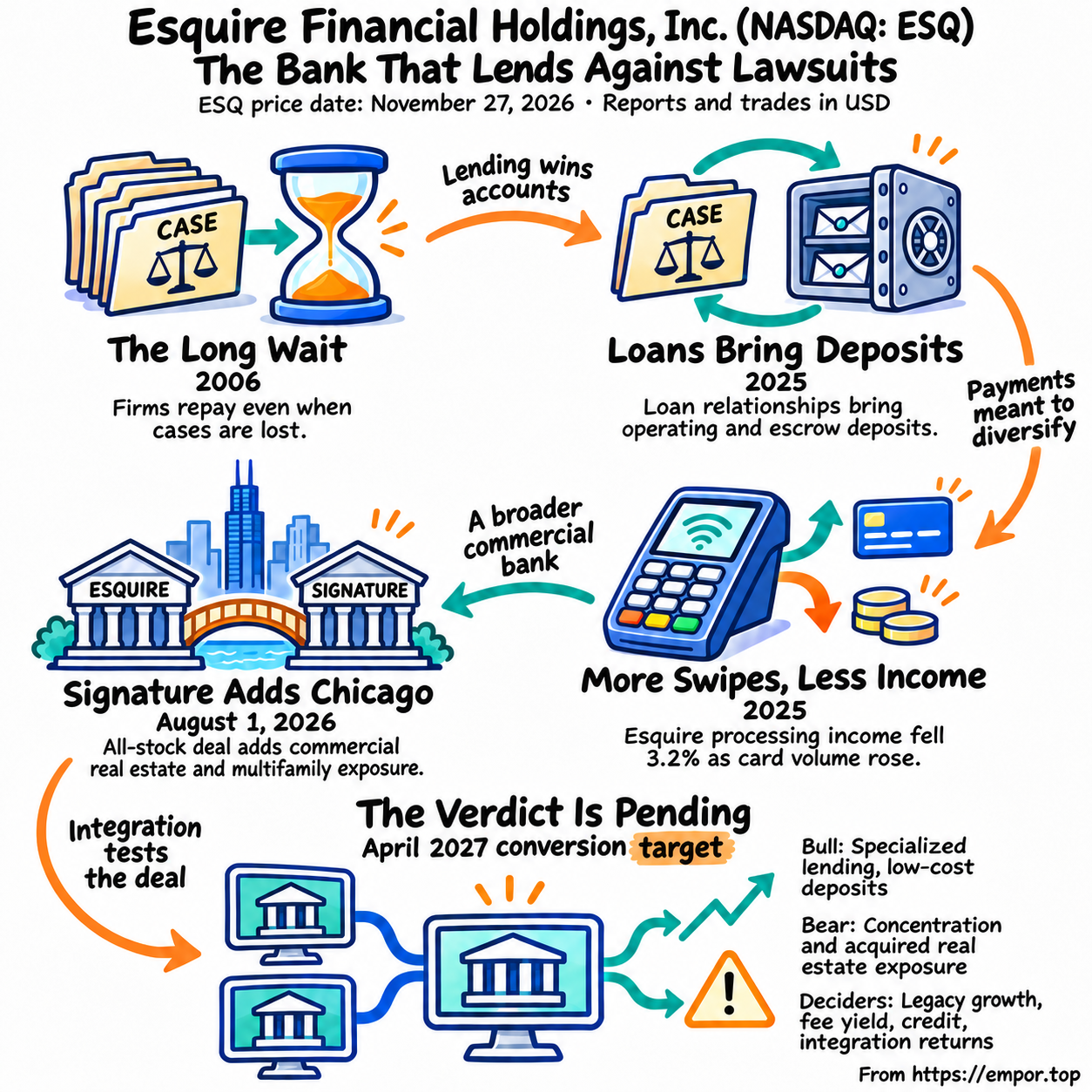
Esquire Financial Holdings, Inc. (NASDAQ: ESQ): The Bank That Lends Against Lawsuits
I. The Deal That Made Esquire a Different Bank
On Saturday, August 1, 2026, a bank that had spent twenty years teaching itself to think like a plaintiffs' law firm woke up as a Midwest commercial bank as well. That was the day Esquire Financial Holdings completed its all-stock acquisition of Signature Bancorporation, the parent of Signature Bank in suburban Chicago.1 Overnight, a company whose loan officers could talk about mass-tort dockets and case-cost lines found itself owning multifamily buildings, commercial real estate loans and business customers who had never filed a lawsuit in their lives.
The scale of the change is easiest to feel in round numbers. Signature brought about $1.9 billion of assets, $1.36 billion of loans and $1.65 billion of deposits, all marked to fair value on closing day.1 The combined company held roughly $4.75 billion of assets and $3.3 billion of loans.1 Esquire had been a bank of about $2.7 billion before the deal, so in a single weekend it had nearly doubled its balance sheet, and, as its chief executive put it on the next earnings call, doubled its employee base too.2
The price was paid entirely in Esquire shares. The company issued about 3.45 million new shares, and because Esquire's stock had climbed between the March announcement and the July closing, the consideration that had been valued at about $348 million when the deal was struck was recorded at $466.1 million when it closed.134 That gap of nearly $120 million is not a rounding error, and it is not a footnote. It is the first clue that the Signature deal has to be judged twice: once on what Esquire's shareholders gave up in ownership, and again on what the accountants say Esquire paid.
The combined company also arrived with a problem for anyone trying to follow it. Its third-quarter 2026 results included only two months of Signature, from August through September, while every prior period showed Esquire on its own.1 The organic engine that had made Esquire one of the most profitable small banks in America was now wrapped inside a larger, more conventional institution. Growth rates that once told a clean story now mix inherited balances with newly won ones.
It helps to be precise about who is who. The listed company is Esquire Financial Holdings, Inc., a Maryland bank holding company; its operating business is Esquire Bank, National Association, a wholly owned subsidiary headquartered in Jericho, New York.4 Signature now operates as "Signature, a division of Esquire Bank," led by its former chief executive Michael O'Rourke.5 When this story talks about Esquire's economics, it means the holding company's consolidated results, and when it talks about the "legacy" franchise, it means the litigation and payments bank that existed before August.
That legacy franchise is the reason anyone cares. For 2025, Esquire earned $50.8 million, a return on average assets of about 2.4%, and a net interest margin of about 6%.6 For a sense of scale, a bank that earns 1% on its assets is generally considered solidly profitable; Esquire was earning more than twice that.
It did so by banking a single, peculiar industry, contingency-fee law firms, better than almost anyone else.
So the tension is simple to state and hard to resolve. A focused bank built around one industry's cash cycle has bought a broader bank built around Chicago's commercial economy. If it works, Esquire gets cheaper and more diverse funding, a bigger lending limit, a beachhead in what management calls one of the three largest markets for contingency-fee law firms in America, and a portfolio less dependent on one sector.5 If it doesn't, the specialized engine gets diluted, the clean organic growth story gets harder to read, and shareholders discover that they paid a premium for size.
Three tests will decide it. The first is whether the legacy franchise keeps growing at its old pace while management's attention is consumed by integration. The second is whether the new risks, from Chicago real estate to acquired commercial loans, behave as well as the marks suggest. The third is whether the deal earns its cost once the systems conversion, targeted for April 2027, is behind it.1 To understand why those tests matter, the story has to go back to the thing Esquire saw in law firms that other banks did not: the long wait.
 Subscribe on LinkedIn
II. The Bank Built for the Long Wait
Picture a personal-injury firm on Long Island in 2006. It has taken on a hundred cases on contingency, which means it gets paid only if its clients win or settle. In the meantime, it has to pay for everything a lawsuit consumes: court filing fees, investigators, deposition transcripts, expert witnesses who bill by the hour.7 Its cash goes out the door today. Its fees come back, if they come back at all, years from now.
Esquire's own description of that cycle became its founding insight. In its 2017 IPO prospectus, the bank said an average case can take two to four years to litigate, and that law firms are prevented from charging their clients interest on the out-of-pocket costs they advance, which amounts to an interest-free loan from the firm to the client.7 A law firm, in other words, is a lender whether it wants to be or not. It finances its clients' cases with its own balance sheet, and most ordinary banks have no idea how to value what that balance sheet holds.
To a conventional small-business lender, a plaintiffs' firm looks strange. It may have lumpy income, few hard assets and receivables that are really just unresolved lawsuits. The collateral is a docket. A loan officer used to underwriting a dry cleaner or a dental practice sees volatility and walks away. A banker who understands how cases move, how settlements are paid, and which kinds of firms manage their inventories well sees something else: a borrower with a portfolio of claims that tends to resolve over time, and a client who needs a bank for far more than a loan.
Esquire Bank opened for business in October 2006, headquartered in Jericho, with a branch in Garden City, New York.7 Its founding DNA is visible in the people around the table. Its executive chairman at the IPO, Dennis Shields, was a founding organizer of the bank and had run LawCash, a New York specialty finance company that served law firms and claimants, since 2000.7
The board included John Morgan, founder of the national plaintiffs' firm Morgan & Morgan, and Anthony Coelho, the former congressman who authored the Americans with Disabilities Act and who later became Esquire's chairman.78 This was not a community bank that wandered into legal lending. It was a bank designed by people who knew how plaintiffs' firms made and spent money.
The man who would run it came from a different world. Andrew Sagliocca joined Esquire in February 2007 as its chief financial officer, after eight years as senior vice president and corporate controller of North Fork Bank, a large Long Island lender.7 He became chief executive in January 2009, which is to say in the depths of the financial crisis, when a two-year-old bank with an unusual niche had every reason to be nervous.7 He was a controller by training, a numbers person, and the company he built carries that imprint: obsessive about margins, efficiency ratios and deposit costs, and plain-spoken on earnings calls.
By the time Esquire went public, the niche had become a business. On June 27, 2017, it listed on the Nasdaq Capital Market under the ticker ESQ, selling 1.8 million new shares at $14 each alongside shares from existing holders.79 Counting the underwriter's extra allotment, the company raised about $26 million.9 It told investors it would use the money to support loan growth, make larger loans thanks to a higher legal lending limit, and finance potential acquisitions "to the extent such opportunities arise," while noting it had no specific deal in mind.7 That last phrase would take nine years to come true.
The prospectus was also honest about what investors could not yet know. At the time, the average loan in Esquire's portfolio was only about 2.1 years old, and the bank warned in its risk factors that the portfolio was "unseasoned," even as it reported no non-performing loans.7 A young loan book with no problems is not the same as a proven loan book. That caveat, written in 2017, still echoes through every later debate about Esquire's credit record.
What followed the listing was a remarkable run. Esquire had earned about $2.8 million in 2016, the year before it went public.9 By 2025 it earned $50.8 million, after net income rose more than 16% in that final year alone.6 Ownership stayed public and management stayed the same throughout, so this was not a story of acquisitions stitched together. It was the same niche, scaled. It also happened during a period when rates first sat near zero and then rose sharply, which flattered a bank whose loans reprice quickly and whose deposits cost little, a point the next chapter returns to.
One distinction needs to be nailed down early, because the title of this story invites a misunderstanding. Esquire does not bet on lawsuits. Its case-cost lines of credit are, in the prospectus's words, "not contingent loans": if the case is lost, the law firm still has to repay from its own cash flows.7 That is what separates a bank from a litigation funder such as Burford Capital, which typically invests in the outcome of cases and earns a share of the proceeds if they win. A litigation funder takes case risk directly. Esquire takes credit risk on the law firm, informed by deep knowledge of the cases the firm is carrying.
That distinction cuts both ways. It means Esquire's losses are not a simple function of verdicts, which is reassuring. It also means Esquire is exposed to the health of the firms themselves, and law firms can fail for reasons that have nothing to do with any single case: a mass tort that collapses, a partner dispute, a slowdown in settlements that stretches every firm at once.
By 2025, the relationship had grown far beyond lending. Esquire said that for every dollar it advanced on its litigation-related commercial loans, it received on average $1.35 of low-cost operating and escrow deposits from those same law firms.6 That ratio is the heart of the model. A conventional bank lends money it has to go out and raise. Esquire, at least on its litigation book, lends money that tends to arrive with the borrower.
The open question that Esquire's founders could not answer in 2006, and that its shareholders still cannot fully answer today, is whether knowing the client's business this well translates into better returns through a full credit cycle. Esquire has not been tested by a severe, prolonged downturn in the legal-services economy since it reached scale. Its record is impressive, but it is a record built mostly in good years. To see why that matters, follow the money from a single loan decision to the balance sheet it creates.
III. The Case File Becomes a Balance Sheet
Imagine a loan officer at Esquire reviewing a mid-sized mass-tort firm. On one side of the desk is the firm's case inventory: hundreds of claims at different stages, some years from resolution, some near settlement. On the other side are its cash needs: payroll, marketing to sign new clients, experts for the cases headed to trial. The question is not whether any single case will win. It is whether this firm, with this inventory and this management, will generate enough settlement cash over the next few years to repay a working-capital line, and whether it will keep its operating and escrow accounts at Esquire while it does.
The products that flow from that decision are surprisingly ordinary in form. In 2017, working-capital lines of credit made up about two-thirds of Esquire's attorney lending, followed by case-cost lines, which fund the out-of-pocket expenses of contingency cases, and smaller term loans for equipment and offices.7 There were also bridge loans after a case had settled but before the money arrived, both to firms and, through consumer products, to individual plaintiffs waiting on administrative delays.7 None of this is exotic finance. What is unusual is the borrower.
By the end of 2025, those litigation-related loans totaled about $1.18 billion, or 67.2% of Esquire's loan portfolio.6 Undrawn lines to law firms were large too: roughly $800 million of uncommitted lines sat behind the drawn balances.6 Sagliocca has explained what that means in practice. Litigation clients typically draw about half of what they are approved for, so producing $500 million of net loan growth requires originating roughly a billion dollars of commitments.2 The book grows in a stair-step pattern that depends on how actively firms are litigating.
Now follow the money the other way. A law firm that banks with Esquire keeps its operating account there. It may also keep client escrow money there, often in IOLA or IOLTA accounts, specialized trust accounts designed to hold client funds that by rule must be segregated from the firm's own money.6
When a mass tort or class action settles, the bank can help manage the settlement funds through qualified settlement fund arrangements, and it places large balances it cannot hold on its own balance sheet into insured sweep programs, earning administrative fees on them.6 At year-end 2025, those off-balance-sheet sweep funds totaled about $737 million, of which about 61% could be brought onto the balance sheet if the bank needed liquidity.6
That deposit machinery is why Esquire's funding is so cheap. Its total cost of deposits in 2025, including non-interest-bearing accounts, was 0.99%, at a time when short-term market rates sat well above that.6 Meanwhile its litigation commercial loans yielded a blended 9.1%.6 Put the two together and the reason for Esquire's roughly 6% net interest margin becomes obvious: it earned high yields on loans most banks would not make, and funded them with deposits that came from the same customers at a fraction of market rates.6 Net interest income, the spread between what the bank earns on loans and securities and what it pays depositors, was $121.5 million in 2025, by far its largest source of revenue.6
This is the moat claim in its strongest form, and it is a credible one. The specialized underwriting lets Esquire make loans others avoid. The loans attract deposits. The deposits fund more loans, including loans in other categories. Management's own language is that the litigation book "funds the entire balance sheet."10 Unlike a conventional bank, which competes for loans and deposits in separate markets, Esquire wins both in a single relationship.
The strongest evidence for that claim comes from the rate cycle. Most of Esquire's loans float with the prime rate, while its deposits are anchored by operating and escrow balances that do not chase every move in market rates. On the second-quarter 2026 call, Sagliocca pointed out that short-term rates had fallen by about three percentage points since 2023, yet the bank's margin had slipped only from a high of about 6.15% to about 6%.10 A bank whose deposits were "hot money" would not show that resilience; its deposit costs would have stayed sticky while its loan yields fell. That is a real-world stress test of the deposit franchise, and the franchise passed it.
There is a flip side. A bank this asset-sensitive, meaning its earnings rise when rates rise, will also feel it when rates fall far enough. After the merger, about 60% of the combined loan book is variable-rate, down from something like 85% to 90% before, and management estimates that a one-percentage-point rise in rates would lift net interest income by about 6.7%.2 The same arithmetic works in reverse. Part of the spectacular earnings run since 2022 was the rate environment, not just the niche.
But the same mechanism that makes the model attractive also concentrates it. If settlements slow down because courts back up, because a big mass tort stalls, or because defendants decide to litigate rather than pay, the effect hits both sides of the balance sheet at once. Borrowers draw more and repay more slowly. At the same time, the escrow balances that fund the bank flow in more slowly too. That correlation is the reason the central earnings question for Esquire is not loan growth by itself. It is credit-adjusted spread: how much the bank earns after the losses that appear when the cycle turns.
The funding side has its own concentration. At year-end 2025, Esquire's ten largest depositors accounted for 25.1% of its total deposits.6 The bank warned in its annual report that a material decline in those balances could force it to replace them with higher-cost funding.6 About a third of its deposits were also above the $250,000 insurance limit.6 A quarter of a bank's funding sitting with ten clients is a lot, even if many of those balances are settlement funds that, by their nature, arrive and depart in waves. The low cost of funds is an advantage; the concentration behind it is a limit on how far that advantage can be stretched.
Management's case for differentiation goes beyond the numbers. In its filings, Esquire describes its litigation niche as protected by experience, tailored products, a track record of more than a decade in its payments vertical, and deep relationships with law firms and trade groups, along with a national "branchless" model staffed by senior business development officers placed in key regions.6 Those are reasonable claims. They are also claims a company makes about itself.
The test is behavior over time. Did the niche bring pricing power? Partly. Litigation loan yields eased from close to 9% toward 8.8% in 2026 as rates fell, and Sagliocca said he cared more about the bank's overall margin than the yield on any individual loan class.10 That suggests a bank that prices competitively rather than one that dictates terms. Did the relationships prove sticky? Esquire does not publish a client retention rate, nor does it disclose what share of revenue comes from its largest customers, so the strength of those relationships has to be inferred from deposit growth rather than observed directly.
The competitive field is narrower than in most of banking but not empty. Esquire says competition for litigation loans comes mainly from a small number of nationally oriented specialty finance companies, some lending only to law firms and some lending to plaintiffs, alongside the specialized expertise required to manage IOLTA-type accounts that keeps many generalist banks out.6 Large banks could enter if they chose; the barrier is know-how and appetite, not regulation. On the payments side, Esquire faces much larger banks and third-party processors with greater scale.6
Viewed through the classic forces, the picture is mixed. New entrants face a knowledge barrier more than a capital barrier. Substitutes exist in the form of non-bank litigation lenders, though they generally cost more. Supplier power is modest, since the bank's main supplier is its depositors, but concentrated depositors do hold some sway over it. Customer power is meaningful: large law firms with multiple banking options can negotiate, and the borrower concentration in one sector raises their leverage. The filings say nothing about switching costs in payments or the pricing terms with processors, so those forces cannot be scored with confidence.
So what does the balance sheet say about the moat? It says the advantage is real but narrower than the marketing. Esquire has demonstrably built a lending business that generates cheap deposits, and that relationship shows up in the margin. What it has not demonstrated, because the data do not exist, is that clients stay through stress, or that the spread survives a full legal-sector downturn. The bank's second engine, payments, was supposed to provide the diversification the litigation book could not. In 2025, it sent a very different signal.
IV. More Swipes, Less Fee Income
In 2025, Esquire's payments platform did more work than ever. It cleared about $39.5 billion of card payments across 590.4 million transactions for small businesses across the country, with volume up 8.6% from the year before.6 By almost any operating measure, the business was growing. And yet payment-processing income fell, by 3.2%, to $20.2 million.6 More swipes, less money. For a business that management pitches as a growth vertical, that divergence is worth stopping on.
First, how the business works. Esquire is a member of Visa, Mastercard, American Express and Discover, and acts as an acquiring bank, meaning it sponsors merchants into the card networks and clears their card, debit and ACH transactions.6 It does this mostly through independent sales organizations, or ISOs, third-party firms that find and sign merchants and then rely on a sponsor bank like Esquire to connect them to the networks.6 Esquire earns fees tied to the volume of transactions it processes. Think of it as a toll bridge that small-business payments must cross, with ISOs acting as the dispatchers who route traffic to that bridge.
The business matters, but it is not the main event. Processing fees of about $20 million in 2025 were roughly one-sixth of the bank's net interest income, and total non-interest income, which also included administrative fees on settlement sweep funds and customer fees, was $25.1 million, about 17% of revenue.6 Payments also bring something harder to measure: merchant deposits and a national footprint. But the spread business is what drives Esquire's earnings.
Esquire describes itself as one of approximately 100 U.S. acquiring banks, a small club, and argues it has an edge in attracting and retaining ISOs because of its history, flexibility and in-house expertise.6 That is a credible positioning statement. It is not evidence of share gains against named competitors, and the filings do not provide any. The bank competes with large commercial banks and third-party processors that dwarf it in scale.6
So why did revenue fall while volume rose? Management attributed the decline primarily to changes in the merchant risk profile and merchant composition.6 In plain English, the mix of merchants changed. Higher-risk merchants typically pay more per transaction; if a bank deliberately sheds riskier merchants, or if the merchants it adds are larger and lower-margin, revenue per dollar of volume falls. That explanation is plausible, and it may reflect prudence rather than weakness. It also took a real toll that year: one of the two charge-offs that drove 2025's credit costs was a $3.3 million commercial loan related to a small-business merchant.6 Risk in payments is not abstract.
The decline did not reverse in 2026. In the third quarter, legacy payment volume rose 4.1% from the year before, to $10.5 billion, while payment-processing income rose only modestly, to $5.4 million, a gain management again described as "muted" because of merchant risk and composition changes.1 On the second-quarter call, Sagliocca was candid about the shape of the business. He called the merchant model "more of a battleship" for the next four to six quarters, said volume tends to grow around 10% while revenue grows around 3% to 5% under the indirect ISO model, and explained that volume had dipped partly because one or two ISOs Esquire banked had sold their platforms to competitors.10
That last admission is the most revealing thing in the record about payments. If an ISO can sell its merchant portfolio and take the volume to another sponsor bank, then Esquire's hold on that volume runs through intermediaries it does not control. Customer power sits with the ISOs. That is the opposite of a switching-cost moat.
Management's plan is to change the model gradually. Esquire wants to sign more merchants directly, especially Signature's non-litigation commercial clients in Chicago, which would give it a direct relationship rather than one routed through an ISO.10 Sagliocca was explicit that this would be "slow and steady," and that nothing would "turn on a dime."10 It is a sensible plan. It is also a plan, not a result.
Here the historical record does its job as a test. The claim that payments volume signals a moat predicts that growing volume should bring growing revenue at stable or rising prices. The evidence from 2025 and the first nine months of 2026 rejects that strong version. It narrows the claim to a smaller one: Esquire runs a scaled, compliant payments platform that produces steady fees and supports the bank's national presence, but it has not shown pricing power, and its revenue per transaction has drifted down. Esquire does not disclose per-transaction pricing, contract duration with ISOs or merchants, or revenue retention, so investors cannot separate deliberate de-risking from competitive pressure.
There is also an accounting trap in the new numbers. In the third quarter, the company said it served 94,000 small-business clients and processed $10.5 billion in payment volume.1 Those are company-wide figures in a post-merger quarter. The growth comparisons management gave were for the legacy platform, which is the right yardstick, but a listener hearing "94,000 clients" should not mistake it for a clean measure of legacy growth. Before the merger, in the second quarter, the figure was 93,000.10
So payments are a solid second business but not yet a second engine. The KPI that will tell whether the direct-merchant strategy works is simple: processing fees relative to transaction volume. If that ratio stabilizes or rises as Signature's commercial clients come aboard, the strategy is working. If it keeps sliding, payments will remain a useful sideline with declining economics. Either way, the larger risk to Esquire's earnings was never in its fee line. It was in its loan book, and in 2025, for the first time in years, that book started to show some wear.
V. When the Loans Come Due
Every bank's story eventually comes down to the moment when a borrower does not pay. For Esquire, that moment arrived in 2025 not in its famous litigation book but on its edges. In the first quarter, a multifamily real estate loan went bad, and the bank charged off $2.9 million. In the second quarter, a small-business commercial loan related to a merchant generated a $3.3 million charge-off.6 Together they accounted for $6.2 million of the $6.6 million of net charge-offs for the year.6
Measured against the size of the book, the change was stark. Net charge-offs rose from 0.03% of average loans in 2024 to 0.44% in 2025.6 To put it in everyday terms: in 2024, for every $10,000 of loans, Esquire lost about three dollars; in 2025, it lost about forty-four. That is still a modest loss rate by historical banking standards, but it was a fifteenfold jump, and it came in a benign economy.
The other credit measures stayed calm. Nonaccrual loans, those on which the bank had stopped booking interest because repayment was in doubt, were 0.49% of total loans at year-end 2025, and the bank's allowance for credit losses covered its nonperforming loans about 2.8 times.6 A bank with those ratios is not in trouble. But a low nonaccrual ratio after a year of rising charge-offs is not a full-cycle result, and it would be a mistake to read it as one.
The loan risks Esquire runs are different from those of a business collecting on invoices. For a manufacturer, the question is how many days it takes customers to pay. For Esquire, the questions are case timing, collateral and repayment capacity. A law firm's line can go bad if its cases take longer to settle than expected, even if every case eventually wins.
A multifamily loan can go bad if rent regulation, rising expenses or a weak sponsor squeezes the building's cash flow. The two risks have little in common, which is why the 2025 losses matter: they came from outside the core niche, in the real estate and commercial books that are supposed to be the boring, diversifying parts of the portfolio.
The multifamily story did not end in 2025. In the second quarter of 2026, Esquire moved a previously criticized multifamily credit to nonaccrual and charged off $1.6 million, and its nine-month filing described that loan as a $4.4 million nonaccrual alongside the foreclosure and sale of another property after a $3.2 million charge-off.410 On the second-quarter call, Sagliocca said the bank had been signaling for more than a year that a second loan to the same sponsor was on its watch list. "I'm not shocked," he said. "I'm also not happy."10 He added that the bank had no other real estate loans rated special mention or substandard, no commercial office exposure, and no litigation loans in those categories.10
That is a credible, specific answer, the kind a skeptic should want to hear. It also illustrates how losses tend to emerge at Esquire: slowly, from a small number of identifiable credits, with a lag between the warning and the write-off. A hint of history sharpens the point. At the 2017 IPO, multifamily loans were already the single largest piece of the real estate book, about 32% of total loans.7 The New York multifamily exposure that produced these losses was not a recent foray. It was a long-standing part of the bank, and it seasoned into losses only after years of rising rates and changing rent rules.
Then came Signature, and with it a different risk mix. At September 30, 2026, Esquire reported $8.6 million of nonperforming loans and $9.6 million of nonperforming assets, representing just 0.25% of loans and 0.20% of assets; the nonperforming assets included acquired Signature real estate.14 The chief financial officer said the bank had six nonperforming assets, with the small increase from the prior quarter due to the merger, and no material charge-offs or significant downgrades to report.2 The allowance stood at $44.7 million, or 1.30% of loans.1
Those are clean numbers. They are also early numbers. Purchase accounting changes how acquired loans show up. When a bank buys another bank, it marks the acquired loans to fair value, building expected losses into the purchase price rather than into the allowance. The accretable portion of Signature's loan mark was about $16 million, according to Sagliocca, with an average life of about three years.2 That mark will flow into interest income over time, which can flatter margins, and the real test of the acquired book will come when those loans either perform as expected or don't. The measurement period for final fair-value adjustments is still open.4
The merger also changed the composition of what Esquire owns. Litigation-related loans fell to about 42.5% of total loans at September 30, from 68.1% a quarter earlier.1 Litigation-related deposits fell from about 79% of the total to 54%.2 Signature brought commercial real estate, multifamily, construction, residential and consumer exposure. On paper, that is diversification. In practice, diversification only lowers risk if the new exposures behave differently from the old ones in a downturn, and multifamily, the asset class that just generated Esquire's losses, is one of the categories Signature added.
Capital and liquidity provide a cushion, though they are not the same thing as earnings quality. Post-merger common equity tier 1 capital, the regulator's core measure of loss-absorbing equity, was 12.95% at September 30, 2026, well above the threshold for being considered well capitalized.1 Esquire reported about $1.63 billion of available liquidity, counting cash, securities, unused borrowing capacity and sweep funds that could be brought onto the balance sheet.42 Deposits remain the main funding source; Esquire had no Federal Home Loan Bank advances at the end of 2025, and the borrowings on its books in late 2026 came with Signature.64
So has Esquire's underwriting held up? On the evidence, the litigation book has held up, with no criticized litigation loans reported in mid-2026.10 The edges of the portfolio have not been flawless. The next test is several quarters of migration across the combined book: charge-offs, nonperforming loans and reserve coverage, with the acquired loans seasoning under Esquire's credit culture. Until those numbers arrive, the clean legacy record is less informative than it once was. And whether the risk Esquire took on in Chicago was worth taking depends on one more number: what it actually paid.
VI. What Esquire Paid for Chicago
The story of the Signature deal begins not in Jericho but in Rosemont, Illinois, where Signature Bank had been operating since it was organized in 2006, the same year Esquire was chartered.3 Signature's board had spent much of 2025 asking how to deliver liquidity to its shareholders. Between December 2024 and January 2025, it consulted Raymond James and three other investment banks about options ranging from an initial public offering to a merger with a larger partner.3 In June 2025, the board authorized management to explore a sale, and a special committee including O'Rourke and Leonard Caronia led the process. Raymond James contacted seven banks, and six signed confidentiality agreements.3
What those bidders were looking at was a solid, unglamorous commercial bank. At the end of 2025, Signature had about $2.0 billion of assets, $1.28 billion of loans, $1.72 billion of deposits and about $220 million of shareholders' equity, serving businesses and individuals mainly in the Chicago metropolitan area through relationship banking paired with technology.3 It was, in other words, almost exactly the size Esquire had been a year or two earlier, but built on a completely different customer base. That made Signature a rare thing for Esquire: a target big enough to matter and different enough to diversify.
Esquire, meanwhile, had been looking for a place to grow. Its filings say it had evaluated expanding into new geographic markets with robust legal communities, and had identified the greater Chicagoland area as a desirable target.3 The fit was logical. Signature had a well-established Chicago-based management team and brand; Esquire had a national litigation platform that, by its own account, underserved the Chicago market.10 Sagliocca put the strategic argument plainly in the closing announcement: Chicago is one of the top three metro markets in the country by both population and number of contingency-fee law firms, alongside New York and Los Angeles.5
The deal was announced on March 12, 2026. Its terms included an unusual twist. The exchange ratio, the number of Esquire shares each Signature share would receive, was not fixed. It would adjust between 2.5 and 2.8 Esquire shares depending on how Signature disposed of four specific loans before closing, and how much it recovered on them.3 That clause is a quiet piece of risk management: Esquire made Signature's shareholders carry part of the risk on loans it did not want to inherit. By May, two of the four had been resolved, capping the maximum ratio at 2.715.3
At the announcement, using Esquire's closing share price of $99.04 on March 11, the deal was valued at about $348.4 million.3 Esquire's financial adviser, Piper Sandler, benchmarked that price at about 9.7 times Signature's trailing earnings and about 1.64 times its tangible book value, against precedent-deal medians of about 12.3 times earnings and 1.57 times book.3 In other words, at the time it was announced, the deal looked cheap on earnings and roughly in line with the market on book value.
Then Esquire's stock rose. By May 1, the same exchange ratio was worth about $377 million.3 By the August 1 closing, after the final ratio was set, the purchase price was recorded at $466.1 million for about 3.45 million shares.14 Here is the subtle point. Signature's shareholders did not get more Esquire shares because the stock rose; they got roughly the same number of shares, now worth more. From the perspective of Esquire's existing owners, the cost measured in ownership barely changed. Those 3.45 million shares represented roughly 28% of the enlarged company, based on the roughly 8.7 million shares Esquire had outstanding in the spring.84 What changed was the accounting price, and with it, the goodwill.
That distinction explains why the headline multiples are slippery. At the closing value, the deal implied roughly 2.1 times Signature's year-end 2025 shareholders' equity of about $220 million, and around 13 times the trailing earnings implied by the announcement multiple.3 Multiples quoted at announcement, around 1.6 times book and under 10 times earnings, described a deal that no longer existed by closing day.
For context, the median U.S. whole-bank deal in 2025 was priced at 1.43 times tangible book value and 15.1 times trailing earnings, according to Olsen Palmer.11 At closing, then, Esquire paid well above the median on book value and somewhat below it on earnings. Those are broad reference points, not a fairness opinion, but they frame the bet: Esquire paid a premium to book because it believed Signature's earnings and deposits were worth more inside Esquire than on their own.
The balance sheet records that premium in two places. Against Signature's $1.90 billion of acquired assets and $1.65 billion of deposits, Esquire booked $246.9 million of goodwill and a $49.3 million core deposit intangible, an asset representing the estimated value of Signature's low-cost deposit relationships.1 Together, those intangibles came to about $296 million against combined equity of about $779 million.1 Goodwill is the part of the price that cannot be pinned to any specific asset. It represents the hope of future earnings above what the identifiable assets alone would produce, and it stays on the books unless impaired.
A skeptic would note the trajectory of Signature's earnings going in. In the first quarter of 2026, Signature earned $7.1 million, down from $9.6 million a year earlier, as its net interest income slipped.3 Esquire bought a bank whose profits were declining, and paid for it at the very moment its own stock had re-rated upward. The bull would reply that a rising share price is exactly when a buyer should use stock as currency, and that Signature's earnings power inside Esquire's lower-cost funding model is what matters, not its standalone trend.
Management pointed to an early win. The company said the combination was about 10% accretive to tangible book value per share on day one, meaning that each Esquire share carried more tangible equity after the deal than before.1 That is unusual for a bank acquisition, where buyers typically dilute tangible book and spend years earning it back.
The explanation is straightforward: Esquire's shares traded at a high multiple of its own book value, so each share it issued bought more than a dollar of Signature's tangible equity. The accretion is real, but it is a function of Esquire's expensive stock rather than proof that the deal creates value. What sustains it is operational: client retention, cost savings, the economics of acquired deposits and credit performance.
Some of those operational facts are encouraging. Sagliocca said there had been no material client attrition through October, and the combined bank grew loans by about $111 million and deposits by $55 million in the two months after closing.1 Others are still ahead. Esquire runs on Fiserv's core banking system; Signature runs on Jack Henry's, and Signature's clients will move onto Fiserv in the conversion targeted for April 2027.2 Sagliocca noted that core conversion is only one of the systems to be combined, alongside management systems, customer-relationship and loan-origination platforms, and culture.2 Systems conversions are where acquired-bank customers most often leave.
The costs are already visible. The third quarter included $8.9 million of pre-tax merger expenses, and nine-month merger expenses reached $11.2 million.1 The chief financial officer said inception-to-date merger costs of $11.6 million were consistent with guidance at announcement.2 Those costs are why GAAP net income and adjusted net income diverged so sharply in the quarter, a gap the next section returns to.
One more financial maneuver deserves mention, because it shows how management thinks. Signature's securities portfolio came with a fair-value mark of about $64 million, reflecting bonds bought when rates were lower.2 Rather than hold those bonds and accrete the discount into income over time, Esquire sold most of them at their marked value and bought newer, shorter-duration bonds in larger blocks that it could more easily pledge for liquidity.2 That choice sacrificed some flattering future accretion for a cleaner, more liquid balance sheet. It is the kind of decision a former controller makes.
Shareholders approved the deal overwhelmingly. At the June 2026 special meeting, 6,568,618 shares voted for the share issuance and 9,444 against.12 That vote is a governance datapoint, and a useful one, since it shows no organized opposition. It is not evidence that the deal will succeed. Shareholders vote on promises; integration delivers outcomes.
And promises are what Esquire has, because it has no prior record of large acquisitions to compare against. The IPO funded organic growth. The company's repurchase program, authorized in 2019, allows up to 300,000 shares; in December 2025 it bought back just 37,620 shares at an average of about $106.6 That is a rounding error next to the 3.45 million shares issued for Signature. The Signature merger is Esquire's first material acquisition and the largest capital allocation decision in its history, made by a management team that had never done one. Whether it was disciplined will be judged by what those shares buy after integration, and by the people who made the call.
VII. The CEO's Bet—and the Evidence That Will Judge It
On the morning of October 27, 2026, Andrew Sagliocca opened the third-quarter earnings call from his office in Jericho, with chief financial officer Michael Lacapria and chief operating officer Eric Bader beside him.2 It was the first quarter of results from the combined company, and Sagliocca did something he said he never does. When an analyst asked about expenses for 2027, he started instead with what he expected the company to earn: approximately $9 per diluted share.2
He then walked through the components with unusual precision: about $500 million of loan growth from a starting point of around $3.5 billion, a net interest margin of 5.70% to 5.75%, $33 million to $34 million of fee income, $138 million to $140 million of operating expenses and a tax rate around 28.5%.2 When another analyst suggested the loan growth target looked conservative, Sagliocca pushed back. "I think I'm being realistic," he said, explaining that the company had just doubled its size and its workforce, had conversions ahead, and did not want "to overpromise on a call like this."2
That exchange captures the management style. Sagliocca, now 58 and the chief executive since 2009, speaks in specifics.8 He gives numbers, ranges and the reasoning behind them, and he often volunteers more than analysts ask. On the Q2 call, when a multifamily loan went bad, he had named the sponsor exposure and said he had been warning about it for a year.10 That consistency is itself evidence. Executives who flag problems before they become write-offs tend to be more credible than those who explain them afterward.
The team around him is unusually stable. Eric Bader, who served as chief financial officer at the time of the IPO, is now chief operating officer and runs the treasury function; Sagliocca told analysts in July that he had known Bader for more than 25 years.710 Michael Lacapria took over as chief financial officer.
Ari Kornhaber, who leads the litigation business and corporate development, and chief credit officer Frank Lonardo spent much of 2026 in Chicago working with Signature's bankers on prospective law-firm clients.82 Continuity like this is a strength when the job is executing a known playbook. It is less obviously a strength when the job is something the team has never done, such as integrating a bank of equal size.
The ownership structure supports alignment. As of the spring of 2026, Sagliocca owned about 3.5% of the company, and directors and executive officers as a group held about 13.9%.8 No director or executive had pledged shares.8 For a bank of Esquire's size, that is meaningful skin in the game. The largest outside holders were institutions: Mawer Investment Management of Calgary at about 9% and BlackRock at about 6%.8 Every director except Sagliocca is independent, and Coelho, now 83, chairs the board.8
Pay has been generous but tied to results. Sagliocca's reported compensation was $3.77 million in 2025, including $1.28 million of non-equity incentive pay and $1.50 million in stock awards.8 His annual bonus target was 115% of base salary, with 75% of the scorecard tied to financial targets and 25% to strategic priorities, and payouts that can range from zero to 150%.8 His total pay swung from $3.08 million in 2023 to $1.84 million in 2024 before rising in 2025, which suggests a package that actually moves with performance.8 Shareholders backed it: the 2025 say-on-pay vote received about 97% support.8 Strong support says investors are comfortable. It does not by itself prove strong alignment.
The operating record behind that support is good, but more mixed than the headline suggests. Net income rose 16.4% in 2025, to $50.8 million.6 In the same year, payment fees fell despite higher volume and the charge-off rate rose about fifteenfold. A rising profit line can coexist with deteriorating parts. A thoughtful investor gives management credit for the aggregate and still asks about the components.
The most interesting test of credibility is how management's forecasts shifted between the second and third quarters. On the July 23 call, a week before closing, Sagliocca said the combined net interest margin would start "right around, call it 540, 545" on day one, reflecting Signature's lower margin.10 Three months later, the guidance was 5.70% to 5.75% for 2027.2 That is a large upward revision in a short time.
Sagliocca explained it on the Q3 call. Rates had moved up once more since the summer, the securities repositioning had gone well, and purchase accounting had come out close to expectations.2 He was careful to separate the effect of Signature being included for only two months, which lifted the reported margin by about six basis points, from the loan mark accretion.2
When an analyst pinned down that the accretable loan mark was adding something on the order of 13 or 14 basis points to the margin, Sagliocca acknowledged it, and noted it would persist for about three years.2 So part of the higher margin guidance rests on accounting that will fade, and part rests on a rate environment the company does not control. The answers were concrete. The underlying drivers are not all durable.
The other piece of evidence to weigh is how management reports its own earnings. In the third quarter, GAAP net income was $17.5 million, while adjusted net income, excluding merger costs and a discrete tax benefit, was $23.6 million.1 Management highlighted the adjusted figure, as almost all acquirers do, and said it exceeded consensus estimates.2 Merger costs are genuinely one-time in nature, but they are also real cash spent on the deal, and they will continue through the conversion. The core deposit intangible amortization of about $1.8 million a quarter, which management excludes from its adjusted efficiency ratio, will run for years.1
Sagliocca said in the third-quarter release that the combined company was positioned to exceed the initial earnings expectations the company set when it announced the merger.1 If that proves true after a full year including the conversion, it will be the most important evidence of management's capital allocation skill. If it requires continued adjustments to get there, the claim will deserve the scrutiny any adjusted metric does.
The board also changed with the deal. O'Rourke and Caronia, Signature's former chief executive and chairman, joined Esquire's board at closing.5 That is standard practice and it gives Signature's former shareholders a voice. It also means the board now includes two directors whose primary experience is the acquired bank, which could help integration or create a constituency for the Chicago franchise over the national litigation business. Watching how capital and talent are allocated between the two will be revealing.
So does the record support confidence? It supports confidence in the operators: specific, consistent, transparent about problems, well aligned with shareholders through ownership. It does not yet support confidence in the acquirer, because there is no record to judge. The Signature deal is the sharpest test of discipline this team has faced. The fair comparison is not adjusted earnings against consensus but actual results after conversion against what was promised in March: client retention, organic growth and returns on the capital spent. That is where the bull and bear cases meet.
VIII. Analysis & Bear vs. Bull Case
Here is the puzzle a sophisticated investor faces when looking at Esquire in late November 2026. The combined bank is reporting faster growth than ever, with nine-month net income of $42.7 million against $37.4 million a year earlier.1 But that comparison includes two months of Signature on one side and none on the other, and it is depressed by merger costs. Adjusted figures look better, GAAP figures look worse, and legacy and acquired performance are now tangled together. The question is what, underneath the noise, actually drives this business, and what could break it.
The bull case starts with Esquire's specialized lending and low-cost law-firm deposits, which produced a 6% net interest margin and a return on assets above 2% in 2025.6
Organic growth continued straight through the merger: management said legacy loans grew by about $500 million and deposits by about $450 million in the twelve months to September, excluding Signature, and that litigation loans grew by about $160 million in the third quarter alone.21 A business that can grow its core book at more than 30% a year while absorbing an acquisition is not standing still.
The bear case starts with the same numbers seen from the other side. Litigation-related loans were 67.2% of the legacy book at the end of 2025, and the ten largest depositors supplied 25.1% of deposits.6 That is a bank whose fortunes are tied to one industry on both sides of its balance sheet. Payment fees fell while volume rose. Charge-offs jumped. The very correlation that makes the model efficient in good times, loans and deposits arriving from the same clients, means that a legal-sector shock would hit lending and funding at once.
The bull's second argument is Signature. The acquisition adds Midwest commercial relationships, a bigger balance sheet and a larger lending limit, and it reduces the combined portfolio's dependence on litigation loans to about 42% and litigation deposits to about 54%.12 The company says Signature already had deposit relationships with law firms but only a small lending book, giving Esquire's litigation team a local brand in one of the country's biggest plaintiffs' markets.2
The bear's second argument is also Signature. The acquisition adds about $296 million of goodwill and intangibles, purchase-accounting estimates that are still provisional, acquired credit exposures including multifamily and real estate, and a two-system conversion that is not yet complete.12 The tangible book accretion depends on Esquire's high share price at the time of issuance, not on demonstrated synergies. And the bank's margin guidance now leans partly on loan mark accretion that will fade over about three years.2
A skeptical long-short investor would push harder on three points. First, disclosure: Esquire does not publish client retention, top-customer revenue shares, payments pricing or a separate run-rate for the legacy franchise after conversion, so investors must trust management's characterization of organic growth. Second, concentration: a bank this dependent on one industry's settlement cycle has never been tested by a prolonged legal-services downturn. Third, capital: the company is paying a dividend of roughly 10% to 12% of earnings and says its constraint is total risk-based capital because its commercial loans carry full risk weights, which means rapid loan growth will consume capital quickly.2 None of these is a red flag. Together, they define the boundaries of what investors can know.
The second-layer checks are mostly quiet. Crowe LLP gave Esquire's 2025 financial statements and internal controls a clean audit opinion with no material weakness, and the company reported no material pending litigation in either its annual report or its third-quarter filing.64 It has no foreign-exchange exposure and held no derivatives at the end of 2025.6 It does not publish a credit-agency rating rationale; as a non-agency cross-check, Weiss Ratings assigned Esquire Bank a "B" in August 2026, citing strong capital and returns.13 There are no related-party loans to directors or executives disclosed for 2024 or 2025.6 The risks in this company are on the balance sheet, not in the footnotes.
To weigh the moat honestly, it helps to run through Hamilton Helmer's seven powers, the sources of durable competitive advantage, one at a time.
The strongest candidate is what Helmer calls process power: embedded organizational know-how that is hard to copy. Esquire's underwriting expertise in contingency-fee firms, built over two decades, is exactly this kind of advantage. It shows up in the bank's ability to price loans and attract deposits that generalist banks cannot.
A related candidate is a relationship advantage that blends into switching costs: a law firm whose operating, escrow, sweep and settlement accounts all run through Esquire faces real friction in moving. Sagliocca himself described the sales cycle as long precisely because every plaintiffs' firm is already banked somewhere and must be persuaded to move.2 That friction protects Esquire once it wins a client, but the company does not disclose retention data, so the strength of the switching cost remains an inference.
Other powers are weaker or absent. Scale economies are limited: Esquire is a $4.8 billion bank competing with institutions hundreds of times its size, and in payments, larger processors have obvious scale advantages. Network effects do not meaningfully apply. Counter-positioning, where an incumbent cannot copy a newcomer without damaging its own business, might have applied in 2006, when big banks avoided plaintiffs' firms, but large banks today could enter the niche without cannibalizing anything; they simply choose not to. Brand matters within the legal community, where Esquire has built a reputation, but it does not command a measurable price premium. Esquire has no cornered resource; its key assets are people and relationships, both of which can leave.
Compare that with the industry players. Non-bank litigation funders like Burford Capital take outcome risk and charge accordingly; they are not direct substitutes for a working-capital line from a bank. Specialty lenders to law firms compete for loans but cannot offer the deposit, escrow and settlement services a bank can. Large banks have the services but generally lack the appetite. Esquire's position sits in the gap between them, which is a real niche but not an impregnable one.
The overall verdict: the moat is plausible and partly proven. The process power in underwriting and the deposit-gathering relationship are supported by the margin and the growth. Pricing power is not established, given flat-to-falling loan yields and declining payment fee yields. Retention is not disclosed. Scale advantages do not exist. And the post-merger returns on the capital spent on Signature are, as of tonight, unproven.
Three numbers will tell investors most of what they need to know. The first is legacy organic loan and deposit growth, separated from acquired balances. The latest reading was strong: litigation loans grew about 49% annualized in the third quarter, and management guided to about $500 million of total loan growth in 2027, roughly 14%.12 The second is payment fees relative to transaction volume.
The latest reading was unfavorable: legacy volume grew about 4% year over year in the third quarter while fees grew more slowly, continuing a decline in yield.1 The third is credit migration across the combined book: charge-offs, nonperforming loans and reserve coverage. The latest reading was benign, with nonperforming assets at 0.20% of assets and an allowance of 1.30% of loans, but rising from a very low base in the legacy book and still untested on the acquired one.1
What does the market think? On November 27, 2026, ESQ shares closed at about $134.52, and a third-party data provider showed a trailing price-to-earnings ratio of about 22 and a forward ratio of about 15.14 The trailing figure is inflated by merger costs and a partial quarter of Signature; the forward figure depends on analyst estimates, and it lines up roughly with management's own $9 guidance.
A forward multiple around 15 times is a premium to most regional banks but not an extreme one for a bank earning returns of this level. It suggests the market is pricing in the legacy franchise's quality and the merger's success, but not a dramatic acceleration beyond it. Peer comparisons are imperfect, because no listed bank combines a litigation franchise, a payments platform and a newly acquired Midwest commercial bank.
So the case for Esquire rests on a clear mechanism: specialized knowledge that brings cheap deposits and good loans. The case against rests on an equally clear one: concentration, uneven fee economics, and an integration that must go right. Both cases are internally coherent. Which one wins will depend on execution over the next eighteen months, and on whether the lessons that built Esquire carry over to a different kind of bank.
IX. Playbook: Business & Investing Lessons
There is a moment in Esquire's 2017 prospectus that reads, in hindsight, like a mission statement. The bank explained that law firms cannot charge clients interest on case costs, so every contingency case is effectively an interest-free loan from the firm to its client, and that a bank willing to finance that loan could fill a gap the market had left open.7 Nearly a decade later, that insight underpins a $4.8 billion bank. The lessons from the journey belong to Esquire, but they travel.
The first lesson is about what makes a niche valuable. Plenty of banks claim specialties: medical practices, veterinarians, franchisees. Most of those specialties are marketing. Esquire's is different because it changed the loan decision itself. A banker who understands how a mass-tort docket resolves can lend to a firm a generalist would reject, and can price that loan based on knowledge the competition lacks.
Then the deposits follow, because the same expertise lets the bank handle escrow and settlement accounts properly. The proof is the dollar and thirty-five cents of deposits that arrives with every dollar of litigation loans. A niche becomes an advantage when it changes the loan decision, not just the marketing. For founders, the wider lesson is that a specialization only creates economic value when it lets you do something a generalist cannot, at a price a generalist cannot match.
The second lesson comes from Chicago. Signature cut Esquire's dependence on litigation loans from about two-thirds of the book to about two-fifths overnight. It is tempting to call that de-risking. But the losses that marred Esquire's record in 2025 and 2026 came from multifamily real estate and a merchant-related commercial loan, not from law firms. Signature added more real estate, more multifamily and more commercial exposure.
A portfolio can look more diversified on a pie chart while concentrating risk in categories that tend to fail together when rates rise and property values fall. Growth is not diversification until the new risks behave differently in a downturn. For investors, the lesson is to look past the mix percentages and ask whether the new exposures would break in the same recession as the old ones.
The third lesson is about the currency of the deal. Because Esquire paid with stock, and because that stock rose between announcement and closing, the accounting price of Signature jumped from about $348 million to $466 million without Esquire handing over a single additional share. It is easy to conclude that the stock-funded deal was free, or that tangible book accretion proves value creation. Neither is true.
Esquire's shareholders gave up about 28% of their company. That is the real price, and it must be repaid in earnings per share, not in accounting optics. A stock-funded acquisition still spends shareholder capital; measure what the shares buy after integration. The wider rule for any acquirer with a richly valued stock is that a high share price makes a deal look cheap. It does not make it cheap.
The fourth lesson is the one most investors coming from industrial companies get wrong. For a bank, "free cash flow" is not a meaningful number, because lending is the business and deposits are the raw material. In 2025, Esquire's operating cash flow of about $60 million exceeded its net income, but the bank used about $368 million of investing cash to grow loans, funded by deposit growth.6
That is not a cash-conversion problem; it is how a bank works. The question is whether the deposits are stable, whether the loans are good, whether liquidity is ample and whether capital keeps up with growth. For a bank, cash conversion is a balance-sheet story: follow deposits, loan quality, liquidity and capital together. Investors who apply the industrial playbook to Esquire will misread it in both directions.
Taken together, these lessons describe a company that knew precisely what made it special and then made a bet that its discipline could travel to a different kind of balance sheet. The playbook has worked brilliantly in one domain. The next year will show whether it is a playbook or a niche.
X. Epilogue
Tonight, in late November 2026, the systems that run Esquire's original bank and its new Chicago division still speak different languages. One runs on Fiserv, the other on Jack Henry.2 Somewhere in Rosemont and Jericho, project teams are mapping account structures, testing data migrations and preparing scripts for the clients who will log in one morning next spring to find a new interface. The conversion is targeted for April 2027.1 For a bank that doubled in size, that date is the single most important event on the calendar.
The reason is simple. Conversions are when acquired customers feel the merger for the first time. Until now, Signature clients have kept their bankers, their branches and their online platform. After April, everything they touch will change. If they leave, it will most likely be then. Management has reported no material client attrition and early loan and deposit growth.1 That is good early evidence. It is not the test that matters.
Four more questions will be answered in the months after conversion. Will legacy organic growth hold at the pace management has promised, with litigation loans continuing to expand while the team splits its attention between Jericho and Chicago? Will payment-processing fees stabilize relative to transaction volume as the bank pursues direct merchant relationships? Will the acquired loans migrate as the purchase-accounting marks assumed, with charge-offs staying low as the measurement period closes? And will the 2027 earnings of roughly $9 per share that management has guided to arrive without relying on ever-larger adjustments?2
The capital base gives Esquire room to absorb surprises. Its CET1 ratio of 12.95% at the end of September sits well above regulatory minimums.1 The litigation-related share of loans, now about 42%, will tell its own story over time.1 If it rises back toward half the book, the core franchise is outgrowing the acquisition and pulling the combined bank toward its original identity. If it keeps falling, Esquire is becoming more of a Midwest commercial bank with a litigation specialty than a litigation bank with a Midwest arm.
Each outcome would mean something different. If clients stay, organic growth continues and acquired credit performs, Signature will have broadened Esquire's funding, footprint and lending capacity without displacing its core, and the deal will look like the moment a niche bank learned to scale. If not, the very thing that made Esquire legible to investors, a clean story about law firms and their deposits, will disappear inside a larger and more ordinary bank, and the premium the market has paid for that story will be hard to defend.
Until then, combined growth and adjusted earnings are early evidence, not a completed verdict. The bank has always been built around the gap between today's commitment and tomorrow's resolution. Now it is living in that gap itself.
XI. Outro
Go back to that law firm on Long Island. It has a hundred cases open, payroll due on Friday, an expert witness who wants a retainer and a settlement that might come next month or might come in three years. The firm cannot wait, and the court will not hurry. That gap between what is owed today and what will be paid someday is where Esquire built a bank. Its specialized lending model brought deposits along for the ride.
Esquire's story is about financing the long wait. Its balance sheet is built around time. Now that balance sheet has been stretched across 850 miles to Chicago, by a merger that must prove it bought more than size. The bank that taught itself to wait for law firms is now waiting on its own verdict.
References
-
Esquire Financial Holdings, Inc. Reports Third Quarter 2026 Results — SEC, 2026-10-27 ↩↩↩↩↩↩↩↩↩↩↩↩↩↩↩↩↩↩↩↩↩↩↩↩↩↩↩↩↩↩↩↩
-
Esquire Financial Holdings Q3 2026 Earnings Call Transcript — Stock Analysis, 2026-10-27 ↩↩↩↩↩↩↩↩↩↩↩↩↩↩↩↩↩↩↩↩↩↩↩↩↩↩↩↩↩↩↩↩
-
Esquire Financial Holdings, Inc. and Signature Bancorporation, Inc. Joint Proxy Statement/Prospectus — SEC, 2026-05-06 ↩↩↩↩↩↩↩↩↩↩↩↩↩
-
Esquire Financial Holdings, Inc. Form 10-Q for the quarter ended September 30, 2026 — SEC, 2026-11-09 ↩↩↩↩↩↩↩↩↩↩
-
Esquire Financial Holdings, Inc. Completes Acquisition of Signature Bancorporation, Inc. — SEC, 2026-08-03 ↩↩↩↩
-
Esquire Financial Holdings, Inc. 2025 Form 10-K — SEC, 2026-03-13 ↩↩↩↩↩↩↩↩↩↩↩↩↩↩↩↩↩↩↩↩↩↩↩↩↩↩↩↩↩↩↩↩↩↩↩↩↩↩↩↩
-
Esquire Financial Holdings, Inc. Final IPO Prospectus, Form 424B4 — SEC, 2017-06-27 ↩↩↩↩↩↩↩↩↩↩↩↩↩↩↩↩
-
Esquire Financial Holdings, Inc. 2026 Definitive Proxy Statement — SEC, 2026-04-30 ↩↩↩↩↩↩↩↩↩↩↩↩
-
Esquire Financial Holdings, Inc. 2017 Form 10-K — SEC, 2018-03-23 ↩↩↩
-
Esquire Financial Holdings Q2 2026 Earnings Call Transcript — Stock Analysis, 2026-07-23 ↩↩↩↩↩↩↩↩↩↩↩↩↩↩↩
-
Esquire Financial Holdings, Inc. Special Meeting Vote Results, Form 8-K — SEC, 2026-06-24 ↩
-
Esquire Financial Holdings (ESQ) Stock Price, Chart & News — Stock Analysis, 2026-11-27 ↩
 LinkedIn
 WhatsApp
 Reddit
 Hacker News
 Email
 Kindle
 RSS Feed
 Spotify
 Apple Podcasts
 Amazon Music
 Audible
 YouTube