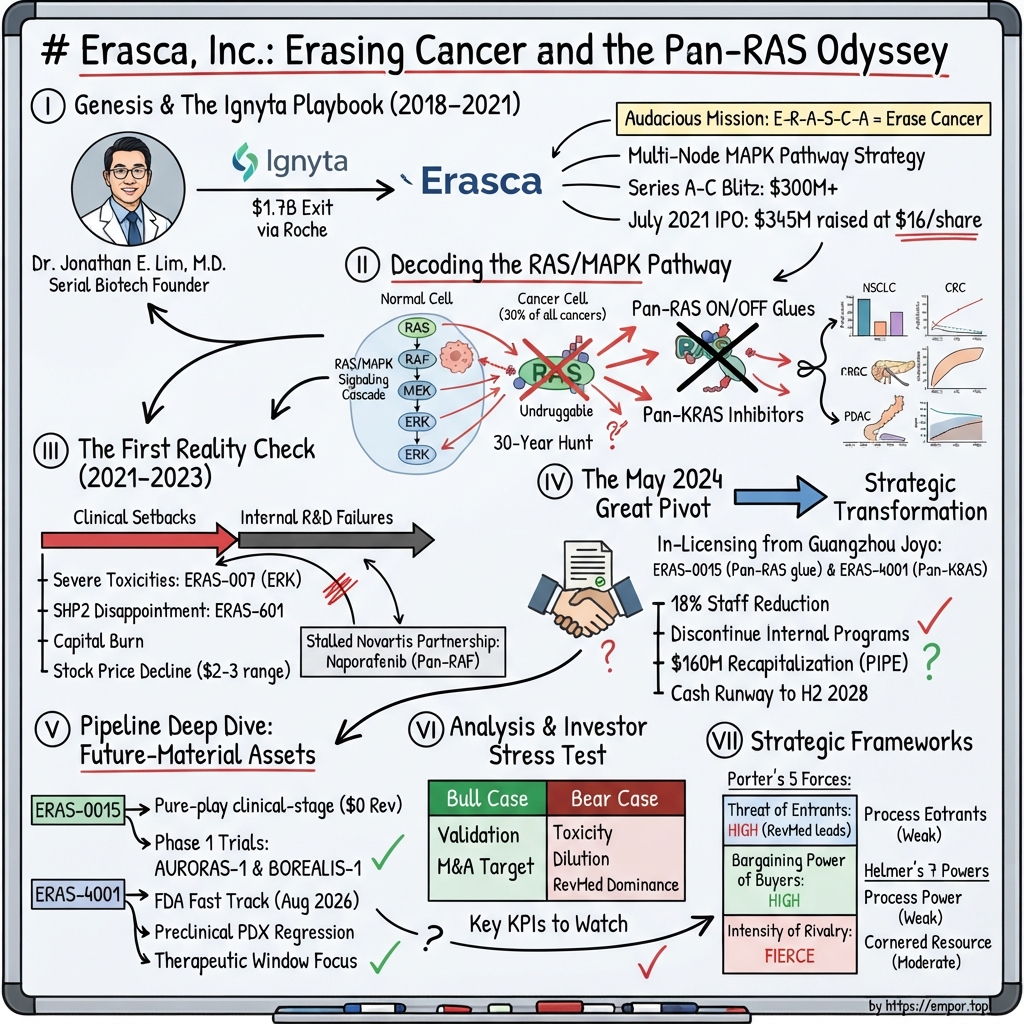
Erasca, Inc.: Erasing Cancer and the Pan-RAS Odyssey
I. Introduction & Episode Roadmap
On the afternoon of Monday, April 27, 2026, Erasca's investor relations team released two documents within hours of each other. The first was a regulatory filing disclosing that legal counsel for a competitor had delivered a letter accusing Erasca's lead drug candidate of patent infringement and trade-secret misappropriation. The second, issued after the market close, presented a clinical data package reporting initial response rates in lung and pancreatic cancer that appeared to outperform the leading drug in its class.
The market did not celebrate. Having closed at $21.49 the prior Friday, Erasca shares fell to $9.90 by the close on Tuesday, April 28 — a 48% single-day decline. Buried in the safety tables of the data release was a critical line item: a 66-year-old male patient with heavily pretreated pancreatic cancer had developed pneumonitis following drug administration and died.116
Eleven weeks later, on July 13, 2026, the company reported updated trial results and completed a $632.5 million equity offering at $17.50 per share — exceeding its 2021 initial public offering price — to institutional healthcare investors.119 Within a single quarter, Erasca, Inc. (Nasdaq: ERAS) moved from a 52-week low of $1.33 per share to a market capitalization exceeding $6 billion, despite generating zero revenue and possessing no approved commercial drugs.7
That volatility reflects a broader strategic realignment. Almost nothing about Erasca's current position aligns with the business plan presented to public markets five years ago.
The core mission. The company's name compresses its stated ambition: "erase cancer." Headquartered in San Diego, Erasca is a clinical-stage precision oncology firm focused on inhibiting the RAS/MAPK pathway, a central signaling cascade in human oncology.3 RAS represents the most frequently mutated oncogene family, with alterations across the RAS/MAPK pathway contributing to more than five million new cancer diagnoses worldwide each year.1 Though long considered undruggable, Erasca was founded on the premise that targeted chemical inhibition had become technically feasible.
The founder's return. Erasca was co-founded in 2018 by Jonathan E. Lim, M.D., a physician and entrepreneur who previously led Ignyta, the developer of entrectinib (Rozlytrek), through its $1.7 billion all-cash acquisition by Roche.5 His co-founder, Kevan Shokat, Ph.D., professor and chair of cellular and molecular pharmacology at UCSF and a Howard Hughes Medical Institute investigator, authored seminal research enabling covalent targeting of KRAS.3 Lim oversaw business development and operations, while Shokat provided foundational scientific guidance.
The central question. Can a precision oncology company initially established as an internal discovery engine — whose early proprietary programs failed, stalled, or were returned — successfully pivot into a licensing business operating external molecules? And if so, what structural advantage does a licensee retain?
This query reflects current operational realities. As of mid-2026, Erasca's clinical pipeline consists entirely of assets in-licensed from Chinese biotechnology companies, while its original IPO-era discovery programs have been terminated or returned.3 Since inception, the company has raised approximately $1.3 billion and accumulated a deficit of roughly $1.1 billion, with outstanding shares more than tripling since its IPO.1 Meanwhile, its lead asset faces intellectual property and trade-secret challenges from the primary competitor against which Erasca benchmarks its clinical performance.1
The roadmap. This analysis examines the target biology and patient populations; the Ignyta operational model and the 2021 IPO at $16.00 per share; the 2023–2024 pipeline restructuring that saw legacy assets written off; the May 2024 strategic pivot acquiring preclinical candidates from Guangzhou; the clinical profile and data surrounding ERAS-0015 and ERAS-4001; corporate governance and management execution relative to historical guidance; competitive dynamics against Revolution Medicines and major pharmaceutical firms; and the key clinical and commercial determinants of the company's long-term valuation.
A key distinction frames this analysis at the outset. Erasca's progress to date consists of early technical and regulatory milestones — Phase 1 dose-escalation response rates, FDA Fast Track designations, and combination trial clearances — which represent authorizations to continue clinical development rather than proof of commercial viability. As management explicitly discloses, the company does not expect product sales revenue for several years, if ever.1 That commercial reality underpins the analysis that follows.
 Subscribe on LinkedIn
II. The Biological Holy Grail: Decoding the RAS/MAPK Pathway
Picture a light switch wired into a human cell. In its "off" position, the cell sits quiet. Flip it "on," and the cell receives an instruction to grow and divide. In healthy tissue, the switch is flipped briefly by an external signal — a growth factor docking onto a receptor on the cell surface — and then flips back. The switch is a protein called RAS, and its "on" or "off" state depends on whether it is holding a molecule of GTP (on) or GDP (off).
Cancer, in one of biology's cruelest bits of engineering, discovered that a single amino-acid substitution can jam that switch permanently in the "on" position. The cell then receives an unrelenting signal to divide. Downstream of RAS sits a relay of proteins — RAF, then MEK, then ERK — that carries the signal to the nucleus. This is the RAS/MAPK pathway, and the reason it has consumed so much of oncology's attention for four decades is simple arithmetic: RAS is the most frequently mutated oncogene in human cancer.1
The scale is enormous even when restricted to the three main tumors where RAS drives the disease. In the United States alone, the estimated annual incidence of KRAS-mutant tumors is roughly 74,000 patients in colorectal cancer, 55,000 in non-small-cell lung cancer, and 50,000 in pancreatic adenocarcinoma.1 Erasca's own estimate of the worldwide opportunity for a pan-RAS agent is approximately 2.7 million patients diagnosed annually with RAS-mutant tumors, of whom more than 2.2 million carry KRAS mutations specifically.1 Those are company figures rather than independent epidemiology, and they represent diagnosed patients rather than treatable, reimbursed, drug-eligible populations — but even when heavily discounted, the patient population is vast.
Why "undruggable" was the consensus. Most successful drugs work by wedging a small molecule into a pocket on a protein's surface. RAS is famously smooth. It has no obvious groove for a drug to grab, and it binds GTP with such ferocious affinity that competing with it directly was long considered hopeless. For roughly thirty years, the pharmaceutical industry's response to RAS was to attack the proteins downstream of it — RAF, MEK, and ERK — which is precisely the strategy Erasca was originally built around. That approach has a structural weakness: the pathway is a relay with feedback loops, and blocking one relay station often prompts the cell to reroute signaling.
The breakout. The wall cracked around 2013, when chemists — Kevan Shokat's lab prominent among them — showed that one specific KRAS mutation, G12C, creates a reactive cysteine that a drug can covalently latch onto. That discovery produced the first approved KRAS drugs: Amgen's sotorasib (Lumakras) and Mirati's adagrasib (Krazati), both mutant-specific inhibitors that lock KRAS in its "off" state.
These targeted therapies represented a major scientific advance, though a commercially modest one. G12C is common in lung adenocarcinoma but rare in pancreatic cancer and uncommon in colorectal cancer, keeping the addressable patient population narrow. Worse, tumors treated with a mutant-specific inhibitor frequently escape by activating a different RAS variant or the wild-type version of the same protein.
Enter pan-RAS. The next generation of drug development asks a broader question: rather than targeting a single mutation, why not shut down RAS itself — mutant and wild-type, across KRAS, NRAS, and HRAS, in both the GTP-bound "on" state and the GDP-bound "off" state? Erasca's framing is that pan-RAS and pan-KRAS molecules can address the broad G12X, G13X, and possibly Q61X populations while also blocking the wild-type activation that drives resistance to narrower drugs.1
The mechanism that enabled this approach relies on a novel strategy. A "molecular glue" does not pry open a pocket on RAS. Instead, it binds to an abundant chaperone protein inside the cell called cyclophilin A, and the drug-plus-chaperone complex then clamps onto RAS, creating a synthetic binding interface. In effect, the drug manufactures a handle on a protein that lacks one naturally. Once glued, RAS can no longer engage its downstream partner RAF, halting the signal.
And here is the catch. Wild-type RAS is not a bystander; it performs essential work in healthy tissue, particularly in skin and gut epithelium, which explains why anti-EGFR and MEK-targeted drugs cause rash and diarrhea. A drug that shuts down RAS everywhere risks causing systemic toxicity. The entire commercial logic of this class reduces to one concept: the therapeutic index — how much tumor RAS can be silenced before normal tissue suffers unacceptable toxicity. That is not a marketing variable; it is the central clinical constraint.
The competitive structure. This is one of the most crowded, high-stakes races in biopharma, and Erasca is not leading it. Revolution Medicines pioneered the tri-complex approach and its lead molecule, daraxonrasib (RMC-6236), read out pivotal Phase 3 results in previously treated metastatic pancreatic cancer in 2026: median overall survival of 13.2 months versus 6.7 months for chemotherapy in the intent-to-treat population, presented in a plenary session at ASCO and published in the New England Journal of Medicine.8 In July 2026, the FDA accepted its New Drug Application, selecting it for the Commissioner's National Priority Voucher pilot with an anticipated review time of one to two months.9 Revolution Medicines carries a market capitalization near $44 billion, while Erasca's is roughly $6 billion.7 Erasca's own 10-K lists the rest of the field: Amgen, Boehringer Ingelheim, BridgeBio Oncology Therapeutics, Bristol Myers Squibb, Eli Lilly, Merck, Pfizer, Roche/Genentech, plus Chinese developers including GenFleet and Jacobio.3
Erasca's public posture toward this field is unusual. Its annual report describes competitors under the heading "Competition + Cooperation," arguing that "the most fearsome competitor of all is cancer itself" and that rivals are "more as potential allies and collaborators than as competitors."3 That sentiment contrasts with industry realities, given that Erasca's lead asset is currently the subject of a patent and trade-secret demand letter from the category leader. Investors should treat that framing as corporate culture rather than an assessment of competitive dynamics.
The economics beneath the biology. Commercial value in this therapeutic class requires precise evaluation, because "2.7 million patients" is a market size rather than a revenue model. Pan-RAS agents are oral small molecules, offering low manufacturing costs and eliminating the need for infusion infrastructure — yielding attractive potential gross margins if approved. However, commercial returns concentrate in a narrow band of settings: tumors where RAS is the primary driver, where current options are limited, and where patients remain on therapy long enough to generate sustained prescription volume.
Pancreatic cancer illustrates the tradeoff. It has the highest RAS-mutation prevalence and the poorest survival, offering the fastest path to a statistically clean survival signal, but presenting a challenging base for long-term revenue because patients rarely stay on therapy for extended periods. Non-small-cell lung cancer presents the opposite dynamics: harder to differentiate clinically, but substantially more valuable per approval because patients treated in earlier lines remain on treatment for many months. That dynamic explains why Erasca has structured its clinical plans around both — a first-line pancreatic Phase 3 trial for initial proof of efficacy and lung cancer trials for long-term franchise value.2
A note on selection. Every response rate in this therapeutic class applies to patients selected by genomic testing. That dependency creates a dual effect. It concentrates efficacy, generating the compelling response rates seen in precision oncology trials. At the same time, real-world adoption depends on testing rates, turnaround times, and diagnostic reimbursement — operational hurdles that have historically slowed the commercial rollout of targeted therapies with strong clinical trial data.
For investors, the key implication of the underlying biology is clear: the market is large, the mechanism has been validated by a randomized Phase 3 trial in one of oncology's most challenging indications, and the central question is no longer whether pan-RAS inhibition works. Rather, it is whether a fourth or fifth entrant into a validated class, arriving years behind the leader, can establish sufficient differentiation on safety, tolerability, or combination potential to capture commercial market share. That sets up the question of how Erasca entered this race in the first place — a transition that departed significantly from its original business plan.
III. Genesis & The Ignyta Playbook: The Founding of Erasca (2018–2021)
In February 2018, Roche completed its $1.7 billion all-cash acquisition of Ignyta.5 For co-founder Jonathan Lim, the deal validated a core operational thesis: matching a precisely targeted drug to a biomarker-selected patient population could yield compelling clinical efficacy, triggering expedited regulatory approvals. Ignyta's lead candidate, entrectinib, subsequently became the first drug to receive simultaneous breakthrough-style regulatory designations from the FDA, the EMA, and Japan's PMDA — an achievement Erasca later highlighted as a regulatory "triple crown" on Lim's executive résumé.3
Lim's background illustrates both the organizational strengths and structural vulnerabilities of Erasca's subsequent strategy. A physician by training, Lim has served as chairman, chief executive, or founding investor across six biotechnology companies that collectively advanced seven approved products in oncology, immunology, and drug delivery.3 His track record reflects the profile of an executive company-builder rather than a bench researcher — adept at assembling high-profile advisory boards, securing substantial private capital, in-licensing clinical candidates, and executing rapid development timelines.
When Erasca was established in 2018, Lim deployed that exact operational blueprint. Partnering with scientific co-founder Kevan Shokat, Lim assembled a scientific advisory board comprising leading figures in RAS biology: Michael Varney, former head of Genentech Research and Early Development, as chair of R&D; René Bernards of the Netherlands Cancer Institute; Stephen Blacklow of Harvard; Karen Cichowski of Harvard; Ryan Corcoran of Massachusetts General Hospital; George Demetri of Dana-Farber Cancer Institute; Piro Lito of Memorial Sloan Kettering Cancer Center; and Pablo Rodriguez-Viciana of University College London.3 The initial operating team was similarly drawn from Ignyta, Roche/Genentech, Illumina, Eli Lilly, Medivation, Merck, Neurocrine Biosciences, Pfizer, and Turning Point Therapeutics.3
The strategy: own every node. Rather than relying on a single candidate, Erasca's founding strategy sought to target the entire RAS/MAPK pathway — inhibiting nodes upstream and downstream of RAS while blocking alternative resistance mechanisms. Executing this pathway-wide coverage required acquiring assets externally rather than developing them in-house. In February 2020, the company in-licensed a SHP2 inhibitor from NiKang Therapeutics, designated ERAS-601.
In March 2020, Erasca licensed a central nervous system-penetrant EGFR inhibitor from Katmai Pharmaceuticals, designated ERAS-801. In November 2020, it acquired ASN Product Development via a merger with Asana BioSciences, securing the ERK1/2 inhibitor later designated ERAS-007. In March 2021, the company acquired EGFR domain II/III antibody assets from Emerge Life Sciences for $2.0 million in cash and 500,000 common shares, forming the foundation of its ERAS-12 program.3
This transaction history underscores a defining characteristic: even while positioning itself as an internal discovery engine, Erasca operated primarily as a business development and licensing platform. That structural reality remains central to assessing both its initial public valuation and its current operating model.
The capital blitz. Private investors backed the model aggressively. In April 2020, Erasca closed a $200 million Series B financing co-led by ARCH Venture Partners and Cormorant Asset Management, with participation from City Hill Ventures, Colt Ventures, LifeSci Venture Partners, EDBI, Invus, and Terra Magnum. A $36 million extension in August 2020 expanded the round to $236 million and pushed total capital raised past $260 million.10 For a company whose oldest program was two years old and whose lead candidate had not yet entered clinical trials, securing nearly a quarter-billion dollars in a single private round reflected the buoyant valuation environment of 2020–2021, when prominent founders pursuing validated oncology targets commanded premium pricing.
Culture and organizational structure. Erasca structured its corporate identity around its clinical mission, establishing core values under the acronym CURE. In May 2021, ahead of its public offering, the company launched the Erasca Foundation, a California non-profit endowed with 1,093,557 shares of common stock — representing 1% of total capital stock — which by 2025 was funding community health organizations including Family Health Centers of San Diego, Cancer Angels of San Diego, the Emilio Nares Foundation, and Life Science Cares.3 While reflecting philanthropic intent, the foundation also served as a recruitment instrument in a competitive San Diego biotechnology labor market. Operational staffing remained lean: headcount grew from 30 employees at year-end 2019 to 103 full-time personnel as of February 2026 — 34 holding doctoral degrees and 70 dedicated to research and development — despite an 18% workforce reduction during the intervening period.3 For a company that has raised cumulative capital of $1.3 billion, maintaining a team of roughly 100 employees reflects a lean, outsourced management model.
The initial public offering. Erasca initiated public trading on the Nasdaq Global Select Market on July 16, 2021. The initial public offering closed on July 20, raising $345.0 million in gross proceeds through the sale of 21,562,500 common shares at $16.00 per share — including full exercise of the underwriters' option — against underwriting discounts of $24.2 million and offering expenses of $3.8 million.6 Simultaneously, the endowment of 1,093,557 shares to the Erasca Foundation — representing 1% of outstanding equity — established an initial baseline capitalization of approximately 110 million shares.3
Capital deployment and allocation. Public capital was earmarked to execute a multi-front strategy: advance four clinical-stage candidates concurrently, build parallel internal discovery capabilities, and evaluate multi-agent combinations across the pathway. This parallel approach expanded operating expenses, driving annual research and development expenditures to $115.4 million by 2024.3 In the low-interest-rate environment of 2021, advancing multiple candidates simultaneously offered risk diversification. However, as capital markets tightened in 2022 and 2023, maintaining high burn rates across multiple early-stage clinical programs created substantial financial leverage if those candidates failed to demonstrate single-agent activity.
In mid-2021, the investment case proved compelling to healthcare institutions: an experienced management team, a prominent scientific advisory panel, a high-value oncology pathway, and a diversified pipeline offering multiple opportunities for clinical validation. What public filings could not foretell was that none of Erasca's initial portfolio assets would reach commercialization.
The subsequent development cycle directly tested Erasca's core thesis: that controlling multiple nodes across a single signaling pathway creates a durable competitive advantage. Evaluating the outcome of that strategy requires examining how those original programs performed in the clinic.
IV. The Initial Pipeline & The First Reality Check (2021–2023)
The claim. Erasca's founding thesis, carried into the public markets, was that a modality-agnostic portfolio spanning multiple nodes of the RAS/MAPK pathway — ERAS-007 at ERK, ERAS-601 at SHP2, ERAS-801 at EGFR, and later naporafenib at RAF — would give the company several independent opportunities to succeed. In addition, this broad portfolio was intended to provide the combination toolkit needed to overcome the pathway's well-known ability to reroute around single-agent blockade — offering, in industry parlance, multiple shots on goal.
The falsification pass. The strongest disconfirming evidence is not analyst skepticism; it is Erasca's own disclosures and subsequent program-by-program execution.
Consider ERAS-007, the ERK inhibitor obtained through the Asana merger. It was evaluated across the HERKULES clinical trial series, most prominently in combination with encorafenib and cetuximab in patients with BRAF-mutant colorectal cancer who had not previously received that regimen.
In its May 2024 investor presentation, Erasca stated its rationale for deprioritizing the HERKULES-3 trial with unusual candor, noting that "clinical efficacy data do not support continued evaluation of this combination in this indication."11 In effect, management acknowledged that the drug failed to demonstrate sufficient efficacy in its target setting. In September 2025, Erasca notified Asana that it was terminating the license entirely, effective November 8, 2025, while agreeing to keep enrolled patients on treatment.3
ERAS-601, the SHP2 inhibitor licensed from NiKang, followed a similar trajectory one step earlier. Erasca announced a strategic reprioritization in November 2023 that deprioritized the FLAGSHP-1 trial evaluating the molecule; the NiKang license was subsequently terminated effective October 9, 2025.3 By that point, the SHP2 class had become crowded and differentiated primarily through combination approaches, and Erasca failed to establish a distinct clinical profile.
ERAS-801, a central nervous system-penetrant EGFR inhibitor for glioblastoma, completed dose escalation and identified a maximum tolerated dose — a technical success — before the THUNDERBBOLT-1 trial was paused in May 2024 to reallocate corporate resources.1211 In April 2025, Erasca signed a termination agreement returning the program to Katmai. The agreement assigned back all operational know-how, regulatory filings, and trial sponsorship, leaving Katmai obligated to pay Erasca only if Katmai subsequently develops or commercializes the asset.3 Rather than a profitable divestiture, the transaction represented a return of licensed rights with a contingent future payout.
Then there was ERAS-4, the internal pan-KRAS discovery program — the sole homegrown asset in the portfolio. On an R&D update call on March 28, 2024, Lim benchmarked internal compounds against external candidates from Revolution Medicines and Loxo/Lilly. He highlighted that Erasca's molecules cleared their oral bioavailability threshold where a leading competitor's compound did not, stating that the team was "encouraged by the progress." However, management also signaled a shift, noting that the competitive space "is rapidly evolving and could close quickly," prompting Erasca to look "at both internal as well as external opportunities to accelerate."12 Roughly seven weeks later, the internal pan-KRAS discovery program was discontinued and replaced by two in-licensed molecules.11
Weighing it. Across four early programs, Erasca recorded four terminations, pauses, or asset returns, yielding zero clinical winners from its IPO-era portfolio. This track record directly undermines the premise of an internal R&D discovery platform. What persisted through this period was not a proprietary discovery engine, but an aggressive business development function and a scientific advisory board capable of evaluating external candidates. That distinction matters: an in-licensing platform represents a narrower, more replicable capability than the internal discovery engine presented to public investors in 2021.
The second claim: late-stage licensing discipline. In December 2022, Erasca expanded its pipeline by securing an exclusive worldwide license from Novartis Pharma AG for naporafenib, a pan-RAF inhibitor targeting both BRAF and CRAF across all therapeutic fields.3 Industry reports pegged the upfront licensing cost at $20 million.14 Erasca positioned naporafenib as its lead clinical asset and primary near-term registrational driver, advancing it into the SEACRAFT-1 trial for tissue-agnostic RAS Q61X solid tumors and planning the pivotal SEACRAFT-2 trial in NRAS-mutant melanoma.
The falsification pass on naporafenib. Here, too, management's promotional commitments faced reality.
In its fourth-quarter 2023 financial results released on March 27, 2024, Erasca announced it had "gained global registrational clarity" for naporafenib. Management highlighted a pooled analysis demonstrating a median overall survival of 13.0 and 14.1 months across two dose cohorts in Phase 1b and Phase 2 trials, claiming these results nearly doubled historical control benchmarks for chemotherapy and single-agent MEK inhibitors.12 On an investor call the following morning, leadership confirmed regulatory alignment with authorities in the United States and Europe, stating that SEACRAFT-2 was statistically powered at 80% for overall survival and 99% for progression-free survival across roughly 350 patients, creating "a realistic opportunity to show statistical and clinical benefit."12
Fourteen months later, in May 2025, Erasca announced it was evaluating strategic alternatives for naporafenib, ultimately halting development. In March 2026, the company formally notified Novartis that it was terminating the license effective June 3, 2026, agreeing only to maintain treatment for currently enrolled patients in SEACRAFT-1 and SEACRAFT-2.31 A pivotal Phase 3 candidate that management had described as regulatory-aligned and statistically powered was abandoned prior to delivering a randomized readout.
A designation is not a drug. The naporafenib timeline highlights an important distinction in biopharmaceutical development. In December 2023, the FDA granted Fast Track designation to naporafenib combined with trametinib for previously treated NRAS-mutant melanoma. Erasca subsequently secured a clinical supply agreement with Novartis for free trametinib in February 2024, while also earning a Fast Track designation for ERAS-801 in glioblastoma.12 Despite three regulatory designations, two free-drug supply agreements, and aligned pivotal trial designs across major health authorities, these assets generated neither an approved commercial product nor product revenue.
Every program from this era was ultimately paused, terminated, or returned. For investors evaluating new regulatory designations in 2026, this historical context is instructive: Fast Track status indicates unaddressed medical need and early promise, but it is granted long before phase-ending clinical proof is established.
Weighing it. The naporafenib experience reveals two contrasting interpretations. Under a critical view, management's public guidance was overly assertive, relying on specific power assumptions and benchmark comparisons that failed to pan out. This effort consumed substantial financial resources during a period when annual R&D spending reached $115.4 million in 2024 alone.3 Under a more sympathetic view, stopping naporafenib reflected prudent capital allocation when superior internal candidates emerged.
Both perspectives hold weight. Erasca's licensing team proved adept at sourcing assets, but it struggled to accurately assess and rank their ultimate clinical utility in advance. Moving forward, the test for this strategy is straightforward: if any of the three registration-enabling ERAS-0015 trials currently planned are abandoned mid-stream, asset reallocation risks becoming a structural pattern.
This set the stage for the pivotal week when Erasca overhauled its corporate strategy.
V. The May 2024 Great Pivot: Re-Allocating Capital to Pan-RAS
By the spring of 2024, Erasca faced severe financial and strategic headwinds. Its shares had fallen from the $16.00 IPO price to roughly $2.00, its lead clinical asset was heading into an expensive Phase 3 trial in a narrow indication, and its internal discovery chemistry lagged behind competitors already in the clinic. In March 2024, the company raised $45.0 million in gross proceeds through a private placement of 21,844,660 shares at $2.06 per share, projecting that the capital would extend its operating runway into the second half of 2026.13 The financing bought temporary breathing room rather than long-term strategic stability.
On May 20, 2024, Erasca executed a fundamental corporate restructuring.[^12]
The deal. Erasca secured an exclusive license from Guangzhou Joyo Pharmatech Co., Ltd. for a pan-RAS molecular glue — designated ERAS-0015 — covering all global territories outside mainland China, Hong Kong, and Macau.22 Erasca paid $12.5 million upfront, committing up to $51.5 million in development and regulatory milestones, up to $125.0 million in commercial milestones, and tiered low-to-mid single-digit royalties.3 The agreement also granted Erasca an option to acquire Greater China rights for $50.0 million if exercised before either party dosed a patient in a Phase 2 trial, or $150.0 million thereafter.3
Concurrently, Erasca licensed a second asset from a separate developer, securing worldwide rights to a pan-KRAS inhibitor — designated ERAS-4001 — from Medshine Discovery Inc. for $10.0 million upfront, up to $30.0 million in development and regulatory milestones, up to $130.0 million in commercial milestones, and low-single-digit royalties.1 Combined, Erasca secured rights to two preclinical candidates from two distinct counterparties for $22.5 million in upfront cash.
The economic terms reflected a broader industry licensing trend. Erasca acquired the foundation of its mid-2026 pipeline for less than the underwriting fees of its 2021 IPO, capitalizing on cross-border structures where Chinese discovery chemistry was out-licensed to U.S. firms equipped with capital access and FDA regulatory experience.
The purge. The May 2024 strategic realignment shuttered nearly all legacy programs. Management deprioritized the HERKULES-3 trial due to insufficient efficacy, paused the THUNDERBBOLT-1 trial, and terminated the internal ERAS-4 pan-KRAS discovery program, folding select preclinical compounds into the Medshine agreement as potential backups. To reduce operating expenses, Erasca cut headcount by approximately 18%, concentrating reductions among internal discovery scientists and project teams on deprioritized programs, generating $2.2 million in one-time restructuring charges paid substantially in June 2024.311 Naporafenib remained an exception at the time, retaining its position as the company's lead clinical asset for another year before being halted in 2025.
The targeted workforce reduction formalized Erasca's operational shift. By reducing internal discovery personnel, the company effectively ended its internal R&D apparatus to operate exclusively as a business development and clinical execution platform.
The recapitalization. Following the announcement, Erasca completed a public equity offering of 99,459,458 common shares at $1.85 per share — including full exercise of the underwriters' option — raising $174.4 million in net proceeds.1 The company also utilized its at-the-market facility throughout 2024, issuing 9,231,114 shares at a weighted average price of $2.37 per share to generate an additional $21.0 million in net proceeds.1
Corporate venture activity. During this period, the company also operated a corporate venture arm, making an equity investment through Erasca Ventures into Affini-T Therapeutics, a developer of T-cell receptor therapies targeting KRAS G12V, G12D, and G12C mutations.11 While financially modest, maintaining an external investment vehicle alongside a struggling internal pipeline highlighted broader capital allocation choices during the pre-pivot period.
Management execution and value retention. The strategic turnaround imposed significant dilution on early equity holders. Investors purchasing shares at the July 2021 IPO price of $16.00 and holding through the May 2024 offering at $1.85 experienced an 88% decline in share value. Furthermore, the capital raises reshaped the corporate ownership structure. Between the March private placement of 21.8 million shares, the May public offering of 99.5 million shares, and subsequent at-the-market sales of 9.2 million shares, Erasca more than doubled its share count in 2024 alone. By August 4, 2026, total shares outstanding reached 349,762,035 — more than triple its IPO baseline.1 Pre-2024 shareholders were diluted to a minority position in an enterprise whose underlying pipeline assets had been entirely replaced.
This transition marked the third iteration of Erasca's core investment thesis in three years: evolving from an internal discovery engine across the MAPK pathway in 2021, to a late-stage registrational play centered on Novartis-licensed naporafenib in 2022, to an in-licensed Chinese preclinical pan-RAS franchise in 2024. While each shift responded to emerging clinical data, the pattern highlights frequent changes in core strategic focus.
Weighing the pivot. Evaluating management's capital allocation yields a nuanced outcome. Judged by subsequent market capitalization, the May 2024 in-licensing agreements were highly cost-effective: $22.5 million in upfront cash secured two assets that became the primary drivers of a multi-billion-dollar valuation by mid-2026. Management demonstrated a willingness to terminate underperforming programs swiftly and acquire external assets at low valuations. However, those low-priced equity issuances at $1.85 and $2.06 per share were necessitated by the clinical failure of the company's initial portfolio. Erasca's leadership executed a low-cost asset acquisition at the market trough, but it had also overseen the pipeline write-downs that created that valuation trough.
VI. Pipeline Deep Dive & Future-Material Business Sizing: ERAS-0015 & ERAS-4001
Start with the financial reality, because it is simple. Erasca has no products, no revenue, and no partnerships generating income. It has never recorded a dollar of product sales since its 2018 inception. What it has is cash and a burn rate.
As of June 30, 2026, cash, cash equivalents and marketable securities stood at $384.3 million, up from $341.8 million at the end of 2025 — but that comparison flatters the year, because it excludes the $150.0 million paid to Joyo in March 2026 and includes $242.7 million of net proceeds from a January 2026 stock offering at $10.00 a share.21 In July 2026, the company added $593.5 million net from the $632.5 million gross offering at $17.50.1
Operating expenses are climbing as trials expand: second-quarter 2026 research and development expense was $35.9 million against $21.2 million a year earlier, and general and administrative expense was $11.7 million against $9.5 million, producing a quarterly net loss of $44.1 million, or $0.14 per share.2 For the first half of 2026, the net loss was $227.5 million — a number dominated by the one-time $150.0 million in-process R&D charge for the China territory buyout rather than by cash operations, where the actual cash used in operating activities was $54.7 million.1 Accumulated deficit since inception stands at approximately $1.1 billion against roughly $1.3 billion raised.1
On runway, note a subtle disclosure shift. The 2025 annual report stated plainly that resources would fund operations "into the second half of 2028."3 The second-quarter 2026 filing dropped the calendar-date formulation and instead framed sufficiency in terms of achieving a specific list of milestones and funding operations "for at least the next twelve months."1 That is not alarming — the milestone list is more informative than a date — but it is a genuine change in how the company bounds its own runway, and it happened in the same quarter the company committed to three registration-enabling trials.
An accounting judgment worth flagging. The $150.0 million territory payment was expensed immediately as in-process research and development rather than capitalised as an intangible asset — standard treatment for an asset acquisition where the acquired rights have no alternative future use, and the same treatment applied to the $7.5 million of Joyo milestones recognised in 2025.1 The practical consequence is that Erasca's income statement understates the balance-sheet value of what it bought and overstates the economic loss in the period. First-half 2026's headline net loss of $227.5 million is therefore a poor guide to the underlying business; the $54.7 million of cash used in operations is the number that describes what the company actually spends to run itself.1 Investors reading quarterly loss figures across 2026 should separate the two, because milestone payments to Joyo and Medshine will continue to land unevenly as programs advance.
Asset one: ERAS-0015, the pan-RAS molecular glue. This is, plausibly, close to 100% of Erasca's enterprise value today.
The mechanism, in plain terms, works as described earlier: the drug recruits cyclophilin A, and the resulting complex clamps RAS across KRAS, NRAS and HRAS, in both active and inactive states, preventing engagement with downstream effectors. Erasca's differentiation claim is potency-based and explicitly comparative: in vitro, ERAS-0015 has shown roughly 8 to 21 times higher binding affinity to cyclophilin A than "the most advanced pan-RAS molecular glue in development," which the company believes yields about five times more potent RAS inhibition in cell assays, and comparable-to-greater in vivo antitumour activity at roughly one-eighth to one-tenth the dose.1 In mice, combined with an anti-PD-1 antibody, ERAS-0015 achieved complete disappearance of tumours by day 31; combined with cetuximab, it produced significant tumour growth inhibition.1
Those are preclinical claims, benchmarked against a competitor's published data rather than head-to-head — and that benchmarking methodology is precisely what Revolution Medicines' lawyers objected to, a point we will return to.
The clinical data are more interesting because they are human. The FDA cleared the AURORAS-1 investigational new drug application in May 2025; the molecule is also being studied in China in the JYP0015M101 trial sponsored by Joyo.1 On January 12, 2026, Erasca disclosed early dose-escalation observations including confirmed and unconfirmed partial responses at doses as low as 8 mg once daily — the disclosure that began the stock's re-rating from around a dollar.18
The substantive readout came on April 27, 2026, pooling the US and Chinese trials. In second-line-or-later KRAS G12X non-small-cell lung cancer, the unconfirmed-plus-confirmed response rate at pharmacologically active doses of 16–32 mg once daily was 62% across 37 patients; in a post-checkpoint-inhibitor, post-platinum subset it was 75% across 16 patients. In second-line KRAS G12X pancreatic cancer, the response rate was 40% across 20 patients at those doses. Pharmacodynamics were striking: all 14 evaluable patients showed at least a 75% reduction in KRAS G12X circulating tumour DNA, with five showing complete clearance. No dose-limiting toxicities were observed, and 24 mg and 32 mg once daily were selected as the recommended expansion doses.15
Then the same release disclosed the death. One patient experienced a Grade 3 treatment-related pneumonitis that progressed to Grade 5 after the patient elected to withdraw supportive care: a 66-year-old man with heavily pretreated metastatic pancreatic cancer, pulmonary metastases and a history of lung cryoablation, dosed at 24 mg, who presented about a month after starting therapy and was treated aggressively with discontinuation, high-dose steroids and infliximab.1 The market's reaction — the 48% single-day decline — was a judgment that a treatment-related death in a small dose-escalation cohort meaningfully raises the probability that the therapeutic window is narrower than the response rates imply.16
The July 13, 2026 update was the rebuttal. With additional patients and longer follow-up through a May 25, 2026 cutoff, ERAS-0015 produced a 57% response rate across seven patients at the 32 mg expansion dose in second-line-or-later KRAS G12X pancreatic cancer, with every responding patient still on treatment; safety remained consistent, with mostly low-grade adverse events, no dose-limiting toxicities, no treatment-related discontinuations, and a median relative dose intensity of 100% at both expansion doses — meaning patients were, on average, taking every scheduled pill.12 The first dose-escalation cohort of the combination with panitumumab cleared without dose-limiting toxicity.2 On August 24, 2026, the FDA granted Fast Track designation for metastatic pancreatic adenocarcinoma.4
Read the numbers carefully. Seven patients. Responses that include unconfirmed ones, meaning some may not hold up on repeat scan — a caveat Erasca itself flags in its own risk language.2 Cross-trial comparisons to competitor data that the company states are "not based on any head-to-head clinical trials."16 A 57% response rate in seven patients has a confidence interval you could drive a truck through.
What the data genuinely establish is that the drug engages its target profoundly in humans — the ctDNA clearance is the most convincing single fact in the package — and that at expansion doses it has so far been tolerable enough that patients stay on full dose. What they do not establish is durability, progression-free survival, overall survival, or behaviour in a randomised setting against an active comparator.
Asset two: ERAS-4001, the pan-KRAS inhibitor. The design logic is the mirror image of ERAS-0015. It targets KRAS specifically — including G12X mutations and wild-type amplifications — while showing no activity against wild-type HRAS or NRAS, on the theory that sparing those isoforms yields a wider therapeutic window than a true pan-RAS approach.1 The BOREALIS-1 IND cleared alongside AURORAS-1 in May 2025, and preliminary Phase 1 monotherapy data are expected in the second half of 2026 — the next binary event on the calendar.2
There is elegant portfolio logic here: if pan-RAS proves too toxic, pan-KRAS is the hedge; if pan-RAS is tolerable, ERAS-4001 becomes a combination partner or a second product. There is also a less elegant reading: two shots on goal from the same 2024 licensing spree is exactly the "multiple shots" framing that did not work last time.
The third program, and a governance signal. ERAS-12, the EGFR biparatopic antibody, has a lead candidate identified — and Erasca has stopped committing internal resources to it, seeking a partner instead.1 That is the fourth program in this company's history to be shopped rather than developed. It is also, in fairness, focus.
Myth versus reality. Three consensus statements about this company are worth checking against the record.
Myth: Erasca in-licensed a preclinical asset in 2024 and got lucky. Reality: partly true and materially incomplete. The 2024 deal was cheap because the assets were unproven and the seller's market was depressed; the outcome to date has been exceptional.
But Erasca also paid $150.0 million in March 2026 to buy back the Greater China territory it had originally left with the licensor — roughly seven times the combined upfronts of both original licenses.1 The full acquisition cost of the franchise is therefore about $172.5 million in cash paid to date plus future milestones and royalties, not $22.5 million. That is still a bargain on current evidence. It is a different bargain than the headline suggests, and the option structure meant the price rose the moment the asset started working.
Myth: Erasca now owns a proprietary pan-RAS platform. Reality: it owns a license. The composition-of-matter family for ERAS-0015 is in-licensed from Joyo and expires in 2043; the pan-KRAS family for ERAS-4001 is in-licensed from Medshine and expires in 2043; Erasca's own filings around the glue chemistry are more recent applications expected to expire between 2045 and 2046, and remain applications rather than issued patents.3 A licensee's economics are structurally worse than an owner's, and its legal position in an infringement dispute is structurally more complicated.
Myth: the July 2026 financing proves the market has validated the drug. Reality: it proves specialist investors were willing to fund a binary at $17.50 after a 48% drawdown and a partial recovery. Those are the same categories of investor who funded the company at $16.00 in 2021, at $2.06 in March 2024 and at $1.85 in May 2024. Financing availability tracks sentiment and data flow; it is not an independent verdict on pharmacology.
The base rate. It bears stating without a footnote because it is simply how the industry works: the large majority of oncology assets that enter Phase 1 never reach approval, most often because the therapeutic window that looked adequate in dose escalation narrows under longer exposure, or because responses prove insufficiently durable. Fast Track designation does not change that base rate; it changes meeting frequency with the FDA and creates eligibility for expedited review pathways if criteria are later met.4 Erasca's current valuation embeds a probability of success meaningfully above the base rate. That may be justified by the depth of target engagement observed. It is, nonetheless, what is being underwritten.
Which raises the question of whether the people making these judgments have earned the benefit of the doubt.
VII. Corporate Governance, Management Incentives & Credibility Audit
Erasca's board is chaired by its chief executive, Dr. Jonathan Lim. The company acknowledges this combined leadership structure in its proxy filing, arguing that uniting the roles "allows one person to drive strategy and agenda-setting at the board level, as well as maintaining responsibility for executing on that strategy," while noting it established a lead independent director position in 2023 for oversight.21 How much comfort that lead independent role provides remains an open question for shareholders, given that the founder-CEO is also the company's largest individual equity holder.
Alignment. Lim holds a substantial position. As of April 15, 2026, he beneficially owned 36,574,772 shares, representing an 11.6% stake in the company — a significant equity position for a founder after rounds of heavy dilution.21 Institutional ownership is similarly concentrated, led by healthcare specialists including entities affiliated with Frazier Life Sciences at 7.3%, Venrock Healthcare Capital at 5.2%, and T. Rowe Price Investment Management at 5.2%.21 This heavy concentration of institutional healthcare investors explains both the market's capacity to absorb $632.5 million in equity financing within a single week and the severity of the April sell-off when those specialized funds repriced risk.
In 2025, Lim received a base salary of $670,400, a cash bonus of $482,688, and option awards valued at $3,135,250; the board's compensation committee awarded executive bonuses at 120% of target for 2025, citing performance against clinical, regulatory, operational, and financial milestones.21 While management advanced the newly licensed pan-RAS franchise rapidly, a 120% bonus payout in a year when the company terminated its former lead clinical asset, naporafenib, highlights a corporate compensation structure that rewarded a strategic pivot away from the very program previously set as management's primary objective.
A broader capital structure pattern is also evident: Erasca has returned to equity markets in every calendar year since its public listing. The company completed its initial public offering in 2021, set up an at-the-market equity program in 2022 that was drawn down in 2024, executed both a private placement and a public offering in 2024, expanded its at-the-market facility in 2025, and closed two major underwritten offerings in January and July 2026.1 For a clinical-stage biotechnology firm with no commercial revenues, continuous equity issuance is standard operating practice, but it continuously dilutes existing holdings.
Historically, positive clinical updates from Erasca have been followed within weeks by new share sales. With an undrawn $200 million at-the-market equity facility currently active, investors should view that capacity as an active financing tool for future capital raises rather than static balance-sheet protection.1
The credibility audit. Evaluating management execution requires measuring historical guidance on investor calls against subsequent operational outcomes.
The company's March 2024 R&D update provides a clear case study. During prepared remarks, management presented pooled overall survival data for naporafenib against three historical benchmarks, displaying detailed survival curves while Chief Medical Officer Dr. Shannon Morris explicitly noted "the caveats associated with cross-trial comparison." Yet despite that analytical presentation, the company abandoned the program fourteen months later.12
During the call's question-and-answer session, an analyst from Evercore asked how management intended to select a dose for naporafenib given that efficacy curves across different dosage cohorts appeared largely indistinguishable. Lim acknowledged the point, calling it "a really astute observation," stating his belief that "it may not matter," and concluding that "safety and tolerability becomes a little more important in that choice."12 While the response was transparent, it revealed that the rationale for a planned Phase 3 registrational trial rested on dose selections with limited observable differences in clinical efficacy.
That same call signaled the impending strategic shift. Unprompted by analyst questions, Lim noted that the pan-KRAS competitive landscape "could close quickly" and disclosed that Erasca was actively evaluating external licensing opportunities.12 Seven weeks later, management discontinued its internal pan-KRAS discovery program. While this disclosure signaled the upcoming pivot, it also underscored how rapidly management discarded internal R&D initiatives that had been emphasized to investors over the preceding two years.
The comparative-claims problem. The corporate narrative surrounding ERAS-0015 has faced legal scrutiny. Erasca's positioning for the candidate relied heavily on cross-trial metrics comparing it to Revolution Medicines' RMC-6236, highlighting higher binding affinity multiples, cellular potency figures, lower dosage requirements, and response-rate comparisons against published competitor data.115
On April 24, 2026, legal counsel for Revolution Medicines delivered a letter to Erasca alleging three distinct violations: first, that ERAS-0015 is "substantially equivalent" to chemical compositions protected under U.S. Patent No. 12,409,225 and infringes that patent under the doctrine of equivalents; second, that a third party misappropriated Revolution Medicines' trade secrets regarding an ERAS-0015 patent application, creating licensee liability for Erasca; and third, that Erasca "improperly compared preclinical data of ERAS-0015 and RMC-6236 in public disclosures." The letter demanded that Erasca halt U.S. activities not shielded by Hatch-Waxman safe harbor provisions and cease publishing comparative statements characterized as deceptive. Erasca stated the claims are without merit and affirmed its intent to defend against them, while acknowledging in regulatory filings that an adverse outcome could lead to injunctive relief, financial damages, forced licensing, or modified clinical development plans.1
This legal dispute introduces structural risk because the trade-secret allegation directly involves the underlying licensor. Because Erasca in-licensed ERAS-0015 rather than discovering it internally, its legal standing is bound to Guangzhou Joyo Pharmatech's development history. In its own annual report, Erasca acknowledged that it "did not control Joyo's operations or compliance systems" prior to acquiring the territory rights and retained "a limited ability to ensure that Joyo's prior activities met applicable regulatory requirements, industry standards, or our expectations."3
The litigation. Legal challenges escalated further in mid-2026. On June 10, 2026, plaintiffs filed a securities class action in the U.S. District Court for the Southern District of California against Erasca and key executives, followed in August 2026 by a shareholder derivative complaint in the same venue alleging breaches of fiduciary duty and federal securities violations; Erasca maintains both lawsuits are without merit.1 The filings establish a class period from January 14, 2025 to April 26, 2026, focusing on management's comparative data disclosures, intellectual property exposure, and clinical safety reporting.17 While shareholder lawsuits frequently follow sharp single-day stock declines, the action is notable because its core allegations mirror the commercial and patent claims raised by Revolution Medicines.
The counterweight. Counterbalancing these legal and governance challenges is a major executive appointment. On August 10, 2026, Erasca appointed Dr. Charles S. Fuchs as president of research and development. Fuchs previously served as senior vice president and global head of oncology and hematology product development at Genentech and Roche — overseeing approvals for cancer therapies including Lunsumio, Columvi, Polivy, and Tecentriq — after serving as director of the Yale Cancer Center and physician-in-chief at Smilow Cancer Hospital.20 To secure his appointment, the board granted an inducement option for 1,300,000 shares at an exercise price of $18.12 per share, drawn primarily from a newly established equity inducement plan reserving 6,200,000 common shares adopted without shareholder approval under Nasdaq listing rules.1
The arrival of an experienced pharmaceutical executive provides meaningful validation for Erasca's clinical data and development roadmap, as senior drug developers rarely transition to early-stage platforms facing existential legal barriers. From a governance perspective, however, the inducement package authorizes up to 6.2 million additional shares outside of a shareholder vote, further expanding equity dilution for long-term investors.
Both perspectives reflect the company's dual reality: operational validation on one side, and governance and legal friction on the other. Which force ultimately dictates Erasca's trajectory depends on how its lead asset performs in head-to-head clinical trials and navigates competitive market dynamics.
VIII. Strategic Frameworks: Porter's 5 Forces & Helmer's 7 Powers
Stripping away the clinical narrative highlights the central strategic question for investors: if ERAS-0015 succeeds in clinical trials, what structural barriers prevent a competitor from capturing the underlying market value?
Hamilton Helmer's 7 Powers, applied honestly.
Cornered Resource — weak to moderate, and contested. The primary candidate for a cornered resource is Erasca's licensed intellectual property portfolio. As of December 31, 2025, the company held an in-licensed patent family from Joyo covering compositions of RAS molecular glues—comprising one issued U.S. patent, one pending U.S. application, one issued foreign patent, and 13 pending foreign applications, all with expected expiries in 2043—alongside a second method-of-use family expiring in 2045, while owning or co-owning seven additional families expected to expire between 2045 and 2046.3 Securing composition-of-matter protection extending into the 2040s for a validated mechanism represents a tangible commercial asset.
The vulnerability is that this exclusivity faces direct legal challenge. A cornered resource encumbered by patent infringement and trade-secret derivation allegations carries substantial legal qualifications. The secondary candidate—executive dealmaking acumen and scientific advisory board evaluation capabilities—reflects operational strength rather than a cornered resource. Peer licensing firms operate across the sector, and the 2024 valuation window for acquiring Chinese biotechnology assets has since been broadly recognized and re-priced by market participants.
Process Power — limited. Erasca does not own or operate manufacturing infrastructure and maintains no plans to build internal facilities, relying entirely on third-party contract manufacturers for preclinical, clinical, and eventual commercial drug supply while qualifying redundant suppliers.1 The company's main operational strength lies in trial execution speed, having initiated monotherapy expansion cohorts and combination dose-escalation arms ahead of original 2026 timelines—a notable operational benchmark in a sector where clinical enrollment frequently stalls.1 However, execution speed represents management efficiency rather than a structural competitive barrier.
Counter-Positioning — none. Erasca is not pursuing a business model that incumbents are structurally disincentivized to emulate. Instead, the company is executing the same strategic blueprint as category leader Revolution Medicines, at a later date, while contending that its molecule offers superior potency. That positioning constitutes a competitive race rather than counter-positioning.
Scale Economies, Network Effects, Switching Costs, Branding — none at this stage. The business lacks an installed commercial base, data flywheels, or established prescribing patterns. If ERAS-0015 ultimately secures regulatory approval, clinical switching friction will naturally accrue to whichever targeted therapy oncologists adopt first—a dynamic that currently favors the incumbent.
The overall summary: Erasca's structural power today rests on a patent estate under active legal challenge and a temporary speed advantage in trial execution. All other Helmer power categories remain theoretical.
Porter's Five Forces.
Rivalry — fierce, and asymmetric. Revolution Medicines has completed a pivotal Phase 3 trial,8 submitted a New Drug Application under an expedited FDA pilot featuring an anticipated one-to-two-month review window,9 and maintains roughly seven times Erasca's market capitalization.7 By the time ERAS-0015 initiates its first potentially registration-enabling trial in second-line-or-later non-small-cell lung cancer in the first half of 2027 and its Phase 3 trial in first-line pancreatic cancer during 2027, a competing pan-RAS inhibitor may already be commercially available.2 That timing mismatch directly alters development dynamics by shifting the standard of care in control arms, raising regulatory approval thresholds, and impacting trial enrollment.
Threat of new entrants — high but slowing. The competitive landscape encompasses major global pharmaceutical developers and multiple Chinese biotechnology firms.3 Although capital requirements for oncology development are high, public validation of the pan-RAS mechanism historically accelerates fast-follower chemistry.
Buyer power — high, and increasingly concentrated. Erasca faces three distinct buyer groups. Commercial payers and pharmacy benefit managers will demand comparative clinical efficacy and favorable safety profiles once competing therapies exist; in pancreatic cancer, an incumbent's randomized overall survival data establishes a benchmark that cross-trial response metrics cannot easily counter. Prescribing oncologists typically default to first-approved therapies with established real-world evidence. Finally, potential pharmaceutical acquirers represent sophisticated institutional buyers capable of deferring transactions until randomized Phase 3 data resolve clinical uncertainty.
Supplier power — moderate to high, and structurally concentrated. Erasca's primary supplier constraint involves asset sourcing rather than contract research or manufacturing vendors. Having executed a $150.0 million buyout for Greater China territorial rights, Erasca remains dependent on Joyo for ongoing transition services and explicitly discloses that Joyo's prior operational conduct—over which Erasca exercised no historical control—could adversely impact the long-term regulatory pathway and commercial viability of ERAS-0015.3 Geopolitical developments further compound supplier risk: the BIOSECURE Act, enacted in December 2025, restricts U.S. federal agencies from contracting with designated foreign biotechnology entities, and Erasca notes that potential designation of a foreign licensor could materially impair its operational partnerships.3 Operating a clinical pipeline originating entirely from foreign licensors introduces regulatory policy exposure independent of drug biology.
A provenance note on clinical data. A material portion of Erasca's April 2026 efficacy package—highlighting 62% response rates in lung cancer and 40% in pancreatic cancer—was derived from pooling its AURORAS-1 trial with JYP0015M101, an independent Phase 1 study conducted in China by licensor Joyo under different data cutoffs and response evaluation criteria.15 While Erasca fully disclosed these parameters, combining company-sponsored trials with external studies managed under separate regulatory frameworks introduces analytical variance that single-sponsor datasets avoid—explaining why the subsequent July 2026 update, restricted exclusively to U.S. trial data, provided a clearer diagnostic signal despite its smaller sample size.1
Substitutes — high. Mutant-specific RAS inhibitors, standard chemotherapy regimens, doublet and triplet immunotherapy combinations, and emerging pan-KRAS candidates present immediate commercial alternatives.
The structural evaluation poses a clear challenge for a $6 billion valuation: Erasca's enterprise value relies almost entirely on the proposition that its licensed molecule can outperform an approved market pioneer in a category where the competitor has already established randomized clinical proof. That profile represents a product-level clinical thesis rather than a durable economic moat—a distinction consistent with the company's operational history.
IX. Playbook: Business & Investing Lessons
Lesson one: a founder's track record buys capital, not biology. Jonathan Lim's successful Ignyta exit gave Erasca access to a $200 million Series B financing before it possessed a clinical asset, followed by a $345 million initial public offering in a buoyant market window.106 However, executive track record did not make ERAS-007 efficacious in colorectal cancer, ERAS-601 differentiated among SHP2 inhibitors, or naporafenib a Phase 3 success. The pattern generalizes: founder pedigree compresses the cost of capital and extends operational runway, which buys valuable time to survive early mistakes. Yet it provides no assurance that a specific molecule will clear a therapeutic window in humans — two factors investors persistently conflate.
Lesson two: killing your own programs is a skill — and so is noticing what it cost. Erasca's execution between 2024 and 2026 demonstrates an unusually decisive pattern of program terminations: four legacy programs returned or shut down, an internal discovery function largely dismantled, an 18% workforce reduction executed, and a Phase 3 trial abandoned prior to readout.311 While many management teams succumb to sunk-cost bias, Erasca leadership repeatedly walked away from failing assets — a discipline that is both rare and valuable in drug development.
However, decisive reallocation reflects only half the analytical ledger. Management had selected those failed initiatives in the first place, and it financed the subsequent pivot by issuing roughly 130 million shares at trough valuations between $1.85 and $2.37 per share in a single year.1 The lesson for investors is to weigh capital redeployment skill against initial asset selection skill. In biopharma, initial selection matters far more, because heavy equity dilution at market lows permanently transfers ownership. While Erasca's market capitalization has recovered dramatically, returns to investors who funded the strategic pivot have far exceeded the returns realized by IPO-era shareholders who funded the initial portfolio.
A corollary on option structures. The most instructive line item in Erasca's deal history is not the initial $12.5 million upfront payment for ERAS-0015, but its territory option structure. Erasca originally acquired worldwide rights outside of Greater China, retaining an option to buy the mainland China, Hong Kong, and Macau rights for $50.0 million prior to Phase 2 trial initiation or $150.0 million thereafter.3 That structure minimized initial cash outlays while the compound was unproven.
However, the option also guaranteed that the cost of complete geographic control would step up by $100 million precisely when early clinical data validated the molecule — leading Erasca to exercise at the $150 million tier in March 2026 after the licensor dosed its first Phase 2 patient.1 Licensing options function as deferred payments with strike prices tied to clinical milestones. When assessing in-licensing deals, investors must evaluate the full capital stack — including upfront cash, option exercise fees, downstream development and commercial milestones, and ongoing royalty obligations — rather than evaluating headline upfront costs in isolation.
Lesson three: when a platform becomes an aggregator, re-underwrite from scratch. The 2021 iteration of Erasca and its 2026 counterpart share a mission statement, a chief executive, and a ticker symbol, but virtually no operational elements. When a biotechnology firm pivots from internal discovery to external asset aggregation, investors cannot simply adjust existing financial models; they must discard them and re-underwrite the enterprise around entirely different questions.
Rather than assessing internal discovery chemistry, analysis must focus on licensing economics, territory boundaries, patent ownership, legal defensibility, and licensor regulatory history. Furthermore, investors must determine how much future commercial upside remains with original licensors through commitments such as milestone payments of up to $57.5 million in development obligations, $125.0 million in commercial targets, and tiered mid-single-digit royalties.3 These deal-structure terms dictate long-term enterprise value.
A fourth lesson, unstated in the outline but earned by the record: comparative marketing is a liability, not an asset. Erasca has repeatedly constructed its differentiation thesis on cross-trial comparisons — contrasting naporafenib against historical melanoma benchmarks in 2024 and positioning ERAS-0015 against Revolution Medicines' RMC-6236 in 2026.121 The first comparative narrative preceded a program termination, while the second triggered a competitor legal demand letter and a subsequent securities class action.117 Regulatory authorities and medical journals scrutinize cross-trial comparisons because variations in patient enrollment, prior treatment lines, and evaluation schedules can produce significant differences in response rates without reflecting underlying pharmacological superiority. When product differentiation relies on unblinded cross-trial metrics rather than randomized head-to-head clinical trials, investors should treat claimed advantages as unproven hypotheses carrying substantial uncertainty.
X. Analysis & Bull vs. Bear Case (Investor Stress Test)
The bull case.
The bull case begins with the single most objective piece of evidence in the data package: circulating tumor DNA. Every evaluable patient at pharmacologically active doses showed at least a 75% reduction in KRAS G12X variant allele fraction, with one-third achieving complete clearance.15 While patient selection and unconfirmed scans can flatter response rates, molecular clearance of a driver mutation provides concrete evidence of target engagement in human tissue.
Second, the tolerability profile at expansion doses has remained manageable for this class. A median relative dose intensity of 100% across both the 24 mg and 32 mg cohorts indicates that patients took essentially all scheduled doses without dose-limiting toxicities or treatment-related discontinuations.1 In a class where wild-type RAS inhibition in skin and gut tissue presents severe toxicity risks, maintaining full dose intensity is critical to sustaining therapeutic benefit.
Third, the balance sheet provides substantial runway. Supported by $384.3 million in cash and securities as of June 2026 and $593.5 million in net proceeds from a July equity offering, Erasca is funded through its key clinical milestones: monotherapy expansion and combination data in the first half of 2027, a registration-enabling lung cancer trial starting in early 2027, a first-line pancreatic Phase 3 trial in 2027, and a Phase 3 lung cancer trial planned for late 2027 or early 2028.12 The company also retains an undrawn $200 million at-the-market equity facility, reducing near-term financing pressure.1
Fourth, initial combination data offer encouraging signs. Clearing the first panitumumab combination cohort without dose-limiting toxicity is notable because combining anti-EGFR antibodies with RAS inhibitors hits the same pathway and risks additive skin toxicity.2 Furthermore, clinical supply collaborations with Merck for pembrolizumab and Tango Therapeutics for a PRMT5 inhibitor expand combination options without drawing on Erasca's capital.1
Fifth, Erasca represents a logical acquisition candidate within a validated target class. As large pharmaceutical companies seek pan-RAS assets, an independent developer with early clinical proof provides potential strategic value.
The bear case.
The bear case highlights that current efficacy data supporting a $6 billion market capitalization rest on small patient cohorts — ranging from seven to twenty patients — with unconfirmed responses benchmarked against competitor data through cross-trial comparisons that management acknowledges are inherently limited.16 In oncology trials, early response rates observed in small dose-escalation cohorts frequently decline when evaluated in broader patient populations.
Second, clinical safety remains a primary concern following one treatment-related patient death from Grade 5 pneumonitis.1 While single adverse events in small cohorts are difficult to interpret, safety risks in patients with pre-existing lung conditions may signal broader class toxicities under extended exposure — a vulnerability highlighted by the stock's sharp single-day decline following the disclosure.
Third, competitive timing presents significant hurdles. If Revolution Medicines secures expedited approval for daraxonrasib in pancreatic cancer, Erasca will be forced to design clinical trials against an established standard of care while competing against an incumbent with commercial infrastructure and real-world safety data.9
Fourth, legal and intellectual property exposures overhang the lead program. Regulatory disclosures indicate that an adverse outcome regarding Revolution Medicines' patent infringement and trade-secret claims could result in financial damages, injunctive relief, or forced licensing.1
Fifth, corporate governance records reveal persistent dilution and strategic shifts. A comprehensive review includes a combined chairman and CEO structure, a 6.2 million share executive inducement plan adopted without a shareholder vote, executive bonuses paid at 120% of target during a year a lead asset was abandoned, an accumulated deficit of $1.1 billion against zero commercial revenue, a share count that has more than tripled since the IPO, four legacy programs discontinued or returned, and comparative marketing claims facing legal and shareholder challenges.21117
The 7 Powers and Porter's synthesis, restated for the bull-bear reconciliation.
Neither case relies on structural economic moats, as Erasca currently lacks proprietary scale, network effects, or switching costs. Instead, valuation depends on two primary variables: whether the therapeutic index demonstrated at expansion doses holds across larger patient populations, and how the company navigates its pending legal disputes.
The risk radar, restricted to what is actually operative.
Three operational exposures dictate near-term outcomes. First, execution risk as Erasca scales from 103 personnel and a single trial to three registration-enabling programs under new R&D leadership.320 Second, geopolitical and regulatory risks tied to its Chinese licensor agreements and U.S. cross-border biotechnology policy.3 Third, cost-of-capital risk, given the company's history of raising equity during share price rallies, which leaves future trial funding vulnerable if market conditions deteriorate.
The three KPIs that actually matter.
One: durability of response in ERAS-0015, not the response rate. The monotherapy expansion and combination readouts scheduled for the first half of 2027 will report larger patient numbers, confirmed response rates, duration of response, and progression-free survival.2 Demonstrating durable target inhibition will be essential to validating clinical utility.
Two: relative dose intensity and the Grade 3-or-higher adverse event rate as patient numbers scale. Maintaining dose intensity will serve as the primary measure of the therapeutic window.1 Any meaningful degradation in tolerability as treatment duration extends would indicate a narrower therapeutic index than early data suggest.
Three: the BOREALIS-1 readout for ERAS-4001, expected in the second half of 2026.2 This initial monotherapy readout represents a key test of Erasca's 2024 in-licensing strategy and will evaluate whether selective KRAS inhibition successfully spares wild-type HRAS and NRAS to widen the therapeutic window in humans.1
Cash runway remains secondary to these scientific milestones. With substantial liquid assets available, financing constraints will become binding only if clinical data fail to support ongoing development.
XI. Epilogue & Outro
There is an aviation metaphor favored by biotechnology executives about rebuilding an airplane in flight. Erasca executed a far more radical maneuver: it landed the plane, sold the airframe for parts, acquired a different aircraft from a developer in Guangzhou for less than the cost of a regional jet, and took off again with original passengers holding a small fraction of their former equity.
As of late August 2026, public markets have treated that trade as a success. Shares trade near $18.00, above the July 2021 initial public offering price of $16.00, after falling as low as $1.33 within the prior year.7 Yet investors who purchased shares at the IPO and held have not been made whole in any meaningful economic sense: their ownership interest has been diluted to roughly one-third of its original baseline in an enterprise operating an entirely replaced pipeline. The stock chart suggests a full recovery; the capitalization table reflects deep, permanent dilution.
What Erasca has demonstrated to date is narrower than the prevailing market narrative. Management has proven that an experienced team supported by a prominent scientific advisory board can identify a promising molecule in an underappreciated licensing market, advance it into human trials within roughly a year of investigational new drug clearance, generate compelling early clinical data, and raise capital aggressively into market strength. Those represent genuine, repeatable operational capabilities, executed precisely when the company had no viable internal candidates remaining.
What Erasca has not yet established is definitive clinical and commercial proof in the setting that ultimately dictates long-term value: durable efficacy in a randomized trial against an active comparator in a broad, unselected patient population. The preliminary response rates are compelling, the target engagement is pronounced, and the initial safety profile at expansion doses has remained manageable over short treatment periods. However, one patient in an early cohort has died of a treatment-related adverse event, while the category leader holds both randomized overall survival data and a legal demand letter alleging patent infringement and trade-secret misappropriation.
The central question for the next eighteen months is not whether executive leadership can replicate the Ignyta acquisition. Ignyta's lead asset had already established clinical proof before its sale to Roche. Instead, the test is whether a management team that twice assured public investors of clear registrational pathways—and twice abandoned those assets before reaching a randomized readout—is correct on its third major pipeline commitment. That outcome will be decided by duration-of-response curves and safety tables in 2027, rather than regulatory designations, cross-trial comparisons, or balance-sheet runway.
Everything else is authorization to continue testing.
References
-
Erasca, Inc. Form 10-Q for the Quarter Ended June 30, 2026 — SEC EDGAR, 2026-08-11 ↩↩↩↩↩↩↩↩↩↩↩↩↩↩↩↩↩↩↩↩↩↩↩↩↩↩↩↩↩↩↩↩↩↩↩↩↩↩↩↩↩↩↩↩↩↩↩↩↩↩↩↩
-
Erasca Reports Second Quarter 2026 Business Updates and Financial Results — SEC EDGAR (Form 8-K Exhibit 99.1), 2026-08-11 ↩↩↩↩↩↩↩↩↩↩↩↩
-
Erasca, Inc. Form 10-K Annual Report for Year Ended December 31, 2025 — SEC EDGAR, 2026-03-12 ↩↩↩↩↩↩↩↩↩↩↩↩↩↩↩↩↩↩↩↩↩↩↩↩↩↩↩↩↩↩↩↩↩↩↩
-
Erasca Granted FDA Fast Track Designation for Pan-RAS Molecular Glue ERAS-0015 in Patients with Metastatic Pancreatic Adenocarcinoma — Erasca IR, 2026-08-24 ↩↩
-
Roche splashes $1.7B in cash for Ignyta and entrectinib — FierceBiotech ↩↩
-
Erasca, Inc. Form 10-K Annual Report for Year Ended December 31, 2021 — SEC EDGAR, 2022-03 ↩↩
-
Daraxonrasib Demonstrates Unprecedented Overall Survival Benefit in Pivotal Phase 3 RASolute 302 Clinical Trial in Patients with Metastatic Pancreatic Cancer — Revolution Medicines, 2026 ↩↩
-
Revolution Medicines' New Drug Application for Daraxonrasib Accepted for Review by U.S. FDA for Previously Treated Metastatic Pancreatic Cancer — Revolution Medicines, 2026-07-22 ↩↩↩
-
Erasca Raises $200 Million Series B Financing — Business Wire, 2020-04-27 ↩↩
-
Erasca Investor Update May 2024 — SEC EDGAR (Form 8-K Exhibit 99.1), 2024-05-16 ↩↩↩↩↩↩
-
Erasca Reports Fourth Quarter 2023 and Full Year 2023 Business Updates and Financial Results — SEC EDGAR (Form 8-K Exhibit 99.1), 2024-03-27 ↩↩↩↩↩↩↩↩↩
-
Erasca, Inc. Form 8-K: Private Placement Stock Purchase Agreement — SEC EDGAR, 2024-03-28 ↩
-
Erasca snags Novartis pan-RAF inhibitor for $20M upfront, adds ex-Mirati CMO to board — FierceBiotech, 2022-11-22 ↩
-
Erasca, Inc. Form 8-K: Preliminary Phase 1 Dose Escalation Data for ERAS-0015 — SEC EDGAR, 2026-04-27 ↩↩↩↩
-
StockWatch: Patient Death, Rival's Patent Challenge Sink Erasca Shares — Genetic Engineering & Biotechnology News, 2026 ↩↩↩↩
-
Pomerantz LLP Calls Attention to Class Action Filed Against Erasca, Inc. — Newswire, 2026 ↩↩↩
-
Erasca Announces Promising Early Clinical Data for ERAS-0015 and 2026-2027 Milestones — Erasca IR, 2026-01-12 ↩
-
Erasca, Inc. Prospectus Supplement (Form 424B5) for the July 2026 Underwritten Offering — SEC EDGAR, 2026-07-14 ↩
-
Erasca Strengthens R&D Leadership with Appointment of Charles S. Fuchs, M.D., M.P.H., as President of R&D — BioSpace, 2026-08-10 ↩↩
-
Erasca, Inc. Definitive Proxy Statement (Form DEF 14A) — SEC EDGAR, 2026-04-28 ↩↩↩↩↩
-
JunHe Advises Joyo Pharmatech on its Licensing of Pan-RAS(ON) with Erasca — JunHe LLP ↩
 LinkedIn
 WhatsApp
 Reddit
 Hacker News
 Email
Email Kindle
 RSS Feed
 Spotify
 Apple Podcasts
 Amazon Music
 Audible
 YouTube