Equity Residential: The REIT That Built—and Rebuilt—America's Apartment Empire
I. Introduction & Episode Setup
On the morning of August 18, 2026, a ticker symbol that had traded continuously on the New York Stock Exchange since the summer of 1993 ceased to exist. EQR—Equity Residential, the apartment company Sam Zell took public at the dawn of the modern real estate investment trust era—became VMRK, Vivmark Residential, the surviving entity of an all-stock merger of equals with AvalonBay Communities that closed the day before.4 Thirty-three years of public-market history as an independent company ended not in a distressed sale or a hostile raid, but in a negotiated combination that created a $69 billion enterprise controlling more than 180,000 rental apartments across the United States.2
That ending reframes everything before it. This is not a story about a company positioning for its next decade of standalone growth. It is a story about a company that spent three decades assembling, dismantling, and reassembling an apartment portfolio—and then concluded, in the spring of 2026, that the most attractive remaining use of its equity was to merge into a larger platform rather than keep compounding alone. For long-term investors, the central question is not merely whether that transaction delivered a fair valuation, but what the historical record reveals about how EQR reached this point and which of its core strategic claims survived market reality.
The scale of the combined enterprise is vast. At the point of combination, Equity Residential owned or held investments in 312 properties containing 85,520 apartment units, concentrated primarily in high-cost coastal labor markets: Boston, New York, Washington, D.C., Seattle, San Francisco, and Southern California, alongside a newer position built across Atlanta, Dallas-Fort Worth, Denver, Austin, Nashville, and Raleigh-Durham.4 AvalonBay brought 322 communities and 99,072 homes.4 Together, the combined platform spans roughly 184,600 units, representing an equity market capitalization near $52 billion and a pro forma enterprise value of approximately $69 billion.2
Underneath this transaction lies a capital allocation debate that persisted for a decade. Founded by Zell, the contrarian investor who called himself the "grave dancer," Equity Residential helped pioneer the institutional apartment REIT—the structure that turned illiquid, privately held real estate into liquid, dividend-paying public equities. But its modern chapter turned on a major directional bet made in 2015 and 2016 to concentrate almost entirely in dense coastal gateway cities. Regulatory shifts and pandemic-era demographic trends tested that thesis, leading Chief Executive Officer Mark J. Parrell to execute a slow, expensive course correction that culminated in an August 2024 portfolio acquisition from Blackstone for $964 million to rebuild exposure in Sun Belt markets the company had previously exited.14
This arc matters because American apartment REITs operate at the intersection of three colliding forces: severe housing unaffordability that keeps six-figure earning households renting; a political response that includes rent regulation, eviction protections, and late-2025 federal antitrust scrutiny of landlord pricing tools;18 and a cost of capital regime that has punished leveraged real estate since 2022. EQR's record serves as a case study in how an investment-grade operator fares when all three pressures apply simultaneously.
The story follows EQR's progression from Sam Zell's early magazine-reselling days to the August 1993 public offering, the $9 billion Archstone acquisition out of Lehman Brothers' bankruptcy, the $5.365 billion Starwood asset sale that tightened its coastal focus, the pandemic-era urban exodus, the Sun Belt re-entry via Blackstone, and the ultimate combination with AvalonBay. Across every phase, the recurring test remains the same: is a REIT's primary edge in its property selection or in its market timing?
 Subscribe on LinkedIn
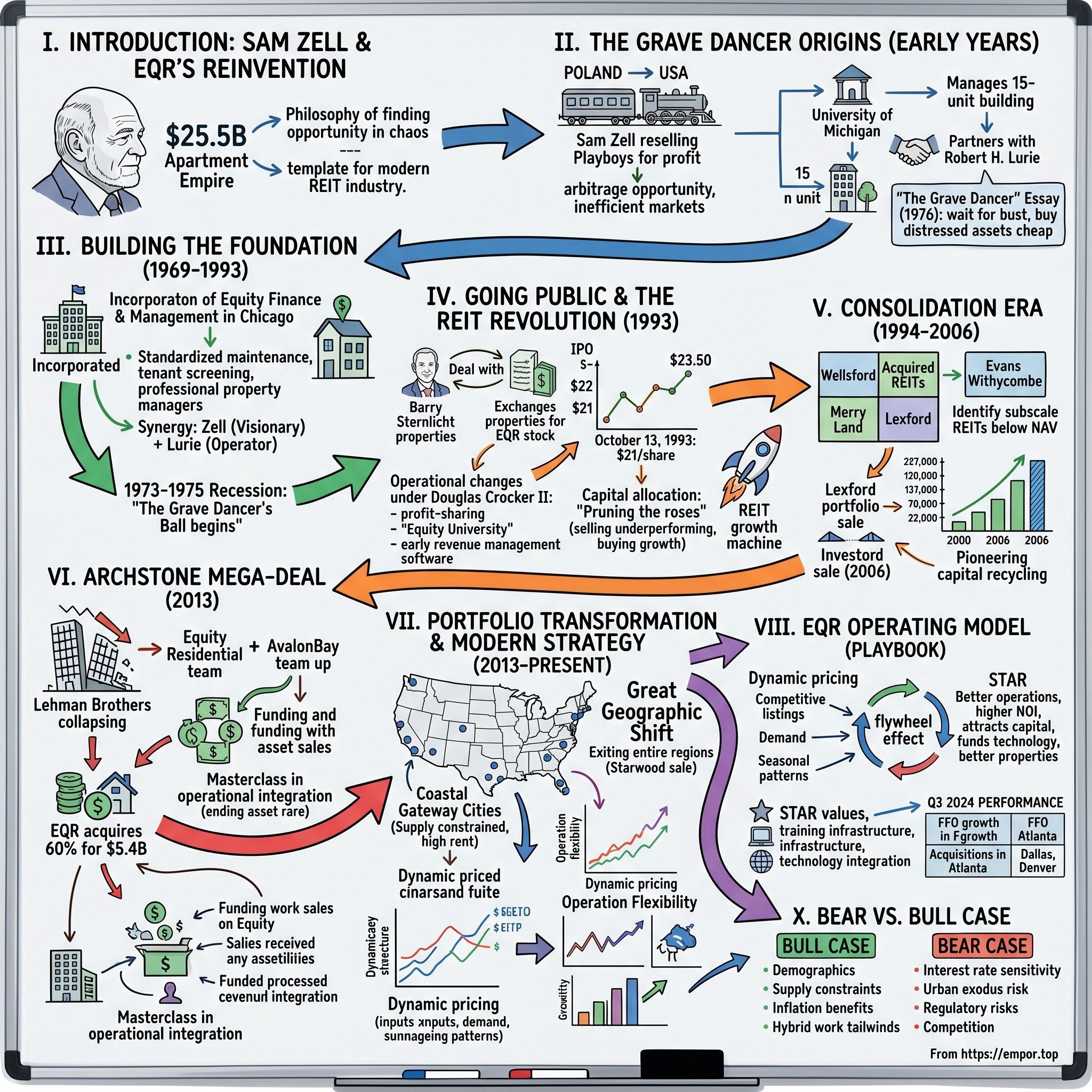
II. The Grave Dancer's Blueprint: Sam Zell & The Birth of Modern REITs (1969–1993)
The origin story begins on a Chicago commuter train. Sam Zell, born in 1941 to Polish refugee parents—Bernard and Rochelle Zielonka, who escaped the German invasion four months before his birth—noticed that Playboy magazine, sold in the city, was unavailable in his suburb. He bought copies for fifty cents downtown and resold them at a substantial markup to classmates who had no other access.6 While the story has calcified into company lore, the underlying mechanism defined Zell's strategy for the next six decades: identify supply-demand dislocations created by distribution barriers, arbitrage them, and extract value by eliminating structural friction.
At the University of Michigan, Zell and fraternity brother Robert Lurie began managing student housing—starting with a single small building before expanding across campus—building an operating business while still undergraduates.6 That partnership became the defining professional relationship of Zell's career. Zell founded Equity Group Investments in 1968, and Lurie joined the following year.6 Their division of labor was clear: Zell was the dealmaker and public personality—blunt, high-profile, and aggressive—while Lurie served as the chief operator and financial counterweight, executing details after deals were struck.
The "Grave Dancer" doctrine
The "grave dancer" nickname originated from a 1976 essay in which Zell detailed his strategy of acquiring distressed real estate at steep discounts to replacement cost. The 1973–1975 real estate downturn provided abundant inventory: overleveraged apartment properties abandoned by developers and surrendered to lenders. The core logic was straightforward: purchasing a functioning asset below its reproduction cost creates a structural moat. Developers cannot economically construct competing supply until market rents rise high enough to justify new construction. In this framework, replacement cost serves as the valuation floor, while time allows market demand to catch up.
That strategy was not an operational moat; there is nothing proprietary about identifying cheap, distressed real estate. Instead, it was a financing and market-timing edge rooted in rapid underwriting, risk tolerance during downturns, and access to capital when liquidity evaporated. Capital access was the load-bearing pillar of the model—and ultimately its greatest vulnerability.
Falsification pass: was the distress model risk-free arbitrage?
Popular profiles long characterized Zell's distressed-asset model as a low-risk arbitrage: buy below replacement cost, hold, and collect income. The historical record refutes that low-risk framing.
When Lurie died of cancer in 1990, Zell lost his primary operational counterweight just as commercial real estate credit froze nationwide. The early-1990s liquidity crisis left Zell overexposed across a complex network of private partnerships backed by personal debt guarantees, requiring years of debt restructurings. The strategy was never a riskless arbitrage; it was a leveraged bet that credit markets would stay open long enough to refinance and stabilize properties. When lenders pulled back, buying below replacement cost provided zero immediate protection because asset illiquidity eliminated market bids entirely.
The key lesson is not that the doctrine failed—it ultimately generated vast wealth—but that its premise requires a critical qualification: purchasing below replacement cost creates durable value only if an investor survives the funding gap. That liquidity condition recurred throughout Equity Residential's history: during the 2008–2009 financial crisis, the 2020 pandemic shocks, and the 2023–2025 credit contraction that reopened acquisition opportunities. For investors, evaluating a distressed strategy requires examining balance sheet capacity and debt maturity ladders rather than relying solely on headline discounts to replacement cost.
The REIT solution
The liquidity crisis of the early 1990s catalyzed a major structural shift. If private partnerships faced overnight credit contagion, public equity offered permanent capital. Real Estate Investment Trusts—created in 1960 to avoid entity-level corporate taxation by distributing most taxable income to shareholders—had long remained a niche market corner. The sector expanded dramatically with the creation of the Umbrella Partnership REIT, or UPREIT, structure. Under an UPREIT, property owners could contribute real estate to an operating partnership in exchange for partnership units, deferring capital gains taxes that cash sales would otherwise trigger.
The UPREIT effectively functioned as a tax-deferred acquisition vehicle for real estate. A family owning an apartment community for decades with a low tax basis could avoid an immediate capital gains tax liability by contributing the asset in exchange for operating units convertible into public shares. This structure provided property owners with liquidity and portfolio diversification while giving emerging apartment REITs a powerful engine to consolidate a fragmented national market throughout the 1990s.
Ahead of the initial public offering in 1993, Zell partnered with Barry Sternlicht's newly formed Starwood Capital, which had accumulated apartment portfolios from government auctions following the savings and loan crisis. Starwood contributed roughly 6,400 multifamily units into Equity Residential at the IPO in exchange for an ownership stake of about 20%.7 Equity Residential Properties Trust completed its initial public offering in August 1993 controlling roughly 22,000 apartments,8 a foundation Zell would scale into an enterprise worth tens of billions.6 To lead execution, Zell recruited Douglas Crocker as chief executive, following Crocker's six-month study analyzing apartment fundamentals across thirty U.S. cities prior to the REIT's formation.8
Why 1993, and why it mattered for everyone else
Prior to this wave, institutional investors seeking apartment exposure faced limited choices: acquiring physical properties directly—which required local operating infrastructure and long holding periods—or committing capital to illiquid private partnerships laden with opaque fee structures. While public real estate securities existed, most were small, illiquid, and externally managed by advisors whose asset-based fees misaligned their incentives with shareholders.
The 1993–1994 REIT IPO wave reshaped institutional real estate by introducing two structural shifts: internal management and equity-backed acquisition currency. Internal management aligned corporate leadership directly with public shareholders rather than third-party advisors. Meanwhile, UPREIT operating units allowed companies to acquire properties accretively without relying entirely on cash raises. Combined, these innovations created a scalable consolidation vehicle targeted at one of the most fragmented asset classes in the United States.
Equity Residential was not alone in adopting this framework—the same period launched modern iterations of several major REITs—but its scale and association with Zell gave it an early cost-of-capital advantage. Public markets were eager to back Zell's platform, enabling the company to issue equity at attractive valuations during the mid-1990s to finance rapid portfolio expansion. For public real estate companies, equity valuation is more than a benchmark—it is an operational tool. A REIT trading at a premium to net asset value can issue shares to buy properties accretively, whereas a company trading at a discount loses its acquisition currency and must focus on capital recycling or share repurchases. That reflexive capital loop drove Equity Residential's strategic choices for the next three decades.
Ultimately, the core innovation was less about Zell's persona than the structural mechanism he engineered. Access to public equity transformed a credit-dependent, timing-sensitive private strategy into a permanent-capital entity capable of compounding across market cycles. Yet while permanent capital solved liquidity risk, it left an open strategic question that tested the company over the next two decades: permanent capital alone does not dictate where or which assets to buy.
III. The M&A Consolidation Era & The Archstone Mega-Deal (1994–2013)
If the 1993 initial public offering established the platform, the decade that followed marked its rapid industrialization. Under Chief Executive Officer Douglas Crocker, Equity Residential systematically leveraged its tax-advantaged acquisition currency as a public consolidator to buy scale across regional markets.
The pace of acquisition was relentless. Early in 1997, the company acquired Wellsford Residential Property Trust for $620 million in stock and $332 million in assumed debt, adding some 19,000 apartments concentrated across Colorado, Utah, Texas, Arizona, Nevada, New Mexico, Washington, and Oklahoma.8 In August 1997, it paid $625 million in stock and assumed $432 million in debt for Arizona-based Evans Withycombe Residential and its roughly 16,000 units.8 The dominant Southeastern apartment owner Merry Land & Investment followed. Then, on October 1, 1999, Equity Residential closed the acquisition of Lexford Residential Trust's multifamily business—a transaction valued at roughly $738 million that brought 402 properties containing 36,609 units.8
That Lexford acquisition alone added more than a third again as many units as Equity Residential had owned at its public debut six years earlier. Crucially, these were small, workforce-oriented properties scattered across secondary markets, averaging fewer than ninety units per community. The company that would later position itself as the landlord of choice for affluent urban professionals spent the late 1990s expanding primarily as an operator of modest suburban and small-city housing. By 2003, the total portfolio approached 227,000 units.
This expansion establishes an important baseline for Equity Residential's strategic arc: the company has reversed its core portfolio thesis three times over three decades. It built national scale in the 1990s, dismantled that breadth for coastal concentration in the 2000s and 2010s, and then sought partial geographic diversification again in the 2020s. The Lexford division was eventually sold in 2006 for approximately $1.1 billion.9 Evaluating whether each turn created net value requires examining the full historical record; the reality of the shifts themselves is unmistakable.
The middle years: from assembler to editor
The consolidation era transitioned in the mid-2000s from portfolio assembly to portfolio editing. By the early 2000s, Equity Residential had become the largest apartment owner in the United States, but investment yields from sheer unit accumulation were compressing. When Douglas Crocker handed the chief executive role to David Neithercut in 2006, corporate focus shifted to refining asset quality—pruning properties that fell outside an increasingly specific strategy focused on high-barrier markets.
The Lexford divestiture was the clearest signal of this pivot. The division that had expanded the company's presence in affordable and workforce housing across small Midwestern and Southern markets was sold in 2006 for approximately $1.1 billion,9 near the peak of the pre-crisis transaction cycle. Selling low-growth, management-intensive assets into a highly liquid market represented sound capital recycling. At the same time, it removed a major counterweight from a portfolio that was migrating steadily toward high-cost coastal product.
The 2008 financial crisis tested the premise of leveraged real estate. Apartment REITs proved more resilient than office or retail platforms because housing remains an essential need and annual residential leases reprice rapidly during economic recoveries. Nonetheless, equity markets dropped indiscriminately, sending REIT share prices down alongside the broader financial sector. Equity Residential emerged with its balance sheet intact, supported by conservative treasury management overseen by then-Chief Financial Officer Mark J. Parrell, who would later become chief executive officer.
The housing crash also created an unexpected structural tailwind for rental demand. Millions of foreclosed homeowners entered the rental market while tightened mortgage underwriting restricted new home purchases. As national homeownership rates declined over subsequent years, apartment fundamentals expanded from 2010 through 2015. This rising sector tide buoyed operating metrics industrywide, making it essential to distinguish broader market momentum from idiosyncratic management execution when evaluating subsequent transactions—including the Archstone acquisition.
The Archstone endgame
The defining transaction of Equity Residential's modern chapter originated during the prior credit boom. In 2007, at the peak of market leverage, Tishman Speyer and Lehman Brothers executed a leveraged buyout of Archstone-Smith valued at roughly $22 billion. Archstone possessed one of the premier apartment portfolios in the United States—modern, urban assets located in supply-constrained coastal markets. However, the transaction was structured with high debt loads built for an unsustainable credit environment. Following Lehman Brothers' bankruptcy in 2008, the Archstone holding became one of the largest single assets managed by the Lehman liquidation estate.
For five years, Archstone remained inside the bankruptcy estate while creditors evaluated strategic options, including an initial public offering and bids from sovereign wealth funds. Meanwhile, the two dominant public apartment operators—Equity Residential and AvalonBay Communities—monitored the asset, recognizing that the liquidation process would eventually require a direct asset sale.
In late November 2012, Equity Residential and AvalonBay announced a joint agreement to acquire Archstone from the Lehman estate rather than compete against each other in an auction.11 By bidding together, the two competitors eliminated a bidding war that would have raised the purchase price, allowing them to divide the portfolio along geographic lines that matched their respective expansion goals.
The transaction closed on February 27, 2013. In aggregate, the two REITs acquired Archstone Enterprise LP for approximately $16 billion, with Equity Residential taking roughly 60% of the assets and liabilities—a share valued at approximately $9 billion—and AvalonBay taking the remaining 40%.10 Equity Residential paid $2.016 billion in cash and issued 34,468,085 common shares to the seller, adding more than 21,000 apartment units across its target markets.10 Integration proceeded rapidly, with newly acquired properties transitioning onto Equity Residential's centralized leasing platform shortly after closing.
How it was paid for — and what that cost
The financial mechanics of the transaction carried significant strategic tradeoffs. To fund approximately $9 billion in high-cost coastal property, Equity Residential sold roughly $4 billion in non-core assets, including secondary-market communities, suburban properties, and legacy workforce housing. The sold properties carried higher going-in capitalization rates because lower-growth markets demanded greater immediate yield to offset weaker long-term rent appreciation. By contrast, the Archstone assets were acquired at tighter capitalization rates around 5%, reflecting market expectations of future rent growth in gateway cities.
In essence, Equity Residential traded immediate cash yield for anticipated rent growth. This capital reallocation creates shareholder value if rapid rent growth materializes over time, but degrades returns if growth slows, because current income is sacrificed for future expectations.
Falsification pass: was Archstone a flawless masterstroke?
The prevailing market narrative portrayed Archstone as a masterstroke that permanently elevated portfolio quality at a favorable point in the cycle. A critical analysis reveals that while the physical assets were top-tier, the transaction significantly heightened the company's structural risk profile.
Funding gateway acquisitions by selling geographically diversified, higher-yielding properties concentrated Equity Residential's revenues in a small number of dense urban markets. Within six years of the acquisition, major coastal jurisdictions enacted strict residential rent regulations, and within seven years, those same dense metropolitan centers faced unprecedented population outflows during the COVID-19 pandemic. By sacrificing geographic breadth to finance coastal density, the portfolio lost its natural hedge against correlated regulatory and demographic disruptions.
A balanced assessment confirms that Archstone enhanced Equity Residential's asset base and operating scale, but fell short of providing durable risk-adjusted outperformance. The concentration created vulnerability to severe urban market shocks over a standard real estate holding period. The key performance metric illustrating this dynamic was the growth spread between same-store net operating income in gateway markets and secondary markets—a spread that inverted sharply between 2019 and 2022 as non-coastal housing outpaced dense urban centers.
That performance inversion set the stage for the next phase of capital reallocation, which began with portfolio moves that made the Archstone concentration look conservative by comparison.
IV. The Coastal Gateway Bet & The Sun Belt Pivot (2016–2024)
In October 2015, Equity Residential agreed to sell approximately 23,000 apartment units to Starwood Capital Group for $5.365 billion.13 The buyer was Barry Sternlicht—the same investor who had contributed the seed portfolio into EQR's 1993 initial public offering in exchange for a 20% stake in the company. Twenty-two years later, Sternlicht was buying back roughly a fifth of the company's housing units.
The sale closed in January 2016, covering 72 properties and 23,262 apartment units at an average price of roughly $230,634 per unit, representing a capitalization rate around 5.5%.12 It marked the largest non-hotel acquisition in Starwood Capital's history. For Equity Residential, the transaction completed a total exit from South Florida and Denver, alongside select New England submarkets. It left the company with investments in 318 properties containing 85,906 apartment units concentrated almost entirely in six high-cost coastal markets: Boston, New York, Washington, D.C., Seattle, San Francisco, and Southern California.12
Management's framing at the time was unambiguous: the company was narrowing its operational footprint to core, high-density urban markets to drive long-term outperformance.12 This was not a routine portfolio trimming, but a deliberate corporate conviction: Equity Residential was tying its balance sheet to a single structural thesis.
The thesis, stated plainly
The coastal gateway argument rested on a clear intellectual framework. Its core premise was that a select group of major U.S. metropolitan areas possess a permanent supply moat: buildable land is scarce, zoning and entitlement processes are slow and politically restrictive, construction costs are high, and local residents regularly oppose new density. At the same time, these cities concentrate high-paying jobs across technology, finance, biotechnology, and government. In theory, constrained housing supply combined with concentrated high-wage demand yields durable pricing power—the real estate equivalent of a toll road.
The logic was coherent. However, because it asserted an enduring structural advantage, the thesis faced immediate testing against changing regulatory and economic realities.
Falsification pass: does the coastal supply moat guarantee premium rent growth?
Within four years of the Starwood transaction, two distinct external shocks tested the validity of the coastal gateway model through separate mechanisms.
The regulatory shock. The gateway thesis assumed that constrained housing supply inevitably translates into landlord pricing power. While supply constraints do support pricing, they also invite political intervention. In 2019, New York enacted the Housing Stability and Tenant Protection Act, eliminating key mechanisms for transitioning rent-stabilized apartments toward market rates and capping embedded upside across a substantial portion of the city's housing stock. California followed with Assembly Bill 1482, imposing statewide rent caps and just-cause eviction requirements across Los Angeles, Orange County, San Diego, and San Francisco. Meanwhile, Seattle and Washington, D.C., expanded municipal tenant protections. For real estate investors, the operational mechanism is direct: long-term asset values depend on the ability to re-price leases to market rates upon expiration. Rent regulations restrict future rent growth distributions, reducing asset valuations even when current net operating income remains stable. High-barrier supply moats are thus partially self-limiting—as housing scarcity intensifies, municipal and state governments become more likely to restrict the financial returns generated by that scarcity.
The demand shock. During 2020 and 2021, the key driver of gateway valuations—urban density and physical proximity to central business districts—temporarily inverted. Occupancy across Equity Residential's urban core properties dropped sharply, forcing the company to compete for tenants by offering concessions measured in months of free rent rather than minor price adjustments. Effective rents in San Francisco and Manhattan fell by double-digit percentages. Concurrently, the Sun Belt and secondary markets Equity Residential had exited in 2016 recorded unprecedented rent growth, driven by remote-capable workers seeking lower living costs and lower tax burdens.
The historical record directly refuted the original thesis that coastal concentration guaranteed perpetual premium rent growth. Two independent forces—regulatory intervention and sudden demand shifts—challenged the thesis within half a decade.
What survived was a more nuanced dynamic: high-barrier coastal markets exhibit lower long-term supply volatility than Sun Belt markets. This dynamic creates a distinct cyclical profile characterized by shallower supply-driven downturns, balanced by a lower upside ceiling due to regulatory constraints. Equity Residential's 2025 and 2026 operating results highlighted this trade-off. As heavy construction deliveries in Sun Belt markets outpaced tenant absorption, San Francisco and New York emerged as the company's top-performing markets. In the second quarter of 2026, San Francisco generated 7.0% same-store revenue growth and 11.0% net operating income growth, while Denver recorded a 6.4% revenue decline and a 9.9% net operating income decline.1 In practice, the coastal supply moat functioned as a volatility dampener rather than a perpetual growth engine.
What the exodus actually looked like on the ground
The operating disruption of 2020 and 2021 exposed the vulnerabilities of a single-factor portfolio strategy. High-density gateway apartments are valued on the assumption of a deep, continuously renewed pool of tenants who must reside near urban offices, universities, or transit hubs. When remote work decoupled housing from office locations and health concerns reduced the appeal of high-rise common spaces, that tenant pool shrank rapidly.
Management faced limited short-term operational options. Existing lease rates were contractually fixed, leaving lease renewals and new tenant acquisitions as the only adjustment mechanisms. In markets where competing property owners offered two or three months of free rent, operators had to match concessions to maintain occupancy. Because concessions represent an upfront financial giveaway amortized over a twelve-month term, effective rental rates in Manhattan and San Francisco declined far more than headline asking prices indicated, compounding pricing pressure into subsequent annual renewal cycles.
This period underscored a broader portfolio construction lesson. Equity Residential's 2016 portfolio was concentrated almost entirely on a single factor: the premium value of physical proximity to dense employment hubs. When that factor repriced, the portfolio lacked offsetting assets in growing non-coastal markets. The company's subsequent efforts to re-enter expansion markets functioned primarily as a risk hedge against factor concentration. The central analytical question is whether adding Sun Belt exposure reduces consolidated net operating income volatility enough to offset the lower initial yields required to acquire those assets. The second-quarter 2026 results—where coastal strength offset Sun Belt weakness—provided initial empirical evidence supporting that hedging strategy.1
The course correction
By 2021, as coastal occupancy stabilized following the pandemic disruption, Chief Executive Officer Mark J. Parrell initiated a strategic pivot to rebuild geographic diversification. Management established a target to generate 20% to 25% of annual net operating income from key expansion markets, including Atlanta, Austin, Dallas-Fort Worth, Denver, Nashville, and Raleigh-Durham.
Rather than pursuing ground-up development—which entails entitlement delays, land risk, construction cost inflation, and an unprofitable multi-year lease-up phase—Equity Residential focused on acquiring newly constructed, stabilized properties from private developers seeking liquidity. This approach adapted Sam Zell's core framework: acquiring completed physical assets below replacement cost while avoiding early-stage development risks.
The August 2024 Blackstone transaction
This acquisition strategy culminated on August 21, 2024, when Equity Residential agreed to purchase 11 apartment properties from multiple Blackstone Real Estate strategies for approximately $964 million.14 The transaction added 3,572 units across three target expansion markets: four properties with 1,357 units in Atlanta, four properties with 1,237 units in Dallas-Fort Worth, and three properties with 978 units in Denver, with an average property age of eight years.14 The purchase price equated to roughly $270,000 per unit for high-quality, recently constructed assets in markets where replacement costs had risen significantly due to post-2021 inflation.
Chief Investment Officer Alec Brackenridge noted that the transaction represented a major step toward expanding the company's net operating income contribution from growth markets.14 Meanwhile, Blackstone representative Asim Hamid described the sale as an attractive outcome for investors that demonstrated strong institutional demand for quality real estate.14
The transaction highlighted contrasting capital positions. Blackstone acted as a seller of stabilized U.S. multifamily assets during a subdued transaction period, while Equity Residential leveraged its investment-grade balance sheet and unsecured debt access to acquire properties at a time when private owners faced refinancing challenges. The deal demonstrated how a conservative balance sheet allows an operator to execute acquisitions during periods of broader market illiquidity.
Nevertheless, the transaction highlighted a persistent strategic question: whether selling expansion-market assets in 2016 and re-acquiring them in 2024 represented an efficient long-term allocation of capital. The 2016–2024 arc demonstrates a recurring pattern in which Equity Residential's strategic realignments have at times reflected pro-cyclical timing rather than contrarian positioning—setting up the operational environment inherited by management leading up to the 2026 combination.
V. Current Management & Operational Playbook: Mark Parrell's EQR
When Mark J. Parrell took over as chief executive in January 2019, he inherited the aftermath of the single-factor coastal concentration strategy—a capital allocation pivot he had helped finance as chief financial officer. Within six months, New York enacted the Housing Stability and Tenant Protection Act. Within fourteen months, the COVID-19 pandemic reshaped the dense urban markets around which Equity Residential's portfolio had been constructed.
Parrell brought a background in treasury management and law rather than real estate development. Joining Equity Residential in 1999, he served as treasurer from 2005 to 2007 and chief financial officer from 2007 through the 2008 financial crisis, before succeeding David Neithercut as chief executive. Where Sam Zell was combative and high-profile, Parrell operated procedurally, focusing on debt maturity ladders, cost-of-capital spreads, and the financial hurdles required for incremental acquisitions. That orientation reflected a broader institutional pattern: for two decades, Equity Residential was guided primarily by financial disciplines rather than development expansion.
By mid-2026, prior to the merger, that balance-sheet discipline was evident in the company's financial profile. Total debt stood at $8.26 billion with a weighted average interest rate of 3.78% and a remaining duration of 6.1 years, while net debt to normalized EBITDAre had improved to 4.32x from 4.38x.1 A 3.78% borrowing cost on a levered real estate portfolio in 2026 served as a competitive asset, reflecting long-term financing secured before interest rates rose. That low borrowing cost provided Equity Residential with the balance-sheet capacity to acquire properties from private owners during periods of market illiquidity.
The operating record, 2025 into 2026
The company's operating metrics in the period leading up to the merger reflected modest organic growth alongside elevated resident retention. For full-year 2025, normalized funds from operations (FFO) reached $3.99 per share, up 2.6% year over year, while earnings per share grew 8.1% to $2.94.15 Same-store revenue increased 2.6% against a 3.7% increase in operating expenses, slowing same-store net operating income growth to 2.2% as cost inflation outpaced revenue gains.15 Physical occupancy averaged 96.4%, while resident turnover dropped from 42.6% to 40.2%—a shift management described as the highest full-year resident retention in company history.15
The retention figure provided important context regarding market demand. Lower turnover reduces vacancy losses, apartment turnover expenses, and leasing commissions. However, high retention combined with modest 2.6% revenue growth indicated that tenants were remaining in place largely because alternative housing options—such as single-family home purchases or cheaper rental units—were limited or uncompetitive. In effect, high retention reflected broader housing market affordability constraints rather than expanding landlord pricing power.
Capital allocation in 2025 maintained the company's traditional capital recycling pattern. Dispositions of 11 properties generated $1.1 billion at a 5.4% disposition yield, while acquisitions of nine properties totaled $636.8 million at a 5.1% acquisition capitalization rate, alongside the completion of three development projects totaling 945 units.15 Exchanging assets yielding 5.4% for acquisitions at 5.1% required sacrificing immediate cash yield in pursuit of long-term rent appreciation—replicating the financial trade-off executed during the Archstone acquisition. Equity Residential also repurchased 4.8 million shares for $300 million and returned approximately $1.38 billion to shareholders overall through dividends and buybacks, paying an annual dividend of $2.77 per share.15
That share repurchase strategy highlighted a key valuation tension. During the February 2026 earnings call, Parrell stated that management viewed the company's stock as undervalued relative to near-term business prospects.15 Share repurchases signal that leadership considers public market valuations to discount underlying asset values. However, issuing equity three months later as merger currency in the combination with AvalonBay presented a contrasting capital allocation decision, raising questions regarding which valuation framework guided management's long-term planning.
Into 2026: the supply cliff and the merger
Initial 2026 guidance projected same-store revenue growth between 1.2% and 3.2%, expense growth of 3.0% to 4.0%, and normalized FFO per share of $4.02 to $4.14.15 Management's primary growth argument relied on supply dynamics: internal tracking projected that competitive new apartment deliveries across Equity Residential's markets would drop approximately 35%, or about 40,000 units, in 2026 compared to 2025.16 That projection aligned with broader construction cycles, as higher borrowing costs in 2023 and 2024 curtailed new starts, leading to reduced completions two years later.
First-half 2026 operating results largely tracked those supply expectations. Second-quarter normalized FFO per share rose 3.0% year over year to $1.02, supported by a 1.9% increase in same-store revenue, a 3.0% increase in expenses, and a 1.4% gain in net operating income; physical occupancy stood at 96.2% and achieved renewal rate growth reached 5.2%.1 Citing sustained occupancy and retention, management raised the full-year same-store revenue midpoint by 20 basis points to a 2.1% to 2.7% range, and increased the net operating income midpoint by 30 basis points to 1.5% to 2.1%.1
Despite the guidance increases, the operating results showed net operating income growing at roughly the rate of general inflation during a period of reduced new supply. While renewal rates increased by 5.2%, overall blended revenue growth remained near 2%, indicating that new-lease rate growth was flat to negative. The spread between positive renewal rates and soft new-lease pricing demonstrated that revenue gains depended primarily on rate increases applied to existing tenants rather than expanding demand from new residents.
Process and technology
Equity Residential invested steadily in centralizing property operations, implementing self-guided tours, centralized lead management, automated maintenance dispatch, and artificial intelligence within its leasing funnel—tools the company credited with delivering operational benefits in 2025.17 The financial logic aimed to amortize fixed platform costs across more than 85,000 units while lowering on-site staffing requirements per community.
However, whether operational centralization creates a durable competitive advantage remains questionable. Competitors across the public apartment REIT sector utilize similar third-party technology platforms. Scale allows larger operators to amortize software expenditures, but the underlying technologies are broadly accessible. In practice, operational centralization functioned primarily as a margin-defense measure against wage and insurance inflation; same-store expense growth of 3.7% in 2025 compared to 2.6% revenue growth indicated that efficiency gains only partially offset cost pressures.15
Falsification pass: is algorithmic pricing a friction-free profit driver?
For a decade, automated revenue-management systems—software designed to recommend daily apartment pricing based on market inputs—were viewed across the real estate industry as an operational optimization tool. That model faced legal and regulatory challenges. The U.S. Department of Justice, along with several state attorneys general, alleged that RealPage violated federal antitrust law by incorporating nonpublic competitor data into its pricing algorithms. On November 24, 2025, the Justice Department filed a proposed settlement under which RealPage, without admitting liability, agreed to restrictions on its use of nonpublic data, including a prohibition on using real-time competitor data to generate price recommendations.1819 Separately, more than two dozen property management firms settled claims related to revenue-management software, including Greystar, which agreed to pay $50 million to resolve class-action litigation and $7 million to resolve state enforcement actions.18
While Equity Residential was not found liable of wrongdoing, the regulatory enforcement actions established clear boundaries for algorithmic pricing across the multifamily sector. Restricting the use of real-time competitor data reduces the pricing sensitivity of automated revenue-management systems. Consequently, algorithmic pricing functions as a legally constrained property management practice rather than an unconstrained driver of net operating income expansion.
Incentives, governance, and what management was paid to do
Executive compensation at Equity Residential followed standard industry structures. Annual cash incentives were tied to normalized FFO per share and same-store net operating income performance, while long-term equity incentives depended primarily on total shareholder return relative to the FTSE Nareit Equity Apartments index, alongside environmental sustainability metrics.
This incentive framework aligned management priorities with short- to medium-term operational performance. Linking compensation to normalized FFO per share encouraged short-term earnings accretion, which can be achieved through low-cost debt issuance or asset acquisitions without necessarily building long-term shareholder value. Measuring total shareholder return against a sector index evaluated performance relative to apartment peers, but did not measure broader capital allocation efficiency across real estate cycles. Notably, standard three-year compensation benchmarks did not evaluate long-term strategic shifts, such as selling geographically diversified assets prior to a market shift and subsequently re-acquiring expansion-market properties at higher valuations.
Evaluating management execution requires comparing corporate strategic commitments against long-term outcomes. Parrell maintained balance-sheet conservatism, managed debt duration prudently, avoided speculative ground-up development, and explicitly addressed share mispricing when public market valuations diverged from private asset values.15 At the same time, the company's broader strategic trajectory was shaped by the need to adjust portfolio concentration decisions made prior to his tenure as chief executive.
Competitive landscape
The public apartment REIT sector features distinct operating profiles. Equity Residential and AvalonBay operated as national platforms combining coastal concentration with targeted expansion markets. Essex Property Trust maintains a focused West Coast footprint. Mid-America Apartment Communities and Camden Property Trust focus on Sun Belt markets, experiencing strong rent growth in 2021 and 2022 followed by elevated supply additions in 2024 and 2025. UDR operates a diversified national portfolio. Beneath these public platforms, private real estate owners—including regional operators, private syndicates, and institutional vehicles managed by firms such as Blackstone—control the vast majority of U.S. rental housing stock and influence marginal transaction pricing.
Equity Residential's core advantage over private owners rested on its cost of capital rather than proprietary operational technology. As an investment-grade unsecured borrower with a 3.78% weighted average interest rate and extended debt maturities, the company could underwrite property acquisitions at capitalization rates that leveraged private buyers relying on bank financing could not match.1 This balance-sheet advantage widened during credit contractions, providing the financial scale that the combination with AvalonBay was structured to expand.
VI. Skeptical Investor Stress Test & Current Risk Radar
Imagine a short-seller building the bear presentation in early 2026, before the merger was announced. The slides write themselves, and most of the data points come directly from the company's own disclosures.
Risk 1: Regulatory escalation, and the moat that invites it. The underlying mechanism is clear: rent regulation truncates upside returns rather than cutting immediate cash flow, meaning the financial damage shows up in asset valuations and long-term growth rather than in quarterly net operating income. New York's good-cause eviction framework extends procedural protections beyond the stabilized housing stock, while California's statewide rent cap applies across Equity Residential's largest single-state exposure. The structural dilemma is that the political salience of tenant rent burdens rises alongside the very supply scarcity that creates landlord pricing power—the moat generates its own regulatory response. An investor cannot own a concentrated gateway apartment portfolio while simultaneously assuming long-term regulatory stability; those two assumptions contradict each other.
Risk 2: Sun Belt supply absorption. Equity Residential re-entered expansion markets during an unprecedented delivery wave across Austin, Dallas, Atlanta, Nashville, and Denver. Operating results in 2026 illustrated the immediate cost of that timing: Denver recorded a 6.4% revenue decline and a 9.9% net operating income decline in the second quarter, driven by properties the company acquired partly in 2024.114 Management's counter-argument—that competitive deliveries would fall roughly 35% in 2026—was analytically sound, but represented a tactical timing argument rather than a structural moat.16 Sun Belt markets feature low barriers to construction, which explains both their long-term growth and their periodic supply gluts. Buying into those regions does not secure an insulated competitive moat; it trades supply stability for demographic growth. That remains a valid portfolio choice, provided it is not framed as a defensive posture.
Risk 3: Round-trip capital recycling. This represents the sharpest structural critique of the company's capital allocation track record. Equity Residential sold 23,262 units to Starwood in 2016 at roughly $230,634 per unit and a 5.5% capitalization rate, exiting Denver entirely.12 In 2024, it bought 3,572 units back at roughly $270,000 per unit, including three Denver properties.14 While per-unit prices are not directly comparable—given that the 2024 acquisitions averaged eight years of age and occupied a different quality tier than the 2016 portfolio—the directional criticism holds: the company sold a geographically diversified position before the largest Sun Belt rent boom in modern history, only to rebuild a smaller version of that position years later at higher nominal prices. Combined with the 2025 capital recycling spread—selling properties at a 5.4% yield to fund acquisitions at a 5.1% capitalization rate15—a consistent pattern emerges of sacrificing current income for future growth that has yet to reliably materialize. The counter-argument holds that the 2024 acquisitions were executed at a discount to a replacement cost base that had inflated significantly since 2016. That math is plausible, but remains unproven, and initial performance in Denver suggests the verdict is still open.
Risk 4: Cost of capital and refinancing arithmetic. Equity Residential's 3.78% average borrowing cost was a historical legacy rather than an achievement of the current interest rate environment.1 Every debt maturity that rolls over in a higher-rate market compresses the spread between property yields and borrowing costs. With a 6.1-year weighted average debt maturity, that repricing takes effect gradually rather than as an immediate cliff—reflecting prudent treasury management—but the upward direction is fixed. A more subtle risk follows: when the spread between property acquisition capitalization rates and a REIT's cost of capital narrows toward zero, external asset growth ceases to be accretive, forcing growth to rely entirely on same-store net operating income. At guided same-store net operating income growth of 1.5% to 2.1%, compounding becomes a slow process.1
Risk 5: Governance questions raised by the merger. An activist investor evaluating the May 2026 transaction would encounter a clear contradiction. In February, management characterized the company's stock as undervalued and actively repurchased shares.15 By May, management agreed to issue that same stock to acquire AvalonBay's portfolio in a fixed-ratio, all-stock transaction. Under the terms, Equity Residential shareholders received a minority 48.8% stake compared to 51.2% for AvalonBay holders, while AvalonBay's chief executive assumed leadership of the combined company and Equity Residential's chief executive retired.2 Reconciling those two decisions requires believing both equities were equally undervalued—the standard merger-of-equals argument. However, an all-stock transaction in which the acquirer of record yields operational control and accepts a minority equity position functions, in practice, as a sale. The 99%-plus shareholder approval at both special meetings on August 12, 2026 indicated broad investor acceptance of the deal.4 Even so, it leaves open whether the board captured full long-term value for shares it had deemed cheap just three months earlier.
Risk 6: Integration and friction costs. The transaction's projected $175 million in gross annual synergies—reduced to roughly $125 million net after anticipated real estate tax reassessments—acknowledged a substantial structural friction.2 In key jurisdictions, a change of corporate control triggers property tax reappraisals at current market value, meaning the merger automatically increases the combined entity's tax liabilities. Property tax reassessments consume roughly 29% of gross projected synergies before a single dollar reaches equity holders. While corporate overhead elimination represents a straightforward savings target, property-level expense reductions are harder to capture, given that apartment operating budgets are dominated by on-site labor, insurance, utilities, and real estate taxes—none of which decline automatically with corporate scale.
None of these risks proved fatal on its own. Together, they described an enterprise whose defensive balance-sheet traits were real, but whose standalone growth engine had slowed—providing the essential framework for evaluating the rationale behind the AvalonBay merger.
VII. The Bull vs. Bear Case
The bull case
The affordability wedge is the demand engine. The foundation of the bull argument is that owning a home across Equity Residential's primary markets became financially unreachable for a large population of high-income households. When a mortgage payment on an entry-level home substantially exceeds the rent on a comparable apartment, renting becomes the rational economic choice—and renters making that decision carry strong credit profiles. Equity Residential's resident base historically featured household incomes well above six figures and rent-to-income ratios in the low twenties, insulating portfolio revenue from consumer financial stress more effectively than workforce housing. Empirical support for this demand stability showed up in record resident retention, with full-year turnover falling to 40.2% in 2025, the lowest figure in company history.15
Supply is genuinely receding. The most credible near-term bull argument relies on construction arithmetic rather than narrative projections. Multifamily starts declined sharply in 2023 and 2024, and completions lag starts by roughly two years; management's internal tracking projected approximately 40,000 fewer competitive apartment deliveries in 2026 than in 2025.16 Reduced competing supply lowers concession pressure and improves new-lease pricing. The operational rebound in San Francisco—the market most disrupted by pandemic outflows, which emerged as the portfolio's top performer by delivering 7.0% revenue growth and 11.0% net operating income growth in the second quarter of 2026—serves as practical proof of concept.1
Diversification has actual value now. The rebuilt portfolio produces the precise geographic offset it was designed to deliver. When Denver net operating income fell nearly 10% in mid-2026, San Francisco expanded 11%.1 The 2016 all-coastal portfolio lacked that internal hedge. The refined version of the coastal thesis that survived market testing—lower supply volatility and dampened downturns—combined with expansion-market exposure to demographic growth, provides a more balanced construction than concentrating in either region alone.
Balance sheet as an option on other people's distress. The August 2024 Blackstone transaction illustrated this balance-sheet advantage: a $964 million acquisition executed while private owners faced financing constraints.14 Maintaining lower leverage than peak-cycle returns would dictate carries an opportunity cost during expansion phases, but it converts credit stress among private operators into acquisition opportunities during market downturns.
The merger thesis itself. The combination created the largest apartment platform in the United States, operating with dual headquarters in Arlington and Chicago. The structure paired Equity Residential's operating organization—where Chief Operating Officer Michael Manelis retained operational leadership—with AvalonBay's development capabilities under Chief Financial Officer Kevin O'Shea and Chief Development Officer Matthew Birenbaum.5 The strategic logic is that AvalonBay's development pipeline provides the combined entity with an internal source of new supply at development-margin returns, a capability Equity Residential lacked at scale after years of prioritizing property acquisitions over ground-up construction. Reflecting that combined scale, the initial annualized dividend was set at $2.81 per share, matching Equity Residential's prior payout.2
The bear case
Political risk is not cyclical. Statutory tenant protections enacted since 2019 have proven permanent in practice, with no major municipal or state jurisdiction rolling back statutory rent caps. The bear view argues that regulatory intervention functions as a one-way ratchet, moving gateway apartment ownership toward a utility-like model characterized by regulated revenue and unregulated operating expenses—a structure where property taxes, insurance, and labor costs inflate freely while revenue growth faces administrative caps. The operating record of 2025, where expense growth of 3.7% outpaced revenue growth of 2.6%, illustrated that margin pressure in miniature.15
The growth algorithm is weak. Underlying operating metrics showed modest organic growth ahead of the merger. The standalone business generated 2.2% same-store net operating income growth in 2025 and guided to between 1.5% and 2.1% for 2026, while normalized FFO per share grew 2.6% in 2025 and was projected to expand about 2.3% at the 2026 guidance midpoint.15 That pace represents low-single-digit compounding prior to accounting for the capital expenditures required to maintain an aging physical portfolio. A REIT compounding funds from operations near the rate of general inflation functions as a bond substitute and trades accordingly.
Capital allocation has been reactive. The long-term record reflects national diversification assembled in the 1990s, sold off during the 2000s and 2010s, and partially re-acquired in the 2020s. Notably, the 2016 coastal exit occurred immediately before the largest Sun Belt rent expansion on record, while the 2024 re-entry occurred during a major supply delivery wave. While large REITs must continuously recycle capital and cannot time every market turn perfectly, the pattern suggests corporate strategy repeatedly extrapolated recent market trends into long-term policy.
Demographic drift. Net domestic out-migration from California and New York persisted, driven by housing costs, state tax burdens, and the permanence of flexible work arrangements. Gateway apartment demand held up primarily because high-wage employment remained resilient. However, relying on high-wage employment makes performance an explicit bet on technology and financial sector headcounts rather than broader housing demand.
Merger integration and the loss of a proven operator. Mark J. Parrell retired at closing after roughly 27 years at the company, including eight as chief executive.2 Regardless of capital allocation critiques, Parrell maintained balance-sheet stability through two major credit disruptions. Integration risks remain real, as merger-of-equals combinations in the REIT sector historically face friction when combining distinct corporate cultures—specifically bridging an acquisition-led operating culture with a development-driven platform.
Myth versus reality
Three consensus narratives regarding the company require factual correction.
Myth: Equity Residential is a pure play on coastal gateway cities. That positioning applied between 2016 and 2021, but no longer reflected the asset base by 2026. By the time of the merger, the company had spent several years rebuilding exposure across Atlanta, Dallas-Fort Worth, Denver, Austin, Nashville, and Raleigh-Durham,14 and second-quarter 2026 operating results demonstrated the two components of the portfolio moving in opposite directions.1 Analyzing the enterprise solely as a coastal gateway vehicle evaluates a portfolio structure that has been fundamentally altered.
Myth: apartment REITs function as automatic inflation hedges. The theoretical argument holds that one-year residential leases reprice annually to track inflation. The operating record of 2025 refuted that assumption for this portfolio, as revenue grew 2.6% while operating expenses expanded 3.7%.15 In high-cost, regulated markets, expense inflation passes through immediately, while revenue gains remain constrained by statutory caps and tenant affordability limits. The inflation hedge functions effectively in unregulated markets with tight housing supply, but breaks down when revenue growth is administratively constrained.
Myth: the merger was an acquisition of AvalonBay by Equity Residential. While Equity Residential acted as the legal issuer and surviving registrant, and the combined entity initially retained Equity Residential's Chicago address on initial filings,3 AvalonBay shareholders received a 51.2% majority economic stake. AvalonBay's chief executive assumed the top executive role, AvalonBay executives filled the chief financial officer, chief development officer, and chief investment officer positions, and Equity Residential's chief executive retired at closing.25 Equity Residential retained the chairmanship and the chief operating officer role.5 Operationally and economically, the transaction functioned as a platform combination led by AvalonBay's executive team, supported by Equity Residential's scale and balance sheet.
Porter's Five Forces
Threat of new entrants: Structurally divergent by market type. In coastal urban cores, entry barriers remain high due to land scarcity and political entitlements, providing a genuine competitive barrier. In Sun Belt expansion markets, entry barriers are low, enabling the delivery wave that produced negative net operating income growth in Denver in 2026.1
Bargaining power of buyers (residents): Individually limited, as tenants face moving expenses, security deposits, and high single-family housing prices that restrict alternative options, as evidenced by record resident retention.15 However, tenants exercise substantial collective bargaining power through legislative bodies, converting individual vulnerability into statutory rent controls and tenant protections.
Bargaining power of suppliers: Moderate and rising. Key operational suppliers—including municipal taxing authorities, insurance underwriters, utility providers, and skilled labor—do not grant meaningful volume discounts to institutional scale. Sharply higher property insurance premiums contributed to persistent expense growth outstripping revenue growth in recent operating periods.15
Threat of substitutes: Single-family homeownership, single-family rental communities, and alternative housing models. Single-family homeownership represents the primary substitute but remains financially uncompetitive for many renters due to elevated mortgage rates. A sustained reduction in mortgage borrowing costs would lower homeownership barriers and reduce tenant retention.
Competitive rivalry: Moderate among public REITs, but intense at the local property level where prospective tenants choose among competing communities within a narrow geographic radius. Local supply concentration explains how quickly concession packages emerge during delivery spikes.
Helmer's 7 Powers
Scale economies: Real and observable, but concentrated in debt financing terms and corporate overhead amortization rather than property-level operations, where apartment management costs scale poorly across physical locations.
Process power: Claimed and partially demonstrated. Centralized leasing workflows and automated management systems generated operational efficiency gains,17 but the underlying software tools are commercially available to competitors, and the Justice Department's RealPage antitrust settlement established legal limits on algorithmic pricing practices.18
Cornered resource: Irreplaceable real estate locations in supply-constrained urban submarkets represent the closest candidate, underpinning the strategic rationale for maintaining replacement-cost discipline.
Switching costs: Moderate at the resident level, reflected in elevated lease retention rates.
Branding, network economies, counter-positioning: Largely absent in residential real estate. Renters rarely pay a premium for corporate landlord branding, tenant network effects do not apply to apartment buildings, and operating models can be replicated by competing institutional platforms.
The structural reality is that the apartment REIT model relies on two primary powers: a scale-driven cost of capital advantage and long-term land positions in supply-constrained locations. Both advantages are shared among major public operators—including AvalonBay, Essex, and select private institutional owners. Rather than a software-style moat, the business operates on an interest-rate spread between investment-grade borrowing costs and real estate yields.
The KPIs that matter
Investors evaluating the combined platform should focus on three primary performance indicators.
First, the blended lease rate spread—specifically the gap between renewal pricing and new-lease rates. Second-quarter 2026 operating results showed renewal rates achieving 5.2% while total same-store revenue grew 1.9%,1 indicating that new leases were signing at flat to negative rate adjustments. Sustainable pricing power returns only when new-lease pricing turns positive and converges upward toward renewal rates; until that convergence occurs, top-line growth relies primarily on rate increases applied to existing residents.
Second, same-store expense growth relative to revenue growth. This relationship dictates operating leverage. The 2025 performance of 3.7% expense growth against 2.6% revenue growth represented negative operating leverage.15 Because property taxes, insurance premiums, and on-site wages drive the expense structure, this spread measures how effectively management preserves operating margins against broader inflation.
Third, the realized returns on expansion-market capital. Long-term evaluation requires tracking net operating income growth across Atlanta, Dallas-Fort Worth, and Denver against initial acquisition yields—including the 5.1% acquisition cap rate reported in 2025 and the implied yield on the $964 million Blackstone portfolio purchase.1415 If those expansion assets compound net operating income faster than coastal properties over a full market cycle, the capital reallocation strategy will be validated; if expansion returns lag, the round-trip capital criticism will be confirmed.
VIII. Business & Investing Lessons
Geographic concentration is a bet on political stability, not just on real estate. The 2016 decision to concentrate entirely in six gateway markets was underwritten on physical scarcity: scarce land, restrictive entitlements, and high construction costs. What management failed to model was that severe housing scarcity generates affordability crises, affordability crises mobilize voters, and voters demand rent regulation. Within three years of completing its coastal concentration, New York eliminated the primary upside mechanism in rent-stabilized housing, while California imposed statewide rent caps. The lesson extends beyond real estate: any enterprise whose returns rely on a structural shortage that customers experience as painful must treat regulatory intervention as an inevitable consequence of its own market position rather than an unexpected external risk.
Capital recycling is where value is created or destroyed—and the spread is the whole game. Equity Residential's history reflects a persistent pattern of exchanging current yield for anticipated growth: selling secondary-market properties at wide capitalization rates to fund Archstone at tight ones, or disposing of assets at a 5.4% yield to acquire properties at a 5.1% cap rate in 2025.15 While each individual transaction had a reasonable strategic premise, the cumulative record shows a company consistently paying premium valuations for long-term growth narratives. The core analytical test is not the physical quality of acquired real estate, but whether the immediate cash yield sacrificed is fully offset by superior compound growth over a complete market cycle.
Replacement cost is the most durable underwriting anchor available. Sam Zell's founding framework outlasted nearly every other strategic thesis in the company's history. The rationale behind the August 2024 Blackstone acquisition has a credible defense—despite awkward round-trip optics—because acquiring eight-year-old institutional properties at roughly $270,000 per unit sat meaningfully below 2024 replacement costs.14 Ownership below replacement cost provides an enduring advantage that compounds without operational intervention by deterring competing development. Investors evaluating real estate acquisitions should scrutinize replacement-cost discounts rather than relying primarily on initial capitalization rates.
Judge management on capital allocation, not daily operations—and track how leadership deploys its own equity. Throughout this era, Equity Residential operated efficiently, maintaining physical occupancy above 96%, achieving record resident retention, and successfully centralizing leasing and maintenance functions.1517 However, operating efficiency is baseline table stakes for institutional REITs. The decisions that altered shareholder value by billions of dollars were exclusively capital allocation choices: the 2013 Archstone acquisition, the 2016 Starwood sale, the 2024 Blackstone purchase, the 2025 share repurchases, and the 2026 merger. The clearest indicator of corporate priorities is where management directs the marginal dollar—and when a company repurchases stock it considers undervalued in February only to issue that same equity as merger currency in May, the tension between those two decisions provides valuable analytical insight.152
Permanent capital solves funding risk, not allocation judgment. The UPREIT structure Zell helped pioneer eliminated the liquidity vulnerability that threatened private real estate developers during credit contractions. Three decades later, Equity Residential could deploy $964 million during a period of private-market illiquidity because permanent public equity and investment-grade balance sheet access provided guaranteed execution. Yet while permanent capital grants the balance-sheet capacity to transact, it does not guarantee disciplined asset selection. Structural capital access permits acquisitions; long-term investment performance depends entirely on discretionary allocation decisions.
IX. Primary Evidence & Earnings Call Guide for Analysts
For investors following the combined platform as Vivmark Residential, the primary document trail tells the core story. Five regulatory filings and earnings releases carry most of the analytical weight.
The August 2024 Blackstone transaction announcement and its accompanying Form 8-K. The press release disclosed the acquisition price, unit count, market allocation, and eight-year average asset age, alongside Chief Investment Officer Alec Brackenridge's operational rationale.14 What the filing omitted was the going-in capitalization rate—a key metric for evaluating whether the acquisition created net shareholder value. Analysts should monitor whether subsequent disclosures reconcile the purchase price to a stabilized yield and track how the acquired Atlanta, Dallas-Fort Worth, and Denver properties perform inside same-store pools. Early 2026 returns from Denver provided a cautionary initial data point.1
The fourth-quarter 2025 earnings release and February 6, 2026 call. This document set established management's strategic framework heading into the merger, detailing full-year operating metrics, capital recycling yields, share buybacks, and former CEO Mark Parrell's assessment that the stock was undervalued.15 On the call, leadership quantified its supply-decline thesis—projecting roughly 40,000 fewer competitive apartment completions in 2026—while outlining plans to reduce rental concessions in New York and San Francisco and acquire land for development in Atlanta.16 The key analytical test is evaluating whether that supply contraction converts into sustained new-lease rate expansion. If reduced supply fails to drive pricing power, underlying tenant demand remains the primary constraint.
The second-quarter 2026 results release, issued July 22, 2026. Serving as Equity Residential's final standalone operating report, this release highlighted a bifurcated portfolio: San Francisco generated 7.0% same-store revenue growth while Denver recorded a 6.4% decline.1 The filing also detailed updated guidance, debt metrics, and transaction status, providing the baseline financial model for the standalone platform immediately prior to combination.
The Form S-4 registration statement, merger proxy, and closing filings. The S-4 and related prospectus detail the background of the merger, fairness opinions from financial advisors, and multi-year management projections for both companies.3 Subsequent Form 8-K exhibits documented the August 12, 2026 shareholder votes—which passed with over 99% approval—and the August 17 closing that created Vivmark Residential.4 For analysts, the primary diligence task is comparing those proxy projections against realized operating results to evaluate whether management achieves its targeted $175 million in gross synergies, or $125 million net of property tax adjustments, within the projected timeframe.2
The full-year 2026 Form 10-K, expected in February 2027. As the combined enterprise's initial annual report, this filing will disclose purchase accounting adjustments, restated geographic segment results, an updated debt maturity schedule, and the realized impact of property tax reassessments—which management identified as a $50 million annual offset to gross cost savings.2 Additionally, the Management's Discussion and Analysis section will outline how the combined same-store property pool is defined, establishing the baseline for measuring go-forward performance against historical operating benchmarks.
The central takeaway for analysts evaluating this corporate history is that Equity Residential's operational execution was rarely the decisive variable. Long-term performance turned on capital allocation timing—whether leadership acquired or divested assets at advantageous points in the real estate cycle. That track record is revealed in transaction disclosures and disposition yields rather than headline occupancy metrics.
References
-
Equity Residential Reports Second Quarter 2026 Results — Equity Residential, 2026-07-22 ↩↩↩↩↩↩↩↩↩↩↩↩↩↩↩↩
-
AvalonBay Communities and Equity Residential Announce Merger of Equals, Creating One of the Country's Leading Real Estate Companies — AvalonBay Communities, 2026-05-21 ↩↩↩↩↩↩↩↩↩↩
-
Equity Residential Form 8-K (Merger Agreement, board composition, executive arrangements) — SEC EDGAR, 2026-05-20 ↩↩
-
Equity Residential and AvalonBay Communities Announce Shareholder Approvals for Merger to Create Vivmark Residential (Form 8-K Exhibit 99.1) — SEC EDGAR, 2026-08 ↩↩↩↩↩
-
AvalonBay Communities and Equity Residential Announce Leadership Team for Combined Company — AvalonBay Communities, 2026-06-08 ↩↩↩
-
Sam Zell, Real Estate Billionaire, Dead at 81 — Commercial Observer, 2023-05-18 ↩↩↩↩
-
Equity Residential — Company History and Business Description — Reference for Business ↩↩↩↩↩
-
Equity Residential Announces Sale of Its Lexford Housing Division for $1.1 Billion — Equity Residential, 2006 ↩↩
-
Equity Residential Announces Closing of $9 Billion Archstone Acquisition — Equity Residential, 2013-02-27 ↩↩
-
Equity Residential Nears Deal for Archstone — The Wall Street Journal, 2012-11-26 ↩
-
Equity Residential Announces Closing of Sale of 23,262 Apartment Units to Starwood Capital Group for $5.365 Billion — Equity Residential, 2016-01-27 ↩↩↩↩
-
Starwood Capital to Buy Equity Residential Units for $5.4 Billion — Bloomberg, 2015-10-26 ↩
-
Equity Residential to Acquire $1 Billion Apartment Portfolio from Blackstone Real Estate (Form 8-K Exhibit 99.1) — SEC EDGAR, 2024-08-21 ↩↩↩↩↩↩↩↩↩↩↩↩
-
Equity Residential Reports Fourth Quarter 2025 Results — Equity Residential, 2026-02 ↩↩↩↩↩↩↩↩↩↩↩↩↩↩↩↩↩↩↩↩↩↩↩
-
Earnings call transcript: Equity Residential Q4 2025 sees EPS beat, stock rises — Investing.com, 2026-02-06 ↩↩↩↩
-
Equity Residential saw AI, automation bump in 2025 — Multifamily Dive, 2026-02 ↩↩↩
-
New limits for rent algorithm that prosecutors say let landlords drive up prices — NPR, 2025-11-25 ↩↩↩↩
-
DOJ Settles Its Algorithmic Price-Fixing Case Against RealPage — Wilson Sonsini, 2025-11 ↩
 LinkedIn
 WhatsApp
 Reddit
 Hacker News
 Email
Email Kindle
 RSS Feed
 Spotify
 Apple Podcasts
 Amazon Music
 Audible
 YouTube