Equitable Holdings: The $1.5 Trillion Financial Engineering Behemoth
I. Introduction & Episode Roadmap
There is a photograph from the night of January 31, 1905, that helped rewrite American financial regulation. It shows the interior of Sherry's restaurant in Manhattan transformed into the gardens of Versailles — live trees hauled indoors, footmen in eighteenth-century livery, and a young man in silk knee breeches presiding over the whole confection. The young man was James Hazen Hyde, twenty-eight years old, heir to majority voting control of the largest life insurance company in the world. Within ten months, the New York State Legislature launched an investigation that restructured the entire American life insurance industry, installed statutory accounting standards still in force today, and elevated a lawyer named Charles Evans Hughes, who would later serve on the Supreme Court.
That is one origin story for the company that trades today as Equitable Holdings on the New York Stock Exchange. Here is another: in the winter of 1990, the Equitable Life Assurance Society — by then a policyholder-owned mutual with a century of accumulated prestige — quietly faced the possibility of insolvency. It had sold pension funds guaranteed investment contracts promising double-digit returns, then funded those promises with commercial real estate and high-yield bonds that subsequently collapsed. The rescue came from Paris, in the form of a French insurer few Americans had heard of, run by a former Mobil engineer named Claude Bébéar.
And here is a third: on March 26, 2026, Equitable Holdings announced an all-stock merger of equals with Corebridge Financial — itself a recent spinoff from the recovery of American International Group — valued at roughly $22 billion, creating an entity with approximately $1.5 trillion in assets under management and administration.[^8]
Three near-death or near-transformation events, separated by roughly sixty years each. That rhythm defines the firm's history.
The temptation with a 167-year-old life insurer is to view it as a slow compounder — a bond portfolio wearing a corporate costume. That framing misses the primary driver of its modern business. Equitable in 2026 is a financial engineering operation: a company that has spent two decades systematically dismantling its capital-heavy guarantee business and rebuilding around fee streams that require far less supporting capital. It relies on buffer annuities that shift tail risk back to policyholders, a captive advisor force selling fee-based advisory accounts, and a majority-owned asset manager, AllianceBernstein, that collects management fees on its parent company's general account.
That is the thesis management presents to investors, but assessing Equitable requires testing that narrative against its historical execution. The same enterprise previously sold tontines that funded a Versailles gala, issued guaranteed investment contracts that nearly forced a bankruptcy, and sold variable annuity guarantees in the 2000s that absorbed capital for a decade. A company that has repeatedly miscalculated the long-term economics of its product suite requires rigorous empirical evidence before accepting that its current model has permanently solved those capital constraints.
The analysis ahead examines: the Gilded Age scandal that established modern insurance regulation; the mutual era and the guaranteed investment contract collapse; the French rescue, the rapid demutualization, and the creation of the buffer annuity; the 2018 spinoff and subsequent de-risking campaign; the Corebridge merger; the segment architecture and underlying earnings drivers; a competitive moat analysis using Helmer and Porter frameworks; a historical stress test evaluating management's load-bearing claims against the company's track record; an audit of management credibility across regulatory filings and earnings calls; and the bull and bear cases, concluding with the core metrics that dictate long-term performance.
Start where the money started: with a twenty-five-year-old who was fired for insubordination.
 Subscribe on LinkedIn
II. The Hyde Era: Gilded Age Insurance & The Scandal That Created Modern Regulation (1859–1905)
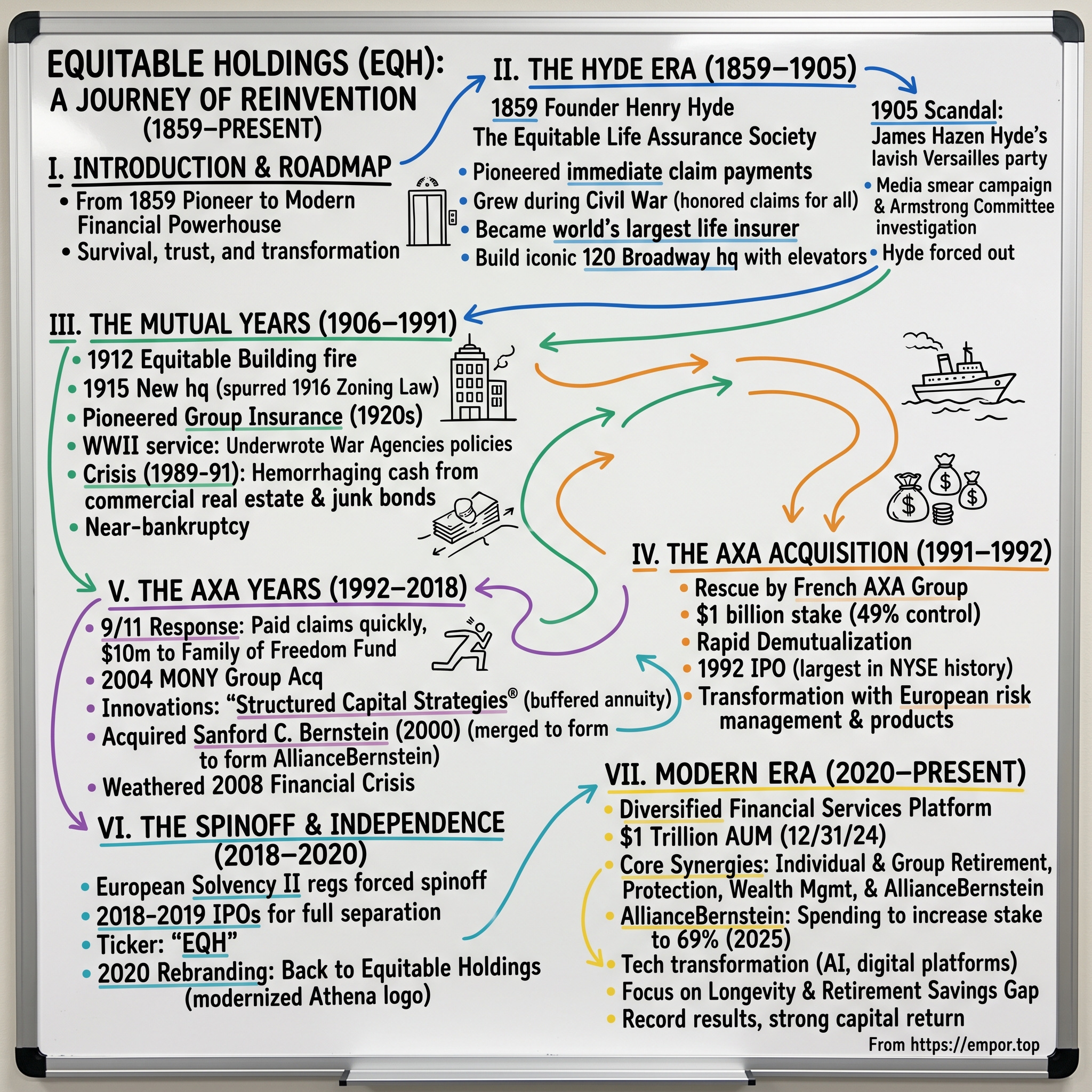
Henry Baldwin Hyde was a clerk at Mutual Life of New York in the late 1850s, and he held a heretical opinion for his time: life insurance was being sold too cautiously, to too few people, by leaders with insufficient ambition. He proposed that his employer write policies far larger than its self-imposed limits. His employer declined. Hyde left — accounts differ on how voluntarily — rented an office one floor above Mutual Life's Broadway premises, and hung a sign so large it was visible from the street below. The gesture signaled the strategy. In 1859, at twenty-five, he founded The Equitable Life Assurance Society of the United States with $100,000 of capital, much of it borrowed through his father's connections.
Hyde's primary advantage was not actuarial. It was distributional and psychological. He understood that life insurance in mid-nineteenth-century America was rarely sought out by consumers; it had to be pressed upon them in person by a persuasive agent sitting in their parlor. So he built an agency force — paying commissions competitors considered reckless, recruiting aggressively, and positioning the salesman rather than the underwriter at the center of the enterprise. That decision echoes forward 167 years: a captive advisor force remains one of the modern company's most defensible assets.
The Civil War, which bankrupted insurers carrying heavy Southern risk, benefited Equitable. Hyde also pioneered a practice that seems ordinary today but was radical at the time: paying death claims immediately upon proof of death rather than after customary waiting periods. When selling a promise that will not be tested for decades, visible proof of rapid claims settlement served as powerful marketing.
The Tontine Engine
Then came the product that drove Equitable's rapid expansion and eventually triggered its crisis: the deferred-dividend policy, popularly known as the tontine.
The mechanics are critical to understand, as they established the template for subsequent financial innovations in the company's history. In a standard participating policy, an insurer returns surplus capital to policyholders annually through dividends. In a tontine, the insurer withheld those dividends for a fixed term — ten, fifteen, or twenty years — and pooled them. Policyholders who died or lapsed during the term forfeited their shares. Survivors who persisted to the end split the entire accumulated pool.
For policyholders, the tontine operated like a lottery ticket attached to a life insurance policy, with eventual returns funded by the forfeitures of others. For Equitable, it created an enormous, long-duration capital pool with no immediate liability claims and minimal disclosure requirements regarding investment allocation. Functionally, the tontine surplus operated as a massive reserve pool governed by minimal accounting transparency.
By 1886, Equitable was the largest life insurance company in the world. Its surplus pool was measured in tens of millions of dollars at a time when the entire federal budget was a few hundred million dollars. Yet this immense pool of policyholder assets was controlled by a stock voting block representing a tiny fraction of the total economic capital at risk. That structural gap — vast policyholder capital governed by a concentrated equity stake — created severe governance risks.
The Ball, and the Reckoning
When Henry Baldwin Hyde died in 1899, he left controlling equity to his son James, then twenty-three, a Harvard graduate with pronounced Francophile interests who lacked operational experience. The board resented the succession. Executives who had spent decades building the institution were suddenly accountable to a young heir whose principal distinctions were French fluency and a passion for driving four-in-hand carriages.
The January 1905 Versailles ball at Sherry's restaurant — reported at the time to have cost roughly $200,000, equivalent to several hundred years of wages for an average worker — became the public symbol of a deeper governance breakdown. Investigation soon revealed that an institution managing the savings of hundreds of thousands of families was being operated for insider benefit: syndicate participations were allocated to executives, securities were parked in affiliated trust companies, political contributions were funded from policyholder reserves, and board oversight was virtually non-existent.
The New York State Legislature responded by launching the Armstrong Investigation, appointing Columbia-trained lawyer Charles Evans Hughes as counsel. Hughes conducted a methodical examination, requiring executives to explain their own ledgers on the public record.
The resulting reforms reshaped American insurance regulation. New York banned tontine policies, prohibited life insurers from owning common stock, restricted investment powers, banned corporate political contributions, and mandated annual public disclosures of executive compensation and holdings. Crucially, New York codified a statutory accounting framework — a conservative, liquidation-oriented regime distinct from GAAP — that continues to govern capital requirements, statutory surplus releases, and dividend capacity for American life insurers today.
For investors examining Equitable's financial statements in 2026, this regulatory history remains directly relevant. Modern metrics — from risk-based capital ratios to holding company cash distributions funded by statutory surplus — operate on the accounting framework established during the Armstrong reforms. The regulatory entry barriers that protect established life insurers today were originally enacted to restrict the practices of Equitable's predecessors.
The immediate governance consequence for Equitable was clear: concentrated stock control had to be eliminated.
III. The Mutual Century: Scale, Real Estate Empire & The 1980s GIC Meltdown (1906–1991)
James Hazen Hyde sold his stock and moved to France. Over the following decades, Equitable bought out its remaining stock interests and converted into a mutual insurer — owned by policyholders, answerable to no public stock market, and governed by a self-perpetuating board. For most of the twentieth century, mutualization was considered the morally superior corporate structure. It also removed a primary financial discipline: public equity investors with capital at risk asking uncomfortable questions.
The mutual era produced a physical monument that still shapes lower Manhattan. Completed in 1915, the Equitable Building at 120 Broadway rose forty stories straight up from its lot line with no setbacks, casting a shadow across several surrounding blocks. Public outcry prompted New York City's 1916 Zoning Resolution, which instituted the setback requirements that created Manhattan's signature wedding-cake skyline. Twice in fifteen years, Equitable's scale and aggressive expansion had provoked major regulatory intervention.
The 120 Broadway project also reflected the firm's long-standing preference for real estate assets. Through mid-century, Equitable grew into one of the largest commercial property investors in the United States while building a group insurance and pension franchise that anchored retirement plans for teachers, municipal workers, and corporate employees. That K-12 educator distribution channel remains an active asset within the modern company.
The Product Trap
In the 1980s, Equitable embraced a product with a reassuring name and hazardous economics: the guaranteed investment contract (GIC).
The mechanics of a GIC were straightforward. A pension fund deposited a lump sum with an insurer, which guaranteed a fixed rate of return over a set term before returning the principal with interest. In substance, a GIC functioned like an unrated, illiquid private bond issued by the insurance company and recorded as an insurance liability.
As inflation drove interest rates to historic highs in the early 1980s, insurers competed for GIC deposits by offering guaranteed annual yields in the mid-teens. Equitable sold these contracts aggressively. Meeting return promises of 14% to 16% after expenses required yields that investment-grade bonds could no longer supply. To bridge the gap, Equitable directed funds into commercial real estate equity and high-yield junk bonds — asset classes management believed it understood after decades of property investing.
The Mismatch Detonates
A dual shock soon exposed the structural flaw in that strategy.
First, interest rates plunged. A contractual liability guaranteeing 14% turned toxic when new premiums could only be reinvested at 8%. In a mutual insurer, no equity capital cushion exists to absorb that shortfall beyond accumulated statutory surplus.
Second, the assets backing those promises collapsed simultaneously. The late-1980s commercial real estate downturn and the high-yield bond market collapse eroded both sides of Equitable's balance sheet. Fixed, long-term contractual liabilities were backed by volatile, declining assets — a classic asset-liability mismatch that statutory accounting rules were designed to flag.
By 1990, Equitable faced severe ratings downgrades, reserve shortfalls, and market comparisons to failed peers like Executive Life and Mutual Benefit Life. A mutual company confronting a capital deficit typically relies on earning its way out over decades. Equitable did not have time.
Instead, management turned to a newly revised New York statute permitting mutual insurers to convert into stock companies. Facing potential insolvency, Equitable chose to surrender eight decades as a policyholder-owned mutual in exchange for access to public equity capital.
Demutualization, however, was a multi-year legal process that required immediate funding to stabilize the balance sheet. Equitable needed a capital injection from an investor willing to back a firm with visible balance-sheet distress. With domestic financial institutions unwilling to commit, the rescue ultimately came from Paris.
IV. The AXA Era: French Rescue, Demutualization & 28-Year Foreign Parentage (1991–2018)
Claude Bébéar had trained as an engineer at the École Polytechnique and taken over a sleepy provincial French mutual insurer in the 1970s with the explicit intention of turning it into a global institution. He renamed it AXA — three letters chosen partly because they were pronounceable in every major language, a detail that reflected his ambitions. Known in French business circles as le parrain, the godfather, Bébéar built AXA through a sequence of acquisitions that were consistently more aggressive than French corporate convention approved of.
In July 1991, AXA injected $1 billion into Equitable for a 49% stake — an investment that included absorbing roughly $500 million of real estate losses as part of the structure. It was, at the time, among the largest foreign investments ever made in an American financial institution, and it was injected into a company that many American investors had written off.
The immediate effect was that the insolvency conversation stopped. Ratings stabilized, policyholders halted withdrawals, and the capital base held.
Nineteen Months
The demutualization itself was executed at an unusual pace for the insurance industry. Converting a mutual insurance company into a stock company requires valuing the interests of millions of policyholders, allocating equity, cash, or policy credits among them, obtaining regulatory approval from a state insurance department incentivized to move cautiously, and executing a public offering. While the process commonly takes years, Equitable completed the conversion and listed publicly in nineteen months, raising approximately $1.45 billion.
The speed was driven by financial necessity, and it succeeded. Over subsequent years, AXA increased its ownership until it held effectively all of what became AXA Equitable — and later AXA Financial — running the American operation as a wholly owned subsidiary for nearly two decades.
The French parent contributed decisive capital when it mattered most, alongside a disciplined approach to risk management and hedging that exceeded the prevailing American industry average. AXA brought a European perspective to the insurance business, treating it as a manufacturing operation whose primary mandate was pricing risk correctly rather than gathering assets at any cost.
What it did not contribute was strategic independence — a limitation that would prove consequential in later years.
Alliance Buys Bernstein
The other structural decision of the AXA era arrived in 2000, when Equitable's asset management subsidiary, Alliance Capital, acquired Sanford C. Bernstein for roughly $3.5 billion to form AllianceBernstein.
The strategic rationale relied on complementarity. Alliance was a growth-equity shop with a large retail mutual fund distribution network. Bernstein was a deep-value research house with an intensely loyal high-net-worth client base and a rigorous research culture. Growth combined with value, retail with institutional, and distribution with research. On paper, it appeared to be an ideal combination.
In practice, the subsequent twenty-five years demonstrated that combining two active equity managers does not produce an economic moat; it produces a larger active manager exposed to the same secular headwinds. The performance and structural headwinds of AllianceBernstein offer instructive counterevidence to the broader Equitable story.
The Crisis That Taught the Lesson
The 2008 financial crisis hit American variable annuity writers with severe force. A variable annuity is a mutual fund wrapped in an insurance contract for tax deferral. During the 2000s, competition among writers took the form of attaching increasingly rich guarantees to those contracts: guaranteed minimum income benefits, guaranteed minimum withdrawal benefits, and guaranteed minimum accumulation benefits. Whatever the market did, policyholders were promised a financial floor.
Understood correctly, each guarantee functioned as a long-dated equity put option written by the insurer and granted to fund product sales. The broader industry failed to hedge these commitments adequately, as hedging incurred costs that reduced competitive pricing flexibility on guarantees.
When equity markets fell by half and interest rates collapsed simultaneously, the value of those written puts exploded. Insurers were forced to post substantial reserves against liabilities that had previously seemed remote. Capital that management had assumed belonged to shareholders was instead absorbed by policyholder guarantees, forcing several competitors to exit the business permanently.
This marked the second time in twenty years that the company discovered a guarantee sold cheaply becomes expensive precisely when it is least affordable. It served as the direct precedent for the next product innovation.
Structured Capital Strategies: The Buffer
In 2010, AXA Equitable launched Structured Capital Strategies, establishing the first registered index-linked annuity (RILA), a category that came to be known as the buffer annuity.
The product mechanism operates on a defined risk-sharing framework. Consider an investor purchasing an S&P 500 contract with two main conditions. First, if the index falls, the insurer absorbs the initial slice of the loss — typically the first ten or twenty percent — leaving the policyholder to absorb losses beyond that buffer. Second, in exchange for that downside protection, upside returns are capped: if the index gains thirty percent, the policyholder's return might top out at fifteen percent.
Behind the scenes, the insurer constructs the payoff structure using derivative options — buying and selling index options so the contract's commitment is substantially replicated in capital markets rather than backed by open-ended balance sheet exposure. The contract functions as a defined, bounded, and hedgeable instrument rather than an unbounded guarantee.
This economic distinction from pre-2008 variable annuities represents a critical structural shift. In traditional variable annuities, the insurer promised a floor without capping its own liability, retaining catastrophic tail risk. In the buffer annuity, the insurer absorbs a defined first-loss layer, while the policyholder retains the tail risk. If the index declines fifty percent, a policyholder with a ten-percent buffer absorbs forty percent of the loss. The insurer's total exposure is capped and established in advance.
Consequently, the capital requirement is lower, supporting a higher return on equity. Commercially, Equitable solved its capital constraint by offering policyholders less absolute downside protection than previous product generations, packaged within a structure that provides defined risk mitigation. The product is transparent and designed for its target market, but its capital-light nature stems primarily from risk transfer rather than pure hedging innovation. Its long-term sustainability depends on continued customer demand for partial downside protection.
Structured Capital Strategies created a new annuity category. By the 2020s, the RILA market became one of the fastest-growing segments in retail annuities, with nearly every major competitor launching a competing version. This market evolution introduces a central strategic question for the company's valuation: as buffer annuities become commoditized, what durable competitive advantage does the originator retain?
That question moved to the public markets in 2018, when AXA initiated its exit from the business.
V. Independence 2.0: Spinoff, Rebranding & The Buffer Annuity Revolution (2018–2025)
The decision to divest Equitable originated in Paris rather than New York, driven primarily by European regulatory capital requirements rather than the performance of the American business.
Under Solvency II, the European capital regime enacted in 2016, long-dated U.S. life and annuity liabilities carrying embedded guarantees imposed heavy capital charges on European group balance sheets. Chief Executive Officer Thomas Buberl steered AXA toward property and casualty, health, and protection lines with shorter liabilities and more predictable capital requirements. In March 2018, AXA agreed to acquire XL Group, a Bermuda-based commercial insurer, for approximately $15 billion. Divesting the American life subsidiary provided the necessary capital.
AXA Equitable Holdings completed its initial public offering in May 2018, raising approximately $2.75 billion.3 Institutional demand proved tepid: the offering priced at $20 per share, below its initial target range, and required resizing. Public equity investors viewed a U.S. variable annuity carrier burdened with a large legacy guarantee block—and sold by a parent facing regulatory capital pressure—as a higher-risk offering.
AXA systematically sold down its remaining stake over the following eighteen months, fully exiting its position in November 2019 through a final transaction with Goldman Sachs.4 Twenty-eight years after injecting rescue capital into the mutual insurer, the French parent severed its ownership link.
For investors evaluating the durability of corporate parentage, this exit illustrates how strategic priorities can shift under regulatory pressure—a dynamic that subsequent sections examine in detail.
In 2020, the company rebranded as Equitable Holdings, Inc., dropping the AXA prefix and reclaiming the corporate identity established 132 years before the French acquisition.
The De-Risking Campaign
Following its separation, management initiated a major restructuring project: systematically offloading legacy variable annuity guarantee blocks from its balance sheet.
The centerpiece transaction closed in June 2021, when Equitable reinsured approximately $26 billion of legacy variable annuity contracts—specifically the pre-2009 policies carrying the highest guarantee obligations—to Venerable Holdings, a specialist run-off aggregator. The transaction freed roughly $1.2 billion in statutory capital and raised Equitable's risk-based capital ratio by approximately 60 percentage points.[^7]
The reinsured contracts stemmed directly from the aggressive product guarantees sold during the 2000s—long-dated obligations sensitive to equity markets and interest rates that required extensive capital reserves against tail risks. Transferring these liabilities off the statutory balance sheet converted constrained reserves into deployable capital, which management used for share repurchases, business expansion, and increasing its equity stake in AllianceBernstein.
In 2022, Equitable executed a second transaction using a quota share reinsurance agreement with Global Atlantic, transferring 50 percent of its legacy Group Retirement block.
These transactions allowed management to address high-risk legacy liabilities, releasing statutory capital and improving solvency metrics. However, labeling these transactions as complete "de-risking" oversimplifies the resulting balance-sheet exposure.
In indemnity reinsurance, the primary insurer retains ultimate contractual liability to policyholders. Should a reinsurer fail, the liabilities return to Equitable's balance sheet. Consequently, Equitable exchanged market equity and longevity risks for concentrated counterparty credit risk with specialized, private-equity-backed run-off entities that operate with less reporting transparency than public life insurers. While this substitution reduces capital requirements during normal market conditions, it introduces counterparty vulnerability during severe financial dislocations that could simultaneously stress both the underlying insurance liabilities and the reinsurers backing them. The strategy transforms and relocates risk rather than eliminating it.
Buying More of AllianceBernstein
Alongside reinsurance transactions, capital allocation focused on expanding ownership of its asset management subsidiary. Between 2024 and 2025, Equitable deployed approximately $761 million through tender offers to increase its equity ownership in AllianceBernstein from roughly 65 percent to 68.6 percent. Concurrently, AllianceBernstein expanded into private credit by acquiring CarVal Investors in 2022, adding $14.3 billion in alternative assets under management.
This vertical model offers clear internal mechanics. Managing an insurer's general account yields management fees; retaining an in-house manager allows Equitable to recapture a substantial portion of those fees while providing AllianceBernstein with a reliable stream of assets. Additionally, AllianceBernstein's private credit platform enables the general account to originate higher-yielding assets than standard corporate bond portfolios.
However, this fee-recapture structure serves primarily as a financial consolidation benefit rather than a unique competitive moat. Most major annuity competitors operate aligned asset management models—such as the Apollo-Athene partnership or similar arrangements at KKR, Blackstone, Brookfield, and Global Atlantic. Equitable's vertical integration aligns with broader industry standards rather than establishing a proprietary advantage.
By 2025, Equitable operated as a standalone entity featuring a streamlined balance sheet, an expanding wealth management division, and a major position in registered index-linked annuities. Having reshaped its capital footprint and product suite, management faced the question of whether further scale through consolidation represented the logical next step.
VI. The $22B Mega-Merger: Combining with Corebridge Financial (2026–Present)
Corebridge Financial arrived on the public market following a corporate lineage as turbulent as Equitable's. As the former life and retirement arm of American International Group (AIG), the business was isolated from the financial products division that triggered AIG’s 2008 government rescue. The unit generated substantial cash flow that helped repay federal aid, leading to AIG's 2022 spinoff of Corebridge and subsequent equity sell-downs.
The March 26, 2026 merger combined two enterprises with strikingly parallel corporate trajectories: major American retirement franchises that operated for decades within large parent conglomerates, were divested into public markets by motivated sellers, and subsequently sought to establish independent standalone platforms.
The Terms
Under the terms of the all-stock merger of equals, valued at approximately $22 billion, Corebridge shareholders received 51% of the combined equity while Equitable shareholders retained 49%. The combined enterprise operates under the Equitable brand, but leadership shifted toward Corebridge: Corebridge Chief Executive Marc Costantini assumed the chief executive role of the combined company; Mark Pearson, who had led Equitable since 2011 through its independence transition, moved to Executive Chair; Robin Raju continues as chief financial officer.[^8]
Despite being framed as a merger of equals, the governance mechanics reflect an acquisition of Equitable by Corebridge in practice. Corebridge equity holders secured majority ownership and top executive leadership, while Equitable contributed its brand identity, executive chairmanship, and chief financial officer. Equitable shareholders accepted a premium-free stock swap that effectively transferred control of the platform.
Management based the transaction's financial rationale on establishing an institution overseeing approximately $1.5 trillion in assets under management and administration across 12 million clients, with a target of more than $500 million in run-rate cost and capital synergies within 36 months.[^8]
What the Combination Actually Buys
The strategic rationale for the merger contains tangible economic logic distinct from corporate marketing, centered on three primary pillars.
First, the deal significantly expands the general account balance sheet. Scale in insurance liabilities directly inflates invested asset volume, which enhances private credit origination capabilities. Sourcing $10 billion in private placements annually yields superior deal structuring, covenant protection, and pricing power compared to sourcing $2 billion, given that origination relies on fixed-cost infrastructure and institutional relationships. Deploying AllianceBernstein’s private credit platform across the enlarged combined general account provides the transaction's most credible driver of long-term economic value.
Second, the merger expands distribution channels with limited operational overlap. Corebridge contributes a major institutional retirement footprint along with established fixed and indexed annuity distribution across bank and broker-dealer networks. Equitable supplies its captive career advisor force and established K-12 educator retirement platform. While minimal distribution overlap helps preserve existing revenue streams, it also implies that projected cost synergies must stem primarily from streamlining corporate overhead, consolidating technology systems, and eliminating duplicate headquarters functions rather than consolidating sales networks.
Third, management's emphasis on achieving scale leadership alongside peers such as MetLife, Prudential, Lincoln Financial, and alternative-backed insurance platforms represents the most speculative justification. Historically, scale in the life insurance sector has shown a weak correlation with superior equity returns. The industry's largest balance sheets have not consistently produced the highest returns on equity, as distribution quality, product underwriting discipline, and capital allocation have proven far more decisive.
The Integration Question
Evaluating the projected $500 million synergy target requires acknowledging that financial integration metrics remain difficult to verify during early execution.
Large-scale financial services mergers frequently encounter systemic friction: policy administration platforms that prove impossible to unify quickly and require parallel operation for years; disparate actuarial models and liability assumptions that require complex reconciliation before reserve adequacy can be verified; administrative disruption among advisor networks with competing compensation models; and multi-state insurance regulatory reviews that slow the legal consolidation of operating subsidiaries.
These operational hurdles highlight why synergy timelines face significant execution risks. For investors, evaluating progress depends less on management's initial projections than on quarterly reporting transparency—specifically whether future disclosures break down itemized expense reductions, headcount changes, decommissioned legacy IT infrastructure, and tangible capital releases rather than presenting unauditable aggregate figures.
Furthermore, the merger subtly shifts the combined enterprise's underlying risk profile. Corebridge generated a larger share of earnings from spread-based fixed and indexed annuities than Equitable's fee-focused model. Spread-based earnings depend on the margin between general account investment yields and policyholder crediting rates—a model that performs well under elevated, stable interest rates but faces margin compression during rapid rate declines. By absorbing a more spread-heavy liability profile, the combined firm increases its net sensitivity to interest rate cycles, creating a structural tension with Equitable’s post-2018 strategic narrative of transitioning toward a capital-light, fee-oriented business model. Evaluating segment reporting in subsequent quarters will reveal whether this rate sensitivity dilutes the firm's fee-based earnings thesis.
VII. Segment Architecture & Financial Engine
Strip away 167 years of history, and the modern enterprise functions as five distinct operational engines attached to a single balance sheet. Evaluating the business requires examining how each segment generates earnings and, crucially, how much capital each consumes in the process.
Individual Retirement serves as the primary earnings engine, historically generating between 40% and 45% of normalized operating earnings. Built around the Structured Capital Strategies registered index-linked annuity (RILA) franchise, its economics rely on a hybrid model: fee income on account values, spread income on general account holdings, and residual earnings from the derivative options structure that underwrites the buffer. The segment's financial appeal stems not from unusually wide margins per dollar of asset, but from capital efficiency: a dollar of RILA liability requires significantly less supporting statutory capital than a dollar of legacy variable annuity guarantees, allowing the same capital base to generate higher sales volume.
That capital efficiency, however, operates alongside mounting competitive pressures. Although Equitable created the RILA category and maintained market leadership, virtually every major annuity writer now competes in buffer annuities. Because these contracts compete on easily visible metrics—primarily the downside buffer level and the upside cap rate—buyers can compare competing offerings side by side. In a commoditizing market where product terms can be boiled down to two numbers, competitive advantage shifts from product design to distribution reach and brand strength. Consequently, evaluating whether Equitable can sustain competitive cap rates without compressing margins requires monitoring quarterly net inflows and fee yields over time.
Group Retirement comprises the K-12 educator 403(b) franchise, representing one of the company's most defensible business units. The operational model relies on structural inertia: advisors build relationships within local school districts, participants contribute through recurring payroll deductions over decades, and policyholders rarely shop for alternative providers. While profit margins per account remain modest, asset persistence is high—a valuable characteristic in an industry where up-front customer acquisition costs are recouped over multi-year horizons.
Nevertheless, the segment faces distinct regulatory vulnerabilities. Insurance-based 403(b) products have drawn scrutiny from labor unions, consumer advocates, and regulators over fee structures and product suitability. Potential legislative or regulatory changes that restrict insurance product offerings in public school retirement plans or enforce stricter fiduciary standards across the channel could directly impair segment profitability. This scrutiny represents an active policy risk rather than a secondary concern.
Wealth Management—operating as Equitable Advisors—represents management's primary organic growth initiative, benefiting from operating leverage as assets scale. The unit deploys more than 4,300 captive financial advisors overseeing more than $100 billion in advisory assets, while systematically transitioning clients from transactional commission products to fee-based advisory accounts.
This transition mirrors a broader structural shift across the wealth management industry. Transactional commissions provide volatile, upfront revenue that ceases when trading activity slows, whereas advisory fees generate predictable, recurring revenue tied to total asset values. Public markets assign higher valuation multiples to recurring fee streams due to their stability. However, Equitable Advisors operates as a captive agency force competing for talent against independent registered investment advisor platforms, regional broker-dealers, and national wirehouses—many of which offer higher payout ratios or greater operational independence. As a result, assessing the franchise's trajectory requires tracking net advisor recruitment and organic asset flows rather than market-driven asset appreciation.
Asset Management consists of AllianceBernstein, in which Equitable holds a 68.6% economic stake. Managing assets in the mid-hundreds of billions of dollars alongside an expanding private credit platform, AllianceBernstein contributes to the parent company in three ways: adding consolidated fee revenue, managing Equitable's general account investments, and originating higher-yielding private credit assets to support general account returns.
Despite these benefits, AllianceBernstein confronts the structural headwinds affecting traditional active asset managers, including industry-wide net outflows from active equity strategies into low-cost index funds and broader fee compression. While expanding into private markets and alternative credit addresses these secular pressures, whether private asset growth can fully offset margin erosion in traditional liquid strategies remains an open empirical question tracked through quarterly net flow figures.
Protection Solutions and Legacy Runoff combines individual life insurance lines—such as variable universal life and indexed universal life—with the portion of the legacy variable annuity block that was not transferred through reinsurance. Earnings in this segment exhibit inherent volatility due to quarterly fluctuations in policyholder mortality around actuarial baselines. Although management has attributed past quarterly spikes in claims to standard statistical variance, evaluating long-term underwriting stability requires monitoring whether adverse mortality trends persist across multi-year periods, which would point to misaligned actuarial assumptions rather than temporary variance.
The Accounting Layer
A structural accounting dynamic significantly impacts how Equitable's performance appears in GAAP financial statements, often masking underlying business trends.
Reported GAAP net income fluctuates sharply from quarter to quarter—generating substantial net profits followed by steep losses—without reflecting equivalent shifts in core operations. This volatility occurs because derivative hedging instruments backing annuity guarantees are marked to fair value through quarterly net income, whereas the underlying policy liabilities move under different accounting frameworks and recognition timelines. Consequently, an economically effective hedge can generate a temporary GAAP net loss simply due to asymmetrical accounting treatment.
To address this distortion, management emphasizes non-GAAP operating earnings, a metric widely adopted by sell-side analysts. While adjusting for mark-to-market derivative noise has a valid economic rationale, non-GAAP figures remain management-defined metrics that require continued scrutiny regarding excluded items. Evaluated rigorously, operating earnings provide insight into quarterly performance, but evaluating long-term financial health requires tracking statutory capital reserves and holding company cash distributions—the metrics that ultimately dictate regulatory capital ratios and dividend capacity.
This leads directly to the question of whether any of these operational engines is protected by a genuine economic moat.
VIII. Strategic Playbook & Competitive Moats: Helmer's 7 Powers & Porter's 5 Forces
Financial services is a difficult industry in which to establish a durable competitive advantage, primarily because the core product is a contract. Contracts can be copied. There is no patent on an annuity structure, no proprietary manufacturing process that takes a decade to replicate, and no physical infrastructure network that must be built. A competitor backed by capital, an actuarial team, and a distribution agreement can launch a materially similar product within a year.
Consequently, the competitive moat question for Equitable is narrower than standard corporate narratives suggest. It is not whether the company possesses advantages, but which of those advantages can survive contact with a well-capitalized competitor determined to replicate them.
Applying Helmer
Cornered Resource — the captive advisor force. Of the strategic powers commonly attributed to the company, the captive distribution network holds the most substance. The K-12 educator relationships within the Group Retirement segment stem from decades of direct presence in individual school districts, built one advisor relationship at a time. A competitor cannot easily buy these relationships or replicate them quickly; doing so requires recruiting into the same districts against incumbent advisors who may have served the same educators for twenty years.
The primary qualification is that a captive advisor force is a cornered resource with mobility. Advisors are employees and independent contractors, not fixed corporate assets. They retire, can be recruited away by rivals, and operate in an industry where the structural drift toward independent platforms continually challenges captive agency models. A resource that can resign represents a softer form of defensibility than canonical examples of cornered resources.
Process Power — buffer annuity hedging. Management implicitly asserts that more than fifteen years of operating the Structured Capital Strategies franchise yields hedging execution and actuarial calibration that competitors cannot match, maintaining hedging costs below industry averages.
This claim is plausible yet largely unverifiable from public filings, as hedging costs are not separately disclosed in a manner permitting clean peer comparison. Investors can evaluate only indirect evidence: whether Equitable can offer competitive cap rates while preserving operating margins, and whether its hedging framework withstands severe market dislocations. The drawdowns of March 2020 and 2022 provided authentic stress tests, and the hedging program operated without capital events. While this offers empirical evidence of operational competence, public disclosures do not prove a structural cost advantage over the second-best operator—leaving the claim unproven rather than established.
Scale Economies — post-merger. Scale advantages are real but uneven across the enterprise. The strongest form appears in private credit origination, where an expanded balance sheet enhances deal sourcing, pricing power, and covenant terms. The weakest form is the general assertion that balance sheet size alone produces superior economics in life insurance.
Switching Costs. Switching costs represent one of the most reliable features of the business model. Contractual surrender charges impose explicit financial penalties for early exit. Tax-deferred status means moving assets out of annuity contracts can trigger immediate tax liabilities. Payroll deduction mechanisms in workplace retirement plans generate operational inertia. As a result, once retirement assets are gathered, retention rates remain high—rendering initial customer acquisition costs economically rational.
However, a critical limitation remains: switching costs protect the existing asset base but provide virtually no leverage for winning the next dollar of new business. They preserve past gains rather than driving future expansion. An investment case reliant primarily on switching costs describes a steady fee stream on legacy assets, not a compounding growth engine.
Notably absent from this strategic inventory are network economies, counter-positioning, and branding power. Network economies are non-existent in individual retirement contracts. Counter-positioning was transient: while the buffer annuity initially counter-positioned Equitable against competitors burdened by capital-heavy variable annuity guarantees, rivals subsequently launched competing products rather than facing structural barriers to entry. Finally, while Equitable's brand carries long-standing institutional credibility, it does not command a pricing premium, as annuity buyers routinely compare contractual rates side by side.
Evaluating the four potential powers yields two solid advantages in captive distribution and switching costs, one partial advantage in private credit scale, and one unverified claim in hedging execution. This represents a defensible corporate footprint, but not an impregnable moat.
Porter's Five Forces
Threat of new entrants: low, providing the industry's primary structural defense. Writing retirement and annuity products at scale requires statutory capital measured in billions of dollars, high financial strength ratings from agencies such as A.M. Best and S&P to secure distributor placement, state-by-state insurance licensing, and distribution relationships that require years to cultivate. Financial capital alone is insufficient; a new entrant capitalized with $5 billion still lacks the operating track record and shelf space needed to compete immediately. Consequently, new competition emerges almost exclusively through acquisitions of existing platforms rather than de novo chartering.
This entry barrier has, however, developed a significant permeability. Alternative asset managers—including Apollo through Athene, KKR through Global Atlantic, and private equity partnerships led by Blackstone—have entered the sector by acquiring established insurance balance sheets directly. These firms bring substantial investment management and private credit origination capabilities that traditional insurers must now match. While the barrier continues to exclude smaller start-ups, it no longer deters large, well-capitalized institutional investors.
Buyer power: moderate and increasing. Individual annuity purchasers operate primarily through financial advisors who compare contract terms and crediting rates across carriers on digital platforms. Because cap rates and buffer terms are transparent and directly comparable, buyers exercise considerable leverage at the point of sale. Only after a contract is executed do switching costs reverse that power dynamic in favor of the insurer.
Rivalry: high. Major carriers—including MetLife, Prudential, Lincoln Financial, Jackson Financial, Brighthouse, Principal, Athene, Global Atlantic, Allianz Life, and Pacific Life—compete aggressively for the same pool of retirement savings with broadly similar contracts. Industry rivalry often takes a hazardous form: carriers compete by offering more generous guarantee terms or higher cap rates, effectively accepting narrower margins or higher tail risk. The aggressive variable annuity guarantees of the 2000s demonstrated how product competition in insurance can periodically destroy capital across the industry rather than merely compressing operating margins.
Substitutes: moderate. Low-cost index funds, target-date funds in 401(k) plans, direct indexing strategies, and automated model portfolios offer retirement savings solutions at a fraction of an annuity's fee structure. The annuity's defenses against these substitutes rest on tax deferral, guaranteed lifetime income features, and the behavioral preference among retirees for downside protection over maximum expected returns. While these defenses are real, they also explain why annuities must be actively sold by advisors rather than sought out independently by consumers—reinforcing why distribution capabilities, rather than product design alone, constitute the primary competitive moat.
Supplier power: substantial and rising. In this ecosystem, financial advisors function as the primary suppliers of client assets. Their bargaining power regarding commission payouts, fee splits, and platform technology remains high and continues to rise as independent advisor platforms proliferate.
Taken together, the Five Forces framework reveals a business protected by high industry entry barriers, yet operating within a highly competitive landscape where firm-specific moats remain modest. Assessing whether management's strategic playbook can deliver sustained outperformance requires testing these structural dynamics against the company's historical execution.
IX. Historical Falsification Layer: Testing Core Investment Claims
A 167-year-old company offers analysts a rare advantage: it has already run the experiments. Most of the strategic claims made for Equitable today have been made before by predecessors of the current management, and the empirical results are on the record. Testing four load-bearing investment claims against the strongest disconfirming evidence in the company's own history clarifies the enterprise's true risk profile.
Claim 1: "Guaranteed retirement products are a durable, high-margin asset-gathering model."
The disconfirming record is severe and repeated. The company has twice approached insolvency by selling guarantees it could not fund. The 1980s guaranteed investment contract crisis created a balance-sheet mismatch between fixed high-rate promises and collapsing real estate and high-yield assets, forcing the company to abandon its mutual structure and sell a 49 percent stake to a foreign buyer. Eighteen years later, the variable annuity living-benefit guarantees written in the 2000s repeated the same failure, creating under-hedged optionality that absorbed capital precisely when markets crashed. Both episodes required outside intervention or years of remediation.
Weighing the evidence. Two major capital crises in less than three decades, both occurring at maximum scale and carrying existential risk, share the same underlying flaw: writing open-ended promises and backing them with assets whose risks were correlated with the events triggering those promises. In both cases, remediation imposed severe costs on existing owners.
The revision. The claim is invalid in its general form. It survives only in the narrower version management currently executes: offering products where policyholders retain catastrophic tail risk. The buffer annuity is structurally different from legacy variable annuities because the insurer's liability is defined and capped. The market drawdowns of 2020 and 2022 demonstrated that the current hedging framework can navigate market stress without triggering capital events. However, this product suite has operated at scale for roughly fifteen years without encountering a severe, multi-year downturn combining a 50 percent equity decline, low interest rates, and widespread credit defaults.
What would confirm or falsify. Analysts should monitor hedging effectiveness disclosures and risk-based capital ratios during market drawdowns. A buffer portfolio that preserves statutory capital through a severe tail event would validate management's model; a capital shortfall would confirm that legacy guarantee risks were merely repackaged.
Claim 2: "A strong strategic parent provides permanent balance sheet backing and stability."
The disconfirming evidence is unambiguous. Although AXA's capital rescue was decisive in 1991, the French parent divested its U.S. subsidiary twenty-seven years later to satisfy Solvency II European capital rules and fund a commercial casualty acquisition. The initial public offering priced below its target range and was resized, after which AXA systematically sold down its position until fully exiting by late 2019. Equitable shareholders absorbed an eighteen-month valuation overhang driven entirely by parent company priorities.34
Weighing the evidence. Strategic parentage provided essential emergency capital during a balance-sheet crisis, but ultimately imposed substantial exit costs on public shareholders when parent-level regulatory incentives changed.
The revision. The claim is rejected. Corporate parents optimize for their own balance sheets and regulatory regimes. Since 2019, standalone governance has aligned management directly with public shareholders through clear targets, dividends, and share buybacks.
The forward relevance. The Corebridge merger introduces a structural parallel. Corebridge's history as an AIG spinoff highlights the ongoing question of how large institutional equity holders manage their stakes over time. A major shareholder's exit strategy depends on its own capital needs rather than the operational requirements of the underlying business.
Claim 3: "AllianceBernstein provides a durable active asset management moat."
The disconfirming evidence spans two decades. In December 2003, the SEC instituted enforcement proceedings against Alliance Capital Management over market-timing arrangements in its mutual funds that favored select investors at the expense of ordinary shareholders. The settlement required $250 million in restitution and fee reductions alongside executive departures, damaging the firm's fiduciary standing and driving institutional client outflows.2
Beyond that acute event, AllianceBernstein has faced persistent secular headwinds. Over the past two decades, the active asset management industry has experienced continuous net outflows toward low-cost passive index funds, accompanied by industry-wide fee compression. The 2000 acquisition of Sanford C. Bernstein was premised on research excellence driving sustained asset inflows; however, active research capabilities have not provided an unassailable defense against lower-cost passive alternatives.
Weighing the evidence. While the 2003 regulatory settlement was remediated under new leadership, ongoing active-to-passive fund migration presents a permanent structural challenge to fee margins.
The revision. The claim of an unassailable active management moat is rejected. AllianceBernstein remains a scaled, profitable operation whose primary value to Equitable stems from managing the parent company's general account assets and originating higher-yielding private credit investments—neither of which depends on winning the active-versus-passive equity debate.
What to track. Investors should monitor AllianceBernstein's net flows by asset class, separating private markets and alternative credit from traditional active equity and fixed income. Tracking net fee yield alongside asset flows will reveal whether competitive pressures are eroding segment margins.
Claim 4: "Reinsurance permanently eliminates legacy product risk."
The structural counterevidence. Indemnity reinsurance transfers economic risk while leaving the ceding insurer contractually liable to policyholders. Collateral accounts and trust structures mitigate counterparty risk, but they do not eliminate it. Historical insurance failures demonstrate that reinsurers can experience financial distress during systemic market dislocations.
Furthermore, legacy annuity blocks across the industry are increasingly acquired by run-off aggregators affiliated with private equity firms. These entities often operate offshore with less regulatory reporting transparency and hold higher allocations of illiquid, structured credit assets to generate yield.
Weighing the evidence. While Equitable has experienced no reinsurer defaults and the statutory capital releases were real, reinsurance substitutes direct market risk for concentrated counterparty credit risk.
The revision. Reinsurance transactions have successfully released capital, but calling the legacy block "permanently de-risked" is inaccurate. The company has exchanged equity market and longevity risks for counterparty exposure that remains manageable in normal conditions but carries risk during correlated market stress.
What to track. Investors should follow financial strength rating actions on Venerable and Global Atlantic, alongside the trust and collateral disclosures in the annual report's reinsurance filings.1 A credit downgrade of a primary reinsurance partner would provide the earliest signal of counterparty strain.
The Composite
Equitable's history demonstrates consistent management skill in recognizing broken business models and executing structural shifts away from them, as seen in 1905, 1991, 2018, and 2021. However, the record does not support the claim that the enterprise has established a permanently risk-free financial engine. Each historical reinvention was presented as a permanent solution before market stress revealed hidden vulnerabilities. The current fee-focused, buffer-centric structure represents the company's most capital-efficient architecture to date, though it remains to be tested by a prolonged economic crisis.
X. Management Credibility, Capital Allocation & Transcript Stress Test
Mark Pearson took over the U.S. operations in 2011, when the enterprise was still an AXA subsidiary carrying legacy liabilities from the 2008 financial crisis. A British executive with extensive experience directing AXA's Japanese business, Pearson assumed leadership with a clear directive: contain losses in the legacy guarantee block and rebuild the operating model around self-sustaining capital.
Evaluated against the balance-sheet distress inherited at his arrival, operational execution has proved steady over the subsequent decade. Management guided the company through its initial public offering, operational separation from its French parent, corporate rebranding, legacy portfolio reinsurance, and growth across targeted fee-bearing business lines. Robin Raju, who became chief financial officer in 2021 after holding senior leadership roles across the finance organization, introduced detailed technical disclosures regarding capital allocation, hedging mechanics, and statutory accounting rules—an essential element in communicating an insurer's complex financial reporting.
What the Record Actually Shows
The most tangible evidence of management discipline lies in capital return. Management committed to returning 50 percent to 60 percent of non-GAAP operating earnings to shareholders through buybacks and dividends, maintaining that distribution framework consistently across successive operating cycles. This track record provides empirical evidence of alignment with stated capital allocation targets.
The most verifiable operational claim involves the Venerable reinsurance transaction. Management projected specific statutory capital releases and risk-based capital ratio improvements, both of which materialized as measurable, audited outcomes in subsequent regulatory filings.[^7]
Conversely, the divergence between GAAP net income and non-GAAP operating earnings represents a persistent analytical friction point. Across multiple reporting periods—particularly during 2023 and 2024—analysts questioned management regarding substantial GAAP net income swings that bore little relationship to steady operating earnings figures. Management consistently explained that this divergence reflects fair-value accounting adjustments on derivative hedging instruments rather than shifts in core operational performance.
While this explanation aligns with fair-value accounting rules, the underlying volatility reflects real mark-to-market changes on active instruments. Although non-GAAP operating earnings offer a useful measure of core performance, management retains discretion over what items are excluded as market noise. Consequently, evaluating true balance-sheet strength requires cross-referencing operating earnings with statutory capital reserves and holding company cash flows—metrics governed by strict statutory accounting rules.
Analyst scrutiny has also focused on AllianceBernstein. During 2025 earnings calls, analysts questioned management regarding active equity outflows and whether expansion in alternative assets could offset fee pressure in traditional strategies. Management highlighted private credit growth and the strategic benefits of managing Equitable's general account. While technically accurate, that explanation shifts focus from structural headwinds in traditional active equity management toward expansion in alternative asset originations, underscoring the need for clear, segmented asset-flow disclosures.
The Merger and the Activist Lens
The call following the March 26, 2026 merger announcement prompted critical inquiries regarding how the $500 million target in cost and capital synergies would be broken down across specific line items, as well as how overlapping insurance liabilities would be integrated. Management responded by emphasizing Costantini's operational record and the identified expense categories.[^8]
However, a rigorous investment assessment highlights broader strategic concerns beyond net expense reductions.
First, the governance structure warrants scrutiny. Equitable shareholders received 49 percent of the combined enterprise, while leadership transferred to Corebridge's chief executive. In an all-stock transaction framed as a merger of equals, the entity relinquishing voting control typically receives a distinct control premium or favorable terms. The transaction structure reflects a scale-driven consolidation rationale rather than explicit economic compensation for Equitable shareholders surrendering majority control.
Second, operational complexity remains a headwind to equity valuation. The combined company consolidates a majority-owned public asset manager with minority interest mechanics, a captive broker-dealer network, multiple regulated state insurance subsidiaries, a reinsured legacy liability block carrying counterparty exposure, and a complex derivative hedging program that obscures GAAP net income. Institutional investors often apply a valuation discount to complex financial structures, reflecting the difficulty of independently modeling risk exposures.
Third, leadership transition risk warrants monitoring. Pearson led the company through its post-spinoff transition and now serves as Executive Chair. In large financial services combinations, executive chairmanships can either facilitate a seamless integration bridge or create operational ambiguity regarding final decision-making authority.
Fourth, segment disclosure granularity will prove critical. As the combined enterprise reports financial results, the level of detail provided—specifically the breakdown between fee-based and spread-based earnings—will determine whether investors can continue to verify the capital-light narrative. A reduction in disclosure granularity relative to Equitable's historical reporting would hinder independent analysis of underlying earnings quality.
In summary, management has established a solid track record of achieving operational targets and maintaining capital return commitments. Nevertheless, the business operates within a complex accounting framework that complicates independent verification, while the recent combination increases organizational complexity and shifts corporate control. Moving forward, these factors raise the empirical standard that future quarterly disclosures must satisfy.
XI. Strategic Position: Bull vs. Bear Case & Key KPIs
Why This Could Work
The demographic argument is the strongest, and it is not a forecast. The American baby boom cohort reaches retirement age at a rate of roughly 10,000 people per day, while the subsequent generation enters retirement relying on defined contribution balances rather than defined benefit pensions. That structural shift—moving longevity risk management from employers to individuals—creates sustained demand for products that convert lump sums into protected income. Equitable does not need to create this market; the demand is structural, leaving execution and market capture as the central variables.
The capital efficiency argument has partial evidence behind it. Moving from products that require heavy capital reserves toward capital-light annuities while expanding advisory fee income mechanically improves return on equity. The Venerable reinsurance transaction demonstrated this transition in practice. However, while empirical evidence supports the direction of this strategy, it does not confirm permanent capital insulation, given the counterparty and market risks outlined previously.
The vertical integration argument is real but common. Recapturing asset management fees on the general account improves financial consolidation. However, because aligned asset management models are standard across major annuity competitors, vertical integration represents an industry baseline rather than a proprietary competitive moat.
The merger argument is the most speculative. Combining general accounts to scale private credit origination offers a tangible mechanism for economic value creation. Conversely, projected cost synergies remain an unverified management assertion until reflected in future reporting.
What Could Break It
Rate and credit risk is the mechanism most likely to cause actual damage, and the merger increases it. Spread-based earnings compress during rapid rate declines, while general account portfolios holding commercial real estate and corporate credit experience impairments during credit downturns. The most severe historical vulnerability—encountered by the company in both the 1980s and 2008—is the simultaneous convergence of falling interest rates and rising credit defaults, which compresses liability margins while eroding asset values. Because the Corebridge merger increases the combined entity's proportion of spread-based earnings, this structural exposure is higher post-merger, directly challenging the narrative of a capital-light business model.
Integration risk is the highest-probability near-term disappointment. Large financial services mergers historically struggle to deliver projected synergies on schedule. Missing integration milestones risks administrative friction, delayed cost rationalization, and management distraction.
Counterparty concentration in the reinsured blocks sits dormant during stable period conditions but introduces significant risk during systemic financial dislocations, as indemnity reinsurance leaves ultimate contractual liability with Equitable.
Competitive commoditization of the buffer annuity is a gradual risk. As buffer annuities commoditize across competing carriers, defending market share may require offering higher cap rates or lower buffer thresholds, gradually compressing operating margins over time.
Distribution disintermediation—the ongoing migration of financial advisors toward independent platforms—threatens Equitable Advisors, directly pressuring the firm's most defensible distribution channel.
Regulatory action in the 403(b) channel could impair segment profitability and disrupt one of the company's most persistent asset streams in the K-12 educator market.
The Three Things That Actually Matter
Evaluating Equitable's ongoing performance requires filtering short-term market noise and focusing on three core financial metrics.
One: non-GAAP operating earnings per share growth. Operating earnings per share serves as the primary gauge of underlying business compounding and post-merger integration execution. The per-share measure clarifies whether share repurchases accrue economic value to remaining shareholders rather than merely offsetting dilution. Because operating earnings are management-defined, this metric must be cross-referenced with statutory capital reserves and holding company cash distributions.
Two: assets under management and administration, with AllianceBernstein net flows disaggregated. Total assets under management and administration indicate overall organic asset gathering across the retirement and wealth franchises. Disaggregating AllianceBernstein's net flows between traditional active equity strategies and private credit or alternative investments reveals whether expansion in higher-fee alternative assets is offsetting persistent active management outflows.
Three: the risk-based capital ratio alongside the capital return rate. Maintaining a risk-based capital ratio above target levels alongside consistent capital returns demonstrates whether shareholder distributions are supported by genuine capital efficiency. A declining risk-based capital ratio paired with elevated capital payouts would signal that distributions are being funded by drawing down balance-sheet reserves—replicating the capital strain that preceded the 1991 restructuring.
Evaluated together, these three metrics provide a complete assessment of structural performance; analyzed in isolation, any single metric can present an incomplete narrative.
XII. Lessons & Epilogue
There is a symmetry to this story that is almost too neat. It begins with a young man in silk breeches spending policyholder money on live trees hauled into a Manhattan restaurant, and it arrives, 167 years later, at a company whose entire competitive identity rests on being disciplined about other people's retirement money. Between those two points sit three separate episodes in which the company nearly destroyed itself by promising more than it could fund, and three separate reinventions that saved it.
The first lesson is about the nature of the product. Every business in this story — tontines, GICs, variable annuity guarantees, buffer annuities — was a variation on the same transaction: taking money now in exchange for a promise later, and investing the difference. The failures were never marketing failures or distribution failures. They were failures to price the promise correctly and fund it with assets that would not collapse in the same scenario that triggered the obligation. Equitable's current product architecture reflects that lesson learned expensively, twice. Whether it has been learned permanently is a question only a genuine crisis answers, and one has not yet arrived while the buffer annuity platform has operated at scale.
The second lesson is about the value and the cost of outside capital. Demutualization saved the enterprise. Access to public equity markets, and a French insurer willing to inject capital when domestic institutions declined, preserved the firm. But outside capital arrives with the capital provider's own agenda attached, and in 2018 that agenda had nothing to do with Equitable's U.S. operations. The generalizable point for investors is that a large controlling holder's decisions are made on its own balance sheet, leaving minority shareholders as passengers to that calculation. That reality remains directly relevant as the merged company begins its next chapter under a modified ownership structure.
The third lesson is about the limits of financial engineering. The vertical structure — a majority-owned asset manager collecting fees on a general account funded by insurance liabilities — offers clear internal mechanics. Reinsuring legacy liabilities to specialized run-off entities releases constrained statutory capital. Redesigning products so policyholders bear catastrophic tail risk reduces corporate capital requirements. But financial engineering rearranges risk; it does not eliminate it. The capital freed by the Venerable transaction was real, as is the counterparty credit exposure that replaced market risk. The capital efficiency of the buffer structure is real, as is the fact that policyholders now absorb the tail risk. Each move is defensible on its own terms, but none permanently eliminates the possibility of balance-sheet distress during severe market dislocations.
What Equitable has demonstrated across 167 years is a specific and unusual institutional capability: the willingness to abandon a failing business model before it causes complete failure. It surrendered the tontine when state regulators intervened. It abandoned the mutual structure when balance-sheet strain forced the issue. It surrendered independence when domestic capital markets closed, and reclaimed it when its parent's priorities shifted. It offloaded its legacy annuity block when a specialized buyer emerged. And in 2026, it yielded majority control of the combined platform in exchange for balance-sheet scale.
That is not the profile of a company with an unassailable moat. It is the profile of a company with a strong survival instinct — which, in an industry where the product is a promise measured in decades and history is littered with firms that sold into losing structures until regulators intervened, may be the more practical asset. An investor's task is not to decide whether Equitable possesses a perpetual competitive advantage, but to track the core metrics that reveal, quarter by quarter, whether this latest reinvention performs differently from those that preceded it.
References
-
Equitable Holdings, Inc. Form 10-K Annual Report (FY 2023) — SEC EDGAR, 2024-02-27 ↩
-
SEC Enforcement Action: In the Matter of Alliance Capital Management L.P. — U.S. Securities and Exchange Commission, 2003-12-18 ↩
-
AXA Raises $2.75 Billion in U.S. Spinoff IPO — Reuters, 2018-05-10 ↩↩
-
AXA Sells Remaining Stake in Equitable Holdings — Wall Street Journal, 2019-11-07 ↩↩
 LinkedIn
 WhatsApp
 Reddit
 Hacker News
 Email
Email Kindle
 RSS Feed
 Spotify
 Apple Podcasts
 Amazon Music
 Audible
 YouTube