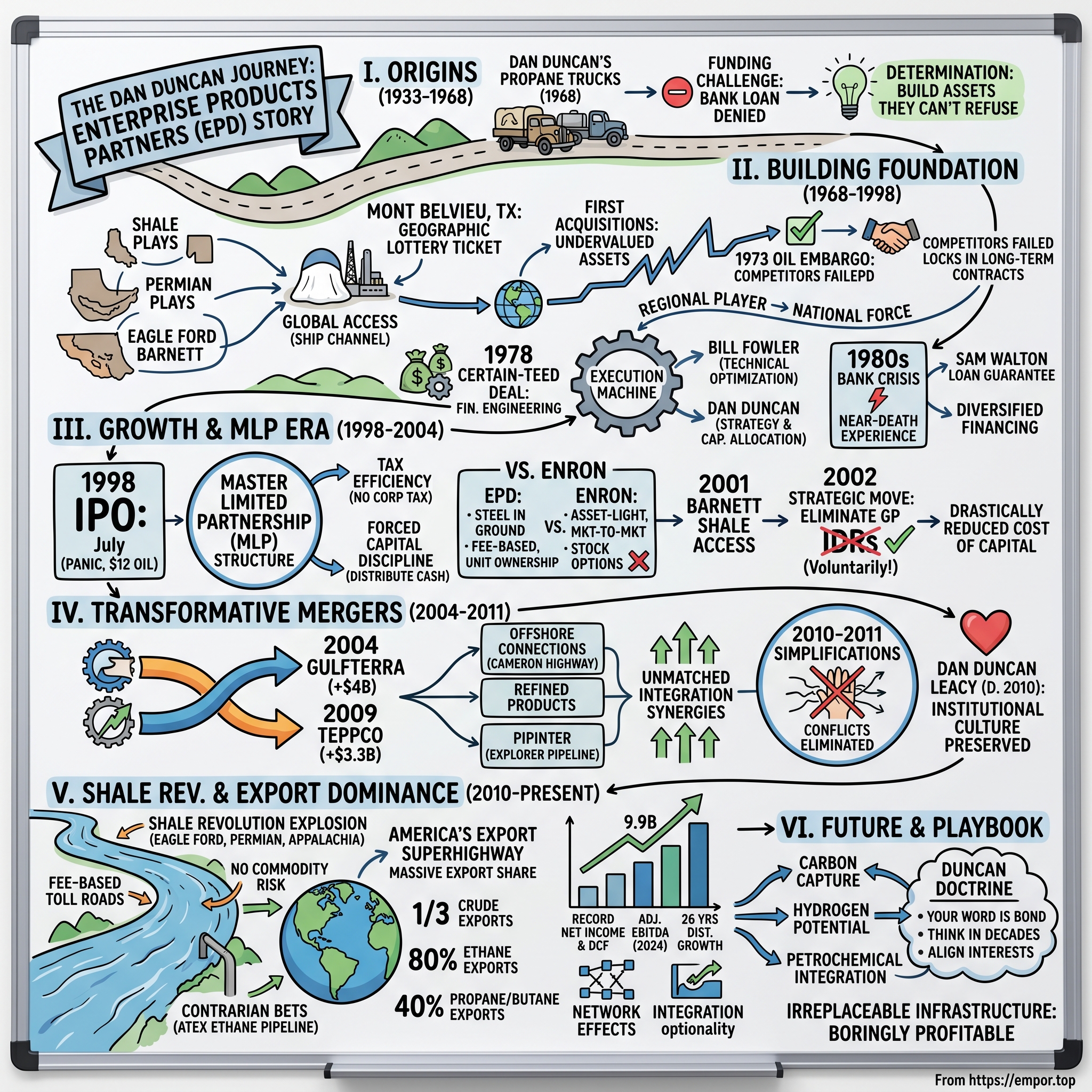
Enterprise Products Partners: The $70 Billion Energy Tollbooth
I. Introduction & Opening Story
There is a particular kind of Texas heat that settles over Chambers County in late summer — thick, salted with refinery vapor, shimmering off the asphalt of Highway 146. In 1968, anyone driving that road east out of Houston toward a crossroads called Mont Belvieu would have seen mostly rice fields, cattle, and a scattering of frame houses. On that same road, one would also have spotted two propane delivery trucks belonging to a 35-year-old East Texan named Dan Duncan. Duncan had left a salaried job at Wanda Petroleum with roughly $10,000 and an idea that most of his peers considered unremarkable: that someone needed to haul the leftover liquids of the oil and gas business from where they were produced to where they were consumed.
Nothing about that scene suggested what it would become. Propane distribution was, and remains, an unglamorous trade — a route business, a weather business, a business of small margins and cold Januaries. The people making fortunes in Texas in 1968 were drilling for oil, not trucking its byproducts.
Fifty-eight years later, the enterprise that grew out of those two trucks ranks among the largest energy infrastructure operators in the world. Enterprise Products Partners L.P. trades on the New York Stock Exchange under the ticker EPD, carries a market capitalization between $65 billion and $70 billion, and reports an asset base spanning roughly 50,000 miles of pipeline moving natural gas liquids, crude oil, natural gas, refined products, and petrochemicals, alongside more than 300 million barrels of liquids storage capacity and around 14 billion cubic feet of natural gas storage.[^1][^3] Financial results reflect that physical scale: recent annual adjusted EBITDA has hovered around $9.5 billion, while cash flow from operations has comfortably exceeded $8 billion, placing EPD on par with North America's premier industrial franchises.[^3][^10]
The partnership describes itself, in the flattest possible language, as a provider of midstream energy services. That understated framing masks a crucial operational reality. What EPD actually operates is closer to a tollbooth system than an energy producer. It does not, for the most part, speculate on the commodity prices of the molecules moving through its steel. Instead, it charges fees for the movement, separation, storage, and — increasingly, and most profitably — the loading of those molecules onto ships bound for Asia and Europe.
That distinction forms the spine of EPD's investment profile, and it deserves scrutiny rather than quiet acceptance. "Fee-based" is the most overused term in midstream marketing, claimed by virtually every master limited partnership. The central analytical question is not whether EPD asserts its cash flows are insulated from commodity price volatility, but which specific contracts, at which specific assets, actually deliver that insulation — and how the unhedged remainder performed when market stress tested that insulation.
Three primary questions frame this analysis:
First, how did a regional propane delivery operation become the physical chokepoint through which a meaningful share of American hydrocarbon exports must pass? The answer turns out to be less about pipeline construction than about geology — specifically, a subterranean salt dome beneath Chambers County that Duncan understood earlier and more completely than his competitors.
Second, how did EPD establish a corporate governance and capital structure that its peers spent nearly two decades and multiple distribution cuts trying to emulate? The partnership eliminated incentive distribution rights to its general partner and transitioned away from selling new equity to fund growth years ahead of the broader industry. While both moves proved structurally advantageous in retrospect, both were executed under market pressure rather than total serenity — a nuance management's official narrative often smooths over.
Third — and most critical for long-term investors — what is an irreplaceable asset base worth when the resource base feeding it eventually matures? EPD's physical moat remains formidable in the near term, but physical infrastructure carries a specific risk: assets rarely erode, but they can become stranded. The primary long-term threat is not that a competitor builds a superior Mont Belvieu, but that the upstream hydrocarbon volumes justifying the facility plateau and ultimately decline.
Understanding EPD's current position requires returning to its origins: an entrepreneur who grew up poor in the pine woods of East Texas, and the geology of the salt dome beneath Mont Belvieu.
 Subscribe on LinkedIn
II. The Founder's Blueprint & Mont Belvieu Origin Story (1933–1998)
Dan Duncan was born in 1933 near Center, Texas, in Shelby County—deep in the piney woods near the Louisiana border, in a region where modern infrastructure arrived late. Raised primarily by his grandmother after losing his mother and brother to tuberculosis when he was seven, and his father at seventeen, Duncan harvested timber, sold fur pelts, and worked his way through partial college coursework before entering the natural gas liquids industry.
It is tempting to draw a straight line from childhood hardship to lifelong financial conservatism. In Duncan's case, that connection is plausible: throughout his career, he exhibited a consistent aversion to unmanageable leverage, a refusal to build assets without long-term contracts, and a practice of securing land and rights-of-way years before development. Yet that conservatism was not always absolute; as the company's balance sheet in the early 2000s would later demonstrate, growth occasionally pushed debt beyond ideal thresholds.
Wanda Petroleum and the education in logistics
Duncan's operational apprenticeship took place at Wanda Petroleum, a Houston-based NGL marketing and transport firm, where he learned the mechanics of a specialized segment of energy logistics. The fundamental reality of natural gas liquids begins at the wellhead. Raw natural gas contains a mix of methane and heavier hydrocarbon molecules—including ethane, propane, butane, and natural gasoline—that exist as gases under atmospheric conditions but liquefy under modest pressure. These liquids hold greater commercial value when separated than when left in the gas stream, where they can condense inside pipelines or burn too hot for end users.
To capture that value, the midstream industry relies on a sequential process: gathering raw gas from wells, stripping out the mixed liquids stream known as "Y-grade," transporting that stream to a central hub, fractionating the liquids into pure components through distillation, and storing each product for distribution. Ethane serves as the primary feedstock for ethylene crackers in plastic manufacturing. Propane heats homes and supplies dehydrogenation plants producing propylene. Butanes are routed into gasoline blending and refinery operations.
At Wanda, Duncan recognized that the highest financial returns in the value chain accrued to whoever controlled the central infrastructure: fractionation and storage. While gathering lines faced local competition and end markets remained cyclical, a central processing hub where mixed streams were sorted and held presented strong natural monopoly characteristics for an early entrant.
1968 and the salt
When Duncan left Wanda in 1968 to found Enterprise Products alongside two partners, the initial propane delivery operation provided immediate cash flow. The decisive capital allocation decision, however, lay in how he deployed that capital.
Mont Belvieu sits atop a massive subterranean salt dome—a geologic plug of rock salt pushed upward through sedimentary layers over millennia. Through solution mining, engineers drill into the salt formation, inject fresh water to dissolve a cavity, and extract the resulting brine. The remaining cavern, often capable of storing tens of millions of barrels, features salt walls that are virtually impermeable and self-healing under subterranean pressure.
Compared to above-ground pressurized tanks, which carry far higher capital costs per barrel and greater operational hazards, salt caverns offer an inexpensive, highly secure storage medium. Once mined, the cavern functions as physical capital with minimal economic depreciation.
Duncan spent years quietly acquiring surface rights and storage leases over the Mont Belvieu dome. This long-term acquisition strategy occurred when the assets had no obvious strategic urgency—the United States remained a net energy importer, and the domestic shale revolution was four decades away.
From trucks to steel
The next logical evolution was transitioning from a transport customer into a pipeline owner. Throughout the 1970s and 1980s, Enterprise constructed and acquired pipeline links connecting its Mont Belvieu storage directly to major industrial complexes along the upper Texas Gulf Coast—including petrochemical facilities in Baytown, Channelview, Deer Park, and Port Arthur—as well as regional refineries.
Each additional pipeline connection generated compounding network effects. A single pipeline linking two points represents a simple conduit; a pipeline tied into a hub already connected to dozens of facilities provides optionality. Existing customers gained new delivery destinations, while new customers accessed the broader integrated system. As a result, the commercial value of the network expanded faster than its physical mileage—a structural advantage assembled steadily without significant competitive resistance.
1983: the dock nobody needed yet
In 1983, Enterprise established marine import and export facilities on the Houston Ship Channel. At the time, with the United States importing energy, the terminal's primary utility was limited to handling inbound cargoes and domestic coastal transfers. Building export-capable waterborne infrastructure for NGL trade appeared to be a modest operational diversification.
While this asset proved vital decades later, it was less an act of predictive foresight than a disciplined acquisition of scarce industrial real estate. Duncan did not anticipate the 21st-century shale boom; rather, he recognized that deepwater frontage adjacent to the Gulf Coast's major petrochemical concentration was finite, permittable, and likely to appreciate. Securing that waterfront created a long-dated option that gained immense value when domestic production reversed trade flows.
By the late 1990s, Enterprise had developed into a substantial private enterprise anchored by a central storage hub, an integrated pipeline network, and a marine terminal. To fund its next scale of expansion, however, the business required access to broader capital markets—just as Wall Street was refining a master limited partnership structure tailored for energy infrastructure.
III. Going Public, The MLP Mania, & Early Governance Discipline (1998–2004)
In July 1998, Enterprise Products Partners L.P. listed on the New York Stock Exchange, selling roughly 12 million common units at $22 apiece to raise about $247 million.[^1]1 With crude oil collapsing toward $11 a barrel, it was one of the worst possible windows to bring an energy company public.
The offering succeeded regardless because Enterprise was not selling direct commodity price exposure; it was selling yield.
The MLP engine, explained plainly
A master limited partnership operates without entity-level federal income tax. Instead, income passes directly to unitholders, who report their share on a Schedule K-1 rather than receiving standard corporate dividends. Because pipelines and storage caverns generate substantial depreciation, a large portion of the cash distributed to unitholders is categorized as a return of capital, which lowers the investor's cost basis rather than triggering immediate income tax.
As a result, a dollar of pipeline cash flow reaches an investor with less tax friction inside an MLP than inside a traditional C-corporation. For predictable, contracted, asset-heavy cash flows, this structure offered a genuine tax advantage. Yet it also introduced distinct drawbacks: K-1 tax filing complexity, potential unrelated business taxable income issues for tax-deferred accounts, and historically near-total exclusion from broad equity index funds. The model effectively traded access to mainstream institutional equity capital for tax efficiency.
The structure contained a second, far more dangerous mechanism.
Incentive distribution rights: the tax on success
Most MLPs were sponsored by a parent entity acting as general partner. The general partner typically held a 2% equity stake alongside incentive distribution rights, or IDRs. These rights functioned as a tiered profit split: as the partnership increased its per-unit distribution past specified targets, the general partner's share of each incremental dollar rose from 2% to 15%, then 25%, and eventually to a top tier of 50%.
At that top tier, every additional dollar of distributable cash flow was split evenly between the general partner and all limited partners combined, even though the general partner contributed no new capital for its 50% share.
This structure created a rising cost of capital. To fund new projects, the partnership had to issue additional units that required regular distributions. Because of the high splits, the partnership needed to generate nearly two dollars of incremental cash flow for every dollar distributed to limited partners. Projects that appeared profitable before IDRs turned value-destructive after paying the general partner's cut. Simultaneously, the general partner had every incentive to pursue aggressive growth, as its compensation was tied to distribution expansion rather than returns on invested capital.
While the midstream sector treated IDRs as an unavoidable cost of doing business for over a decade, Enterprise sought to alter the arrangement.
2002: the first surgery
In 2002, EPD restructured its general partner economics, capping the general partner's share and materially reducing its IDR burden — a move that anticipated the broader midstream sector by years in recognizing that high splits damaged the cost of equity.[^1]1 Mechanically, lowering the general partner's take reduced EPD's cost of capital, allowing a wider array of expansion projects to clear required hurdle rates and compound returns.
This concession fell directly on the Duncan family, which owned the general partner and surrendered a substantial claim on future cash flows. While often cited as evidence that EPD prioritized limited partners, the move was also pragmatically self-interested: reducing the cost of capital allowed the partnership to expand more rapidly, increasing the value of the family's substantial equity stake in EPD itself.
Testing the "always conservative" claim
Enterprise's official narrative, alongside consensus investor sentiment, portrays the partnership as a consistently conservative capital allocator. The historical record reveals a more complex trajectory.
During the late 1990s and early 2000s, EPD expanded aggressively through acquisitions and construction while maintaining leverage well above its modern target of roughly 3.0 times net debt to EBITDA, reaching ratio levels above 4.5 times during the buildout.1 When energy markets tumbled in 2001 and 2002 — compounded by Enron's collapse and a severe credit freeze across energy capital markets — sector financing evaporated rapidly. Multiple peer MLPs responded by cutting distributions or issuing emergency equity on unfavorable terms.
Viewed in that environment, the 2002 IDR restructuring resembles necessary surgery under financial strain rather than pure strategic foresight. The structural fix was required because EPD's balance sheet lacked the flexibility to absorb an extended downturn. That context does not diminish the action, but it reframes it: the lesson EPD took away was that financial engineering could not replace balance sheet strength, prompting two decades of deliberate debt reduction.
For investors, this history clarifies the distinction between management claims and observed behavior under stress. Enterprise built its reputation for fiscal discipline not from an uninterrupted history of caution, but from correcting early overleverage and maintaining balance sheet discipline ever since.
With a lower cost of capital and a flexible equity currency, Enterprise prepared to pursue expansion on a scale the midstream industry had not yet seen.
IV. The Megamerger Roll-Up Era: GulfTerra & TEPPCO (2004–2011)
By late 2003, El Paso Corporation faced severe financial distress. Following the collapse of Enron and the broader merchant energy model, El Paso carried unsustainable debt and was forced to sell assets into a depressed market. Among its primary holdings was GulfTerra Energy Partners, a midstream partnership operating Gulf of Mexico gathering systems, Permian and San Juan basin assets, and Texas natural gas liquids infrastructure that directly complemented Enterprise's existing network.
El Paso's position as a forced seller allowed Enterprise—one of the few industry buyers with sufficient balance sheet strength and strategic rationale—to execute a major acquisition on favorable terms.
GulfTerra (2004): buying the puzzle piece
Announced in December 2003 and closed in September 2004, the transaction was valued at roughly $13 billion to $14 billion in enterprise value, including the purchase of El Paso's general partner interest.[^5]1 Enterprise acquired the general partner interest and a block of GulfTerra units for cash, while public GulfTerra unitholders received 1.81 EPD units for each GulfTerra unit.[^5]
The valuation highlighted Enterprise's pricing advantage. The deal closed at an implied forward enterprise value-to-EBITDA multiple in the mid-8x range, compared with prevailing midstream transaction multiples of 9.5x to 10.5x.1 By using its higher-valued equity currency to purchase lower-cost cash flows, Enterprise executed a classic accretive roll-up. Combined with roughly $40 million in identified general and administrative expense reductions, the transaction generated positive financial returns from inception.[^5]
Beyond financial accretion, the primary strategic value lay in network integration. GulfTerra's offshore and Texas pipeline systems connected directly into Enterprise's Mont Belvieu hub, uniting two partial systems into a single integrated network and capturing compounding operational benefits without constructing new assets from scratch.
However, the acquisition brought structural challenges. Enterprise absorbed substantial Gulf of Mexico shelf infrastructure just as conventional offshore production entered a secular decline. Offshore gathering volumes on the shelf fell steadily in subsequent years, demonstrating that not all acquired assets maintained their initial value.
TEPPCO (2009): buying in the wreckage
While the GulfTerra transaction was opportunistic, the acquisition of TEPPCO Partners represented a far larger market expansion during a period of widespread financial distress. In late 2008, frozen credit markets drove midstream unit prices down to yields reflecting severe market distress. TEPPCO Partners—a refined products and crude pipeline operator whose general partner was also controlled by Duncan family interests—was announced as a merger target in June 2009 and closed that October. The transaction created an entity with an enterprise value of approximately $30 billion, establishing EPD as the largest publicly traded energy partnership in North America.[^5]1 Under the merger terms, TEPPCO unitholders received 1.24 EPD units for each TEPPCO unit,[^5] at an implied multiple in the low-9x range on forward EBITDA.1
The transaction highlighted two distinct aspects of Enterprise's corporate strategy.
On one hand, Enterprise executed a transformational, all-equity merger during severe credit market dislocation, while peer companies struggled to refinance revolving credit facilities. This execution relied on the balance sheet flexibility and equity valuation strength built through earlier governance reforms and debt management.
On the other hand, the deal represented a related-party transaction. Because Duncan family interests controlled both general partners, the transaction was negotiated between affiliated entities. Although independent conflicts committees approved the exchange ratio, the counterparties did not negotiate at arm's length in a conventional market sense. Limited partners in EPD ultimately relied on management and committee oversight to ensure fair pricing, as unitholders lacked voting rights to override affiliate terms—a structural dynamic that remains relevant for governance evaluation.
The FTC intervenes
Regulatory scrutiny followed the increased market concentration. In November 2009, the Federal Trade Commission required Enterprise to divest ownership interests in specific refined products and natural gas liquids pipelines—including holdings in the Indian Basin and Chaparral systems—to address competitive concerns across select Gulf Coast and Southwest transportation markets.[^9]
The FTC's remedy remained narrowly targeted. Regulators did not challenge Enterprise's core position at Mont Belvieu, as antitrust enforcement focuses on anti-competitive mergers rather than market positions built organically over decades. Consequently, the core storage and fractionation hub remained intact, underscoring that Enterprise's primary competitive advantage was both resistant to regulatory unwinding and difficult for competitors to replicate through acquisition.
2010–2011: killing the general partner
Enterprise completed its structural simplification in 2010 by merging with Enterprise GP Holdings L.P.—the publicly traded entity that held its general partner—in an all-equity transaction valued at approximately $8 billion to $9 billion.[^5]1 The merger eliminated the 2% general partner interest alongside all remaining incentive distribution rights, leaving a single class of common units without general partner splits or structural incentives to prioritize distribution growth over return on capital.
This restructuring preceded broader industry trends by several years. Peer partnerships such as Kinder Morgan, Energy Transfer, Plains All American, and Targa Resources unwound their general partner structures between 2014 and 2020, often under financial stress and accompanied by distribution reductions or corporate conversions. By completing its simplification prior to the rapid expansion of U.S. shale production, Enterprise secured a lower cost of capital ahead of its peers, avoiding the financial drag of incentive distribution rights during a decade of volume growth.
The timing proved critical. In 2010, as hydraulic fracturing drove a surge in domestic natural gas liquids production, Dan Duncan passed away, leaving behind a simplified corporate structure and an integrated asset footprint positioned for the next phase of midstream expansion.
V. The Shale Revolution & Global Export Monopoly (2010–2020)
Dan Duncan died in March 2010 at age 77, shortly after the U.S. federal estate tax briefly lapsed—a legislative anomaly that allowed one of the largest fortunes in energy history to pass to his heirs under tax-exempt conditions.2 Control of the general partner shifted to the family holding entity, with his daughter Randa Duncan Williams assuming the role of Chairman.
The central governance question following his death was whether a founder's operational discipline could endure without the founder. Sixteen years later, the record shows it largely has, though the evidence is behavioral rather than structural. The same concentrated control that insulated management from short-term market pressures also left public unitholders with virtually no legal recourse if leadership strategy ever strayed.
The molecules arrive
What followed across the American energy landscape had few precedents in industrial logistics. The rapid adoption of horizontal drilling and hydraulic fracturing unlocked vast volumes across the Permian Basin, the Eagle Ford, the Marcellus, Utica, and Haynesville shales. Much of this output contained heavy concentrations of liquids. In the Permian especially, natural gas liquids surfaced as an unavoidable byproduct of crude oil production, ensuring that NGL supply surged regardless of NGL price signals.
Consequently, the United States shifted rapidly from a structurally deficit NGL market—where ethane and propane commanded high import-parity prices—to a market burdened by chronic oversupply. By the mid-2010s, domestic petrochemical facilities and regional heating markets reached full absorption capacity. Spot prices at Mont Belvieu plummeted to levels where producers routinely began "ethane rejection," leaving the molecule in the natural gas stream to be burned as fuel because processing and transport costs exceeded its market value.
Clearing that domestic glut required a massive buildout of specialized export infrastructure capable of reaching international markets.
Building the gateway
Enterprise responded by spending a decade transforming its Houston Ship Channel footprint into a dominant global export hub. The company expanded the Enterprise Hydrocarbons Terminal repeatedly, constructing large-scale refrigeration units to liquefy ethane and propane at atmospheric pressure, deepening ship berths, accelerating loading rates to thousands of barrels per hour, and adding pipeline connections to maintain continuous loading operations.[^1][^4]
The physical requirements of cryogenic shipping created a high barrier to entry. Transporting ethane overseas requires chilling the gas to approximately minus 128 degrees Fahrenheit, while propane must be cooled to roughly minus 44 degrees. Handling these flows demands capital-intensive refrigeration trains, specialized insulated storage, high-volume loading arms, and access to deepwater channels capable of accommodating Very Large Gas Carriers. Because suitable Gulf Coast sites are physically scarce and environmental permitting has tightened significantly since the 1980s, replicating such facilities presents formidable economic and regulatory hurdles.
By the early 2020s, corporate disclosures and trade data showed Enterprise handling approximately 30 to 35 percent of total U.S. crude oil exports, about 80 percent of U.S. ethane exports, and roughly 40 percent of U.S. liquefied petroleum gas exports.[^1][^4]3 Rather than representing typical commercial market share, these metrics reflected a bottleneck position where a substantial portion of American waterborne hydrocarbon exports passed through a single company's docks.
The arbitrage, in plain terms
The economic incentive driving these flows was straightforward. Global petrochemical plants generally process either crude-derived naphtha or gas-derived ethane. When domestic shale production kept U.S. natural gas prices low relative to global crude oil, American ethane offered a clear cost advantage for overseas manufacturers—even after factoring in cryogenic processing, long-distance ocean transport, and regasification. Industrial buyers across Asia and Europe responded by constructing ethane-compatible steam crackers, commissioning specialized carriers, and executing long-term terminal service agreements backed by minimum volume commitments.
By anchoring both ends of the supply chain, Enterprise positioned its waterborne terminals as indispensable throughput nodes, representing one of the clearest applications of a fee-based infrastructure model in the midstream sector.
Falsifying the "commodity-insulated" claim
However, management's assertion that terminal operations are fully insulated from commodity volatility warrants careful examination. Historical performance indicates that fee-based contract terms do not entirely eliminate commodity price exposure.
Standard export agreements pair minimum volume commitments with provisions allowing customers to cancel or defer cargoes in exchange for a cancellation fee that is lower than the full loading tariff. When global price spreads are wide, customers fulfill their full throughput allocations. When the price gap between U.S. supply and international markets narrows below transport costs, customers routinely choose to pay cancellation penalties rather than move unprofitable cargoes.
This vulnerability materialized during the 2019–2020 market downturn. As international price spreads compressed and pandemic-related lockdowns curtailed global energy demand, off-takers exercised cargo cancellation options. Consequently, gross operating margin across Enterprise's marine terminal operations contracted by 15 percent or more year-over-year during the trough.[^3]1 While minimum volume commitments prevented revenues from collapsing entirely, cash flows fell noticeably below peak operating levels.
The empirical record demonstrates that while baseline revenue backed by minimum volume commitments remains protected, margin upside from spot throughput and above-minimum volumes remains directly exposed to global commodity price spreads. Treating peak export margins as fixed utility cash flows overlooks this cyclical exposure. Evaluating operational resilience requires tracking the spread between contracted minimum volumes and total loaded cargoes during periods of compressed market arbitrage.
As the export business matured, a broader structural challenge emerged: the traditional equity-issuance model that long funded midstream growth was becoming increasingly unviable.
VI. The Capital Allocation Pivot & Modern M&A (2017–Present)
By 2016, the master limited partnership sector had survived a severe financial crisis. The oil price collapse that began in late 2014 effectively closed the equity market for midstream operators. Partnerships that had expanded by continuously issuing units to fund capital programs discovered that the model depended entirely on high unit prices to make equity issuance accretive. When equity values tumbled, dozens of partnerships cut distributions and several restructured, leaving the sector with severe investment losses.
Enterprise did not cut its distribution. However, management drew a conclusion that extended beyond short-term survival.
The 2017 decision
The traditional MLP model functioned on an implicit contract: partnerships distributed nearly all distributable cash flow to unitholders and funded growth projects by issuing new equity and debt. In a rising market, that model created a self-reinforcing expansion cycle. In a falling market, it created severe financial drag: once a partnership's cost of equity exceeded the expected return on its projects, every dollar of new capital destroyed value—at the exact moment funding was most urgently needed.
In 2017, EPD deliberately slowed distribution growth from its historical 5–6% annual pace down to roughly 2–3%, redirecting the retained cash flow into its capital expansion program.[^1][^4] Management targeted a self-funded financial model in which growth capital expenditures were funded entirely out of retained cash flow and debt capacity aligned with its leverage targets, ending reliance on new equity issuance.
The transition carried immediate market consequences. Yield-focused investors who owned the units for distribution growth penalized the security, causing the price to underperform. On subsequent earnings calls, management repeatedly outlined the underlying math: retaining cash and funding projects internally represented a permanent, structural reduction in the partnership's cost of capital.[^10]4
Subsequent execution validated the strategy. EPD has not issued common units to fund growth capital since the pivot, retaining $3 billion or more of annual distributable cash flow for organic projects while maintaining net debt to Adjusted EBITDA in the low-to-mid 3x range against a 3.0x target.[^1][^3][^10] The partnership carries the highest credit ratings in the midstream sector at Baa1/BBB+.[^1]
This shift represented structural discipline rather than administrative convenience. Management announced a restrictive capital plan, absorbed an immediate market penalty, and executed the strategy consistently across nine years and two commodity cycles. EPD has increased its distribution annually for more than 27 consecutive years, with 2025 declared distributions of approximately $2.175 per unit and distributable cash flow coverage near 1.7x.[^1][^10]
A coverage ratio of 1.7x indicates that distributions consume less than 60% of generated cash flow, leaving the remaining 40% to fund growth capital—establishing utility-like cash retention inside a structure that historically distributed nearly all cash earnings.
Navitas (2022): the discipline test
In February 2022, EPD closed the acquisition of Navitas Midstream Partners from Warburg Pincus for $3.25 billion in cash on a debt-free basis, adding roughly 1,750 miles of natural gas gathering pipelines and approximately 1.0 billion cubic feet per day of cryogenic processing capacity in the Midland Basin.[^7]
The strategic rationale centered on upstream supply capture. Enterprise's Gulf Coast fractionation and marine export infrastructure relies on continuous volumes of mixed natural gas liquids, and the Midland Basin represents the largest incremental source of NGL supply in North America. Navitas provided wellhead-to-water integration across that core supply basin: gathering raw natural gas, processing it, transporting the liquids down Enterprise's pipeline grid to Mont Belvieu, fractionating them into pure products, storing them in salt caverns, and loading them onto waterborne vessels at company-owned docks—collecting fees at each stage.
On valuation, the transaction was executed at a run-rate multiple in the low-to-mid 8x range, compared with Enterprise's trading multiple of around 10x, with the spread widening further as Midland volumes expanded into available processing capacity.[^7]3 Purchasing cash flows below the partnership's trading valuation within a basin feeding its core network delivered immediate financial accretion.
Piñon (2024): paying a full price for a niche
In August 2024, EPD acquired Piñon Midstream from Black Bay Energy Capital for $950 million in cash, acquiring sour gas treating and acid gas injection capacity in the Delaware Basin of southern New Mexico.[^8]
The acquisition stood out because the purchase price reflected a full valuation rather than a distressed discount. The implied multiple reached nearly 9.6x against roughly $99.5 million of projected 2026 EBITDA, delivering a modest contribution of approximately $0.03 per unit to 2025 distributable cash flow.[^8]4 Management acknowledged the pricing on conference calls, framing the transaction as paying fair value for a hard-to-replicate asset rather than acquiring a discounted property.4
The transaction addressed specific geological and regulatory barriers. Portions of the Delaware Basin yield natural gas with high concentrations of toxic, corrosive hydrogen sulfide. Producers cannot legally vent acid gas; it must be separated, compressed, and permanently injected into deep geologic formations under strict regulatory permits. Piñon held that treatment capacity at scale. For producers operating in sour gas acreage, alternative processing routes were virtually non-existent, creating a localized geographic monopoly.
While paying near the partnership's own trading multiple for a specialized asset raised questions regarding capital discipline, the relative scale framed the risk: a $950 million acquisition against an annual EBITDA base of approximately $9.5 billion represented a targeted investment in a high-barrier niche rather than a speculative corporate diversification.
The people running it
Randa Duncan Williams serves as non-executive Chairman of the general partner. A lawyer who worked within the organization prior to her father's death, she maintains a low public profile, refraining from earnings calls and media interviews. The Duncan family and affiliated EPCO entities hold an effective economic interest estimated at roughly 32% of EPD's outstanding units, alongside complete control of the general partner.[^1]2
A.J. "Jim" Teague serves as co-Chief Executive Officer and the primary operational leader—an industry veteran known for direct commentary during investor calls. He has consistently addressed operational setbacks directly, including performance challenges in the propane dehydrogenation business, rather than minimizing issues.[^10]4 Teague has announced his retirement from the co-CEO role effective January 2027.
W. Randall "Randy" Fowler serves as co-CEO and Chief Financial Officer, and is scheduled to become sole CEO in January 2027. Fowler designed the partnership's self-funding capital strategy, focusing executive communications on capital costs, cash flow coverage, and balance sheet leverage metrics.
This leadership transition shifts executive governance from a dual operator-financier model to single leadership under a financial officer. In an asset-heavy sector where capital overruns represent a primary risk factor, financial oversight provides structural discipline, though it also marks the departure of the executive voice most recognized for direct operational reporting.
VII. Segment Economics, Network Moat, & Competitive Landscape
Across the Gulf Coast between Corpus Christi and Beaumont, Enterprise Products Partners operates less like a collection of standalone facilities and more like a unified system, linked by roughly 50,000 miles of pipeline. Understanding how this infrastructure generates earnings requires tracing a single hydrocarbon molecule through the chain.
A gas well in the Midland Basin produces raw natural gas. Enterprise's gathering system—expanded significantly through the Navitas acquisition—collects the stream and delivers it to a cryogenic processing plant, which chills the gas until heavier liquid molecules condense out. The dry residue gas flows into a natural gas pipeline, generating a gathering and processing fee. The remaining mixed natural gas liquids stream enters an NGL pipeline heading southeast toward Mont Belvieu, generating a transportation tariff. At Mont Belvieu, the stream enters a fractionator, where distillation towers separate ethane, propane, normal butane, isobutane, and natural gasoline, generating a fractionation fee. Each separated product moves into subterranean salt caverns, generating a storage fee. From there, pipeline connections deliver ethane to ethylene crackers and propane to regional processing facilities or Enterprise's propane dehydrogenation units, while remaining volumes route to waterborne docks, generating terminaling and loading fees.
A single molecule can generate five or six distinct fees along its path, all accruing to a single balance sheet. That integrated vertical chain, rather than any isolated facility, forms the core of the business.
The four segments
NGL Pipelines & Services serves as the partnership's primary earnings driver, generating $5.5 billion or more in annual Adjusted EBITDA—roughly 58 percent of the company total.[^3][^10] The division encompasses the Mont Belvieu fractionation complex, subterranean salt cavern storage, the regional NGL pipeline network, and marine export terminals. This business produces the portfolio's most resilient cash flows by pairing multi-year fee contracts with strategically located, hard-to-replicate infrastructure.
Crude Oil Pipelines & Services generates approximately $1.7 billion, representing about 18 percent of Adjusted EBITDA.[^3] Operations include trunkline capacity connecting the Permian Basin to Houston, Midland-area gathering terminals, and the Enterprise Crude Houston (ECHO) terminal. ECHO serves as a central crude hub where raw barrels are aggregated, blended to precise refinery specifications, and directed toward Gulf Coast refiners or marine export docks. The proposed Sea Port Oil Terminal, a deepwater offshore project designed to fully load Very Large Crude Carriers, falls under this segment following extended federal environmental permitting reviews.
Natural Gas Pipelines & Services contributes roughly $1.1 billion, or about 12 percent of total earnings, overseeing natural gas gathering and processing assets across the Permian, Eagle Ford, and Haynesville shales along with interstate gas transmission lines.[^3] This segment has served as the primary operational recipient of recent corporate acquisitions.
Petrochemical & Refined Products Services contributes a matching $1.1 billion, or approximately 12 percent of Adjusted EBITDA, representing the partnership's most operationally complex business line.[^3] Unlike pure transportation assets, this division operates processing facilities, including two propane dehydrogenation (PDH) plants, propylene fractionation units, octane enhancement facilities producing isobutylene, butane isomerization plants, and refined products pipelines.
Fee-based versus spread-based, honestly stated
Management consistently reports that 85 percent or more of total gross operating margin is fee-based, with the remaining balance exposed to commodity processing spreads and spot export market dynamics.[^3][^10] While financial disclosures support this general classification, evaluating cash flow quality requires two analytical distinctions.
First, fee-based contract terms eliminate commodity price risk but retain volume exposure. A fixed pipeline tariff insulates earnings against falling oil or gas prices, but revenues still decline if physical throughput drops. Minimum volume commitments soften this volume risk, but only for the duration of the underlying contract and up to the specific volume floor pledged by the customer.
Second, the remaining 15 percent of margin tied to commodity spreads represents the incremental margin slice. Consequently, this unhedged portion exerts a disproportionate effect on earnings volatility. During periods of wide international price spreads, spot export demand and processing margins inflate total earnings; during periods of price convergence, those margins contract. Neither extreme represents a permanent baseline.
Seven Powers, applied with a scorecard
Evaluated through Hamilton Helmer's strategic framework (Seven Powers), Enterprise demonstrates three competitive advantages clearly, one partially, and three not at all.
Cornered Resource — strong. The Mont Belvieu salt cavern storage complex and deepwater frontage along the Houston Ship Channel represent the partnership's central strategic asset. The salt dome itself is a unique geological structure, while the environmental permits required to solution-mine storage at this scale and construct new marine hydrocarbon docks along the Gulf Coast present formidable regulatory hurdles. Even a competitor backed by substantial capital cannot replicate this physical footprint under modern environmental standards.
Scale Economies — strong. Fractionation and cryogenic marine loading operate on steep fixed-cost curves. Enterprise's operating costs per barrel at Mont Belvieu remain lower than what a new entrant could achieve, while direct pipeline connections to more than 100 Gulf Coast refineries and petrochemical plants allow management to attach new capital projects to an established grid rather than constructing standalone systems.[^1][^4]
Switching Costs — strong but narrow. Downstream industrial facilities physically connected to Enterprise's fractionation and storage network face substantial barriers to switching providers, as doing so would require constructing alternative pipeline connections. Upstream, however, switching costs are considerably weaker: Permian Basin producers with multiple gathering options routinely re-contract capacity based on price, placing Enterprise in direct competition with operators like Targa Resources and Energy Transfer.
Network Economies — partial. System connectivity provides operational optionality, but this advantage stems primarily from physical scale and asset density rather than true network effects, as adding a new customer does not automatically increase the utility of the network for existing users.
Counter-Positioning, Branding, and Process Power — absent. Competitors face no structural disincentives to replicating Enterprise's business model, and the partnership derives no meaningful premium from corporate branding or proprietary processing technology.
Porter, and the competitive field
Analyzing the midstream landscape through Michael Porter's Five Forces highlights distinct operational boundaries:
- Barriers to Entry: High barriers protect the core Gulf Coast NGL hub and export terminals, driven by high capital costs, physical land constraints, and tight environmental permitting.
- Buyer Power: Upstream buyer power is moderate and expanding as consolidated Permian producers negotiate multi-pipe commitments. Downstream buyer power is low, as connected petrochemical facilities remain physically bound to the network.
- Supplier Power: Upstream producers act as effective suppliers whose drilling activity dictates system throughput. Because producer activity depends on global oil and gas prices, volume swings remain outside Enterprise's control.
- Rivalry: Competition remains intense across regional gathering and processing basins, but muted around the central Mont Belvieu storage and fractionation hub.
- Threat of Substitutes: The primary long-term threat stems not from competing pipelines, but from potential demand shifts driven by electrification, alternative feedstocks, and advanced plastics recycling over multi-decade horizons.
Compared with midstream peers—including Energy Transfer, Kinder Morgan, Targa Resources, Plains All American, and MPLX—Enterprise's primary distinction extends beyond physical asset placement. Targa maintains higher Permian gathering concentration, Energy Transfer controls broader multi-commodity pipeline mileage, and MPLX benefits from dedicated refining volumes through its corporate sponsor. Enterprise's core distinction lies in combining the sector's highest credit rating (Baa1/BBB+), the lowest net leverage target (3.0x), an equity-simplified structure free of general partner incentive distribution rights, and insider ownership exceeding 30 percent.[^1]
This combination provides a structural cost-of-capital advantage—a critical lever in an asset-heavy sector where infrastructure assets deliver similar physical services. However, this financial advantage has gradually narrowed as peer partnerships execute their own corporate simplifications and debt reduction plans.
That structural position clarifies the core business, but it also highlights the specific segment of the portfolio where Enterprise's competitive advantages have proven least effective.
VIII. Historical Falsification Pass & Skeptical Investor Stress Test
In the summer of 2023, Enterprise brought its second propane dehydrogenation (PDH 2) plant online at Mont Belvieu. Shortly after startup, one of its four reactors suffered a mechanical failure. The facility—intended to demonstrate that operational lessons from the first plant had been resolved—instead required an emergency turnaround in the third quarter of 2024.54
Evaluating Enterprise's economic moat requires testing management's strategic narrative against empirical execution, with the petrochemical segment presenting the clearest operational friction.
The value-chain extension that did not work as advertised
The claim: Moving downstream from midstream logistics into petrochemical manufacturing provides Enterprise with high-return growth optionality, upgrading low-cost domestic propane into higher-value polymer-grade propylene.
The theoretical logic appeared straightforward: Enterprise controlled the underlying propane feedstock, storage caverns, pipeline network, and export docks. Constructing a PDH facility aimed to upgrade a molecule already within the partnership's system to capture value in an expanding global propylene market.
The disconfirming record:
The first facility, PDH 1, completed around 2016–2017, ran significantly over budget and experienced repeated operational outages. Construction disputes culminated in litigation against contractor Amec Foster Wheeler over alleged construction defects and project management failures.5 A partnership built on executing civil and mechanical infrastructure on schedule and within budget struggled with its initial expansion into continuous-process chemical manufacturing.
The second facility, PDH 2, repeated those operational challenges through early mechanical failure and an unplanned turnaround.5 On investor calls, management acknowledged the reliability issues and quantified the financial drag directly, providing transparent disclosure while confirming the material impact on segment performance.4
Financial returns mirrored these operational delays. Petrochemical segment returns have persistently lagged the internal hurdle rates used to justify the capital investments. The business faced dual pressures: unplanned downtime reduced asset utilization in a fixed-cost operation, while expanding global propylene capacity—driven largely by new Chinese facilities—compressed industry processing margins.
The calibrated verdict: The empirical record refutes the strong form of the petrochemical optionality thesis. Two major capital projects under separate construction contracts failed to deliver on-time, on-budget, and reliable initial operations, establishing a pattern rather than an isolated incident. The evidence indicates a clear boundary: Enterprise operates as a premier builder and manager of pipelines, storage caverns, and marine terminals, but an unproven operator of complex chemical processing plants. Transporting and storing hydrocarbons involves civil and mechanical infrastructure with long asset lives and few moving parts, whereas continuous chemical processing involves catalysts, high-temperature reactors, and complex operational failure modes.
A clear test for future performance requires sustained utilization across both PDH units over four consecutive quarters without unplanned turnarounds, alongside segment gross operating margins that hold up during periods of average propylene spreads. Without that operational stability, investors should evaluate the petrochemical segment as a lower-multiple, higher-volatility cash flow stream rather than a fee-based tollbooth asset.
This underperformance should be evaluated in context. Representing roughly 12 percent of Adjusted EBITDA—with much of the segment consisting of refined products pipelines and octane enhancement assets—the PDH challenges represent a drag on total returns rather than a systemic threat to the enterprise. The primary insight is analytical, identifying the precise operational limits of Enterprise's moat.
The governance stress test
An evaluation of Enterprise's governance framework reveals three core structural features.
First, EPCO—Enterprise Products Company, the private Duncan family holding entity—employs virtually all operational personnel and provides administrative services to the partnership under cost-reimbursement arrangements.[^1]1 Although these related-party agreements are structured as cost pass-throughs rather than profit centers, contract terms are negotiated between affiliated entities, requiring public unitholders to rely on internal governance oversight.
Second, unitholders do not elect the board of directors. As a master limited partnership, the general partner's board is appointed directly by its owner. Unitholders lack access to proxy contests, binding say-on-pay votes, or direct board representation. Consequently, unitholders seeking to challenge capital allocation decisions possess a single practical option: selling their units.
Third, the primary counterweight to this structural concentration is economic alignment. The Duncan family's approximately 32 percent economic stake aligns controlling interests directly with public unitholders. Historically, management has exercised control to eliminate general partner economic claims, as demonstrated by the 2002 IDR restructuring and the 2010 general partner simplification.
The governance profile combines weak structural protections with strong historical alignment. Investors underwrite the risk that controlling family oversight will maintain capital discipline across future generations without formal governance enforcement mechanisms.
Terminal value and the decline curve
The primary long-term investment risk centers on basin throughput rather than direct peer competition.
Enterprise's asset valuation assumes sustained physical volumes. If U.S. crude oil and associated natural gas production plateaus in the late 2020s and subsequently declines as core shale acreage matures, long-haul pipelines bound by multi-year contracts face re-contracting risks at lower tariffs and utilization rates. Pipeline tariffs remain competitive during periods of capacity constraint, but compress rapidly when takeaway capacity becomes abundant.
Asset exposure varies across the system. Long-haul crude oil pipelines face high vulnerability to regional volume declines because their valuation depends on takeaway demand. Conversely, hub infrastructure—including Mont Belvieu salt caverns, fractionation capacity, and waterborne export docks—remains more defensible by serving global demand and capturing storage value during market volatility. However, hub assets remain dependent on upstream supply: processing capacity loses economic value if underlying throughput contracts permanently.
A nearer-term operational signal is visible in West Texas. Waha hub natural gas prices have repeatedly traded in negative territory, with producers paying to move residue gas as Permian associated gas production outpaced local pipeline capacity.3 For Enterprise, negative regional pricing creates demand for new takeaway expansion projects at attractive returns, while simultaneously highlighting regional infrastructure bottlenecks that compress producer margins and elevate counterparty credit risk among smaller upstream operators.
Finally, regulatory permitting presents a key valuation variable. The proposed Sea Port Oil Terminal has undergone years of federal environmental review. The final regulatory outcome will signal whether large-scale U.S. offshore export infrastructure remains permittable, directly influencing the value of Enterprise's existing waterfront footprint. Tightening regulatory constraints increase the barriers to entry for competing projects, shifting Enterprise's growth strategy toward system optimization rather than greenfield asset expansion.
IX. Playbook: Lessons for Builders, Allocators, & Investors
1. Fix your cost of capital before the market forces you to.
Enterprise restructured its incentive distribution rights in 2002, eliminated them entirely in 2010, and abandoned equity-funded growth in 2017 — executing each move before or early in the sector-wide crises that eventually forced peers to follow suit. The competitive payoff was less about the restructurings themselves than the strategic position they created: entering downturns as the lowest-cost-of-capital buyer when distressed assets were most plentiful.
A complete assessment of this lesson requires acknowledging the caveat detailed earlier: Enterprise executed its 2002 restructuring under credit pressure rather than absolute serenity. The transferable insight is narrower and more practical: structural flaws in a capital model compound silently during expansions and become nearly unfixable during credit freezes. The window to address capital weaknesses opens early, precisely when repairs feel least urgent.
2. Own the bottleneck, not the distance.
A long-haul pipeline moves molecules between fixed points, holding pricing power only as long as regional takeaway capacity remains constrained. Adding competing pipelines compresses tariffs rapidly. Storage hubs and deepwater export terminals operate under different structural dynamics: they serve as nodes where optionality is generated rather than consumed, generating fees in both contango and backwardation market structures. Their scarcity stems from geological features and environmental permitting constraints rather than capital availability alone.
The broader takeaway for capital allocators is clear: prioritize infrastructure assets through which traffic must route over conduits that simply move high volume. Physical throughput remains contestable; irreplaceable chokepoints do not.
3. Be skeptical of value-chain extension.
Strategic claims regarding value-chain adjacencies are frequently framed as low-risk initiatives on the assumption that owning the raw feedstock and serving the customer base guarantees operational success. Enterprise's experience with its propane dehydrogenation facilities highlights the flaws in that assumption. Owning the propane feedstock did not provide operational capability to run complex chemical reactors. Before extending a value chain, the essential strategic question is not whether a company controls the underlying inputs, but whether the expansion relies on the core operational competencies that drove its original success. Moving from midstream infrastructure into continuous chemical processing crossed a distinct operational boundary that strategic synergy claims obscured.
4. Alignment is a behavior, not a structure.
Enterprise operates under one of the weakest structural governance frameworks available to public equity investors, featuring direct board appointments, extensive related-party service agreements, and concentrated family control. The partnership has nonetheless delivered superior unitholder outcomes compared to many conventionally governed peers, primarily because the controlling family's economic returns are tied directly to the same common units held by public investors.
This dynamic provides a dual insight for long-term investors. Concentrated insider ownership can serve as a practical substitute for formal governance rights, often supporting longer capital allocation horizons and discouraging value-destructive empire building. However, that alignment relies heavily on the ongoing discipline of key decision-makers and offers public unitholders little legal recourse should leadership priorities shift. Formal governance structure exists to protect investors when operational alignment falters — a safeguard that Enterprise unitholders have not yet needed to invoke.
X. Investment Analysis: Bull vs. Bear Case & Forward KPIs
Why this wins from here
The affirmative investment thesis rests on three primary factors of unequal strength.
The strongest is the physical asset position. The Mont Belvieu storage hub and the Houston Ship Channel marine export complex represent infrastructure that is virtually impossible to replicate under modern environmental permitting constraints. These assets sit at the exact geographic intersection where structurally surplus American natural gas liquid supply connects to deficit international demand. So long as domestic ethane and propane production exceeds domestic industrial consumption, those molecules must transit a limited number of waterborne gateways, and Enterprise controls a dominant portion of that bottleneck.[^1][^4]3
The second leg is the financial architecture. Retaining at least $3 billion in cash flow annually after distributions, maintaining net debt to Adjusted EBITDA in the low-3x range, and holding the midstream sector's highest credit ratings allows Enterprise to self-fund its growth capital without issuing equity.[^1][^3][^10] In a capital-intensive, cyclical industry, this balance sheet discipline enables opportunistic expansion when capital-constrained peers are forced to retrench.
The third and weakest leg is volume growth. Higher throughput from Permian Basin production moving through fully amortized pipelines and fractionation towers generates high-margin cash flow. However, this growth depends entirely on upstream producer drilling economics outside management's control, making it the element most exposed to long-term basin maturation.
What breaks the case
The bear thesis does not assume that the physical moat erodes, but that changing supply dynamics could render it less relevant.
Terminal value represents the central analytical issue. Infrastructure built for a 50-year operating life sitting atop a resource base that may plateau within a decade creates a structural mismatch. Consequently, valuations relying on long-dated cash flows beyond 2035 depend heavily on discount rate assumptions. While low maintenance capital requirements support asset value, cash generation remains strictly contingent on sustained upstream throughput.
Second, operational challenges in the petrochemical segment remain unresolved across two sequential propane dehydrogenation facilities, creating a persistent drag on capital returns.
Third, regulatory permitting functions as a dual constraint. While stringent permitting protects incumbent infrastructure from new entrants, it simultaneously delays growth projects—most notably the proposed Sea Port Oil Terminal—designed to extend long-term export takeaway.
Fourth, the executive transition scheduled for January 2027 will shift leadership to a sole CEO, removing the co-CEO operating executive whose direct operational reporting on conference calls provided key qualitative transparency for investors.
The three things to watch
Evaluating the long-term thesis relies on tracking three disclosed metrics that reflect core operational health.
1. NGL fractionation and export volumes. Mont Belvieu throughput and marine export loadings indicate whether the central bottleneck remains effective. Investors should monitor the spread between contracted minimum volume commitments and actual loaded volumes during periods of compressed international price spreads. That differential reveals what portion of terminal cash flow is structurally contracted versus arbitrage-dependent.
2. Distribution coverage and retained cash flow. Maintaining distribution coverage above 1.5x and retained cash flow above $3 billion annually supports the self-funded capital model. If coverage compresses toward 1.2x or the partnership resumes equity issuances to fund growth capital, the self-funding strategy adopted in 2017 would be effectively undermined.
3. Net debt to Adjusted EBITDA. The target range of 3.0x to 3.5x underpins the credit ratings that maintain Enterprise's cost-of-capital advantage. A sustained drift above 3.5x, particularly following a major acquisition, would signal a deviation from established balance sheet discipline.
Each metric is disclosed quarterly, requiring no external estimation. Together, they map directly to the primary pillars of the business model—the physical bottleneck, the self-funded financial structure, and balance sheet discipline—providing clear benchmarks to evaluate performance over time.
What began with two propane delivery trucks on a Texas road evolved into a network of fee-generating chokepoints moving essential global energy supplies. Whether that position remains intact through 2045 depends less on administrative strategy than on upstream production out of the Permian Basin—the fundamental variable the midstream tollbooth operator does not control.
References
-
SEC EDGAR — Enterprise Products Partners L.P. Filings (CIK 0001061219) ↩↩↩↩↩↩↩↩↩↩
-
Enterprise Products Partners L.P. Company Profile — Reuters ↩↩
-
Enterprise Products Partners (EPD) Q3 2024 Earnings Call Transcript — The Motley Fool, 2024-10-29 ↩↩↩↩↩↩
-
Enterprise Mont Belvieu PDH Plant Turnaround & Reliability Analysis — S&P Global Commodity Insights ↩↩↩
 LinkedIn
 WhatsApp
 Reddit
 Hacker News
 Email
Email Kindle
 RSS Feed
 Spotify
 Apple Podcasts
 Amazon Music
 Audible
 YouTube