Energizer Holdings, Inc.: The Bunny, the Borrowings and the Battery Aisle
I. The Battery That Keeps Going—Can the Business?
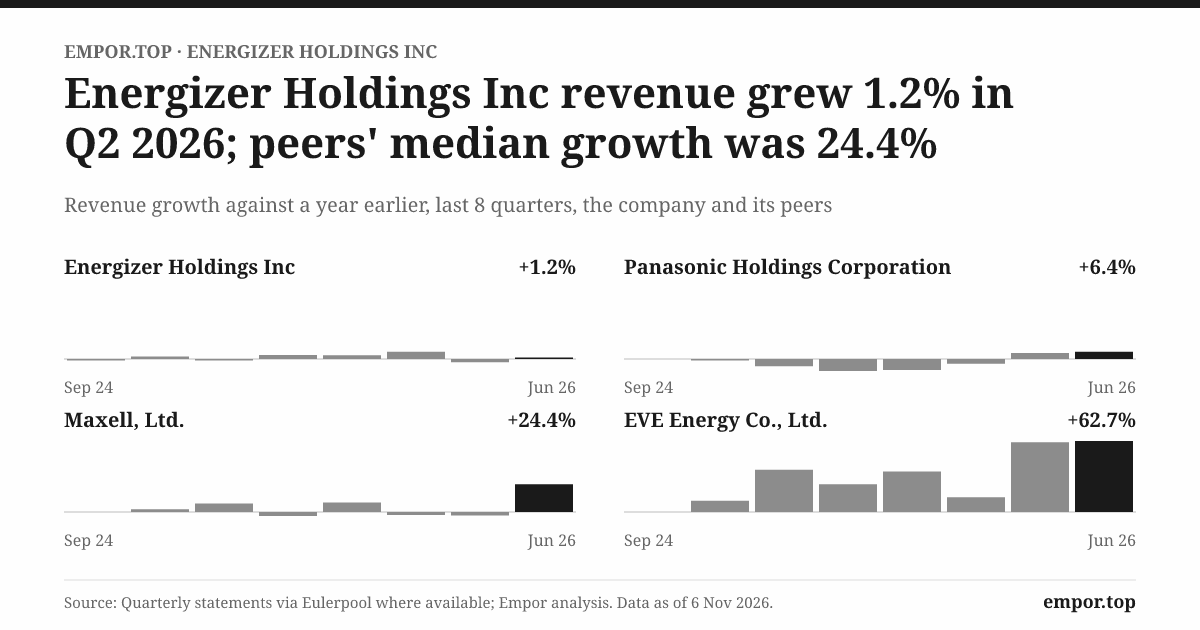
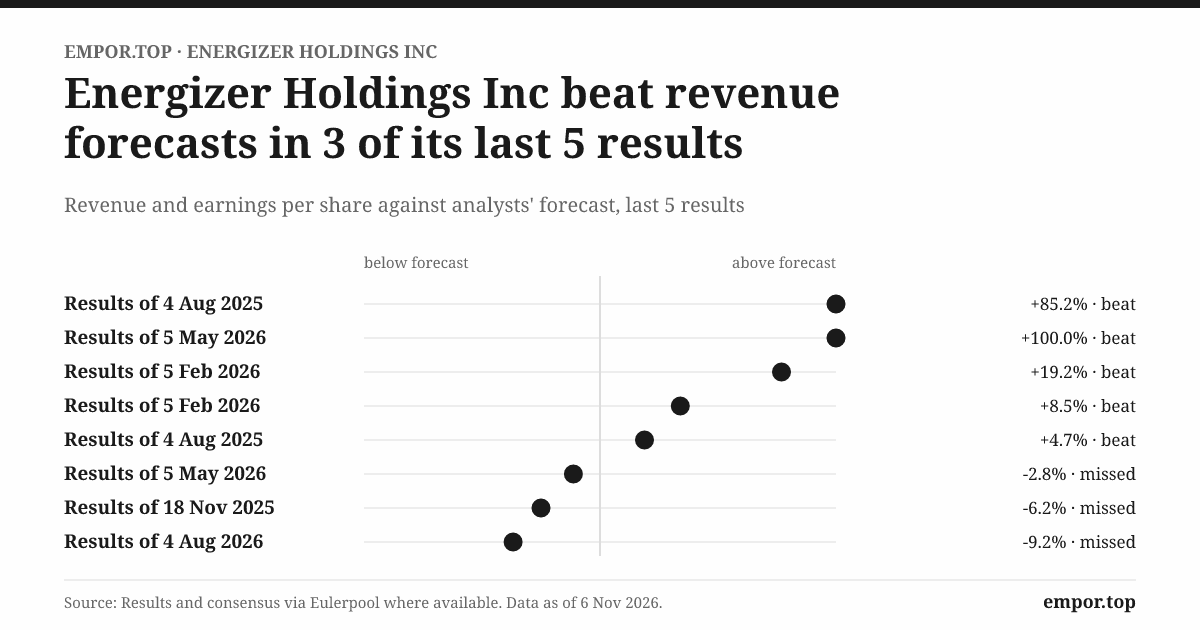
On the first Tuesday of August 2026, Mark LaVigne opened Energizer's third-quarter earnings call and called the quarter solid.2 The headline figure backed him up, but only just: net sales rose 1.2% from a year earlier, to about $734 million.1 Then came the rest of the release. Adjusted earnings per share had fallen to $0.75 from $1.13 a year before, and the company moved its full-year outlook to the low end of the ranges it had promised at the start of the fiscal year.1 A solid quarter, in other words, that ended with the forecast being cut.
That contrast runs through this whole story. Energizer owns one of the most famous advertising promises in American consumer goods: a pink, drum-banging rabbit in sunglasses that keeps going, and going, after its rivals have stopped. The joke works because a battery is meant to be the most reliable object in the house. You forget about it until it dies. The company that makes it has a harder time being forgettable. In fiscal 2025, which ended in September of that year, Energizer's organic sales, the growth left after stripping out acquisitions and currency, rose just 0.7%.3 A year later management was describing consumers as selective and value-seeking, and saying it did not expect a meaningful snapback in battery demand during fiscal 2026.2 Behind those words were softer shelves, heavier promotions and a balance sheet that does not leave much room for either.
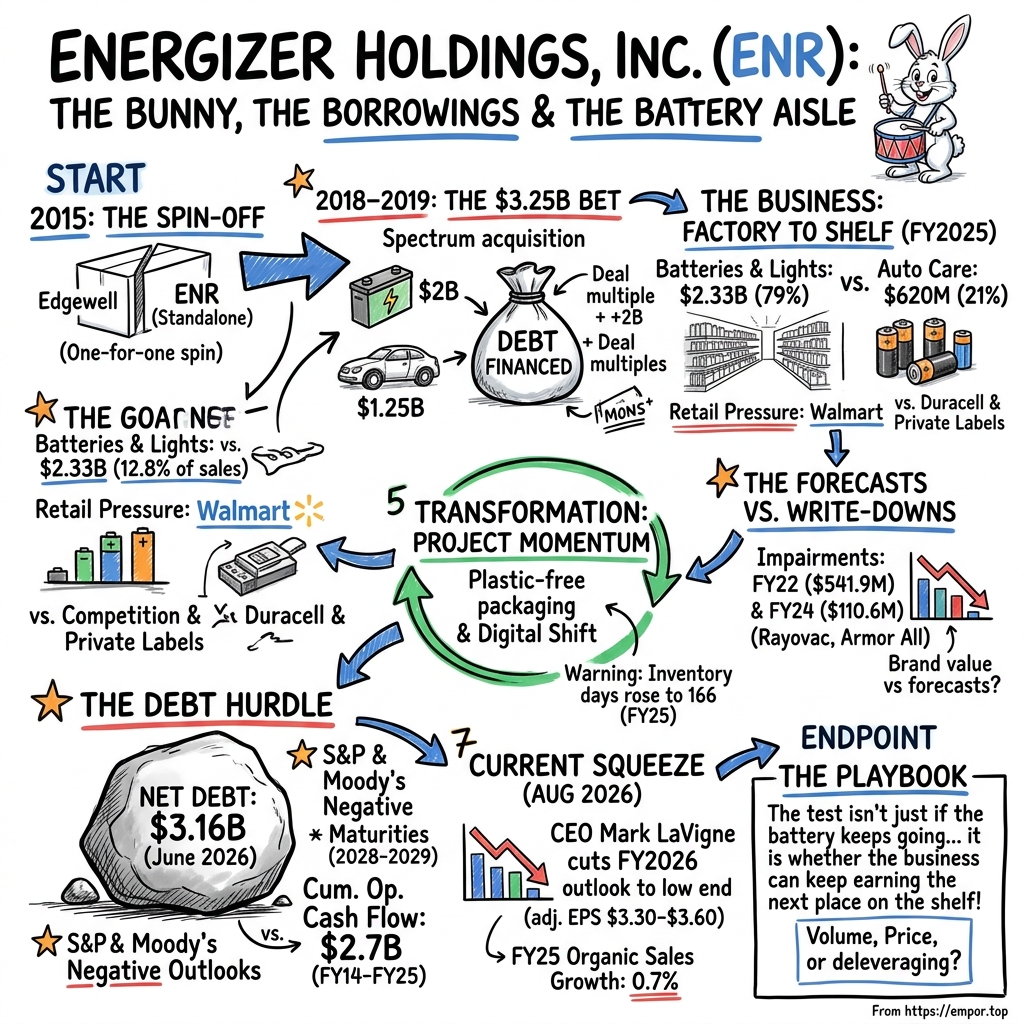
Start with the scale, because it frames everything else. Energizer is a manufacturer with about $3 billion of annual sales, split between two businesses.3 Batteries & Lights is the company everyone knows: Energizer and Eveready, plus Rayovac and Varta, sold in AA packs at the checkout, in hearing-aid cells and in flashlights. Auto Care is the one most people do not connect to the Bunny at all. It sells Armor All dashboard wipes, STP fuel additives and A/C Pro refrigerant recharge kits, the kind of products a weekend driver throws into a cart at an auto-parts store.3 Holding both businesses together is debt. At the end of June 2026 the company reported about $3.16 billion of net debt, against a stock market value of roughly $1.7 billion.124 Lenders, not shareholders, are the larger owners of the claims on Energizer's cash.
That is why this episode turns on three questions, and each has a number attached. The first is whether Energizer can grow again from the brands it already owns, rather than from the businesses it buys or the prices it raises. The second is whether a long and expensive change in packaging and supply chain, which piled up inventory in the warehouses, can be reversed into cash that actually pays down debt instead of disappearing into dividends and buybacks. The third is whether management can rebuild margins without buying volume through promotions or leaning on one-off credits, like the tariff refunds that flattered the third quarter's cost of goods.4
There is a simple way to state the test. A battery is a small, replaceable thing, and a shopper standing in the aisle has choices. They can buy Duracell. They can buy the retailer's own brand at a lower price. They can buy a rechargeable pack once and not come back for years. Or they can buy whatever is on promotion. Energizer's brand, its relationships with retailers and its factories exist to win that decision again and again, at a price that leaves something over after the interest bill. The case for the company is that those assets still earn their keep. The case against it is that in a mature category, brand familiarity is necessary but not enough, and that a leveraged balance sheet punishes every quarter in which the category softens.
The rest of the story follows that test from the beginning, which in Energizer's case is not the century-old history of the dry cell, but a summer day in 2015 when the Bunny got a company of its own.
 Subscribe on LinkedIn
II. The Spin-Off That Made the Bunny a Company
On July 1, 2015, shareholders of the old Energizer Holdings woke up owning two companies. For every share of the parent they held, they received one share of a newly independent Energizer Holdings, which took the battery and lighting business with it.56 The parent kept the razors, sunscreens, tampons and other personal-care brands and took a new name, Edgewell Personal Care.5 Inside the old structure, batteries had been the steady, cash-producing older sibling. Outside it, they became the whole show.
The logic of the separation was familiar from the corporate break-ups of that decade. A shaving business and a battery business want different things. One needs heavy spending on marketing and new products to fight in a fast-moving category; the other is a mature franchise that throws off cash and needs disciplined cost management. Put them under one roof, the argument went, and each is valued at a blur of the two. Split them, and investors can pick the profile they want, while each management team allocates its own capital.5 The new Energizer inherited the battery and lighting brands, their manufacturing plants and distribution network, and a new standalone cost base, with its own board, finance team and public listing.5 It did not inherit the economics of the whole former parent. The Household Products business that had sat inside the old company is the predecessor of today's Energizer, and the older history beyond it is what the company carries rather than what it chooses.
The inheritance mattered most in one asset. The Energizer Bunny had become one of the most recognizable characters in American advertising, and the brand behind it had decades of shelf presence at the world's largest retailers. That is real value. It is also the kind of value that is easy to over-read, a theme that will come back with some force later in the story.
For anyone studying the numbers, the spin-off creates a trap. The fiscal 2014 figures belong to the predecessor business, which reported about $1.8 billion of revenue, but they are not a clean standalone baseline because the cost structure, the debt and the corporate overhead were all different.53 Fiscal 2015, the year of separation, was messy: revenue fell to about $1.6 billion, separation costs pushed the year to a small loss, and the new company took on about $1 billion of borrowings at the start of its independent life.3 So when someone says Energizer has grown revenue at about 6% a year over the ten years to fiscal 2025, the right response is to ask what was inside the perimeter at each end. In 2015 the company was a battery and flashlight maker. By 2025 it was also a car-care company, and it owned Rayovac and Varta, the brands of a former rival. Most of that decade's growth was purchased.
That brings the post-spin story to its defining choice. The first few years of independence looked like what the separation had promised. Revenue held at around $1.6 billion to $1.8 billion, operating margins recovered to about 17% by fiscal 2017, and the company began paying a dividend that it has paid every year since.3 Management could have kept running a focused, slightly shrinking battery franchise, harvesting its cash and returning most of it. Instead it decided to use its new independence, and its new access to the bond market, to build something much bigger. The opportunity came from a familiar name across the aisle.
III. The $3.25 Billion Bet on Spectrum's Brands
In January 2018, Energizer announced that it would buy the global battery and portable-lighting business of Spectrum Brands for $2 billion in cash.7 The business it was buying was not a stranger. Spectrum owned Rayovac, the long-time value challenger in American batteries, and rights to the Varta brand in markets outside Europe's core. In fiscal 2017 the business had generated about $866 million of revenue and about $169 million of EBITDA.7 Ten months later, Energizer went back to the same seller and agreed to buy Spectrum's Auto Care business, owner of Armor All, STP and A/C Pro, for $1.25 billion, paid as $937.5 million of cash and $312.5 million of Energizer stock.8 Two deals, one seller, roughly $3.25 billion. A company that had been worth about $1.6 billion in annual sales at its spin was doubling itself in less than a year.3
The strategic case was neat on paper, and worth stating at full strength. In batteries, Energizer would own the premium brand and the value brand, which meant it could meet shoppers at more price points without ceding the low end to someone else. Rayovac also brought particular strength in hearing-aid batteries and international markets, and the combination would give Energizer more factories, more purchasing scale and more weight in conversations with retailers.7 Auto Care added a second leg that sold through many of the same big-box retailers and shared the same playbook: branded, low-ticket consumables, sold off a shelf where brand recognition and display space matter. Management argued that the two portfolios could share distribution, sourcing and back-office costs, and that the result would be a larger, more diversified consumer-products company with better cash generation.78
Now look at the price, because this is where the story first asks the listener to separate a presentation from a payment. Divide the $2 billion battery price by the $169 million of EBITDA the business actually earned, and Energizer paid about 11.8 times trailing EBITDA. That is a full price for a business in a mature category. Management did not present it that way. Its announcement framed the deal at about 7.5 times, a figure that came after adding the value of tax benefits from the transaction structure and $80 million to $100 million of expected annual cost synergies to the denominator.7 Neither adjustment was illegitimate. Buyers do capture synergies, and tax benefits are real cash. But the 7.5 times was the multiple Energizer would pay if every planned saving arrived on time and the acquired business held its earnings. The 11.8 times was the multiple of the cash leaving the building against the profit coming in.
The battery deal did not close as first imagined. European competition authorities required Energizer to divest part of Spectrum's Varta-related business in Europe, which changed the perimeter of what Energizer actually kept, and by the time the transactions were financed the company's own materials described an adjusted multiple of roughly 10.5 to 11 times for the revised battery transaction.9 That is a company-calculated figure, not a comparison to a clean set of peer deals, and there is no transparent third-party benchmark for what a battery portfolio should fetch in a two-player branded market. Auto Care is harder still to judge on price alone, because comparable sales of car-care brands are rare and the cash-and-stock structure meant Spectrum shareholders kept a slice of the combined company's future.8 The honest conclusion is that the price was not obviously reckless at signing and not obviously cheap either. Whether it was too much would be decided later, by what the brands earned.
What changed immediately was the balance sheet. To pay for the deals, Energizer raised new term loans and bonds in late 2018 and early 2019, and borrowings rose from about $1.1 billion at the end of fiscal 2017 to about $3.5 billion by the end of fiscal 2019, peaking at about $4.3 billion a year later.93 Revenue jumped too, by almost 39% in fiscal 2019 and a further 10% the following year, as the acquired businesses arrived.3 But the extra debt brought extra interest expense, and with it a smaller margin for error. Profit before tax fell from about $273 million in fiscal 2017 to about $73 million in fiscal 2019, as interest, integration costs and acquisition accounting swallowed the gains from a larger business.3 The company had swapped a small, unlevered franchise for a large, levered one whose payoff depended on integration going well.
By November 2019, when Alan Hoskins, the chief executive who had led Energizer since the spin, took analysts through the first full fiscal year with both businesses inside, the integration story was the story.10 LaVigne, then the company's president and chief operating officer, was on the same call, and integration and synergy capture were the measures management asked investors to judge it by.10 That framing turned out to be both fair and dangerous. Fair, because synergies were the main argument for paying above 11 times trailing EBITDA. Dangerous, because the synergy target was only half the bet. The other half was the assumption that the acquired brands would keep growing, or at least keep earning, in categories where Energizer had no special control over consumer demand.
So here is the forensic test to carry forward. Did the acquired brands grow? Did the promised savings appear and stay? And when the forecasts behind those purchase prices were tested by inflation, currency and a softer consumer, did the values on the balance sheet hold? The first two questions are about execution. The third is about whether the original price was right, and the answer was coming. Before it arrived, though, it helps to go back to the aisle, because that is where all of these forecasts are either earned or broken.
IV. What Happens Between the Factory and the Shelf?
A shopper stops in front of the battery rack at a supercenter. The decision takes a few seconds. There is a bright copper-and-black pack, a black-and-silver one with the Bunny on it, a cheaper store-brand pack beside them, and maybe a set of rechargeables in a blister on the end. What looks like an impulse is actually the last step of a long chain. Before the shopper arrived, Energizer had to make the cells in its plants, pack them in the right counts for that retailer, negotiate the shelf position and the promotion calendar with a buyer at headquarters, ship enough product to avoid empty hooks, and spend enough on advertising that its name feels like the safe choice. The shopper pays for a few dollars of zinc, manganese and steel. Energizer gets paid for having been there at the right moment, at the right price.
That is the revenue model in a sentence. Energizer makes physical products and ships them to retailers, distributors, device makers and other commercial customers, and it generally recognizes revenue when title and the risk of loss pass to the customer on delivery.3 There are no subscriptions here, no royalties of significance, and no disclosed minimum purchase commitments.3 Every quarter's sales depend on whether retailers want to reorder, and that depends on whether shoppers took product off the shelf, whether retailers chose to hold more or less inventory, and whether the promotion calendar fell into one quarter or the next. The business is also seasonal, so a quarter's sales say as much about the calendar of holidays, storms, driving seasons and retailer orders as about underlying demand.3
The two segments are not equal partners. In fiscal 2025, Batteries & Lights generated about $2.33 billion of sales and about $542 million of segment profit, which means roughly 23 cents of every sales dollar came back as segment profit before corporate costs and interest. Auto Care generated about $620 million of sales and about $106 million of segment profit, about 17 cents on the dollar.3 Put another way, batteries and lights were nearly four-fifths of sales and more than four-fifths of segment profit. Auto Care matters, and it has been improving, but it is a contributor rather than a co-engine. When this story talks about the moat, it is mostly talking about batteries.
The battery industry, at least in North America, is a branded duopoly with a discount fringe. Energizer and Duracell are the two dominant brand names in consumer batteries. After Energizer acquired Rayovac, the company's own estimate, cited in an Argonne National Laboratory report on U.S. battery supply, was that Energizer and Duracell together represented about 75% of the consumer battery market.11 That figure tells you how concentrated branded supply is. It does not tell you the current share split between the two, which neither company publishes in a way that allows a clean comparison, and it does not capture how much of the remaining market belongs to private labels sold by the very retailers who stock Energizer's packs.
Those retailers are the next force in the chain, and they are powerful. Walmart alone accounted for 12.8% of Energizer's fiscal 2025 net sales, down from 13.2% in fiscal 2024 and 14.2% in fiscal 2023.3 It is the only customer the company identifies as above 10% of sales, and Energizer does not disclose what share its top five or top ten customers represent, although it does say that a small number of customers account for a large portion of sales.3 That is a meaningful concentration, if not a dangerous one. No single customer can make or break Energizer, but a handful of giant chains decide how much space the battery aisle gets, how it is split between brands, how prominently private label sits beside the national brands, and when promotions run. A retailer can add a third brand, move rechargeables to eye level or expand its own label without asking Energizer's permission. The bargaining power runs mostly one way.
What does Energizer bring to that negotiation? Four things show up in the record. First, brand recognition built over decades, which helps a retailer sell a product shoppers already trust. Second, breadth: Energizer can supply premium alkaline, value alkaline, lithium, hearing-aid and specialty cells, rechargeables, flashlights and car-care products, which makes it a one-stop vendor for a category manager. Third, distribution reach across 34 countries, through grocery, mass, drug, convenience, auto and online channels.3 Fourth, production scale, which should let it make cells more cheaply than a smaller rival.
What is missing is the evidence that would turn those assets into a proven moat. Energizer does not publish customer retention rates, share by product line, or a consistent measure of the price premium its brands earn over private label.3 The strongest indirect evidence cuts both ways. Revenue in batteries has held roughly flat for several years through inflation, which suggests the brands have retained their place on the shelf. But in fiscal 2025 the company grew volume by about 1.5% while price subtracted about 0.8% from growth, meaning it gave back price to win units.3 A business with clear pricing power usually does the opposite in a mature category.
That trade-off is the hinge of the battery economics. Promotions are how branded batteries defend shelf space. A two-for-one display at the front of the store moves volume, keeps the brand visible and reminds the retailer that the vendor is a partner. But promotions are paid for out of price, either directly or through allowances deducted from what the retailer owes. At the end of fiscal 2025, Energizer had about $603 million of gross trade receivables and deducted about $191 million of promotional allowances from them, roughly a third of the gross figure.3 Those allowances are not bad debts; they are the cost of shelf presence, recorded as money Energizer agreed in advance not to collect. Their size shows how much of the brand's revenue is negotiated rather than simply charged.
Product quality and distribution therefore matter only if they convert into repeat purchases at prices that hold. That is the standard the brand must meet, and it is a harder standard than familiarity. Everyone recognizes the Bunny. The question is whether recognition still persuades a value-seeking shopper to pay more for it than for a cheaper pack hanging a few inches away.
There is a slower force too. Rechargeable batteries and devices with built-in lithium-ion packs have been eating at the edges of disposable demand for years. Many items that once took a set of AAs, from cameras to game controllers to toothbrushes, now charge through a cable. That is substitution, but gradual substitution, because remote controls, smoke detectors, clocks, toys, hearing aids and emergency kits still run on disposable cells, and Energizer sells rechargeables itself.3 The right posture is not to forecast collapse. It is to test management's own category commentary against the volumes that actually ship. When management told analysts in August 2026 that it saw no meaningful battery-category demand snapback in fiscal 2026, it was describing exactly the kind of soft, slow pressure that a mature category produces: no cliff, just fewer reasons to buy a second pack.2
The other overhang in the aisle is legal. Three related class actions alleging that Energizer conspired with Walmart over battery pricing were consolidated in the Northern District of California, and the company was defending them without recording a loss because it did not consider one probable and estimable.3 That is not a reason to assume an adverse outcome, but it is a reminder that the retailer relationship, which is the heart of the business, is also the subject of litigation.
The aisle, then, gives a clear but limited answer. Energizer has brands, breadth and reach, and they keep it on the shelf. The evidence does not show that they let it set the price. And if the shelf is where forecasts are earned, the next part of the story is where the ones attached to the Spectrum brands were broken.
V. The Forecasts That Turned Into Write-Downs
In fiscal 2022, the bill for the Spectrum deals finally came due in a form accountants could see. Energizer recorded about $541.9 million of non-cash impairment charges.12 The biggest single piece, about $370.4 million, was against the Armor All trade name. Another $127.8 million came off Rayovac, and $26.3 million off STP, with the rest against goodwill in the international Auto Care business.12 Two years later, in fiscal 2024, the company came back with another $110.6 million of charges, this time about $85.2 million against Rayovac and $25.4 million against Varta.13 Together, the two rounds removed more than $650 million from the book value of acquired brands and goodwill. That is about a fifth of what Energizer had paid for both Spectrum businesses combined.
An impairment does not take money out of the bank. The cash was spent years earlier, on the day the deals closed. What an impairment does is admit that the forecast used to justify a value on the balance sheet no longer holds. When a company buys a brand, it records the brand at a value based on the cash flows it expects that brand to produce. Each year it checks whether that value still makes sense. If expected sales, margins or growth fall, or if the discount rate used to value future cash rises, the brand is written down. In Energizer's case, the mechanism was a combination of all four. Category projections weakened after the pandemic surge in demand faded, input costs surged with inflation, the dollar strengthened against currencies in which the international brands earned money, and higher interest rates raised the discount rate applied to every future dollar.1213
Set those charges beside the deal slides, and the lesson sharpens. The case for Armor All was that a famous car-care brand would grow inside a company with Energizer's retail relationships. The fiscal 2022 charge said that the brand would earn meaningfully less than the price assumed. The case for Rayovac was that a value battery brand would round out the portfolio and capture shoppers trading down. Two separate write-downs, in fiscal 2022 and fiscal 2024, said that the brand had not held the earnings power embedded in its purchase value, even in a period when shoppers were plainly looking for value. The Varta write-down said the same about international batteries.
None of this means the deals were pure failures. Rayovac, Varta, Armor All and STP still generate real revenue, and they still occupy shelf space Energizer would struggle to win any other way. An impairment of part of a brand's value leaves the rest standing. Nor does it prove the whole purchase price was wrong; some of the damage came from currency and interest-rate shifts no management could control. But the record does narrow a claim that is central to the investment case: that Energizer's brand portfolio reliably turns acquisition spending into growth. Two separate rounds of write-downs, in both segments, say that the company was too optimistic about what familiar brands would earn.
Auto Care offers the counterpoint, and it deserves full weight. After the fiscal 2022 charge, segment profit in Auto Care rose from about $46.5 million that year to about $105.6 million in fiscal 2025.123 Roughly doubling segment profit in three years is a real recovery, and it came from a combination of pricing, cost actions and product mix rather than from a new acquisition. That is evidence that the Auto Care business was not broken, only priced and forecast too generously at the start.
What the recovery does not prove is that the original valuation was earned. A business that earns about $106 million of segment profit is not obviously worth the $1.25 billion paid for it, before corporate costs, taxes and the interest on the money borrowed to buy it.83 The improvement moves Auto Care from a disappointment toward a respectable contributor. It does not close the gap between what was paid and what has been delivered.
The practical lesson for anyone following the company is to stop treating brand awareness or old balance-sheet values as evidence of future pricing power. The measures that matter are segment profit and organic volume, quarter after quarter, without assuming the brands will grow just because they are well known. That discipline matters most in the period that followed, when Energizer began an operational overhaul whose costs and benefits would be just as easy to over-read.
VI. Project Momentum Meets the Packaging Transition
Walk into an Energizer distribution center during the last two years and the most visible change would not be the batteries. It would be the packaging. The company has been moving its battery packs away from the familiar hard plastic blister toward plastic-free, paper-based packaging, while simultaneously rewiring parts of its supply network and upgrading its digital systems.3 Management folded the cost-saving side of that work into a program called Project Momentum, which it has described as a source of productivity savings across manufacturing, sourcing and overhead.3 To an outsider, it sounds like housekeeping. To the balance sheet, it has been one of the most important events of the decade.
The company that carried out this work is bigger than its brand names suggest. At September 2025 it reported 6,050 employees across 34 countries, running plants, warehouses and sales teams for both segments.3 It spends modestly on research and development, about $32.6 million in fiscal 2025, or roughly 1.1% of sales, which is consistent with a mature product where innovation is incremental: slightly longer-lasting cells, child-safety coatings on coin batteries, new pack formats.3 Capital spending, by contrast, rose noticeably. It ran at about $57 million in fiscal 2023, then about $98 million in fiscal 2024 and about $84 million in fiscal 2025, the last being about 2.8% of sales, with the company attributing the increase to plastic-free packaging, digital transformation and Project Momentum.3 In the first nine months of fiscal 2026, capital spending reached about $52 million.4
The important point about this investment is what it is not. It is not a speculative bet on a new business or technology. It is spending on the physical cost base and packaging of products Energizer already sells. That makes the potential payoff more credible than a moonshot, but it also makes the costs more immediate and easier to underestimate.
Here is why. Changing the packaging of a product sold in dozens of formats and dozens of countries is like changing the tires on a moving truck. Retailers need product in the new format, but the old format still has to keep flowing until each store and each market switches. That means running both systems for a while, holding buffer stock to protect against hiccups at new production lines, and absorbing write-offs on old packaging. Network optimization adds its own disruption, because closing or consolidating sites, moving production and re-routing distribution all require inventory to be built in advance so shelves stay full. The savings arrive later, if at all, and only if service levels hold. A retailer that sees empty hooks during a transition will not wait for the efficiencies; it will give the space to a competitor or its own label.
The numbers show the strain clearly. Inventory days, which measure how many days of cost of goods the company holds in stock, rose from about 112 at the end of fiscal 2020 to about 166 at the end of fiscal 2025.3 That is nearly two extra months of product sitting in warehouses. The cash conversion cycle, the number of days between paying suppliers and collecting from customers, reached about 147 days.3 In fiscal 2025 alone, the increase in inventory absorbed about $88.6 million of cash.3 Some of that build was deliberate, to protect customers during the transition and ahead of tariff changes. But a company with more than $3 billion of debt cannot afford to have nearly half a year of cost of goods tied up in stock for long.
Early evidence suggests the build has begun to unwind. In the first nine months of fiscal 2026, operating cash flow rose to about $156 million from about $85.6 million a year earlier, and management attributed much of the improvement to inventory coming down and to the timing of payments to suppliers.4 That second factor deserves a caution. Paying suppliers later is a legitimate cash-management tool, but it is a one-time lever, not a source of permanent cash, and it reverses if supplier terms tighten. The inventory release is more meaningful, because it is the specific benefit the transition promised. Still, nine months of improvement after several years of build is early evidence, not completion.
The tone of management's commentary across 2026 is part of the test. On the second-quarter call in May, management kept its full-year outlook and talked with confidence about the year ahead, presenting the transition costs as largely understood and the savings as on track.14 By the third-quarter call in August, the tone had shifted. Category weakness had become the explanation for moving guidance to the low end, and executives emphasized that consumers were trading down and that demand was not rebounding.2 That explanation is plausible, and it is consistent with what retailers and other consumer-products companies were saying. What it does not do on its own is separate how much of the shortfall came from the market and how much from execution, and management did not lay out a full accounting of remaining transition costs in a way an outsider could reconcile line by line.
The cleanest way to judge the transformation is to watch three things together. Inventory days should keep falling toward the levels of the pre-pandemic years. Segment gross margins should rise once one-off transition costs roll off, not only because of temporary credits. And free cash flow after those costs should show up as debt reduction. A falling inventory balance that does not become lower net debt would mean the cash was released only to be spent elsewhere, which would weaken the strongest argument for the whole program.
That question, of whether cash released from the business reaches the lenders, is also a question about the people deciding where it goes.
VII. Mark LaVigne's Test: Growth, Guidance and Pay
Mark LaVigne took over as chief executive in January 2021, after several years as Energizer's president and chief operating officer, the role he held while the Spectrum businesses were being integrated.1510 He is not a founder or a showman. His public style is measured and operational: on calls he talks in terms of priorities, playbooks and controllables, and he tends to frame bad news inside a long-term plan rather than dwell on it. Beside him, chief financial officer John Drabik does much of the work of explaining what investors most need to know, from the mechanics of tariffs and production credits to the timing of cash flow and the path of debt.215 Together they inherited the company the Spectrum deals created, and they have been judged on whether they could make it pay.
Take the claims and the outcomes in turn. In fiscal 2025, the headline revenue growth of 2.3% looked like a return to growth after two years of decline. But about $63.6 million of that came from APS, a European battery maker Energizer had acquired, and organic sales growth was only 0.7%.3 Underneath, volume rose while price fell.3 That pattern is honest progress, not a turnaround: more units, sold at slightly lower average prices, with acquisitions doing a large share of the reported growth.
Then came fiscal 2026. At the start of the year, management guided to adjusted earnings per share of $3.30 to $3.60 and adjusted EBITDA of $580 million to $610 million.1 By the third quarter, it said results would land at the low end of both ranges, after a quarter in which adjusted EPS fell by about a third from a year earlier.1 Low-end guidance is not a crisis; it means the company still expects to land inside the range it gave. But the trajectory matters. A company that tells investors in May that the year is on track and in August that it will come in at the bottom has either seen conditions change quickly or was optimistic in May. Either way, credibility is now earned quarter by quarter.
Pay is where governance meets that test. LaVigne's total reported compensation rose from about $9.6 million in fiscal 2023 to about $11 million in fiscal 2025.15 Over the same years, net income moved from about $140 million to about $38 million and back up to about $239 million.153 In other words, the chief executive's pay rose in the year that profit fell by almost three-quarters. Most of the fiscal 2025 package, about $8.6 million, was stock awards, with about $1.2 million of cash incentive; Drabik's total was about $2.8 million.15
The board's defense is in the design. Energizer's incentives are based on adjusted sales, EBITDA, gross margin and EPS, alongside relative total shareholder return, so pay is not meant to track GAAP profit, which in fiscal 2024 was depressed by impairments and currency losses that the board treated as outside management's control.15 Stock awards are also valued at grant, so their realized value depends on later share prices. That defense has some merit. But it relies on adjusted measures that strip out exactly the kinds of costs, restructuring and impairments, that have been recurring features of this company's results. When adjustments recur, shareholders are entitled to ask whether the incentive targets reward management for the reported business or for a cleaner version of it.
Shareholders have mostly accepted the board's view. At the January 2026 annual meeting, the say-on-pay vote passed comfortably, with about 55.6 million votes for and about 2 million against.16 The one notable dissent was against director Robert Vitale, who received about 9.5 million votes against, far more than any other nominee.16 That is a signal worth noting, not a campaign. No activist has launched a public challenge, and the vote did not remove anyone.
Ownership helps explain why. Energizer has no controlling shareholder. As of late November 2025, the largest holders were BlackRock at about 13.8%, Vanguard at about 13.7% and Aqua Capital at about 10.2%, followed by FMR, Clarkston, Fuller & Thaler, Goldman Sachs and LSV, each between 5% and 9%.15 Aqua added a small purchase in June 2026 and reported about 7.2 million shares afterward.20 FMR, by contrast, cut its reported position to about 4.6% by the end of September 2026, from the 8.6% shown in the proxy.21 The shareholder base is dispersed and largely institutional, which tends to produce comfortable votes and occasional, targeted dissent rather than confrontation. Executive and director holdings, listed in the proxy's beneficial-ownership table, are small relative to the large institutions.15
What would sharpen the test is a direct comparison of the two 2026 calls. In May, management talked about momentum; in August, it talked about a selective consumer and a category without a rebound.142 The more concrete pieces of the August explanation, such as tariff costs, refund timing and the inventory unwind, can be checked against the filings. The vaguer pieces, such as how much of the softness came from category weakness rather than lost share, cannot, because Energizer does not report market share consistently. A management team that wants the benefit of the doubt would do well to give investors the data to test it.
Pay, guidance and tone are all secondary, though, to the place where this management team's record will finally be judged: the debt.
VIII. The Cash That Has to Climb Over the Debt
Here is the paradox at the center of Energizer. From fiscal 2014 through fiscal 2025, the business generated about $2.7 billion of operating cash flow, roughly three times its reported net profit over the same years.3 It produced about $2.0 billion of free cash flow after capital spending, and paid out about $861 million of it as dividends.3 That is the record of a real cash machine. Yet at the end of June 2026, Energizer still carried about $3.16 billion of net debt, and both major rating agencies had it on negative outlook.11718 How can a company that keeps generating cash keep owing so much?
The first part of the answer is the gap between profit and cash itself. Energizer's reported profits have been held down by large non-cash charges: depreciation, the amortization of acquired intangibles and the impairments that wrote down the Spectrum brands. Those charges reduce net profit without reducing cash, so cash flow naturally runs ahead of earnings. In fiscal 2025, depreciation and amortization were about $127 million, and in fiscal 2024 the $110.6 million of impairments similarly lowered profit without touching cash.313 That explains a lot of the cumulative difference. It does not mean the cash is free, because the amortization reflects money spent on acquisitions financed with debt.
The second part is working capital, and it explains why cash flow lurches from year to year. In fiscal 2024, Energizer reported operating cash flow of about $430 million against net income of about $38 million.13 In fiscal 2025, operating cash flow dropped to about $147 million even though net income rose to about $239 million.3 The swing came largely from inventory, which absorbed about $88.6 million in fiscal 2025, and from payables, which absorbed about $60 million as the company paid suppliers down, partly offset by about $33 million released from receivables.3 Free cash flow fell from about $332 million to about $63 million. A shareholder looking only at the income statement would have seen a strong recovery. A lender looking at the cash flow statement saw the opposite.
Receivables add another layer. Energizer sells a large volume of its customer invoices to banks before they come due, a common tool known as factoring. In fiscal 2025, it sold about $720.9 million of receivables this way and had about $144.4 million outstanding under the program at year-end, on a non-recourse basis, meaning the banks rather than Energizer bear the credit risk once the invoices are sold.3 Factoring accelerates cash, which is useful, but it also flatters operating cash flow relative to a company that waits for customers to pay, and any reduction in the program would show up as a cash drag. The quality of the remaining receivables looks sound but not fully transparent. The allowance for doubtful accounts rose from about $5.7 million at September 2024 to about $8.3 million a year later, and was about $7.8 million in June 2026; those are small numbers against hundreds of millions of receivables, and Energizer does not disclose ageing or overdue balances.34 The large promotional allowances deducted from receivables are part of the business model rather than a credit problem.
Now place the debt in concrete terms. At the end of June 2026, Energizer owed about $761 million on term loans, about $584 million of notes due in 2028, about $791 million of U.S. notes due in 2029, €650 million of euro notes worth about $742 million, and $400 million of 6% notes due in 2033, plus small finance leases.4 The 2033 notes came out of a 2025 refinancing that pushed some maturities out and lifted the coupon to a level that reflects the company's credit standing.193 The 2028 and 2029 U.S. notes alone come to almost $1.4 billion, and the maturity schedule is concentrated in those two years.4 The company also had only $30 million drawn on its $500 million revolving credit line and about $462 million available, and it reported compliance with its covenants and expected to remain in compliance for the next year.4 Liquidity is not the immediate problem. Refinancing is the clock, and it is getting louder.
The capital-allocation record during this period is where a skeptical investor would push hardest. In fiscal 2025, a year in which free cash flow was about $63 million, Energizer paid about $87 million of dividends and spent about $89.7 million buying back about 4 million of its own shares.3 Together, those payouts were almost three times the free cash flow the business produced, which means part of the money returned to shareholders was effectively borrowed. The board authorized up to 7.5 million shares of repurchases in November 2024 and kept the remaining authorization in place.3 In fairness, management shifted behavior in fiscal 2026, buying back only about 245,000 shares, for about $4.5 million, in the first nine months.4 Moody's had specifically criticized the earlier repurchases when it moved its outlook to negative in November 2025, citing high leverage, slow deleveraging, soft demand and buybacks despite negative free cash flow.18 The change in fiscal 2026 looks like a response to that pressure. Whether it is a durable change in priorities will only be visible over several years.
The rating agencies are blunt about the stakes. S&P affirmed Energizer at B+ in February 2026 but moved its outlook to negative, saying it expected leverage of about 6.3 times in 2026, above its stated threshold of 6 times for a downgrade, and that its base case was for leverage to fall to the high-5 times range in 2027.17 It pointed to weak consumer demand, tariff costs, restructuring spending and inventory tied to the packaging transition, while acknowledging the possible cash benefits of the inventory unwind, U.S. production tax credits and cost actions.17 The agencies' rationales cited roughly $60 million to $70 million of unmitigated tariff costs and $60 million to $75 million of acquisition and restructuring costs in fiscal 2026, which together take a meaningful bite out of a company guiding to about $580 million of adjusted EBITDA.1718 Moody's, at B1 with a negative outlook, gave credit for the company's market positions, brands, liquidity and prospective cash generation, but made clear that it expected to see deleveraging.18 Both agencies effectively placed the burden of proof on cash.
Management's own answer was a target. It said it expected to repay $150 million to $200 million of debt in fiscal 2026, and it had already prepaid some term debt.14 Through nine months, free cash flow was about $105 million.4 To reach the target, Energizer would have needed a strong final quarter of cash, which the September quarter has historically sometimes delivered, and it would have needed to keep buybacks restrained. The full-year 10-K will settle whether the promise was kept; the third-quarter filing cannot.
The dividend belongs in this context. At recent prices it yields about 5%, which is unusually high for a consumer-products company and is a large part of what attracts income investors.24 The annual cash cost, about $87 million, is modest in absolute terms but substantial relative to free cash flow in a weak year. A high yield is not a measure of safety. It is a measure of how much the market doubts the growth or the balance sheet behind it. The real question is whether Energizer can fund the dividend, the transition costs and meaningful debt reduction at the same time, in a year when the category is not helping. And that depends on where the next dollar of growth comes from.
IX. The Next Growth Dollar: Volume, Price or Acquisition?
Fiscal 2025 closed with a headline that looked like the end of a slump: sales up 2.3%.3 Dig into it and the picture changes. Organic growth was 0.7%, about $63.6 million came from APS, and the volume gains that management celebrated were partly given back in price.3 A year later the mood had soured. By the August 2026 call, management said it expected fiscal 2026 organic sales to decline by a low single-digit percentage, as consumers remained selective and battery demand failed to rebound.2 The one positive year of organic growth in the recent record was followed by another year of decline.
The longer history explains why that matters. Revenue grew about 6.1% a year from fiscal 2015 to fiscal 2025, a decade whose growth was driven by the two Spectrum acquisitions.3 Over the five years to fiscal 2025, growth slowed to about 1.5% a year, and over the three years to fiscal 2025 revenue actually declined about 1.1% a year.3 Those figures, laid end to end, describe a company whose size was built by buying and whose organic engine has been idling. That does not mean the brands are declining fast. It means the reported growth record cannot be used as evidence that Energizer has a reliable organic growth engine today.
Break growth into its parts, because they are not interchangeable. Acquisitions add sales but also costs and integration risk. Organic volume, units sold through existing brands, is the clearest evidence of brand and distribution strength. Price can come from genuine pricing power or from inflation passed through, and it can go negative when promotions intensify. Currency moves reported results without changing the underlying business. In fiscal 2025, volume added about 1.5%, price took away about 0.8%, and the APS acquisition did the rest of the heavy lifting.3 For a mature category, that mix is respectable but not a growth engine.
The business mix makes it harder still. Batteries & Lights produces most of the sales and profit, so the company's growth rate is, practically speaking, the growth rate of a mature battery category plus or minus share shifts. Auto Care can add a point here or there, but at around a fifth of sales it cannot move the whole company on its own unless it grows unusually quickly.3 International markets, which accounted for about $1.23 billion, roughly 42% of fiscal 2025 revenue, offer more room, but they also bring currency risk.3
Currency deserves a sentence of proportion. Energizer hedges a portion of its identified transaction exposures with forward contracts and does not speculate.3 Foreign-currency transaction losses were small in fiscal 2025, about $1.8 million, but about $32 million in fiscal 2024, a year distorted by Argentina's currency reforms and devaluation.313 Currency is a real source of volatility in results. It is not a growth strategy, and it is not the main reason the organic record is weak.
The ways the growth case could fail are the same ways a battery moat would fail, so it is worth tying them together. Substitution toward rechargeables and built-in batteries slowly shrinks the number of disposable cells a household buys. Retailer multi-sourcing and private label mean that a shopper who trades down does not have to leave the store or even the aisle. Weaker pricing shows up when brands fund more promotions to protect volume. And retailers' control of shelf space means that shifts in category strategy happen on their schedule, not Energizer's. None of these is new. What is notable is that management's fiscal 2026 commentary, about a value-seeking consumer and no snapback in demand, describes several of them operating at once.2
What should an investor watch? The practical measures are segment-level organic volume and price, reported separately; market share where the company discloses it; gross margin after promotional costs and excluding temporary credits such as tariff refunds and production tax credits; and cash conversion that repeats from year to year. Those figures will distinguish a brand that is holding share in a soft market from one that is quietly ceding ground.
One optionality story is worth keeping small. APS cost about $16.7 million and brought European production capacity and customers, and it supports Energizer's distribution and manufacturing footprint in that region.3 Its sales contribution was meaningful in fiscal 2025 growth, but it is an integration and supply-chain move, not a new engine. Calling it a growth vector would overstate it.
The honest reading is that growth recovery is unproven. Fiscal 2025 showed that Energizer could win volume through distribution and promotion; fiscal 2026 showed that the category could take that away again. Which raises the obvious question: what is the market paying for, when it values the shares where it does?
X. The Case for the Stock, and the Case Against It
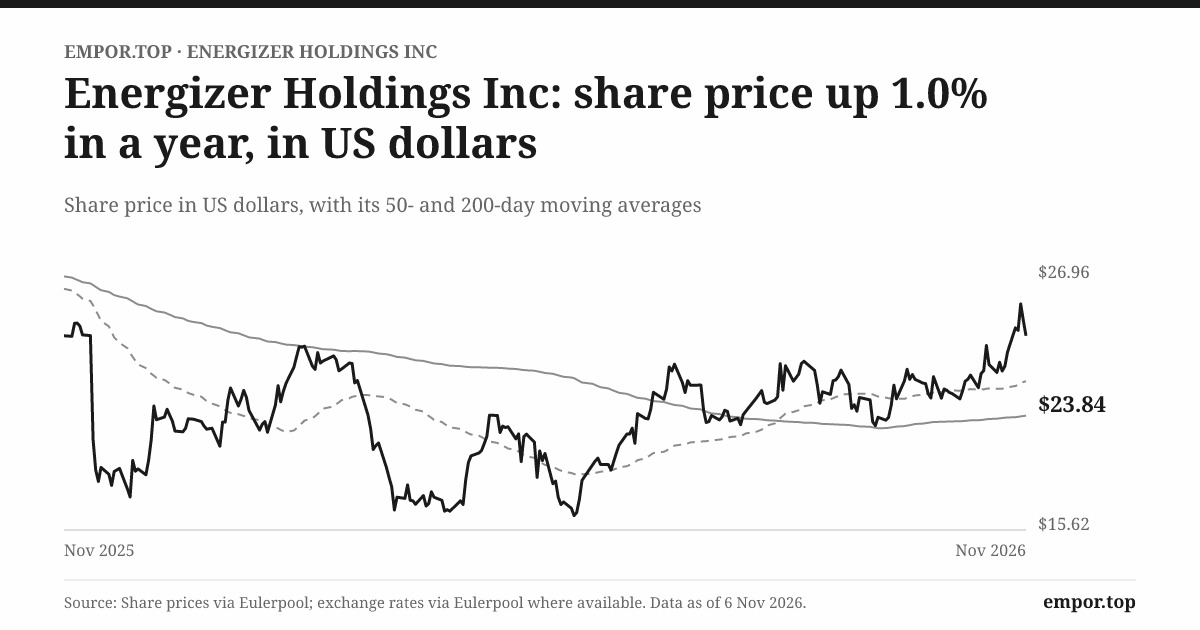
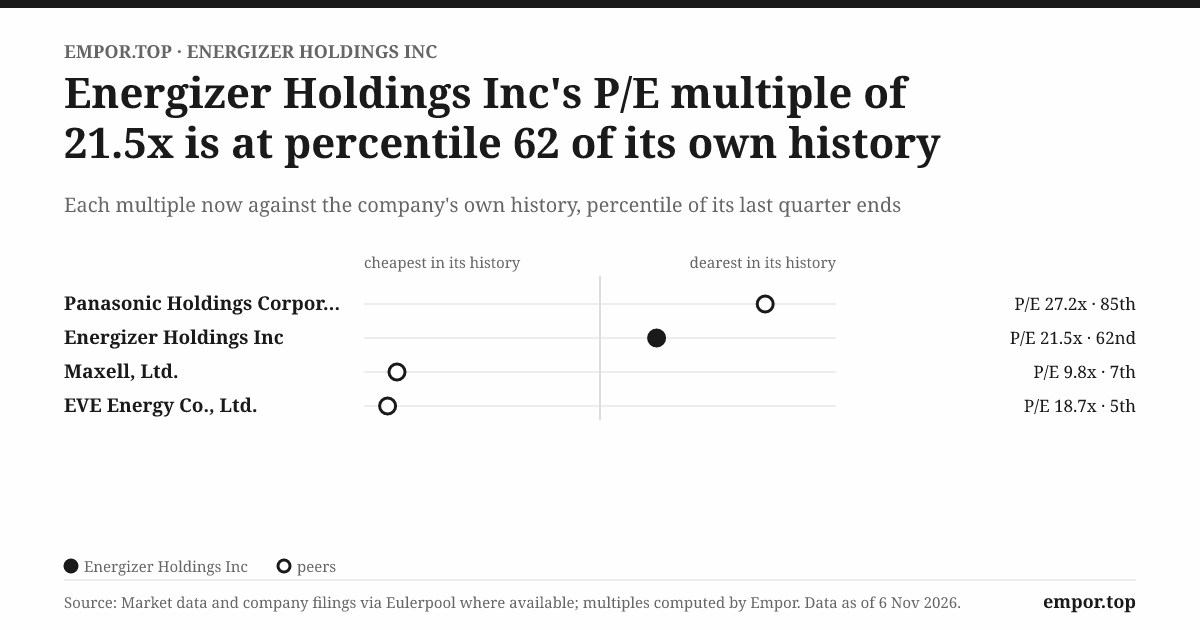
On November 6, 2026, Energizer's shares closed at about $23.84, within about 5% of their 52-week high of roughly $25.19 and well above the year's low near $16.23.24 For a stock whose company had just cut guidance to the low end and whose credit outlooks were negative, that is a striking position. At that price, the company's equity was worth about $1.7 billion, and adding its debt gave an enterprise value of about $5.0 billion.244 The shares traded at about 21.5 times trailing reported earnings, above their own five-year median of about 17.7 times, at about 12.3 times trailing EBITDA, and with a dividend yield of about 5%.243
Those multiples need interpretation, because Energizer's denominators are unusually noisy. Trailing reported earnings per share were about $1.18, held down by restructuring, acquisition costs and other charges.34 Management's adjusted earnings guidance for fiscal 2026 was at the low end of $3.30 to $3.60.1 On the adjusted figure, the stock trades at roughly seven times earnings; on the reported figure, above 21 times. The gap is the whole debate in miniature. A bull reads the adjusted figure as the business's real earning power, temporarily masked by transition costs. A bear reads the reported figure as what shareholders actually get after costs that keep recurring. The truth will be decided by whether those costs actually fall away.
The free cash flow yield, about 8.8% on trailing figures, is similarly double-edged.24 It looks generous, but it depends on a cash flow series that has swung from about $332 million to about $63 million and back up within two years. A yield calculated on a volatile base is a range, not a number.
The bull case, at its strongest, rests on leading brands and scale in a concentrated category, a recovering Auto Care business, and a long record of cash generation.311 If the packaging and network changes convert inventory to cash, costs fall away, and debt reduction continues, the stock could be cheap on cash flow and the equity could benefit disproportionately.41 The bear case points to weak organic growth and limited pricing power,3 the constraints from substitution and private label,3 impairments on acquired brands,1213 and high leverage with maturities clustered in 2028 and 2029.417 On reported earnings, the stock already trades above its own history. A further miss would arrive with little cushion.
The moat, tested once
The competitive frameworks help sort these arguments. Start with the five forces. Buyer power is meaningful: Walmart alone is about 13% of sales, a few retailers control most shelf space, and those retailers sell competing private labels.3 Supplier power appears moderate; the company says many raw materials and components have multiple potential sources, while also citing reliance on certain significant suppliers without naming them.34 The threat of new branded entrants is low, because building a battery brand, the factories and the retail relationships from scratch is expensive, but the threat from retailer brands is high because they do not need a brand to get shelf space. Substitutes are real but gradual: rechargeables and built-in batteries are slowly eroding the disposable market. And rivalry is a disciplined duopoly fought largely through promotions, rather than an outright price war.
Hamilton Helmer's seven powers sharpen the moat question. Energizer clearly has some branding power, a reason shoppers pay for the familiar name, but the fiscal 2025 price drag and the size of promotional allowances suggest that premium is limited.3 It has scale economies in manufacturing and distribution, which help it make cells cheaply and serve retailers efficiently, though Duracell has comparable scale. Switching costs are close to zero for shoppers, and modest for retailers. There are no network effects. Counter-positioning does not apply, because no rival is attacking with a model Energizer cannot copy. Cornered resources are not evident beyond the brands themselves. Process power may exist in manufacturing know-how, but nothing in the public record proves it is a decisive advantage. The verdict is that Energizer's moat is real but narrow: brand plus scale keeps it on the shelf in a concentrated category, without giving it freedom to set prices. That is enough to defend a position. It has not proved enough to grow one.
Peer comparison does not resolve the debate. Duracell is owned privately within a conglomerate and does not publish comparable figures. Clorox, a branded consumer-products peer with a very different balance sheet and product set, traded at about 23.7 times earnings on the same day.22 Spectrum Brands, the closest company by history and portfolio, has published market data that does not produce a consistent like-for-like multiple.23 Valuation, then, is context rather than verdict: the market is pricing Energizer above its own reported-earnings history, while still demanding a high dividend yield, which suggests it believes adjusted earnings are closer to the truth than reported ones but still doubts the balance sheet.
The skeptical investor's sharpest question is about capital allocation. Why did management spend about $90 million on buybacks in fiscal 2025, when free cash flow was about $63 million and leverage was already high enough to draw rating-agency warnings?318 The fiscal 2026 slowdown in repurchases suggests the priority has shifted, but the board kept the authorization intact, and nothing yet forces it to stay on the shelf.4 An activist would press for explicit leverage targets, tying buybacks to them, and for clearer separation of recurring and one-off costs in the adjusted figures.
Three measures matter more than any others. The first is organic volume growth, which was about 1.5% in fiscal 2025 but is expected to turn negative in fiscal 2026.32 The second is net debt, which stood at about $3.16 billion in June 2026, with S&P expecting leverage around 6.3 times this year.117 The third is inventory days, which climbed to about 166 at the end of fiscal 2025 and need to fall to prove the transition is working.3 Consecutive quarters of volume growth, margins rising without credits or restructuring add-backs, lower inventory days and net debt falling while buybacks stay restrained would tilt the balance. The opposite would tilt it back.
XI. Playbook: Business & Investing Lessons
Put the January 2018 deal slide beside the fiscal 2022 and fiscal 2024 annual reports, and you have most of Energizer's lessons on two pages. On one side, the battery deal presented at about 7.5 times synergy- and tax-adjusted EBITDA.7 On the other, the write-downs on the brands that deal and its sequel delivered.1213 And underneath both, the net debt still waiting to be paid.1 The lessons are about the gap between those pages.
The first lesson is that a familiar brand is a head start at the shelf, not a blank check for the forecast. Rayovac, Varta, Armor All and STP were all well-known names when Energizer bought them, and familiarity is precisely what made their forecasts feel safe. Then inflation, currency and a value-seeking consumer arrived, and the write-downs showed that awareness and earnings power are not the same thing. For investors and operators alike, the test of a brand is not whether people recognize it, but whether it holds price and volume when conditions turn.
The second lesson is that synergies spend well in a presentation; debt comes due on a calendar. The difference between 11.8 times trailing EBITDA and 7.5 times adjusted EBITDA came from future savings and tax benefits, while the borrowing used to pay the full price was immediate and fixed. Years later, the savings have been partly absorbed by inflation and transition costs, and the 2028 and 2029 maturities are still there. Any acquirer that pays for synergies with debt is betting that the future arrives on schedule; the lender only cares that the coupon does.
The third lesson is that at Energizer, cash is a working-capital story before it is a dividend story. Operating cash flow swung sharply from one year to the next as inventory builds, supplier payments and factoring moved the numbers.133 A dividend set against the good year looks safe; set against the bad year, it looks borrowed. The lesson is to judge payouts against the cash a business can produce through a full cycle of inventory, not against its best year.
The fourth lesson is that when guidance moves, ask which part of the plan moved with it. Between May and August 2026, Energizer's story shifted from momentum to a selective consumer, and the outlook slid to the bottom of the range.142 The easy explanation is the category. The useful question is whether the controllable parts of the plan, savings, inventory and debt paydown, moved too. A management team that separates market softness from execution, with numbers, earns more trust than one that lets the market carry the blame.
XII. Epilogue
Tonight, in early November 2026, Energizer stands just weeks from closing the books on fiscal 2026. The third-quarter filing showed what the company had done through June: about $105 million of free cash flow, a slowdown in buybacks, an inventory unwind beginning, and a promise of $150 million to $200 million of debt repayment for the full year.41 It also showed what had not yet happened. Inventory days were still elevated from the 166 recorded at the end of fiscal 2025, both rating agencies still had negative outlooks, and the company had cut its earnings expectations to the bottom of the range.31718
The next scorecard arrives with the fiscal 2026 results and annual report. Four numbers will matter most. Full-year free cash flow will show whether the September quarter delivered the cash management needed. Actual net debt will show whether that cash reached the lenders. Inventory days will show whether the packaging transition is converting stock into cash. And the share-repurchase line will show whether the board has kept its promise of restraint or drifted back toward buybacks.
After that come the first quarters of fiscal 2027, which will test the operating side. Investors should watch organic volume and price separately in Batteries & Lights and in Auto Care, and margins reported after tariff refunds, production tax credits and restructuring costs are stripped out. If the company can grow volume without giving away more price, and lift margins without leaning on credits, the recovery case strengthens. If another guidance reset arrives, inventory builds again, or buybacks resume ahead of debt reduction, the case weakens sharply.
Each outcome would answer one of the story's central questions. Sustained organic volume would say the brands still win the shelf. Lower net debt would say the transition worked and capital allocation shifted. Higher margins without one-off help would say the cost base really changed. Fail on all three, and the same Energizer becomes a mature, leveraged company with a rising maturity wall.
Refinancing is not an immediate crisis. The company has liquidity, covenant headroom and more than a year before the 2028 notes come due.4 But the clock is now audible. Every quarter of deleveraging makes the 2028 and 2029 refinancing cheaper and easier; every quarter without it makes the cost of that refinancing, and its pressure on equity holders, higher. The tension that remains is whether the cash shows up before the calendar does.
XIII. Outro
Go back to the battery aisle. The Bunny is still on the package, still drumming, still promising to outlast the competition. The shopper still decides in seconds. But that small purchase now carries more weight than it appears to. Behind it sit a retailer deciding how much shelf to give each brand, a supply chain still settling after a packaging overhaul, and a balance sheet that needs every pack to earn its margin.
Energizer sells a tiny, replaceable object whose value depends on trust and availability. Its own endurance depends on turning that trust into profitable volume and using the cash to make the company less fragile. For Energizer, the test is not whether the battery keeps going. It is whether the business can keep earning the next place on the shelf.
References
-
Energizer Holdings, Inc. Announces Fiscal 2026 Third Quarter Results — Energizer Holdings, Inc., 2026-08-04 ↩↩↩↩↩↩↩↩↩↩↩↩
-
Energizer (ENR) Q3 2026 Earnings Call Transcript — The Motley Fool, 2026-08-04 ↩↩↩↩↩↩↩↩↩↩
-
2025 Form 10-K — Energizer Holdings, Inc., 2025-11-19 ↩↩↩↩↩↩↩↩↩↩↩↩↩↩↩↩↩↩↩↩↩↩↩↩↩↩↩↩↩↩↩↩↩↩↩↩↩↩↩↩↩↩↩↩↩↩↩↩↩↩↩↩↩↩↩↩↩↩↩↩↩↩↩↩↩↩↩↩
-
Q3 FY2026 Form 10-Q — Energizer Holdings, Inc., 2026-08-04 ↩↩↩↩↩↩↩↩↩↩↩↩↩↩↩↩↩↩
-
Form 10 Information Statement — Energizer Holdings, Inc., 2015-05-27 ↩↩↩↩↩
-
Battery Acquisition Announcement — Energizer Holdings, Inc., 2018-01-16 ↩↩↩↩↩↩
-
Energizer Adds Armor All and STP Brands in $1.25 Billion Spectrum Deal — Reuters, 2018-11-15 ↩↩↩↩
-
Battery and Auto Care Acquisitions, Form 424B2 — Energizer Holdings, Inc., 2019-01-18 ↩↩
-
Energizer Holdings (ENR) Q4 2019 Earnings Call Transcript — The Motley Fool, 2019-11-17 ↩↩↩
-
Quantification of Commercially Planned Battery Component Supply in the United States through 2035 — Argonne National Laboratory, 2024-03 ↩↩
-
Fiscal 2023 Form 10-K, including fiscal 2022 impairment disclosures — Energizer Holdings, Inc. ↩↩↩↩↩↩
-
2024 Form 10-K — Energizer Holdings, Inc., 2024-11-19 ↩↩↩↩↩↩↩↩
-
Energizer Q2 2026 Earnings Call Transcript — Stock Analysis, 2026-05-05 ↩↩↩
-
2025 Proxy Statement — Energizer Holdings, Inc., 2025-12-12 ↩↩↩↩↩↩↩↩
-
2026 Annual Meeting Voting Results, Form 8-K — Energizer Holdings, Inc., 2026-01-30 ↩↩
-
S&P Revises Energizer Outlook to Negative on Leverage Concerns — Investing.com, 2026-02-20 ↩↩↩↩↩↩↩
-
Moody's Changes Energizer Outlook to Negative Amid High Leverage — Investing.com, 2025-11-25 ↩↩↩↩↩↩
-
Energizer Holdings Proposed Refinancing Rating Rationale — S&P Global Ratings, 2025-03-03 ↩
-
Aqua Capital Form 4 — U.S. Securities and Exchange Commission, 2026-06-03 ↩
-
Energizer Holdings Investor Relations — Energizer Holdings, Inc. ↩↩↩↩↩↩
 LinkedIn
 WhatsApp
 Reddit
 Hacker News
 Email
 Kindle
 RSS Feed
 Spotify
 Apple Podcasts
 Amazon Music
 Audible
 YouTube