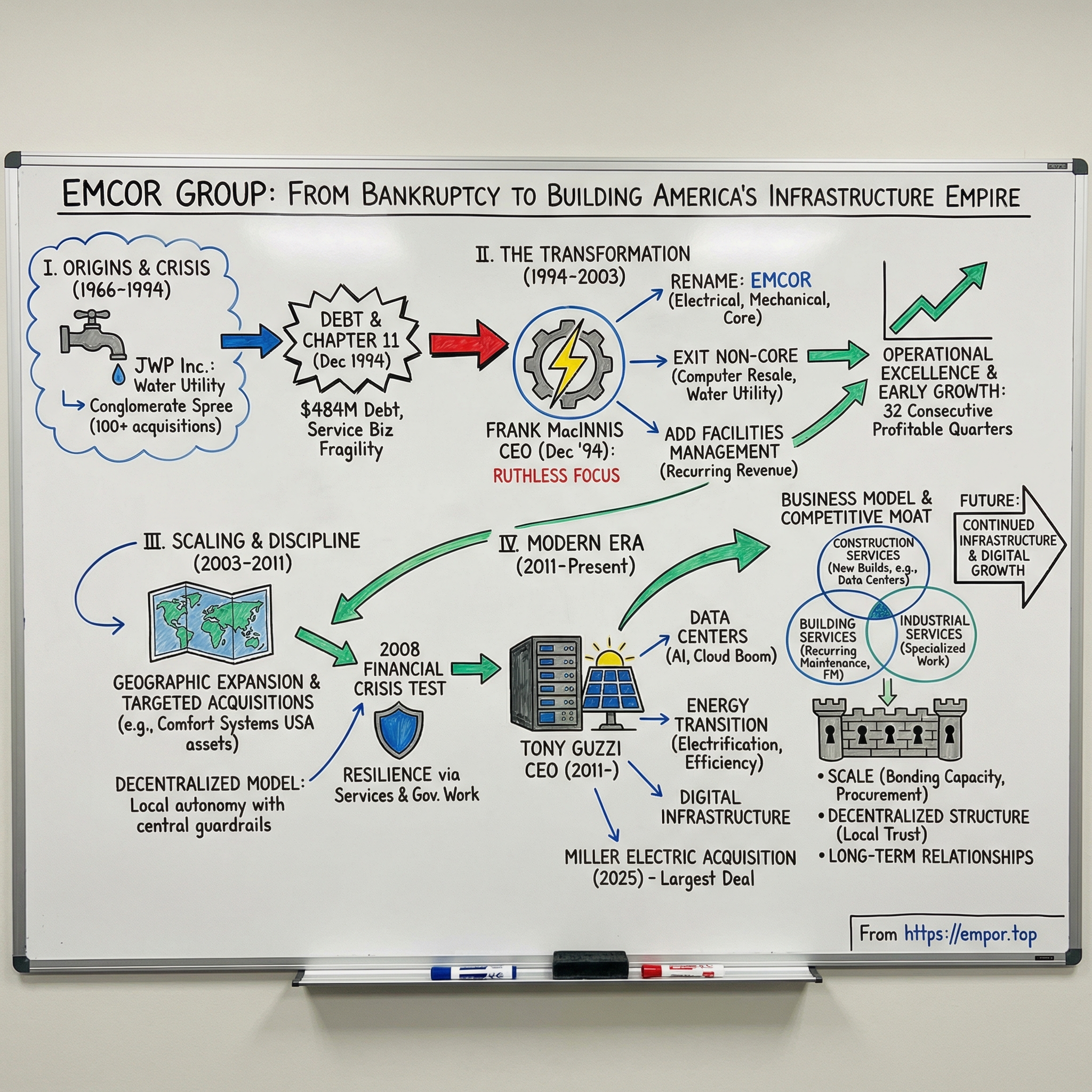
EMCOR Group: Building America's Infrastructure Empire
I. Cold Open & Episode Roadmap
On December 15, 1994, a company that most of Wall Street had written off changed its name. The old name — JWP Inc. — had become shorthand for corporate failure: a debt-fueled conglomerate that acquired more than a hundred businesses it did not understand, discovered its accounting was flawed, and collapsed into Chapter 11 bankruptcy. The new name was EMCOR Group, Inc. It stood for nothing glamorous: Electrical, Mechanical, Core — three words describing what remained after everything else had been sold, closed, or surrendered.
There was no ribbon-cutting. The business emerging from bankruptcy court was a collection of regional electrical and mechanical contractors — firms that pull wire through conduit, hang ductwork, weld process piping, and install the chillers that keep commercial buildings cool. It was unglamorous work, the kind of line item that appears on a construction budget but rarely in a press release.
Three decades later, that foundation has grown into a Fortune 500 company. Trading on the New York Stock Exchange under the ticker EME, EMCOR reported record financial results for fiscal year 2024, with revenue reaching $14.57 billion, operating income hitting $1.34 billion, and diluted earnings per share reaching $21.52.1 Through 2025 and into 2026, trailing twelve-month revenue climbed past $16 billion, while remaining performance obligations — the backlog of contracted work awarded but not yet completed — reached roughly $17 billion.2 Engineering News-Record ranks EMCOR among the largest specialty contractors in North America.3
The central question animating this story is straightforward yet complex: how did a failed Long Island water utility, turned aggressive 1980s conglomerate, turned bankruptcy casualty, transform into the contractor physically assembling the electrical and mechanical infrastructure for America's data centers, semiconductor fabs, hospitals, and manufacturing plants?
One simple explanation is market timing. EMCOR held substantial electrical and mechanical capacity just as artificial intelligence sparked a historic private construction boom — an expansion that is fundamentally an electrical challenge. A hyperscale data center is less a conventional building than a power-distribution and heat-rejection system wrapped in a shell. Specialized trades capable of installing medium-voltage switchgear, running busways, and plumbing liquid cooling loops briefly became among the scarcest resources in American construction.
Yet favorable market conditions alone do not explain EMCOR's performance. Operating margins roughly doubled over the past decade alongside top-line growth, cash conversion routinely outpaced industry peers, and an enterprise that once destroyed value through reckless expansion began executing acquisitions systematically. Structural changes took hold between 1993 and today.
Four central themes define this history. The first is the anti-conglomerate playbook — how bankruptcy forced a transition to decentralized operations paired with strict centralized financial controls. The second is a strategy of small, cash-funded acquisitions, evaluated against a history that makes management's claims of M&A discipline worth testing rather than taking at face value. The third is market positioning at the intersection of AI infrastructure, manufacturing reshoring, and grid modernization, raising the question of how much growth reflects a durable advantage versus a cyclical high tide. The fourth is labor dynamics — whether access to skilled electricians and pipefitters represents a true competitive moat or simply an input cost that rises with demand.
This analysis tests each theme against EMCOR's actual record, including episodes management rarely highlights. That record begins with an unlikely origin: a local water utility in Queens.
 Subscribe on LinkedIn
II. Origins & The Debt Spiral: Jamaica Water to JWP (1966–1993)
In Queens and Nassau County during the 1960s, post-war suburban expansion was booming. The water flowing into many of those new suburban kitchens came from Jamaica Water Supply Company, a regulated utility with the classic economics of its sector: predictable revenue paired with capped returns. A state commission determined allowable earnings, meaning the business could not grow faster than its geographic service territory—and that territory had filled out.
For an ambitious management team, that earnings ceiling posed a fundamental constraint. In 1978, Andrew T. Dwyer took control of the business intent on breaking through it. The underlying logic was straightforward: leverage the steady, predictable cash flows of a regulated utility to acquire unregulated businesses with uncapped returns—using diversification as an escape hatch from the utility rate base.
The initial moves fit that thesis cleanly. The company expanded into electrical contracting by acquiring Welsbach Corporation, a business with genuine operational adjacency to utility work involving field crews, conduit installation, and municipal clients. While contracting was far more cyclical than water delivery, it operated in familiar territory.
By the mid-1980s, however, operational adjacency ceased to be a requirement.
The Binge
In 1986, the company rebranded as JWP Inc., cutting its explicit identity link to the water utility. Over the next six years, JWP executed one of the decade's most aggressive acquisition sprees, buying more than a hundred companies across disparate end markets, financed primarily with debt.
The rationale reflected a popular 1980s roll-up strategy that persists in corporate finance today. Specialty service industries were fragmented and dominated by retiring owner-operators willing to sell at modest earnings multiples. Acquiring those targets with low-cost debt and folding them into a public entity with a higher valuation multiple created immediate arbitrage, boosting reported earnings per share. Combined with promised synergies in purchasing, overhead, and cross-selling, the roll-up arithmetic appeared compelling on paper.
In practice, the execution unravelled the math. Every acquired contractor brought its own estimating standards, project managers, bidding discipline, and receivables collection practices. A holding company acquiring nearly a business per month lacked the capacity to audit the job-cost accounting across its expanding network. In construction, job-cost accounting is fundamental to survival. Revenue recognition on multi-year contracts relies on estimating completion percentages and total projected costs. Aggregating optimistic estimates across a hundred subsidiaries turned reported profits into a fiction long before formal accounting irregularities were acknowledged.
The Fatal Error
The deal that transformed a strained conglomerate into a collapsing enterprise came in 1991, when JWP acquired Businessland, a computer hardware reseller and IT distributor.
The transaction represented a complete departure from JWP's core operations. JWP's contracting units installed physical infrastructure characterized by multi-year project cycles, local client relationships, skilled trade labor, and pricing power linked to execution risk. Businessland, by contrast, resold computer hardware—a high-volume, low-margin business plagued by rapid inventory obsolescence, price-sensitive customers, and unforgiving working capital demands. While a contractor relies on field execution and cost estimation, a hardware distributor relies on supply chain logistics and vendor credit terms. JWP had neither advantage, entering the personal computer market just as PC hardware devolved into a fierce price war in the early 1990s.
The collapse arrived quickly. Accounting irregularities surfaced, operational integration failed, and roughly $484 million in debt became unserviceable. In late 1993, JWP filed for Chapter 11 bankruptcy protection.
What the Record Actually Disproves
This history provides an essential analytical benchmark. A common investment thesis for acquisitive specialty contractors is that consolidating fragmented service industries automatically generates economies of scale. JWP stands as a clear counterexample—and serves as EMCOR's direct corporate ancestor.
JWP's collapse demonstrated that rapid acquisition volume without rigorous financial controls and cultural integration produces concealed risk rather than true scale. While purchasing synergies in electrical contracting offer modest cost benefits, commodity materials remain commodities. The decisive factor in specialty contracting is whether local operating units maintain disciplined bidding on jobs they can profitably execute—a cultural standard that cannot simply be purchased on a balance sheet.
The bankruptcy highlighted a second vulnerability inherent to specialty contracting. A service company's primary asset is its accounts receivable—funds owed for work already performed. Unlike physical property or inventory, these receivables depend heavily on client confidence that the contractor will remain solvent to complete the project and honor warranties. When a contractor enters bankruptcy, that confidence evaporates. Project owners withhold payments, surety companies refuse new performance bonds, and subcontractors demand upfront cash. Rather than deteriorating gradually, the asset base rapidly liquefies.
As a result, historically almost no large specialty service contractor had successfully emerged from Chapter 11 intact. That was the precarious reality facing the new management team brought in one month after JWP's filing.
III. The Crisis Years & The MacInnis Turnaround (1994–2004)
Frank T. MacInnis took charge of JWP in 1994, taking over a bankrupt enterprise whose core asset—customer trust—was eroding rapidly.
A construction industry veteran rather than a financial restructuring specialist, MacInnis approached the crisis from an operational perspective. A conventional turnaround manager might have focused strictly on financial engineering: renegotiating debt, selling off assets to the highest bidders, and returning a deleveraged shell to creditors. MacInnis recognized that in specialty contracting, the balance sheet is a lagging indicator of client confidence. Restructuring debt without preserving operational credibility would leave behind an entity unable to secure new contracts.
MacInnis noted at the time that the primary asset of a service business is its accounts receivable, pointing out that no large specialty contractor had previously emerged intact from Chapter 11 bankruptcy. Overcoming those historical odds required stabilizing daily field operations before addressing the capital structure.
Surgical Subtraction
The initial phase of the turnaround relied on aggressive divestitures. MacInnis sold off more than 40 non-core subsidiaries, beginning with Businessland, the computer reseller responsible for accelerating the collapse. By 1996, the company also sold Jamaica Water Supply, severing ties with the regulated utility that had founded the enterprise three decades earlier.
What remained after the divestitures was JWP's core strength: regional electrical and mechanical contracting and maintenance services.
The corporate name change to EMCOR Group in December 1994 formalized this sharp focus on core trades, establishing a defined scope of operations. Corporate headquarters subsequently moved from Rye Brook, New York, to Norwalk, Connecticut, consolidating management over a streamlined operating footprint.
Two Structural Decisions
Two structural decisions made during this period defined EMCOR's long-term business model, each directly addressing JWP's structural failures.
The first was an inverted corporate structure: a federation of local subsidiaries that retained their established brand names, local management teams, and regional client relationships, supervised by a centralized corporate headquarters controlling capital allocation, treasury functions, surety bonding, insurance, and financial reporting. Where JWP had attempted to centralize brand identity while allowing decentralized accounting controls, EMCOR decentralized market operations while centralizing financial risk management.
This model addresses the localized nature of commercial construction. General contractors and project owners select trade subcontractors based on regional reputations and long-standing relationships with local job superintendents—credibility that rarely transfers to a national corporate parent. Conversely, small regional contractors often struggle with working capital swings, securing large performance bonds, negotiating competitive insurance rates, and maintaining rigid job-costing discipline. EMCOR's structure assigned market-facing operations to local units while leveraging the financial scale of the corporate center.
The second decision was the expansion into facilities services, encompassing ongoing maintenance for commercial HVAC systems, building automation, fire protection, and mechanical equipment. While new construction is highly cyclical, existing commercial structures require continuous mechanical maintenance regardless of broader economic conditions. These service contracts generated smaller, higher-frequency recurring revenue designed to act as a counter-cyclical buffer during construction downturns.
That strategic premise was later tested during the 2008 recession, producing results that proved more nuanced than management's original thesis implied.
The Result
The operational turnaround yielded sustained results. EMCOR logged an unbroken series of profitable quarters through the late 1990s and early 2000s, achieving a stable recovery that had seemed unlikely during its 1994 reorganization.
The primary analytical takeaway from this period is how the bankruptcy shaped EMCOR's operating culture. The company's strict bidding discipline, focus on cash conversion, and avoidance of non-core acquisitions originated directly from the operational failures that had caused JWP's collapse. While management cultures forged during corporate reorganizations tend to remain risk-averse, maintaining that discipline over time depends heavily on executive succession as leadership transitions across generations.
Returning to Acquisitions
By 2002, EMCOR resumed inorganic expansion. The largest transaction occurred that year with the acquisition of 19 regional companies from Comfort Systems USA for approximately $186 million, significantly expanding EMCOR's mechanical contracting footprint across the Midwest. A subsequent acquisition of Consolidated Engineering Services expanded the mobile mechanical maintenance network, forming a key component of the company's Building Services division.
Unlike JWP's aggressive leverage-driven expansion, EMCOR's new M&A framework targeted established trade contractors in familiar geographic markets. Transactions were funded primarily with balance-sheet cash rather than heavy debt, while local management teams were retained to maintain operational continuity. Acquisitions were completed at modest valuation multiples, reflecting the fragmented and low-margin nature of specialty contracting at the time.
While this disciplined approach proved successful in the early 2000s, evaluating whether that M&A framework remains effective at EMCOR's current scale requires examining the valuations and integration records of its larger, more recent transactions.
By 2004, MacInnis initiated leadership succession planning, setting the stage for an executive team that would guide EMCOR over the next two decades.
IV. The Modern Era: Tony Guzzi & The Mega-Trend Supercycle (2004–Present)
Anthony "Tony" Guzzi joined EMCOR in October 2004 as president and chief operating officer, stepping into the leadership succession pipeline established under Frank MacInnis. Guzzi's background was distinctive for a federation of trade contractors: graduation from West Point, an MBA from Harvard Business School, and executive leadership at Carrier Corporation, where he directed the commercial systems and services division.
That Carrier experience provided Guzzi with firsthand insight from the equipment manufacturer's perspective. Carrier produced the heating, ventilation, and air conditioning systems that EMCOR's field subsidiaries installed and maintained. Arriving with a clear understanding of OEM margins, realistic equipment lead times, and service-contract pricing dynamics, Guzzi brought a valuable vantage point to contractor operations and negotiations.
His military background also aligned with EMCOR's corporate structure. The company's operating model delegates substantial execution authority to subsidiary presidents while enforcing strict, centralized oversight on safety, ethics, and financial reporting. That structure functions like a military command model: operational autonomy in the field paired with non-negotiable governance standards from corporate headquarters.
Guzzi assumed the role of chief executive officer in January 2011 and became chairman in June 2015, establishing a long executive tenure that provides a clear record for operational evaluation.
The Crisis That Tested the Model
Guzzi's initial years as CEO coincided with the prolonged downturn following the 2008–2010 financial crisis. Private commercial construction—spanning offices, retail centers, and hotels—contracted sharply as credit markets dried up. For a specialty contractor whose skilled trade crews represent both its primary operational asset and a major ongoing expense, a severe demand collapse presents a difficult operational choice: lay off electricians and pipefitters trained over many years, or retain them through an extended slump.
EMCOR responded by redirecting field capacity rather than shrinking its workforce. Management shifted labor toward institutional projects—including healthcare facilities, educational institutions, government buildings, and public infrastructure—that were funded by public budgets rather than private credit markets. Broad end-market coverage provided a clear operational buffer: while a contractor dedicated solely to commercial office space has limited alternatives during a downturn, a firm operating across multiple sectors can rotate crews to active markets.
That diversification strategy had clear limits and operational costs. Reallocating field crews across project categories required bidding on unfamiliar work, frequently at thinner profit margins and against established incumbent contractors. While multi-market coverage cushioned the impact of the commercial real estate decline, it did not entirely neutralize the economic pressure.
The Convergence
By the 2020s, market conditions shifted from cyclical recovery to rapid expansion as three major secular demand trends converged around EMCOR's core electrical and mechanical capabilities.
Data centers and AI compute. The expansion of artificial intelligence infrastructure is fundamentally an electrical and mechanical engineering challenge. While a rack of conventional servers draws a few kilowatts of power, a high-density rack of AI accelerators can demand ten to twenty times that amount. Delivering that power requires substations, medium-voltage switchgear, transformers, busway distribution systems, uninterruptible power supplies, and backup generation—all installed to precise tolerances where an installation error risks facility-wide outages. Cooling high-density equipment presents a parallel mechanical challenge. Because standard air cooling becomes inadequate at high heat densities, facility operators rely on direct-to-chip liquid cooling systems requiring specialized pumps, heat exchangers, process controls, and leak-free piping. In physical layout and engineering requirements, a liquid-cooled AI data center closely resembles a chemical processing plant.
Semiconductor and advanced manufacturing. Semiconductor fabrication facilities require cleanroom environments with air-filtration and particulate-control standards far exceeding those of standard commercial buildings. Fabs also depend on ultra-pure process piping to transport corrosive and hazardous chemicals without contamination, requiring inspectable welds and certified installations. Spurred by federal funding under the CHIPS and Science Act, domestic semiconductor construction expanded alongside new battery plants, electric vehicle facilities, and pharmaceutical manufacturing sites that all require intensive cleanroom and process-piping work.
Energy efficiency and grid infrastructure. Commercial and industrial building owners face continuous pressure to upgrade aging, inefficient mechanical systems. Driven by rising energy costs, tightening emissions regulations, and grid reliability concerns, property owners are retrofitting facilities with modern chillers, automated building controls, microgrids, and distributed power generation.
Buying Into the Wave
EMCOR responded to these market currents with targeted acquisitions.
In July 2023, the company agreed to acquire ECM Holding Group, Inc., a business generating roughly $60 million in annual revenue focused on energy efficiency and decarbonization retrofits, expanding EMCOR's capability in a niche it had previously served only regionally.4
In early 2025, EMCOR executed the largest acquisition in its history. On January 14, 2025, the company agreed to acquire Miller Electric Company, a Jacksonville, Florida-based electrical contractor, for approximately $865 million in cash, closing the transaction on February 3, 2025.56 Miller generated roughly $805 million in revenue and about $80 million in adjusted EBITDA in its prior fiscal year—implying an enterprise purchase multiple in the high single digits to low double digits on EBITDA before accounting for potential synergies.5
The strategic rationale for the transaction is clear. Miller is one of the largest electrical contractors in the Southeast, a geographic corridor receiving significant investment in data centers, healthcare, and advanced manufacturing. EMCOR's electrical footprint in the region had previously been light. Additionally, Miller's open-shop labor model complements EMCOR's union-affiliated operations in the Northeast and Midwest, aligning labor strategy with regional market norms.
A critical evaluation of the deal highlights notable risks. At approximately $865 million in cash, Miller represents the largest acquisition check EMCOR has ever written, far exceeding the scale of its 2002 Comfort Systems transaction. Large acquisitions carry inherent integration risks, as demonstrated by JWP's historical collapse. Furthermore, the deal was completed at an active point in the industrial construction cycle, paying a full valuation for an asset generating peak-cycle earnings. If data center construction in the Southeast slows, the acquired earnings base could compress, making the purchase multiple look less favorable over time.
Conversely, two key factors mitigate those concerns: the acquisition was funded entirely with balance-sheet cash rather than debt, preserving financial flexibility, and Miller operates directly within EMCOR's core electrical contracting competency. That approach stands in contrast to the leverage-fueled, non-core expansion that led to JWP's failure. Ultimately, the long-term success of the transaction will depend on whether Miller maintains its operating margins through a complete demand cycle and retains its key management personnel as integration proceeds.
This strategic expansion raises the fundamental question of how EMCOR's underlying business segments convert contracted demand into sustained profitability.
V. Business Model, Segment Economics & 7 Powers Analysis
To understand EMCOR, consider a half-finished data center shell. The concrete is poured, the steel structure is erected, and the roof is sealed. At this stage, the general contractor's primary scope is essentially complete, yet the structure remains an empty building.
Everything that converts that shell into an operating facility comes next, and nearly all of it involves electrical and mechanical systems: conduit racks, switchgear lineups the size of shipping containers, thick feeder cables, welded and pressure-tested chilled-water piping, coolant distribution units, fire suppression systems, and building automation controls. Thirty to fifty percent of total project costs typically reside in these systems, along with virtually all of the schedule risk. While steel erection follows predictable timelines, energizing and commissioning a high-density facility does not.
That is EMCOR's core market: converting empty shells into functioning infrastructure, and increasingly securing recurring revenue to maintain those complex systems over their operating lifecycle.
The Five Segments
EMCOR reports financial performance across five operating segments, each with distinct economics.
U.S. Mechanical Construction and Facilities Services is the largest segment, generating the plurality of both revenue and operating income. Its scope encompasses HVAC systems, plumbing, process piping, fire protection, and cleanroom mechanical installations. This unit handles the most complex, highest-value-added work, including semiconductor fabs and data center liquid cooling projects.
U.S. Electrical Construction and Facilities Services represents the second construction pillar, covering power distribution, switchgear installation, substations, and low-voltage cabling. This segment directly benefits from data center expansion and expanded further with the acquisition of Miller Electric in early 2025.
Together, these two construction segments generate roughly two-thirds of total revenue and a larger share of operating income. EMCOR's consolidated operating margin expanded substantially through 2023 and 2024, reaching approximately 9.2% for the full year 2024 — a level the company would have considered unattainable a decade earlier, when margins in the low-to-mid single digits were normal for the industry.1
Evaluating that margin expansion requires separating temporary market dynamics from structural improvements. Three factors drove the increase: a favorable project mix shift toward complex, high-density facilities where execution skill commands a premium over standard fit-out work; tight labor capacity that allowed contractors to be selective in bidding; and prefabrication processes that improved labor productivity on site.
Crucially, only prefabrication represents a structural advantage. Project mix and bidding selectivity stem from a tight market. When construction demand softens, contractor bidding discipline across the industry historically erodes, squeezing operating margins. That cyclical sensitivity remains a central risk to EMCOR's current profitability.
U.S. Building Services provides recurring revenue through mechanical service contracts, mobile technician fleets, energy retrofits, and facilities management. While operating at lower margins than heavy construction, these services offer higher frequency and greater customer retention.
U.S. Industrial Services handles refinery turnarounds, heat exchanger maintenance, and shop fabrication. It is the smallest and most volatile segment, closely tied to energy sector capital spending and maintenance cycles.
U.K. Building Services completes the portfolio, contributing a small fraction of total revenue.
The Working Capital Reality
A critical operational mechanic in specialty contracting is working capital management. Contractors perform work, submit progress billings, and collect payment over sixty to ninety days, often with a portion retained by the project owner until final completion. Meanwhile, trade payroll must be met weekly and materials purchased upfront. Rapid top-line growth therefore consumes substantial cash, requiring a contractor growing revenue at 20% to fund an expanding base of receivables and unbilled work.
Consequently, free cash flow generation is a more reliable indicator of operational health than net income alone. A specialty contractor reporting strong profits alongside deteriorating cash conversion may be relying on optimistic percentage-of-completion accounting estimates rather than real cash flow — the precise pattern that disguised JWP's financial distress before its collapse. For EMCOR, operating cash flow relative to net income serves as an accounting integrity check as much as a liquidity metric.
Testing the 7 Powers
Applying Hamilton Helmer's 7 Powers framework highlights which of EMCOR's competitive advantages are durable and which are overstated.
Scale economies — partially real. Executing large-scale projects requires substantial surety bonding, which depends directly on balance sheet strength and prior execution track record. Small regional contractors cannot secure bonding for nine-figure mega-projects, creating a barrier to entry for the largest assignments. In the broader middle market, however, regional firms compete effectively, while bulk procurement savings on commodity materials offer only modest cost benefits.
Cornered resource — the weakest claim. EMCOR employs tens of thousands of trade workers and maintains long-standing relationships with union locals affiliated with the National Electrical Contractors Association and the United Association. Amid a nationwide shortage of electricians and pipefitters, management often frames this workforce access as a competitive moat.
However, union labor agreements are non-exclusive, allowing any signatory contractor to request workers from the same local hiring halls. EMCOR does not own its labor supply; it competes for trade workers in an open market, often by offering higher wages or steady project allocation. Labor scarcity functions as an industry-wide cost pressure and growth constraint rather than an exclusive company asset. EMCOR's true advantage lies in its long-standing local union relationships and internal training programs, which help stabilize crew availability relative to smaller peers—a meaningful operational benefit, but far narrower than a true cornered resource.
Process power — the most defensible. Prefabrication provides EMCOR's most defensible operational edge. Rather than assembling complex piping and electrical systems entirely on site — where field crews face ladder work, trade congestion, and weather delays — EMCOR fabricates modular assemblies in dedicated off-site facilities. Piping racks, electrical skids, and multi-trade modules are constructed under controlled factory conditions, then delivered for final installation. Integrated with building information modeling software to resolve trade clashes prior to fabrication, this approach reduces field labor hours while improving safety and quality control.
This advantage is durable because prefabrication capabilities cannot be quickly acquired through equipment purchases alone. Developing efficient off-site modeling, shop-to-field coordination workflows, and customer acceptance requires years of operational refinement and continuous capital investment. In a tight labor market, prefabrication also amplifies workforce productivity, enabling EMCOR to execute a larger volume of work with existing field crews.
Counter-positioning — mislabeled. EMCOR's decentralized operating structure is highly effective, but it represents an organizational choice rather than counter-positioning under Helmer's framework, as competitors are not structurally disincentivized from adopting a similar model.
Porter, Briefly
Applying Michael Porter's Five Forces highlights additional industry dynamics. Buyer power is low on complex mega-projects, where project owners face substantial revenue losses for every day a facility is delayed in commissioning. Conversely, buyer power is high in commoditized commercial fit-out work, where contracts are awarded primarily on price. Supplier power is significant and elevated: extended lead times for critical electrical equipment, such as transformers and switchgear, can delay project completion regardless of contractor execution. Substitution risk remains negligible, as software cannot replace physical installation work. The threat of new entrants is low for complex mega-projects due to capital, bonding, and technical requirements. Industry rivalry among major peers — including Comfort Systems USA and Quanta Services — has remained rational during the demand surge, though competitive behavior during a sharp downturn remains an open question.
In sum, EMCOR's competitive advantages are genuine but more focused than broad market narratives suggest. Prefabrication capabilities and financial scale provide durable operational edges, whereas labor access represents a shared industry condition rather than an exclusive moat. Furthermore, a portion of recent margin expansion reflects tight market conditions that could compress if construction demand slows.
Which brings the focus to how the company deploys the cash those margins generate.
VI. M&A Strategy & Capital Allocation Benchmarking
Every acquisitive company describes its approach as disciplined. Testing that claim requires examining EMCOR's actual operating track record rather than taking management statements at face value.
Management's stated playbook focuses on bolt-on acquisitions of regional specialty contractors with leading local market positions, strong safety records, and retained leadership teams. Target companies retain their established local brands and management while gaining access to EMCOR's balance sheet and surety bonding capacity. In return, EMCOR expands into geographic markets or technical capabilities where it lacked a presence.
The focus on safety records carries practical operational weight. Contractors are evaluated by their Experience Modification Rate—an externally computed insurance metric benchmarking injury history against the industry average, where 1.0 represents average and lower numbers reflect superior safety performance. Beyond insurance costs, safety metrics serve as a reliable proxy for general operational quality: maintaining a low injury rate requires disciplined field supervision, thorough pre-job planning, and experienced trade crews. The metric is also commercially essential, as major industrial, healthcare, and technology clients require contractors to meet strict safety thresholds before placing them on approved bid lists. Acquiring a firm with a poor safety record introduces both immediate insurance liabilities and restricted market access.
The Record
The 2002 acquisitions established this model, when EMCOR bought 19 regional companies from Comfort Systems USA for roughly $186 million alongside Consolidated Engineering Services. Both transactions were executed at modest valuation multiples within core trades and familiar geographies. More than two decades later, the acquired Midwest mechanical footprint and mobile maintenance network remain integral to EMCOR's operations, providing long-term validation for that acquisition strategy.
The 2023 acquisition of ECM Holding Group represented a capability addition rather than an expansion of scale, bringing in roughly $60 million of revenue to build a national energy-efficiency offering.4 Given its modest size relative to EMCOR's total revenue, the transaction has a minimal direct financial impact, functioning primarily as a strategic capability expansion.
The early 2025 acquisition of Miller Electric represents a structural shift from this pattern, testing whether management can apply its M&A framework at a vastly larger scale.56
Weighing the Discipline Claim
Evaluating whether EMCOR's historical record supports its reputation as a disciplined acquirer requires distinguishing between different operational eras.
Between 2002 and 2023, the record demonstrates consistent execution: cash-funded acquisitions of core-trade contractors with retained local management that sustained profitability over extended periods. While JWP's 1990s collapse stands as a counterexample, that failure occurred under prior leadership with an unrelated conglomerate strategy. That historical failure is more accurately understood as the catalyst for EMCOR's modern risk-averse controls rather than evidence against its current management.
However, two primary factors qualify the claim of M&A discipline regarding recent activity. First, the Miller Electric transaction is roughly an order of magnitude larger than EMCOR's traditional bolt-on acquisitions. Operational integration complexity expands non-linearly with size, meaning execution success on small regional deals does not guarantee seamless integration at scale. Second, the transaction closed near a cyclical peak in data center and advanced manufacturing investment—the specific end markets Miller serves. Acquiring assets at peak valuations during high-demand cycles carries the risk that earnings could compress if regional construction activity moderates.
Consequently, EMCOR maintains a verified track record with small-to-midsize bolt-on acquisitions in core trades, but an untested record with large-scale integration. Key indicators of integration failure would include electrical segment margin compression linked to Miller or executive turnover among retained Miller leadership. Conversely, sustained operating margins through a regional data center construction slowdown would confirm the acquisition's long-term value.
The Rest of the Capital
Beyond acquisitions, EMCOR's capital deployment has emphasized shareholder returns through consistent share repurchases and a growing dividend. Returns on invested capital have comfortably exceeded the company's cost of capital, reflecting a business model with low fixed-capital requirements. Specialty contractors primarily invest in field tools, service vehicles, and regional prefabrication shops rather than heavy industrial plants. Capital requirements reside principally in working capital rather than fixed property, plant, and equipment.
This asset-light operating model enables elevated returns on capital, placing heightened importance on cash conversion metrics. If a specialty contractor fails to convert reported earnings into operating cash flow, capital intensity has typically migrated into expanding accounts receivable and unbilled work rather than fixed assets.
The share repurchase strategy also warrants scrutiny. Executing buybacks aggressively during periods of peak operating margins and elevated equity valuations retires fewer shares per dollar spent than repurchases executed during market downturns. While pro-cyclical share repurchases are common across corporate finance, evaluating capital allocation discipline requires observing whether management maintains share buybacks counter-cyclically when market valuations decline.
Ultimately, capital allocation reflects executive decision-making and governance oversight.
VII. Management Credibility, Governance & Incentives
On an EMCOR earnings call, the tone is noticeably pragmatic. While executives at companies riding a once-in-a-generation demand wave often lean on expansive statements about total addressable markets and transformational positioning, EMCOR’s leadership tends to focus on operational details: segment execution, labor availability, project schedules, and backlog mix by end market.
That operational focus offers useful signal, though it should not be overstated. A management team that speaks like operators is easier to evaluate against outcomes than one that relies on broad strategic themes, because operational claims are testable against results. However, plain speaking is also a communication style, and styles can endure even when underlying fundamentals soften. The ultimate test remains the operational track record, not executive tone.
The People
Tony Guzzi has served as CEO since 2011 and chairman since 2015, establishing a tenure long enough to span a post-recession recovery, a pandemic, global supply chain disruptions, and the current construction boom. His defining operational stance has been a refusal to pursue revenue through unpromising or underpriced bids—a posture articulated consistently across multiple market cycles rather than adopted recently. That consistency is central to evaluating leadership: a contractor that emphasizes bidding discipline only during periods of strong demand is describing market conditions, whereas one that maintains margin thresholds when backlogs are thin is demonstrating policy.
Jason Nalbandian serves as Chief Financial Officer, having advanced through EMCOR’s internal accounting and financial organization. In specialty contracting, an internally promoted CFO with direct experience in job-cost accounting systems provides a distinct control advantage. Percentage-of-completion accounting remains the primary failure point for construction firms, requiring hands-on operational familiarity rather than purely theoretical finance background.
Kevin Matz, as Executive Vice President of Shared Services, oversees safety programs, employee benefits, and subsidiary integration—the operational infrastructure supporting EMCOR’s federated model. This function determines whether newly acquired contractors are successfully integrated into corporate governance standards or left exposed to decentralized risk.
Incentives
Executive compensation is heavily weighted toward performance rather than fixed salary. According to the 2025 proxy statement, the CEO's pay package combined a base salary in the low seven figures with substantially larger non-equity incentive compensation tied to operating performance metrics and equity awards. This generated total compensation in the mid-teens of millions, structuring the vast majority of realized pay around operational results rather than mere tenure.7
While the structure aligns incentives with performance, it carries an important analytical caveat. Incentive plans tied to operating income growth, earnings per share, and returns on capital naturally reward executives during an industry supercycle when market tailwinds lift all three metrics. Pay-for-performance incentives are most revealing when operating conditions are challenging; during a demand surge, generous payouts may reflect favorable market dynamics as much as management skill. A key governance question is whether performance targets ratchet upward as market conditions improve or reset downward to preserve payouts during cyclical contractions. Furthermore, share repurchases mechanically reduce share count and elevate per-share metrics, a factor that requires scrutiny whenever earnings per share serves as a primary compensation metric.
Guidance Behavior
In recent years, EMCOR has established a consistent pattern of setting conservative full-year guidance and raising forecasts as the year progresses. The company raised its outlook repeatedly through 2023, 2024, and 2025 as execution outpaced projections, ultimately delivering record revenue, operating income, and earnings per share for 2024.12
This pattern permits two distinct interpretations. The favorable view points to conservative target-setting, where management intentionally sets achievable benchmarks it can consistently beat. The skeptical view suggests that a management team repeatedly surprised by its own performance has limited forward visibility into its demand environment—a dynamic that applies equally in both directions, as an inability to anticipate upside often implies an equal inability to foresee downturns. For a contractor managing a multi-billion-dollar backlog, this limited visibility is less concerning than in other industries, given that contract conversion timelines depend heavily on client construction schedules beyond the contractor's control. Nonetheless, the underlying principle holds: the same forecasting conservatism that produces positive surprises during an expansion can mask emerging headwinds when demand softens.
A more telling indicator of credibility is what management discloses unprompted. On earnings calls, EMCOR executives have consistently highlighted operational constraints—including labor availability, electrical equipment lead times, and project scheduling shifts—rather than attributing performance entirely to macroeconomic tailwinds. Identifying internal bottlenecks while delivering strong financial results reflects an executive team prepared to be evaluated on operational execution.
That measured scrutiny is precisely the posture investors should maintain when evaluating EMCOR's long-term strategic claims.
VIII. Historical Falsification Layer: Testing Core Thesis Claims
Every investment thesis is a set of claims about the future dressed as observations about the present. The most rigorous test is to examine the company's historical record for evidence that challenges each claim, evaluating whether past performance refutes the premise, narrows its scope, or leaves it unproven.
Claim One: Building Services is a recession hedge
The claim. Recurring maintenance and facilities services cushion the cyclicality of construction, because existing buildings require ongoing servicing regardless of new construction activity.
The disconfirming record. The 2008–2010 economic downturn provided a direct test of this premise, and Building Services did not fully hold up. Segment revenue declined materially on an organic basis as commercial building owners deferred discretionary spending. The mechanism is instructive: maintenance work falls into two distinct categories. Non-deferrable work—such as critical chiller failures or mandatory code inspections—continues out of operational necessity. Deferrable work, including equipment retrofits, efficiency upgrades, and non-essential servicing, is frequently postponed during cash squeezes. Property owners under financial distress also insource basic maintenance to existing building staff or re-bid service contracts aggressively on price.
Verdict. The claim survives in a narrowed form. Building Services experiences smaller, delayed declines relative to new construction, providing genuine operational stabilization. Rather than functioning as a true recession hedge, however, the segment acts as a shock absorber—a distinction that is critical when modeling trough earnings. The key metric for evaluating this revised claim is service contract retention and pricing during periods of commercial real estate refinancing stress.
Claim Two: Industrial Services offers attractive growth
The claim. Refinery turnarounds and specialized industrial maintenance provide high-value, technically demanding revenue streams.
The disconfirming record. Historical performance directly refutes this growth thesis. During the 2015–2016 oil price decline and the 2020 demand shock, Industrial Services operating income fell sharply as refiners postponed scheduled turnarounds. The segment's underlying economics are straightforward: a refinery turnaround requires shutting down operating units. When refining margins are strong, facility operators run at full capacity and defer maintenance; when margins collapse, refiners cut capital expenditures and delay projects. While postponed maintenance must eventually occur, project timing depends entirely on client decision-making unrelated to contractor execution quality. Furthermore, the North American refining sector remains structurally mature, with limited capacity expansion and long-term demand headwinds from vehicle electrification.
Verdict. The growth claim is rejected. Industrial Services is a cyclical, commodity-exposed business that has historically depressed consolidated margins during downturns. Management's actions reflect this reality: the segment has been allowed to contract to a minor share of total revenue, capping potential earnings drag. The appropriate analytical approach is to model Industrial Services as a volatile, minor contributor rather than a growth engine, recognizing that even strong segment performance has minimal impact on consolidated results.
Claim Three: Fixed-price risk is controlled by management discipline
The claim. EMCOR's disciplined estimating practices and selective bidding protect the business from contract losses that historically destabilize specialty contractors.
The disconfirming record. The 2021–2022 inflation shock demonstrated the limits of estimating discipline. As prices for copper, steel, conduit, and electrical switchgear escalated alongside rising trade labor costs, projects bid under fixed-price terms prior to 2021 had to be completed at unforecasted costs, compressing legacy project margins. The issue was not poor estimating execution, but the inherent structure of fixed-price contracting, which transfers input-cost inflation risk directly to the contractor. No degree of bidding rigor can accurately price an unpredicted macroeconomic shock.
A fundamental asymmetry exists in fixed-price contracting: a contractor's upside is capped at the bid margin, whereas downside exposure is theoretically uncapped. Estimating discipline improves average project outcomes but does not alter this underlying risk distribution.
Verdict. The claim is substantially narrowed, with risk reduction depending more on contract structure than estimating skill. EMCOR mitigated this exposure by shifting toward guaranteed maximum price and cost-plus contracts, shortening the duration between bidding and project execution, and inserting inflation escalation clauses tied to material indices. This structural contract shift represents a durable operational improvement. However, this risk mitigation remains dependent on market conditions: EMCOR can demand favorable contract terms primarily because construction demand exceeds specialty trade capacity. In a softer market, project owners typically push cost risks back onto contractors. Consequently, execution risk is well-managed under current high-demand conditions, making contract-mix disclosures and project-specific charges key metrics to monitor.
Claim Four: The U.K. business scales into a European platform
The claim. U.K. Building Services provides an operational base for broader international expansion.
The disconfirming record. Over a decade of operational results refutes this thesis. The U.K. unit has consistently generated operating margins substantially below EMCOR's domestic business, reflecting a price-sensitive facilities management market with frequent rebidding and sluggish regional growth. The segment has failed to achieve meaningful scale, while corporate capital deployment has remained focused almost entirely on U.S. opportunities.
Verdict. The growth thesis is rejected. The U.K. business remains a small legacy operation representing a low-single-digit percentage of consolidated revenue, making it too small to materially impact either the bullish or bearish investment case. Its primary analytical relevance lies in capital allocation governance: management has retained a subscale, low-return operation for years without executing an operational turnaround or an exit. This persistence likely reflects the unit's negligible size, representing a pragmatic operational prioritization while serving as a minor caveat to claims of strict capital discipline.
What the Four Tests Add Up To
A clear pattern emerges from these four historical evaluations. EMCOR's claims regarding execution—such as off-site prefabrication, safety standards, bidding selectivity, and decentralized operations—are well-supported by its operational track record. Conversely, claims regarding structural cycle insulation are largely unsupported. Building Services acts as a shock absorber rather than a recession hedge; Industrial Services introduces cyclical volatility rather than growth diversification; and fixed-price risk management relies on favorable market leverage as much as estimating discipline.
This distinction does not diminish EMCOR's operational record, but provides a precise analytical framework: EMCOR operates as an exceptionally well-managed cyclical business rather than a cycle-proof enterprise—a distinction central to evaluating its current peak-cycle earnings.
IX. Bear vs. Bull Case & Skeptical Investor Stress Test
Imagine two investors who agree entirely on the facts and disagree completely on what they mean.
The Bull Case
Demand has a long runway with visible funding. The artificial intelligence infrastructure buildout relies on multi-year capital commitments from major technology hyperscalers. At the same time, the reshoring of semiconductor and advanced manufacturing capacity carries federal policy support on a multi-year horizon, while power grid modernization represents an independent infrastructure mandate. Rather than relying on a single consumer demand cycle, these initiatives represent distinct, separately funded capital programs.
Backlog provides genuine visibility. Remaining performance obligations of roughly $17 billion against annual revenue in the mid-teens of billions represent more than a year of contracted work.2 For a business historically characterized by short order cycles, this backlog provides clearer medium-term revenue visibility for management and investors alike.
The mix shift enhances margins. Complex data center and advanced manufacturing projects command higher margins than standard commercial construction because clients prioritize execution certainty and schedule compliance over square-footage cost. As long as this project mix dominates the backlog, operating margins should remain above historical industry averages.
Labor scarcity favors efficient contractors. With skilled trade labor serving as the primary industry constraint, contractors capable of maximizing output per field hour through off-site prefabrication and building information modeling capture a disproportionate share of complex project awards.
The Bear Case
Concentration risk in hyperscaler spending. EMCOR’s highest-margin work depends heavily on continuous capital deployment by a small group of major technology companies. These capital budgets are discretionary, subject to quarterly revisions, and tied to artificial intelligence investments whose long-term financial returns remain unproven. A pullback in tech spending would not only slow top-line growth but also force competing contractors to seek bids in other end markets. Increased bidding competition across the industry would compress operating margins faster than revenue declines—the classic failure mechanism in specialty contracting downturns.
Labor constraint acts as a growth ceiling. While labor shortages restrict overall industry capacity, they also cap EMCOR's top-line expansion and push trade wages higher. Multi-year trade apprenticeships prevent rapid labor expansion, limiting upside potential while providing no exclusive competitive protection.
Contracting risk carries asymmetric downside. Specialty contracting is subject to asymmetric project risk. A single large project marred by design errors, schedule delays triggering liquidated damages, or subcontractor defaults can produce write-downs that eliminate quarterly operating earnings. While EMCOR's execution record has been disciplined in recent years, project-level execution risk remains an inherent industry reality.
Commercial real estate weakness persists. Ongoing office vacancies and refinancing stress continue to strain commercial property owners—the primary client base for EMCOR’s Building Services segment—limiting high-margin retrofit and discretionary maintenance opportunities.
Peak-cycle acquisition exposure. The acquisition of Miller Electric committed substantial balance-sheet cash to an electrical contractor heavily exposed to the Southeast's cyclical data center and manufacturing markets near peak valuation levels, compounding EMCOR's exposure to those specific end markets.
The Activist's Questions
A skeptical investor examining EMCOR's governance and risk management would focus on four specific issues. First, why retain a subscale, low-margin U.K. business for over a decade rather than reallocating that capital? Second, does a decentralized network of roughly one hundred operating subsidiaries allow corporate management adequate real-time visibility into project-level cost overruns, or does it risk obscuring operational problems as JWP's structure did? Third, are share repurchases executed counter-cyclically during market pullbacks or merely conducted continuously across peak valuations? Finally, given that percentage-of-completion accounting relies on internal estimates of total project costs, does EMCOR provide sufficient disclosure around contract estimate revisions for investors to separate underlying operational execution from accounting adjustments?
Against the Peer Set
Comfort Systems USA represents EMCOR's most direct peer—a mechanical-focused contractor with a largely open-shop workforce and strong exposure to technology and industrial construction. Comfort Systems has generated operating margins comparable to or exceeding EMCOR's during the current cycle. However, its higher concentration in high-growth end markets offers greater upside during expansions alongside elevated downside risk if spending cools.
Quanta Services operates at a larger scale with a different business model, primarily serving electric utilities and renewable energy developers. Because its client base consists largely of regulated utilities operating under rate-base capital plans, Quanta benefits from a steadier, less discretionary demand signal than contractors reliant on corporate tech budgets.
MasTec focuses on telecommunications and energy infrastructure, operating at lower historical margins with a higher debt burden from past acquisitions—a profile that leaves less flexibility during economic contractions.
Within this peer group, EMCOR is distinguished by its end-market breadth, a hybrid union and open-shop labor structure adaptable to regional labor markets, and a strong balance sheet. However, like its peers, EMCOR lacks structural insulation from broader commercial and industrial construction cycles.
Synthesis
The bullish and bearish cases address different time horizons. Over the medium term, contracted backlog and funded customer projects provide clear top-line visibility. Over a longer horizon, performance will depend on hyperscaler capital allocation decisions and industry bidding behavior if demand softens. While EMCOR’s operational discipline and execution quality are well-documented, its ability to maintain peak operating margins across a complete demand cycle at its current scale remains unproven.
That operational and cyclical tension defines the company's outlook as it navigates the current construction cycle.
X. Playbook: Key Business & Investing Lessons
Decentralize identity, centralize money. EMCOR's operating model succeeds because it distinguishes what requires local autonomy from what demands central control. Customer relationships, trade labor connections, and project estimating are irreducibly local, relying on regional executives with deep market context. Capital allocation, bonding capacity, insurance, and financial reporting are irreducibly central, where systemic risk accumulates and scale provides a genuine advantage. JWP inverted this formula, attempting to unify branding while failing to centralize financial oversight. The broader lesson: corporate structure must separate functions that benefit from proximity from those that demand scale, rather than forcing them into a single framework.
Crisis is the cheapest source of strategic clarity. A conventional strategy process rarely generates a decision to sell off more than forty businesses. Reorganization under Chapter 11 forced that outcome in months, with liquidation as the alternative. When evaluating a disciplined contractor, investors must ask whether operational rigor was chosen voluntarily or imposed by crisis—and whether the leadership that experienced that restructuring remains in place. Institutional memory of a corporate crisis is a tangible operational asset with a finite depreciation schedule.
Own the physical bottleneck. The most durable position in a technology surge is frequently located outside the primary tech stack. While artificial intelligence generates substantial paper value across software and semiconductor providers, capturing those returns requires navigating intense competitive risks. By contrast, every AI data center requires complex switchgear and process piping installed correctly, and few organizations possess the scale to execute those installations. Physical bottlenecks in a digital expansion offer attractive positioning, provided investors recognize that construction bottlenecks carry a shorter duration than the underlying technology boom.
Contract terms are risk allocation, and risk allocation is the business. The most consequential reduction in EMCOR's risk profile originated not from superior cost estimating, but from revising contract structures. Shifting toward guaranteed maximum price and cost-plus contracts with escalation clauses transfers input-cost inflation risk back to project owners who are better equipped to absorb it. For project-based enterprises, the breakdown of contract types is a far more revealing disclosure than total backlog, as contract structure determines which party absorbs unexpected cost overruns.
Cash conversion is the lie detector. Under percentage-of-completion accounting, reported net income relies heavily on forward-looking estimates. Operating cash flow does not. Persistent divergence between net income and cash conversion remains the single most reliable early warning indicator in specialty contracting—and served as the definitive red flag prior to JWP's bankruptcy filing.
XI. Epilogue & Forward KPIs to Watch
Somewhere in the Southeast, a Miller Electric crew is pulling feeder cable into a data center designed to consume more power than a small city. The core task looks essentially as it did in 1994: conduit, cable, terminations, and testing. The difference lies in the facility's purpose and what the client will pay to have it energized on schedule.
That continuity defines EMCOR's evolution. The company has changed enormously in the end markets it serves, while remaining grounded in its core trade execution. Its forward agenda represents a series of operational extensions rather than strategic reinventions: integrating Miller Electric into the domestic electrical segment to cross-sell mechanical and facilities services across the Southeast; expanding off-site prefabrication capacity to mitigate skilled labor constraints; and positioning for power-generation infrastructure—spanning grid interconnections, natural gas generation, and eventual nuclear or small modular reactor projects as data center power demands exceed utility capacity.
That nuclear exposure warrants explicit caution. Small modular reactor deployment in the United States remains in the demonstration and licensing phase, with commercial construction timelines repeatedly slipping across the industry. Contractor participation in nuclear projects offers long-term optionality, but optionality does not equal contracted revenue. The disciplined analytical approach requires measuring the rate at which announced infrastructure programs convert into awarded, executed contracts, projecting growth based on real conversion rather than headline commitments.
The broader strategic question remains unanswered. The artificial intelligence infrastructure expansion is unprecedented in scale, leaving market observers without a historical base rate for comparison. If hyperscale capital spending continues at current levels for a decade, EMCOR's present earnings represent a waypoint in an ongoing expansion. If AI economics fail to generate expected returns and technology budgets reset, the industry will reveal how much of its recent margin expansion stemmed from operational skill versus temporary trade scarcity. EMCOR is better equipped than most peers to navigate a contraction—supported by an unleveraged balance sheet, broad end-market coverage, and a flexible cost structure—but maintaining financial resilience during a downturn is not the same as avoiding one.
The Three Metrics That Matter
Remaining performance obligations, and specifically their mix. The headline backlog figure is widely cited but reveals little in isolation. What matters is composition: the proportion allocated to data centers and advanced manufacturing versus conventional commercial construction, and how that ratio shifts quarter over quarter. Backlog growth driven by lower-margin commercial work while high-tech orders stagnate would signal mix deterioration long before it appears in reported margins, serving as the earliest indicator of demand quality.
Operating margin, evaluated as a cyclical indicator rather than a performance score. EMCOR's margin expansion past 9% reflects a combination of structural operational gains and cyclical trade scarcity, two factors that cannot be separated from external financial reports except over time. If operating margins hold steady while revenue growth moderates, the margin gains are likely structural. If margins compress as top-line growth slows, the expansion primarily reflected temporary scarcity pricing.
Operating cash flow relative to net income. For a contractor using percentage-of-completion accounting to fund expanding working capital, cash conversion serves as a liquidity metric, a growth-cost test, and an accounting integrity check. Sustained conversion near or above 100% confirms that reported profits are backed by cash and self-funding. Deterioration indicates either that top-line expansion is consuming cash faster than it generates it, or that internal job-cost estimates have drifted overly optimistic. Given JWP's historical collapse under flawed contract accounting, cash conversion remains the single most critical metric to monitor.
References
-
EMCOR Group, Inc. Reports Fourth Quarter and Full Year 2024 Results — Business Wire, 2025-02-27 ↩↩↩
-
EMCOR Group, Inc. Reports Second Quarter 2025 Results — EMCOR Group, Inc., 2025-07-31 ↩↩↩
-
Engineering News-Record 2024 Top 600 Specialty Contractors — ENR, 2024-10-15 ↩
-
EMCOR Group, Inc. Announces Agreement to Acquire ECM Holding Group, Inc. — EMCOR Group, Inc., 2023-07-05 ↩↩
-
EMCOR Group, Inc. Enters Into Definitive Agreement to Acquire Miller Electric Company — EMCOR Group, Inc., 2025-01-14 ↩↩↩
-
EMCOR Group, Inc. Completes Acquisition of Miller Electric Company — EMCOR Group, Inc., 2025-02-03 ↩↩
-
EMCOR Group, Inc. Definitive Proxy Statement (DEF 14A) — SEC EDGAR, 2025-04-10 ↩
 LinkedIn
 WhatsApp
 Reddit
 Hacker News
 Email
Email Kindle
 RSS Feed
 Spotify
 Apple Podcasts
 Amazon Music
 Audible
 YouTube