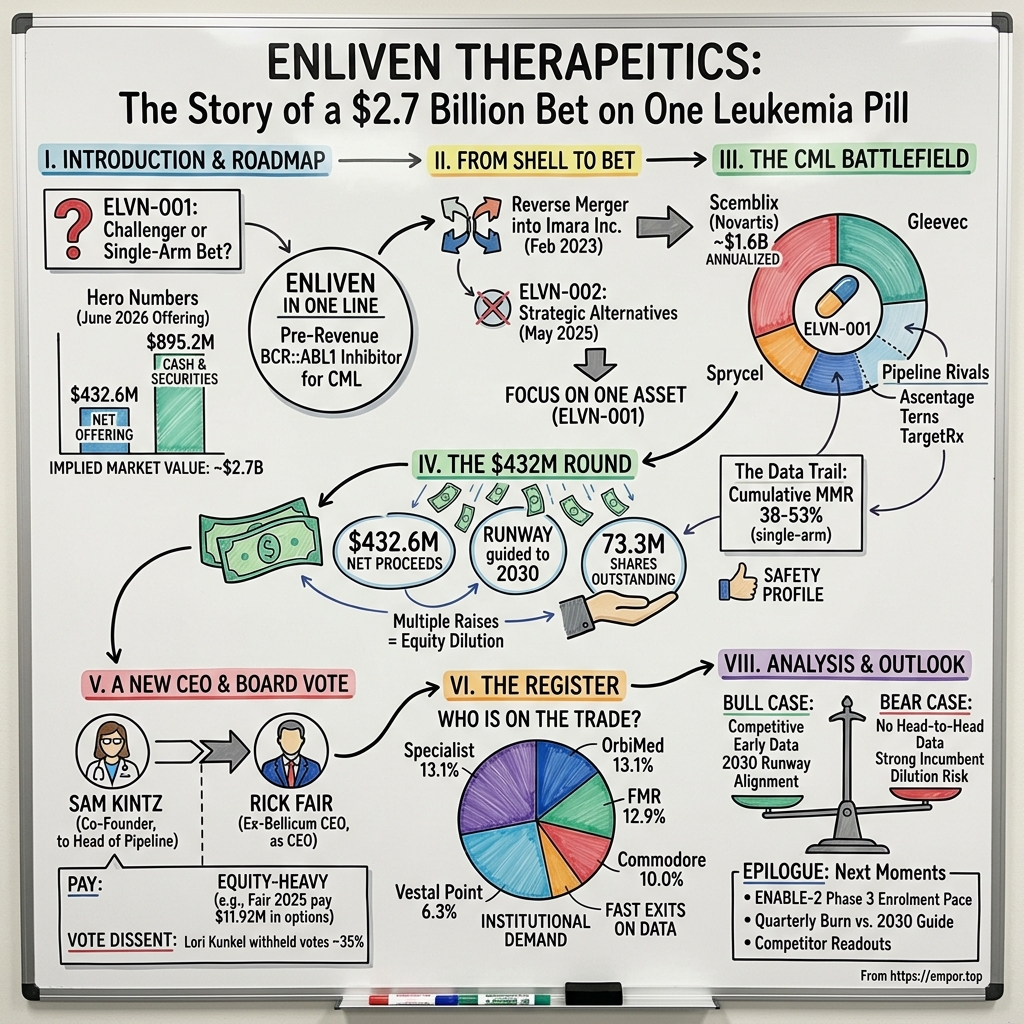
Enliven Therapeutics: The Story of a $2.7 Billion Bet on One Leukemia Pill
I. Introduction & Episode Roadmap (5 min)
On 15 June 2026, a small biotech company in Colorado closed a deal that most drug developers only get in good dreams. Enliven Therapeutics sold 10.5 million new shares at $37.50 each, along with about 1.7 million pre-funded warrants priced a fraction of a cent below that, to a group of investors who mostly already owned the stock.1 When the bankers and lawyers had been paid, about $27.4 million of costs in total, the company kept roughly $432.6 million.1
Hold that number against what Enliven actually is. It has no revenue. It has no approved product. It has no sales force, no factory and no customers. It has one lead drug, a pill called ELVN-001, which is being tested in patients with chronic myeloid leukemia, a blood cancer that is already treated by half a dozen approved medicines.2 And yet, after the June round, the company sat on about $895 million of cash and marketable securities.1
The market was valuing it at far more than that. At the offering price, the roughly 73.3 million common shares outstanding at the end of June were worth about $2.7 billion, before counting the pre-funded warrants.1 So investors were paying about three times the cash in the bank. The extra $1.8 billion or so is a price for something nobody can hold in their hand: the probability that ELVN-001 eventually wins a share of a mature, profitable market from some of the largest drug companies in the world.
There is a third number that belongs beside the first two. Since its founding, Enliven has accumulated about $403 million of losses.1 That is the cost of getting to this point: the chemistry, the toxicology studies, the early trials, the staff. Every dollar of the $2.7 billion valuation rests on what that $403 million bought.
This is the question at the centre of the story. Is ELVN-001 a genuine challenger to the CML drugs already on the market, or is it a well-funded single-arm data set that looks good because it has not yet been tested against anything?
Enliven in one line: a Delaware-incorporated, NASDAQ-listed, pre-revenue drug developer whose fate rests on ELVN-001, a BCR::ABL1 inhibitor for chronic myeloid leukemia.2
That sounds technical, so here is the plain-English version. In CML, a broken gene creates a protein that acts like an accelerator pedal jammed to the floor, telling white blood cells to multiply without stopping. Drugs called tyrosine kinase inhibitors, or TKIs, work by taking the foot off that pedal. Enliven is trying to build a better version of the brake.
To judge whether it can, the story asks four questions, and each section that follows tests one or more of them:
- Does the drug have an edge? The early clinical results look competitive. But "competitive" against what, measured how, and in which patients?
- Is the money enough? $895 million sounds like a fortress. What does it cost to get through a Phase 3 trial, and what does it cost shareholders in dilution?
- Is management aligned with shareholders? A new chief executive arrived in December 2025 and was awarded large option grants. One director drew a striking protest vote.
- Is the price already paying for success? A crowded register of specialist funds paid $37.50. What exactly are they assuming?
There is a simplicity to this company that is unusual in a business story. Enliven has no customers to analyse, no pricing history to test and no debt to refinance.1 There are only three things to judge: the evidence from the clinic, the cash on the balance sheet and the people deciding how to spend it.
The verdict, stated once at the start so the rest of the story can test it: this is a binary clinical bet with unusually strong funding. The money buys time, not proof. How much of a successful outcome is already in the share price is the question every section circles back to.
To understand how a company with one pill came to hold nearly $900 million, the story has to go back to February 2023, and to a public company whose own ambitions had run out.
 Subscribe on LinkedIn
II. From a Failed Shell to a CML Bet (7 min)
The back door to the public market
Most biotechs go public through the front door. They hire banks, write a long prospectus, run a roadshow and price an IPO. Enliven did not. On 23 February 2023, the privately held Enliven Inc. merged with Imara Inc., an already-listed clinical-stage company, and the combined business took the Enliven name and its programs.2 There was no IPO prospectus because there was no IPO.2
The reason a company does this is mostly about timing and certainty. Early 2023 was a hard moment to sell a new biotech stock to the public. The listed partner in a reverse merger brings a stock market listing and, usually, the cash left on its own balance sheet. In return, its shareholders get a slice of a company with a more promising pipeline. For Imara's holders, it was a way to turn a public shell whose own story had stalled into a stake in something new.
The merger left a quiet trace that still appears in the accounts. Enliven records a contingent value right, or CVR, linked to milestones on assets disposed of in connection with the deal, and it carries it as both a liability and an asset.1 A CVR is essentially an IOU to old shareholders: if certain legacy assets earn milestone money, those holders share in it. The company does not publish terms that would let an outsider size it, so it is best treated as a piece of housekeeping from the merger, not a hidden source of value.
The founder and the thesis
The scientific bet came from co-founder Sam Kintz, who led the company as chief executive until December 2025.5 The thesis was focused rather than grand: CML has a well-understood driver, the BCR::ABL1 fusion protein, and approved drugs already prove that blocking it works. The opening is not in finding a new target. It is in hitting the known target more precisely, so that patients get deep, durable responses with fewer side effects that force them to stop or reduce their dose.2
That framing matters for investors because it changes the kind of risk the company carries. A biotech chasing a brand-new biological mechanism risks discovering that the mechanism does not work at all. Enliven is not taking that risk. It is taking a narrower one: that its version of a proven approach is enough better than what doctors already use to change prescribing habits. The science is lower-risk. The competition is higher.
Pruning the tree
For a while, Enliven had two shots on goal. The second was ELVN-002, an irreversible inhibitor of HER2, a protein involved in some breast, lung and other cancers.2 In May 2025, the company put ELVN-002 up for strategic alternatives, which in biotech usually means looking for a partner or buyer rather than funding the program itself.2
Meanwhile, ELVN-001 kept collecting milestones. It received orphan drug designation from the FDA in November 2024, a status granted to drugs for rare conditions that brings tax credits, fee waivers and a period of market exclusivity if the drug is approved.29 By April 2025, 90 patients had been enrolled in its early trial.2
The ELVN-002 decision is worth pausing on, because it is the clearest capital-allocation choice the company had made before 2026. Management chose concentration over breadth. That is defensible: a small company running a Phase 3 trial against Novartis cannot afford to spread scarce clinical talent across two unrelated cancers. It also means the usual biotech argument that "there is optionality in the rest of the pipeline" does not apply here. The company itself decided the second program was not worth funding on its own balance sheet. Any investor building a bull case on hidden pipeline value is arguing with management's own revealed preference.
The cost of focus is fragility. One asset now carries the whole thesis, and the $2.7 billion valuation has no second leg to stand on if ELVN-001 stumbles.
That raises the obvious question. If everything rides on one drug, how good is the drug, and how crowded is the market it wants to enter?
III. The CML Battlefield: Who Owns the Patients Today? (14 min, deepest section)
The patient at the crossroads
Picture a patient a few years into a CML diagnosis. They started on a TKI, perhaps imatinib, sold as Gleevec, the drug that turned this disease from a death sentence into something many people live with for decades. It worked for a while, then the blood tests stopped improving, or the side effects became intolerable. They switched to a second drug. Now that one is faltering too.
Their hematologist is looking at a shelf of options. Gleevec, Tasigna, Sprycel, Bosulif, Iclusig and the newest arrival, Novartis's Scemblix.2 Each has a different profile of potency and side effects. Each requires a pill every day, potentially for years. The doctor's choice for this one patient, multiplied by tens of thousands of patients, is the market Enliven wants to enter.
That patient, a person who has failed one or two prior TKIs, is the first place ELVN-001 is aiming. In the trade, this is the "second line and later" population, written as 2L+.1
How the CML market works
CML is a chronic disease treated with chronic therapy. A patient who responds well may stay on the same pill for many years. For a drug company, that is close to a subscription: each patient who starts on a drug and does well becomes a source of recurring revenue that compounds as new patients are added. That logic explains why investors pay up for CML assets.
It is worth being clear that, for Enliven, this is a thesis, not a disclosed fact. The company has no revenue and does not expect meaningful revenue before regulatory approval.1 Every statement about what ELVN-001 might earn is an extrapolation from how other companies' drugs have performed.
The most relevant extrapolation is Scemblix. Novartis's drug, which works by binding a different pocket on the BCR::ABL1 protein than older TKIs, was running at about $1.6 billion a year in sales according to Enliven's own annual report.2 That number is the prize. It is also the wall. Scemblix is the incumbent that ELVN-001 has to beat, and it is owned by one of the most capable commercial organisations in oncology.
The approved field is not the end of it. Enliven names three pipeline rivals going after the same patients: olverembatinib from Ascentage Pharma (亚盛医药), TERN-701 from Terns Pharmaceuticals and TGRX-678 from TargetRx.2 So ELVN-001 is entering a market with six approved drugs and at least three other challengers on the way. Being good is not enough. It has to be noticeably better for some identifiable group of patients.
Reading the scoreboard: what MMR means
The key number in CML trials is the major molecular response, or MMR. In plain terms, doctors measure how much of the cancer-causing gene can be detected in a patient's blood. MMR means the level has fallen to one-thousandth or less of a standard baseline. It is not a cure, but it is a strong signal that the drug is controlling the disease, and patients who reach it tend to do well over the long run.
The data trail for ELVN-001 has three checkpoints.
At 28 April 2025, with 90 patients enrolled, the cumulative MMR rate by 24 weeks was 47%.2 In other words, almost half of the evaluable patients had reached that deep level of response within about six months.
In January 2026, the company reported MMR rates of between 38% and 53% across the different cohorts of its Phase 1b study.26
By the 10 March 2026 data cutoff, the trial had grown to 161 patients, treated for a median of about 35 weeks, and the company described the safety profile as favourable.16
The useful test is whether the early numbers held up as more patients joined. Early cohorts in oncology trials are often small and sometimes include patients who happen to be better candidates. As enrolment grows, response rates often drift down. Here, the picture is roughly stable: the 47% early figure sits inside the later 38–53% band. The low end of that band shows that not every cohort does as well, but there is no sign of a collapse as the trial nearly doubled. That is a genuine point in the drug's favour.
Why single-arm data is not proof
Here is where the story has to slow down. Every one of these numbers comes from a single-arm trial, meaning every patient got ELVN-001 and there was no comparison group taking Scemblix or another TKI.1
Imagine judging a runner by their time on a track you have never seen, with no other runners and no knowledge of the wind. A fast time is encouraging. It is not a race result.
Comparing ELVN-001's MMR rates to published Scemblix or rival data runs into the same problem. Trials enrol different mixes of patients. A trial that includes more people who have failed three or four prior drugs will show lower response rates than one dominated by second-line patients, even with an identical drug. Some trials include patients already in partial response at entry; others do not. The time point matters too: a cumulative rate "by 24 weeks" is not the same as a rate "at 24 weeks", or by 48 weeks. Until the patient groups and measurement rules match, a cross-trial comparison tells an investor whether ELVN-001 is in the right neighbourhood, not whether it wins.
So the falsification pass for the "efficacy edge" claim lands here. ELVN-001's early response rates are in a competitive range, they held up as the trial grew, and the company reports a favourable tolerability profile. None of that is a head-to-head result. The claim is not rejected. It is narrowed to a smaller, honest version: ELVN-001 looks like a credible member of the modern TKI class, and whether it is better than Scemblix is unproven.
The path to a real answer
That answer is what ENABLE-2 is for. In the second quarter of 2026, the FDA aligned with Enliven on key components of the design of this Phase 3 trial.1 That is real progress: it lowers the risk that the company spends years and hundreds of millions of dollars running a trial whose design the regulator later rejects. It is not approval, and it is not a promise of approval. It means the referee has agreed on the rules of the match, not on the score.
The trial is registered publicly, and its enrolment status will become one of the most important public signals for the stock.8 The company has flagged recruitment challenges at Israeli trial sites in its risk disclosures and mentions Japan in connection with ENABLE-2, a reminder that running a global Phase 3 trial is a logistics business as much as a science one.1
The legal moat: patents and orphan status
Behind the clinical data sits the legal protection. Enliven's first family of composition-of-matter patents, the patents that cover the molecule itself, runs to 2041. Other families extend to 2045, before any term extensions.2 If the drug reaches the market around the end of this decade, that leaves a long stretch of exclusivity. The caution is that only the first family is a settled composition-of-matter shield; later families are typically narrower and easier for competitors to design around.
Orphan designation adds a separate layer of US market exclusivity after approval.9 Neither patents nor orphan status stop a different molecule, such as Scemblix or TERN-701, from competing for the same patient. They protect ELVN-001 from copies, not from rivals.
The battlefield in frameworks
Running the competitive analysis once, in full, shows where the power in this market sits.
Rivalry among existing competitors is intense. Six approved TKIs fight over a defined pool of patients, and the newest one, Scemblix, has a large and capable owner.2
Threat of substitutes and new entrants is high. Three named pipeline drugs are pursuing the same patients, and Ascentage's olverembatinib has a head start in China.2
Buyer power is moderate to high. Payers and prescribers have many alternatives. A new drug has to justify its price against existing options, including generic imatinib.
Supplier power sits in contract manufacturers. Enliven owns no manufacturing and relies on firms including Pharmaron, Hande Sciences, Latitude, Quotient Sciences and CoreRx.2 The company does not disclose how much it depends on any single one. For a small-molecule pill, manufacturing is not usually a binding constraint, but a supply disruption during a Phase 3 trial or a launch would be costly.
Through Hamilton Helmer's 7 Powers lens, only three candidate powers apply, and none has yet been converted into revenue. Cornered resource in the form of patents runs to 2041 and beyond.2 Regulatory protection from orphan exclusivity is real but limited.9 A possible process power in Enliven's drug-design approach is plausible, but it is a claim about how the company works, not something visible in any outcome. The more commercially important powers, such as switching costs (patients doing well on one drug rarely switch) and scale economies in sales and marketing, currently belong to the incumbents, not to Enliven. Switching costs actually work against a new entrant: the patients most likely to try ELVN-001 are the ones whose current drug is failing.
The verdict for this section is clear. The early data is competitive, the safety profile is encouraging and the regulatory path is better defined than it was a year ago. The efficacy edge remains plausible but unproven until a randomized readout. The confirming event is an ENABLE-2 result in the 2L+ population. Until then, every comparison with Scemblix is an argument, not a fact.
Running that randomized trial is expensive, which is exactly why the June 2026 offering matters so much.
IV. The $432 Million Round and the Dilution Bill (12 min)
The pricing
There is a particular kind of quiet that comes over a biotech offering when it goes well. The deal is announced after the market closes. Bankers call a short list of specialist investors who already know the company, many of whom already own it. Orders come in. The price is set. By the next morning, the company has hundreds of millions of dollars more than it had the day before.
Enliven's June 2026 offering followed that pattern. It sold 10.5 million shares at $37.50 and about 1.7 million pre-funded warrants at $37.499, closing on 15 June 2026.1 Pre-funded warrants are a tool big funds use when they want to buy more of a company without crossing ownership thresholds that trigger extra reporting obligations: they pay almost the full price now and can convert to shares later for a penny. That a meaningful slice of the deal came as pre-funded warrants is itself a clue about who was buying: large holders who were already near those thresholds.
The net take was $432.6 million after about $27.4 million of costs.1 Paid-in capital, the running total of money shareholders have put into the company, rose to about $1.3 billion from $806.4 million at the start of the year.1
The capital trail
The June 2026 deal was not a one-off. It was the latest in a series of trips to the equity market.
The 2023 reverse merger brought the company public. In June 2025, it ran a public offering. On 13 August 2025, it signed an at-the-market sales agreement, which lets a company dribble shares into the market at prevailing prices whenever it wants.12 Then came the June 2026 follow-on.
The pattern says something about how this management team thinks about money. It raises when it can, not only when it must. That is generally the right instinct for a biotech: capital is cheapest when the data is fresh and the stock is strong, and running low on cash before a Phase 3 readout hands negotiating power to whoever is willing to fund you. The cost is that each raise dilutes existing holders, and the company has done so repeatedly in a short time.
Cash and burn
At 30 June 2026, Enliven held $135.5 million of cash and $759.7 million of marketable securities, together about $895 million.1 Against that, the six-month cash outflow from operations was $37.8 million.1
The headline loss was larger: $56.1 million for the six months.1 The gap between the two numbers is the important clue. About $21.3 million of the loss was stock-based compensation.1 That is a real cost, but it is paid in shares and options rather than cash. Shareholders bear it through dilution. Here is the plain version: roughly two of every three dollars of the reported loss left the bank account; the third dollar was paid in paper.
There is also an offset. The cash pile earns interest. In the first half of 2026, interest income was about $8.9 million, up from $6.4 million a year earlier, and it covered about 16% of the net loss.1 That is a meaningful cushion. It also means that a fall in short-term interest rates would quietly raise the company's net burn.
Spending is speeding up
The six-month totals hide an acceleration. In the second quarter alone, research and development spending rose about 35%, to $29.0 million from $21.5 million.1 General and administrative spending rose about 16%, to $8.2 million.1 The quarterly net loss rose to $32.5 million from $25.3 million.1
That is what a company preparing for Phase 3 looks like. Phase 3 trials are much larger than early trials, with hundreds of patients at sites across many countries, and they cost far more to run. The second quarter's spending is a preview, not a ceiling.
Two different runway tests
Management guides that its cash will last into 2030.6 The quarterly filing makes a narrower statement: under the accounting rules, the company assesses whether it has enough cash for the next twelve months, which takes it to around June 2027, and concludes that it does.1
These are different tests, and it is worth not confusing them. The twelve-month going-concern assessment is a formal accounting check, with little room for optimism. The 2030 runway is a forecast that depends on how quickly ENABLE-2 enrols, how many sites open, and what other spending the company chooses. It is management's estimate, and a reasonable one given the cash, but it is not audited. At the current half-year cash burn rate of under $80 million a year, $895 million would last far beyond 2030. The fact that management guides to "into 2030" rather than something longer tells an investor that the company expects burn to rise sharply as Phase 3 gets going.
What the share authorisation says
At the 9 June 2026 annual meeting, shareholders approved doubling the number of authorised shares from 100 million to 200 million.4 With about 73 million shares outstanding, plus options, warrants and the at-the-market program, the old ceiling was getting close. Authorising more shares is not the same as issuing them. It is a signal, though. Companies do not double their authorised share count unless they want the flexibility to keep issuing.
The stress test on financial strength
A skeptic looking at balance-sheet strength would point to three facts together: three separate equity raises in about a year, $21.3 million of stock compensation in six months, and a doubled share authorisation. Read as a set, they say that the strength of the balance sheet has been bought with dilution and will continue to be.
The verdict is nuanced but clear. Liquidity is strong; cash is not the near-term constraint on Enliven's plans. Equity dilution is the price of that strength, and it is likely to continue. The supporting details are reassuring: the company has no debt, and its only lease liability is about $0.9 million, so there are no covenants and no refinancing calls to worry about.1
The number to watch is quarterly cash operating outflow once ENABLE-2 sites are fully open, measured against the 2030 guide. If burn rises in line with management's plan, the guidance holds. If it rises faster, the next offering arrives sooner.
How that money gets spent depends on the people running the company, and in December 2025 the person at the top changed.
V. A New CEO, Big Option Grants and a Board Vote That Bit (12 min)
The handover
On 11 December 2025, Enliven announced that Sam Kintz, the co-founder who had led the company from its private beginnings through the reverse merger and the early ELVN-001 data, would step aside as chief executive. Kintz moved into the role of Head of Pipeline. The new CEO was Rick Fair, formerly chief executive of Bellicum Pharmaceuticals.5
The timing is the story. Enliven was not in trouble. Its data had been positive and its cash position was healthy. It was approaching the moment when a clinical-stage company stops being purely a science project and starts having to think like a commercial one: running a large, multinational Phase 3 trial, preparing for regulators, and, if things go well, building or partnering for a launch. Founder-scientists are often brilliant at the first phase and less suited to the second. Boards that manage the transition early, before a crisis forces it, usually avoid the worst version of that problem.
That is the generous reading of the change, and it is plausible. The skeptical reading is that the board believed the next phase required a different leader and acted on that belief, which does not by itself prove that the new leader is the right one. Fair's record at Enliven is, at this point, a few months long.
The terms
Fair's employment terms set his base salary at $660,000, with a target bonus of 55% of salary and options on 875,000 shares.5 The options are the substance of the package. At prices around the June offering, an option on 875,000 shares gives Fair a large financial stake in the stock rising, and almost nothing if it falls below his exercise price.
Kintz kept a substantial personal stake, about 2.1% of the company as of 31 March 2026.3 As part of the transition, the company agreed to pay his COBRA health coverage until 31 December 2026.5
The pay numbers
In the 2026 proxy statement, the reported 2025 compensation for Fair came to about $11.9 million, almost entirely options, despite his holding the CEO title for only about three weeks of the year.3 Kintz's reported 2025 compensation was about $8.9 million, of which about $7.95 million was options and about $0.32 million a non-equity incentive payment.3
These numbers look jarring for a company with no revenue and a net loss of roughly $100 million a year. They need context. The reported value of an option grant is an accounting estimate of its worth on the day it is granted, not cash paid. A new-hire grant in biotech is typically front-loaded to cover several years of expected pay. So Fair's $11.9 million is better read as a multi-year equity package than as three weeks of wages.
The more important point is the structure. Pay at Enliven is overwhelmingly equity, which ties executives' fortunes to the share price. Because the share price has risen with the data, executives have already benefited. If ENABLE-2 disappoints, they will feel it alongside shareholders. That is real alignment on direction. It is weaker alignment on magnitude: option holders gain from upside but do not lose money on the downside the way shareholders do, which can tilt incentives toward risk-taking.
The vote that bit
The most interesting signals came at the annual meeting on 9 June 2026.4
Say-on-pay passed easily: about 47.6 million votes for and about 3.1 million against, roughly 94% support among votes cast on that proposal.4 Shareholders approved an annual frequency for future say-on-pay votes.4 Deloitte & Touche's appointment as auditor was ratified with almost no opposition.4 The authorised-share increase passed with about 54.7 million votes for and about 0.37 million against.4 Fair's own election drew only about 152,000 withheld votes.4
Then there was Lori Kunkel. Her re-election drew about 32.8 million votes for and about 17.9 million withheld.4 Roughly 35% of the votes cast on her election were withheld. In a meeting where almost everything else passed with overwhelming support, that is a pointed signal. The company's filings do not give the reason. It could reflect a proxy adviser's recommendation, a concern about her commitments on other boards, a view about a committee she sits on, or something else entirely. What can be said is that a large block of Enliven's shareholders, who are mostly sophisticated specialists, chose to send a message about one director and not about pay or the CEO.
The board
Six of Enliven's eight directors are independent, and the board was set to shrink to seven after the 2026 meeting.3 A former consulting agreement with Scott Garland, a non-independent director, has been terminated.3 The company does not publish the payments under that agreement in its proxy summary, so the relevant fact is that the arrangement ended, removing a conflict that governance-minded investors generally prefer not to see.
The finance function is led by Benjamin Hohl, who serves as chief financial officer and also leads corporate development.3 His capital-allocation record is visible in the moves already described: the offerings of 2025 and 2026, and the ELVN-002 decision.
Testing management credibility
The usual way to judge management is to compare what it promised with what it delivered. Enliven makes that hard. It issues no revenue guidance, because it has no revenue. Its track record of public promises is short: the runway guidance, the clinical timelines and the Phase 3 plan.
On those, there is no evidence of a broken promise, but also not much history to test. The FDA alignment on ENABLE-2 design was achieved. The data updates arrived on the cadence the company set. That is consistent with competent execution, but it is a short record, and most of it pre-dates the new CEO.
The verdict for this section is mixed rather than negative. Pay is large but equity-heavy, and shareholders broadly approved it. Governance housekeeping is improving. The Kunkel vote is a real signal whose cause the company does not explain. Management credibility under Fair is untested. The next proxy statement is the test: how much of his pay is cash versus options, whether advisers criticise the pay-for-performance link, and whether the withheld votes against Kunkel recur.
All of those votes were cast by a small group of large investors. Who they are explains a lot about how this stock behaves.
VI. The Register: Who Is on the Other Side of the Trade? (7 min)
The crowd in the room
Look at Enliven's shareholder list and it reads like a guest list for a healthcare investing conference. As of 31 March 2026, OrbiMed held about 13.1%, FMR (the Fidelity group) about 12.9%, Commodore about 10.0%, Vestal Point about 6.3%, Fairmount about 6.1% and Venrock about 5.3%.3 Six funds each held more than 5%. Together, they controlled more than half of the company.
No single holder controls Enliven. But this is not a widely held stock owned by thousands of small investors. It is a concentrated position for a handful of specialists who understand the science, follow every data release and can move quickly.
That cuts both ways. These are the investors whose conviction lifted the June round to $37.50. They are also the investors most likely to sell in size if ENABLE-2 news disappoints. A register full of specialists means fast, informed price moves in both directions around data events.
There is already some sign of portfolio management at the top of the list. OrbiMed's 13.1% stake at the end of March appears to have been trimmed afterwards; its most recent Schedule 13D amendment on EDGAR is the place to read the current figure.7 Trimming after a strong run is ordinary fund behaviour, not necessarily a loss of faith, but it is a reminder that even the most committed holders take money off the table.
What the price assumes
Now for the arithmetic. At 30 June 2025, a year before the big round, the market value of shares held by non-affiliates was about $836 million.2 A year later, the offering price implied about $2.7 billion for the common stock alone.1 The data improved, the FDA aligned on Phase 3 design, and the market more than tripled the company's value.
Against about $895 million of cash and securities, roughly $1.8 billion of the valuation is paid for ELVN-001's future. Here is a rough way to think about what that implies. If an investor believes ELVN-001 could one day earn something like Scemblix's $1.6 billion a year, and applies the probability that a drug at this stage eventually reaches approval and wins meaningful share, then discounts for the years of further spending and dilution before any revenue arrives, the $1.8 billion premium is not absurd. It is also not cheap. It assumes a meaningful chance of approval and a real commercial position against an entrenched incumbent.
The stress test is simple. A skeptical investor asks: what am I paying for beyond the cash? The answer is: the probability of approval multiplied by a Scemblix-scale revenue opportunity. Nothing on the balance sheet today supports the premium. It is all expectation. Comparing it with listed peers such as Terns Pharmaceuticals and Ascentage Pharma, which are pursuing the same patients, would help calibrate whether Enliven's premium is out of line, but the underlying point does not change: the market is already pricing a good outcome.
The verdict: demand for Enliven stock is institutional and specialist. That signals conviction, and it also means the stock will react sharply to clinical news. The share price is already paying for meaningful success.
So what does a company built this way teach, beyond the specifics of one leukemia pill?
VII. Playbook: Business & Investing Lessons (7 min)
One drug. About $895 million in the bank. A market value near $2.7 billion. Out of those three numbers come five lessons that belong to Enliven and to no other company quite as cleanly.
1. Raise when the data is good, not when you need it. In June 2026, Enliven did not need money. It already had enough to run for years. It raised anyway, right after a string of positive updates and the FDA's alignment on Phase 3 design, and walked away with $432.6 million at $37.50 a share.1 The wider lesson for founders is that the best time to sell equity is the moment it feels least necessary. The wider lesson for investors is that a well-timed raise is a sign of discipline only if the money is spent well afterwards. Capital is cheapest the morning after good news, and most expensive the morning before bad news.
2. Prune the pipeline to feed the lead. In May 2025, Enliven put its HER2 program up for strategic alternatives and bet everything on ELVN-001.2 Most small biotechs cling to second programs as insurance. Enliven chose to concentrate its people and money. That choice made the company sharper and more fragile at the same time. A second program is only optionality if you are willing to pay for it; Enliven decided it wasn't.
3. Swap the founder for the launch CEO before Phase 3, not after. In December 2025, with data positive and money in hand, Sam Kintz stepped aside and Rick Fair took over.5 The founder stayed in the building as Head of Pipeline. Companies that make that change in a crisis often lose both the founder's knowledge and the new leader's honeymoon. Enliven made it while the company was strong. Whether Fair is the right choice is a separate question that ENABLE-2 will answer. The best time to change the driver is before the road gets steep.
4. Stock comp is the burn that doesn't show in cash. Of Enliven's $56.1 million first-half loss, about $21.3 million was stock compensation.1 That money never left the bank. It left shareholders' pockets in the form of new shares and options. Investors who only watch the cash flow statement will see a company burning less than it really is. Every option granted is a cheque written to the future, and shareholders cash it.
5. Single-arm is not a victory lap. ELVN-001's 38–53% MMR rates are encouraging, and they held up as the trial grew.2 They come from a trial with no comparison group. Only a randomized trial against the drugs patients actually use, including Scemblix, settles whether ELVN-001 is better or merely good. A fast lap on an empty track is a qualification time, not a race result.
Those lessons point straight at the two sides of the debate over the stock.
VIII. Analysis & Bull vs. Bear Case (10 min)
Two analysts, one slide
Imagine two analysts sitting on opposite sides of a conference room, both looking at the same slide: ELVN-001's Phase 1b response rates. One sees a drug that is already in the range of the best treatments in CML, with a cleaner safety profile and years of patent protection. The other sees a single-arm trial, a powerful incumbent, three rivals and a stock priced as if the race were already won. Both are reading the same numbers correctly. The difference is in what they assume about what comes next.
The bull case
The bull case rests on five pillars.
The data is competitive. MMR rates in the 38–53% range across Phase 1b cohorts, consistent with the 47% seen earlier at 90 patients, put ELVN-001 in a credible position among modern TKIs.2 The rates did not collapse as enrolment grew to 161 patients.6
Safety looks favourable. At a median of about 35 weeks of treatment, the company reports a favourable tolerability profile.16 In CML, tolerability matters enormously, because patients take these pills for years and side effects are a common reason for switching.
The regulatory path is clearer. Orphan designation and FDA alignment on Phase 3 design reduce two categories of risk: the risk of an expensive trial whose design the regulator rejects, and the risk of a drug approved without a period of protected exclusivity.19
The money is there. About $895 million of cash and securities, with management guiding to a runway into 2030, means Enliven should not need to raise from a position of weakness before its Phase 3 readout.16
The leadership is in place for the next phase. A CEO with prior experience running a public biotech now leads the company through Phase 3 and toward a possible launch.5
The bear case
The bear case has five matching pillars.
No head-to-head data. Every efficacy number comes from a single-arm trial. Cross-trial comparisons with Scemblix are unreliable because patient mixes differ.
A strong incumbent. Scemblix's roughly $1.6 billion run-rate means Novartis has the sales force, the physician relationships and the money to defend its position.2
Named rivals. Olverembatinib, TERN-701 and TGRX-678 are pursuing the same patients.2 Even if ELVN-001 is a good drug, the market may split among several good drugs.
A price that assumes success. At about three times cash, the share price is not pricing a coin flip. It is pricing a meaningful probability of approval and commercial success.
Rising costs and dilution. Stock compensation is large, R&D is accelerating, the share authorisation has doubled and the company has raised repeatedly.14
The material risks, and how they bite
Clinical failure or a weak Phase 3 result. This is the binary risk. If ENABLE-2 fails to show that ELVN-001 is at least as good as existing options, most of the premium over cash disappears. The mechanism is direct: there is no other product to fall back on.
Trial execution. Phase 3 trials depend on enrolling enough of the right patients at sites around the world. Enliven has flagged recruitment challenges at Israeli sites and mentions Japan in its ENABLE-2 plans.1 Slower enrolment would push back the readout and raise total cost.
Manufacturing dependence. All drug supply comes from contract manufacturers.2 A disruption at a key supplier could delay the trial or, later, a launch.
Further dilution. Each future raise reduces existing shareholders' share of any eventual success. The doubled share authorisation makes this easier.4
On the other radar items, the exposure is thin. The company states it is not party to any material pending litigation.2 Currency exposure is limited, because there is no foreign revenue, only foreign trial and vendor costs. There is no debt, and therefore no credit rating or refinancing risk.1 The one financial-market sensitivity worth noting is interest rates: lower rates would reduce the interest income that currently offsets about a sixth of the loss.1
The verdict
The bull case is real. The bear case is also real. The decisive point is that the bull case is mostly about evidence and funding that already exists, while the bear case is mostly about what the share price already assumes. The efficacy claim is intact but unproven. The funding claim is strong but paid for with dilution. The management claim is untested.
Three numbers to watch
Out of everything in this story, three measures matter most.
ENABLE-2 enrolment pace and any interim readout. This is the single most important signal. Its latest reading is that the FDA aligned on the trial's design in the second quarter of 2026.1
Quarterly cash operating outflow. The latest reading is about $37.8 million for the six months to June 2026, with second-quarter R&D up about 35% year on year.1 The direction is up, as expected. The question is how fast relative to the 2030 guide.
MMR rates as the cohort matures. The latest reading is 38–53% across Phase 1b cohorts, with 161 patients enrolled.26 Stable rates as follow-up lengthens would support the case. Declining rates would undermine it.
Those three numbers lead straight to the events that will decide the story.
IX. Epilogue (4 min)
Tonight, somewhere in a hospital clinic, a patient who has failed one or two TKIs may be signing a consent form to join ENABLE-2. They will not know which drug they are getting. That uncertainty is the whole point. It is the first time ELVN-001 will be measured against the medicines it hopes to replace, and the first time the market will get an answer it cannot argue its way around.
Enliven stands, in October 2026, with roughly $895 million in the bank, a Phase 3 design agreed with the FDA, a new chief executive and a share price that implies something close to three times its cash.1 Nothing on its income statement will decide what happens next. The decisive events are clinical, financial and governance moments that are already on the calendar or soon will be.
ENABLE-2 enrolment and interim results. Fast enrolment would suggest physicians are willing to put their patients into the trial, a modest early signal of interest. An interim analysis showing ELVN-001 ahead of comparators in the 2L+ population would be the single biggest positive event in the company's history. A neutral or negative result would remove most of the premium over cash.
The next proxy statement. It will show how much of Fair's first full year of pay is cash versus options, and whether proxy advisers criticise the structure. It will also show whether the protest vote against Lori Kunkel recurs, fades or spreads to other directors.
The next equity raise. With 200 million shares now authorised, the company can return to the market at any time.4 A raise after positive data would confirm the "raise when it's good" playbook. A raise after disappointing news would happen at a lower price and hurt more.
Competitor readouts. News from Ascentage, Terns and TargetRx will change how investors judge ELVN-001's relative position, even without any new Enliven data.2
What each outcome would mean is unusually clear. A win in ENABLE-2 would put ELVN-001 into direct competition with a $1.6 billion incumbent, with patent protection into the 2040s and enough cash to reach the launch.2 A miss would leave a company with about $895 million of cash and no lead asset, a company whose value would fall back toward its bank balance minus whatever it costs to wind down or redirect.
Between those two outcomes lies the tension that defines Enliven today: a well-funded, well-run company whose entire valuation depends on a race it has not yet run.
X. Outro (2 min)
Go back to that June afternoon in 2026. A group of the most sophisticated healthcare investors in the world wired $432.6 million to a company with no revenue, paying $37.50 a share for a drug that has never faced Scemblix in a head-to-head trial.1 They were not buying a business. They were buying a lottery ticket with very good odds and a very large prize, and they were paying a price that already reflected both.
Enliven is a company priced at three times its cash on the strength of one pill's single-arm results, and it still has to run the race that decides it.
References
-
Enliven Therapeutics Form 10-Q, quarter ended 2026-06-30 — SEC EDGAR, 2026-08 ↩↩↩↩↩↩↩↩↩↩↩↩↩↩↩↩↩↩↩↩↩↩↩↩↩↩↩↩↩↩↩↩↩↩↩↩↩↩↩↩↩
-
Enliven Therapeutics Form 10-K FY2025 — SEC EDGAR, 2026 ↩↩↩↩↩↩↩↩↩↩↩↩↩↩↩↩↩↩↩↩↩↩↩↩↩↩↩↩↩↩↩
-
Enliven Form 8-K, annual meeting voting results — SEC EDGAR, 2026-06-09 ↩↩↩↩↩↩↩↩↩↩↩
-
Enliven Form 8-K, CEO appointment — SEC EDGAR, 2025-12 ↩↩↩↩↩↩
-
ClinicalTrials.gov registry, for the ELVN-001 and ENABLE-2 trial records ↩
-
FDA Orphan Drug Designations and Approvals database — FDA ↩↩↩↩
 LinkedIn
 WhatsApp
 Reddit
 Hacker News
 Email
Email Kindle
 RSS Feed
 Spotify
 Apple Podcasts
 Amazon Music
 Audible
 YouTube